THE ANTHROPOLOGICAL STUDY OF RELIGION Chapter 1 INTRODUCTION



- Slides: 34
THE ANTHROPOLOGICAL STUDY OF RELIGION Chapter 1
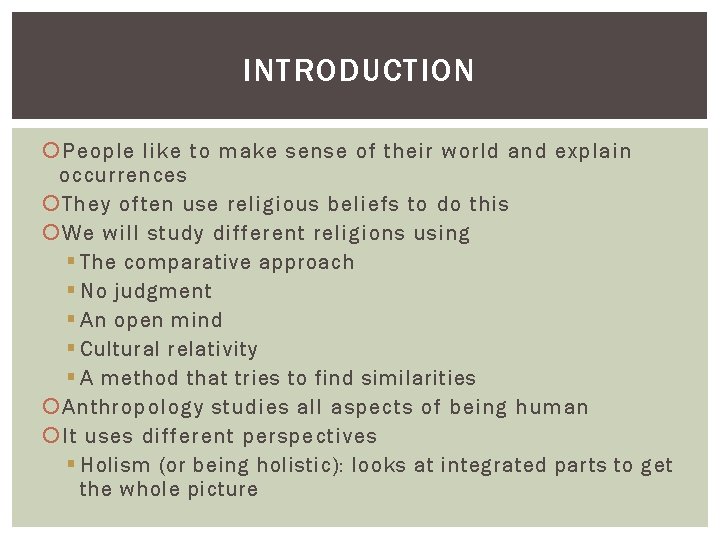
INTRODUCTION People like to make sense of their world and explain occurrences They often use religious beliefs to do this We will study different religions using § The comparative approach § No judgment § An open mind § Cultural relativity § A method that tries to find similarities Anthropology studies all aspects of being human It uses different perspectives § Holism (or being holistic): looks at integrated parts to get the whole picture
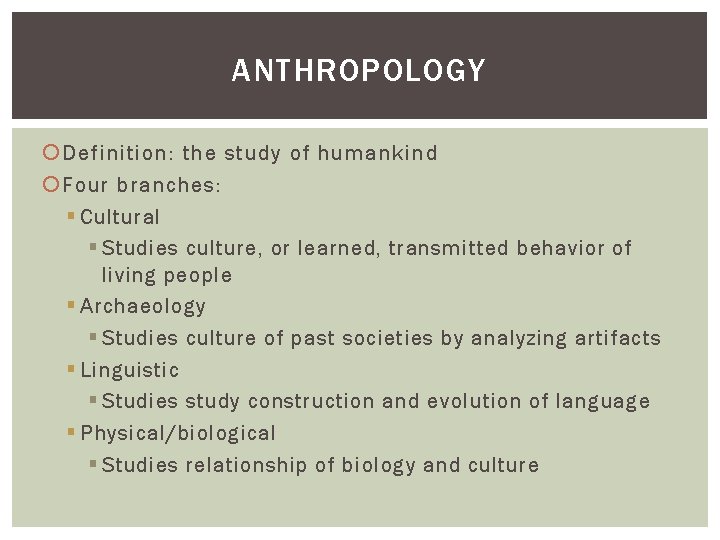
ANTHROPOLOGY Definition: the study of humankind Four branches: § Cultural § Studies culture, or learned, transmitted behavior of living people § Archaeology § Studies culture of past societies by analyzing artifacts § Linguistic § Studies study construction and evolution of language § Physical/biological § Studies relationship of biology and culture
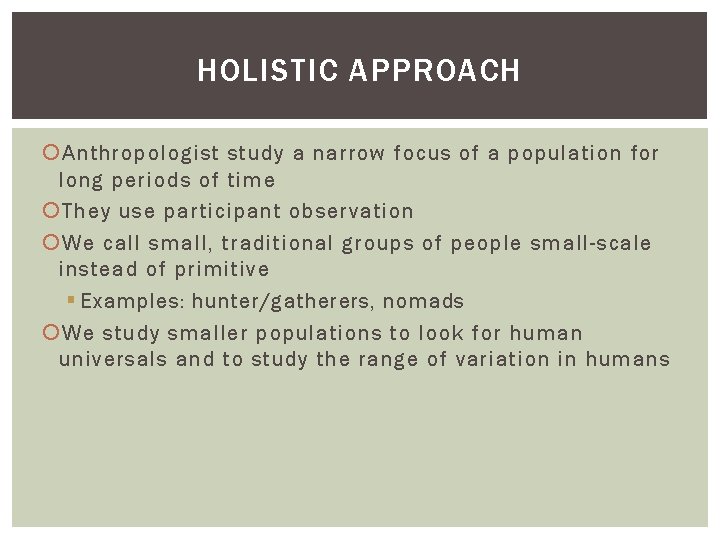
HOLISTIC APPROACH Anthropologist study a narrow focus of a population for long periods of time They use participant observation We call small, traditional groups of people small-scale instead of primitive § Examples: hunter/gatherers, nomads We study smaller populations to look for human universals and to study the range of variation in humans
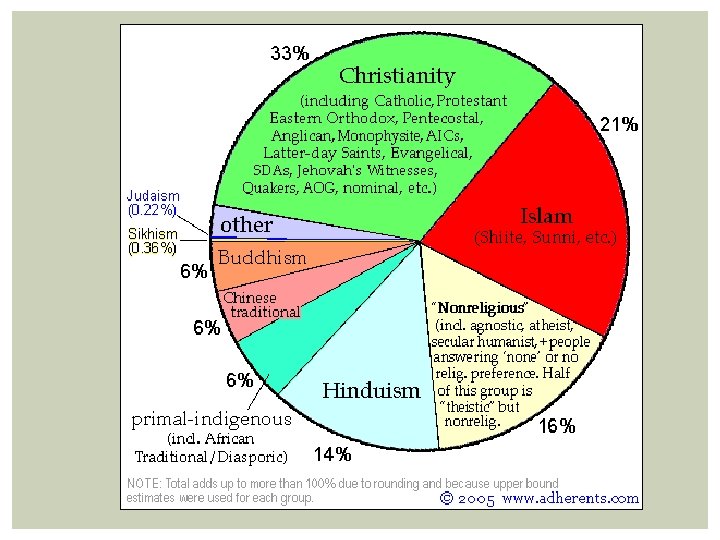
VARIATION How many religions are there in the world? Is there variation within religions?
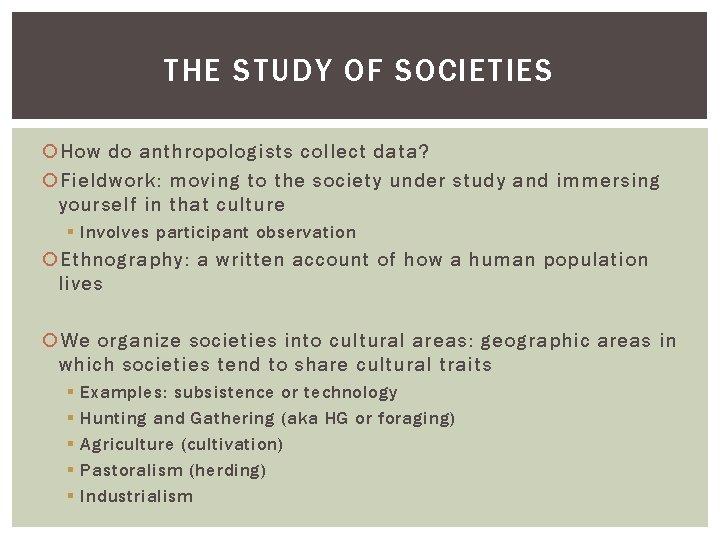
THE STUDY OF SOCIETIES How do anthropologists collect data? Fieldwork: moving to the society under study and immersing yourself in that culture § Involves participant observation Ethnography: a written account of how a human population lives We organize societies into cultural areas: geographic areas in which societies tend to share cultural traits § § § Examples: subsistence or technology Hunting and Gathering (aka HG or foraging) Agriculture (cultivation) Pastoralism (herding) Industrialism
ETHNOGRAPHIC EXAMPLE The Fore of New Guinea, horticulturalists, 1950 s Many suffered from unknown disease called kuru or shaking disease Affected women more
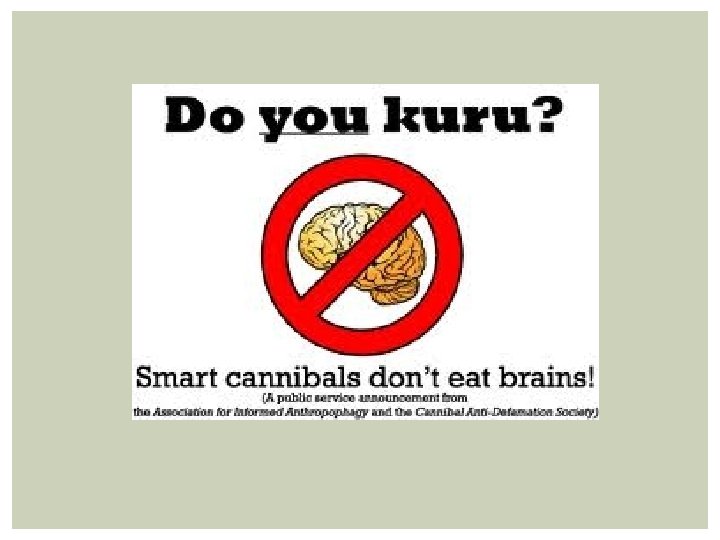
ETHNOGRAPHIC EXAMPLE Medical team needed to take holistic approach Discovered that disease was caused by prions Fore contracted prions by eating their relative’s remains (especially brains) at funeral ceremonies Fore thought disease was from sorcery Do the Kore and Western doctors view this disease in the same way? How would this affect those with the disease?
WAYS TO VIEW CULTURE An anthropologist (or any researcher) cannot be 100% objective Anthropology unlocked the answer of kuru, not medical knowledge Holism involves viewing something from the insider (emic) and outsider (etic) perspectives Both views provide a holistic picture Keep this in mind while reading the novel for this class
CULTURAL RELATIVISM It is difficult to not judge others’ cultural practices We have to be careful of ethnocentrism § Belief that one’s own culture is superior Can cultures or beliefs be superior/inferior? Take the stance of cultural relativism
POSTMODERNISM Is it possible to understand the “true” meaning of another's culture or about the world? Cultural knowledge and viewpoints are social constructions There are multiple ways to see the world There are no right or wrong practices or beliefs We take a middle approach: § Non-judgment is objective § Postmodernism is subjective
NOVEL While reading the novel, work on the study guide (posted on portal) You want to pay attention to the different ways the family and Western doctors explain and treat the child’s disease Look for examples of ethnocentrism and cultural relativism Try to see the story from both sides Ask yourself what you would do in that situation Quiz #1 is on March 13
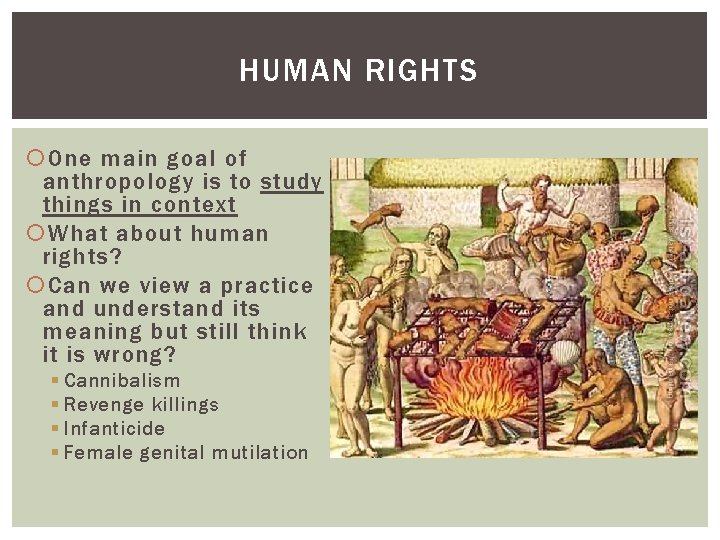
HUMAN RIGHTS One main goal of anthropology is to study things in context What about human rights? Can we view a practice and understand its meaning but still think it is wrong? § Cannibalism § Revenge killings § Infanticide § Female genital mutilation
WHAT IS CULTURE? It is a “complex whole” Culture gives meaning to reality Culture § Is not biological § Is learned by living in that group § Is shared by members of a group § Accounts for differences between groups of people § Based on symbolism Culture is highly variable and changes quickly
DEFINING RELIGION How do we define religion? Discuss with your group and come up with a simple definition of religion
DEFINING RELIGION How do we define religion? Use operant definitions so we can observe and study religion We use analytic definitions to explain how it is expressed We use functional definitions to explain social functions We us essentialist definitions to show that much of the core parts of religion are extraordinary We use supernatural classifications to explain things not explained in the natural world
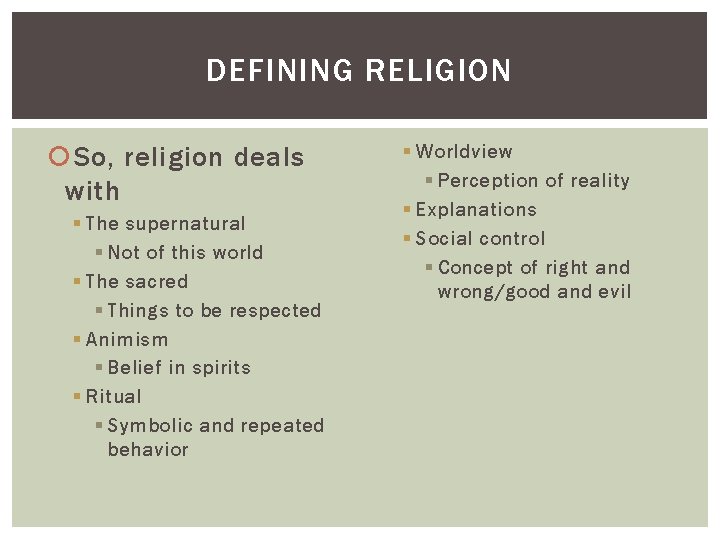
DEFINING RELIGION So, religion deals with § The supernatural § Not of this world § The sacred § Things to be respected § Animism § Belief in spirits § Ritual § Symbolic and repeated behavior § Worldview § Perception of reality § Explanations § Social control § Concept of right and wrong/good and evil
VIDEOS Next we’ll watch two short videos on ancient religions As you watch, practice cultural relativity and comparative approach What aspects are similar between the two ancient religions?
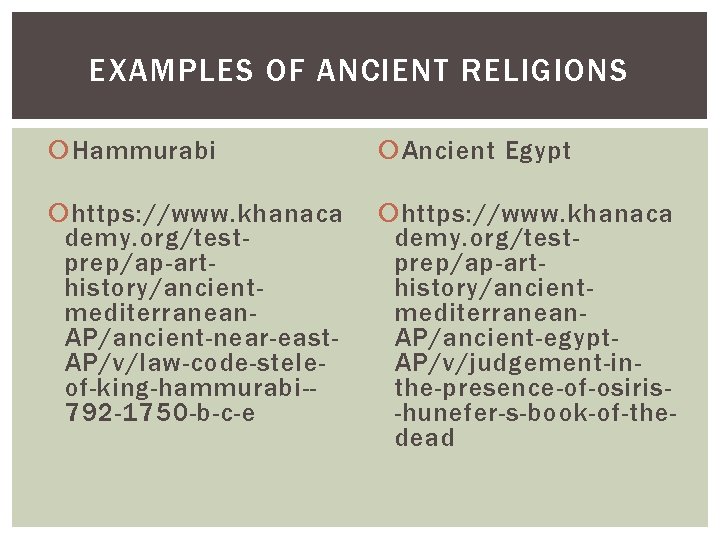
EXAMPLES OF ANCIENT RELIGIONS Hammurabi Ancient Egypt https: //www. khanaca demy. org/testprep/ap-arthistory/ancientmediterranean. AP/ancient-near-east. AP/v/law-code-steleof-king-hammurabi-792 -1750 -b-c-e https: //www. khanaca demy. org/testprep/ap-arthistory/ancientmediterranean. AP/ancient-egypt. AP/v/judgement-inthe-presence-of-osiris-hunefer-s-book-of-thedead
THE STUDY OF RELIGION One aspect of studying religion is to try to see what purpose the religion has
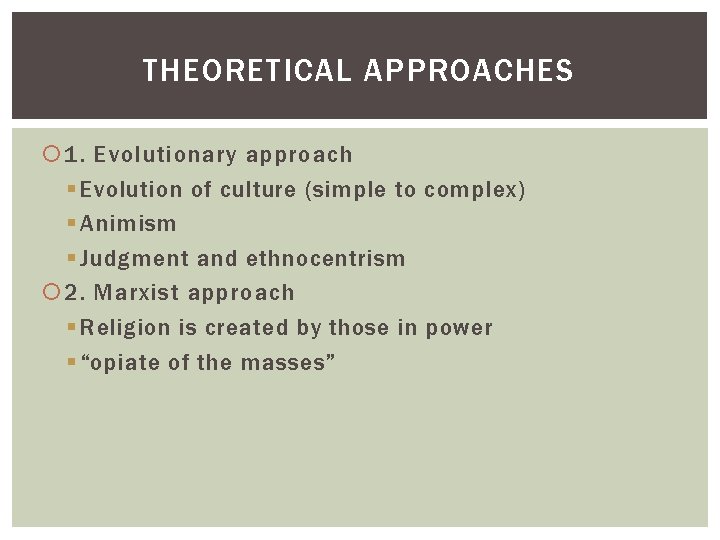
THEORETICAL APPROACHES 1. Evolutionary approach § Evolution of culture (simple to complex) § Animism § Judgment and ethnocentrism 2. Marxist approach § Religion is created by those in power § “opiate of the masses”
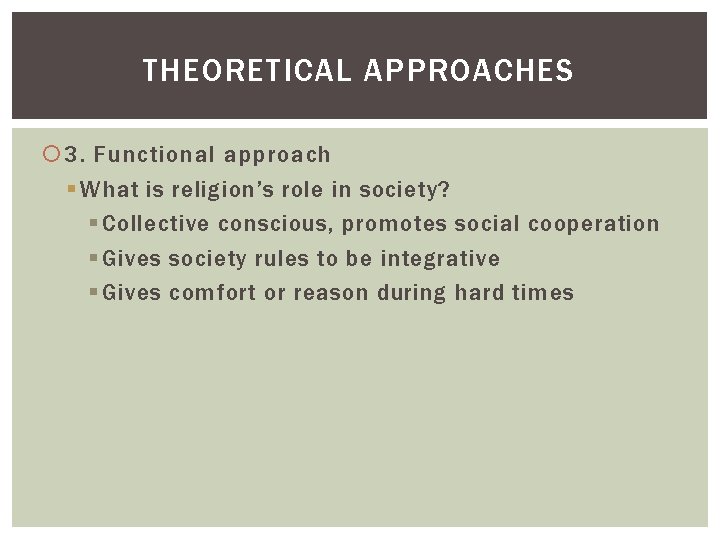
THEORETICAL APPROACHES 3. Functional approach § What is religion’s role in society? § Collective conscious, promotes social cooperation § Gives society rules to be integrative § Gives comfort or reason during hard times
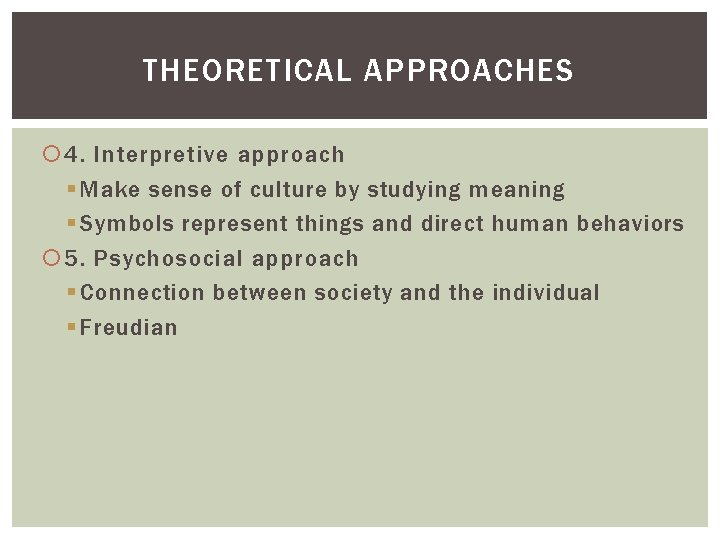
THEORETICAL APPROACHES 4. Interpretive approach § Make sense of culture by studying meaning § Symbols represent things and direct human behaviors 5. Psychosocial approach § Connection between society and the individual § Freudian
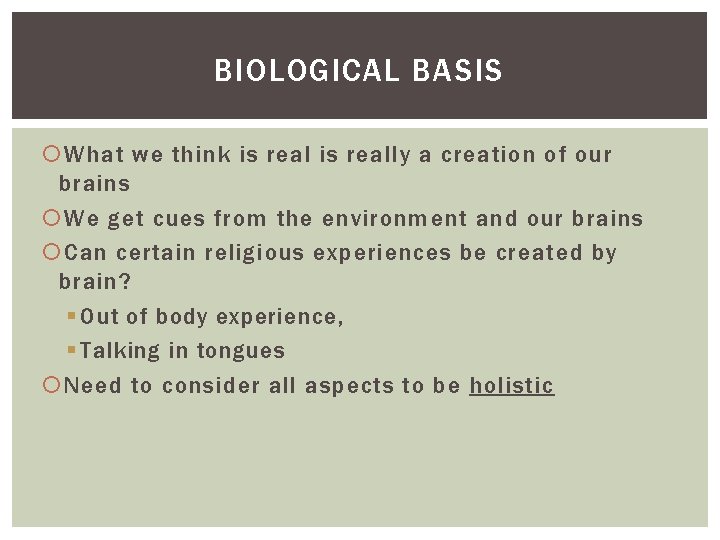
BIOLOGICAL BASIS What we think is really a creation of our brains We get cues from the environment and our brains Can certain religious experiences be created by brain? § Out of body experience, § Talking in tongues Need to consider all aspects to be holistic
BELIEFS IN SPIRITS Most cultures believe in spirits Anthropomorphic means treating non-human things in a human way Theory of mind allows us to think we understand what other beings are feeling § Empathy § Critical for living in social systems This may lead into the supernatural Maybe a way to control or understand nature
EVOLUTION OF RELIGION Maybe it evolve as a way to ensure cooperation Or to enforce kinship Or to stabilize society and people’s behavior Our cognition sees two representations of the world: § The physical § The psychological We impose our hopes and desires onto things and can “see” what we want to see (even if it is not there)
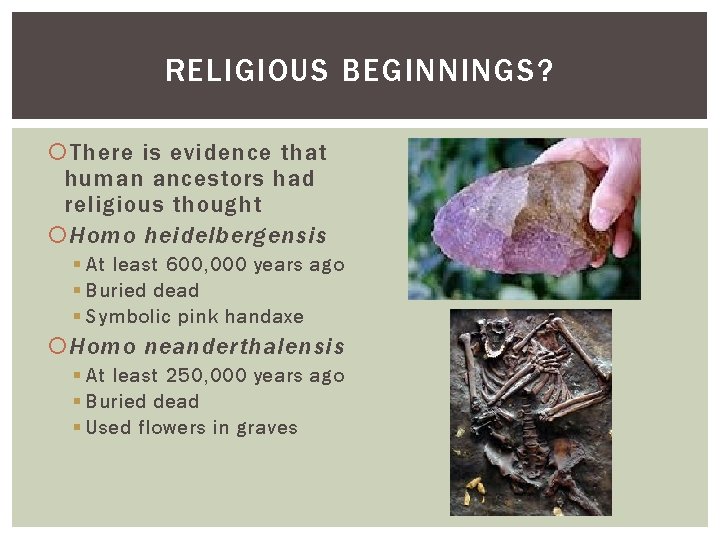
RELIGIOUS BEGINNINGS? There is evidence that human ancestors had religious thought Homo heidelbergensis § At least 600, 000 years ago § Buried dead § Symbolic pink handaxe Homo neanderthalensis § At least 250, 000 years ago § Buried dead § Used flowers in graves
DISCUSSION QUESTIONS 1. Describe what it means to be holistic 2. Describe why it is important to have cultural relativism 3. Identify three religious ceremonies you have participated in 4. Do you think there is a biological basis for religious beliefs? Or is religion entirely social?
ASSIGNMENT Read “Body Ritual of the Nacirema” and work on questions in group