T Madas What is a tree diagram A









- Slides: 75
© T Madas
What is a tree diagram? • A probability diagram • It is used to calculate probabilities • of combined events i. e. when an event is followed by another event © T Madas
Constant probability events © T Madas
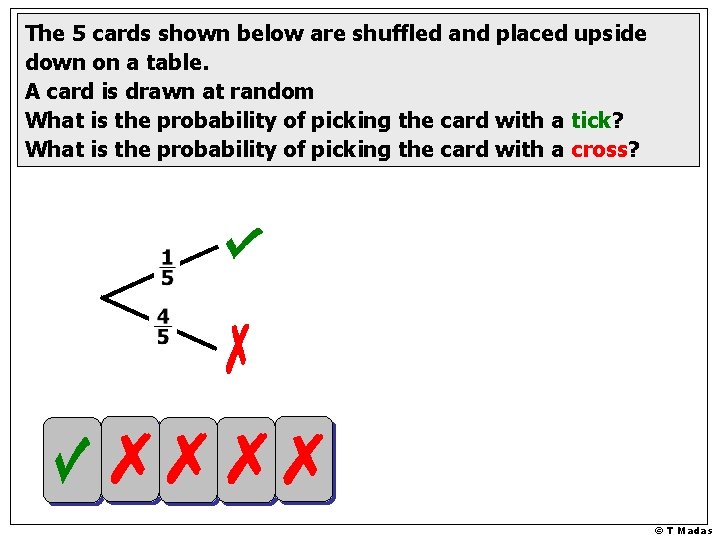
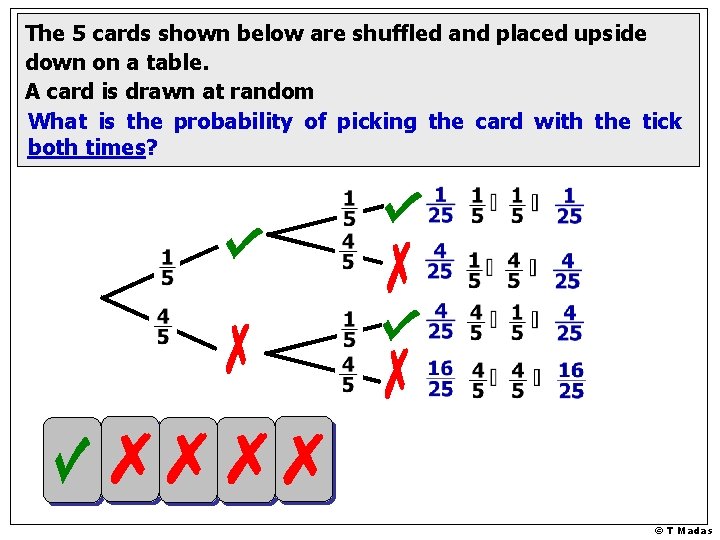
The 5 cards shown below are shuffled and placed upside down on a table. A card is drawn at random What is the probability of picking the card with a tick? What is the probability of picking the card with a cross? © T Madas
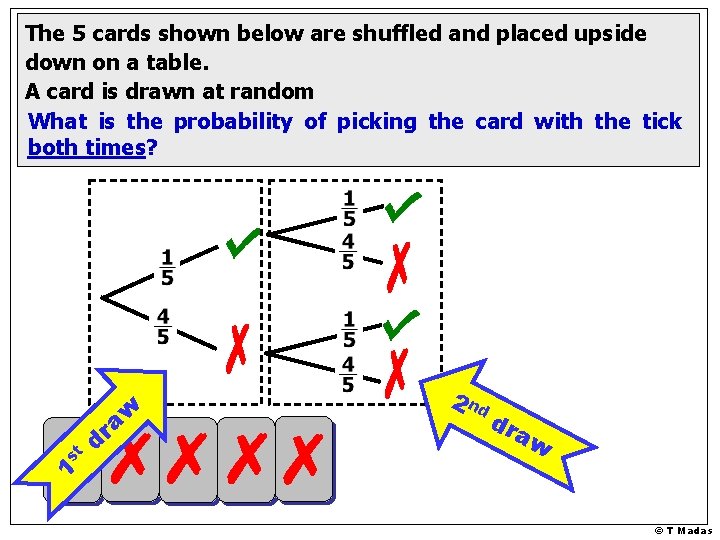
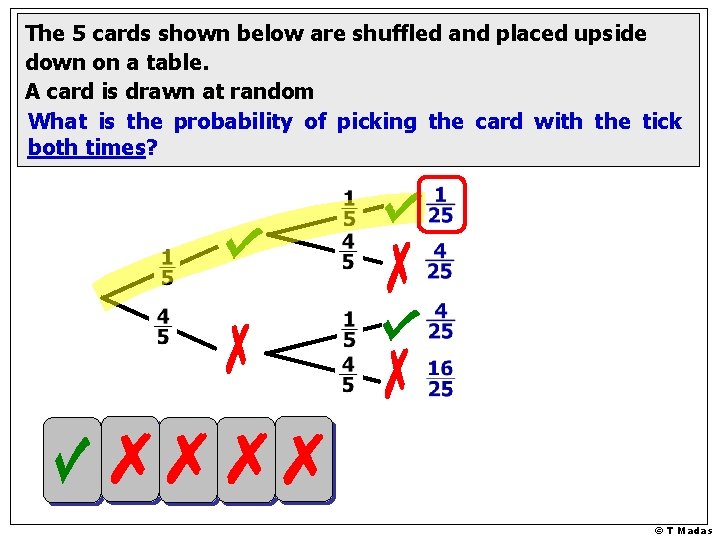
The 5 cards shown below are shuffled and placed upside down on a table. A card is drawn at random What picking thethe card with a tick? What isisthe theprobabilityofof picking card the tick both times? What is the probability of picking the card with a cross? st 1 w a dr 2 nd dr aw © T Madas
The 5 cards shown below are shuffled and placed upside down on a table. A card is drawn at random What picking thethe card with a tick? What isisthe theprobabilityofof picking card the tick both times? What is the probability of picking the card with a cross? © T Madas
The 5 cards shown below are shuffled and placed upside down on a table. A card is drawn at random What picking thethe card with a tick? What isisthe theprobabilityofof picking card the tick both times? What is the probability of picking the card with a cross? © T Madas
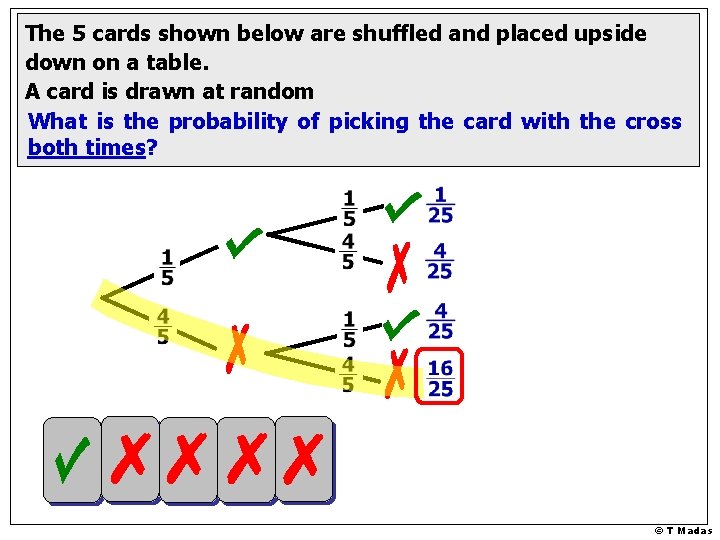
The 5 cards shown below are shuffled and placed upside down on a table. A card is drawn at random What card with a tick? What is isthe theprobabilityofofpickingthe card with the cross both times? What is the probability of picking the card with a cross? © T Madas
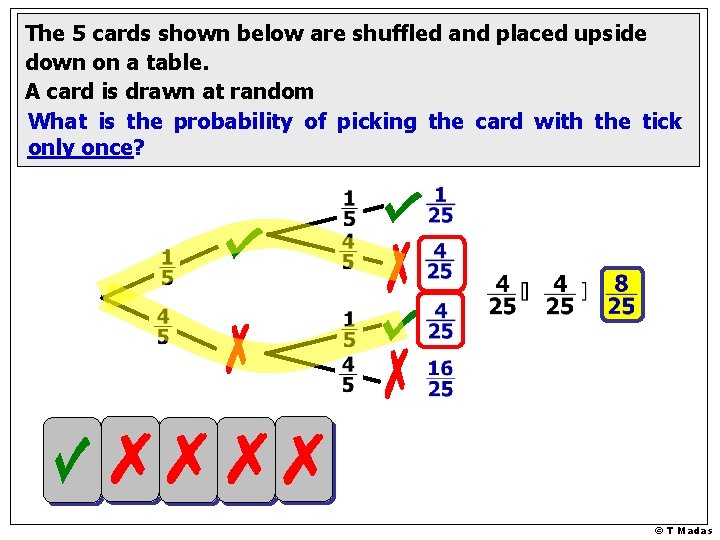
The 5 cards shown below are shuffled and placed upside down on a table. A card is drawn at random What picking thethe card with a tick? What isisthe theprobabilityofof picking card the tick only once? What is the probability of picking the card with a cross? © T Madas
© T Madas
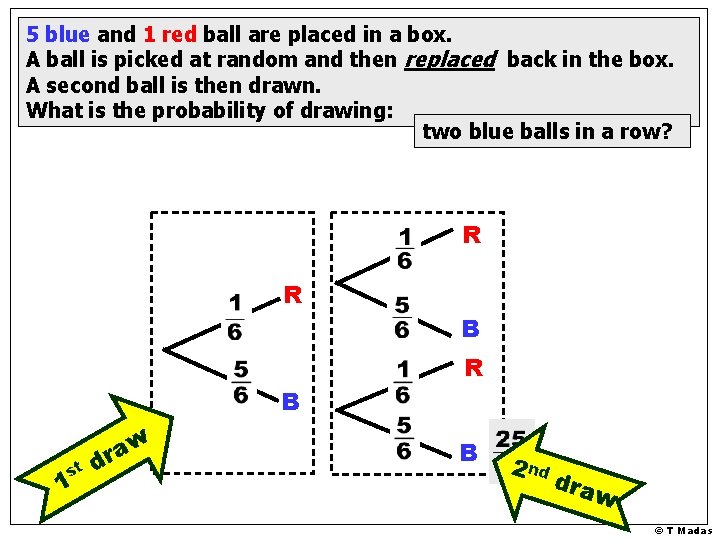
5 blue and 1 red ball are placed in a box. A ball is picked at random and then replaced back in the box. A second ball is then drawn. What is the probability of drawing: two blue balls in a row? R R B st 1 aw r d B 2 nd dra w © T Madas
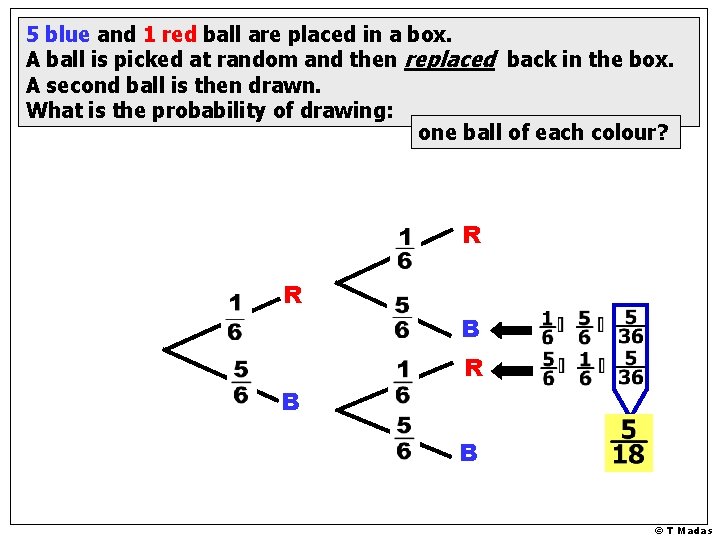
5 blue and 1 red ball are placed in a box. A ball is picked at random and then replaced back in the box. A second ball is then drawn. What is the probability of drawing: one ball of each colour? R R B B © T Madas
© T Madas
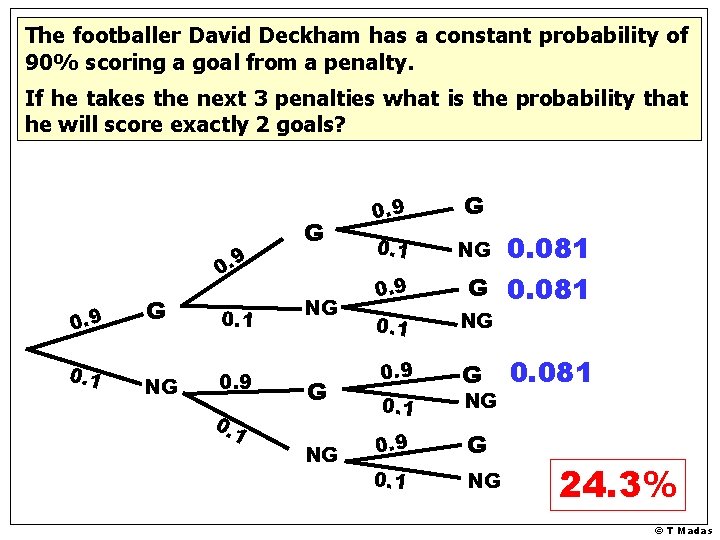
The footballer David Deckham has a constant probability of 90% scoring a goal from a penalty. If he takes the next 3 penalties what is the probability that he will score exactly 2 goals? . 9 G 0 0. 9 0. 1 G 0. 1 NG 0. 9 0. 1 NG G NG 0. 9 G 0. 1 NG 0. 9 0. 081 G 0. 081 0. 1 NG 0. 9 G 0. 1 NG 0. 081 0. 243 24. 3% © T Madas
© T Madas
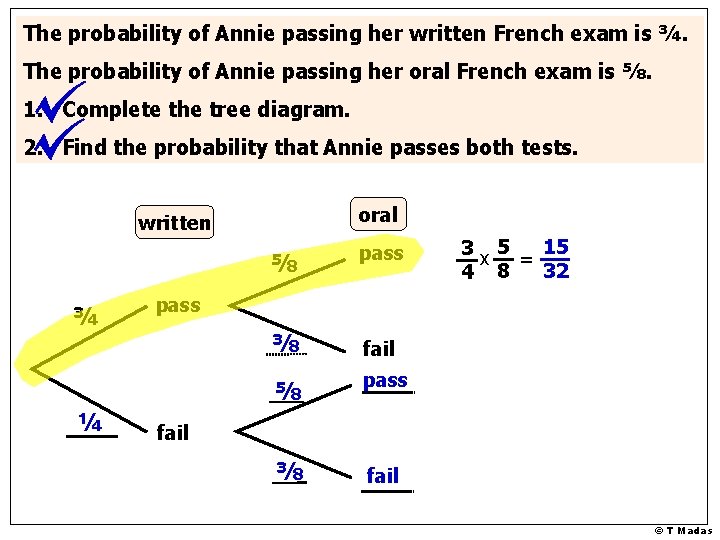
The probability of Annie passing her written French exam is ¾. The probability of Annie passing her oral French exam is ⅝. 1. Complete the tree diagram. 2. Find the probability that Annie passes both tests. oral written ¾ ¼ ⅝ pass ⅜ fail 15 3 5 x = 32 4 8 pass fail © T Madas
© T Madas
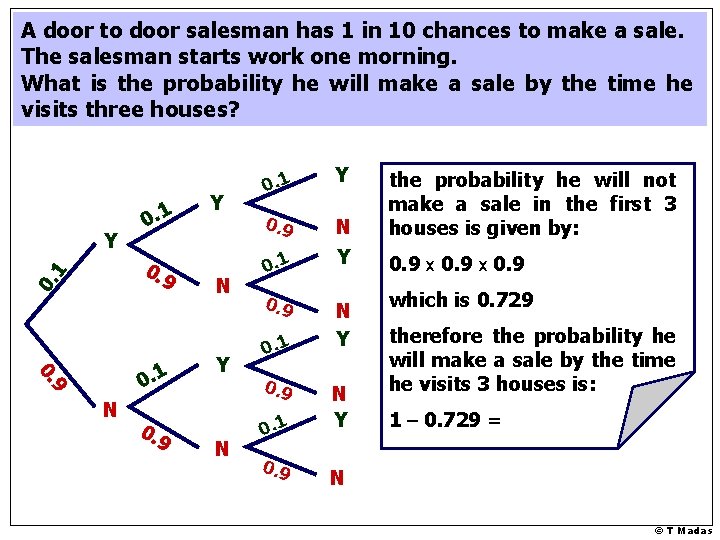
A door to door salesman has 1 in 10 chances to make a sale. The salesman starts work one morning. What is the probability he will make a sale by the time he visits three houses? Y 0. 1 0. 9 9 0. 1 N 0. 9 Y N 0. 1 Y 0. 9 N Y 0. 1 N Y 0. 9 N the probability he will not make a sale in the first 3 houses is given by: 0. 9 x 0. 9 which is 0. 729 therefore the probability he will make a sale by the time he visits 3 houses is: 1 – 0. 729 = 0. 271 © T Madas
© T Madas
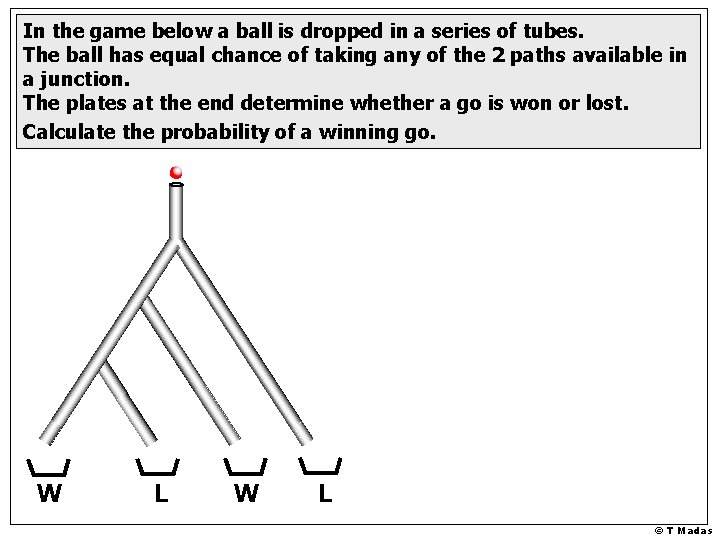
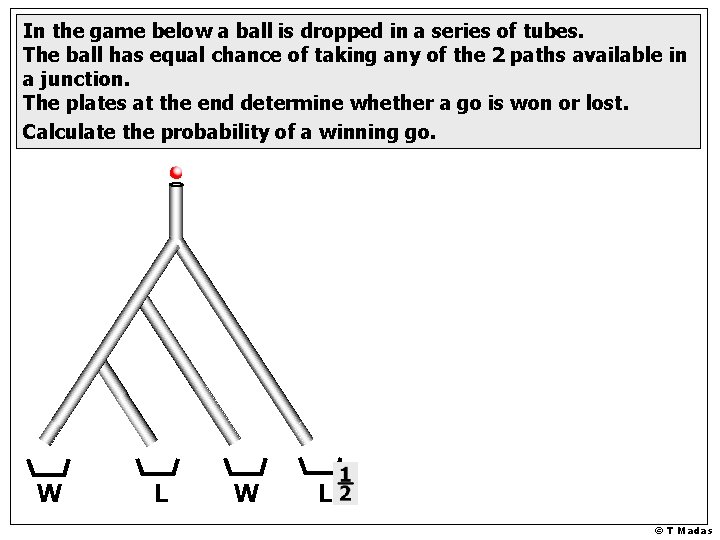
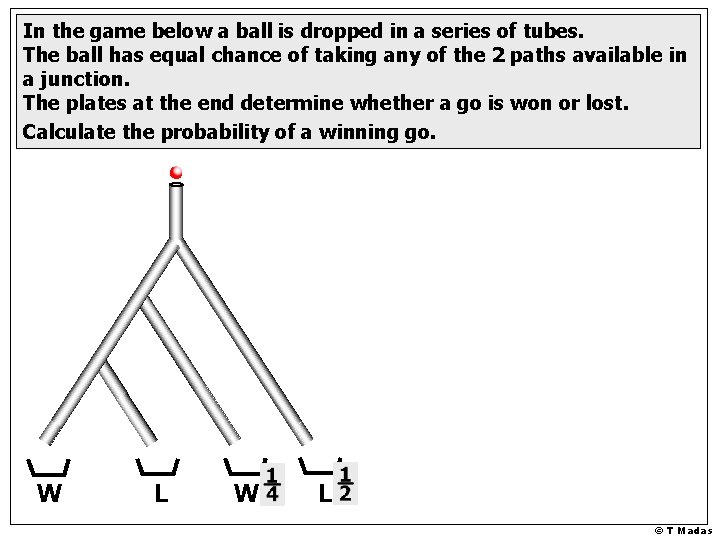
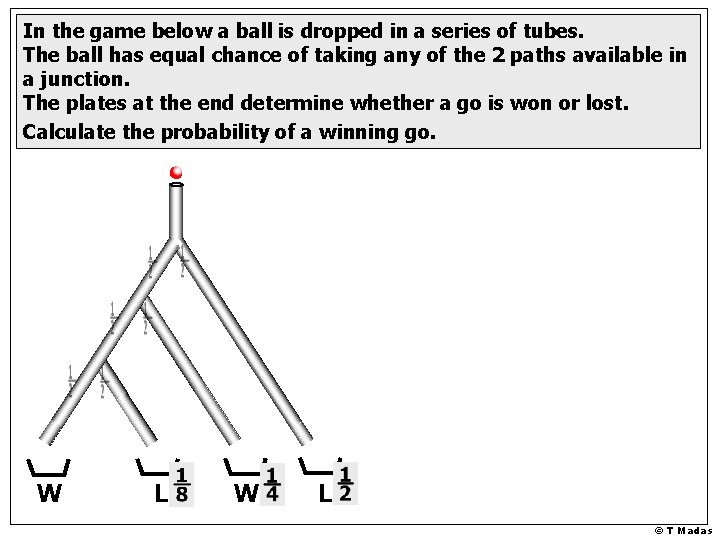
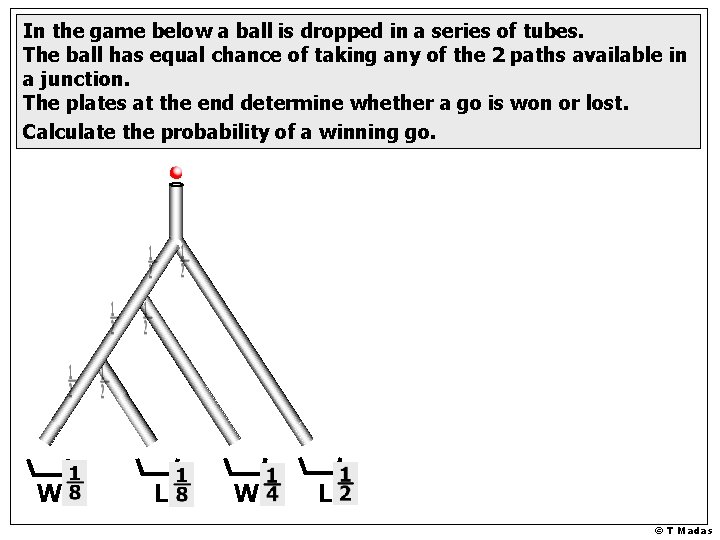
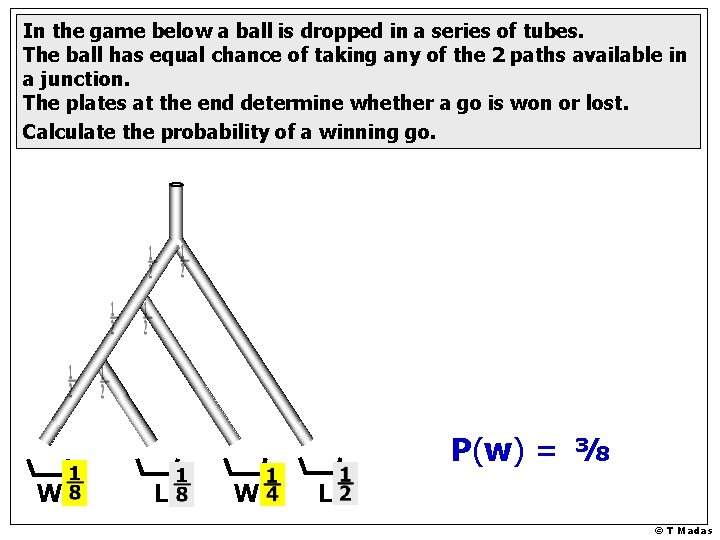
In the game below a ball is dropped in a series of tubes. The ball has equal chance of taking any of the 2 paths available in a junction. The plates at the end determine whether a go is won or lost. Calculate the probability of a winning go. W L © T Madas
In the game below a ball is dropped in a series of tubes. The ball has equal chance of taking any of the 2 paths available in a junction. The plates at the end determine whether a go is won or lost. Calculate the probability of a winning go. W L © T Madas
In the game below a ball is dropped in a series of tubes. The ball has equal chance of taking any of the 2 paths available in a junction. The plates at the end determine whether a go is won or lost. Calculate the probability of a winning go. W L © T Madas
In the game below a ball is dropped in a series of tubes. The ball has equal chance of taking any of the 2 paths available in a junction. The plates at the end determine whether a go is won or lost. Calculate the probability of a winning go. W L © T Madas
In the game below a ball is dropped in a series of tubes. The ball has equal chance of taking any of the 2 paths available in a junction. The plates at the end determine whether a go is won or lost. Calculate the probability of a winning go. W L © T Madas
In the game below a ball is dropped in a series of tubes. The ball has equal chance of taking any of the 2 paths available in a junction. The plates at the end determine whether a go is won or lost. Calculate the probability of a winning go. P(w) = ⅜ W L © T Madas
An A* Exam Question © T Madas
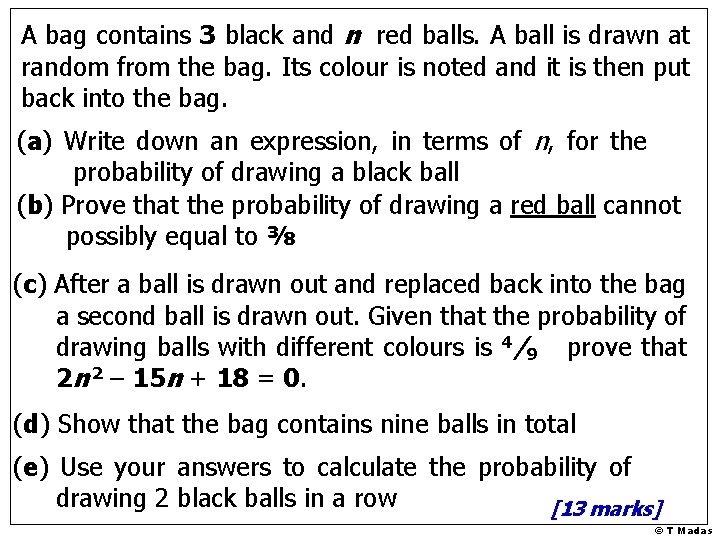
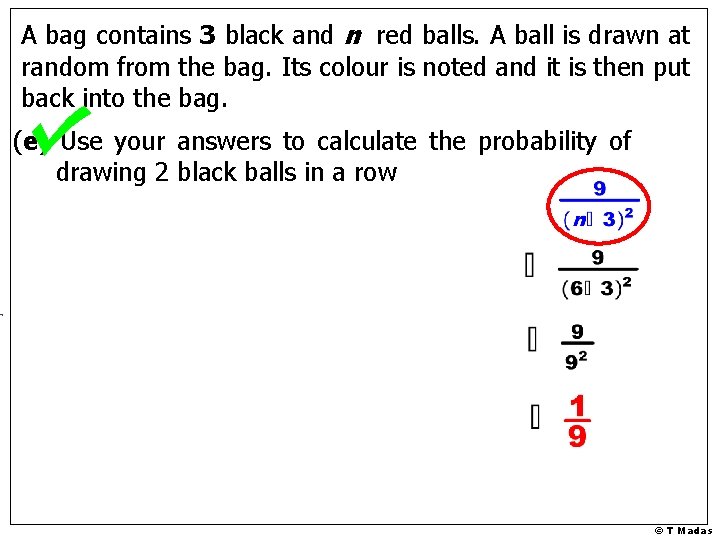
A bag contains 3 black and n red balls. A ball is drawn at random from the bag. Its colour is noted and it is then put back into the bag. (a) Write down an expression, in terms of n, for the probability of drawing a black ball (b) Prove that the probability of drawing a red ball cannot possibly equal to ⅜ (c) After a ball is drawn out and replaced back into the bag a second ball is drawn out. Given that the probability of drawing balls with different colours is 4/9 prove that 2 n 2 – 15 n + 18 = 0. (d) Show that the bag contains nine balls in total (e) Use your answers to calculate the probability of drawing 2 black balls in a row [13 marks] © T Madas
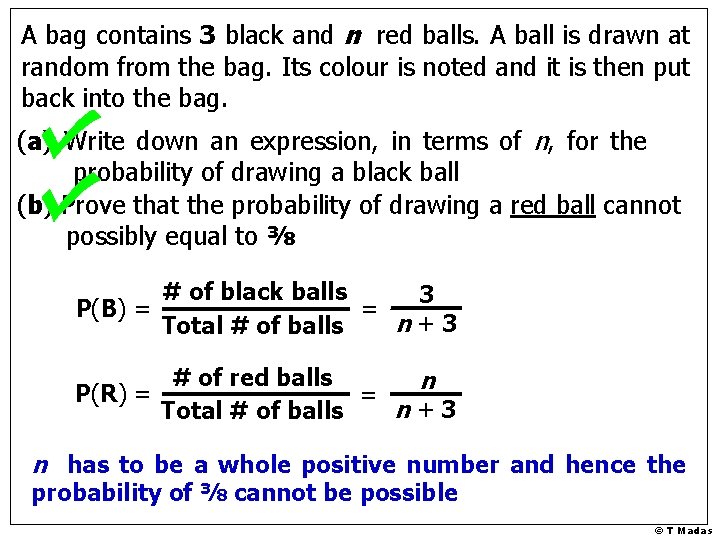
A bag contains 3 black and n red balls. A ball is drawn at random from the bag. Its colour is noted and it is then put back into the bag. (a) Write down an expression, in terms of n, for the probability of drawing a black ball (b) Prove that the probability of drawing a red ball cannot possibly equal to ⅜ # of black balls 3 P(B) = = n+3 Total # of balls # of red balls n P(R) = = n+3 Total # of balls n hasn to = be 3 a whole number and hence the 8 n =positive 3 n + 9 5 n = 9 n + 3 8 probability of ⅜ cannot be possible © T Madas
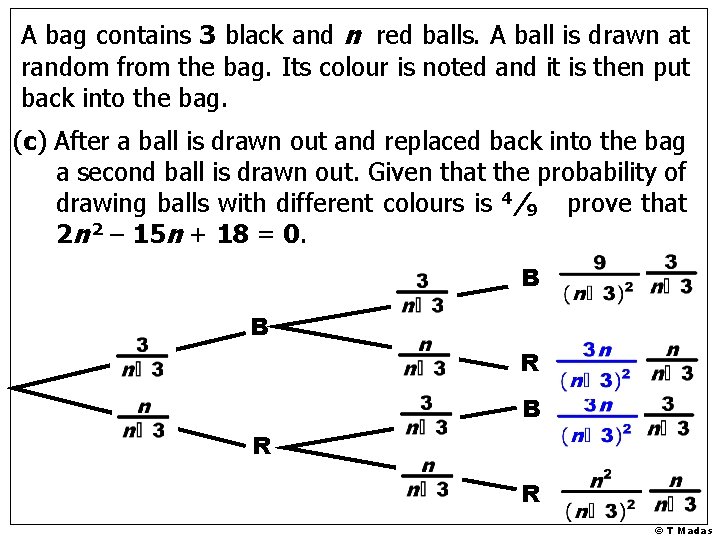
A bag contains 3 black and n red balls. A ball is drawn at random from the bag. Its colour is noted and it is then put back into the bag. (c) After a ball is drawn out and replaced back into the bag a second ball is drawn out. Given that the probability of drawing balls with different colours is 4/9 prove that 2 n 2 – 15 n + 18 = 0. B B R R © T Madas
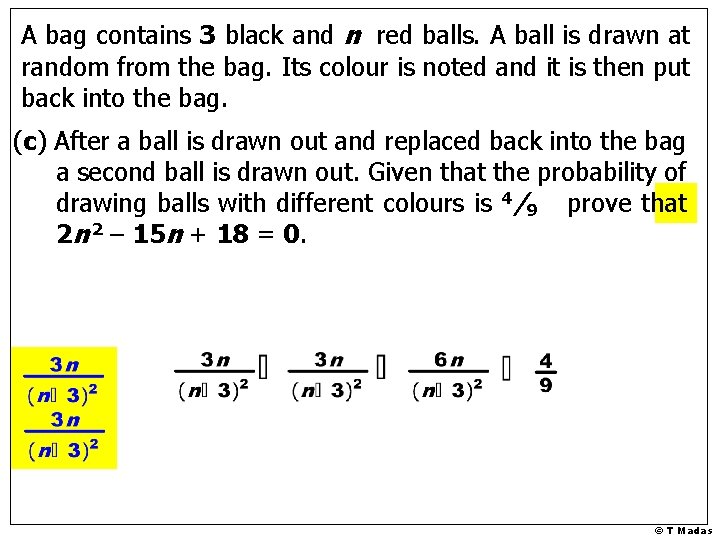
A bag contains 3 black and n red balls. A ball is drawn at random from the bag. Its colour is noted and it is then put back into the bag. (c) After a ball is drawn out and replaced back into the bag a second ball is drawn out. Given that the probability of drawing balls with different colours is 4/9 prove that 2 n 2 – 15 n + 18 = 0. © T Madas
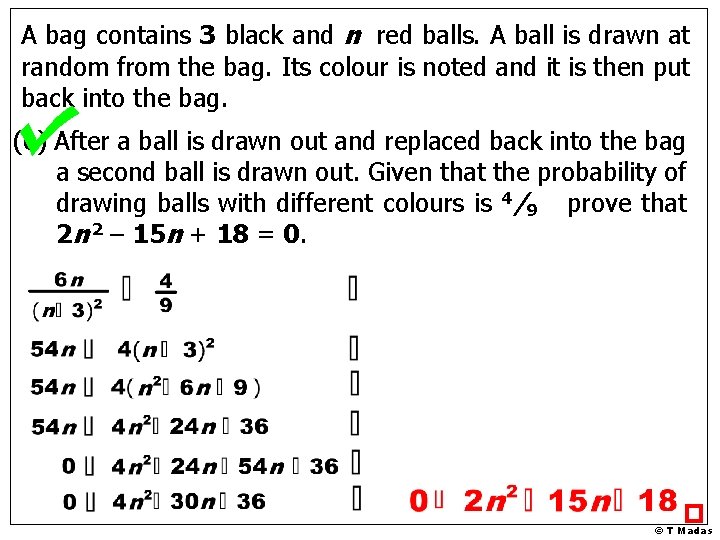
A bag contains 3 black and n red balls. A ball is drawn at random from the bag. Its colour is noted and it is then put back into the bag. (c) After a ball is drawn out and replaced back into the bag a second ball is drawn out. Given that the probability of drawing balls with different colours is 4/9 prove that 2 n 2 – 15 n + 18 = 0. © T Madas
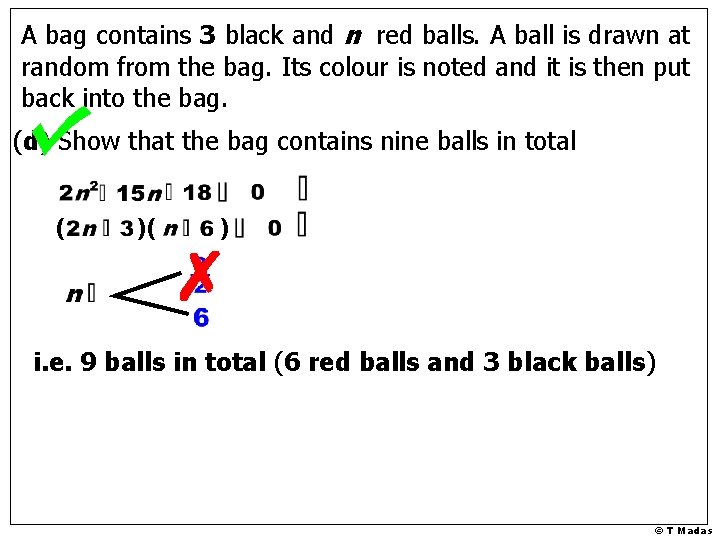
A bag contains 3 black and n red balls. A ball is drawn at random from the bag. Its colour is noted and it is then put back into the bag. (d) Show that the bag contains nine balls in total ( )( ) i. e. 9 balls in total (6 red balls and 3 black balls) © T Madas
A bag contains 3 black and n red balls. A ball is drawn at random from the bag. Its colour is noted and it is then put back into the bag. (e) Use your answers to calculate the probability of drawing 2 black balls in a row B B R R © T Madas
Changing Probability Events © T Madas
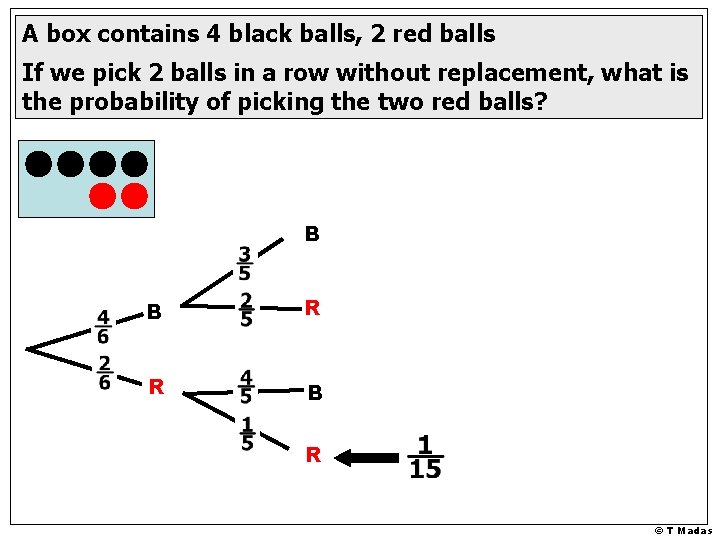
A box contains 4 black balls, 2 red balls If we pick 2 balls in a row without replacement, what is the probability of picking the two red balls? B B R R B R © T Madas
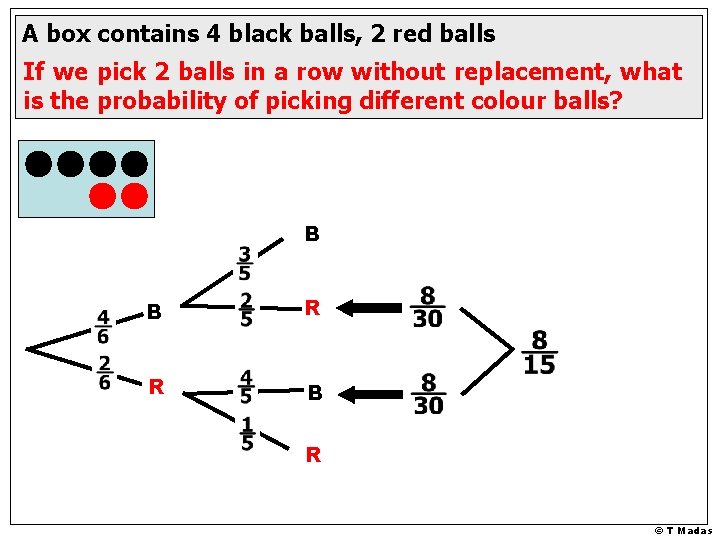
A box contains 4 black balls, 2 red balls If we we pick 22 ballsin inaarow rowwithoutreplacement, what is is the probability picking the probability of of picking thedifferent two redcolour balls? B B R R B R © T Madas
© T Madas
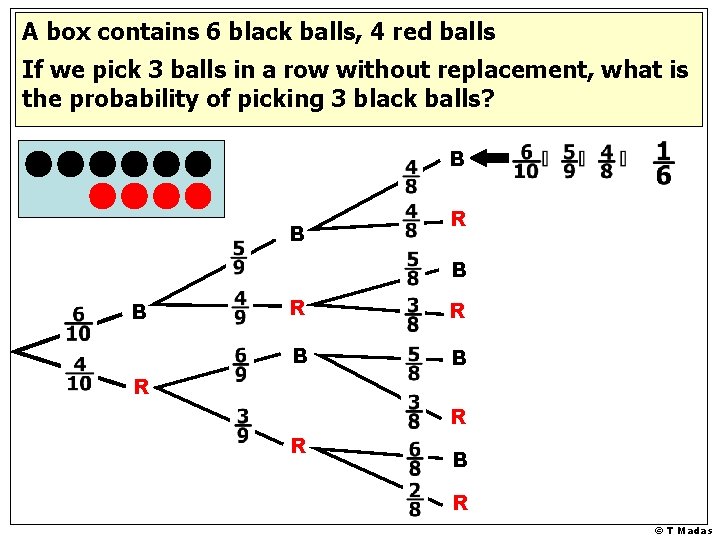
A box contains 6 black balls, 4 red balls If we pick 3 balls in a row without replacement, what is the probability of picking 3 black balls? B B R R R B R © T Madas
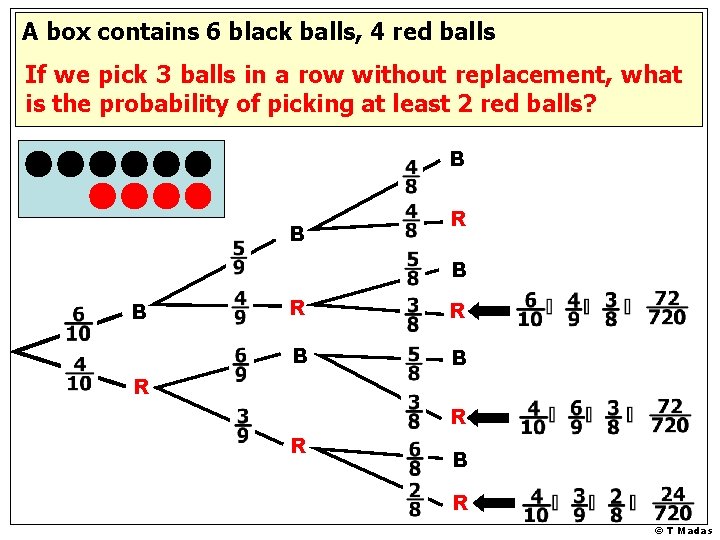
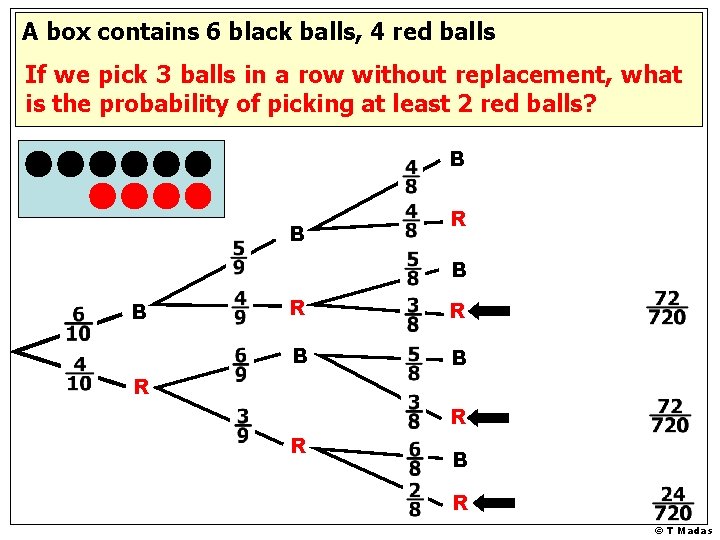
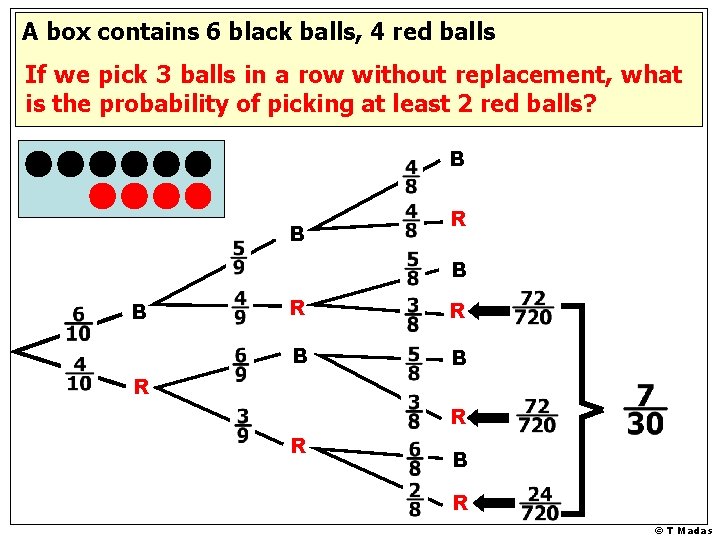
A box contains 6 black balls, 4 red balls If is If we we pick 33 ballsininaarow rowwithoutreplacement, what the probability of of picking 3 black balls? is the probability picking at least 2 red balls? B B R R R B R © T Madas
A box contains 6 black balls, 4 red balls If is If we we pick 33 ballsininaarow rowwithoutreplacement, what the probability of of picking 3 black balls? is the probability picking at least 2 red balls? B B R R R B R © T Madas
A box contains 6 black balls, 4 red balls If is If we we pick 33 ballsininaarow rowwithoutreplacement, what the probability of of picking 3 black balls? is the probability picking at least 2 red balls? B B R R R B R © T Madas
Exam Question © T Madas
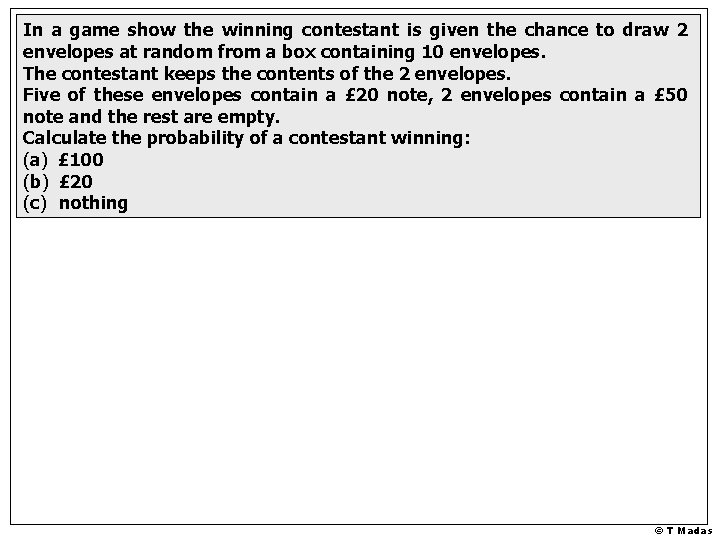
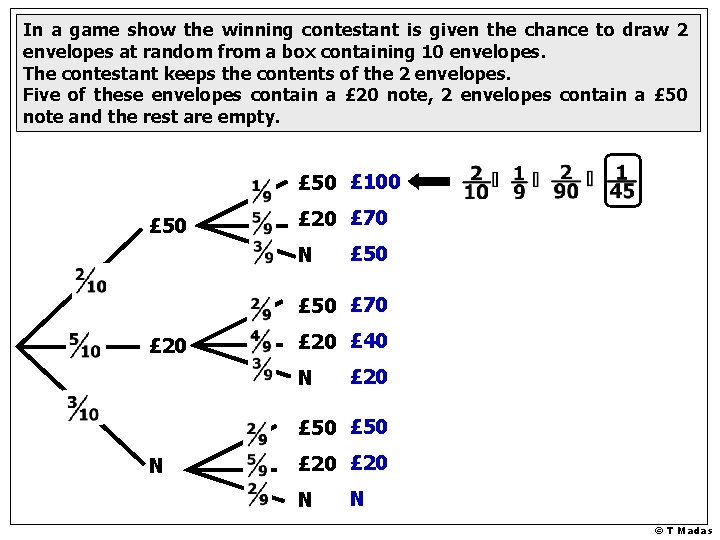
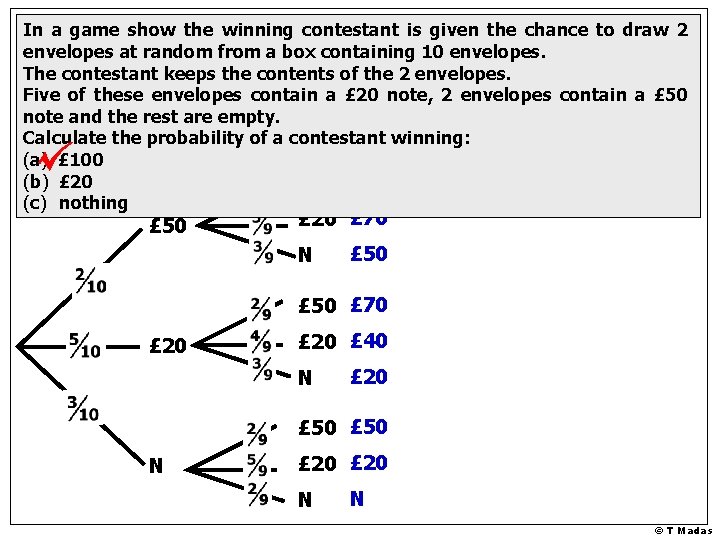
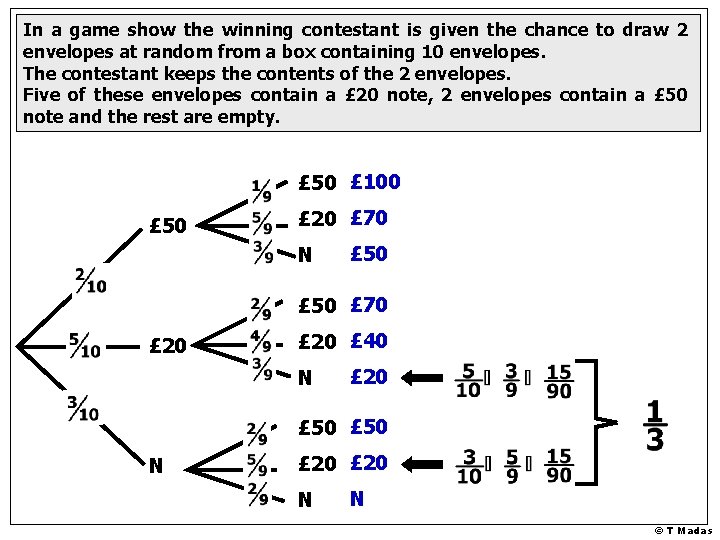
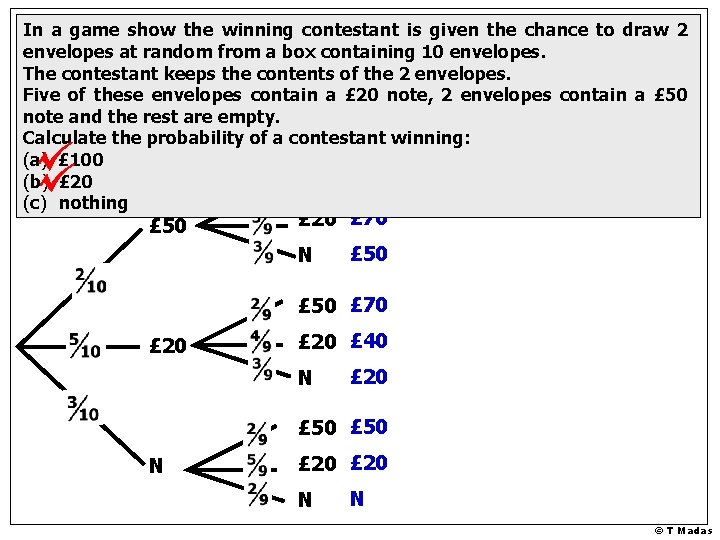
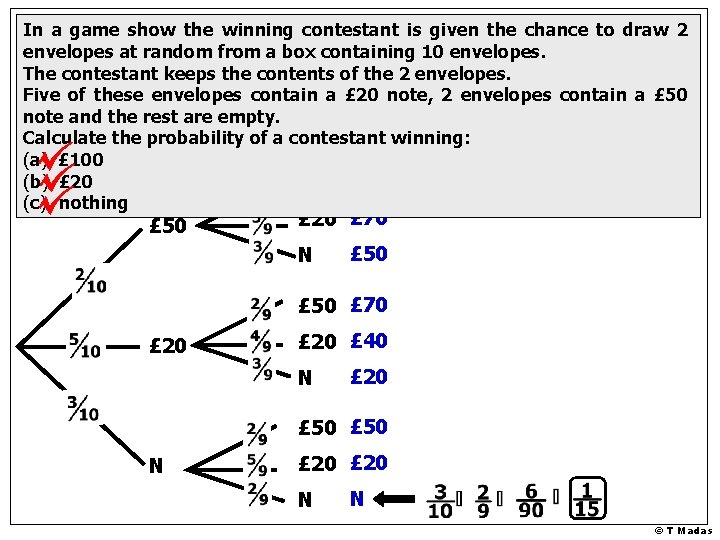
In a game show the winning contestant is given the chance to draw 2 envelopes at random from a box containing 10 envelopes. The contestant keeps the contents of the 2 envelopes. Five of these envelopes contain a £ 20 note, 2 envelopes contain a £ 50 note and the rest are empty. Calculate the probability of a contestant winning: (a) £ 100 (b) £ 20 (c) nothing © T Madas
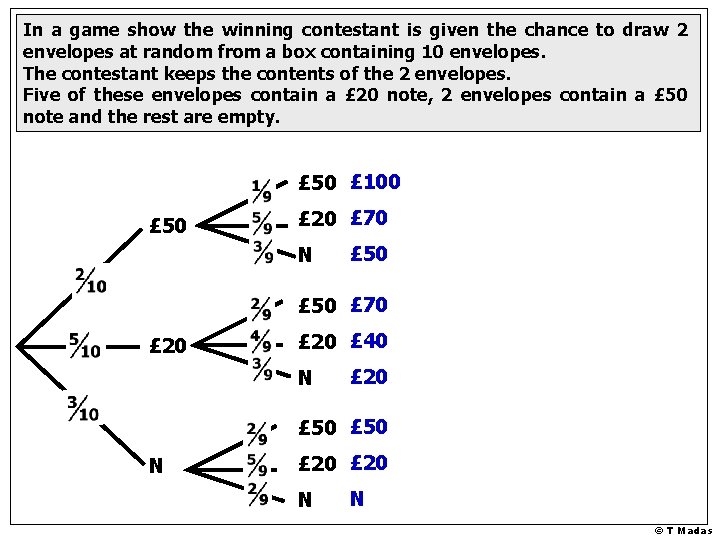
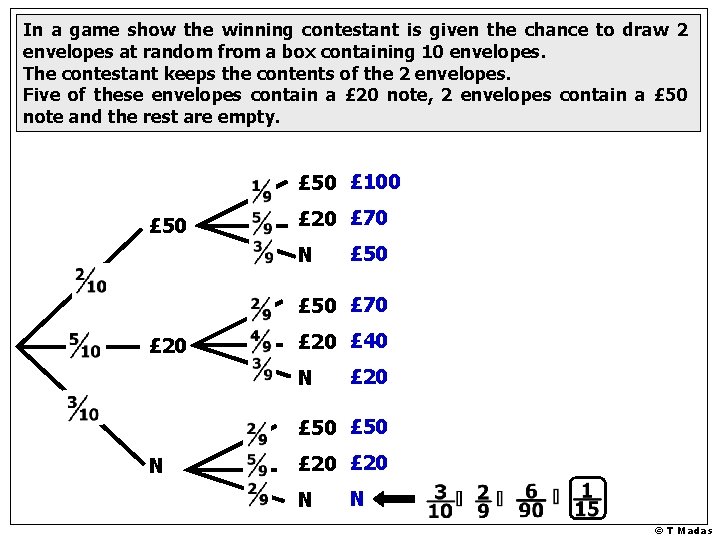
In a game show the winning contestant is given the chance to draw 2 envelopes at random from a box containing 10 envelopes. The contestant keeps the contents of the 2 envelopes. Five of these envelopes contain a £ 20 note, 2 envelopes contain a £ 50 note and the rest are empty. £ 50 £ 100 £ 50 £ 20 £ 70 N £ 50 £ 70 £ 20 £ 40 N £ 20 £ 50 N £ 20 N N © T Madas
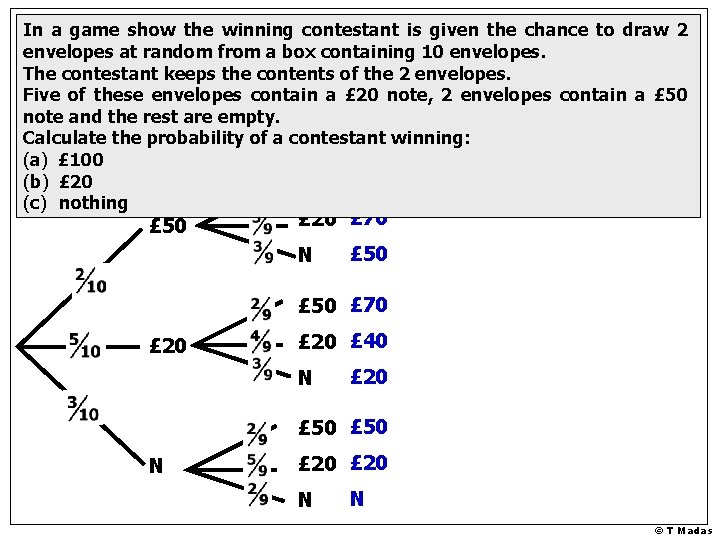
In a game show the winning contestant is given the chance to draw 2 envelopes at random from a box containing 10 envelopes. The contestant keeps the contents of the 2 envelopes. Five of these envelopes contain a £ 20 note, 2 envelopes contain a £ 50 note and the rest are empty. Calculate the probability of a contestant winning: (a) £ 100 (b) £ 20 £ 50 £ 100 (c) nothing £ 50 £ 20 £ 70 N £ 50 £ 70 £ 20 £ 40 N £ 20 £ 50 N £ 20 N N © T Madas
© T Madas
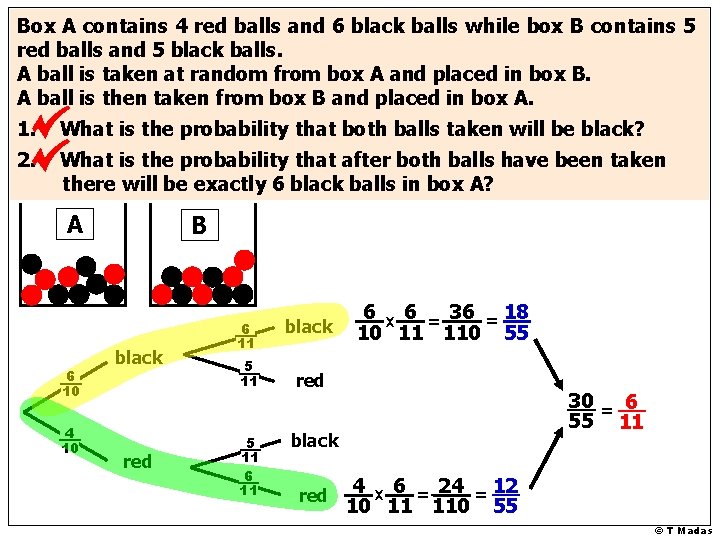
Box A contains 4 red balls and 6 black balls while box B contains 5 red balls and 5 black balls. A ball is taken at random from box A and placed in box B. A ball is then taken from box B and placed in box A. 1. What is the probability that both balls taken will be black? 2. What is the probability that after both balls have been taken there will be exactly 6 black balls in box A? A 6 10 4 10 B black red 6 11 5 11 6 11 black 6 x 6 = 36 = 18 10 11 110 55 red 30 = 6 55 11 black red 4 x 6 = 24 = 12 10 11 110 55 © T Madas
© T Madas
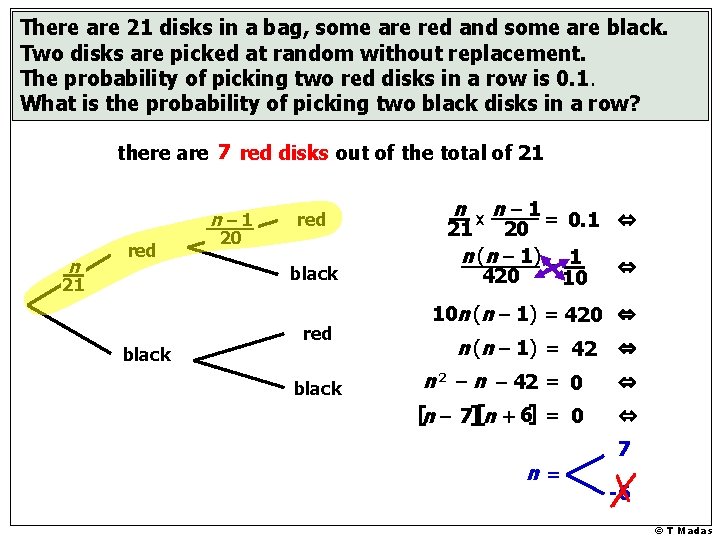
There are 21 disks in a bag, some are red and some are black. Two disks are picked at random without replacement. The probability of picking two red disks in a row is 0. 1. What is the probability of picking two black disks in a row? Suppose there are n 7 red disks out of the total of 21 n– 1 n red 20 red black 21 black red black n x n – 1= 0. 1 ⇔ 21 20 n (n – 1) = 1 420 10 ⇔ 10 n (n – 1) = 420 ⇔ n (n – 1) = 42 ⇔ n 2 – n – 42 = 0 ⇔ n – 7 n +6 = 0 ⇔ n= 7 -6 © T Madas
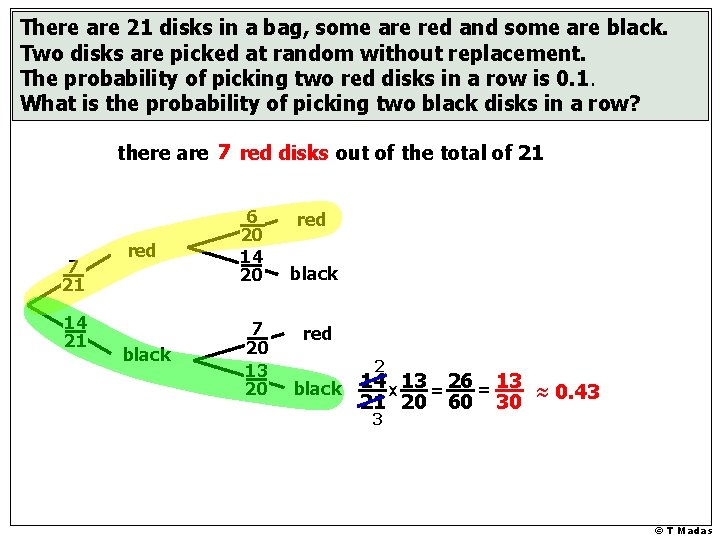
There are 21 disks in a bag, some are red and some are black. Two disks are picked at random without replacement. The probability of picking two red disks in a row is 0. 1. What is the probability of picking two black disks in a row? Suppose there are n 7 red disks out of the total of 21 7 21 14 21 red black 6 20 14 20 7 20 13 20 red black red 2 black 14 x 13 = 26 = 13 21 20 60 30 ≈ 0. 43 3 © T Madas
Other Tree Diagrams © T Madas
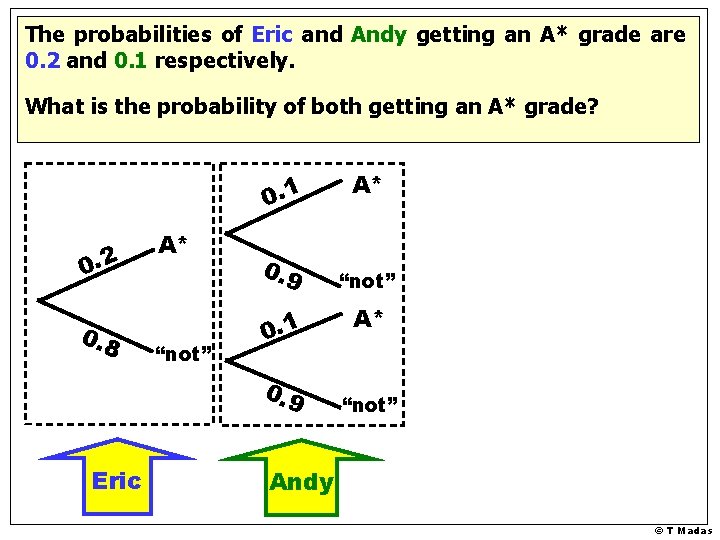
The probabilities of Eric and Andy getting an A* grade are 0. 2 and 0. 1 respectively. What is the probability of both getting an A* grade? 0. 2 0. 8 A* “not” 0. 1 A* 0. 9 Eric “not” Andy © T Madas
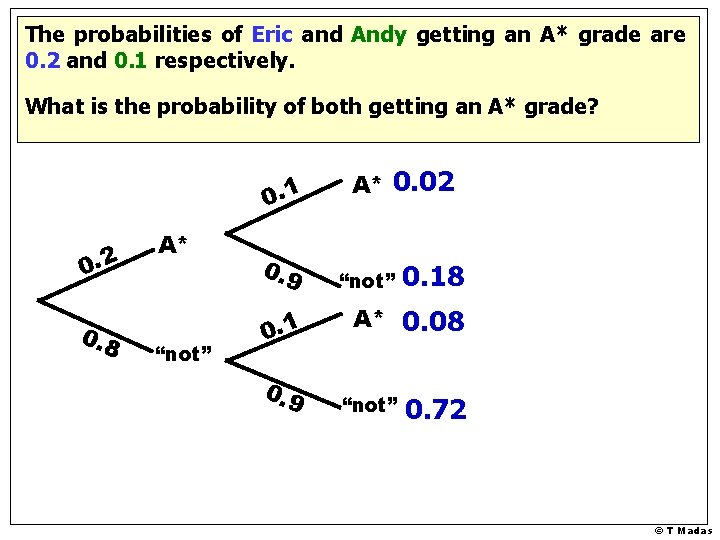
The probabilities of Eric and Andy getting an A* grade are 0. 2 and 0. 1 respectively. What is the probability of both getting an A* grade? 0. 1 0. 2 0. 8 A* “not” 0. 9 0. 1 0. 9 A* 0. 02 “not” 0. 18 A* 0. 08 “not” 0. 72 © T Madas
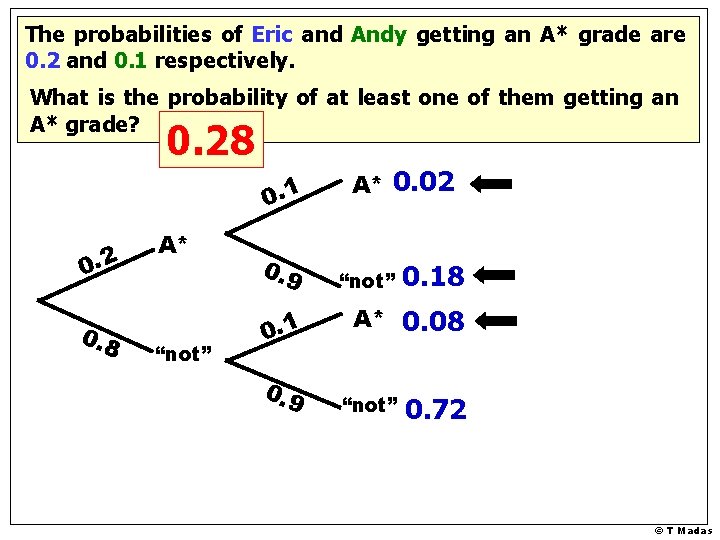
The probabilities of Eric and Andy getting an A* grade are 0. 2 and 0. 1 respectively. What is isthe theprobabilityofofboth at least onean of. A* them getting an What getting grade? A* grade? 0. 28 0. 1 0. 2 0. 8 A* “not” 0. 9 0. 1 0. 9 A* 0. 02 “not” 0. 18 A* 0. 08 “not” 0. 72 © T Madas
© T Madas
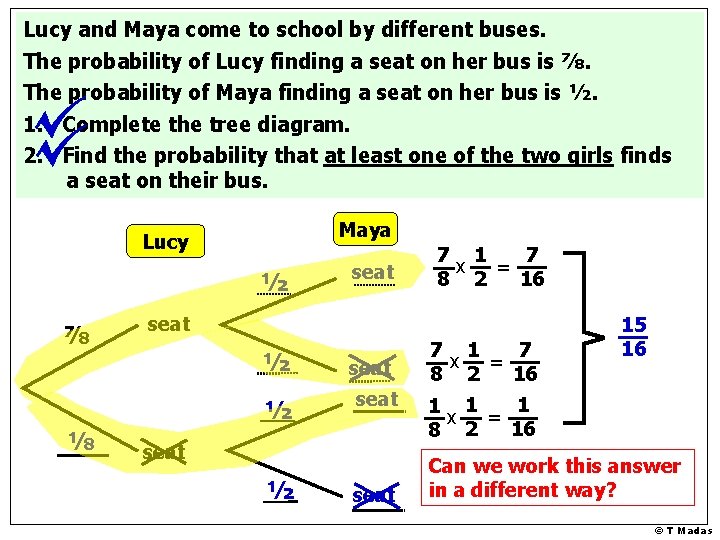
Lucy and Maya come to school by different buses. The probability of Lucy finding a seat on her bus is ⅞. The probability of Maya finding a seat on her bus is ½. 1. Complete the tree diagram. 2. Find the probability that at least one of the two girls finds a seat on their bus. Maya Lucy ½ ⅞ seat ½ ½ ⅛ seat 7 7 1 x = 16 8 2 seat ½ seat 7 7 1 x = 16 8 2 15 16 1 1 1 x = 16 8 2 Can we work this answer in a different way? © T Madas
© T Madas
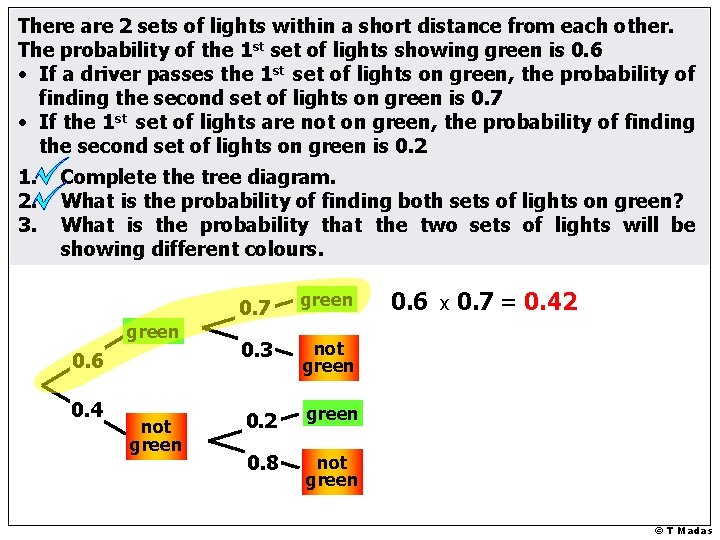
There are 2 sets of lights within a short distance from each other. The probability of the 1 st set of lights showing green is 0. 6 • If a driver passes the 1 st set of lights on green, the probability of finding the second set of lights on green is 0. 7 • If the 1 st set of lights are not on green, the probability of finding the second set of lights on green is 0. 2 1. 2. 3. Complete the tree diagram. What is the probability of finding both sets of lights on green? What is the probability that the two sets of lights will be showing different colours. green 0. 6 0. 4 not green 0. 7 green 0. 3 not green 0. 2 green 0. 8 not green 0. 6 x 0. 7 = 0. 42 © T Madas
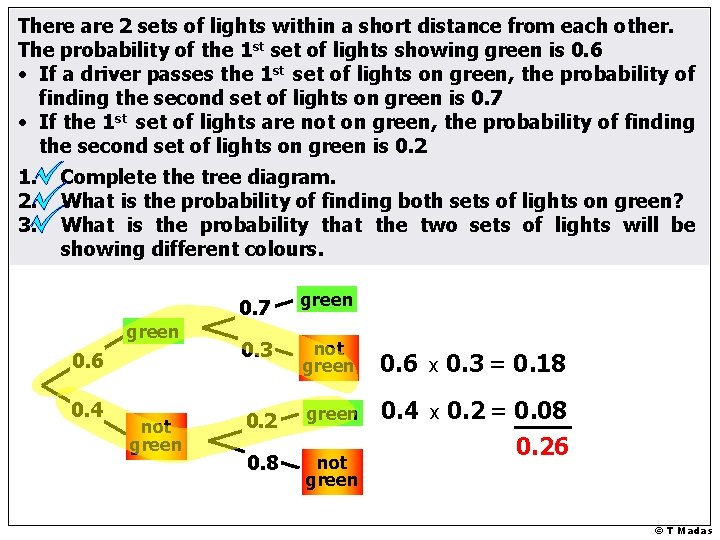
There are 2 sets of lights within a short distance from each other. The probability of the 1 st set of lights showing green is 0. 6 • If a driver passes the 1 st set of lights on green, the probability of finding the second set of lights on green is 0. 7 • If the 1 st set of lights are not on green, the probability of finding the second set of lights on green is 0. 2 1. 2. 3. Complete the tree diagram. What is the probability of finding both sets of lights on green? What is the probability that the two sets of lights will be showing different colours. green 0. 6 0. 4 not green 0. 7 green 0. 3 not green 0. 6 x 0. 3 = 0. 18 0. 2 green 0. 4 x 0. 2 = 0. 08 0. 8 not green 0. 26 © T Madas
© T Madas
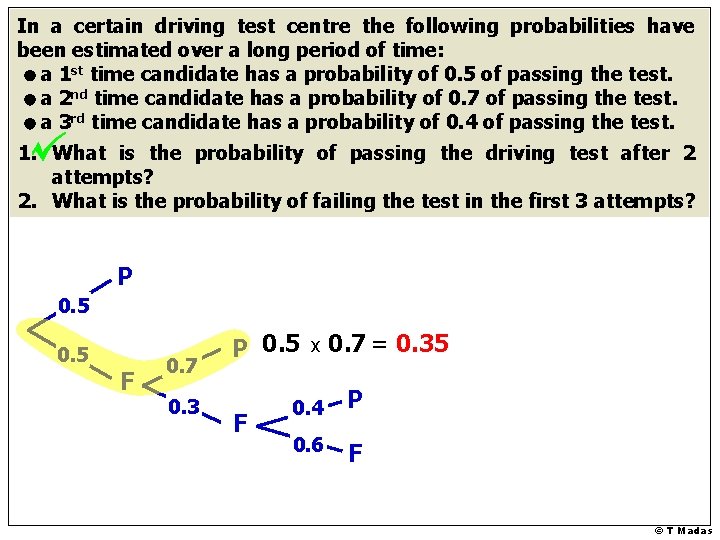
In a certain driving test centre the following probabilities have been estimated over a long period of time: a 1 st time candidate has a probability of 0. 5 of passing the test. a 2 nd time candidate has a probability of 0. 7 of passing the test. a 3 rd time candidate has a probability of 0. 4 of passing the test. 1. What is the probability of passing the driving test after 2 attempts? 2. What is the probability of failing the test in the first 3 attempts? P 0. 5 F 0. 7 0. 3 P 0. 5 x 0. 7 = 0. 35 F 0. 4 P 0. 6 F © T Madas
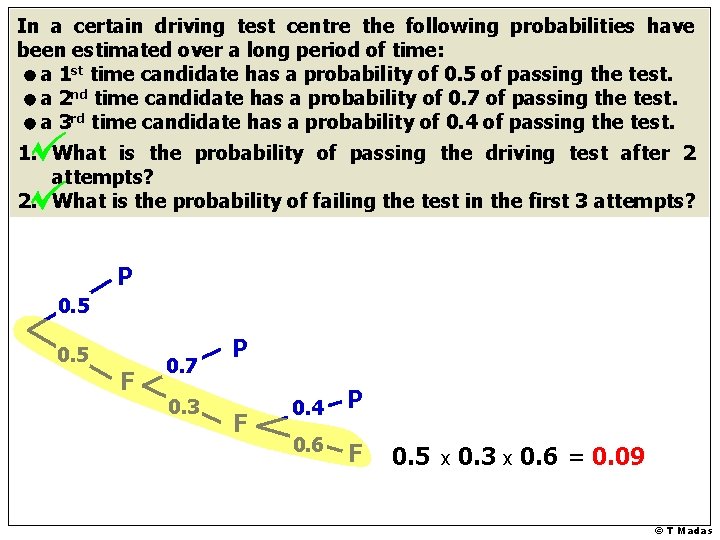
In a certain driving test centre the following probabilities have been estimated over a long period of time: a 1 st time candidate has a probability of 0. 5 of passing the test. a 2 nd time candidate has a probability of 0. 7 of passing the test. a 3 rd time candidate has a probability of 0. 4 of passing the test. 1. What is the probability of passing the driving test after 2 attempts? 2. What is the probability of failing the test in the first 3 attempts? P 0. 5 F 0. 7 0. 3 P F 0. 4 P 0. 6 F 0. 5 x 0. 3 x 0. 6 = 0. 09 © T Madas
An A* Exam Question © T Madas
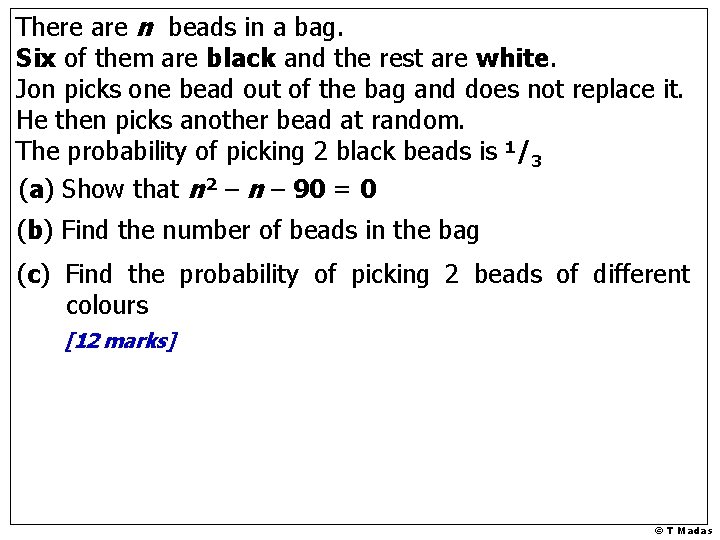
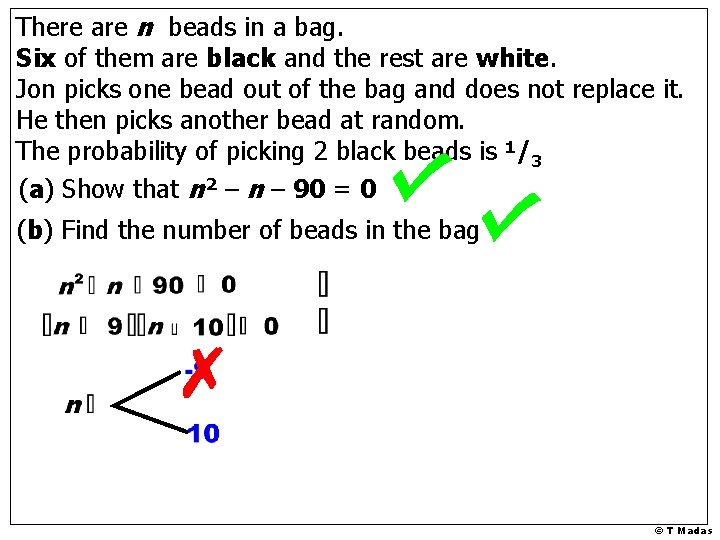
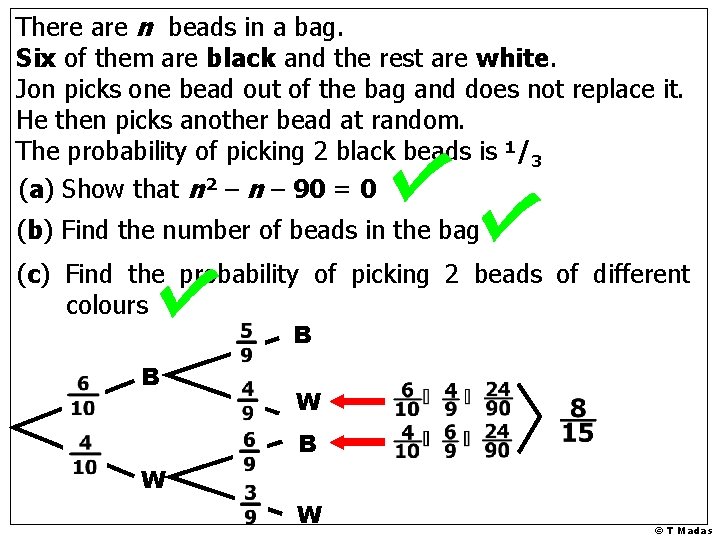
There are n beads in a bag. Six of them are black and the rest are white. Jon picks one bead out of the bag and does not replace it. He then picks another bead at random. The probability of picking 2 black beads is 1/3 (a) Show that n 2 – n – 90 = 0 (b) Find the number of beads in the bag (c) Find the probability of picking 2 beads of different colours [12 marks] © T Madas
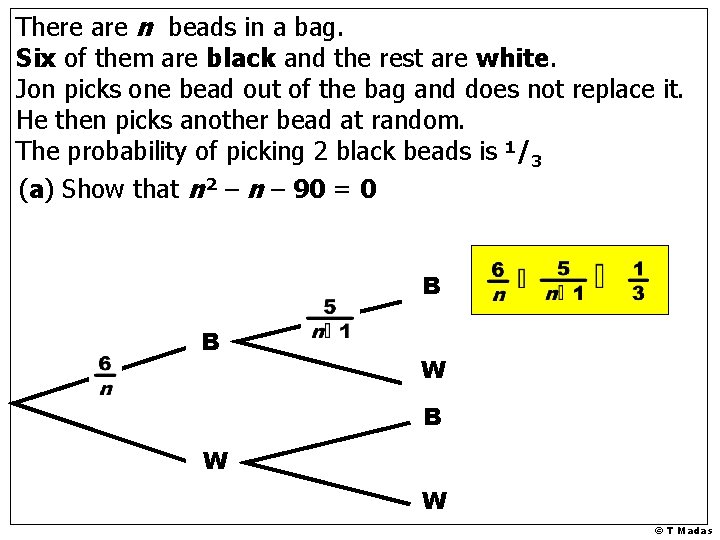
There are n beads in a bag. Six of them are black and the rest are white. Jon picks one bead out of the bag and does not replace it. He then picks another bead at random. The probability of picking 2 black beads is 1/3 (a) Show that n 2 – n – 90 = 0 B B W W © T Madas
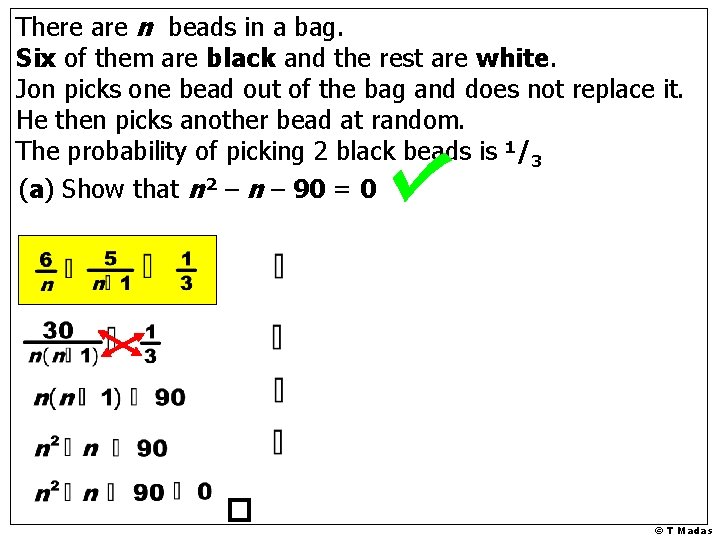
There are n beads in a bag. Six of them are black and the rest are white. Jon picks one bead out of the bag and does not replace it. He then picks another bead at random. The probability of picking 2 black beads is 1/3 (a) Show that n 2 – n – 90 = 0 © T Madas
There are n beads in a bag. Six of them are black and the rest are white. Jon picks one bead out of the bag and does not replace it. He then picks another bead at random. The probability of picking 2 black beads is 1/3 (a) Show that n 2 – n – 90 = 0 (b) Find the number of beads in the bag © T Madas
There are n beads in a bag. Six of them are black and the rest are white. Jon picks one bead out of the bag and does not replace it. He then picks another bead at random. The probability of picking 2 black beads is 1/3 (a) Show that n 2 – n – 90 = 0 (b) Find the number of beads in the bag (c) Find the probability of picking 2 beads of different colours B B W W © T Madas
© T Madas