
T Madas T Madas The term surd is

- Slides: 25
© T Madas
© T Madas
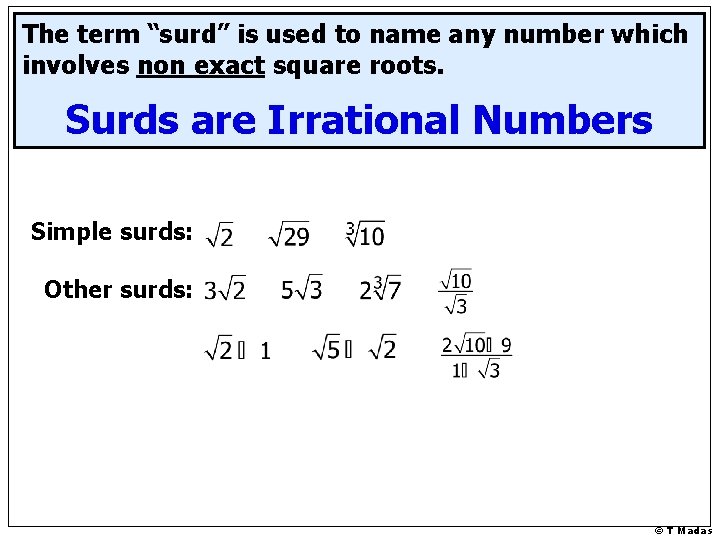
The term “surd” is used to name any number which involves non exact square roots. Surds are Irrational Numbers Simple surds: Other surds: © T Madas
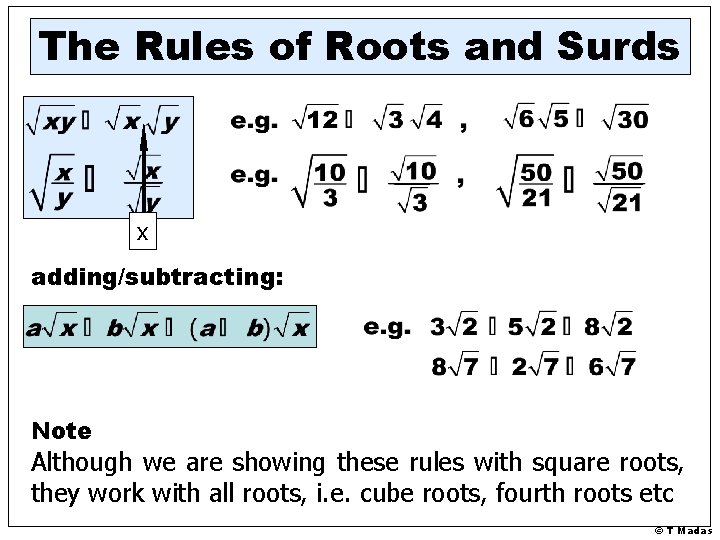
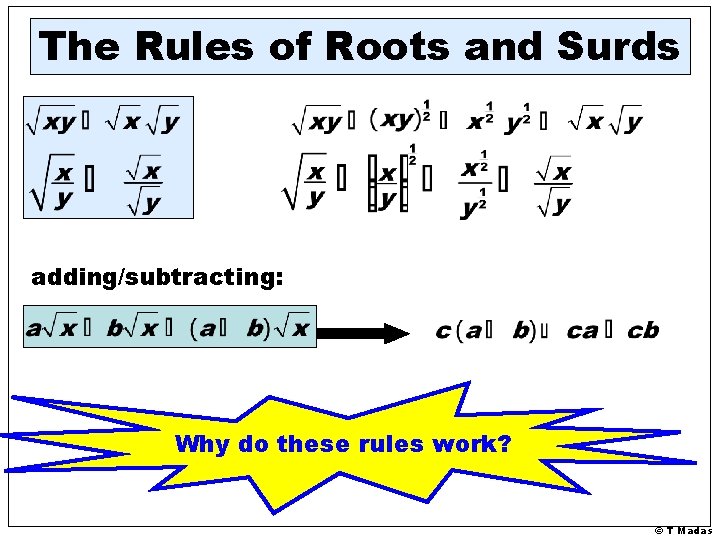
The Rules of Roots and Surds x adding/subtracting: Note Although we are showing these rules with square roots, they work with all roots, i. e. cube roots, fourth roots etc © T Madas
The Rules of Roots and Surds adding/subtracting: Why do these rules work? © T Madas
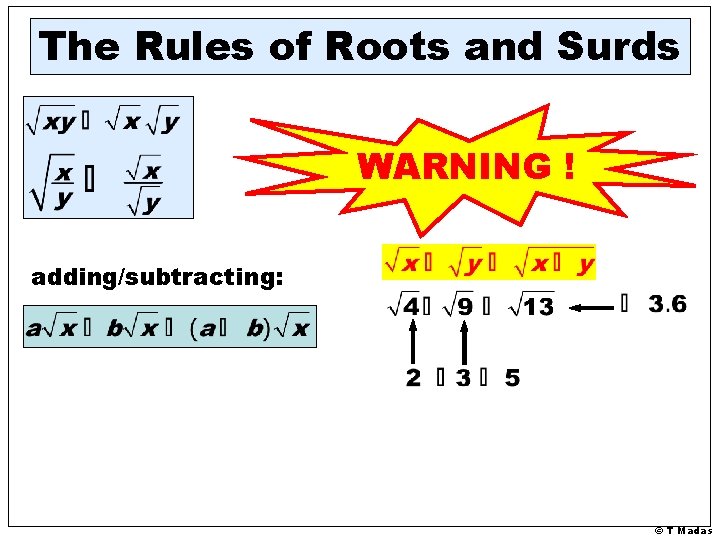
The Rules of Roots and Surds WARNING ! adding/subtracting: © T Madas
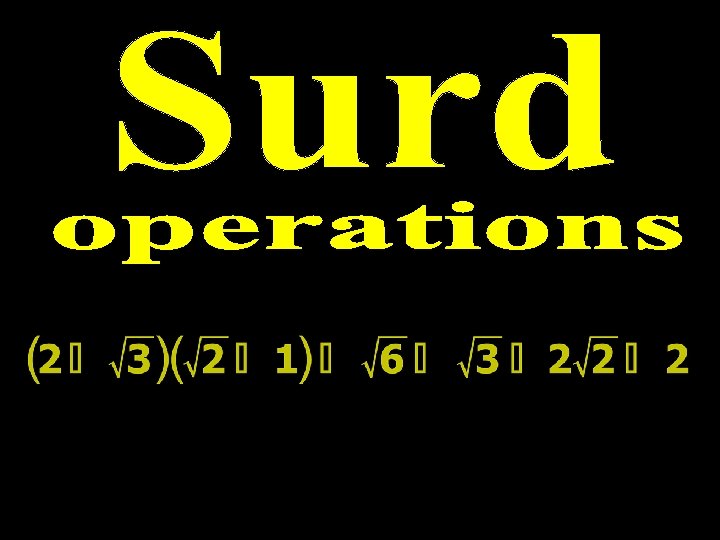
© T Madas
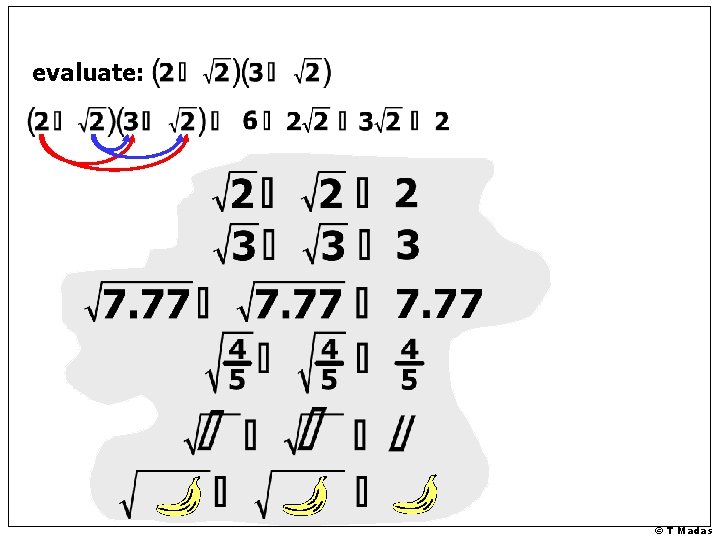
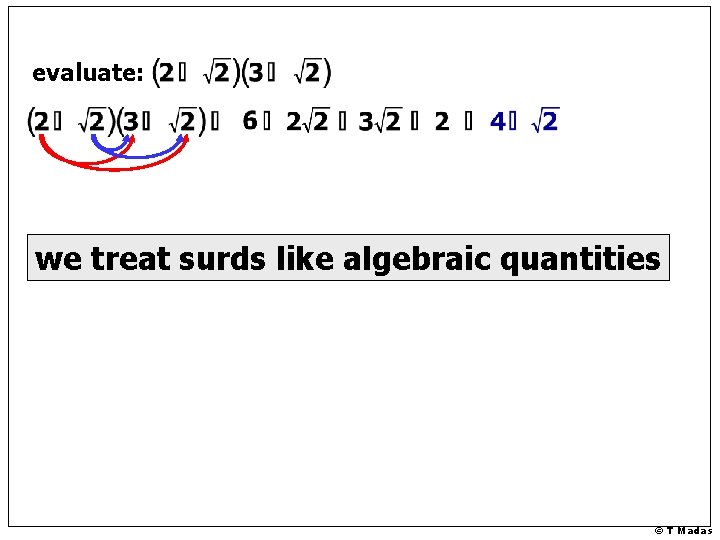
evaluate: © T Madas
evaluate: we treat surds like algebraic quantities © T Madas
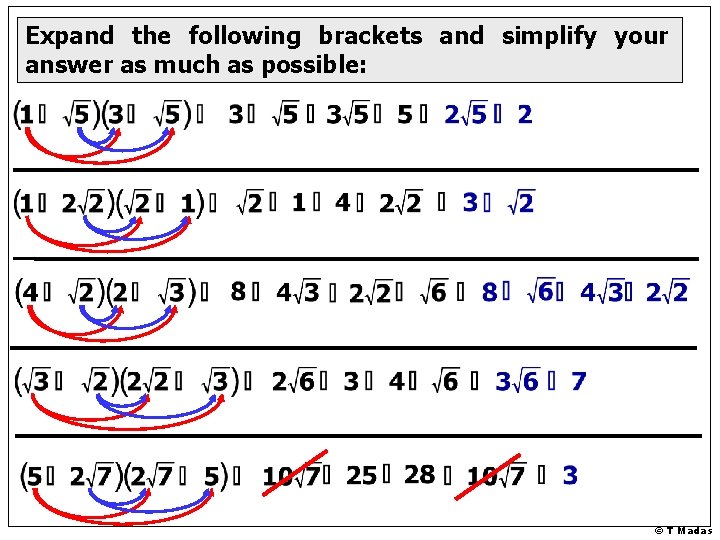
Expand the following brackets and simplify your answer as much as possible: © T Madas
© T Madas
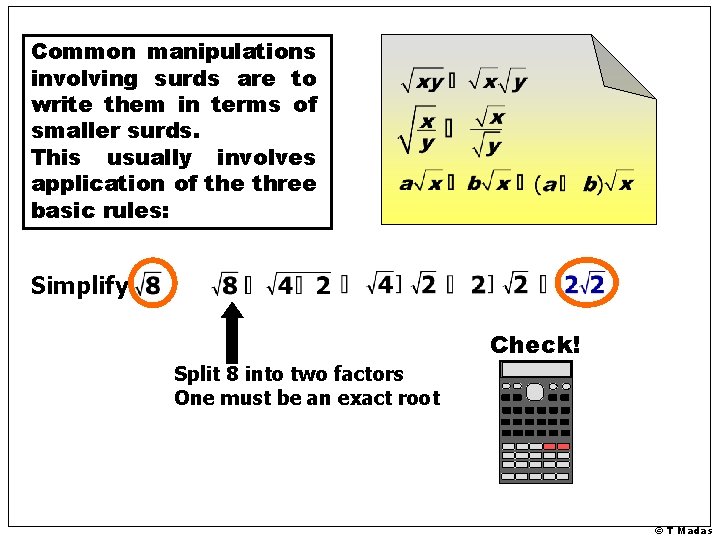
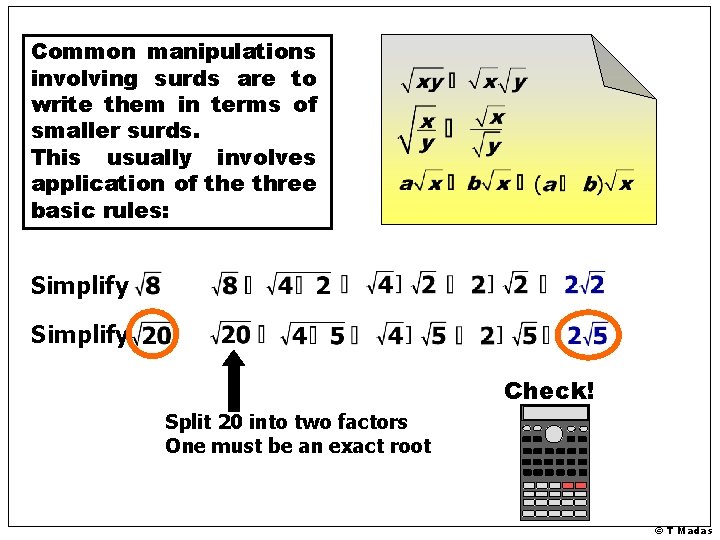
Common manipulations involving surds are to write them in terms of smaller surds. This usually involves application of the three basic rules: Simplify Check! Split 8 into two factors One must be an exact root © T Madas
Common manipulations involving surds are to write them in terms of smaller surds. This usually involves application of the three basic rules: Simplify Check! Split 20 into two factors One must be an exact root © T Madas
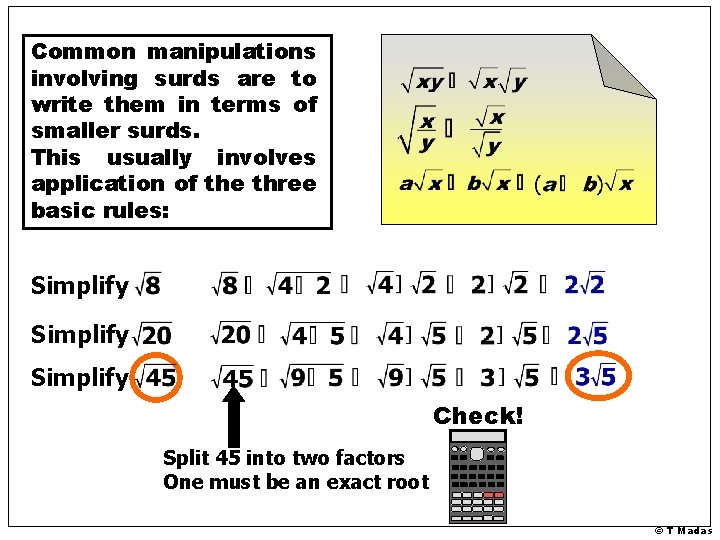
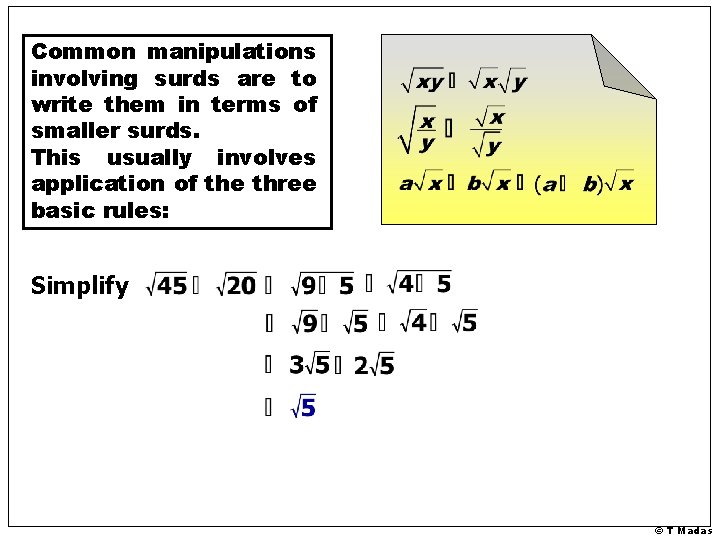
Common manipulations involving surds are to write them in terms of smaller surds. This usually involves application of the three basic rules: Simplify Check! Split 45 into two factors One must be an exact root © T Madas
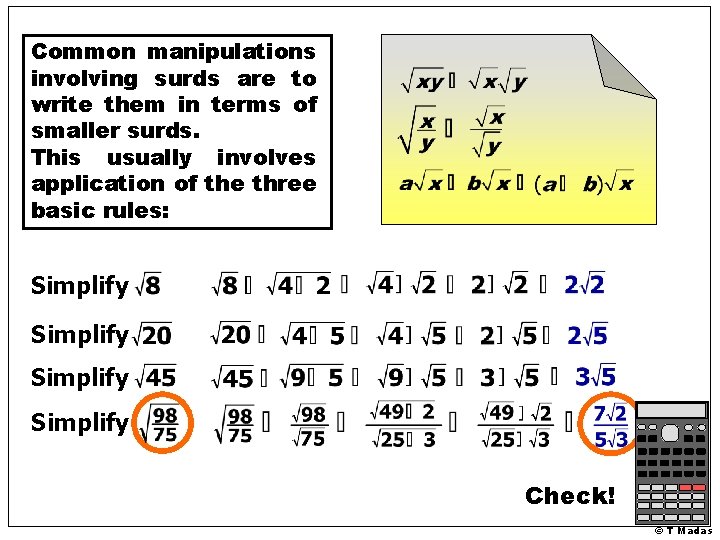
Common manipulations involving surds are to write them in terms of smaller surds. This usually involves application of the three basic rules: Simplify Check! © T Madas
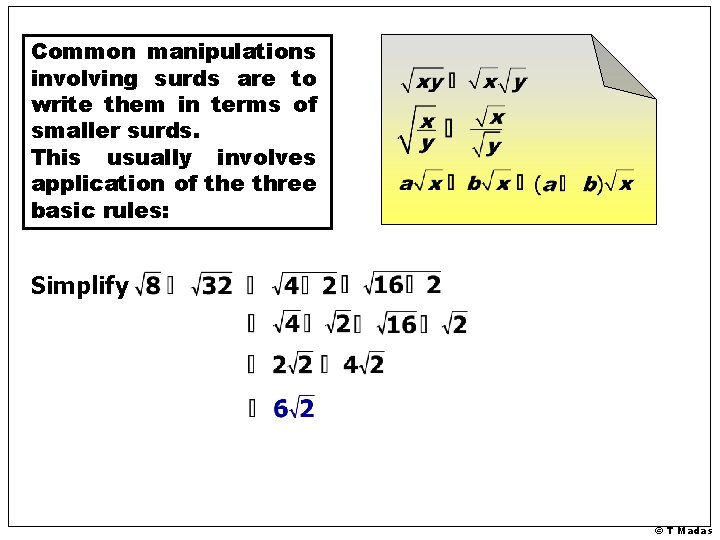
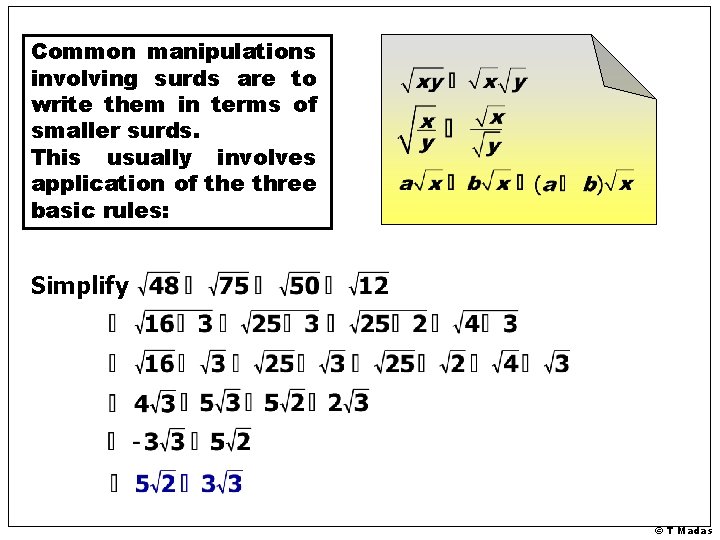
Common manipulations involving surds are to write them in terms of smaller surds. This usually involves application of the three basic rules: Simplify © T Madas
Common manipulations involving surds are to write them in terms of smaller surds. This usually involves application of the three basic rules: Simplify © T Madas
Common manipulations involving surds are to write them in terms of smaller surds. This usually involves application of the three basic rules: Simplify © T Madas
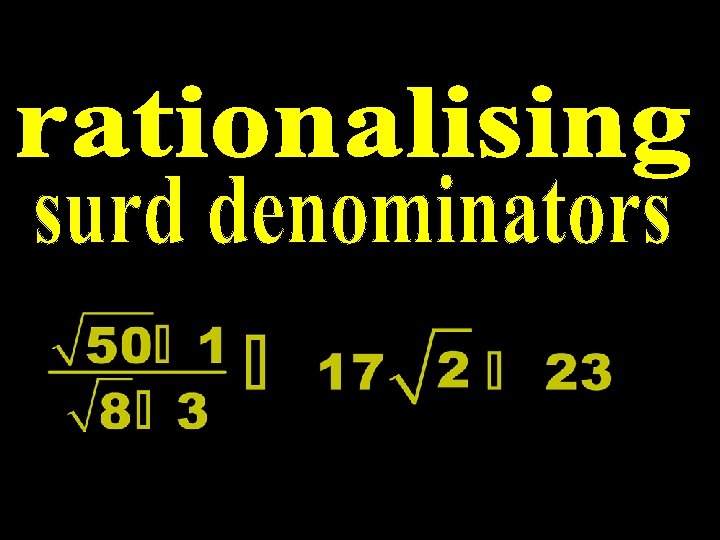
© T Madas
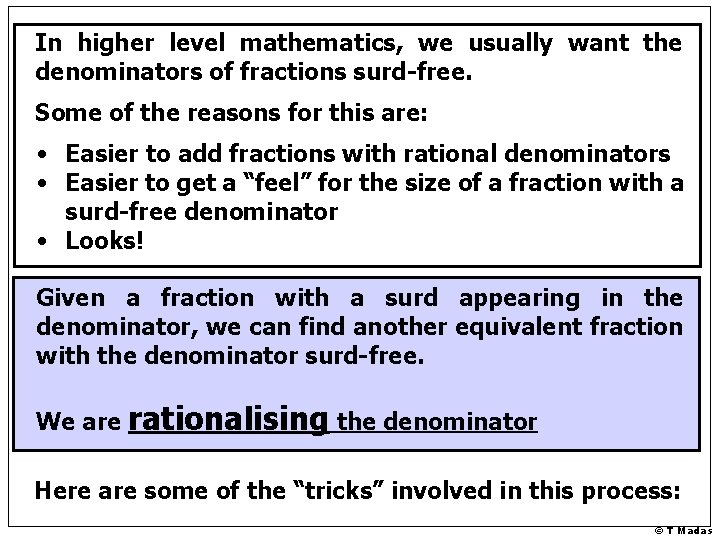
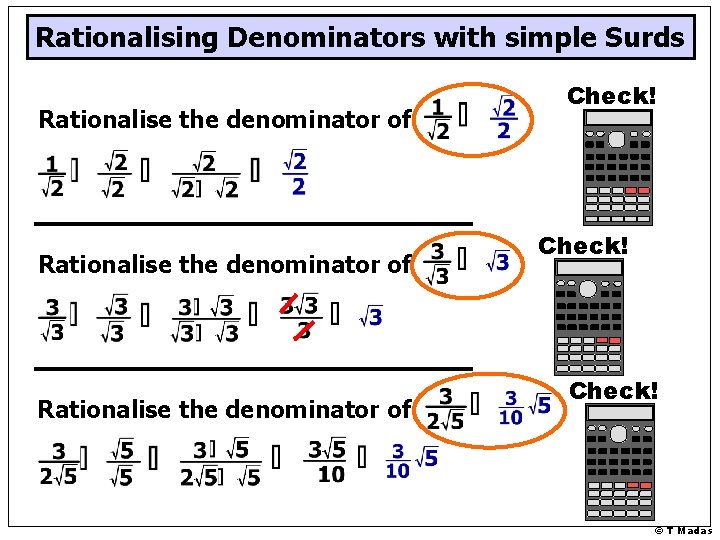
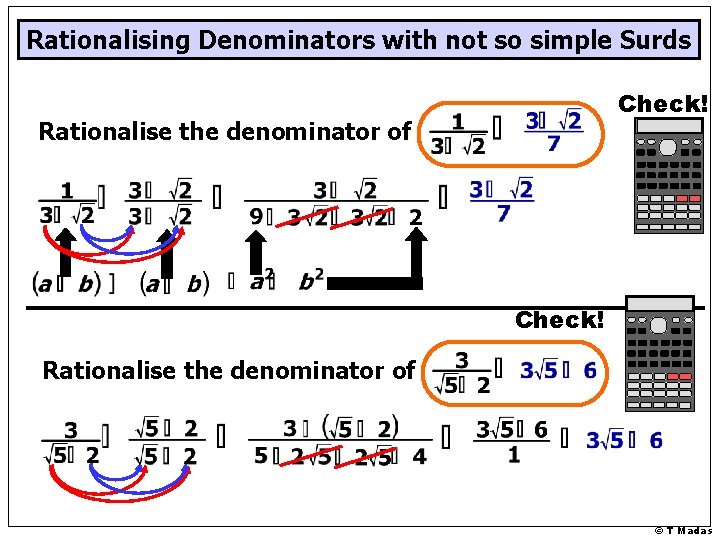
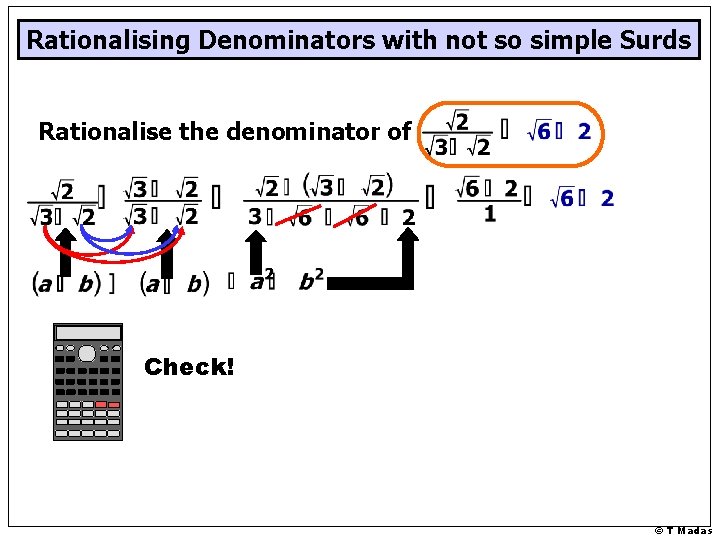
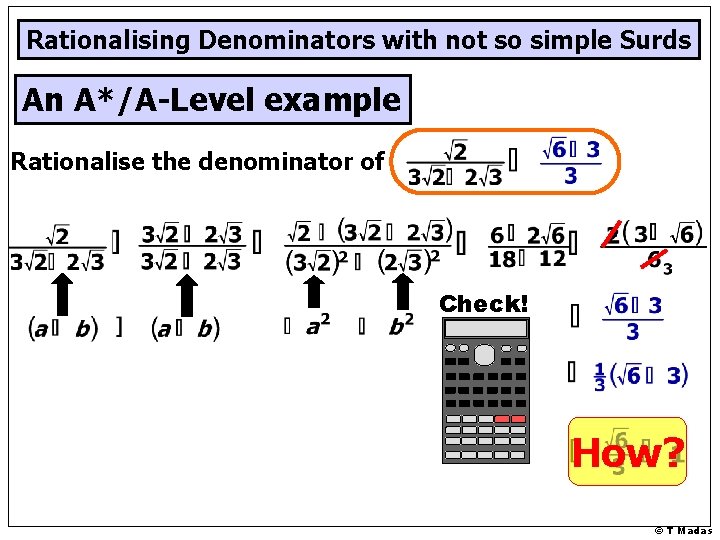
In higher level mathematics, we usually want the denominators of fractions surd-free. Some of the reasons for this are: • Easier to add fractions with rational denominators • Easier to get a “feel” for the size of a fraction with a surd-free denominator • Looks! Given a fraction with a surd appearing in the denominator, we can find another equivalent fraction with the denominator surd-free. We are rationalising the denominator Here are some of the “tricks” involved in this process: © T Madas
Rationalising Denominators with simple Surds Rationalise the denominator of Check! © T Madas
Rationalising Denominators with not so simple Surds Check! Rationalise the denominator of © T Madas
Rationalising Denominators with not so simple Surds Rationalise the denominator of Check! © T Madas
Rationalising Denominators with not so simple Surds An A*/A-Level example Rationalise the denominator of Check! How? © T Madas
© T Madas