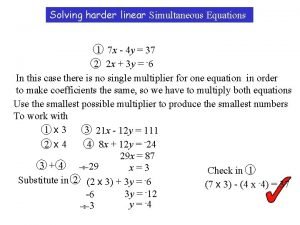
T Madas Solve the following simultaneous equations 1







- Slides: 47
© T Madas
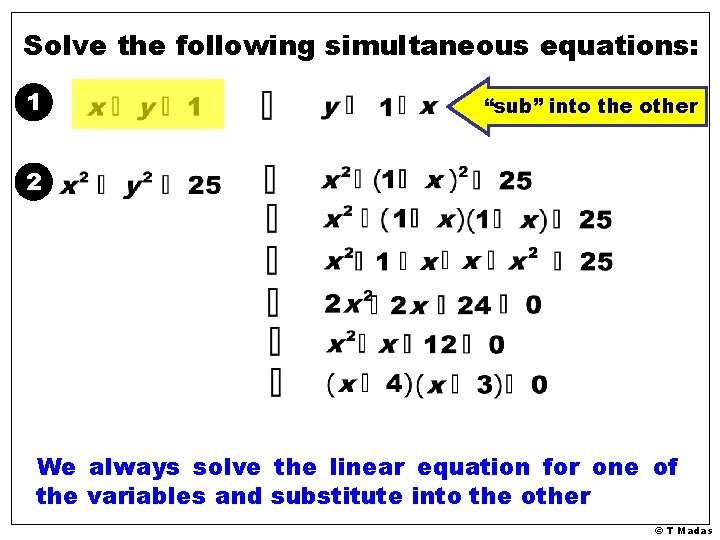
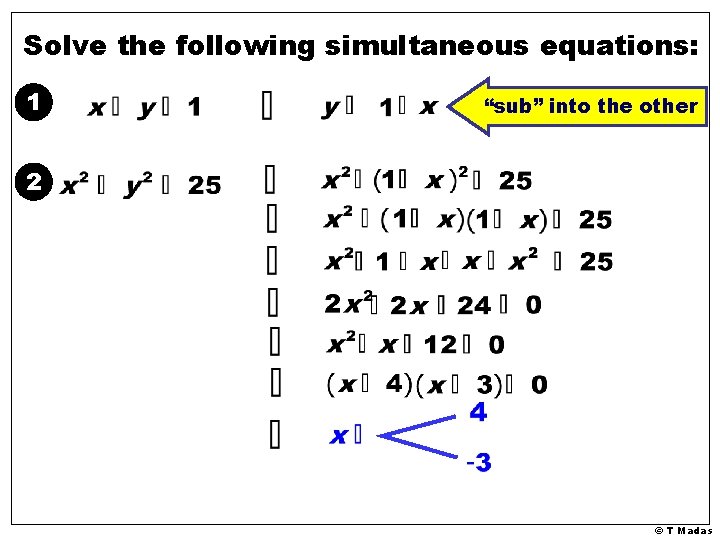
Solve the following simultaneous equations: 1 2 Linear Non - linear Quadratic To solve a system of simultaneous equations of which one is linear and one is quadratic: We always solve the linear equation for one of the variables and substitute into the other © T Madas
Solve the following simultaneous equations: 1 “sub” into the other 2 We always solve the linear equation for one of the variables and substitute into the other © T Madas
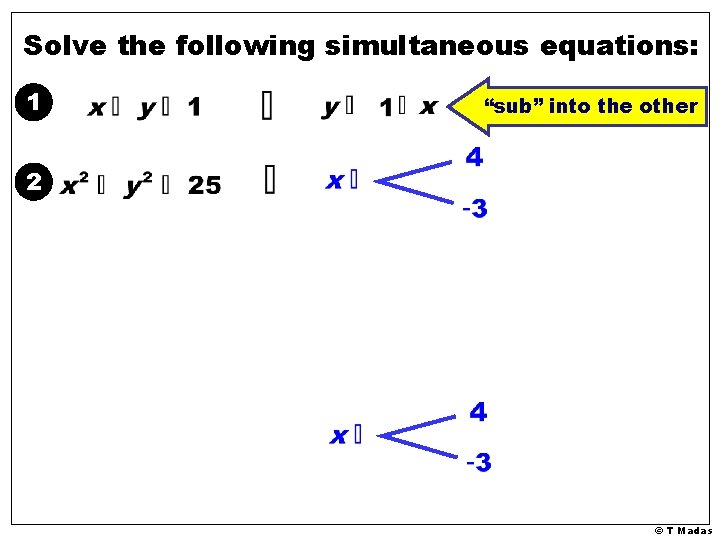
Solve the following simultaneous equations: 1 “sub” into the other 2 © T Madas
Solve the following simultaneous equations: 1 “sub” into the other 2 © T Madas
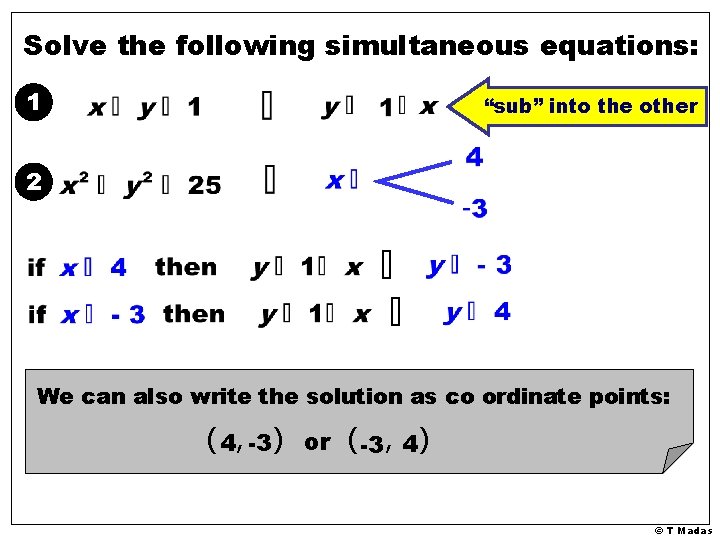
Solve the following simultaneous equations: 1 “sub” into the other 2 We can also write the solution as co ordinate points: ( 4, -3) or ( -3, 4) © T Madas
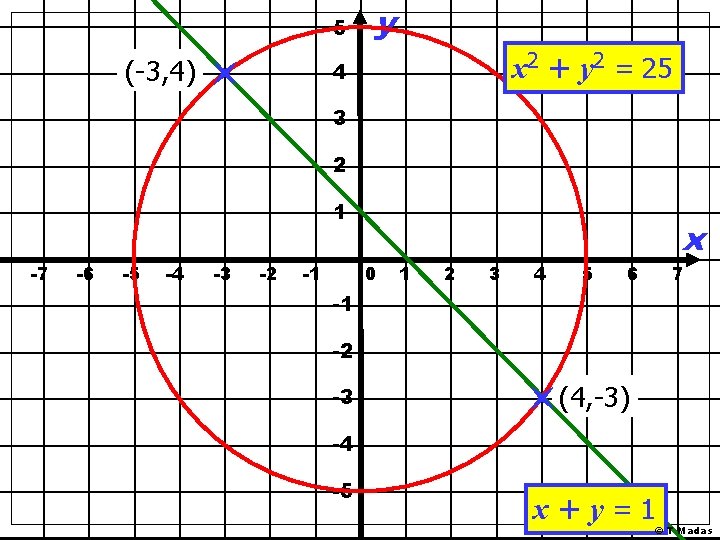
5 (-3, 4) y x 2 + y 2 = 25 4 3 2 1 -7 -6 -5 -4 -3 -2 -1 0 1 2 3 4 5 6 x 7 -1 -2 -3 (4, -3) -4 -5 x+y=1 © T Madas
© T Madas
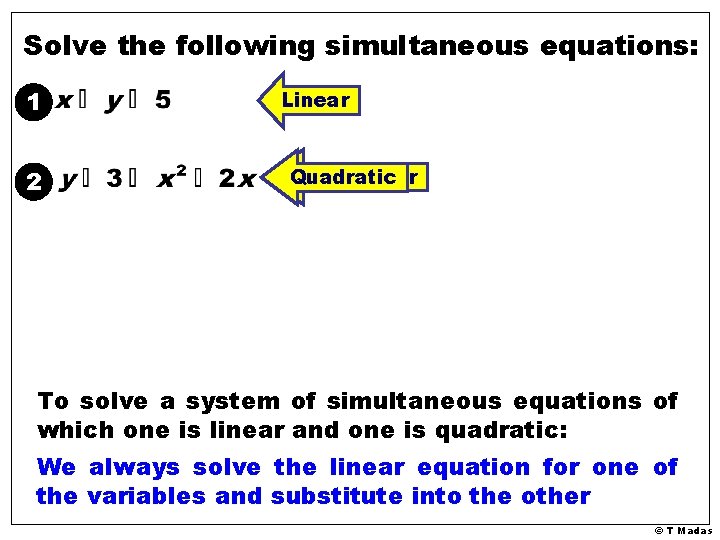
Solve the following simultaneous equations: 1 2 Linear Non - linear Quadratic To solve a system of simultaneous equations of which one is linear and one is quadratic: We always solve the linear equation for one of the variables and substitute into the other © T Madas
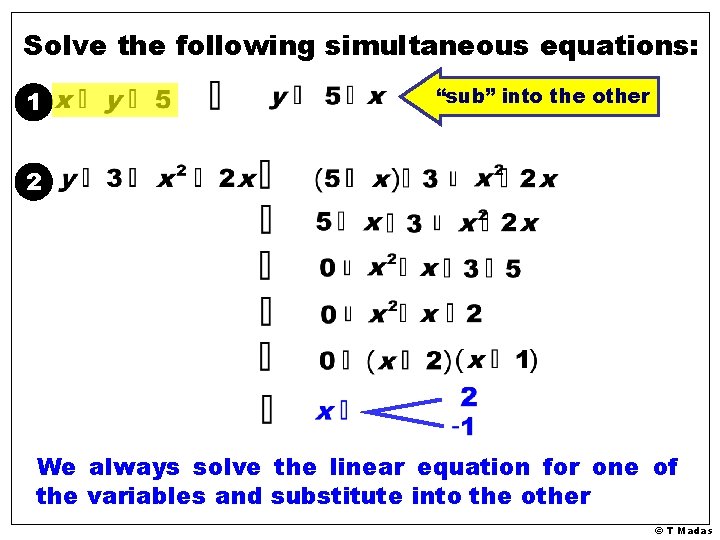
Solve the following simultaneous equations: 1 “sub” into the other 2 We always solve the linear equation for one of the variables and substitute into the other © T Madas
Solve the following simultaneous equations: 1 “sub” into the other 2 We always solve the linear equation for one of the variables and substitute into the other © T Madas
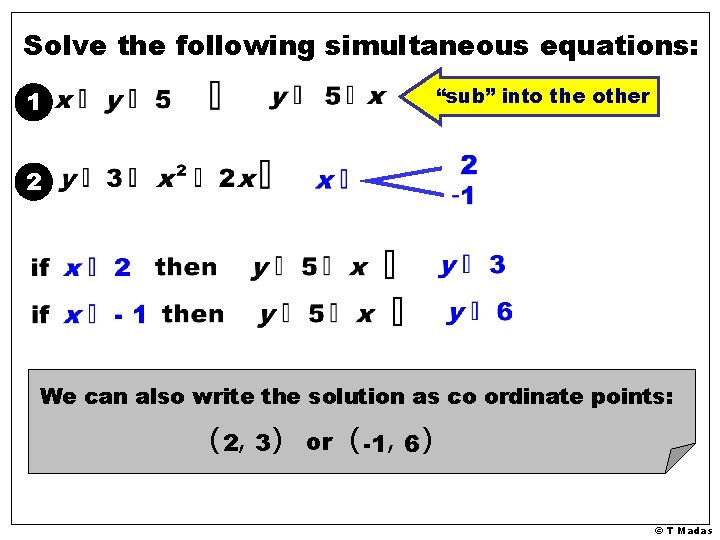
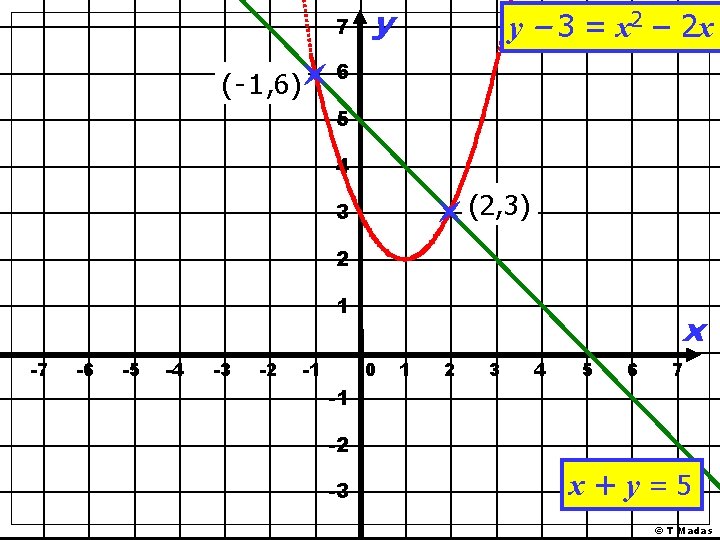
Solve the following simultaneous equations: “sub” into the other 1 2 We can also write the solution as co ordinate points: ( 2, 3) or ( -1, 6) © T Madas
7 y y – 3 = x 2 – 2 x 6 ( - 1 , 6) 5 4 (2, 3) 3 2 1 -7 -6 -5 -4 -3 -2 -1 x 0 1 2 3 4 5 6 7 -1 -2 -3 x+y=5 © T Madas
© T Madas
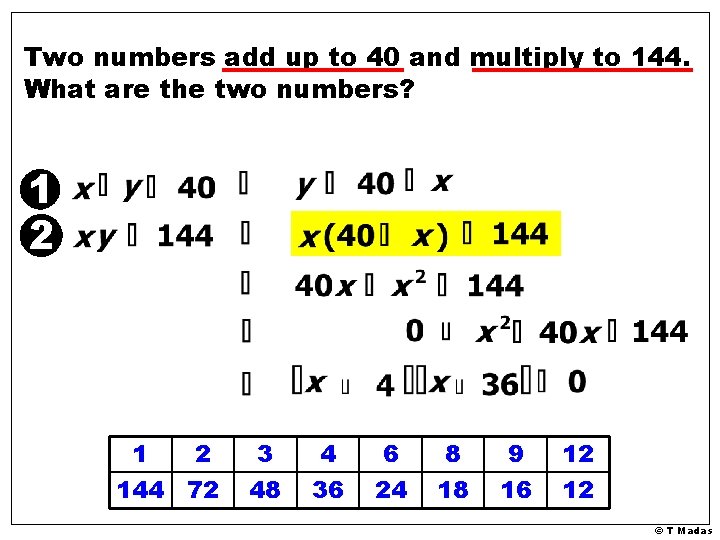
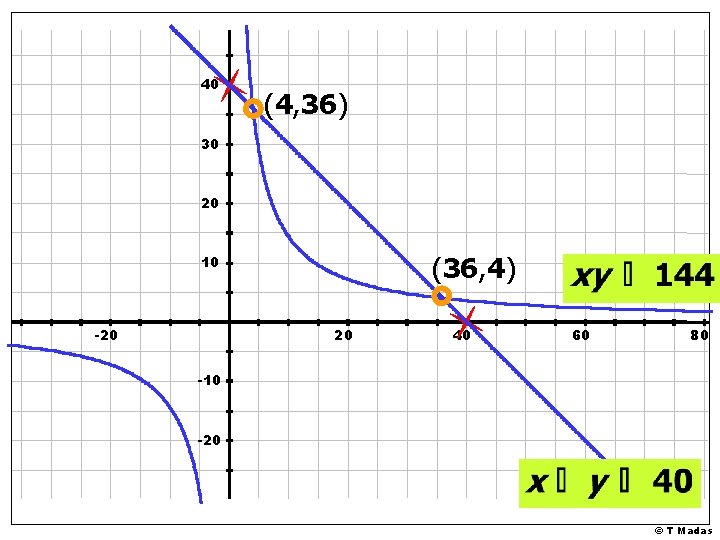
Two numbers add up to 40 and multiply to 144. What are the two numbers? 1 2 144 72 3 48 4 36 6 24 8 18 9 16 12 12 © T Madas
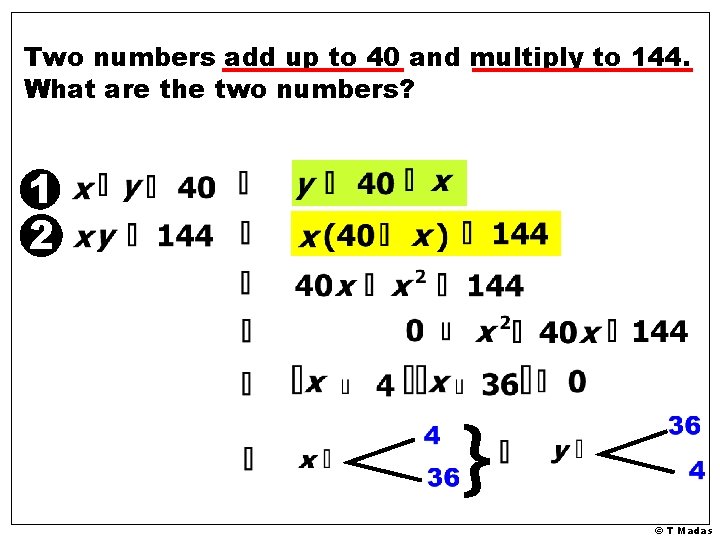
Two numbers add up to 40 and multiply to 144. What are the two numbers? 1 2 } © T Madas
40 (4, 36) 30 20 (36, 4) 10 -20 20 40 60 80 -10 -20 © T Madas
© T Madas
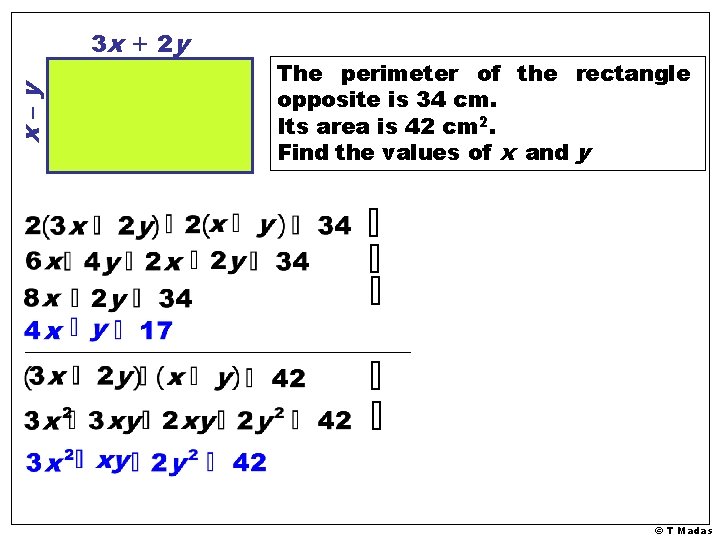
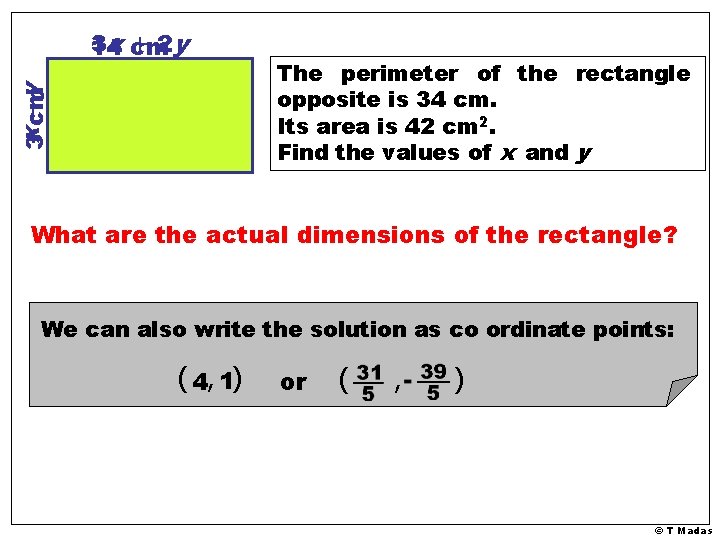
x–y 3 x + 2 y The perimeter of the rectangle opposite is 34 cm. Its area is 42 cm 2. Find the values of x and y © T Madas
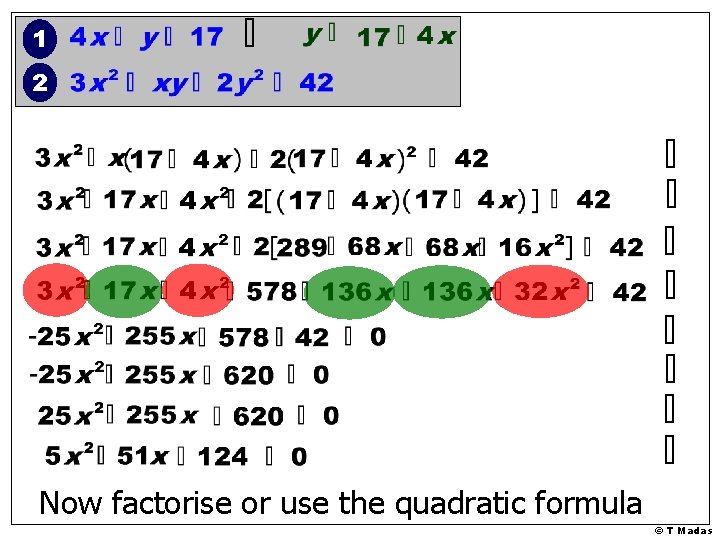
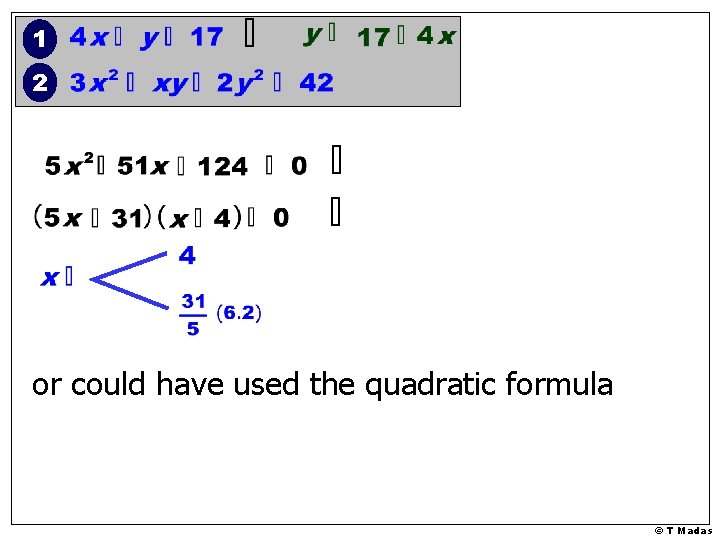
1 2 Now factorise or use the quadratic formula © T Madas
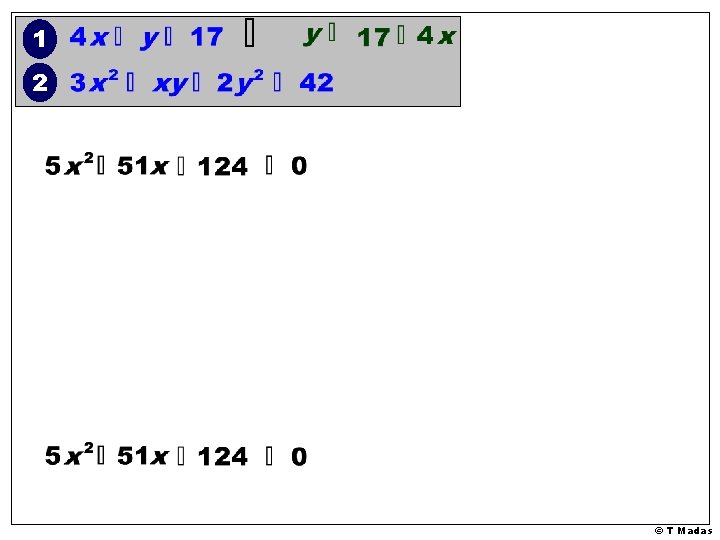
1 2 © T Madas
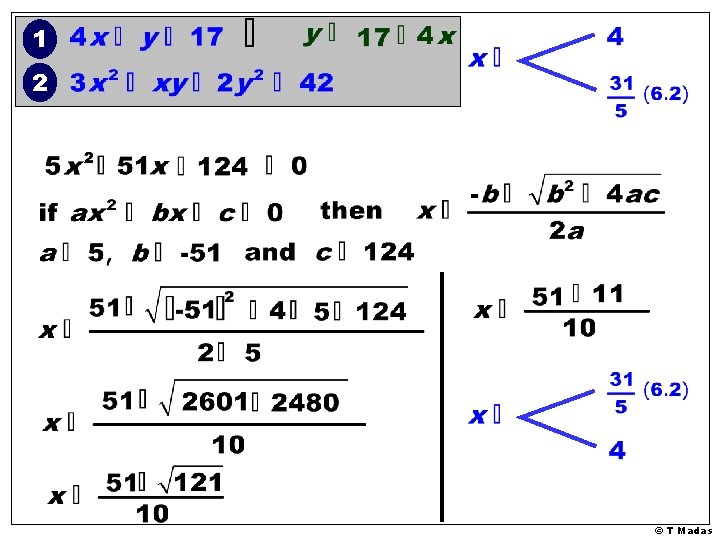
1 2 or could have used the quadratic formula © T Madas
1 2 © T Madas
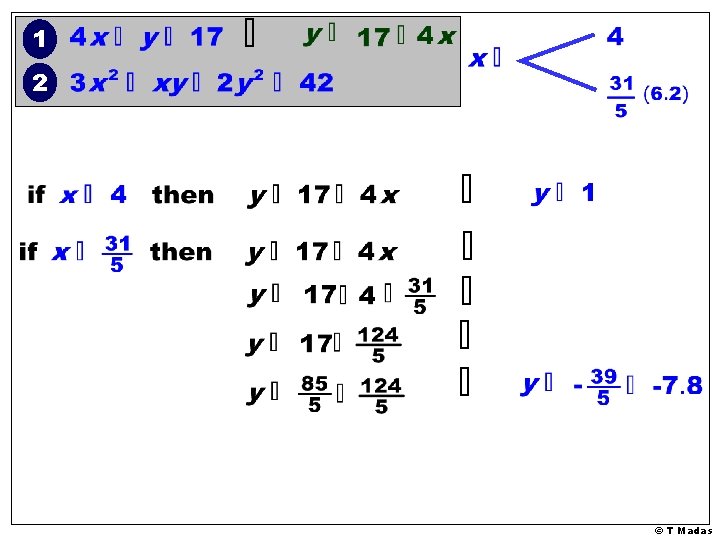
1 2 © T Madas
1 2 © T Madas
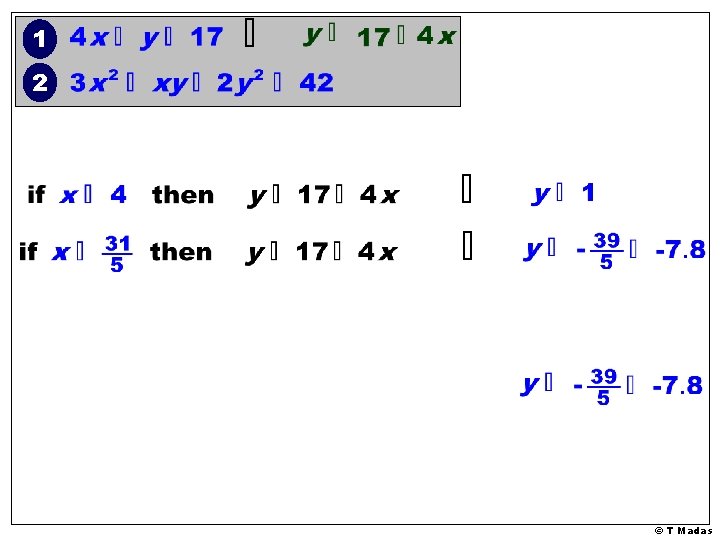
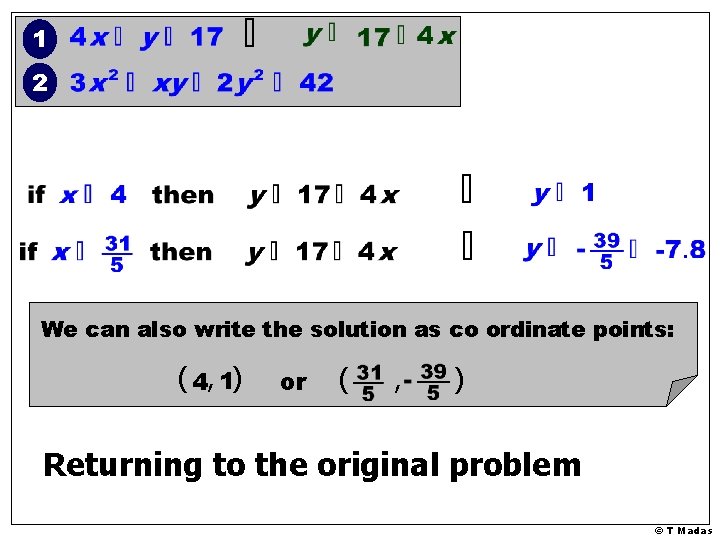
1 2 We can also write the solution as co ordinate points: ( 4, 1) or ( , ) Returning to the original problem © T Madas
–y 3 x cm + 2 y 14 The perimeter of the rectangle opposite is 34 cm. Its area is 42 cm 2. Find the values of x and y What are the actual dimensions of the rectangle? We can also write the solution as co ordinate points: ( 4, 1) or ( , ) © T Madas
© T Madas
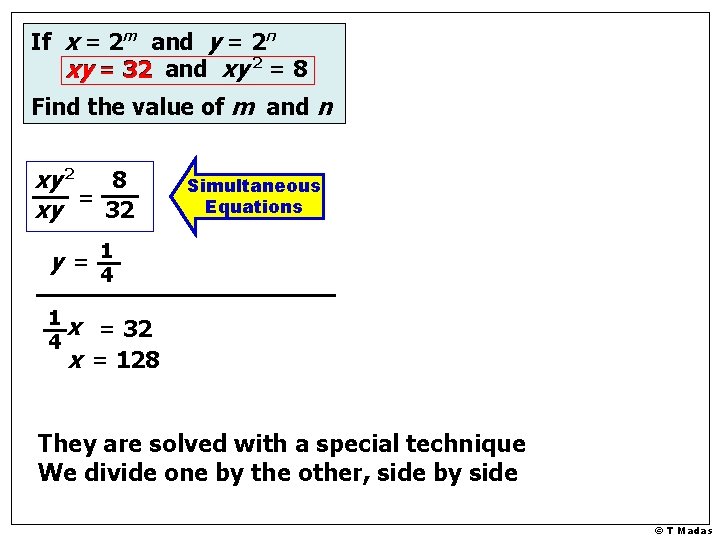
If x = 2 m and y = 2 n xy = 32 and xy 2 = 8 Find the value of m and n xy 2 = 8 = xy = 32 Simultaneous Equations y = 1 4 x = 32 x = 128 They are solved with a special technique We divide one by the other, side by side © T Madas
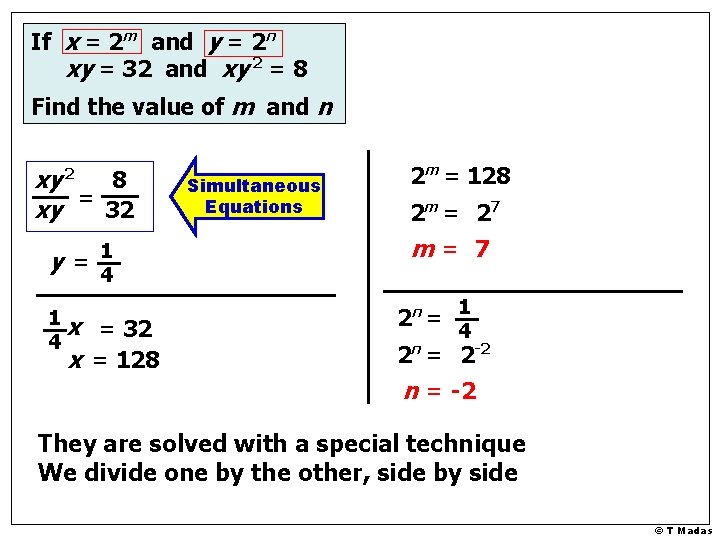
If x = 2 m and y = 2 n xy = 32 and xy 2 = 8 Find the value of m and n 2 xy = 8 = xy = 32 y = 1 4 x = 32 x = 128 Simultaneous Equations 2 m = 128 2 m = 27 m= 7 2 n = 1 4 2 n = 2 -2 n = -2 They are solved with a special technique We divide one by the other, side by side © T Madas
© T Madas
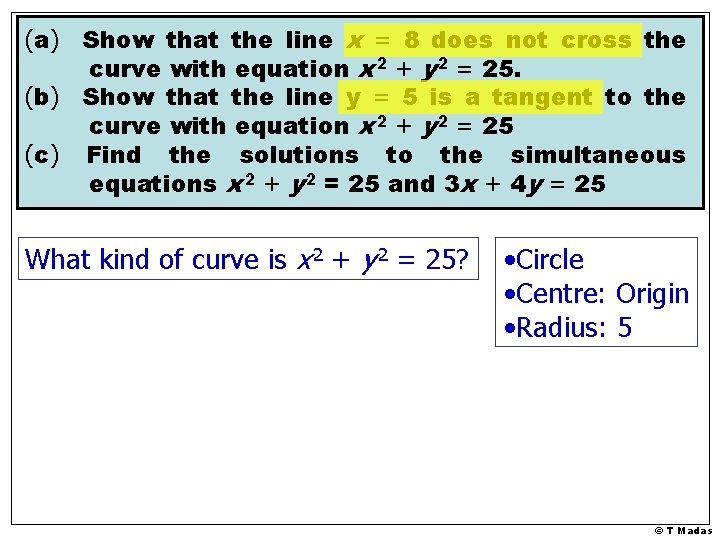
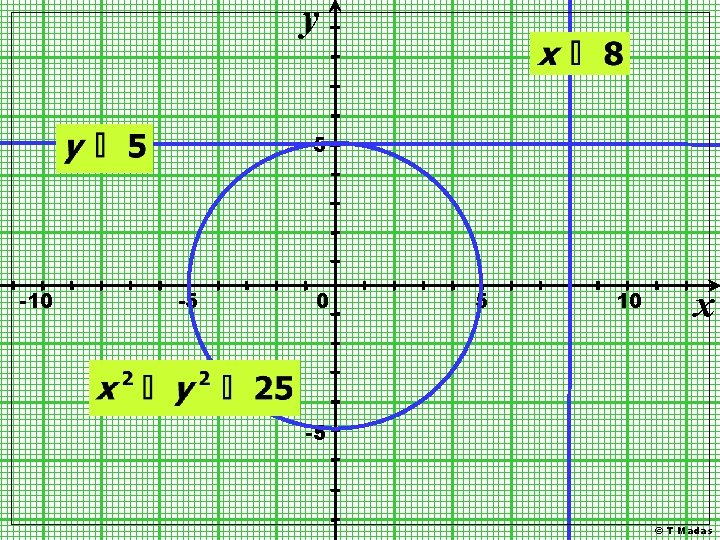
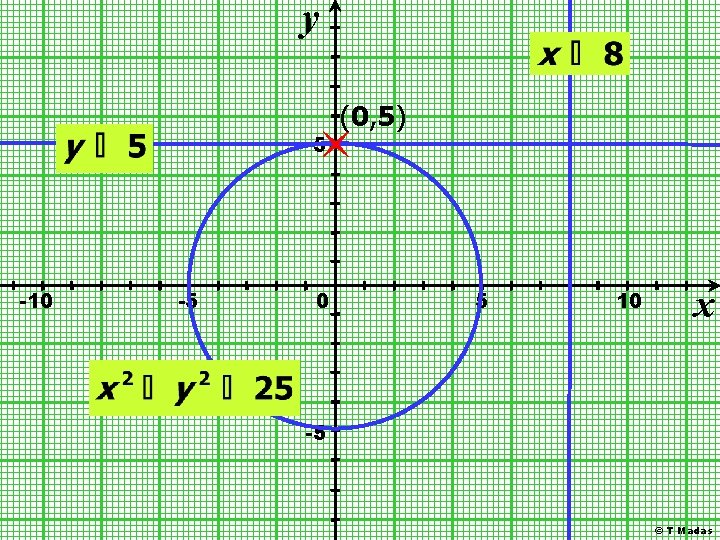
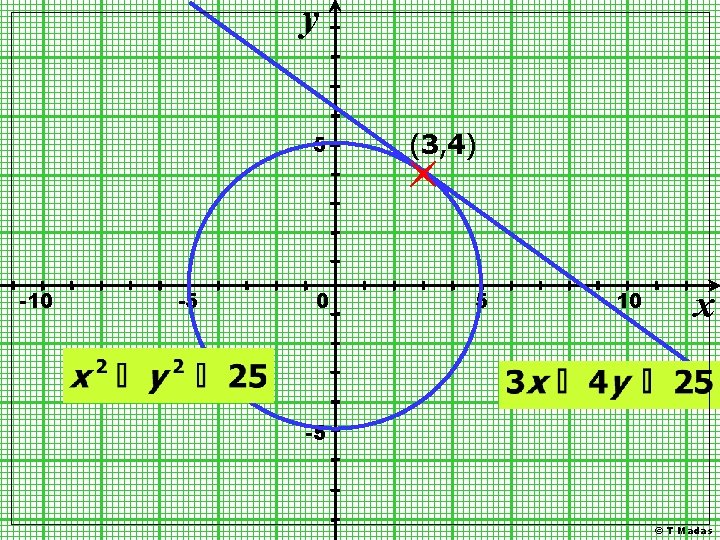
(a) Show that the line x = 8 does not cross the curve with equation x 2 + y 2 = 25. (b) Show that the line y = 5 is a tangent to the curve with equation x 2 + y 2 = 25 (c) Find the solutions to the simultaneous equations x 2 + y 2 = 25 and 3 x + 4 y = 25 What kind of curve is x 2 + y 2 = 25? • Circle • Centre: Origin • Radius: 5 © T Madas
y 5 -10 -5 0 5 10 x -5 © T Madas
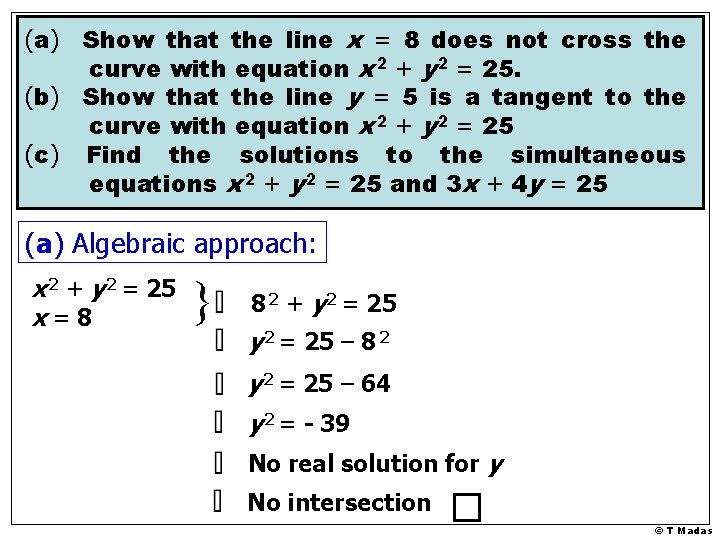
(a) Show that the line x = 8 does not cross the curve with equation x 2 + y 2 = 25. (b) Show that the line y = 5 is a tangent to the curve with equation x 2 + y 2 = 25 (c) Find the solutions to the simultaneous equations x 2 + y 2 = 25 and 3 x + 4 y = 25 (a) Algebraic approach: x 2 + y 2 = 25 x=8 } 8 2 + y 2 = 25 – 8 2 y 2 = 25 – 64 y 2 = - 39 No real solution for y No intersection © T Madas
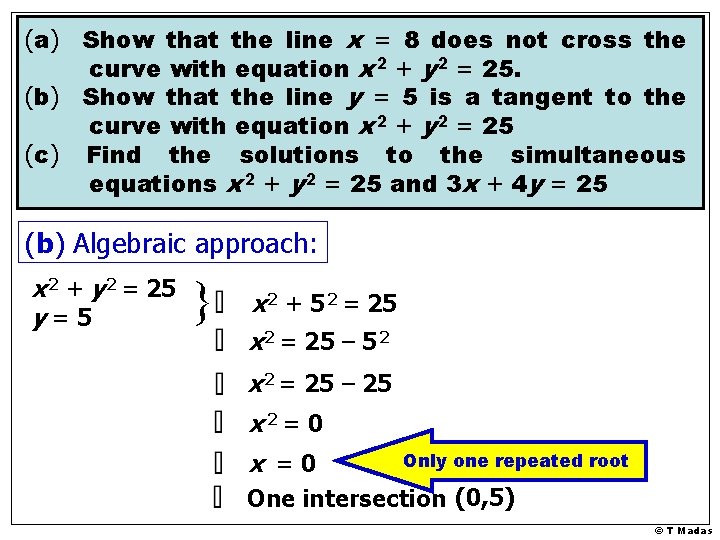
(a) Show that the line x = 8 does not cross the curve with equation x 2 + y 2 = 25. (b) Show that the line y = 5 is a tangent to the curve with equation x 2 + y 2 = 25 (c) Find the solutions to the simultaneous equations x 2 + y 2 = 25 and 3 x + 4 y = 25 (b) Algebraic approach: x 2 + y 2 = 25 y=5 } x 2 + 5 2 = 25 x 2 = 25 – 5 2 x 2 = 25 – 25 x 2= 0 x =0 Only one repeated root One intersection (0, 5) © T Madas
y 5 -10 -5 0 (0, 5) 5 10 x -5 © T Madas
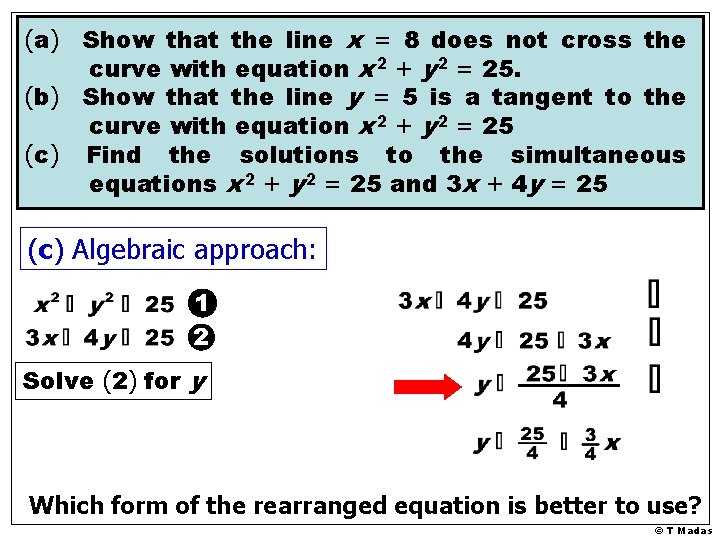
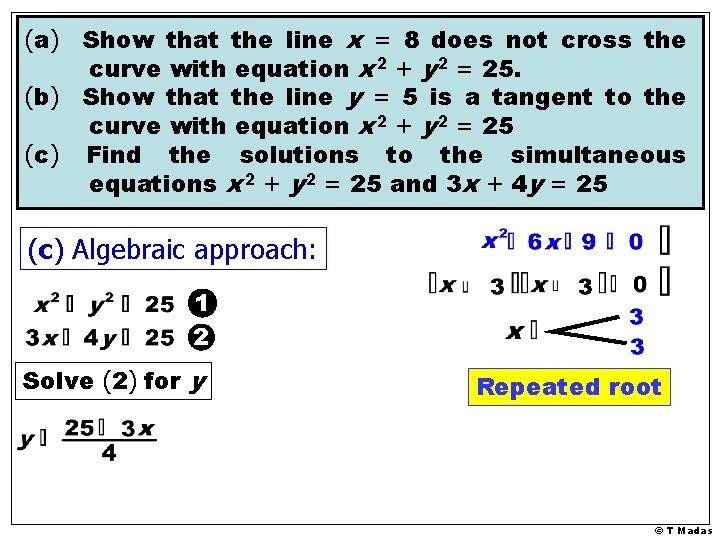
(a) Show that the line x = 8 does not cross the curve with equation x 2 + y 2 = 25. (b) Show that the line y = 5 is a tangent to the curve with equation x 2 + y 2 = 25 (c) Find the solutions to the simultaneous equations x 2 + y 2 = 25 and 3 x + 4 y = 25 (c) Algebraic approach: 1 2 Solve (2) for y Which form of the rearranged equation is better to use? © T Madas
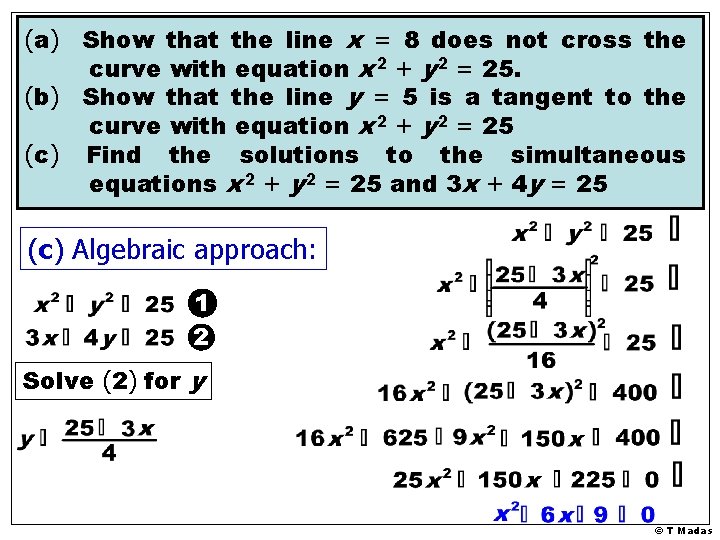
(a) Show that the line x = 8 does not cross the curve with equation x 2 + y 2 = 25. (b) Show that the line y = 5 is a tangent to the curve with equation x 2 + y 2 = 25 (c) Find the solutions to the simultaneous equations x 2 + y 2 = 25 and 3 x + 4 y = 25 (c) Algebraic approach: 1 2 Solve (2) for y © T Madas
(a) Show that the line x = 8 does not cross the curve with equation x 2 + y 2 = 25. (b) Show that the line y = 5 is a tangent to the curve with equation x 2 + y 2 = 25 (c) Find the solutions to the simultaneous equations x 2 + y 2 = 25 and 3 x + 4 y = 25 (c) Algebraic approach: 1 2 Solve (2) for y © T Madas
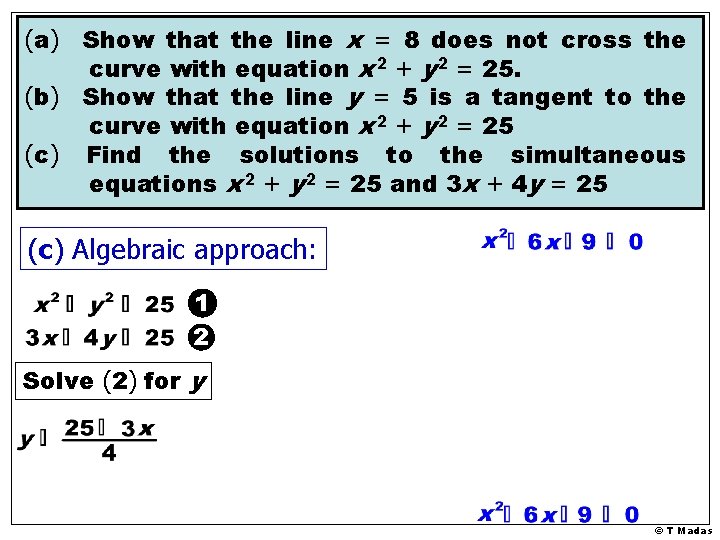
(a) Show that the line x = 8 does not cross the curve with equation x 2 + y 2 = 25. (b) Show that the line y = 5 is a tangent to the curve with equation x 2 + y 2 = 25 (c) Find the solutions to the simultaneous equations x 2 + y 2 = 25 and 3 x + 4 y = 25 (c) Algebraic approach: 1 2 Solve (2) for y Repeated root © T Madas
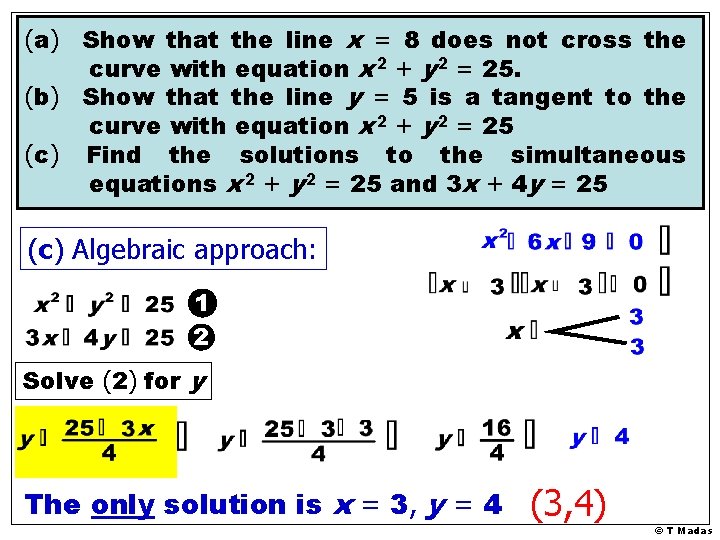
(a) Show that the line x = 8 does not cross the curve with equation x 2 + y 2 = 25. (b) Show that the line y = 5 is a tangent to the curve with equation x 2 + y 2 = 25 (c) Find the solutions to the simultaneous equations x 2 + y 2 = 25 and 3 x + 4 y = 25 (c) Algebraic approach: 1 2 Solve (2) for y The only solution is x = 3, y = 4 (3, 4) © T Madas
y 5 -10 -5 0 (3, 4) 5 10 x -5 © T Madas
© T Madas
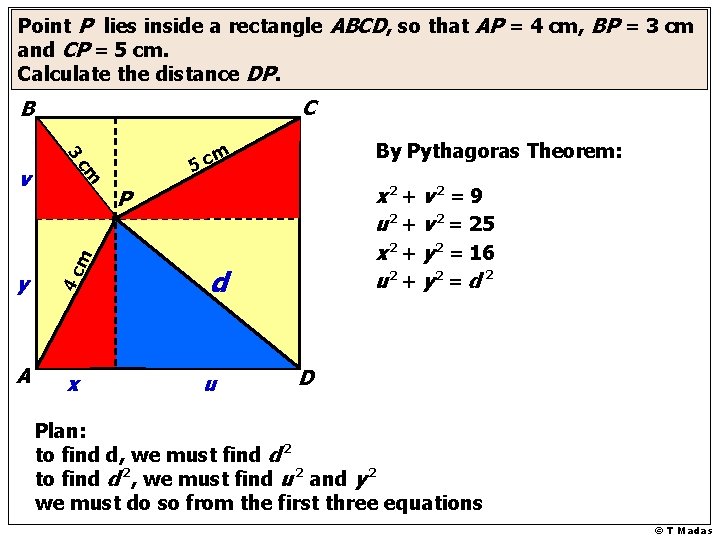
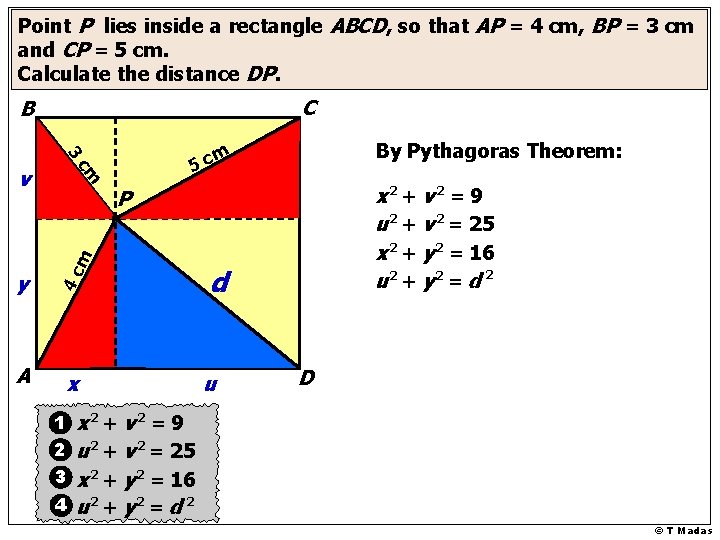
Point P lies inside a rectangle ABCD, so that AP = 4 cm, BP = 3 cm and CP = 5 cm. Calculate the distance DP. C B 3 y 4 c m cm v A x By Pythagoras Theorem: m 5 c x 2+ v 2 = 9 u 2 + v 2 = 25 x 2 + y 2 = 16 u 2+ y 2= d 2 P d u D Plan: to find d, we must find d 2 to find d 2, we must find u 2 and y 2 we must do so from the first three equations © T Madas
Point P lies inside a rectangle ABCD, so that AP = 4 cm, BP = 3 cm and CP = 5 cm. Calculate the distance DP. C B 3 y 4 c A x x 2+ v 2 = 9 u 2 + v 2 = 25 x 2 + y 2 = 16 u 2+ y 2= d 2 P m cm v By Pythagoras Theorem: m 5 c d u D 1 x 2+ v 2 = 9 2 u 2 + v 2 = 25 3 x 2 + y 2 = 16 4 u 2+ y 2= d 2 © T Madas
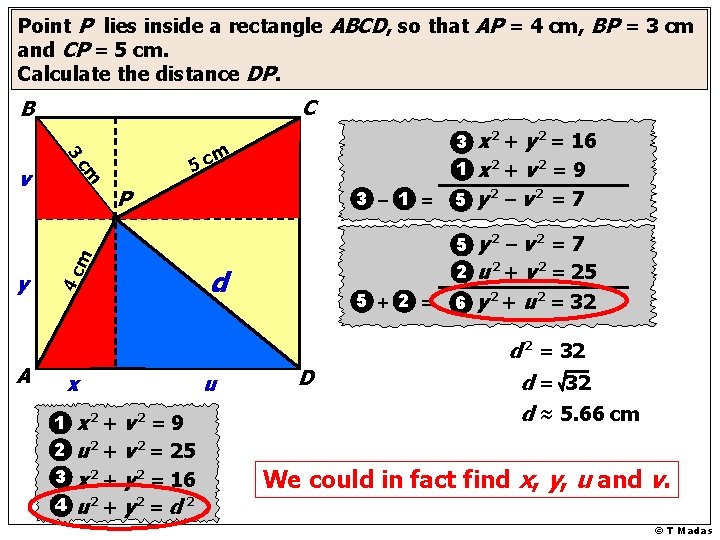
Point P lies inside a rectangle ABCD, so that AP = 4 cm, BP = 3 cm and CP = 5 cm. Calculate the distance DP. C B m 5 c 3 P y A 4 c m cm v 3 x 2 + y 2 = 16 1 x 2+ v 2 = 9 x 1 x 2+ v 2 = 9 2 u 2 + v 2 = 25 3 x 2 + y 2 = 16 4 u 2+ y 2= d 2 3 – 1 = 5 y 2 – v 2 = 7 2 u 2 + v 2 = 25 d u 5 + 2 = D 6 y 2 + u 2 = 32 d ≈ 5. 66 cm We could in fact find x, y, u and v. © T Madas
© T Madas