T Madas The volume and the surface area








- Slides: 27
© T Madas
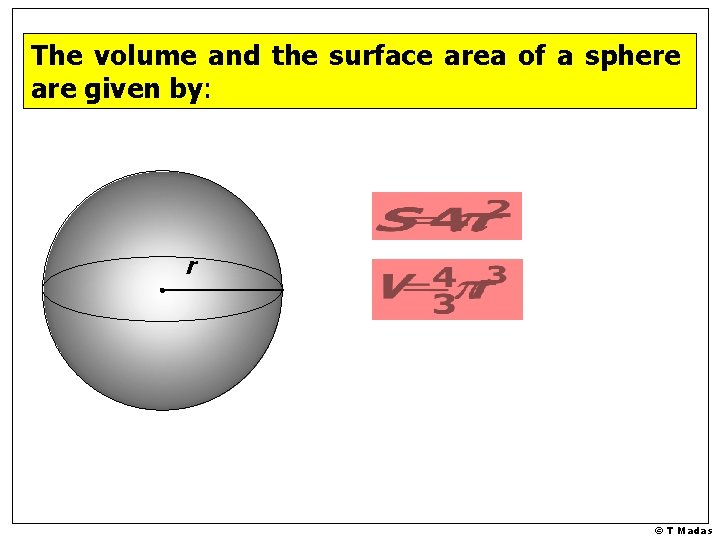
The volume and the surface area of a sphere are given by: r © T Madas
© T Madas
A tennis ball can be modelled as a sphere with diameter 8 cm Calculate: 8 cm S = 4 x π x 42 S = 64π S = 201 cm 2 c 4 r cm 3 V = 256π 3 V = 268 cm 3 [3 s. f. ] c c V = 4 x π x 43 c 1. The volume of the ball, correct to 3 significant figures 2. The surface area of the ball, correct to 3 significant figures [3 s. f. ] © T Madas
© T Madas
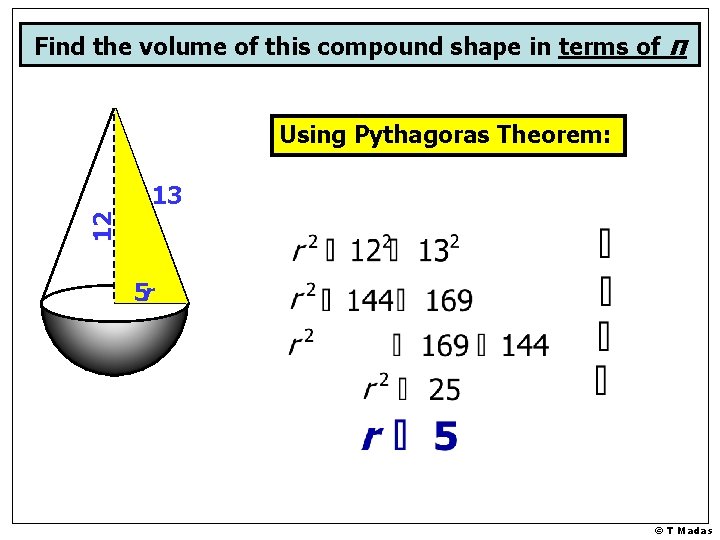
Find the volume of this compound shape in terms of π Using Pythagoras Theorem: 12 13 5 r © T Madas
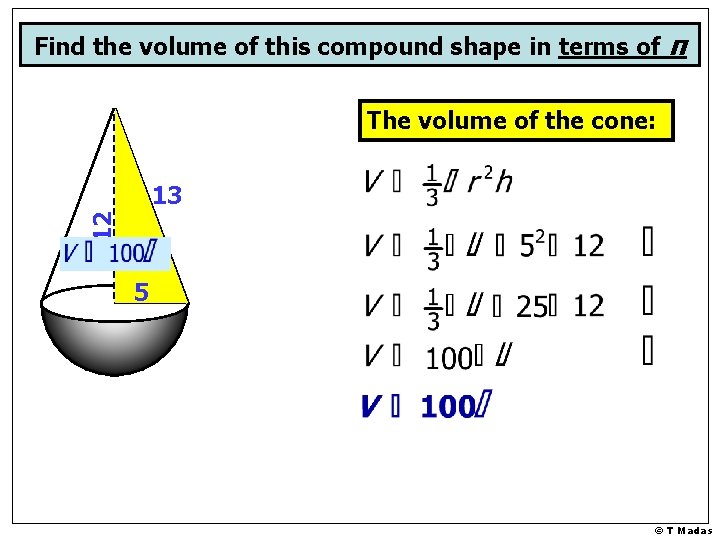
Find the volume of this compound shape in terms of π The volume of the cone: 12 13 5 © T Madas
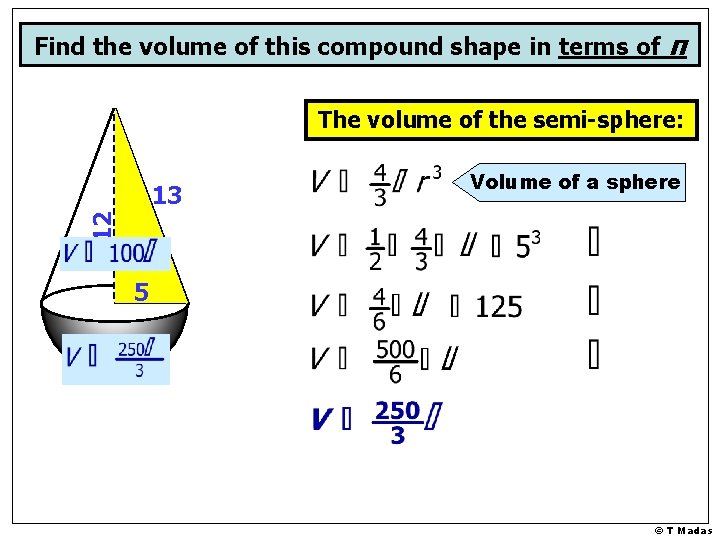
Find the volume of this compound shape in terms of π The volume of the semi-sphere: Volume of a sphere 12 13 5 © T Madas
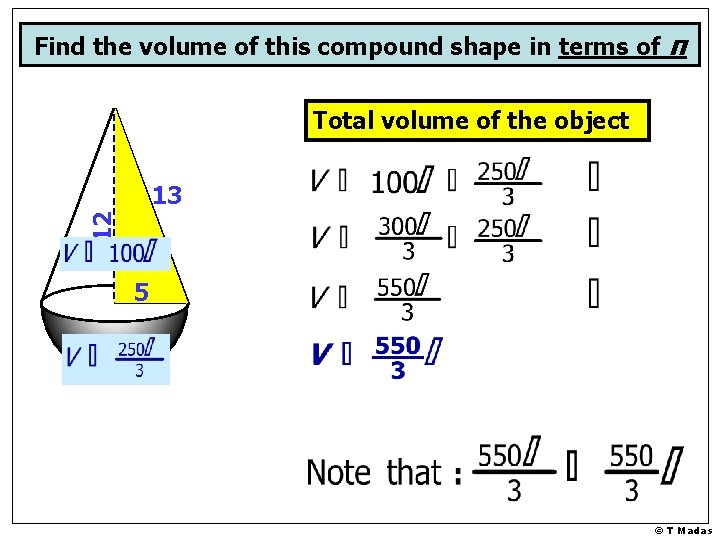
Find the volume of this compound shape in terms of π Total volume of the object 12 13 5 © T Madas
© T Madas
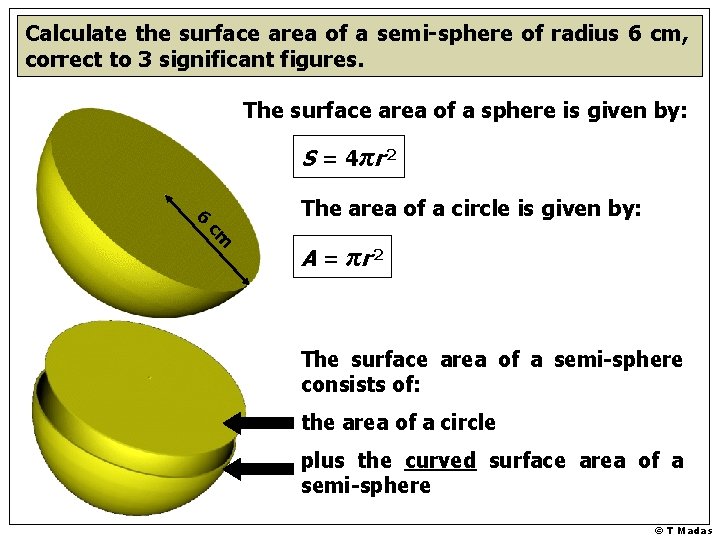
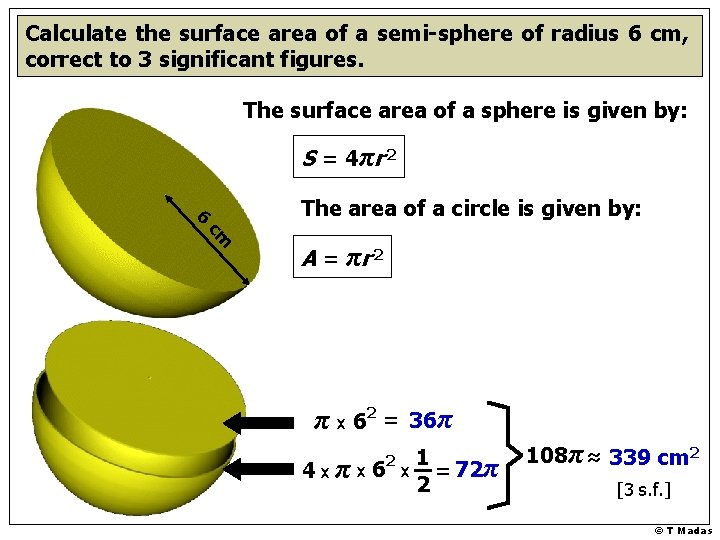
Calculate the surface area of a semi-sphere of radius 6 cm, correct to 3 significant figures. The surface area of a sphere is given by: S = 4π r 2 6 The area of a circle is given by: cm A = πr 2 The surface area of a semi-sphere consists of: the area of a circle plus the curved surface area of a semi-sphere © T Madas
Calculate the surface area of a semi-sphere of radius 6 cm, correct to 3 significant figures. The surface area of a sphere is given by: S = 4π r 2 6 The area of a circle is given by: cm A = πr 2 π x 62 = 36π 1 4 x π x 6 x = 72π 2 2 108π ≈ 339 cm 2 [3 s. f. ] © T Madas
© T Madas
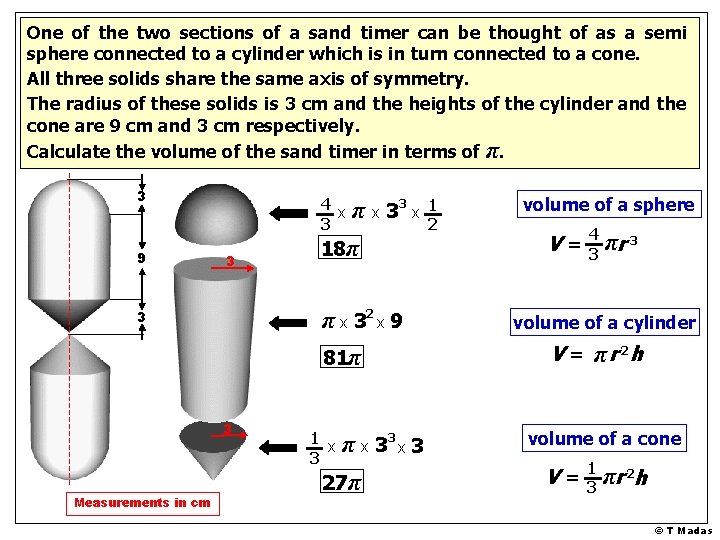
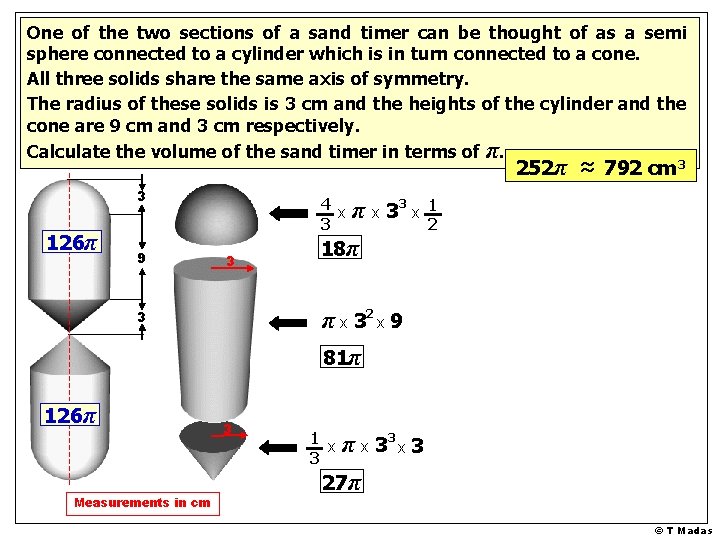
One of the two sections of a sand timer can be thought of as a semi sphere connected to a cylinder which is in turn connected to a cone. All three solids share the same axis of symmetry. The radius of these solids is 3 cm and the heights of the cylinder and the cone are 9 cm and 3 cm respectively. Calculate the volume of the sand timer in terms of π. 3 9 4 x 3 3 π x 33 x 18π π x 32 x 9 3 81π 3 Measurements in cm 1 x 3 π x 33 x 3 27π 1 2 volume of a sphere V= 4 3 πr 3 volume of a cylinder V = π r 2 h volume of a cone V= 1 3 πr 2 h © T Madas
One of the two sections of a sand timer can be thought of as a semi sphere connected to a cylinder which is in turn connected to a cone. All three solids share the same axis of symmetry. The radius of these solids is 3 cm and the heights of the cylinder and the cone are 9 cm and 3 cm respectively. Calculate the volume of the sand timer in terms of π. 252π 3 126π 9 4 x 3 3 π x 33 x ≈ 792 cm 3 1 2 18π π x 32 x 9 3 81π 126π Measurements in cm 3 1 x 3 π x 33 x 3 27π © T Madas
© T Madas
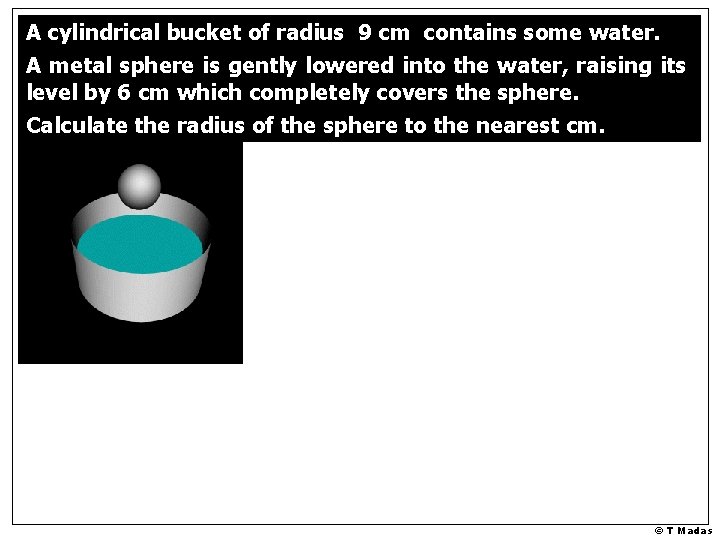
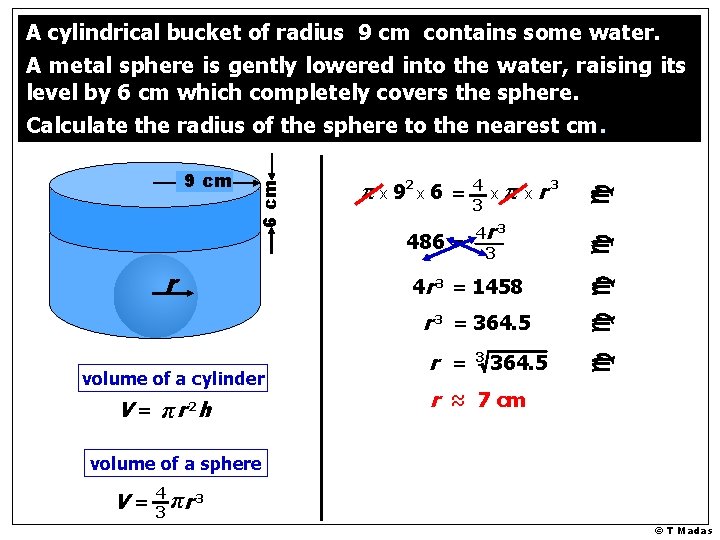
A cylindrical bucket of radius 9 cm contains some water. A metal sphere is gently lowered into the water, raising its level by 6 cm which completely covers the sphere. Calculate the radius of the sphere to the nearest cm. © T Madas
486 = r 4 x 3 π x r 3 4 r 3 = 1458 r 3 = 364. 5 volume of a cylinder V = π r 2 h r = 3 364. 5 c π x 92 x 6 = c c 9 cm 6 cm A cylindrical bucket of radius 9 cm contains some water. A metal sphere is gently lowered into the water, raising its level by 6 cm which completely covers the sphere. Calculate the radius of the sphere to the nearest cm. r ≈ 7 cm volume of a sphere V= 4 3 πr 3 © T Madas
© T Madas
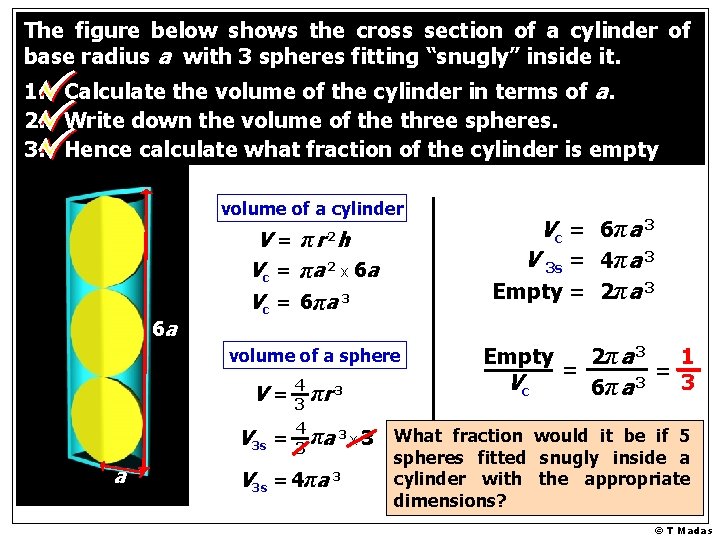
The figure below shows the cross section of a cylinder of base radius a with 3 spheres fitting “snugly” inside it. 1. Calculate the volume of the cylinder in terms of a. 2. Write down the volume of the three spheres. 3. Hence calculate what fraction of the cylinder is empty volume of a cylinder V = πr h Vc = πa 2 x 6 a 2 6 a Vc = 6 πa 3 volume of a sphere a V= 4 3 πr 3 V 3 s = 4 3 πa 3 x 3 V 3 s = 4 πa 3 Vc = 6π a 3 V 3 s = 4πa 3 Empty = 2πa 3 Empty Vc 2π a 3 1 = = 3 3 6π a What fraction would it be if 5 spheres fitted snugly inside a cylinder with the appropriate dimensions? © T Madas
© T Madas
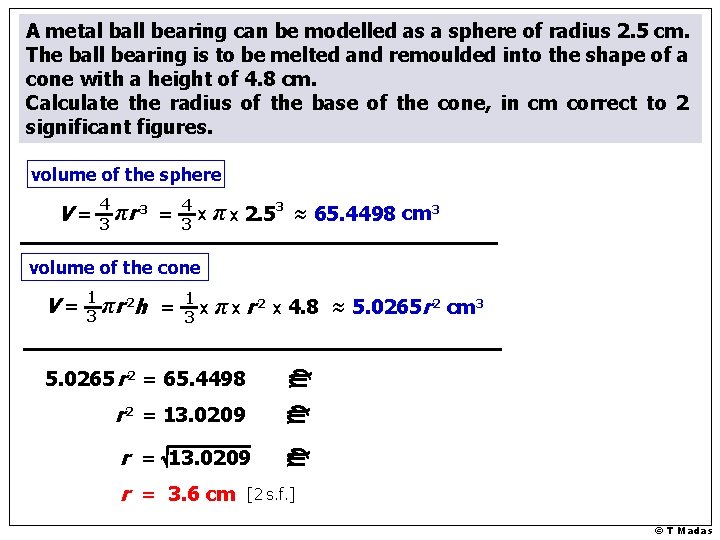
A metal ball bearing can be modelled as a sphere of radius 2. 5 cm. The ball bearing is to be melted and remoulded into the shape of a cone with a height of 4. 8 cm. Calculate the radius of the base of the cone, in cm correct to 2 significant figures. volume of the sphere V= 4 3 πr 3 = 4 x 3 π x 2. 53 ≈ 65. 4498 cm 3 volume of the cone 1 3 πr 2 h = 1 x 3 π x r 2 x 4. 8 ≈ 5. 0265 r 2 cm 3 5. 0265 r 2 = 65. 4498 r 2 = 13. 0209 r = 3. 6 cm c c c V= [2 s. f. ] © T Madas
© T Madas
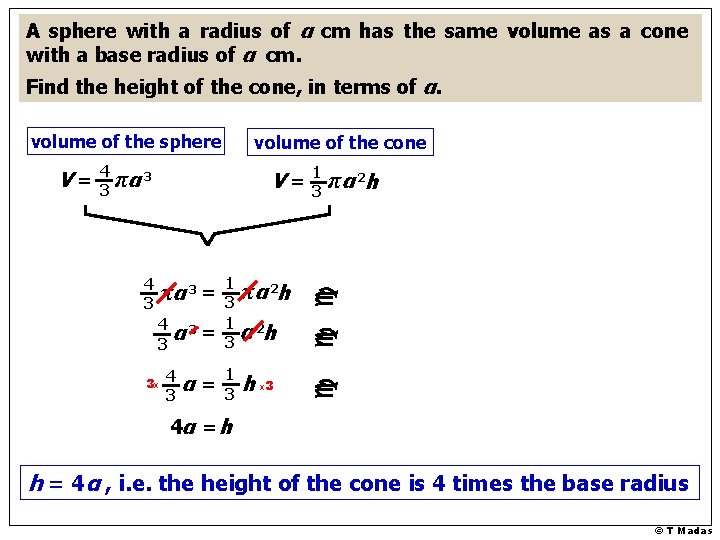
A sphere with a radius of α cm has the same volume as a cone with a base radius of α cm. Find the height of the cone, in terms of α. volume of the sphere πα 3 V= 4 3 πα 3 = 4 3 3 x α 3= 4 3 α= 1 3 π α 2 h 1 3 α 2 h c c 4 3 1 3 h x 3 c V= volume of the cone π α 2 h 4α = h h = 4α , i. e. the height of the cone is 4 times the base radius © T Madas
© T Madas
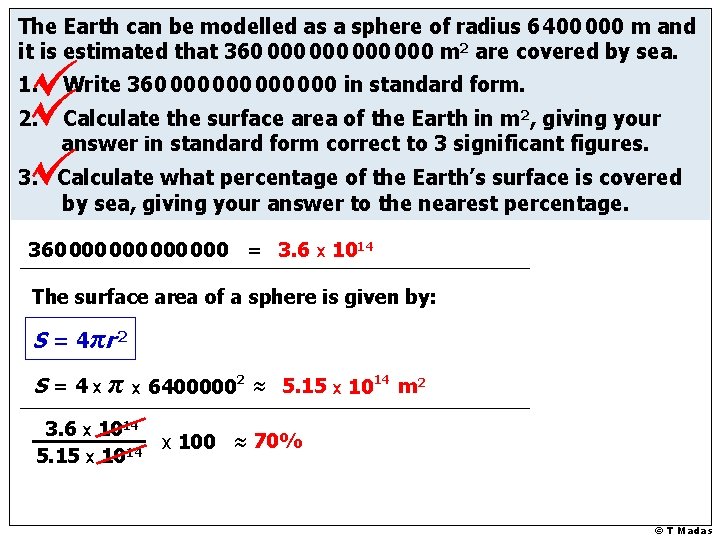
The Earth can be modelled as a sphere of radius 6 400 000 m and it is estimated that 360 000 000 m 2 are covered by sea. 1. Write 360 000 000 in standard form. 2. Calculate the surface area of the Earth in m 2, giving your answer in standard form correct to 3 significant figures. 3. Calculate what percentage of the Earth’s surface is covered by sea, giving your answer to the nearest percentage. 360 000 000 = 3. 6 x 10¹⁴ The surface area of a sphere is given by: S = 4π r 2 S = 4 x π x 64000002 ≈ 5. 15 x 1014 m 2 3. 6 x 1014 x 100 ≈ 70% 5. 15 x 1014 © T Madas
© T Madas