Honors Geometry Chapter 12 Extending Surface Area and

- Slides: 39
Honors Geometry
Chapter 12 Extending Surface Area and Volume
Section 12 -1 & Section 12. 2 Representations of 3 -Dimensional Figures & Surface Areas of Prisms and Cylinders Objective: 1. To identify and use three-dimensional figures 2. To find the lateral and surface areas of prisms. 3. To find lateral and surface areas of cylinders.
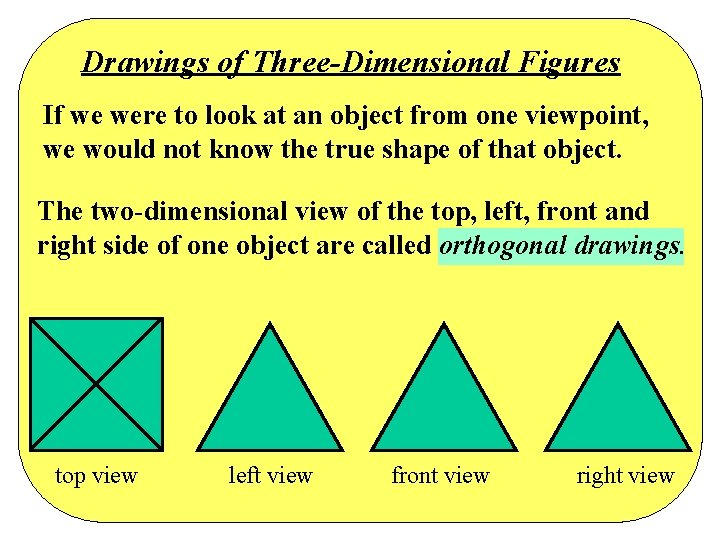
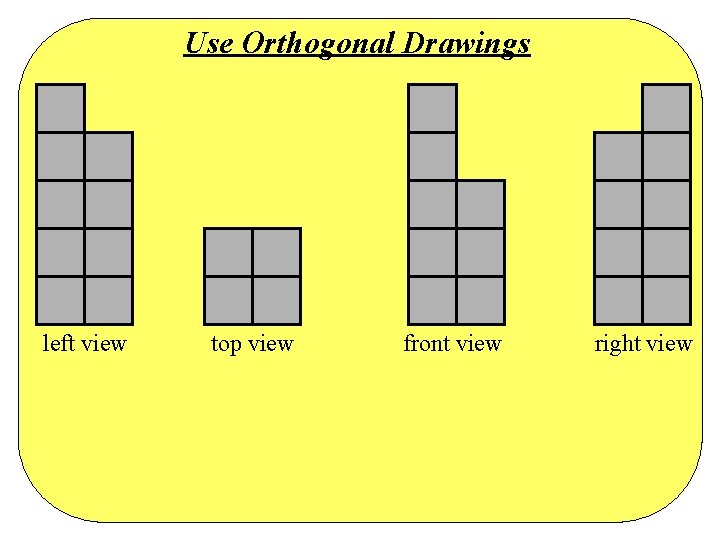
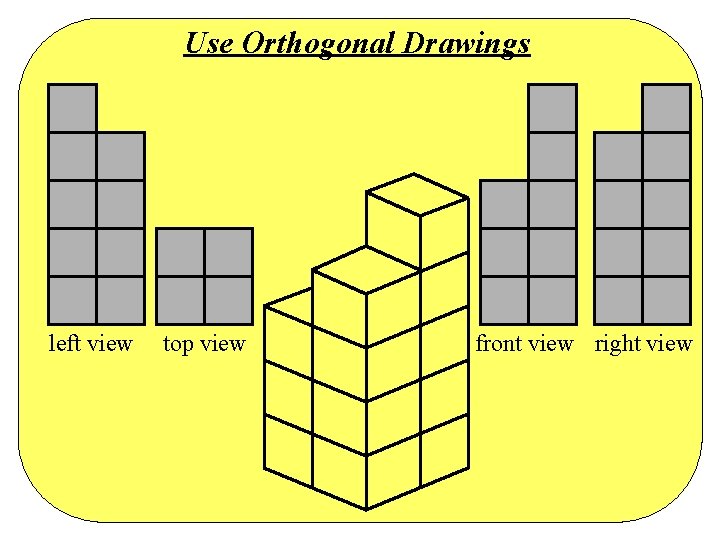
Drawings of Three-Dimensional Figures If we were to look at an object from one viewpoint, we would not know the true shape of that object. The two-dimensional view of the top, left, front and right side of one object are called orthogonal drawings. top view left view front view right view
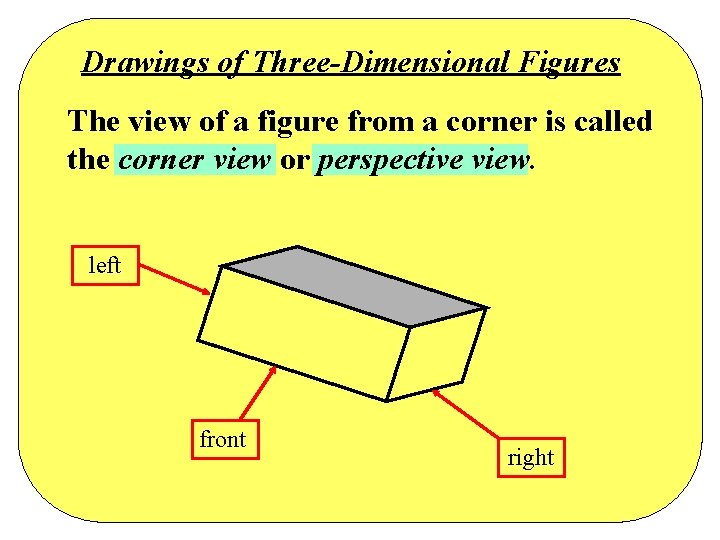
Drawings of Three-Dimensional Figures The view of a figure from a corner is called the corner view or perspective view. left front right
Use Orthogonal Drawings left view top view front view right view
Use Orthogonal Drawings left view top view front view right view
Chapter 12 Extending Surface Area and Volume
Section 12 -1 & Section 12. 2 Representations of 3 -Dimensional Figures & Surface Areas of Prisms and Cylinders Objective: 1. To identify three-dimensional figures 2. To find the lateral and surface areas of prisms. 3. To find lateral and surface areas of cylinders.
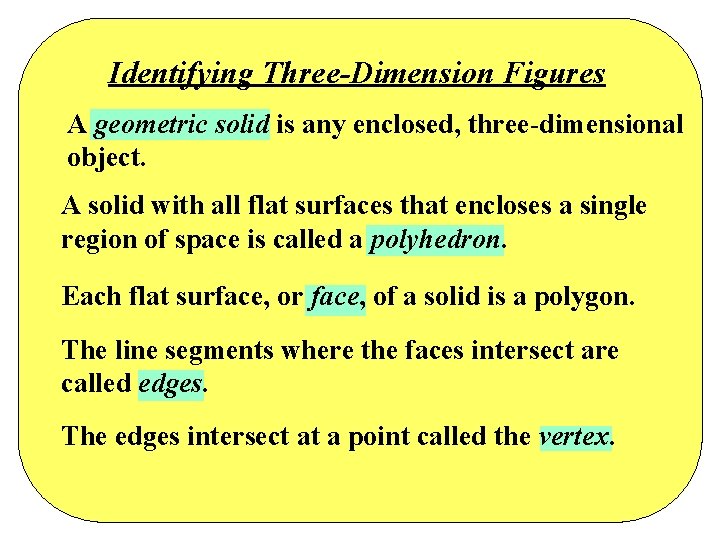
Identifying Three-Dimension Figures A geometric solid is any enclosed, three-dimensional object. A solid with all flat surfaces that encloses a single region of space is called a polyhedron. Each flat surface, or face, of a solid is a polygon. The line segments where the faces intersect are called edges. The edges intersect at a point called the vertex.
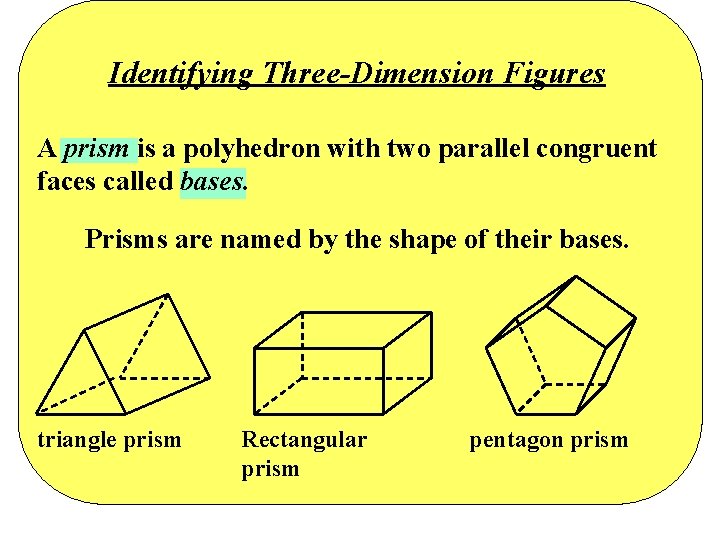
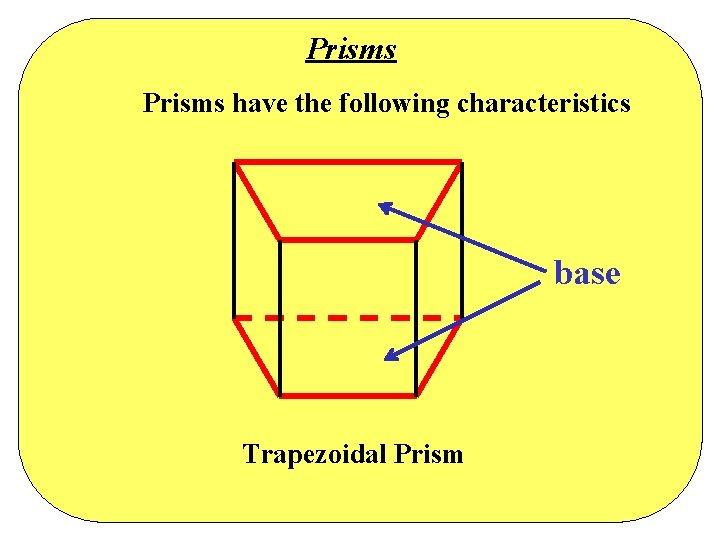
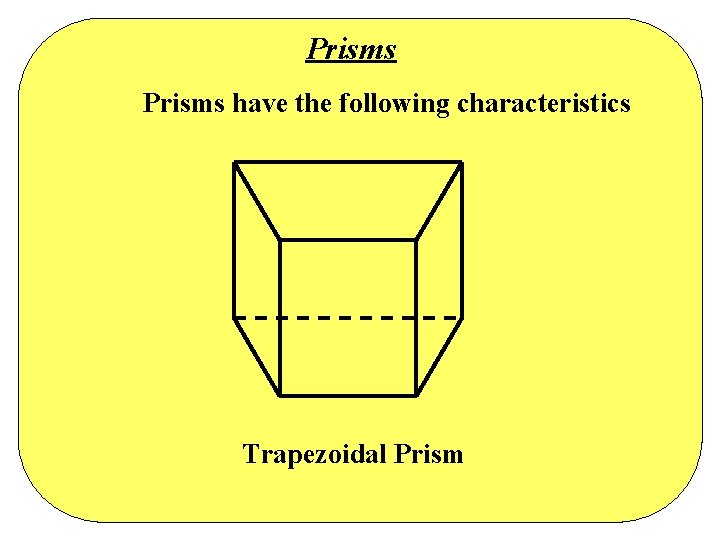
Identifying Three-Dimension Figures A prism is a polyhedron with two parallel congruent faces called bases. Prisms are named by the shape of their bases. triangle prism Rectangular prism pentagon prism
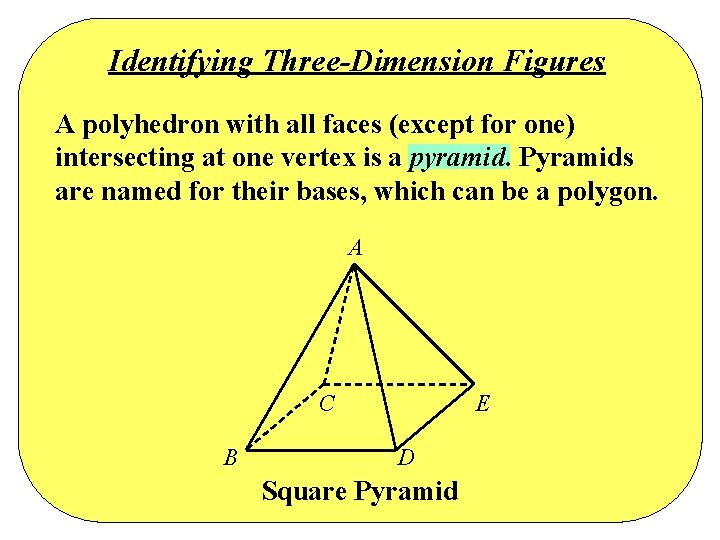
Identifying Three-Dimension Figures A polyhedron with all faces (except for one) intersecting at one vertex is a pyramid. Pyramids are named for their bases, which can be a polygon. A C B E D Square Pyramid
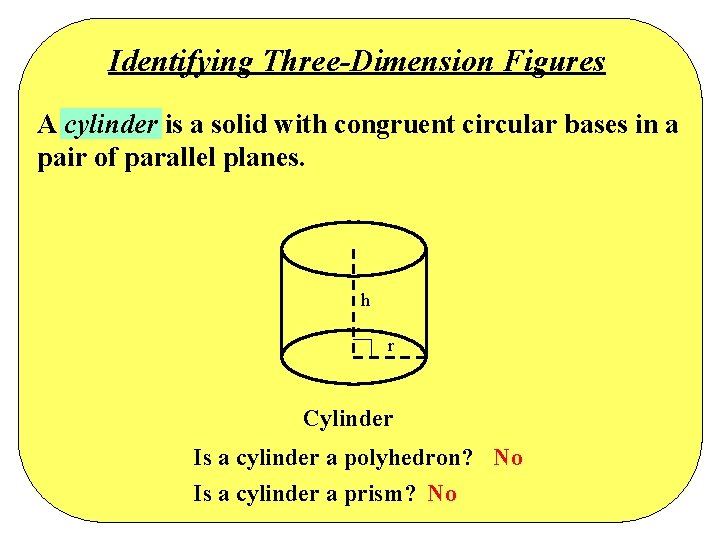
Identifying Three-Dimension Figures A cylinder is a solid with congruent circular bases in a pair of parallel planes. h r Cylinder Is a cylinder a polyhedron? No Is a cylinder a prism? No
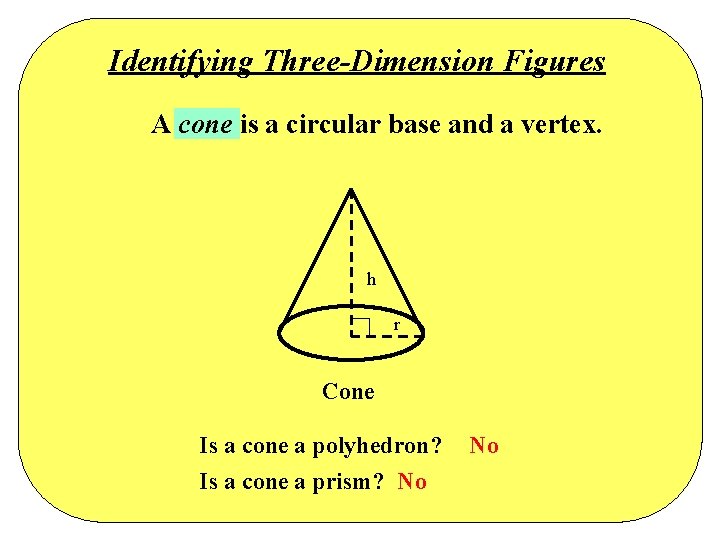
Identifying Three-Dimension Figures A cone is a circular base and a vertex. h r Cone Is a cone a polyhedron? Is a cone a prism? No No
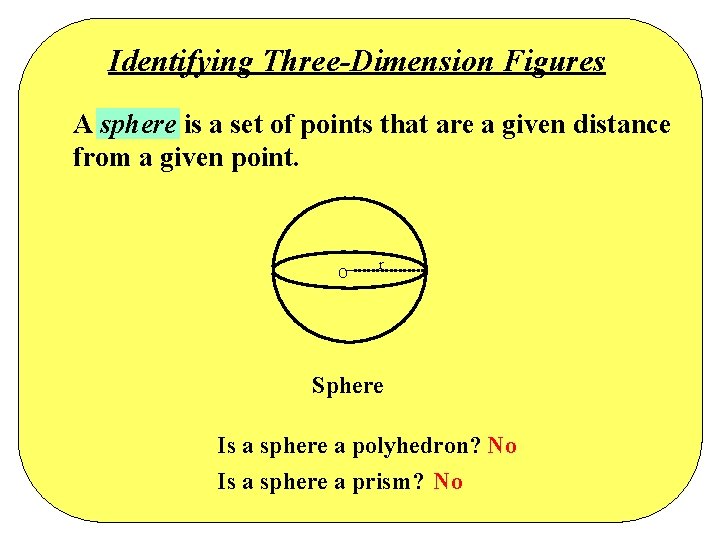
Identifying Three-Dimension Figures A sphere is a set of points that are a given distance from a given point. O r Sphere Is a sphere a polyhedron? No Is a sphere a prism? No
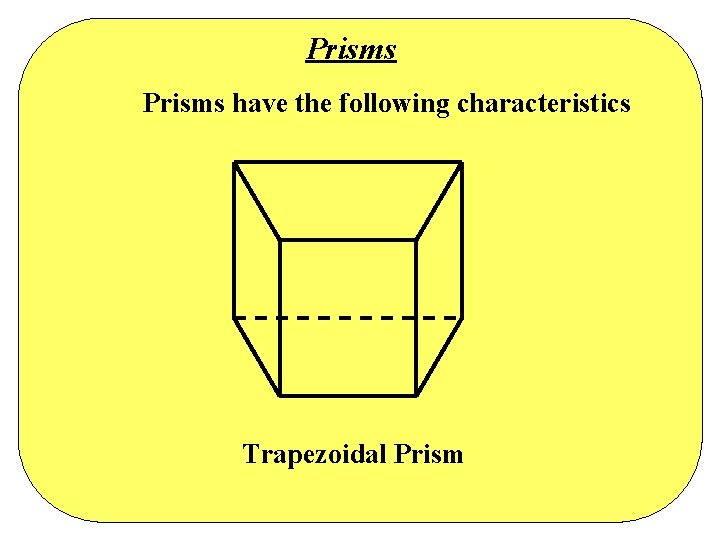
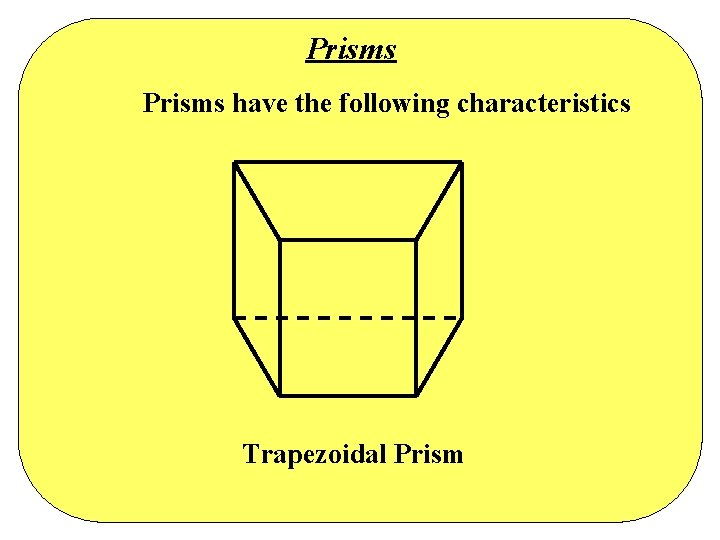
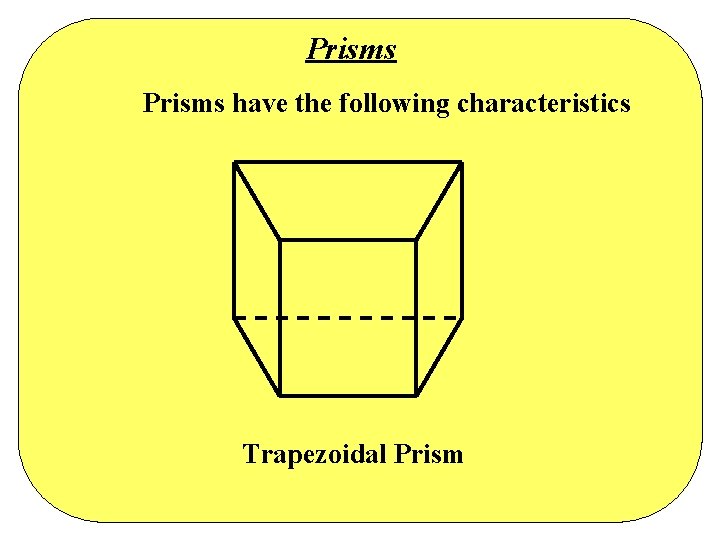
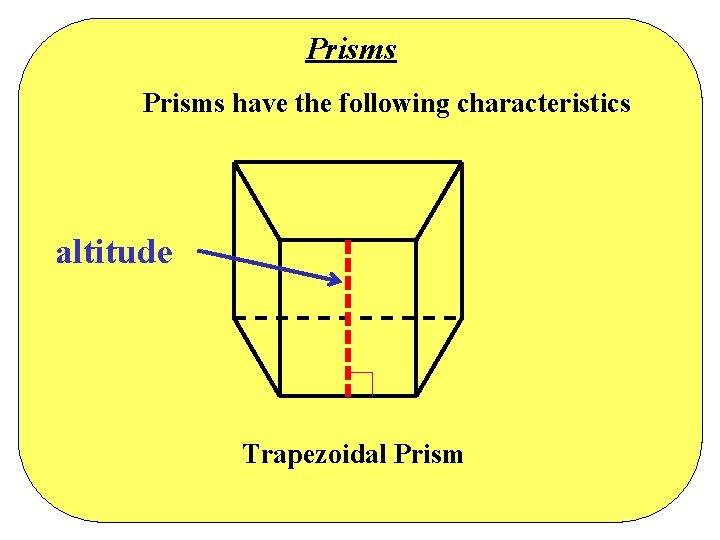
Prisms have the following characteristics Trapezoidal Prism
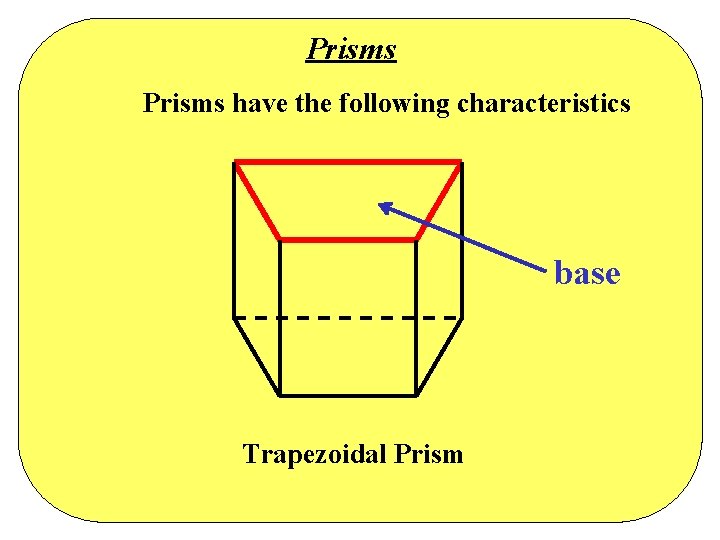
Prisms have the following characteristics base Trapezoidal Prism
Prisms have the following characteristics base Trapezoidal Prism
Prisms have the following characteristics Trapezoidal Prism
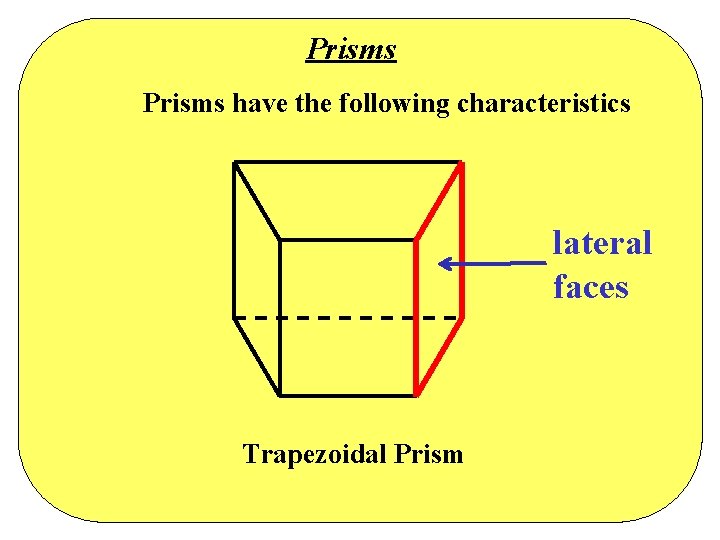
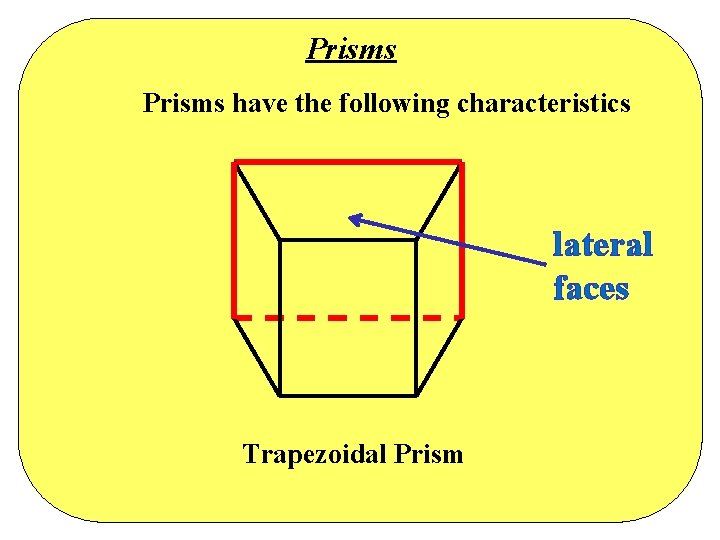
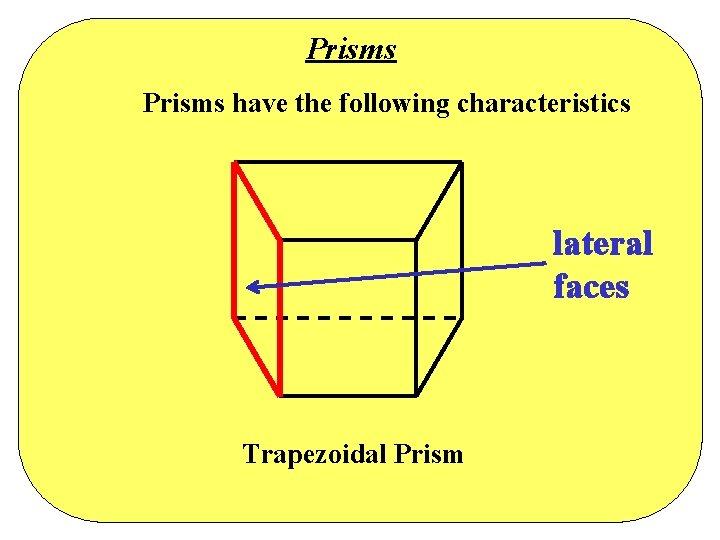
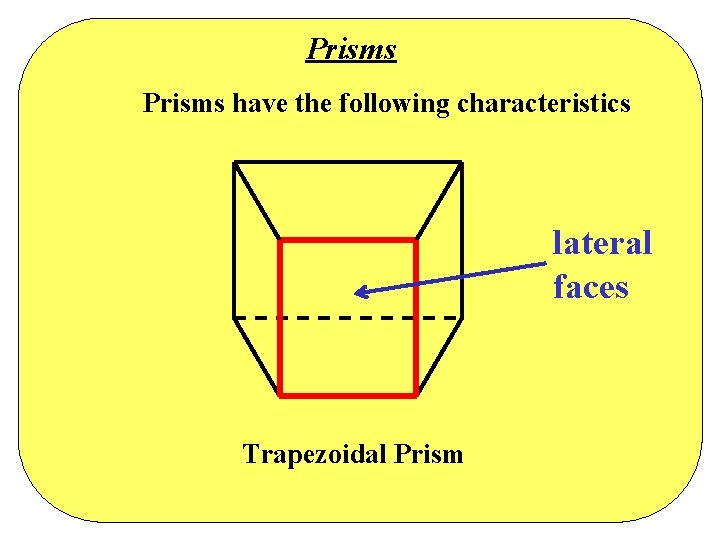
Prisms have the following characteristics lateral faces Trapezoidal Prism
Prisms have the following characteristics lateral faces Trapezoidal Prism
Prisms have the following characteristics lateral faces Trapezoidal Prism
Prisms have the following characteristics lateral faces Trapezoidal Prism
Prisms have the following characteristics Trapezoidal Prism
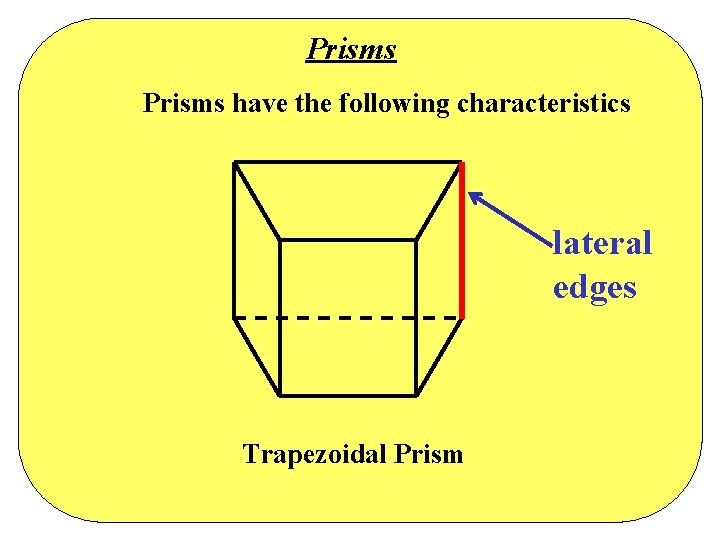
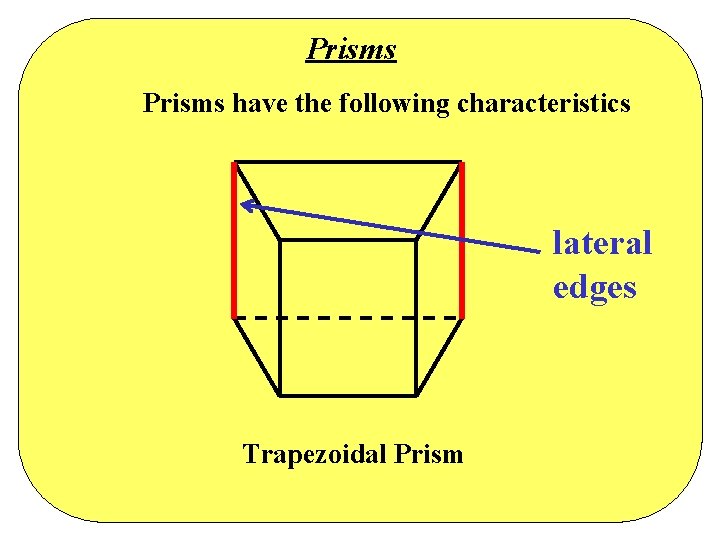
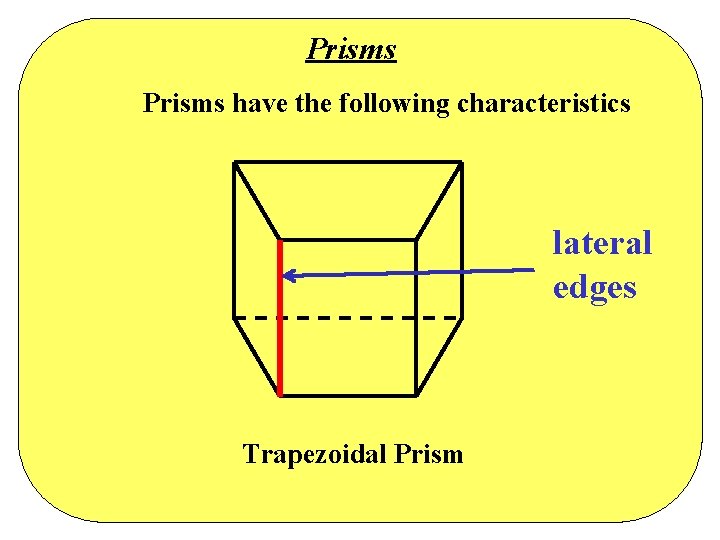
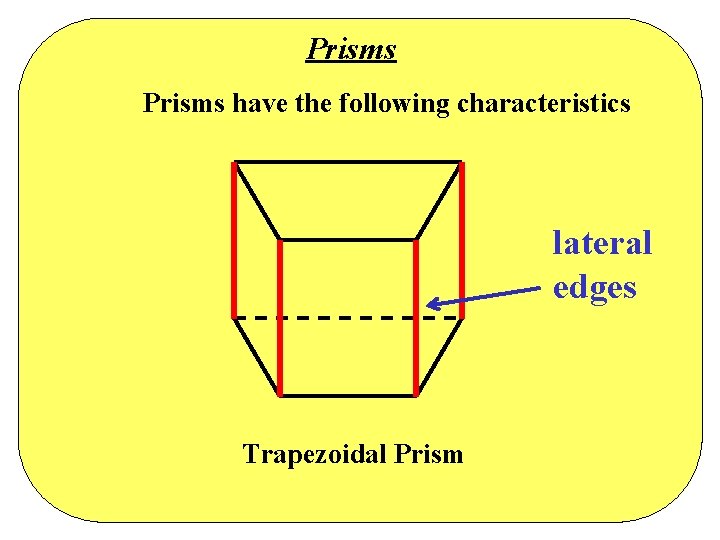
Prisms have the following characteristics lateral edges Trapezoidal Prism
Prisms have the following characteristics lateral edges Trapezoidal Prism
Prisms have the following characteristics lateral edges Trapezoidal Prism
Prisms have the following characteristics lateral edges Trapezoidal Prism
Prisms have the following characteristics Trapezoidal Prism
Prisms have the following characteristics altitude Trapezoidal Prism
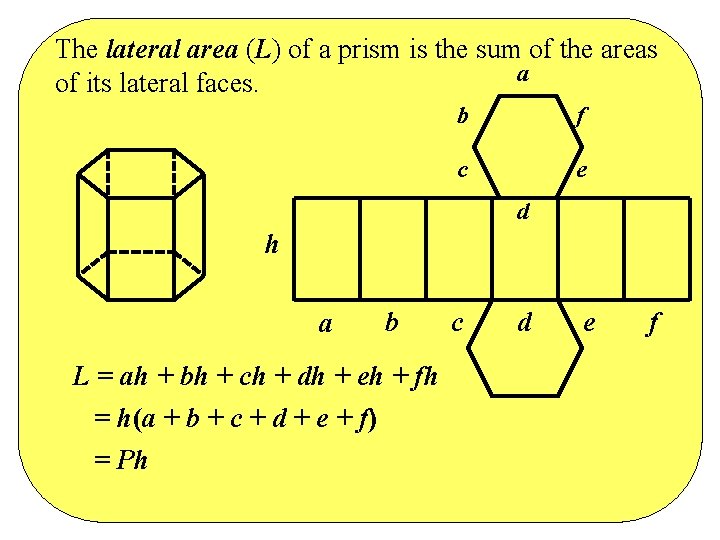
The lateral area (L) of a prism is the sum of the areas a of its lateral faces. b f c e d h a b L = ah + bh + ch + dh + eh + fh = h(a + b + c + d + e + f) = Ph c d e f
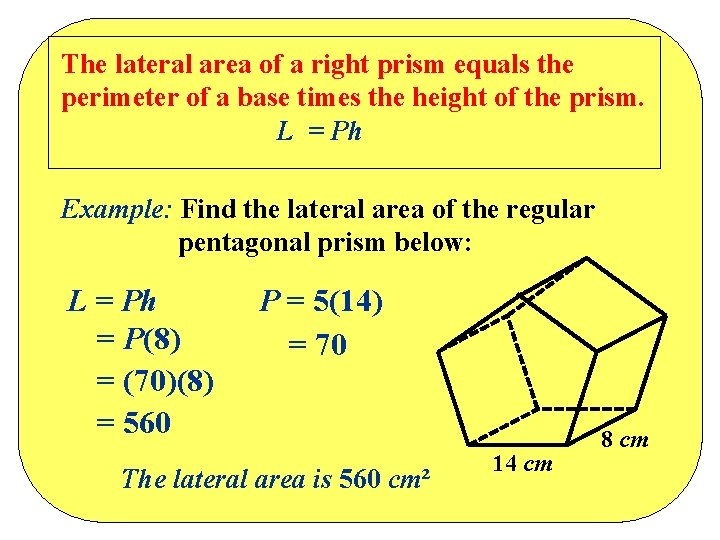
The lateral area of a right prism equals the perimeter of a base times the height of the prism. L = Ph Example: Find the lateral area of the regular pentagonal prism below: L = Ph = P(8) = (70)(8) = 560 P = 5(14) = 70 The lateral area is 560 cm² 14 cm 8 cm
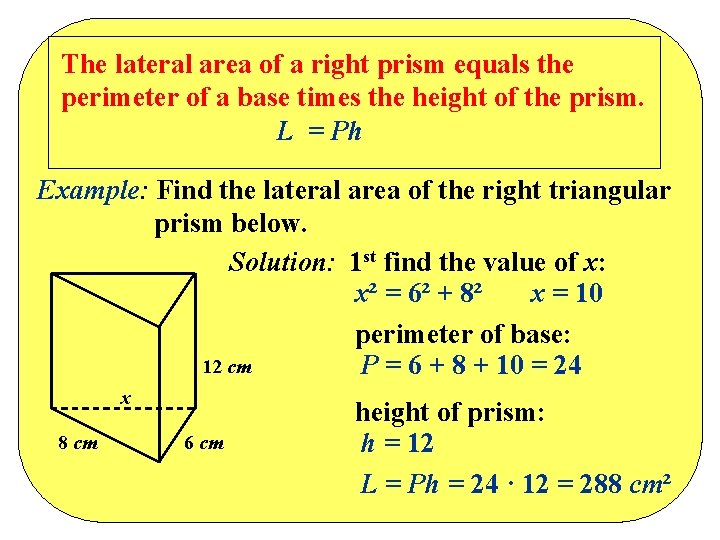
The lateral area of a right prism equals the perimeter of a base times the height of the prism. L = Ph Example: Find the lateral area of the right triangular prism below. Solution: 1 st find the value of x: x² = 6² + 8² x = 10 perimeter of base: 12 cm P = 6 + 8 + 10 = 24 x 8 cm 6 cm height of prism: h = 12 L = Ph = 24 · 12 = 288 cm²
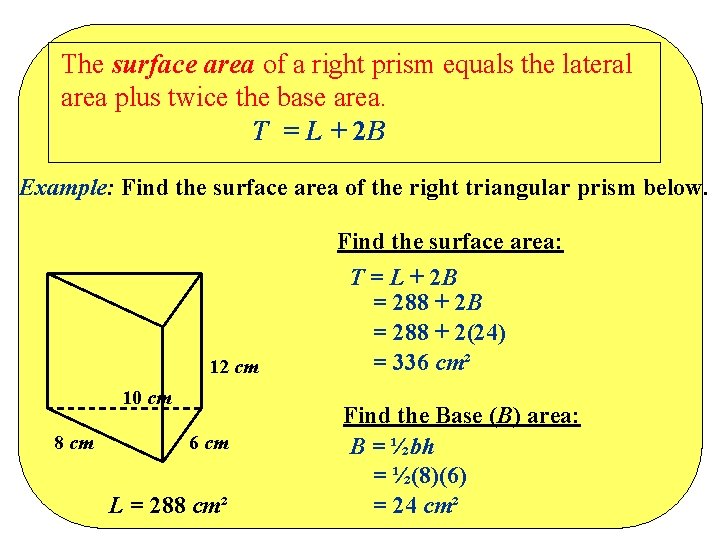
The surface area of a right prism equals the lateral area plus twice the base area. T = L + 2 B Example: Find the surface area of the right triangular prism below. Find the surface area: 12 cm 10 cm 8 cm 6 cm L = 288 cm² T = L + 2 B = 288 + 2(24) = 336 cm² Find the Base (B) area: B = ½bh = ½(8)(6) = 24 cm²
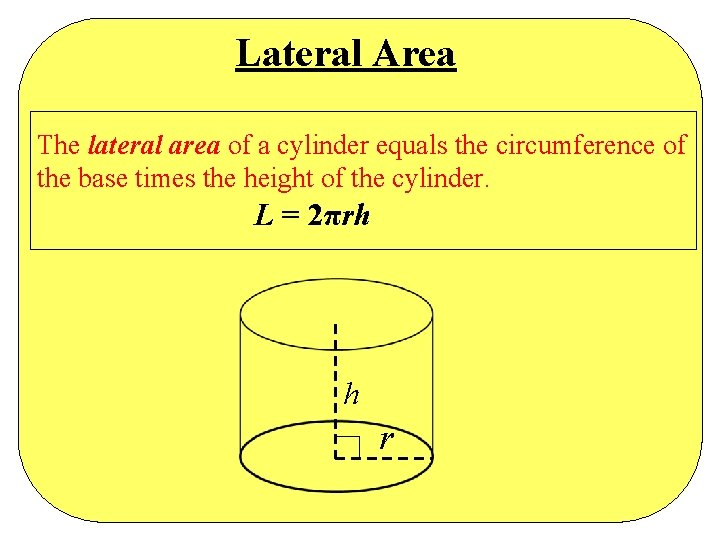
Lateral Area The lateral area of a cylinder equals the circumference of the base times the height of the cylinder. L = 2πrh h r
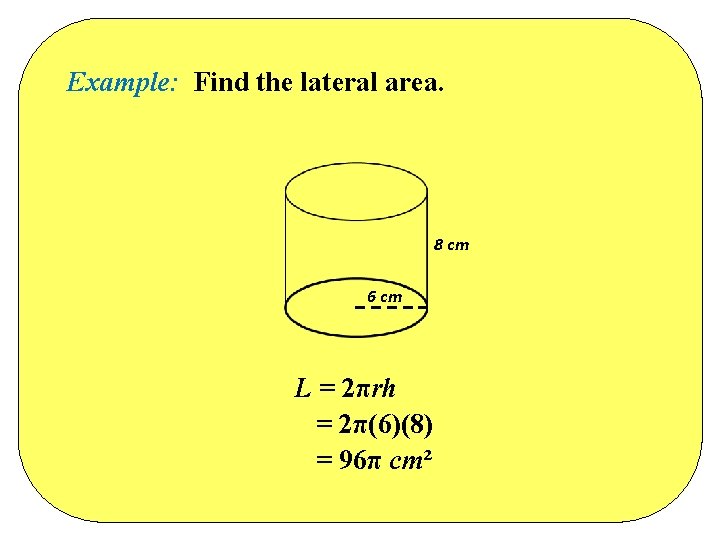
Example: Find the lateral area. 8 cm 6 cm L = 2πrh = 2π(6)(8) = 96π cm²
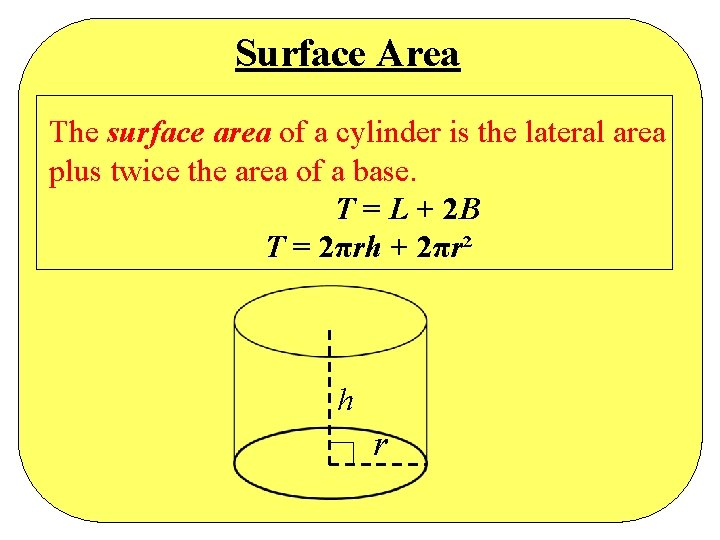
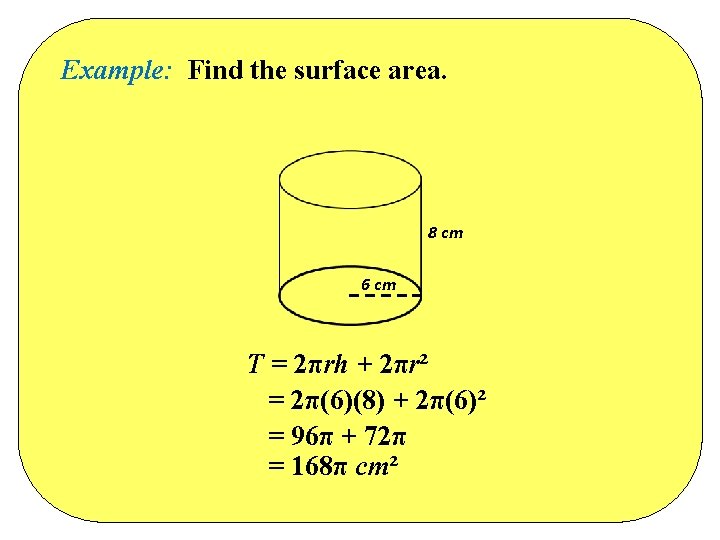
Surface Area The surface area of a cylinder is the lateral area plus twice the area of a base. T = L + 2 B T = 2πrh + 2πr² h r
Example: Find the surface area. 8 cm 6 cm T = 2πrh + 2πr² = 2π(6)(8) + 2π(6)² = 96π + 72π = 168π cm²
End of Sections 12. 1 & 12. 2