Solar Photovoltaics We are on the cusp of
- Slides: 34
Solar Photovoltaics ‘ We are on the cusp of a new era of Energy Independence ‘ Prashun Gorai CH 03 B 054 Rahul Vyas CH 03 B 056 Saurabh Mathur CH 03 B 058 Akshat Gupta CH 03 B 060
Broad Outline Physics of Photovoltaic Generation PV Technologies and Advancement Environmental Aspect Economic Aspect Indian Scenario Future Prospects
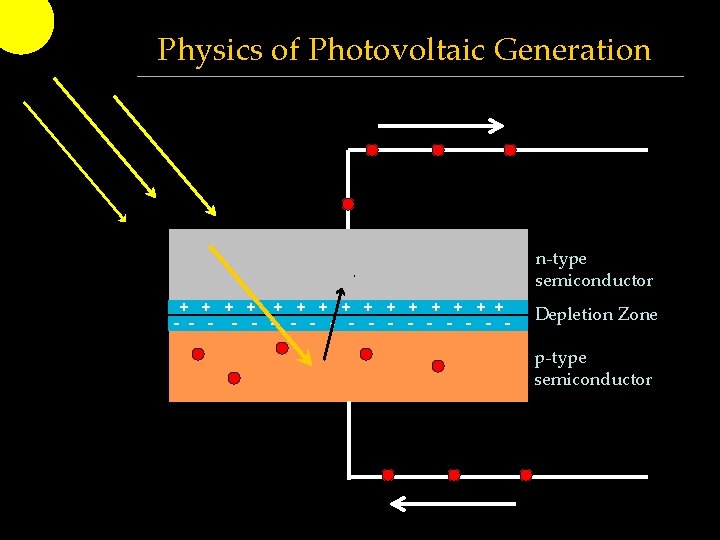
Physics of Photovoltaic Generation n-type semiconductor + + + + - - - - - Depletion Zone p-type semiconductor
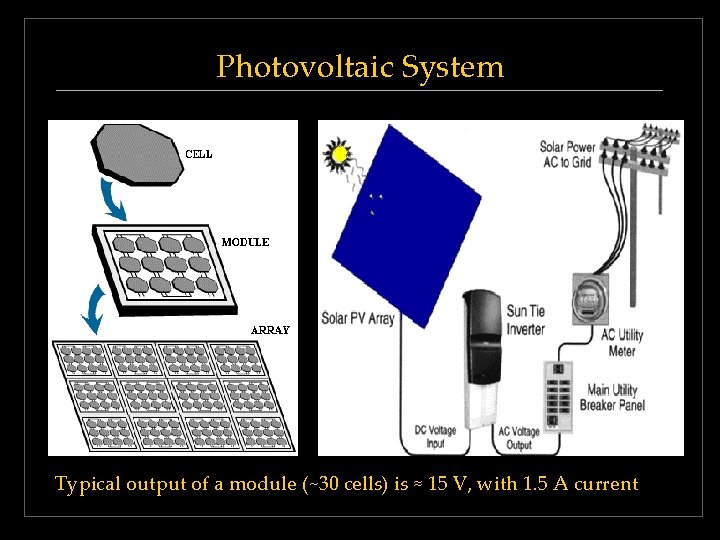
Photovoltaic System Typical output of a module (~30 cells) is ≈ 15 V, with 1. 5 A current
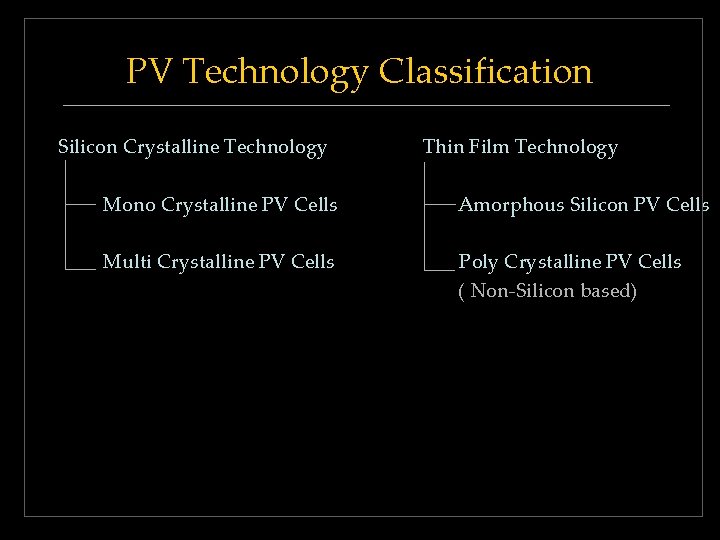
PV Technology Classification Silicon Crystalline Technology Thin Film Technology Mono Crystalline PV Cells Amorphous Silicon PV Cells Multi Crystalline PV Cells Poly Crystalline PV Cells ( Non-Silicon based)
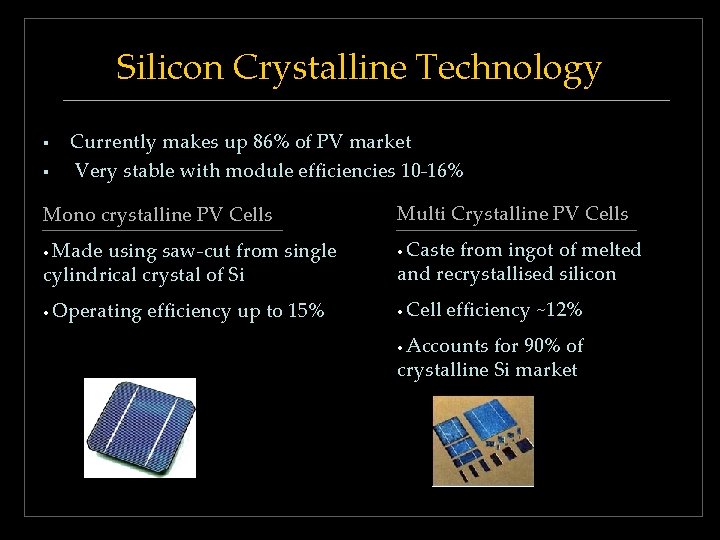
Silicon Crystalline Technology § § Currently makes up 86% of PV market Very stable with module efficiencies 10 -16% Mono crystalline PV Cells Multi Crystalline PV Cells • Made using saw-cut from single • Caste from ingot of melted • Operating efficiency up to 15% • Cell efficiency ~12% cylindrical crystal of Si and recrystallised silicon • Accounts for 90% of crystalline Si market
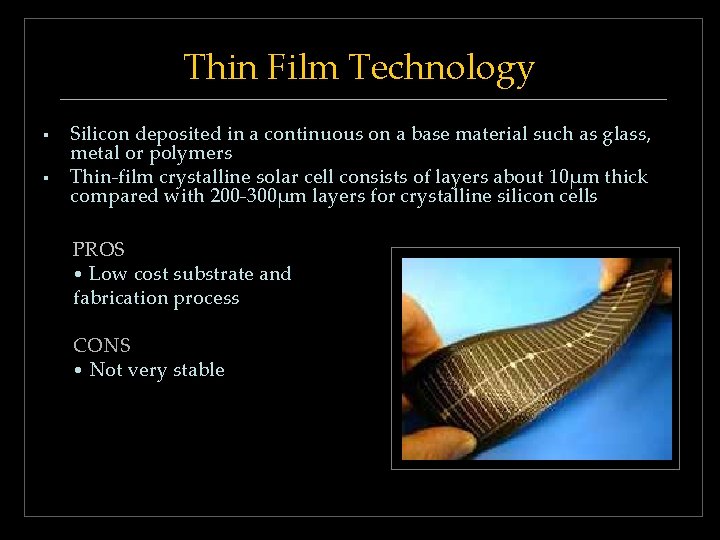
Thin Film Technology § § Silicon deposited in a continuous on a base material such as glass, metal or polymers Thin-film crystalline solar cell consists of layers about 10μm thick compared with 200 -300μm layers for crystalline silicon cells PROS • Low cost substrate and fabrication process CONS • Not very stable
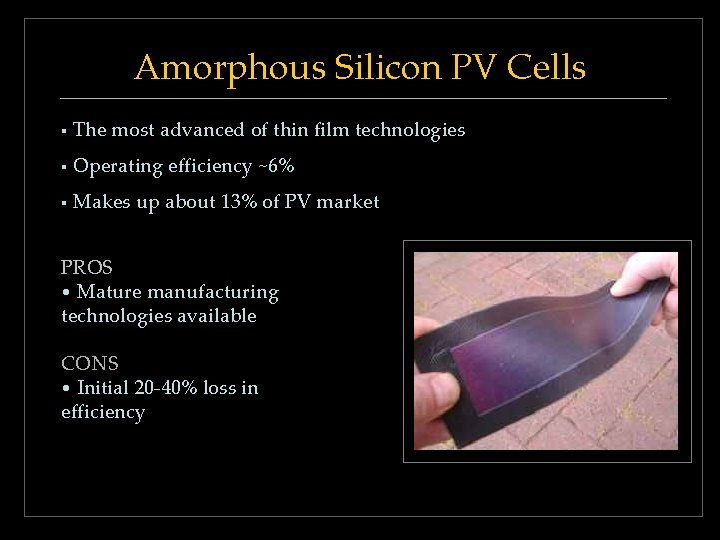
Amorphous Silicon PV Cells § The most advanced of thin film technologies § Operating efficiency ~6% § Makes up about 13% of PV market PROS • Mature manufacturing technologies available CONS • Initial 20 -40% loss in efficiency
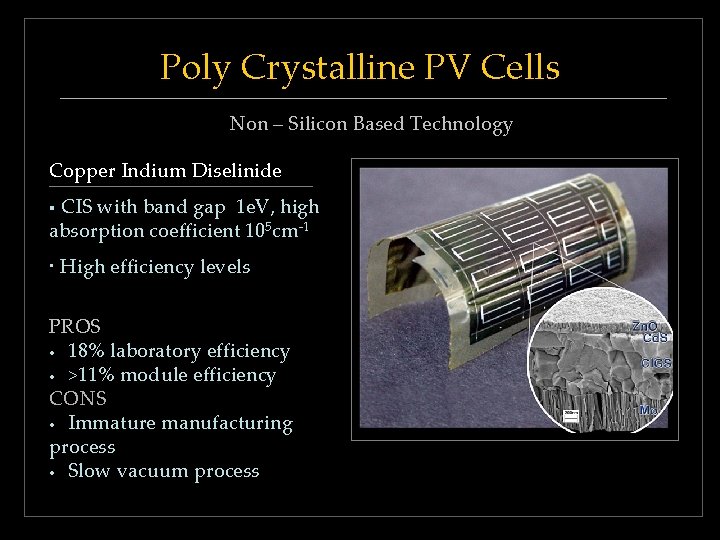
Poly Crystalline PV Cells Non – Silicon Based Technology Copper Indium Diselinide § CIS with band gap 1 e. V, high absorption coefficient 105 cm-1 High efficiency levels § PROS • 18% laboratory efficiency • >11% module efficiency CONS • Immature manufacturing process • Slow vacuum process
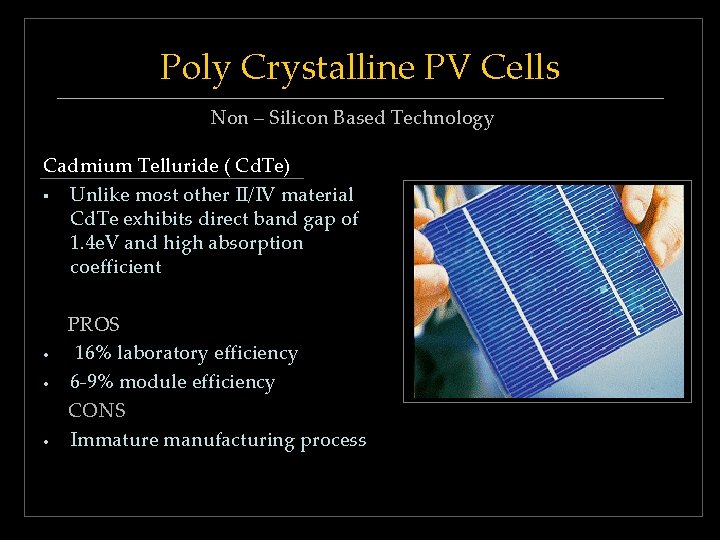
Poly Crystalline PV Cells Non – Silicon Based Technology Cadmium Telluride ( Cd. Te) § Unlike most other II/IV material Cd. Te exhibits direct band gap of 1. 4 e. V and high absorption coefficient PROS • 16% laboratory efficiency • 6 -9% module efficiency CONS • Immature manufacturing process
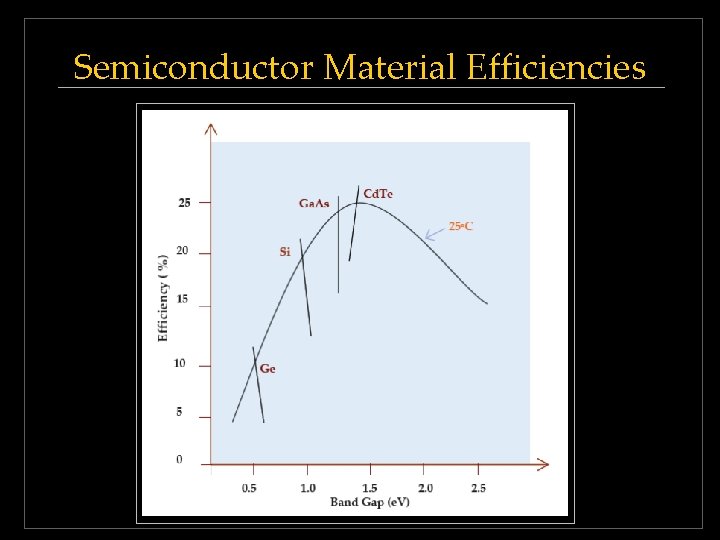
Semiconductor Material Efficiencies
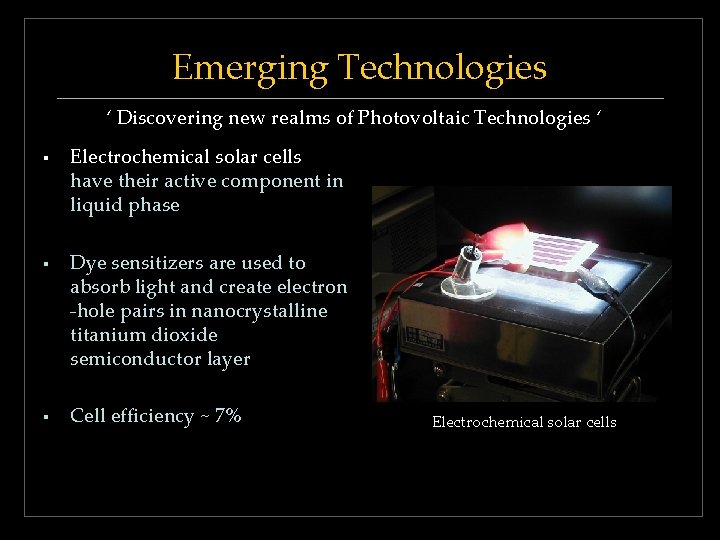
Emerging Technologies ‘ Discovering new realms of Photovoltaic Technologies ‘ § § § Electrochemical solar cells have their active component in liquid phase Dye sensitizers are used to absorb light and create electron -hole pairs in nanocrystalline titanium dioxide semiconductor layer Cell efficiency ~ 7% Electrochemical solar cells
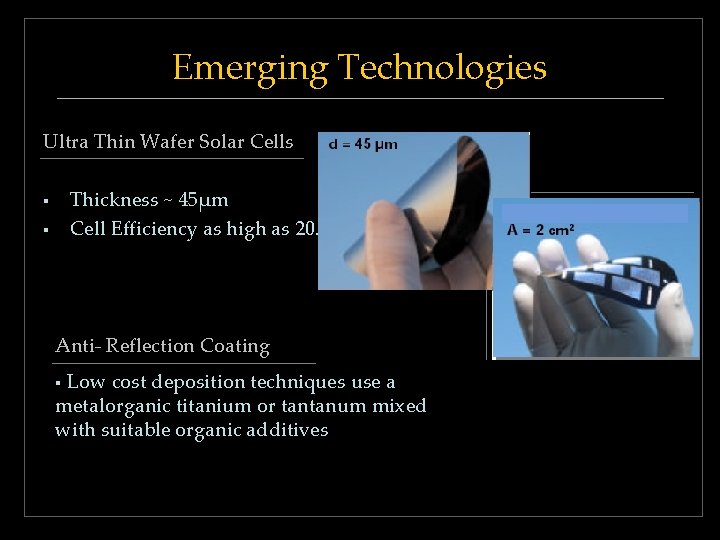
Emerging Technologies Ultra Thin Wafer Solar Cells § § Thickness ~ 45μm Cell Efficiency as high as 20. 3% Anti- Reflection Coating § Low cost deposition techniques use a metalorganic titanium or tantanum mixed with suitable organic additives
Environmental Aspects § § Exhaustion of raw materials CO 2 emission during fabrication process Acidification Disposal problems of hazardous semiconductor material In spite of all these environmental concerns, Solar Photovoltaic is one of the cleanest form of energy
PV’nomics • PV unit : Price per peak watt (Wp) ( Peak watt is the amount of power output a PV module produces at Standard Test Conditions (STC) of a module operating temperature of 25°C in full noontime sunshine (irradiance) of 1, 000 Watts per square meter ) A typical 1 k. Wp System produces approximately 1600 -2000 k. Wh energy in India and Australia • • A typical 2000 watt peak (2 KWp) solar energy system costing $8000 (including installation) will correspond to a price of $4/Wp
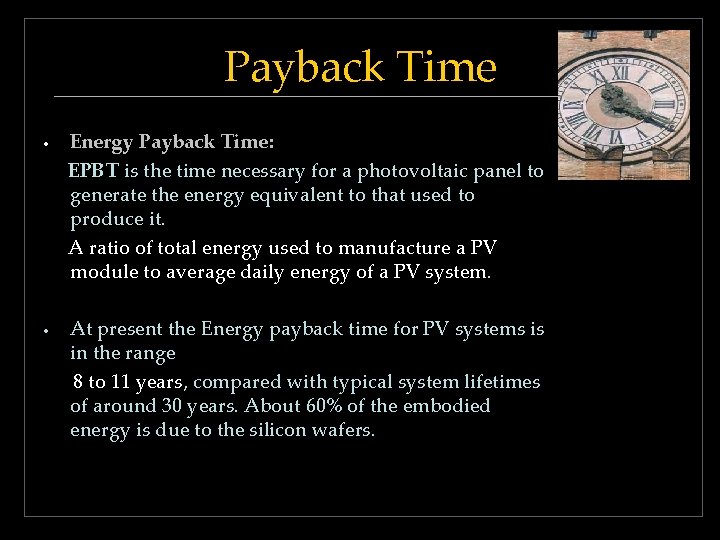
Payback Time • Energy Payback Time: EPBT is the time necessary for a photovoltaic panel to generate the energy equivalent to that used to produce it. A ratio of total energy used to manufacture a PV module to average daily energy of a PV system. At present the Energy payback time for PV systems is in the range 8 to 11 years, compared with typical system lifetimes of around 30 years. About 60% of the embodied energy is due to the silicon wafers. •
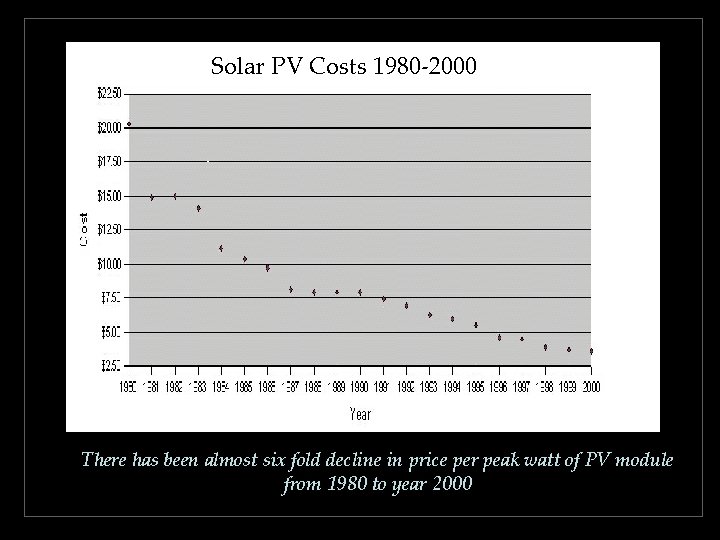
Solar PV Costs 1980 -2000 There has been almost six fold decline in price per peak watt of PV module from 1980 to year 2000
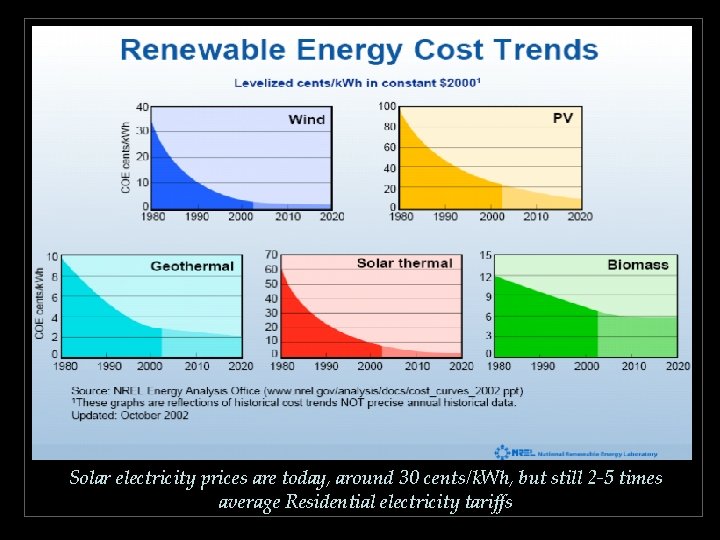
Solar electricity prices are today, around 30 cents/k. Wh, but still 2 -5 times average Residential electricity tariffs
PV’nomics …. § § § Module costs typically represents only 40 -60% of total PV system cost and the rest is accounted by inverter, PV array support, electrical cabling and installation Most PV solar technologies rely on semiconductor-grade crystalline-silicon wafers, which are expensive to produce compared with other energy sources The high initial cost of the equipment they require discourages their large-scale commercialization
‘ The basic commercialization problem PV technology has faced for 20 years : markets will explode when module costs decline, but module costs can't decline much, until the market grows much larger ‘ -PV Insider's Report
The Other Side • Use newer and cheaper materials like amorphous silicon , Cu. In. Se 2 , Cd. Te. • Thin-film solar cells use less than 1% of the raw material (silicon) compared to wafer based solar cells, leading to a significant price drop per k. Wh. • Incentives may bring down the cost of solar energy down to 10 -12 cents per kilowatt hour - which can imply a payback of 5 to 7 years.
However …. • If a location is not currently connected to the “grid”, it is less expensive to install PV panels than to either extend the grid or set up small-scale electricity production. • PV : Best suited for remote site applications having moderate/small power requirements consuming applications even where the grid is in existence. • Isolated mountaintops and other rural areas are ideal for standalone PV systems where maintenance and power accessibility makes PV the ideal technology.
Applications @ PV • • • Water Pumping: PV powered pumping systems are excellent , simple , reliable – life 20 yrs Commercial Lighting: PV powered lighting systems are reliable and low cost alternative. Security, billboard sign, area, and outdoor lighting are all viable applications for PV Consumer electronics: Solar powered watches, calculators, and cameras are all everyday applications for PV technologies. Telecommunications Residential Power: A residence located more than a mile from the electric grid can install a PV system more inexpensively than extending the electric grid (Over 500, 000 homes worldwide use PV power as their only source of electricity)
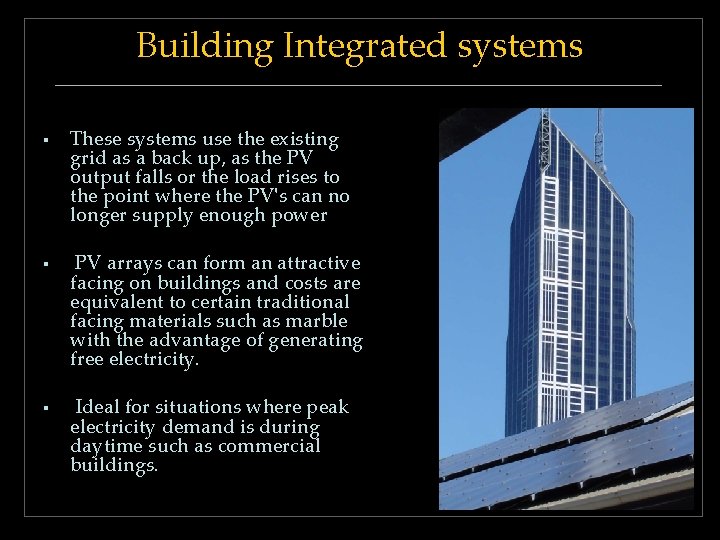
Building Integrated systems § § § These systems use the existing grid as a back up, as the PV output falls or the load rises to the point where the PV's can no longer supply enough power PV arrays can form an attractive facing on buildings and costs are equivalent to certain traditional facing materials such as marble with the advantage of generating free electricity. Ideal for situations where peak electricity demand is during daytime such as commercial buildings.
Present PV Scenario in India • In terms of overall installed PV capacity, India comes fourth after Japan, Germany and U. S. (With Installed capacity of 110 MW) In the area of Photovoltaics India today is the second largest manufacturer in the world of PV panels based on crystalline solar cells. (Industrial production in this area has reached a level of 11 MW per year which is about 10% of the world’s total PV production) • A major drive has also been initiated by the Government to export Indian PV products, systems, technologies and services (Solar Photovoltaic plant and equipment has been exported to countries in the Middle East and Africa) •
Indian PV Era — Vision 2012 Arid regions receive plentiful solar radiation, regions like Rajasthan, Gujarat and Haryana receive sunlight in plenty. Thus the Potential availability - 20 MW/km 2 (source IREDA) • • IREDA is planning to electrify 18, 000 villages by year 2012 mainly through solar PV systems • Targets have been set for the large scale utilization of PV technology by different sectors within the next five years
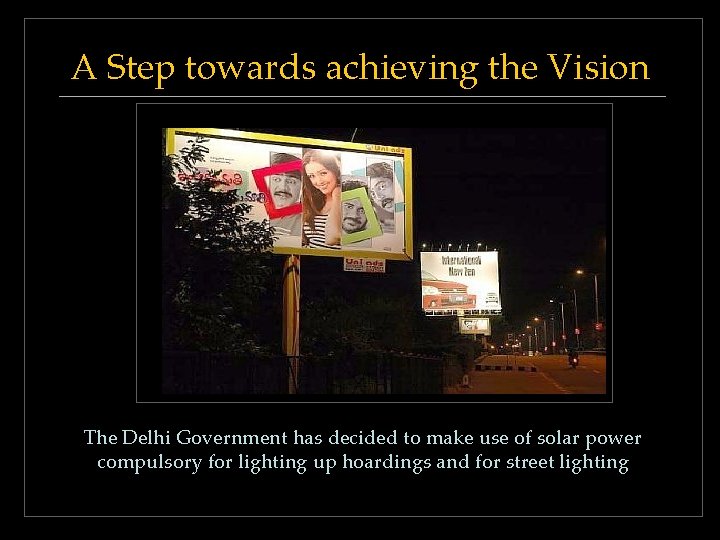
A Step towards achieving the Vision The Delhi Government has decided to make use of solar power compulsory for lighting up hoardings and for street lighting
“ By the year 2030, India should achieve Energy Independence through solar power and other forms of renewable energy ” Dr. A. P. J. Abdul Kalam President of India Independence Day Speech, 2005
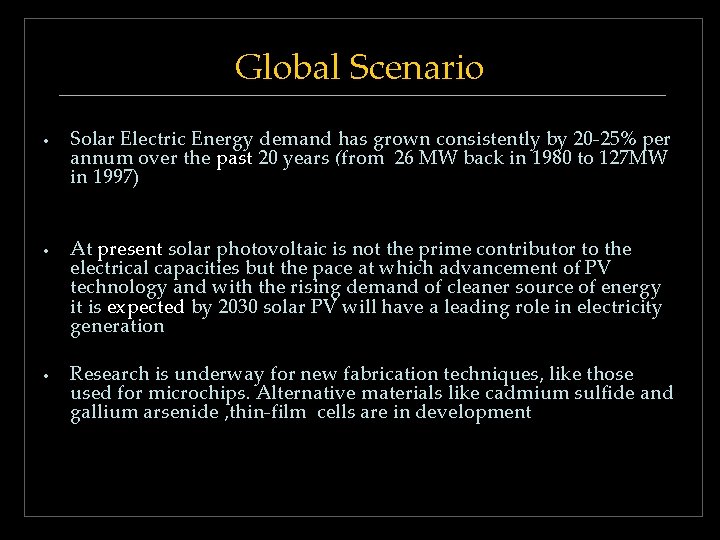
Global Scenario • Solar Electric Energy demand has grown consistently by 20 -25% per annum over the past 20 years (from 26 MW back in 1980 to 127 MW in 1997) • At present solar photovoltaic is not the prime contributor to the electrical capacities but the pace at which advancement of PV technology and with the rising demand of cleaner source of energy it is expected by 2030 solar PV will have a leading role in electricity generation • Research is underway for new fabrication techniques, like those used for microchips. Alternative materials like cadmium sulfide and gallium arsenide , thin-film cells are in development
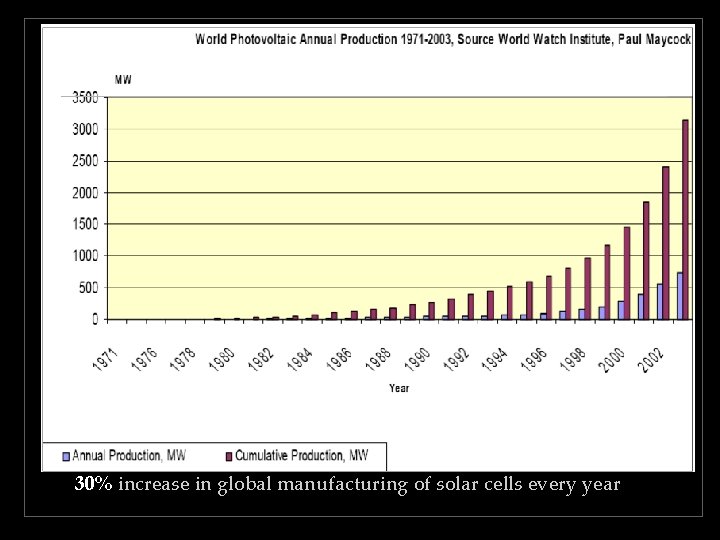
30% increase in global manufacturing of solar cells every year
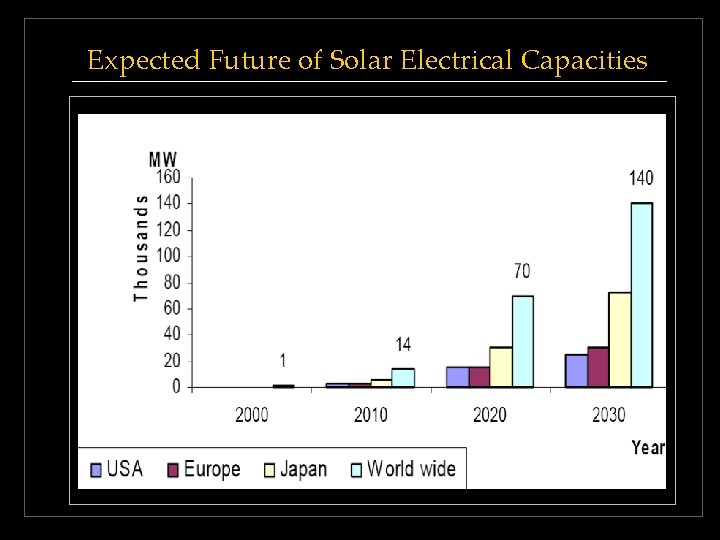
Expected Future of Solar Electrical Capacities
Concluding Remarks • The key to successful solar energy installation is to use quality components that have long lifetimes and require minimal maintenance. The future is bright for continued PV technology dissemination. PV technology fills a significant need in supplying electricity, creating local jobs and promoting economic development in rural areas, avoiding the external environmental costs associated with traditional electrical generation technologies. • • Major power policy reforms and tax incentives will play a major role if all the above said is to be effectively realized.
“The Light at the end of the Tunnel” By 2020 global solar output could be 276 Terawatt hours, which would equal 30% of Africa's energy needs or 1% of global demand. This would replace the output of 75 new coal fired power stations. The global solar infrastructure would have an investment value of US$75 billion a year. By 2040 global solar output could be more than 9000 Terawatt hours, or 26% of the expected global demand Report European Photovoltaic Industry Association (EPIA) and Greenpeace
‘ Can technological developments and the transition to a culture that is more aware of the need to safeguard the environment help create a world powered by the Sun’s Energy ? ‘