
On the CUSP STOP BSI Overview of STOPBSI
On the CUSP: STOP BSI Overview of STOP-BSI Program
Immersion Call Overview Week 1: Project overview Week 2: Science of Improving Patient Safety Week 3: Eliminating CLABSI Week 4: The Comprehensive Unit-Based Safety Program (CUSP) Week 5: Building a Team Week 6: Physician Engagement
Learning Objectives • To delineate the goals of STOP-BSI • To describe the project organization • To define the interventions • To outline the planned learning sessions • To identify who to call for help
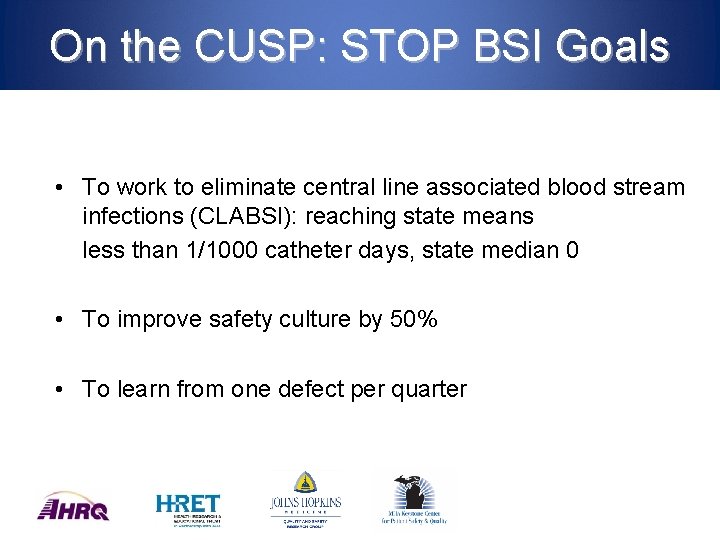
On the CUSP: STOP BSI Goals • To work to eliminate central line associated blood stream infections (CLABSI): reaching state means less than 1/1000 catheter days, state median 0 • To improve safety culture by 50% • To learn from one defect per quarter
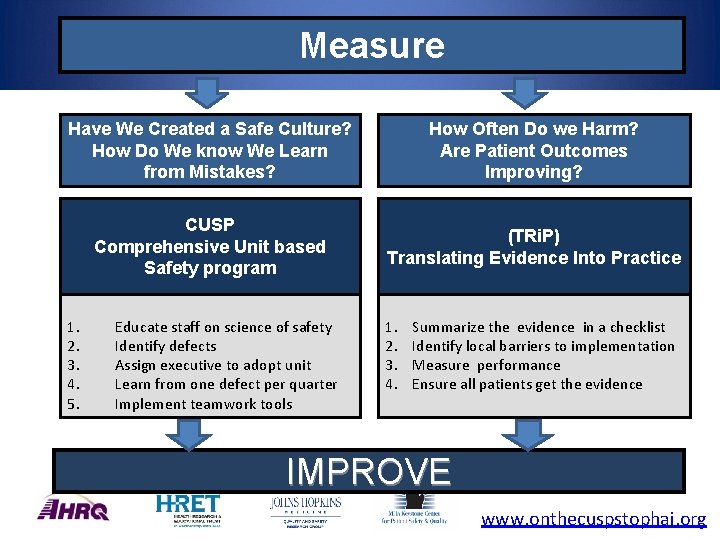
Measure Have We Created a Safe Culture? How Do We know We Learn from Mistakes? How Often Do we Harm? Are Patient Outcomes Improving? CUSP Comprehensive Unit based Safety program (TRi. P) Translating Evidence Into Practice 1. 2. 3. 4. 5. Educate staff on science of safety Identify defects Assign executive to adopt unit Learn from one defect per quarter Implement teamwork tools 1. 2. 3. 4. Summarize the evidence in a checklist Identify local barriers to implementation Measure performance Ensure all patients get the evidence IMPROVE www. onthecuspstophai. org
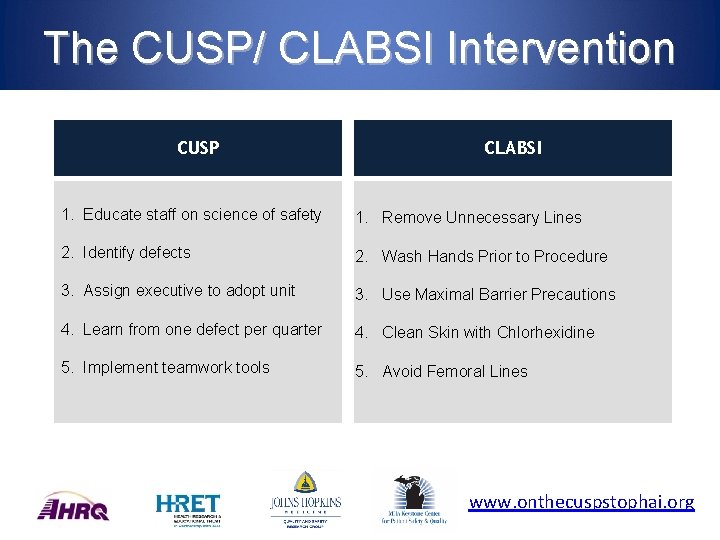
The CUSP/ CLABSI Intervention CUSP CLABSI 1. Educate staff on science of safety 1. Remove Unnecessary Lines 2. Identify defects 2. Wash Hands Prior to Procedure 3. Assign executive to adopt unit 3. Use Maximal Barrier Precautions 4. Learn from one defect per quarter 4. Clean Skin with Chlorhexidine 5. Implement teamwork tools 5. Avoid Femoral Lines www. onthecuspstophai. org
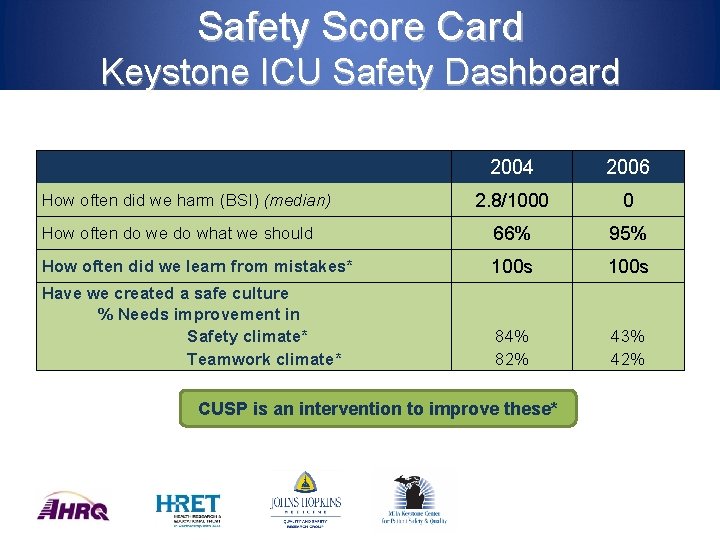
Safety Score Card Keystone ICU Safety Dashboard 2004 2006 2. 8/1000 0 How often do we do what we should 66% 95% How often did we learn from mistakes* 100 s How often did we harm (BSI) (median) Have we created a safe culture % Needs improvement in Safety climate* Teamwork climate* 84% 82% CUSP is an intervention to improve these* 43% 42%
Project Organization • State-wide effort coordinated by Hospital Association or designated collaborative agency • Learning collaborative model (e. g. , multisite participation, 2 face-to-face meetings, monthly calls) • Standardized data collection tools and evidence • Local unit modification of how to implement interventions
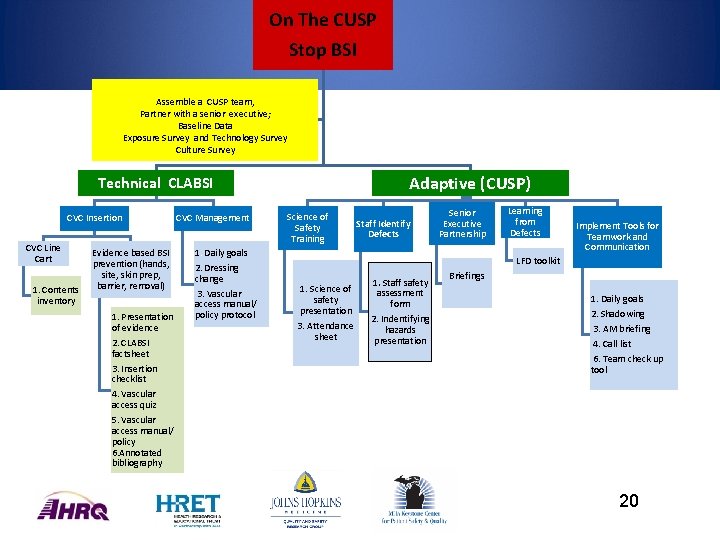
On The CUSP Stop BSI Assemble a CUSP team, Partner with a senior executive; Baseline Data Exposure Survey and Technology Survey Culture Survey Adaptive (CUSP) Technical CLABSI CVC Insertion CVC Line Cart 1. Contents inventory Evidence based BSI prevention (hands, site, skin prep, barrier, removal) 1. Presentation of evidence 2. CLABSI factsheet 3. Insertion checklist 4. Vascular access quiz 5. Vascular access manual/ policy 6. Annotated bibliography CVC Management Science of Safety Training Staff Identify Defects Senior Executive Partnership 1. Daily goals 2. Dressing change 3. Vascular access manual/ policy protocol Learning from Defects Implement Tools for Teamwork and Communication LFD toolkit 1. Science of safety presentation 3. Attendance sheet 1. Staff safety assessment form 2. Indentifying hazards presentation Briefings 1. Daily goals 2. Shadowing 3. AM briefing 4. Call list 6. Team check up tool 20
Intervention to Eliminate CLABSI
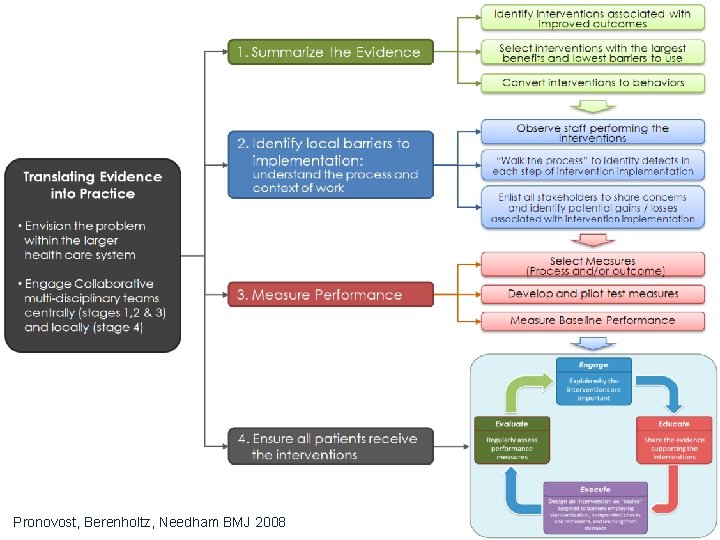
Pronovost, Berenholtz, Needham BMJ 2008
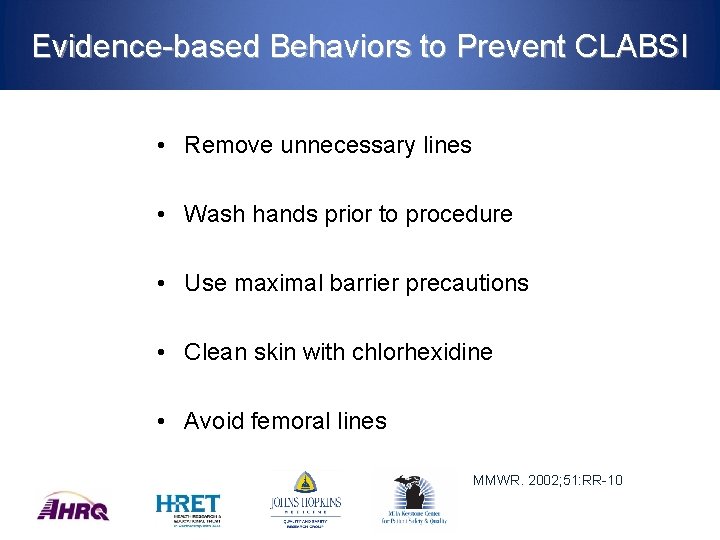
Evidence-based Behaviors to Prevent CLABSI • Remove unnecessary lines • Wash hands prior to procedure • Use maximal barrier precautions • Clean skin with chlorhexidine • Avoid femoral lines MMWR. 2002; 51: RR-10
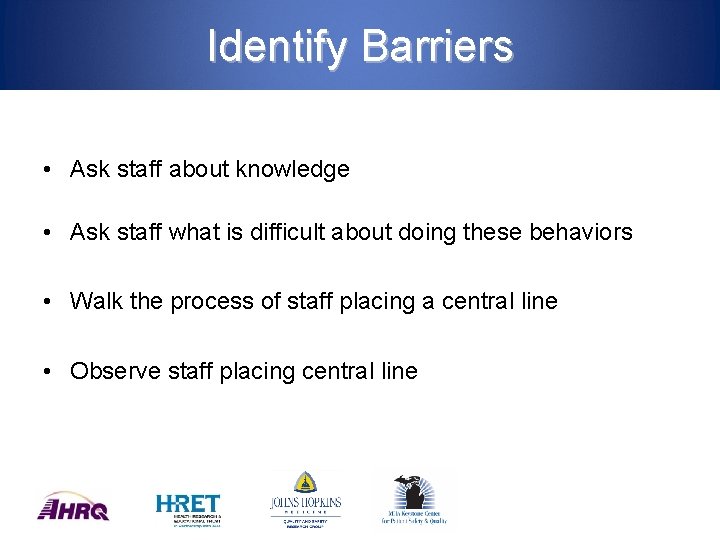
Identify Barriers • Ask staff about knowledge • Ask staff what is difficult about doing these behaviors • Walk the process of staff placing a central line • Observe staff placing central line
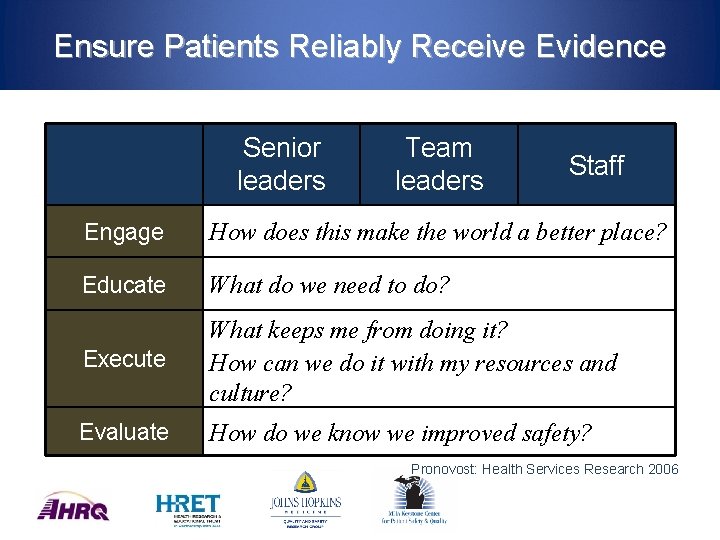
Ensure Patients Reliably Receive Evidence Senior leaders Team leaders Staff Engage How does this make the world a better place? Educate What do we need to do? Execute What keeps me from doing it? How can we do it with my resources and culture? Evaluate How do we know we improved safety? Pronovost: Health Services Research 2006
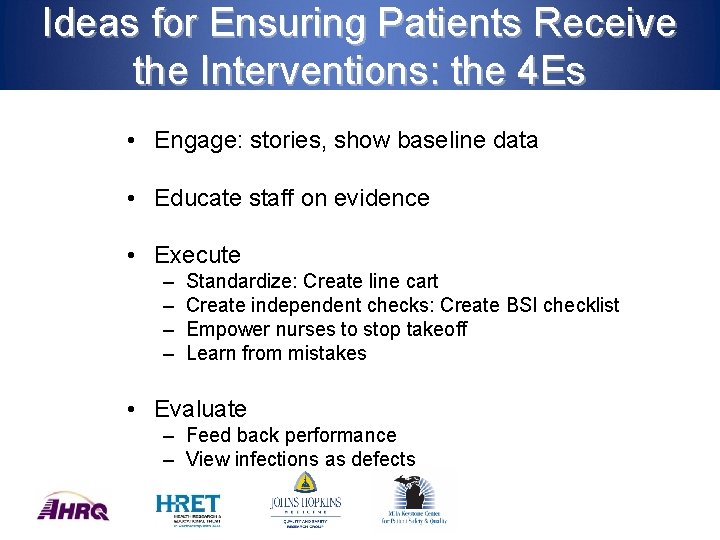
Ideas for Ensuring Patients Receive the Interventions: the 4 Es • Engage: stories, show baseline data • Educate staff on evidence • Execute – – Standardize: Create line cart Create independent checks: Create BSI checklist Empower nurses to stop takeoff Learn from mistakes • Evaluate – Feed back performance – View infections as defects
Comprehensive Unit-based Safety Program (CUSP)
Pre CUSP Work • Create a unit-level team – Nurse, physician administrator, others – Assign a team leader • Measure culture in the unit • Seek out a senior executive to participate on unit-level team
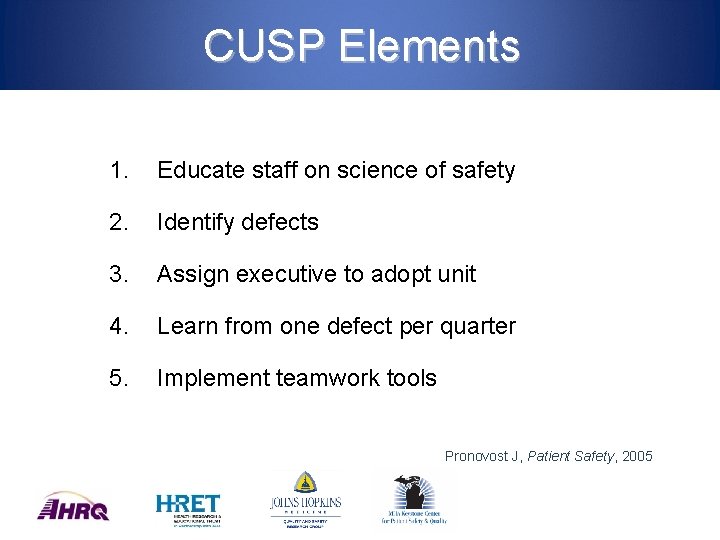
CUSP Elements 1. Educate staff on science of safety 2. Identify defects 3. Assign executive to adopt unit 4. Learn from one defect per quarter 5. Implement teamwork tools Pronovost J, Patient Safety, 2005
We are on a Continuous Journey • We have toolkits, manuals, websites, and monthly calls to learn from and with each other. • Your job is to join the calls, share with us your successes and more importantly the barriers you face. • Commit to the premise that harm is untenable.
To Get Help • Email /call state project leader • Talk to your team leader
Action Items • Review content of website • Toolkits • Slidesets • Manuals • Project Management Checklists – Pre-Implementation Checklist – CEO/ Senior Leader Checklist – Infection Preventionist Checklist
References Measuring Safety • Pronovost PJ, Goeschel CA, Wachter RM. The wisdom and justice of not paying for "preventable complications". JAMA. 2008; 299(18): 2197 -2199. • Pronovost PJ, Miller MR, Wachter RM. Tracking progress in patient safety: An elusive target. JAMA. 2006; 296(6): 696 -699. • Pronovost PJ, Sexton JB, Pham JC, Goeschel CA, Winters BD, Miller MR. Measurement of quality and assurance of safety in the critically ill. Clin Chest Med. 2008; in press.
References Measuring Safety • Pronovost PJ, Goeschel CA, Wachter RM. The wisdom and justice of not paying for "preventable complications". JAMA. 2008; 299(18): 2197 -2199. • Pronovost PJ, Miller MR, Wachter RM. Tracking progress in patient safety: An elusive target. JAMA. 2006; 296(6): 696 -699. • Pronovost PJ, Sexton JB, Pham JC, Goeschel CA, Winters BD, Miller MR. Measurement of quality and assurance of safety in the critically ill. Clin Chest Med. 2008; in press.
References • • Pronovost P, Weast B, Rosenstein B, et al. Implementing and validating a comprehensive unit-based safety program. J Pat Safety. 2005; 1(1): 33 -40. Pronovost P, Berenholtz S, Dorman T, Lipsett PA, Simmonds T, Haraden C. Improving communication in the ICU using daily goals. J Crit Care. 2003; 18(2): 71 -75. • Pronovost PJ, Berenholtz SM, Needham DM. Translating evidence into practice: a model for large scale knowledge translation. BMJ. 2008 Oct 6; 337. • Pronovost PJ, Weast B, Bishop K, et al. Senior executive adopt-a-work unit: A model for safety improvement. Jt Comm J Qual Saf. 2004; 30(2): 59 -68. • Thompson DA, Holzmueller CG, Cafeo CL, Sexton JB, Pronovost PJ. A morning briefing: Setting the stage for a clinically and operationally good day. Jt Comm J Qual and Saf. 2005; 31(8): 476 -479.
- Slides: 26