Sheltered Instruction Opening Adelita Acosta adelita acostaesc 13

- Slides: 68
Sheltered Instruction Opening Adelita Acosta adelita. acosta@esc 13. txed. net Jennifer Holling jennifer. holling@esc 13. txed. net Janet O’Keeffe janet. okeeffe@esc 13. txed. net 1
What is LEP SSI? • LEP SSI is a competitive state grant – One goal is to improve LEP student performance, particularly at the secondary level with regard to graduation and credit accrual – To develop a model for effectively improving LEP student performance • Region XIII created a Shared Service Arrangement of 34 districts and was awarded the grant 2
Why Are You Here? • One of the major initiatives of the LEP SSI grant is training in Sheltered Instruction at the high school level • You have been identified by your district or campus as a trainer who will attend this 4 -day training of the trainer series and then in turn train teachers at your campus 3
Overview of the Training of the Trainer Series Ø Opening Day—All team members together Ø Content Area Days—Two days of content-specific strategy training for the content area team members and/or the ESL team member and/or the special education team member Ø Closing Day—All team members together 4
Your Role as a Trainer • Present the first three days of the training of the trainer series in your district by the end of the school year • Submit a Report of Training form to Region XIII to document when you present the training and how many teachers you train • You may be flexible in the scheduling of your presentations; however, the content must be presented as it is in the training of the trainer 5
Region XIII Support ü Provide training of the trainer to district identified teams ü Provide binders with training materials to identified teams ü Provide training power points, handouts and materials on a CD ü Provide a copy of the SIOP Model book ü Provide technical assistance and support 6
Objectives Build Foundations of First and Second Language Acquisition Understand What Sheltered Instruction Is Become Familiar with Components of the SIOP Model 7
Icebreaker 8
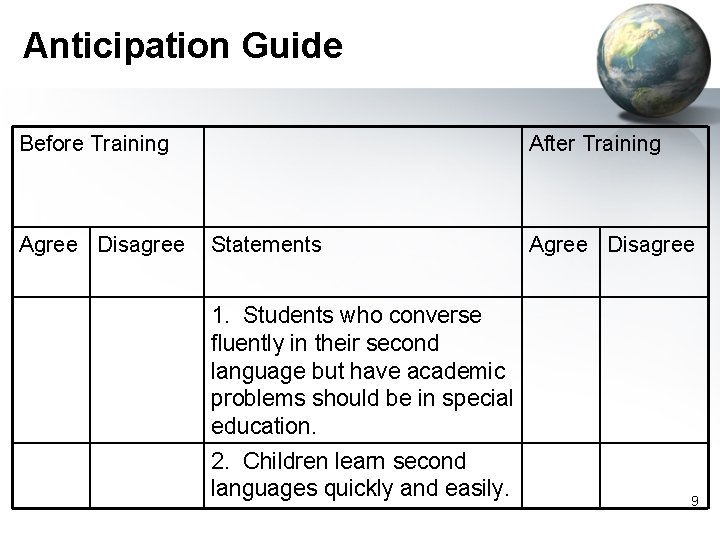
Anticipation Guide Before Training Agree Disagree After Training Statements Agree Disagree 1. Students who converse fluently in their second language but have academic problems should be in special education. 2. Children learn second languages quickly and easily. 9
Vocabulary Match-Up • When you get your card, keep it secret. • When you are instructed to do so, move around the room, talk to people, and try to match your term or definition with its mate. • Once you have matched your cards, stand still next to your partner. • If you have two cards, give the first matching pair to your partner, and continue to look for your second partner. 10
Onion-Ring Discussion • How did you learn your native language? • What language skills did you become proficient in first? • How long did the process of acquiring your first language take? Was it different for different skills? 11
Onion-Ring Discussion (Cont. ) • Who were your first conversations in your native language with? What were they about? How did that person respond to you? • What kinds of activities did your parents or early childhood teachers engage you in? What were some of the characteristics of these activities? 12
How do you think acquiring a 2 nd (L 2) or additional language is similar to or different from acquiring a 1 st (L 1) language? 13
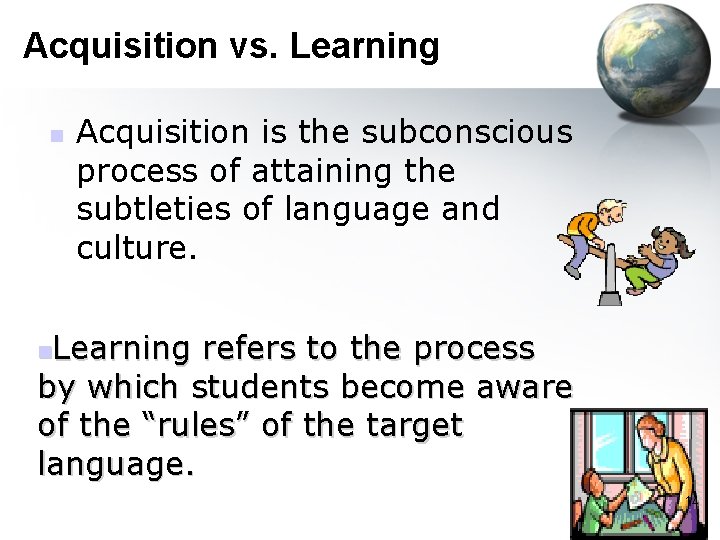
Acquisition vs. Learning n Acquisition is the subconscious process of attaining the subtleties of language and culture. Learning refers to the process by which students become aware of the “rules” of the target language. n 14
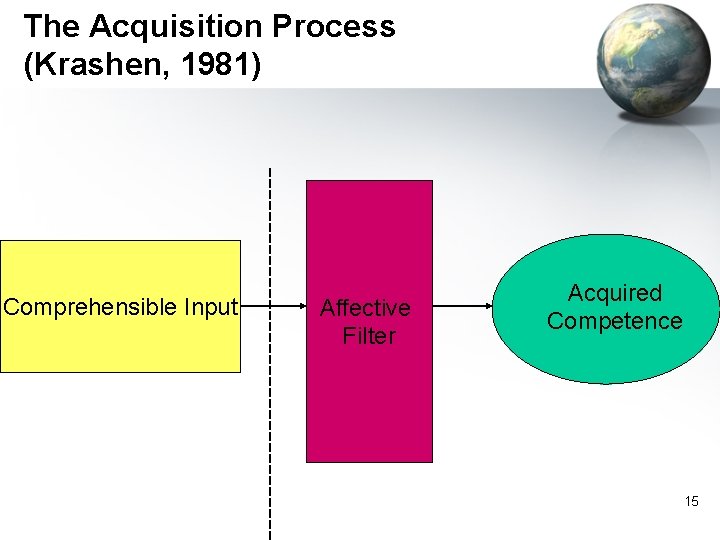
The Acquisition Process (Krashen, 1981) Comprehensible Input Affective Filter Acquired Competence 15
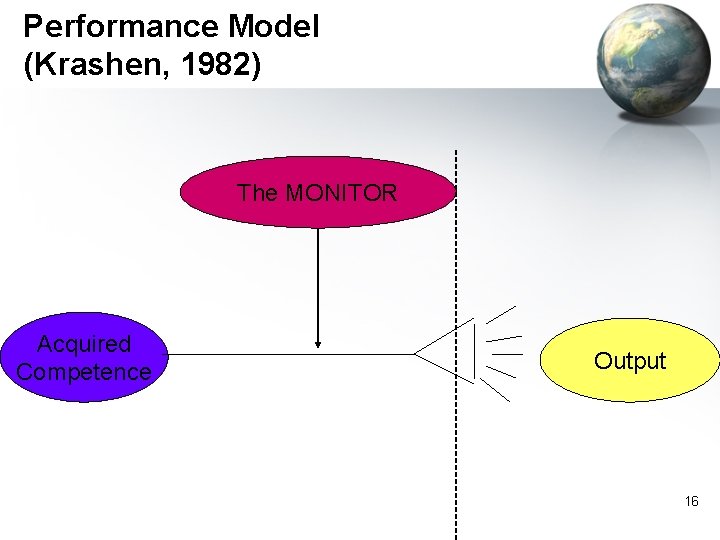
Performance Model (Krashen, 1982) The MONITOR Acquired Competence Output 16
Comprehensible Input • Input that is clearly understood • Language that is acquired through comprehended messages • Meaningful, context-supported language input • i + 1 (similar to Vygotsky’s ZPD)—input is a little beyond the student’s current comprehension level 17
Making Input Comprehensible • Use authentic language • Use non-verbal cues • Use manipulatives, realia, and visuals • Create a low-stress, friendly environment • Stress student involvement; hands-on activities • Use prior content introduction in the primary language • Simplify teacher talk 18
Simplifying Teacher Talk • Speak slowly • Enunciate clearly • • Include pauses Repeat key words/vocabulary Restate Use cognates • Use high frequency words • Reduce the number of pronouns • Avoid slang and idioms (for beginners) 19
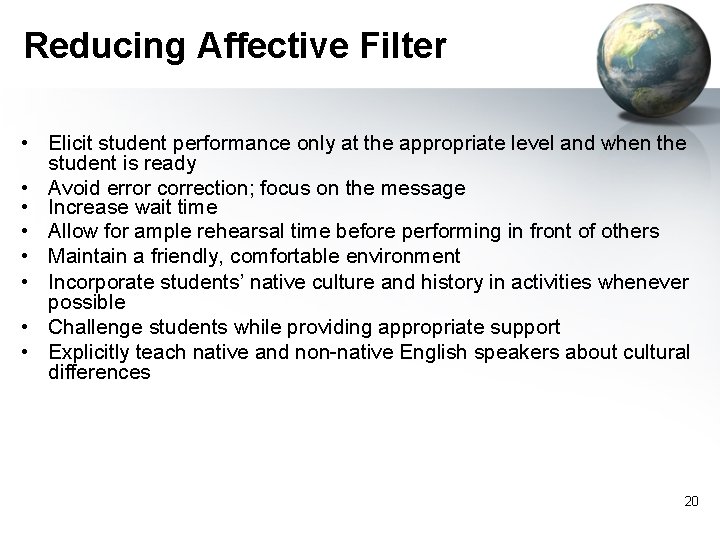
Reducing Affective Filter • Elicit student performance only at the appropriate level and when the student is ready • Avoid error correction; focus on the message • Increase wait time • Allow for ample rehearsal time before performing in front of others • Maintain a friendly, comfortable environment • Incorporate students’ native culture and history in activities whenever possible • Challenge students while providing appropriate support • Explicitly teach native and non-native English speakers about cultural differences 20
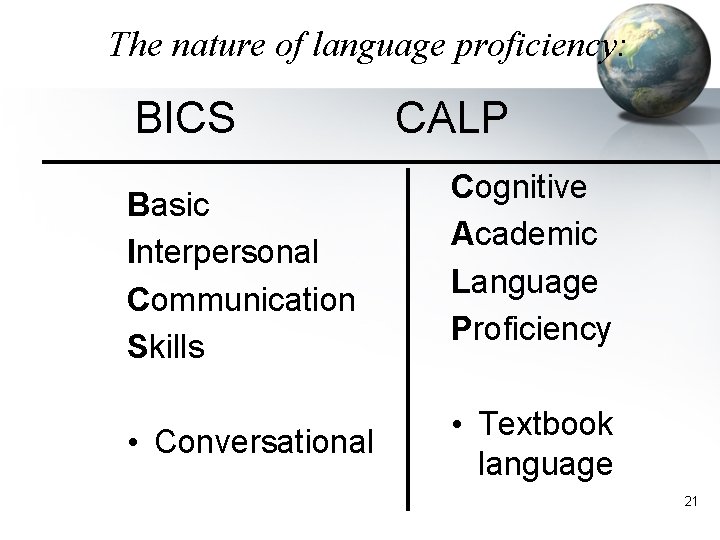
The nature of language proficiency: BICS Basic Interpersonal Communication Skills • Conversational CALP Cognitive Academic Language Proficiency • Textbook language 21
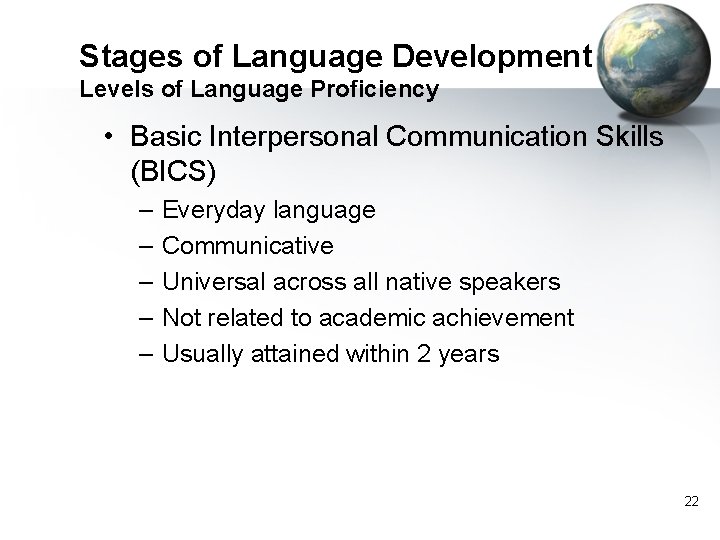
Stages of Language Development Levels of Language Proficiency • Basic Interpersonal Communication Skills (BICS) – – – Everyday language Communicative Universal across all native speakers Not related to academic achievement Usually attained within 2 years 22
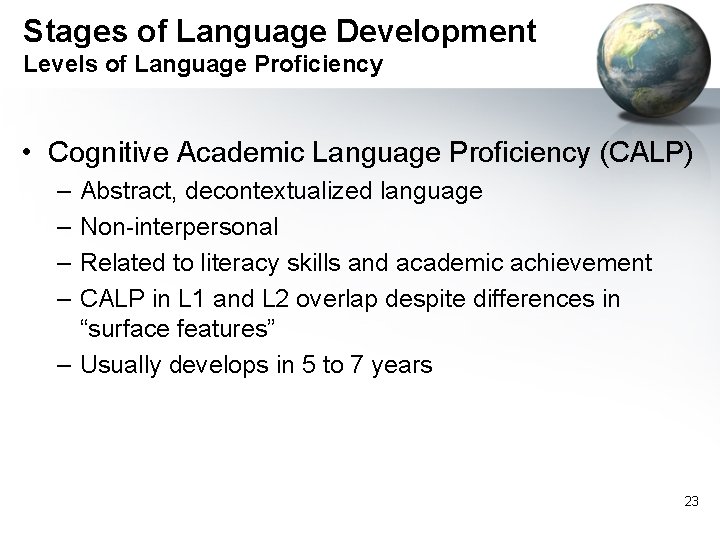
Stages of Language Development Levels of Language Proficiency • Cognitive Academic Language Proficiency (CALP) – – Abstract, decontextualized language Non-interpersonal Related to literacy skills and academic achievement CALP in L 1 and L 2 overlap despite differences in “surface features” – Usually develops in 5 to 7 years 23
Language of the Discipline Activity 24
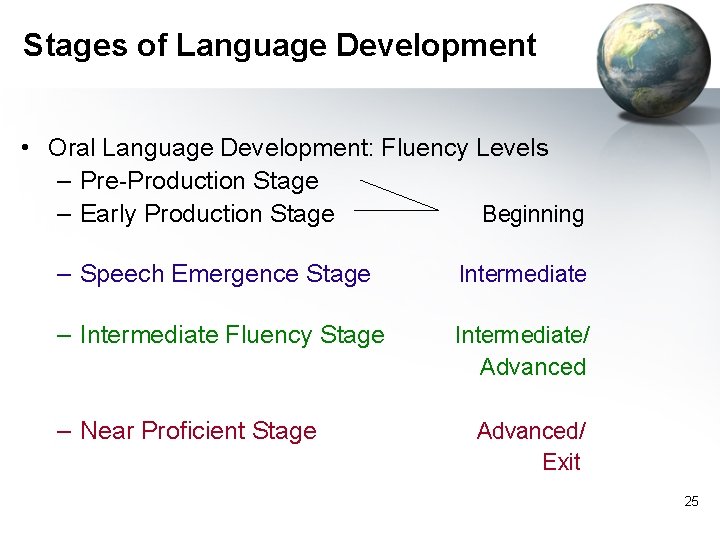
Stages of Language Development • Oral Language Development: Fluency Levels – Pre-Production Stage – Early Production Stage Beginning – Speech Emergence Stage Intermediate – Intermediate Fluency Stage Intermediate/ Advanced – Near Proficient Stage Advanced/ Exit 25
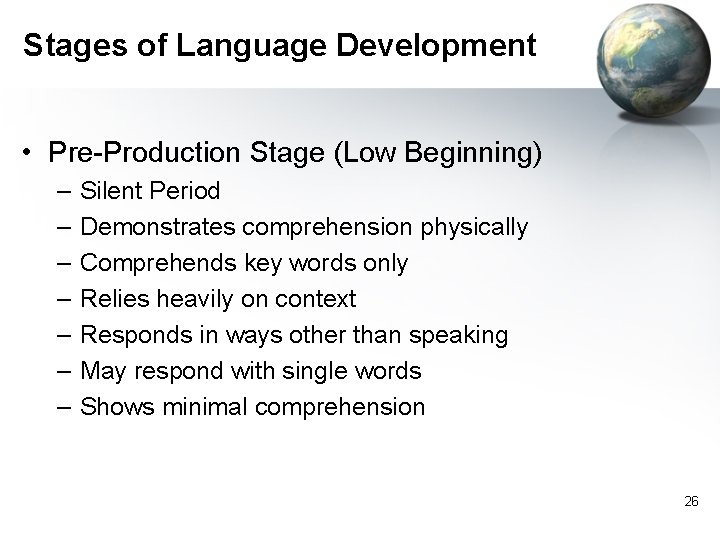
Stages of Language Development • Pre-Production Stage (Low Beginning) – – – – Silent Period Demonstrates comprehension physically Comprehends key words only Relies heavily on context Responds in ways other than speaking May respond with single words Shows minimal comprehension 26
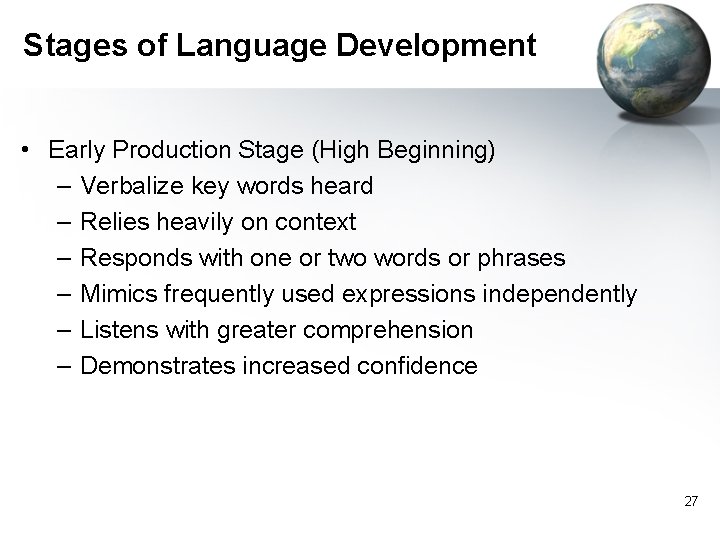
Stages of Language Development • Early Production Stage (High Beginning) – Verbalize key words heard – Relies heavily on context – Responds with one or two words or phrases – Mimics frequently used expressions independently – Listens with greater comprehension – Demonstrates increased confidence 27
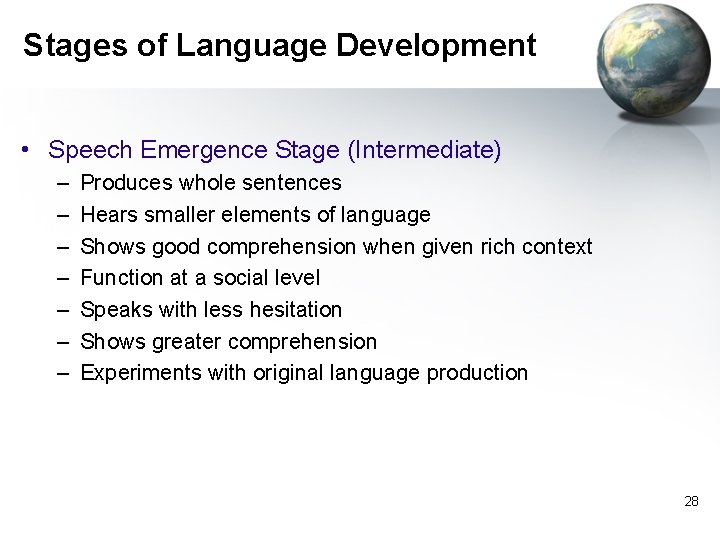
Stages of Language Development • Speech Emergence Stage (Intermediate) – – – – Produces whole sentences Hears smaller elements of language Shows good comprehension when given rich context Function at a social level Speaks with less hesitation Shows greater comprehension Experiments with original language production 28
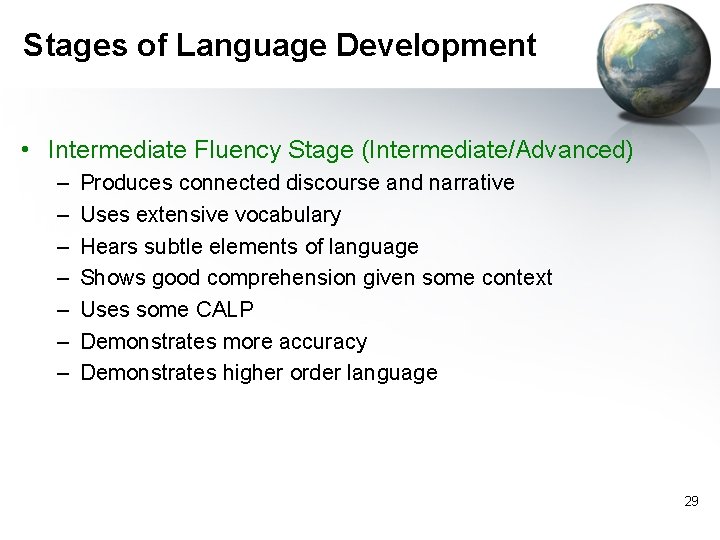
Stages of Language Development • Intermediate Fluency Stage (Intermediate/Advanced) – – – – Produces connected discourse and narrative Uses extensive vocabulary Hears subtle elements of language Shows good comprehension given some context Uses some CALP Demonstrates more accuracy Demonstrates higher order language 29
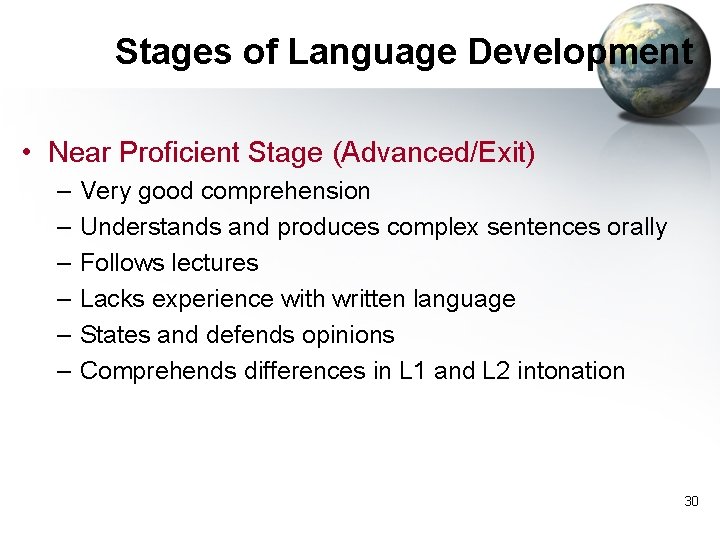
Stages of Language Development • Near Proficient Stage (Advanced/Exit) – – – Very good comprehension Understands and produces complex sentences orally Follows lectures Lacks experience with written language States and defends opinions Comprehends differences in L 1 and L 2 intonation 30
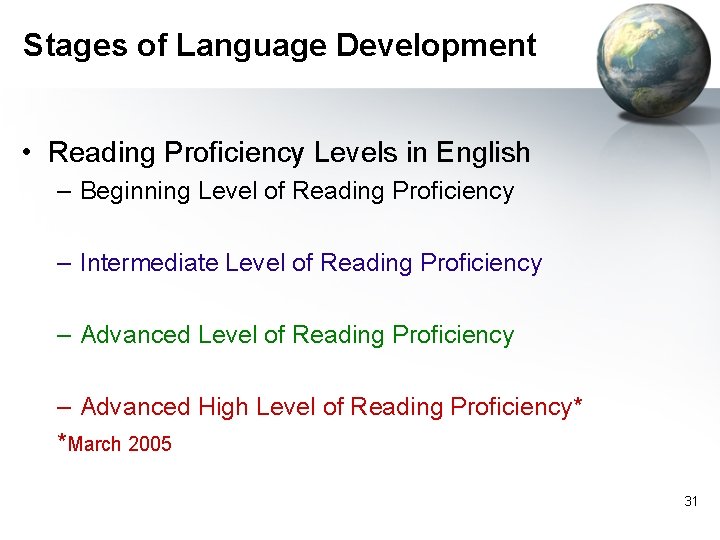
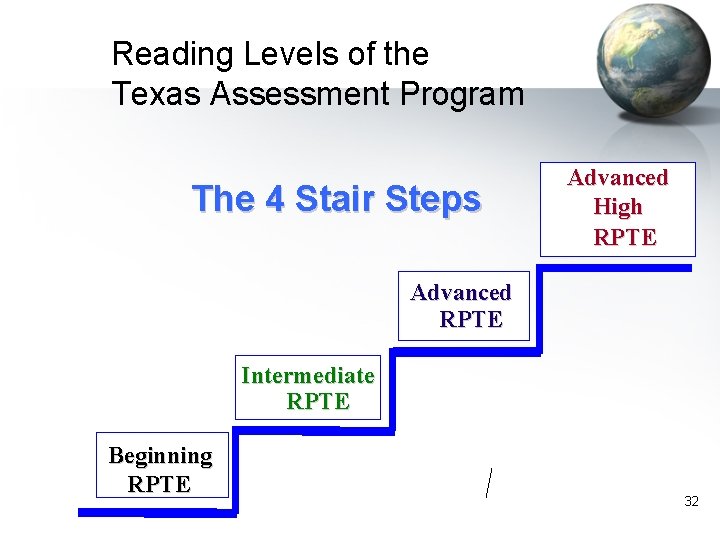
Stages of Language Development • Reading Proficiency Levels in English – Beginning Level of Reading Proficiency – Intermediate Level of Reading Proficiency – Advanced High Level of Reading Proficiency* *March 2005 31
Reading Levels of the Texas Assessment Program The 4 Stair Steps Advanced High RPTE Advanced RPTE Intermediate RPTE Beginning RPTE 32
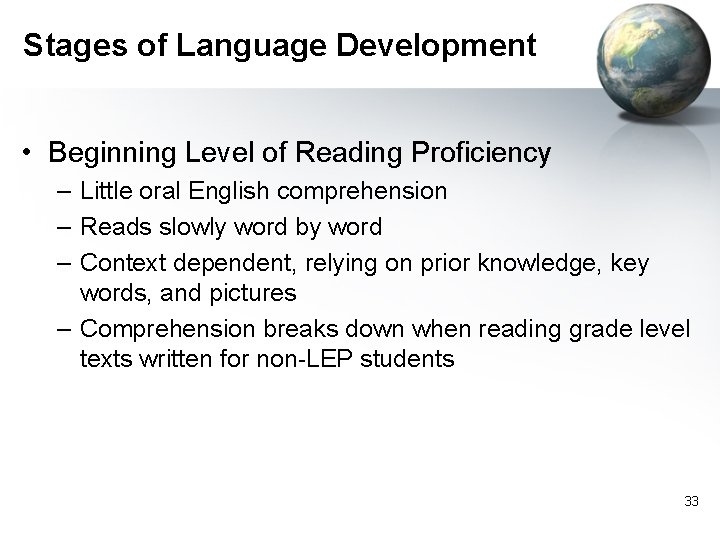
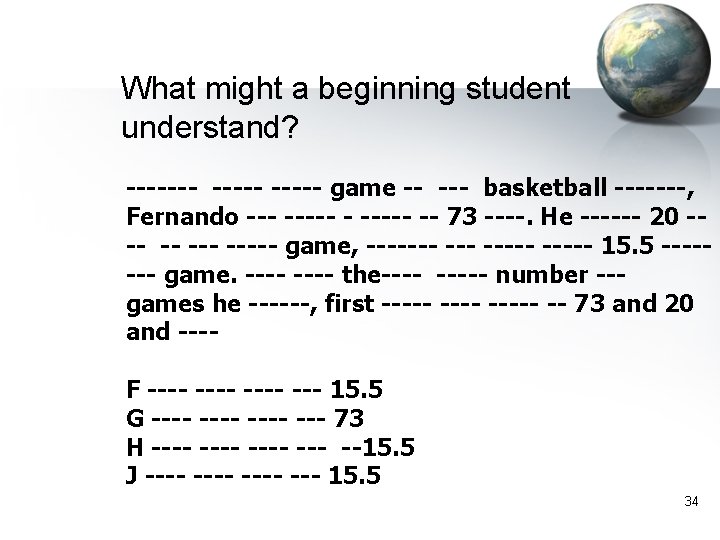
Stages of Language Development • Beginning Level of Reading Proficiency – Little oral English comprehension – Reads slowly word by word – Context dependent, relying on prior knowledge, key words, and pictures – Comprehension breaks down when reading grade level texts written for non-LEP students 33
What might a beginning student understand? ------- game -- --- basketball -------, Fernando ----- -- 73 ----. He ------ 20 --- ----- game, ------- 15. 5 ----- game. ---- the----- number --- games he ------, first ----- -- 73 and 20 and ---- F ---- 15. 5 G ---- 73 H ---- --15. 5 J ---- 15. 5 34
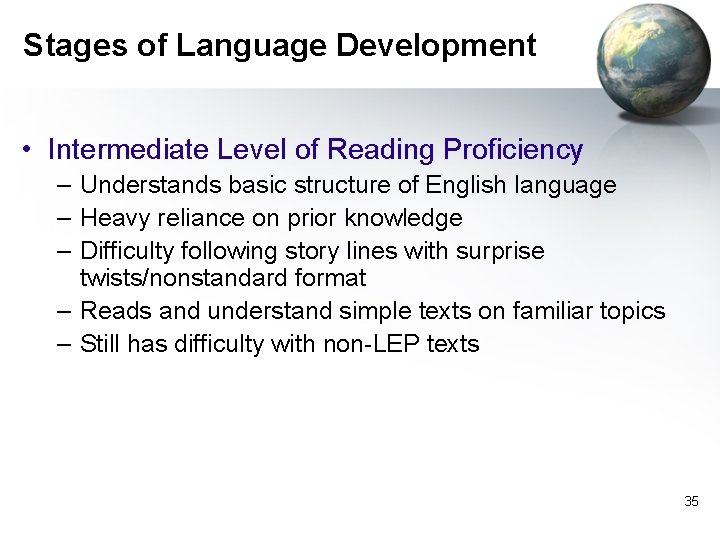
Stages of Language Development • Intermediate Level of Reading Proficiency – Understands basic structure of English language – Heavy reliance on prior knowledge – Difficulty following story lines with surprise twists/nonstandard format – Reads and understand simple texts on familiar topics – Still has difficulty with non-LEP texts 35
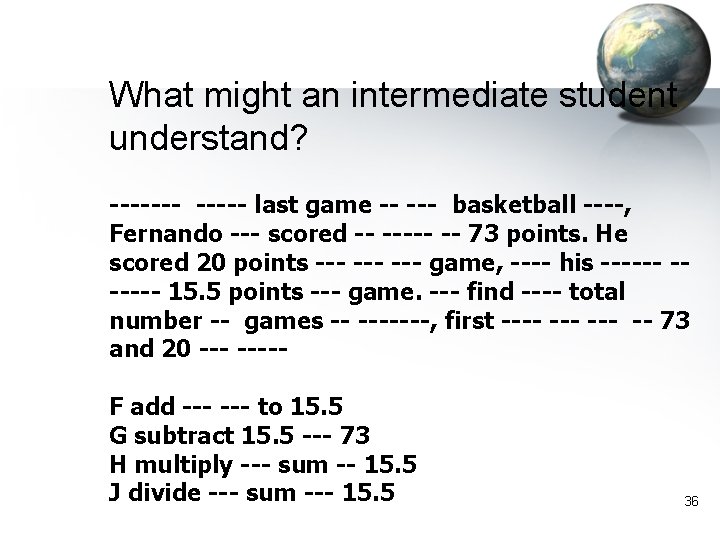
What might an intermediate student understand? ------- last game -- --- basketball ----, Fernando --- scored -- ----- -- 73 points. He scored 20 points --- --- game, ---- his ------ 15. 5 points --- game. --- find ---- total number -- games -- -------, first ---- --- -- 73 and 20 ----- F add --- to 15. 5 G subtract 15. 5 --- 73 H multiply --- sum -- 15. 5 J divide --- sum --- 15. 5 36
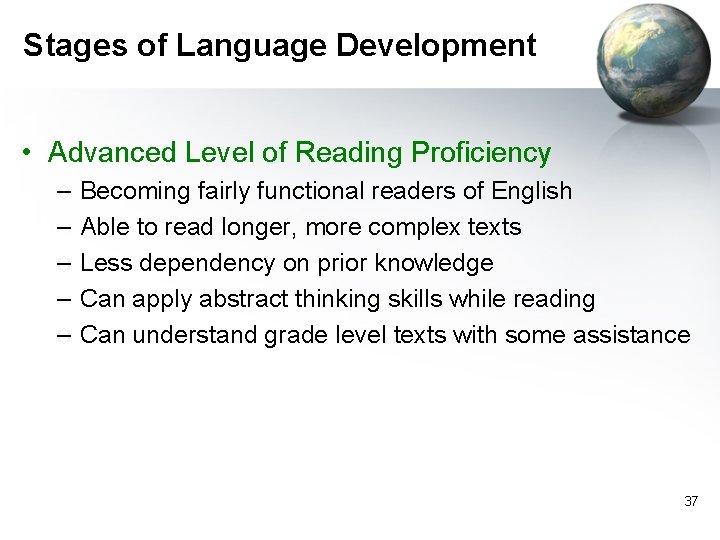
Stages of Language Development • Advanced Level of Reading Proficiency – – – Becoming fairly functional readers of English Able to read longer, more complex texts Less dependency on prior knowledge Can apply abstract thinking skills while reading Can understand grade level texts with some assistance 37
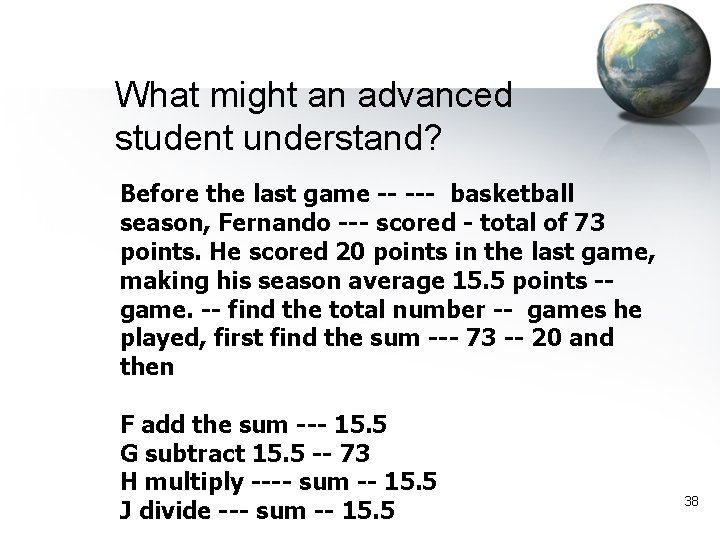
What might an advanced student understand? Before the last game -- --- basketball season, Fernando --- scored - total of 73 points. He scored 20 points in the last game, making his season average 15. 5 points -- game. -- find the total number -- games he played, first find the sum --- 73 -- 20 and then F add the sum --- 15. 5 G subtract 15. 5 -- 73 H multiply ---- sum -- 15. 5 J divide --- sum -- 15. 5 38
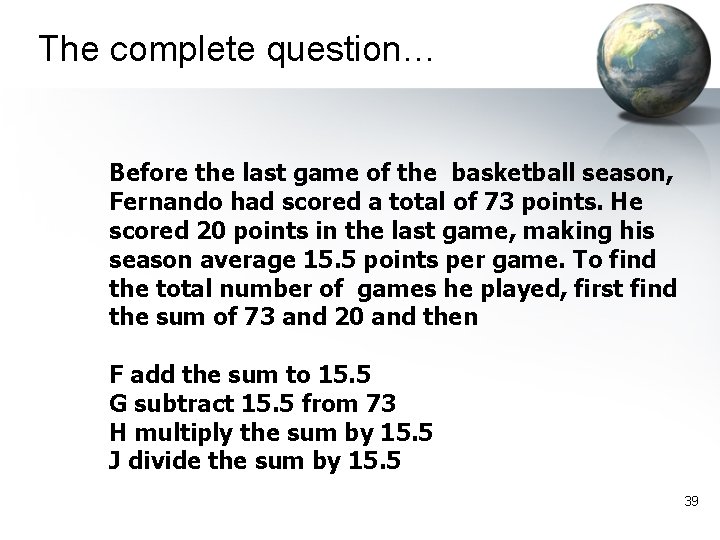
The complete question… Before the last game of the basketball season, Fernando had scored a total of 73 points. He scored 20 points in the last game, making his season average 15. 5 points per game. To find the total number of games he played, first find the sum of 73 and 20 and then F add the sum to 15. 5 G subtract 15. 5 from 73 H multiply the sum by 15. 5 J divide the sum by 15. 5 39
A Look at the Oral Language Development Chart ? What do you notice about the assessment options as a student moves from pre-production to near proficient? ? What kinds of instructional foci should you have at the various levels of oral language development? 40
Case Studies 41
What is Sheltered Instruction? Ø Sheltered instruction is a means for making grade-level content more accessible for ELLs while also promoting English language development. ØThis approach combines second language acquisition strategies with content area instruction. ØSheltered instruction teaches academic subject matter and its associated vocabulary, concepts, and skills by using language and context to make 42 the information comprehensible to ELLs
What Sheltered Instruction Is Not • Traditional ESL • Content Remediation • Teaching Lower Grade Level Content • Watered Down Curriculum • Taught by an ESL Specialist 43
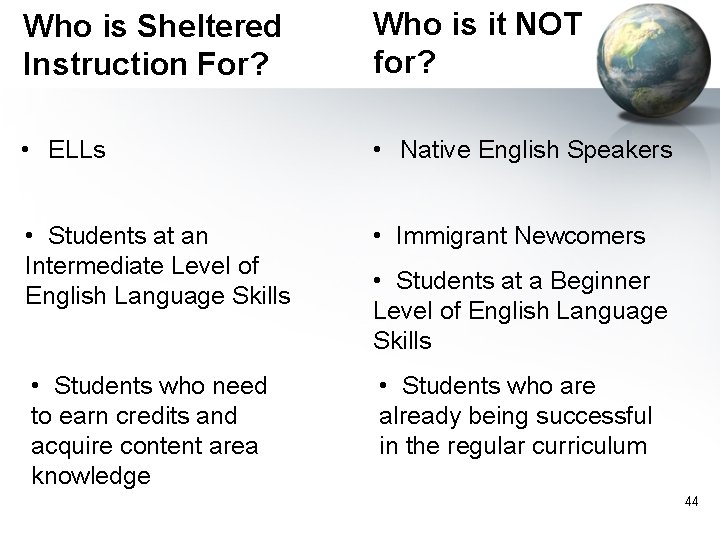
Who is Sheltered Instruction For? Who is it NOT for? • ELLs • Native English Speakers • Students at an Intermediate Level of English Language Skills • Immigrant Newcomers • Students who need to earn credits and acquire content area knowledge • Students who are already being successful in the regular curriculum • Students at a Beginner Level of English Language Skills 44
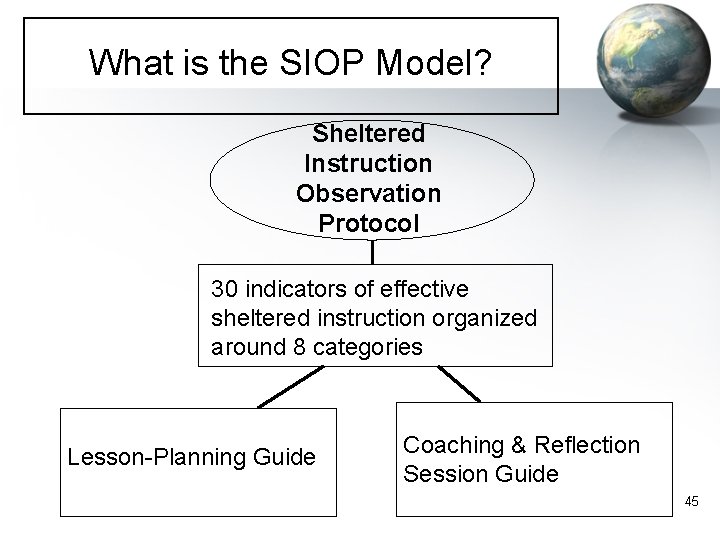
What is the SIOP Model? Sheltered Instruction Observation Protocol 30 indicators of effective sheltered instruction organized around 8 categories Lesson-Planning Guide Coaching & Reflection Session Guide 45
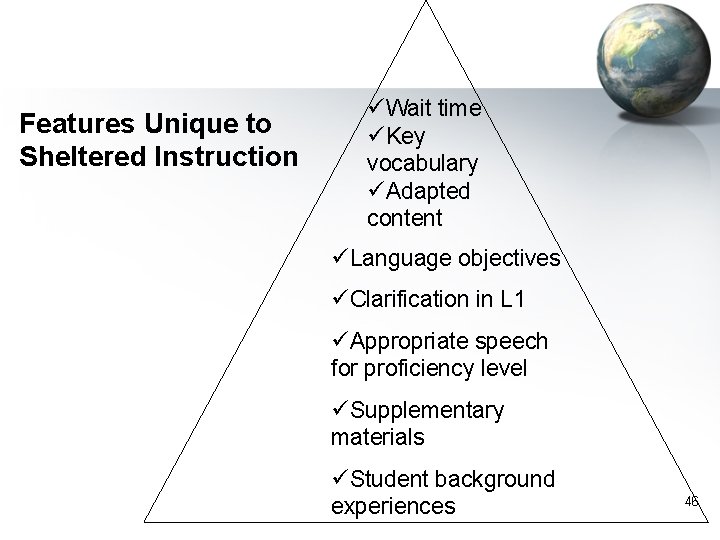
Features Unique to Sheltered Instruction üWait time üKey vocabulary üAdapted content üLanguage objectives üClarification in L 1 üAppropriate speech for proficiency level üSupplementary materials üStudent background experiences 46
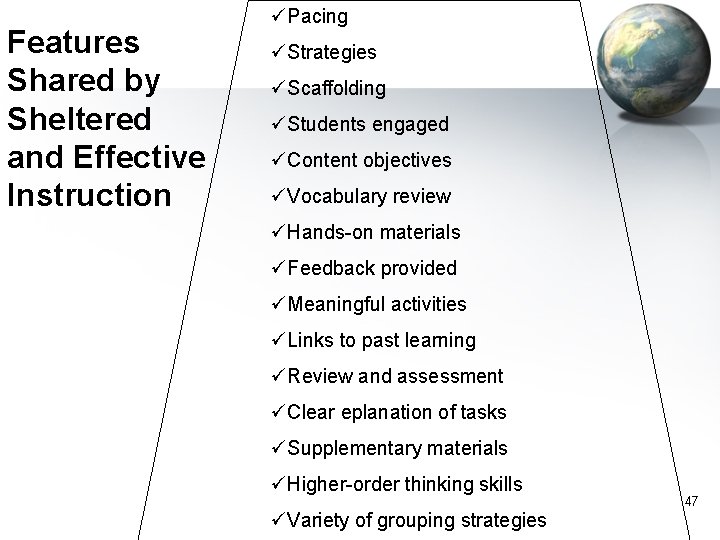
Features Shared by Sheltered and Effective Instruction üPacing üStrategies üScaffolding üStudents engaged üContent objectives üVocabulary review üHands-on materials üFeedback provided üMeaningful activities üLinks to past learning üReview and assessment üClear eplanation of tasks üSupplementary materials üHigher-order thinking skills üVariety of grouping strategies 47
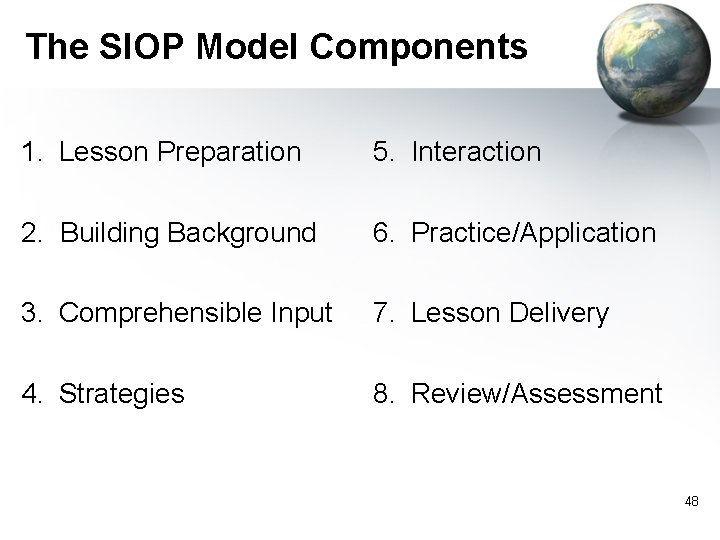
The SIOP Model Components 1. Lesson Preparation 5. Interaction 2. Building Background 6. Practice/Application 3. Comprehensible Input 7. Lesson Delivery 4. Strategies 8. Review/Assessment 48
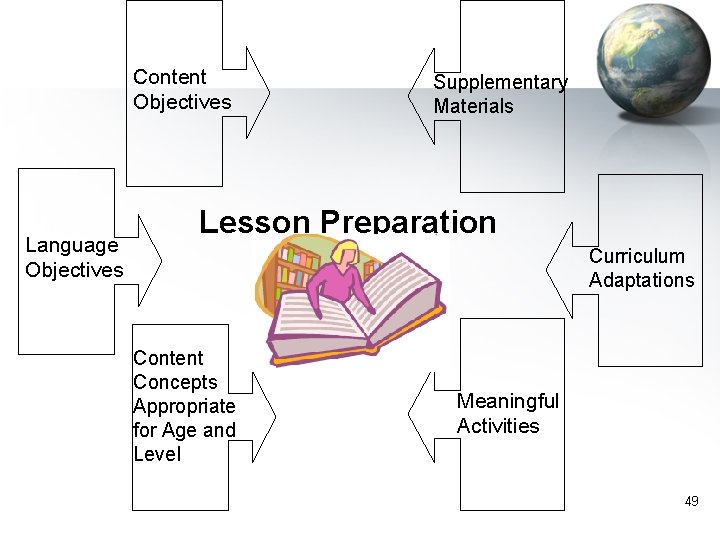
Content Objectives Language Objectives Supplementary Materials Lesson Preparation Curriculum Adaptations Content Concepts Appropriate for Age and Level Meaningful Activities 49
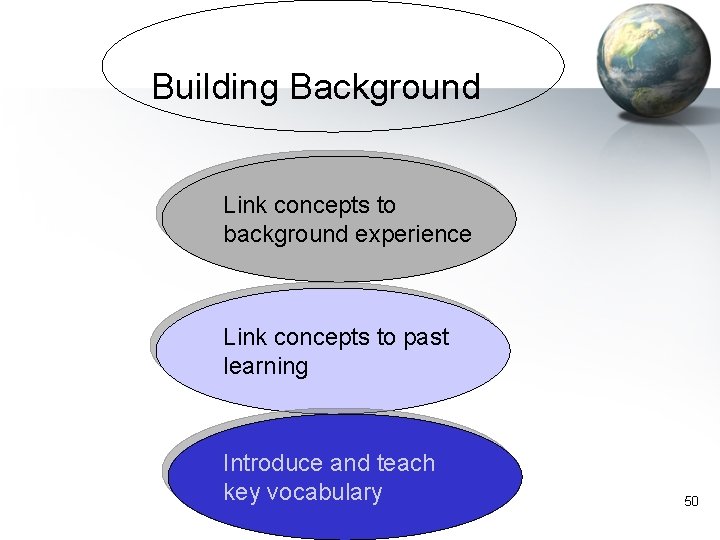
Building Background Link concepts to background experience Link concepts to past learning Introduce and teach key vocabulary 50
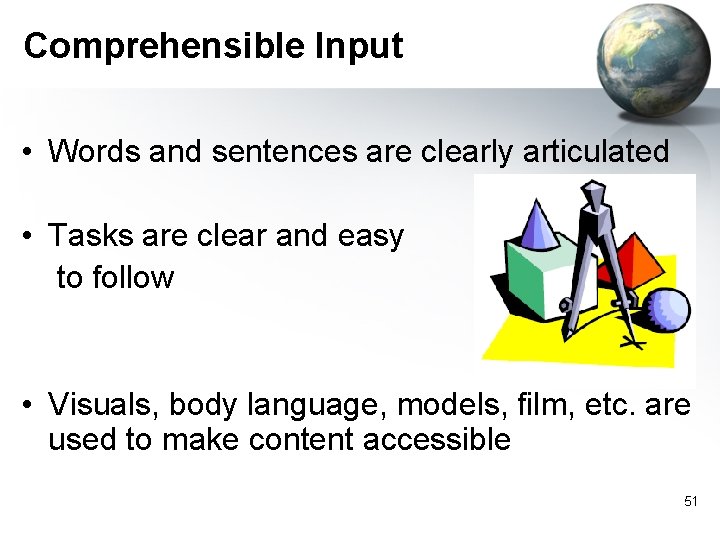
Comprehensible Input • Words and sentences are clearly articulated • Tasks are clear and easy to follow • Visuals, body language, models, film, etc. are used to make content accessible 51
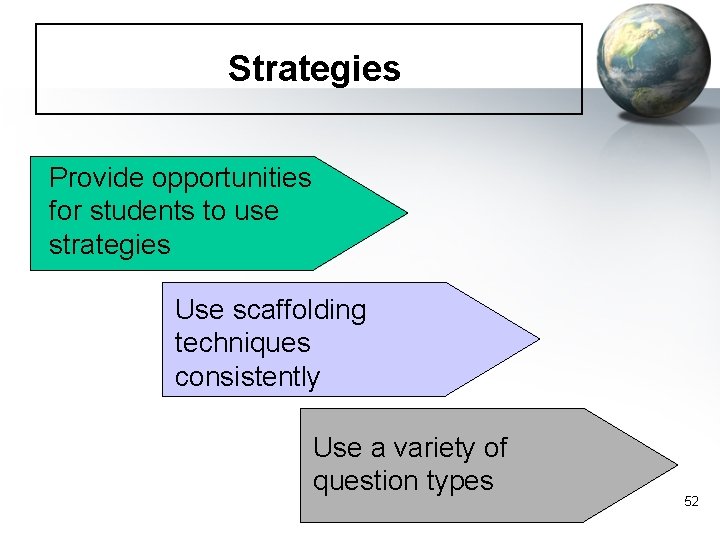
Strategies Provide opportunities for students to use strategies Use scaffolding techniques consistently Use a variety of question types 52
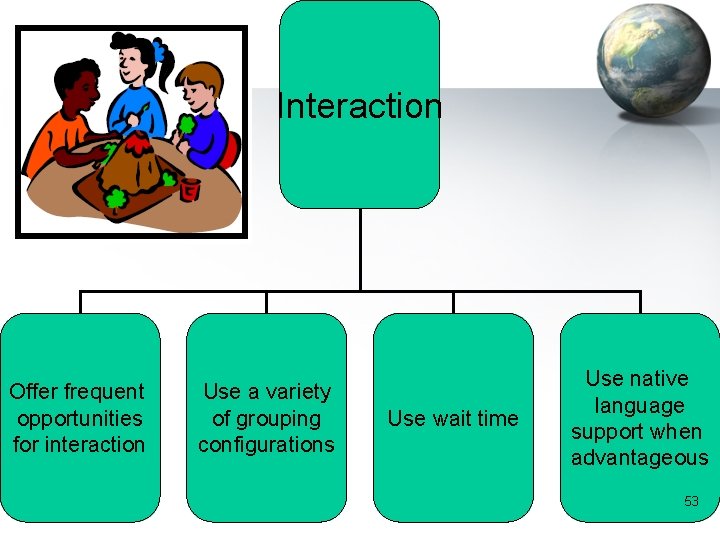
Interaction Offer frequent opportunities for interaction Use a variety of grouping configurations Use wait time Use native language support when advantageous 53
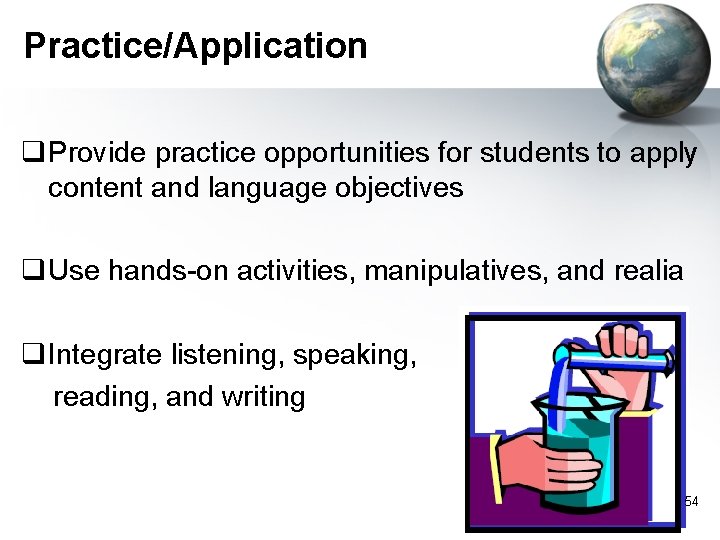
Practice/Application q. Provide practice opportunities for students to apply content and language objectives q. Use hands-on activities, manipulatives, and realia q. Integrate listening, speaking, reading, and writing 54
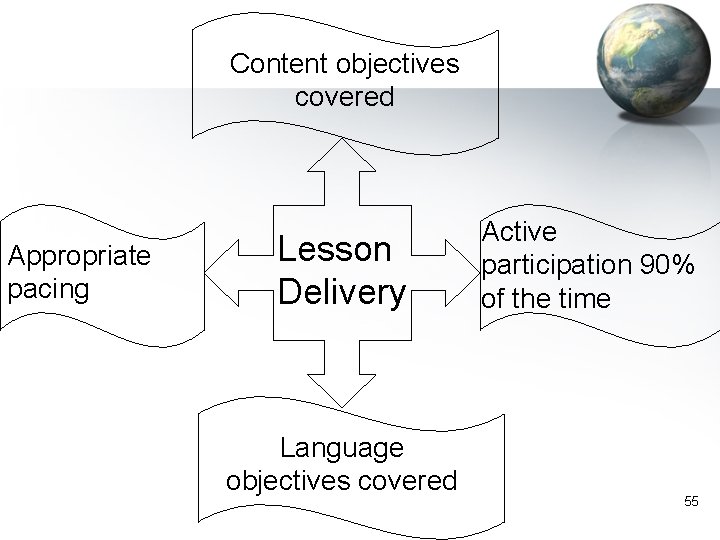
Content objectives covered Appropriate pacing Lesson Delivery Language objectives covered Active participation 90% of the time 55
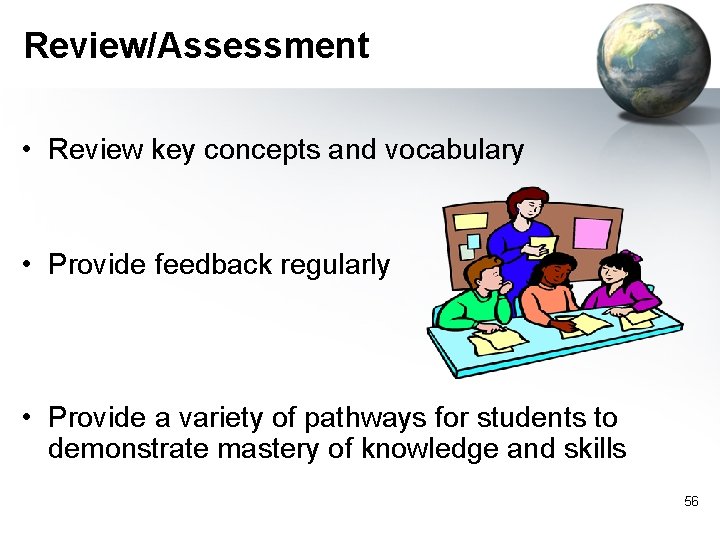
Review/Assessment • Review key concepts and vocabulary • Provide feedback regularly • Provide a variety of pathways for students to demonstrate mastery of knowledge and skills 56
SIOP Model Activity 57
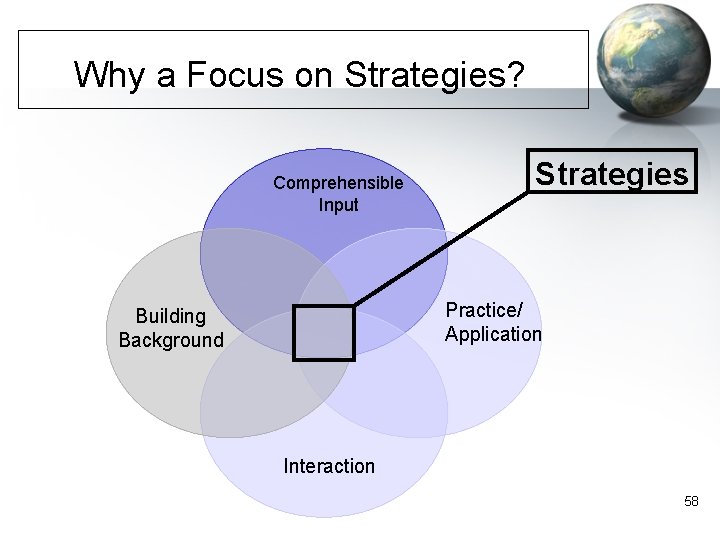
Why a Focus on Strategies? Comprehensible Input Strategies Practice/ Application Building Background Interaction 58
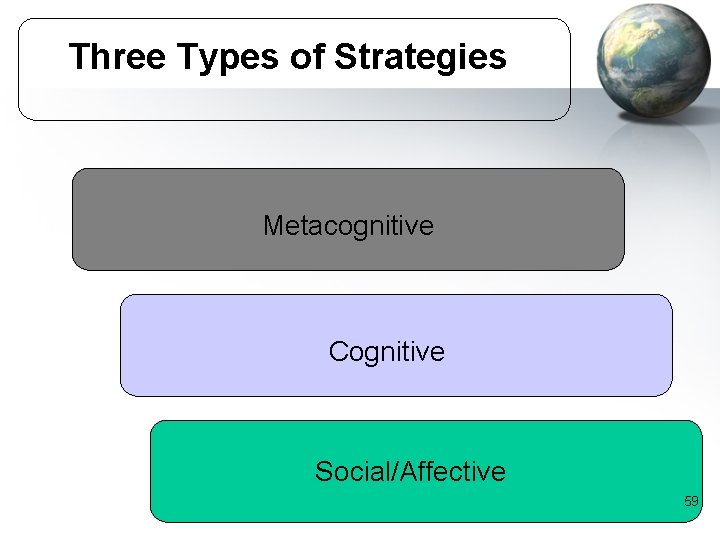
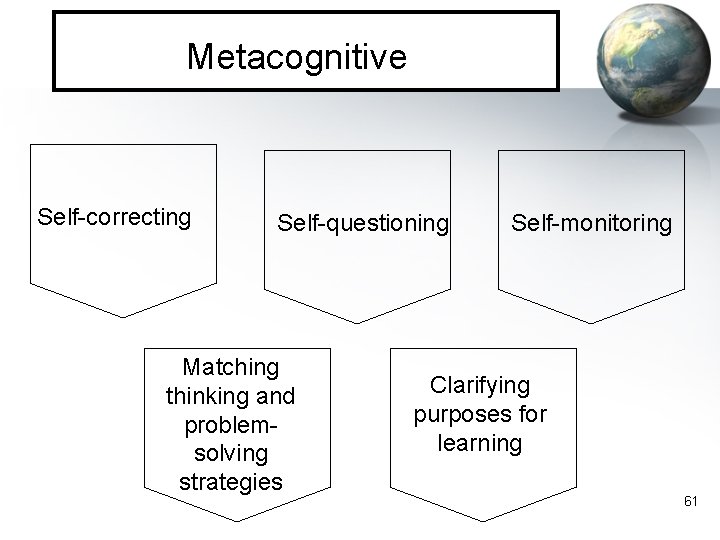
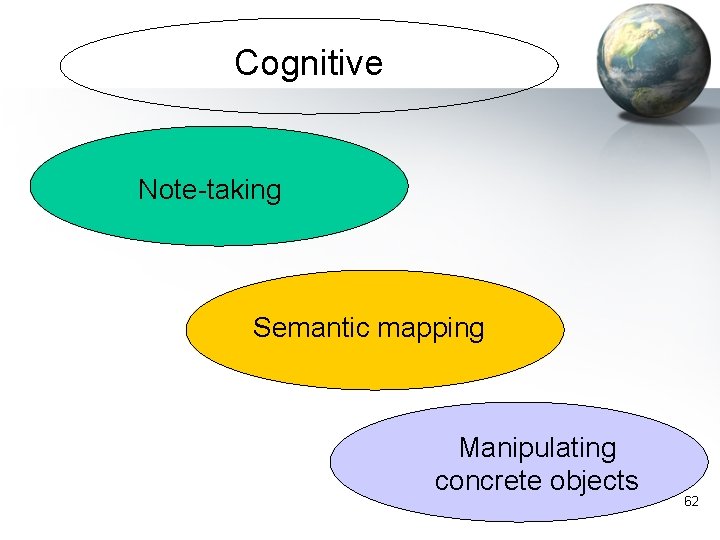
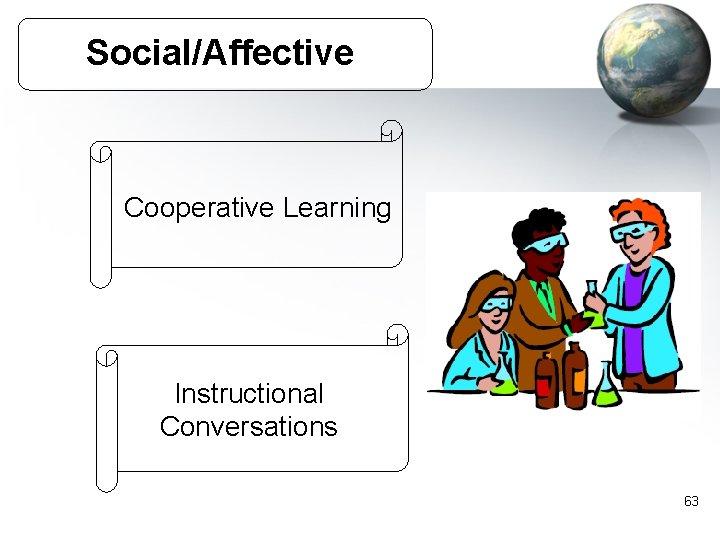
Three Types of Strategies Metacognitive Cognitive Social/Affective 59
Strategies Activity 60
Metacognitive Self-correcting Self-questioning Matching thinking and problemsolving strategies Self-monitoring Clarifying purposes for learning 61
Cognitive Note-taking Semantic mapping Manipulating concrete objects 62
Social/Affective Cooperative Learning Instructional Conversations 63
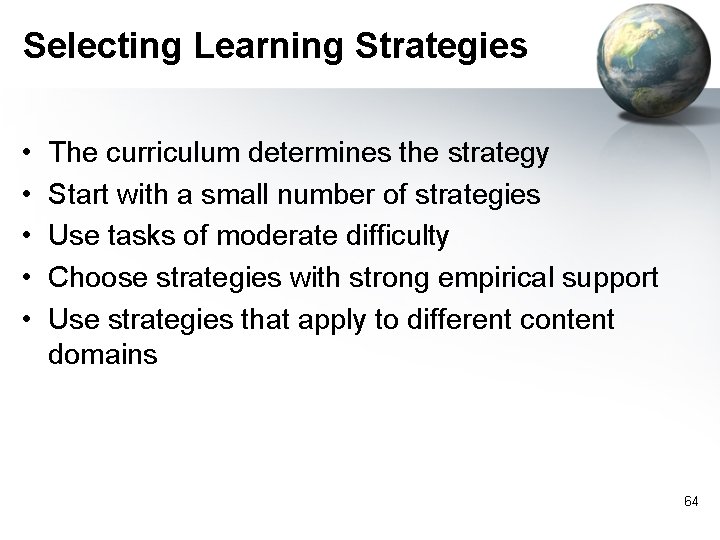
Selecting Learning Strategies • • • The curriculum determines the strategy Start with a small number of strategies Use tasks of moderate difficulty Choose strategies with strong empirical support Use strategies that apply to different content domains 64
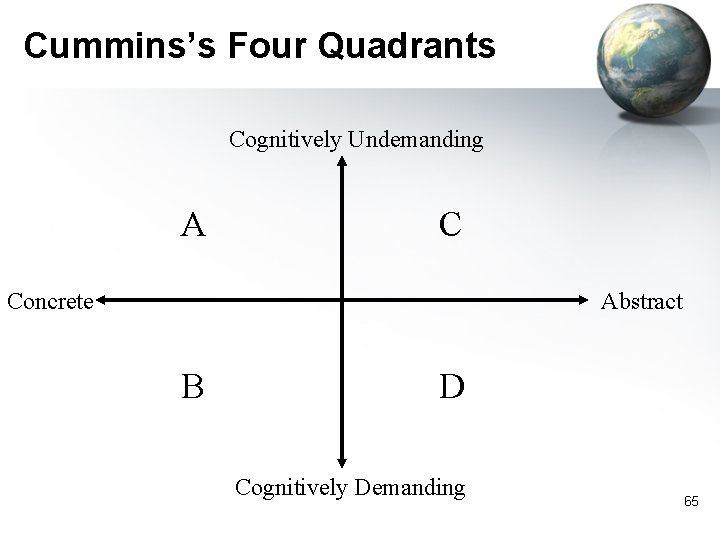
Cummins’s Four Quadrants Cognitively Undemanding A C Concrete Abstract B D Cognitively Demanding 65
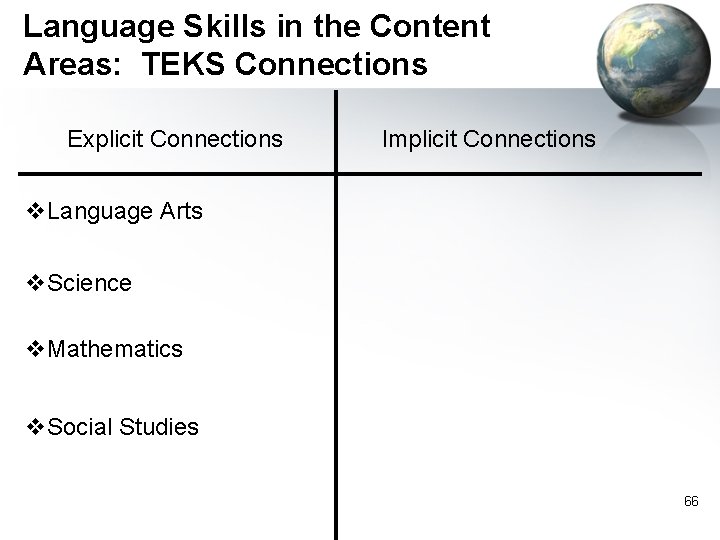
Language Skills in the Content Areas: TEKS Connections Explicit Connections Implicit Connections v. Language Arts v. Science v. Mathematics v. Social Studies 66
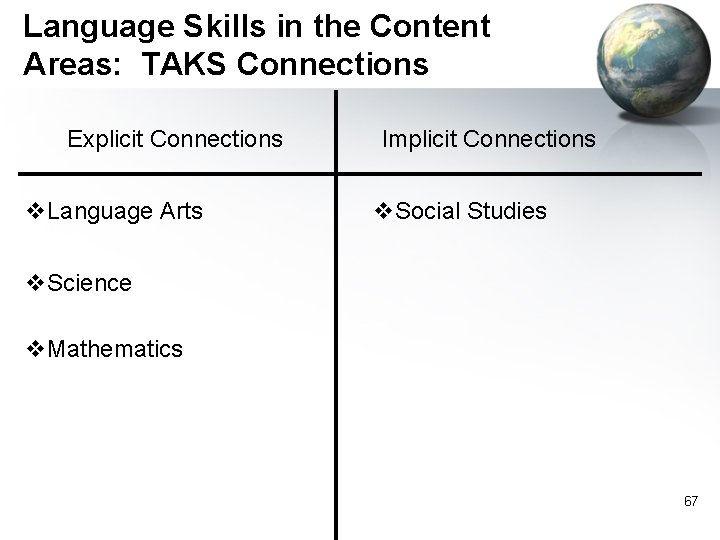
Language Skills in the Content Areas: TAKS Connections Explicit Connections v. Language Arts Implicit Connections v. Social Studies v. Science v. Mathematics 67
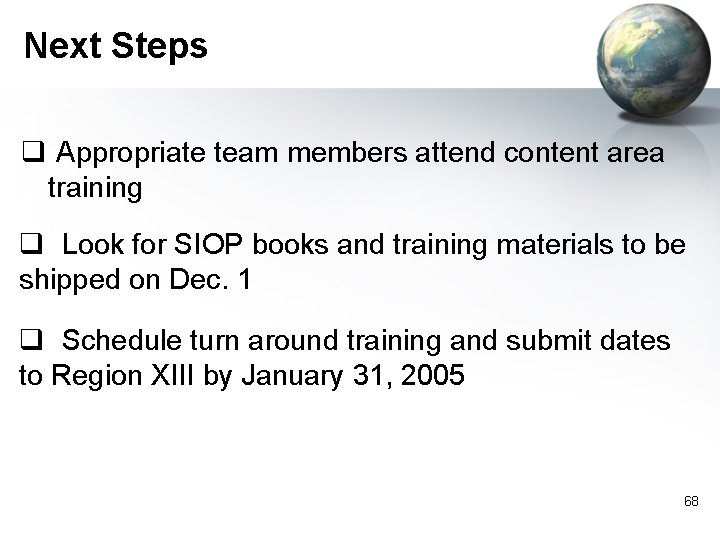
Next Steps q Appropriate team members attend content area training q Look for SIOP books and training materials to be shipped on Dec. 1 q Schedule turn around training and submit dates to Region XIII by January 31, 2005 68