Relations Section 9 1 9 3 9 5
- Slides: 60
Relations Section 9. 1, 9. 3— 9. 5 of Rosen Spring 2013 CSCE 235 H Introduction to Discrete Structures (Honors) Course web-page: cse. unl. edu/~cse 235 h Questions: Piazza
Outline • Relation: – Definition, representation, relation on a set • Properties – Reflexivity, symmetry, antisymmetric, irreflexive, asymmetric • Combining relations – , , , composite of relations • Representing relations – 0 -1 matrices, directed graphs • Closure of relations – Reflexive closure, diagonal relation, Warshall’s Algorithm, • Equivalence relations: – Equivalence class, partitions, CSCE 235 Relations 2
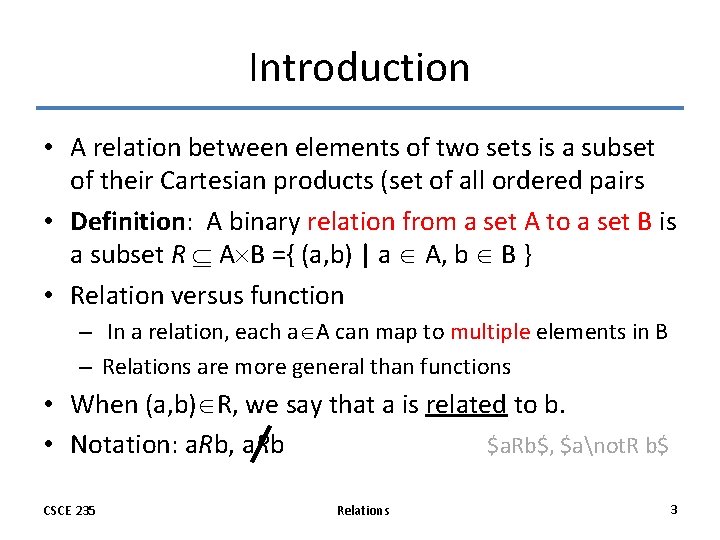
Introduction • A relation between elements of two sets is a subset of their Cartesian products (set of all ordered pairs • Definition: A binary relation from a set A to a set B is a subset R A B ={ (a, b) | a A, b B } • Relation versus function – In a relation, each a A can map to multiple elements in B – Relations are more general than functions • When (a, b) R, we say that a is related to b. • Notation: a. Rb, a. Rb $a. Rb$, $anot. R b$ CSCE 235 Relations 3
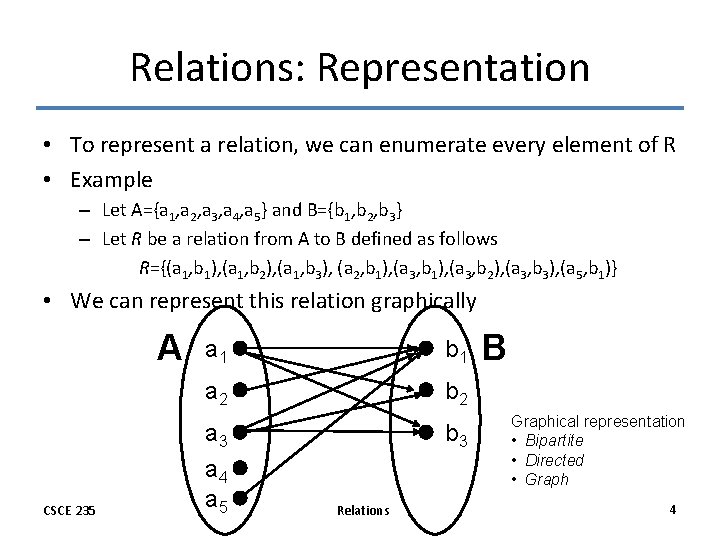
Relations: Representation • To represent a relation, we can enumerate every element of R • Example – Let A={a 1, a 2, a 3, a 4, a 5} and B={b 1, b 2, b 3} – Let R be a relation from A to B defined as follows R={(a 1, b 1), (a 1, b 2), (a 1, b 3), (a 2, b 1), (a 3, b 2), (a 3, b 3), (a 5, b 1)} • We can represent this relation graphically A CSCE 235 a 1 b 1 a 2 b 2 a 3 a 4 a 5 b 3 Relations B Graphical representation • Bipartite • Directed • Graph 4
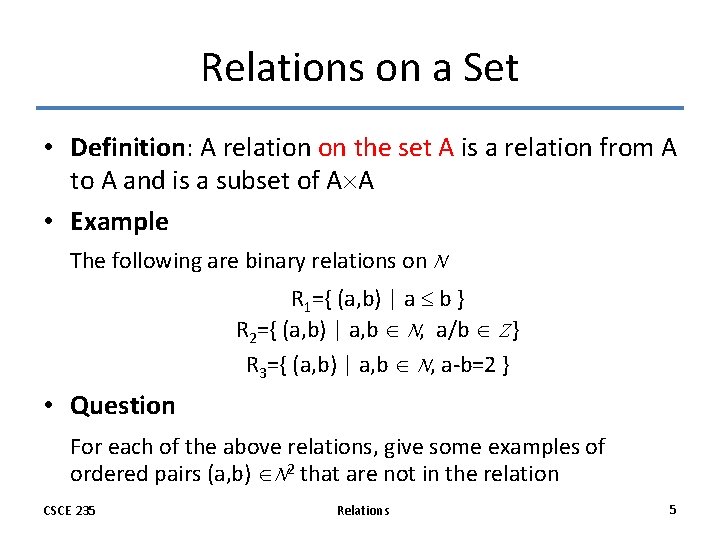
Relations on a Set • Definition: A relation on the set A is a relation from A to A and is a subset of A A • Example The following are binary relations on N R 1={ (a, b) | a b } R 2={ (a, b) | a, b N, a/b Z } R 3={ (a, b) | a, b N, a-b=2 } • Question For each of the above relations, give some examples of ordered pairs (a, b) N 2 that are not in the relation CSCE 235 Relations 5
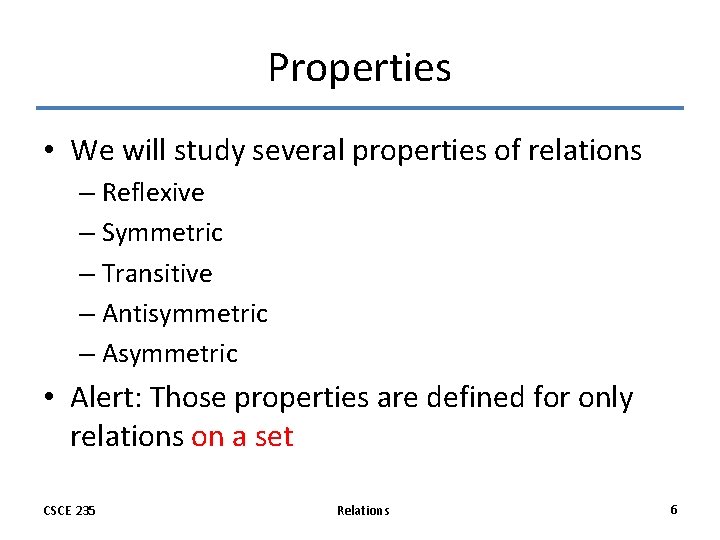
Properties • We will study several properties of relations – Reflexive – Symmetric – Transitive – Antisymmetric – Asymmetric • Alert: Those properties are defined for only relations on a set CSCE 235 Relations 6
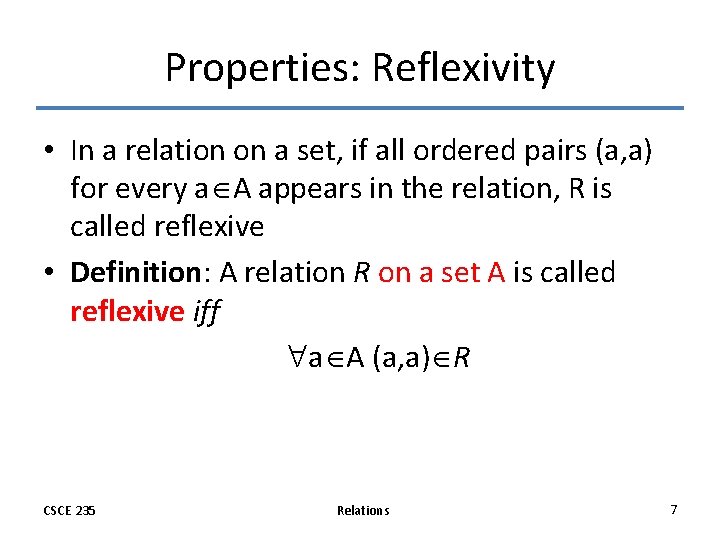
Properties: Reflexivity • In a relation on a set, if all ordered pairs (a, a) for every a A appears in the relation, R is called reflexive • Definition: A relation R on a set A is called reflexive iff a A (a, a) R CSCE 235 Relations 7
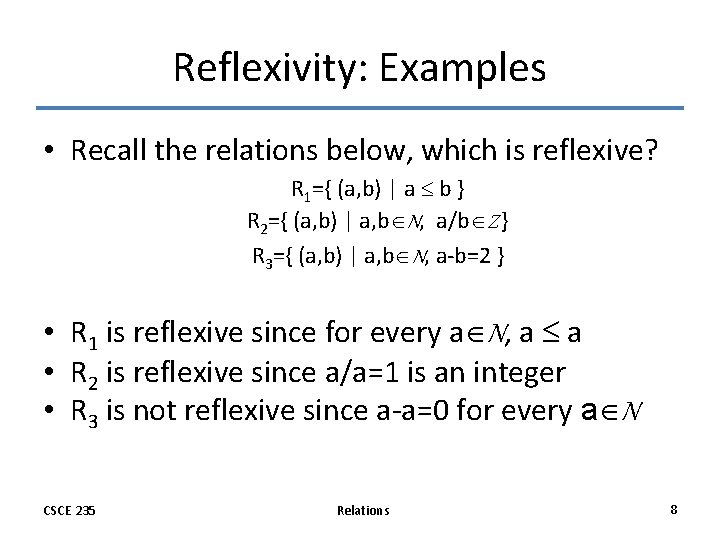
Reflexivity: Examples • Recall the relations below, which is reflexive? R 1={ (a, b) | a b } R 2={ (a, b) | a, b N, a/b Z } R 3={ (a, b) | a, b N, a-b=2 } • R 1 is reflexive since for every a N, a a • R 2 is reflexive since a/a=1 is an integer • R 3 is not reflexive since a-a=0 for every a N CSCE 235 Relations 8
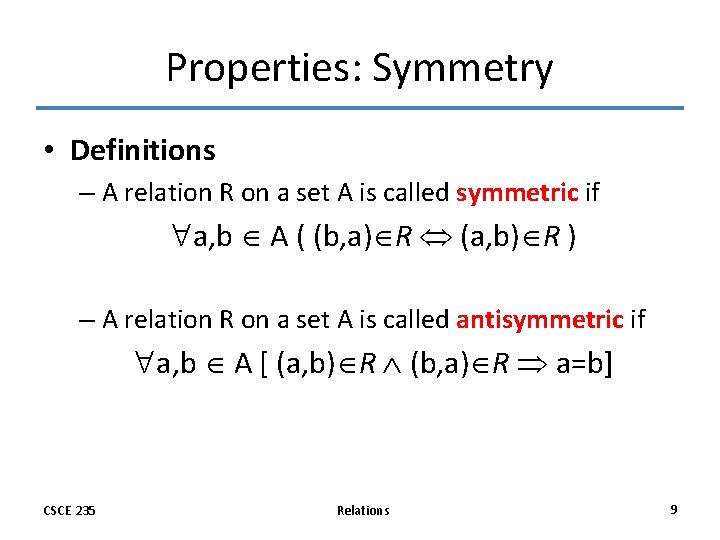
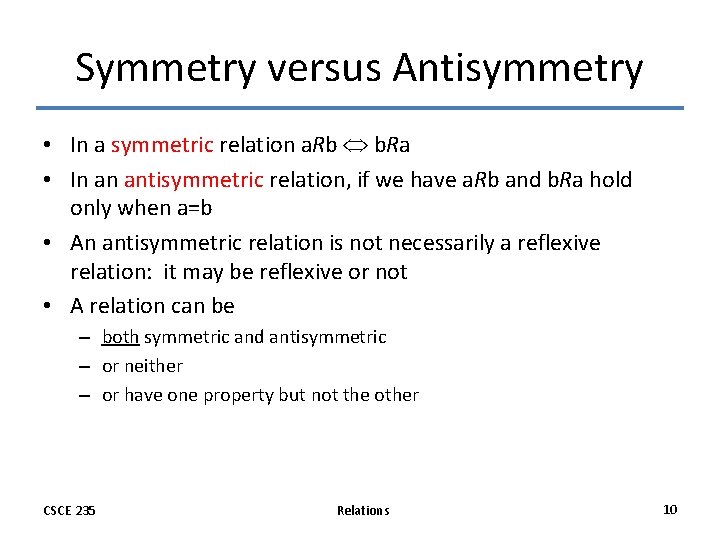
Properties: Symmetry • Definitions – A relation R on a set A is called symmetric if a, b A ( (b, a) R (a, b) R ) – A relation R on a set A is called antisymmetric if a, b A [ (a, b) R (b, a) R a=b] CSCE 235 Relations 9
Symmetry versus Antisymmetry • In a symmetric relation a. Rb b. Ra • In an antisymmetric relation, if we have a. Rb and b. Ra hold only when a=b • An antisymmetric relation is not necessarily a reflexive relation: it may be reflexive or not • A relation can be – both symmetric and antisymmetric – or neither – or have one property but not the other CSCE 235 Relations 10
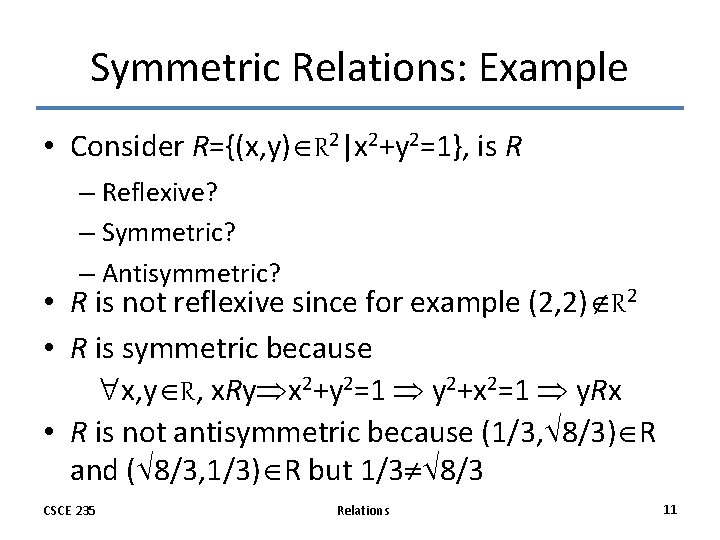
Symmetric Relations: Example • Consider R={(x, y) R 2|x 2+y 2=1}, is R – Reflexive? – Symmetric? – Antisymmetric? • R is not reflexive since for example (2, 2) R 2 • R is symmetric because x, y R, x. Ry x 2+y 2=1 y 2+x 2=1 y. Rx • R is not antisymmetric because (1/3, 8/3) R and ( 8/3, 1/3) R but 1/3 8/3 CSCE 235 Relations 11
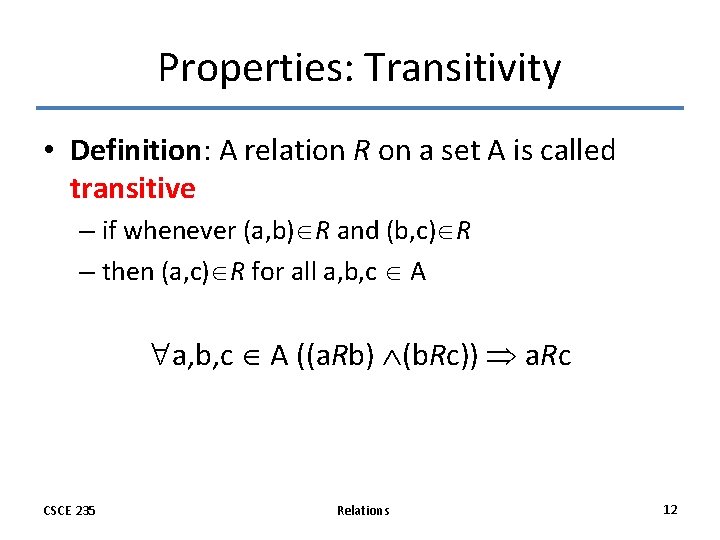
Properties: Transitivity • Definition: A relation R on a set A is called transitive – if whenever (a, b) R and (b, c) R – then (a, c) R for all a, b, c A ((a. Rb) (b. Rc)) a. Rc CSCE 235 Relations 12
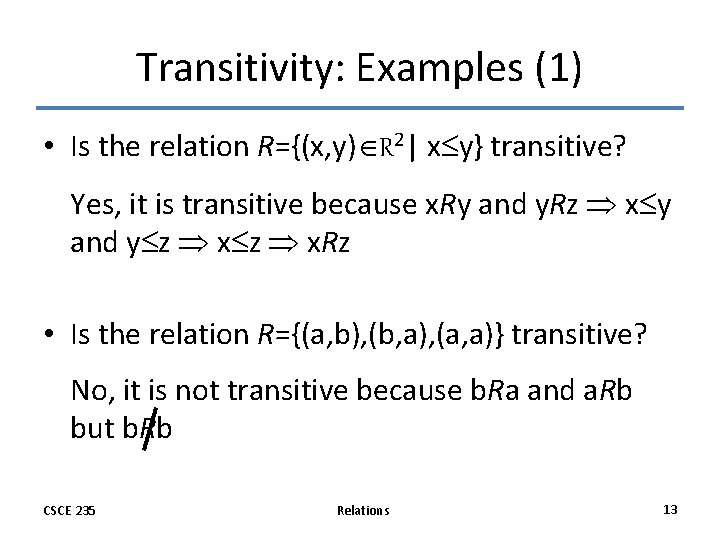
Transitivity: Examples (1) • Is the relation R={(x, y) R 2| x y} transitive? Yes, it is transitive because x. Ry and y. Rz x y and y z x. Rz • Is the relation R={(a, b), (b, a), (a, a)} transitive? No, it is not transitive because b. Ra and a. Rb but b. Rb CSCE 235 Relations 13
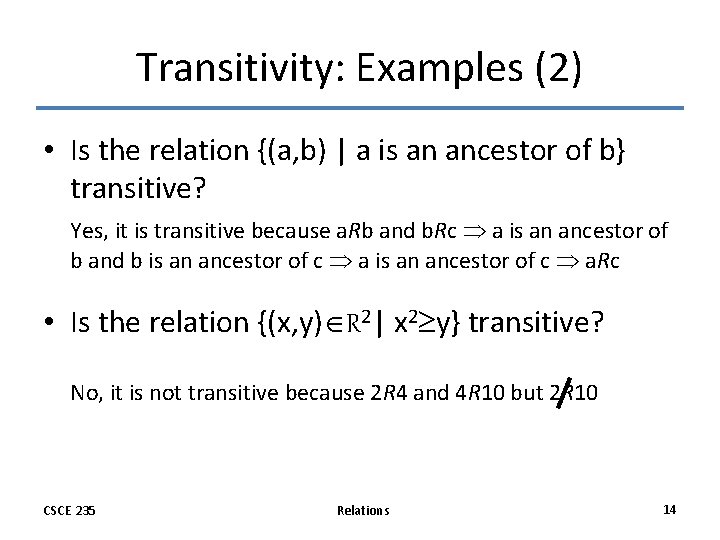
Transitivity: Examples (2) • Is the relation {(a, b) | a is an ancestor of b} transitive? Yes, it is transitive because a. Rb and b. Rc a is an ancestor of b and b is an ancestor of c a. Rc • Is the relation {(x, y) R 2| x 2 y} transitive? No, it is not transitive because 2 R 4 and 4 R 10 but 2 R 10 CSCE 235 Relations 14
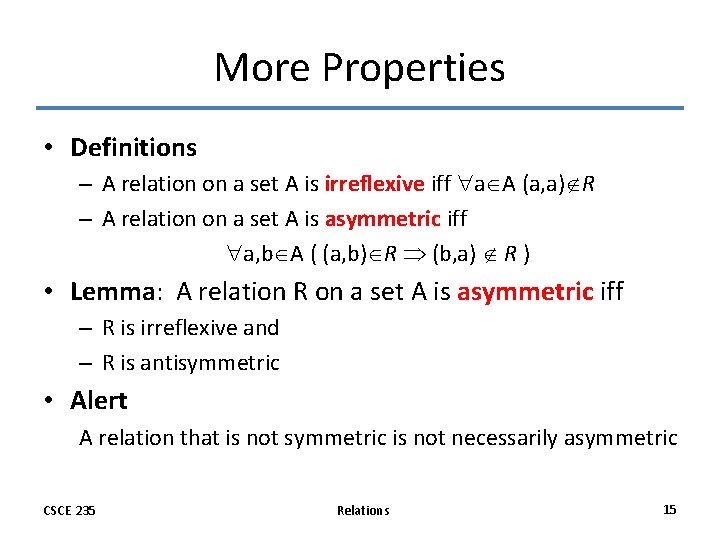
More Properties • Definitions – A relation on a set A is irreflexive iff a A (a, a) R – A relation on a set A is asymmetric iff a, b A ( (a, b) R (b, a) R ) • Lemma: A relation R on a set A is asymmetric iff – R is irreflexive and – R is antisymmetric • Alert A relation that is not symmetric is not necessarily asymmetric CSCE 235 Relations 15
Outline • Relation: – Definition, representation, relation on a set • Properties – Reflexivity, symmetry, antisymmetric, irreflexive, asymmetric • Combining relations – , , , composite of relations • Representing relations – 0 -1 matrices, directed graphs • Closure of relations – Reflexive closure, diagonal relation, Warshall’s Algorithm, • Equivalence relations: – Equivalence class, partitions, CSCE 235 Relations 16
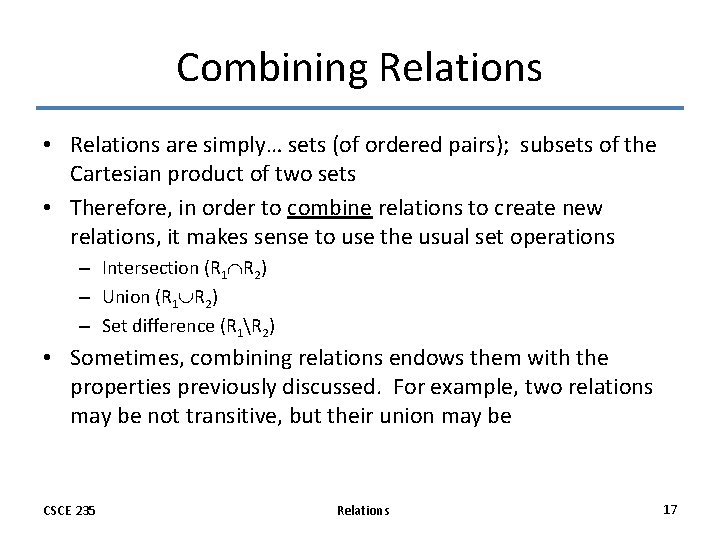
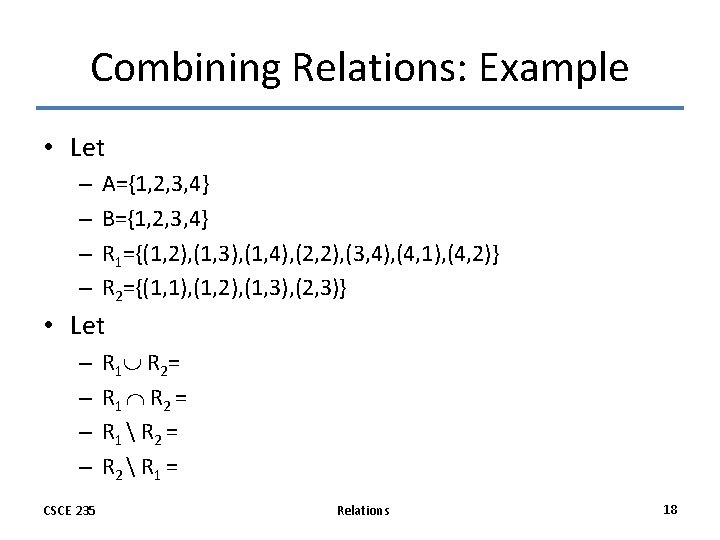
Combining Relations • Relations are simply… sets (of ordered pairs); subsets of the Cartesian product of two sets • Therefore, in order to combine relations to create new relations, it makes sense to use the usual set operations – Intersection (R 1 R 2) – Union (R 1 R 2) – Set difference (R 1R 2) • Sometimes, combining relations endows them with the properties previously discussed. For example, two relations may be not transitive, but their union may be CSCE 235 Relations 17
Combining Relations: Example • Let – – A={1, 2, 3, 4} B={1, 2, 3, 4} R 1={(1, 2), (1, 3), (1, 4), (2, 2), (3, 4), (4, 1), (4, 2)} R 2={(1, 1), (1, 2), (1, 3), (2, 3)} • Let – – CSCE 235 R 1 R 2= R 1 R 2 = R 1 R 2 = R 2 R 1 = Relations 18
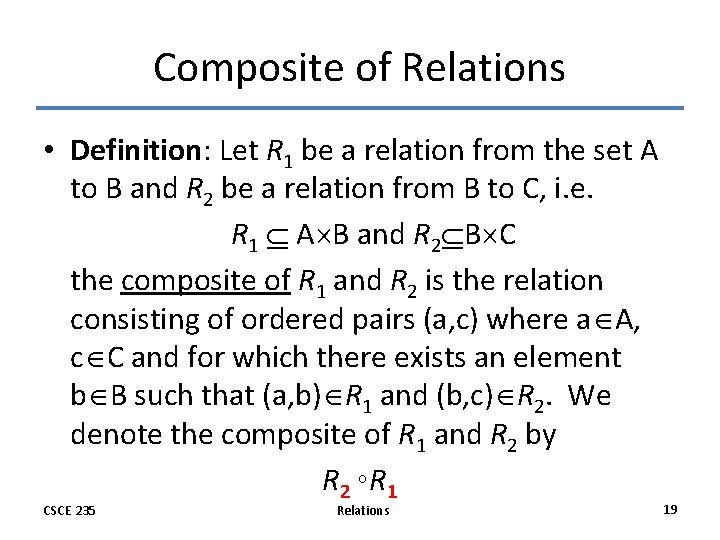
Composite of Relations • Definition: Let R 1 be a relation from the set A to B and R 2 be a relation from B to C, i. e. R 1 A B and R 2 B C the composite of R 1 and R 2 is the relation consisting of ordered pairs (a, c) where a A, c C and for which there exists an element b B such that (a, b) R 1 and (b, c) R 2. We denote the composite of R 1 and R 2 by R 2 R 1 CSCE 235 Relations 19
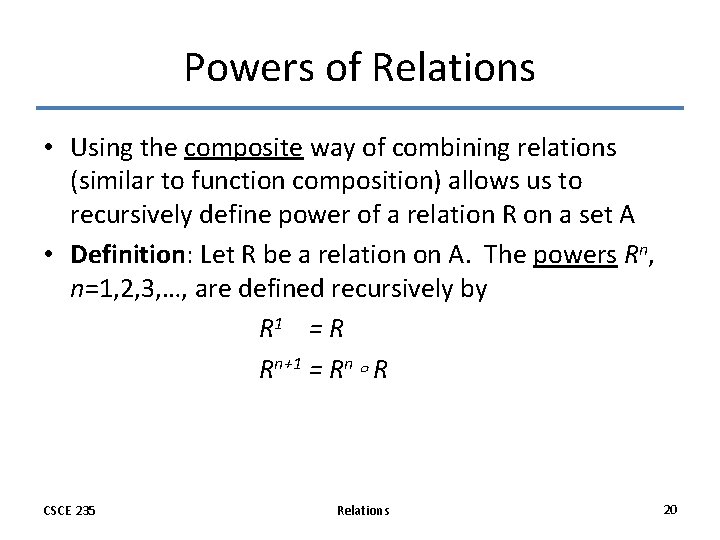
Powers of Relations • Using the composite way of combining relations (similar to function composition) allows us to recursively define power of a relation R on a set A • Definition: Let R be a relation on A. The powers Rn, n=1, 2, 3, …, are defined recursively by R 1 = R Rn+1 = Rn R CSCE 235 Relations 20
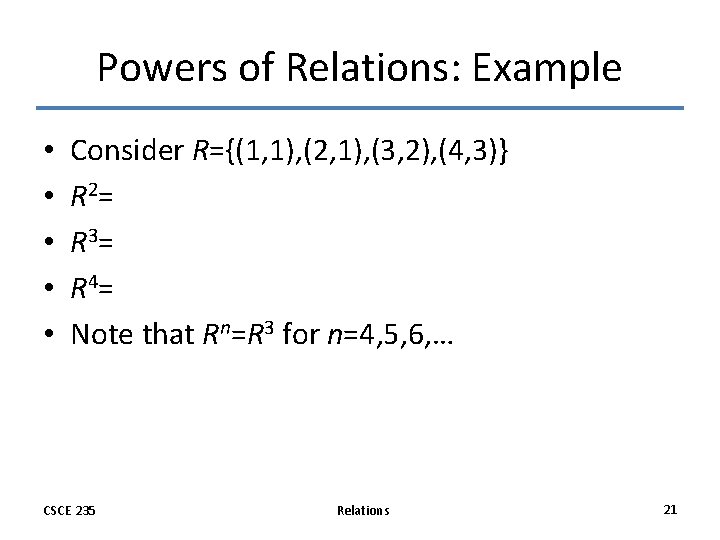
Powers of Relations: Example • • • Consider R={(1, 1), (2, 1), (3, 2), (4, 3)} R 2= R 3= R 4= Note that Rn=R 3 for n=4, 5, 6, … CSCE 235 Relations 21
Powers of Relations & Transitivity • The powers of relations give us a nice characterization of transitivity • Theorem: A relation R is transitive if and only if Rn R for n=1, 2, 3, … CSCE 235 Relations 22
Outline • Relation: – Definition, representation, relation on a set • Properties – Reflexivity, symmetry, antisymmetric, irreflexive, asymmetric • Combining relations – , , , composite of relations • Representing relations – 0 -1 matrices, directed graphs • Closure of relations – Reflexive closure, diagonal relation, Warshall’s Algorithm, • Equivalence relations: – Equivalence class, partitions, CSCE 235 Relations 23
Representing Relations • We have seen one way to graphically represent a function/relation between two (different) sets: Specifically as a directed graph with arrows between nodes that are related • We will look at two alternative ways to represent relations – 0 -1 matrices (bit matrices) – Directed graphs CSCE 235 Relations 24
0 -1 Matrices (1) • A 0 -1 matrix is a matrix whose entries are 0 or 1 • Let R be a relation from A={a 1, a 2, …, an} and B={b 1, b 2, …, bn} • Let’s impose an ordering on the elements in each set. Although this ordering is arbitrary, it is important that it remain consistent. That is, once we fix an ordering, we have to stick to it. • When A=B, R is a relation on A and we choose the same ordering in the two dimensions of the matrix CSCE 235 Relations 25
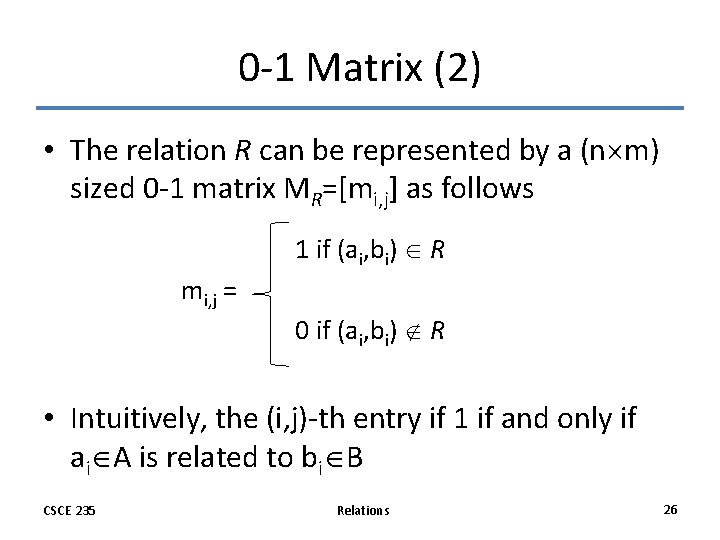
0 -1 Matrix (2) • The relation R can be represented by a (n m) sized 0 -1 matrix MR=[mi, j] as follows 1 if (ai, bi) R mi, j = 0 if (ai, bi) R • Intuitively, the (i, j)-th entry if 1 if and only if ai A is related to bi B CSCE 235 Relations 26
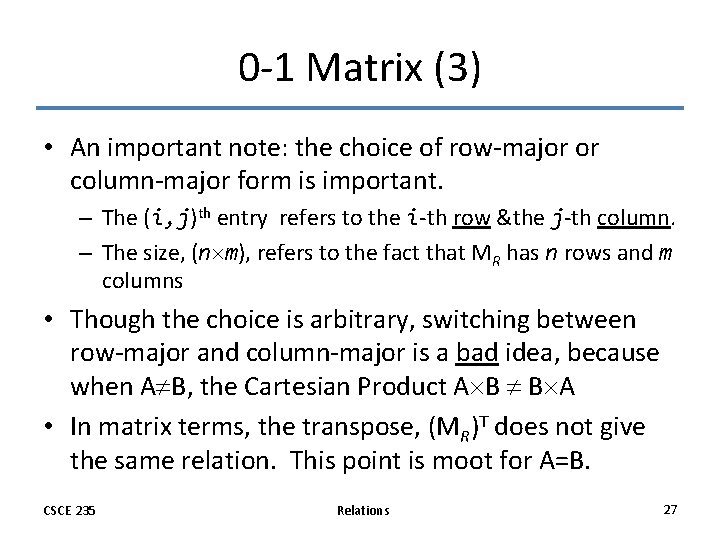
0 -1 Matrix (3) • An important note: the choice of row-major or column-major form is important. – The (i, j)th entry refers to the i-th row &the j-th column. – The size, (n m), refers to the fact that MR has n rows and m columns • Though the choice is arbitrary, switching between row-major and column-major is a bad idea, because when A B, the Cartesian Product A B B A • In matrix terms, the transpose, (MR)T does not give the same relation. This point is moot for A=B. CSCE 235 Relations 27
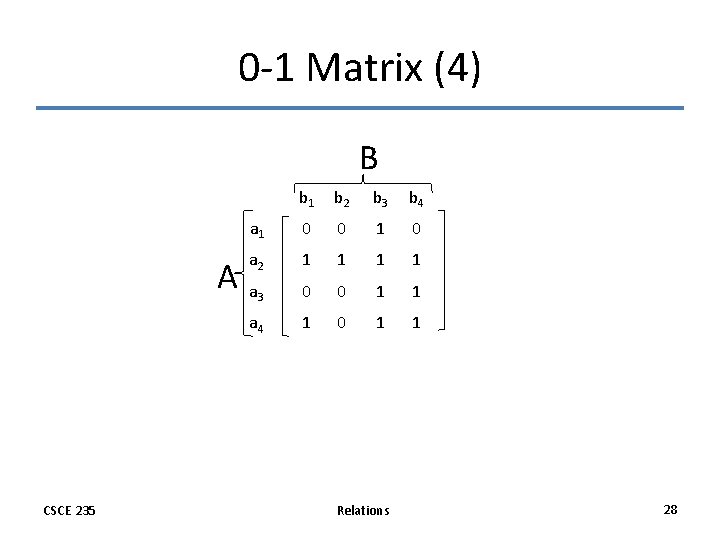
0 -1 Matrix (4) B A CSCE 235 b 1 b 2 b 3 b 4 a 1 0 0 1 0 a 2 1 1 a 3 0 0 1 1 a 4 1 0 1 1 Relations 28
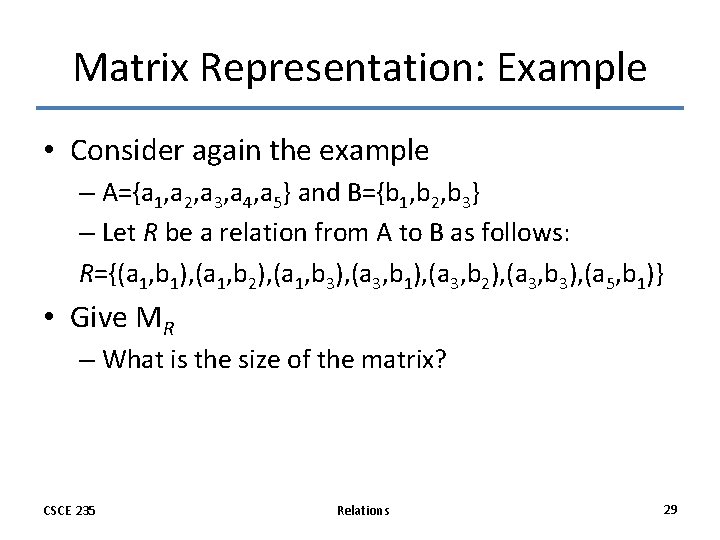
Matrix Representation: Example • Consider again the example – A={a 1, a 2, a 3, a 4, a 5} and B={b 1, b 2, b 3} – Let R be a relation from A to B as follows: R={(a 1, b 1), (a 1, b 2), (a 1, b 3), (a 3, b 1), (a 3, b 2), (a 3, b 3), (a 5, b 1)} • Give MR – What is the size of the matrix? CSCE 235 Relations 29
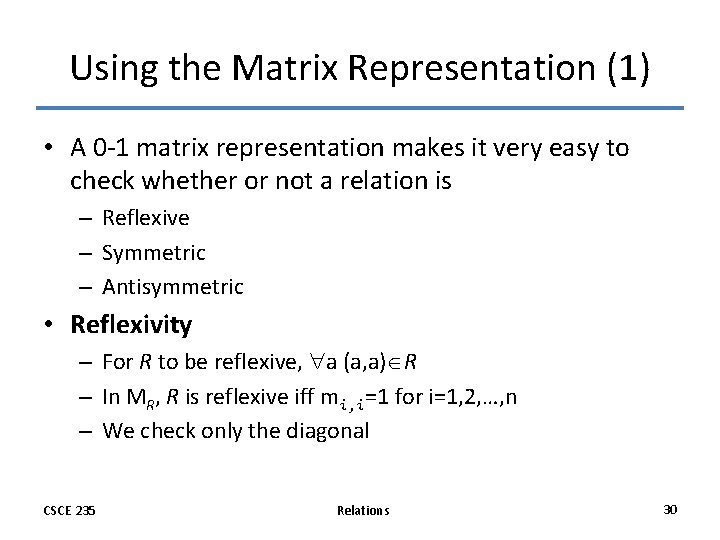
Using the Matrix Representation (1) • A 0 -1 matrix representation makes it very easy to check whether or not a relation is – Reflexive – Symmetric – Antisymmetric • Reflexivity – For R to be reflexive, a (a, a) R – In MR, R is reflexive iff mi, i=1 for i=1, 2, …, n – We check only the diagonal CSCE 235 Relations 30
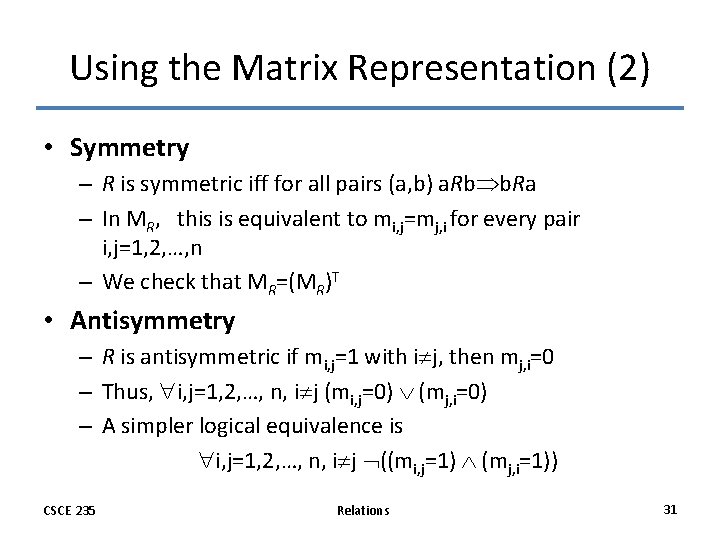
Using the Matrix Representation (2) • Symmetry – R is symmetric iff for all pairs (a, b) a. Rb b. Ra – In MR, this is equivalent to mi, j=mj, i for every pair i, j=1, 2, …, n – We check that MR=(MR)T • Antisymmetry – R is antisymmetric if mi, j=1 with i j, then mj, i=0 – Thus, i, j=1, 2, …, n, i j (mi, j=0) (mj, i=0) – A simpler logical equivalence is i, j=1, 2, …, n, i j ((mi, j=1) (mj, i=1)) CSCE 235 Relations 31
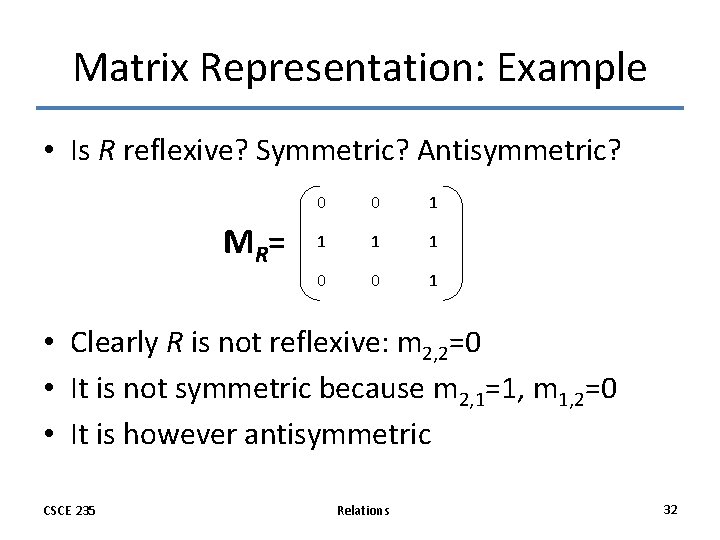
Matrix Representation: Example • Is R reflexive? Symmetric? Antisymmetric? MR = 0 0 1 1 0 0 1 • Clearly R is not reflexive: m 2, 2=0 • It is not symmetric because m 2, 1=1, m 1, 2=0 • It is however antisymmetric CSCE 235 Relations 32
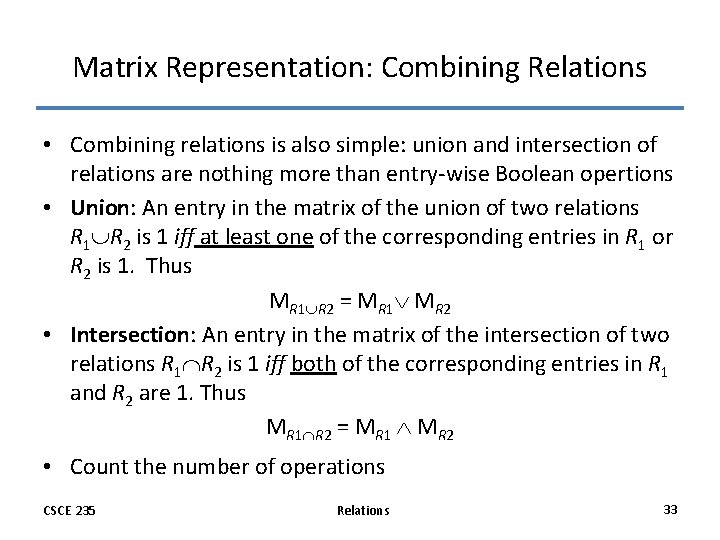
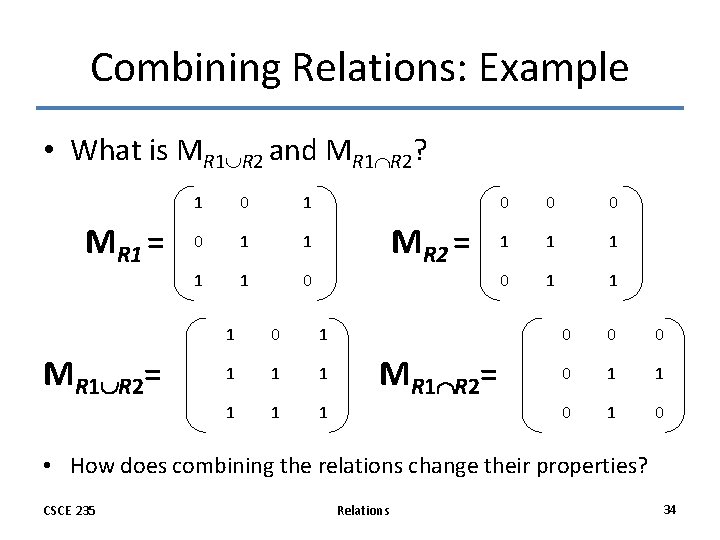
Matrix Representation: Combining Relations • Combining relations is also simple: union and intersection of relations are nothing more than entry-wise Boolean opertions • Union: An entry in the matrix of the union of two relations R 1 R 2 is 1 iff at least one of the corresponding entries in R 1 or R 2 is 1. Thus MR 1 R 2 = MR 1 MR 2 • Intersection: An entry in the matrix of the intersection of two relations R 1 R 2 is 1 iff both of the corresponding entries in R 1 and R 2 are 1. Thus MR 1 R 2 = MR 1 MR 2 • Count the number of operations CSCE 235 Relations 33
Combining Relations: Example • What is MR 1 R 2 and MR 1 R 2? MR 1 = MR 1 R 2= 1 0 1 1 0 MR 2 = 1 0 1 1 1 1 MR 1 R 2= 0 0 0 1 1 1 0 0 0 0 1 1 0 • How does combining the relations change their properties? CSCE 235 Relations 34
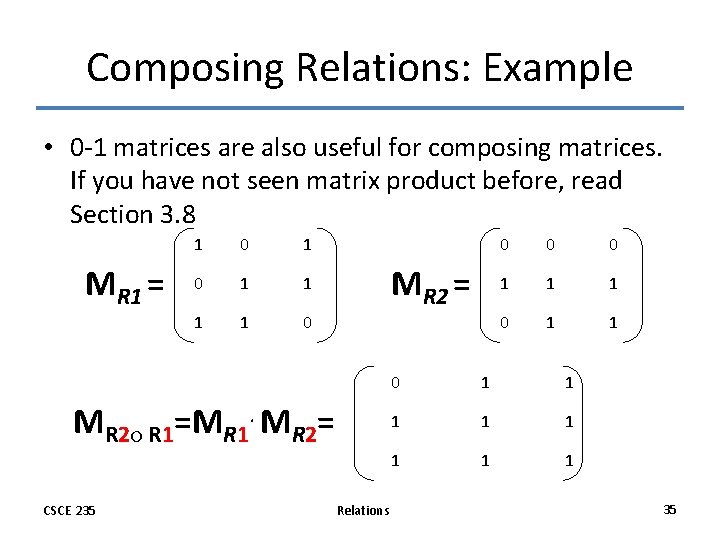
Composing Relations: Example • 0 -1 matrices are also useful for composing matrices. If you have not seen matrix product before, read Section 3. 8 MR 1 = 1 0 1 1 0 MR 2 = MR 2 R 1=MR 1. MR 2= CSCE 235 Relations 0 0 0 1 1 1 1 35
Composite Relations: Rn • Remember that recursively composing a relation Rn R for n=1, 2, 3, … gives a nice characterization of transitivity • Theorem: A relation R is transitive if and only if Rn R for n=1, 2, 3, … • We will use – this idea and – the composition by matrix multiplication to build the Warshall (a. k. a. Roy-Warshall) algorithm, which computed the transitive closure (discussed in the next section) CSCE 235 Relations 36
Directed Graphs Representation (1) • We will study graphs in details towards the end of the semester • We briefly introduce them here to use them to represent relations • We have already seen directed graphs to represent functions and relations (between two sets). Those are special graphs, called bipartite directed graphs • For a relation on a set A, it makes more sense to use a general directed graph rather than having two copies of the same set A CSCE 235 Relations 37
Definition: Directed Graphs (2) • Definition: A G graph consists of – A set V of vertices (or nodes), and – A set E of edges (or arcs) – We note: G=(V, E) • Definition: A directed G graph (digraph) consists of – A set V of vertices (or nodes), and – A set E of edges of ordered pairs of elements of V (of vertices) CSCE 235 Relations 38
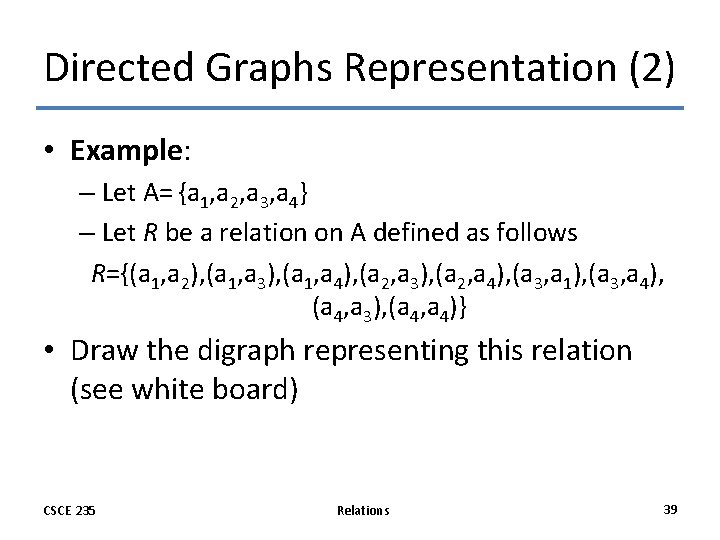
Directed Graphs Representation (2) • Example: – Let A= {a 1, a 2, a 3, a 4} – Let R be a relation on A defined as follows R={(a 1, a 2), (a 1, a 3), (a 1, a 4), (a 2, a 3), (a 2, a 4), (a 3, a 1), (a 3, a 4), (a 4, a 3), (a 4, a 4)} • Draw the digraph representing this relation (see white board) CSCE 235 Relations 39
Using the Digraphs Representation (1) • A directed graph offers some insight into the properties of a relation • Reflexivity: In a digraph, the represented relation is reflexive iff every vertex has a self loop • Symmetry: In a digraph, the represented relation is symmetric iff for every directed edge from a vertex x to a vertex y there is also an edge from y to x CSCE 235 Relations 40
Using the Digraphs Representation (2) • Antisymmetry: A represented relation is antisymmetric iff there is never a back edge for any directed edges between two distinct vertices • Transitivity: A digraph is transitive if for every pair of directed edges (x, y) and (y, z) there is also a directed edge (x, z) This may be harder to visually verify in more complex graphs CSCE 235 Relations 41
Outline • Relation: – Definition, representation, relation on a set • Properties – Reflexivity, symmetry, antisymmetric, irreflexive, asymmetric • Combining relations – , , , composite of relations • Representing relations – 0 -1 matrices, directed graphs • Closure of relations – Reflexive closure, diagonal relation, Warshall’s Algorithm, • Equivalence relations: – Equivalence class, partitions, CSCE 235 Relations 42
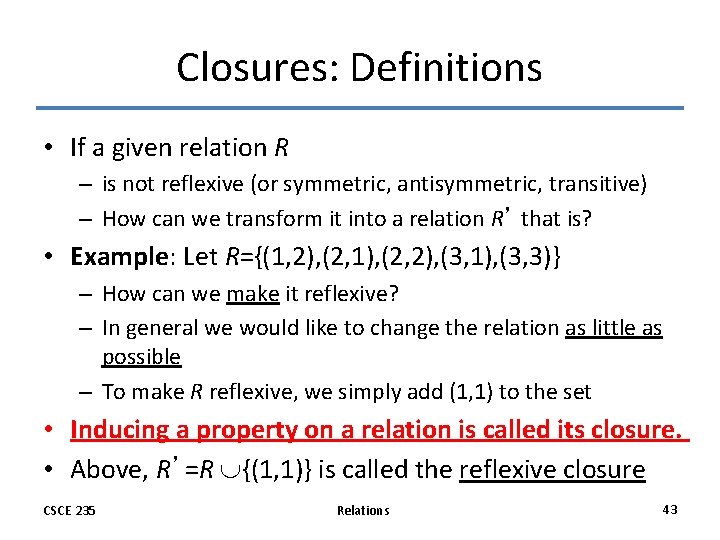
Closures: Definitions • If a given relation R – is not reflexive (or symmetric, antisymmetric, transitive) – How can we transform it into a relation R’ that is? • Example: Let R={(1, 2), (2, 1), (2, 2), (3, 1), (3, 3)} – How can we make it reflexive? – In general we would like to change the relation as little as possible – To make R reflexive, we simply add (1, 1) to the set • Inducing a property on a relation is called its closure. • Above, R’=R {(1, 1)} is called the reflexive closure CSCE 235 Relations 43
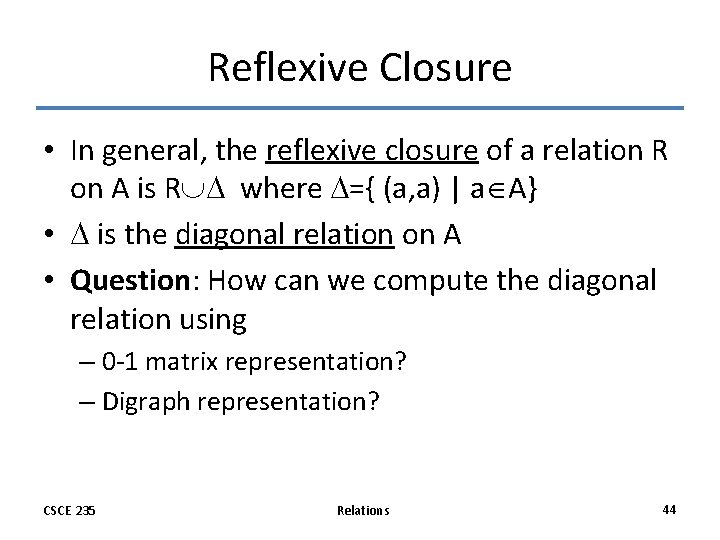
Reflexive Closure • In general, the reflexive closure of a relation R on A is R where ={ (a, a) | a A} • is the diagonal relation on A • Question: How can we compute the diagonal relation using – 0 -1 matrix representation? – Digraph representation? CSCE 235 Relations 44
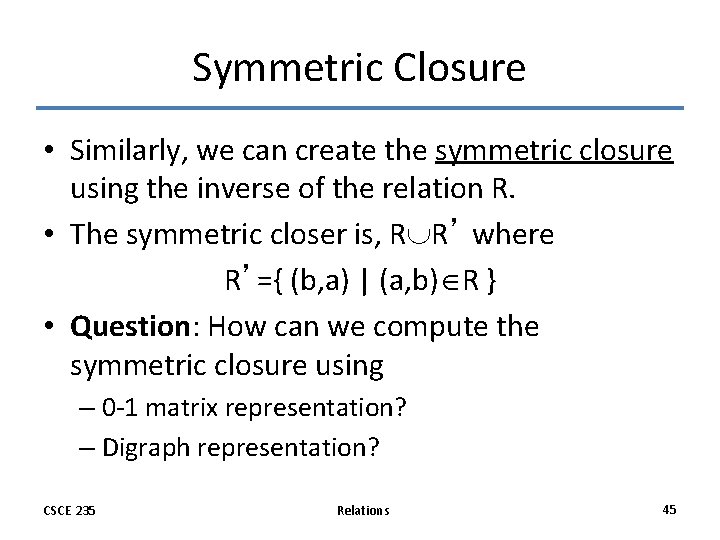
Symmetric Closure • Similarly, we can create the symmetric closure using the inverse of the relation R. • The symmetric closer is, R R’ where R’={ (b, a) | (a, b) R } • Question: How can we compute the symmetric closure using – 0 -1 matrix representation? – Digraph representation? CSCE 235 Relations 45
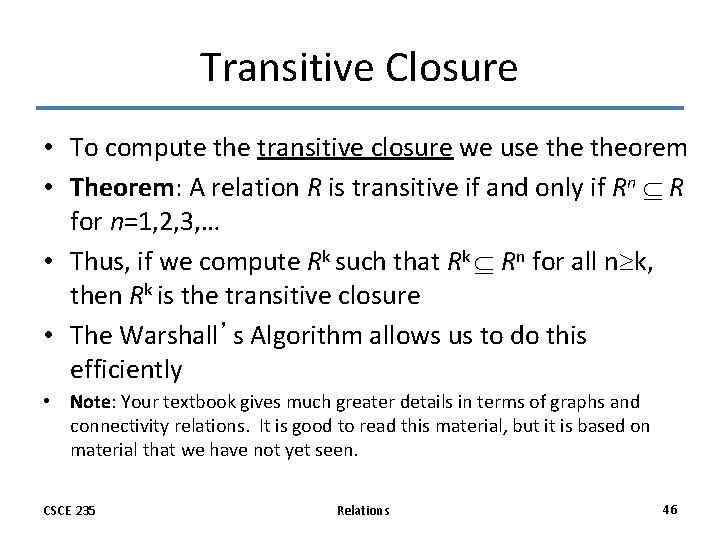
Transitive Closure • To compute the transitive closure we use theorem • Theorem: A relation R is transitive if and only if Rn R for n=1, 2, 3, … • Thus, if we compute Rk such that Rk Rn for all n k, then Rk is the transitive closure • The Warshall’s Algorithm allows us to do this efficiently • Note: Your textbook gives much greater details in terms of graphs and connectivity relations. It is good to read this material, but it is based on material that we have not yet seen. CSCE 235 Relations 46
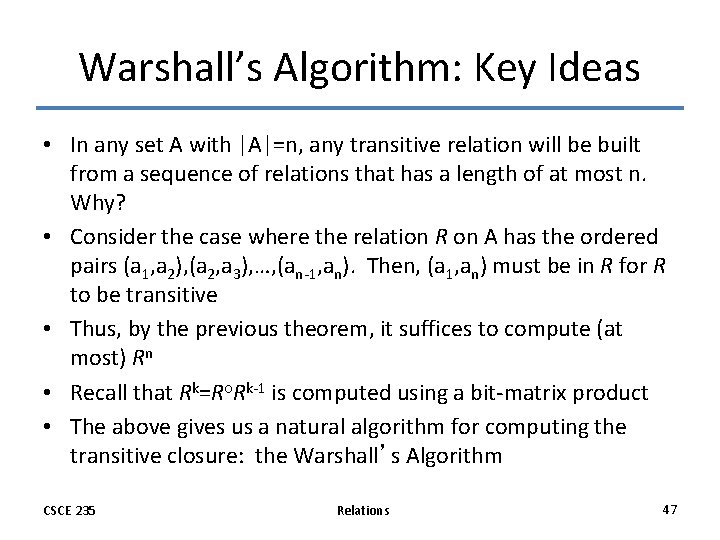
Warshall’s Algorithm: Key Ideas • In any set A with |A|=n, any transitive relation will be built from a sequence of relations that has a length of at most n. Why? • Consider the case where the relation R on A has the ordered pairs (a 1, a 2), (a 2, a 3), …, (an-1, an). Then, (a 1, an) must be in R for R to be transitive • Thus, by the previous theorem, it suffices to compute (at most) Rn • Recall that Rk=R Rk-1 is computed using a bit-matrix product • The above gives us a natural algorithm for computing the transitive closure: the Warshall’s Algorithm CSCE 235 Relations 47
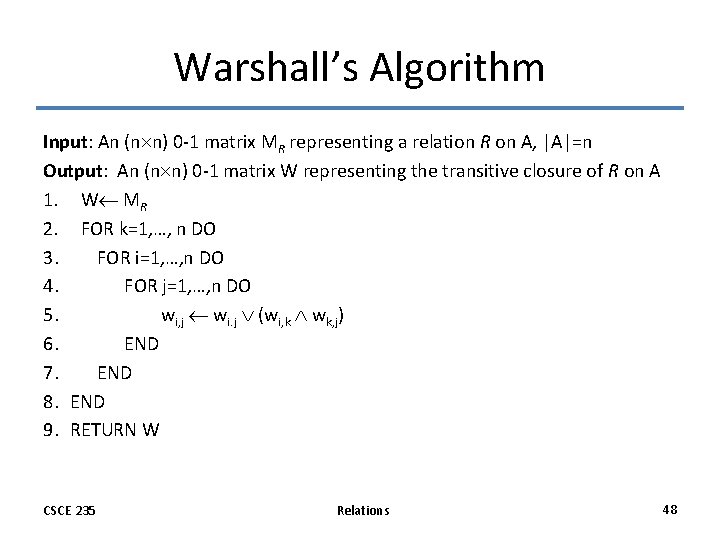
Warshall’s Algorithm Input: An (n n) 0 -1 matrix MR representing a relation R on A, |A|=n Output: An (n n) 0 -1 matrix W representing the transitive closure of R on A 1. W MR 2. FOR k=1, …, n DO 3. FOR i=1, …, n DO 4. FOR j=1, …, n DO 5. wi, j wi. j (wi, k wk, j) 6. END 7. END 8. END 9. RETURN W CSCE 235 Relations 48
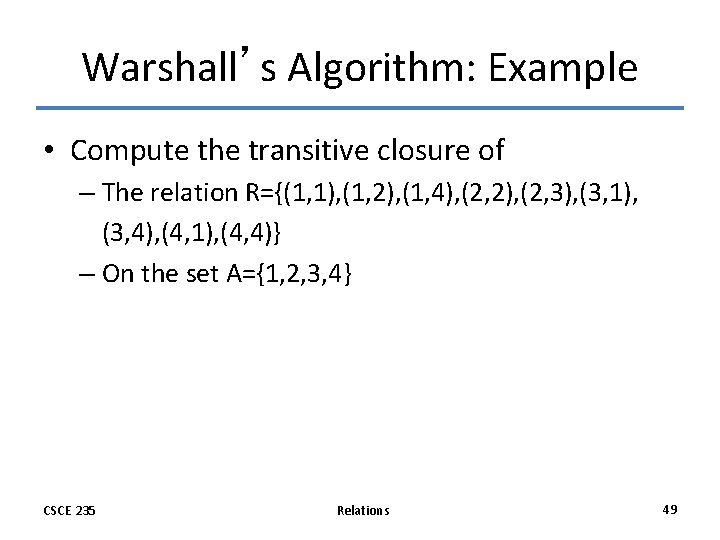
Warshall’s Algorithm: Example • Compute the transitive closure of – The relation R={(1, 1), (1, 2), (1, 4), (2, 2), (2, 3), (3, 1), (3, 4), (4, 1), (4, 4)} – On the set A={1, 2, 3, 4} CSCE 235 Relations 49
Outline • Relation: – Definition, representation, relation on a set • Properties – Reflexivity, symmetry, antisymmetric, irreflexive, asymmetric • Combining relations – , , , composite of relations • Representing relations – 0 -1 matrices, directed graphs • Closure of relations – Reflexive closure, diagonal relation, Warshall’s Algorithm • Equivalence relations: – Equivalence class, partitions, CSCE 235 Relations 50
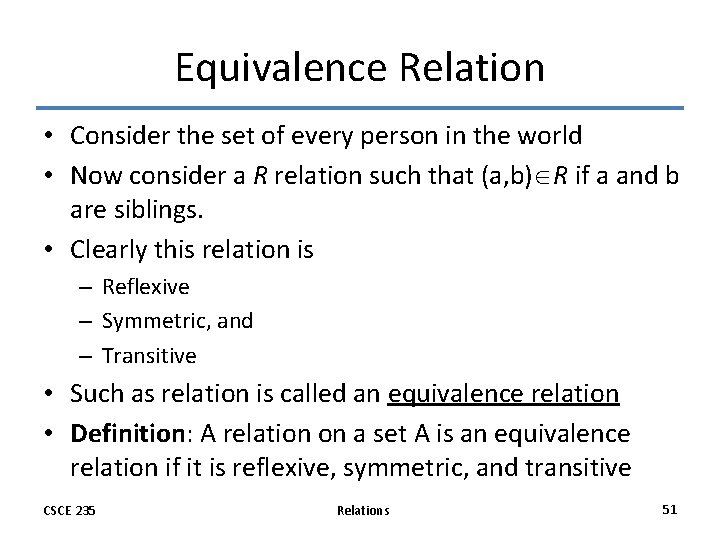
Equivalence Relation • Consider the set of every person in the world • Now consider a R relation such that (a, b) R if a and b are siblings. • Clearly this relation is – Reflexive – Symmetric, and – Transitive • Such as relation is called an equivalence relation • Definition: A relation on a set A is an equivalence relation if it is reflexive, symmetric, and transitive CSCE 235 Relations 51
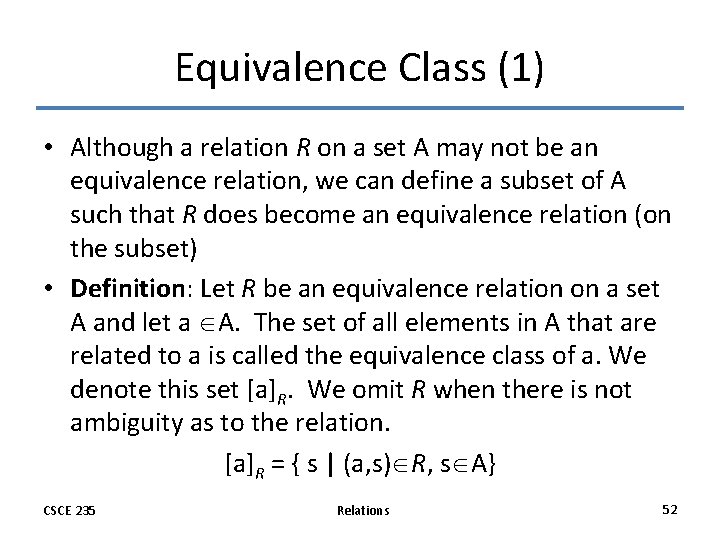
Equivalence Class (1) • Although a relation R on a set A may not be an equivalence relation, we can define a subset of A such that R does become an equivalence relation (on the subset) • Definition: Let R be an equivalence relation on a set A and let a A. The set of all elements in A that are related to a is called the equivalence class of a. We denote this set [a]R. We omit R when there is not ambiguity as to the relation. [a]R = { s | (a, s) R, s A} CSCE 235 Relations 52
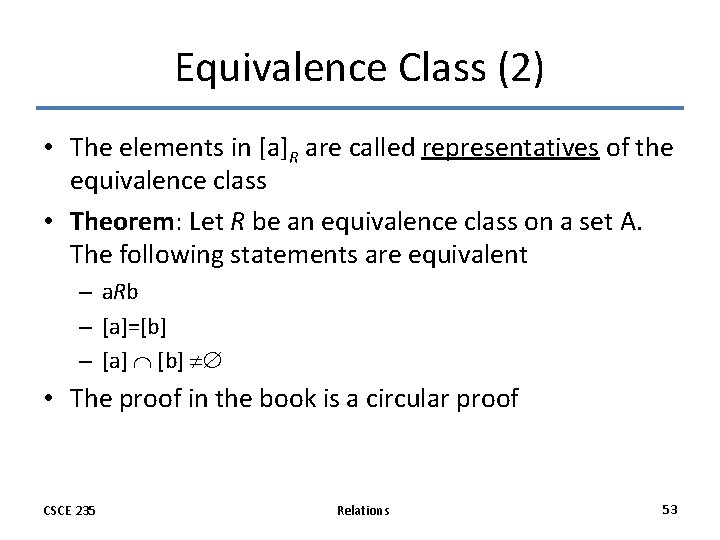
Equivalence Class (2) • The elements in [a]R are called representatives of the equivalence class • Theorem: Let R be an equivalence class on a set A. The following statements are equivalent – a. Rb – [a]=[b] – [a] [b] • The proof in the book is a circular proof CSCE 235 Relations 53
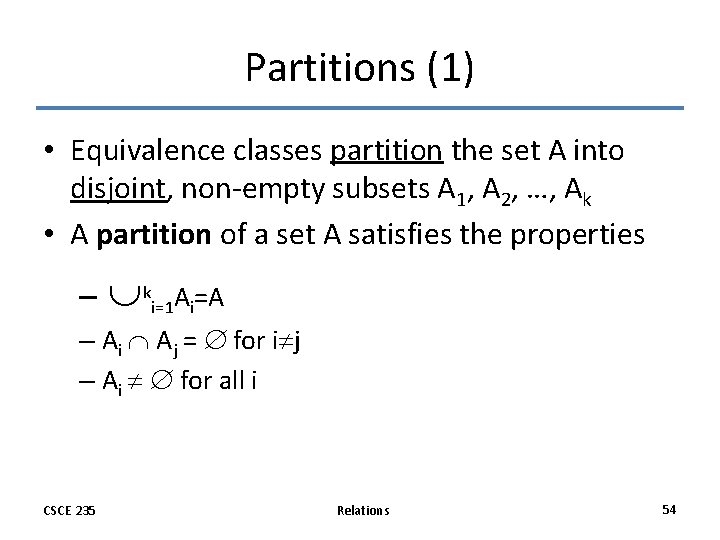
Partitions (1) • Equivalence classes partition the set A into disjoint, non-empty subsets A 1, A 2, …, Ak • A partition of a set A satisfies the properties – ki=1 Ai=A – Ai Aj = for i j – Ai for all i CSCE 235 Relations 54
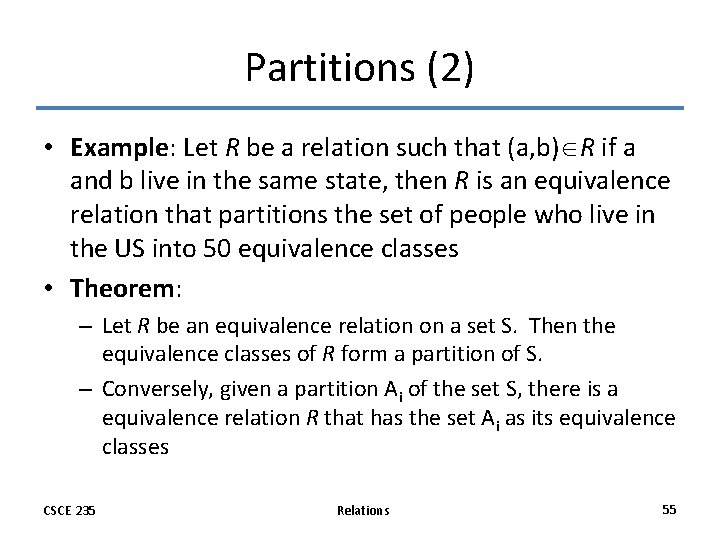
Partitions (2) • Example: Let R be a relation such that (a, b) R if a and b live in the same state, then R is an equivalence relation that partitions the set of people who live in the US into 50 equivalence classes • Theorem: – Let R be an equivalence relation on a set S. Then the equivalence classes of R form a partition of S. – Conversely, given a partition Ai of the set S, there is a equivalence relation R that has the set Ai as its equivalence classes CSCE 235 Relations 55
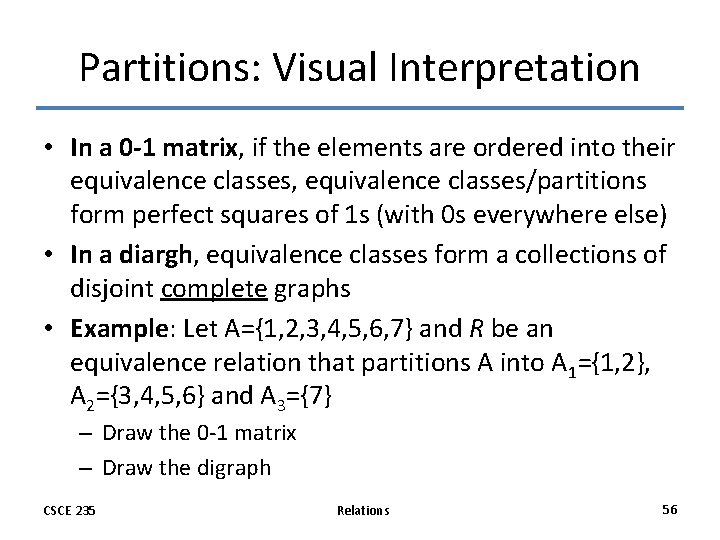
Partitions: Visual Interpretation • In a 0 -1 matrix, if the elements are ordered into their equivalence classes, equivalence classes/partitions form perfect squares of 1 s (with 0 s everywhere else) • In a diargh, equivalence classes form a collections of disjoint complete graphs • Example: Let A={1, 2, 3, 4, 5, 6, 7} and R be an equivalence relation that partitions A into A 1={1, 2}, A 2={3, 4, 5, 6} and A 3={7} – Draw the 0 -1 matrix – Draw the digraph CSCE 235 Relations 56
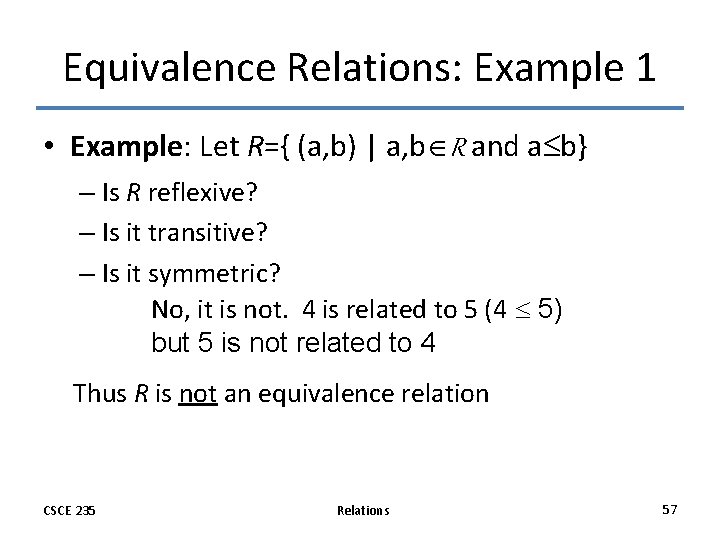
Equivalence Relations: Example 1 • Example: Let R={ (a, b) | a, b R and a b} – Is R reflexive? – Is it transitive? – Is it symmetric? No, it is not. 4 is related to 5 (4 5) but 5 is not related to 4 Thus R is not an equivalence relation CSCE 235 Relations 57
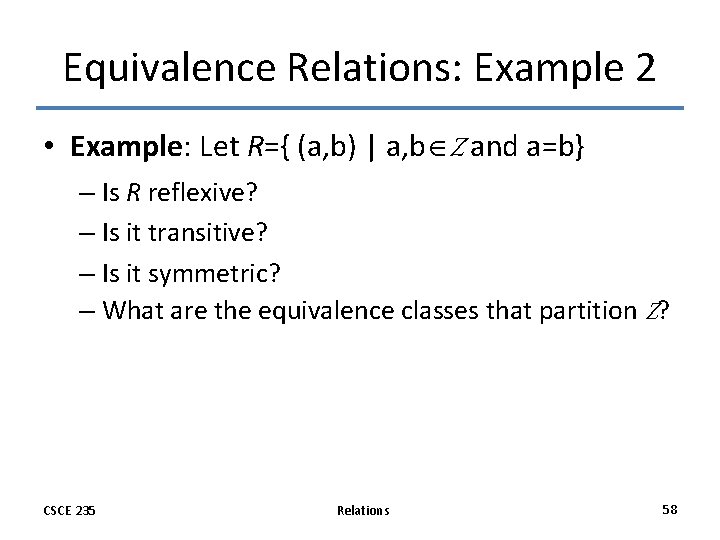
Equivalence Relations: Example 2 • Example: Let R={ (a, b) | a, b Z and a=b} – Is R reflexive? – Is it transitive? – Is it symmetric? – What are the equivalence classes that partition Z? CSCE 235 Relations 58
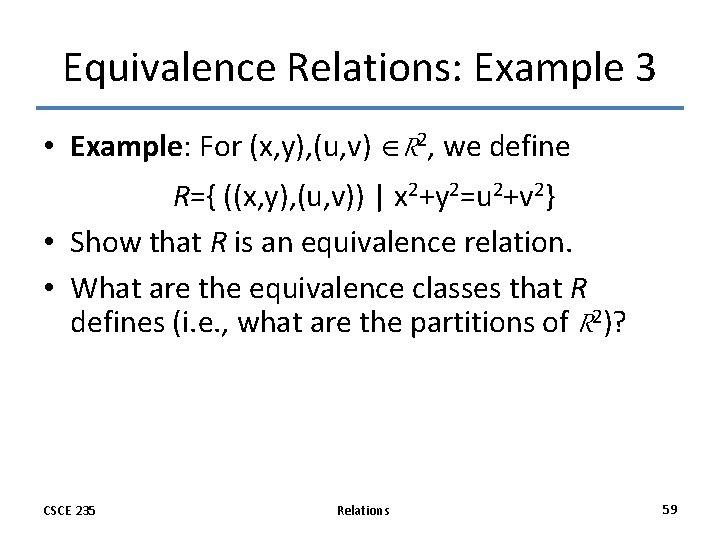
Equivalence Relations: Example 3 • Example: For (x, y), (u, v) R 2, we define R={ ((x, y), (u, v)) | x 2+y 2=u 2+v 2} • Show that R is an equivalence relation. • What are the equivalence classes that R defines (i. e. , what are the partitions of R 2)? CSCE 235 Relations 59
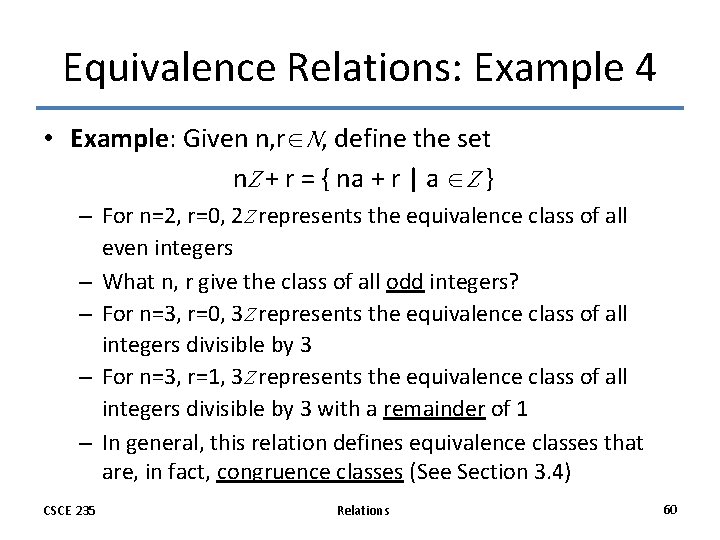
Equivalence Relations: Example 4 • Example: Given n, r N, define the set n. Z + r = { na + r | a Z } – For n=2, r=0, 2 Z represents the equivalence class of all even integers – What n, r give the class of all odd integers? – For n=3, r=0, 3 Z represents the equivalence class of all integers divisible by 3 – For n=3, r=1, 3 Z represents the equivalence class of all integers divisible by 3 with a remainder of 1 – In general, this relation defines equivalence classes that are, in fact, congruence classes (See Section 3. 4) CSCE 235 Relations 60