Properties of Relations Are the following relations on
- Slides: 10
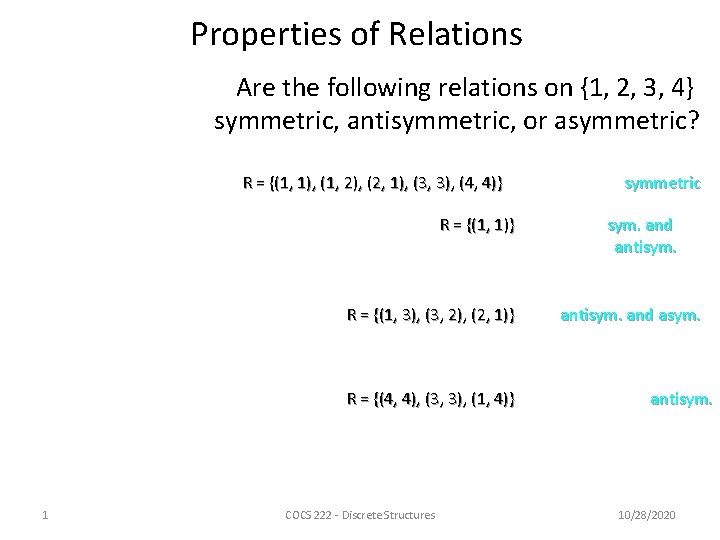
Properties of Relations Are the following relations on {1, 2, 3, 4} symmetric, antisymmetric, or asymmetric? R = {(1, 1), (1, 2), (2, 1), (3, 3), (4, 4)} R = {(1, 1)} R = {(1, 3), (3, 2), (2, 1)} R = {(4, 4), (3, 3), (1, 4)} 1 COCS 222 - Discrete Structures symmetric sym. and antisym. and asym. antisym. 10/28/2020
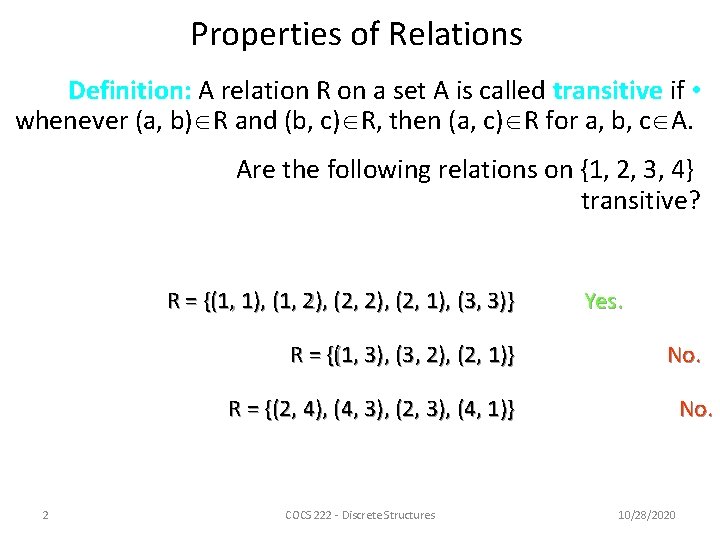
Properties of Relations Definition: A relation R on a set A is called transitive if • whenever (a, b) R and (b, c) R, then (a, c) R for a, b, c A. Are the following relations on {1, 2, 3, 4} transitive? R = {(1, 1), (1, 2), (2, 1), (3, 3)} R = {(1, 3), (3, 2), (2, 1)} Yes. No. R = {(2, 4), (4, 3), (2, 3), (4, 1)} 2 COCS 222 - Discrete Structures No. 10/28/2020
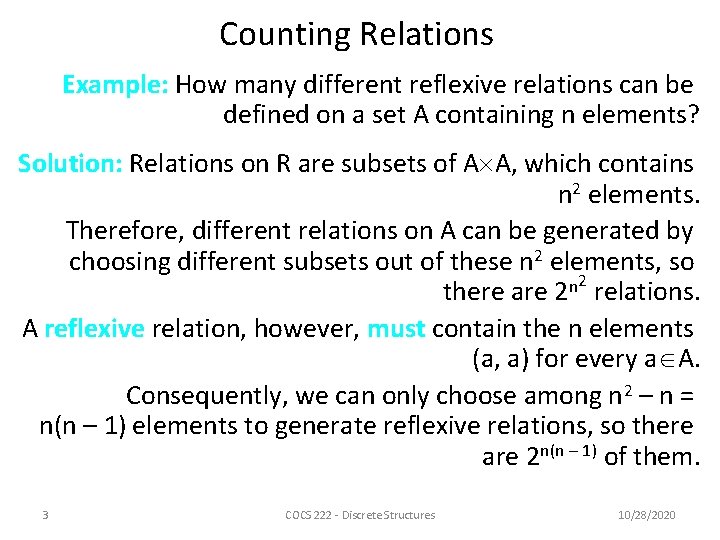
Counting Relations Example: How many different reflexive relations can be defined on a set A containing n elements? Solution: Relations on R are subsets of A A, which contains n 2 elements. Therefore, different relations on A can be generated by choosing different subsets out of these n 2 elements, so there are 2 n 2 relations. A reflexive relation, however, must contain the n elements (a, a) for every a A. Consequently, we can only choose among n 2 – n = n(n – 1) elements to generate reflexive relations, so there are 2 n(n – 1) of them. 3 COCS 222 - Discrete Structures 10/28/2020
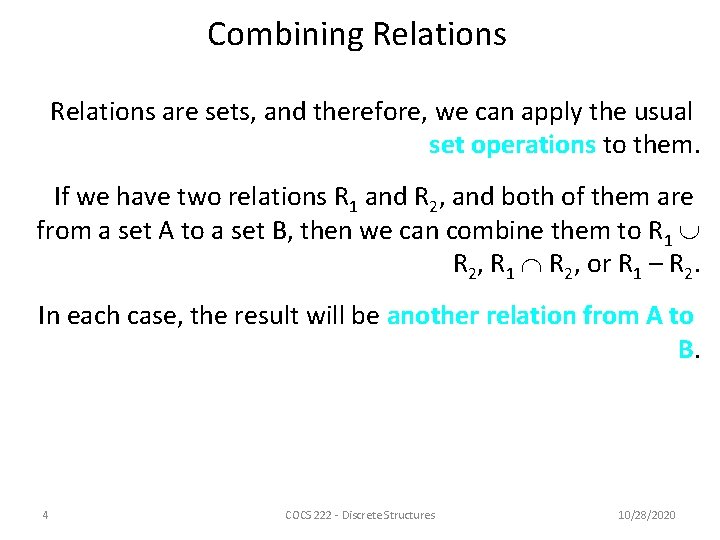
Combining Relations are sets, and therefore, we can apply the usual set operations to them. If we have two relations R 1 and R 2, and both of them are from a set A to a set B, then we can combine them to R 1 R 2, or R 1 – R 2. In each case, the result will be another relation from A to B. 4 COCS 222 - Discrete Structures 10/28/2020
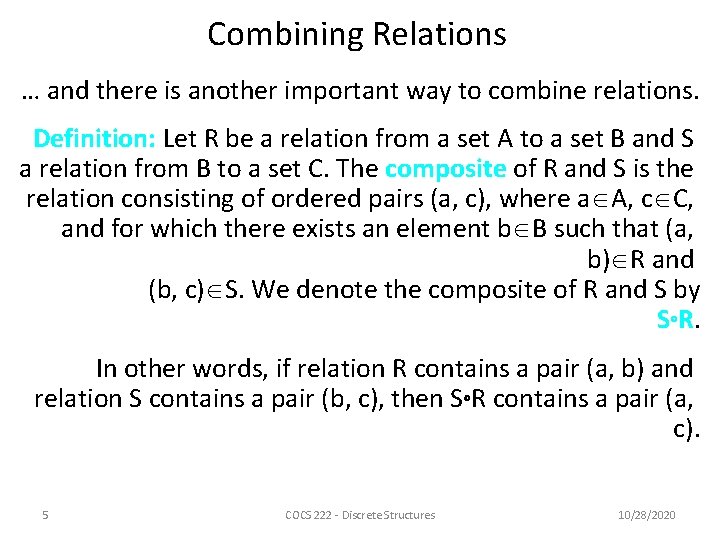
Combining Relations … and there is another important way to combine relations. Definition: Let R be a relation from a set A to a set B and S a relation from B to a set C. The composite of R and S is the relation consisting of ordered pairs (a, c), where a A, c C, and for which there exists an element b B such that (a, b) R and (b, c) S. We denote the composite of R and S by S R. In other words, if relation R contains a pair (a, b) and relation S contains a pair (b, c), then S R contains a pair (a, c). 5 COCS 222 - Discrete Structures 10/28/2020
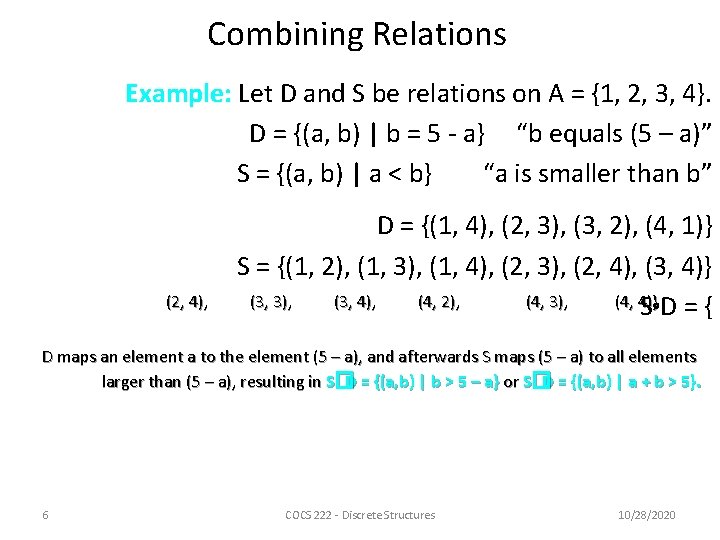
Combining Relations Example: Let D and S be relations on A = {1, 2, 3, 4}. D = {(a, b) | b = 5 - a} “b equals (5 – a)” S = {(a, b) | a < b} “a is smaller than b” (2, 4), D = {(1, 4), (2, 3), (3, 2), (4, 1)} S = {(1, 2), (1, 3), (1, 4), (2, 3), (2, 4), (3, 4)} (3, 3), (3, 4), (4, 2), (4, 3), (4, 4)} S D = { D maps an element a to the element (5 – a), and afterwards S maps (5 – a) to all elements larger than (5 – a), resulting in S� D = {(a, b) | b > 5 – a} or S� D = {(a, b) | a + b > 5}. 6 COCS 222 - Discrete Structures 10/28/2020
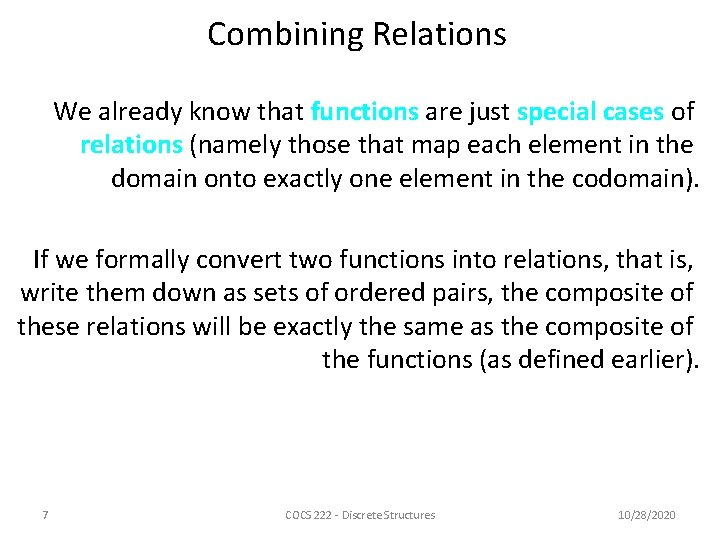
Combining Relations We already know that functions are just special cases of relations (namely those that map each element in the domain onto exactly one element in the codomain). If we formally convert two functions into relations, that is, write them down as sets of ordered pairs, the composite of these relations will be exactly the same as the composite of the functions (as defined earlier). 7 COCS 222 - Discrete Structures 10/28/2020
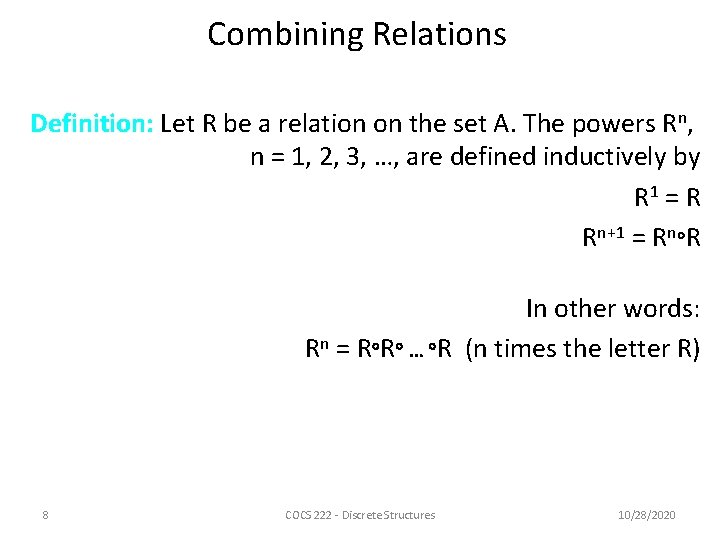
Combining Relations Definition: Let R be a relation on the set A. The powers Rn, n = 1, 2, 3, …, are defined inductively by R 1 = R Rn+1 = Rn R In other words: Rn = R R … R (n times the letter R) 8 COCS 222 - Discrete Structures 10/28/2020
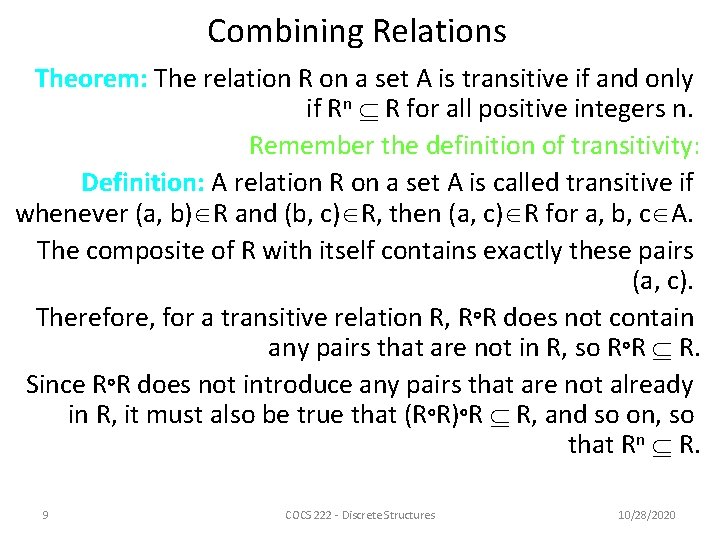
Combining Relations Theorem: The relation R on a set A is transitive if and only if Rn R for all positive integers n. Remember the definition of transitivity: Definition: A relation R on a set A is called transitive if whenever (a, b) R and (b, c) R, then (a, c) R for a, b, c A. The composite of R with itself contains exactly these pairs (a, c). Therefore, for a transitive relation R, R R does not contain any pairs that are not in R, so R R R. Since R R does not introduce any pairs that are not already in R, it must also be true that (R R) R R, and so on, so that Rn R. 9 COCS 222 - Discrete Structures 10/28/2020
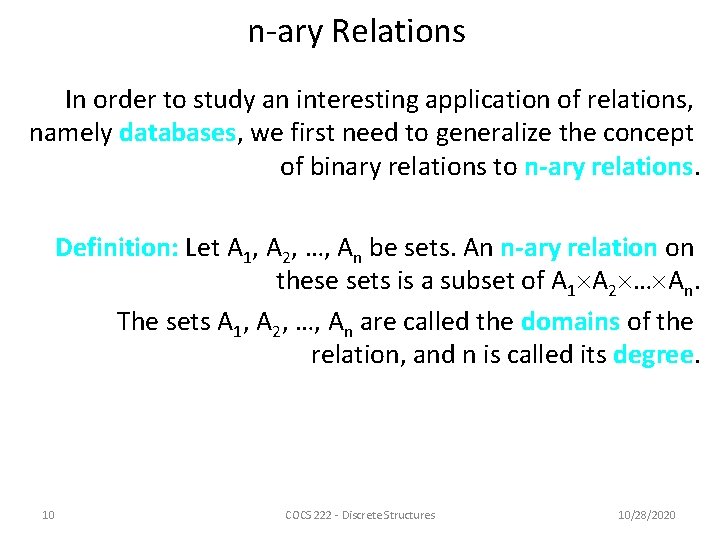
n-ary Relations In order to study an interesting application of relations, namely databases, we first need to generalize the concept of binary relations to n-ary relations. Definition: Let A 1, A 2, …, An be sets. An n-ary relation on these sets is a subset of A 1 A 2 … An. The sets A 1, A 2, …, An are called the domains of the relation, and n is called its degree. 10 COCS 222 - Discrete Structures 10/28/2020