Properties of Relations Definitions A relation R on
- Slides: 16
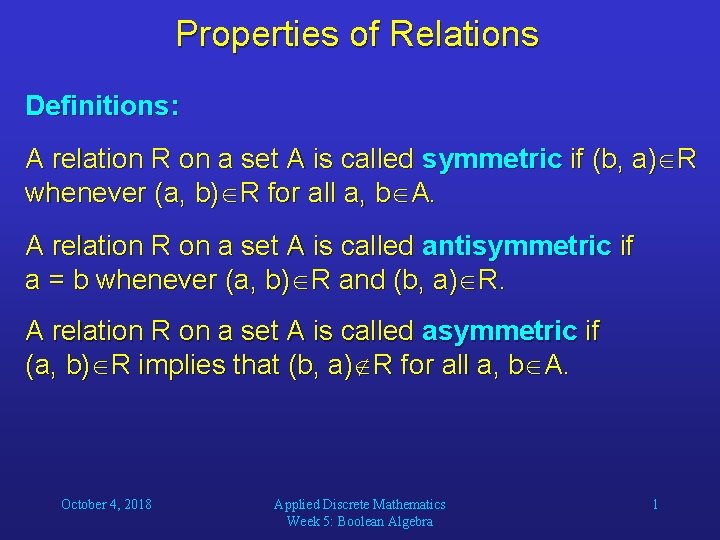
Properties of Relations Definitions: A relation R on a set A is called symmetric if (b, a) R whenever (a, b) R for all a, b A. A relation R on a set A is called antisymmetric if a = b whenever (a, b) R and (b, a) R. A relation R on a set A is called asymmetric if (a, b) R implies that (b, a) R for all a, b A. October 4, 2018 Applied Discrete Mathematics Week 5: Boolean Algebra 1
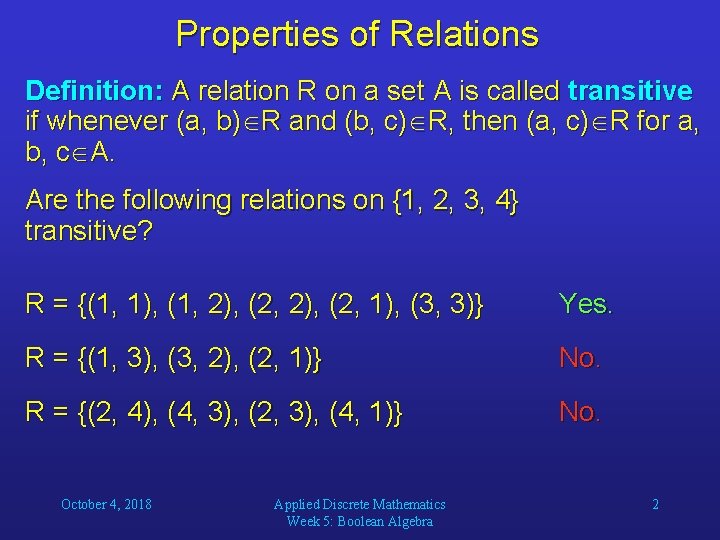
Properties of Relations Definition: A relation R on a set A is called transitive if whenever (a, b) R and (b, c) R, then (a, c) R for a, b, c A. Are the following relations on {1, 2, 3, 4} transitive? R = {(1, 1), (1, 2), (2, 1), (3, 3)} Yes. R = {(1, 3), (3, 2), (2, 1)} No. R = {(2, 4), (4, 3), (2, 3), (4, 1)} No. October 4, 2018 Applied Discrete Mathematics Week 5: Boolean Algebra 2
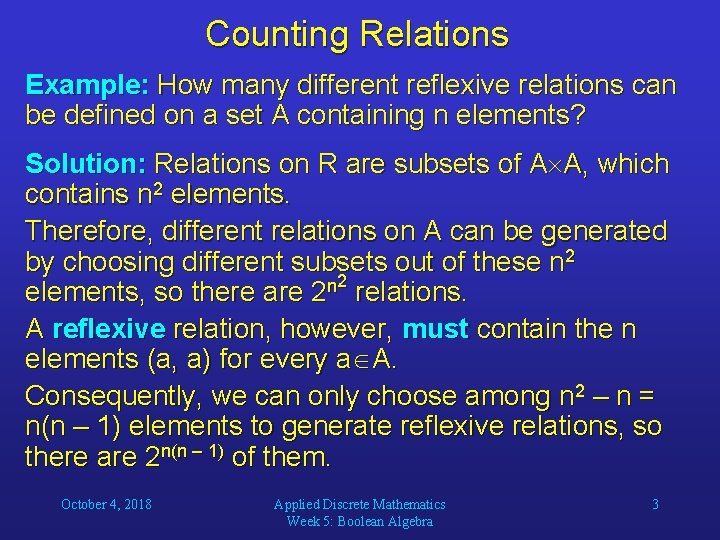
Counting Relations Example: How many different reflexive relations can be defined on a set A containing n elements? Solution: Relations on R are subsets of A A, which contains n 2 elements. Therefore, different relations on A can be generated by choosing different subsets out of these n 2 2 n elements, so there are 2 relations. A reflexive relation, however, must contain the n elements (a, a) for every a A. Consequently, we can only choose among n 2 – n = n(n – 1) elements to generate reflexive relations, so there are 2 n(n – 1) of them. October 4, 2018 Applied Discrete Mathematics Week 5: Boolean Algebra 3
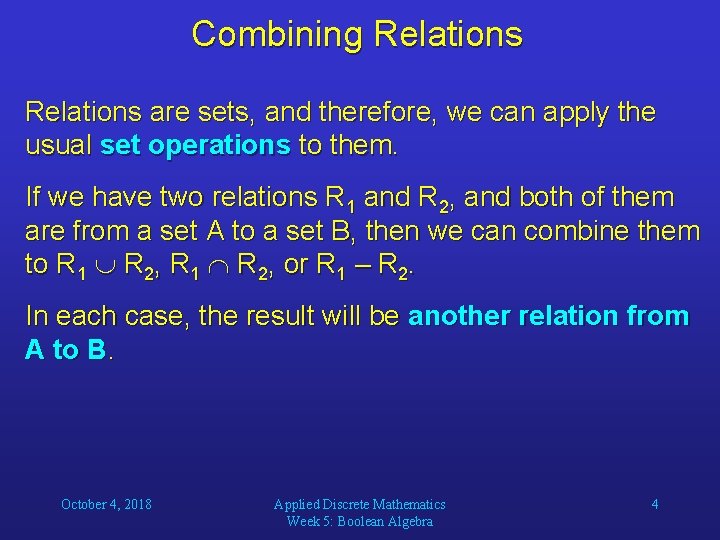
Combining Relations are sets, and therefore, we can apply the usual set operations to them. If we have two relations R 1 and R 2, and both of them are from a set A to a set B, then we can combine them to R 1 R 2, or R 1 – R 2. In each case, the result will be another relation from A to B. October 4, 2018 Applied Discrete Mathematics Week 5: Boolean Algebra 4
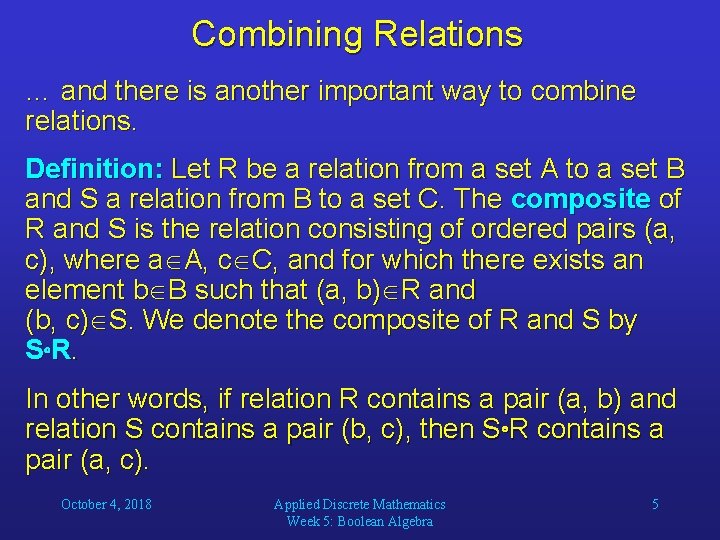
Combining Relations … and there is another important way to combine relations. Definition: Let R be a relation from a set A to a set B and S a relation from B to a set C. The composite of R and S is the relation consisting of ordered pairs (a, c), where a A, c C, and for which there exists an element b B such that (a, b) R and (b, c) S. We denote the composite of R and S by S R. In other words, if relation R contains a pair (a, b) and relation S contains a pair (b, c), then S R contains a pair (a, c). October 4, 2018 Applied Discrete Mathematics Week 5: Boolean Algebra 5
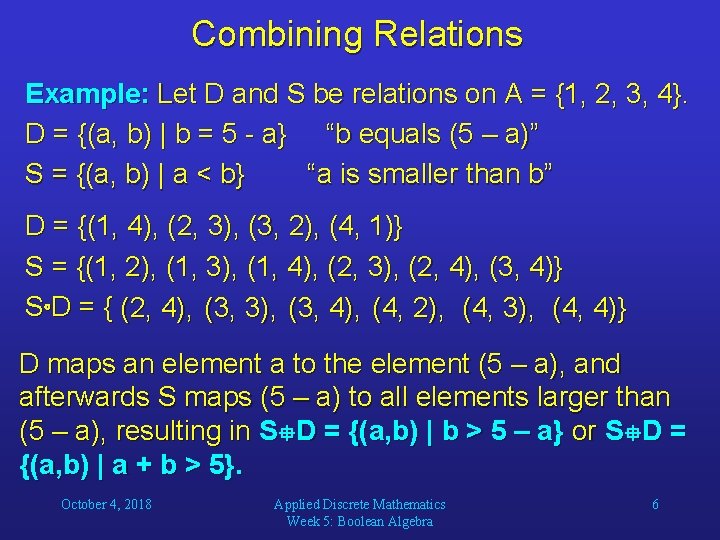
Combining Relations Example: Let D and S be relations on A = {1, 2, 3, 4}. D = {(a, b) | b = 5 - a} “b equals (5 – a)” S = {(a, b) | a < b} “a is smaller than b” D = {(1, 4), (2, 3), (3, 2), (4, 1)} S = {(1, 2), (1, 3), (1, 4), (2, 3), (2, 4), (3, 4)} S D = { (2, 4), (3, 3), (3, 4), (4, 2), (4, 3), (4, 4)} D maps an element a to the element (5 – a), and afterwards S maps (5 – a) to all elements larger than (5 – a), resulting in S D = {(a, b) | b > 5 – a} or S D = {(a, b) | a + b > 5}. October 4, 2018 Applied Discrete Mathematics Week 5: Boolean Algebra 6
Combining Relations We already know that functions are just special cases of relations (namely those that map each element in the domain onto exactly one element in the codomain). If we formally convert two functions into relations, that is, write them down as sets of ordered pairs, the composite of these relations will be exactly the same as the composite of the functions (as defined earlier). October 4, 2018 Applied Discrete Mathematics Week 5: Boolean Algebra 7
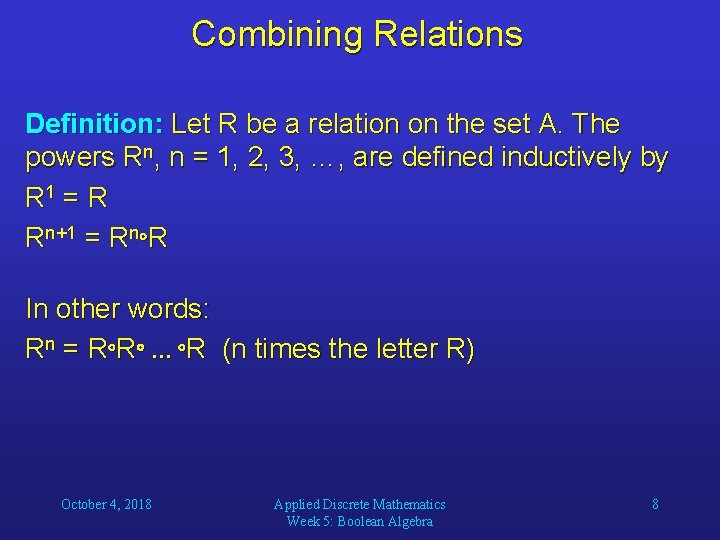
Combining Relations Definition: Let R be a relation on the set A. The powers Rn, n = 1, 2, 3, …, are defined inductively by R 1 = R Rn+1 = Rn R In other words: Rn = R R … R (n times the letter R) October 4, 2018 Applied Discrete Mathematics Week 5: Boolean Algebra 8
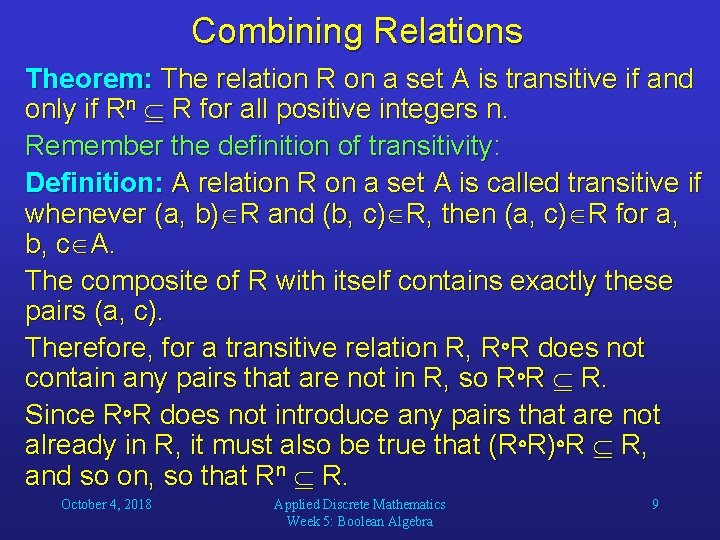
Combining Relations Theorem: The relation R on a set A is transitive if and only if Rn R for all positive integers n. Remember the definition of transitivity: Definition: A relation R on a set A is called transitive if whenever (a, b) R and (b, c) R, then (a, c) R for a, b, c A. The composite of R with itself contains exactly these pairs (a, c). Therefore, for a transitive relation R, R R does not contain any pairs that are not in R, so R R R. Since R R does not introduce any pairs that are not already in R, it must also be true that (R R) R R, and so on, so that Rn R. October 4, 2018 Applied Discrete Mathematics Week 5: Boolean Algebra 9
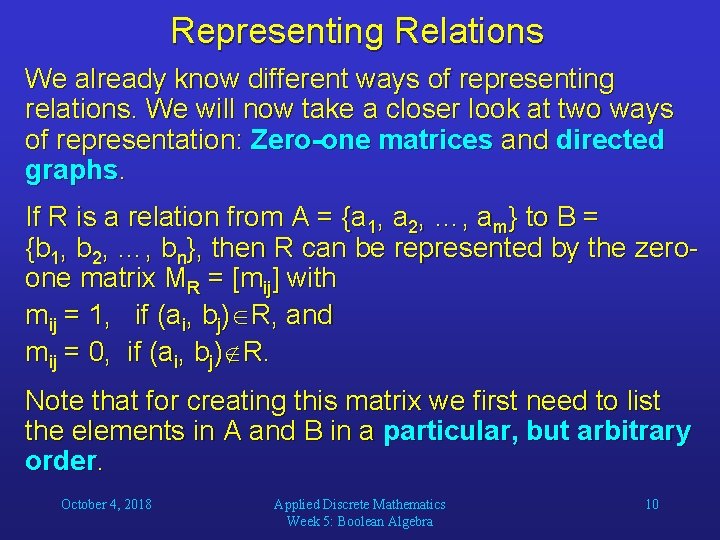
Representing Relations We already know different ways of representing relations. We will now take a closer look at two ways of representation: Zero-one matrices and directed graphs. If R is a relation from A = {a 1, a 2, …, am} to B = {b 1, b 2, …, bn}, then R can be represented by the zeroone matrix MR = [mij] with mij = 1, if (ai, bj) R, and mij = 0, if (ai, bj) R. Note that for creating this matrix we first need to list the elements in A and B in a particular, but arbitrary order. October 4, 2018 Applied Discrete Mathematics Week 5: Boolean Algebra 10
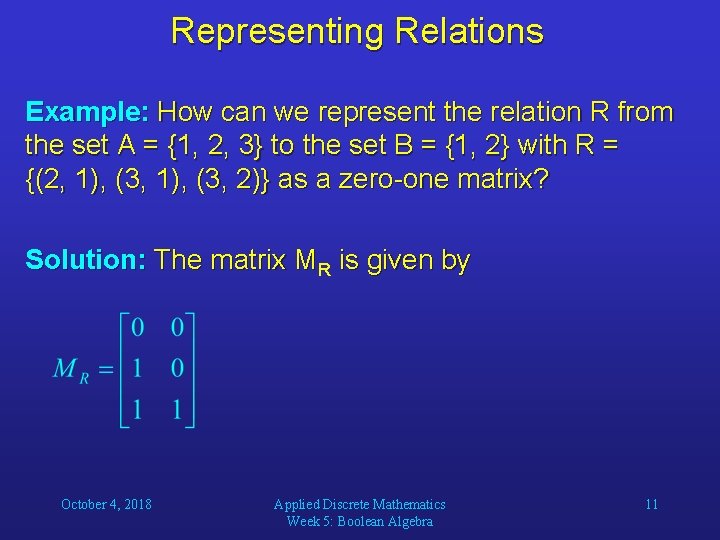
Representing Relations Example: How can we represent the relation R from the set A = {1, 2, 3} to the set B = {1, 2} with R = {(2, 1), (3, 2)} as a zero-one matrix? Solution: The matrix MR is given by October 4, 2018 Applied Discrete Mathematics Week 5: Boolean Algebra 11
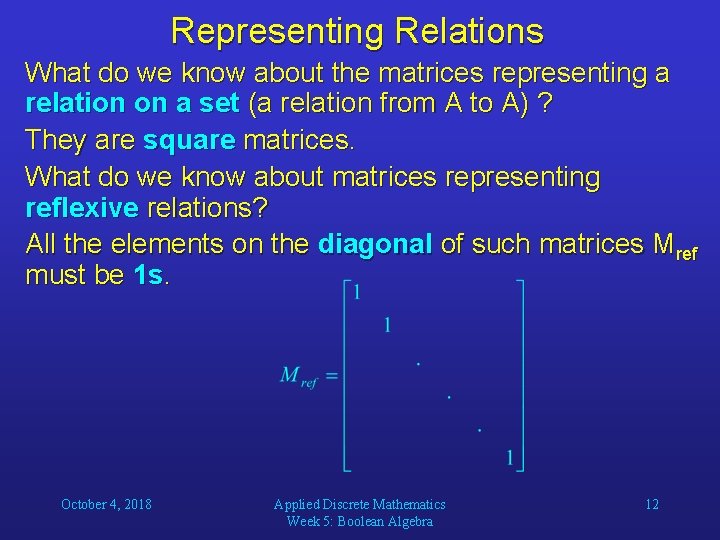
Representing Relations What do we know about the matrices representing a relation on a set (a relation from A to A) ? They are square matrices. What do we know about matrices representing reflexive relations? All the elements on the diagonal of such matrices Mref must be 1 s. October 4, 2018 Applied Discrete Mathematics Week 5: Boolean Algebra 12
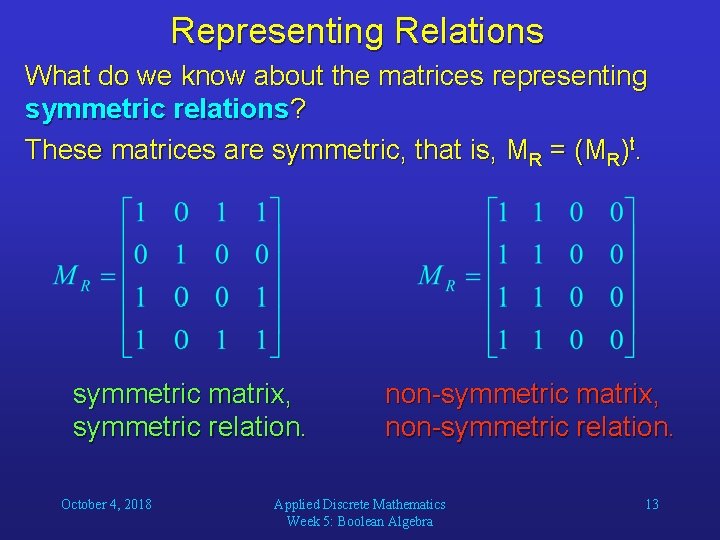
Representing Relations What do we know about the matrices representing symmetric relations? These matrices are symmetric, that is, MR = (MR)t. symmetric matrix, symmetric relation. October 4, 2018 non-symmetric matrix, non-symmetric relation. Applied Discrete Mathematics Week 5: Boolean Algebra 13
Representing Relations The Boolean operations join and meet (you remember? ) can be used to determine the matrices representing the union and the intersection of two relations, respectively. To obtain the join of two zero-one matrices, we apply the Boolean “or” function to all corresponding elements in the matrices. To obtain the meet of two zero-one matrices, we apply the Boolean “and” function to all corresponding elements in the matrices. October 4, 2018 Applied Discrete Mathematics Week 5: Boolean Algebra 14
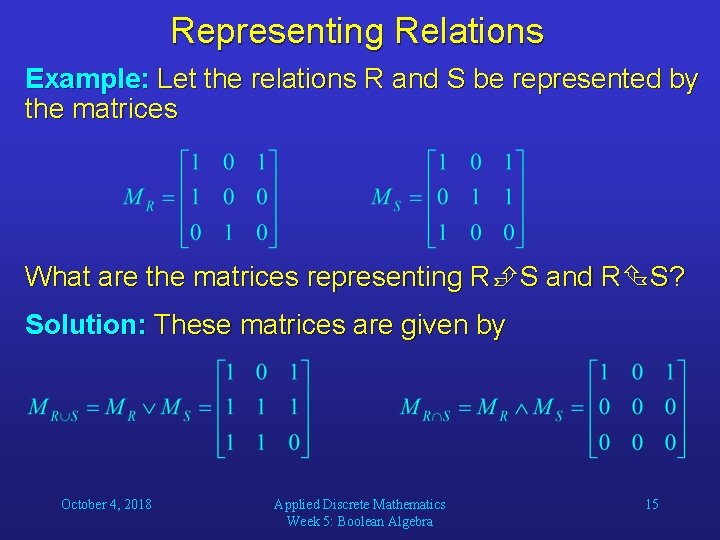
Representing Relations Example: Let the relations R and S be represented by the matrices What are the matrices representing R S and R S? Solution: These matrices are given by October 4, 2018 Applied Discrete Mathematics Week 5: Boolean Algebra 15
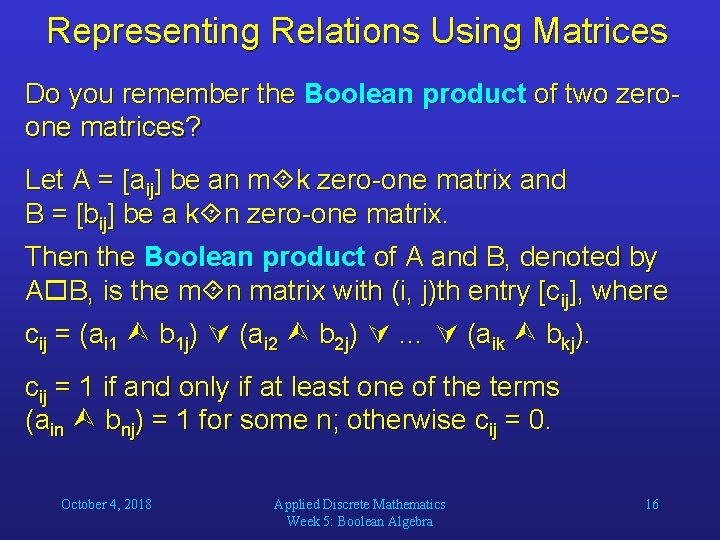
Representing Relations Using Matrices Do you remember the Boolean product of two zeroone matrices? Let A = [aij] be an m k zero-one matrix and B = [bij] be a k n zero-one matrix. Then the Boolean product of A and B, denoted by A B, is the m n matrix with (i, j)th entry [cij], where cij = (ai 1 b 1 j) (ai 2 b 2 j) … (aik bkj). cij = 1 if and only if at least one of the terms (ain bnj) = 1 for some n; otherwise cij = 0. October 4, 2018 Applied Discrete Mathematics Week 5: Boolean Algebra 16