PHY 274 Atomic Structure IV Wolfgang Pauli Zeeman
- Slides: 34
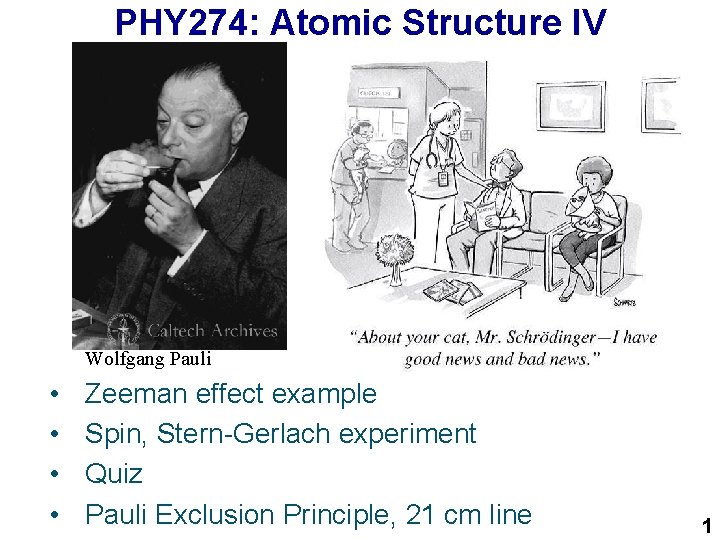
PHY 274: Atomic Structure IV Wolfgang Pauli • • Zeeman effect example Spin, Stern-Gerlach experiment Quiz Pauli Exclusion Principle, 21 cm line 1
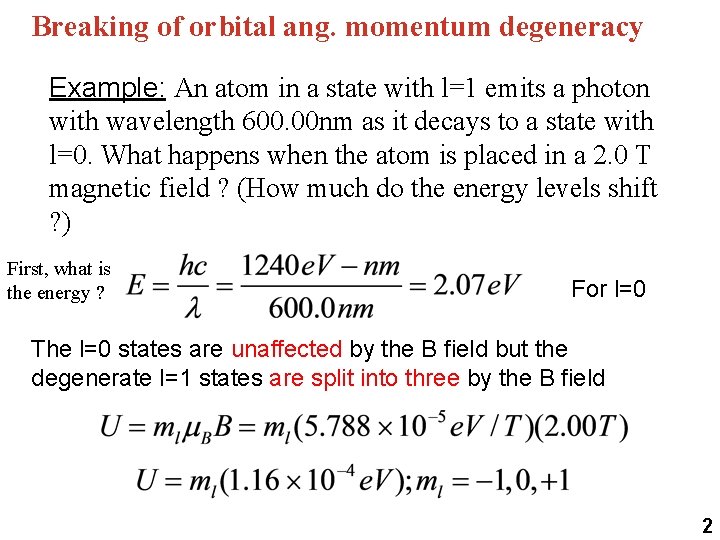
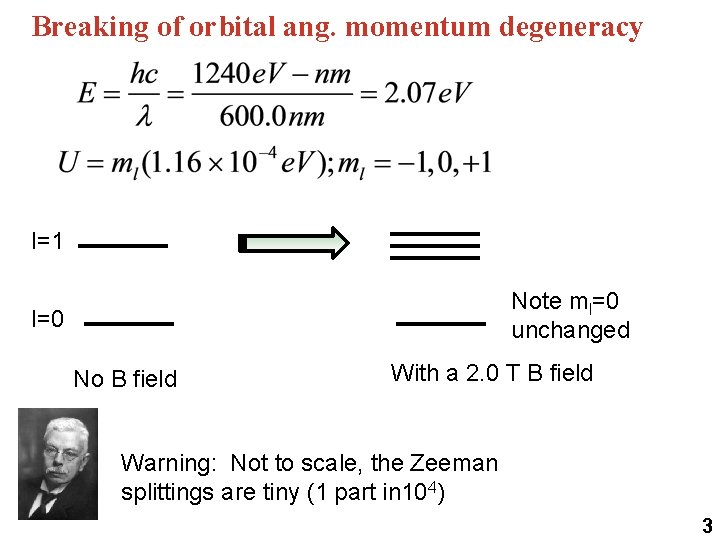
Breaking of orbital ang. momentum degeneracy Example: An atom in a state with l=1 emits a photon with wavelength 600. 00 nm as it decays to a state with l=0. What happens when the atom is placed in a 2. 0 T magnetic field ? (How much do the energy levels shift ? ) First, what is the energy ? For l=0 The l=0 states are unaffected by the B field but the degenerate l=1 states are split into three by the B field 2
Breaking of orbital ang. momentum degeneracy l=1 Note ml=0 unchanged l=0 No B field With a 2. 0 T B field Warning: Not to scale, the Zeeman splittings are tiny (1 part in 104) 3
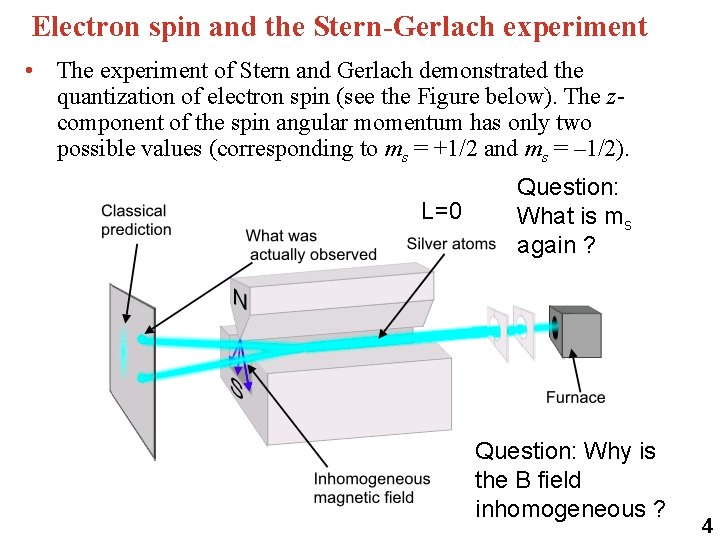
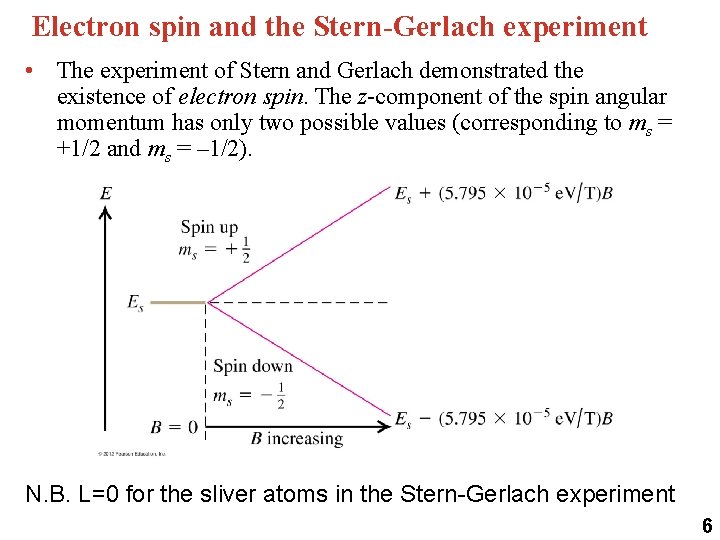
Electron spin and the Stern-Gerlach experiment • The experiment of Stern and Gerlach demonstrated the quantization of electron spin (see the Figure below). The zcomponent of the spin angular momentum has only two possible values (corresponding to ms = +1/2 and ms = – 1/2). L=0 Question: What is ms again ? Question: Why is the B field inhomogeneous ? 4
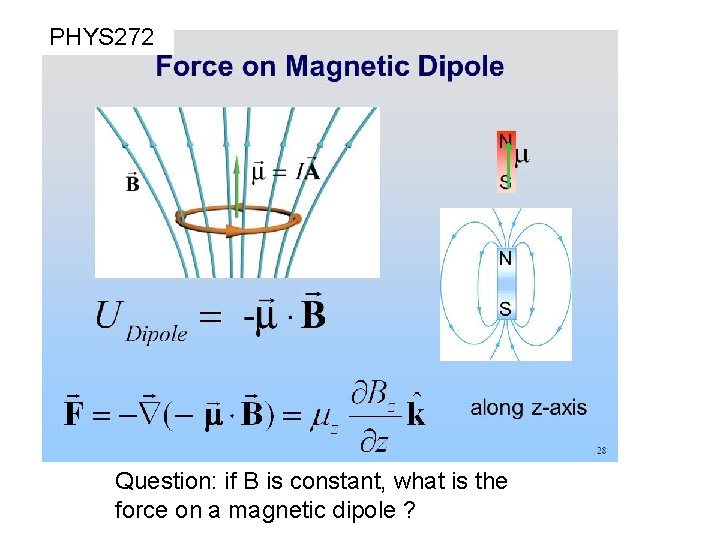
PHYS 272 Question: if B is constant, what is the force on a magnetic dipole ?
Electron spin and the Stern-Gerlach experiment • The experiment of Stern and Gerlach demonstrated the existence of electron spin. The z-component of the spin angular momentum has only two possible values (corresponding to ms = +1/2 and ms = – 1/2). N. B. L=0 for the sliver atoms in the Stern-Gerlach experiment 6
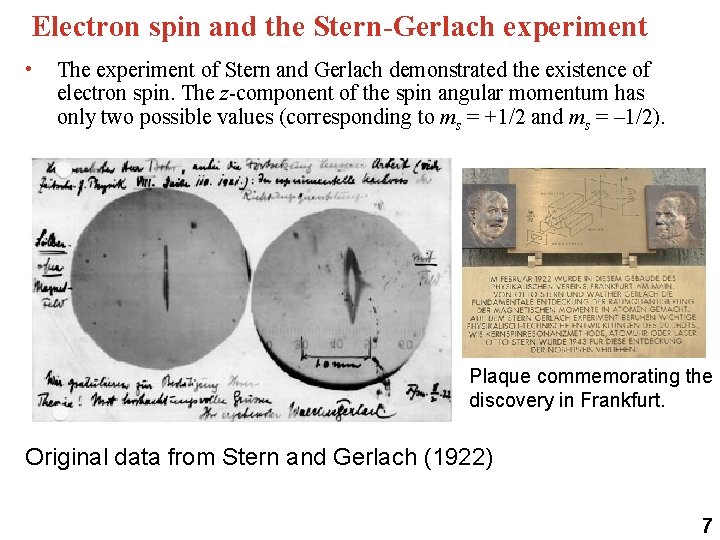
Electron spin and the Stern-Gerlach experiment • The experiment of Stern and Gerlach demonstrated the existence of electron spin. The z-component of the spin angular momentum has only two possible values (corresponding to ms = +1/2 and ms = – 1/2). Plaque commemorating the discovery in Frankfurt. Original data from Stern and Gerlach (1922) 7
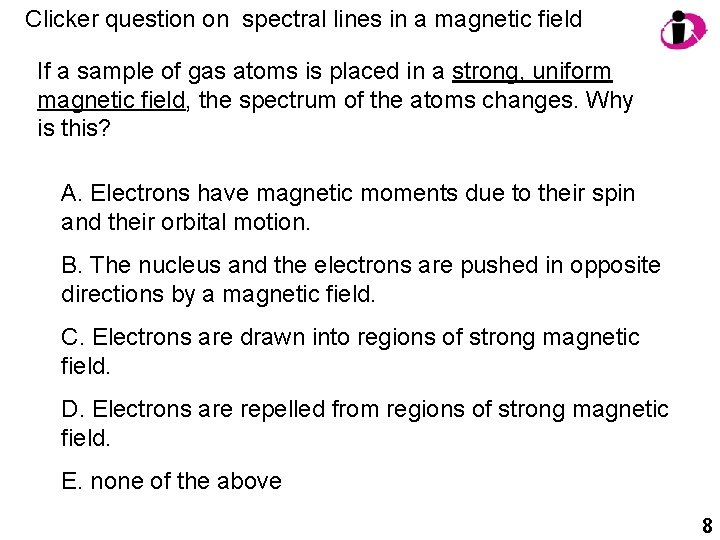
Clicker question on spectral lines in a magnetic field If a sample of gas atoms is placed in a strong, uniform magnetic field, the spectrum of the atoms changes. Why is this? A. Electrons have magnetic moments due to their spin and their orbital motion. B. The nucleus and the electrons are pushed in opposite directions by a magnetic field. C. Electrons are drawn into regions of strong magnetic field. D. Electrons are repelled from regions of strong magnetic field. E. none of the above 8
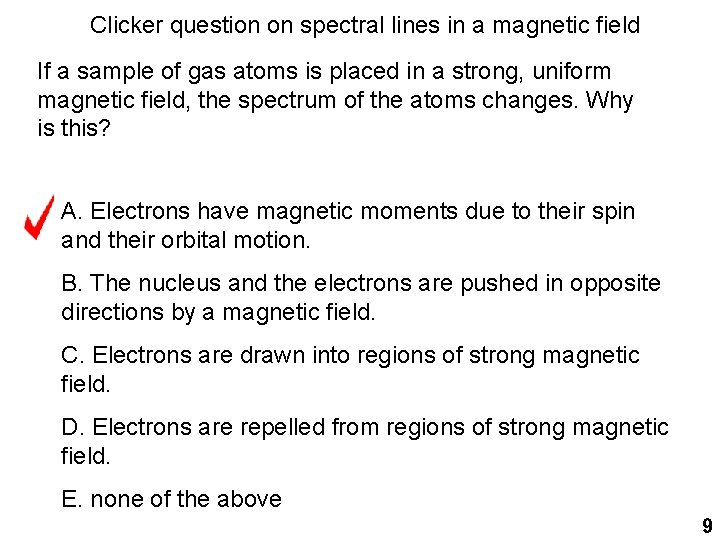
Clicker question on spectral lines in a magnetic field If a sample of gas atoms is placed in a strong, uniform magnetic field, the spectrum of the atoms changes. Why is this? A. Electrons have magnetic moments due to their spin and their orbital motion. B. The nucleus and the electrons are pushed in opposite directions by a magnetic field. C. Electrons are drawn into regions of strong magnetic field. D. Electrons are repelled from regions of strong magnetic field. E. none of the above 9
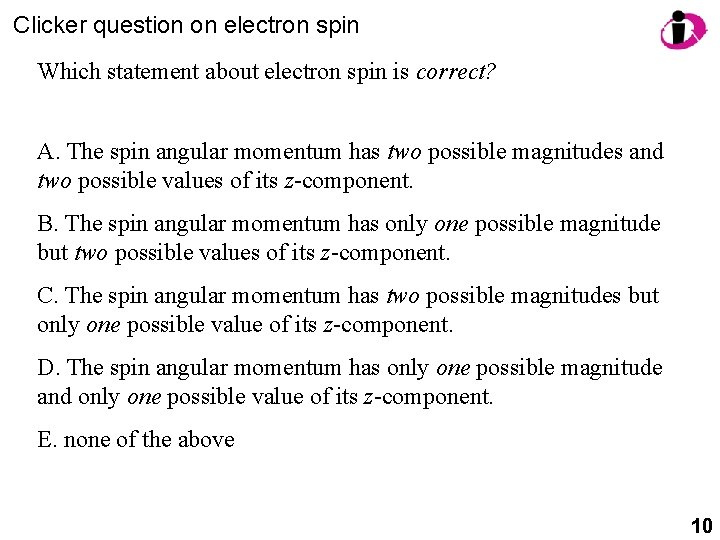
Clicker question on electron spin Which statement about electron spin is correct? A. The spin angular momentum has two possible magnitudes and two possible values of its z-component. B. The spin angular momentum has only one possible magnitude but two possible values of its z-component. C. The spin angular momentum has two possible magnitudes but only one possible value of its z-component. D. The spin angular momentum has only one possible magnitude and only one possible value of its z-component. E. none of the above 10
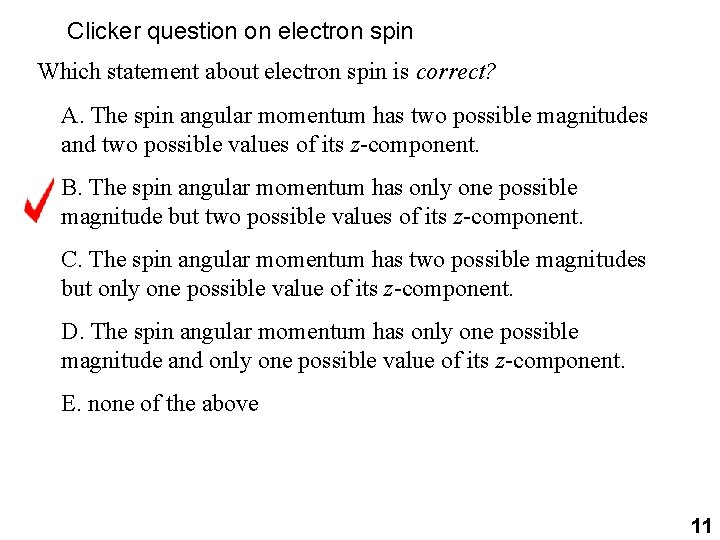
Clicker question on electron spin Which statement about electron spin is correct? A. The spin angular momentum has two possible magnitudes and two possible values of its z-component. B. The spin angular momentum has only one possible magnitude but two possible values of its z-component. C. The spin angular momentum has two possible magnitudes but only one possible value of its z-component. D. The spin angular momentum has only one possible magnitude and only one possible value of its z-component. E. none of the above 11
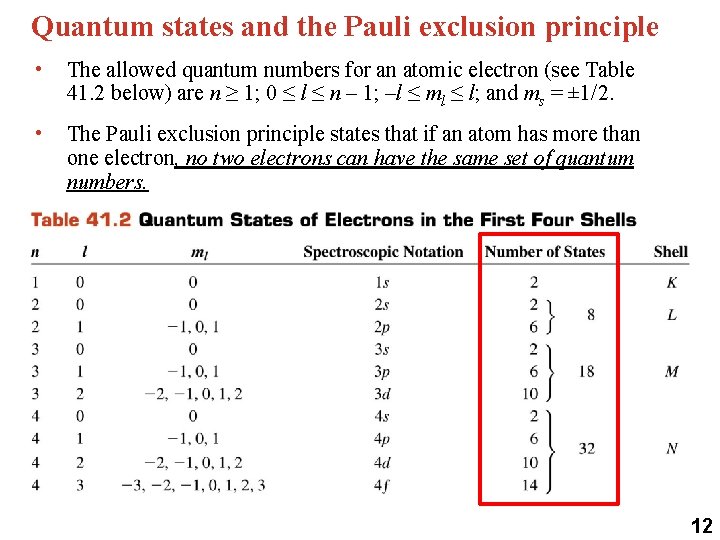
Quantum states and the Pauli exclusion principle • The allowed quantum numbers for an atomic electron (see Table 41. 2 below) are n ≥ 1; 0 ≤ l ≤ n – 1; –l ≤ ml ≤ l; and ms = ± 1/2. • The Pauli exclusion principle states that if an atom has more than one electron, no two electrons can have the same set of quantum numbers. 12
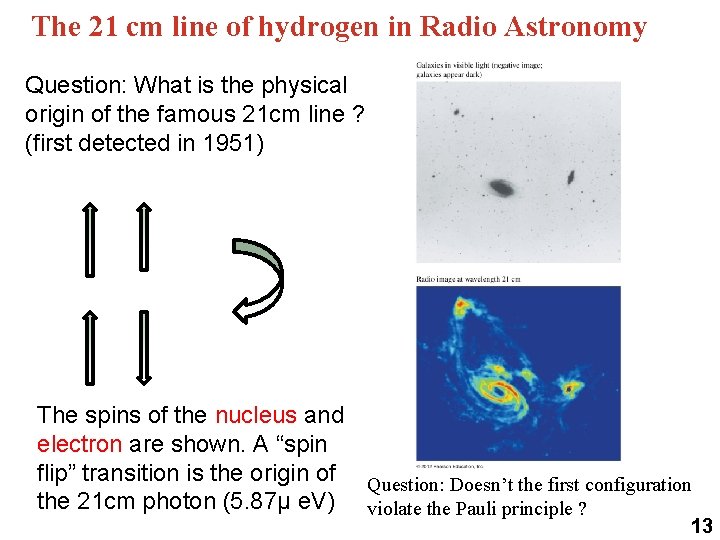
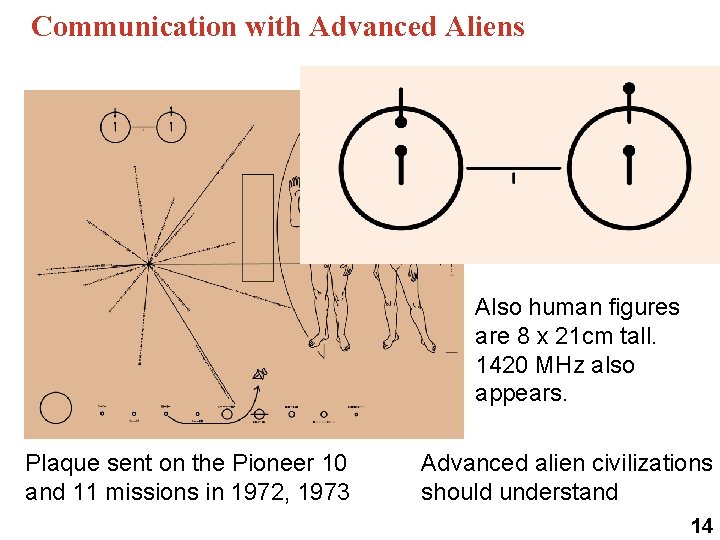
The 21 cm line of hydrogen in Radio Astronomy Question: What is the physical origin of the famous 21 cm line ? (first detected in 1951) The spins of the nucleus and electron are shown. A “spin flip” transition is the origin of Question: Doesn’t the first configuration the 21 cm photon (5. 87μ e. V) violate the Pauli principle ? 13
Communication with Advanced Aliens Also human figures are 8 x 21 cm tall. 1420 MHz also appears. Plaque sent on the Pioneer 10 and 11 missions in 1972, 1973 Advanced alien civilizations should understand 14
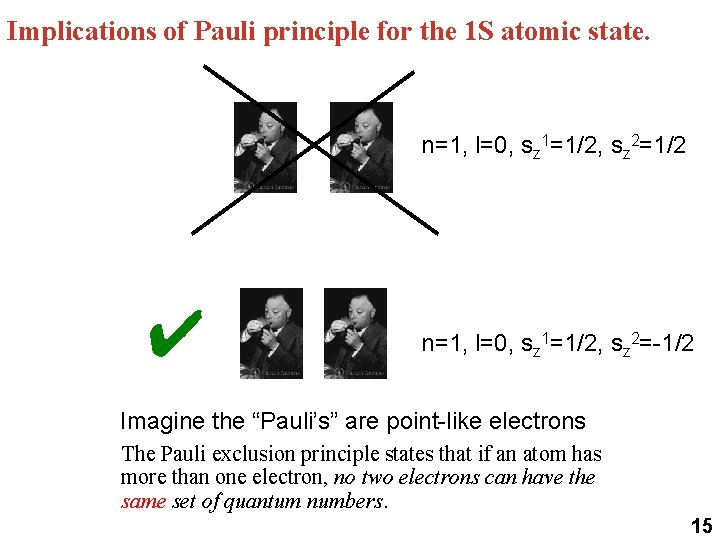
Implications of Pauli principle for the 1 S atomic state. n=1, l=0, sz 1=1/2, sz 2=1/2 ✔ n=1, l=0, sz 1=1/2, sz 2=-1/2 Imagine the “Pauli’s” are point-like electrons The Pauli exclusion principle states that if an atom has more than one electron, no two electrons can have the same set of quantum numbers. 15
Q 31. 1 The Pauli Exclusion Principle states that: A) No two electrons can occupy the same quantum state B) Two electrons can occupy the same quantum state but no more than two C) No two electrons can occupy the ground state, but this is ok for excited states D) No two photons can occupy the same quantum state. 16
Q 31. 1 The Pauli Exclusion Principle states that: A) No two electrons can occupy the same quantum state B) Two electrons can occupy the same quantum state but no more than two C) No two electrons can occupy the ground state, but this is ok for excited states D) No two photons can occupy the same quantum state. 17
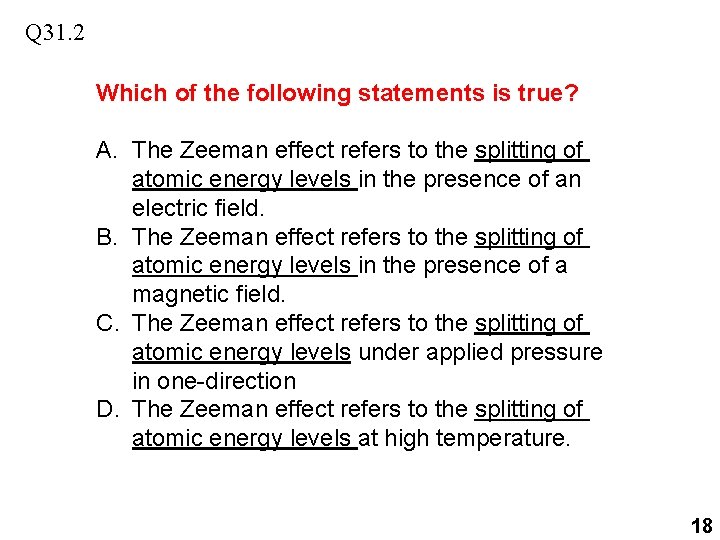
Q 31. 2 Which of the following statements is true? A. The Zeeman effect refers to the splitting of atomic energy levels in the presence of an electric field. B. The Zeeman effect refers to the splitting of atomic energy levels in the presence of a magnetic field. C. The Zeeman effect refers to the splitting of atomic energy levels under applied pressure in one-direction D. The Zeeman effect refers to the splitting of atomic energy levels at high temperature. 18
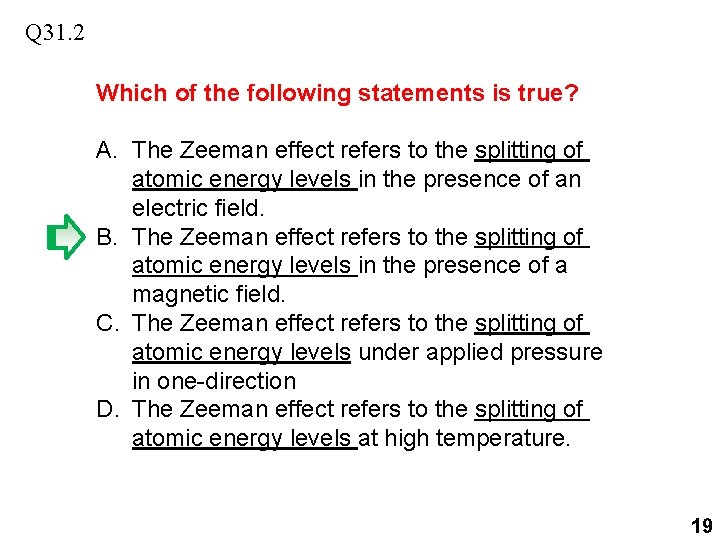
Q 31. 2 Which of the following statements is true? A. The Zeeman effect refers to the splitting of atomic energy levels in the presence of an electric field. B. The Zeeman effect refers to the splitting of atomic energy levels in the presence of a magnetic field. C. The Zeeman effect refers to the splitting of atomic energy levels under applied pressure in one-direction D. The Zeeman effect refers to the splitting of atomic energy levels at high temperature. 19
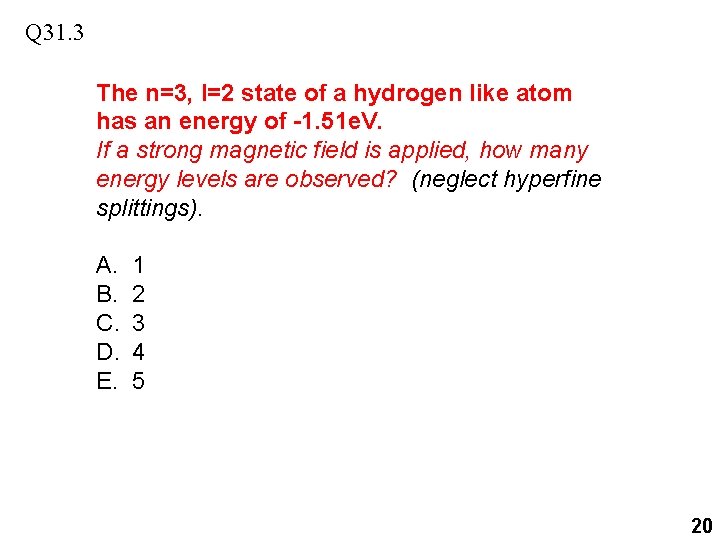
Q 31. 3 The n=3, l=2 state of a hydrogen like atom has an energy of -1. 51 e. V. If a strong magnetic field is applied, how many energy levels are observed? (neglect hyperfine splittings). A. B. C. D. E. 1 2 3 4 5 20
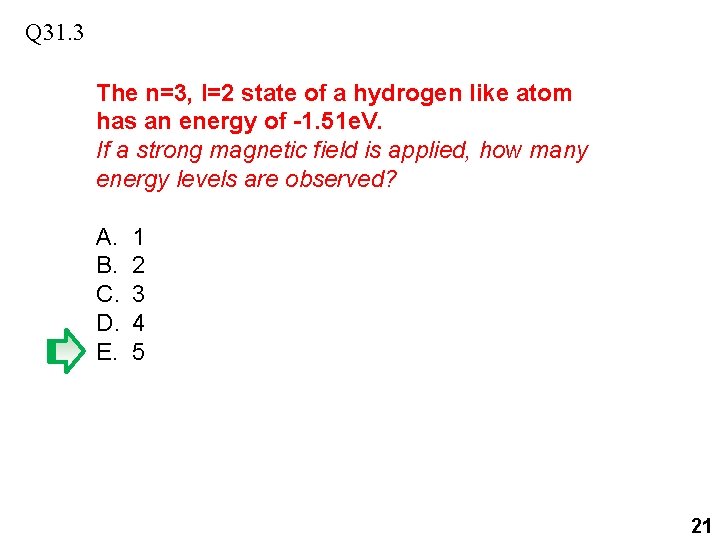
Q 31. 3 The n=3, l=2 state of a hydrogen like atom has an energy of -1. 51 e. V. If a strong magnetic field is applied, how many energy levels are observed? A. B. C. D. E. 1 2 3 4 5 21
Let’s get warmed up for the atomic structure of multi-electron atoms
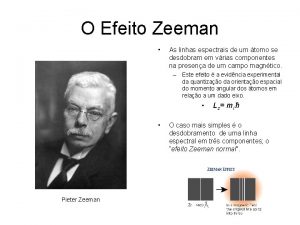
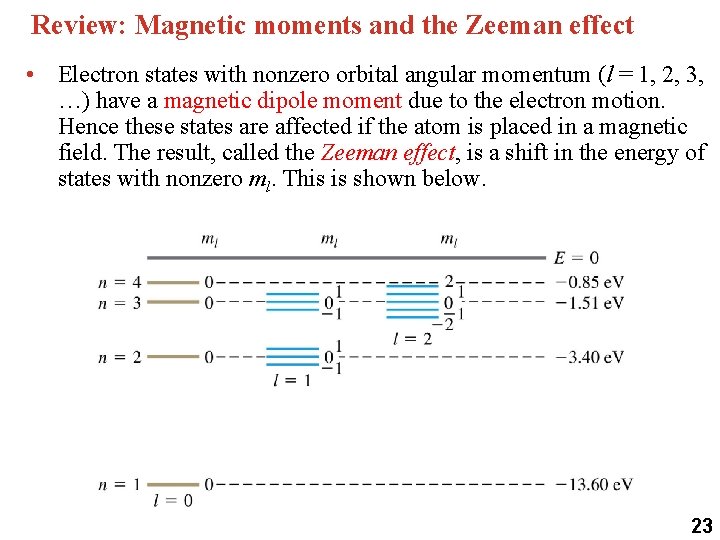
Review: Magnetic moments and the Zeeman effect • Electron states with nonzero orbital angular momentum (l = 1, 2, 3, …) have a magnetic dipole moment due to the electron motion. Hence these states are affected if the atom is placed in a magnetic field. The result, called the Zeeman effect, is a shift in the energy of states with nonzero ml. This is shown below. 23
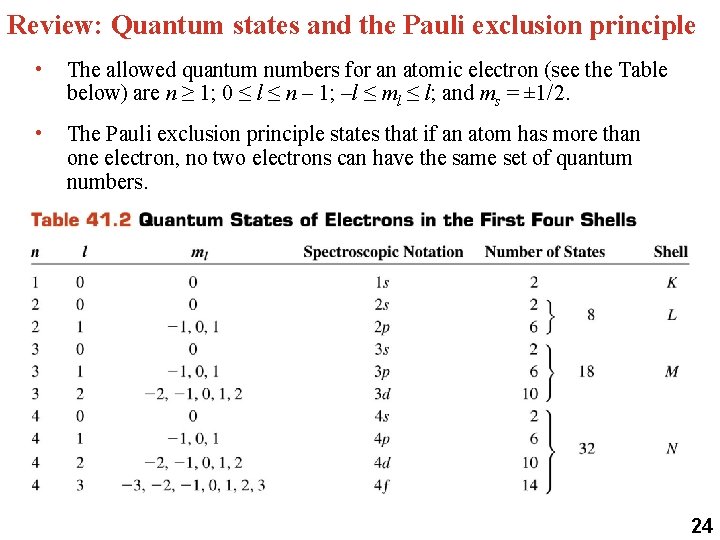
Review: Quantum states and the Pauli exclusion principle • The allowed quantum numbers for an atomic electron (see the Table below) are n ≥ 1; 0 ≤ l ≤ n – 1; –l ≤ ml ≤ l; and ms = ± 1/2. • The Pauli exclusion principle states that if an atom has more than one electron, no two electrons can have the same set of quantum numbers. 24
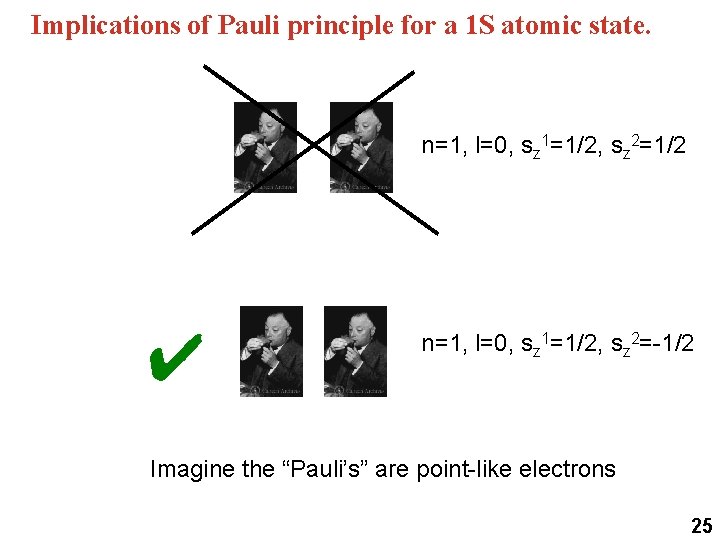
Implications of Pauli principle for a 1 S atomic state. n=1, l=0, sz 1=1/2, sz 2=1/2 ✔ n=1, l=0, sz 1=1/2, sz 2=-1/2 Imagine the “Pauli’s” are point-like electrons 25
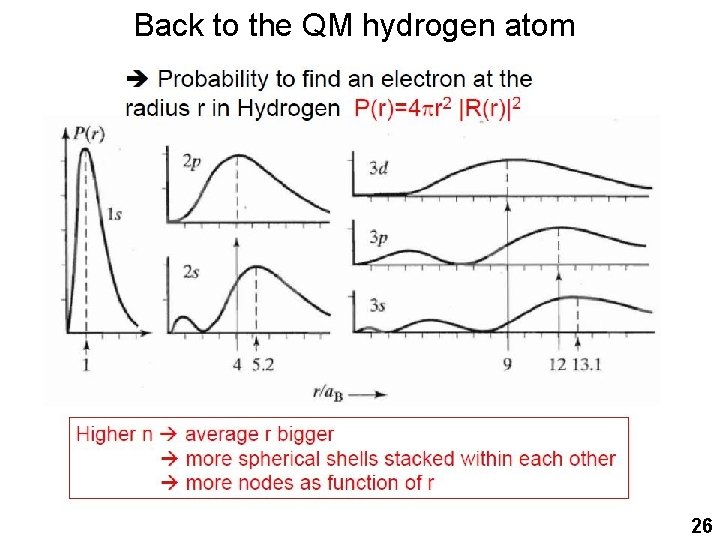
Back to the QM hydrogen atom 26
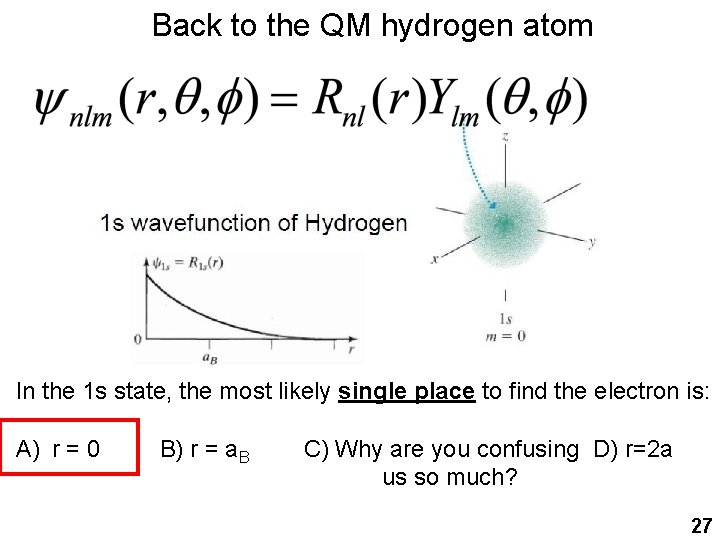
Back to the QM hydrogen atom In the 1 s state, the most likely single place to find the electron is: A) r = 0 B) r = a. B C) Why are you confusing D) r=2 a us so much? 27
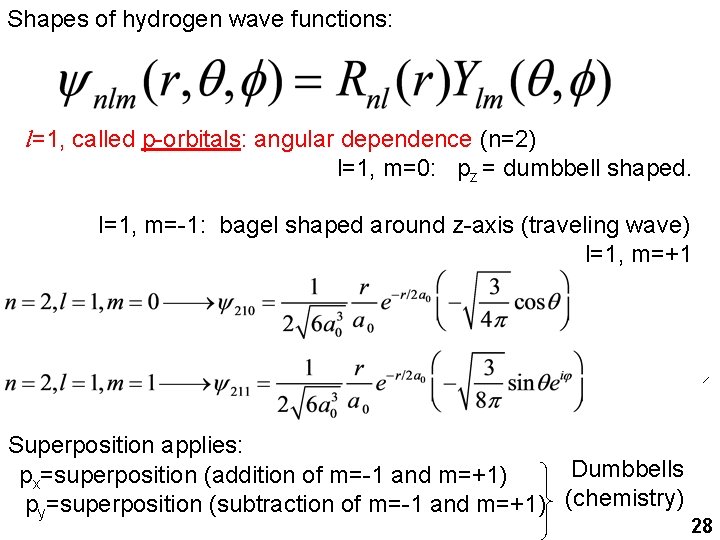
Shapes of hydrogen wave functions: l=1, called p-orbitals: angular dependence (n=2) l=1, m=0: pz = dumbbell shaped. l=1, m=-1: bagel shaped around z-axis (traveling wave) l=1, m=+1 Superposition applies: Dumbbells px=superposition (addition of m=-1 and m=+1) py=superposition (subtraction of m=-1 and m=+1) (chemistry) 28
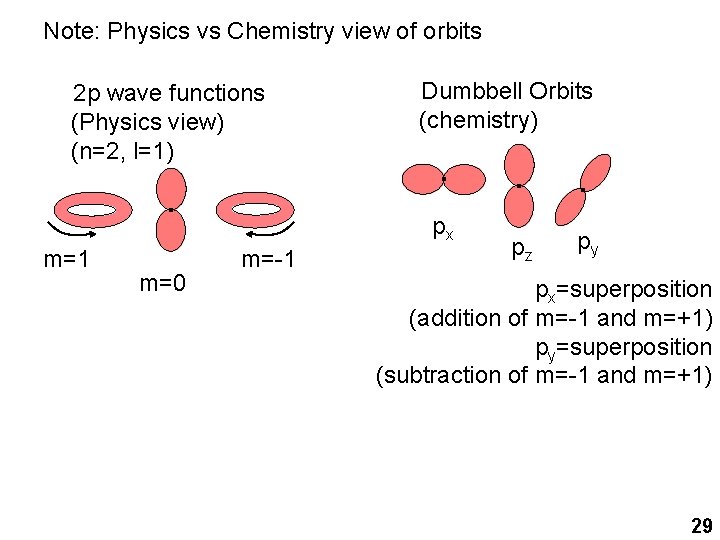
Note: Physics vs Chemistry view of orbits 2 p wave functions (Physics view) (n=2, l=1) Dumbbell Orbits (chemistry) px m=1 m=0 m=-1 pz py px=superposition (addition of m=-1 and m=+1) py=superposition (subtraction of m=-1 and m=+1) 29
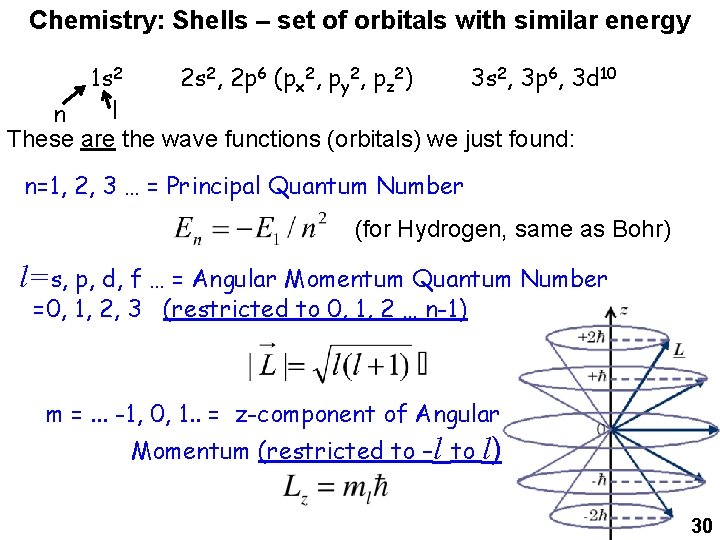
Chemistry: Shells – set of orbitals with similar energy 1 s 2 2 s 2, 2 p 6 (px 2, py 2, pz 2) 3 s 2, 3 p 6, 3 d 10 l n These are the wave functions (orbitals) we just found: n=1, 2, 3 … = Principal Quantum Number (for Hydrogen, same as Bohr) l=s, p, d, f … = Angular Momentum Quantum Number =0, 1, 2, 3 (restricted to 0, 1, 2 … n-1) m =. . . -1, 0, 1. . = z-component of Angular Momentum (restricted to –l to l) 30
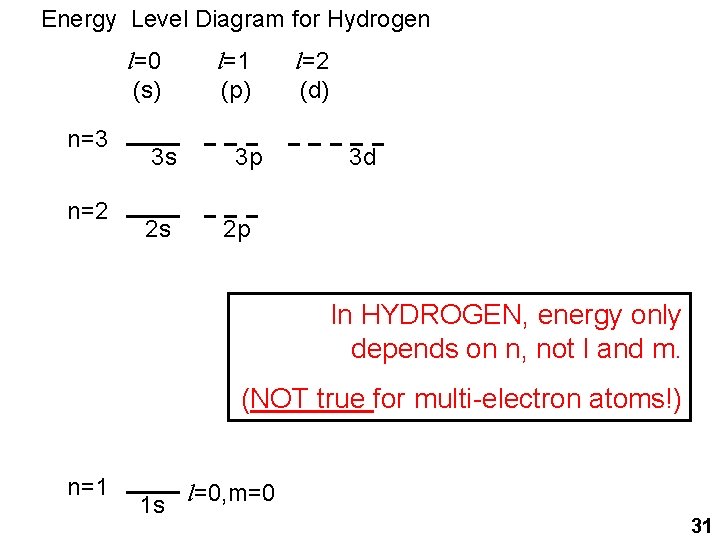
Energy Level Diagram for Hydrogen l=0 (s) n=3 n=2 3 s 2 s l=1 (p) 3 p l=2 (d) 3 d 2 p In HYDROGEN, energy only depends on n, not l and m. (NOT true for multi-electron atoms!) n=1 1 s l=0, m=0 31
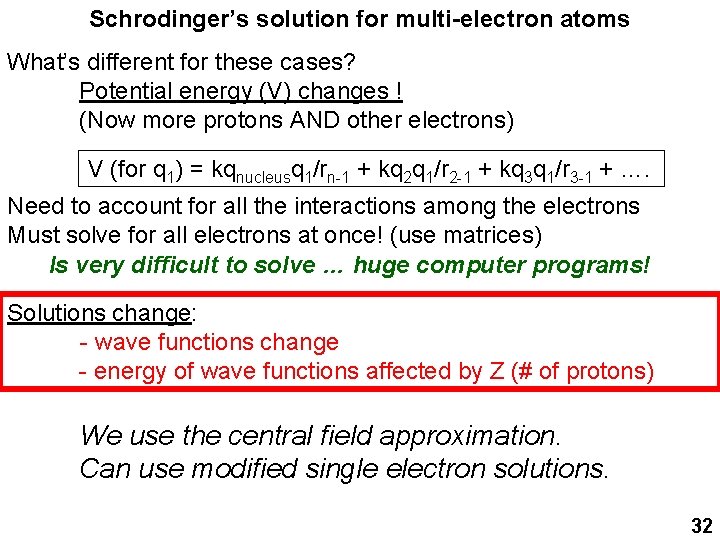
Schrodinger’s solution for multi-electron atoms What’s different for these cases? Potential energy (V) changes ! (Now more protons AND other electrons) V (for q 1) = kqnucleusq 1/rn-1 + kq 2 q 1/r 2 -1 + kq 3 q 1/r 3 -1 + …. Need to account for all the interactions among the electrons Must solve for all electrons at once! (use matrices) Is very difficult to solve … huge computer programs! Solutions change: - wave functions change - energy of wave functions affected by Z (# of protons) We use the central field approximation. Can use modified single electron solutions. 32
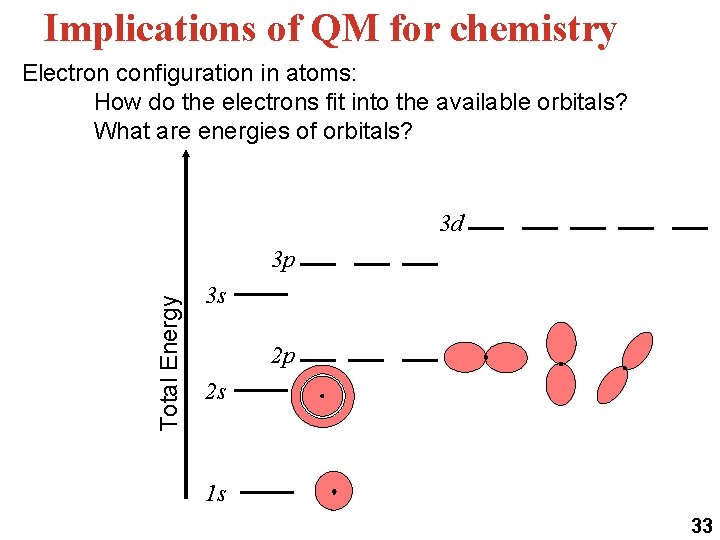
Implications of QM for chemistry Electron configuration in atoms: How do the electrons fit into the available orbitals? What are energies of orbitals? 3 d Total Energy 3 p 3 s 2 p 2 s 1 s 33
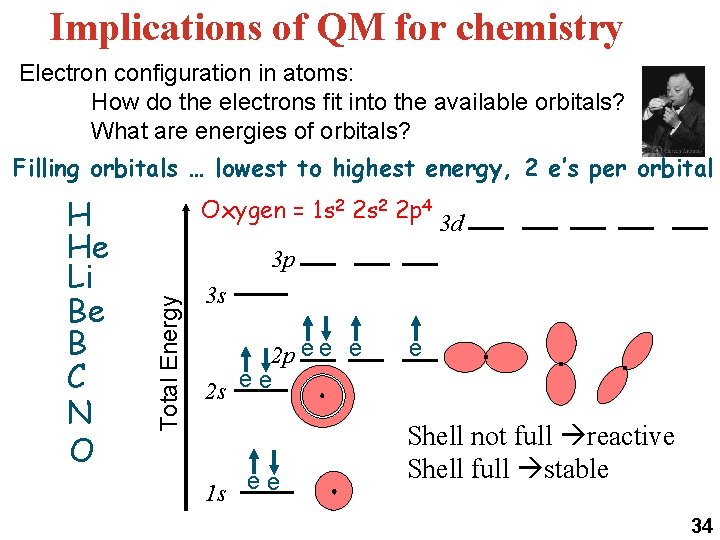
Implications of QM for chemistry Electron configuration in atoms: How do the electrons fit into the available orbitals? What are energies of orbitals? Filling orbitals … lowest to highest energy, 2 e’s per orbital 3 d 3 p Total Energy H He Li Be B C N O Oxygen = 1 s 2 2 p 4 3 s 2 p e e e 2 s e e 1 s e e e Shell not full reactive Shell full stable 34