
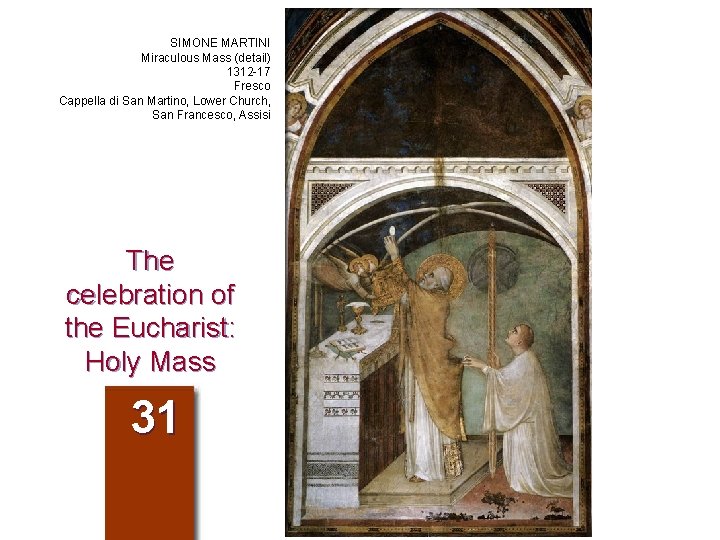
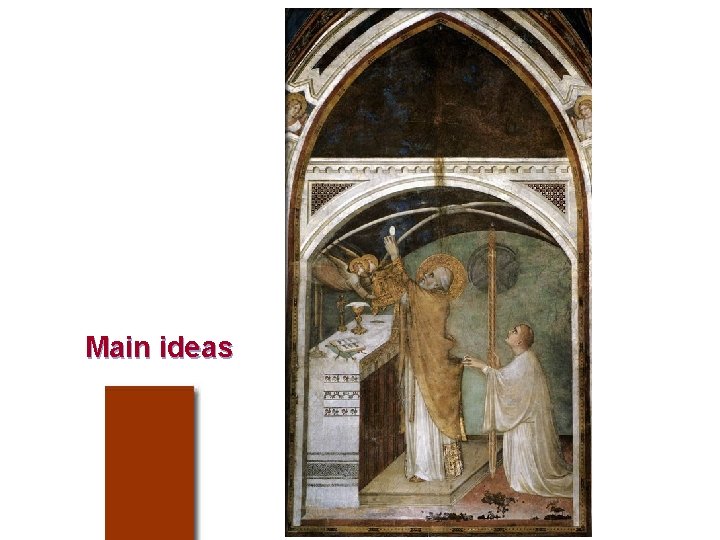
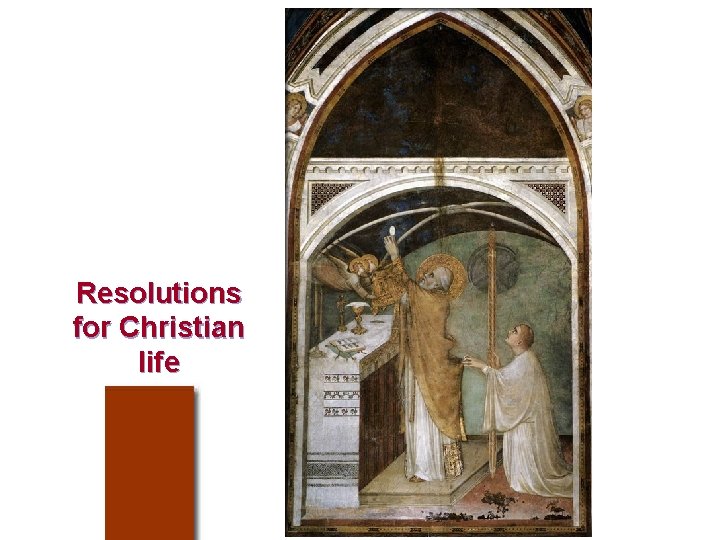
SIMONE MARTINI Miraculous Mass detail 1312 17 Fresco



- Slides: 10
SIMONE MARTINI Miraculous Mass (detail) 1312 -17 Fresco Cappella di San Martino, Lower Church, San Francesco, Assisi The celebration of the Eucharist: Holy Mass 31
Compendium of the Catechism n n n 274. What does the Eucharist represent in the life of the Church? 1324 -1327 1407 It is the source and summit of all Christian life. In the Eucharist, the sanctifying action of God in our regard and our worship of him reach their high point. It contains the whole spiritual good of the Church, Christ himself, our Pasch. Communion with divine life and the unity of the People of God are both expressed and effected by the Eucharist. Through the eucharistic celebration we are united already with the liturgy of heaven and we have a foretaste of eternal life.
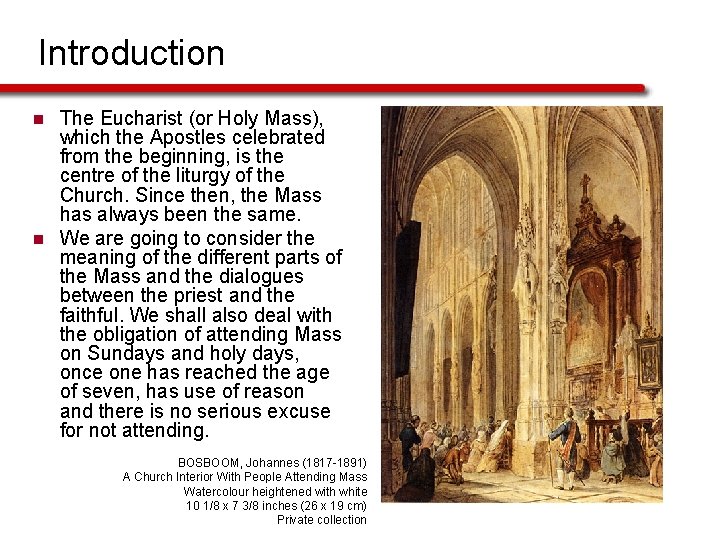
Introduction n n The Eucharist (or Holy Mass), which the Apostles celebrated from the beginning, is the centre of the liturgy of the Church. Since then, the Mass has always been the same. We are going to consider the meaning of the different parts of the Mass and the dialogues between the priest and the faithful. We shall also deal with the obligation of attending Mass on Sundays and holy days, once one has reached the age of seven, has use of reason and there is no serious excuse for not attending. BOSBOOM, Johannes (1817 -1891) A Church Interior With People Attending Mass Watercolour heightened with white 10 1/8 x 7 3/8 inches (26 x 19 cm) Private collection
Main ideas
1. Participation in the Eucharist n n Objetivamente la Misa es la acción más grande que se celebra en la tierra. Cuando asistimos, debemos participar con el mayor interés y devoción tratando de alcanzar el máximo fruto. Puesto que en la Misa se renueva el sacrificio del Calvario, deberíamos estar presentes con los mismos sentimientos de Santa María al pie de la cruz, acompañando a su Hijo plenamente identificada con Él. DÜRER, Albrecht Mass Drawing, 1523 12 x 8 5/8 inches (30. 7 x 22. 1 cm) Kupferstichkabinett, Öffentliche Kunstsammlung , Basle
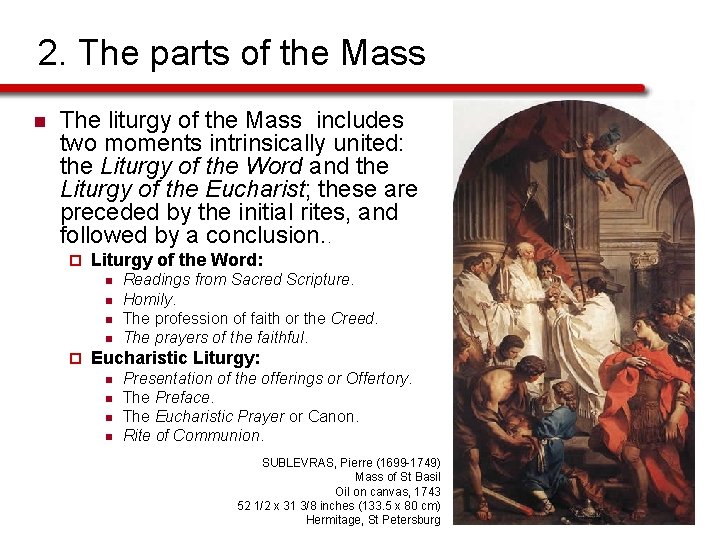
2. The parts of the Mass n The liturgy of the Mass includes two moments intrinsically united: the Liturgy of the Word and the Liturgy of the Eucharist; these are preceded by the initial rites, and followed by a conclusion. . ¨ Liturgy of the Word: n n ¨ Readings from Sacred Scripture. Homily. The profession of faith or the Creed. The prayers of the faithful. Eucharistic Liturgy: n n Presentation of the offerings or Offertory. The Preface. The Eucharistic Prayer or Canon. Rite of Communion. SUBLEVRAS, Pierre (1699 -1749) Mass of St Basil Oil on canvas, 1743 52 1/2 x 31 3/8 inches (133. 5 x 80 cm) Hermitage, St Petersburg
3. Responses of the faithful during the Mass n n BENLLIURE Y GIL, José (1855 -1937) Oyendo misa, Rocafort [Hearing the mass, Rocafort] Oil on linen 38 1/2 x 58 1/4 inches (98 x 148 cm) Museo de Bellas Artes de Valencia en su Historia, Valencia During the Mass the faithful recite prayers either in dialogue with the priest or praying along with him. These are prayers like “I confess”, the “Gloria”, the “Creed”, etc. It is useful to learn these prayers so as to recite them with dignity during the Mass. These prayers can be found in the Missal or in a Prayer Book.
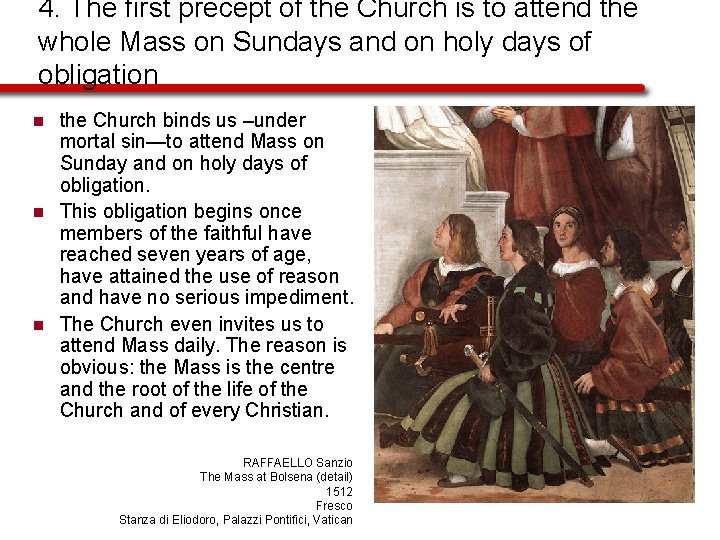
4. The first precept of the Church is to attend the whole Mass on Sundays and on holy days of obligation n the Church binds us –under mortal sin—to attend Mass on Sunday and on holy days of obligation. This obligation begins once members of the faithful have reached seven years of age, have attained the use of reason and have no serious impediment. The Church even invites us to attend Mass daily. The reason is obvious: the Mass is the centre and the root of the life of the Church and of every Christian. RAFFAELLO Sanzio The Mass at Bolsena (detail) 1512 Fresco Stanza di Eliodoro, Palazzi Pontifici, Vatican
Resolutions for Christian life
Resolutions to move forward n n Listen attentively at Mass, participating in the responses and behaving with due reverence. Make the resolution of never omitting Mass on Sundays or on holy days, and also of attending Mass some other days when there is no obligation.