THE J 1 0 ROTATIONAL TRANSITIONS OF 12



- Slides: 19
THE J = 1 – 0 ROTATIONAL TRANSITIONS OF 12 CH+, 13 CH+, AND CD+ T. Amano Department of Chemistry and Department of Physics and Astronomy The University of Waterloo Chemistry, Okayama University
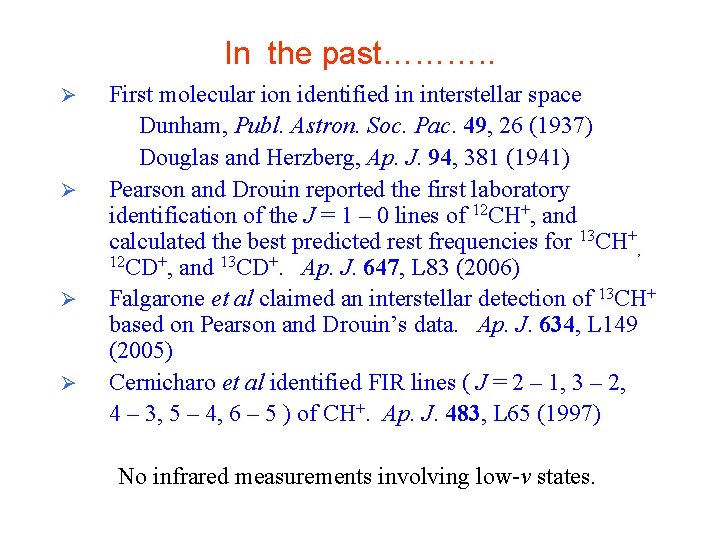
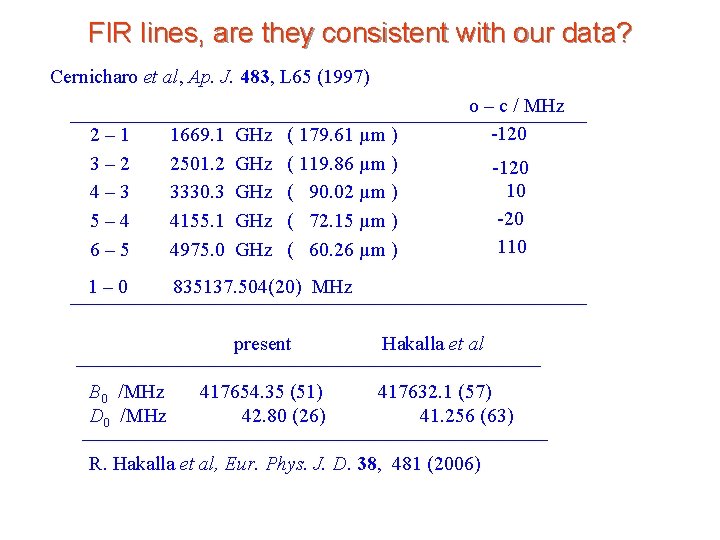
In the past………. . Ø Ø First molecular ion identified in interstellar space Dunham, Publ. Astron. Soc. Pac. 49, 26 (1937) Douglas and Herzberg, Ap. J. 94, 381 (1941) Pearson and Drouin reported the first laboratory identification of the J = 1 – 0 lines of 12 CH+, and calculated the best predicted rest frequencies for 13 CH+, 12 CD+, and 13 CD+. Ap. J. 647, L 83 (2006) Falgarone et al claimed an interstellar detection of 13 CH+ based on Pearson and Drouin’s data. Ap. J. 634, L 149 (2005) Cernicharo et al identified FIR lines ( J = 2 – 1, 3 – 2, 4 – 3, 5 – 4, 6 – 5 ) of CH+. Ap. J. 483, L 65 (1997) No infrared measurements involving low-v states. Chemistry, Okayama University
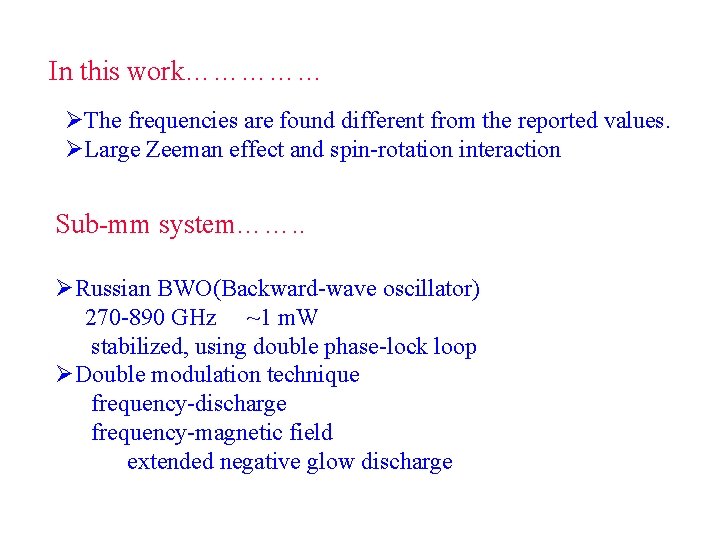
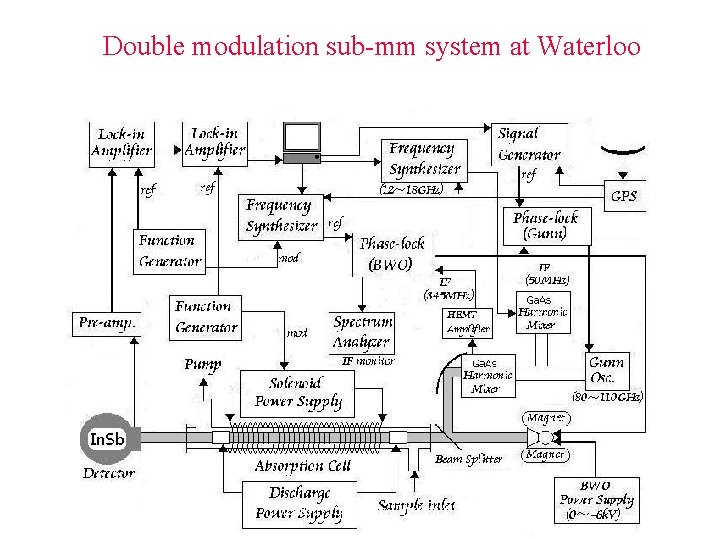
In this work…………… ØThe frequencies are found different from the reported values. ØLarge Zeeman effect and spin-rotation interaction Sub-mm system……. . ØRussian BWO(Backward-wave oscillator) 270 -890 GHz ~1 m. W stabilized, using double phase-lock loop ØDouble modulation technique frequency-discharge frequency-magnetic field extended negative glow discharge Chemistry, Okayama University
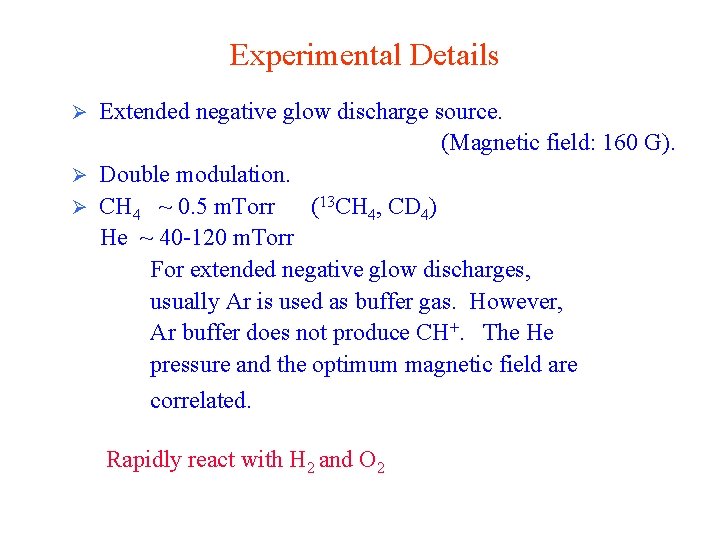
Experimental Details Extended negative glow discharge source. (Magnetic field: 160 G). Ø Double modulation. Ø CH 4 ~ 0. 5 m. Torr (13 CH 4, CD 4) He ~ 40 -120 m. Torr For extended negative glow discharges, usually Ar is used as buffer gas. However, Ar buffer does not produce CH+. The He pressure and the optimum magnetic field are Ø correlated. Rapidly react with H 2 and O 2 Chemistry, Okayama University
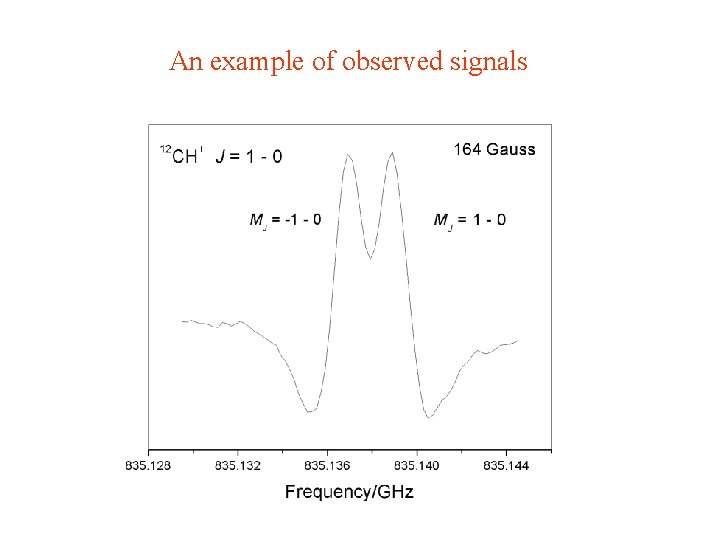
An example of observed signals Chemistry, Okayama University
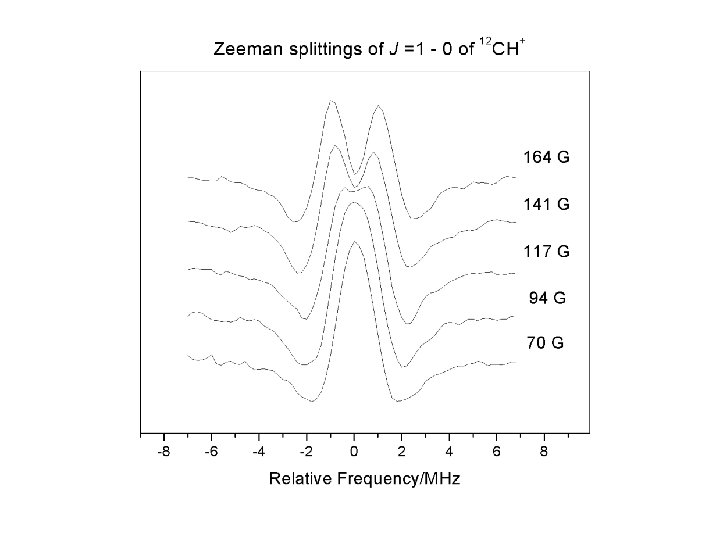
Chemistry, Okayama University
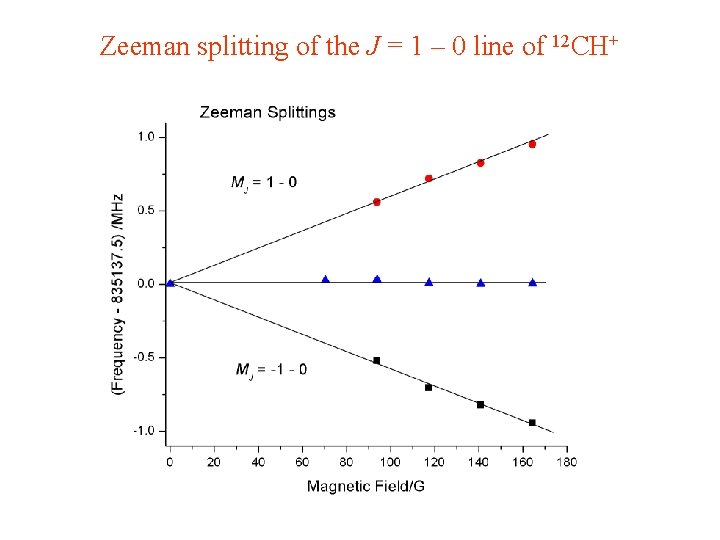
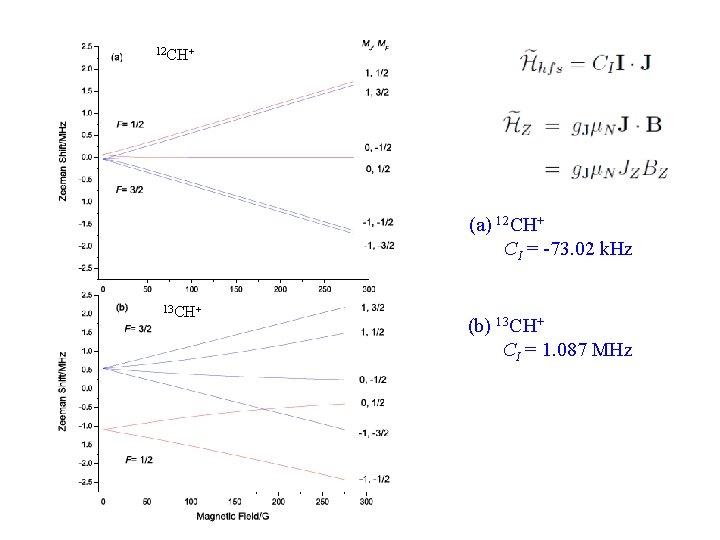
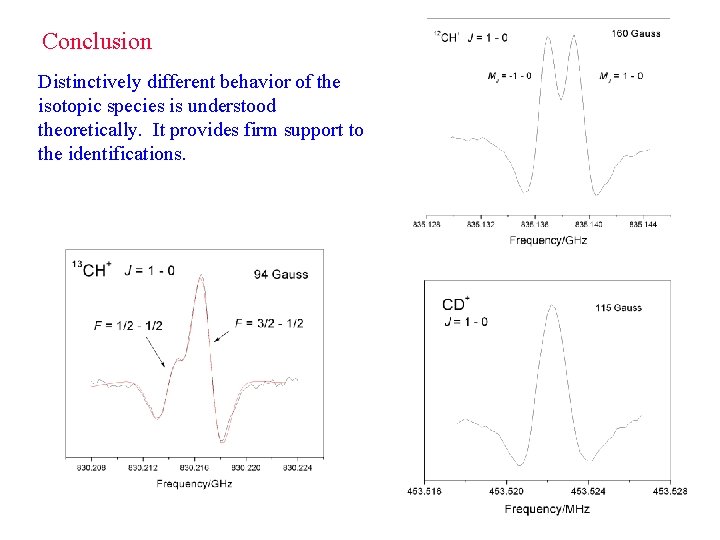
Zeeman splitting of the J = 1 – 0 line of 12 CH+ Chemistry, Okayama University
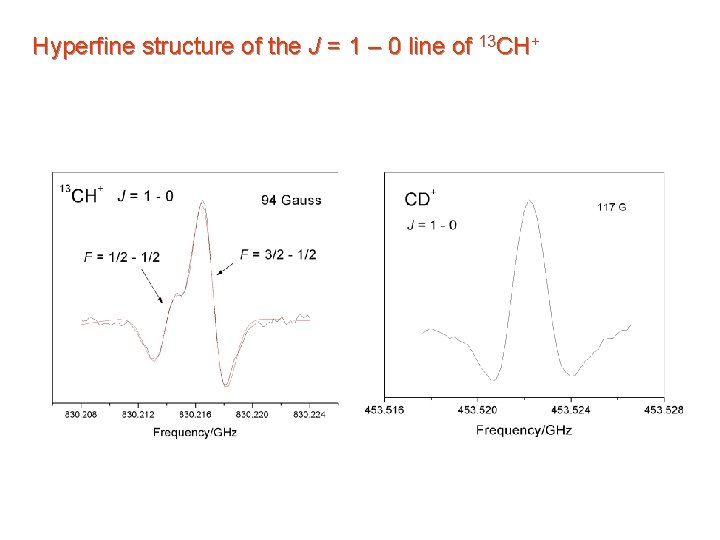
Hyperfine structure of the J = 1 – 0 line of 13 CH+ Chemistry, Okayama University
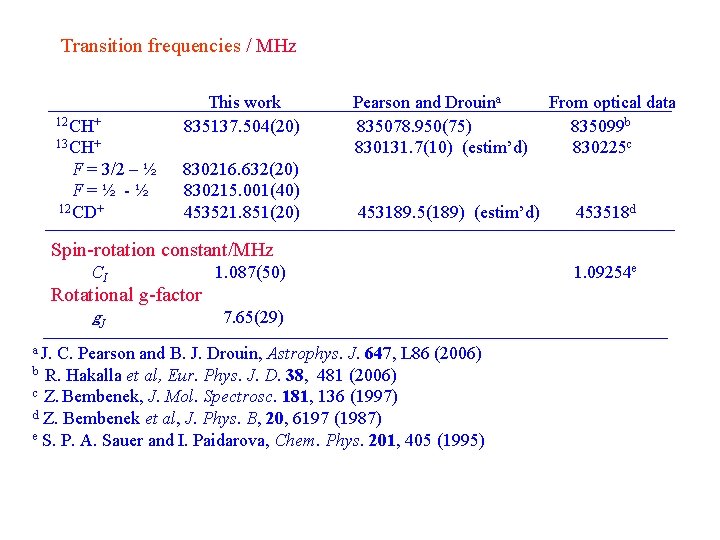
Transition frequencies / MHz 12 CH+ This work 835137. 504(20) 13 CH+ F = 3/2 – ½ F=½ -½ 12 CD+ 830216. 632(20) 830215. 001(40) 453521. 851(20) Pearson and Drouina 835078. 950(75) 830131. 7(10) (estim’d) 453189. 5(189) (estim’d) From optical data 835099 b 830225 c 453518 d Spin-rotation constant/MHz CI Rotational g-factor g. J 1. 087(50) 7. 65(29) a J. C. Pearson and B. J. Drouin, Astrophys. J. 647, L 86 (2006) b R. Hakalla et al, Eur. Phys. J. D. 38, 481 (2006) c Z. Bembenek, J. Mol. Spectrosc. 181, 136 (1997) d Z. Bembenek et al, J. Phys. B, 20, 6197 (1987) e S. P. A. Sauer and I. Paidarova, Chem. Phys. 201, 405 (1995) Chemistry, Okayama University 1. 09254 e
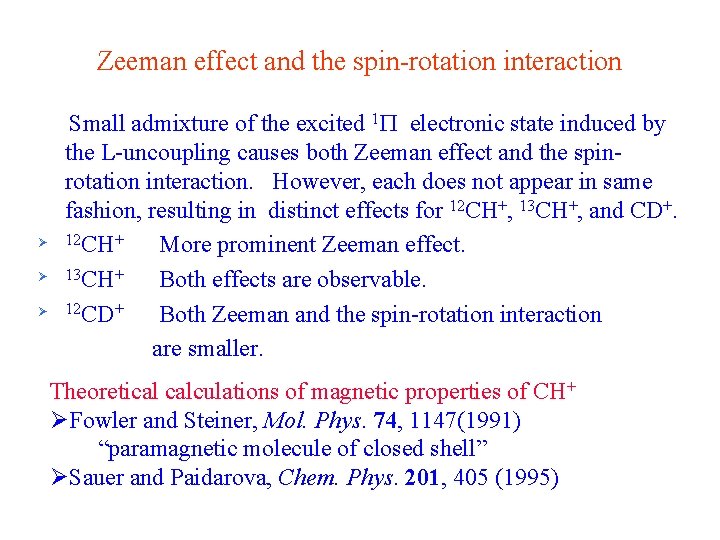
Zeeman effect and the spin-rotation interaction Ø Ø Ø Small admixture of the excited 1 electronic state induced by the L-uncoupling causes both Zeeman effect and the spinrotation interaction. However, each does not appear in same fashion, resulting in distinct effects for 12 CH+, 13 CH+, and CD+. 12 CH+ More prominent Zeeman effect. 13 CH+ Both effects are observable. 12 CD+ Both Zeeman and the spin-rotation interaction are smaller. Theoretical calculations of magnetic properties of CH+ ØFowler and Steiner, Mol. Phys. 74, 1147(1991) “paramagnetic molecule of closed shell” ØSauer and Paidarova, Chem. Phys. 201, 405 (1995) Chemistry, Okayama University
12 CH+ (a) 12 CH+ CI = -73. 02 k. Hz 13 CH+ (b) 13 CH+ CI = 1. 087 MHz Chemistry, Okayama University
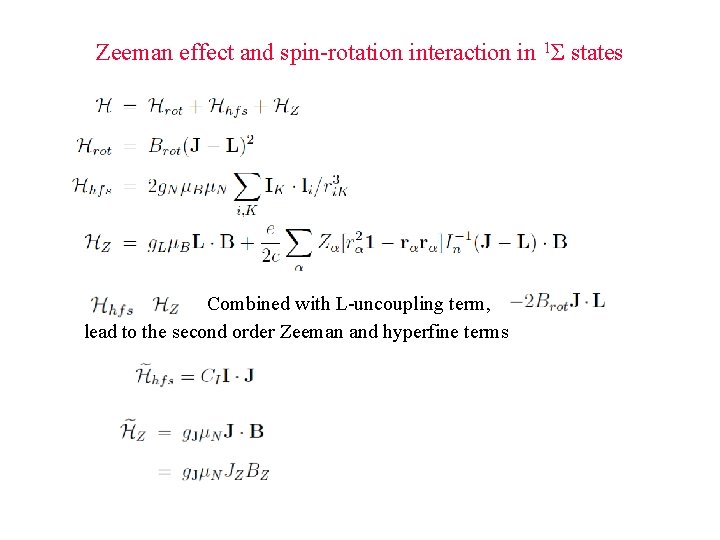
Zeeman effect and spin-rotation interaction in 1Σ states Combined with L-uncoupling term, lead to the second order Zeeman and hyperfine terms Chemistry, Okayama University
Rotational g-factor Λ-doubling constant and rotational g-factor q = 0. 0392 cm-1 ge ∼ g. J = 5. 17 ( v = 0 in A 1 ) ( 7. 65 obs ) 11. 3 (ab initio calculation, HF-SCF/aug-p. V 5 Z) ( Hui Li, Waterloo) Chemistry, Okayama University
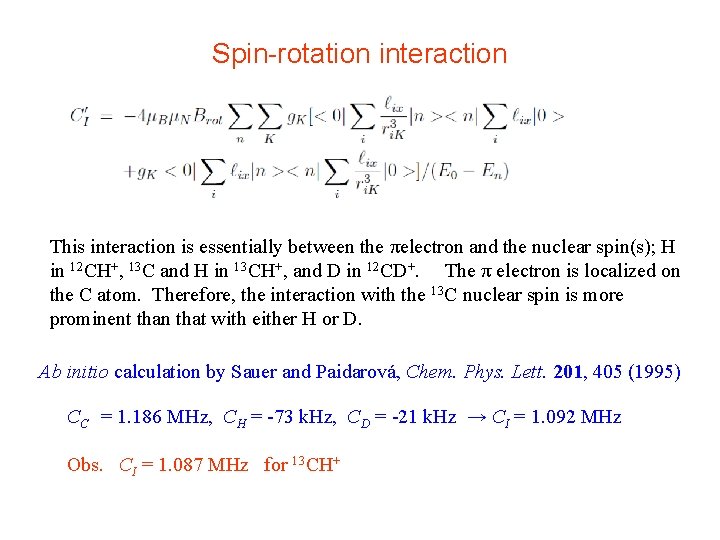
Spin-rotation interaction This interaction is essentially between the πelectron and the nuclear spin(s); H in 12 CH+, 13 C and H in 13 CH+, and D in 12 CD+. The π electron is localized on the C atom. Therefore, the interaction with the 13 C nuclear spin is more prominent than that with either H or D. Ab initio calculation by Sauer and Paidarová, Chem. Phys. Lett. 201, 405 (1995) CC = 1. 186 MHz, CH = -73 k. Hz, CD = -21 k. Hz → CI = 1. 092 MHz Obs. CI = 1. 087 MHz for 13 CH+ Chemistry, Okayama University
Conclusion Distinctively different behavior of the isotopic species is understood theoretically. It provides firm support to the identifications. Chemistry, Okayama University
Acknowledgments NSERC (Natural Science and Engineering Research Council of Canada) University of Waterloo H. Li (Waterloo) R. J. Le Roy (Waterloo) Chemistry, Okayama University
Chemistry, Okayama University
Double modulation sub-mm system at Waterloo Chemistry, Okayama University
FIR lines, are they consistent with our data? Cernicharo et al, Ap. J. 483, L 65 (1997) 2– 1 3– 2 4– 3 5– 4 6– 5 1669. 1 2501. 2 3330. 3 4155. 1 4975. 0 GHz GHz GHz ( 179. 61 µm ) ( 119. 86 µm ) ( 90. 02 µm ) ( 72. 15 µm ) ( 60. 26 µm ) 1– 0 835137. 504(20) MHz present B 0 /MHz D 0 /MHz 417654. 35 (51) 42. 80 (26) o – c / MHz -120 10 -20 110 Hakalla et al 417632. 1 (57) 41. 256 (63) R. Hakalla et al, Eur. Phys. J. D. 38, 481 (2006) Chemistry, Okayama University