Optical Zeeman Spectroscopy of Calcium Fluoride Ca F

- Slides: 19
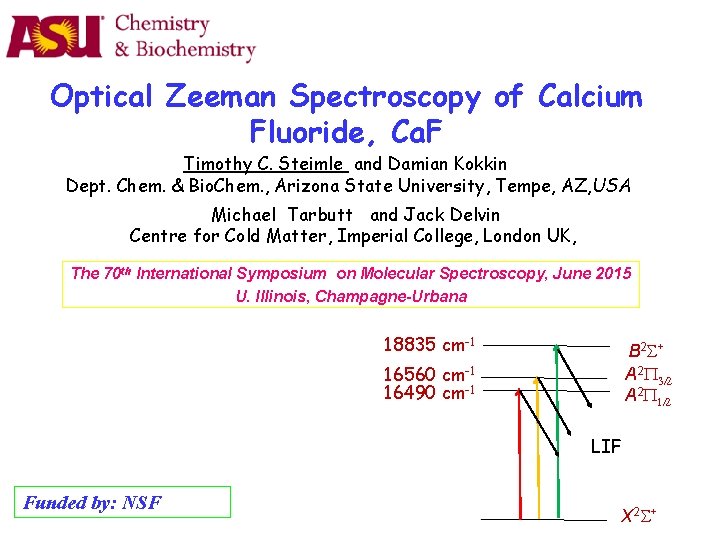
Optical Zeeman Spectroscopy of Calcium Fluoride, Ca. F Timothy C. Steimle and Damian Kokkin Dept. Chem. & Bio. Chem. , Arizona State University, Tempe, AZ, USA Michael Tarbutt and Jack Delvin Centre for Cold Matter, Imperial College, London UK, The 70 th International Symposium on Molecular Spectroscopy, June 2015 U. Illinois, Champagne-Urbana 18835 cm-1 B 2 S+ A 2 P 3/2 A 2 P 1/2 16560 cm-1 16490 cm-1 LIF Funded by: NSF X 2 S+
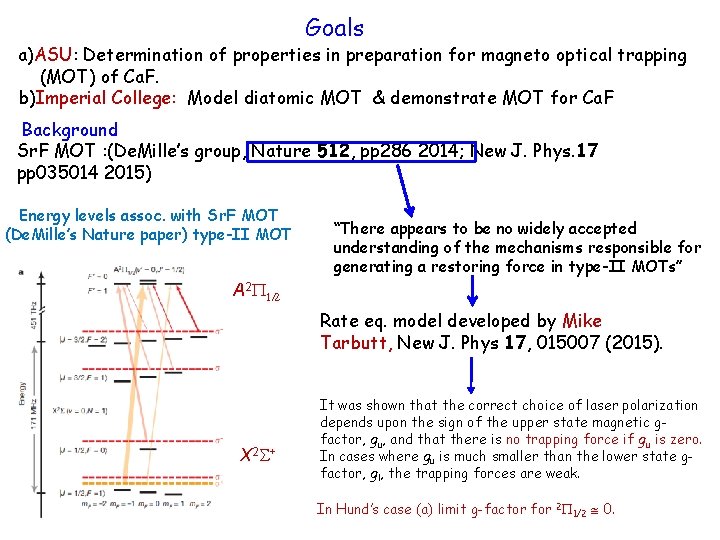
Goals a)ASU: Determination of properties in preparation for magneto optical trapping (MOT) of Ca. F. b)Imperial College: Model diatomic MOT & demonstrate MOT for Ca. F Background Sr. F MOT : (De. Mille’s group, Nature 512, pp 286 2014; New J. Phys. 17 pp 035014 2015) Energy levels assoc. with Sr. F MOT (De. Mille’s Nature paper) type-II MOT “There appears to be no widely accepted understanding of the mechanisms responsible for generating a restoring force in type-II MOTs” A 2 P 1/2 Rate eq. model developed by Mike Tarbutt, New J. Phys 17, 015007 (2015). X 2 S+ It was shown that the correct choice of laser polarization depends upon the sign of the upper state magnetic gfactor, gu, and that there is no trapping force if gu is zero. In cases where gu is much smaller than the lower state gfactor, gl, the trapping forces are weak. In Hund’s case (a) limit g-factor for 2 P 1/2 0.
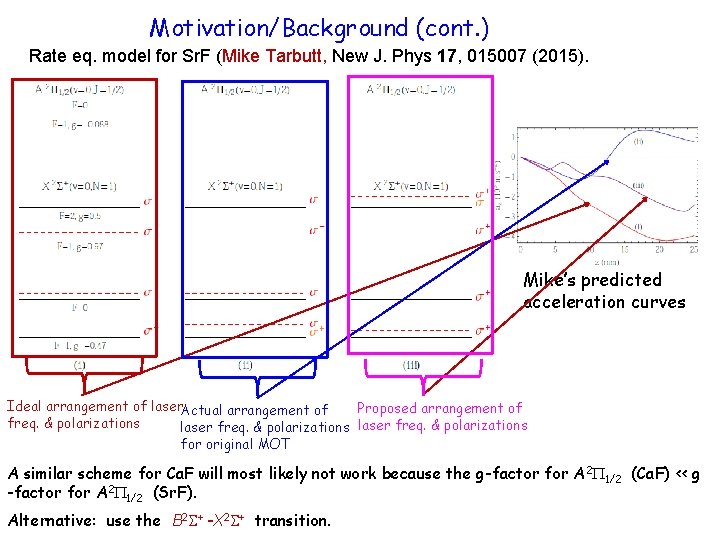
Motivation/Background (cont. ) Rate eq. model for Sr. F (Mike Tarbutt, New J. Phys 17, 015007 (2015). Mike’s predicted acceleration curves Ideal arrangement of laser. Actual arrangement of Proposed arrangement of freq. & polarizations laser freq. & polarizations for original MOT A similar scheme for Ca. F will most likely not work because the g-factor for A 2 P 1/2 (Ca. F) << g -factor for A 2 P 1/2 (Sr. F). Alternative: use the B 2 S+ -X 2 S+ transition.
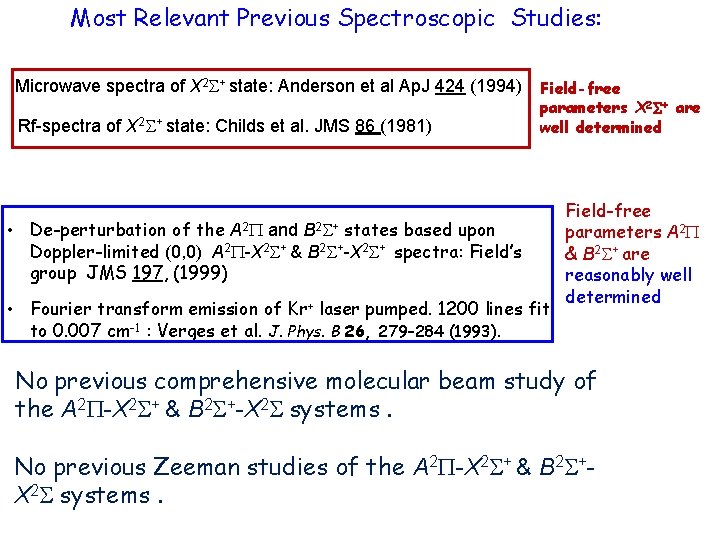
Most Relevant Previous Spectroscopic Studies: Microwave spectra of X 2 S+ state: Anderson et al Ap. J 424 (1994) Field-free Rf-spectra of X 2 S+ state: Childs et al. JMS 86 (1981) parameters X 2 S+ are well determined • De-perturbation of the and states based upon Doppler-limited (0, 0) A 2 P-X 2 S+ & B 2 S+-X 2 S+ spectra: Field’s group JMS 197, (1999) A 2 P B 2 S+ • Fourier transform emission of Kr+ laser pumped. 1200 lines fit to 0. 007 cm-1 : Verges et al. J. Phys. B 26, 279– 284 (1993). Field-free parameters A 2 P & B 2 S+ are reasonably well determined No previous comprehensive molecular beam study of the A 2 P-X 2 S+ & B 2 S+-X 2 S systems. No previous Zeeman studies of the A 2 P-X 2 S+ & B 2 S+X 2 S systems.
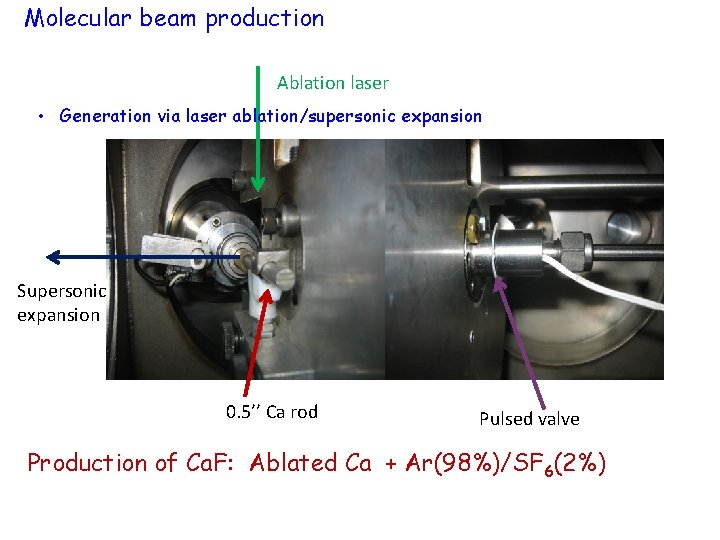
Molecular beam production Ablation laser • Generation via laser ablation/supersonic expansion Supersonic expansion 0. 5’’ Ca rod Pulsed valve Production of Ca. F: Ablated Ca + Ar(98%)/SF 6(2%)
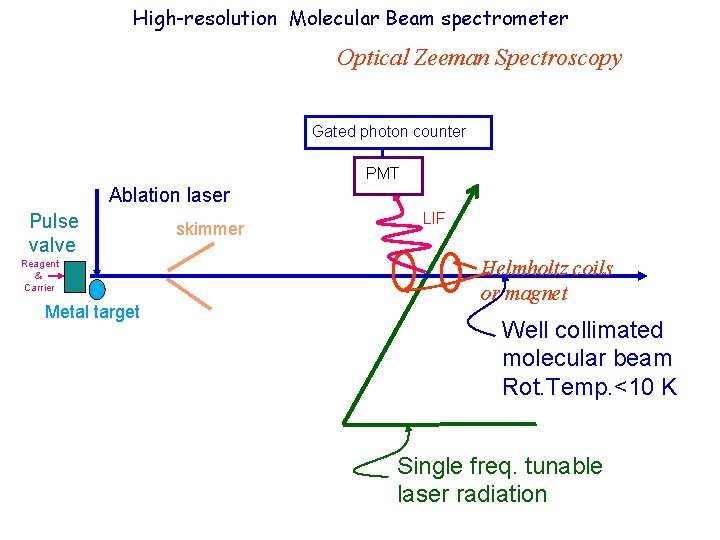
High-resolution Molecular Beam spectrometer Optical Zeeman Spectroscopy Gated photon counter PMT Ablation laser Pulse valve Reagent & Carrier Metal target skimmer LIF Helmholtz coils or magnet Well collimated molecular beam Rot. Temp. <10 K Single freq. tunable laser radiation
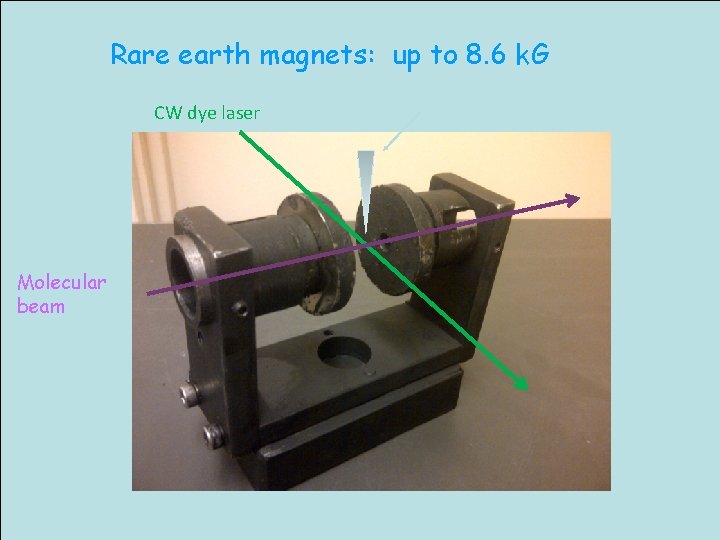
Rare earth magnets: up to 8. 6 k. G CW dye laser Molecular beam
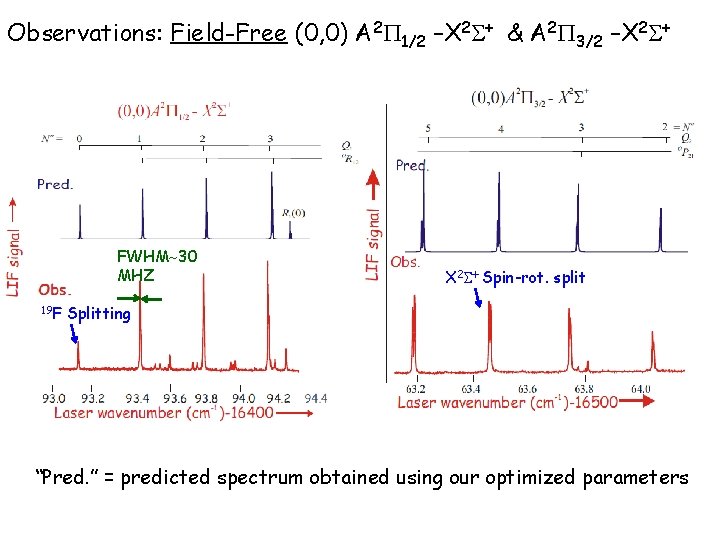
Observations: Field-Free (0, 0) A 2 P 1/2 –X 2 S+ & A 2 P 3/2 –X 2 S+ FWHM 30 MHZ 19 F X 2 S+ Spin-rot. split Splitting “Pred. ” = predicted spectrum obtained using our optimized parameters
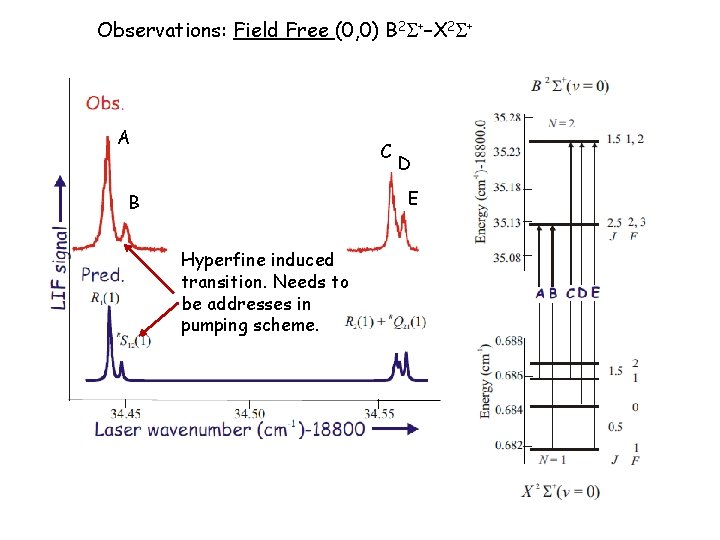
Observations: Field Free (0, 0) B 2 S+–X 2 S+ A C D E B Hyperfine induced transition. Needs to be addresses in pumping scheme.
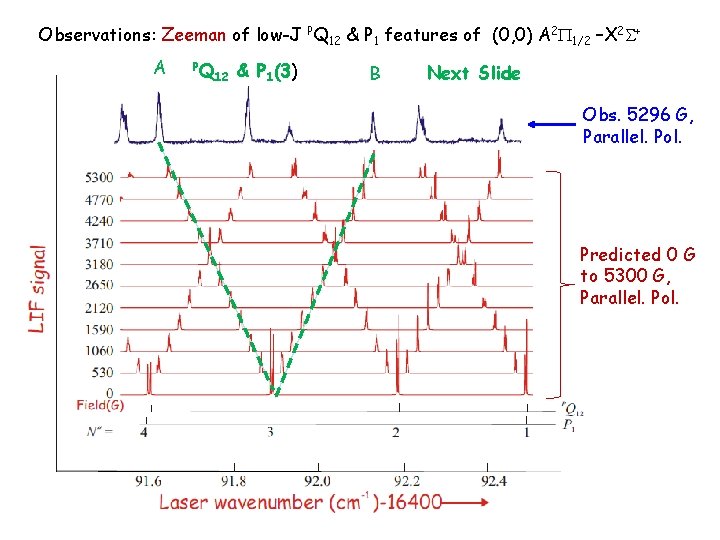
Observations: Zeeman of low-J PQ 12 & P 1 features of (0, 0) A 2 P 1/2 –X 2 S+ A PQ 12 & P 1(3) B Next Slide Obs. 5296 G, Parallel. Pol. Predicted 0 G to 5300 G, Parallel. Pol.
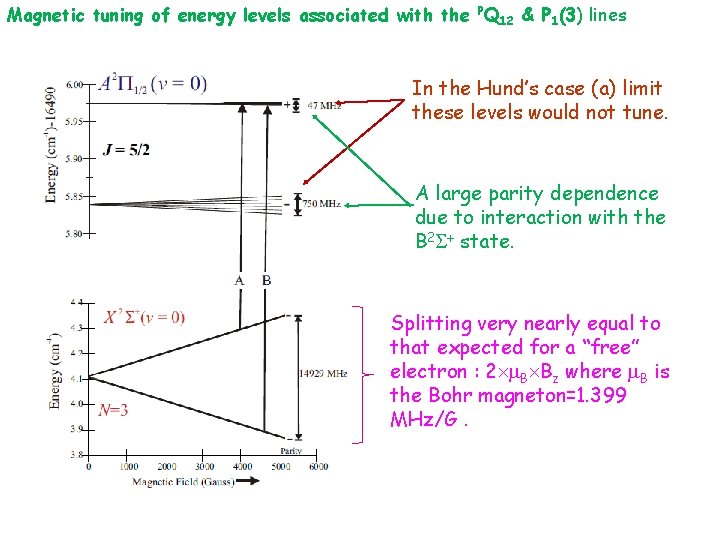
Magnetic tuning of energy levels associated with the PQ 12 & P 1(3) lines In the Hund’s case (a) limit these levels would not tune. A large parity dependence due to interaction with the B 2 S+ state. Splitting very nearly equal to that expected for a “free” electron : 2 B Bz where B is the Bohr magneton=1. 399 MHz/G.
Observations: Zeeman low-J RQ 21 & R 2 features of (0, 0) A 2 P 3/2 –X 2 S+ RQ 21 A & R 2(1) Next Slide B C D Obs. 3163 G, Perpendicular Pol. Predicted 0 G to 3163 G, Perp. Pol.
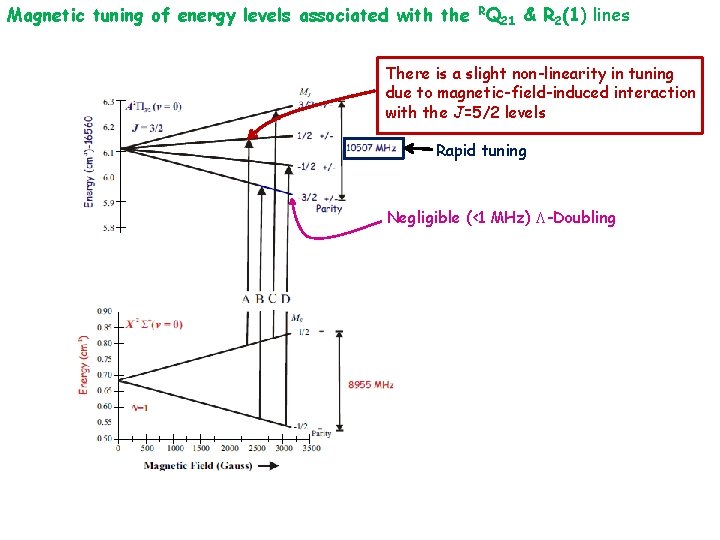
Magnetic tuning of energy levels associated with the RQ 21 & R 2(1) lines There is a slight non-linearity in tuning due to magnetic-field-induced interaction with the J=5/2 levels Rapid tuning Negligible (<1 MHz) -Doubling
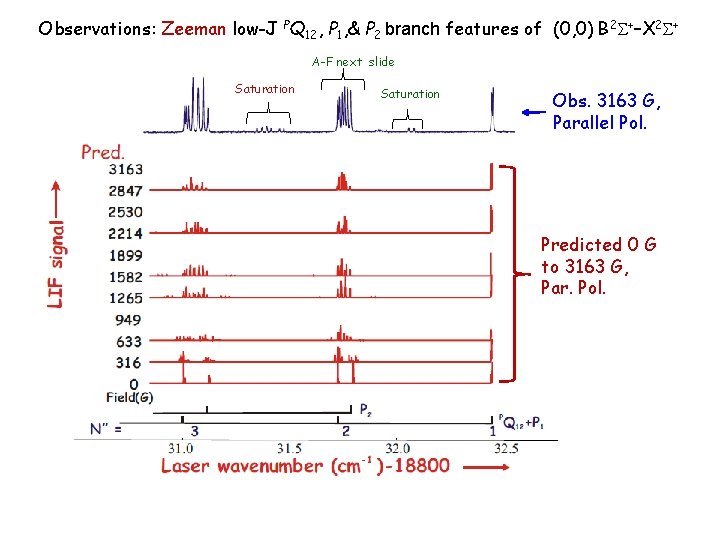
Observations: Zeeman low-J PQ 12, P 1, & P 2 branch features of (0, 0) B 2 S+–X 2 S+ A-F next slide Saturation Obs. 3163 G, Parallel Pol. Predicted 0 G to 3163 G, Par. Pol.
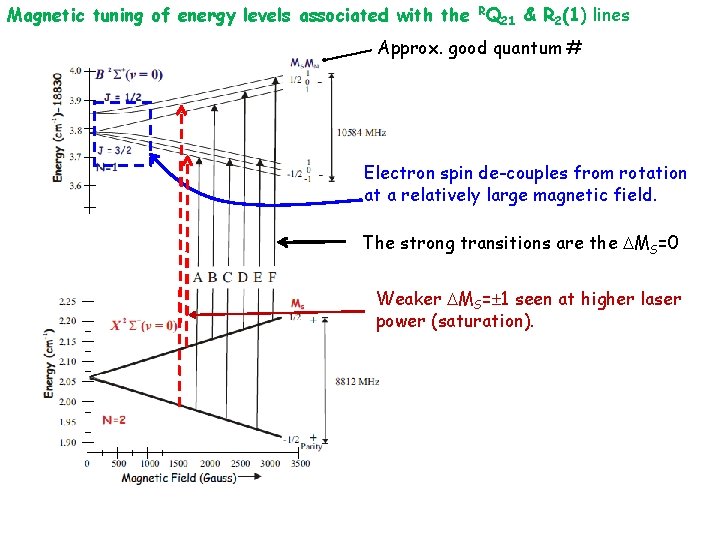
Magnetic tuning of energy levels associated with the RQ 21 & R 2(1) lines Approx. good quantum # Electron spin de-couples from rotation at a relatively large magnetic field. The strong transitions are the MS=0 Weaker MS= 1 seen at higher laser power (saturation).
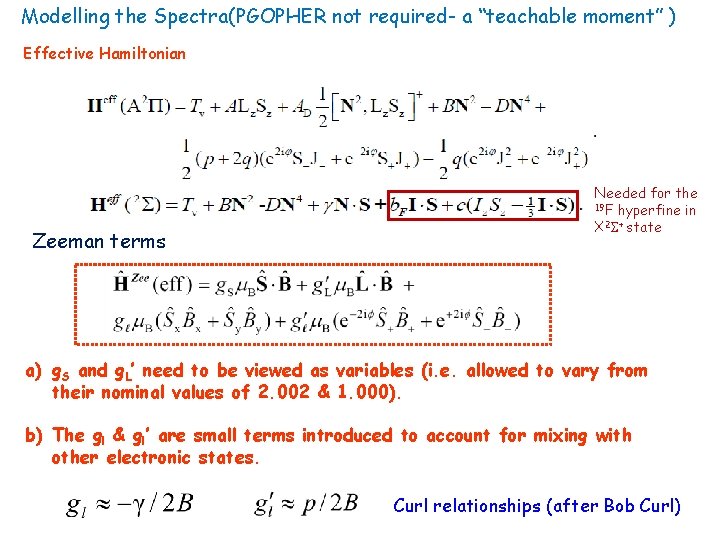
Modelling the Spectra(PGOPHER not required- a “teachable moment” ) Effective Hamiltonian Zeeman terms Needed for the 19 F hyperfine in X 2 S+ state a) g. S and g. L’ need to be viewed as variables (i. e. allowed to vary from their nominal values of 2. 002 & 1. 000). b) The gl & gl’ are small terms introduced to account for mixing with other electronic states. Curl relationships (after Bob Curl)
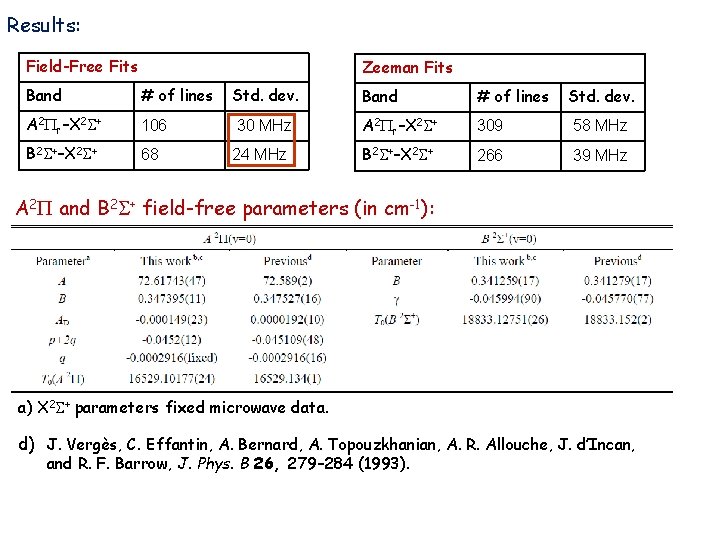
Results: Field-Free Fits Zeeman Fits Band # of lines Std. dev. A 2 Pr–X 2 S+ 106 30 MHz A 2 Pr–X 2 S+ 309 58 MHz B 2 S+–X 2 S+ 68 24 MHz B 2 S+–X 2 S+ 266 39 MHz A 2 P and B 2 S+ field-free parameters (in cm-1): a) X 2 S+ parameters fixed microwave data. d) J. Vergès, C. Effantin, A. Bernard, A. Topouzkhanian, A. R. Allouche, J. d’Incan, and R. F. Barrow, J. Phys. B 26, 279– 284 (1993).
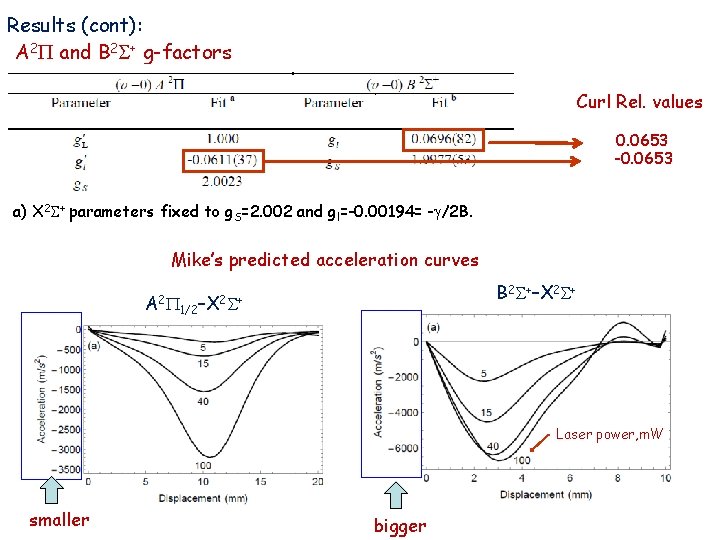
Results (cont): A 2 P and B 2 S+ g-factors Curl Rel. values 0. 0653 -0. 0653 a) X 2 S+ parameters fixed to g. S=2. 002 and gl=-0. 00194= -g/2 B. Mike’s predicted acceleration curves A 2 P 1/2 B 2 S+–X 2 S+ Laser power, m. W smaller bigger
Summary • The transition wavelengths and magnetic tuning of the low-J lines of the B 2 S+-X 2 S+ and A 2 P-X 2 S+ states that will be used in the MOT experiment have been measured • The g-factors and field-free parameters have been precisely determined. • Using the newly determines spectroscopic data. Prof. Mike Tarbutt (Imperial College) has modelled the Ca. F MOT. Thank you !