
The Argon Fluoride laser as high performance driver

- Slides: 21
The Argon Fluoride laser as high performance driver for ICF/IFE Fusion Power Associates December 3 -4, 2019 GRAND HYATT WASHINGTON HOTEL Presented by Stephen Obenschain Laser Plasma Branch Plasma Physics Division Work supported by DOE-NNSA
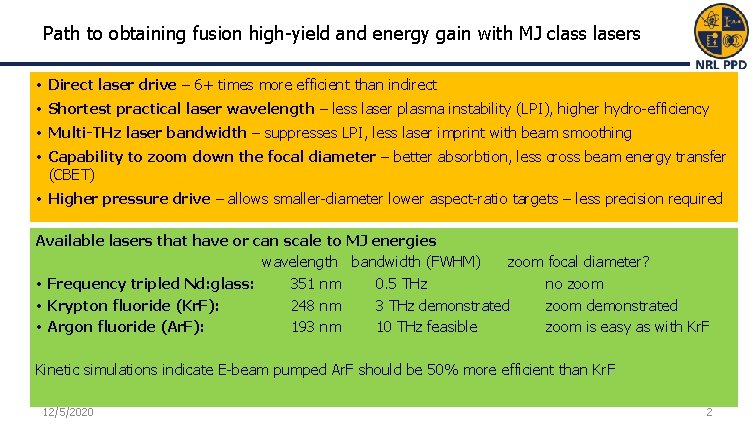
Path to obtaining fusion high-yield and energy gain with MJ class lasers • Direct laser drive – 6+ times more efficient than indirect • Shortest practical laser wavelength – less laser plasma instability (LPI), higher hydro-efficiency • Multi-THz laser bandwidth – suppresses LPI, less laser imprint with beam smoothing • Capability to zoom down the focal diameter – better absorbtion, less cross beam energy transfer (CBET) • Higher pressure drive – allows smaller-diameter lower aspect-ratio targets – less precision required Available lasers that have or can scale to MJ energies wavelength bandwidth (FWHM) zoom focal diameter? • Frequency tripled Nd: glass: 351 nm 0. 5 THz no zoom • Krypton fluoride (Kr. F): 248 nm 3 THz demonstrated zoom demonstrated • Argon fluoride (Ar. F): 193 nm 10 THz feasible zoom is easy as with Kr. F Kinetic simulations indicate E-beam pumped Ar. F should be 50% more efficient than Kr. F 12/5/2020 2
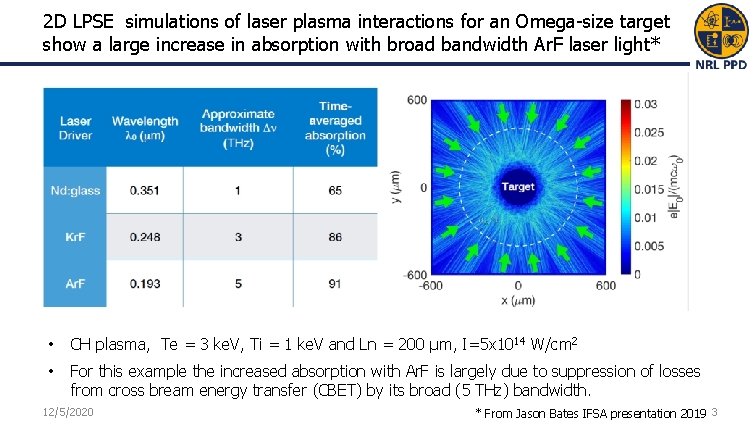
2 D LPSE simulations of laser plasma interactions for an Omega-size target show a large increase in absorption with broad bandwidth Ar. F laser light* Laser Wavelength Approximate Timebandwidth Δ averaged Driver ( m) (THz) absorption (%) Nd: glass Kr. F Ar. F • CH plasma, Te = 3 ke. V, Ti = 1 ke. V and Ln = 200 μm, I=5 x 10¹⁴ W/cm 2 • For this example the increased absorption with Ar. F is largely due to suppression of losses from cross bream energy transfer (CBET) by its broad (5 THz) bandwidth. 12/5/2020 * From Jason Bates IFSA presentation 2019 3
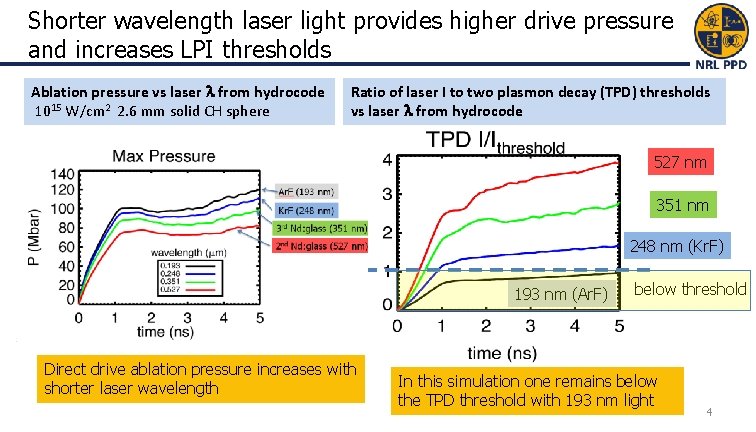
Shorter wavelength laser light provides higher drive pressure and increases LPI thresholds Ablation pressure vs laser from hydrocode 1015 W/cm 2 2. 6 mm solid CH sphere Ratio of laser I to two plasmon decay (TPD) thresholds vs laser from hydrocode 527 nm 351 nm 248 nm (Kr. F) 193 nm (Ar. F) Direct drive ablation pressure increases with shorter laser wavelength below threshold In this simulation one remains below the TPD threshold with 193 nm light 4
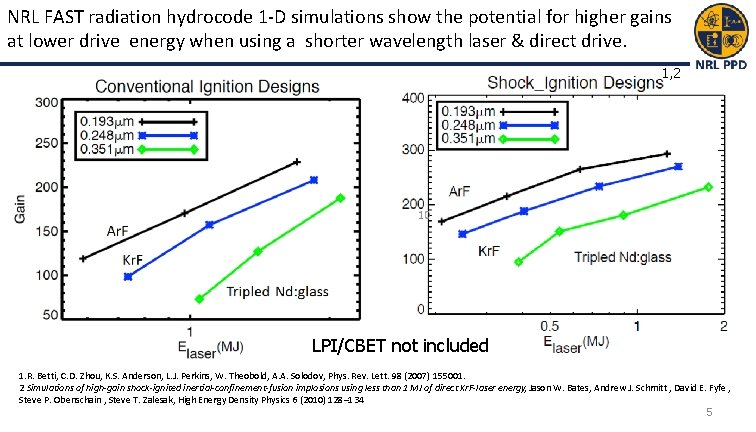
NRL FAST radiation hydrocode 1 -D simulations show the potential for higher gains at lower drive energy when using a shorter wavelength laser & direct drive. 1, 2 LPI/CBET not included 1. R. Betti, C. D. Zhou, K. S. Anderson, L. J. Perkins, W. Theobold, A. A. Solodov, Phys. Rev. Lett. 98 (2007) 155001. 2 Simulations of high-gain shock-ignited inertial-confinement-fusion implosions using less than 1 MJ of direct Kr. F-laser energy, Jason W. Bates, Andrew J. Schmitt , David E. Fyfe , Steve P. Obenschain , Steve T. Zalesak, High Energy Density Physics 6 (2010) 128– 134 5
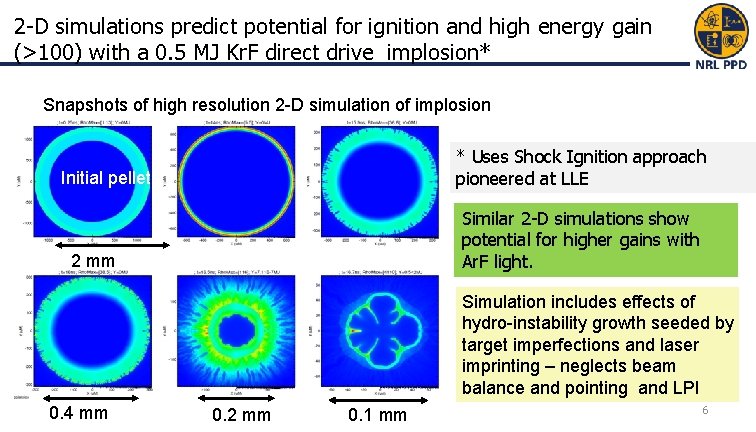
2 -D simulations predict potential for ignition and high energy gain (>100) with a 0. 5 MJ Kr. F direct drive implosion* Snapshots of high resolution 2 -D simulation of implosion * Uses Shock Ignition approach pioneered at LLE Initial pellet Similar 2 -D simulations show potential for higher gains with Ar. F light. 2 mm Simulation includes effects of hydro-instability growth seeded by target imperfections and laser imprinting – neglects beam balance and pointing and LPI 0. 4 mm 0. 2 mm 0. 1 mm 6
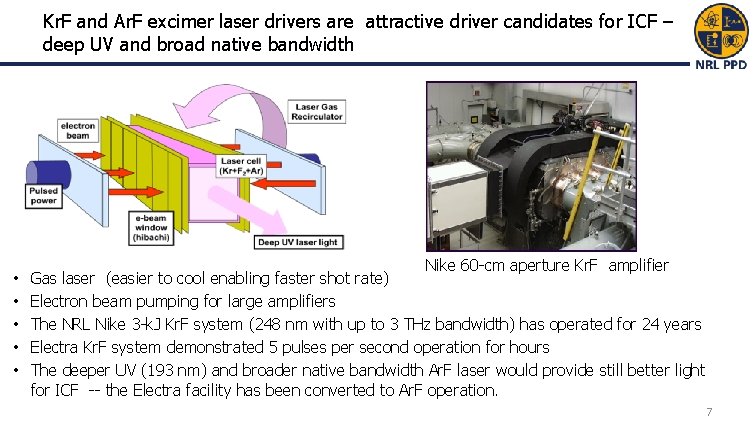
Kr. F and Ar. F excimer laser drivers are attractive driver candidates for ICF – deep UV and broad native bandwidth • • • Nike 60 -cm aperture Kr. F amplifier Gas laser (easier to cool enabling faster shot rate) Electron beam pumping for large amplifiers The NRL Nike 3 -k. J Kr. F system (248 nm with up to 3 THz bandwidth) has operated for 24 years Electra Kr. F system demonstrated 5 pulses per second operation for hours The deeper UV (193 nm) and broader native bandwidth Ar. F laser would provide still better light for ICF -- the Electra facility has been converted to Ar. F operation. 7
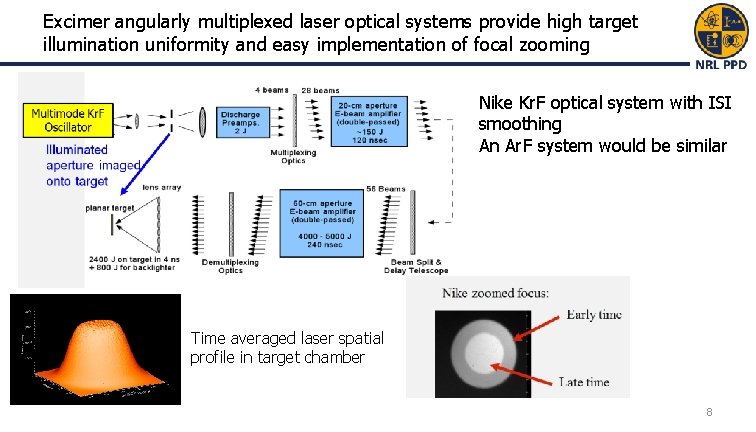
Excimer angularly multiplexed laser optical systems provide high target illumination uniformity and easy implementation of focal zooming Nike Kr. F optical system with ISI smoothing An Ar. F system would be similar Time averaged laser spatial profile in target chamber 8
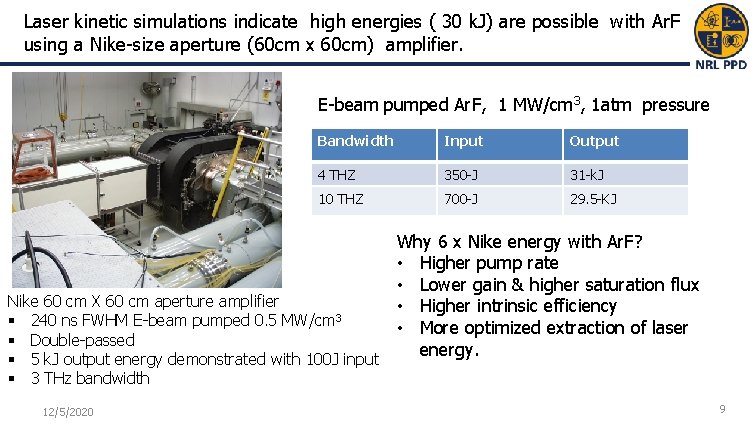
Laser kinetic simulations indicate high energies ( 30 k. J) are possible with Ar. F using a Nike-size aperture (60 cm x 60 cm) amplifier. E-beam pumped Ar. F, 1 MW/cm 3, 1 atm pressure Bandwidth Input Output 4 THZ 350 -J 31 -k. J 10 THZ 700 -J 29. 5 -KJ Nike 60 cm X 60 cm aperture amplifier § 240 ns FWHM E-beam pumped 0. 5 MW/cm 3 § Double-passed § 5 k. J output energy demonstrated with 100 J input § 3 THz bandwidth 12/5/2020 Why 6 x Nike energy with Ar. F? • Higher pump rate • Lower gain & higher saturation flux • Higher intrinsic efficiency • More optimized extraction of laser energy. 9
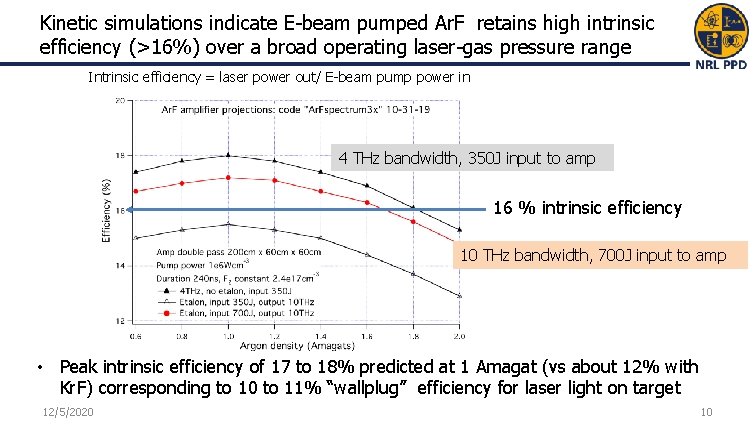
Kinetic simulations indicate E-beam pumped Ar. F retains high intrinsic efficiency (>16%) over a broad operating laser-gas pressure range Intrinsic efficiency = laser power out/ E-beam pump power in 4 THz bandwidth, 350 J input to amp 16 % intrinsic efficiency 10 THz bandwidth, 700 J input to amp • Peak intrinsic efficiency of 17 to 18% predicted at 1 Amagat (vs about 12% with Kr. F) corresponding to 10 to 11% “wallplug” efficiency for laser light on target 12/5/2020 10
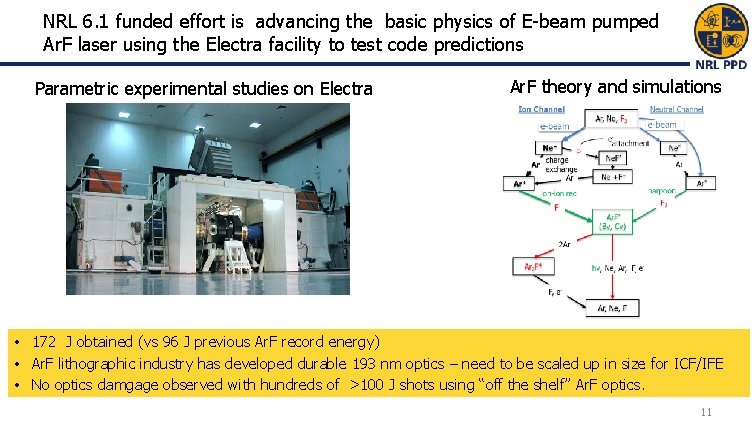
NRL 6. 1 funded effort is advancing the basic physics of E-beam pumped Ar. F laser using the Electra facility to test code predictions Parametric experimental studies on Electra Ar. F theory and simulations • 172 J obtained (vs 96 J previous Ar. F record energy) • Ar. F lithographic industry has developed durable 193 nm optics – need to be scaled up in size for ICF/IFE • No optics damgage observed with hundreds of >100 J shots using “off the shelf” Ar. F optics. 11
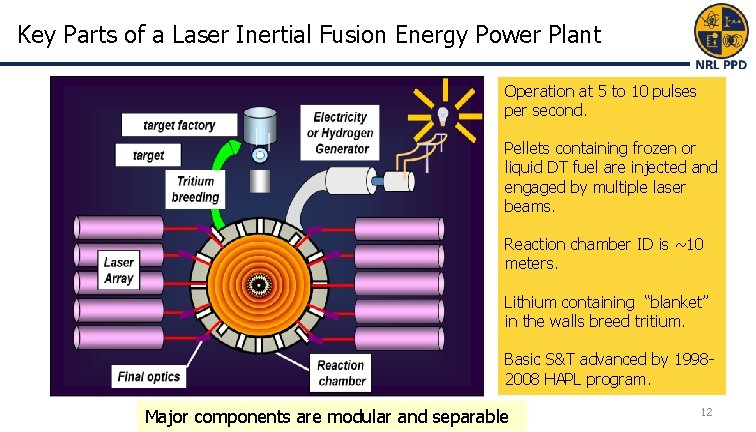
Key Parts of a Laser Inertial Fusion Energy Power Plant Operation at 5 to 10 pulses per second. Pellets containing frozen or liquid DT fuel are injected and engaged by multiple laser beams. Reaction chamber ID is ~10 meters. Lithium containing “blanket” in the walls breed tritium. Basic S&T advanced by 19982008 HAPL program. Major components are modular and separable 12
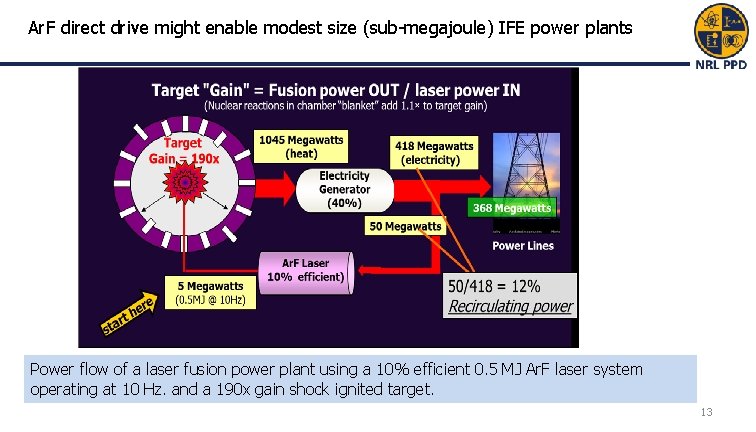
Ar. F direct drive might enable modest size (sub-megajoule) IFE power plants Power flow of a laser fusion power plant using a 10% efficient 0. 5 MJ Ar. F laser system operating at 10 Hz. and a 190 x gain shock ignited target. 13
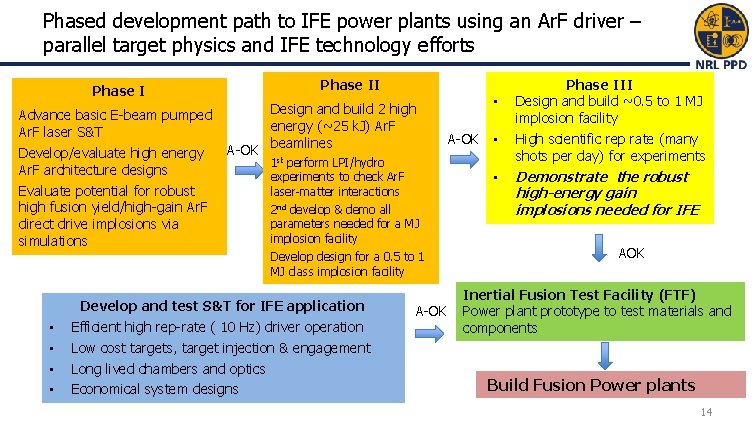
Phased development path to IFE power plants using an Ar. F driver – parallel target physics and IFE technology efforts Phase II Phase I Advance basic E-beam pumped Ar. F laser S&T Develop/evaluate high energy Ar. F architecture designs Evaluate potential for robust high fusion yield/high-gain Ar. F direct drive implosions via simulations A-OK Design and build 2 high energy (~25 k. J) Ar. F beamlines 1 st perform LPI/hydro experiments to check Ar. F laser-matter interactions Develop design for a 0. 5 to 1 MJ class implosion facility • • A-OK • • 2 nd develop & demo all parameters needed for a MJ implosion facility Develop and test S&T for IFE application Efficient high rep-rate ( 10 Hz) driver operation Low cost targets, target injection & engagement Long lived chambers and optics Economical system designs • A-OK Phase III Design and build ~0. 5 to 1 MJ implosion facility High scientific rep rate (many shots per day) for experiments Demonstrate the robust high-energy gain implosions needed for IFE AOK Inertial Fusion Test Facility (FTF) Power plant prototype to test materials and components Build Fusion Power plants 14
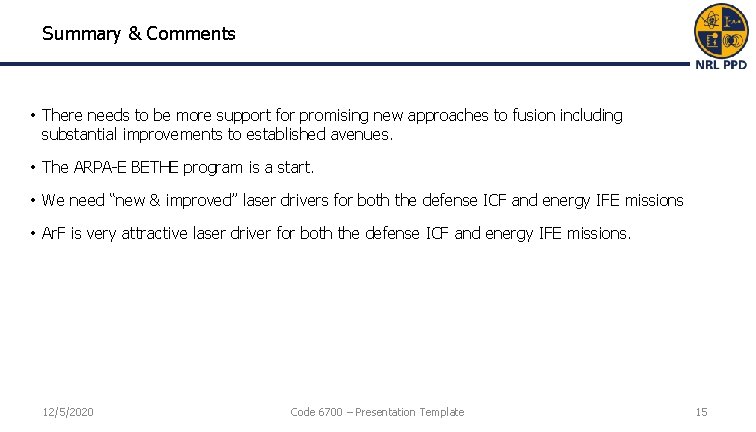
Summary & Comments • There needs to be more support for promising new approaches to fusion including substantial improvements to established avenues. • The ARPA-E BETHE program is a start. • We need “new & improved” laser drivers for both the defense ICF and energy IFE missions • Ar. F is very attractive laser driver for both the defense ICF and energy IFE missions. 12/5/2020 Code 6700 – Presentation Template 15
Extra slides 12/5/2020 16
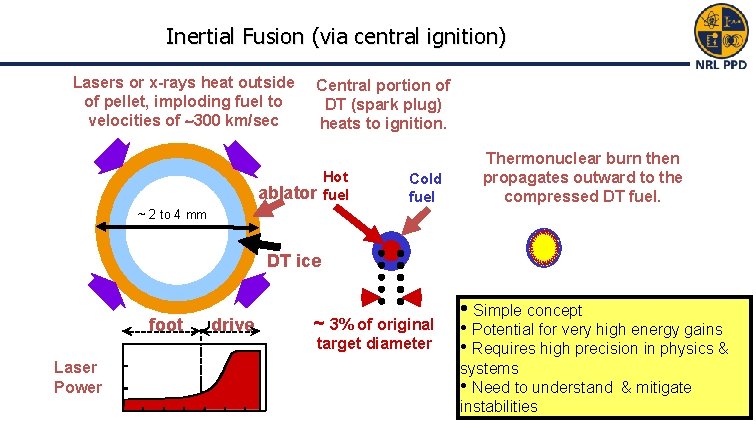
Inertial Fusion (via central ignition) Lasers or x-rays heat outside of pellet, imploding fuel to velocities of 300 km/sec Central portion of DT (spark plug) heats to ignition. ablator Hot fuel Cold fuel Thermonuclear burn then propagates outward to the compressed DT fuel. ~ 2 to 4 mm DT ice foot drive ~ 3% of original target diameter Laser Power • Simple concept • Potential for very high energy gains • Requires high precision in physics & systems • Need to understand & mitigate instabilities 17
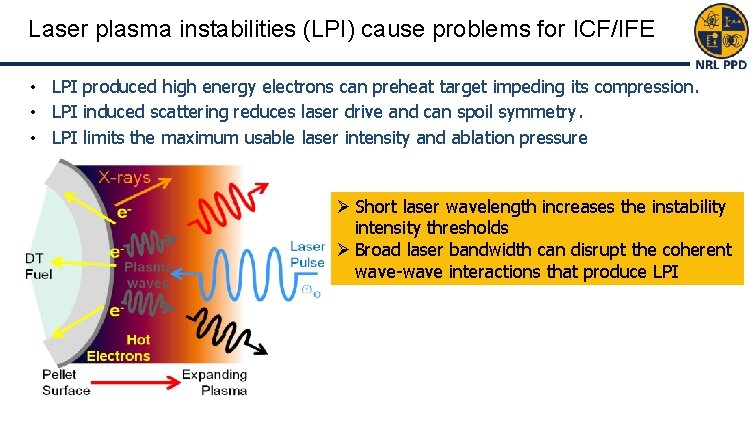
Laser plasma instabilities (LPI) cause problems for ICF/IFE • LPI produced high energy electrons can preheat target impeding its compression. • LPI induced scattering reduces laser drive and can spoil symmetry. • LPI limits the maximum usable laser intensity and ablation pressure Ø Short laser wavelength increases the instability intensity thresholds Ø Broad laser bandwidth can disrupt the coherent wave-wave interactions that produce LPI
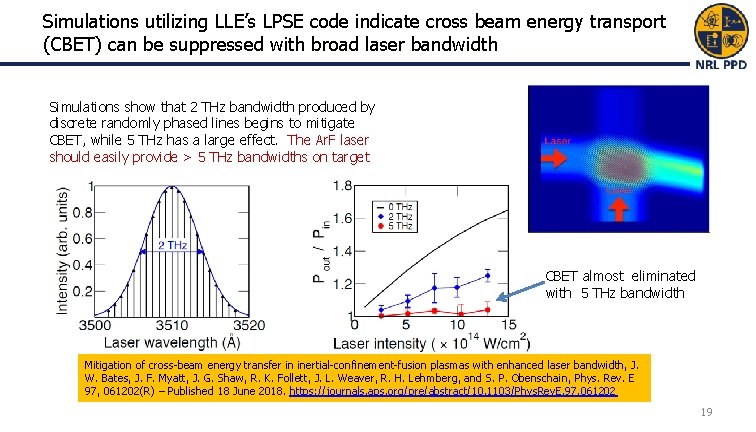
Simulations utilizing LLE’s LPSE code indicate cross beam energy transport (CBET) can be suppressed with broad laser bandwidth Simulations show that 2 THz bandwidth produced by discrete randomly phased lines begins to mitigate CBET, while 5 THz has a large effect. The Ar. F laser should easily provide > 5 THz bandwidths on target CBET almost eliminated with 5 THz bandwidth Mitigation of cross-beam energy transfer in inertial-confinement-fusion plasmas with enhanced laser bandwidth, J. W. Bates, J. F. Myatt, J. G. Shaw, R. K. Follett, J. L. Weaver, R. H. Lehmberg, and S. P. Obenschain, Phys. Rev. E 97, 061202(R) – Published 18 June 2018. https: //journals. aps. org/pre/abstract/10. 1103/Phys. Rev. E. 97. 061202 19
Why an Ar. F laser driver could enable lower cost modest size laser IFE power plants The superior laser target coupling with Ar. F’s deep UV light (193 nm) could enable the high target gains needed for the energy application at much lower laser energies than previously thought feasible. The combination of deep UV light and broad native bandwidth (>5 THz) suppresses laser-plasma instabilities that limit the laser intensity and ablation pressures of current 351 nm frequency-tripled glass lasers which are the traditional laser drivers for fusion. Ar. F is a potentially disruptive technology for laser fusion that shares several advantageous technologies with the krypton fluoride (Kr. F) laser technology (λ=248 nm) used on the Nike laser system located at the Naval Research Laboratory (NRL). The Ar. F laser would utilize similar electron-beam pumping to that used for large Kr. F amplifiers. It would also be able to use the beam smoothing technology demonstrated on Nike that enables very uniform illumination of directly driven targets and provides the capability to “zoom” the focal profile to follow an imploding target. The Kr. F technology was chosen for the Nike facility because of numerous advantages for achieving laser fusion. Ar. F laser light in turn would be superior to Kr. F. For the IFE application, kinetics simulations indicate that Ar. F would have as much as 1. 6 x higher intrinsic efficiency than Kr. F. The advantages would enable the development of modest size and low cost power plant modules utilizing laser energies well below 1 MJ. This would drastically change the present view on inertial fusion energy (IFE) as being too expensive and the power plant size too large.
References • High-energy krypton fluoride lasers for inertial fusion, Stephen Obenschain, Robert Lehmberg, David Kehne, Frank Hegeler, Matthew Wolford, John Sethian, James Weaver, and Max Karasik, Applied Optics, Vol. 54, Issue 31, pp. F 103 -F 122 (2015). https: //www. osapublishing. org/ao/abstract. cfm? uri=ao-54 -31 -f 103 • Spectral and far-field broadening due to stimulated rotational Raman scattering driven by the Nike krypton fluoride laser, James Weaver, Robert Lehmberg, Stephen Obenschain, David Kehne, and Matthew Wolford, Applied Optics, Vol. 56, Issue 31, pp. 8618 -8631 (2017). https: //www. osapublishing. org/ao/abstract. cfm? uri=ao-56 -31 -8618 • Mitigation of cross-beam energy transfer in inertial-confinement-fusion plasmas with enhanced laser bandwidth, J. W. Bates, J. F. Myatt, J. G. Shaw, R. K. Follett, J. L. Weaver, R. H. Lehmberg, and S. P. Obenschain, Phys. Rev. E 97, 061202(R) – Published 18 June 2018. https: //journals. aps. org/pre/abstract/10. 1103/Phys. Rev. E. 97. 061202 • Production of radical species by electron beam deposition in an Ar. F* lasing medium, G. M. Petrov, M. F. Wolford, Tz. B. Petrova, J. L. Giuliani, and S. P. Obenschain, Journal of Applied Physics 122, 133301 (2017); https: //aip. scitation. org/doi/10. 1063/1. 4995224 • J. D. Sethian and 87 other authors, “The Science and Technologies for Fusion Energy With Lasers and Direct-Drive Targets, IEEE Trans on Plasma Science 38, 690 -703 (2010). • Science and technologies that would advance high-performance direct-drive laser fusion, S. P. Obenschain et al. white paper submitted to the Nat. Acad. 2020 Decadal Study of Plasma Phys. : #41 in submitted papers. http: //sites. nationalacademies. org/bpa_188502. 12/5/2020 21