
CS 274 Computer Animation and Simulation Lecture VIII
- Slides: 26
CS 274: Computer Animation and Simulation Lecture VIII Deformable Bodies CS 274 Spring 01 Lecture 8 Copyright © Mark Meyer
Overview Deformable Bodies Many objects are not rigid § jello § mud § gases/liquids § etc. Two main techniques: § Geometric deformations § Physically-based methods CS 274 Spring 01 Lecture 8 Copyright © Mark Meyer
Geometric Deformations Deform the object’s geometry directly Two main techniques: § control point / vertex manipulation § space warping CS 274 Spring 01 Lecture 8 Copyright © Mark Meyer
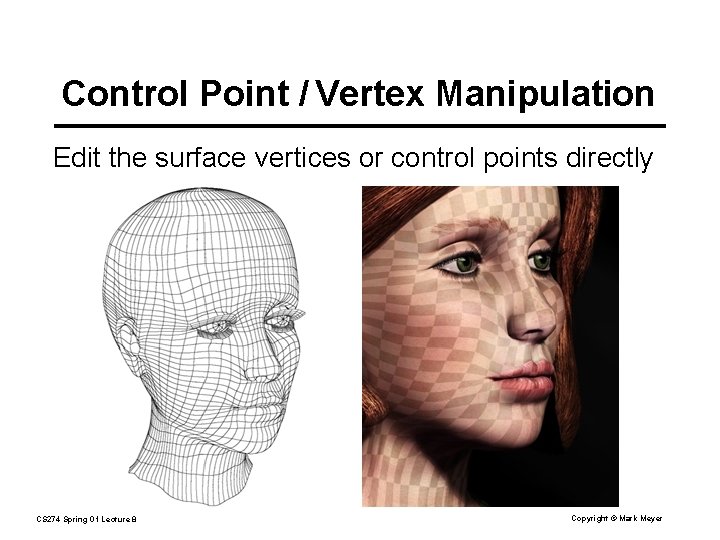
Control Point / Vertex Manipulation Edit the surface vertices or control points directly CS 274 Spring 01 Lecture 8 Copyright © Mark Meyer
Space Warping Deform the object by deforming the space it is in Two main techniques: § Nonlinear Deformation § Free Form Deformation (FFD) Independent of object representation CS 274 Spring 01 Lecture 8 Copyright © Mark Meyer
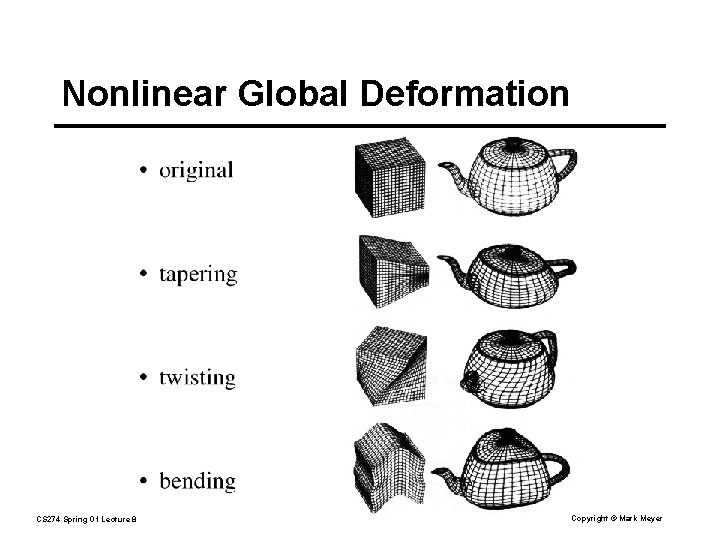
Nonlinear Global Deformation Objects are defined in a local object space Deform this space using a combination of: § Non-uniform Scaling § Tapering § Twisting § Bending CS 274 Spring 01 Lecture 8 Copyright © Mark Meyer
Nonlinear Global Deformation CS 274 Spring 01 Lecture 8 Copyright © Mark Meyer
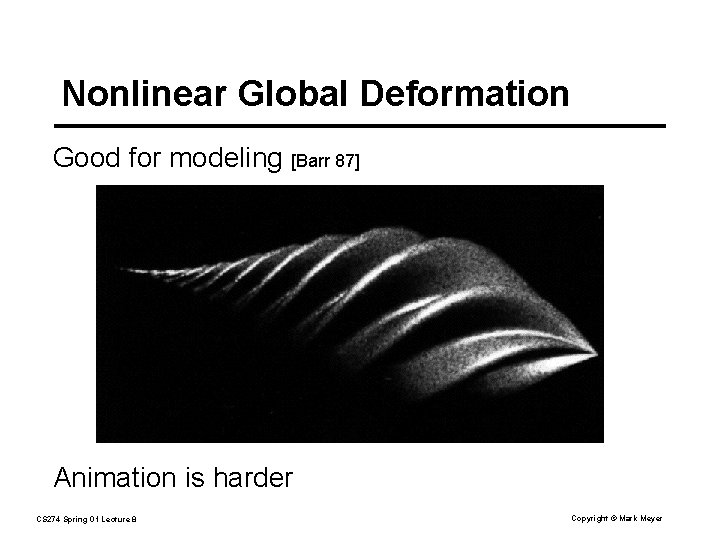
Nonlinear Global Deformation Good for modeling [Barr 87] Animation is harder CS 274 Spring 01 Lecture 8 Copyright © Mark Meyer
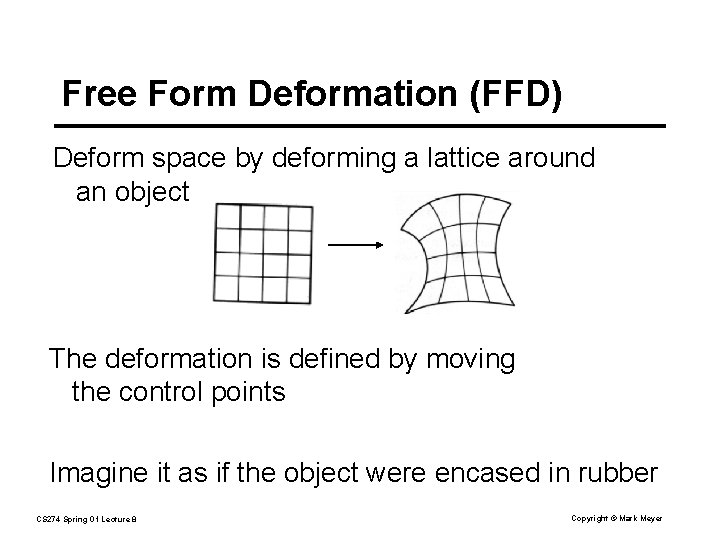
Free Form Deformation (FFD) Deform space by deforming a lattice around an object The deformation is defined by moving the control points Imagine it as if the object were encased in rubber CS 274 Spring 01 Lecture 8 Copyright © Mark Meyer
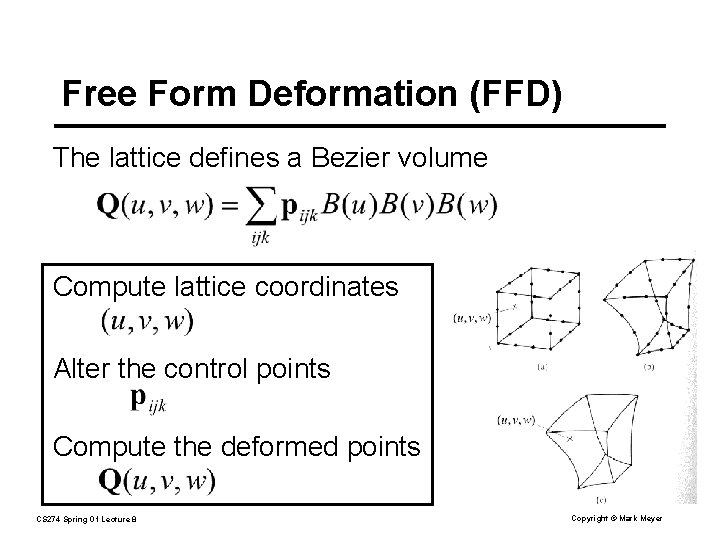
Free Form Deformation (FFD) The lattice defines a Bezier volume Compute lattice coordinates Alter the control points Compute the deformed points CS 274 Spring 01 Lecture 8 Copyright © Mark Meyer
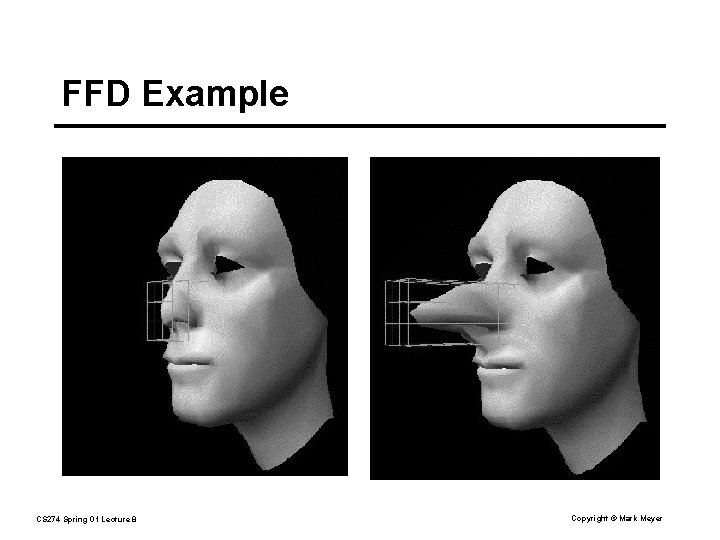
FFD Example CS 274 Spring 01 Lecture 8 Copyright © Mark Meyer
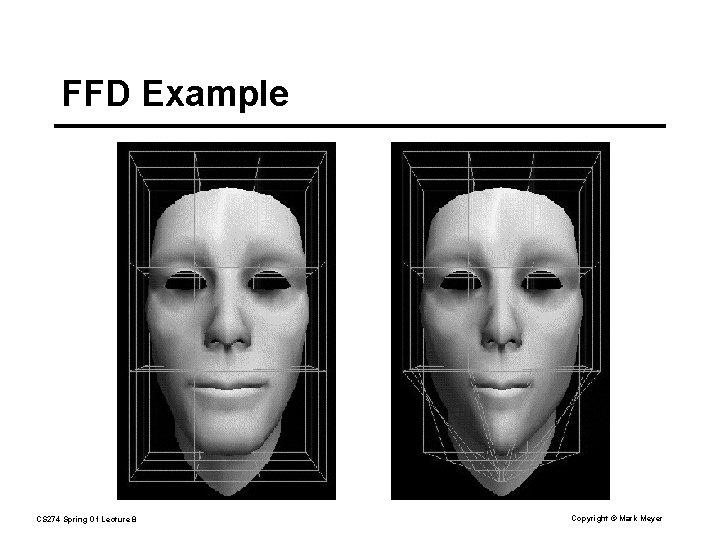
FFD Example CS 274 Spring 01 Lecture 8 Copyright © Mark Meyer
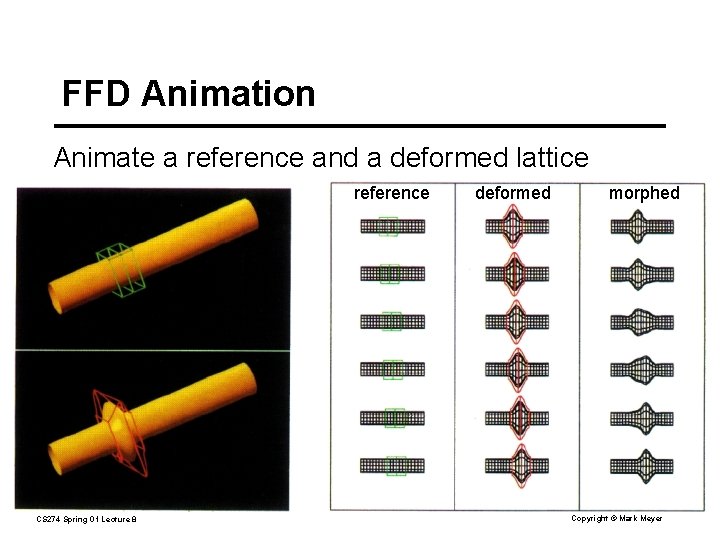
FFD Animation Animate a reference and a deformed lattice reference CS 274 Spring 01 Lecture 8 deformed morphed Copyright © Mark Meyer
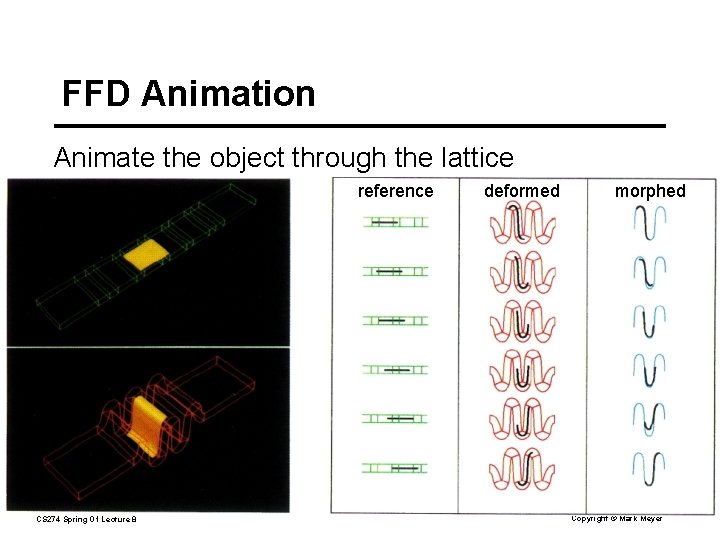
FFD Animation Animate the object through the lattice reference CS 274 Spring 01 Lecture 8 deformed morphed Copyright © Mark Meyer
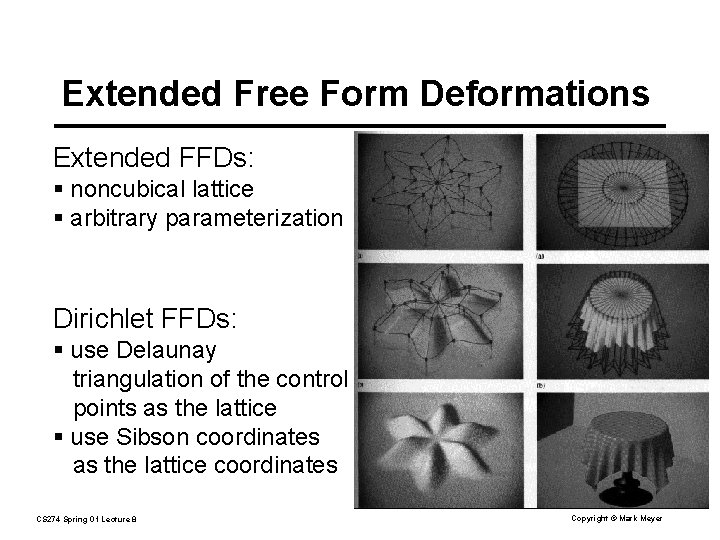
Extended Free Form Deformations Extended FFDs: § noncubical lattice § arbitrary parameterization Dirichlet FFDs: § use Delaunay triangulation of the control points as the lattice § use Sibson coordinates as the lattice coordinates CS 274 Spring 01 Lecture 8 Copyright © Mark Meyer
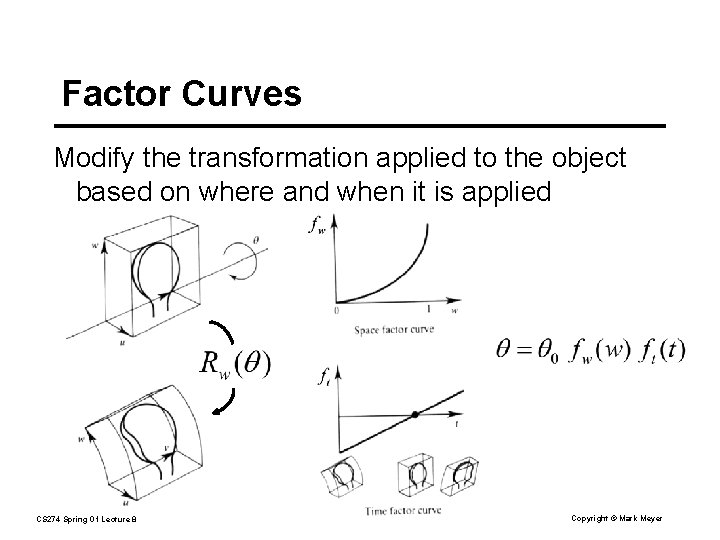
Factor Curves Modify the transformation applied to the object based on where and when it is applied CS 274 Spring 01 Lecture 8 Copyright © Mark Meyer
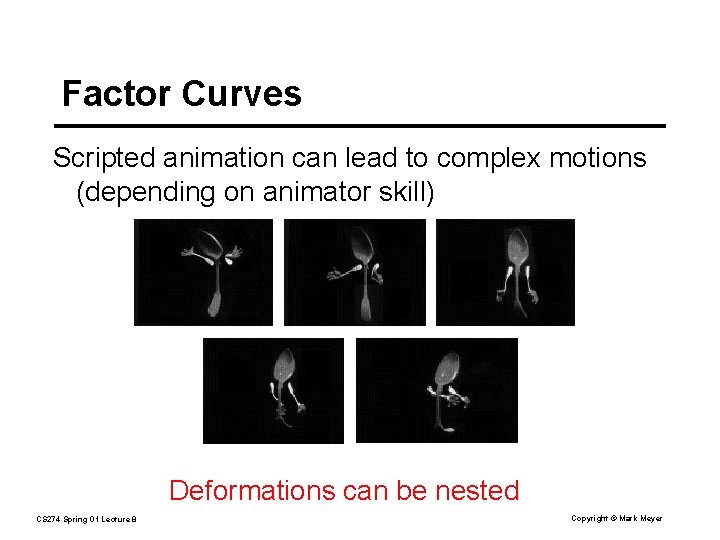
Factor Curves Scripted animation can lead to complex motions (depending on animator skill) Deformations can be nested CS 274 Spring 01 Lecture 8 Copyright © Mark Meyer
Physically-Based Deformations Deform the object according to physical laws Two main techniques: § mass-spring systems § finite element methods CS 274 Spring 01 Lecture 8 Copyright © Mark Meyer
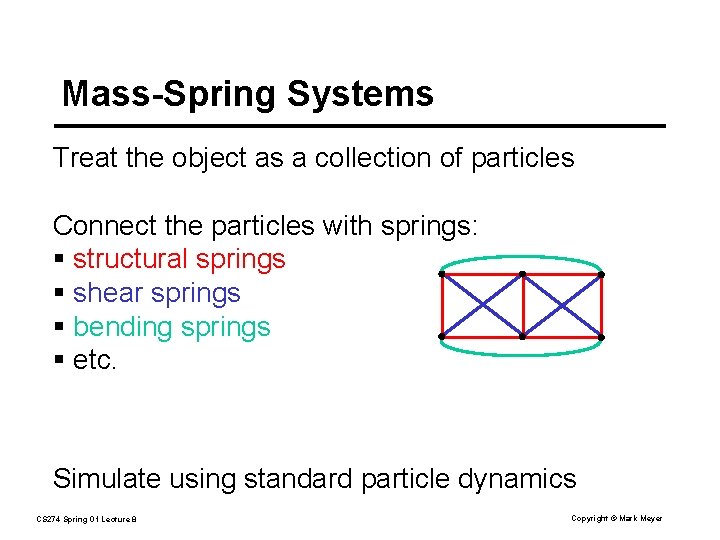
Mass-Spring Systems Treat the object as a collection of particles Connect the particles with springs: § structural springs § shear springs § bending springs § etc. Simulate using standard particle dynamics CS 274 Spring 01 Lecture 8 Copyright © Mark Meyer
Finite Element Methods Mass-Spring systems are not very realistic We need: § more accurate physical laws § error control Finite Element Methods (FEM) offer a way to solve the physical equations we wish to simulate. CS 274 Spring 01 Lecture 8 Copyright © Mark Meyer
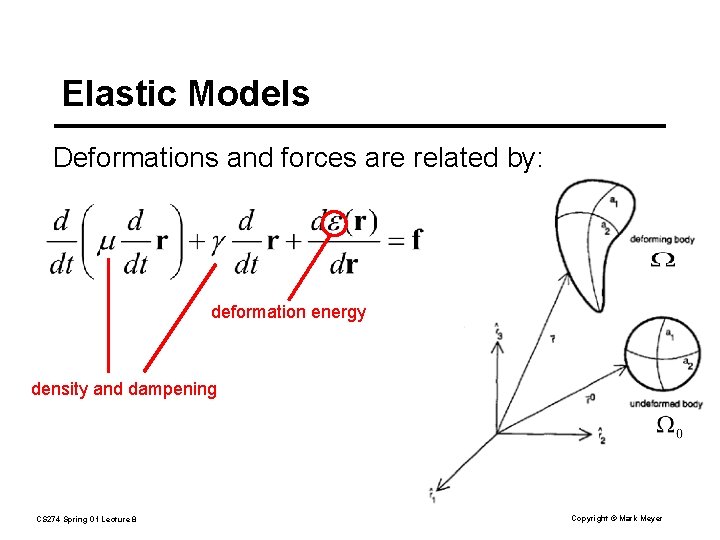
Elastic Models Deformations and forces are related by: deformation energy density and dampening CS 274 Spring 01 Lecture 8 Copyright © Mark Meyer
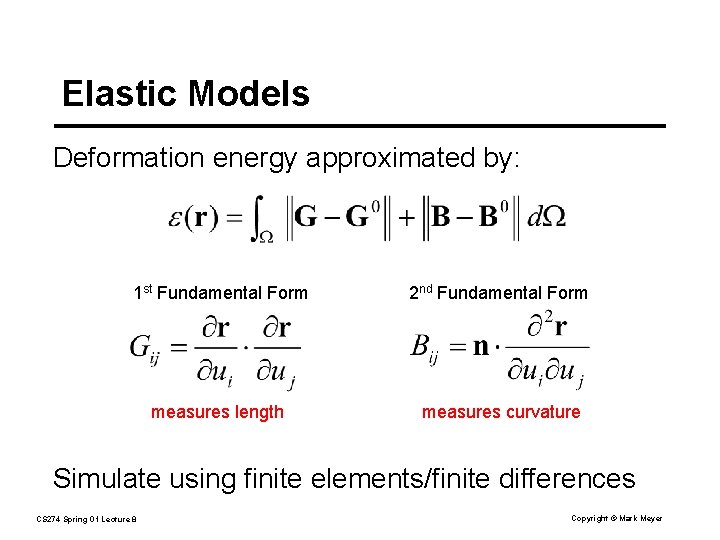
Elastic Models Deformation energy approximated by: 1 st Fundamental Form 2 nd Fundamental Form measures length measures curvature Simulate using finite elements/finite differences CS 274 Spring 01 Lecture 8 Copyright © Mark Meyer
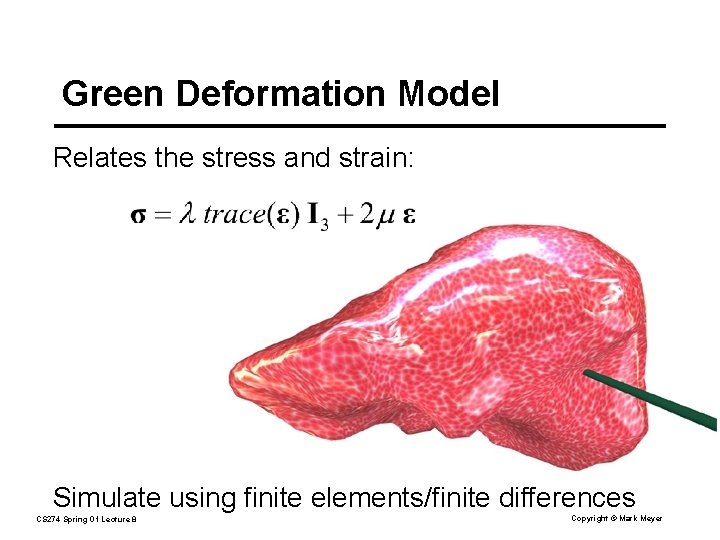
Green Deformation Model Relates the stress and strain: Simulate using finite elements/finite differences CS 274 Spring 01 Lecture 8 Copyright © Mark Meyer
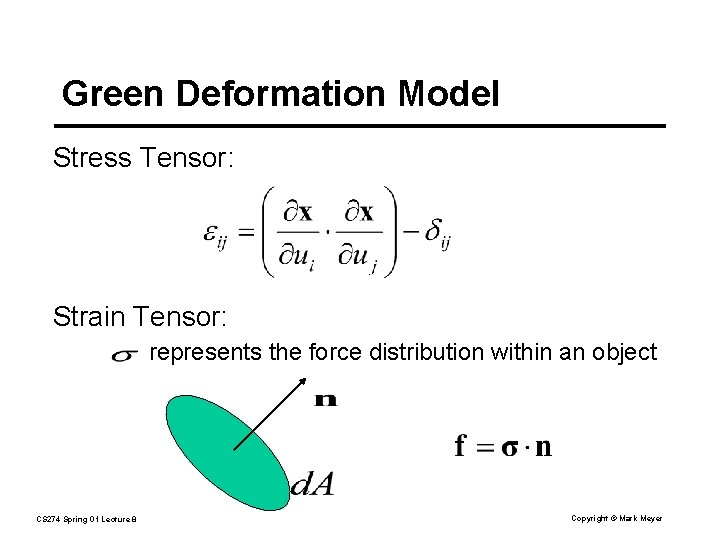
Green Deformation Model Stress Tensor: Strain Tensor: represents the force distribution within an object CS 274 Spring 01 Lecture 8 Copyright © Mark Meyer
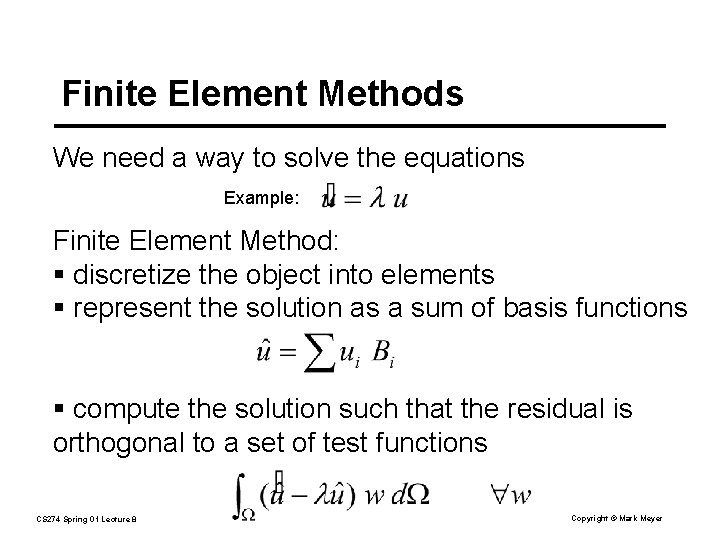
Finite Element Methods We need a way to solve the equations Example: Finite Element Method: § discretize the object into elements § represent the solution as a sum of basis functions § compute the solution such that the residual is orthogonal to a set of test functions CS 274 Spring 01 Lecture 8 Copyright © Mark Meyer
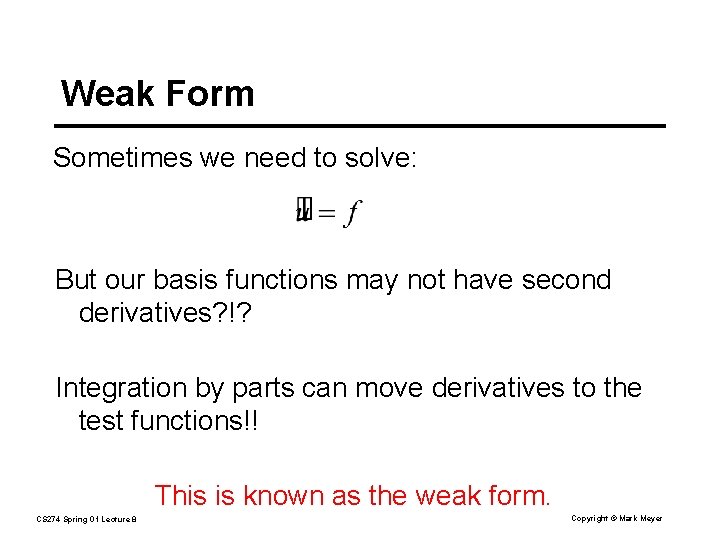
Weak Form Sometimes we need to solve: But our basis functions may not have second derivatives? !? Integration by parts can move derivatives to the test functions!! This is known as the weak form. CS 274 Spring 01 Lecture 8 Copyright © Mark Meyer