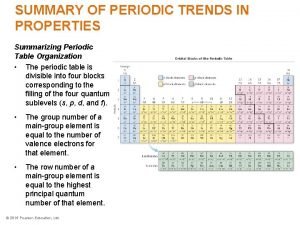
Periodic Trends Elemental Properties and Patterns The Periodic

- Slides: 46
Periodic Trends Elemental Properties and Patterns
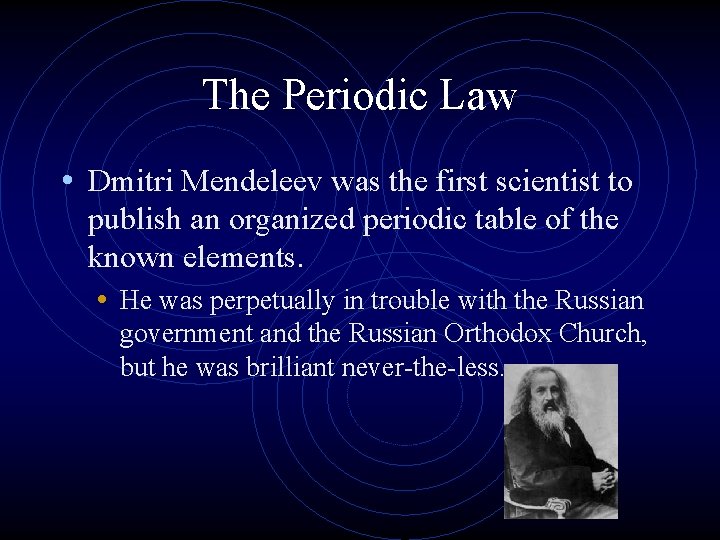
The Periodic Law • Dmitri Mendeleev was the first scientist to publish an organized periodic table of the known elements. • He was perpetually in trouble with the Russian government and the Russian Orthodox Church, but he was brilliant never-the-less.
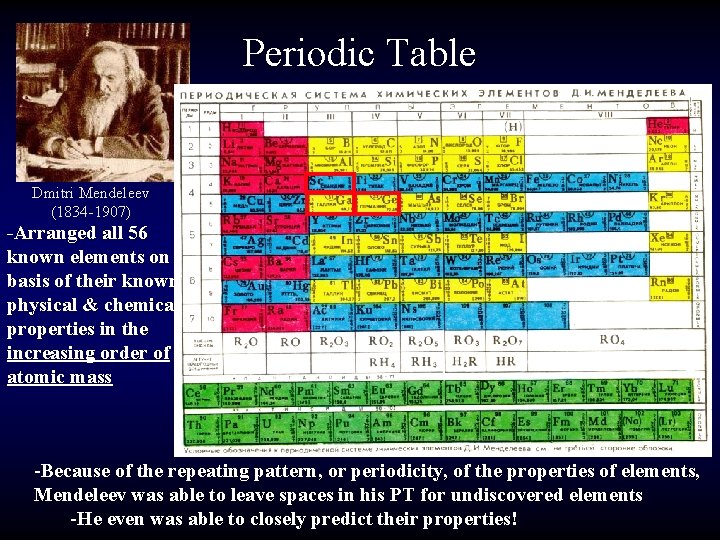
Periodic Table Dmitri Mendeleev (1834 -1907) -Arranged all 56 known elements on basis of their known physical & chemical properties in the increasing order of atomic mass -Because of the repeating pattern, or periodicity, of the properties of elements, Mendeleev was able to leave spaces in his PT for undiscovered elements -He even was able to closely predict their properties!
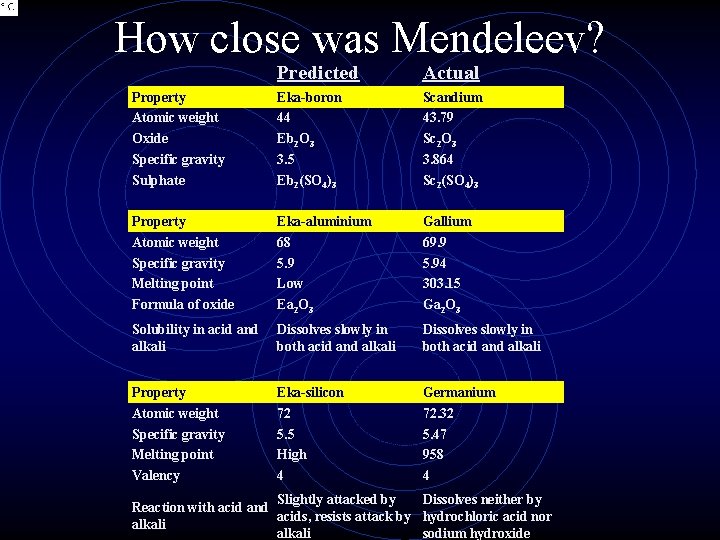
How close was Mendeleev? Predicted Actual Property Atomic weight Oxide Specific gravity Sulphate Eka-boron 44 Eb 2 O 3 3. 5 Eb 2(SO 4)3 Scandium 43. 79 Sc 2 O 3 3. 864 Sc 2(SO 4)3 Property Atomic weight Specific gravity Melting point Formula of oxide Eka-aluminium 68 5. 9 Low Ea 2 O 3 Gallium 69. 9 5. 94 303. 15 Ga 2 O 3 Solubility in acid and alkali Dissolves slowly in both acid and alkali Property Atomic weight Specific gravity Melting point Valency Eka-silicon 72 5. 5 High 4 Germanium 72. 32 5. 47 958 4 Slightly attacked by Dissolves neither by Reaction with acid and acids, resists attack by hydrochloric acid nor alkali sodium hydroxide
Brilliant – Yet 2 questions remained… - Mendeleev was very accurate in his predictions, which led the world to accept his ideas about periodicity and a logical periodic table, but… (1) Why could most of the elements be arranged in the order of increasing atomic mass but a few could not? (2) What was the reason for chemical periodicity?
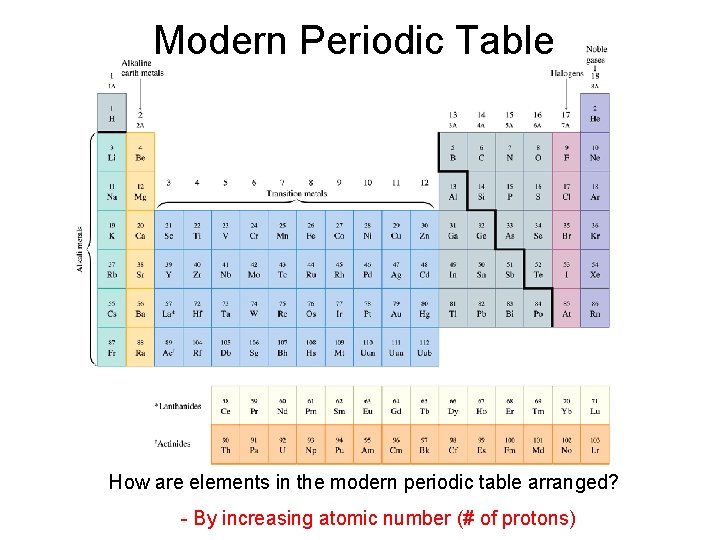
The Modern Periodic Table • In 1911, Henry Moseley discovered a previously unrecognized pattern • Elements fit into patterns better when they were arranged according to the number of protons in the nucleus instead of atomic mass • Modern PT includes many more elements that were not on Mendeleev’s PT: • Transition metals • Lanthanides • Actinides • Noble Gases • Atoms are arranged on based on increasing atomic number
The Periodic Law • Mendeleev’s principle of chemical periodicity is correctly stated in what is understood as the ‘Periodic Law’ • When arranged by increasing atomic number, the chemical elements display a regular and repeating pattern of chemical and physical properties.
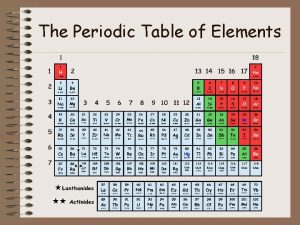
Modern Periodic Table How are elements in the modern periodic table arranged? - By increasing atomic number (# of protons)
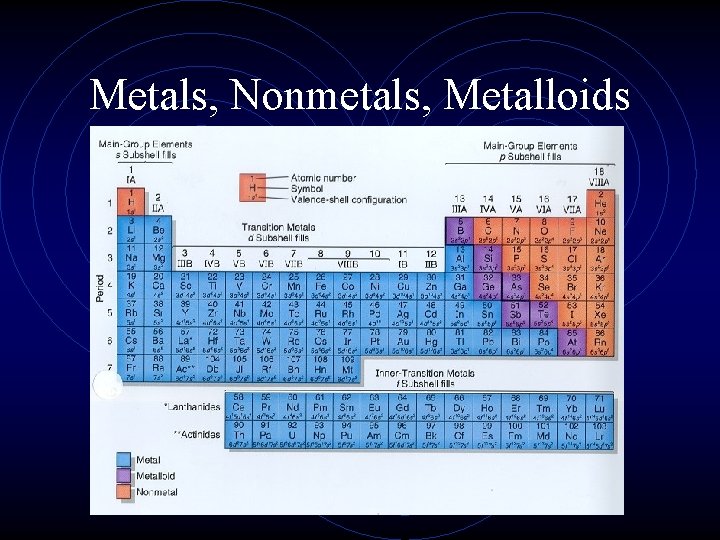
Metals, Nonmetals, Metalloids
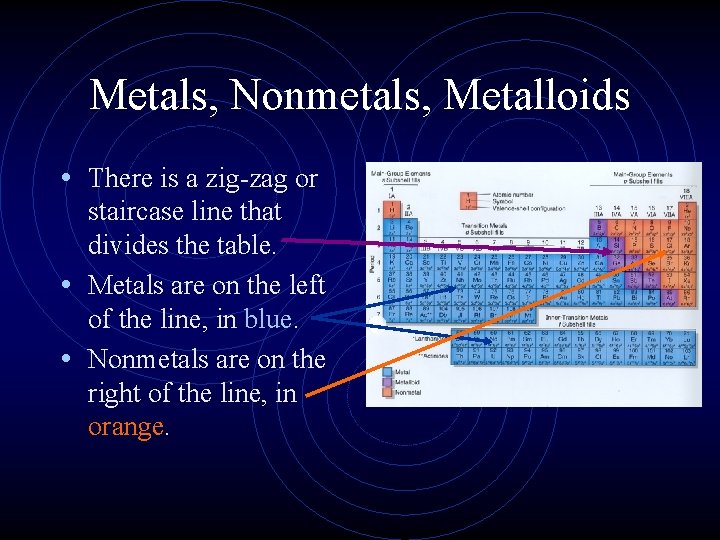
Metals, Nonmetals, Metalloids • There is a zig-zag or staircase line that divides the table. • Metals are on the left of the line, in blue. • Nonmetals are on the right of the line, in orange.
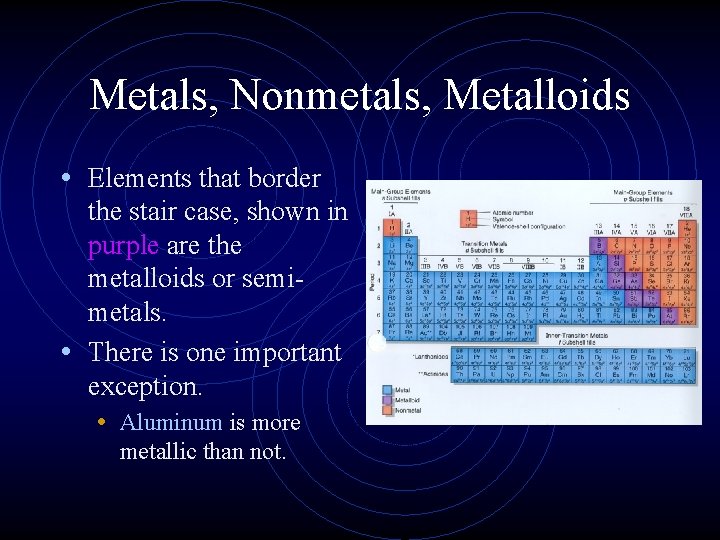
Metals, Nonmetals, Metalloids • Elements that border the stair case, shown in purple are the metalloids or semimetals. • There is one important exception. • Aluminum is more metallic than not.
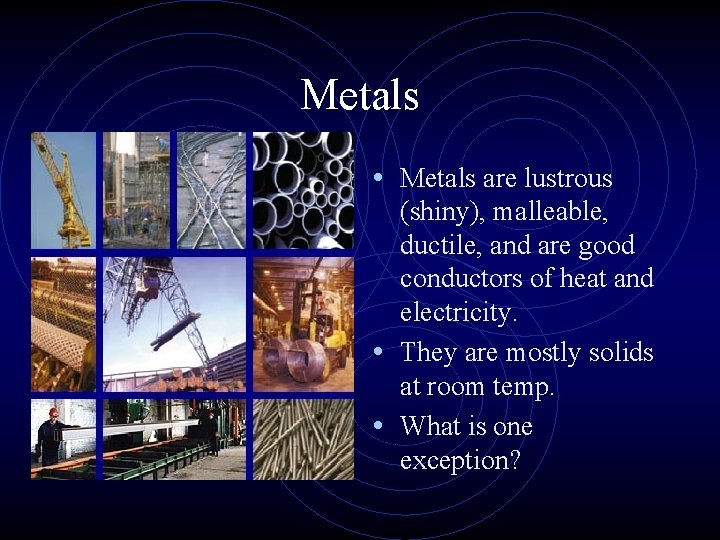
Metals • Metals are lustrous (shiny), malleable, ductile, and are good conductors of heat and electricity. • They are mostly solids at room temp. • What is one exception?
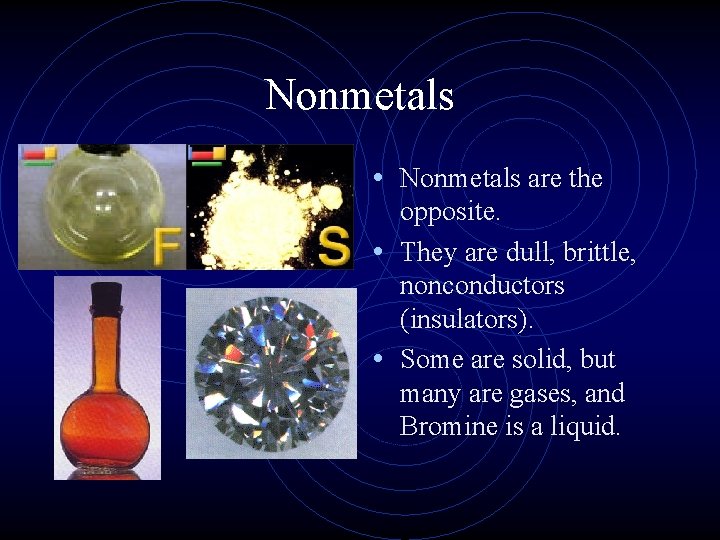
Nonmetals • Nonmetals are the opposite. • They are dull, brittle, nonconductors (insulators). • Some are solid, but many are gases, and Bromine is a liquid.
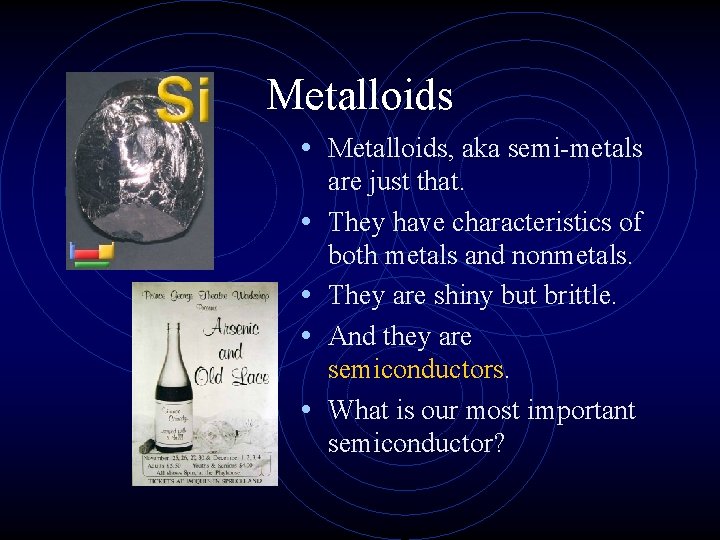
Metalloids • Metalloids, aka semi-metals • • are just that. They have characteristics of both metals and nonmetals. They are shiny but brittle. And they are semiconductors. What is our most important semiconductor?
The Periodic Law • Atoms with similar properties appear in groups or families (vertical columns) on the periodic table. • They are similar because they all have the same number of valence (outer shell) electrons, which governs their chemical behavior.
Start Periodic Trends Here
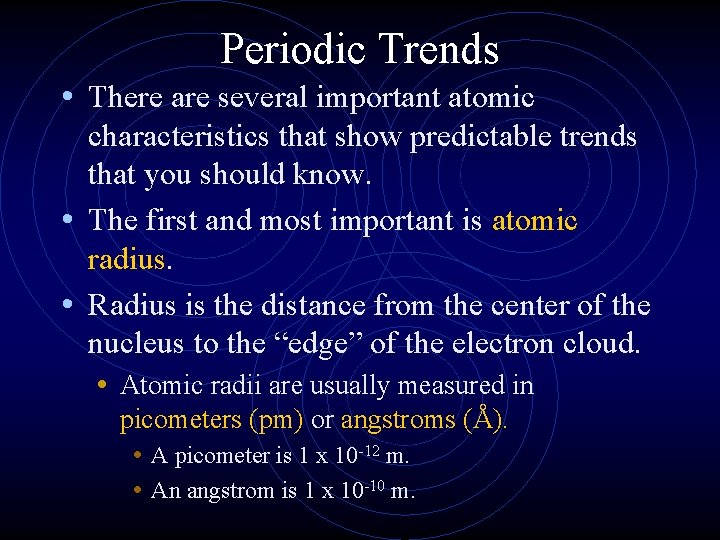
Periodic Trends • There are several important atomic characteristics that show predictable trends that you should know. • The first and most important is atomic radius. • Radius is the distance from the center of the nucleus to the “edge” of the electron cloud. • Atomic radii are usually measured in picometers (pm) or angstroms (Å). • A picometer is 1 x 10 -12 m. • An angstrom is 1 x 10 -10 m.
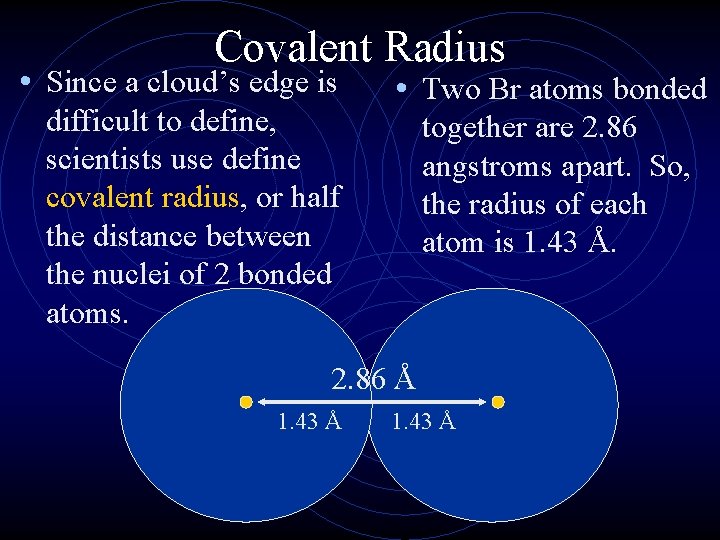
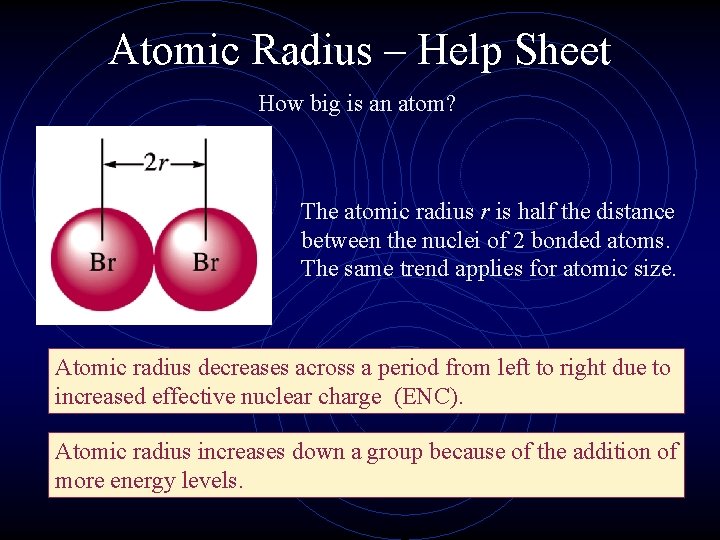
Covalent Radius • Since a cloud’s edge is difficult to define, scientists use define covalent radius, or half the distance between the nuclei of 2 bonded atoms. • Two Br atoms bonded together are 2. 86 angstroms apart. So, the radius of each atom is 1. 43 Å. 2. 86 Å 1. 43 Å
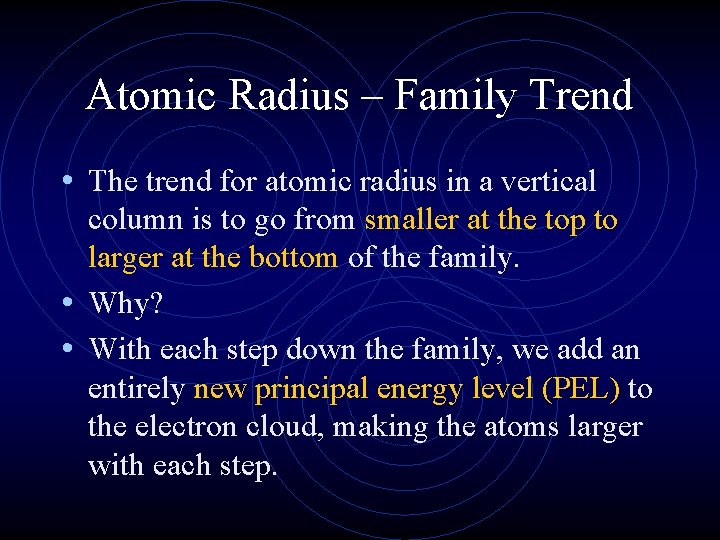
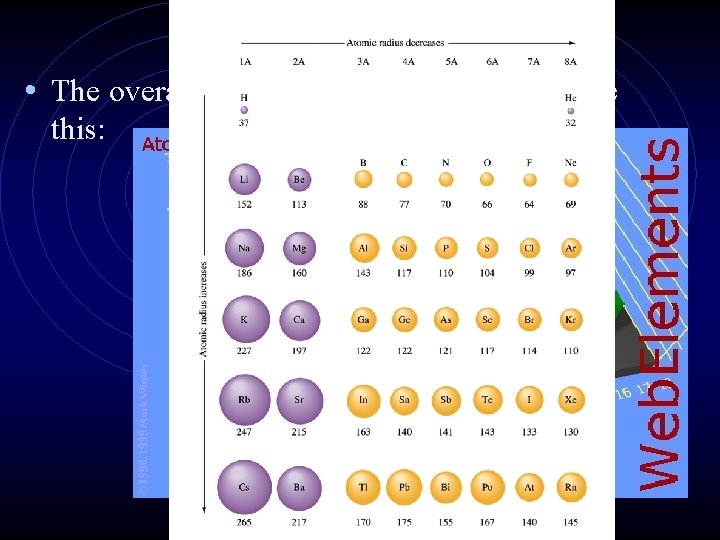
Atomic Radius – Family Trend • The trend for atomic radius in a vertical column is to go from smaller at the top to larger at the bottom of the family. • Why? • With each step down the family, we add an entirely new principal energy level (PEL) to the electron cloud, making the atoms larger with each step.
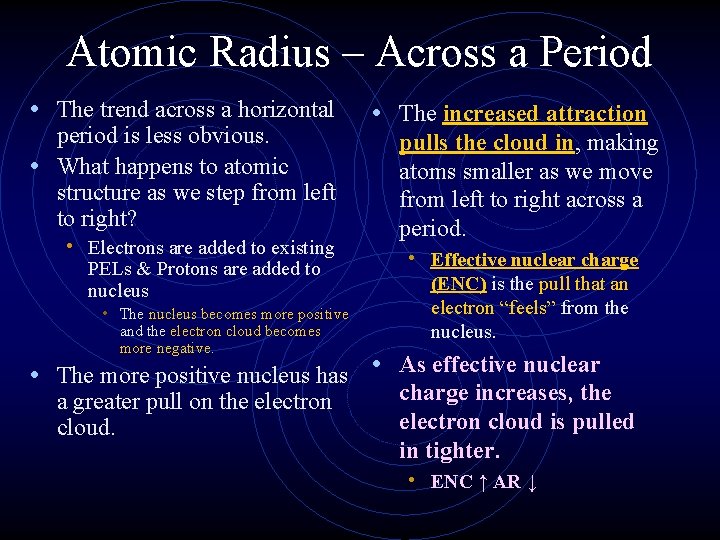
Atomic Radius – Across a Period • The trend across a horizontal period is less obvious. • What happens to atomic structure as we step from left to right? • Electrons are added to existing PELs & Protons are added to nucleus • The nucleus becomes more positive and the electron cloud becomes more negative. • The increased attraction pulls the cloud in, making atoms smaller as we move from left to right across a period. • Effective nuclear charge (ENC) is the pull that an electron “feels” from the nucleus. • The more positive nucleus has • As effective nuclear a greater pull on the electron cloud. charge increases, the electron cloud is pulled in tighter. • ENC ↑ AR ↓
Atomic Radius • The overall trend in atomic radius looks like this:
Periodicity BW • Periodicity Chart
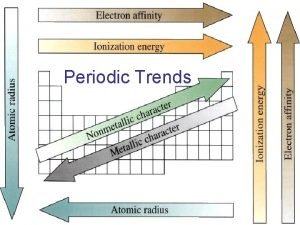
Atomic Radius – Help Sheet How big is an atom? The atomic radius r is half the distance between the nuclei of 2 bonded atoms. The same trend applies for atomic size. Atomic radius decreases across a period from left to right due to increased effective nuclear charge (ENC). Atomic radius increases down a group because of the addition of more energy levels.
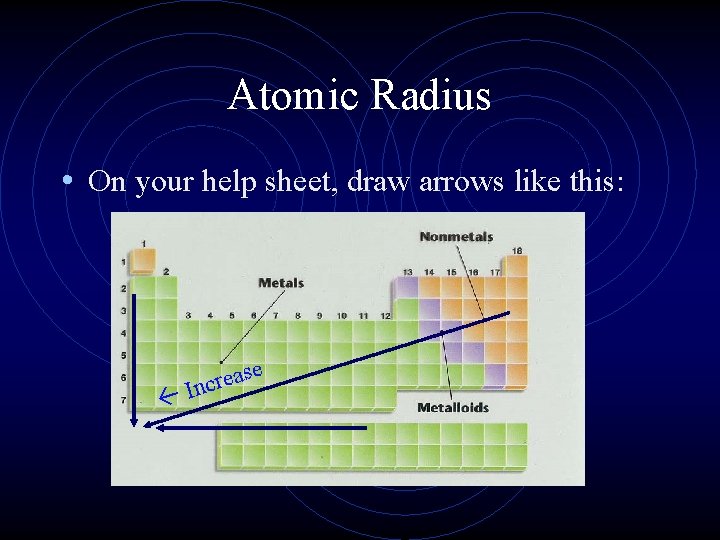
Atomic Radius • On your help sheet, draw arrows like this: se a e r c In
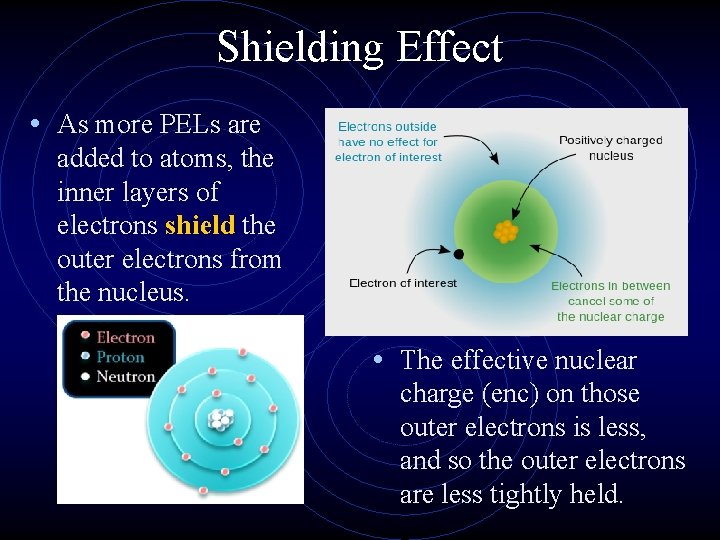
Shielding Effect • As more PELs are added to atoms, the inner layers of electrons shield the outer electrons from the nucleus. • The effective nuclear charge (enc) on those outer electrons is less, and so the outer electrons are less tightly held.
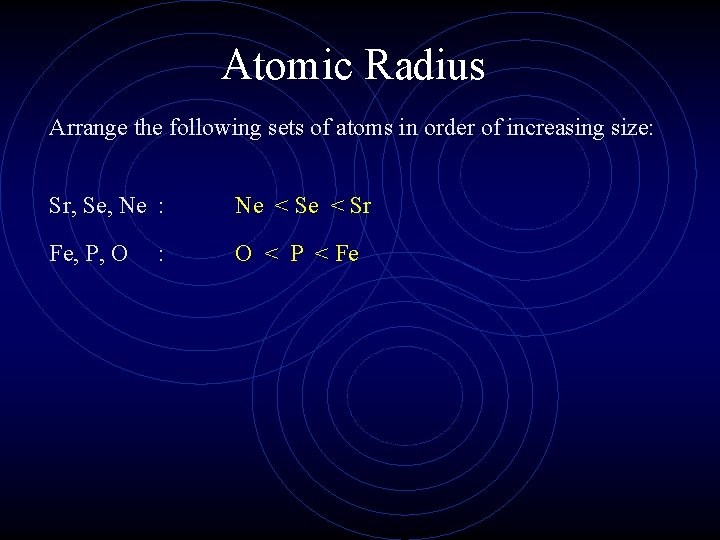
Atomic Radius Arrange the following sets of atoms in order of increasing size: Sr, Se, Ne : Ne < Sr Fe, P, O O < P < Fe :
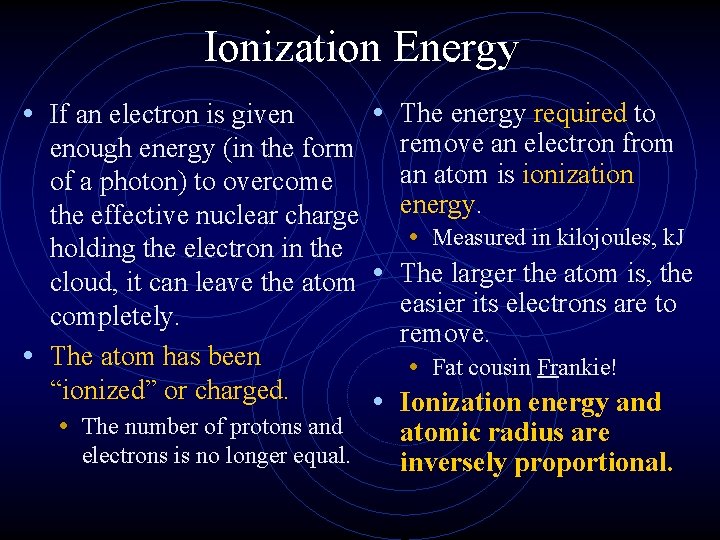
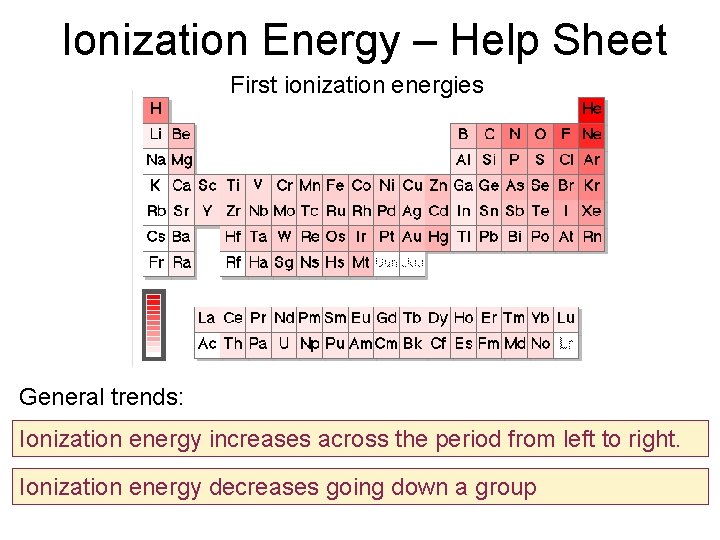
Ionization Energy • If an electron is given • The energy required to remove an electron from enough energy (in the form an atom is ionization of a photon) to overcome the effective nuclear charge energy. • Measured in kilojoules, k. J holding the electron in the cloud, it can leave the atom • The larger the atom is, the easier its electrons are to completely. remove. • The atom has been • Fat cousin Frankie! “ionized” or charged. • Ionization energy and • The number of protons and atomic radius are electrons is no longer equal. inversely proportional.
Ionization Energy
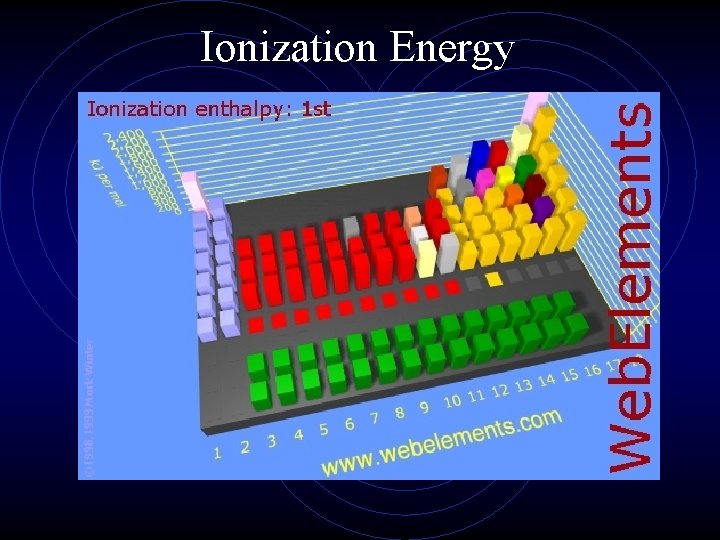
Ionization Energy – Help Sheet First ionization energies General trends: Ionization energy increases across the period from left to right. Ionization energy decreases going down a group
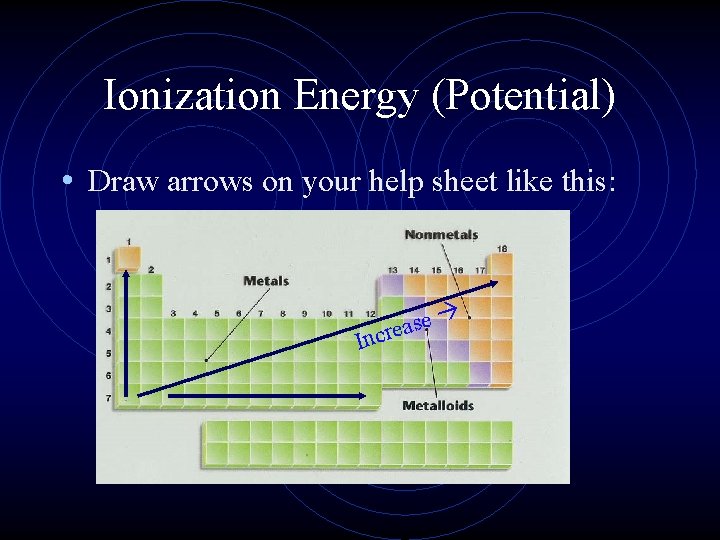
Ionization Energy (Potential) • Draw arrows on your help sheet like this: e s a Incre
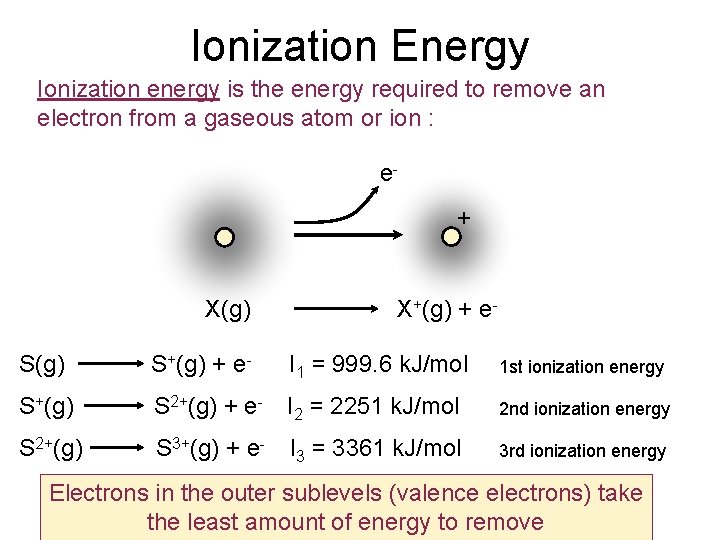
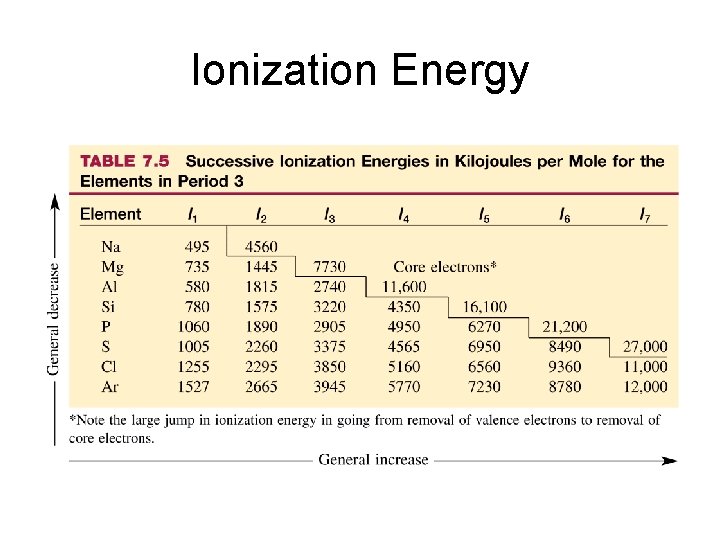
Ionization Energy Ionization energy is the energy required to remove an electron from a gaseous atom or ion : e+ X(g) X+(g) + e- S(g) S+(g) + e- I 1 = 999. 6 k. J/mol 1 st ionization energy S+(g) S 2+(g) + e- I 2 = 2251 k. J/mol 2 nd ionization energy S 2+(g) S 3+(g) + e- I 3 = 3361 k. J/mol 3 rd ionization energy Electrons in the outer sublevels (valence electrons) take the least amount of energy to remove
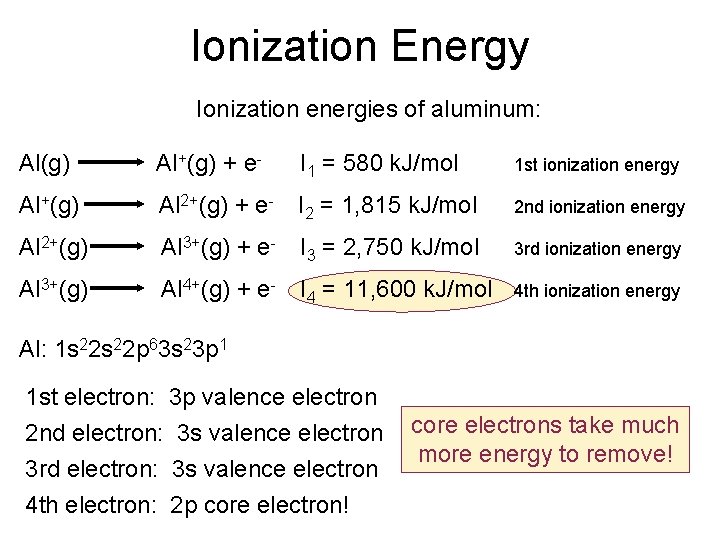
Ionization Energy Ionization energies of aluminum: Al(g) Al+(g) + e- I 1 = 580 k. J/mol 1 st ionization energy Al+(g) Al 2+(g) + e- I 2 = 1, 815 k. J/mol 2 nd ionization energy Al 2+(g) Al 3+(g) + e- I 3 = 2, 750 k. J/mol 3 rd ionization energy Al 3+(g) Al 4+(g) + e- I 4 = 11, 600 k. J/mol 4 th ionization energy Al: 1 s 22 p 63 s 23 p 1 1 st electron: 3 p valence electron 2 nd electron: 3 s valence electron 3 rd electron: 3 s valence electron 4 th electron: 2 p core electron! core electrons take much more energy to remove!
Ionization Energy
Electronegativity • Electronegativity is a measure of an atom’s • • • attraction for another atom’s electrons. It is an arbitrary scale that ranges from 0 to 4. The units of electronegativity are Paulings. Generally, metals are electron givers and have low electronegativities. Nonmetals are electron takers and have high electronegativities. What about the noble gases?
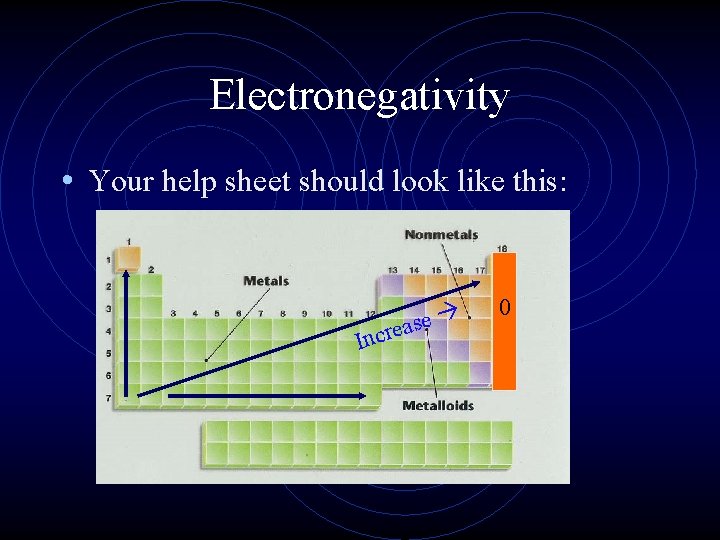
Electronegativity • Your help sheet should look like this: e s a Incre 0
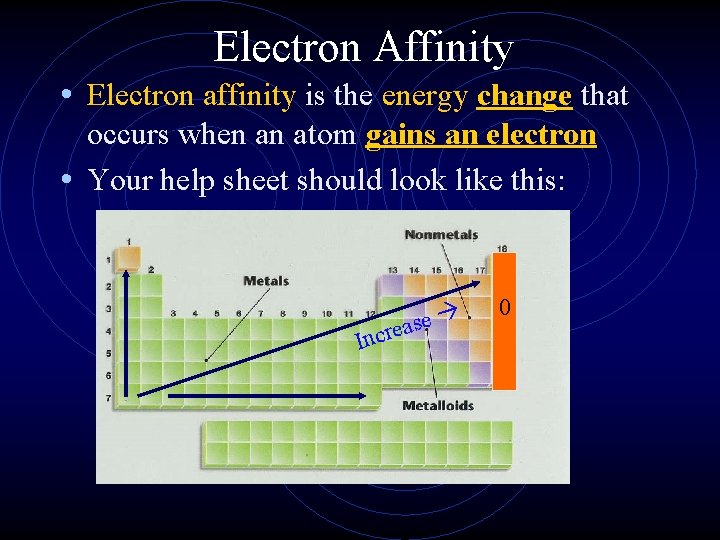
Electron Affinity • Electron affinity is the energy change that occurs when an atom gains an electron • Your help sheet should look like this: e e s s a a IInnccrree 0
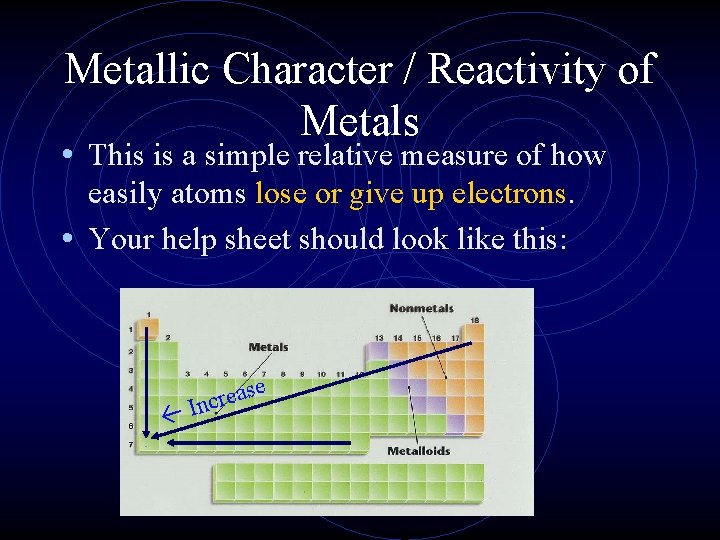
Metallic Character / Reactivity of Metals • This is a simple relative measure of how easily atoms lose or give up electrons. • Your help sheet should look like this: se a e r Inc
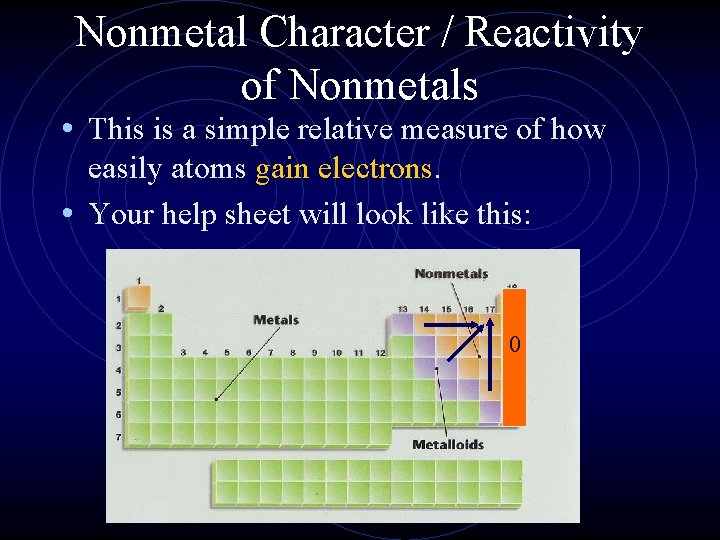
Nonmetal Character / Reactivity of Nonmetals • This is a simple relative measure of how easily atoms gain electrons. • Your help sheet will look like this: 0
The Octet Rule • The “goal” of most atoms (except H, Li and Be) is to have an octet or group of 8 electrons in their valence energy level. • They may accomplish this by either giving electrons away or taking them. • Metals generally give electrons, nonmetals take them from other atoms. • Atoms that have gained or lost electrons are called ions.
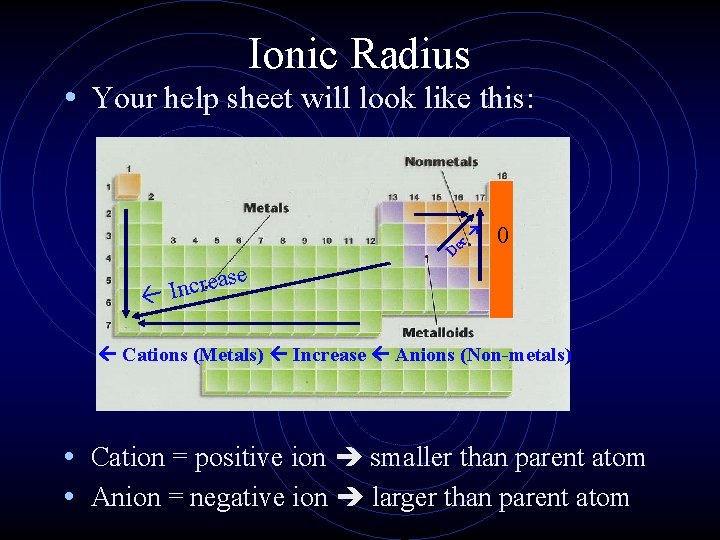
Ions • When an atom gains an electron, it becomes negatively charged (more electrons than protons ) and is called an anion. • In the same way that nonmetal atoms can gain electrons, metal atoms can lose electrons. • They become positively charged cations. • Ionic radius is a measure of the size of an atom’s ion.
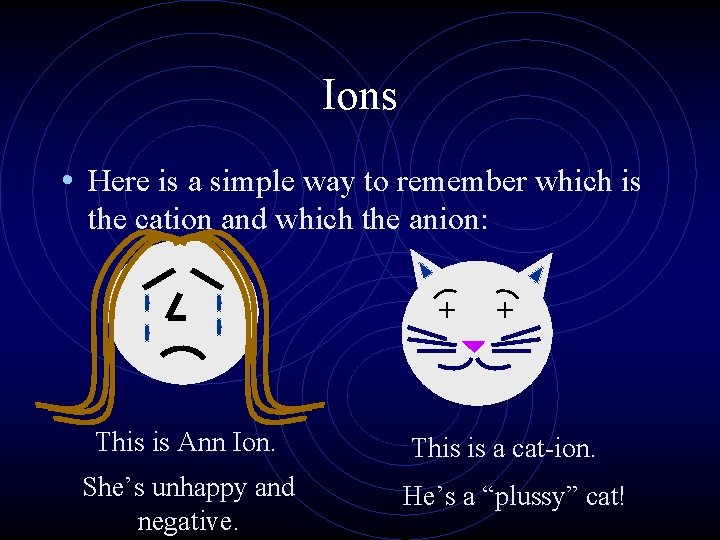
Ions • Here is a simple way to remember which is the cation and which the anion: + This is Ann Ion. She’s unhappy and negative. + This is a cat-ion. He’s a “plussy” cat!
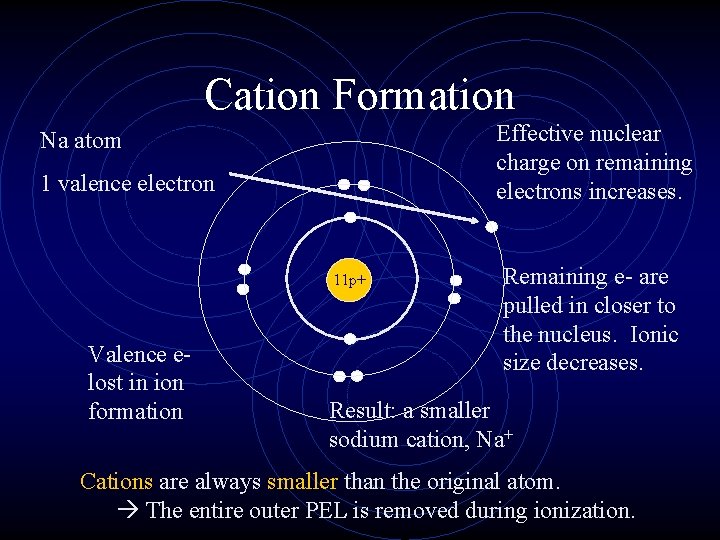
Cation Formation Effective nuclear charge on remaining electrons increases. Na atom 1 valence electron 11 p+ Valence elost in ion formation Remaining e- are pulled in closer to the nucleus. Ionic size decreases. Result: a smaller sodium cation, Na+ Cations are always smaller than the original atom. The entire outer PEL is removed during ionization.
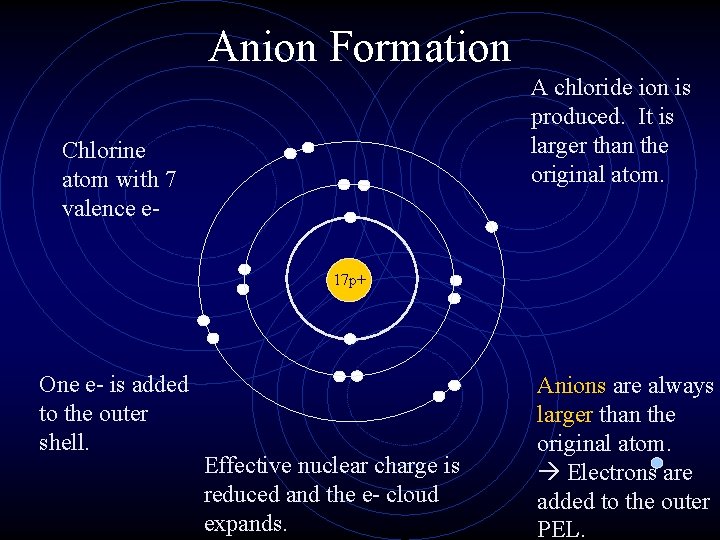
Anion Formation A chloride ion is produced. It is larger than the original atom. Chlorine atom with 7 valence e 17 p+ One e- is added to the outer shell. Effective nuclear charge is reduced and the e- cloud expands. Anions are always larger than the original atom. Electrons are added to the outer PEL.
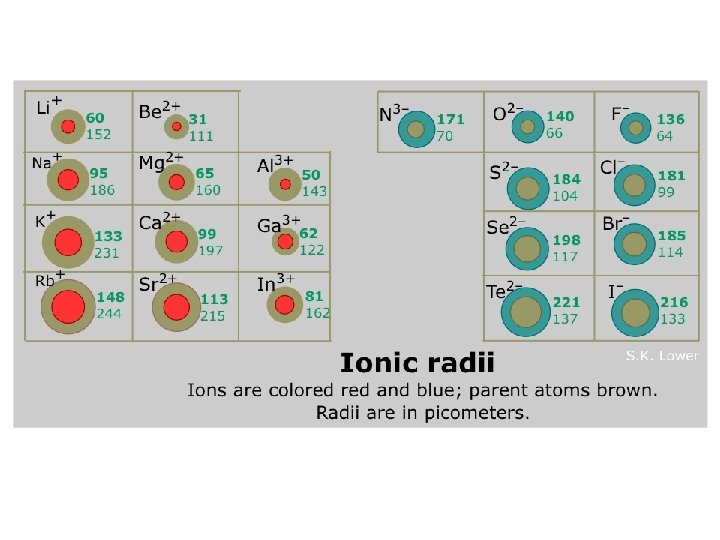
Ionic Radius • Your help sheet will look like this: c e D 0 se a e r c In Cations (Metals) Increase Anions (Non-metals) • Cation = positive ion smaller than parent atom • Anion = negative ion larger than parent atom
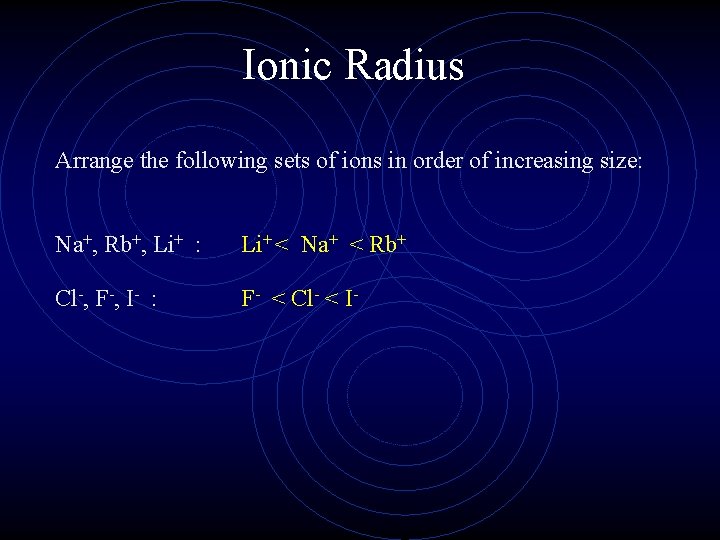
Ionic Radius Arrange the following sets of ions in order of increasing size: Na+, Rb+, Li+ : Li+ < Na+ < Rb+ Cl-, F-, I- : F- < Cl- < I-