
Periodic Table History and Trends Objectives To know
Periodic Table History and Trends
• Objectives • • • To know who created the periodic table in its current form. To understand how the periodic table is laid out. Identify trends in the periodic table and in the groups within it.
• Previous Models of for Elements • • Today we know of over 100 different elements. We know things like: • • • Reactivity, weights, how it will bond with other elements, etc. But how do scientists arrange the elements so that they can be presented in a way that is useful and attempts to illustrate predictable characteristics of these? There have been several unsuccessful attempts at arranging the elements to display the trends in their properties.
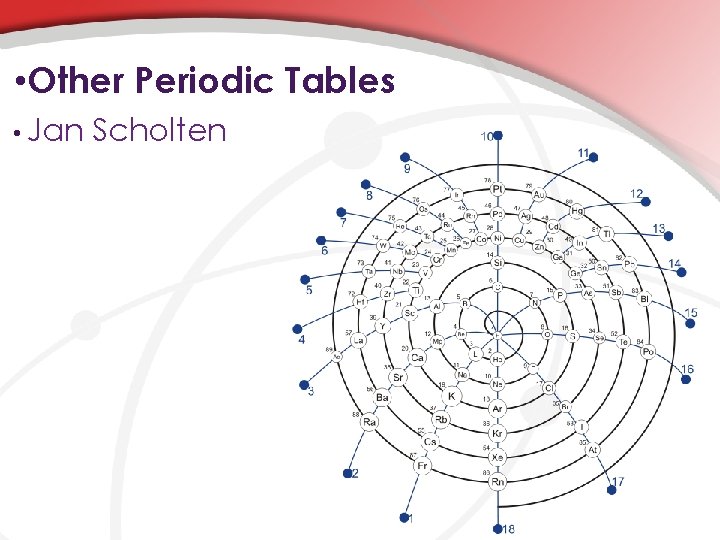
• Other Periodic Tables • Jan Scholten
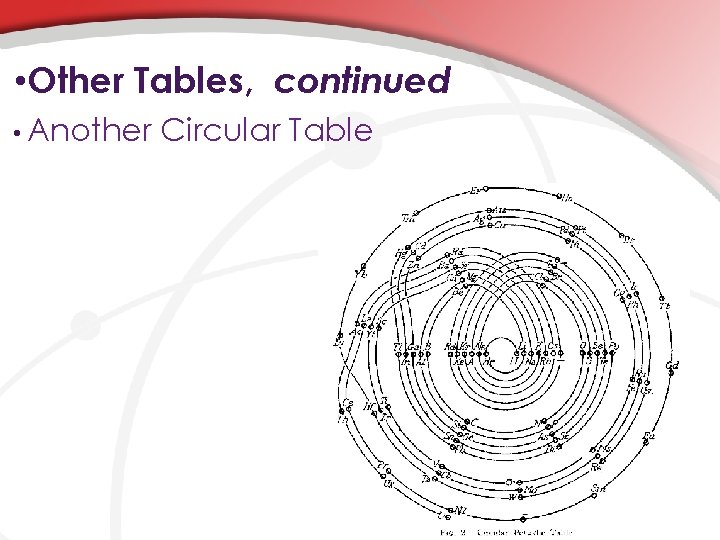
• Other Tables, continued • Another Circular Table
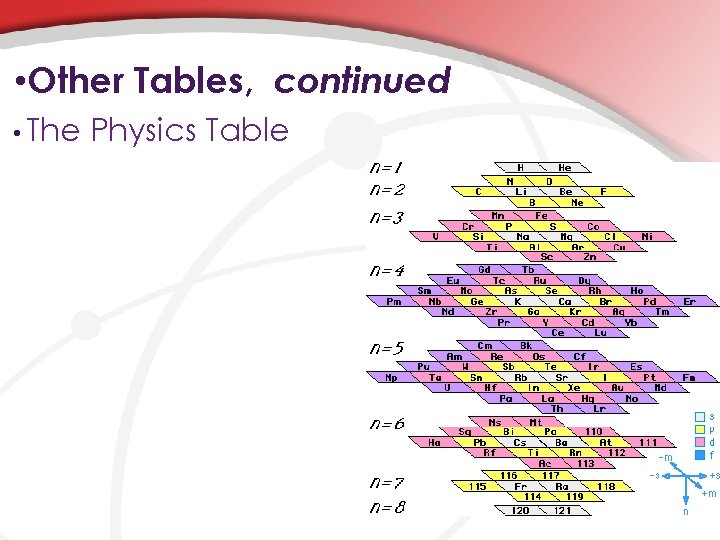
• Other Tables, continued • The Physics Table
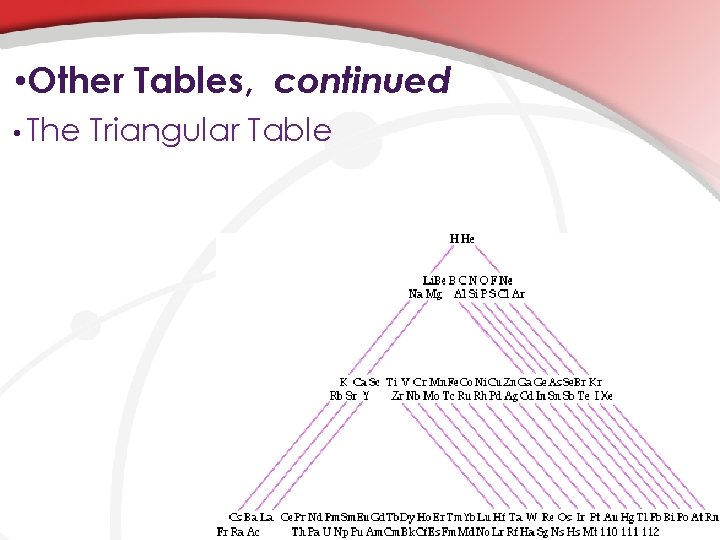
• Other Tables, continued • The Triangular Table
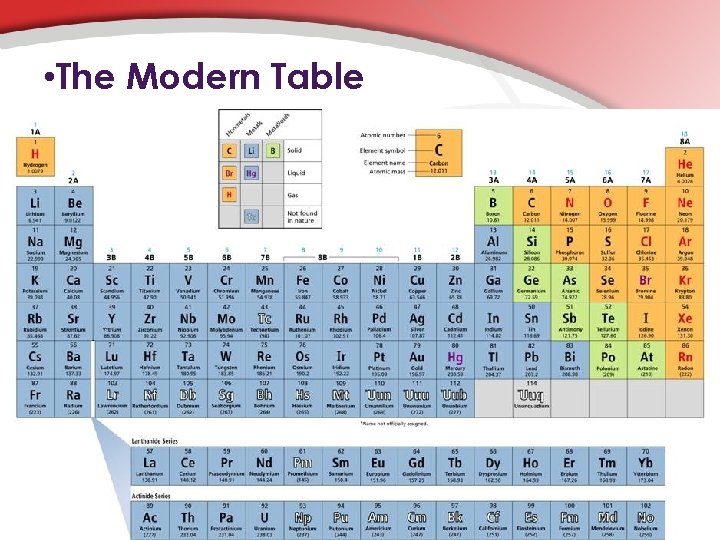
• The Modern Table
Foundations of the Modern Periodic Table • Due to the enlightenment and advances in science, by 1750 scientists had discovered 17 elements. • In 1789, Antoine Lavoisier attempted to categorize these elements into classes, but he failed to capture the essence of how elements were different though similar. • • In the 1860 s, with even more elements known (63 by then), Russian Chemist Dmitri Mendeleev gave it another attempt. Using the game of solitaire as a template, Mendeleev arranged cards of the elements he had created, displaying their names, masses, properties, and how they reacted with hydrogen and oxygen, into a basic arrangement. • His final proposal: Mendeleev arranged the elements in rows, first, in order of increasing atomic mass (which is? ), then, so that the elements with similar properties were arranged in the same column.

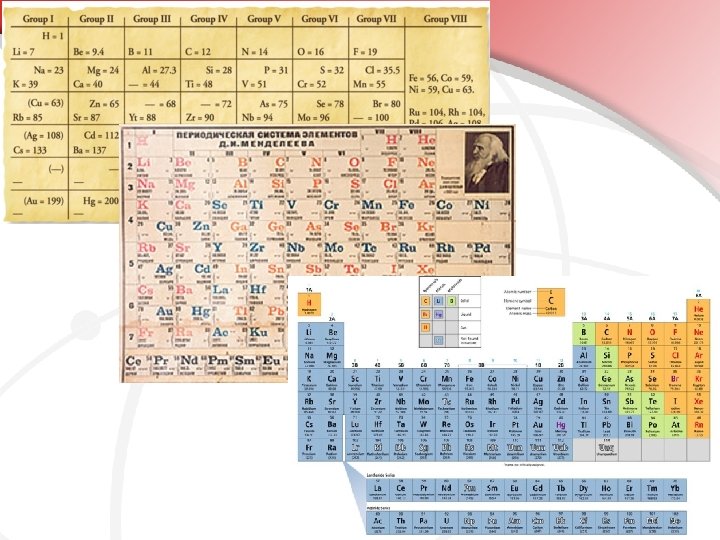
• Mendeleev’s Periodic Table • • What he came up with was this. The interesting fact about Mendeleev’s table was that despite not knowing all the elements yet (& making a few mistakes), he was able to create a table that grouped elements accurately by properties, but also PREDICTED that there were other undiscovered elements whose properties could be predicted.
• Paint Chip Lab • Much like Mendeleev, if given a bunch of information that relates to each other in various ways, how do you arrange it? What would your strategy be? • Today you’ll be given a package of paint chips so you and your group can attempt to arrange these a way that makes sense to create an organized presentation of them. • Lab Protocols: 1. Work with a partner in your assigned groups of 4. Stay in your area. If you don’t have enough seats at the tables, move your group to desks. 2. You will need one worksheet person and each person will turn in the completed worksheet. You will need one bag of paint chips (paint sample cards) too. Stay organized. If duplicates are found, let me know. 3. Participate. This is everyone’s responsibility. While working, I expect contributions from everyone. 4. Act right. Stay off your phones. No horseplay. Everyone earns the same points if everyone is working together. Those that have to be separated will have an opportunity to practice self-discipline and copy out of a book.
• Paint Chip Lab 1. Look at your paint chips and think of three different ways the paint chips can be organized. Write these down for #1. Take your time. 2. Out of those three ways, classify the paint chips, organize these into groups, and piles. Describe the organization. 3. Then, arrange the piles into vertical columns. All paint chips will be visible. Arranged horizontally, the different groups should have distinct features. Do not reorganize groups in any other way at this point. There is not right or wrong way. Describe the group organization at this point. 4. Skip #4. 5. Answer the post-lab questions as groups. Each member must contribute. Each individual will turn in their own so pay attention. 6. For homework (or the rest of class) answer the rest of the questions. You can use 1 chemistry book per pair to do a little research on Mendeleev. What’s not done in class must be done at home. Due tomorrow. 25 pt. Lab grade.
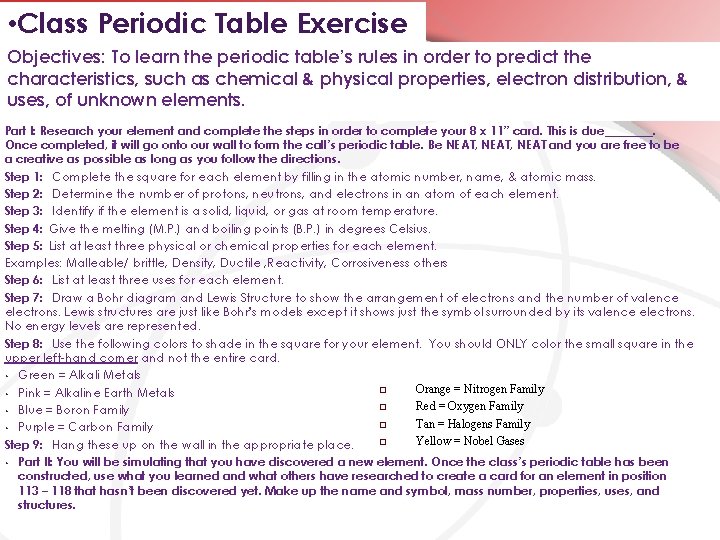
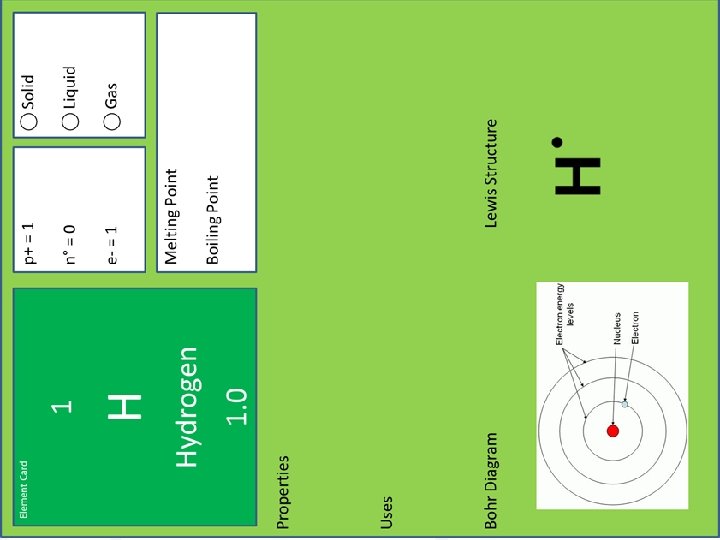
• Class Periodic Table Exercise Objectives: To learn the periodic table’s rules in order to predict the characteristics, such as chemical & physical properties, electron distribution, & uses, of unknown elements. Part I: Research your element and complete the steps in order to complete your 8 x 11” card. This is due____. Once completed, it will go onto our wall to form the call’s periodic table. Be NEAT, NEAT and you are free to be a creative as possible as long as you follow the directions. Step 1: Complete the square for each element by filling in the atomic number, name, & atomic mass. Step 2: Determine the number of protons, neutrons, and electrons in an atom of each element. Step 3: Identify if the element is a solid, liquid, or gas at room temperature. Step 4: Give the melting (M. P. ) and boiling points (B. P. ) in degrees Celsius. Step 5: List at least three physical or chemical properties for each element. Examples: Malleable/ brittle, Density, Ductile , Reactivity, Corrosiveness others Step 6: List at least three uses for each element. Step 7: Draw a Bohr diagram and Lewis Structure to show the arrangement of electrons and the number of valence electrons. Lewis structures are just like Bohr’s models except it shows just the symbol surrounded by its valence electrons. No energy levels are represented. Step 8: Use the following colors to shade in the square for your element. You should ONLY color the small square in the upper left-hand corner and not the entire card. • Green = Alkali Metals o Orange = Nitrogen Family • Pink = Alkaline Earth Metals o Red = Oxygen Family • Blue = Boron Family o Tan = Halogens Family • Purple = Carbon Family o Yellow = Nobel Gases Step 9: Hang these up on the wall in the appropriate place. • Part II: You will be simulating that you have discovered a new element. Once the class’s periodic table has been constructed, use what you learned and what others have researched to create a card for an element in position 113 – 118 that hasn’t been discovered yet. Make up the name and symbol, mass number, properties, uses, and structures.
• Modern Periodic Table Anatomy We’ve discussed the anatomy of an atom and you know what makes one element different than another. • You know how many rings an atom has, where protons, neutrons, and electrons go, and the concept of valence electrons. • Now we will proceed to discuss the elements in further detail and why the periodic table is set up the way it is. • • First, know the Periodic Table is based upon Periodic Table Law: the table is set up to highlight the pattern of repeating properties.
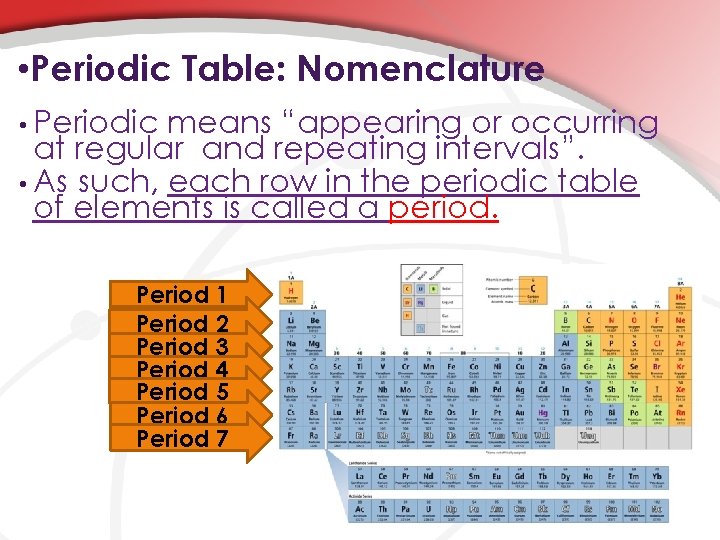
• Periodic Table: Nomenclature • Periodic means “appearing or occurring at regular and repeating intervals”. • As such, each row in the periodic table of elements is called a period. Period 1 Period 2 Period 3 Period 4 Period 5 Period 6 Period 7
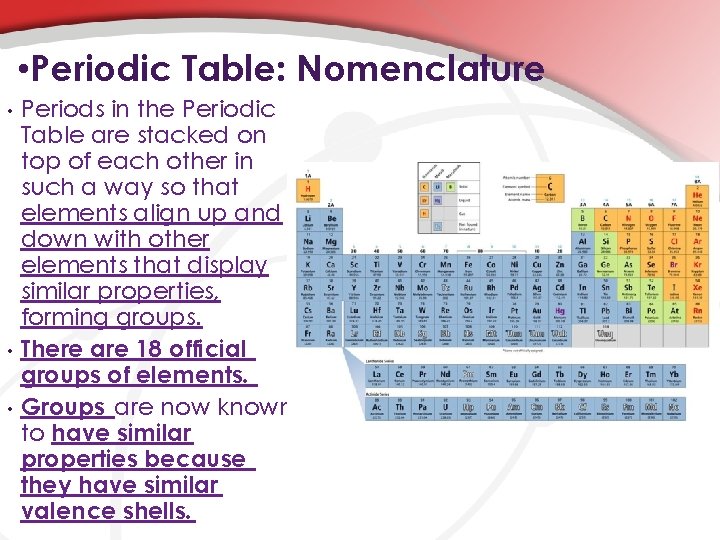
• Periodic Table: Nomenclature • • • Periods in the Periodic Table are stacked on top of each other in such a way so that elements align up and down with other elements that display similar properties, forming groups. There are 18 official groups of elements. Groups are now known to have similar properties because they have similar valence shells.
• Periodic Table: Groups of Groups • • These 18 groups are broken down into what are known as the 11 Representative Groups. These are: 1. 2. 3. 4. 5. • The Alkali Metals The Alkaline Earth Metals The Transition Elements The Lanthanides Group The Actinides Group The Boron Group The Carbon Group The Oxygen Group The Nitrogen Group 10. The Halogens 11. The Nobel Gasses 6. 7. 8. 9. The highlighted groups are the ones you are responsible for researching and knowing.
• Periodic Table Groups • • For this part of the unit, you will research groups to discover what the major properties of each group is. Understand that though elements are arranged in groups, which would imply similar properties, elements do not have exactly the same properties because they have different energy levels, numbers of protons, neutrons, and electrons. This is important to note, because you cannot simply substitute another element in the same group for another element to get the same result in a compound (more than one element bonded together). For example, water is hydrogen and oxygen. We cannot substitute, say, silicon for oxygen and get a fluid that can sustain life even though oxygen and silicon have the same valence shells.
• Trends in the Modern Periodic Table You know a few trends in the periodic table already… • As you move up atomic numbers, the atoms gain one more proton. • You use proton numbers to determine electron numbers. • Atomic mass – atomic number gives you neutrons. • As you move down rows, atoms gain energy levels (rings). • Valence shell electrons are determined by the column the element is in. • There are three ways to classify the elements. 1. Based upon their properties. 2. If they are solids, liquids, or gasses at room temperature. 3. If they occur naturally or only in laboratory settings. •
• Trends in the Modern Periodic Table Across a period from left to right, elements become less metallic and more nonmetallic in their properties. • There are three main categories of properties: 1. Metals 2. Nonmetals 3. Metalloids •
• Modern Periodic Table: Metals • • • The majority of elements are metals Metals are elements that are good conductors of electricity and heat. Generally, they are solids (like magnesium) or liquids (like mercury) Commonly have properties such as: Malleability Being ductile Reactive (oxidize or rust in oxygen) Transition metals : (these fall in the B columns) bridge between the left and right sides of the PTE. Include precious metals like gold, silver, and platinum.
• Modern Periodic Table: Nonmetals are elements that are poor conductors of heat and electricity. • They generally have low melting points and are usually gases at room temp. • Solid nonmetals are very brittle and will shatter or crumble. • But they vary as much chemically as they do physically. • Some are very reactive, some are inert (nonreactive). •
• Modern Periodic Table: Metalloids are elements with properties between metals and non-metals. • As such they tend to share properties, such as being conductors or not, with both metals and nonmetals. • This is generally dependent upon things like temperature. • Silicon is a good insulator at room temperature but conducts well at high temps. •
• Trends in the Modern Periodic Table • Before we move into bonding, it’s important to note one • • • additional trend in the periodic table that refers to an element’s tendency regarding how electrons are used to accomplish the Octet Rule. Remember, the valence shell can only have 8 electrons in it. If an element does not have 8 it will interact with other elements in ways that allow for them to reach 8. The issue is, some elements are closer to achieving 8 than others. Some would achieve 8 if they lost a few, some would achieve 8 if they gained a few. In general, the closer they are to achieving 8 means the more likely they are to do so. This leads us to the last trend we need to know: ionization energy.
• Modern Periodic Table: Ionization Energy • The amount of energy required to remove an electron is called ionization energy. • The lower the ionization energy, the easier it is to remove an e- from an atom. • In general: Ionization energies increase from left to right • Ionization energies increase from bottom to top. •
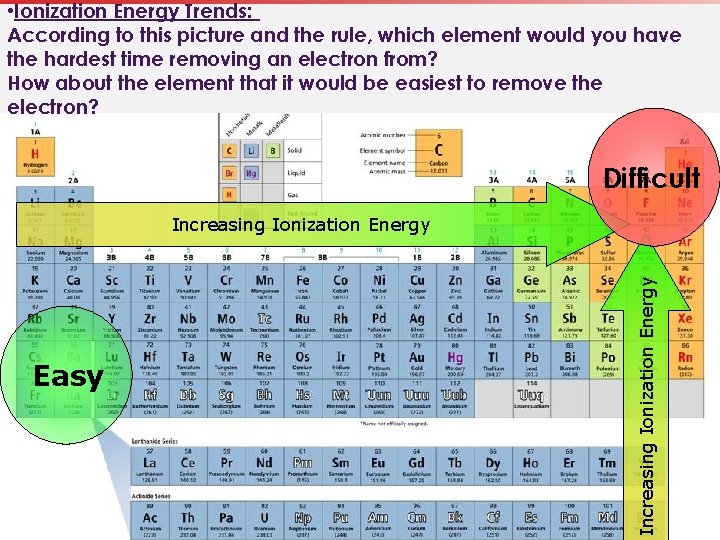
• Ionization Energy Trends: According to this picture and the rule, which element would you have the hardest time removing an electron from? How about the element that it would be easiest to remove the electron? Difficult Easy Increasing Ionization Energy
Lanthanides Group Actinides Group
Label your Periodic groups and fill in with Tables their names. Color • PERIODS: Fill in the arrow match elements for period numbers, but involved with the arrows. don’t highlight/color all • Shade in each group below using a different the elements in the periods. Only the arrows. PATTERN AND MAKE A KEY for… • GROUP HEADINGS: • Metals Write in the headings for each of the groups • Nonmetals (there will be 18 number- • Metalloids letter labels; A’s & B’s) • Transition metals, • Using different colors Lanthanides, & Actinides and/or patterns, highlight/label/outline… • Lightly draw in block arrows showing how • REPRESENTATIVE ionization energies GROUPS: Color each of change over the arrows for each of periodic table. the 8 representative •
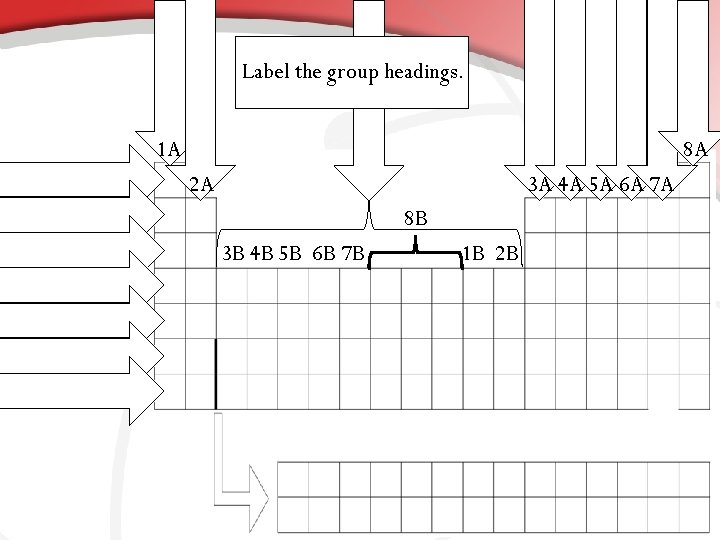
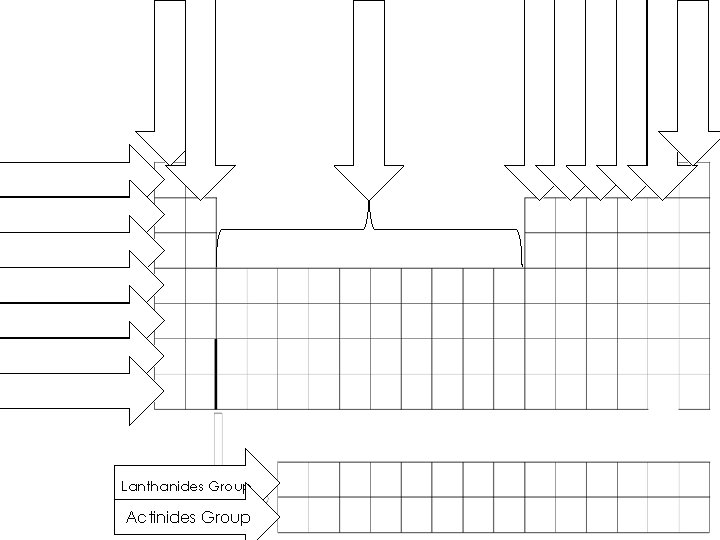
Label the group headings. 1 A 8 A 2 A 3 A 4 A 5 A 6 A 7 A 8 B 3 B 4 B 5 B 6 B 7 B 1 B 2 B
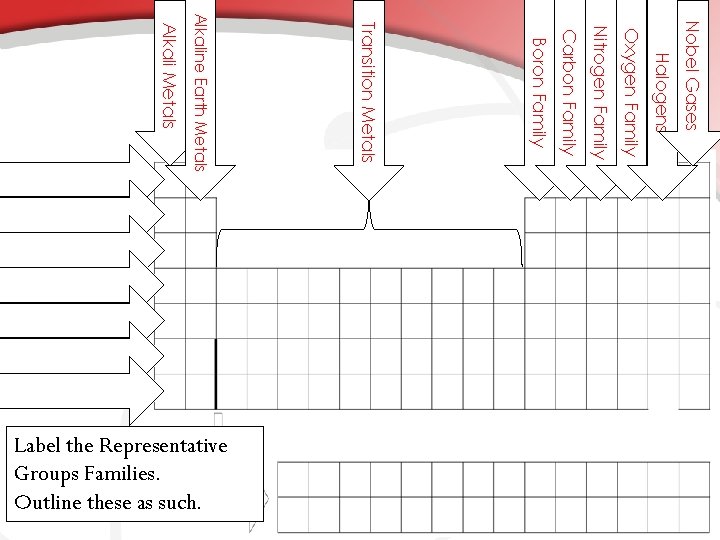
Nobel Gases Halogens Oxygen Family Nitrogen Family Carbon Family Boron Family Transition Metals Alkaline Earth Metals Alkali Metals Label the Representative Groups Families. Outline these as such.
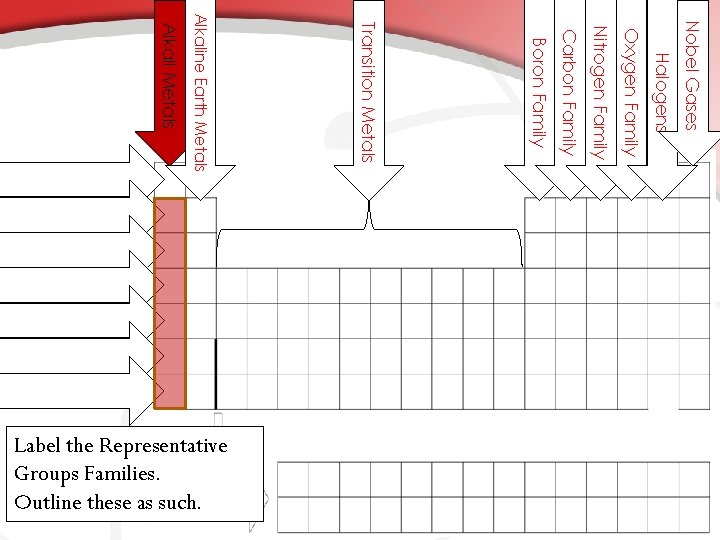
Nobel Gases Halogens Oxygen Family Nitrogen Family Carbon Family Boron Family Transition Metals Alkaline Earth Metals Alkali Metals Label the Representative Groups Families. Outline these as such.
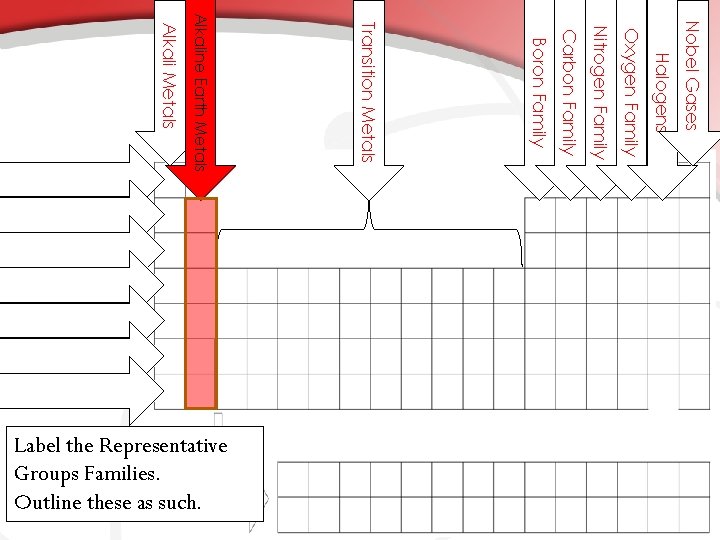
Nobel Gases Halogens Oxygen Family Nitrogen Family Carbon Family Boron Family Transition Metals Alkaline Earth Metals Alkali Metals Label the Representative Groups Families. Outline these as such.
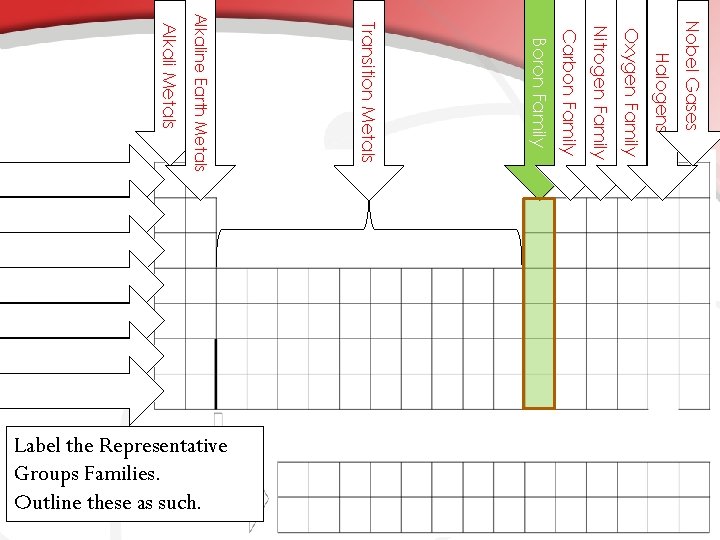
Nobel Gases Halogens Oxygen Family Nitrogen Family Carbon Family Boron Family Transition Metals Alkaline Earth Metals Alkali Metals Label the Representative Groups Families. Outline these as such.
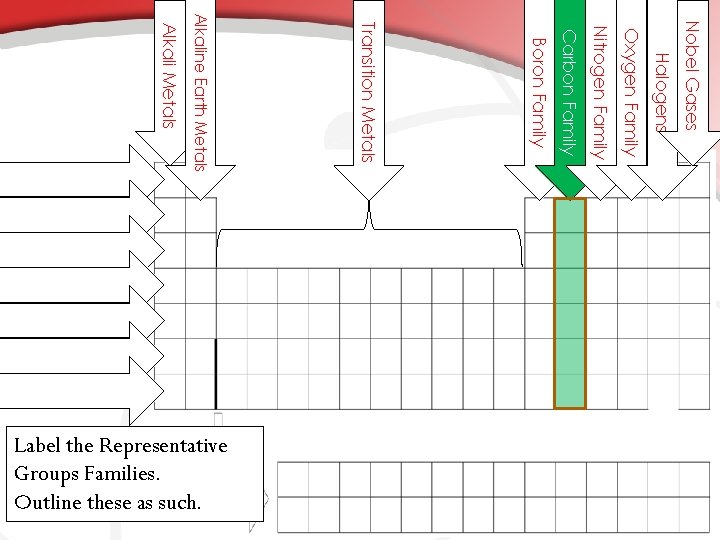
Nobel Gases Halogens Oxygen Family Nitrogen Family Carbon Family Boron Family Transition Metals Alkaline Earth Metals Alkali Metals Label the Representative Groups Families. Outline these as such.
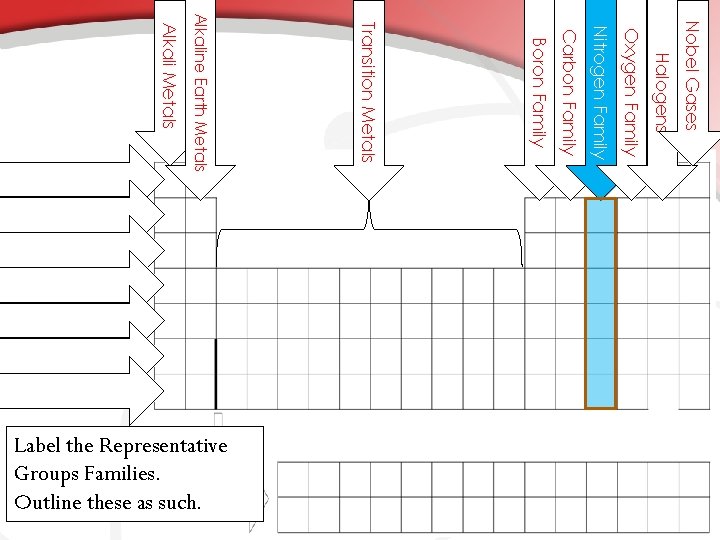
Nobel Gases Halogens Oxygen Family Nitrogen Family Carbon Family Boron Family Transition Metals Alkaline Earth Metals Alkali Metals Label the Representative Groups Families. Outline these as such.
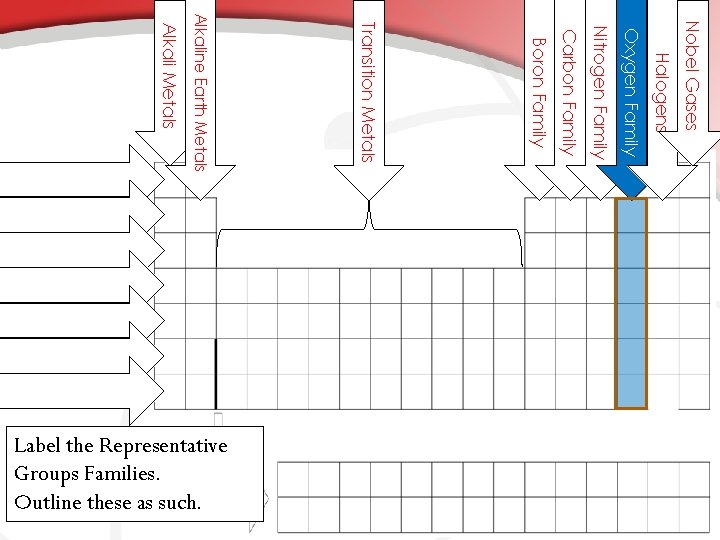
Nobel Gases Halogens Oxygen Family Nitrogen Family Carbon Family Boron Family Transition Metals Alkaline Earth Metals Alkali Metals Label the Representative Groups Families. Outline these as such.
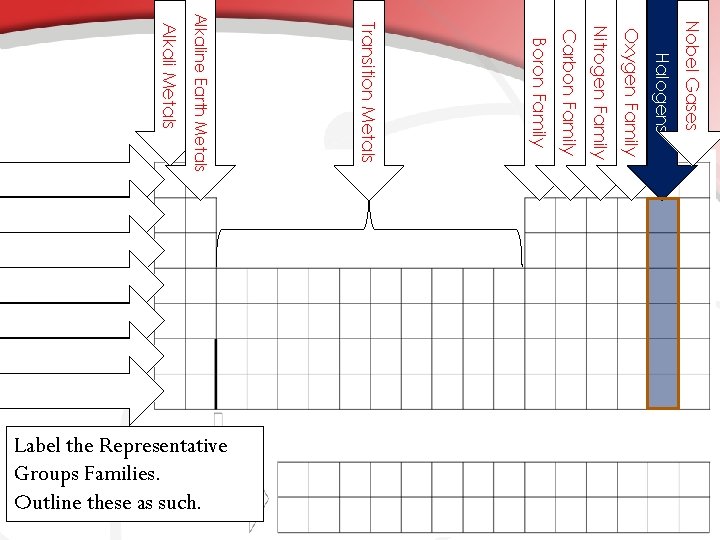
Nobel Gases Halogens Oxygen Family Nitrogen Family Carbon Family Boron Family Transition Metals Alkaline Earth Metals Alkali Metals Label the Representative Groups Families. Outline these as such.
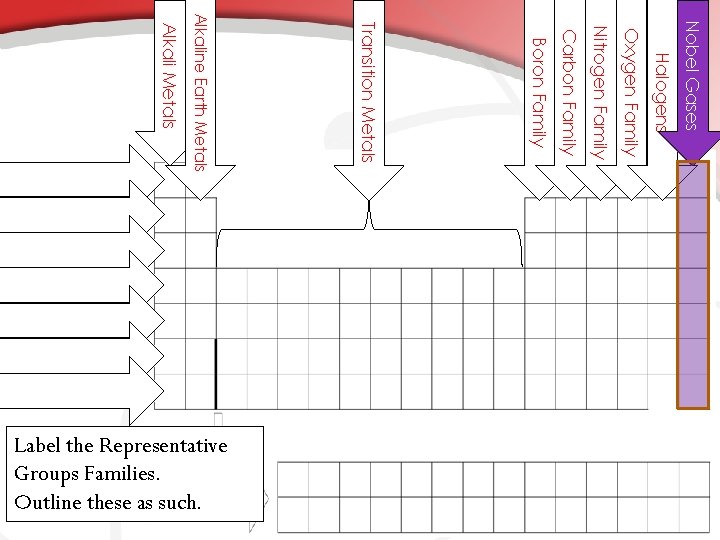
Nobel Gases Halogens Oxygen Family Nitrogen Family Carbon Family Boron Family Transition Metals Alkaline Earth Metals Alkali Metals Label the Representative Groups Families. Outline these as such.
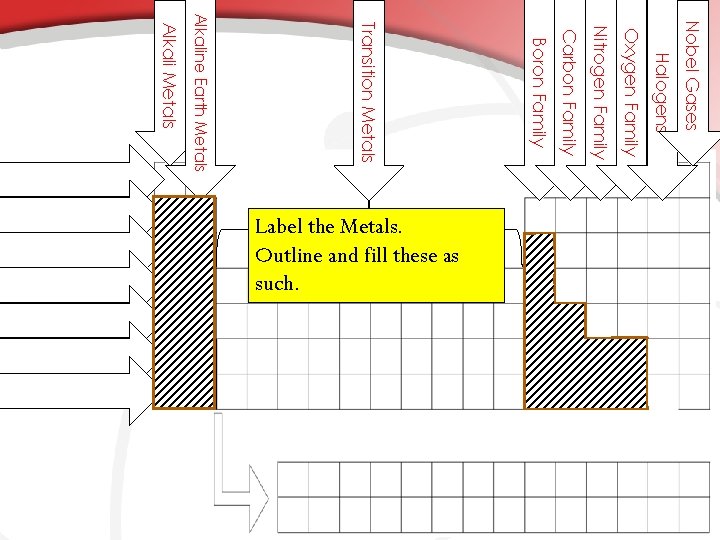
Nobel Gases Halogens Oxygen Family Nitrogen Family Carbon Family Boron Family Transition Metals Alkaline Earth Metals Alkali Metals Label the Metals. Outline and fill these as such.
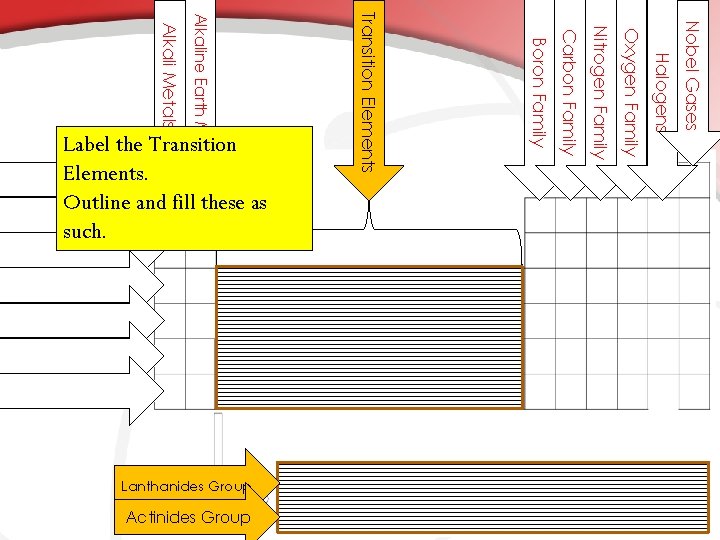
Nobel Gases Halogens Oxygen Family Nitrogen Family Carbon Family Actinides Group Boron Family Lanthanides Group Transition Elements Alkali Metals Alkaline Earth Metals Label the Transition Elements. Outline and fill these as such.
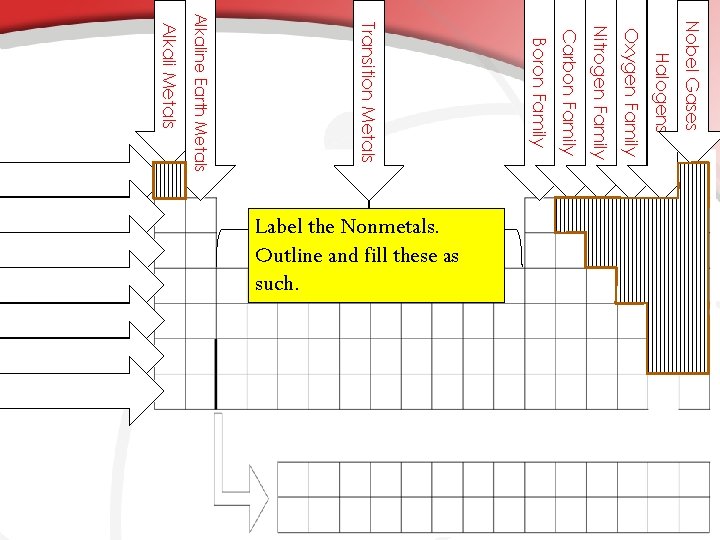
Nobel Gases Halogens Oxygen Family Nitrogen Family Carbon Family Boron Family Transition Metals Alkaline Earth Metals Alkali Metals Label the Nonmetals. Outline and fill these as such.
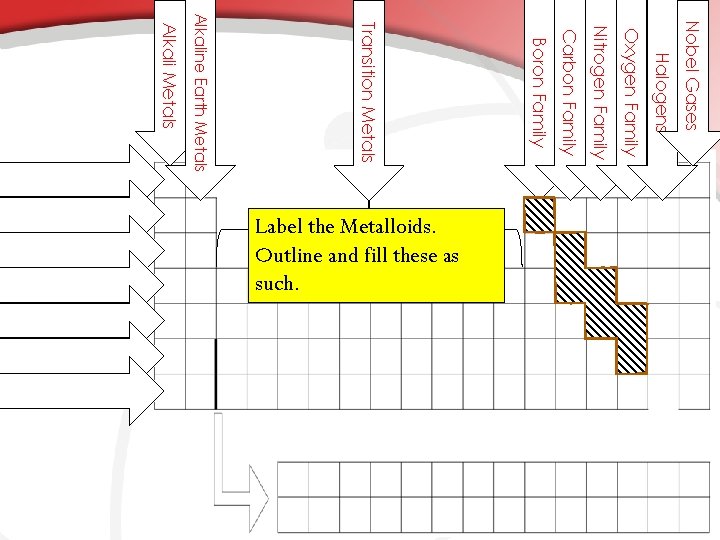
Nobel Gases Halogens Oxygen Family Nitrogen Family Carbon Family Boron Family Transition Metals Alkaline Earth Metals Alkali Metals Label the Metalloids. Outline and fill these as such.
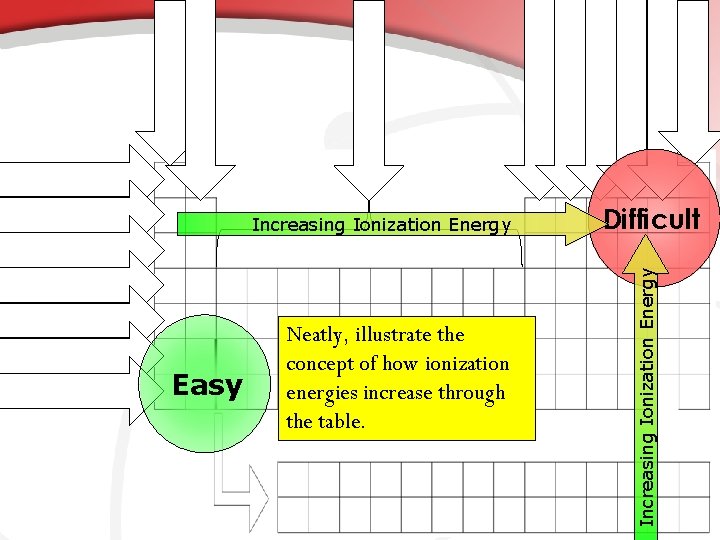
Easy Neatly, illustrate the concept of how ionization energies increase through the table. Difficult Increasing Ionization Energy
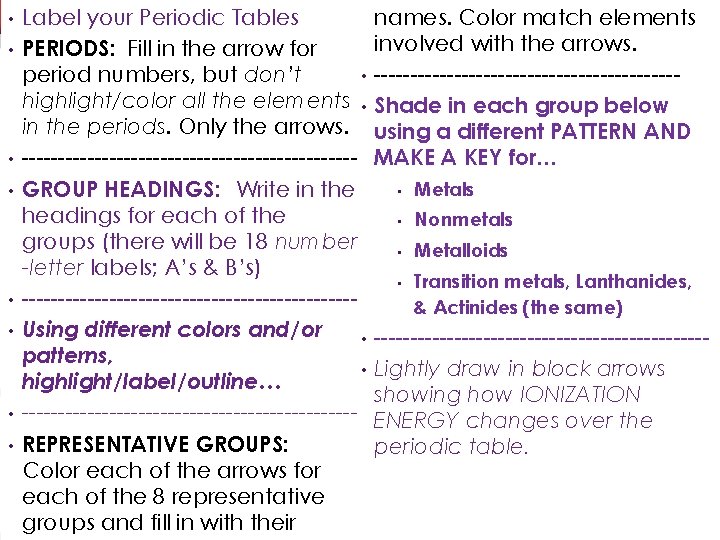
• • Label your Periodic Tables PERIODS: Fill in the arrow for period numbers, but don’t • highlight/color all the elements • in the periods. Only the arrows. -----------------------GROUP HEADINGS: Write in the headings for each of the groups (there will be 18 number -letter labels; A’s & B’s) -----------------------Using different colors and/or • patterns, • highlight/label/outline… -----------------------REPRESENTATIVE GROUPS: Color each of the arrows for each of the 8 representative groups and fill in with their names. Color match elements involved with the arrows. ---------------------Shade in each group below using a different PATTERN AND MAKE A KEY for… • Metals • Nonmetals • Metalloids • Transition metals, Lanthanides, & Actinides (the same) -----------------------Lightly draw in block arrows showing how IONIZATION ENERGY changes over the periodic table.
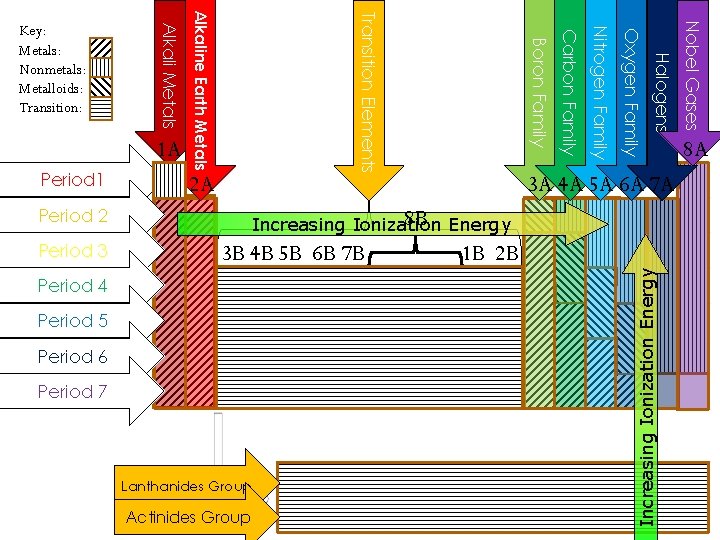
3 A 4 A 5 A 6 A 7 A 3 B 4 B 5 B 6 B 7 B Period 4 Period 5 Period 6 Period 7 Lanthanides Group Actinides Group 1 B 2 B Increasing Ionization Energy 8 B Energy Increasing Ionization Nobel Gases Halogens Oxygen Family Period 3 Nitrogen Family Period 2 Carbon Family 2 A Boron Family Period 1 Transition Elements 1 A Alkaline Earth Metals Alkali Metals Key: Metals: Nonmetals: Metalloids: Transition: 8 A
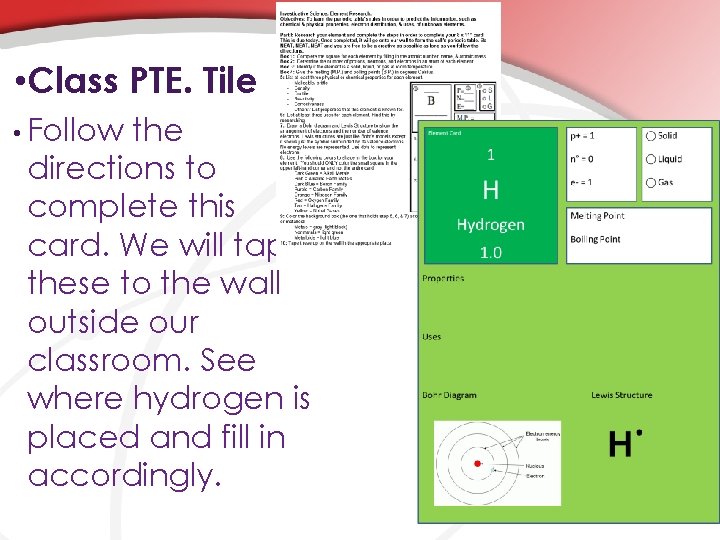
• Class PTE. Tile • Follow the directions to complete this card. We will tape these to the wall outside our classroom. See where hydrogen is placed and fill in accordingly.
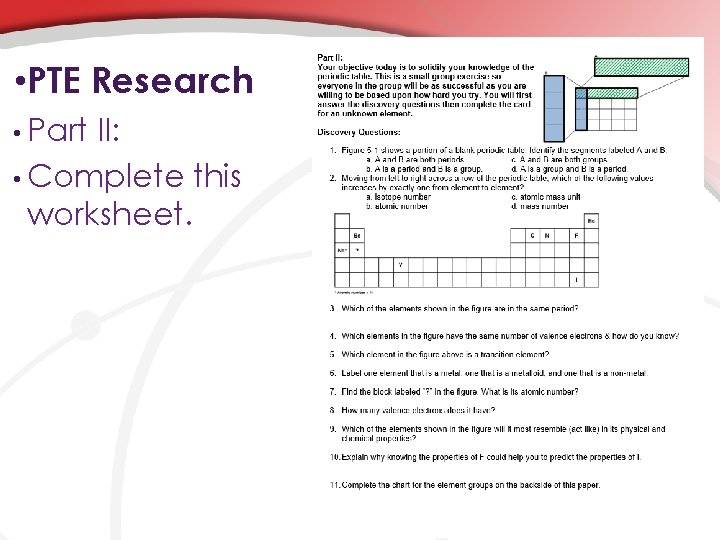
• PTE Research • Part II: • Complete this worksheet.
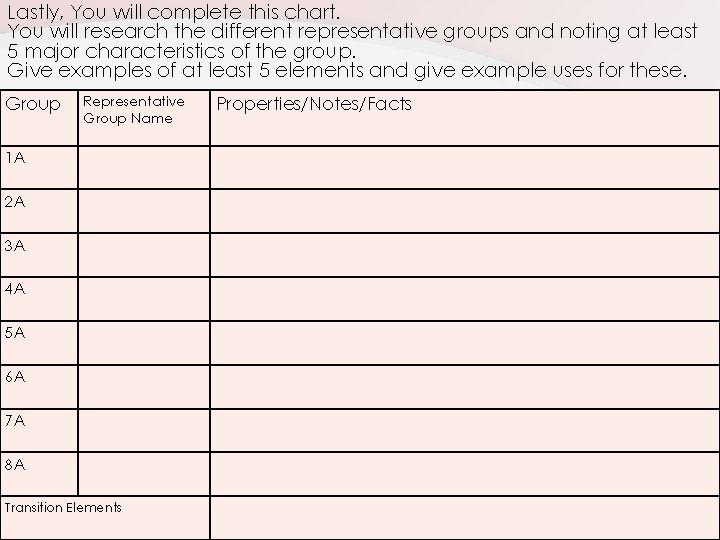
Lastly, You will complete this chart. You will research the different representative groups and noting at least 5 major characteristics of the group. Give examples of at least 5 elements and give example uses for these. Group Representative Group Name Properties/Notes/Facts 1 A 2 A 3 A 4 A 5 A 6 A 7 A 8 A Transition Elements
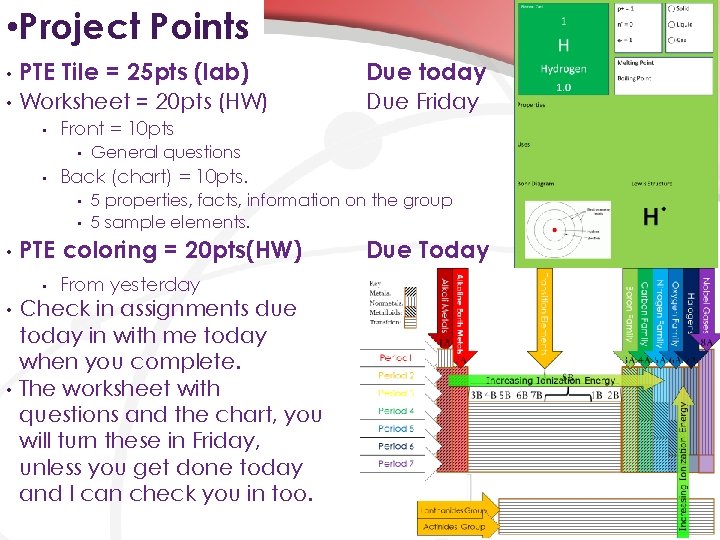
• Project Points • PTE Tile = 25 pts (lab) Due today • Worksheet = 20 pts (HW) Due Friday • Front = 10 pts • • Back (chart) = 10 pts. • • 5 properties, facts, information on the group 5 sample elements. PTE coloring = 20 pts(HW) • • General questions From yesterday Check in assignments due today in with me today when you complete. The worksheet with questions and the chart, you will turn these in Friday, unless you get done today and I can check you in too. Due Today
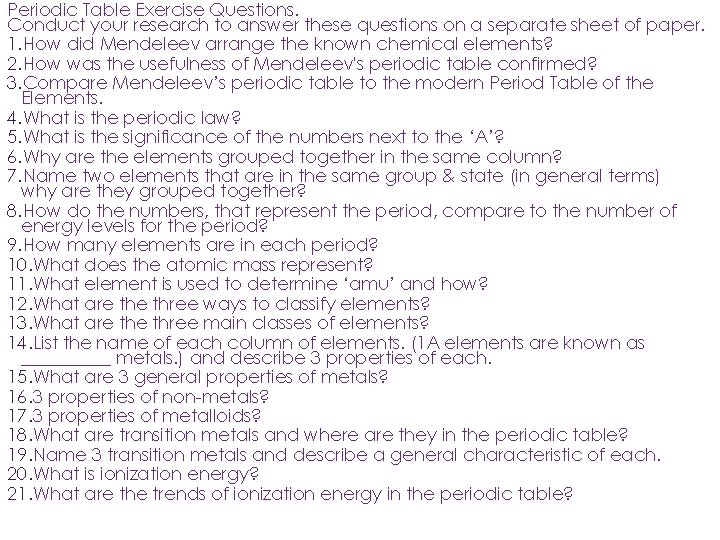
Periodic Table Exercise Questions. Conduct your research to answer these questions on a separate sheet of paper. 1. How did Mendeleev arrange the known chemical elements? 2. How was the usefulness of Mendeleev's periodic table confirmed? 3. Compare Mendeleev’s periodic table to the modern Period Table of the Elements. 4. What is the periodic law? 5. What is the significance of the numbers next to the ‘A’? 6. Why are the elements grouped together in the same column? 7. Name two elements that are in the same group & state (in general terms) why are they grouped together? 8. How do the numbers, that represent the period, compare to the number of energy levels for the period? 9. How many elements are in each period? 10. What does the atomic mass represent? 11. What element is used to determine ‘amu’ and how? 12. What are three ways to classify elements? 13. What are three main classes of elements? 14. List the name of each column of elements. (1 A elements are known as _____ metals. ) and describe 3 properties of each. 15. What are 3 general properties of metals? 16. 3 properties of non-metals? 17. 3 properties of metalloids? 18. What are transition metals and where are they in the periodic table? 19. Name 3 transition metals and describe a general characteristic of each. 20. What is ionization energy? 21. What are the trends of ionization energy in the periodic table?
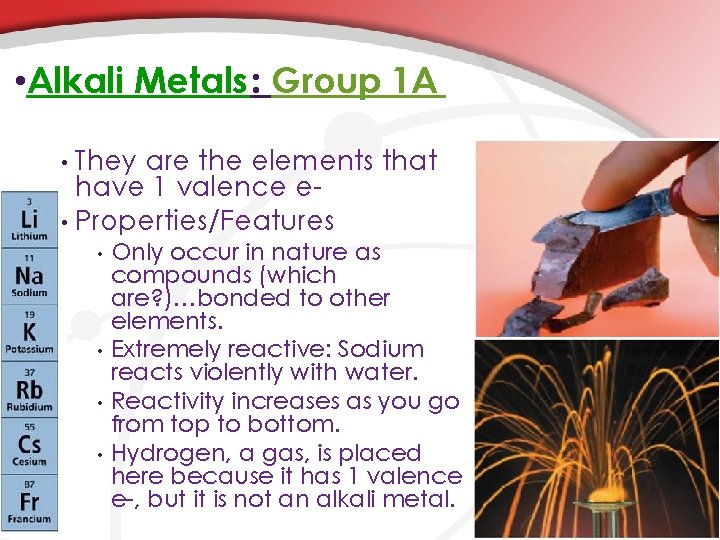
• Alkali Metals: Group 1 A They are the elements that have 1 valence e • Properties/Features • • • Only occur in nature as compounds (which are? )…bonded to other elements. Extremely reactive: Sodium reacts violently with water. Reactivity increases as you go from top to bottom. Hydrogen, a gas, is placed here because it has 1 valence e-, but it is not an alkali metal.
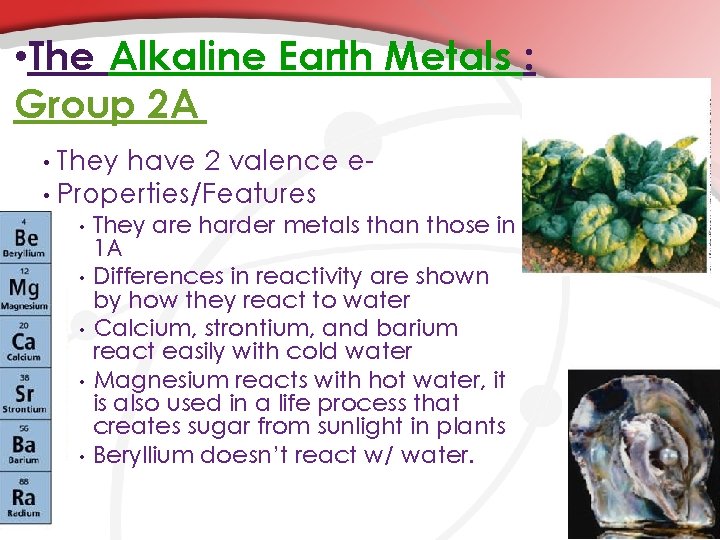
• The Alkaline Earth Metals : Group 2 A They have 2 valence e • Properties/Features • • • They are harder metals than those in 1 A Differences in reactivity are shown by how they react to water Calcium, strontium, and barium react easily with cold water Magnesium reacts with hot water, it is also used in a life process that creates sugar from sunlight in plants Beryllium doesn’t react w/ water.
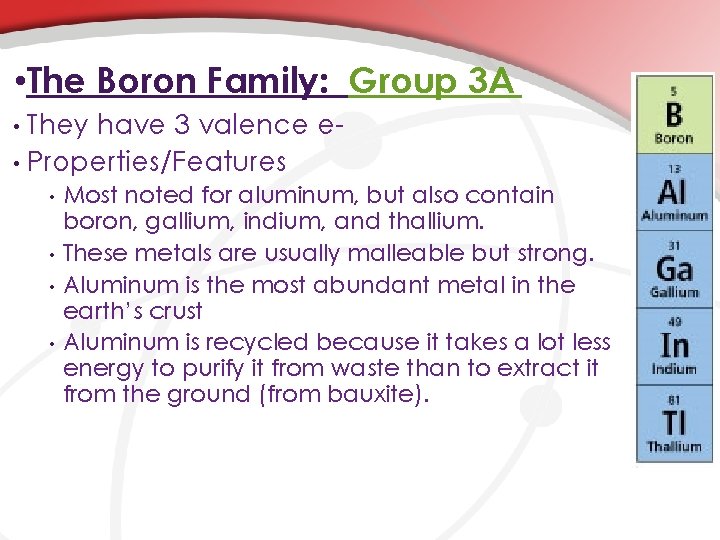
• The Boron Family: Group 3 A They have 3 valence e • Properties/Features • • • Most noted for aluminum, but also contain boron, gallium, indium, and thallium. These metals are usually malleable but strong. Aluminum is the most abundant metal in the earth’s crust Aluminum is recycled because it takes a lot less energy to purify it from waste than to extract it from the ground (from bauxite).
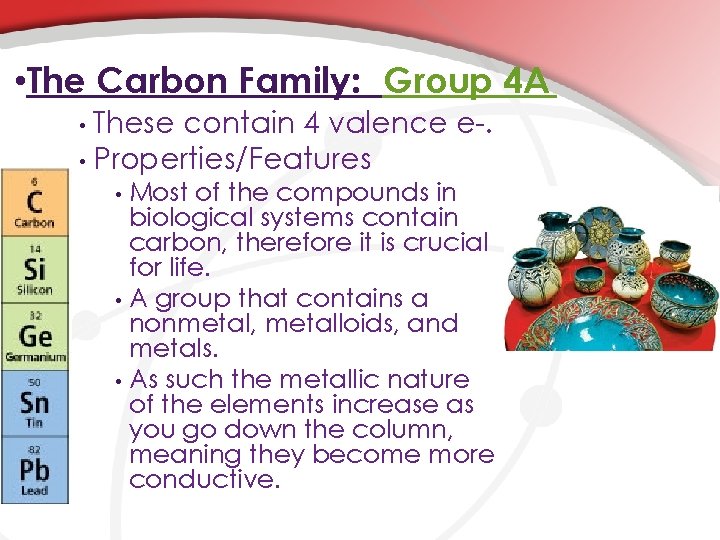
• The Carbon Family: Group 4 A • These contain 4 valence e-. • Properties/Features Most of the compounds in biological systems contain carbon, therefore it is crucial for life. • A group that contains a nonmetal, metalloids, and metals. • As such the metallic nature of the elements increase as you go down the column, meaning they become more conductive. •
• The Nitrogen Family: Group 5 A • Contain 5 valence e • Properties/Features Nitrogen and phosphorus are important elements often used in fertilizers. • This group also contains all three types of elements: metal, metalloid, and nonmetal. •
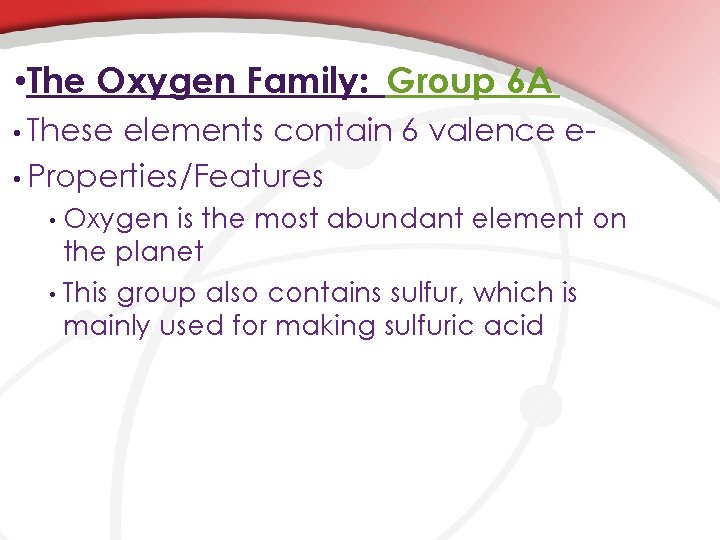
• The Oxygen Family: Group 6 A • These elements contain 6 valence e • Properties/Features Oxygen is the most abundant element on the planet • This group also contains sulfur, which is mainly used for making sulfuric acid •
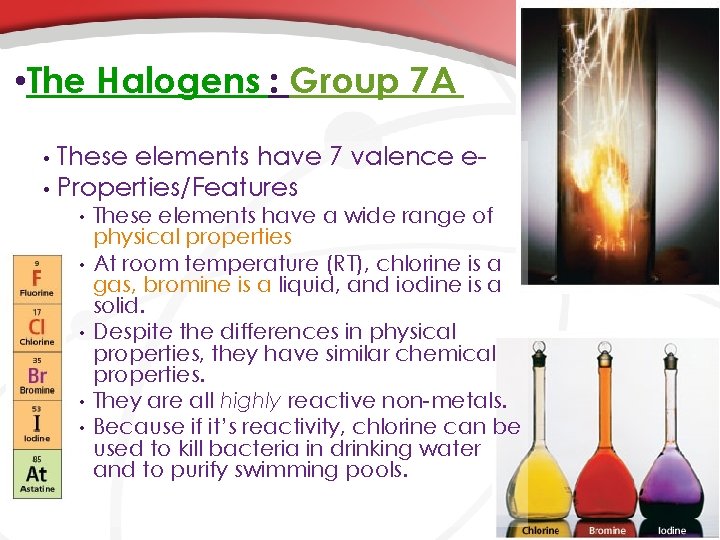
• The Halogens : Group 7 A These elements have 7 valence e • Properties/Features • • • These elements have a wide range of physical properties At room temperature (RT), chlorine is a gas, bromine is a liquid, and iodine is a solid. Despite the differences in physical properties, they have similar chemical properties. They are all highly reactive non-metals. Because if it’s reactivity, chlorine can be used to kill bacteria in drinking water and to purify swimming pools.
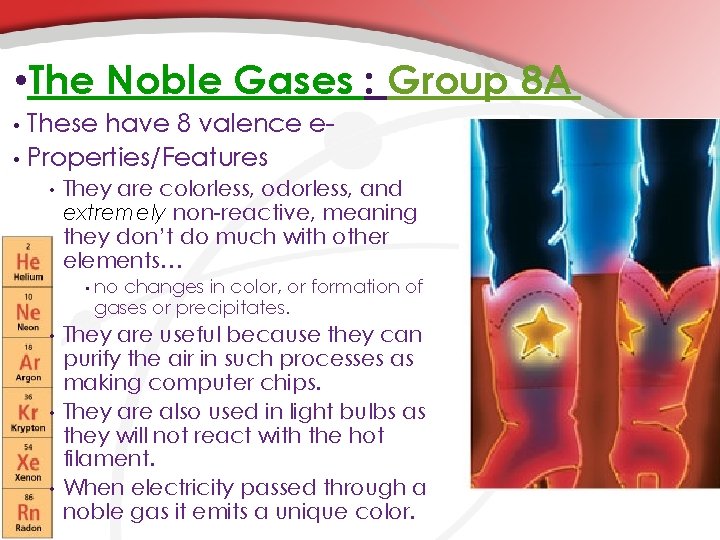
• The Noble Gases : Group 8 A These have 8 valence e • Properties/Features • • They are colorless, odorless, and extremely non-reactive, meaning they don’t do much with other elements… • • no changes in color, or formation of gases or precipitates. They are useful because they can purify the air in such processes as making computer chips. They are also used in light bulbs as they will not react with the hot filament. When electricity passed through a noble gas it emits a unique color.


- Slides: 62