PEGASUSTIMI54 trial Kendall Downer MS 4 Goals and
- Slides: 36
PEGASUS-TIMI-54 trial Kendall Downer MS 4
Goals and Objectives • Explain what clinical question the PEGASUSTIMI 54 trial attempted to answer • Interpret the results of the PEGASUS TIMI 54 trial – Define Number Needed to Treat and Number Needed to Harm – Be able to calculate NNT/NNH • Apply this trial to a real patient case
Outline • • Case Clinical Question Background Trial – Design/methods – Internal validity – Results • External validity/Application • Summary
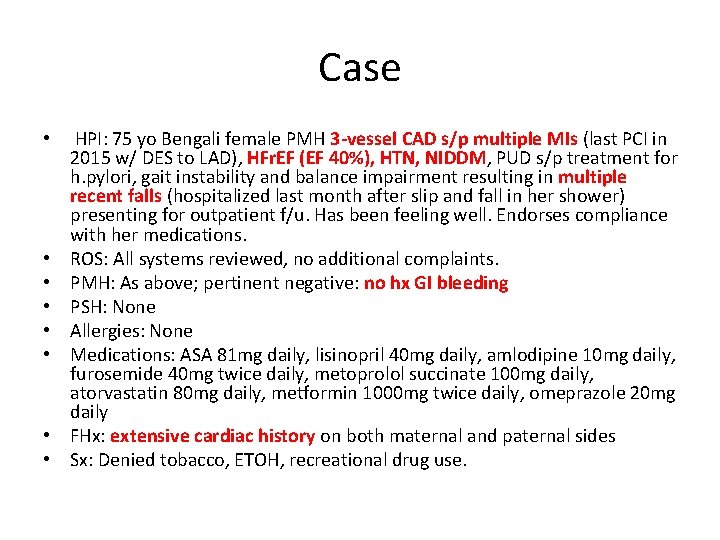
Case • • HPI: 75 yo Bengali female PMH 3 -vessel CAD s/p multiple MIs (last PCI in 2015 w/ DES to LAD), HFr. EF (EF 40%), HTN, NIDDM, PUD s/p treatment for h. pylori, gait instability and balance impairment resulting in multiple recent falls (hospitalized last month after slip and fall in her shower) presenting for outpatient f/u. Has been feeling well. Endorses compliance with her medications. ROS: All systems reviewed, no additional complaints. PMH: As above; pertinent negative: no hx GI bleeding PSH: None Allergies: None Medications: ASA 81 mg daily, lisinopril 40 mg daily, amlodipine 10 mg daily, furosemide 40 mg twice daily, metoprolol succinate 100 mg daily, atorvastatin 80 mg daily, metformin 1000 mg twice daily, omeprazole 20 mg daily FHx: extensive cardiac history on both maternal and paternal sides Sx: Denied tobacco, ETOH, recreational drug use.
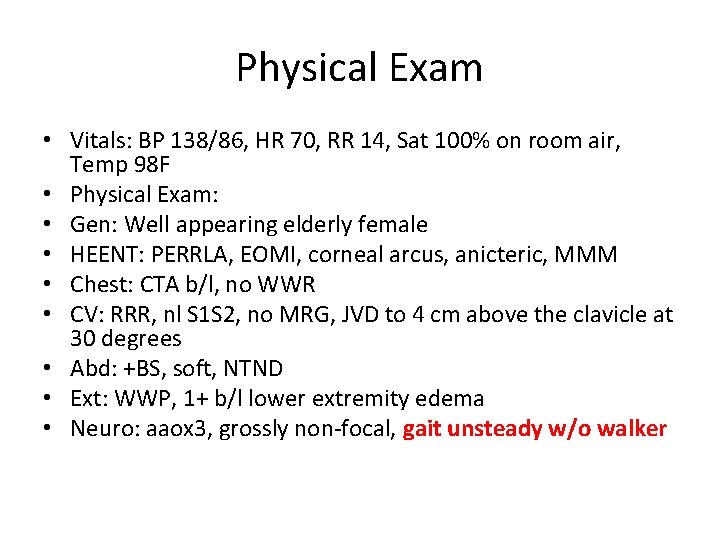
Physical Exam • Vitals: BP 138/86, HR 70, RR 14, Sat 100% on room air, Temp 98 F • Physical Exam: • Gen: Well appearing elderly female • HEENT: PERRLA, EOMI, corneal arcus, anicteric, MMM • Chest: CTA b/l, no WWR • CV: RRR, nl S 1 S 2, no MRG, JVD to 4 cm above the clavicle at 30 degrees • Abd: +BS, soft, NTND • Ext: WWP, 1+ b/l lower extremity edema • Neuro: aaox 3, grossly non-focal, gait unsteady w/o walker
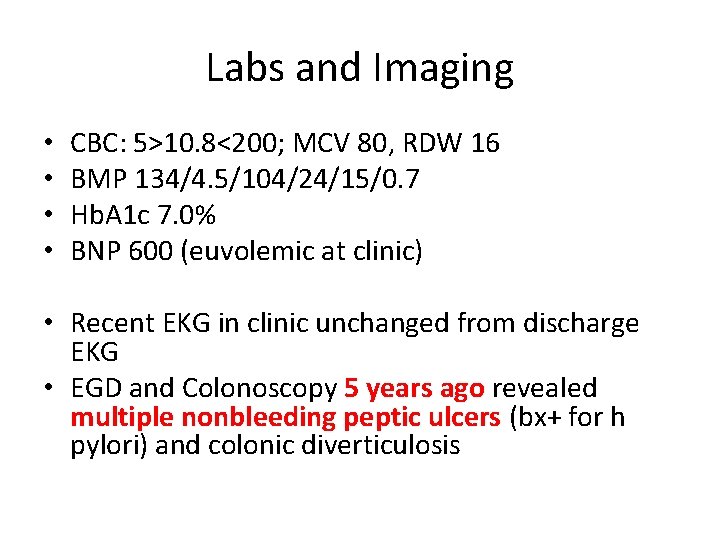
Labs and Imaging • • CBC: 5>10. 8<200; MCV 80, RDW 16 BMP 134/4. 5/104/24/15/0. 7 Hb. A 1 c 7. 0% BNP 600 (euvolemic at clinic) • Recent EKG in clinic unchanged from discharge EKG • EGD and Colonoscopy 5 years ago revealed multiple nonbleeding peptic ulcers (bx+ for h pylori) and colonic diverticulosis
• Is our patient at high risk of an myocardial infarction? • Is there anything we can do to lower that risk?
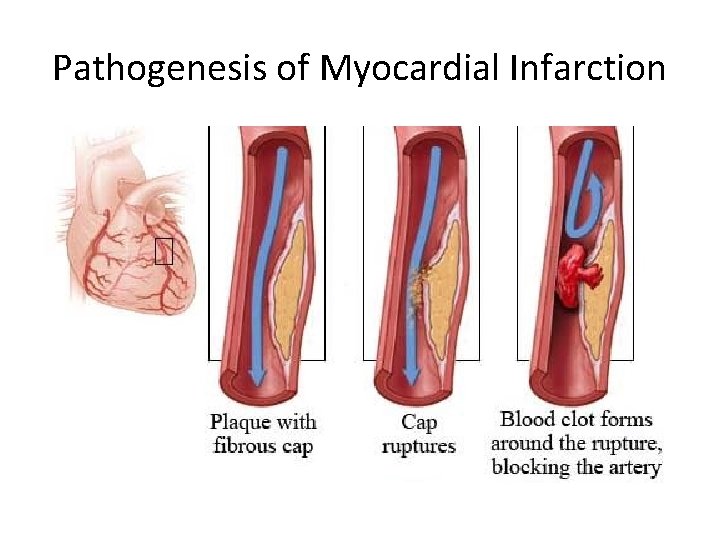
Pathogenesis of Myocardial Infarction
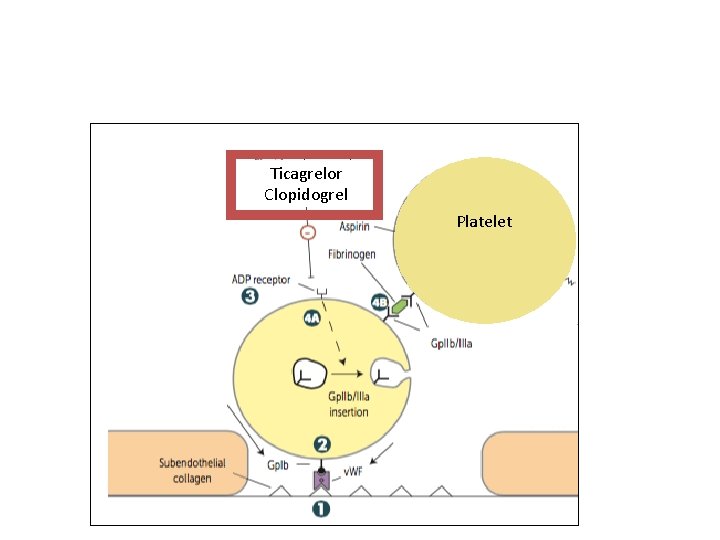
Ticagrelor Clopidogrel Platelet
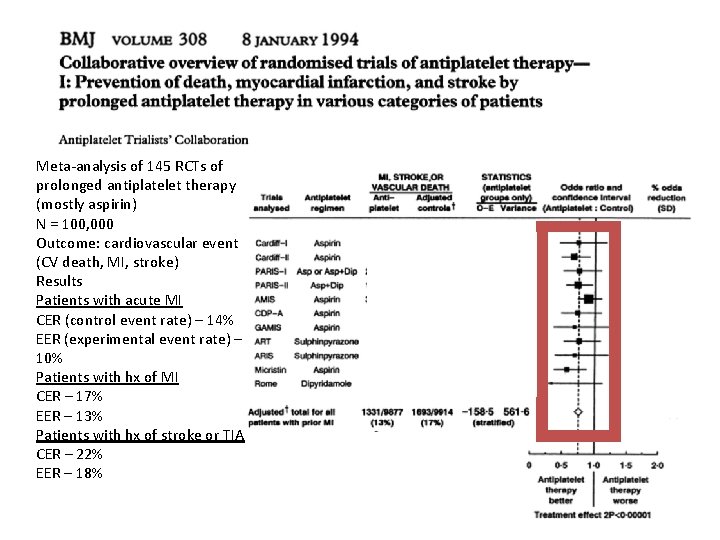
Meta-analysis of 145 RCTs of prolonged antiplatelet therapy (mostly aspirin) N = 100, 000 Outcome: cardiovascular event (CV death, MI, stroke) Results Patients with acute MI CER (control event rate) – 14% EER (experimental event rate) – 10% Patients with hx of MI CER – 17% EER – 13% Patients with hx of stroke or TIA CER – 22% EER – 18%
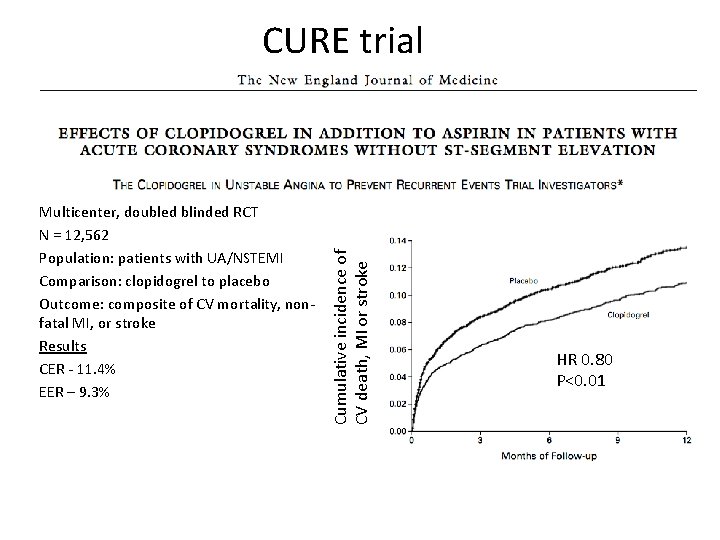
Multicenter, doubled blinded RCT N = 12, 562 Population: patients with UA/NSTEMI Comparison: clopidogrel to placebo Outcome: composite of CV mortality, nonfatal MI, or stroke Results CER - 11. 4% EER – 9. 3% Cumulative incidence of CV death, MI or stroke CURE trial HR 0. 80 P<0. 01
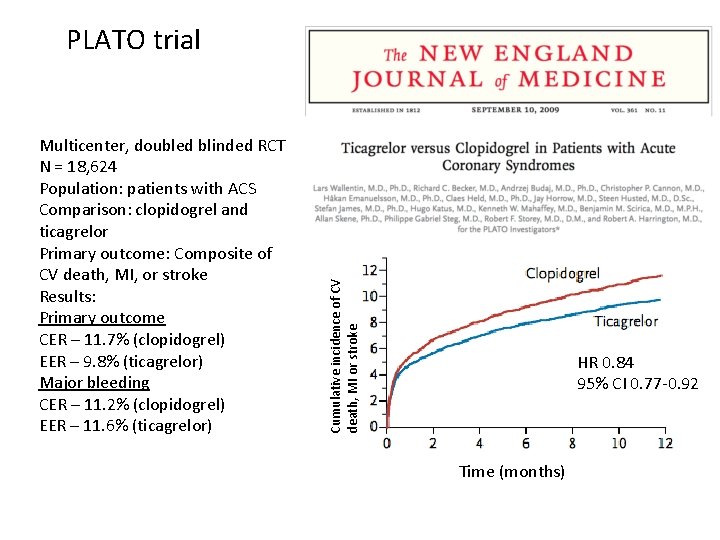
Multicenter, doubled blinded RCT N = 18, 624 Population: patients with ACS Comparison: clopidogrel and ticagrelor Primary outcome: Composite of CV death, MI, or stroke Results: Primary outcome CER – 11. 7% (clopidogrel) EER – 9. 8% (ticagrelor) Major bleeding CER – 11. 2% (clopidogrel) EER – 11. 6% (ticagrelor) Cumulative incidence of CV death, MI or stroke PLATO trial HR 0. 84 95% CI 0. 77 -0. 92 Time (months)
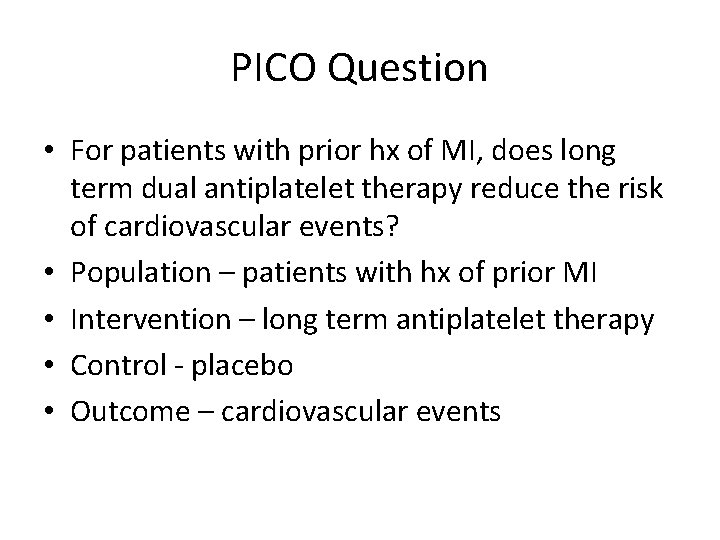
PICO Question • For patients with prior hx of MI, does long term dual antiplatelet therapy reduce the risk of cardiovascular events? • Population – patients with hx of prior MI • Intervention – long term antiplatelet therapy • Control - placebo • Outcome – cardiovascular events
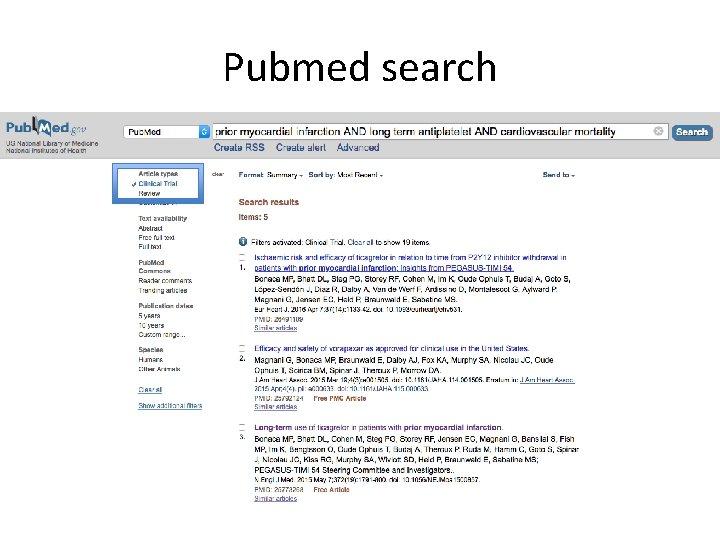
Pubmed search
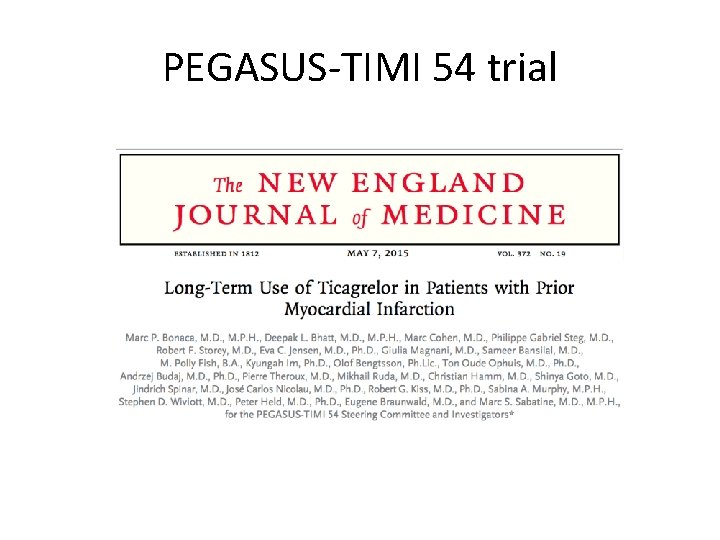
PEGASUS-TIMI 54 trial
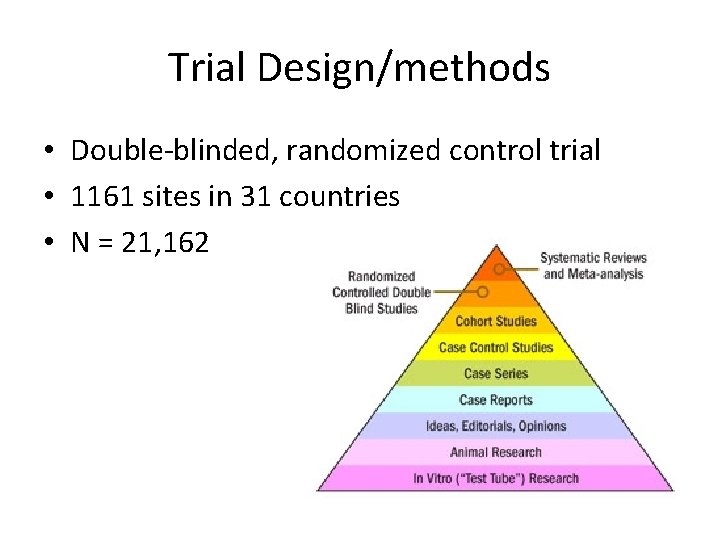
Trial Design/methods • Double-blinded, randomized control trial • 1161 sites in 31 countries • N = 21, 162
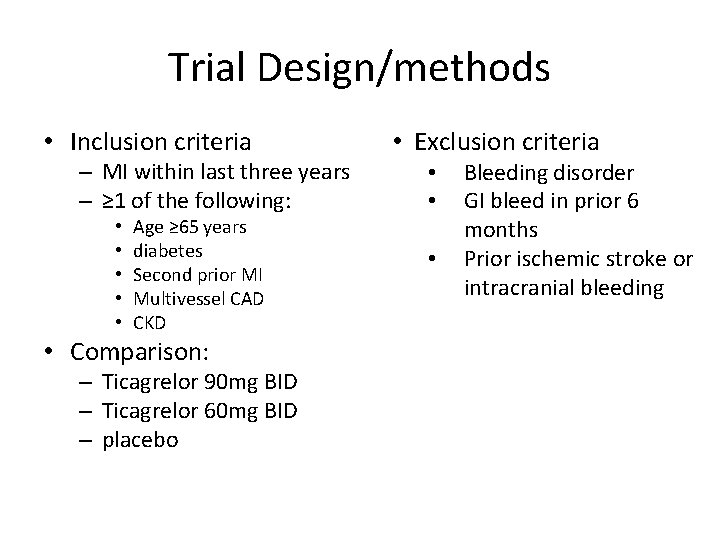
Trial Design/methods • Inclusion criteria – MI within last three years – ≥ 1 of the following: • • • Age ≥ 65 years diabetes Second prior MI Multivessel CAD CKD • Comparison: – Ticagrelor 90 mg BID – Ticagrelor 60 mg BID – placebo • Exclusion criteria • • • Bleeding disorder GI bleed in prior 6 months Prior ischemic stroke or intracranial bleeding
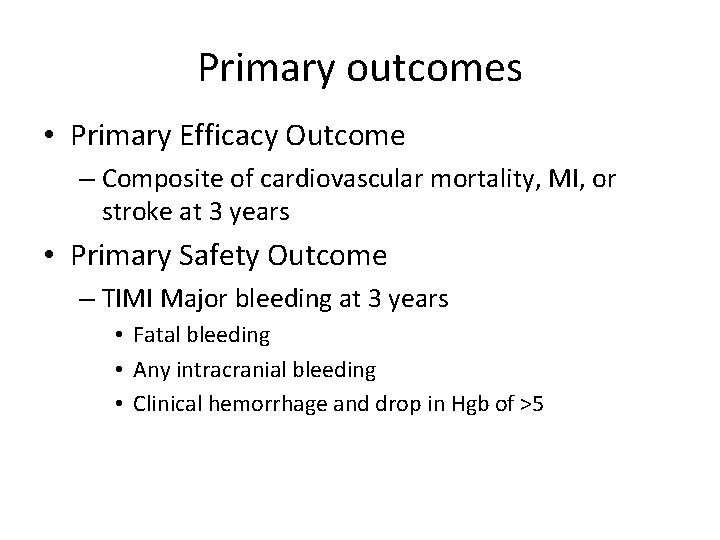
Primary outcomes • Primary Efficacy Outcome – Composite of cardiovascular mortality, MI, or stroke at 3 years • Primary Safety Outcome – TIMI Major bleeding at 3 years • Fatal bleeding • Any intracranial bleeding • Clinical hemorrhage and drop in Hgb of >5
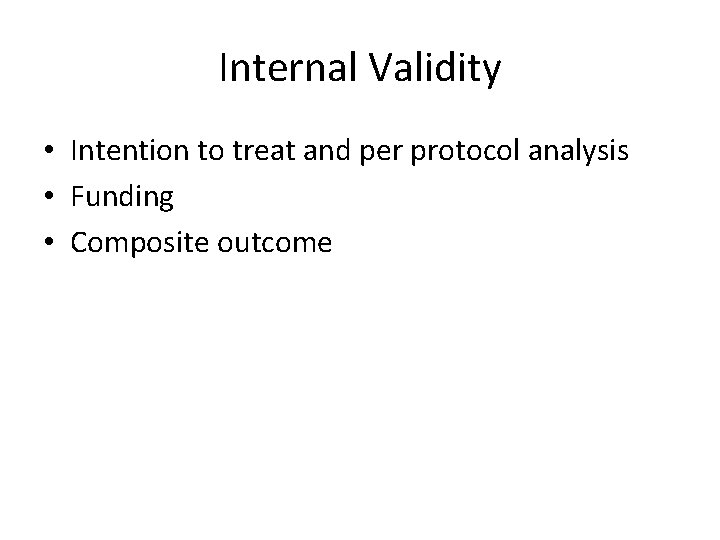
Internal Validity • Intention to treat and per protocol analysis • Funding • Composite outcome
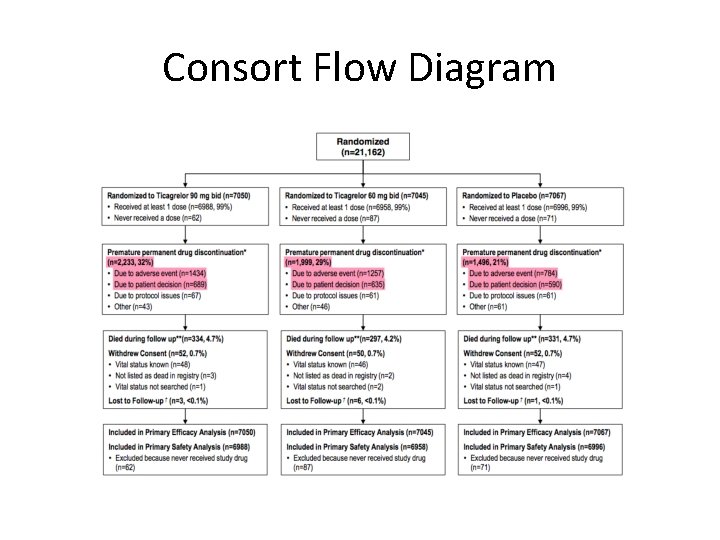
Consort Flow Diagram
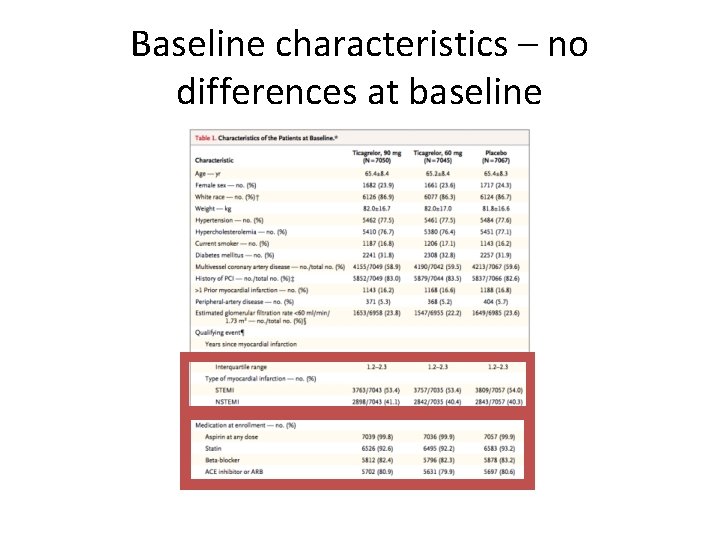
Baseline characteristics – no differences at baseline
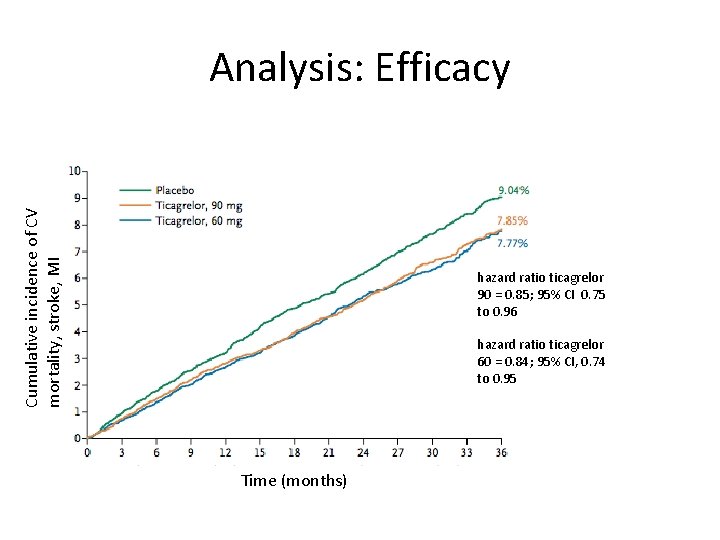
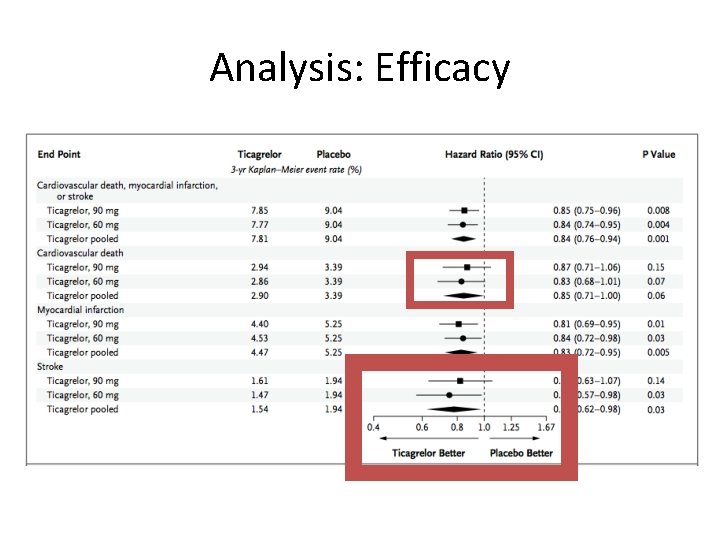
Cumulative incidence of CV mortality, stroke, MI Analysis: Efficacy hazard ratio ticagrelor 90 = 0. 85; 95% CI 0. 75 to 0. 96 hazard ratio ticagrelor 60 = 0. 84; 95% CI, 0. 74 to 0. 95 Time (months)
Analysis: Efficacy
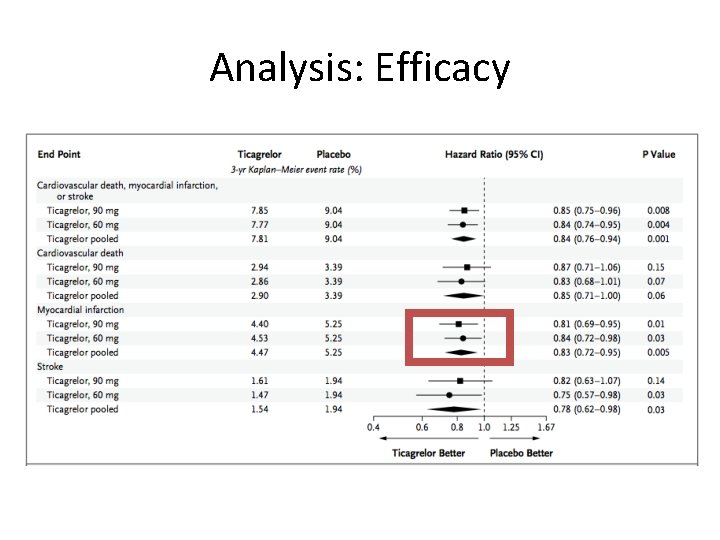
Analysis: Efficacy
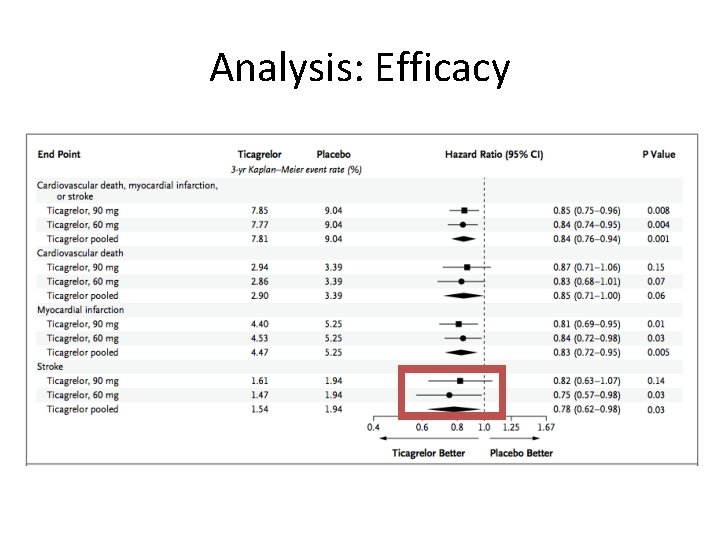
Analysis: Efficacy
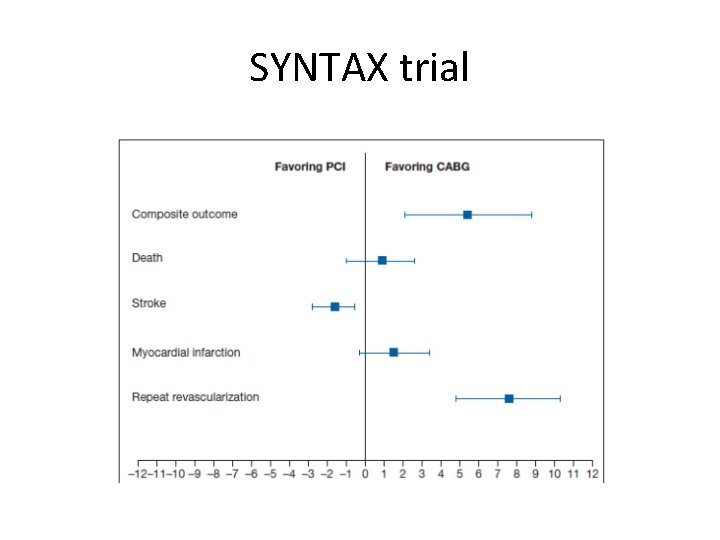
SYNTAX trial
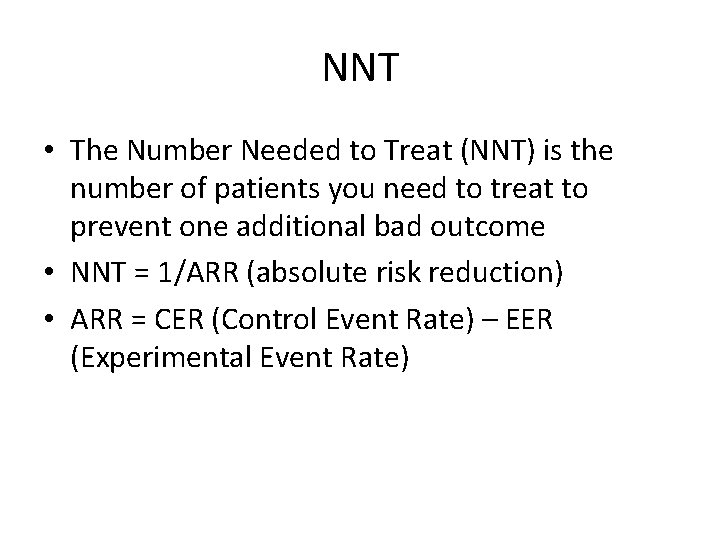
NNT • The Number Needed to Treat (NNT) is the number of patients you need to treat to prevent one additional bad outcome • NNT = 1/ARR (absolute risk reduction) • ARR = CER (Control Event Rate) – EER (Experimental Event Rate)
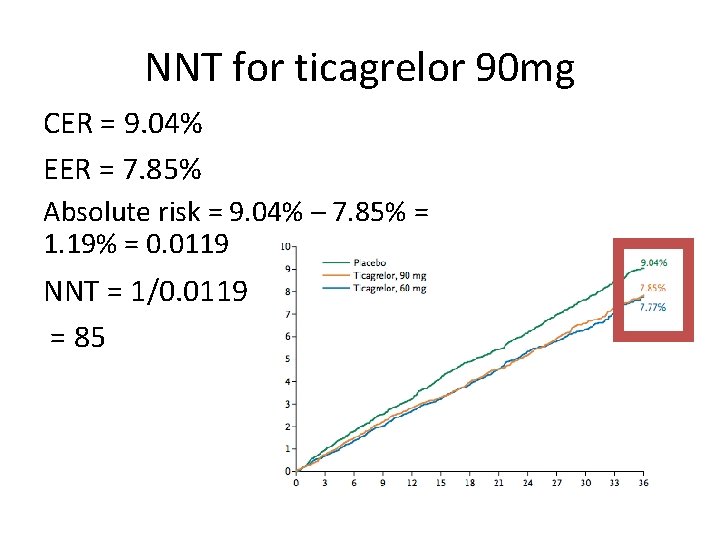
NNT for ticagrelor 90 mg CER = 9. 04% EER = 7. 85% Absolute risk = 9. 04% – 7. 85% = 1. 19% = 0. 0119 NNT = 1/0. 0119 = 85
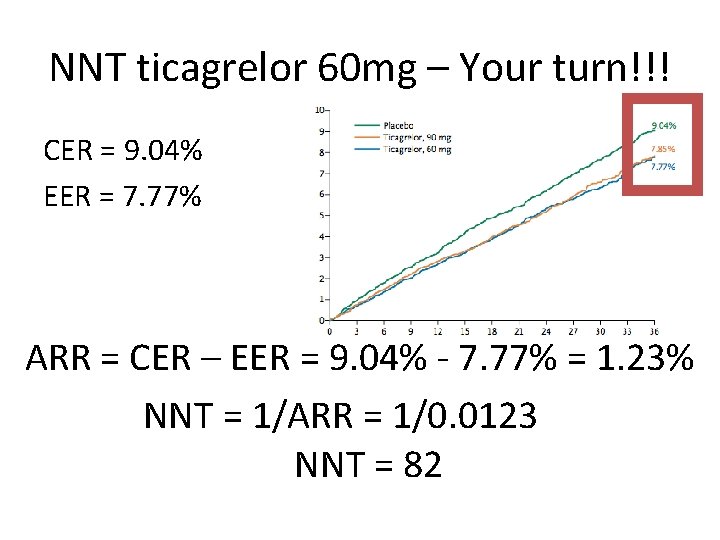
NNT ticagrelor 60 mg – Your turn!!! CER = 9. 04% EER = 7. 77% ARR = CER – EER = 9. 04% - 7. 77% = 1. 23% NNT = 1/ARR = 1/0. 0123 NNT = 82
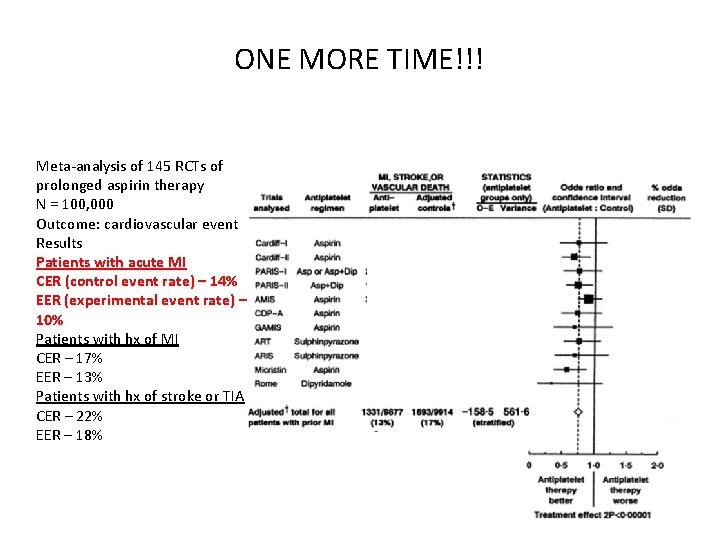
ONE MORE TIME!!! Meta-analysis of 145 RCTs of prolonged aspirin therapy N = 100, 000 Outcome: cardiovascular event Results Patients with acute MI CER (control event rate) – 14% EER (experimental event rate) – 10% Patients with hx of MI CER – 17% EER – 13% Patients with hx of stroke or TIA CER – 22% EER – 18%
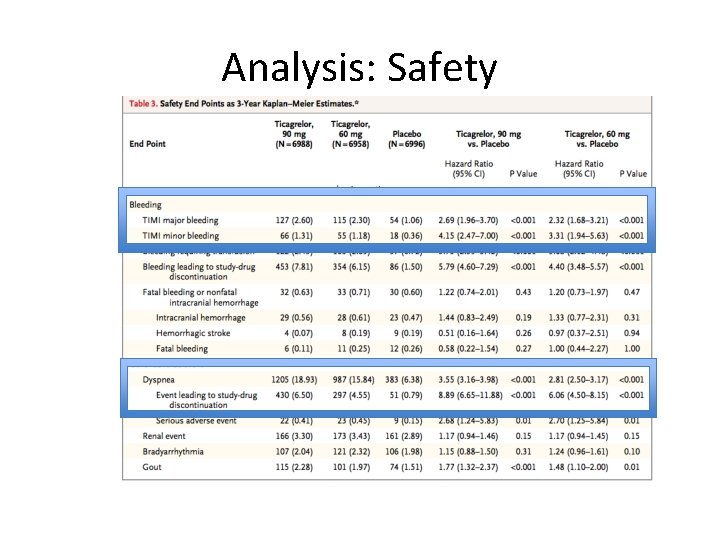
Analysis: Safety
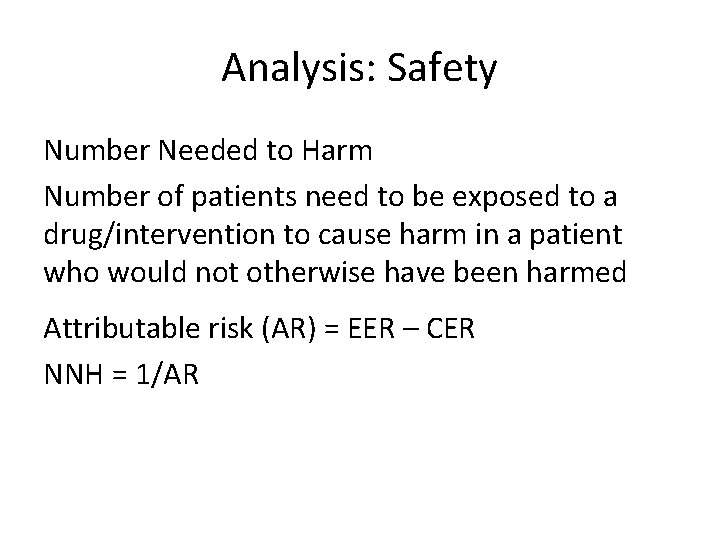
Analysis: Safety Number Needed to Harm Number of patients need to be exposed to a drug/intervention to cause harm in a patient who would not otherwise have been harmed Attributable risk (AR) = EER – CER NNH = 1/AR
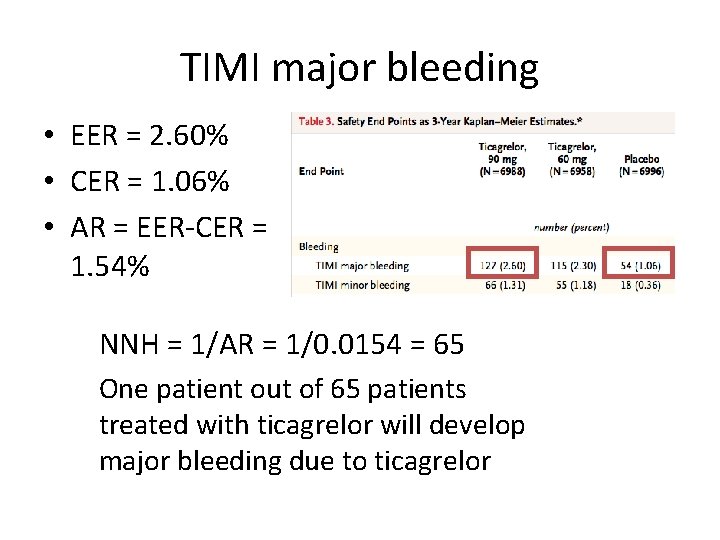
TIMI major bleeding • EER = 2. 60% • CER = 1. 06% • AR = EER-CER = 1. 54% NNH = 1/AR = 1/0. 0154 = 65 One patient out of 65 patients treated with ticagrelor will develop major bleeding due to ticagrelor
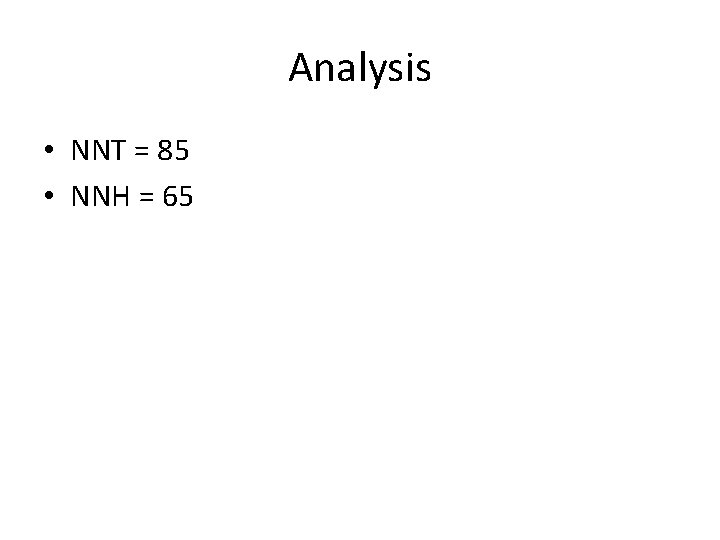
Analysis • NNT = 85 • NNH = 65
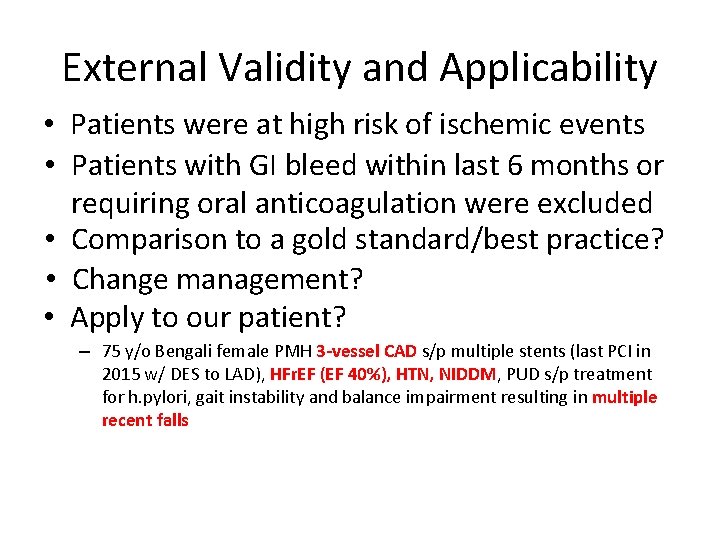
External Validity and Applicability • Patients were at high risk of ischemic events • Patients with GI bleed within last 6 months or requiring oral anticoagulation were excluded • Comparison to a gold standard/best practice? • Change management? • Apply to our patient? – 75 y/o Bengali female PMH 3 -vessel CAD s/p multiple stents (last PCI in 2015 w/ DES to LAD), HFr. EF (EF 40%), HTN, NIDDM, PUD s/p treatment for h. pylori, gait instability and balance impairment resulting in multiple recent falls
Summary • PEGASUS TIMI 54: – long-term antiplatelet therapy with ticagrelor reduces the risk of cardiovascular events at the expense of increasing the risk of serious bleeding • NNT/NNH – – Absolute Risk Reduction = CER – EER NNT = 1/ARR Attributable Risk = EER – CER NNH = 1/AR • Applying this data to our patient – How well does the patient match the study criteria (inclusion and exclusion)? – How high is the risk of MI? – How high is the risk of bleeding?