Particle Physics II CP violation also known as


- Slides: 63
Particle Physics II – CP violation (also known as “Physics of Anti-matter”) Lecture 2 N. Tuning Niels Tuning (1)
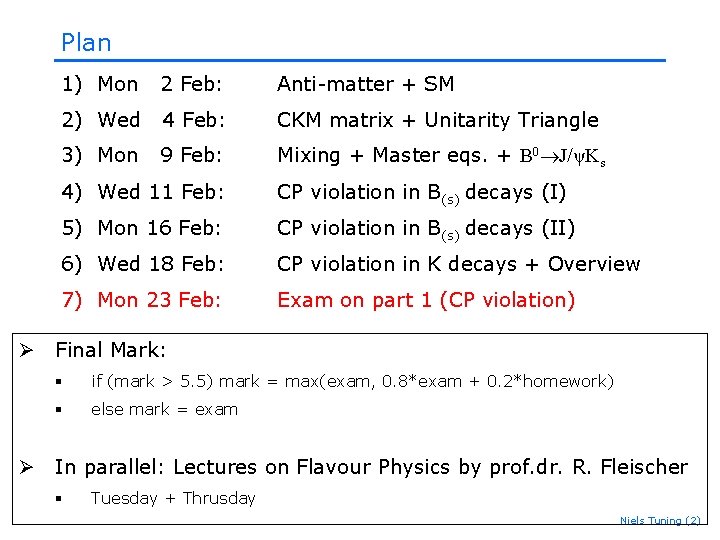
Plan 1) Mon 2 Feb: Anti-matter + SM 2) Wed 4 Feb: CKM matrix + Unitarity Triangle 3) Mon 9 Feb: Mixing + Master eqs. + B 0 J/ψKs 4) Wed 11 Feb: CP violation in B(s) decays (I) 5) Mon 16 Feb: CP violation in B(s) decays (II) 6) Wed 18 Feb: CP violation in K decays + Overview 7) Mon 23 Feb: Exam on part 1 (CP violation) Ø Final Mark: § if (mark > 5. 5) mark = max(exam, 0. 8*exam + 0. 2*homework) § else mark = exam Ø In parallel: Lectures on Flavour Physics by prof. dr. R. Fleischer § Tuesday + Thrusday Niels Tuning (2)
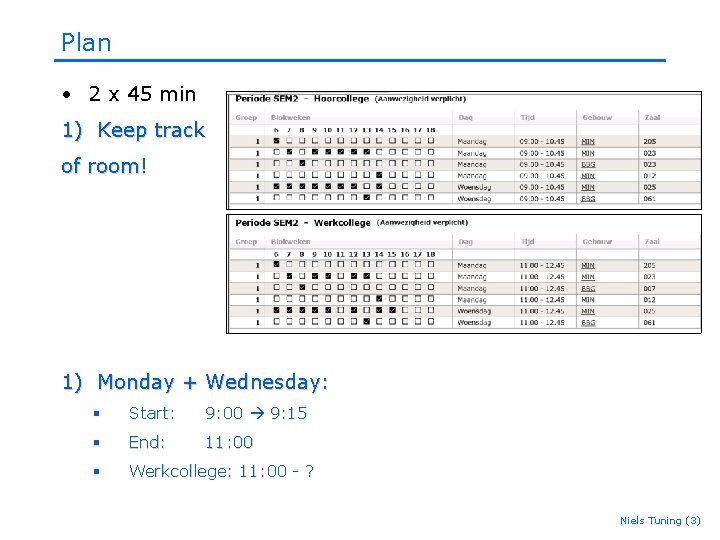
Plan • 2 x 45 min 1) Keep track of room! 1) Monday + Wednesday: § Start: 9: 00 9: 15 § End: 11: 00 § Werkcollege: 11: 00 - ? Niels Tuning (3)
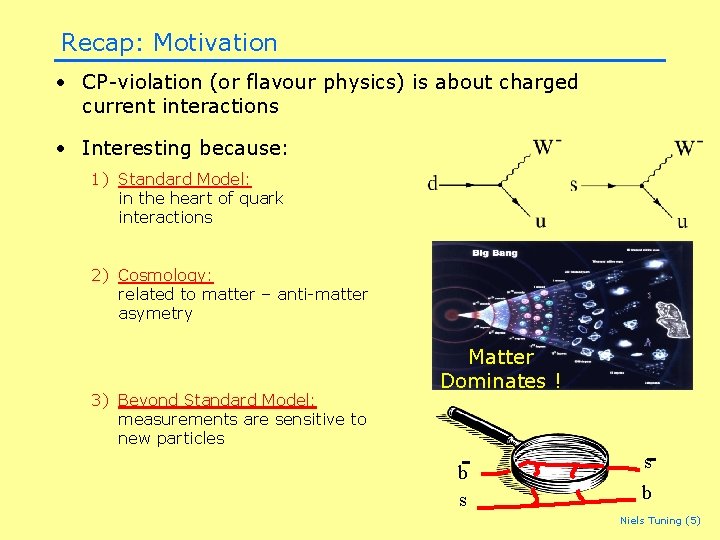
Recap: Motivation • CP-violation (or flavour physics) is about charged current interactions • Interesting because: 1) Standard Model: in the heart of quark interactions 2) Cosmology: related to matter – anti-matter asymetry 3) Beyond Standard Model: measurements are sensitive to new particles Matter Dominates ! b s s b Niels Tuning (5)
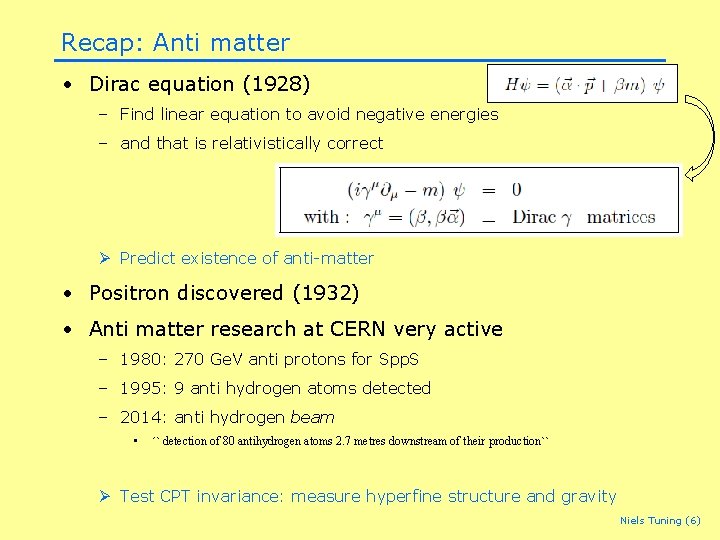
Recap: Anti matter • Dirac equation (1928) – Find linear equation to avoid negative energies – and that is relativistically correct Ø Predict existence of anti-matter • Positron discovered (1932) • Anti matter research at CERN very active – 1980: 270 Ge. V anti protons for Spp. S – 1995: 9 anti hydrogen atoms detected – 2014: anti hydrogen beam • ´` detection of 80 antihydrogen atoms 2. 7 metres downstream of their production`` Ø Test CPT invariance: measure hyperfine structure and gravity Niels Tuning (6)
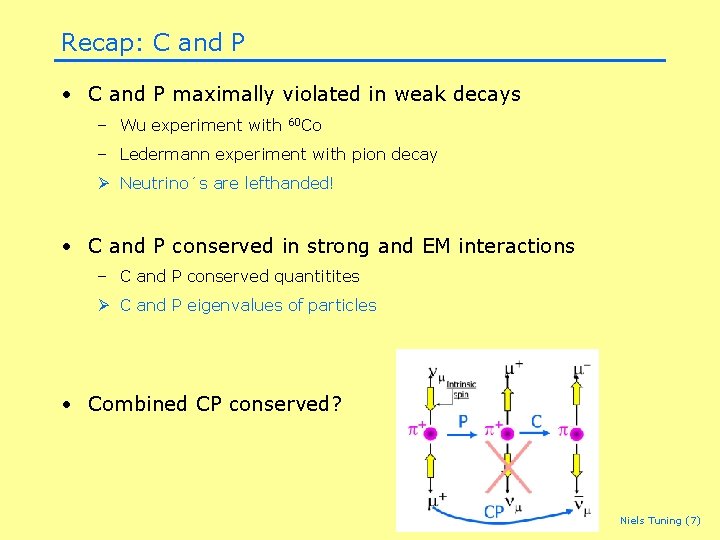
Recap: C and P • C and P maximally violated in weak decays – Wu experiment with 60 Co – Ledermann experiment with pion decay Ø Neutrino´s are lefthanded! • C and P conserved in strong and EM interactions – C and P conserved quantitites Ø C and P eigenvalues of particles • Combined CP conserved? Niels Tuning (7)
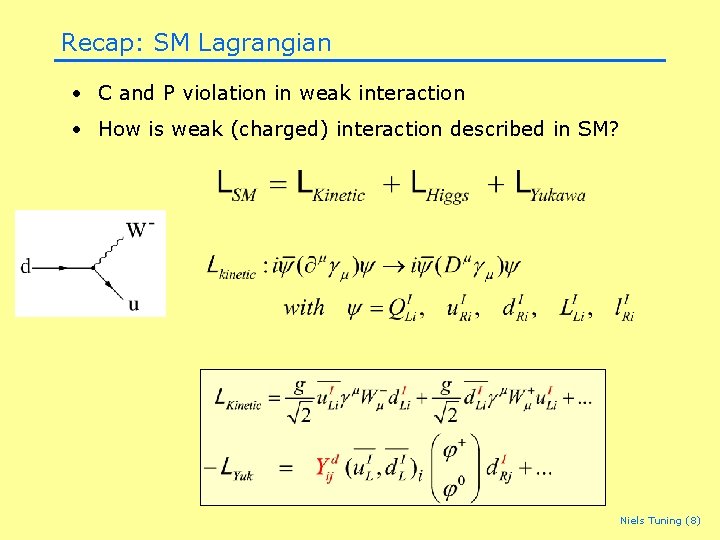
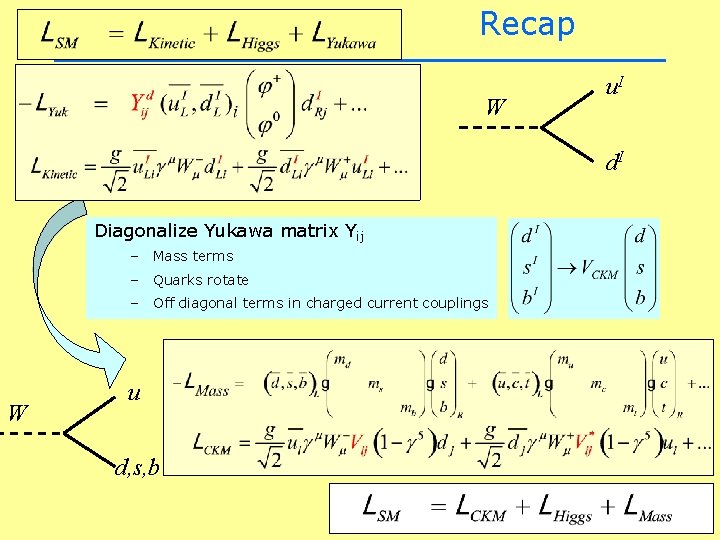
Recap: SM Lagrangian • C and P violation in weak interaction • How is weak (charged) interaction described in SM? Niels Tuning (8)
Recap W u. I d. I Diagonalize Yukawa matrix Yij – Mass terms – Quarks rotate – Off diagonal terms in charged current couplings W u d, s, b Niels Tuning (9)
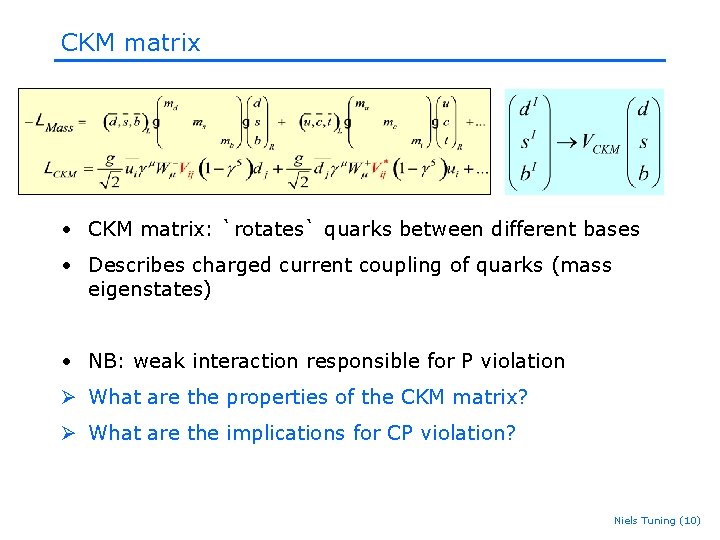
CKM matrix • CKM matrix: `rotates` quarks between different bases • Describes charged current coupling of quarks (mass eigenstates) • NB: weak interaction responsible for P violation Ø What are the properties of the CKM matrix? Ø What are the implications for CP violation? Niels Tuning (10)
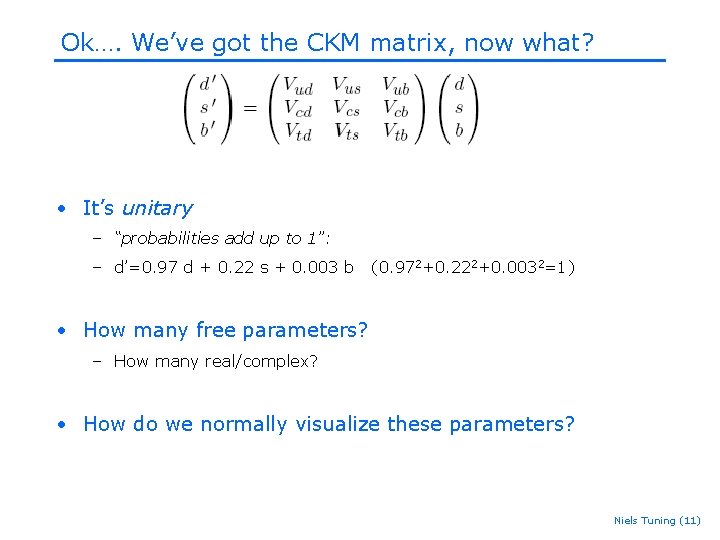
Ok…. We’ve got the CKM matrix, now what? • It’s unitary – “probabilities add up to 1”: – d’=0. 97 d + 0. 22 s + 0. 003 b (0. 972+0. 222+0. 0032=1) • How many free parameters? – How many real/complex? • How do we normally visualize these parameters? Niels Tuning (11)
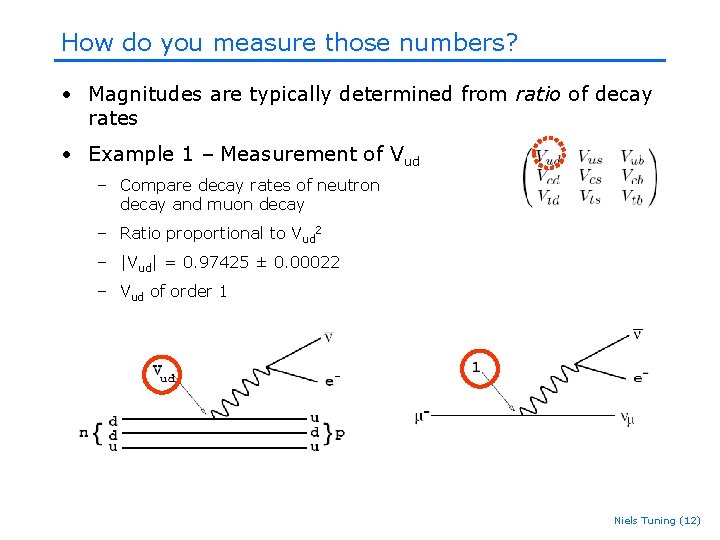
How do you measure those numbers? • Magnitudes are typically determined from ratio of decay rates • Example 1 – Measurement of Vud – Compare decay rates of neutron decay and muon decay – Ratio proportional to Vud 2 – |Vud| = 0. 97425 ± 0. 00022 – Vud of order 1 Niels Tuning (12)
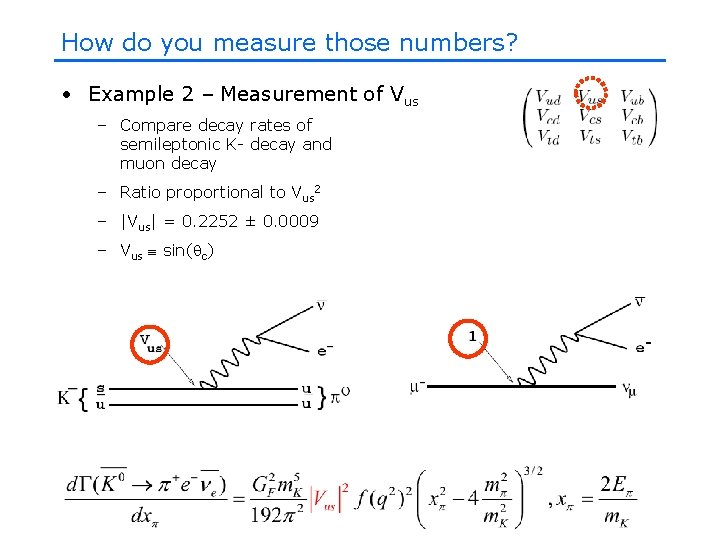
How do you measure those numbers? • Example 2 – Measurement of Vus – Compare decay rates of semileptonic K- decay and muon decay – Ratio proportional to Vus 2 – |Vus| = 0. 2252 ± 0. 0009 – Vus sin(qc)
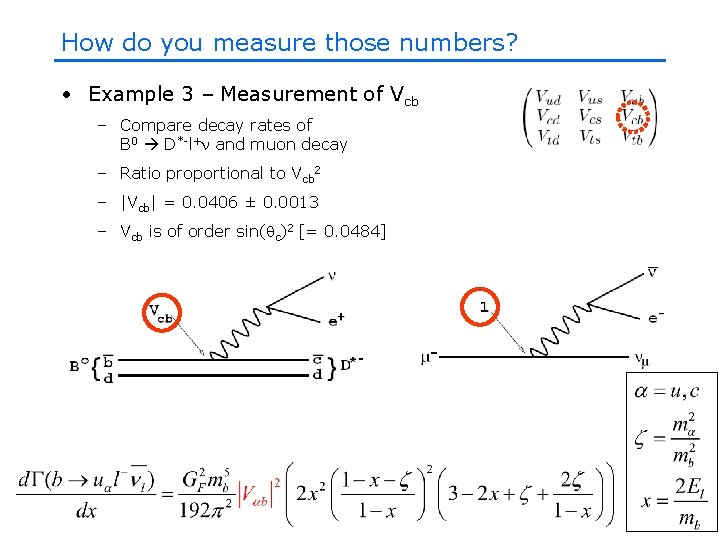
How do you measure those numbers? • Example 3 – Measurement of Vcb – Compare decay rates of B 0 D*-l+n and muon decay – Ratio proportional to Vcb 2 – |Vcb| = 0. 0406 ± 0. 0013 – Vcb is of order sin(qc)2 [= 0. 0484]
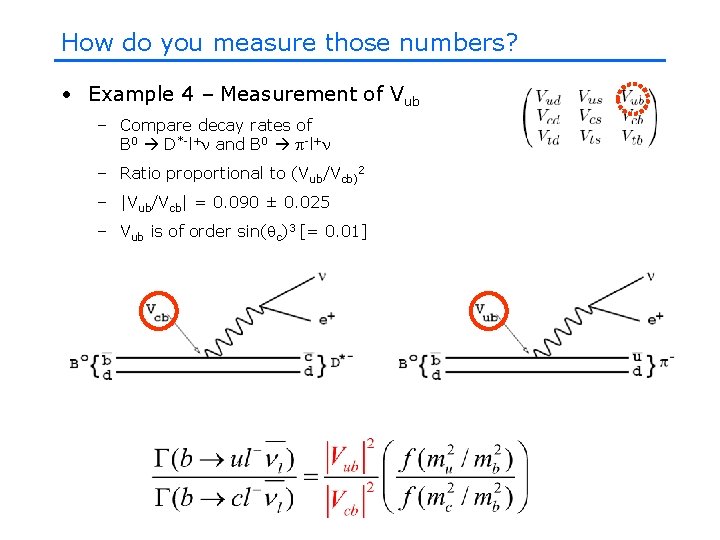
How do you measure those numbers? • Example 4 – Measurement of Vub – Compare decay rates of B 0 D*-l+n and B 0 p-l+n – Ratio proportional to (Vub/Vcb)2 – |Vub/Vcb| = 0. 090 ± 0. 025 – Vub is of order sin(qc)3 [= 0. 01]
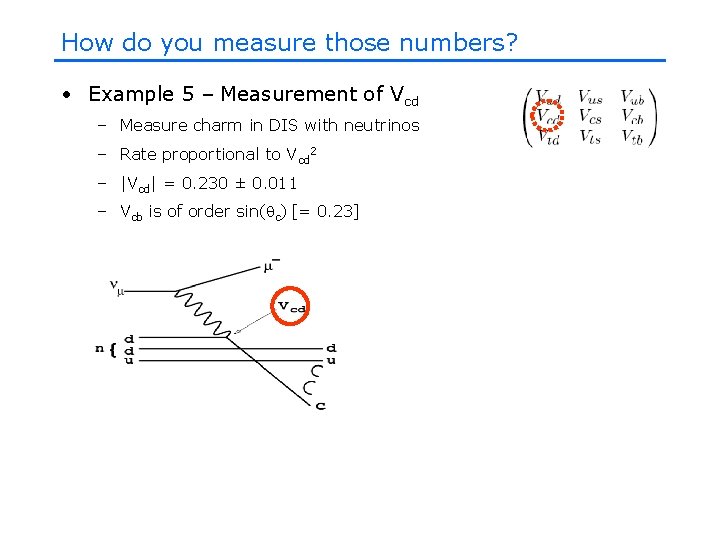
How do you measure those numbers? • Example 5 – Measurement of Vcd – Measure charm in DIS with neutrinos – Rate proportional to Vcd 2 – |Vcd| = 0. 230 ± 0. 011 – Vcb is of order sin(qc) [= 0. 23]
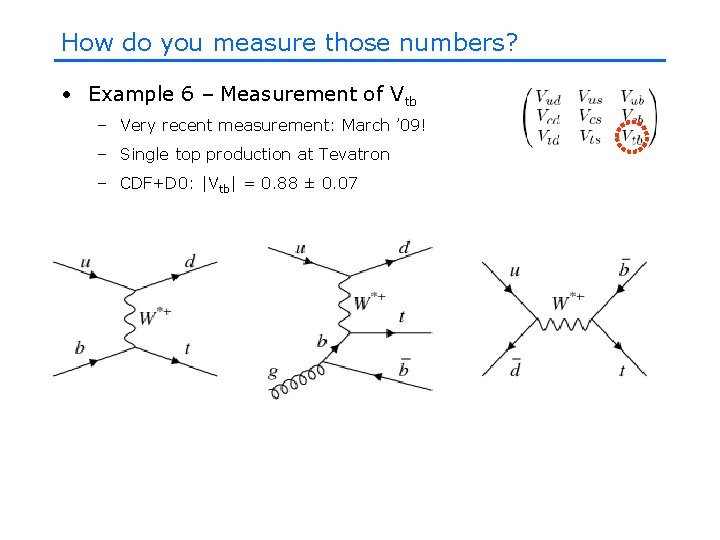
How do you measure those numbers? • Example 6 – Measurement of Vtb – Very recent measurement: March ’ 09! – Single top production at Tevatron – CDF+D 0: |Vtb| = 0. 88 ± 0. 07
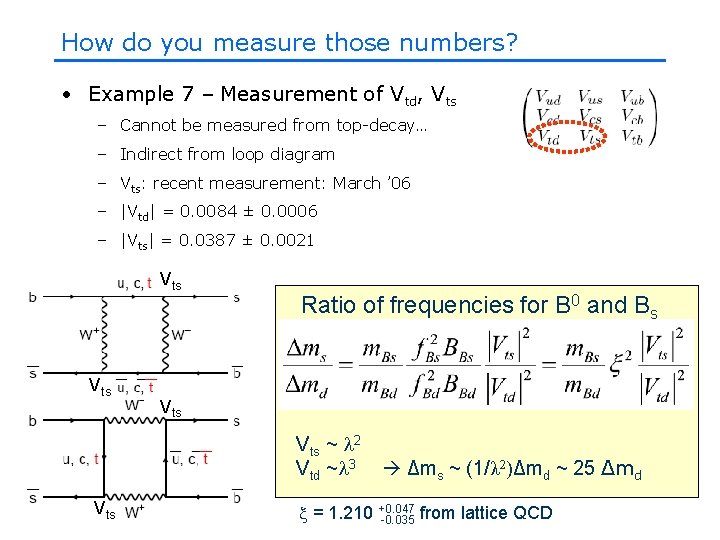
How do you measure those numbers? • Example 7 – Measurement of Vtd, Vts – Cannot be measured from top-decay… – Indirect from loop diagram – Vts: recent measurement: March ’ 06 – |Vtd| = 0. 0084 ± 0. 0006 – |Vts| = 0. 0387 ± 0. 0021 Vts Ratio of frequencies for B 0 and Bs Vts ~ 2 Vtd ~ 3 Vts Δms ~ (1/λ 2)Δmd ~ 25 Δmd = 1. 210 +0. 047 -0. 035 from lattice QCD
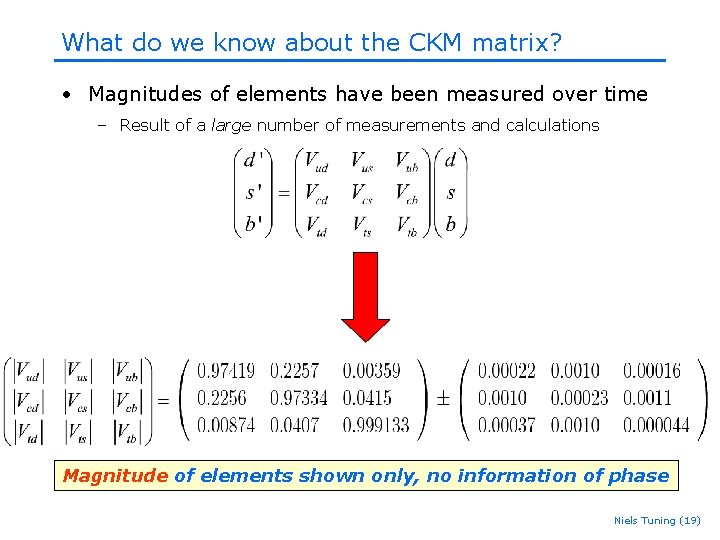
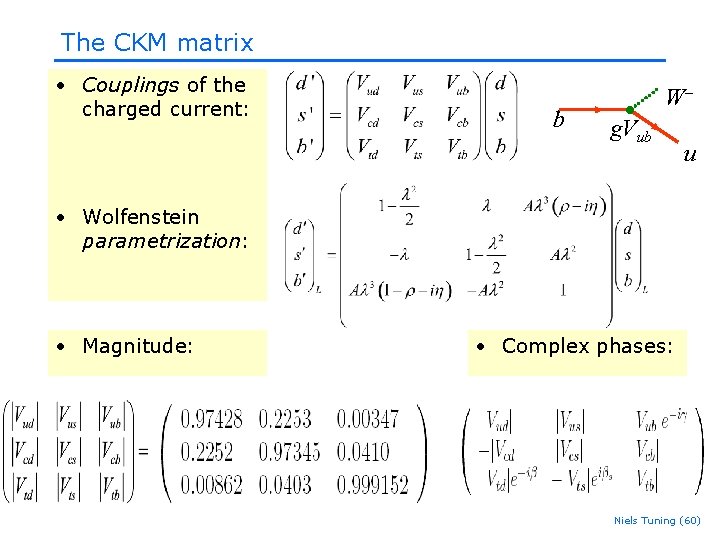
What do we know about the CKM matrix? • Magnitudes of elements have been measured over time – Result of a large number of measurements and calculations Magnitude of elements shown only, no information of phase Niels Tuning (19)
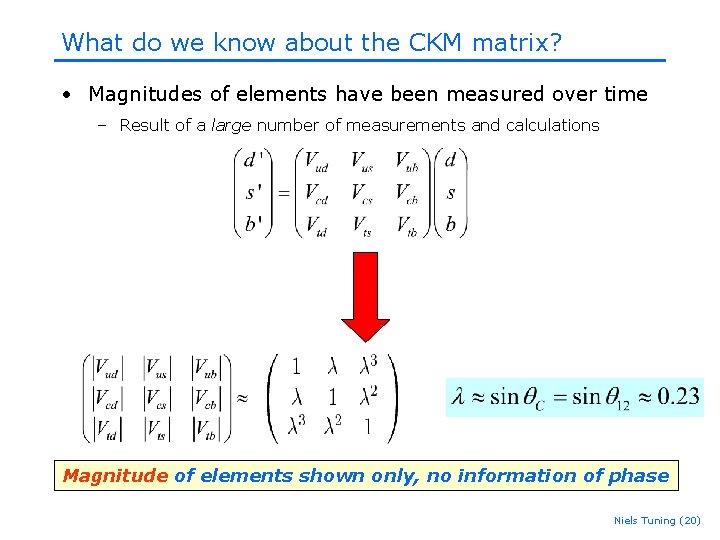
What do we know about the CKM matrix? • Magnitudes of elements have been measured over time – Result of a large number of measurements and calculations Magnitude of elements shown only, no information of phase Niels Tuning (20)
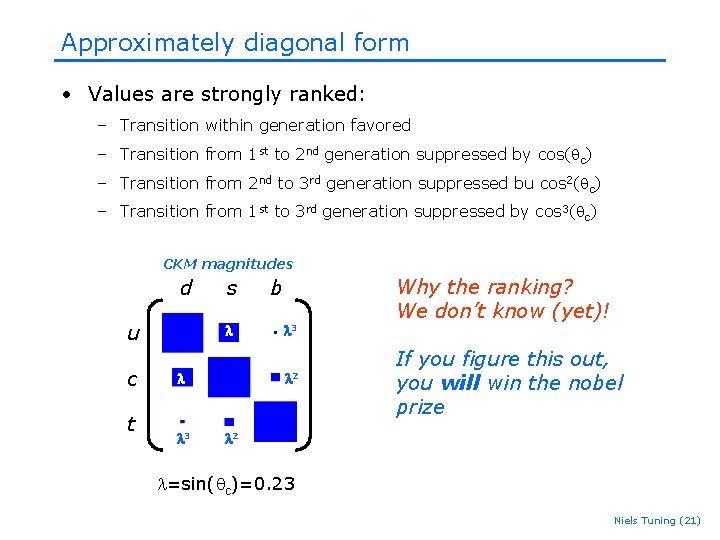
Approximately diagonal form • Values are strongly ranked: – Transition within generation favored – Transition from 1 st to 2 nd generation suppressed by cos(qc) – Transition from 2 nd to 3 rd generation suppressed bu cos 2(qc) – Transition from 1 st to 3 rd generation suppressed by cos 3(qc) CKM magnitudes d u c t s l l l 3 b l 3 l 2 Why the ranking? We don’t know (yet)! If you figure this out, you will win the nobel prize l 2 =sin(qc)=0. 23 Niels Tuning (21)
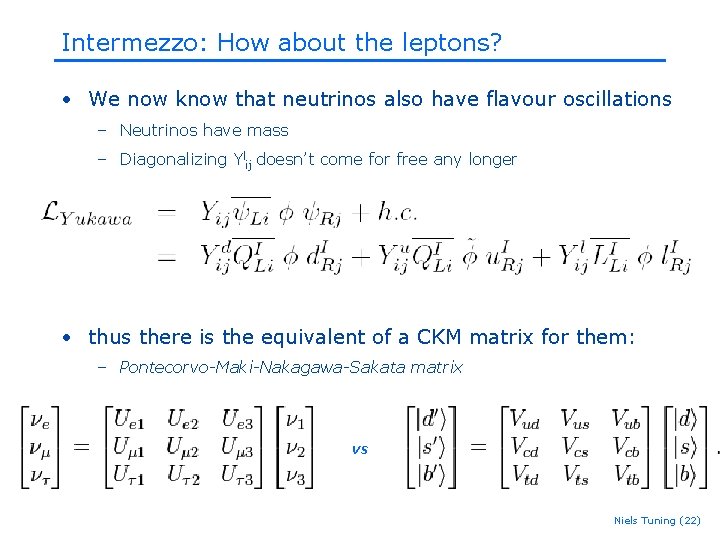
Intermezzo: How about the leptons? • We now know that neutrinos also have flavour oscillations – Neutrinos have mass – Diagonalizing Ylij doesn’t come for free any longer • thus there is the equivalent of a CKM matrix for them: – Pontecorvo-Maki-Nakagawa-Sakata matrix vs Niels Tuning (22)
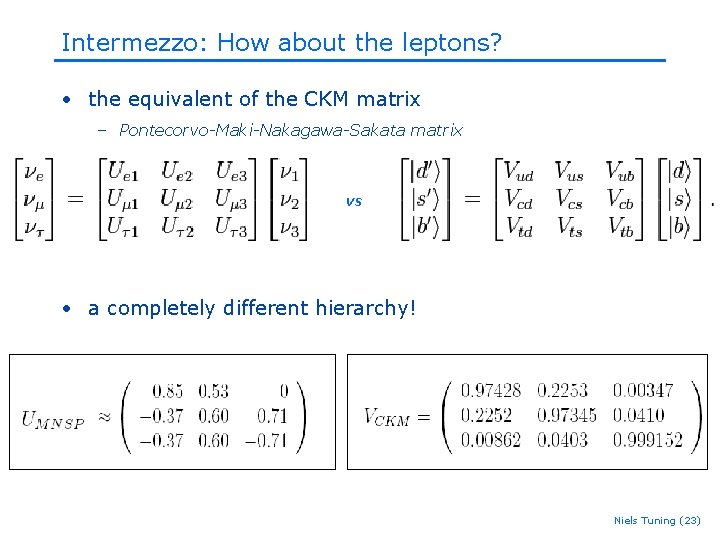
Intermezzo: How about the leptons? • the equivalent of the CKM matrix – Pontecorvo-Maki-Nakagawa-Sakata matrix vs • a completely different hierarchy! Niels Tuning (23)
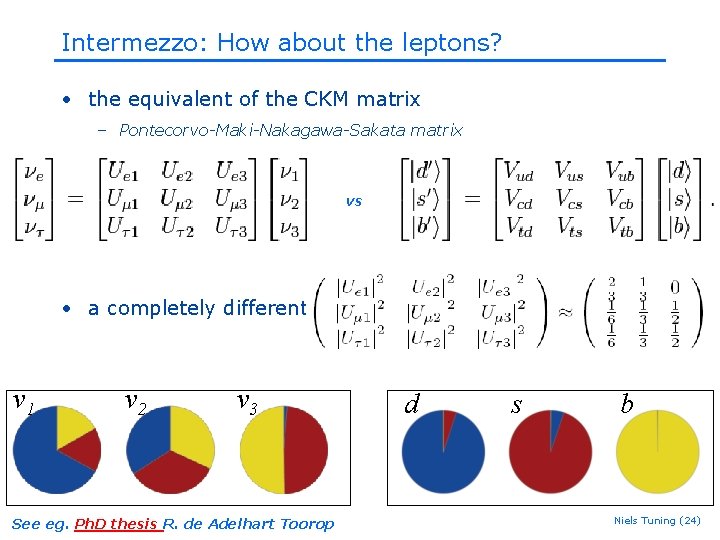
Intermezzo: How about the leptons? • the equivalent of the CKM matrix – Pontecorvo-Maki-Nakagawa-Sakata matrix vs • a completely different hierarchy! ν 1 ν 2 ν 3 See eg. Ph. D thesis R. de Adelhart Toorop d s b Niels Tuning (24)
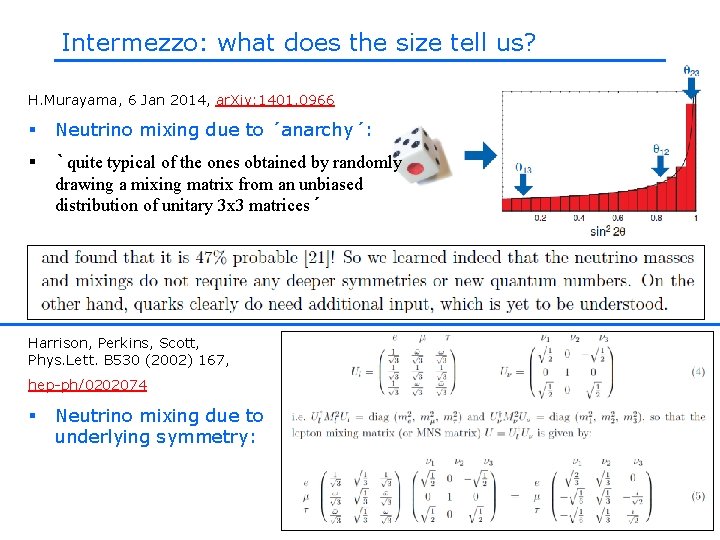
Intermezzo: what does the size tell us? H. Murayama, 6 Jan 2014, ar. Xiv: 1401. 0966 § Neutrino mixing due to ´anarchy´: § `quite typical of the ones obtained by randomly drawing a mixing matrix from an unbiased distribution of unitary 3 x 3 matrices´ Harrison, Perkins, Scott, Phys. Lett. B 530 (2002) 167, hep-ph/0202074 § Neutrino mixing due to underlying symmetry: Niels Tuning (25)
Back to business: quarks We discussed magnitude. Next is the imaginary part ! Niels Tuning (26)
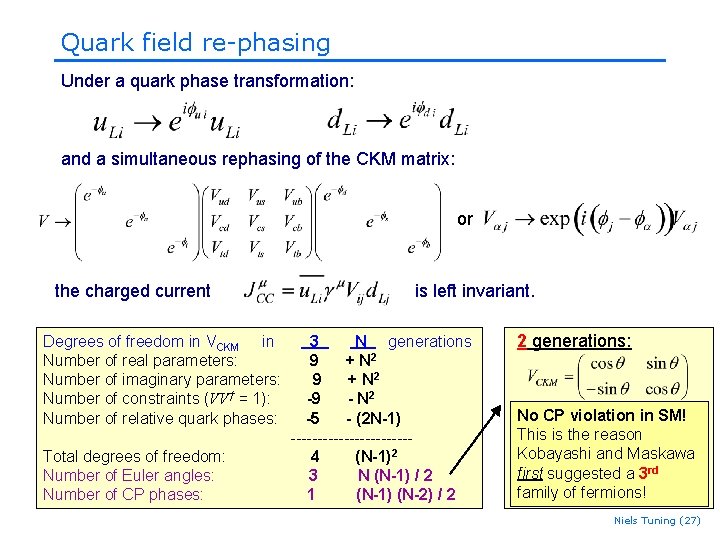
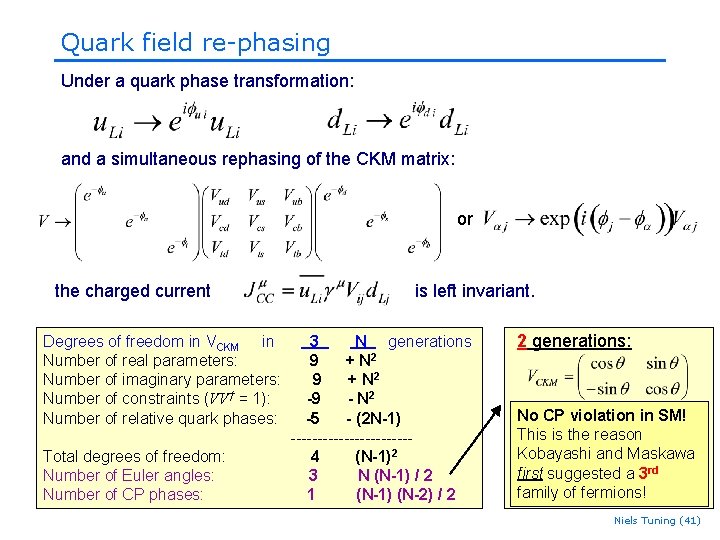
Quark field re-phasing Under a quark phase transformation: and a simultaneous rephasing of the CKM matrix: or the charged current Degrees of freedom in VCKM in Number of real parameters: Number of imaginary parameters: Number of constraints (VV† = 1): Number of relative quark phases: Total degrees of freedom: Number of Euler angles: Number of CP phases: is left invariant. 3 N generations 9 + N 2 -9 - N 2 -5 - (2 N-1) -----------4 (N-1)2 3 N (N-1) / 2 1 (N-1) (N-2) / 2 2 generations: No CP violation in SM! This is the reason Kobayashi and Maskawa first suggested a 3 rd family of fermions! Niels Tuning (27)
First some history… Niels Tuning (28)
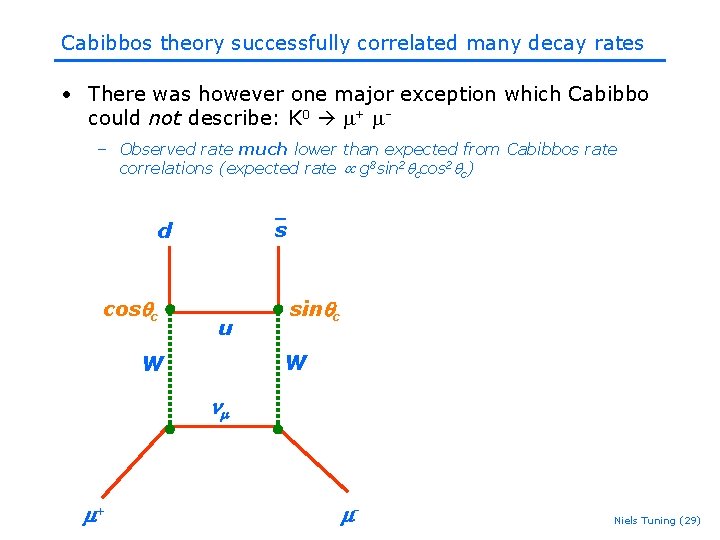
Cabibbos theory successfully correlated many decay rates • There was however one major exception which Cabibbo could not describe: K 0 m+ m– Observed rate much lower than expected from Cabibbos rate correlations (expected rate g 8 sin 2 qccos 2 qc) s d cosqc u sinqc W W nm m+ m- Niels Tuning (29)
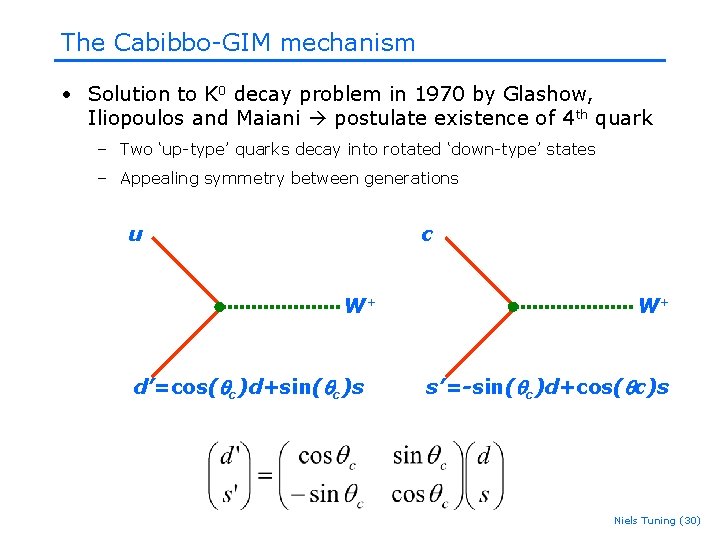
The Cabibbo-GIM mechanism • Solution to K 0 decay problem in 1970 by Glashow, Iliopoulos and Maiani postulate existence of 4 th quark – Two ‘up-type’ quarks decay into rotated ‘down-type’ states – Appealing symmetry between generations u c W+ d’=cos(qc)d+sin(qc)s W+ s’=-sin(qc)d+cos(qc)s Niels Tuning (30)
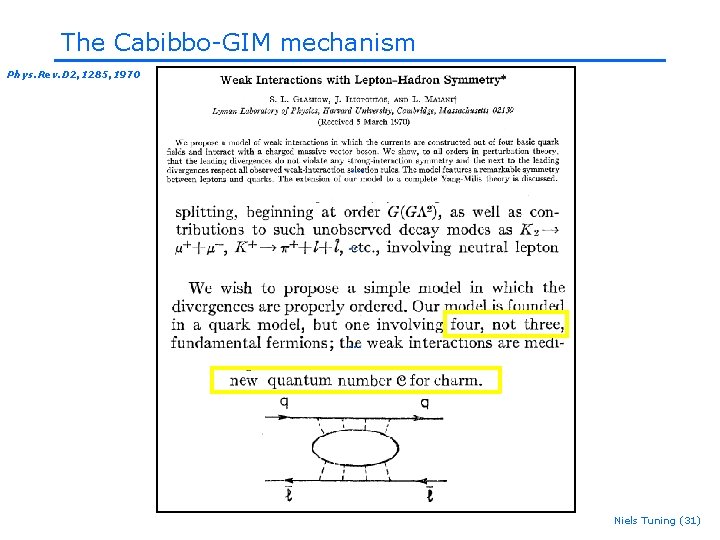
The Cabibbo-GIM mechanism Phys. Rev. D 2, 1285, 1970 … … … Niels Tuning (31)
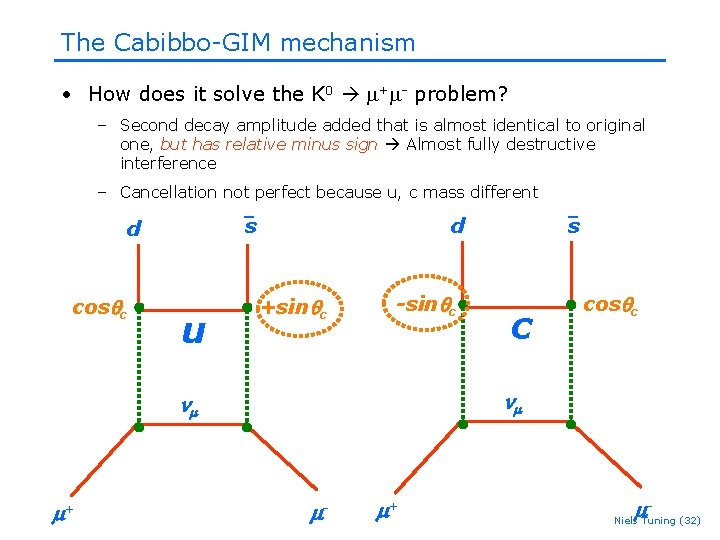
The Cabibbo-GIM mechanism • How does it solve the K 0 m+m- problem? – Second decay amplitude added that is almost identical to original one, but has relative minus sign Almost fully destructive interference – Cancellation not perfect because u, c mass different s d cosqc u d +sinqc -sinqc c cosqc nm nm m+ s m- m+ m- Niels Tuning (32)
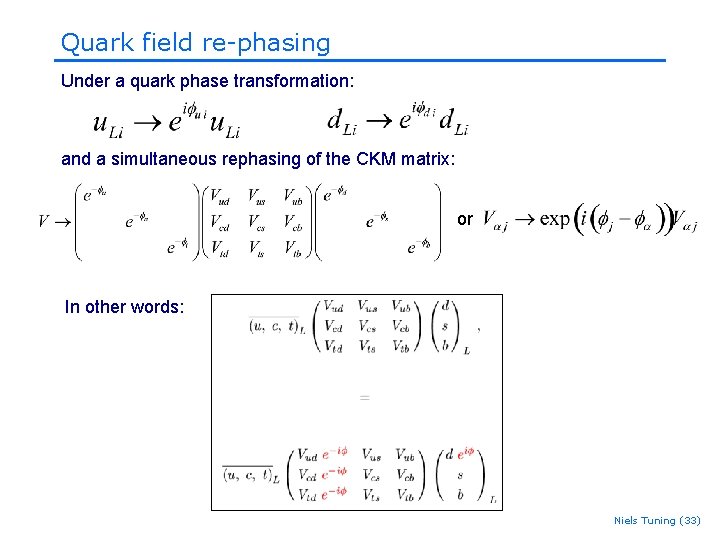
Quark field re-phasing Under a quark phase transformation: and a simultaneous rephasing of the CKM matrix: or In other words: Niels Tuning (33)
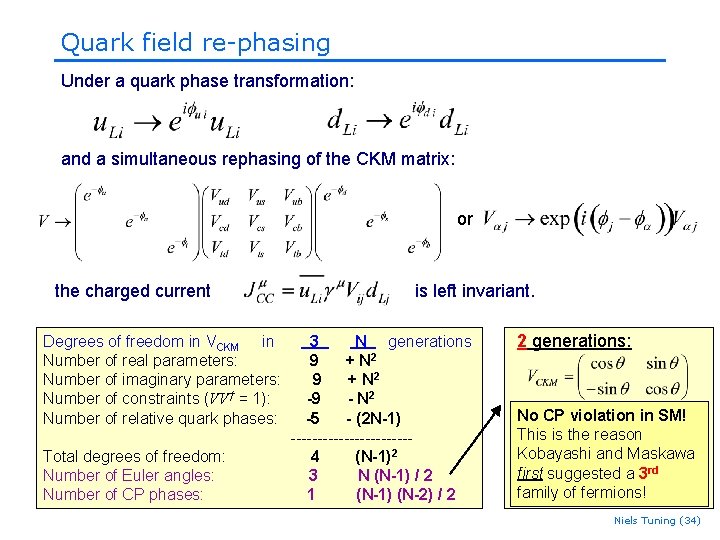
Quark field re-phasing Under a quark phase transformation: and a simultaneous rephasing of the CKM matrix: or the charged current Degrees of freedom in VCKM in Number of real parameters: Number of imaginary parameters: Number of constraints (VV† = 1): Number of relative quark phases: Total degrees of freedom: Number of Euler angles: Number of CP phases: is left invariant. 3 N generations 9 + N 2 -9 - N 2 -5 - (2 N-1) -----------4 (N-1)2 3 N (N-1) / 2 1 (N-1) (N-2) / 2 2 generations: No CP violation in SM! This is the reason Kobayashi and Maskawa first suggested a 3 rd family of fermions! Niels Tuning (34)
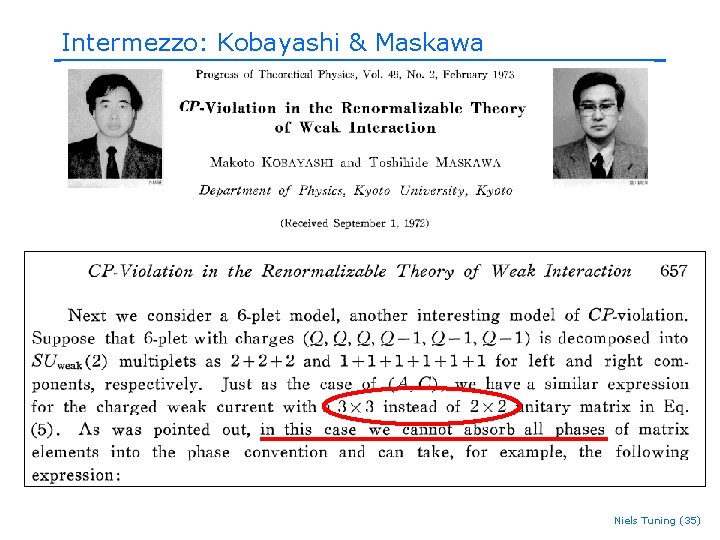
Intermezzo: Kobayashi & Maskawa Niels Tuning (35)
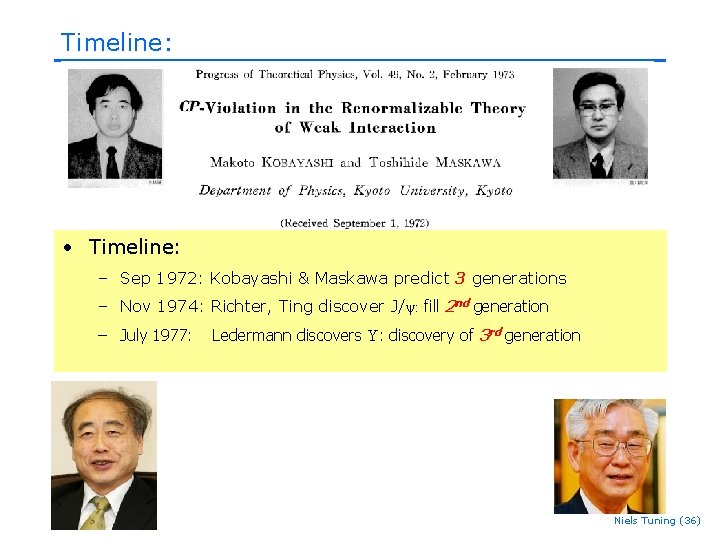
Timeline: • Timeline: – Sep 1972: Kobayashi & Maskawa predict 3 generations – Nov 1974: Richter, Ting discover J/ψ: fill 2 nd generation – July 1977: Ledermann discovers Υ: discovery of 3 rd generation Niels Tuning (36)
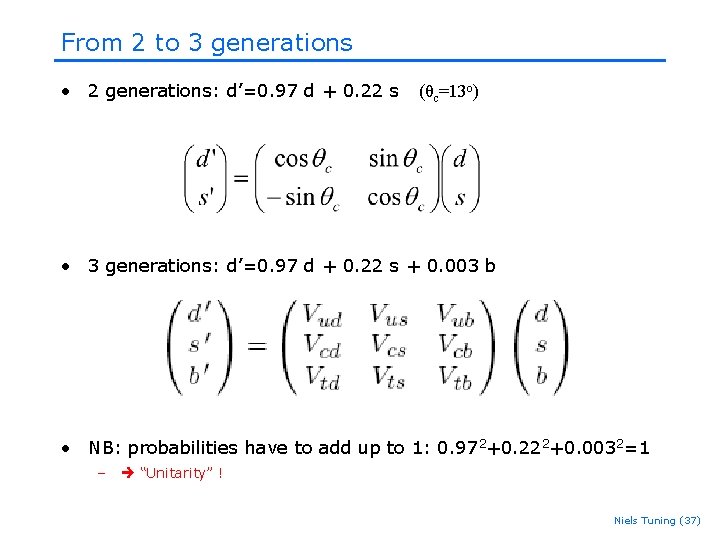
From 2 to 3 generations • 2 generations: d’=0. 97 d + 0. 22 s (θc=13 o) • 3 generations: d’=0. 97 d + 0. 22 s + 0. 003 b • NB: probabilities have to add up to 1: 0. 972+0. 222+0. 0032=1 – “Unitarity” ! Niels Tuning (37)
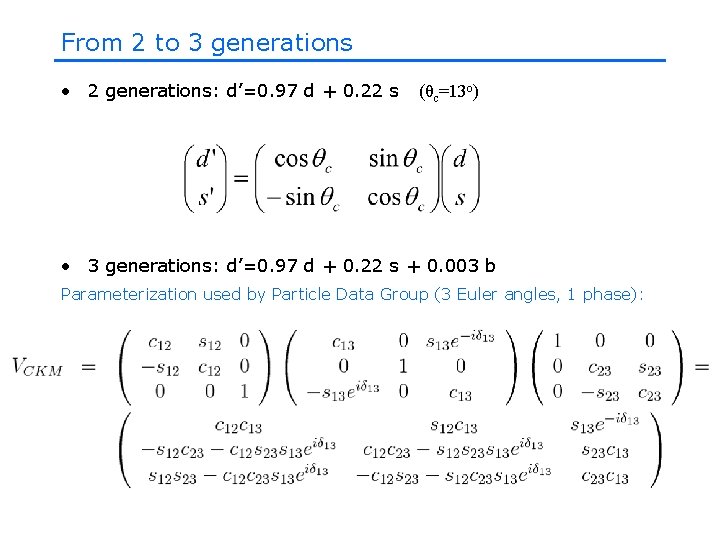
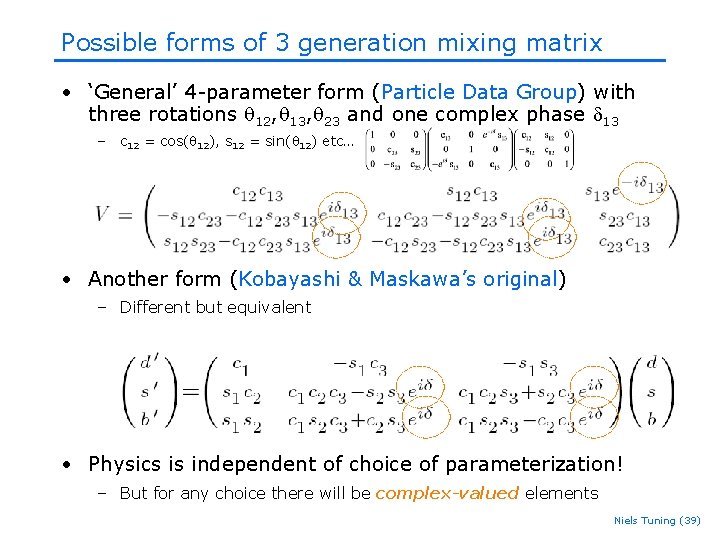
From 2 to 3 generations • 2 generations: d’=0. 97 d + 0. 22 s (θc=13 o) • 3 generations: d’=0. 97 d + 0. 22 s + 0. 003 b Parameterization used by Particle Data Group (3 Euler angles, 1 phase):
Possible forms of 3 generation mixing matrix • ‘General’ 4 -parameter form (Particle Data Group) with three rotations q 12, q 13, q 23 and one complex phase d 13 – c 12 = cos(q 12), s 12 = sin(q 12) etc… • Another form (Kobayashi & Maskawa’s original) – Different but equivalent • Physics is independent of choice of parameterization! – But for any choice there will be complex-valued elements Niels Tuning (39)
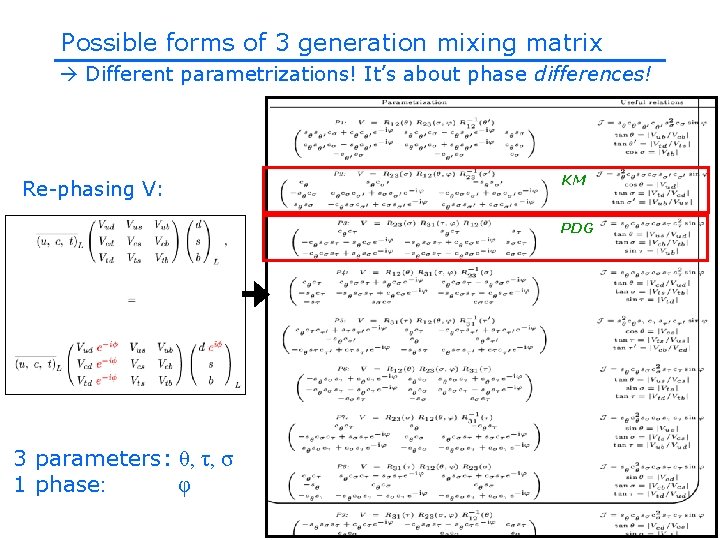
Possible forms of 3 generation mixing matrix Different parametrizations! It’s about phase differences! Re-phasing V: KM PDG 3 parameters: θ, τ, σ 1 phase: φ Niels Tuning (40)
Quark field re-phasing Under a quark phase transformation: and a simultaneous rephasing of the CKM matrix: or the charged current Degrees of freedom in VCKM in Number of real parameters: Number of imaginary parameters: Number of constraints (VV† = 1): Number of relative quark phases: Total degrees of freedom: Number of Euler angles: Number of CP phases: is left invariant. 3 N generations 9 + N 2 -9 - N 2 -5 - (2 N-1) -----------4 (N-1)2 3 N (N-1) / 2 1 (N-1) (N-2) / 2 2 generations: No CP violation in SM! This is the reason Kobayashi and Maskawa first suggested a 3 rd family of fermions! Niels Tuning (41)
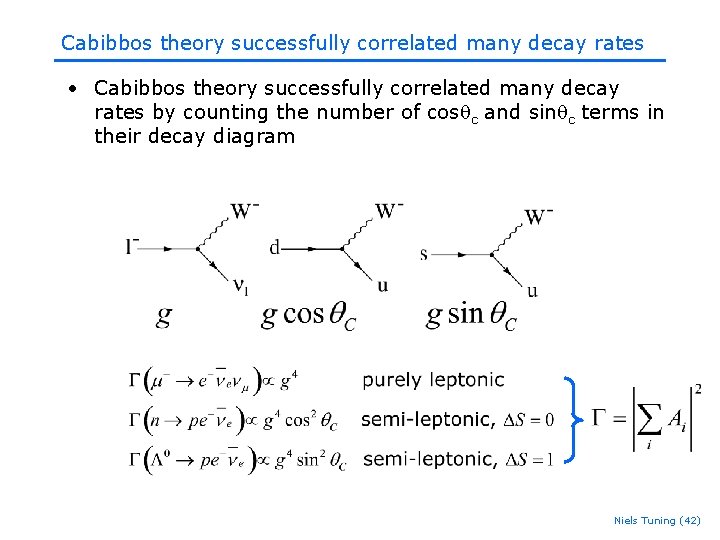
Cabibbos theory successfully correlated many decay rates • Cabibbos theory successfully correlated many decay rates by counting the number of cosqc and sinqc terms in their decay diagram Niels Tuning (42)
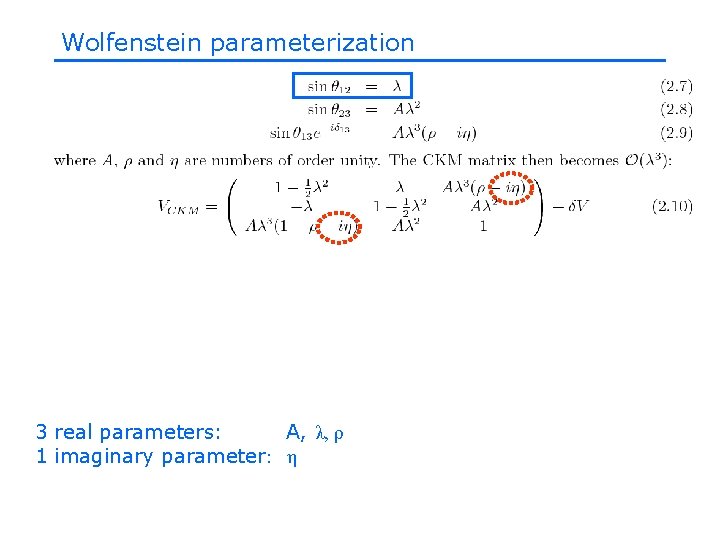
Wolfenstein parameterization 3 real parameters: A, λ, ρ 1 imaginary parameter: η
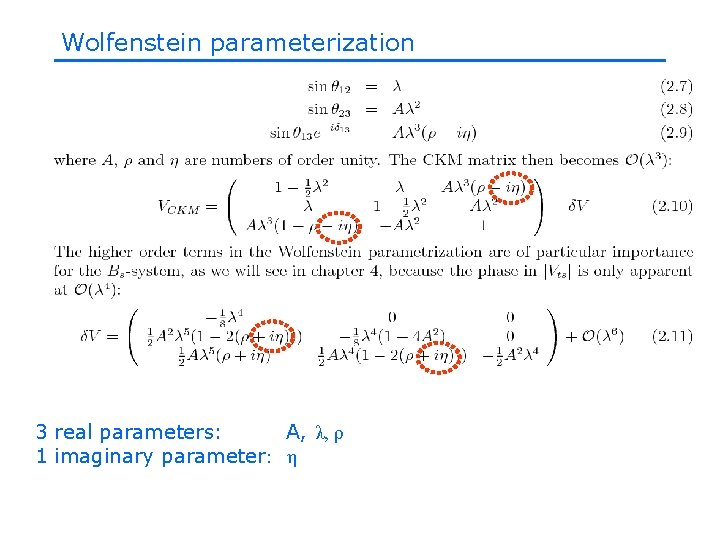
Wolfenstein parameterization 3 real parameters: A, λ, ρ 1 imaginary parameter: η
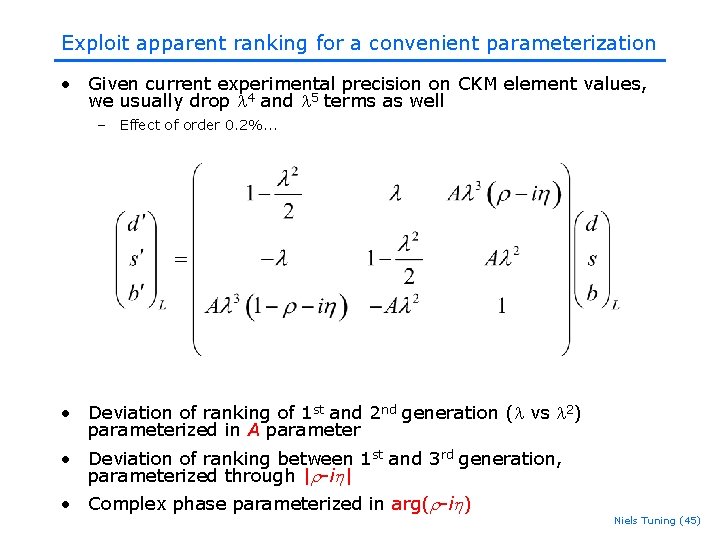
Exploit apparent ranking for a convenient parameterization • Given current experimental precision on CKM element values, we usually drop 4 and 5 terms as well – Effect of order 0. 2%. . . • Deviation of ranking of 1 st and 2 nd generation ( vs 2) parameterized in A parameter • Deviation of ranking between 1 st and 3 rd generation, parameterized through |r-ih| • Complex phase parameterized in arg(r-ih) Niels Tuning (45)
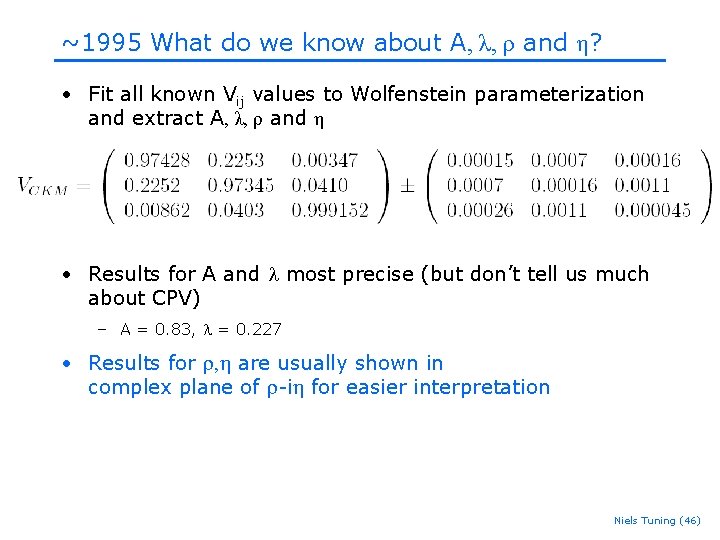
~1995 What do we know about A, λ, ρ and η? • Fit all known Vij values to Wolfenstein parameterization and extract A, λ, ρ and η • Results for A and most precise (but don’t tell us much about CPV) – A = 0. 83, = 0. 227 • Results for r, h are usually shown in complex plane of r-ih for easier interpretation Niels Tuning (46)
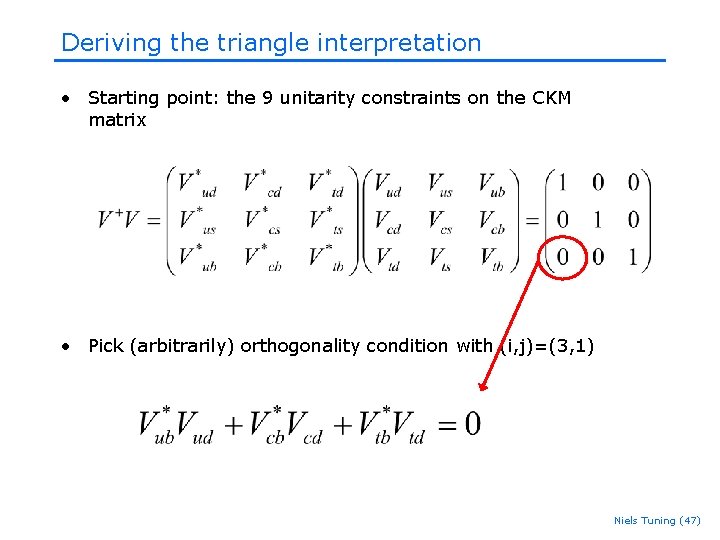
Deriving the triangle interpretation • Starting point: the 9 unitarity constraints on the CKM matrix • Pick (arbitrarily) orthogonality condition with (i, j)=(3, 1) Niels Tuning (47)
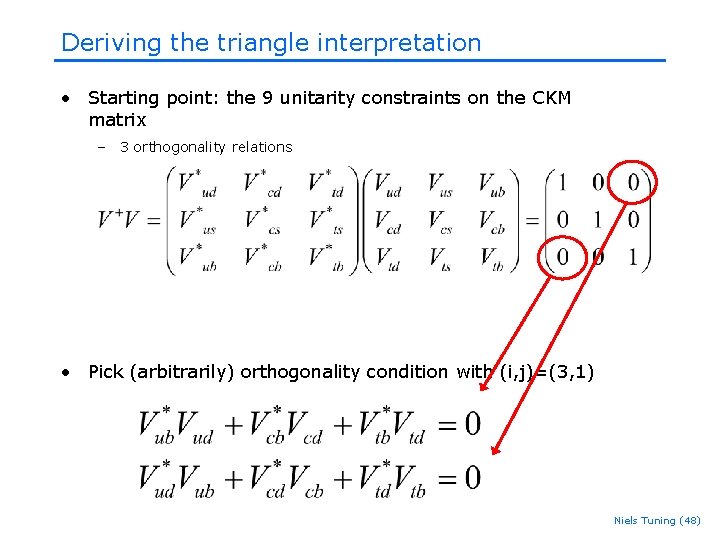
Deriving the triangle interpretation • Starting point: the 9 unitarity constraints on the CKM matrix – 3 orthogonality relations • Pick (arbitrarily) orthogonality condition with (i, j)=(3, 1) Niels Tuning (48)
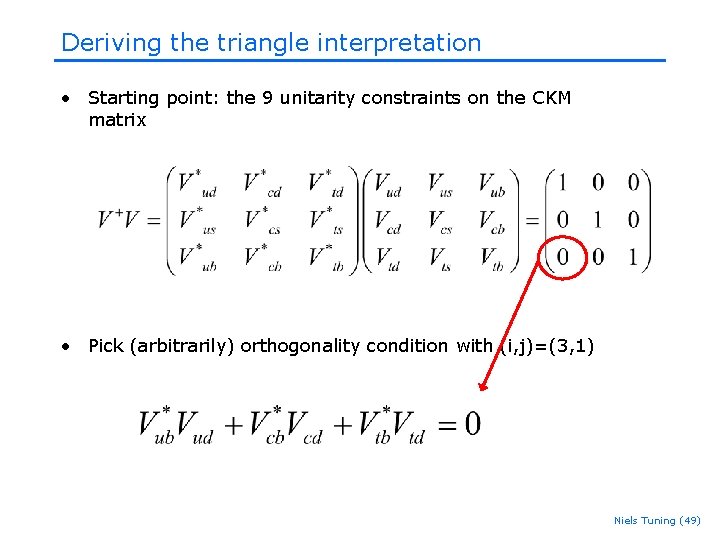
Deriving the triangle interpretation • Starting point: the 9 unitarity constraints on the CKM matrix • Pick (arbitrarily) orthogonality condition with (i, j)=(3, 1) Niels Tuning (49)
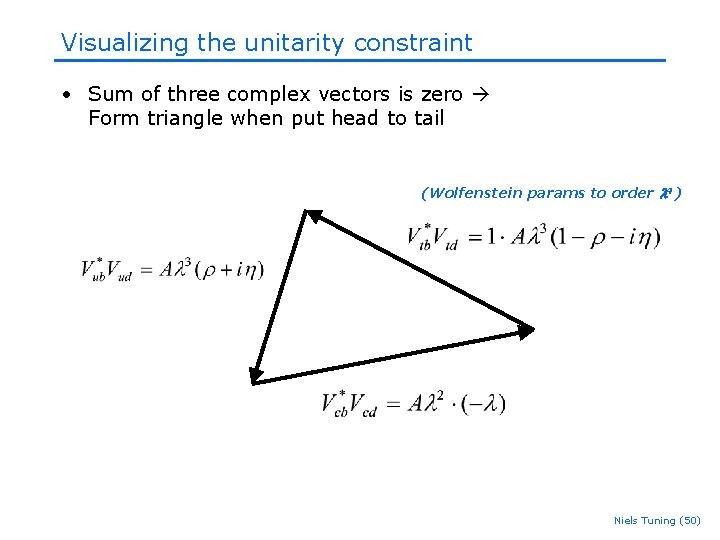
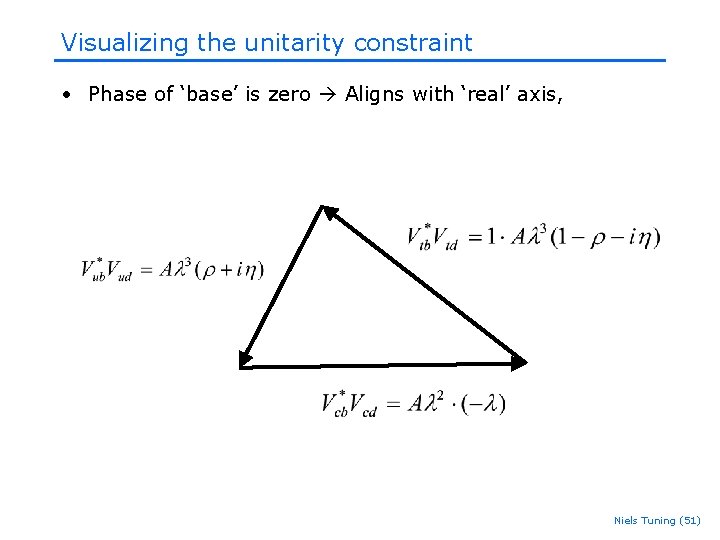
Visualizing the unitarity constraint • Sum of three complex vectors is zero Form triangle when put head to tail (Wolfenstein params to order l 4) Niels Tuning (50)
Visualizing the unitarity constraint • Phase of ‘base’ is zero Aligns with ‘real’ axis, Niels Tuning (51)
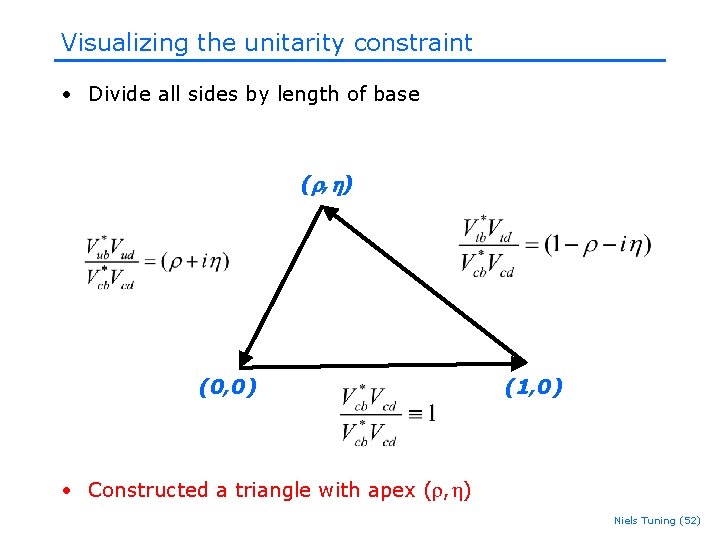
Visualizing the unitarity constraint • Divide all sides by length of base ( r , h) (0, 0) (1, 0) • Constructed a triangle with apex (r, h) Niels Tuning (52)
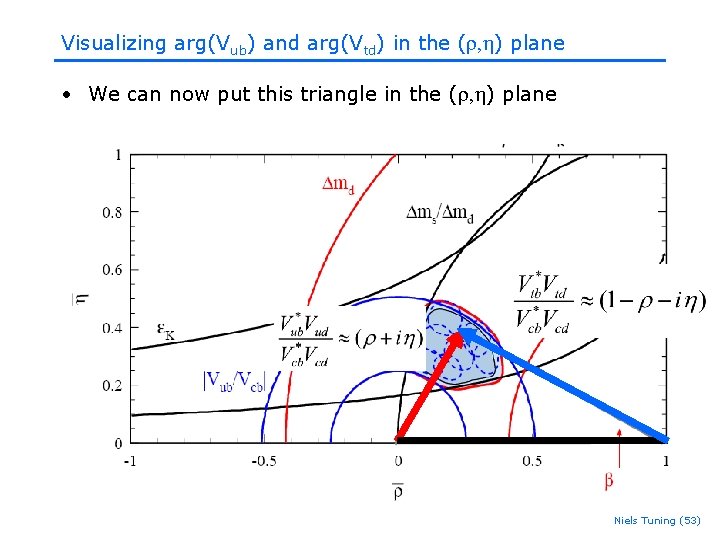
Visualizing arg(Vub) and arg(Vtd) in the (r, h) plane • We can now put this triangle in the (r, h) plane Niels Tuning (53)
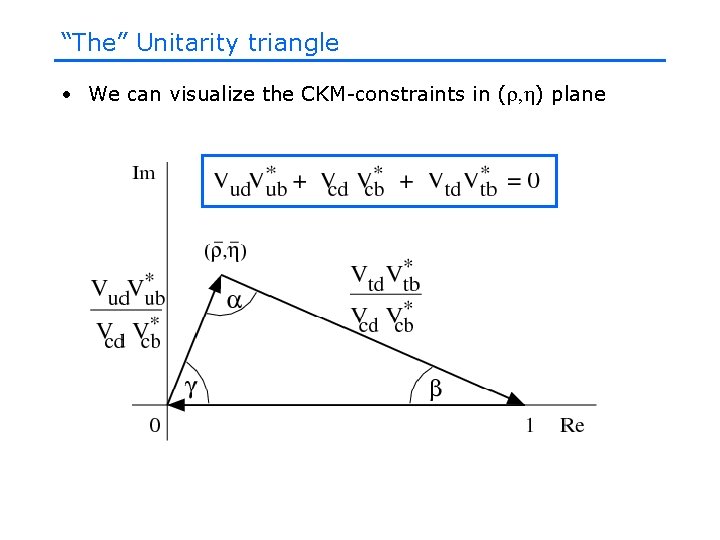
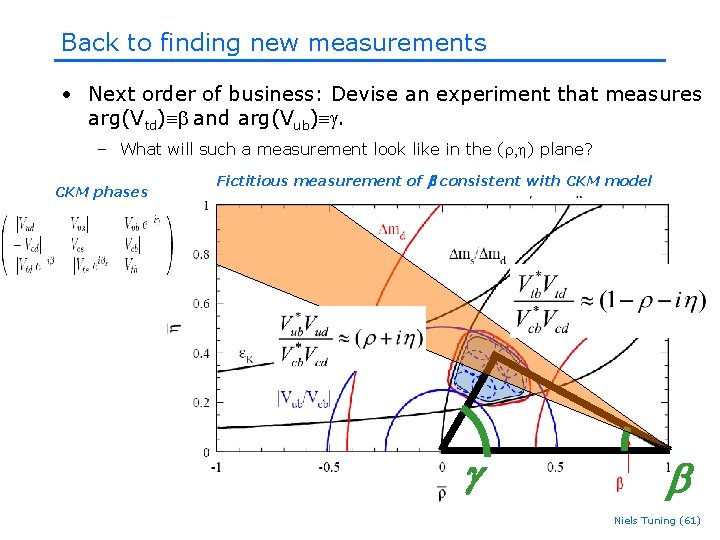
“The” Unitarity triangle • We can visualize the CKM-constraints in (r, h) plane
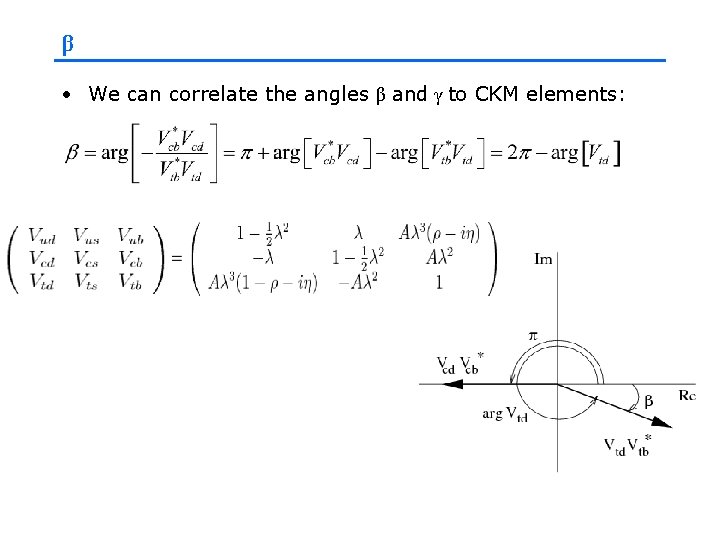
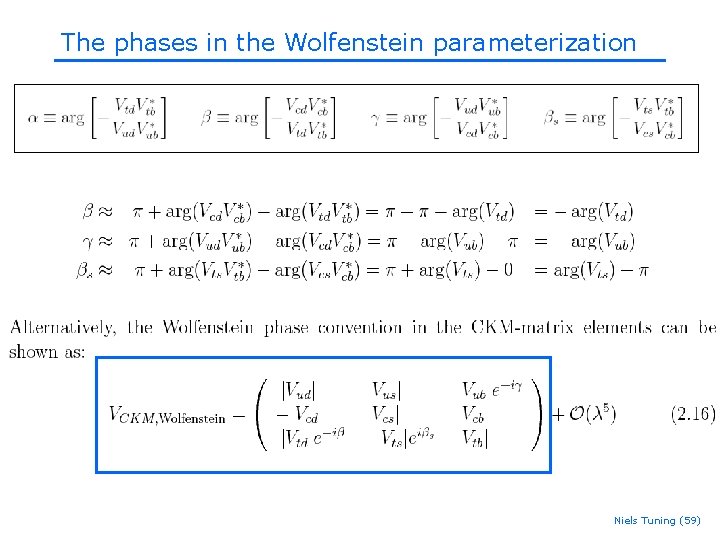
β • We can correlate the angles β and γ to CKM elements:
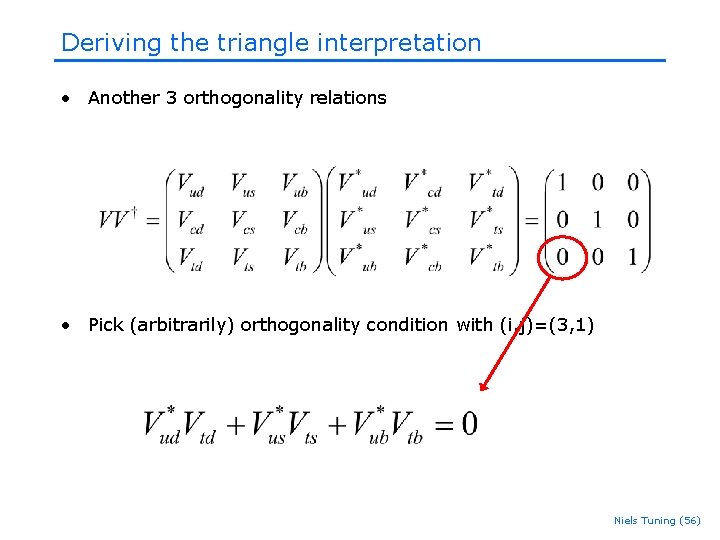
Deriving the triangle interpretation • Another 3 orthogonality relations • Pick (arbitrarily) orthogonality condition with (i, j)=(3, 1) Niels Tuning (56)
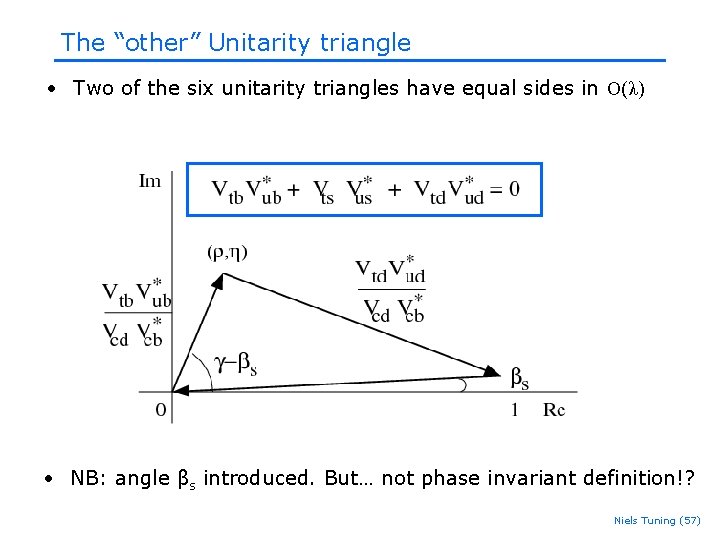
The “other” Unitarity triangle • Two of the six unitarity triangles have equal sides in O(λ) • NB: angle βs introduced. But… not phase invariant definition!? Niels Tuning (57)
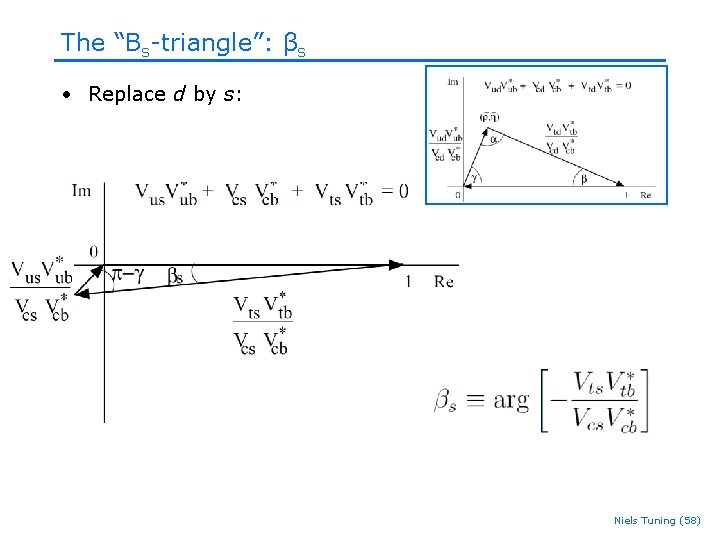
The “Bs-triangle”: βs • Replace d by s: Niels Tuning (58)
The phases in the Wolfenstein parameterization Niels Tuning (59)
The CKM matrix • Couplings of the charged current: b Wg. Vub u • Wolfenstein parametrization: • Magnitude: • Complex phases: Niels Tuning (60)
Back to finding new measurements • Next order of business: Devise an experiment that measures arg(Vtd) b and arg(Vub) g. – What will such a measurement look like in the (r, h) plane? CKM phases Fictitious measurement of b consistent with CKM model g b Niels Tuning (61)
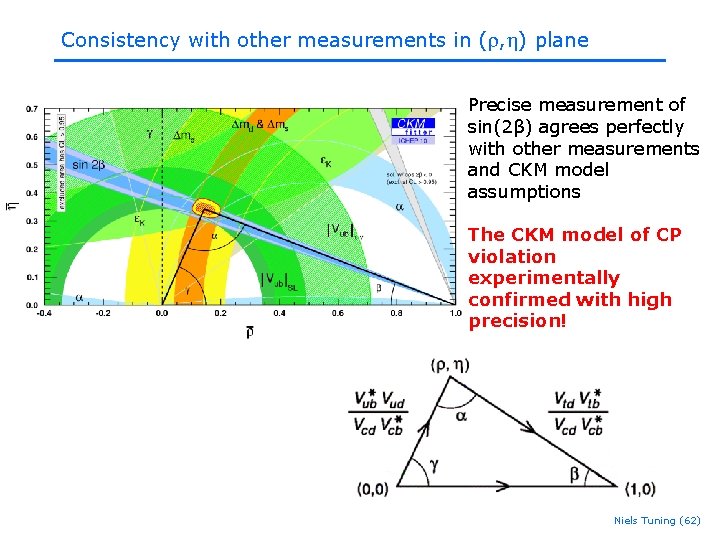
Consistency with other measurements in (r, h) plane Precise measurement of sin(2β) agrees perfectly with other measurements and CKM model assumptions The CKM model of CP violation experimentally confirmed with high precision! Niels Tuning (62)
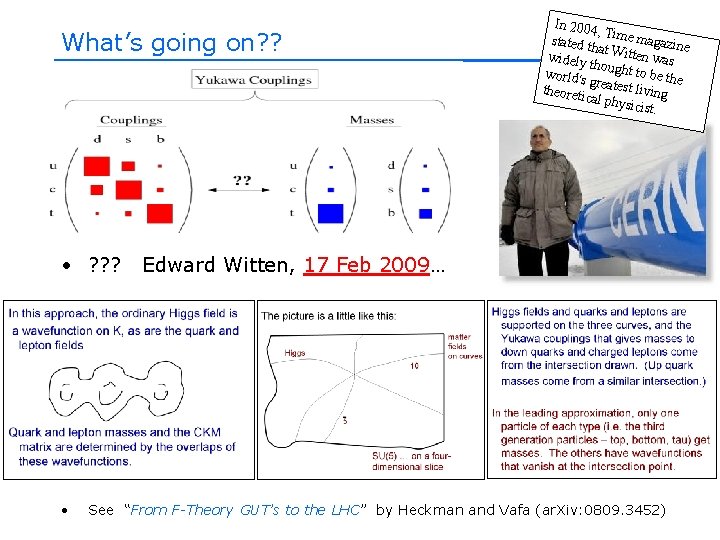
What’s going on? ? • ? ? ? • In 2004 , T stated th ime magazine at Witte n widely thought was to world's greatest be the li theoreti cal phy ving sicist. Edward Witten, 17 Feb 2009… See “From F-Theory GUT’s to the LHC” by Heckman and Vafa (ar. Xiv: 0809. 3452)