Overdose Approach Assessment and Management Dr Kirsty Dunn




- Slides: 66
Overdose Approach, Assessment and Management Dr. Kirsty Dunn FACEM Emergency Department Ballarat Health Services
Key Issues l l l Heterogenous clinical presentation Myriad toxins – ingestion, exposure Risk assessment knows pt weight (? ) and comorbidities (? ) Dynamic medical illness (some anticipated clinical decline) Tailored Mx plan for individual patient Conventional resuscitation methods may not apply GCS 12 vs 8 for ETT
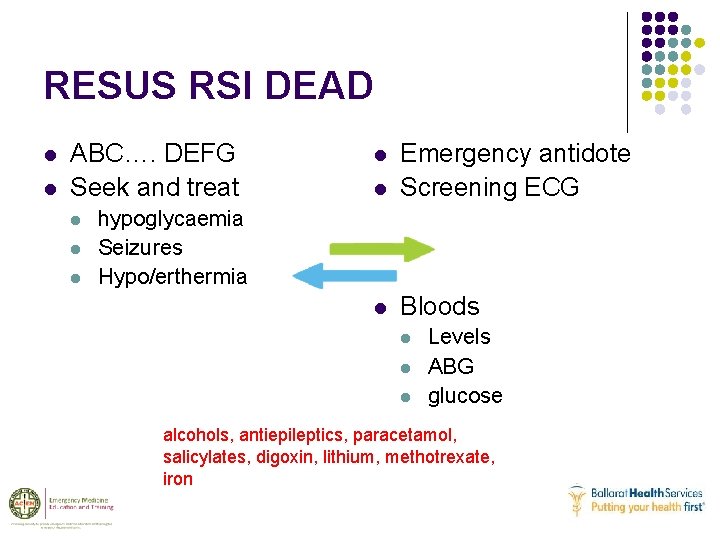
Approach l “RESUS RSI DEAD” l Typically management simultaneous with assessment. Coal face – no past medical history, limited drug history, reliant on bystanders/ ambulance officers / old notes.
Assessment l l Criticality Aetiology l l Most likely Most fatal Impact on underlying comorbidities Rule out non-accidental injury. l l l History Examination Investigations l l Bedside Labs Imaging Specialist
Management l l l Resuscitate Specific Supportive Referral Disposition Education l l l l RESUS RSI DEAD Resuscitate + Antidote Risk assess Supportive care + monitoring Investigations Decontaminate Enhance elimination Disposition
RESUS RSI DEAD l l ABC…. DEFG Seek and treat l l Emergency antidote Screening ECG l Bloods l hypoglycaemia Seizures Hypo/erthermia l l l Levels ABG glucose alcohols, antiepileptics, paracetamol, salicylates, digoxin, lithium, methotrexate, iron
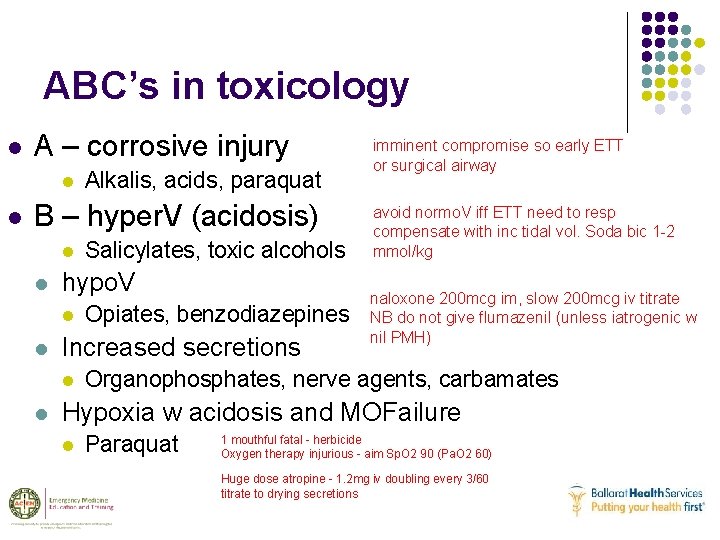
ABC’s in toxicology l A – corrosive injury l l Alkalis, acids, paraquat B – hyper. V (acidosis) l l hypo. V l l Opiates, benzodiazepines Increased secretions l l Salicylates, toxic alcohols imminent compromise so early ETT or surgical airway avoid normo. V iff ETT need to resp compensate with inc tidal vol. Soda bic 1 -2 mmol/kg naloxone 200 mcg im, slow 200 mcg iv titrate NB do not give flumazenil (unless iatrogenic w nil PMH) Organophosphates, nerve agents, carbamates Hypoxia w acidosis and MOFailure l Paraquat 1 mouthful fatal - herbicide Oxygen therapy injurious - aim Sp. O 2 90 (Pa. O 2 60) Huge dose atropine - 1. 2 mg iv doubling every 3/60 titrate to drying secretions
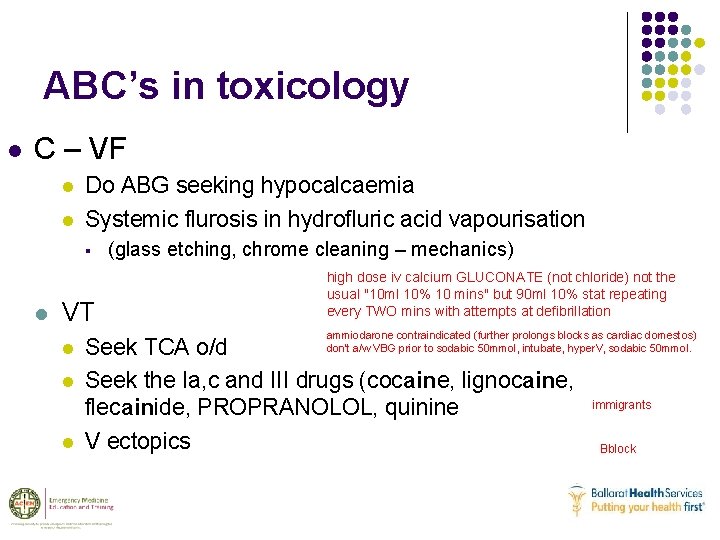
ABC’s in toxicology l C – VF l l Do ABG seeking hypocalcaemia Systemic flurosis in hydrofluric acid vapourisation § l VT l l l (glass etching, chrome cleaning – mechanics) high dose iv calcium GLUCONATE (not chloride) not the usual "10 ml 10% 10 mins" but 90 ml 10% stat repeating every TWO mins with attempts at defibrillation ammiodarone contraindicated (further prolongs blocks as cardiac domestos) don't a/w VBG prior to sodabic 50 mmol, intubate, hyper. V, sodabic 50 mmol. Seek TCA o/d Seek the Ia, c and III drugs (cocaine, lignocaine, flecainide, PROPRANOLOL, quinine V ectopics immigrants Bblock
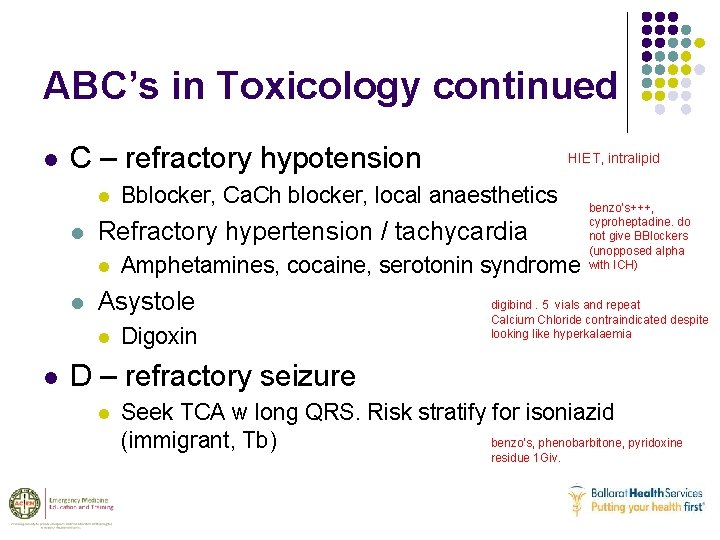
ABC’s in Toxicology continued l C – refractory hypotension l l Amphetamines, cocaine, serotonin syndrome Asystole l l Bblocker, Ca. Ch blocker, local anaesthetics Refractory hypertension / tachycardia l l HIET, intralipid Digoxin benzo's+++, cyproheptadine. do not give BBlockers (unopposed alpha with ICH) digibind. 5 vials and repeat Calcium Chloride contraindicated despite looking like hyperkalaemia D – refractory seizure l Seek TCA w long QRS. Risk stratify for isoniazid benzo's, phenobarbitone, pyridoxine (immigrant, Tb) residue 1 Giv.
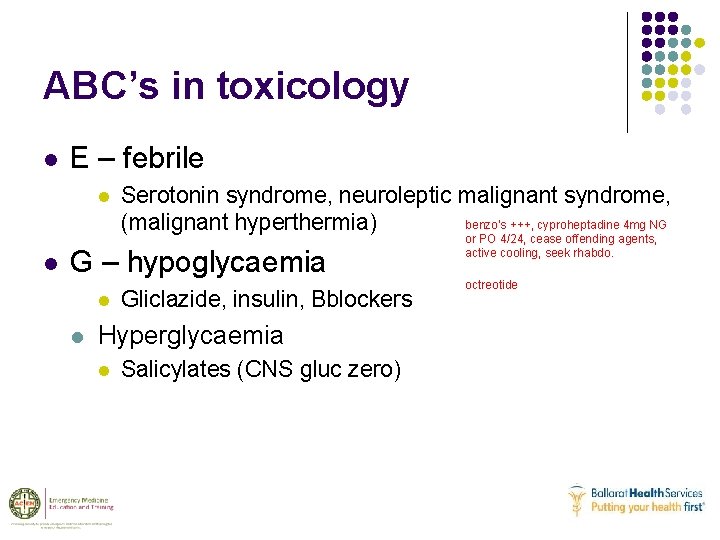
ABC’s in toxicology l E – febrile l l Serotonin syndrome, neuroleptic malignant syndrome, benzo's +++, cyproheptadine 4 mg NG (malignant hyperthermia) G – hypoglycaemia l l Gliclazide, insulin, Bblockers Hyperglycaemia l Salicylates (CNS gluc zero) or PO 4/24, cease offending agents, active cooling, seek rhabdo. octreotide
Risk assessment l l l Agent (s) Dose Time ingested Time lapsed Clinical features and course Patient factors (Wt, liver and renal F, anorexia, cardiac)
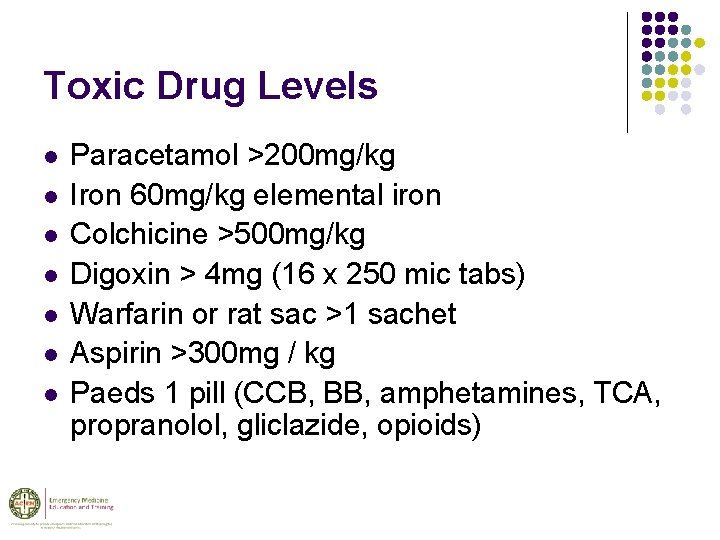
Toxic Drug Levels l l l l Paracetamol >200 mg/kg Iron 60 mg/kg elemental iron Colchicine >500 mg/kg Digoxin > 4 mg (16 x 250 mic tabs) Warfarin or rat sac >1 sachet Aspirin >300 mg / kg Paeds 1 pill (CCB, BB, amphetamines, TCA, propranolol, gliclazide, opioids)
Decontamination PROS Improved morb / mortality More benign clinical course Reduce need for hazardous intervention Reduce hosp LOS l CONS Aspiration GIT obstruction / perf Distraction from supportive Mx Resource intense l
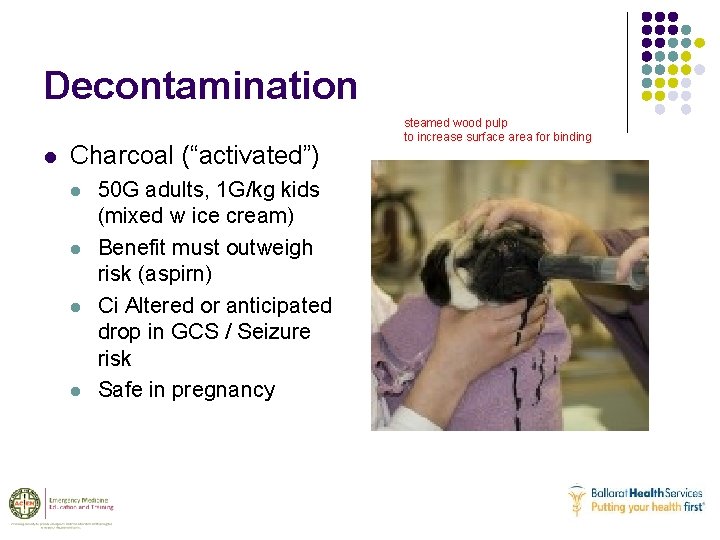
Decontamination l Charcoal (“activated”) l l 50 G adults, 1 G/kg kids (mixed w ice cream) Benefit must outweigh risk (aspirn) Ci Altered or anticipated drop in GCS / Seizure risk Safe in pregnancy steamed wood pulp to increase surface area for binding
Charcoal l l Indications…. (*dubious) Almost everything else l l l l But never really used Paracetamol (*) Benzo’s (*) Barbiturates (*) TCA’s (*) Phenothiazines Anticonvulsants (*) Aspirin Theophylline Digoxin Amphetamines (*) Quinine Blockers l Contraindications l PHAILS l l l l Pesticides Hydrocarbons Acids / alkalis / alcohols /arsenic Iron / lead Lithium or ionic elements Solvents Patient: l l l unstable, non-toxic ingestion, antidote available, ACS, will require gastroscopy, bowel obstruction
Whole bowel irrigation l l PEG Takes 1 nurse 6 hours as sole job Needs commode and antiemetics (and lots of toilet paper) When charcoal ineffective and poor prognosis with no antidote and not amenable to purely supportive care l Eg enteric coated or slow release preps. l IRON, slow K, SR Ca. Ch Block, arsenic, lead, body packers.
Elimination l Never carried out to the detriment of resuscitation or antidote. l Multi-dose activated charcoal Urinary alkalinisation Haemodialysis / CVVHDF Charcoal haemoperfusion l l l
Pearls for Elimination l MDAC causes aspiration, bowel obstruction, corneal abrasions l l listen for bowel sounds every 2/24 50 g bottle. Takes up to 6 hours. Urinary alkalinisation l l Aim urine p. H >7. 5 1 -2 mmol soda bic / Kg then 100 mmol over 4/24. give KCl and monitor K. Stop when tox resolving.
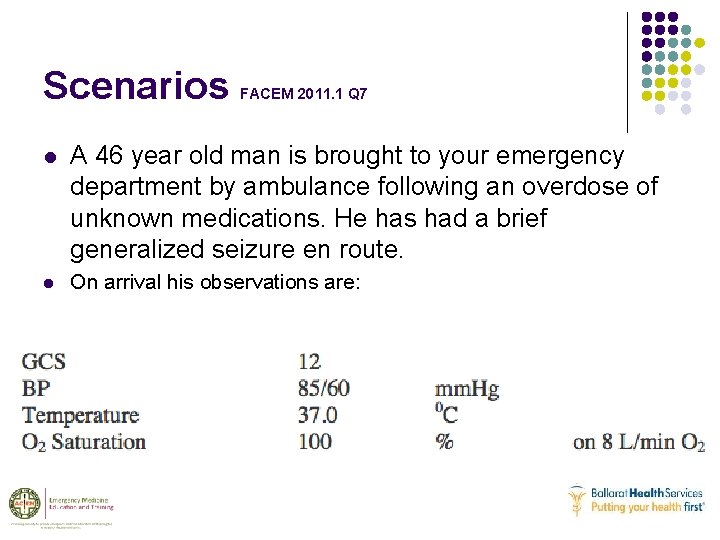
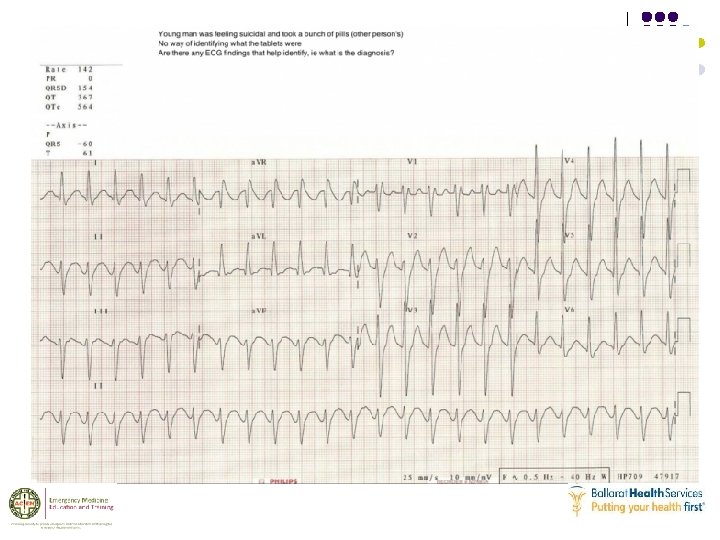
Scenarios FACEM 2011. 1 Q 7 l A 46 year old man is brought to your emergency department by ambulance following an overdose of unknown medications. He has had a brief generalized seizure en route. l On arrival his observations are:
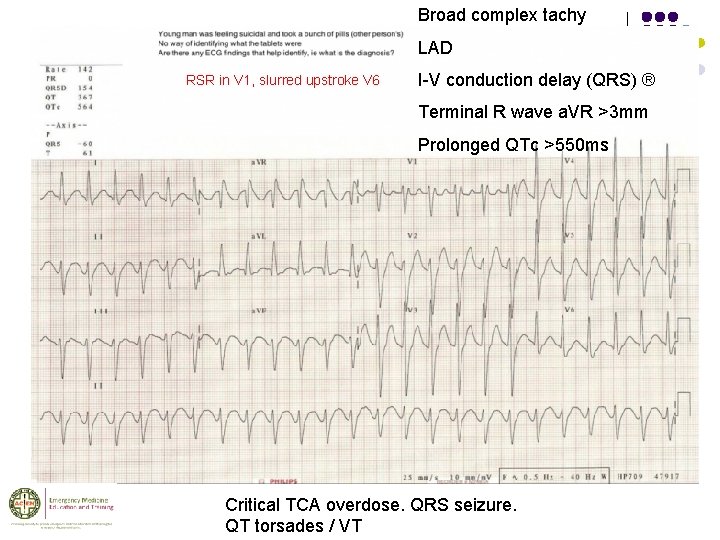
Broad complex tachy LAD RSR in V 1, slurred upstroke V 6 I-V conduction delay (QRS) ® Terminal R wave a. VR >3 mm Prolonged QTc >550 ms Critical TCA overdose. QRS seizure. QT torsades / VT
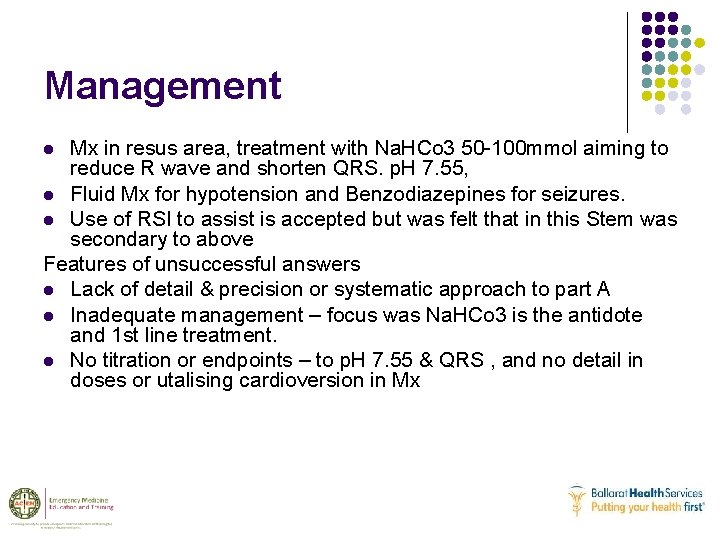
Management Mx in resus area, treatment with Na. HCo 3 50 -100 mmol aiming to reduce R wave and shorten QRS. p. H 7. 55, l Fluid Mx for hypotension and Benzodiazepines for seizures. l Use of RSI to assist is accepted but was felt that in this Stem was secondary to above Features of unsuccessful answers l Lack of detail & precision or systematic approach to part A l Inadequate management – focus was Na. HCo 3 is the antidote and 1 st line treatment. l No titration or endpoints – to p. H 7. 55 & QRS , and no detail in doses or utalising cardioversion in Mx l
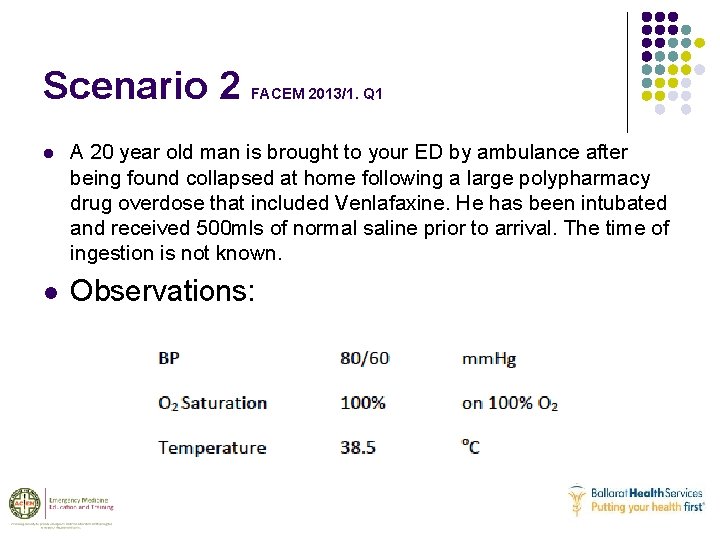
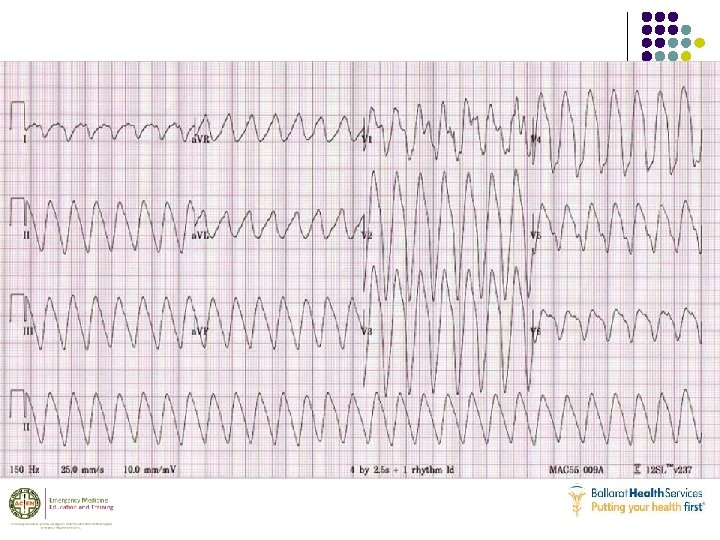
Scenario 2 l l FACEM 2013/1. Q 1 A 20 year old man is brought to your ED by ambulance after being found collapsed at home following a large polypharmacy drug overdose that included Venlafaxine. He has been intubated and received 500 mls of normal saline prior to arrival. The time of ingestion is not known. Observations:
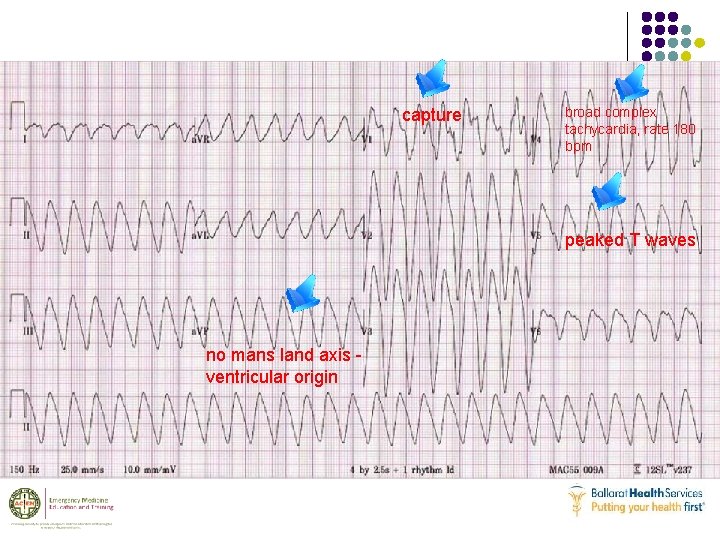
capture broad complex tachycardia, rate 180 bpm peaked T waves no mans land axis - ventricular origin
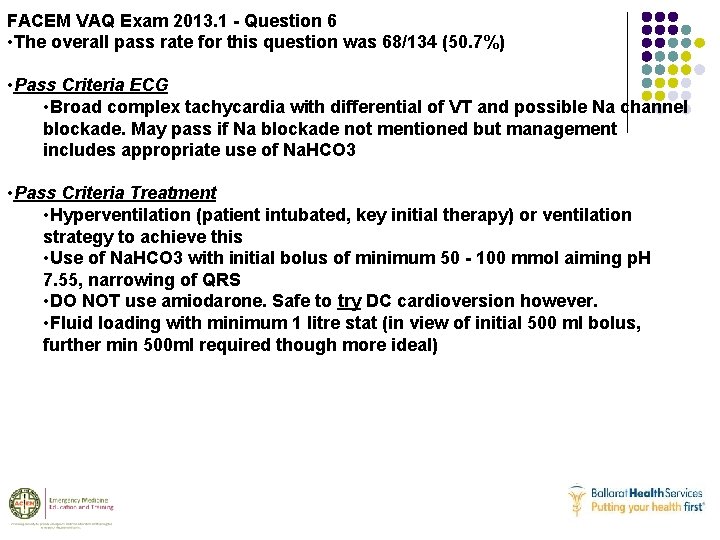
FACEM VAQ Exam 2013. 1 - Question 6 • The overall pass rate for this question was 68/134 (50. 7%) • Pass Criteria ECG • Broad complex tachycardia with differential of VT and possible Na channel blockade. May pass if Na blockade not mentioned but management includes appropriate use of Na. HCO 3 • Pass Criteria Treatment • Hyperventilation (patient intubated, key initial therapy) or ventilation strategy to achieve this • Use of Na. HCO 3 with initial bolus of minimum 50 - 100 mmol aiming p. H 7. 55, narrowing of QRS • DO NOT use amiodarone. Safe to try DC cardioversion however. • Fluid loading with minimum 1 litre stat (in view of initial 500 ml bolus, further min 500 ml required though more ideal)
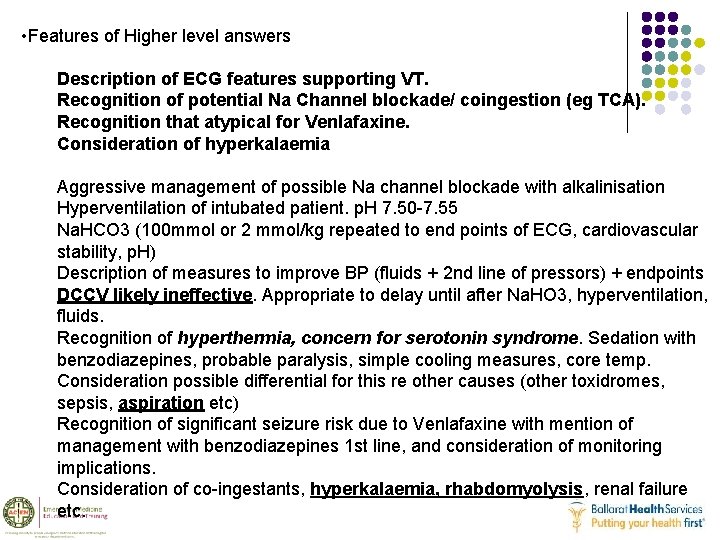
• Features of Higher level answers Description of ECG features supporting VT. Recognition of potential Na Channel blockade/ coingestion (eg TCA). Recognition that atypical for Venlafaxine. Consideration of hyperkalaemia Aggressive management of possible Na channel blockade with alkalinisation Hyperventilation of intubated patient. p. H 7. 50 -7. 55 Na. HCO 3 (100 mmol or 2 mmol/kg repeated to end points of ECG, cardiovascular stability, p. H) Description of measures to improve BP (fluids + 2 nd line of pressors) + endpoints DCCV likely ineffective. Appropriate to delay until after Na. HO 3, hyperventilation, fluids. Recognition of hyperthermia, concern for serotonin syndrome. Sedation with benzodiazepines, probable paralysis, simple cooling measures, core temp. Consideration possible differential for this re other causes (other toxidromes, sepsis, aspiration etc) Recognition of significant seizure risk due to Venlafaxine with mention of management with benzodiazepines 1 st line, and consideration of monitoring implications. Consideration of co-ingestants, hyperkalaemia, rhabdomyolysis, renal failure etc.
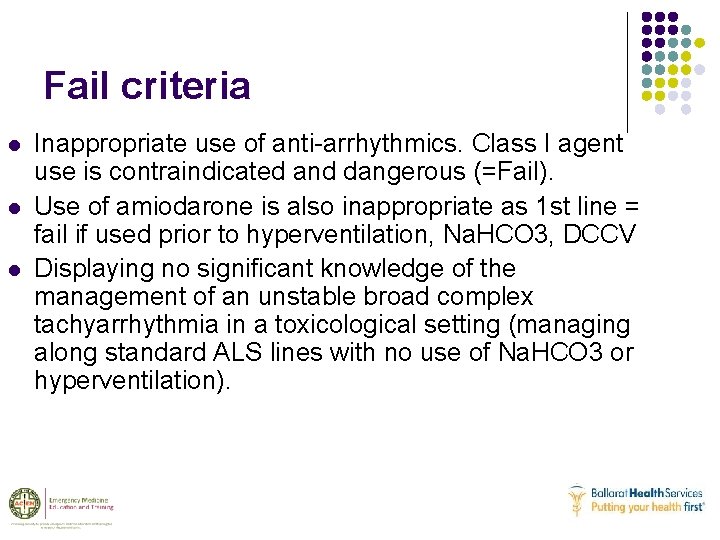
Fail criteria l l l Inappropriate use of anti-arrhythmics. Class I agent use is contraindicated and dangerous (=Fail). Use of amiodarone is also inappropriate as 1 st line = fail if used prior to hyperventilation, Na. HCO 3, DCCV Displaying no significant knowledge of the management of an unstable broad complex tachyarrhythmia in a toxicological setting (managing along standard ALS lines with no use of Na. HCO 3 or hyperventilation).
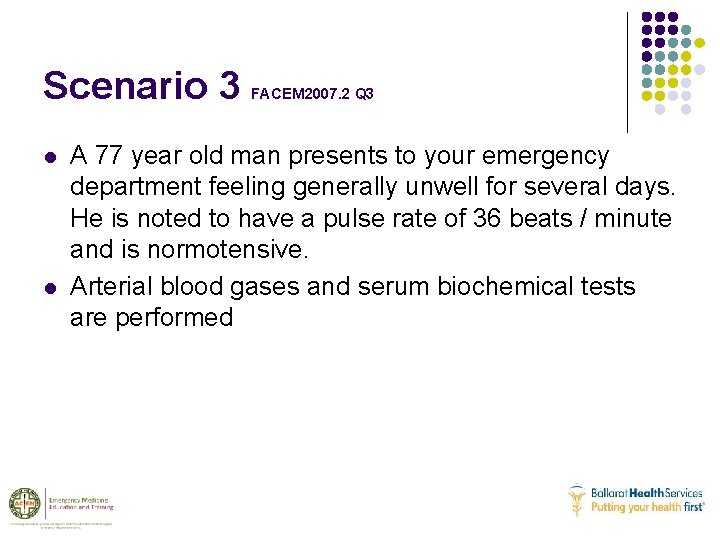
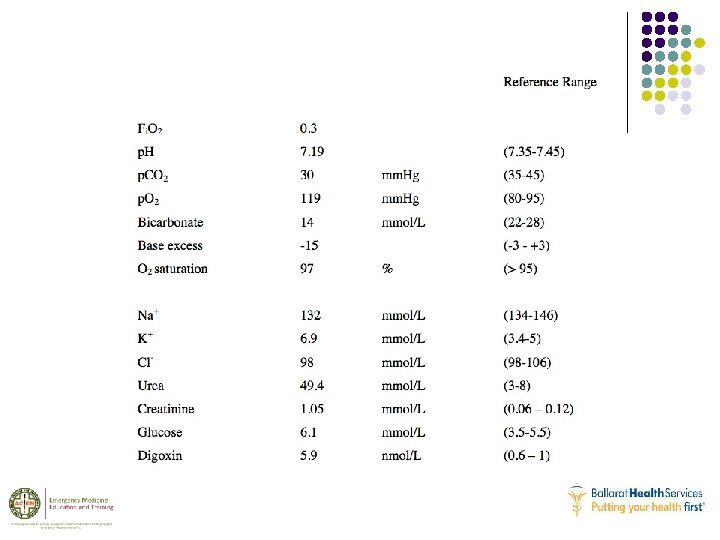
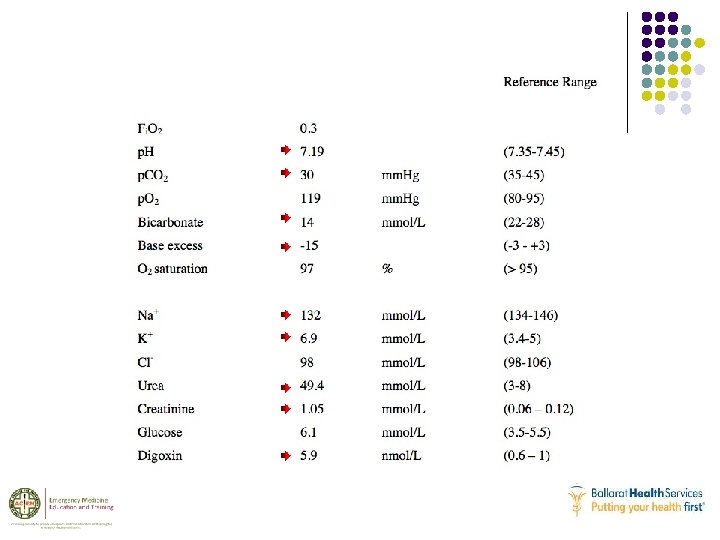
Scenario 3 l l FACEM 2007. 2 Q 3 A 77 year old man presents to your emergency department feeling generally unwell for several days. He is noted to have a pulse rate of 36 beats / minute and is normotensive. Arterial blood gases and serum biochemical tests are performed
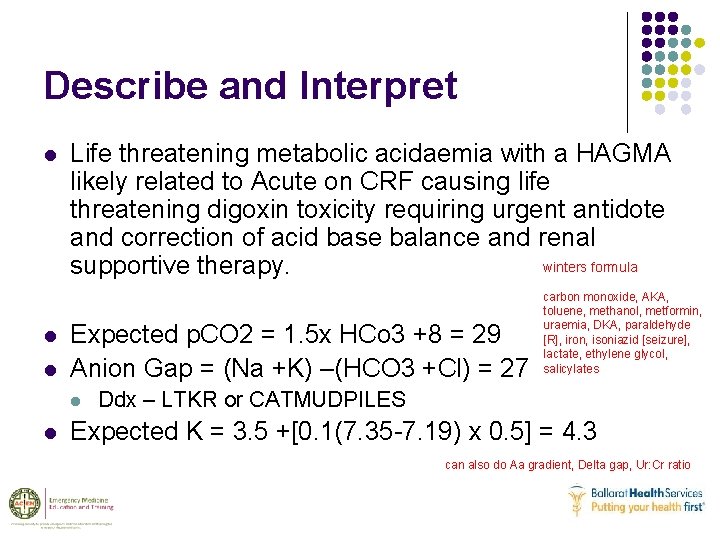
Describe and Interpret l l l Life threatening metabolic acidaemia with a HAGMA likely related to Acute on CRF causing life threatening digoxin toxicity requiring urgent antidote and correction of acid base balance and renal winters formula supportive therapy. Expected p. CO 2 = 1. 5 x HCo 3 +8 = 29 Anion Gap = (Na +K) –(HCO 3 +Cl) = 27 l l carbon monoxide, AKA, toluene, methanol, metformin, uraemia, DKA, paraldehyde [R], iron, isoniazid [seizure], lactate, ethylene glycol, salicylates Ddx – LTKR or CATMUDPILES Expected K = 3. 5 +[0. 1(7. 35 -7. 19) x 0. 5] = 4. 3 can also do Aa gradient, Delta gap, Ur: Cr ratio
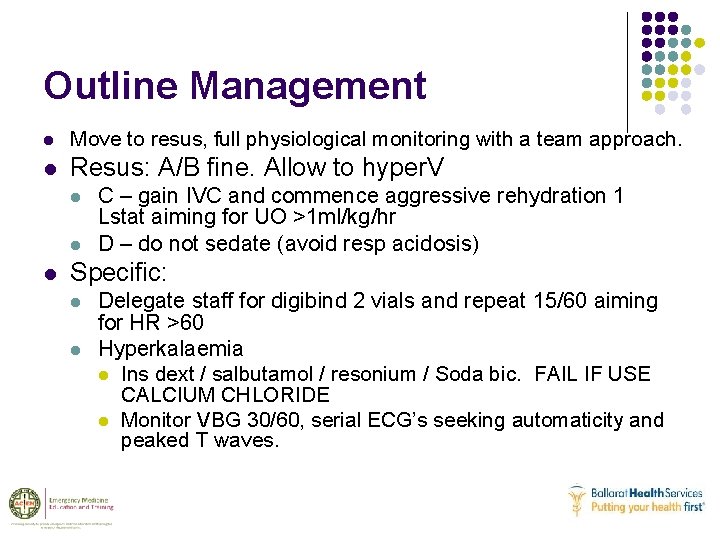
Outline Management l Move to resus, full physiological monitoring with a team approach. l Resus: A/B fine. Allow to hyper. V l l l C – gain IVC and commence aggressive rehydration 1 Lstat aiming for UO >1 ml/kg/hr D – do not sedate (avoid resp acidosis) Specific: l l Delegate staff for digibind 2 vials and repeat 15/60 aiming for HR >60 Hyperkalaemia l Ins dext / salbutamol / resonium / Soda bic. FAIL IF USE CALCIUM CHLORIDE l Monitor VBG 30/60, serial ECG’s seeking automaticity and peaked T waves.
Outline management l Supportive l l Renal failure – ivf. Cvvhdf. Monitor fluid balance, K and urea. Cease nephrotoxics. Glucose – avoid hypoglycaemia (K Rx) Antiemetics for nausea Seek cause of ARF--- digoxin tox -- N/V l ? stroke / myocardial event / infection / change meds
Outline management l Referral l l Disposition l l ICU, renal med, poisons information, and cause initial illness – cardiol / neurol / etc ICU for monitoring, correction of fluid / elec’s/ treating cause Education l NOK, GP, altering prescription
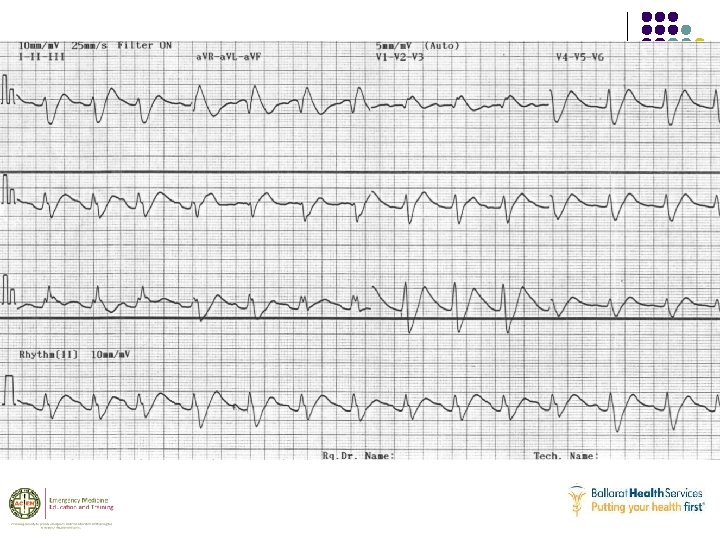
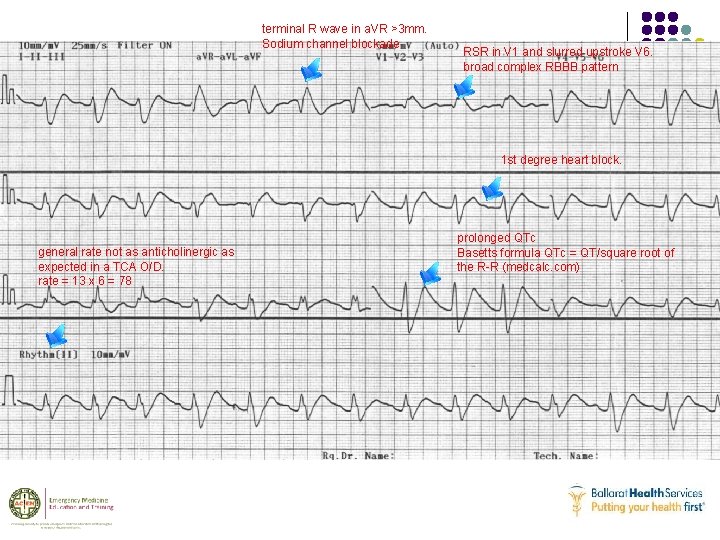
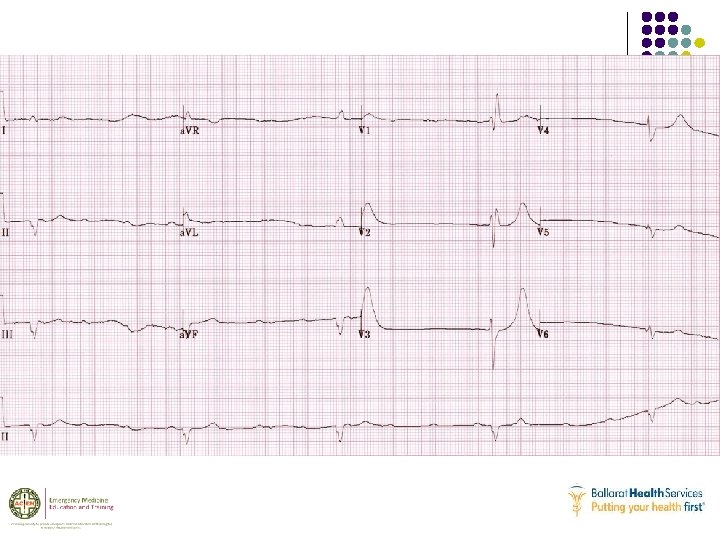
Scenario 4 l l l A 27 -year old female presents to ED one hour after swallowing 70 x 40 mg propranolol tablets (= 2. 8 grams) with suicidal intent. At the time of assessment she is drowsy (GCS 13) with a heart rate of 46 bpm. Fifteen minutes earlier she had been awake and able to give a history to paramedics… You need to act fast to save this patient. Are you up to the challenge? LITFL
terminal R wave in a. VR >3 mm. Sodium channel blockade RSR in V 1 and slurred upstroke V 6. broad complex RBBB pattern 1 st degree heart block. general rate not as anticholinergic as expected in a TCA O/D. rate = 13 x 6 = 78 prolonged QTc Basetts formula QTc = QT/square root of the R-R (medcalc. com)
Propranolol overdose
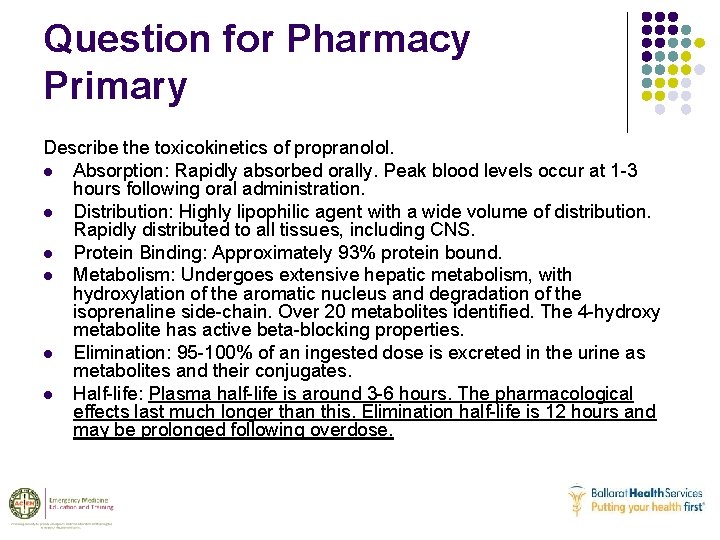
Question for Pharmacy Primary Describe the toxicokinetics of propranolol. l Absorption: Rapidly absorbed orally. Peak blood levels occur at 1 -3 hours following oral administration. l Distribution: Highly lipophilic agent with a wide volume of distribution. Rapidly distributed to all tissues, including CNS. l Protein Binding: Approximately 93% protein bound. l Metabolism: Undergoes extensive hepatic metabolism, with hydroxylation of the aromatic nucleus and degradation of the isoprenaline side-chain. Over 20 metabolites identified. The 4 -hydroxy metabolite has active beta-blocking properties. l Elimination: 95 -100% of an ingested dose is excreted in the urine as metabolites and their conjugates. l Half-life: Plasma half-life is around 3 -6 hours. The pharmacological effects last much longer than this. Elimination half-life is 12 hours and may be prolonged following overdose.
Question for Pharmacy Primary Describe the toxicokinetics of propranolol. l Absorption: Rapidly absorbed orally. Peak blood levels occur at 1 -3 hours following oral administration. l Distribution: Highly lipophilic agent with a wide volume of distribution. Rapidly distributed to all tissues, including CNS. l Protein Binding: Approximately 93% protein bound. l Metabolism: Undergoes extensive hepatic metabolism, with hydroxylation of the aromatic nucleus and degradation of the isoprenaline side-chain. Over 20 metabolites identified. The 4 -hydroxy metabolite has active beta-blocking properties. l Elimination: 95 -100% of an ingested dose is excreted in the urine as metabolites and their conjugates. l Half-life: Plasma half-life is around 3 -6 hours. The pharmacological effects last much longer than this. Elimination half-life is 12 hours and may be prolonged following overdose.
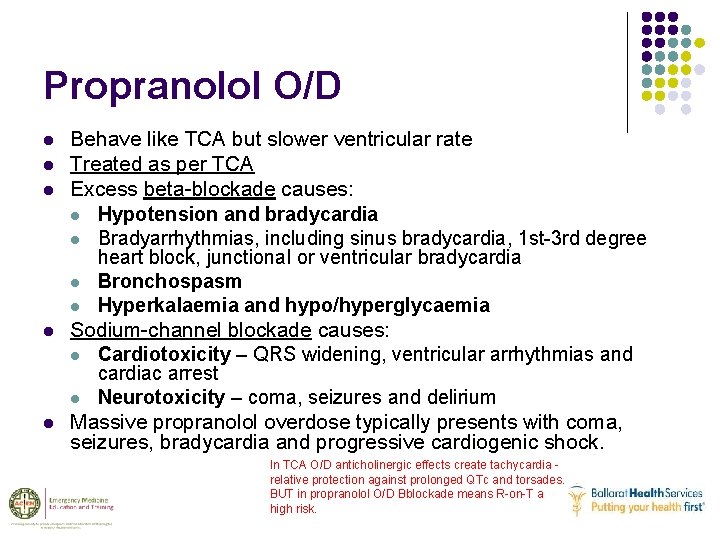
Propranolol O/D l l l Behave like TCA but slower ventricular rate Treated as per TCA Excess beta-blockade causes: l Hypotension and bradycardia l Bradyarrhythmias, including sinus bradycardia, 1 st-3 rd degree heart block, junctional or ventricular bradycardia l Bronchospasm l Hyperkalaemia and hypo/hyperglycaemia Sodium-channel blockade causes: l Cardiotoxicity – QRS widening, ventricular arrhythmias and cardiac arrest l Neurotoxicity – coma, seizures and delirium Massive propranolol overdose typically presents with coma, seizures, bradycardia and progressive cardiogenic shock. In TCA O/D anticholinergic effects create tachycardia - relative protection against prolonged QTc and torsades. BUT in propranolol O/D Bblockade means R-on-T a high risk.
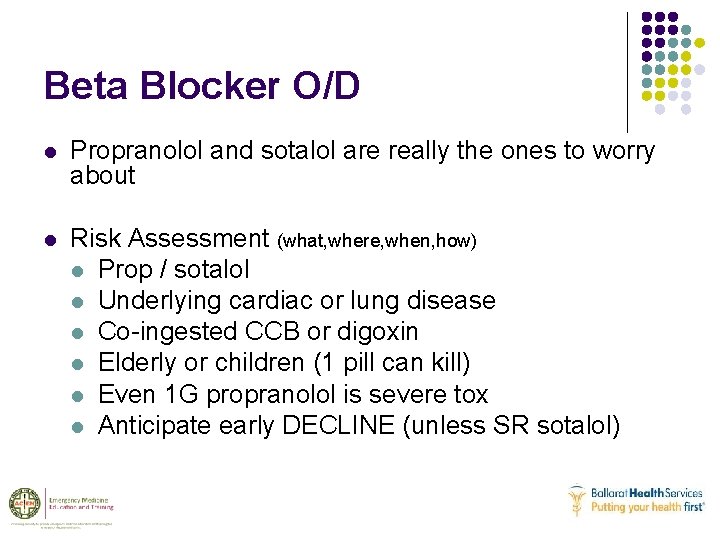
Beta Blocker O/D l Propranolol and sotalol are really the ones to worry about l Risk Assessment (what, where, when, how) l Prop / sotalol l Underlying cardiac or lung disease l Co-ingested CCB or digoxin l Elderly or children (1 pill can kill) l Even 1 G propranolol is severe tox l Anticipate early DECLINE (unless SR sotalol)
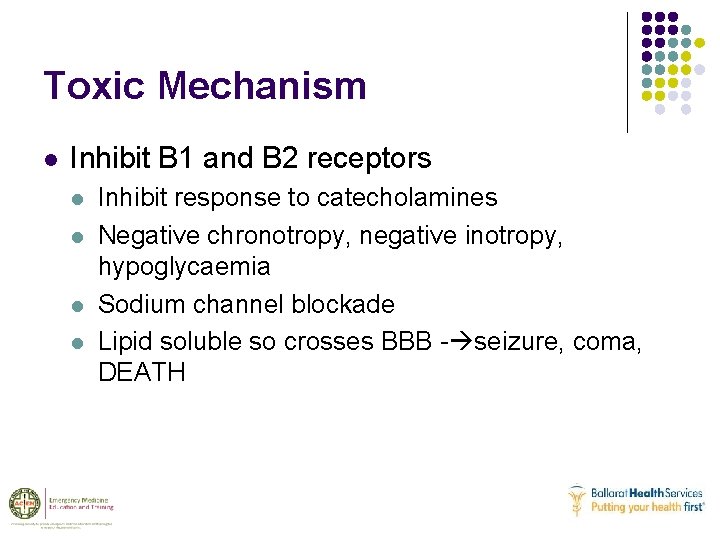
Toxic Mechanism l Inhibit B 1 and B 2 receptors l l Inhibit response to catecholamines Negative chronotropy, negative inotropy, hypoglycaemia Sodium channel blockade Lipid soluble so crosses BBB - seizure, coma, DEATH
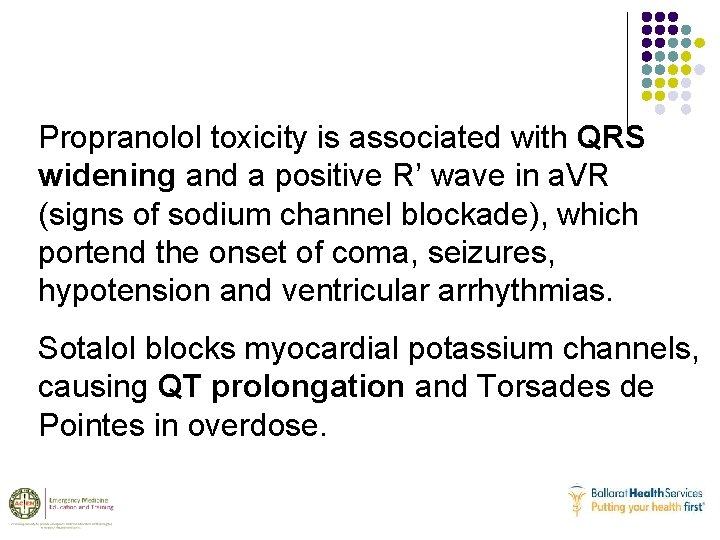
Propranolol toxicity is associated with QRS widening and a positive R’ wave in a. VR (signs of sodium channel blockade), which portend the onset of coma, seizures, hypotension and ventricular arrhythmias. Sotalol blocks myocardial potassium channels, causing QT prolongation and Torsades de Pointes in overdose.
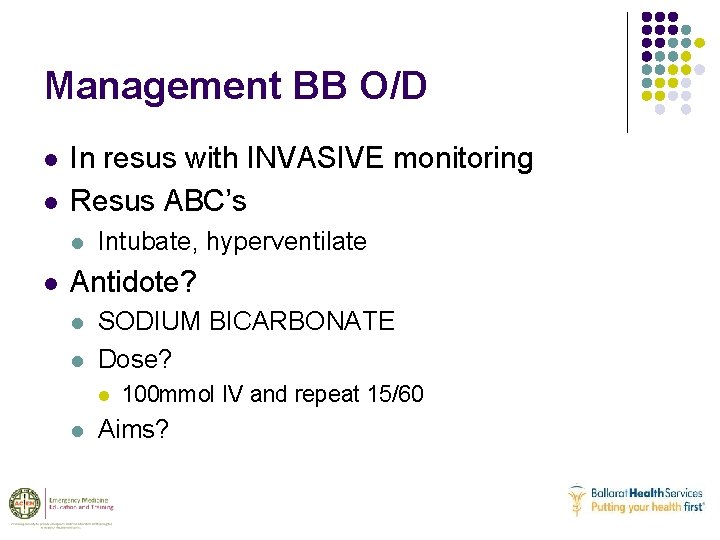
Management BB O/D l l l In resus with INVASIVE monitoring Resus ABC’s Antidote?
Management BB O/D l l l In resus with INVASIVE monitoring Resus ABC’s Antidote? l SODIUM BICARBONATE
Management BB O/D l l In resus with INVASIVE monitoring Resus ABC’s l l Intubate, hyperventilate Antidote? l l SODIUM BICARBONATE Dose?
Management BB O/D l l In resus with INVASIVE monitoring Resus ABC’s l l Intubate, hyperventilate Antidote? l l SODIUM BICARBONATE Dose? l 100 mmol IV and repeat 15/60
Management BB O/D l l In resus with INVASIVE monitoring Resus ABC’s l l Intubate, hyperventilate Antidote? l l SODIUM BICARBONATE Dose? l l 100 mmol IV and repeat 15/60 Aims?
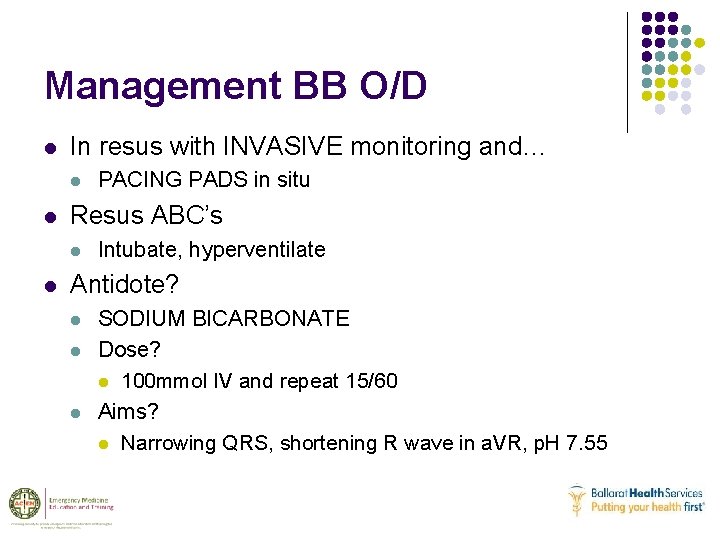
Management BB O/D l In resus with INVASIVE monitoring and… l l Resus ABC’s l l PACING PADS in situ Intubate, hyperventilate Antidote? l l l SODIUM BICARBONATE Dose? l 100 mmol IV and repeat 15/60 Aims? l Narrowing QRS, shortening R wave in a. VR, p. H 7. 55
Management BB O/D l C – what are the options?
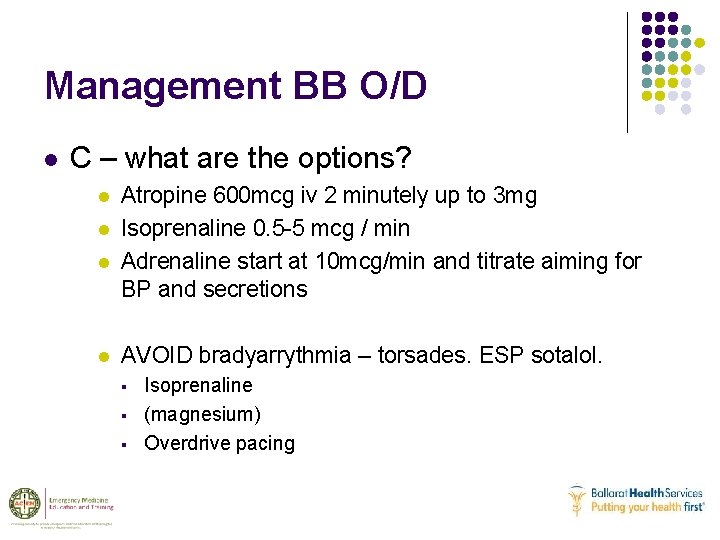
Management BB O/D l C – what are the options? l l Atropine 600 mcg iv 2 minutely up to 3 mg Isoprenaline 0. 5 -5 mcg / min Adrenaline start at 10 mcg/min and titrate aiming for BP and secretions AVOID bradyarrythmia – torsades. ESP sotalol. § § § Isoprenaline (magnesium) Overdrive pacing
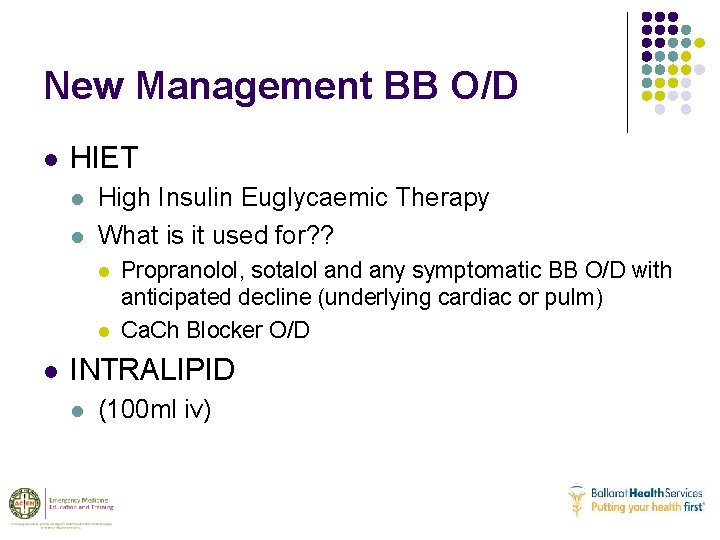
New Management BB O/D l HIET l l High Insulin Euglycaemic Therapy What is it used for? ? l l l Propranolol, sotalol and any symptomatic BB O/D with anticipated decline (underlying cardiac or pulm) Ca. Ch Blocker O/D INTRALIPID l (100 ml iv)
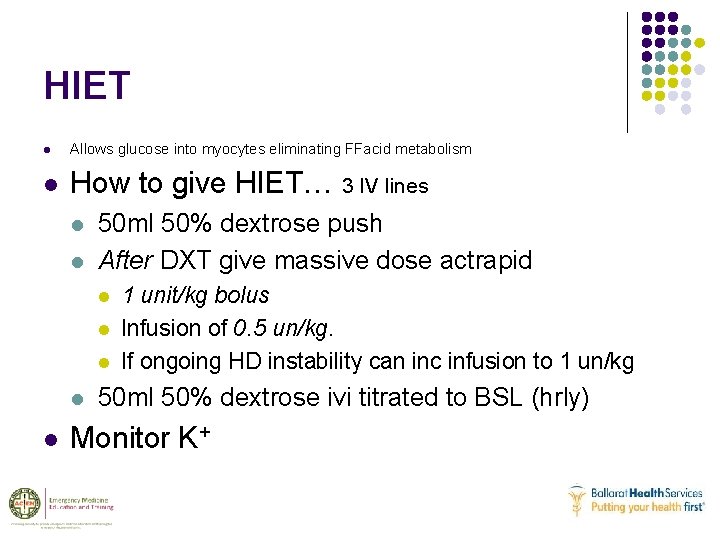
HIET l Allows glucose into myocytes eliminating FFacid metabolism l How to give HIET… 3 IV lines l l 50 ml 50% dextrose push After DXT give massive dose actrapid l l l 1 unit/kg bolus Infusion of 0. 5 un/kg. If ongoing HD instability can inc infusion to 1 un/kg 50 ml 50% dextrose ivi titrated to BSL (hrly) Monitor K+
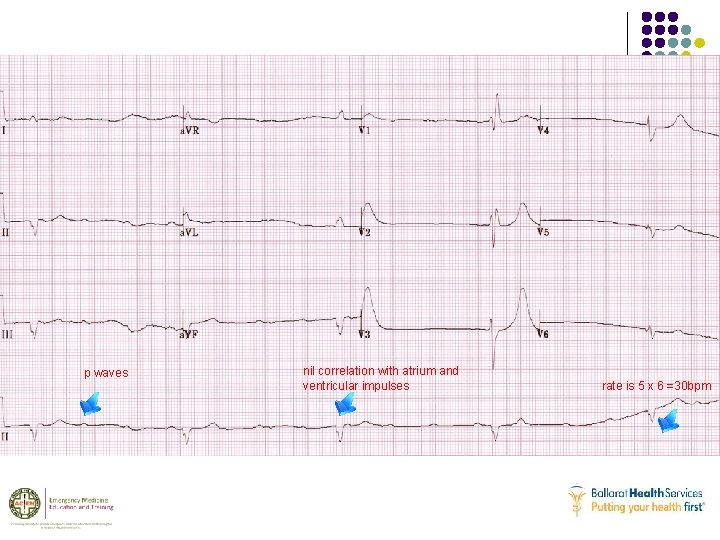
p waves nil correlation with atrium and ventricular impulses rate is 5 x 6 =30 bpm
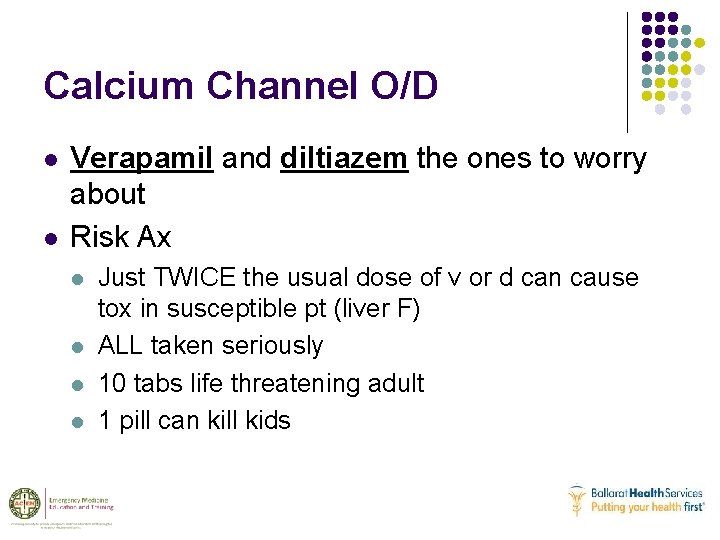
Calcium Channel O/D l l Verapamil and diltiazem the ones to worry about Risk Ax l l Just TWICE the usual dose of v or d can cause tox in susceptible pt (liver F) ALL taken seriously 10 tabs life threatening adult 1 pill can kill kids
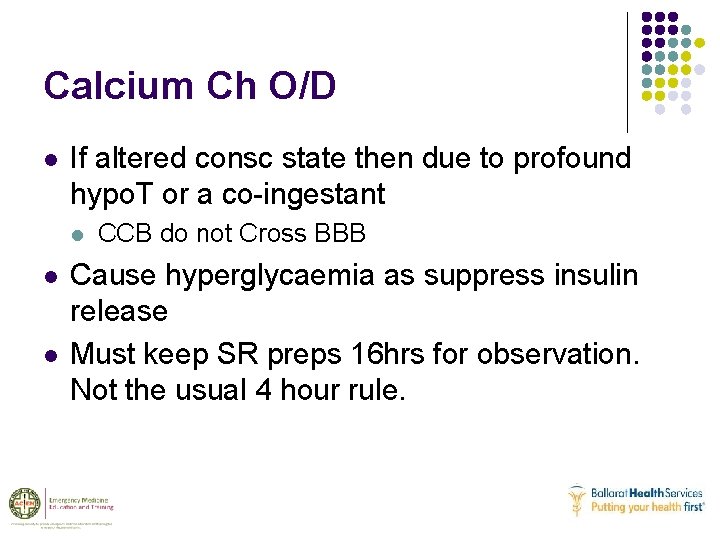
Calcium Ch O/D l If altered consc state then due to profound hypo. T or a co-ingestant l l l CCB do not Cross BBB Cause hyperglycaemia as suppress insulin release Must keep SR preps 16 hrs for observation. Not the usual 4 hour rule.
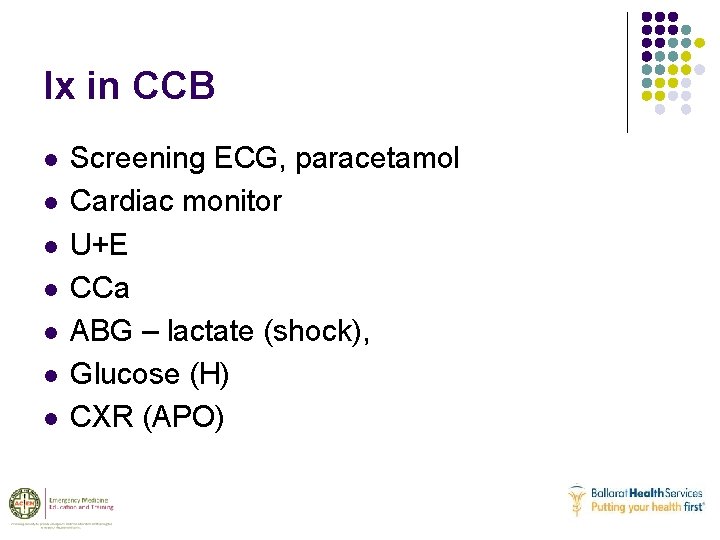
Ix in CCB l l l l Screening ECG, paracetamol Cardiac monitor U+E CCa ABG – lactate (shock), Glucose (H) CXR (APO)
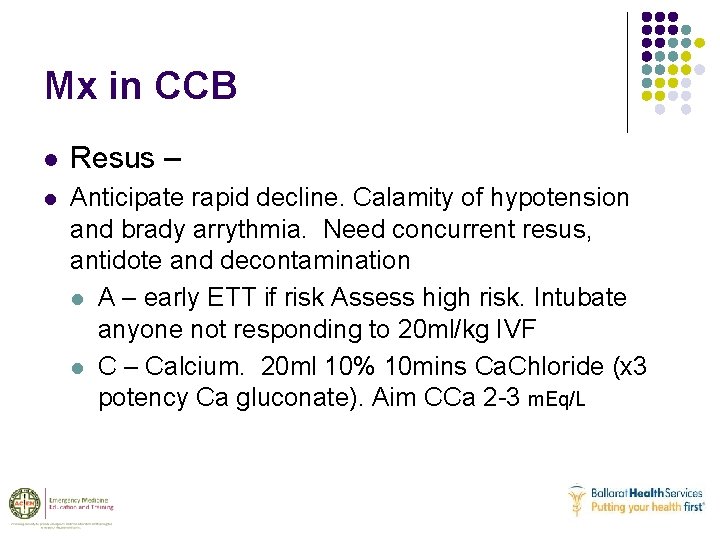
Mx in CCB l Resus – l Anticipate rapid decline. Calamity of hypotension and brady arrythmia. Need concurrent resus, antidote and decontamination l A – early ETT if risk Assess high risk. Intubate anyone not responding to 20 ml/kg IVF l C – Calcium. 20 ml 10% 10 mins Ca. Chloride (x 3 potency Ca gluconate). Aim CCa 2 -3 m. Eq/L
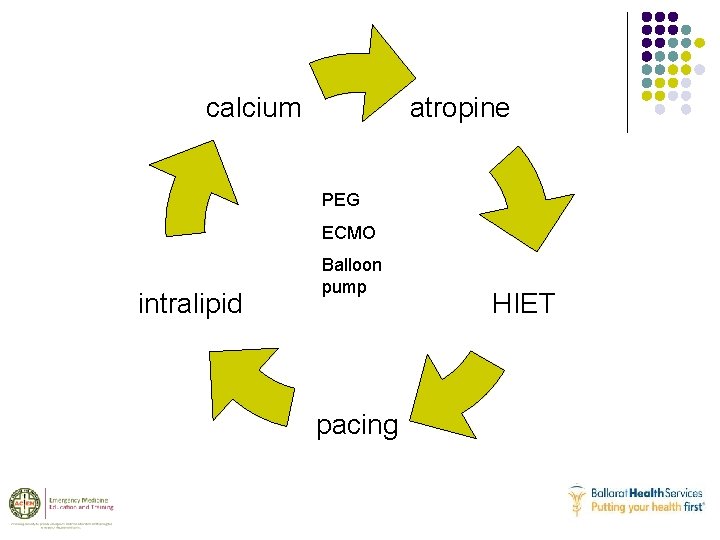
atropine calcium PEG ECMO intralipid Balloon pump pacing HIET
Reading list Murray Toxicology Handbook l Life in the fast lane l EM RAP l Cameron Resources: Life in the Fast Lane (http: //lifeinthefastlane. com) l