Natural Language Processing for Enhancing Teaching and Learning










- Slides: 63
Natural Language Processing for Enhancing Teaching and Learning Diane Litman Professor, Computer Science Department Co-Director, Intelligent Systems Program Senior Scientist, Learning Research & Development Center University of Pittsburgh, PA USA AAAI 2016 1
Roles for Language Processing in Education Learning Language (e. g. , reading, writing, speaking)
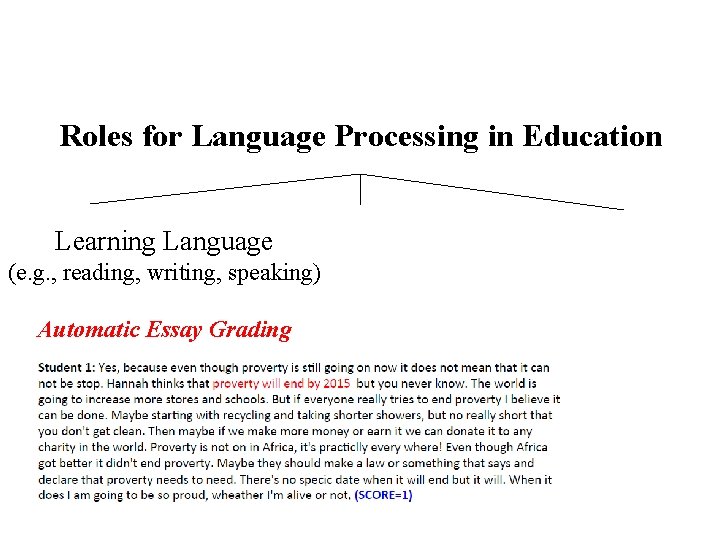
Roles for Language Processing in Education Learning Language (e. g. , reading, writing, speaking) Automatic Essay Grading
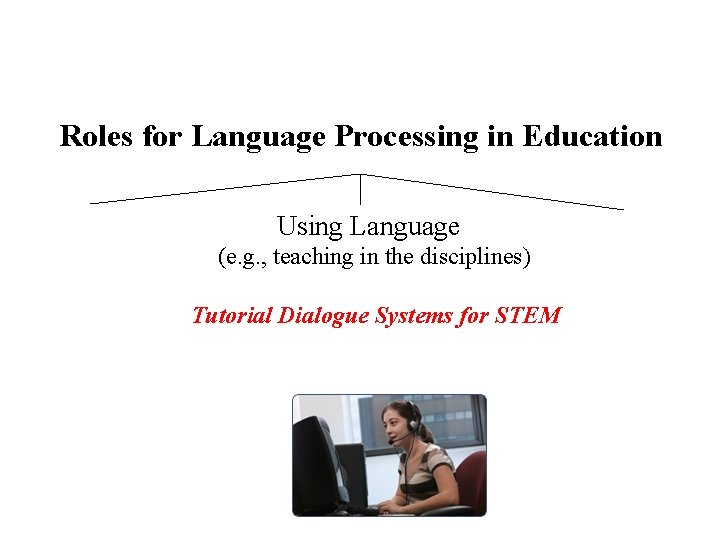
Roles for Language Processing in Education Using Language (e. g. , teaching in the disciplines)
Roles for Language Processing in Education Using Language (e. g. , teaching in the disciplines) Tutorial Dialogue Systems for STEM
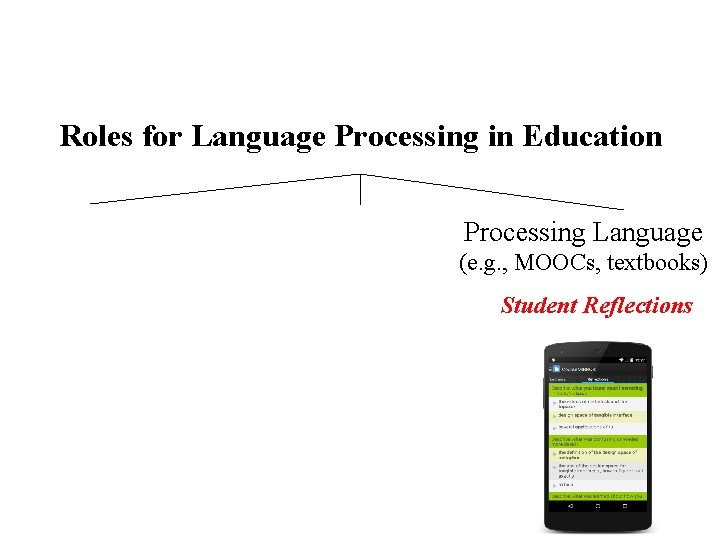
Roles for Language Processing in Education Processing Language (e. g. MOOCs, textbooks)
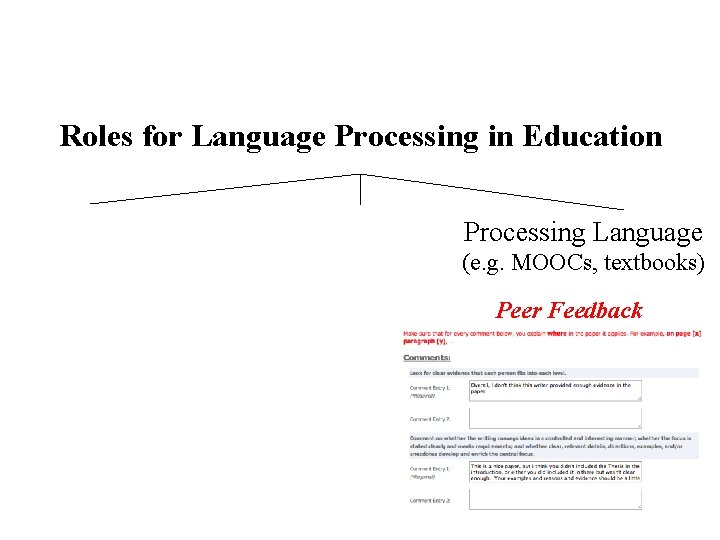
Roles for Language Processing in Education Processing Language (e. g. MOOCs, textbooks) Peer Feedback
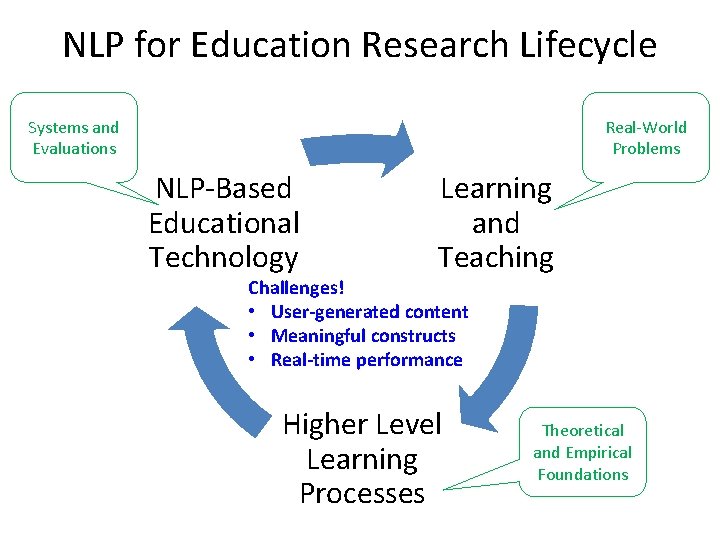
NLP for Education Research Lifecycle Real-World Problems Systems and Evaluations NLP-Based Educational Technology Learning and Teaching Challenges! • User-generated content • Meaningful constructs • Real-time performance Higher Level Learning Processes Theoretical and Empirical Foundations
A Case Study: Automatic Writing Assessment • Essential for Massive Open Online Courses (MOOCs) • Even in traditional classes, frequent assignments can limit the amount of teacher feedback 2
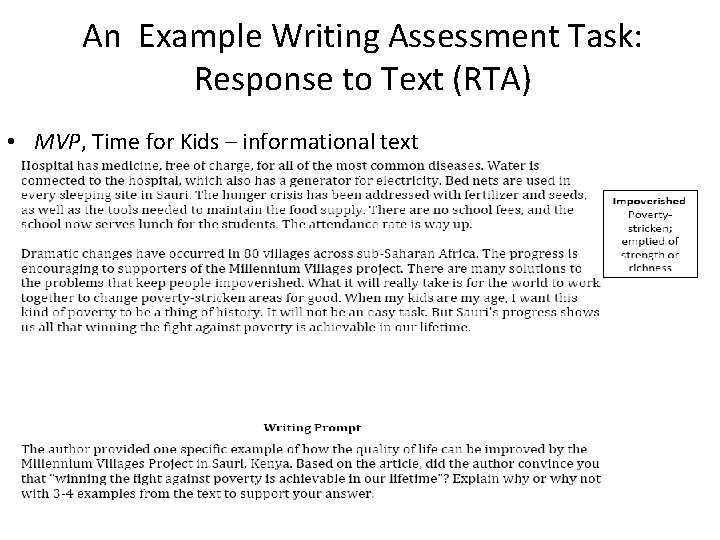
An Example Writing Assessment Task: Response to Text (RTA) • MVP, Time for Kids – informational text
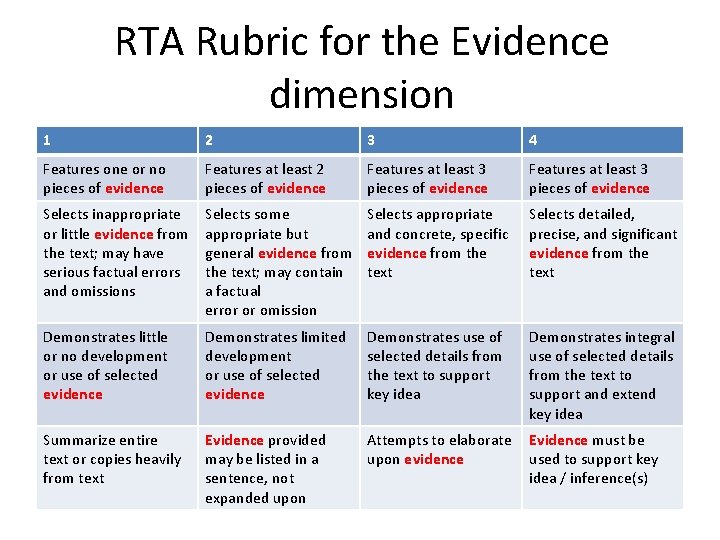
RTA Rubric for the Evidence dimension 1 2 3 4 Features one or no pieces of evidence Features at least 2 pieces of evidence Features at least 3 pieces of evidence Selects inappropriate or little evidence from the text; may have serious factual errors and omissions Selects some appropriate but general evidence from the text; may contain a factual error or omission Selects appropriate and concrete, specific evidence from the text Selects detailed, precise, and significant evidence from the text Demonstrates little or no development or use of selected evidence Demonstrates limited development or use of selected evidence Demonstrates use of selected details from the text to support key idea Demonstrates integral use of selected details from the text to support and extend key idea Summarize entire text or copies heavily from text Evidence provided may be listed in a sentence, not expanded upon Attempts to elaborate upon evidence Evidence must be used to support key idea / inference(s)
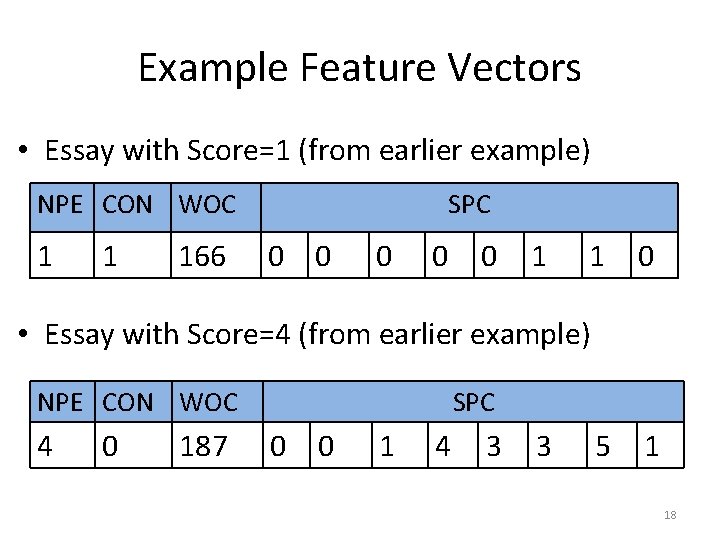
Gold-Standard Scores (& NLP-based evidence) Student 1: Yes, because even though proverty is still going on now it does not mean that it can not be stop. Hannah thinks that proverty will end by 2015 but you never know. The world is going to increase more stores and schools. But if everyone really tries to end proverty I believe it can be done. Maybe starting with recycling and taking shorter showers, but no really short that you don't get clean. Then maybe if we make more money or earn it we can donate it to any charity in the world. Proverty is not on in Africa, it's practiclly every where! Even though Africa got better it didn't end proverty. Maybe they should make a law or something that says and declare that proverty needs to need. There's no specic date when it will end but it will. When it does I am going to be so proud, wheather I'm alive or not. (SCORE=1) Student 2: I was convinced that winning the fight of poverty is achievable in our lifetime. Many people couldn't afford medicine or bed nets to be treated for malaria. Many children had died from this dieseuse even though it could be treated easily. But now, bed nets are used in every sleeping site. And the medicine is free of charge. Another example is that the farmers' crops are dying because they could not afford the nessacary fertilizer and irrigation. But they are now, making progess. Farmers now have fertilizer and water to give to the crops. Also with seeds and the proper tools. Third, kids in Sauri were not well educated. Many families couldn't afford school. Even at school there was no lunch. Students were exhausted from each day of school. Now, school is free. Children excited to learn now can and they do have midday meals. Finally, Sauri is making great progress. If they keep it up that city will no longer be in poverty. Then the Millennium Village project can move on to help other countries in need. (SCORE=4)
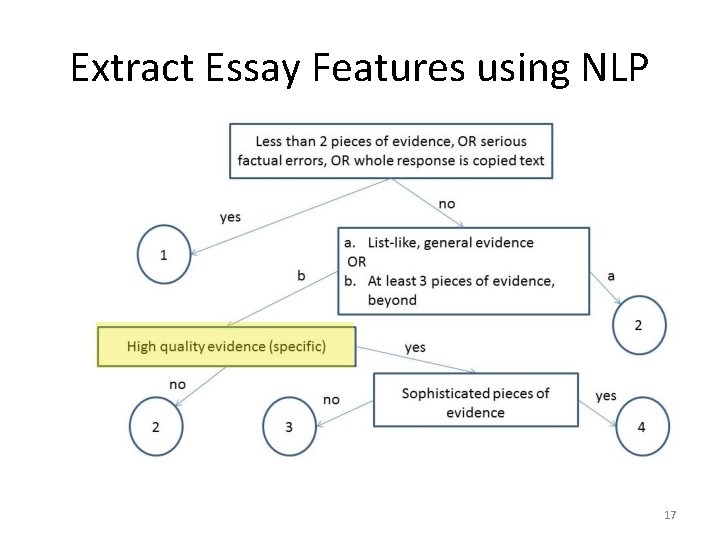
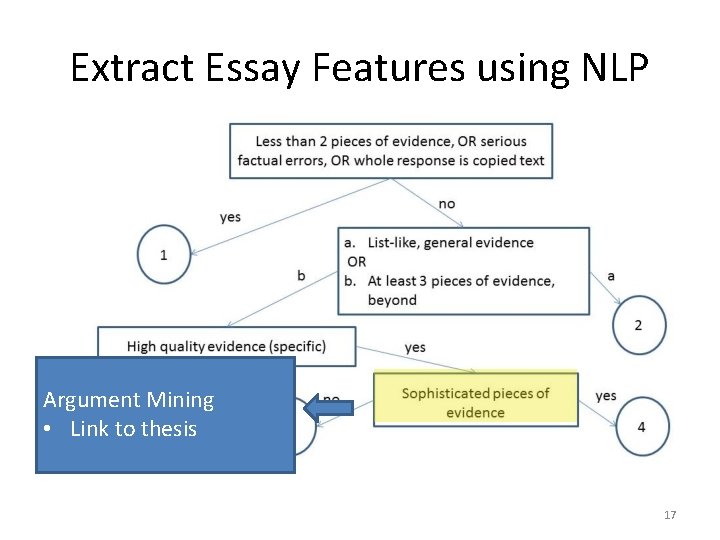
Automatic Scoring of an Analytical Response-To-Text Assessment (RTA) • Summative writing assessment for argumentrelated RTA scoring rubrics – Evidence [Rahimi, Litman, Correnti, Matsumura, Wang & Kisa, 2014] – Organization [Rahimi, Litman, Wang & Correnti, 2015] • Pedagogically meaningful scoring features – Validity as well as reliability 13
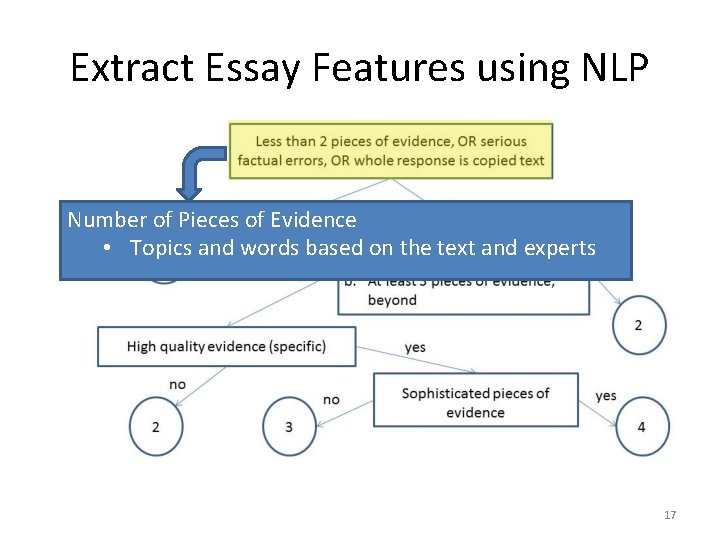
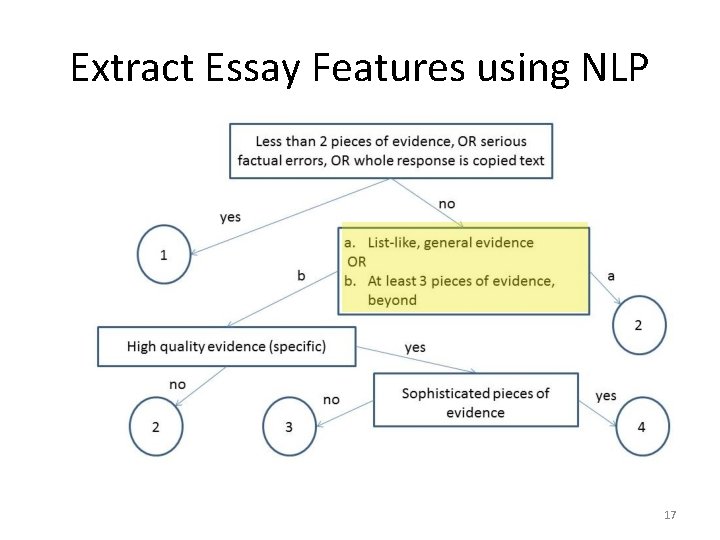
Extract Essay Features using NLP 17
Extract Essay Features using NLP Number of Pieces of Evidence • Topics and words based on the text and experts 17
Extract Essay Features using NLP 17
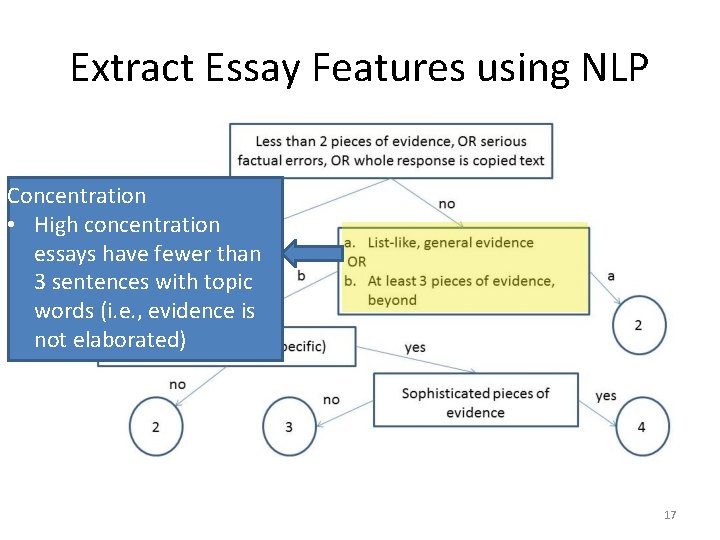
Extract Essay Features using NLP Concentration • High concentration essays have fewer than 3 sentences with topic words (i. e. , evidence is not elaborated) 17
Extract Essay Features using NLP 17
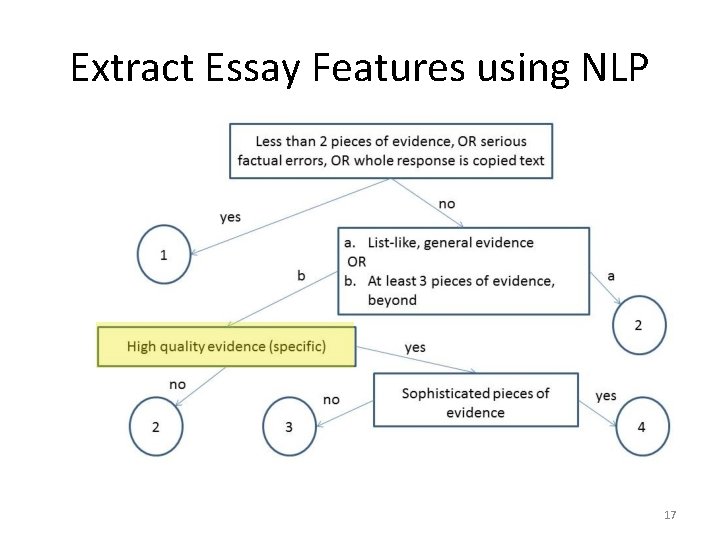
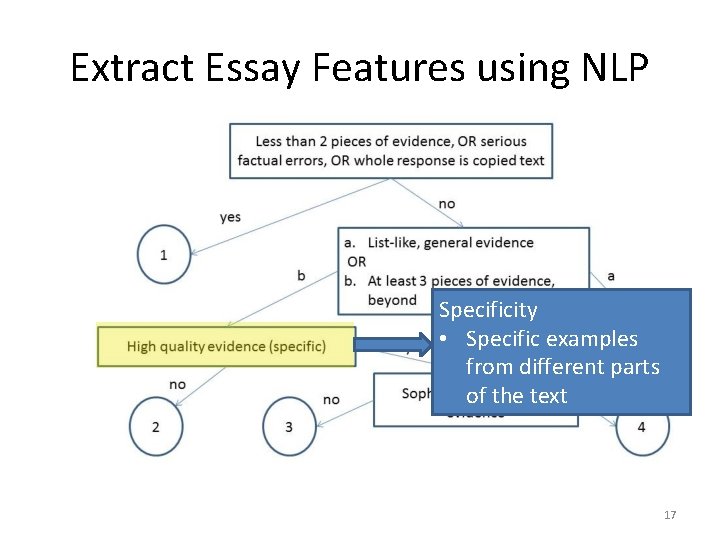
Extract Essay Features using NLP Specificity • Specific examples from different parts of the text 17
Extract Essay Features using NLP 17
Extract Essay Features using NLP Argument Mining • Link to thesis 17
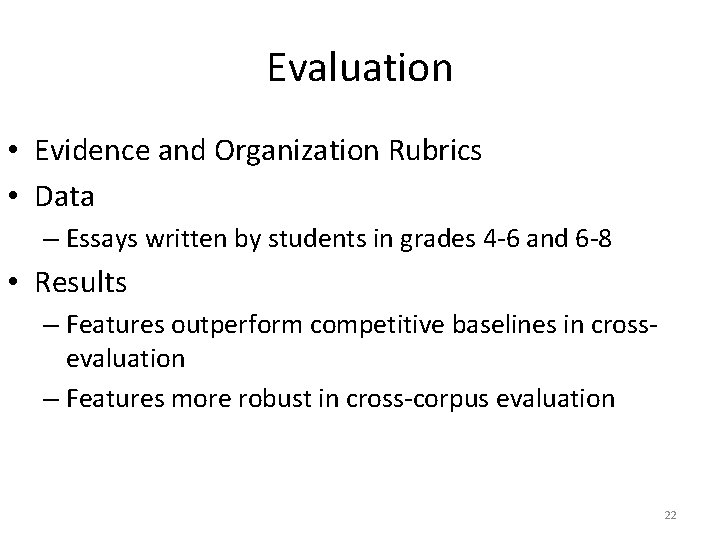
Evaluation • Evidence and Organization Rubrics • Data – Essays written by students in grades 4 -6 and 6 -8 • Results – Features outperform competitive baselines in crossevaluation – Features more robust in cross-corpus evaluation 22
AI Research Opportunities/Challenges • • Argumentation Mining Ontology Extraction Unsupervised Topic Modeling Transfer Learning • … and of course, Language & Speech!
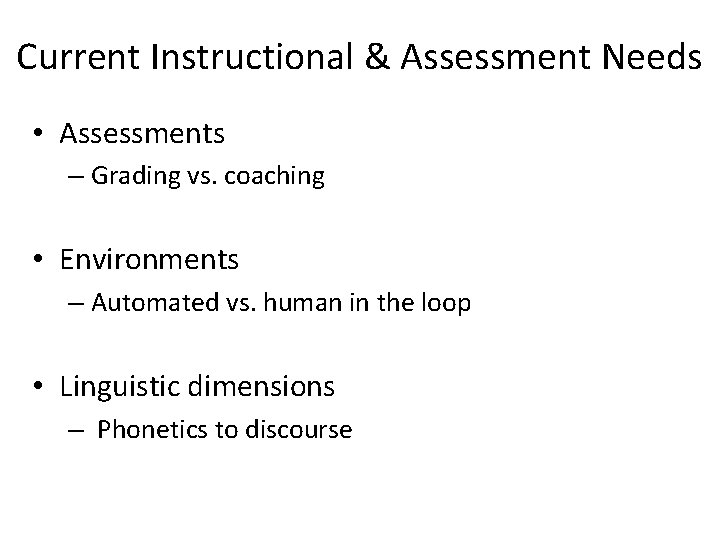
Current Instructional & Assessment Needs • Assessments – Grading vs. coaching • Environments – Automated vs. human in the loop • Linguistic dimensions – Phonetics to discourse
The Issue of Evaluation • Intrinsic evaluation is the norm • Extrinsic evaluation is less common • In vivo evaluation is even rarer
Summing Up • NLP roles for teaching and learning at scale – Assessing language – Using language – Processing language • Many opportunities and challenges – Characteristics of student generated content – Model desiderata (e. g. , beyond accuracy) – Interactions between (noisy) NLP & Educational Technology 26
Learn More! • Innovative Use of NLP for Building Educational Applications – NAACL workshop series – 11 th meeting (June 16, 2016, San Diego) • Speech and Language Technology in Education – ISCA special interest group – 7 th meeting (2017, Stockholm) • Shared Tasks – Grammatical error detection – Student response analysis – MOOC attrition prediction • Hewlett Foundation / Kaggle Competitions – essay and short-answer scoring
Thank You! • Questions? • Further Information – http: //www. cs. pitt. edu/~litman
Language Processing in Education • Over a 50 year history • Exciting new research opportunities – MOOCs, mobile technologies, social media, ASR • Commercial interest as well – E. g. , ETS, Pearson, Turnitin, Carnegie Speech
Roles for Language Processing in Education Processing Language (e. g. , MOOCs, textbooks) Student Reflections
A Case Study: Teaching about Language (joint work with School of Education) • Automatic Writing Assessment at Scale (today) • Tutors, Analytics, Data Science (longer term) – For students, teachers, researchers, policy makers 31
Supervised Machine Learning • Data [Correnti et al. , 2013] – 1560 essays written by students in grades 4 -6 • Short, many spelling and grammatical errors
Experimental Evaluation • Baseline 1 [Mayfield 13]: one of the best methods from the Hewlett Foundation competition [Shermis and Hamner, 2012] – Features: primarily bag of words (top 500) • Baseline 2: Latent Semantic Analysis [Miller 03] 21
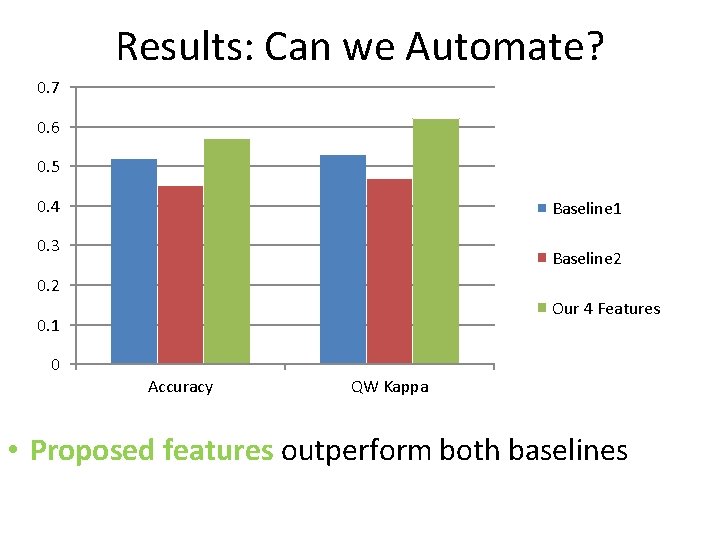
Results: Can we Automate? 0. 7 0. 6 0. 5 0. 4 Baseline 1 0. 3 Baseline 2 0. 2 Our 4 Features 0. 1 0 Accuracy QW Kappa • Proposed features outperform both baselines
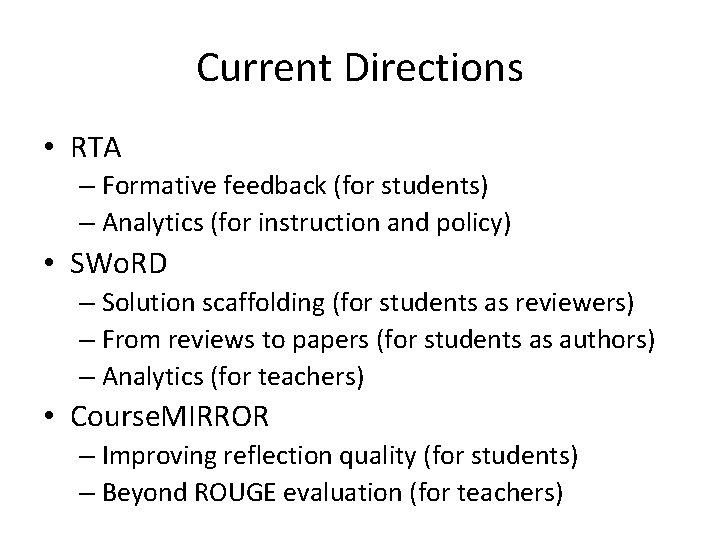
Current Directions • RTA – Formative feedback (for students) – Analytics (for instruction and policy) • SWo. RD – Solution scaffolding (for students as reviewers) – From reviews to papers (for students as authors) – Analytics (for teachers) • Course. MIRROR – Improving reflection quality (for students) – Beyond ROUGE evaluation (for teachers)
Use our Technology and Data! • Peer Review – SWo. RD • NLP-enhanced system is free with research agreement – Peerceptiv (by Panther Learning) • Commercial (non-enhanced) system has a small fee • Course. Mirror – App (both Android and i. OS) – Reflection dataset
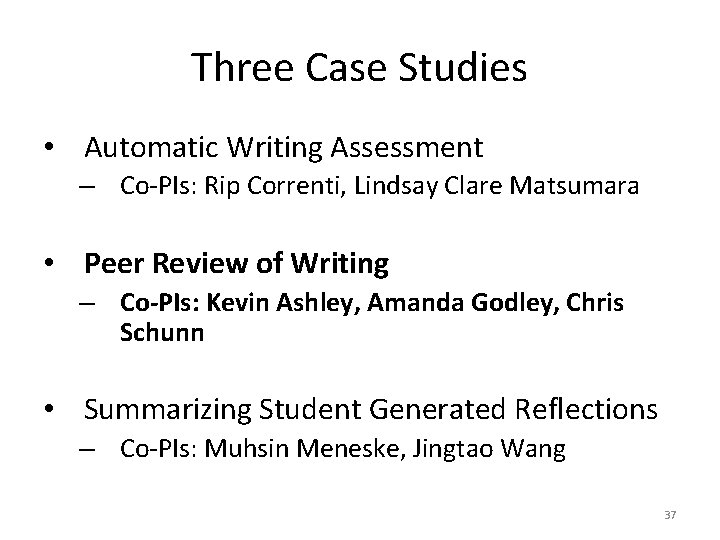
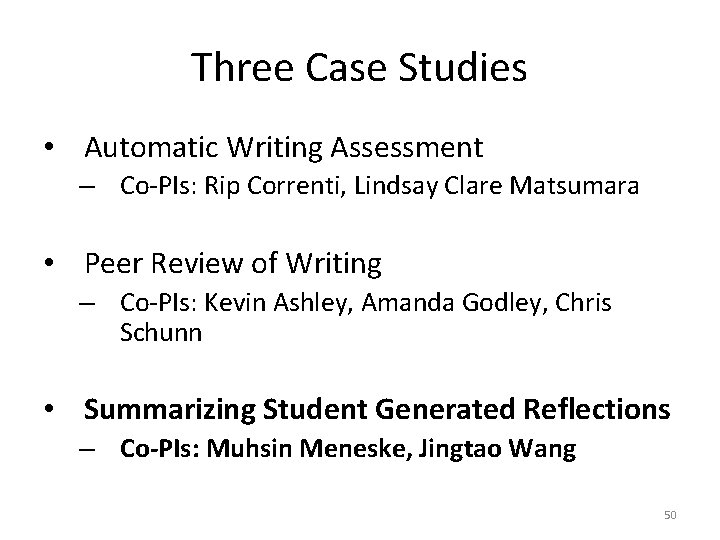
Three Case Studies • Automatic Writing Assessment – Co-PIs: Rip Correnti, Lindsay Clare Matsumara • Peer Review of Writing – Co-PIs: Kevin Ashley, Amanda Godley, Chris Schunn • Summarizing Student Generated Reflections – Co-PIs: Muhsin Meneske, Jingtao Wang 37
Why Peer Review? • An alternative for grading writing at scale in MOOCs • Also used in traditional classes – Quantity and diversity of review feedback – Students learn by reviewing
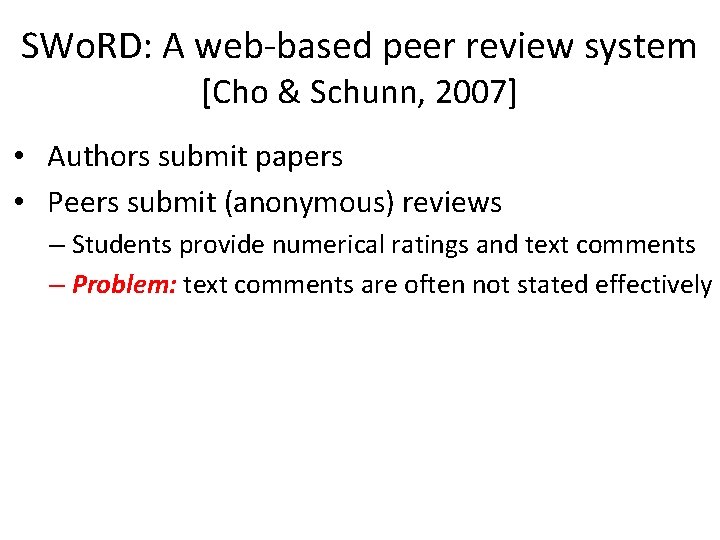
SWo. RD: A web-based peer review system [Cho & Schunn, 2007] • Authors submit papers • Peers submit (anonymous) reviews – Students provide numerical ratings and text comments – Problem: text comments are often not stated effectively
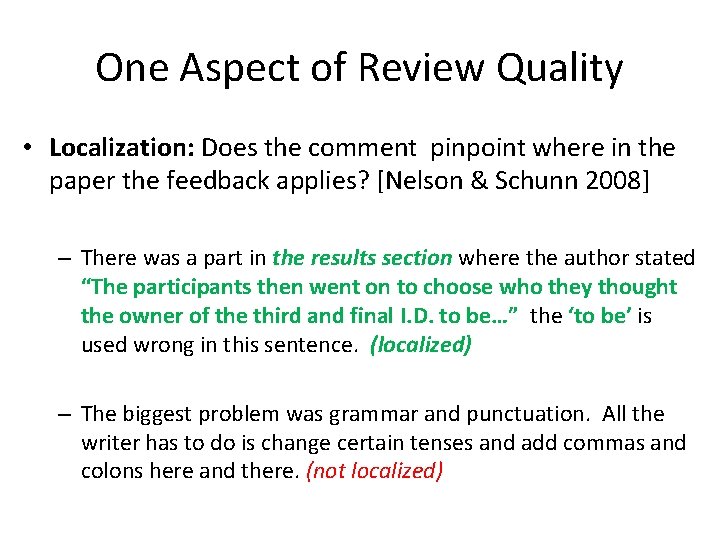
One Aspect of Review Quality • Localization: Does the comment pinpoint where in the paper the feedback applies? [Nelson & Schunn 2008] – There was a part in the results section where the author stated “The participants then went on to choose who they thought the owner of the third and final I. D. to be…” the ‘to be’ is used wrong in this sentence. (localized) – The biggest problem was grammar and punctuation. All the writer has to do is change certain tenses and add commas and colons here and there. (not localized)
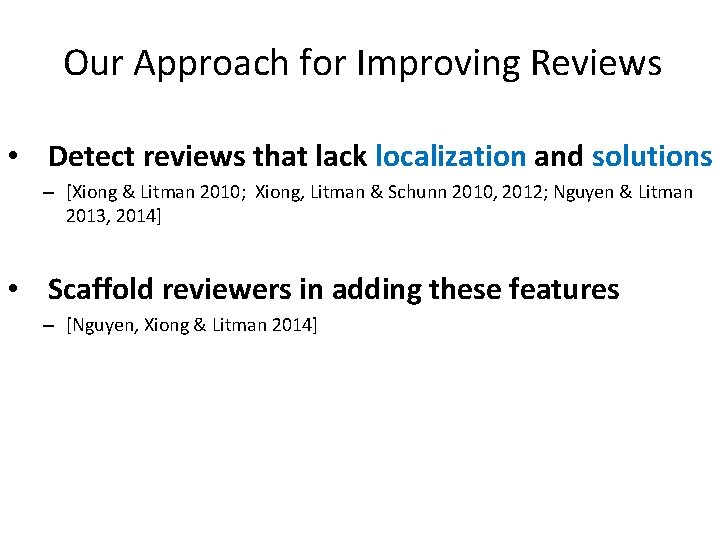
Our Approach for Improving Reviews • Detect reviews that lack localization and solutions – [Xiong & Litman 2010; Xiong, Litman & Schunn 2010, 2012; Nguyen & Litman 2013, 2014] • Scaffold reviewers in adding these features – [Nguyen, Xiong & Litman 2014]
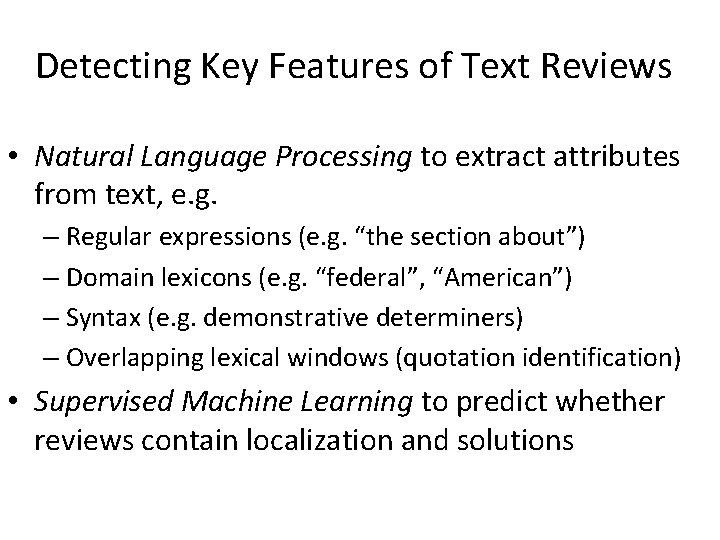
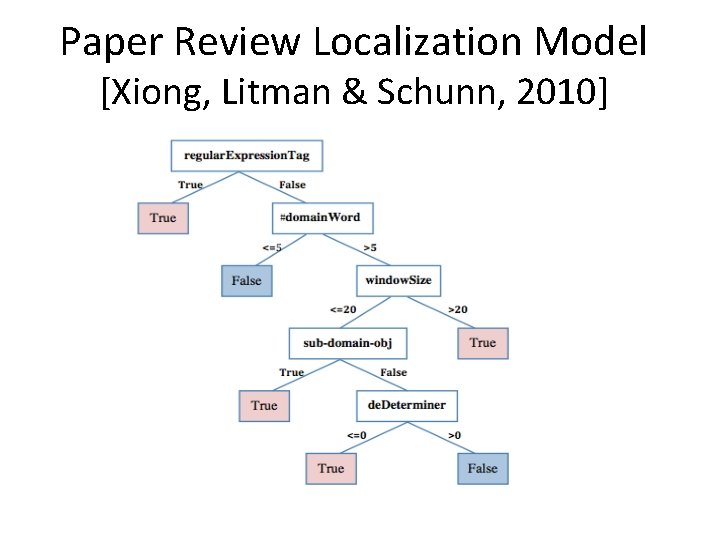
Detecting Key Features of Text Reviews • Natural Language Processing to extract attributes from text, e. g. – Regular expressions (e. g. “the section about”) – Domain lexicons (e. g. “federal”, “American”) – Syntax (e. g. demonstrative determiners) – Overlapping lexical windows (quotation identification) • Supervised Machine Learning to predict whether reviews contain localization and solutions
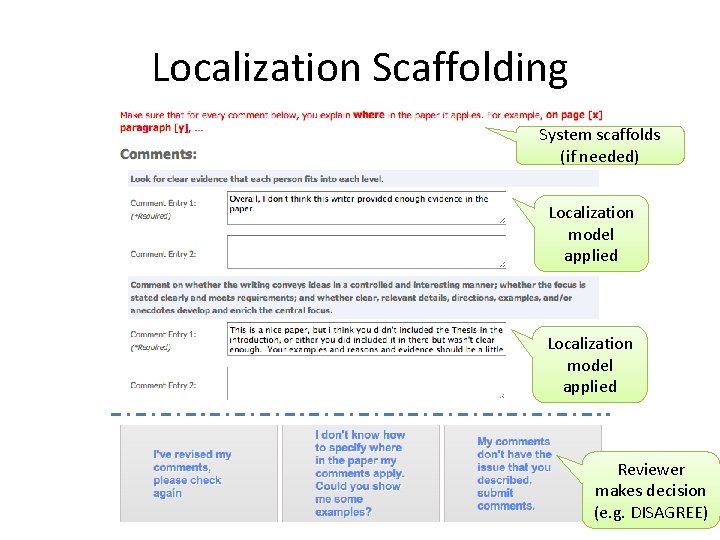
Localization Scaffolding System scaffolds (if needed) Localization model applied Reviewer makes decision (e. g. DISAGREE) 43
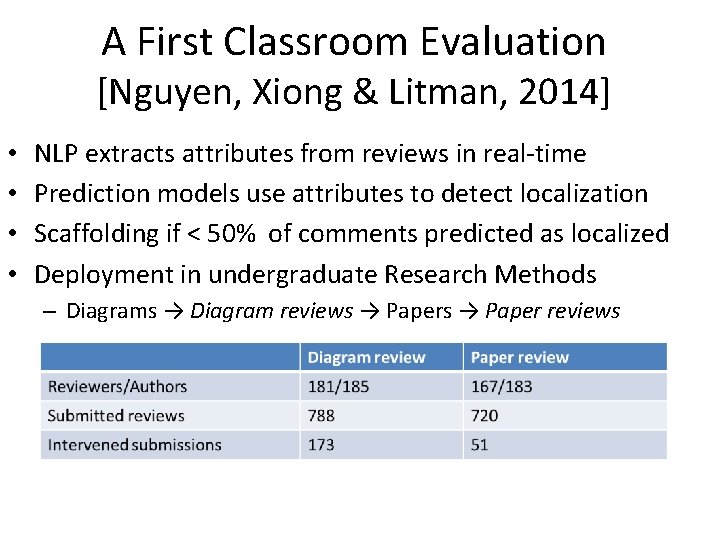
A First Classroom Evaluation [Nguyen, Xiong & Litman, 2014] • • NLP extracts attributes from reviews in real-time Prediction models use attributes to detect localization Scaffolding if < 50% of comments predicted as localized Deployment in undergraduate Research Methods – Diagrams → Diagram reviews → Paper reviews
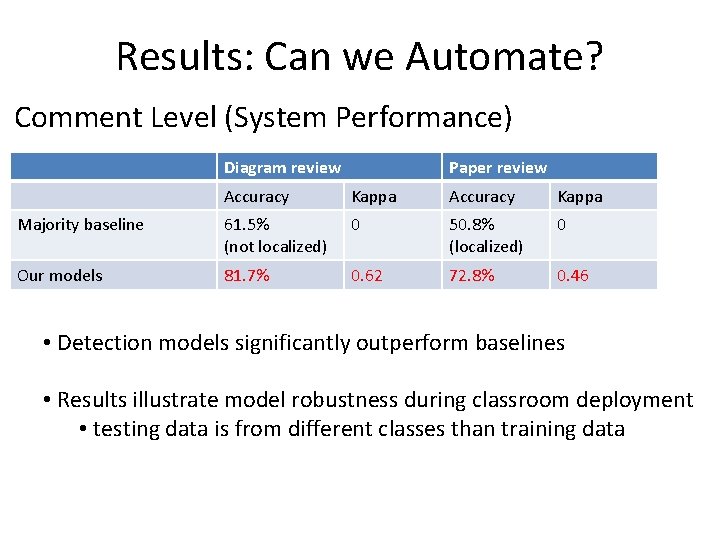
Results: Can we Automate? Comment Level (System Performance) Diagram review Paper review Accuracy Kappa Majority baseline 61. 5% (not localized) 0 50. 8% (localized) 0 Our models 81. 7% 0. 62 72. 8% 0. 46 • Detection models significantly outperform baselines • Results illustrate model robustness during classroom deployment • testing data is from different classes than training data
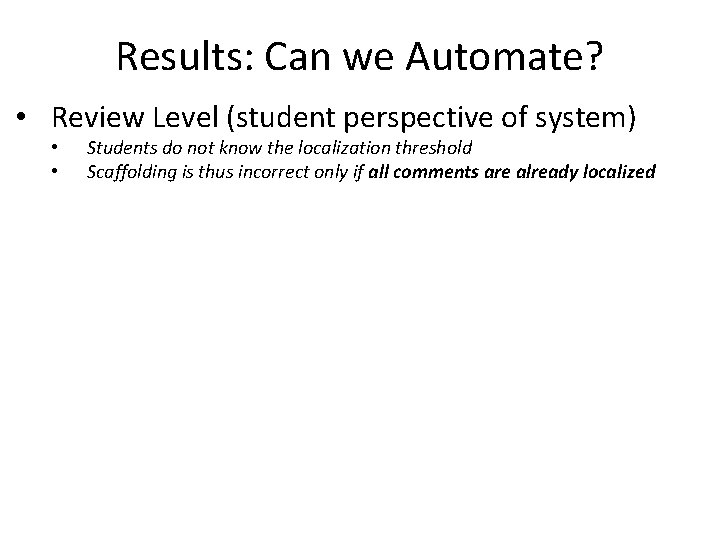
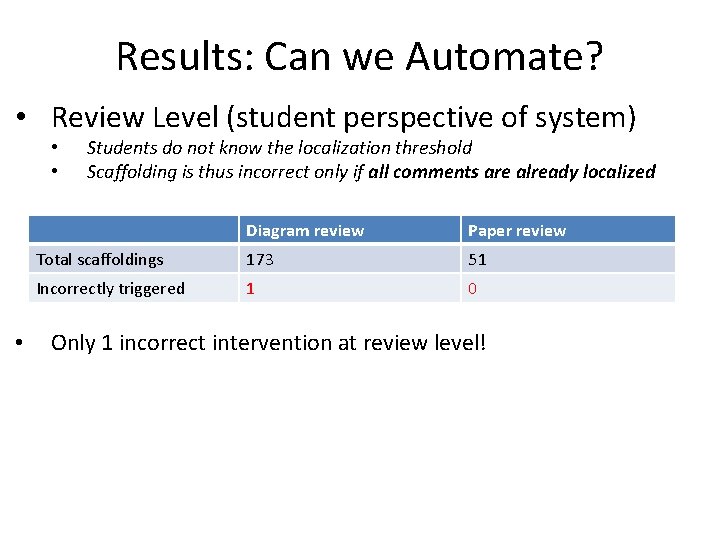
Results: Can we Automate? • Review Level (student perspective of system) • • Students do not know the localization threshold Scaffolding is thus incorrect only if all comments are already localized
Results: Can we Automate? • Review Level (student perspective of system) • • • Students do not know the localization threshold Scaffolding is thus incorrect only if all comments are already localized Diagram review Paper review Total scaffoldings 173 51 Incorrectly triggered 1 0 Only 1 incorrect intervention at review level!
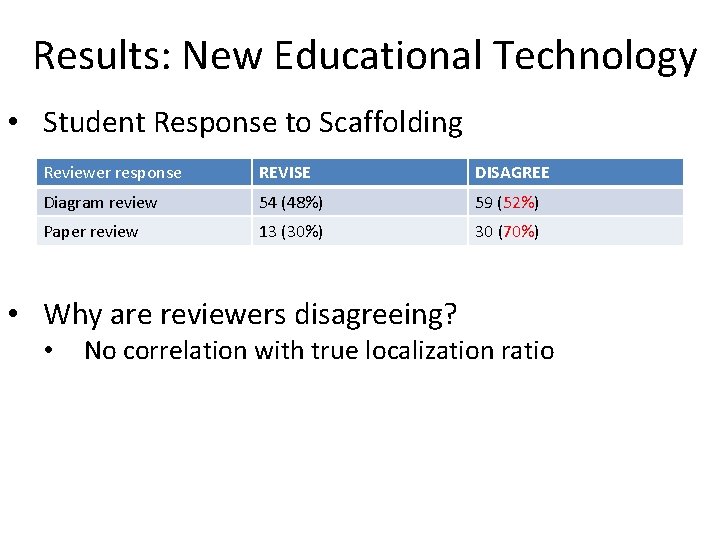
Results: New Educational Technology • Student Response to Scaffolding Reviewer response REVISE DISAGREE Diagram review 54 (48%) 59 (52%) Paper review 13 (30%) 30 (70%) • Why are reviewers disagreeing? • No correlation with true localization ratio
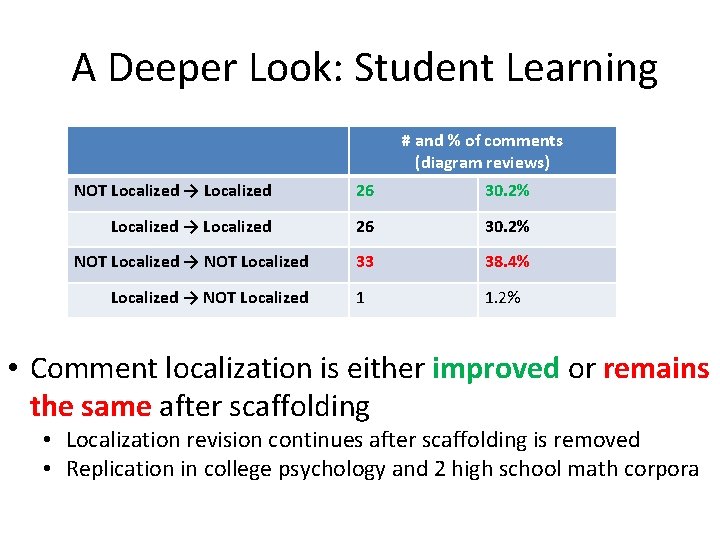
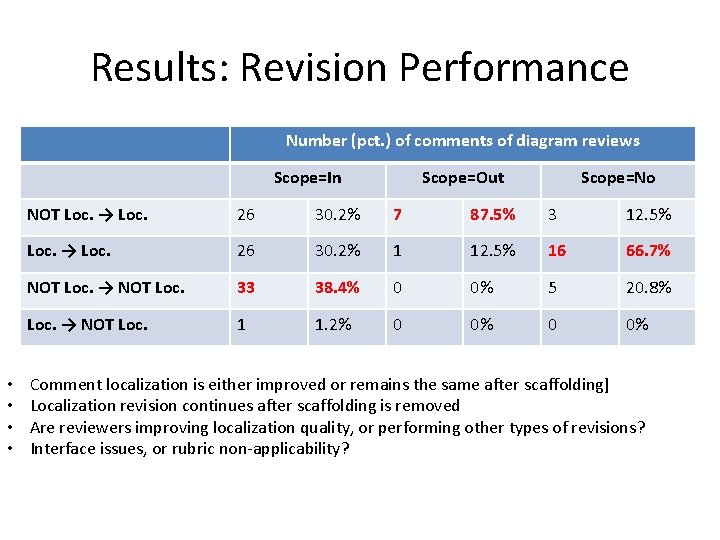
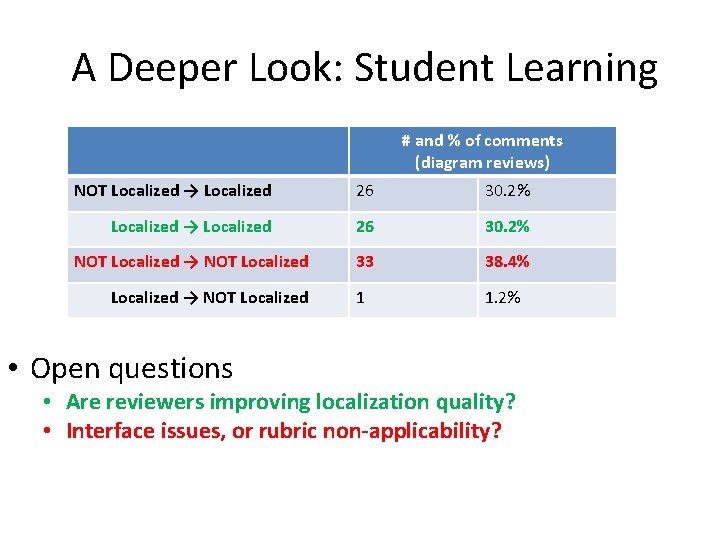
A Deeper Look: Student Learning # and % of comments (diagram reviews) NOT Localized → Localized 26 30. 2% NOT Localized → NOT Localized 33 38. 4% 1 1. 2% Localized → NOT Localized • Comment localization is either improved or remains the same after scaffolding • Localization revision continues after scaffolding is removed • Replication in college psychology and 2 high school math corpora
Three Case Studies • Automatic Writing Assessment – Co-PIs: Rip Correnti, Lindsay Clare Matsumara • Peer Review of Writing – Co-PIs: Kevin Ashley, Amanda Godley, Chris Schunn • Summarizing Student Generated Reflections – Co-PIs: Muhsin Meneske, Jingtao Wang 50
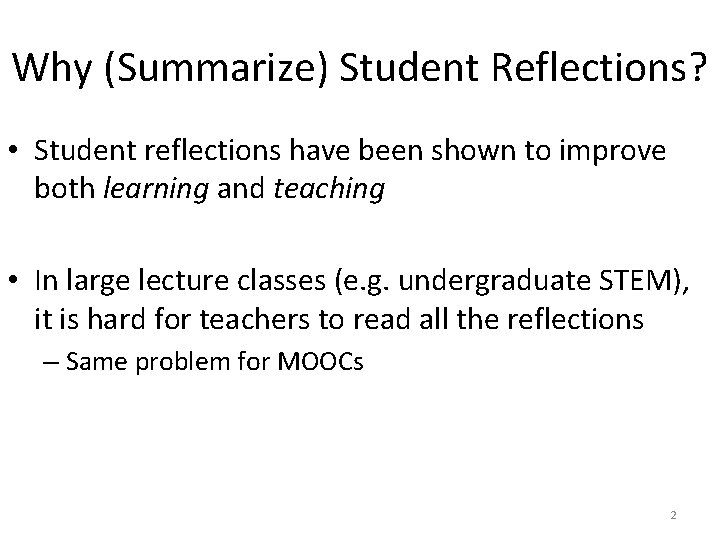
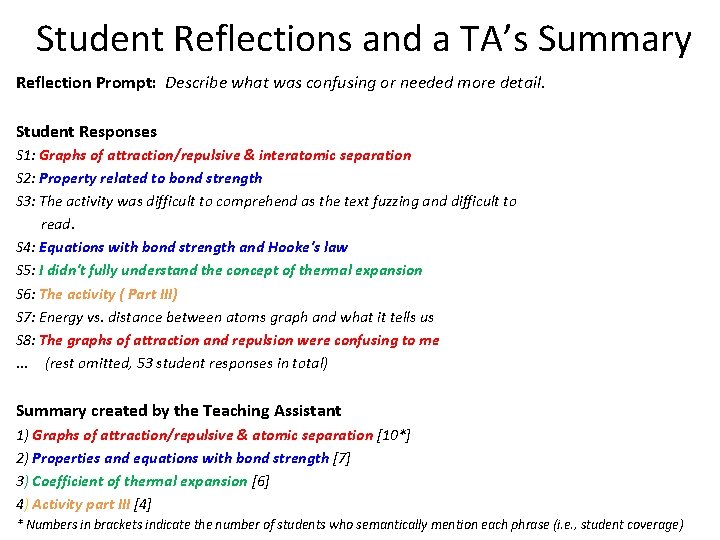
Why (Summarize) Student Reflections? • Student reflections have been shown to improve both learning and teaching • In large lecture classes (e. g. undergraduate STEM), it is hard for teachers to read all the reflections – Same problem for MOOCs 2
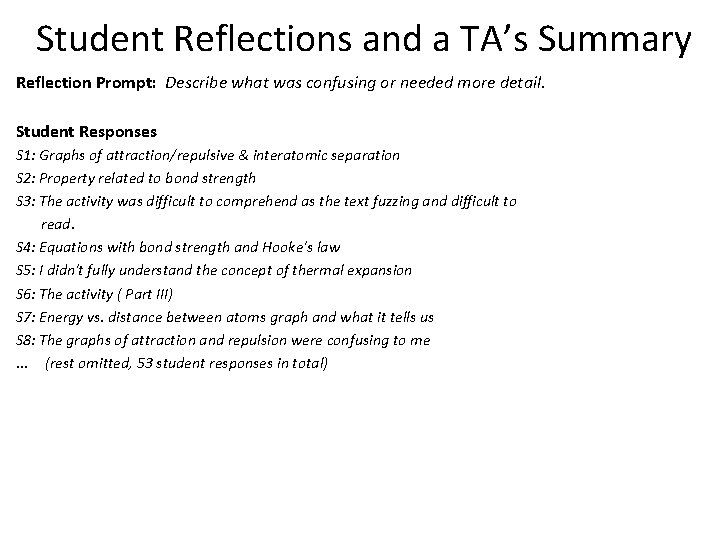
Student Reflections and a TA’s Summary Reflection Prompt: Describe what was confusing or needed more detail. Student Responses S 1: Graphs of attraction/repulsive & interatomic separation S 2: Property related to bond strength S 3: The activity was difficult to comprehend as the text fuzzing and difficult to read. S 4: Equations with bond strength and Hooke's law S 5: I didn't fully understand the concept of thermal expansion S 6: The activity ( Part III) S 7: Energy vs. distance between atoms graph and what it tells us S 8: The graphs of attraction and repulsion were confusing to me … (rest omitted, 53 student responses in total)
Student Reflections and a TA’s Summary Reflection Prompt: Describe what was confusing or needed more detail. Student Responses S 1: Graphs of attraction/repulsive & interatomic separation S 2: Property related to bond strength S 3: The activity was difficult to comprehend as the text fuzzing and difficult to read. S 4: Equations with bond strength and Hooke's law S 5: I didn't fully understand the concept of thermal expansion S 6: The activity ( Part III) S 7: Energy vs. distance between atoms graph and what it tells us S 8: The graphs of attraction and repulsion were confusing to me … (rest omitted, 53 student responses in total) Summary created by the Teaching Assistant 1) Graphs of attraction/repulsive & atomic separation [10*] 2) Properties and equations with bond strength [7] 3) Coefficient of thermal expansion [6] 4) Activity part III [4] * Numbers in brackets indicate the number of students who semantically mention each phrase (i. e. , student coverage)
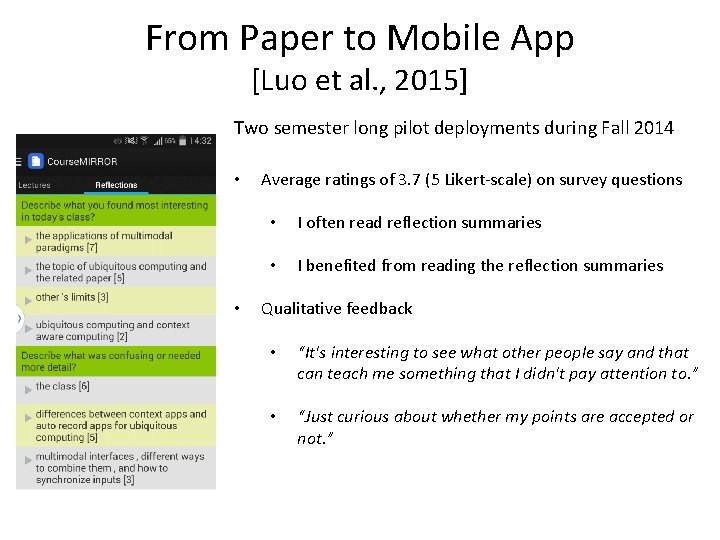
Enhancing Large Classroom Instructor-Student Interactions via Summarization • Course. MIRROR: A mobile app for collecting and browsing student reflections – [Fan, Luo, Menekse, Litman, & Wang, 2015] – [Luo, Fan, Menekse, Wang, & Litman, 2015] • A phrase-based approach to extractive summarization of student-generated content – [Luo & Litman, 2015] 54
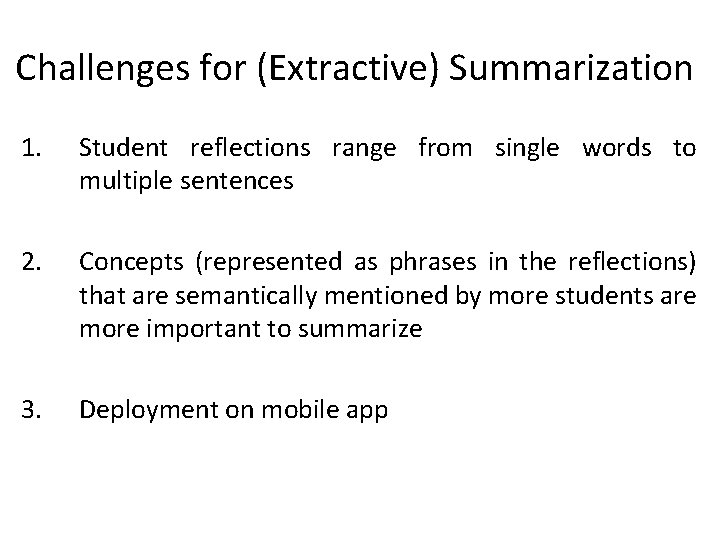
Challenges for (Extractive) Summarization 1. Student reflections range from single words to multiple sentences 2. Concepts (represented as phrases in the reflections) that are semantically mentioned by more students are more important to summarize 3. Deployment on mobile app
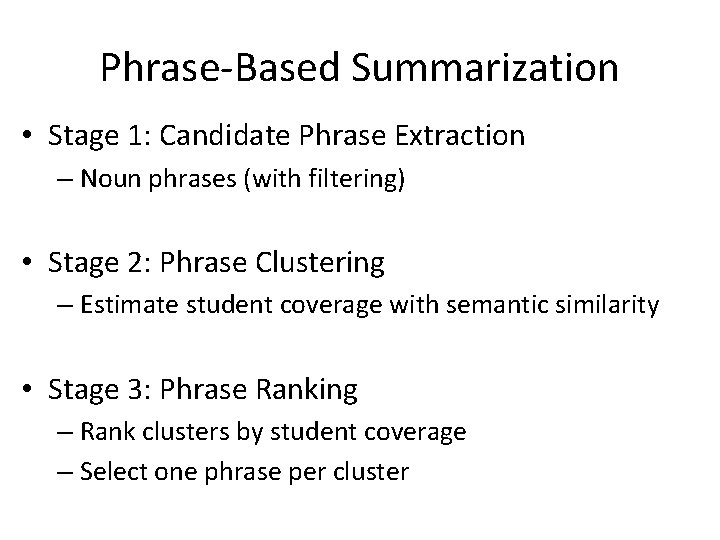
Phrase-Based Summarization • Stage 1: Candidate Phrase Extraction – Noun phrases (with filtering) • Stage 2: Phrase Clustering – Estimate student coverage with semantic similarity • Stage 3: Phrase Ranking – Rank clusters by student coverage – Select one phrase per cluster
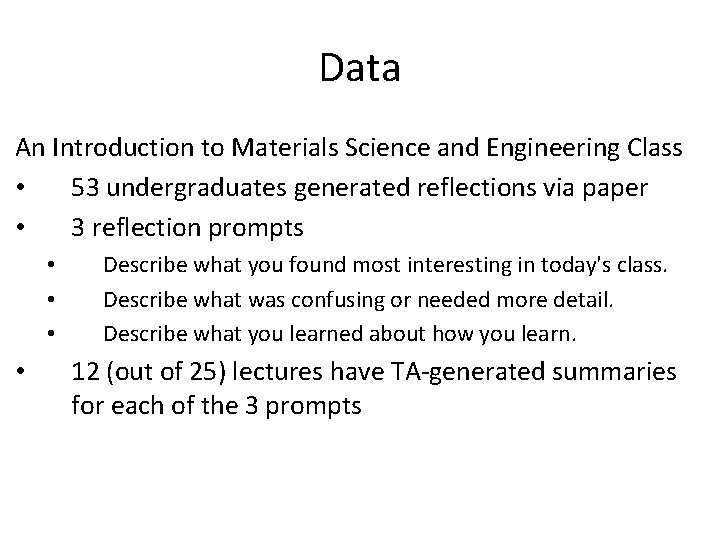
Data An Introduction to Materials Science and Engineering Class • 53 undergraduates generated reflections via paper • 3 reflection prompts • • Describe what you found most interesting in today's class. Describe what was confusing or needed more detail. Describe what you learned about how you learn. 12 (out of 25) lectures have TA-generated summaries for each of the 3 prompts
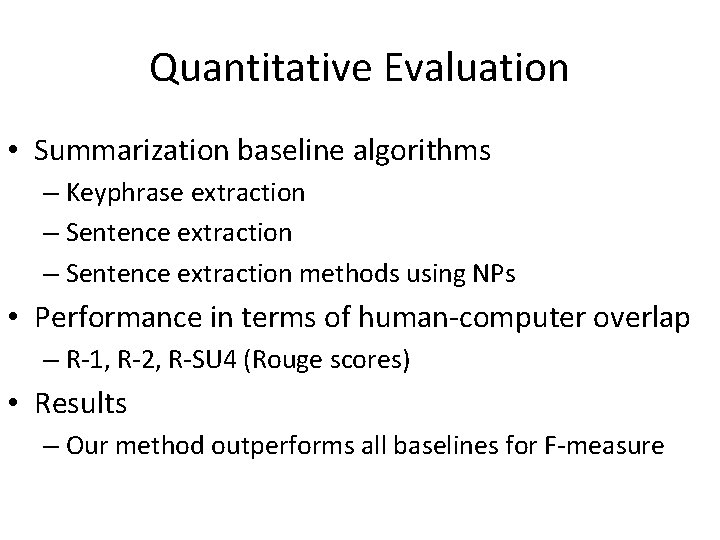
Quantitative Evaluation • Summarization baseline algorithms – Keyphrase extraction – Sentence extraction methods using NPs • Performance in terms of human-computer overlap – R-1, R-2, R-SU 4 (Rouge scores) • Results – Our method outperforms all baselines for F-measure
From Paper to Mobile App [Luo et al. , 2015] Two semester long pilot deployments during Fall 2014 • • Average ratings of 3. 7 (5 Likert-scale) on survey questions • I often read reflection summaries • I benefited from reading the reflection summaries Qualitative feedback • “It's interesting to see what other people say and that can teach me something that I didn't pay attention to. ” • “Just curious about whether my points are accepted or not. ”
Paper Review Localization Model [Xiong, Litman & Schunn, 2010]
Results: Revision Performance Number (pct. ) of comments of diagram reviews Scope=In • • Scope=Out Scope=No NOT Loc. → Loc. 26 30. 2% 7 87. 5% 3 12. 5% Loc. → Loc. 26 30. 2% 1 12. 5% 16 66. 7% NOT Loc. → NOT Loc. 33 38. 4% 0 0% 5 20. 8% Loc. → NOT Loc. 1 1. 2% 0 0% Comment localization is either improved or remains the same after scaffolding] Localization revision continues after scaffolding is removed Are reviewers improving localization quality, or performing other types of revisions? Interface issues, or rubric non-applicability?
Example Feature Vectors • Essay with Score=1 (from earlier example) NPE CON WOC 1 1 166 SPC 0 0 0 1 1 0 • Essay with Score=4 (from earlier example) NPE CON WOC 4 0 187 SPC 0 0 1 4 3 3 5 1 18
A Deeper Look: Student Learning # and % of comments (diagram reviews) NOT Localized → Localized 26 30. 2% NOT Localized → NOT Localized 33 38. 4% 1 1. 2% Localized → NOT Localized • Open questions • Are reviewers improving localization quality? • Interface issues, or rubric non-applicability?