
MENG 364 Manufacturing Technology Presented by Assist Prof
MENG 364 Manufacturing Technology Presented by: Assist. Prof. Dr. Mohammed. Asmael
COURSE MATERIALS Required text: Fundamentals of Modern Manufacturing: Materials, Processes, and Systems, M. P. Groover, 4 rd edition, John Wiley & Sons Inc. (2007).
GRADING Midterm: 15% Laboratory reports : 30% ( 15% report +15% attend) Two Quizzes 20% Final: 30% Assignment : 5% ( 2. 5% submit +2. 5% attends) Attends : <%50=NG. Filed to submit the lab or never attend lab hours=NG.

TEACHING ASSISTANTS Teaching Assistants will • perform laboratory and tutorial hours, • have office hours to help you with course material and problem sets, • Take quizzes in tutorial hours.
INTRODUCTION AND OVERVIEW OF MANUFACTURING 1. What is Manufacturing? 2. Materials in Manufacturing. 3. Manufacturing Processes.
Manufacturing is Important Making things has been an essential human activity since before recorded history Today, the term manufacturing is used for this activity Manufacturing is important to the United States and most other developed and developing nations Technologically Economically
Technological Importance Technology - the application of science to provide society and its members with those things that are needed or desired Technology affects our daily lives, directly and indirectly, in many ways Technology provides the products that help our society and its members live better
Technological Importance What do these products have in common? They are all manufactured They would not be available to our society if they could not be manufactured Manufacturing is the essential factor that makes technology possible
Economic Importance U. S. Economy Sector: %GDP (gross domestic product) Agriculture and natural resources Construction and public utilities Manufacturing Service industries* 5 5 12 78 100 * includes retail, transportation, banking, communication, education, and government
WHAT IS MANUFACTURING? The word manufacture is derived from two Latin words, manus (hand) and factus (make); the combination means made by hand. The English word manufacture is several centuries old, and ‘‘made by hand’’ accurately described the manual methods used Most modern manufacturing is accomplished by automated and computer-controlled machinery.
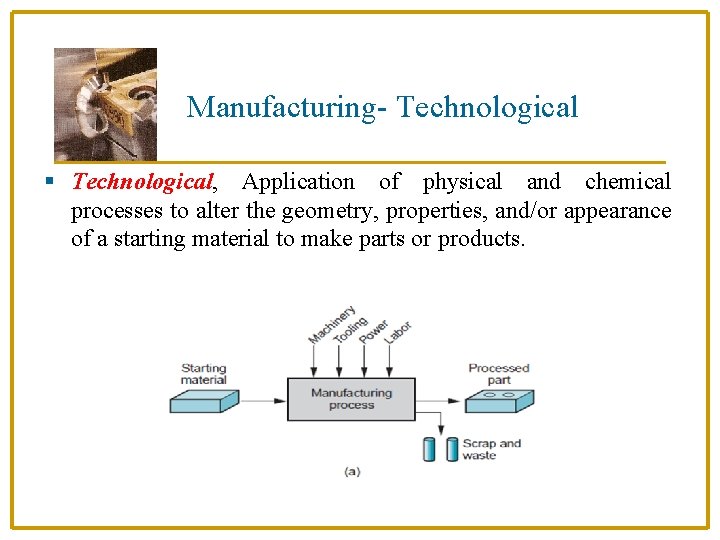
Manufacturing- Technological, Application of physical and chemical processes to alter the geometry, properties, and/or appearance of a starting material to make parts or products.

Manufacturing- Economically, manufacturing is the transformation of materials into items of greater value by means of one or more processing and/or assembly operations,
Example
Example
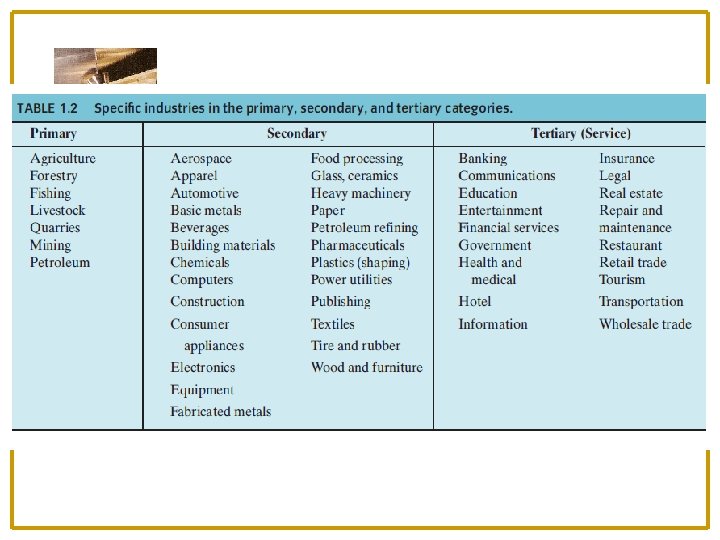
Manufacturing Industries Industry consists of enterprises and organizations that produce or supply goods and services Industries can be classified as: 1. Primary industries - exploit natural resources, e. g. , agriculture, mining 2. Secondary industries - take the outputs of primary industries and convert them into consumer and capital goods 3. Tertiary industries - service sector
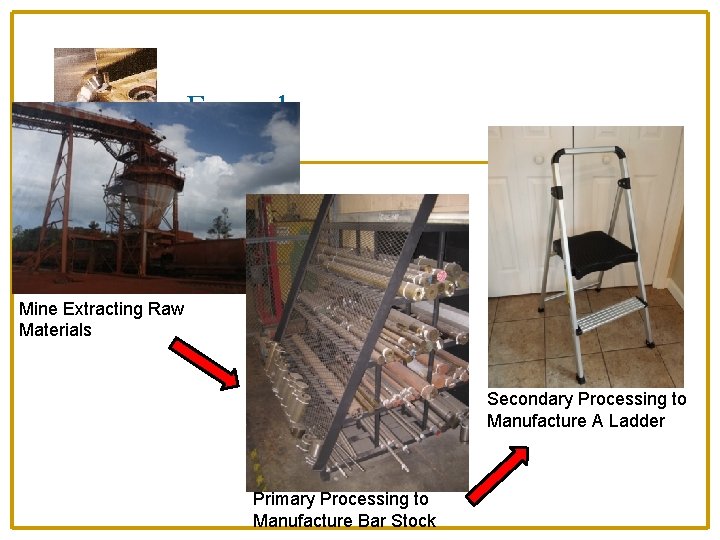
Example Mine Extracting Raw Materials Secondary Processing to Manufacture A Ladder Primary Processing to Manufacture Bar Stock
Manufactured Products Final products made by the manufacturing industries can be divided into two major classes: Consumer goods are products purchased directly by consumers, such as cars, personal computers, TVs, tires Capital goods are those purchased by companies to produce goods and/or provide services. Examples of capital goods include aircraft, trucks and buses, railroad locomotives, machine tools, and construction equipment
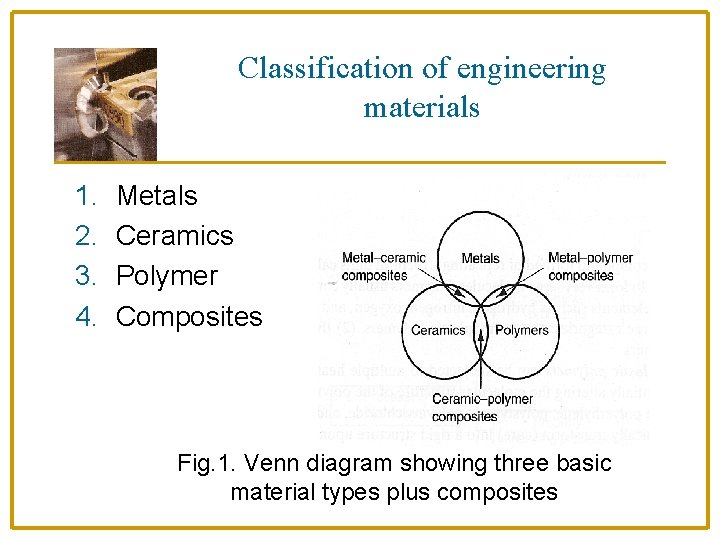
Classification of engineering materials 1. 2. 3. 4. Metals Ceramics Polymer Composites Fig. 1. Venn diagram showing three basic material types plus composites
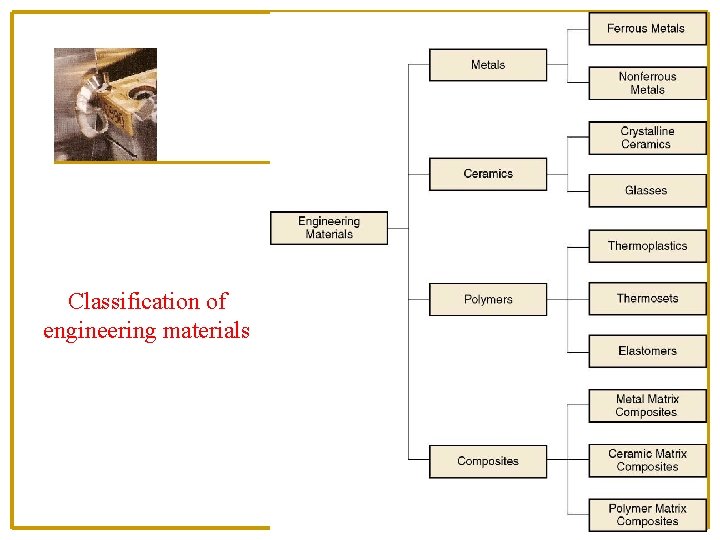
Classification of engineering materials
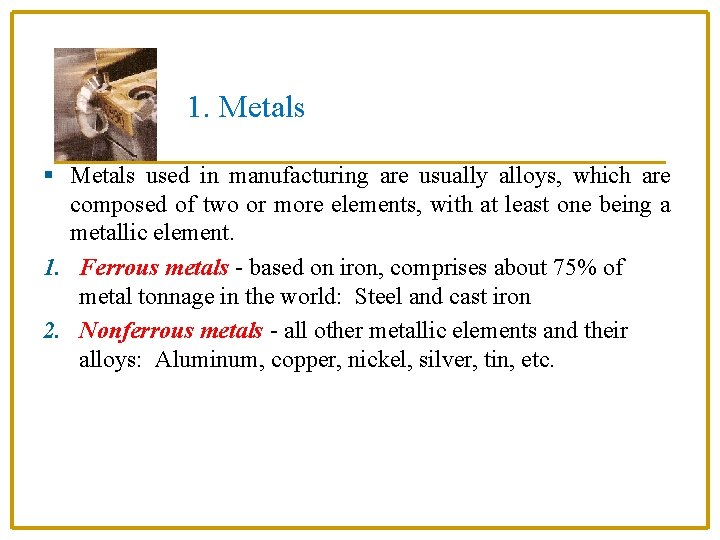
1. Metals used in manufacturing are usually alloys, which are composed of two or more elements, with at least one being a metallic element. 1. Ferrous metals - based on iron, comprises about 75% of metal tonnage in the world: Steel and cast iron 2. Nonferrous metals - all other metallic elements and their alloys: Aluminum, copper, nickel, silver, tin, etc.
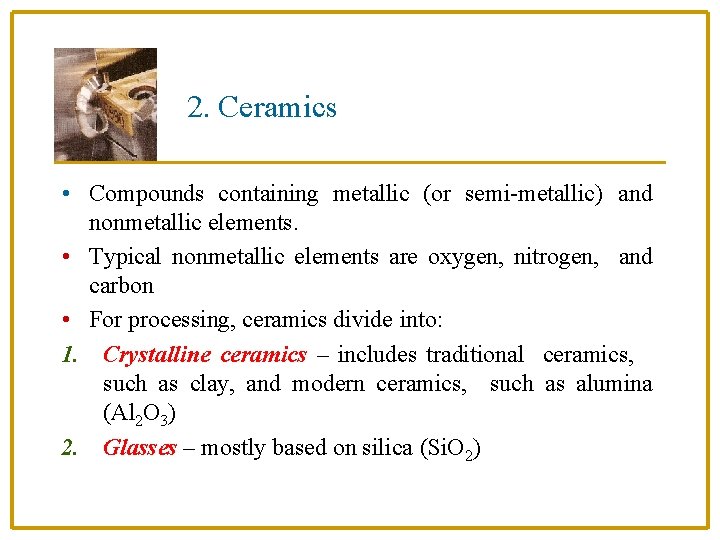
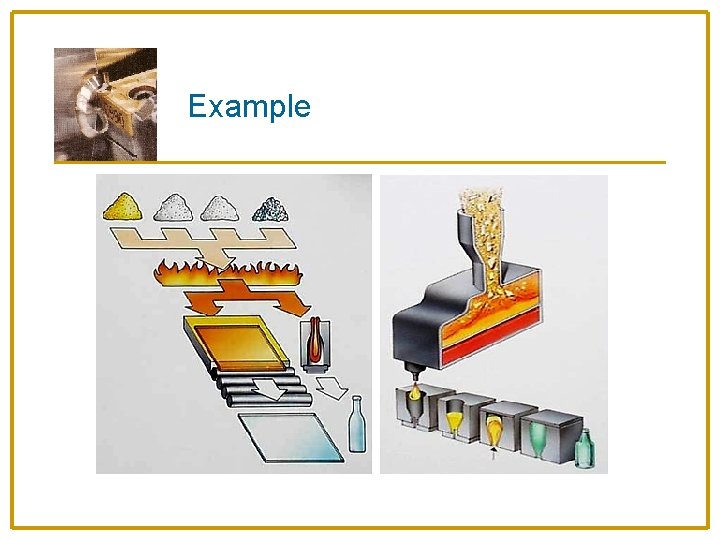
2. Ceramics • Compounds containing metallic (or semi-metallic) and nonmetallic elements. • Typical nonmetallic elements are oxygen, nitrogen, and carbon • For processing, ceramics divide into: 1. Crystalline ceramics – includes traditional ceramics, such as clay, and modern ceramics, such as alumina (Al 2 O 3) 2. Glasses – mostly based on silica (Si. O 2)
3. Polymers Compound formed of repeating structural units called "mers", whose atoms share electrons to form very large molecules. Three categories: 1. Thermoplastic polymers - can be subjected to multiple heating and cooling cycles without altering molecular structure 2. Thermosetting polymers - molecules chemically transform into a rigid structure – cannot reheat 3. Elastomers - shows significant elastic behavior
4. Composites • Material consisting of two or more phases that are processed separately and then bonded together to achieve properties superior to its constituents Ø Phase - homogeneous material, such as grains of identical unit cell structure in a solid metal Ø Usual structure consists of particles or fibers of one phase mixed in a second phase Ø Properties depend on components, physical shapes of components, and the way they are combined to form the final material
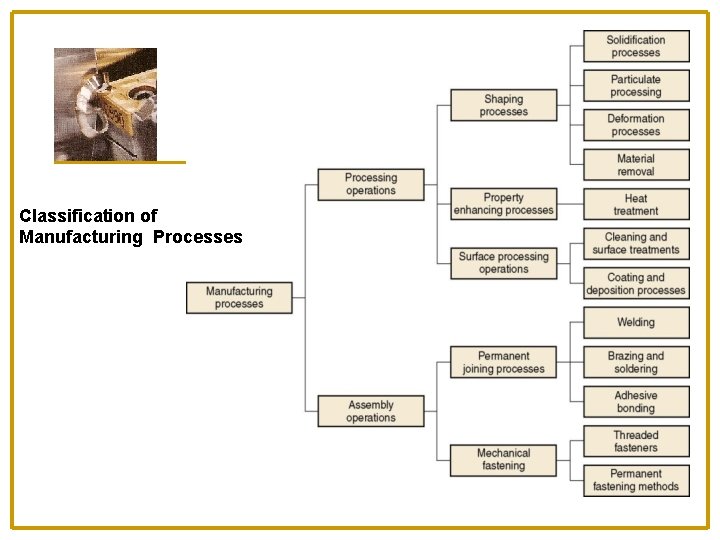
Classification of Manufacturing Processes
Manufacturing Processes: Two Basic Types 1. Processing operations - transform a work material from one state of completion to a more advanced state Operations that change the geometry, properties, or appearance of the starting material 2. Assembly operations - join two or more components to create a new entity
Processing Operations Alters a material’s shape, physical properties, or appearance in order to add value Three categories of processing operations: 1. Shaping operations - alter the geometry of the starting work material 2. Property-enhancing operations - improve physical properties without changing shape 3. Surface processing operations - clean, treat, coat, or deposit material on surface of work
Four Categories of Shaping Processes 1. 2. 3. 4. Solidification processes - starting material is a heated liquid or semifluid Particulate processing - starting material consists of powders Deformation processes - starting material is a ductile solid (commonly metal) Material removal processes - starting material is a ductile or brittle solid
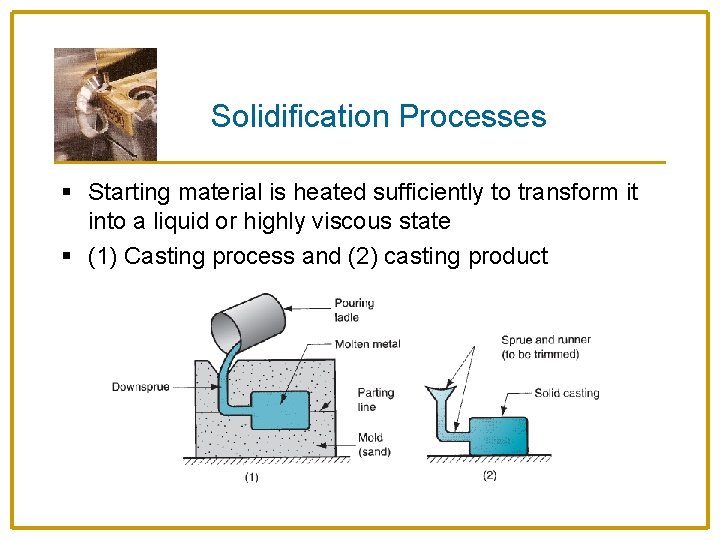
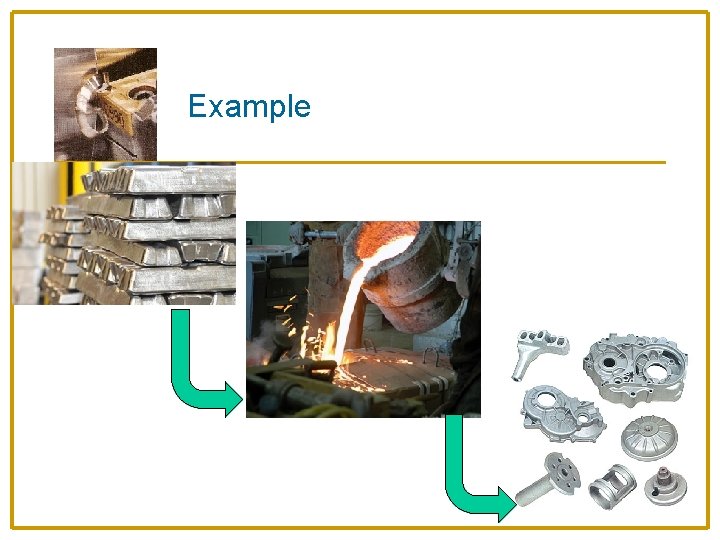
Solidification Processes Starting material is heated sufficiently to transform it into a liquid or highly viscous state (1) Casting process and (2) casting product
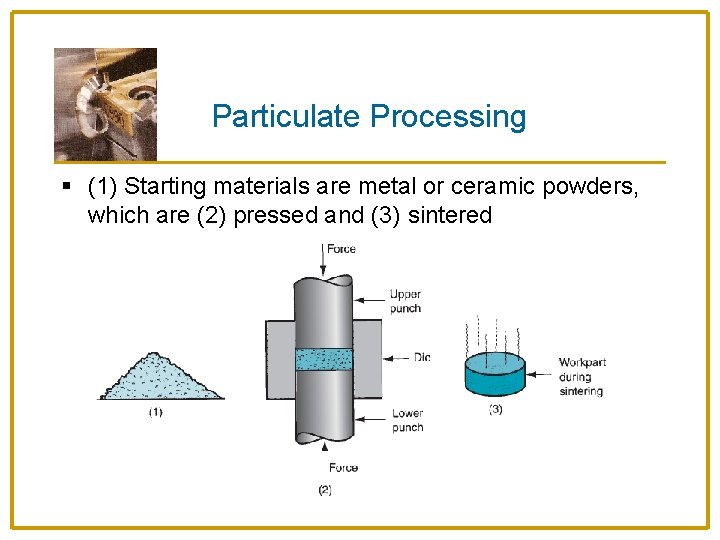
Particulate Processing (1) Starting materials are metal or ceramic powders, which are (2) pressed and (3) sintered
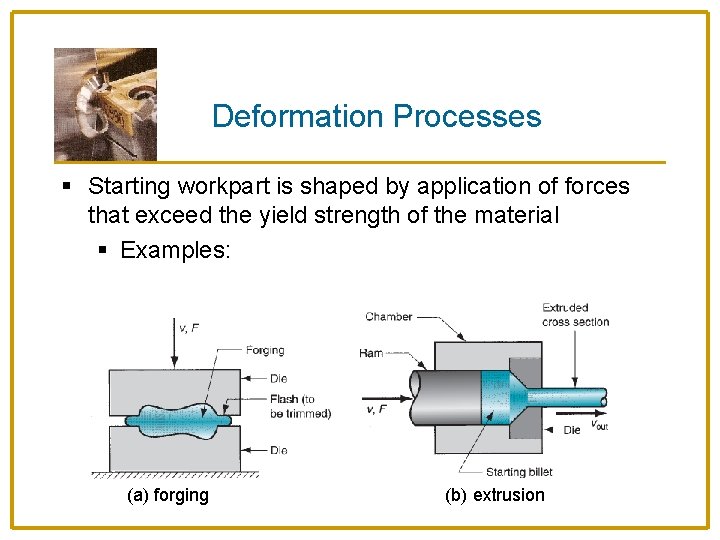
Deformation Processes Starting workpart is shaped by application of forces that exceed the yield strength of the material Examples: (a) forging (b) extrusion
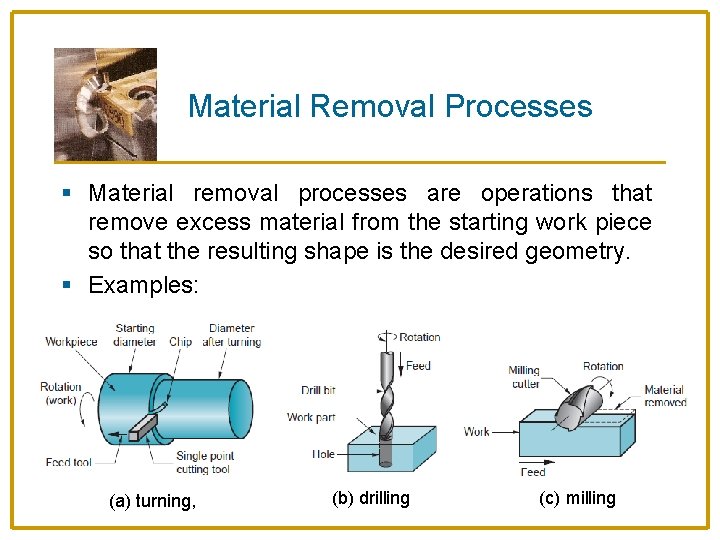
Material Removal Processes Material removal processes are operations that remove excess material from the starting work piece so that the resulting shape is the desired geometry. Examples: (a) turning, (b) drilling (c) milling
Waste in Shaping Processes It is desirable to minimize waste in part shaping Material removal processes are wasteful in the unit operations, but molding and particulate processing operations waste little material Terminology for minimum waste processes: Net shape processes - little or no waste of the starting material and no machining is required Near net shape processes - when minimum machining is required
Property-Enhancing Processes that improve mechanical or physical properties of work material Examples: Heat treatment of metals and glasses Sintering of powdered metals and ceramics Part shape is not altered, except unintentionally Example: unintentional warping of a heat treated part
What is Heat-treatment? The process of heating and cooling metals to achieve desired physical and mechanical properties through modification of their crystalline structure. The temperature, length of time, and rate of cooling after heat treatment will all impact properties dramatically. Common heat treatments: annealing, normalizing, tempering, stress relieving, and etc.
Surface Processing Operations Cleaning - chemical and mechanical processes to remove dirt, oil, and other surface contaminants Surface treatments - mechanical working such as sand blasting, and physical processes like diffusion Coating and thin film deposition - coating exterior surface of the workpiece Electroplating Painting
Assembly Operations Two or more separate parts are joined to form a new entity Types of assembly operations: 1. Joining processes – create a permanent joint Welding, brazing, soldering, adhesive bonding 2. Mechanical assembly – fastening by mechanical methods Threaded fasteners (screws, bolts and nuts); press fitting, expansion fits
- Slides: 37