ENHANCING THE PERFORMANCE OF GRADE VIC PUPILS OF
- Slides: 11
“ENHANCING THE PERFORMANCE OF GRADE VI-C PUPILS OF BUYAGAN ELEMENTARY SCHOOL THROUGH THE USE OF ARTS IN MATH (AIM)” By LORNA VICENTE- WALLIT Presented by LORNA V. WALLIT Dep. Ed-CAR La Trinidad, Benguet
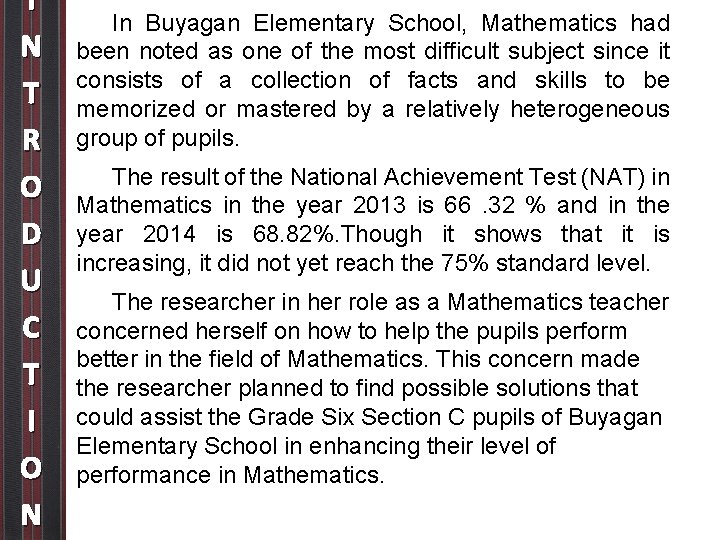
I N T R O D U C T I O N In Buyagan Elementary School, Mathematics had been noted as one of the most difficult subject since it consists of a collection of facts and skills to be memorized or mastered by a relatively heterogeneous group of pupils. The result of the National Achievement Test (NAT) in Mathematics in the year 2013 is 66 . 32 % and in the year 2014 is 68. 82%. Though it shows that it is increasing, it did not yet reach the 75% standard level. The researcher in her role as a Mathematics teacher concerned herself on how to help the pupils perform better in the field of Mathematics. This concern made the researcher planned to find possible solutions that could assist the Grade Six Section C pupils of Buyagan Elementary School in enhancing their level of performance in Mathematics.
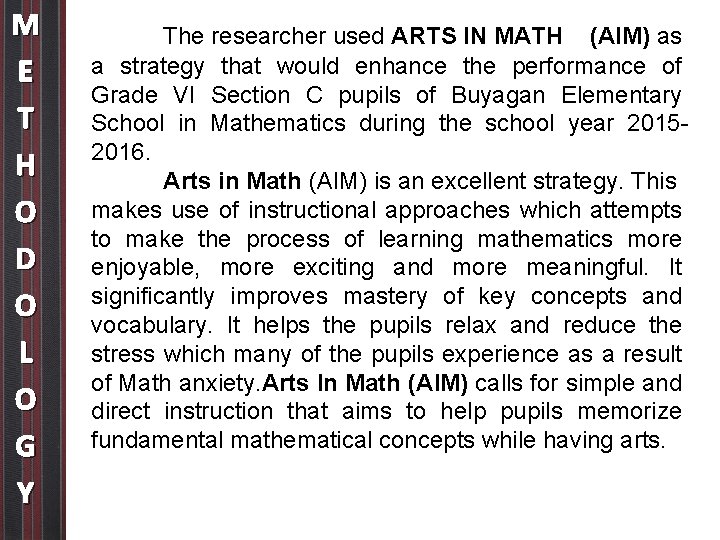
M E T H O D O L O G Y The researcher used ARTS IN MATH (AIM) as a strategy that would enhance the performance of Grade VI Section C pupils of Buyagan Elementary School in Mathematics during the school year 20152016. Arts in Math (AIM) is an excellent strategy. This makes use of instructional approaches which attempts to make the process of learning mathematics more enjoyable, more exciting and more meaningful. It significantly improves mastery of key concepts and vocabulary. It helps the pupils relax and reduce the stress which many of the pupils experience as a result of Math anxiety. Arts In Math (AIM) calls for simple and direct instruction that aims to help pupils memorize fundamental mathematical concepts while having arts.
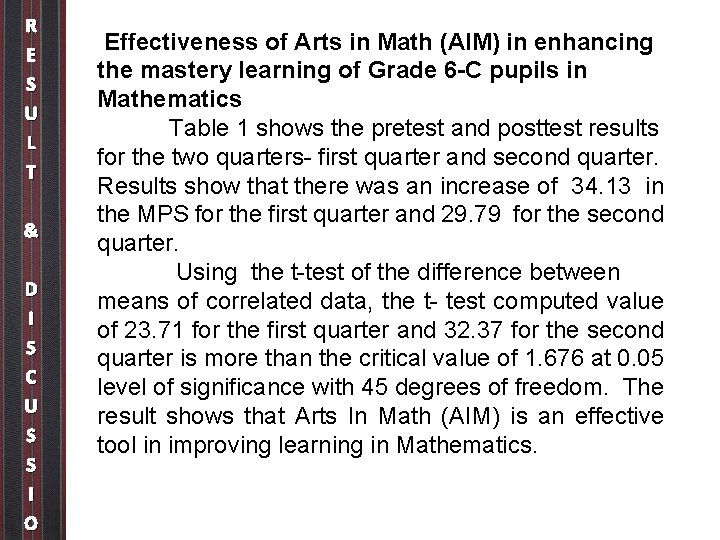
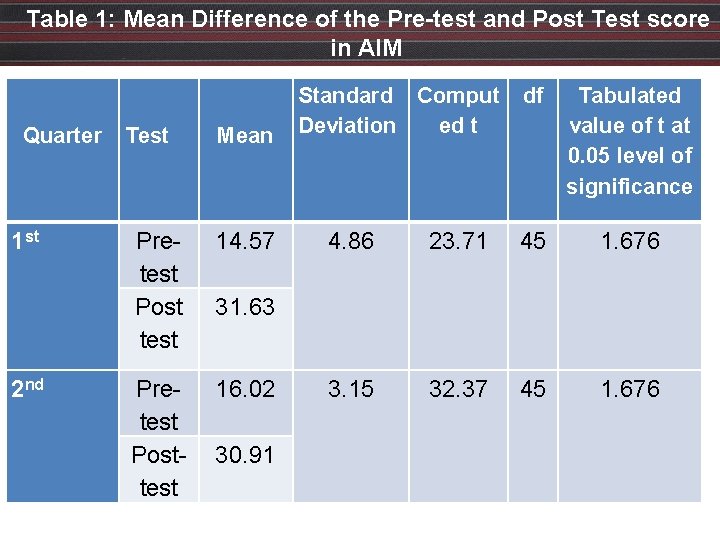
R E S U L T & D I S C U S S I O Effectiveness of Arts in Math (AIM) in enhancing the mastery learning of Grade 6 -C pupils in Mathematics Table 1 shows the pretest and posttest results for the two quarters- first quarter and second quarter. Results show that there was an increase of 34. 13 in the MPS for the first quarter and 29. 79 for the second quarter. Using the t-test of the difference between means of correlated data, the t- test computed value of 23. 71 for the first quarter and 32. 37 for the second quarter is more than the critical value of 1. 676 at 0. 05 level of significance with 45 degrees of freedom. The result shows that Arts In Math (AIM) is an effective tool in improving learning in Mathematics.
Table 1: Mean Difference of the Pre-test and Post Test score in AIM Quarter 1 st 2 nd Test Mean Pretest Post test 14. 57 Pretest Posttest 16. 02 Standard Comput Deviation ed t df Tabulated value of t at 0. 05 level of significance 4. 86 23. 71 45 1. 676 3. 15 32. 37 45 1. 676 31. 63 30. 91
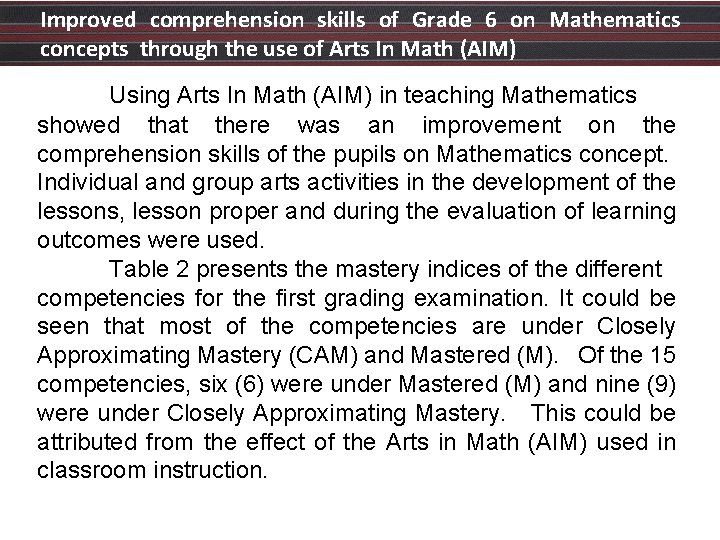
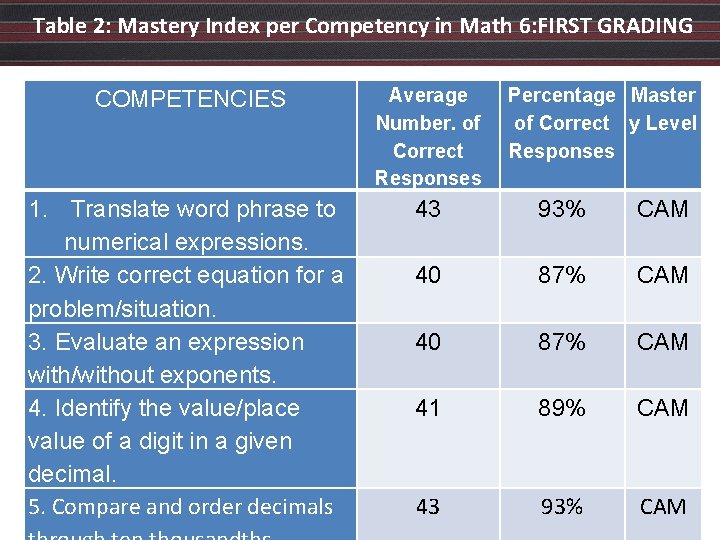
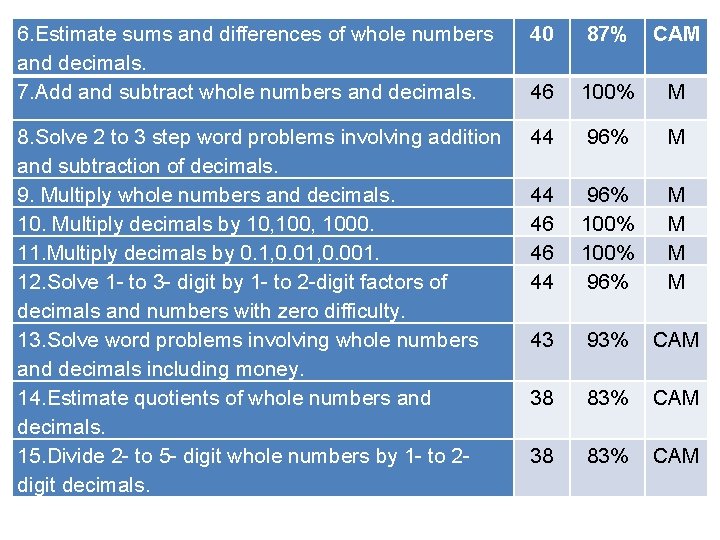
Improved comprehension skills of Grade 6 on Mathematics concepts through the use of Arts In Math (AIM) Using Arts In Math (AIM) in teaching Mathematics showed that there was an improvement on the comprehension skills of the pupils on Mathematics concept. Individual and group arts activities in the development of the lessons, lesson proper and during the evaluation of learning outcomes were used. Table 2 presents the mastery indices of the different competencies for the first grading examination. It could be seen that most of the competencies are under Closely Approximating Mastery (CAM) and Mastered (M). Of the 15 competencies, six (6) were under Mastered (M) and nine (9) were under Closely Approximating Mastery. This could be attributed from the effect of the Arts in Math (AIM) used in classroom instruction.
Table 2: Mastery Index per Competency in Math 6: FIRST GRADING COMPETENCIES Average Number. of Correct Responses Percentage Master of Correct y Level Responses 1. Translate word phrase to numerical expressions. 2. Write correct equation for a problem/situation. 3. Evaluate an expression with/without exponents. 4. Identify the value/place value of a digit in a given decimal. 5. Compare and order decimals 43 93% CAM 40 87% CAM 41 89% CAM 43 93% CAM
6. Estimate sums and differences of whole numbers and decimals. 7. Add and subtract whole numbers and decimals. 40 87% CAM 46 100% M 8. Solve 2 to 3 step word problems involving addition and subtraction of decimals. 9. Multiply whole numbers and decimals. 10. Multiply decimals by 10, 1000. 11. Multiply decimals by 0. 1, 0. 001. 12. Solve 1 - to 3 - digit by 1 - to 2 -digit factors of decimals and numbers with zero difficulty. 13. Solve word problems involving whole numbers and decimals including money. 14. Estimate quotients of whole numbers and decimals. 15. Divide 2 - to 5 - digit whole numbers by 1 - to 2 - digit decimals. 44 96% M 44 46 46 44 96% 100% 96% M M 43 93% CAM 38 83% CAM
Used Arts In Math (AIM) to stimulate, motivate and sustain pupils’ interest
Improved the teaching strategy in Mathematics According to Rivera and Sambrano (1982), as cited by Ducayso (2004), the slow learners have short span of interest; hence, they exactly get bored. Because of this, the teacher should set more interesting environment through discussions, games, puzzles, arts and other exciting activities. It is then the role of a teacher to make the teaching-learning process effective and successful by improving his teaching strategy instead of typical intermediate papers or chalk boards. The use of Arts In Math (AIM) was a very effective strategy in teaching Mathematics subject. The pupils were provided with different art activities which they enjoyed doing while computing and analyzing mathematical sentences and mathematics word problems.
R E F L E C T I O N In this study, Arts In Math (AIM) was used to make teaching-learning process in Mathematics fun, enjoyable and interesting. At first, it was a tough job for me since I didn’t have the skills in arts, but I really wanted to present and teach math concepts in a way that pupils will develop the attitude of “I LOVE MATH. ” With this research, I realized that a teacher should be ARTISTIC. A teacher should possess the following characteristics: A= Artistic and Approachable R= Resourceful T= Thoughtful I= Innovative S= Systematic T= Tender to his/her pupils I= Ingenious C= Creative