Miseenscene is french for the arrangement of scenery
- Slides: 36
Mise-en-scene is french for the arrangement of scenery and stage properties in a play
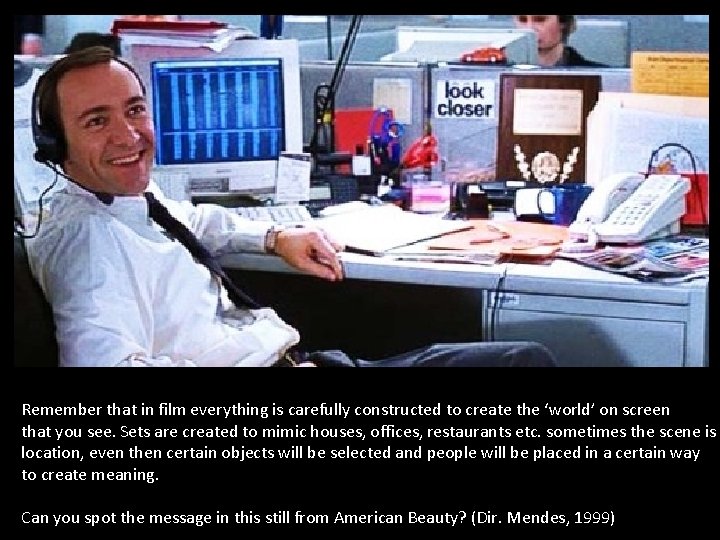
Remember that in film everything is carefully constructed to create the ‘world’ on screen that you see. Sets are created to mimic houses, offices, restaurants etc. sometimes the scene is location, even then certain objects will be selected and people will be placed in a certain way to create meaning. Can you spot the message in this still from American Beauty? (Dir. Mendes, 1999)
The different elements of mise-en-scene 1. Settings 2. Props 3. Staging/ framing 4. Figure expression and movement 5. Costume, hair & make up 6. Lighting and colour
1. Settings • Settings & Locations play an important part in film-making and are not just ‘backgrounds’. • Settings can manipulate an audience by building certain expectations (these expectations can then be played with!). • TASK: What settings might you find in: 1. 2. 3. A Science Fiction Film? A Romantic Comedy? A Horror Film? Why would these be set here? What connotations do locations have? Denotation= the object itself Connotation= what is means or represents e. g. hearts = love
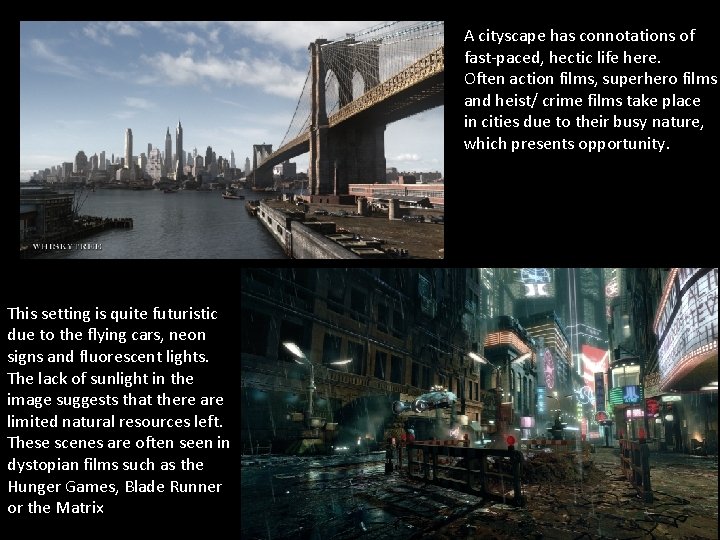
A cityscape has connotations of fast-paced, hectic life here. Often action films, superhero films and heist/ crime films take place in cities due to their busy nature, which presents opportunity. This setting is quite futuristic due to the flying cars, neon signs and fluorescent lights. The lack of sunlight in the image suggests that there are limited natural resources left. These scenes are often seen in dystopian films such as the Hunger Games, Blade Runner or the Matrix
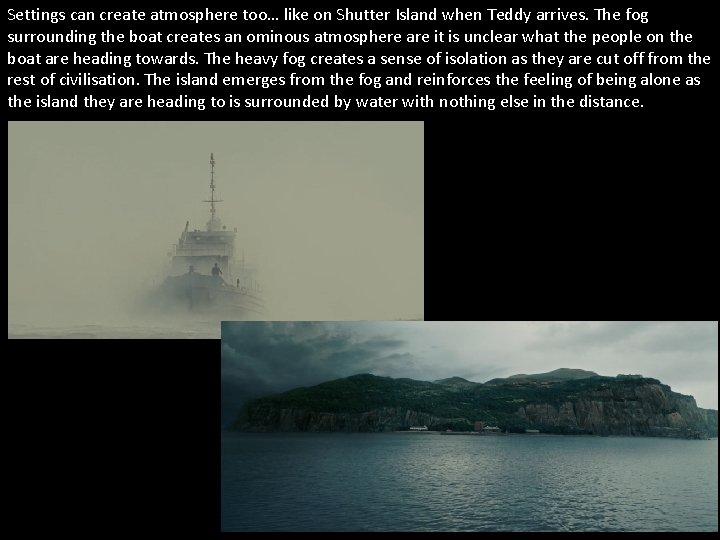
Settings can create atmosphere too… like on Shutter Island when Teddy arrives. The fog surrounding the boat creates an ominous atmosphere are it is unclear what the people on the boat are heading towards. The heavy fog creates a sense of isolation as they are cut off from the rest of civilisation. The island emerges from the fog and reinforces the feeling of being alone as the island they are heading to is surrounded by water with nothing else in the distance.
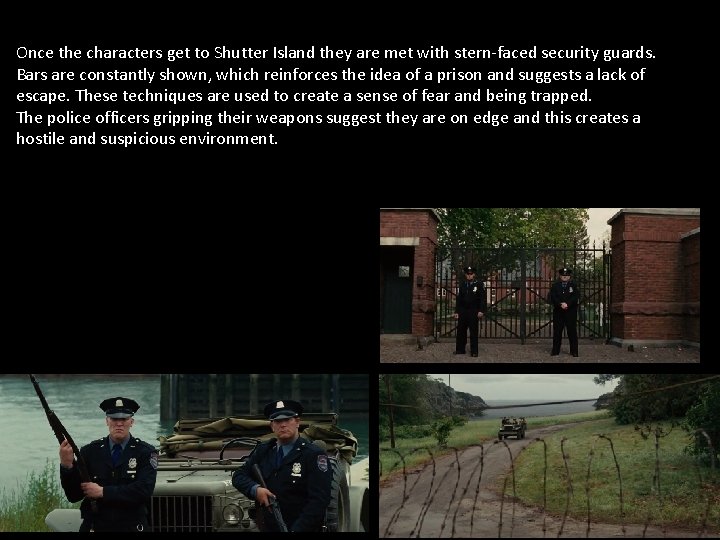
Once the characters get to Shutter Island they are met with stern-faced security guards. Bars are constantly shown, which reinforces the idea of a prison and suggests a lack of escape. These techniques are used to create a sense of fear and being trapped. The police officers gripping their weapons suggest they are on edge and this creates a hostile and suspicious environment.
2. Props • What is a prop? • You have 30 seconds to discuss what it might be. . Be prepared to feedback • Answer: An item of use
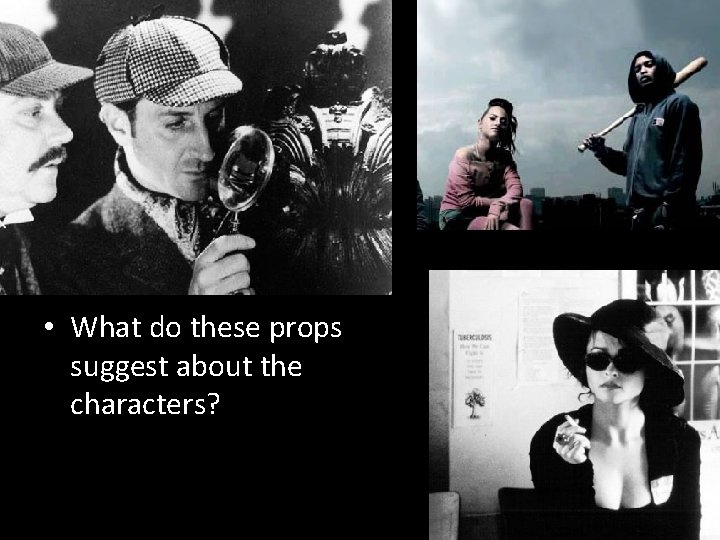
2. Props • Props build on the setting to create a believable ‘world’. • They can establish a setting/ period and create realism • Props can be used to establish character. • Props can be used as symbols to connote additional meanings over and above their material presence e. g. a magnifying glass= someone has a good attention to detail • ‘At their simplest, props work to give an authentic sense of place, but can also be used in more complex ways to suggest important characteristics of particular individuals or even key themes for the whole film. ’ (Benyahia, Gaffney & White, 2006)
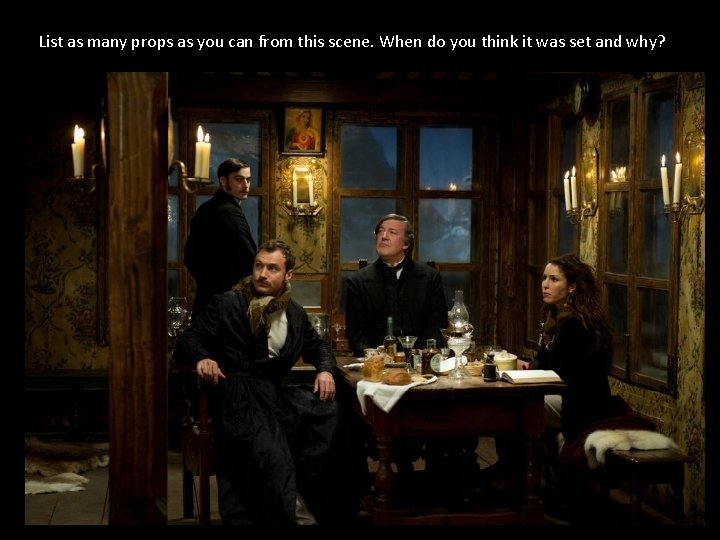
List as many props as you can from this scene. When do you think it was set and why?
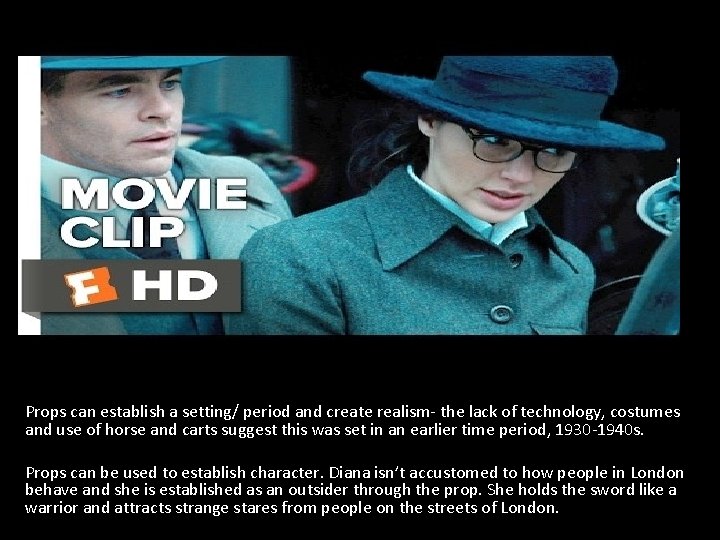
Props can establish a setting/ period and create realism- the lack of technology, costumes and use of horse and carts suggest this was set in an earlier time period, 1930 -1940 s. Props can be used to establish character. Diana isn’t accustomed to how people in London behave and she is established as an outsider through the prop. She holds the sword like a warrior and attracts strange stares from people on the streets of London.
• What do these props suggest about the characters?
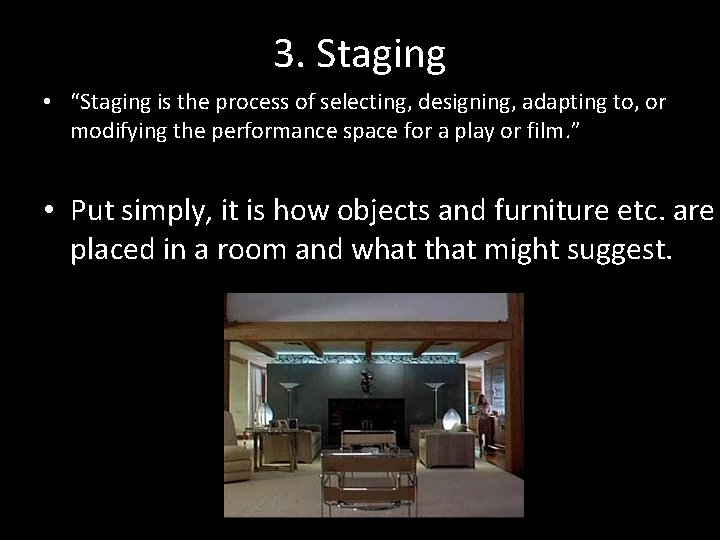
3. Staging • “Staging is the process of selecting, designing, adapting to, or modifying the performance space for a play or film. ” • Put simply, it is how objects and furniture etc. are placed in a room and what that might suggest.
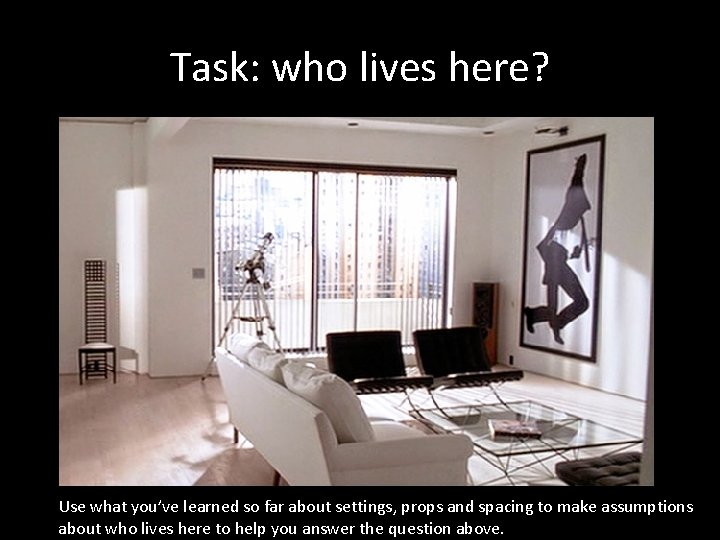
Task: who lives here? Use what you’ve learned so far about settings, props and spacing to make assumptions about who lives here to help you answer the question above.
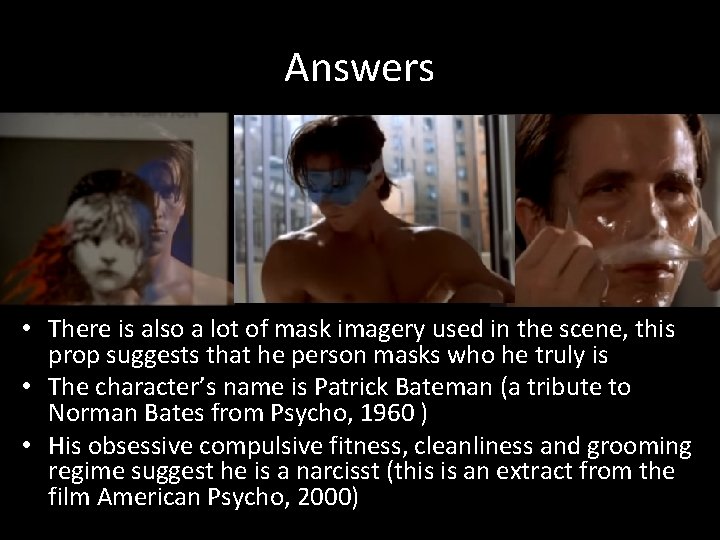
Answers • The room is very clean and sterile. There are no colourful paintings or toys, suggesting that this person lives alone • There is modern art on the wall and the furnishings are minimalistic, with large open spaces surrounding them. This suggests that this person cares about their apartment and has a fine taste • There is a view of sky scrapers through the window, suggesting that this person lives in a nice apartment in the middle of the city, suggesting that they are wealthy • The telescope indicates they are into expensive hobbies (or that they like to spy on other people) • Click on the link to watch the short scene to find out more about the person who lives here https: //www. youtube. com/watch? v=5_0 Jyj. LKKL 0
Answers • There is also a lot of mask imagery used in the scene, this prop suggests that he person masks who he truly is • The character’s name is Patrick Bateman (a tribute to Norman Bates from Psycho, 1960 ) • His obsessive compulsive fitness, cleanliness and grooming regime suggest he is a narcisst (this is an extract from the film American Psycho, 2000)
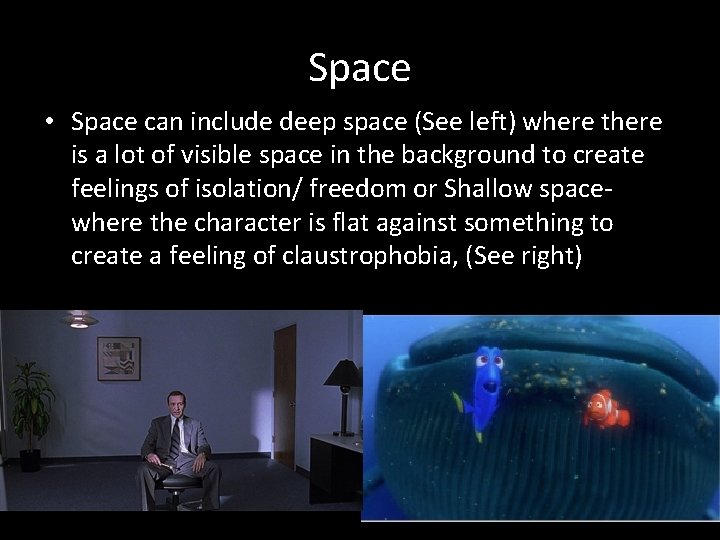
Space • Space can include deep space (See left) where there is a lot of visible space in the background to create feelings of isolation/ freedom or Shallow spacewhere the character is flat against something to create a feeling of claustrophobia, (See right)
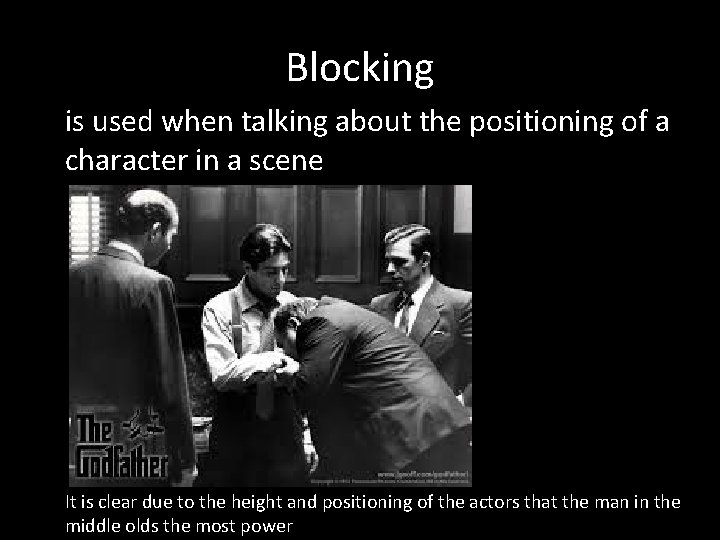
Blocking is used when talking about the positioning of a character in a scene It is clear due to the height and positioning of the actors that the man in the middle olds the most power
4. Figure Expression & Movement • Figure Expressions provide a clear indicator of how someone is feeling. • If someone is smiling broadly, we assume they are happy but we may get a different feeling if this is accompanied by scary music. • Body Language may also indicate how a character feels towards another character or may reflect the state of their relationship • Movement can suggest the character’s mood: slow movement= sad, quick movements could show anger/ excitement
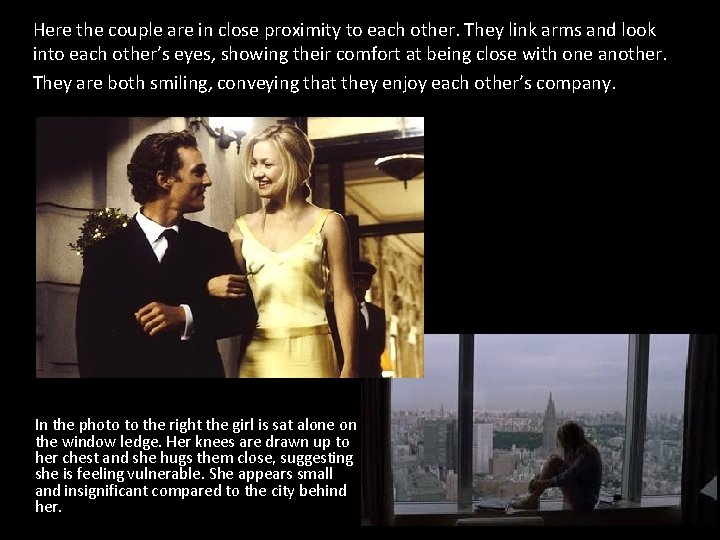
Here the couple are in close proximity to each other. They link arms and look into each other’s eyes, showing their comfort at being close with one another. They are both smiling, conveying that they enjoy each other’s company. In the photo to the right the girl is sat alone on the window ledge. Her knees are drawn up to her chest and she hugs them close, suggesting she is feeling vulnerable. She appears small and insignificant compared to the city behind her.
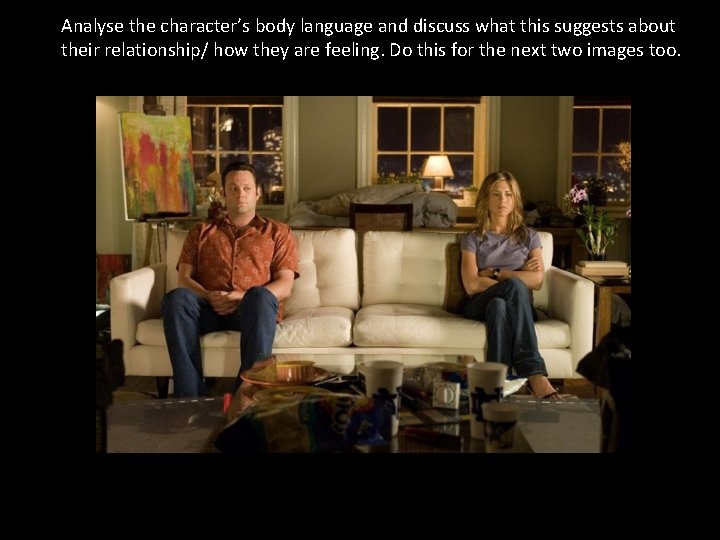
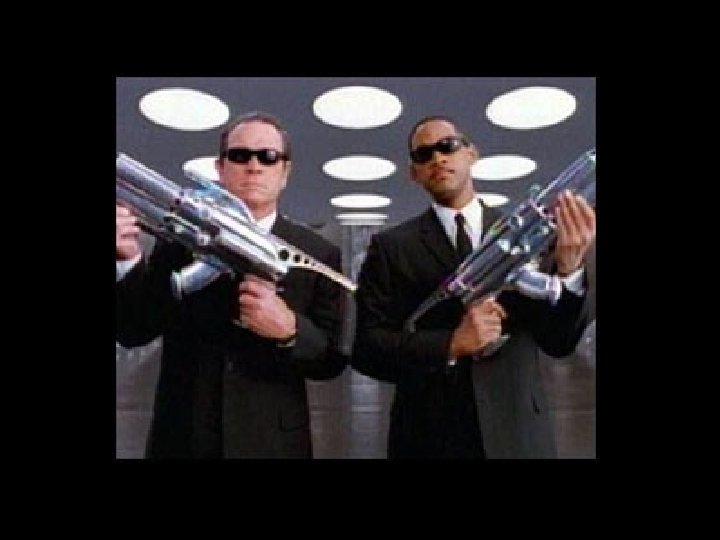
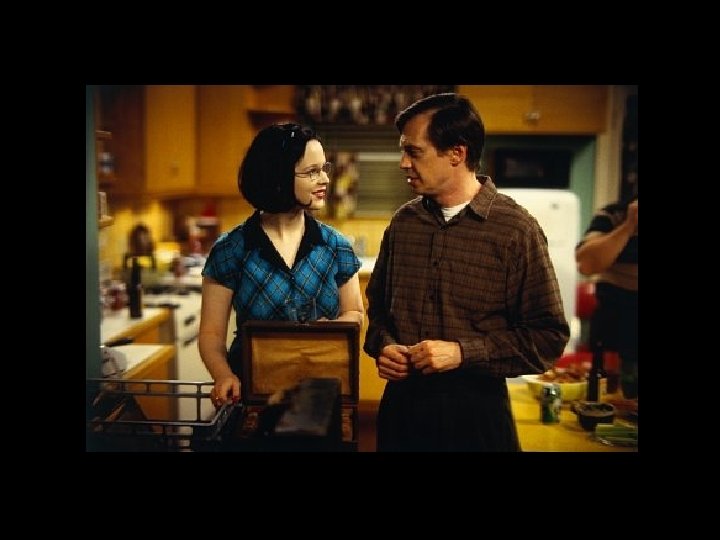
Analyse the character’s body language and discuss what this suggests about their relationship/ how they are feeling. Do this for the next two images too.
5. Costume, Hair & Make Up • Costume, Hair & Make Up act as an instant indicator of a character’s personality, status & job. • It can tell us immediately whether the film is set in the present and what society or culture it will centre around. • Certain costumes can signify certain individuals (i. e. black cloak of a vampire, Spidey’s Spiderman suit) • Costumes are used to show difference or similarity between characters, changes in an individual’s character or mood as the film progresses and whether or not they fit in with the setting.
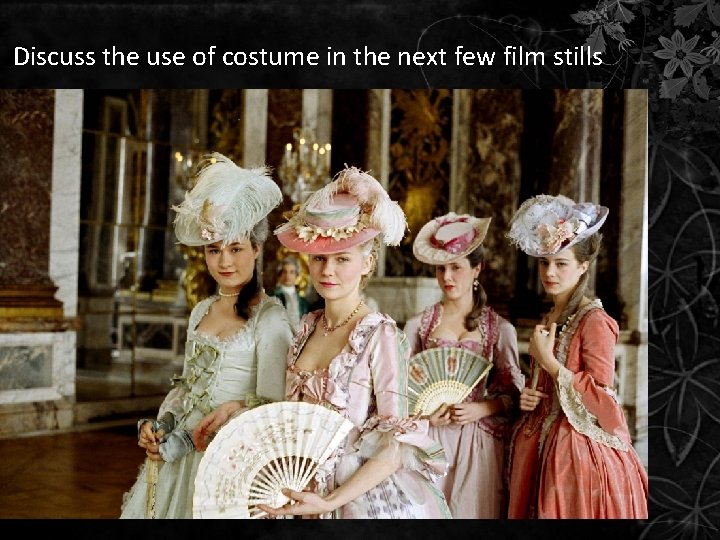
Discuss the use of costume in the next few film stills
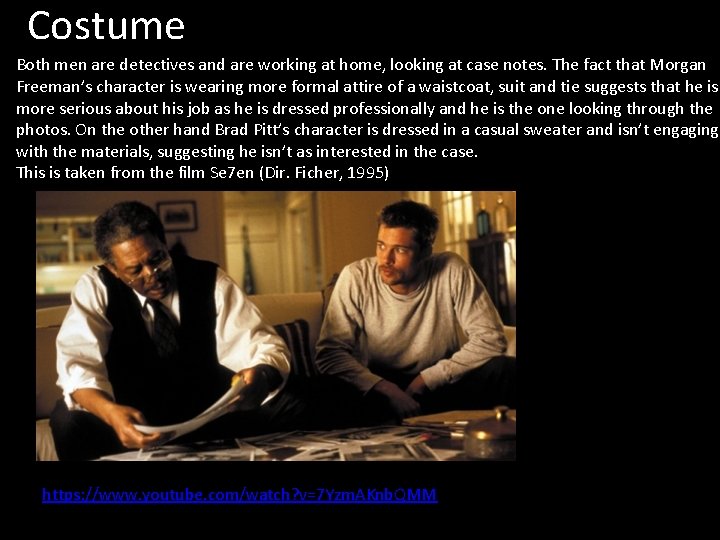
Costume Both men are detectives and are working at home, looking at case notes. The fact that Morgan Freeman’s character is wearing more formal attire of a waistcoat, suit and tie suggests that he is more serious about his job as he is dressed professionally and he is the one looking through the photos. On the other hand Brad Pitt’s character is dressed in a casual sweater and isn’t engaging with the materials, suggesting he isn’t as interested in the case. This is taken from the film Se 7 en (Dir. Ficher, 1995) https: //www. youtube. com/watch? v=7 Yzm. AKnb. QMM
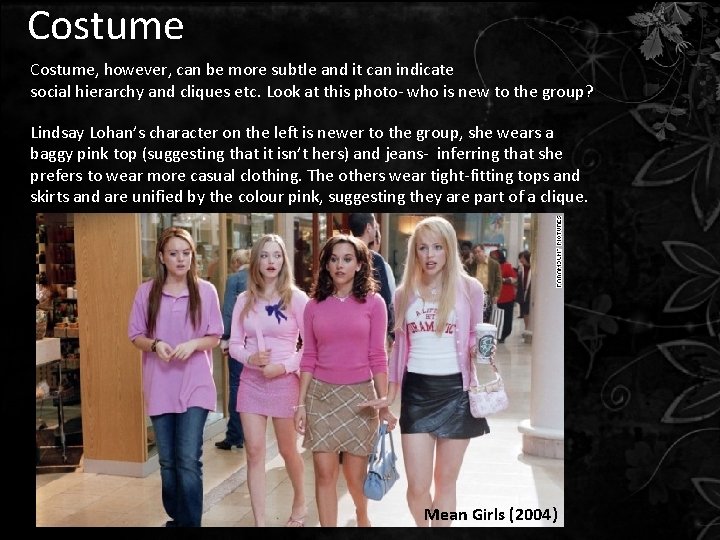
Costume, however, can be more subtle and it can indicate social hierarchy and cliques etc. Look at this photo- who is new to the group? Lindsay Lohan’s character on the left is newer to the group, she wears a baggy pink top (suggesting that it isn’t hers) and jeans- inferring that she prefers to wear more casual clothing. The others wear tight-fitting tops and skirts and are unified by the colour pink, suggesting they are part of a clique. Mean Girls (2004)
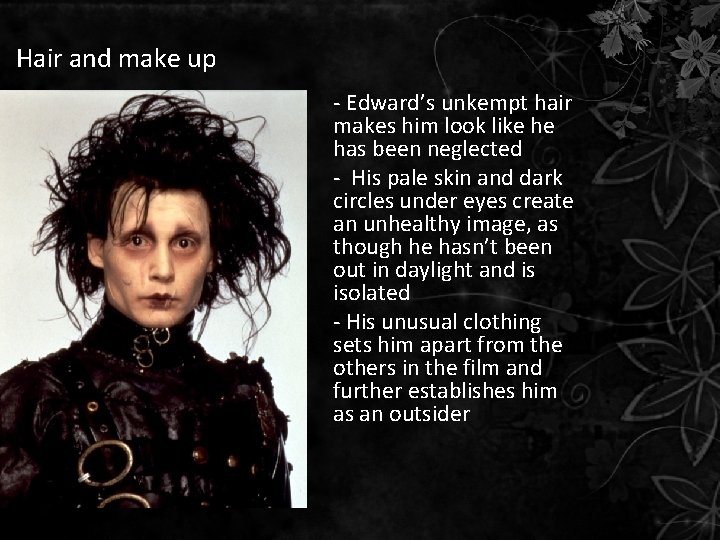
Hair and make up - Edward’s unkempt hair makes him look like he has been neglected - His pale skin and dark circles under eyes create an unhealthy image, as though he hasn’t been out in daylight and is isolated - His unusual clothing sets him apart from the others in the film and further establishes him as an outsider
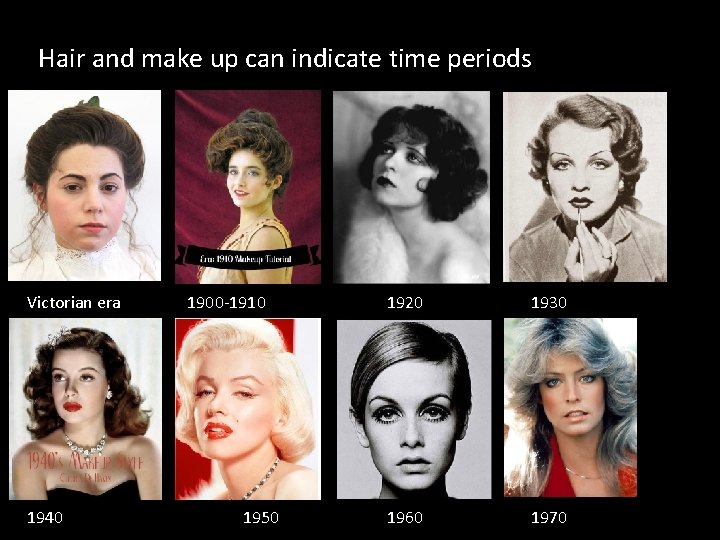
Hair and make up can indicate time periods Victorian era 1940 1900 -1910 1950 1920 1930 1960 1970
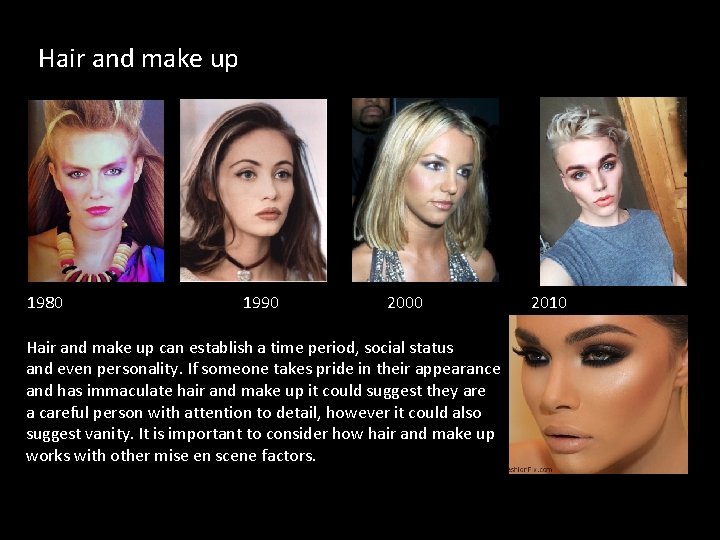
Hair and make up 1980 1990 2000 Hair and make up can establish a time period, social status and even personality. If someone takes pride in their appearance and has immaculate hair and make up it could suggest they are a careful person with attention to detail, however it could also suggest vanity. It is important to consider how hair and make up works with other mise en scene factors. 2010
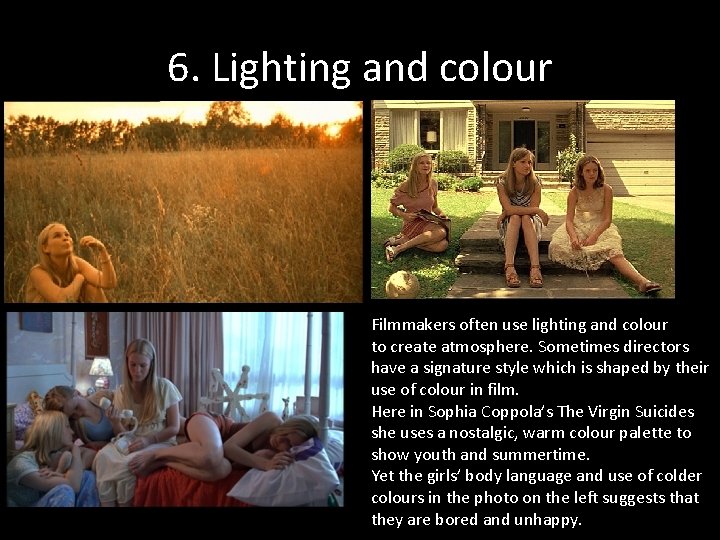
6. Lighting and colour Filmmakers often use lighting and colour to create atmosphere. Sometimes directors have a signature style which is shaped by their use of colour in film. Here in Sophia Coppola’s The Virgin Suicides she uses a nostalgic, warm colour palette to show youth and summertime. Yet the girls’ body language and use of colder colours in the photo on the left suggests that they are bored and unhappy.
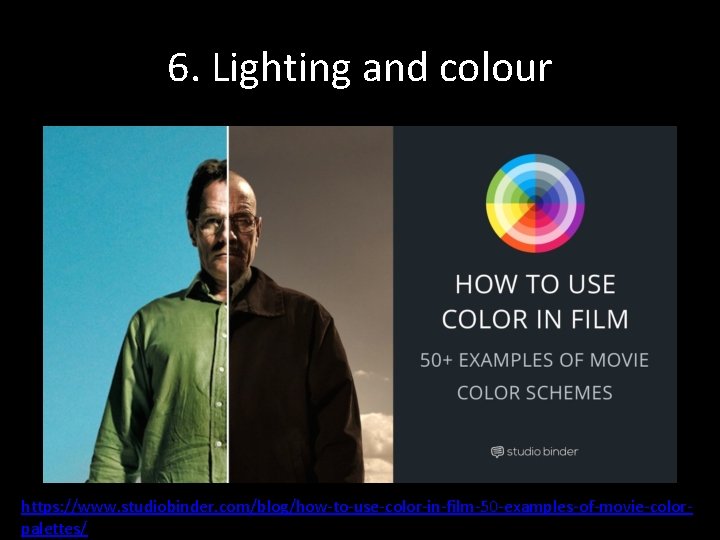
6. Lighting and colour https: //www. studiobinder. com/blog/how-to-use-color-in-film-50 -examples-of-movie-colorpalettes/
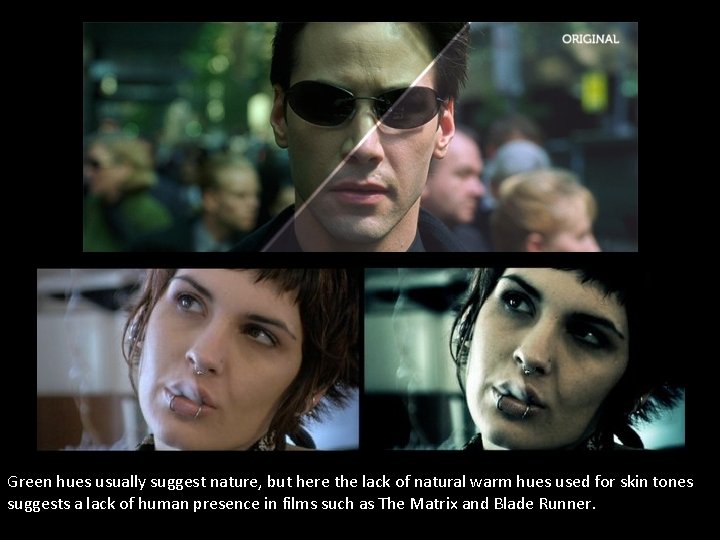
Green hues usually suggest nature, but here the lack of natural warm hues used for skin tones suggests a lack of human presence in films such as The Matrix and Blade Runner.
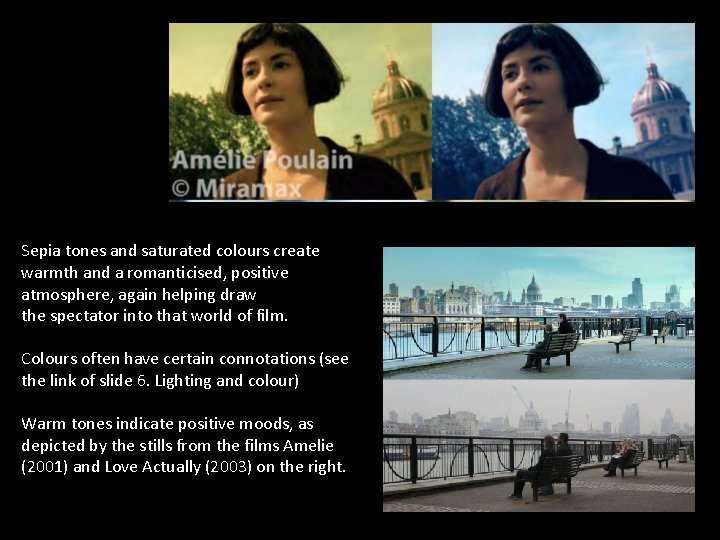
Sepia tones and saturated colours create warmth and a romanticised, positive atmosphere, again helping draw the spectator into that world of film. Colours often have certain connotations (see the link of slide 6. Lighting and colour) Warm tones indicate positive moods, as depicted by the stills from the films Amelie (2001) and Love Actually (2003) on the right.
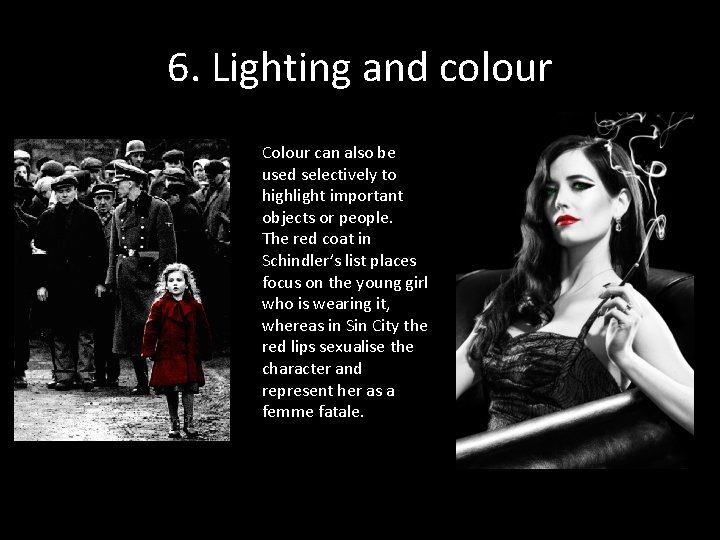
6. Lighting and colour Colour can also be used selectively to highlight important objects or people. The red coat in Schindler’s list places focus on the young girl who is wearing it, whereas in Sin City the red lips sexualise the character and represent her as a femme fatale.
Mise En Scene Analysis • Now, watch a short film clip of your choice (roughly 2 -5 minutes long) and note down how the following are used: • Settings • Props • Staging • Costume, hair & make up • Figure expression and movement • Lighting and colour