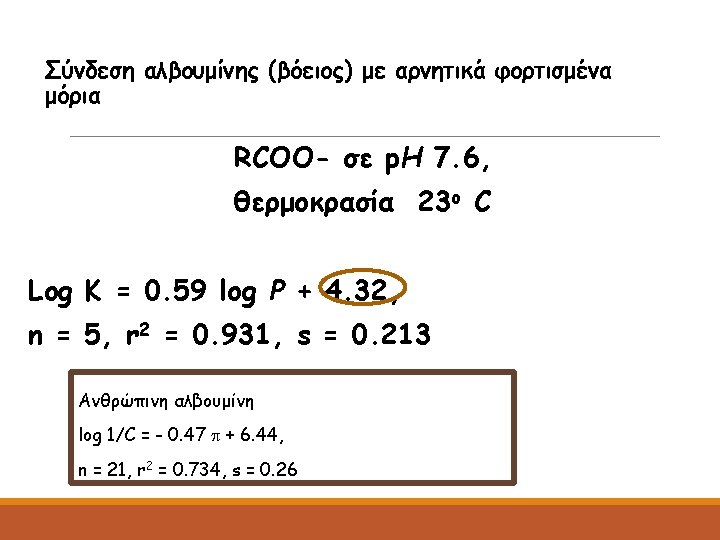
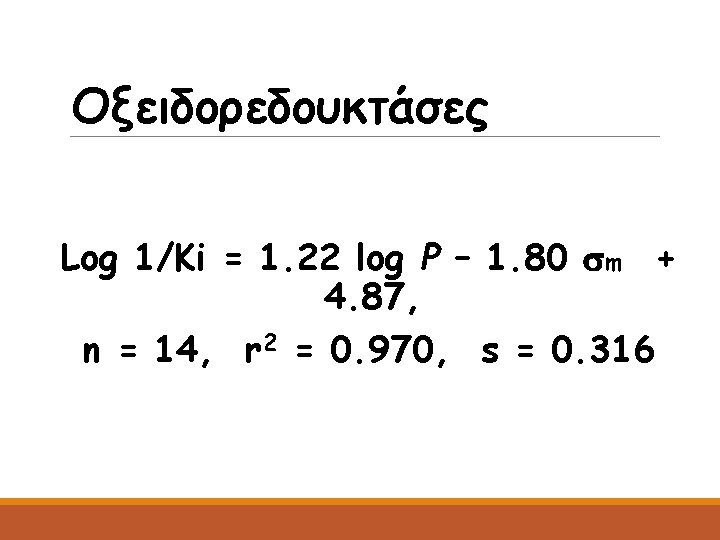
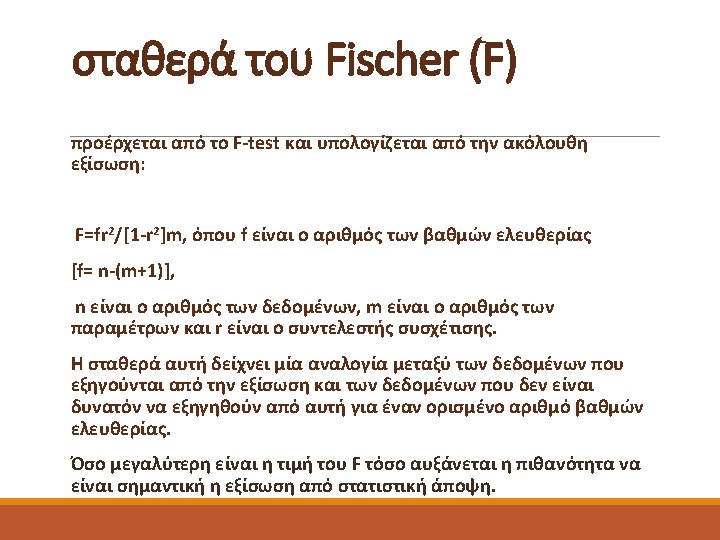
Log 1 C 0 71 log P 1




- Slides: 29
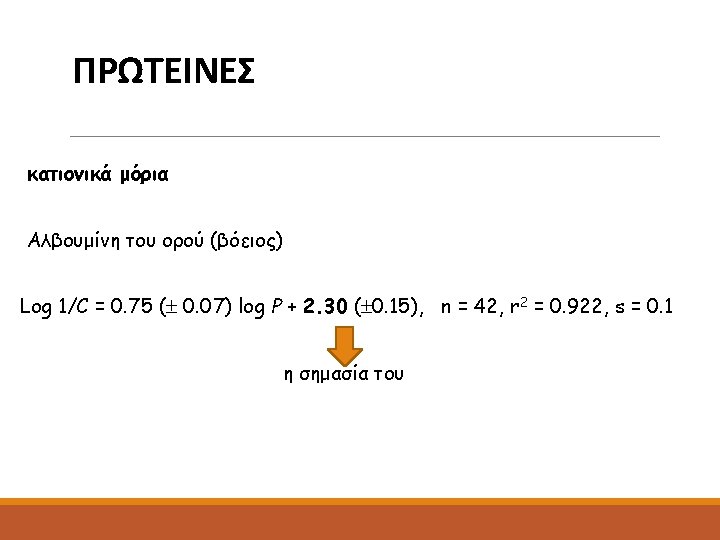
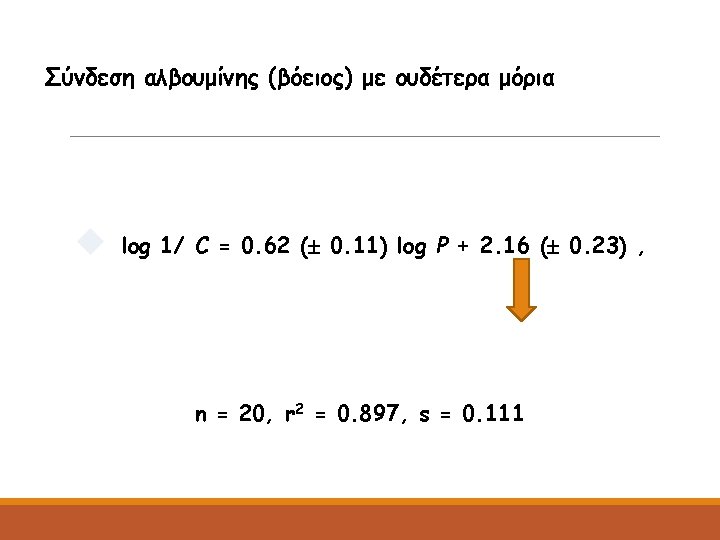
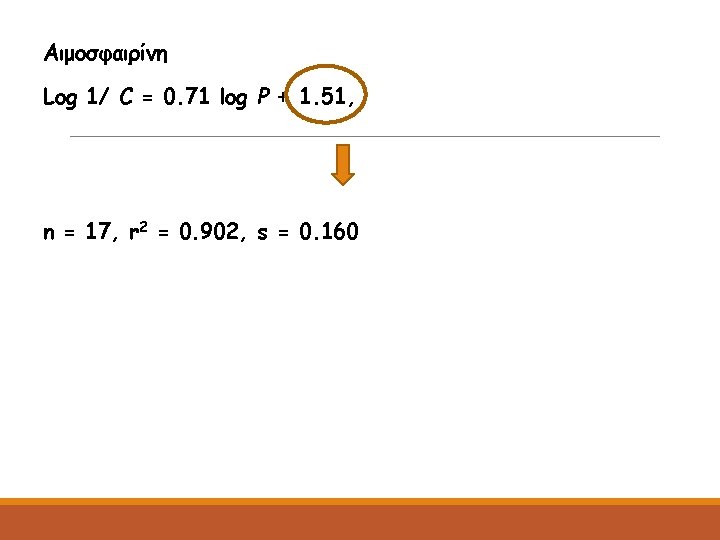
Αιμοσφαιρίνη Log 1/ C = 0. 71 log P + 1. 51, n = 17, r 2 = 0. 902, s = 0. 160
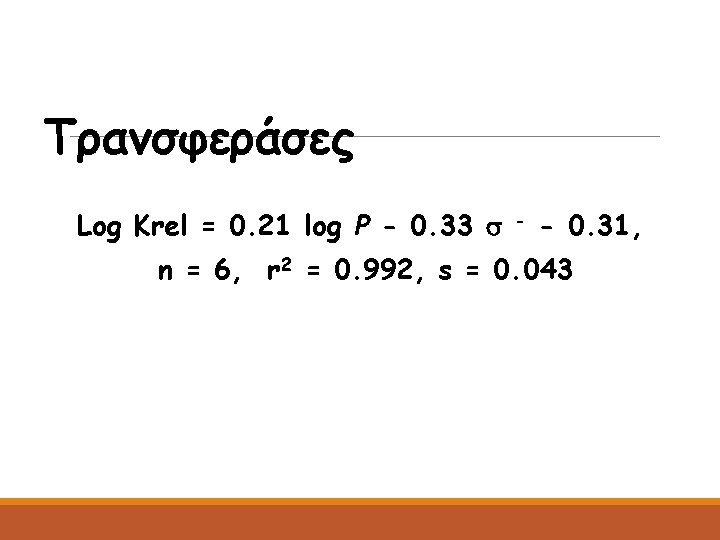
Τρανσφεράσες Log Krel = 0. 21 log P - 0. 33 - - 0. 31, n = 6, r 2 = 0. 992, s = 0. 043
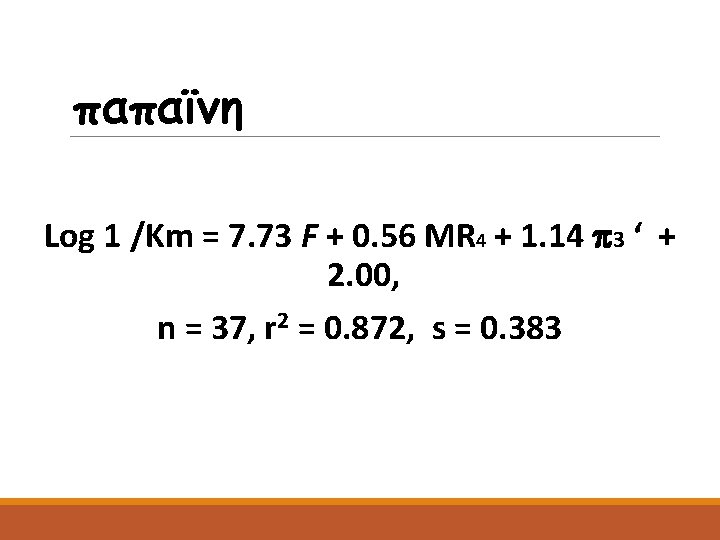
παπαϊνη Log 1 /Km = 7. 73 F + 0. 56 MR 4 + 1. 14 3 ‘ + 2. 00, n = 37, r 2 = 0. 872, s = 0. 383
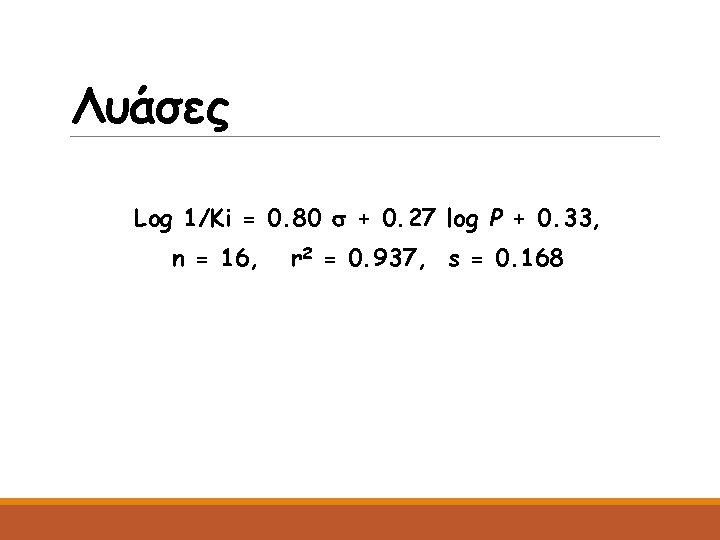
Λυάσες Lοg 1/Ki = 0. 80 + 0. 27 log P + 0. 33, n = 16, r 2 = 0. 937, s = 0. 168
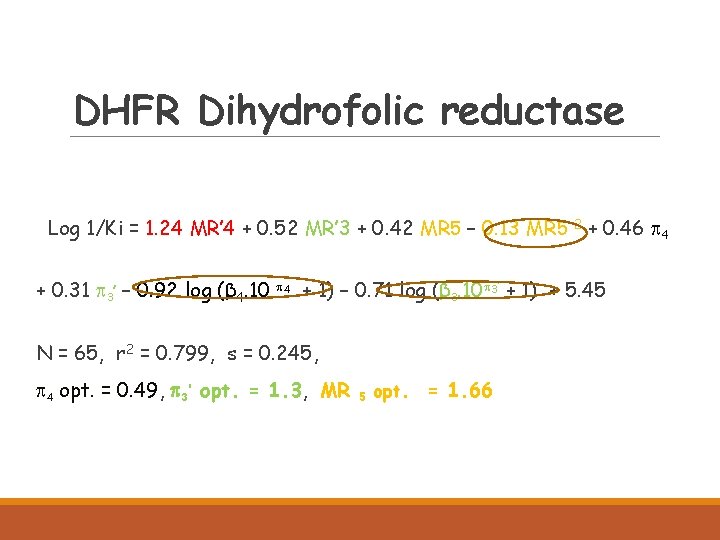
DHFR Dihydrofolic reductase Log 1/Ki = 1. 24 MR’ 4 + 0. 52 MR’ 3 + 0. 42 MR 5 – 0. 13 MR 5 2 + 0. 46 4 + 0. 31 3’ – 0. 92 log (β 4. 10 4 + 1) – 0. 71 log (β 3. 10 3’ + 1) + 5. 45 N = 65, r 2 = 0. 799, s = 0. 245, 4 opt. = 0. 49, 3’ opt. = 1. 3, MR 5 opt. = 1. 66
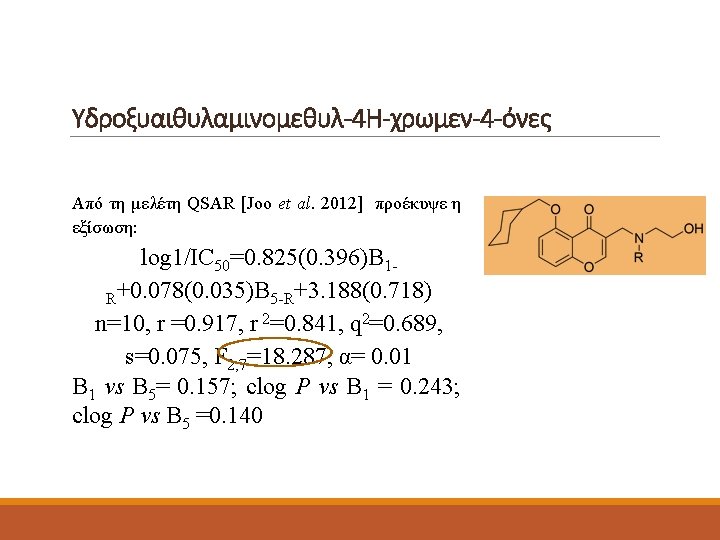
Υδροξυαιθυλαμινομεθυλ-4Η-χρωμεν-4 -όνες Από τη μελέτη QSAR [Joo et al. 2012] προέκυψε η εξίσωση: log 1/IC 50=0. 825(0. 396)B 1 R+0. 078(0. 035)B 5 -R+3. 188(0. 718) n=10, r =0. 917, r 2=0. 841, q 2=0. 689, s=0. 075, F 2, 7=18. 287, α= 0. 01 B 1 vs B 5= 0. 157; clog P vs B 1 = 0. 243; clog P vs B 5 =0. 140
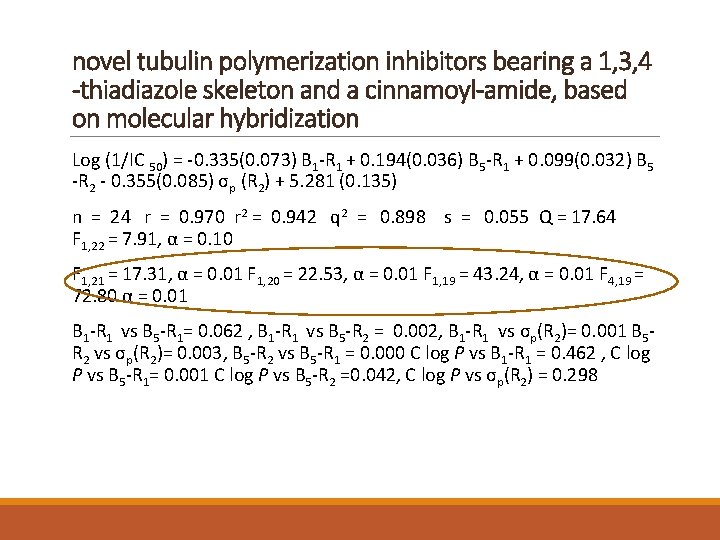
novel tubulin polymerization inhibitors bearing a 1, 3, 4 -thiadiazole skeleton and a cinnamoyl-amide, based on molecular hybridization Log (1/IC 50) = -0. 335(0. 073) B 1 -R 1 + 0. 194(0. 036) B 5 -R 1 + 0. 099(0. 032) B 5 -R 2 - 0. 355(0. 085) σp (R 2) + 5. 281 (0. 135) n = 24 r = 0. 970 r 2 = 0. 942 q 2 = 0. 898 s = 0. 055 Q = 17. 64 F 1, 22 = 7. 91, α = 0. 10 F 1, 21 = 17. 31, α = 0. 01 F 1, 20 = 22. 53, α = 0. 01 F 1, 19 = 43. 24, α = 0. 01 F 4, 19 = 72. 80 α = 0. 01 B 1 -R 1 vs B 5 -R 1= 0. 062 , B 1 -R 1 vs B 5 -R 2 = 0. 002, B 1 -R 1 vs σp(R 2)= 0. 001 B 5 R 2 vs σp(R 2)= 0. 003, B 5 -R 2 vs B 5 -R 1 = 0. 000 C log P vs B 1 -R 1 = 0. 462 , C log P vs B 5 -R 1= 0. 001 C log P vs B 5 -R 2 =0. 042, C log P vs σp(R 2) = 0. 298
The model underlines the important role of steric factors for antitubulin activity. B 1 -R 1, B 5 -R 1 and B 5 -R 2 are Verloop’s sterimol parameters for the minimum and maximum width, for the R 1 and R 2 substituents respectively. The most significant variable is B 5 for R 1 phenyl substituents, followed by B 1 R 1, σp (R 2) and B 5 -R 2. Enhancement of the maximum width for R 1 and R 2 leads to an increase of inhibition. The negative sign with B 1 -R 1 denotes a decrease in biological response. The Hammett’s σp stands for the electronic effect of R 2 - phenyl substituents of cinnamic scaffold and follows the steric parameters. Negative coefficient suggests that electron-donating π-groups may enhance the inhibitory activity
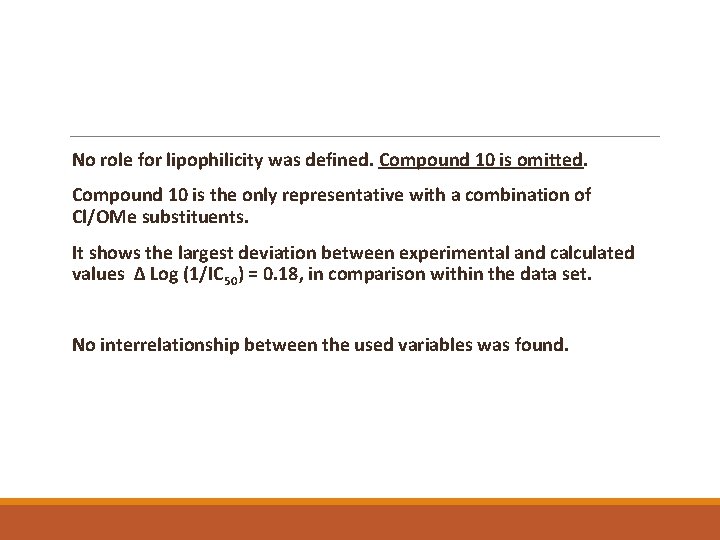
No role for lipophilicity was defined. Compound 10 is omitted. Compound 10 is the only representative with a combination of Cl/OMe substituents. It shows the largest deviation between experimental and calculated values Δ Log (1/IC 50) = 0. 18, in comparison within the data set. No interrelationship between the used variables was found.