Involuntary Commitment Law and Related Issues March 2020


- Slides: 112
Involuntary Commitment Law and Related Issues March 2020 Mark Botts
Topics § Criteria for Commitment § Three kinds of commitment § Defining dangerousness § Writing a legally sufficient petition § Emergency criteria and procedure § Commitment procedures § Diversion with PADs or HCPAs § Layperson Petition Procedure § Clinician Petition Procedure § Law enforcement custody during wait times and delays
Involuntary Commitment
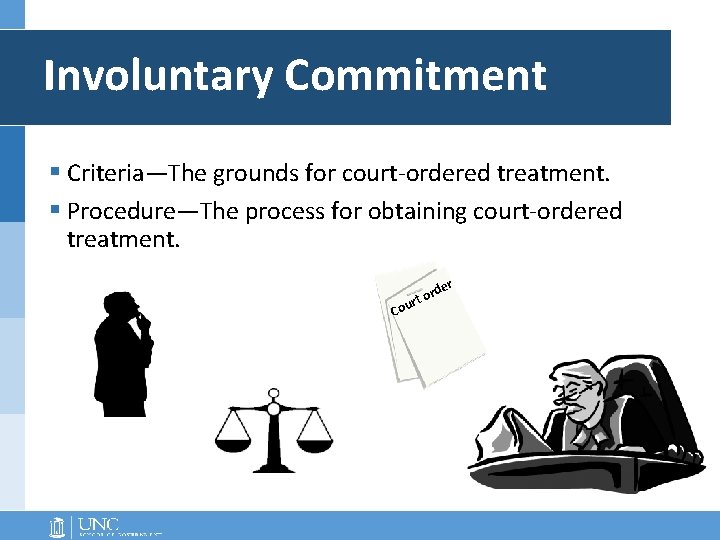
Involuntary Commitment § Criteria—The grounds for court-ordered treatment. § Procedure—The process for obtaining court-ordered treatment. Because the commitment statutes provide for a drastic r e d t or r remedy, those that use them must do so with “care and u Co exactness. ” In re Ingram, 74 N. C. App. 579 (1985), quoting Samons, 9 NC App. 490 (1970).
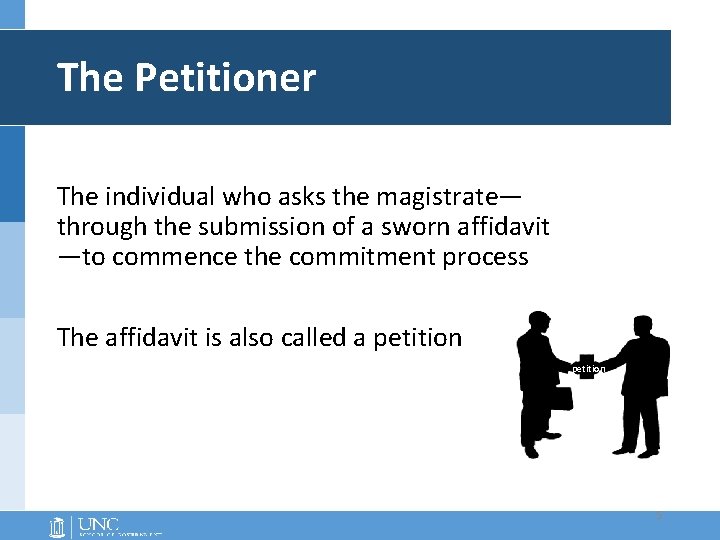
The Petitioner The individual who asks the magistrate— through the submission of a sworn affidavit —to commence the commitment process The affidavit is also called a petition 5
The Respondent The individual who is the subject of the petition and—if the magistrate commences the commitment case— § Will be examined by a commitment examiner § Will have the opportunity to respond to the petitioner’s allegations at a court hearing 6
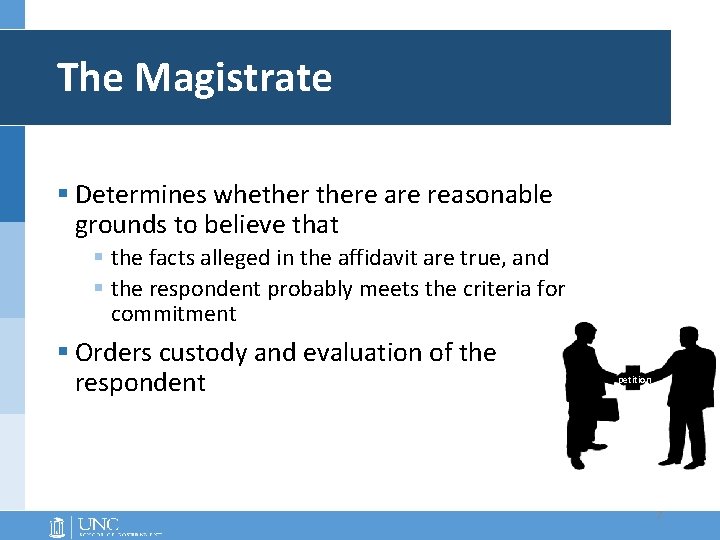
The Magistrate § Determines whethere are reasonable grounds to believe that § the facts alleged in the affidavit are true, and § the respondent probably meets the criteria for commitment § Orders custody and evaluation of the respondent petition 7
The District Court Judge Orders commitment of the respondent if there is clear, cogent, and convincing evidence that the respondent meets the criteria for commitment r rde rt o Cou
The Commitment Examiner Examines the respondent to determine whether the respondent meets the statutory criteria for commitment Examiners who are qualified to perform the first examination: §Physicians §Ph. D psychologists with a health services provider certificate §The following professionals if qualified through DHHS training and certification: licensed clinical social workers, masters level or higher nurse practitioners, physician assistants, licensed professional counselors and licensed clinical addictions specialists v. Note: LCAS is qualified to perform only the substance abuse commitment examination
The Clerk of Superior Court § Receives the findings and recommendations of commitment examiners § Maintains the court record containing the petition, custody order, and commitment examination forms § Calendars the case for a hearing § Appoints an attorney to represent the respondent 10
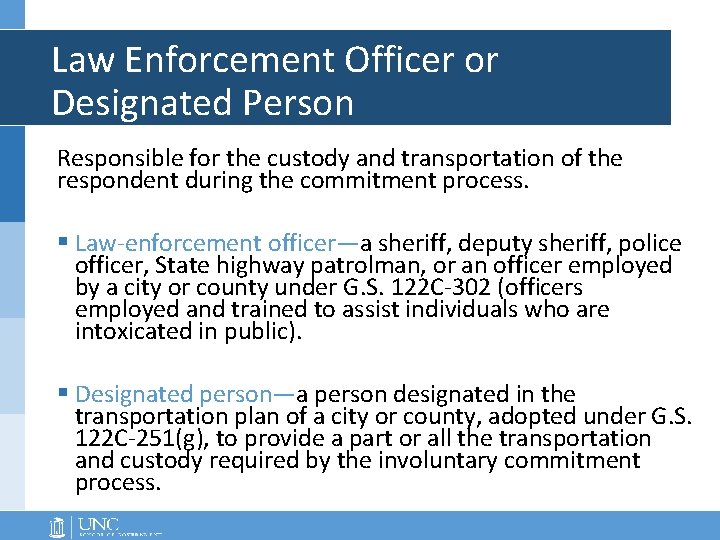
Law Enforcement Officer or Designated Person Responsible for the custody and transportation of the respondent during the commitment process. § Law-enforcement officer—a sheriff, deputy sheriff, police officer, State highway patrolman, or an officer employed by a city or county under G. S. 122 C-302 (officers employed and trained to assist individuals who are intoxicated in public). § Designated person—a person designated in the transportation plan of a city or county, adopted under G. S. 122 C-251(g), to provide a part or all the transportation and custody required by the involuntary commitment process.
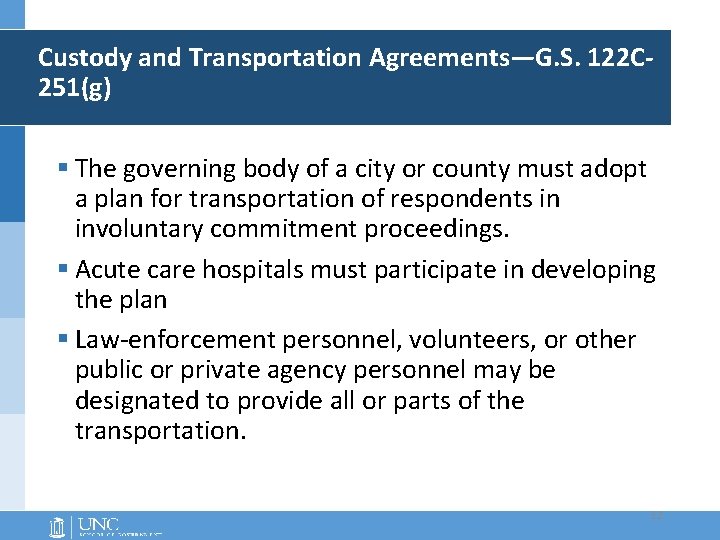
Custody and Transportation Agreements—G. S. 122 C 251(g) § The governing body of a city or county must adopt a plan for transportation of respondents in involuntary commitment proceedings. § Acute care hospitals must participate in developing the plan § Law-enforcement personnel, volunteers, or other public or private agency personnel may be designated to provide all or parts of the transportation. 12
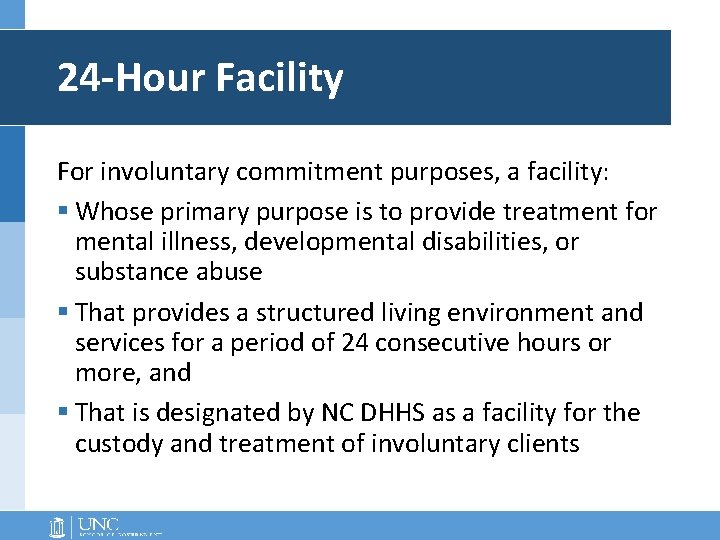
24 -Hour Facility For involuntary commitment purposes, a facility: § Whose primary purpose is to provide treatment for mental illness, developmental disabilities, or substance abuse § That provides a structured living environment and services for a period of 24 consecutive hours or more, and § That is designated by NC DHHS as a facility for the custody and treatment of involuntary clients
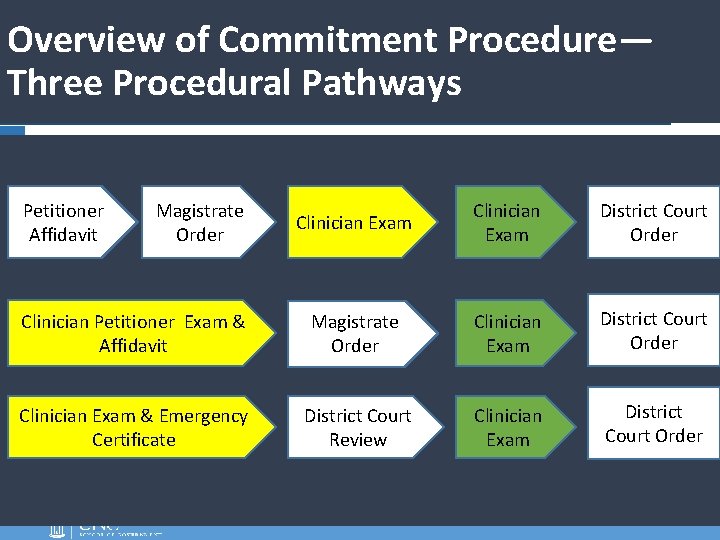
Overview of Commitment Procedure— Three Procedural Pathways Petitioner Affidavit Clinician Exam District Court Order Clinician Petitioner Exam & Affidavit Magistrate Order Clinician Exam District Court Order Clinician Exam & Emergency Certificate District Court Review Clinician Exam District Court Order Magistrate Order
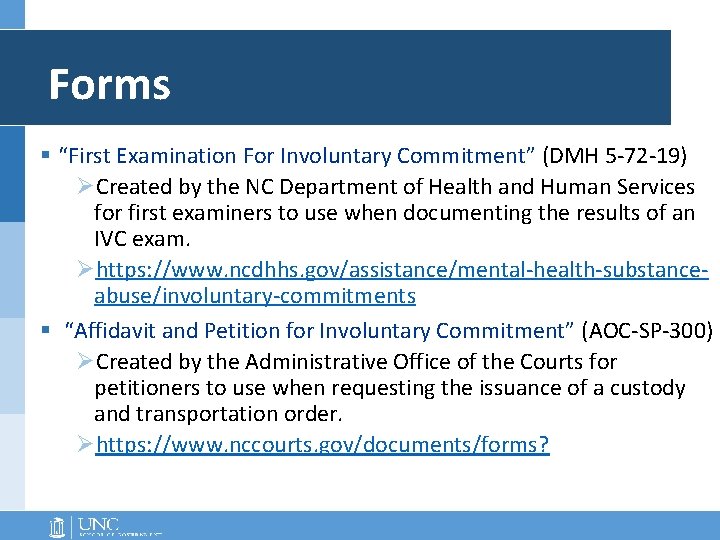
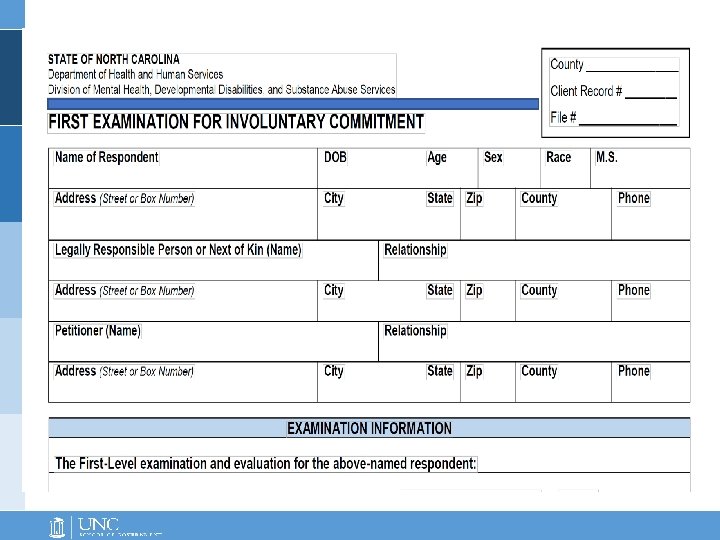
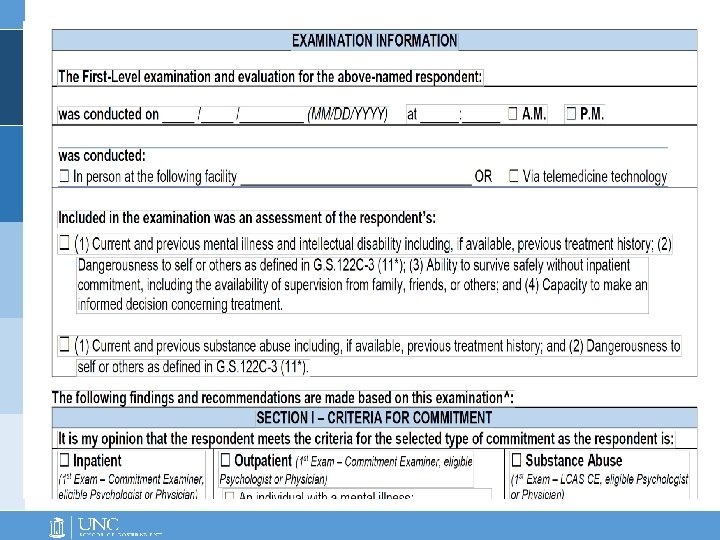
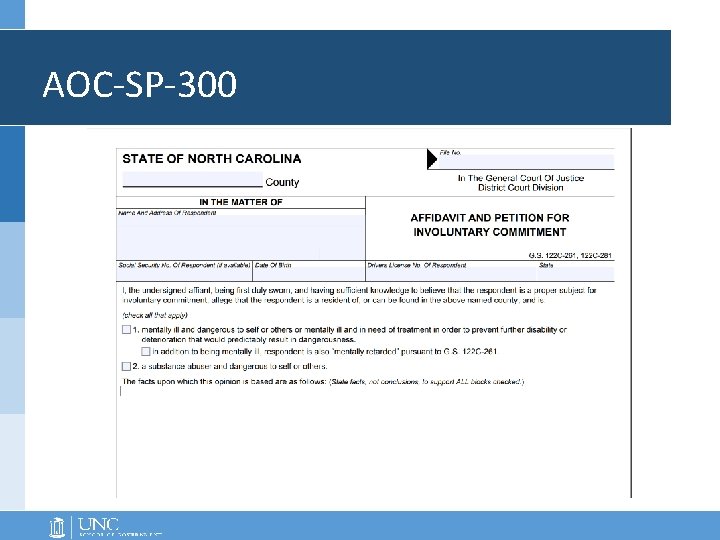
Forms § “First Examination For Involuntary Commitment” (DMH 5 -72 -19) ØCreated by the NC Department of Health and Human Services for first examiners to use when documenting the results of an IVC exam. Øhttps: //www. ncdhhs. gov/assistance/mental-health-substanceabuse/involuntary-commitments § “Affidavit and Petition for Involuntary Commitment” (AOC-SP-300) ØCreated by the Administrative Office of the Courts for petitioners to use when requesting the issuance of a custody and transportation order. Øhttps: //www. nccourts. gov/documents/forms?
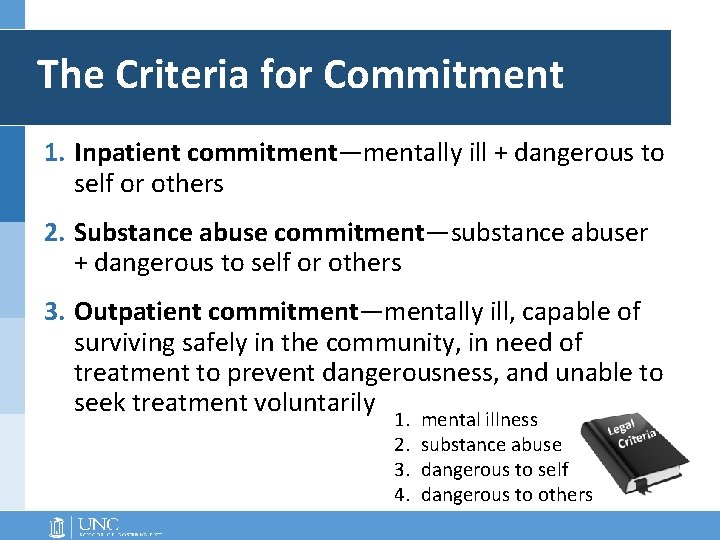
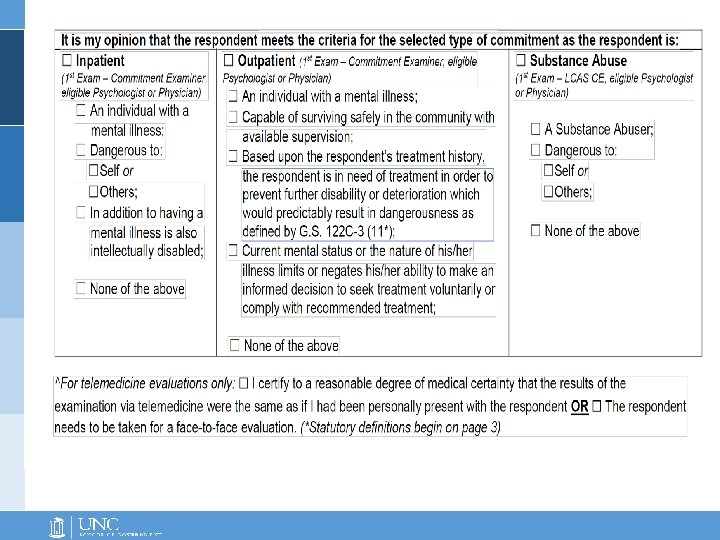
The Criteria for Commitment 1. Inpatient commitment—mentally ill + dangerous to self or others 2. Substance abuse commitment—substance abuser + dangerous to self or others 3. Outpatient commitment—mentally ill, capable of surviving safely in the community, in need of treatment to prevent dangerousness, and unable to seek treatment voluntarily 1. 2. 3. 4. mental illness substance abuse dangerous to self dangerous to others
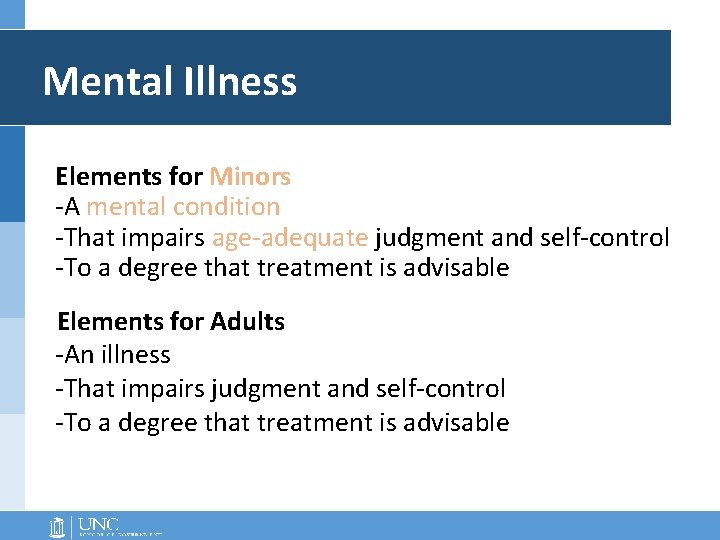
Mental Illness Elements for Minors -A mental condition -That impairs age-adequate judgment and self-control -To a degree that treatment is advisable Elements for Adults -An illness -That impairs judgment and self-control -To a degree that treatment is advisable
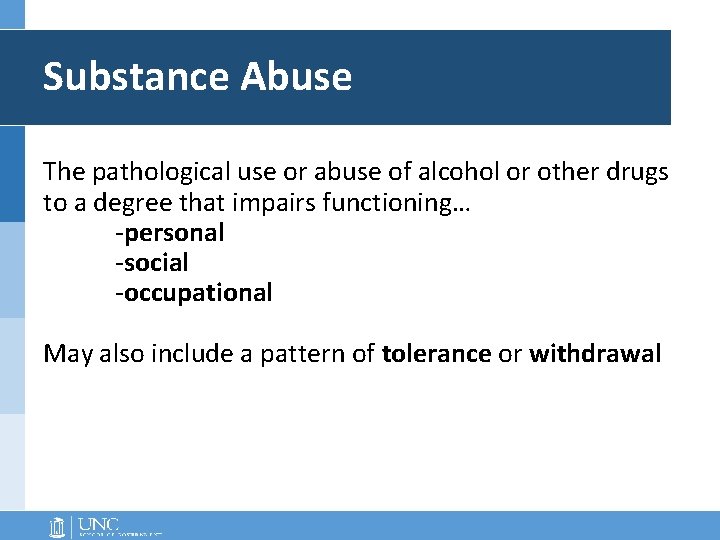
Substance Abuse The pathological use or abuse of alcohol or other drugs to a degree that impairs functioning… -personal -social -occupational May also include a pattern of tolerance or withdrawal
Dangerous to Self Within the relevant past, the individual has: § Acted in a way to show unable to care for self + reasonable probability of serious physical debilitation in the near future unless adequated treatment is given § Attempted or threatened suicide + reasonable probability of suicide unless adequate treatment is given § Attempted or engaged in self-mutilation + reasonable probability of serious self-mutilation uness adquate treatment is given
Dangerous to Self § The respondent gets up 3 to 6 times a night and has unusual eating habits (sometimes fasts, sometimes eats a whole loaf of bread or whole chicken in one sitting, eats about 5 lbs. of sugar every 2 days). § Is the respondent dangerous to self? 20
Dangerous to Self A two prong test that requires a finding of: § a lack of self-care ability regarding one’s daily affairs, and § a probability of serious physical debilitation resulting from the more general finding of lack of self-caring ability. In re Monroe, 49 N. C. App. 23 (1980).
Unable to Care for Self Dorothy stopped taking her medication for mental illness. She has begun to experience visual and audio hallucinations and has ceased eating and bathing. You believe that she is unable to exercise judgment and discretion in the conduct of her daily responsibilities related to nourishment and medicine. As you consider whethere is a reasonable probability that she will suffer serious physical debilitation in the near future, may you take into account that, two years ago, after exhibiting these same behaviors, she suffered serious dehydration and malnourishment requiring hospitalization?
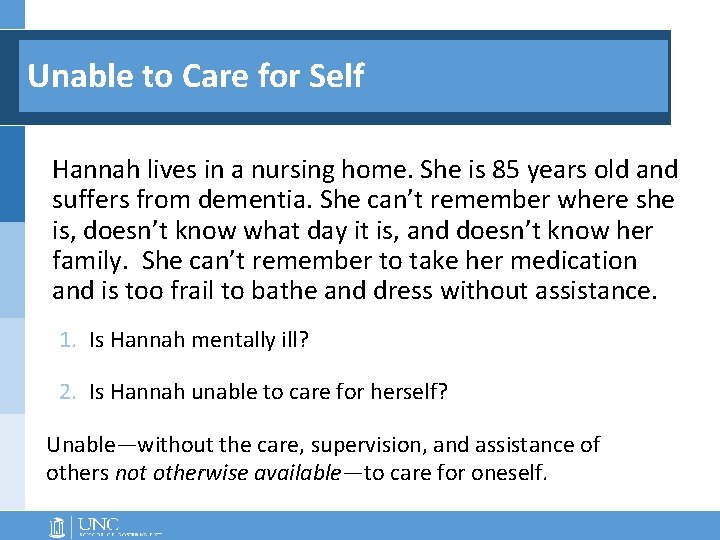
Unable to Care for Self Hannah lives in a nursing home. She is 85 years old and suffers from dementia. She can’t remember where she is, doesn’t know what day it is, and doesn’t know her family. She can’t remember to take her medication and is too frail to bathe and dress without assistance. 1. Is Hannah mentally ill? 2. Is Hannah unable to care for herself? Unable—without the care, supervision, and assistance of others not otherwise available—to care for oneself.
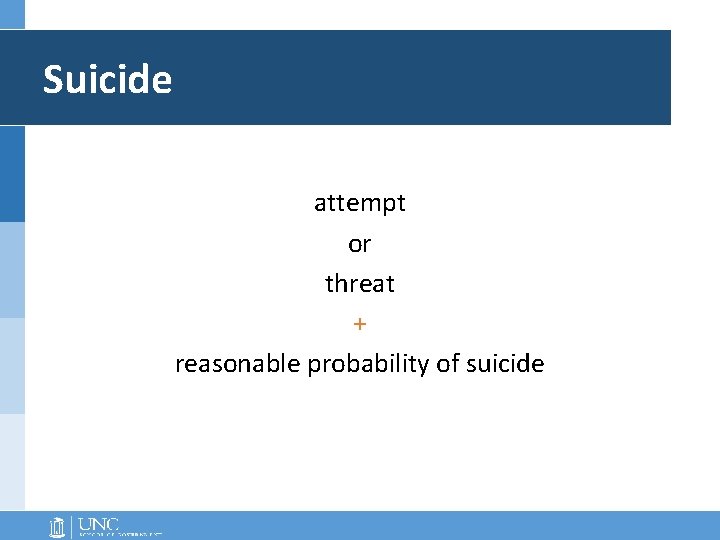
Suicide attempt or threat + reasonable probability of suicide
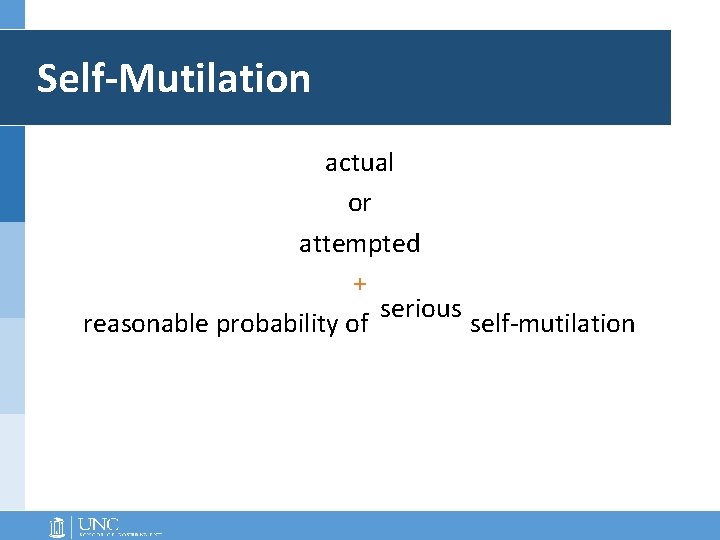
Self-Mutilation actual or attempted + serious reasonable probability of self-mutilation
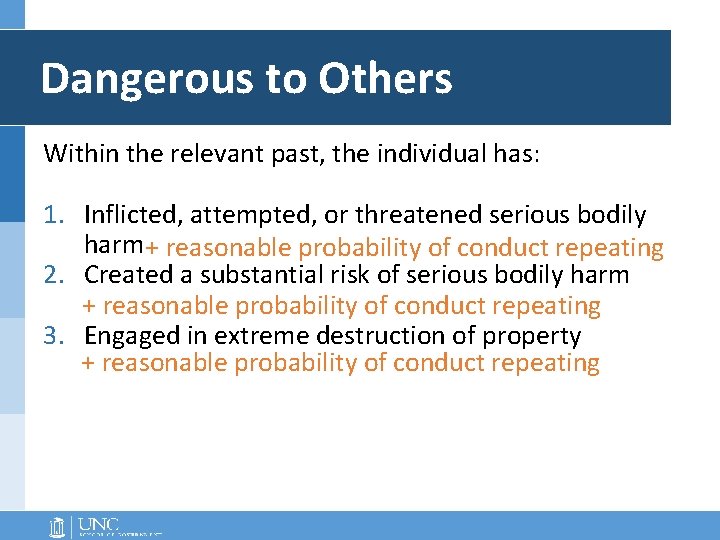
Dangerous to Others Within the relevant past, the individual has: 1. Inflicted, attempted, or threatened serious bodily harm + reasonable probability of conduct repeating 2. Created a substantial risk of serious bodily harm + reasonable probability of conduct repeating 3. Engaged in extreme destruction of property + reasonable probability of conduct repeating
Inflicted, attempted, or threatened serious bodily harm A mere threat can be sufficient. An overt act of violence is not necessary to establish that the respondent is dangerous to others. …he screamed, shouted, cursed, and threatened to bust her head if she called anybody about his behavior.
Created a substantial risk of serious bodily harm Intent to harm is not required. A person with a rifle who sits on one side of a four lane divided highway shooting at delusions of monsters… …creates a substantial risk of bodily harm to motorists… If the respondent has a habit of digging holes in a field… …risk of serious bodily harm depends on the depth of the holes and the amount of pedestrian traffic in the field.
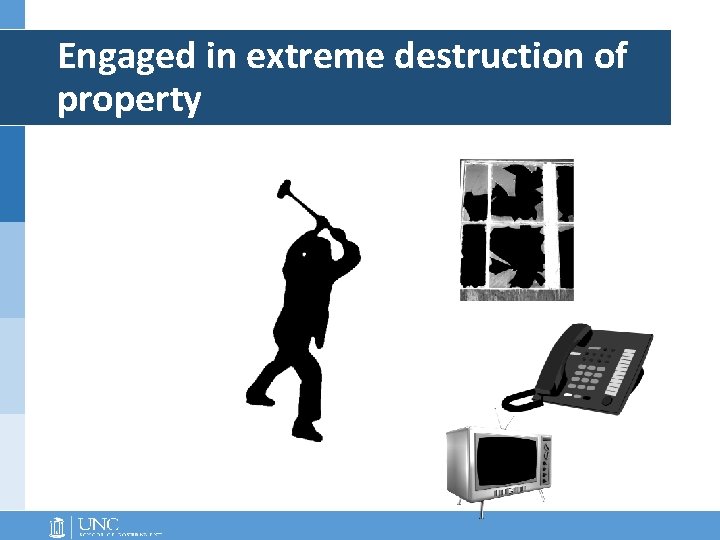
Engaged in extreme destruction of property
Sample Case § Patient diagnosed with schizophrenia. § Guardian recently appointed because of patient’s “health issues and failure to attend to basic needs. ” Patient not taking his medication for schizophrenia and a serious heart condition. Not eating very much. § Patient denies having a mental illness and refuses to meet with guardian. Tells guardian, “you better back off, Jack. ” “Don’t you come around me. ” § Guardian says patient is “menacing” and “hostile. ”
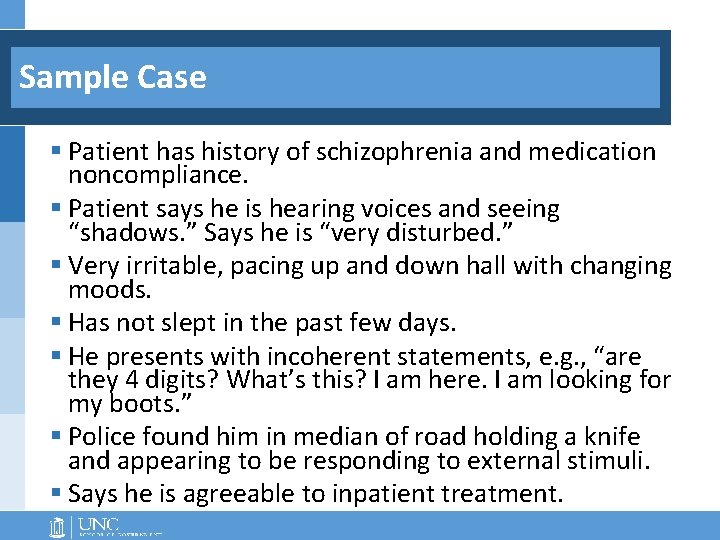
Sample Case § Patient has history of schizophrenia and medication noncompliance. § Patient says he is hearing voices and seeing “shadows. ” Says he is “very disturbed. ” § Very irritable, pacing up and down hall with changing moods. § Has not slept in the past few days. § He presents with incoherent statements, e. g. , “are they 4 digits? What’s this? I am here. I am looking for my boots. ” § Police found him in median of road holding a knife and appearing to be responding to external stimuli. § Says he is agreeable to inpatient treatment.
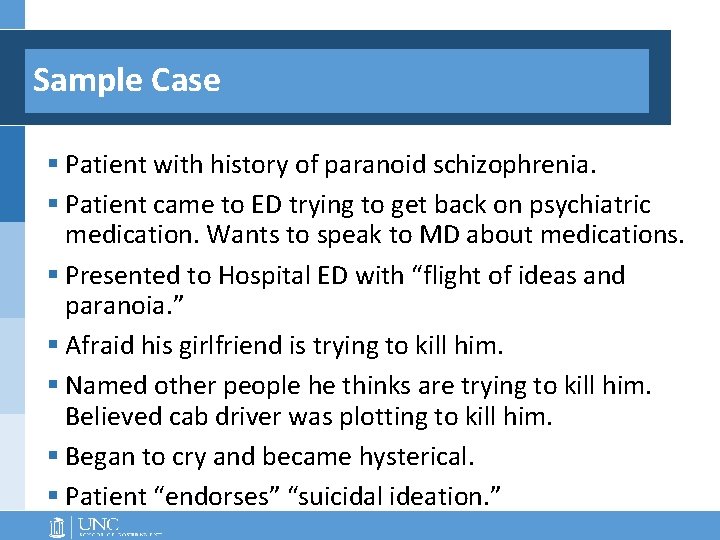
Sample Case § Patient with history of paranoid schizophrenia. § Patient came to ED trying to get back on psychiatric medication. Wants to speak to MD about medications. § Presented to Hospital ED with “flight of ideas and paranoia. ” § Afraid his girlfriend is trying to kill him. § Named other people he thinks are trying to kill him. Believed cab driver was plotting to kill him. § Began to cry and became hysterical. § Patient “endorses” “suicidal ideation. ”
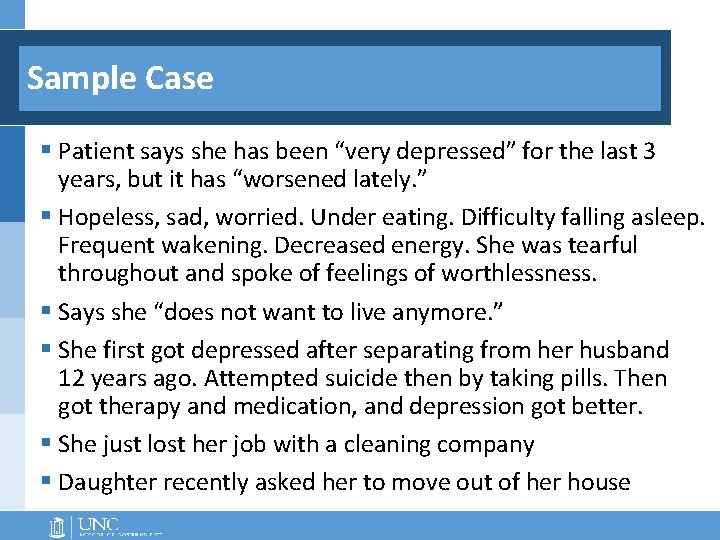
Sample Case § Patient says she has been “very depressed” for the last 3 years, but it has “worsened lately. ” § Hopeless, sad, worried. Under eating. Difficulty falling asleep. Frequent wakening. Decreased energy. She was tearful throughout and spoke of feelings of worthlessness. § Says she “does not want to live anymore. ” § She first got depressed after separating from her husband 12 years ago. Attempted suicide then by taking pills. Then got therapy and medication, and depression got better. § She just lost her job with a cleaning company § Daughter recently asked her to move out of her house
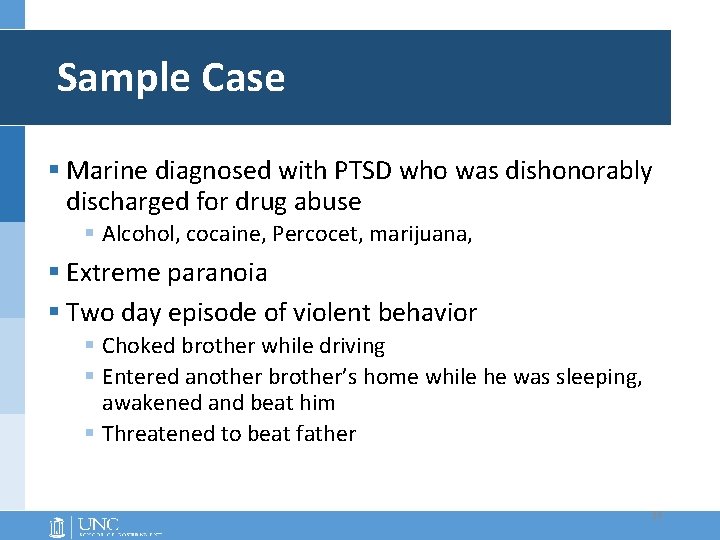
Sample Case § Marine diagnosed with PTSD who was dishonorably discharged for drug abuse § Alcohol, cocaine, Percocet, marijuana, § Extreme paranoia § Two day episode of violent behavior § Choked brother while driving § Entered another brother’s home while he was sleeping, awakened and beat him § Threatened to beat father 34
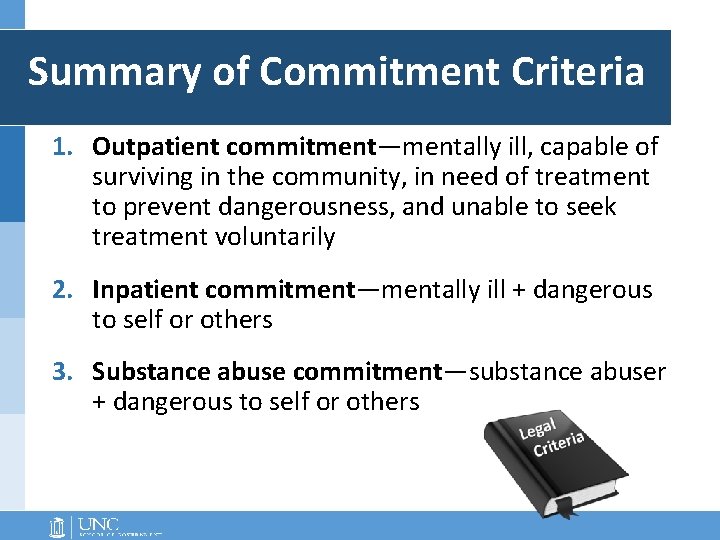
Summary of Commitment Criteria 1. Outpatient commitment—mentally ill, capable of surviving in the community, in need of treatment to prevent dangerousness, and unable to seek treatment voluntarily 2. Inpatient commitment—mentally ill + dangerous to self or others 3. Substance abuse commitment—substance abuser + dangerous to self or others
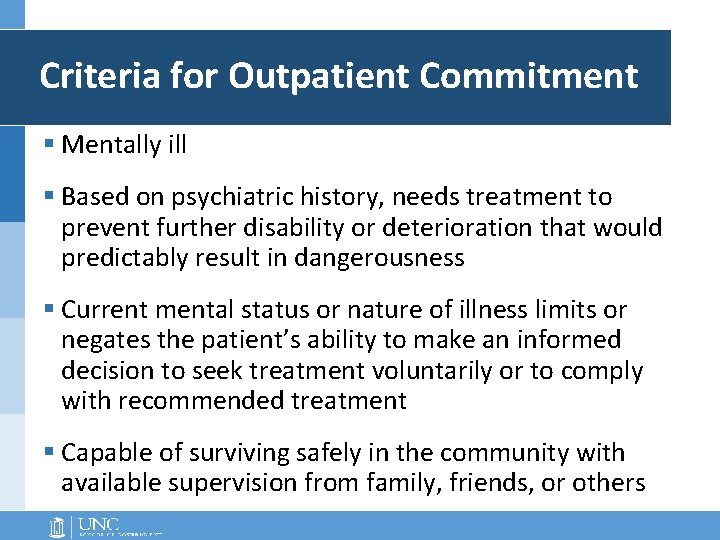
Criteria for Outpatient Commitment § Mentally ill § Based on psychiatric history, needs treatment to prevent further disability or deterioration that would predictably result in dangerousness § Current mental status or nature of illness limits or negates the patient’s ability to make an informed decision to seek treatment voluntarily or to comply with recommended treatment § Capable of surviving safely in the community with available supervision from family, friends, or others
Submitting a Legally Sufficient Petition • Magistrate role • Petitioner role
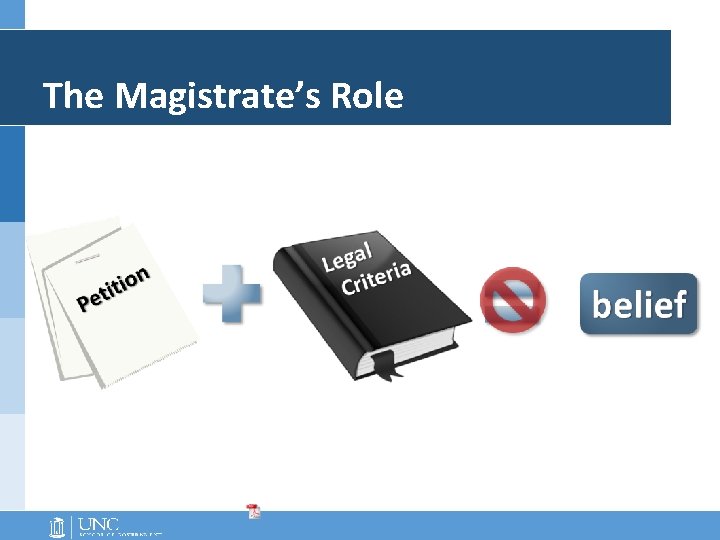
The Magistrate’s Role
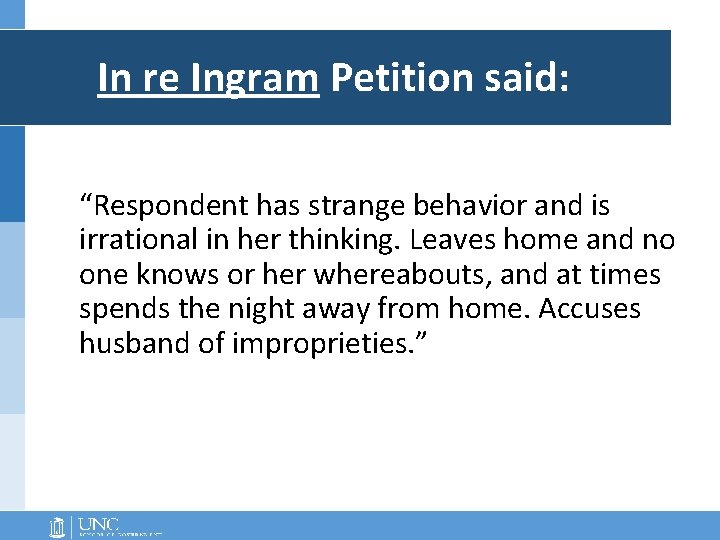
In re Ingram Petition said: “Respondent has strange behavior and is irrational in her thinking. Leaves home and no one knows or her whereabouts, and at times spends the night away from home. Accuses husband of improprieties. ”
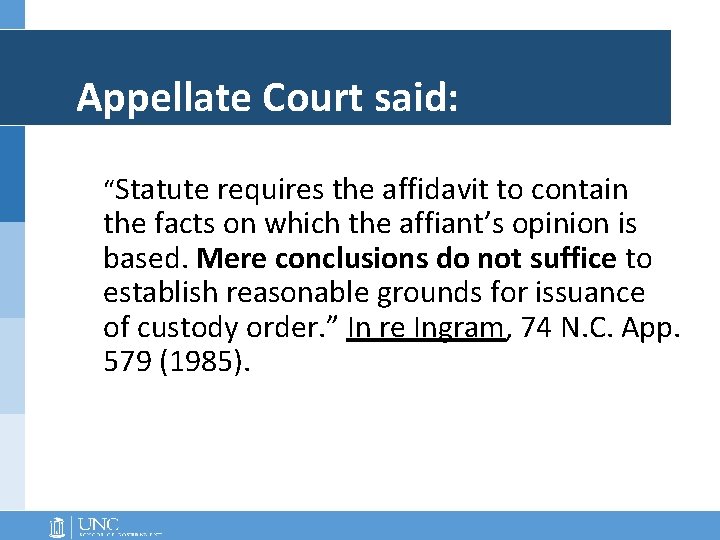
Appellate Court said: “Statute requires the affidavit to contain the facts on which the affiant’s opinion is based. Mere conclusions do not suffice to establish reasonable grounds for issuance of custody order. ” In re Ingram, 74 N. C. App. 579 (1985).
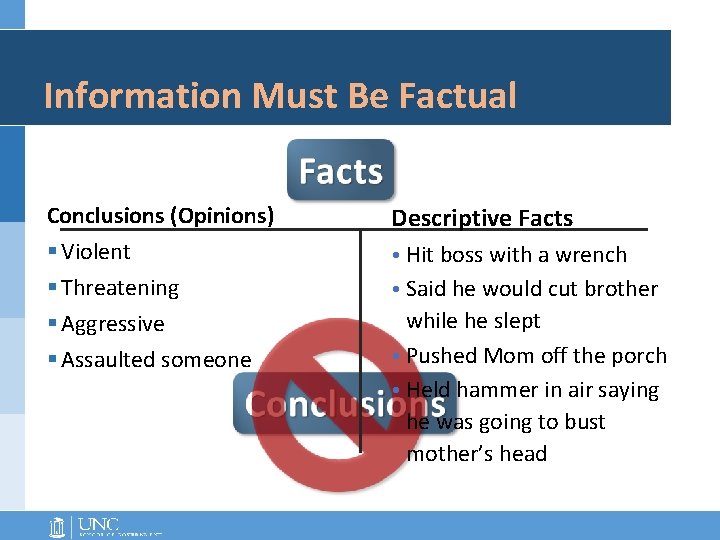
Information Must Be Factual Conclusions (Opinions) § Violent § Threatening § Aggressive § Assaulted someone Descriptive Facts • Hit boss with a wrench • Said he would cut brother while he slept • Pushed Mom off the porch • Held hammer in air saying he was going to bust mother’s head
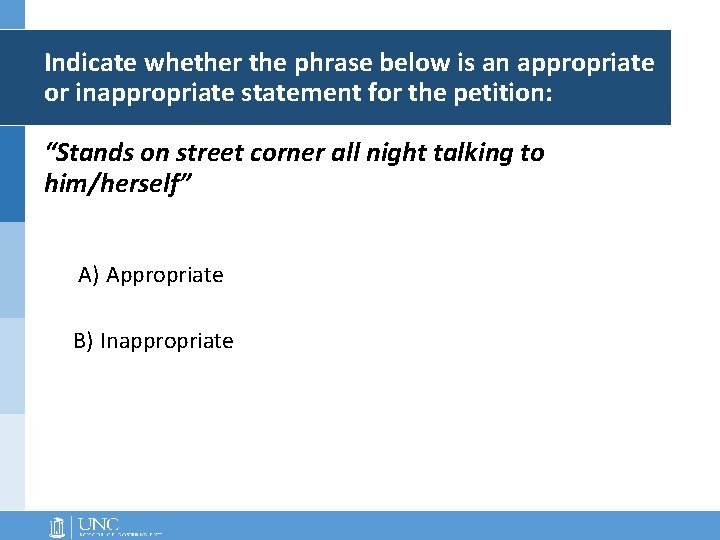
Indicate whether the phrase below is an appropriate or inappropriate statement for the petition: “Stands on street corner all night talking to him/herself” A) Appropriate B) Inappropriate
Indicate whether the phrase below is an appropriate or inappropriate statement for the petition: “Says she is going to fly to the moon with the President” A) Appropriate B) Inappropriate
Indicate whether the phrase below is an appropriate or inappropriate statement for the petition: “Exhibits bizarre behavior” A) Appropriate B) Inappropriate
Indicate whether the phrase below is an appropriate or inappropriate statement for the petition: “Irrational thinking” A) Appropriate B) Inappropriate
Indicate whether the phrase below is an appropriate or inappropriate statement for the petition: “Doesn't know what day or month it is” A) Appropriate B) Inappropriate
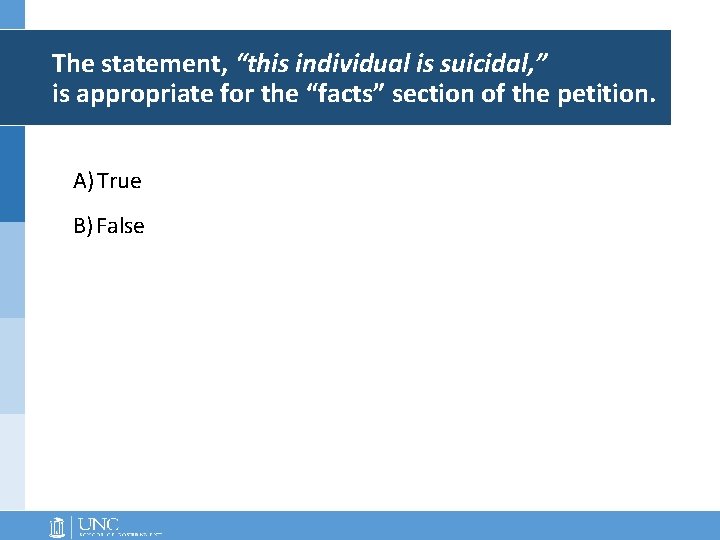
The statement, “this individual is suicidal, ” is appropriate for the “facts” section of the petition. A) True B) False
The Emergency Procedure
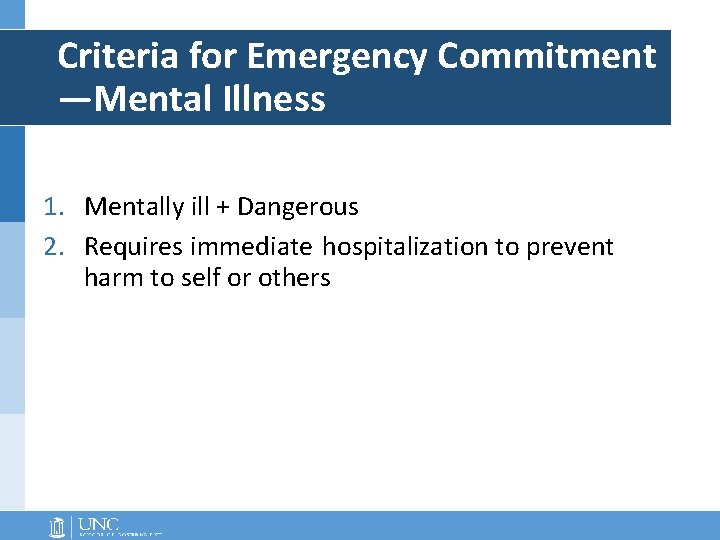
Criteria for Emergency Commitment —Mental Illness 1. Mentally ill + Dangerous 2. Requires immediate hospitalization to prevent harm to self or others
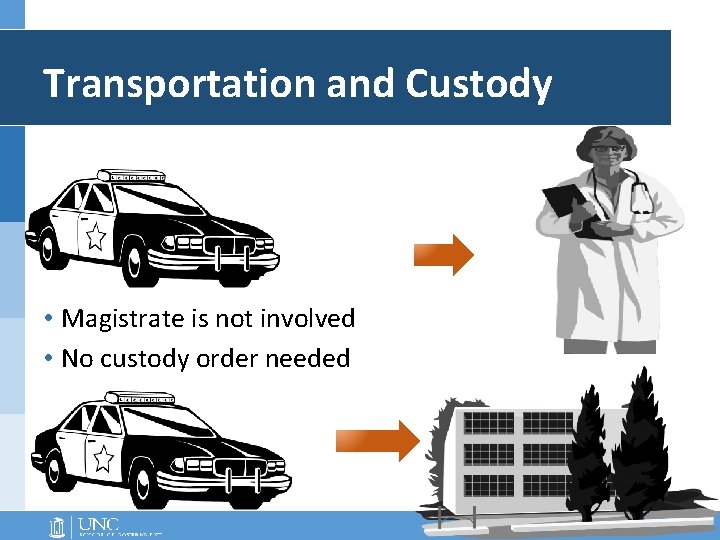
Transportation and Custody • Magistrate is not involved • No custody order needed
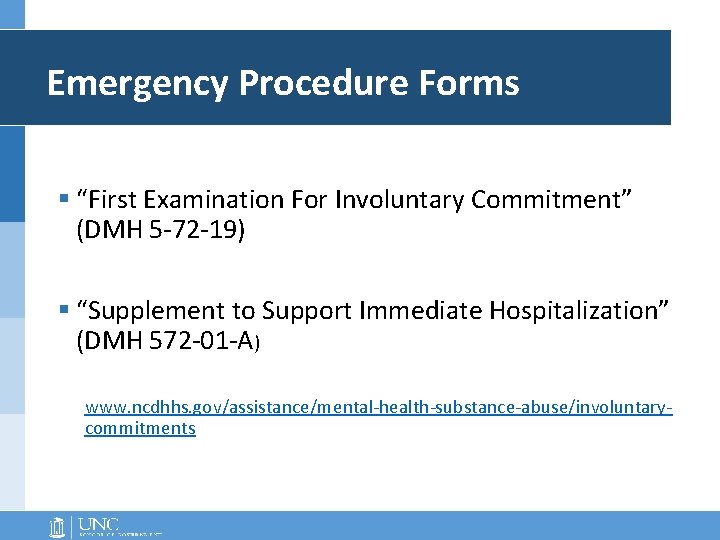
Emergency Procedure Forms § “First Examination For Involuntary Commitment” (DMH 5 -72 -19) § “Supplement to Support Immediate Hospitalization” (DMH 572 -01 -A) www. ncdhhs. gov/assistance/mental-health-substance-abuse/involuntarycommitments
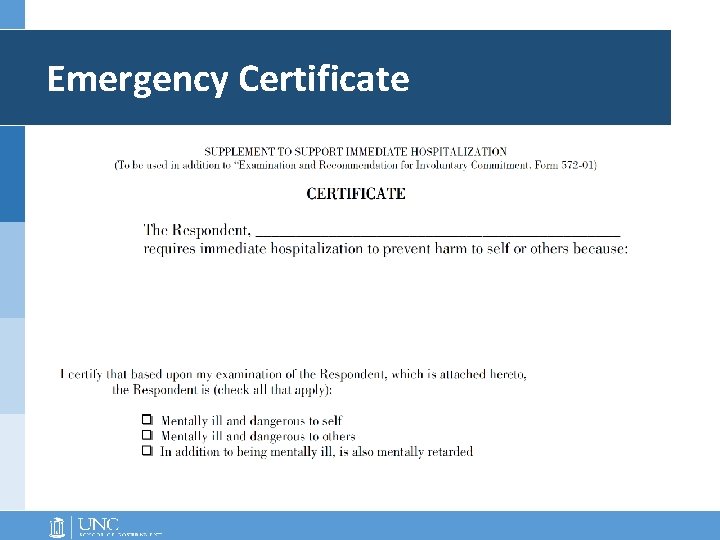
Emergency Certificate
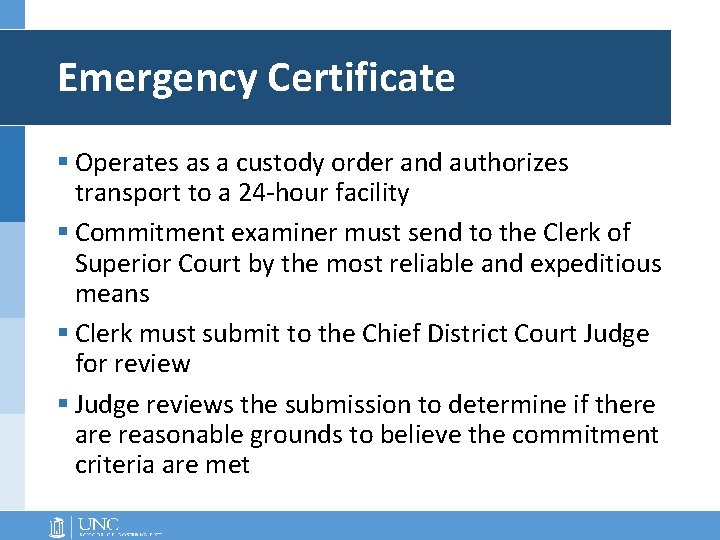
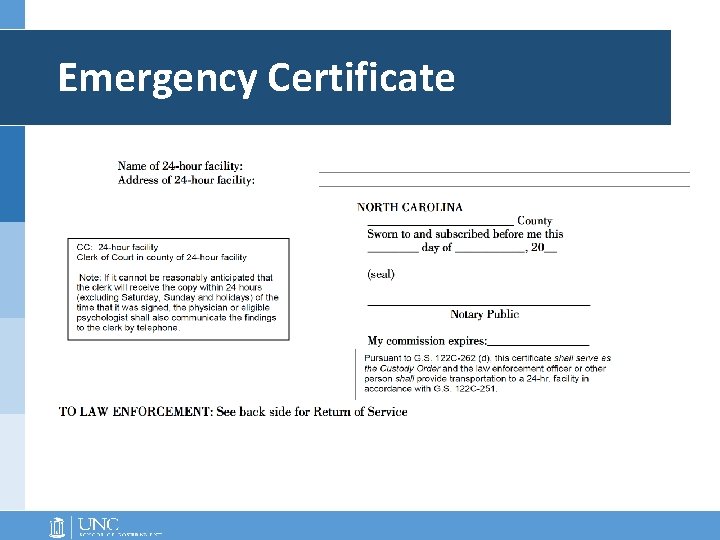
Emergency Certificate § Operates as a custody order and authorizes transport to a 24 -hour facility § Commitment examiner must send to the Clerk of Superior Court by the most reliable and expeditious means § Clerk must submit to the Chief District Court Judge for review § Judge reviews the submission to determine if there are reasonable grounds to believe the commitment criteria are met
Emergency Certificate
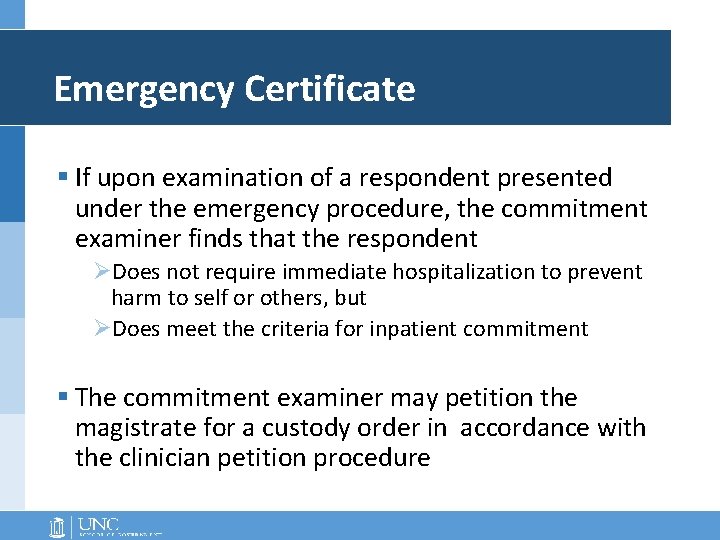
Emergency Certificate § If upon examination of a respondent presented under the emergency procedure, the commitment examiner finds that the respondent ØDoes not require immediate hospitalization to prevent harm to self or others, but ØDoes meet the criteria for inpatient commitment § The commitment examiner may petition the magistrate for a custody order in accordance with the clinician petition procedure
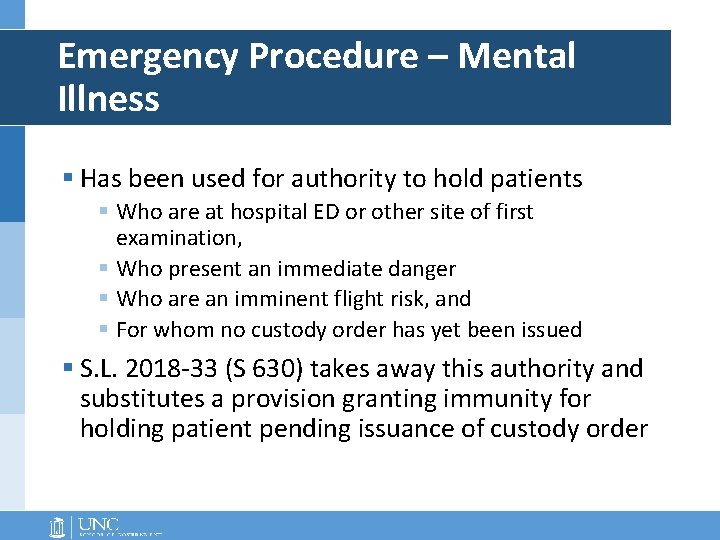
Emergency Procedure – Mental Illness § Has been used for authority to hold patients § Who are at hospital ED or other site of first examination, § Who present an immediate danger § Who are an imminent flight risk, and § For whom no custody order has yet been issued § S. L. 2018 -33 (S 630) takes away this authority and substitutes a provision granting immunity for holding patient pending issuance of custody order
Voluntary Admission Alternative for “Incapable Adults” S. L. 2018, Senate Bill 630 Effective October 1, 2019
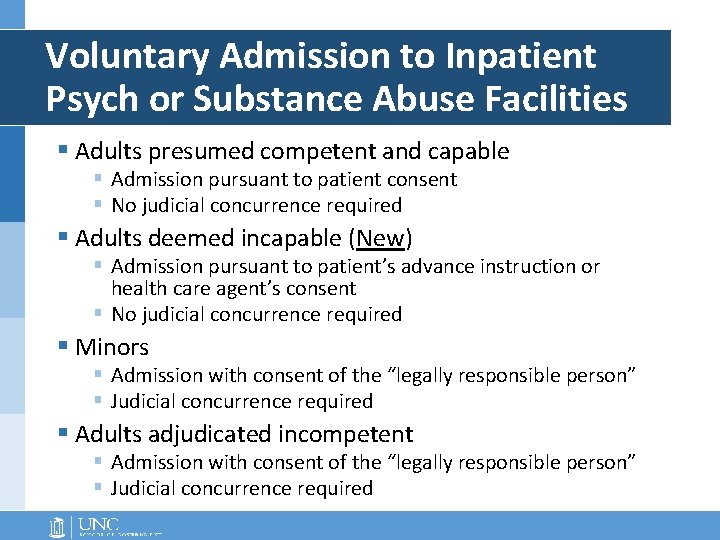
Voluntary Admission to Inpatient Psych or Substance Abuse Facilities § Adults presumed competent and capable § Admission pursuant to patient consent § No judicial concurrence required § Adults deemed incapable (New) § Admission pursuant to patient’s advance instruction or health care agent’s consent § No judicial concurrence required § Minors § Admission with consent of the “legally responsible person” § Judicial concurrence required § Adults adjudicated incompetent § Admission with consent of the “legally responsible person” § Judicial concurrence required
Pychiatric Advance Directive (PAD) Allows an individual who anticipates future mental health treatment needs to put in writing helpful information and instructions for treatment providers in the event that the individual, due to an acute phase of psychiatric illness, loses the capacity to make and communicate mental health treatment decisions (becomes “incapable”). § Permits the individual (the principal) to give advanced consent to future treatment, including consent to inpatient admission § NC statutory term for PAD is “advance instruction for mental health treatment” See G. S. 122 C-71, et seq
Health Care Power of Attorney A Health Care Power of Attorney (HCPA) may be used to name a surrogate decision maker (“health care agent”), someone the principal trusts, to make treatment decisions on behalf of the principal if the principal, at some point in the future, loses the capacity to consent to treatment. § May address physical and mental health treatment § Health care agent’s authority to make decisions on behalf of the principal is broad unless the principal writes limitations on authority in the HCPA § Includes authority to consent to psychiatric inpatient admission See G. S. 32 A-15, et seq
“Incapable” In the opinion of a physician or eligible psychologist, the person currently lacks sufficient understanding or capacity to make and communicate. . . § mental health treatment decisions (G. S. 122 C-72) § decisions relating to health care (G. S. 32 A-20) § “eligible psychologist”—a licensed psychologist who holds permanent licensure and certification as a health services provider psychologist issued by the NC Psychology Board. G. S. 122 C-3(13 d).
PADs and HCPAs § Providers who are presented with a PAD or HCPA must make it part of the principal’s medical record § Providers must act in accordance with the PAD’s or health care agent’s instructions if the principal is determined “incapable” § Once the principal regains decisional capcity—is no longer “incapable”—principle regains authority to make treatment decisions
Exceptions to Duty to Comply § Compliance is not consistent with: § § Generally accepted community practice standards The availability of treatment Applicable law Appropriate treatment in an emergency endangering life or health § The principal is involuntarily committed to a 24 -hour facility, treatment may be given in an emergency or when two physicians agree that, without benefit of the treatment, § the client will be incapable of particpating in any available treatment that will give a realistic opportunity of improvement, or § There is a significant possibility that the client will harm self or others before improvement of the client’s condition.
PADs and HCPAs—S 630, Secs. 14, 17 § The limit on the duration of admission to inpatient facility by PAD increases from 10 to 15 days § Clarifies that “incapable” is not the same as “incompetent. ” § Part 4 governing guardian admissions of incompetent adults does not apply to PAD and HCPA admissions.
The Layperson Petition Procedure
The Petitioner § Anyone with knowledge may petition § Petitioner must appear personally § Jurisdiction is in the county where respondent resides or is found
Magistrate Role If the magistrate finds that the commitment criteria are met for either § outpatient commitment, § inpatient commitment, or § substance abuse commitment the magistrate shall issue a custody and transportation order
Custody-GS 122 C-261 The magistrate shall issue the order to Øa law enforcement officer or Øany other person authorized under G. S. 122 C‑ 251 to take the respondent into custody for examination by a physician or psychologist v S. L. 2018 -33, sec. 8, requires LME/MCOs to create a “community crisis plan, ” developed with the participation of acute care hospitals and law enforcement agencies, that identifies where the respondent shall be taken for the first exam. Intended to divert some respondents from hospital ED to a mental health providers.
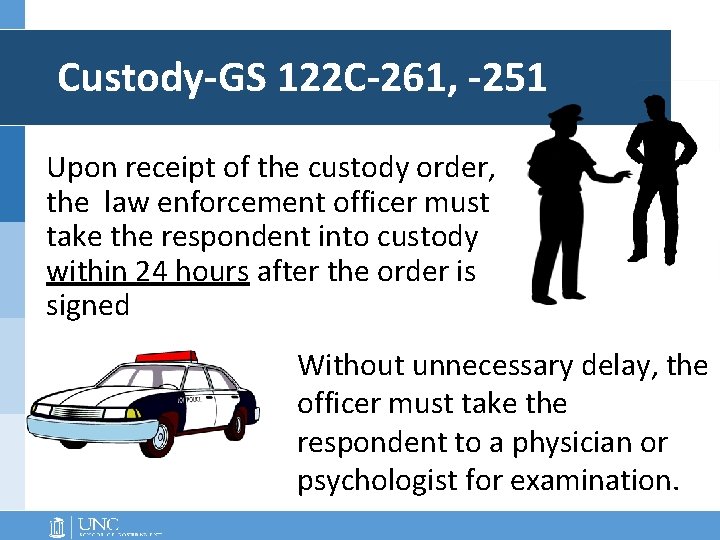
Custody-GS 122 C-261, -251 Upon receipt of the custody order, the law enforcement officer must take the respondent into custody within 24 hours after the order is signed Without unnecessary delay, the officer must take the respondent to a physician or psychologist for examination.
Hospital ED Role Commitment Examination—As soon as possible and w/n 24 hours after respondent is presented § Outpatient commitment § Inpatient commitment § Substance abuse commitment
Statutory Examination Mental Illness 1. Current and previous mental illness and mental retardation, including previous treatment history if available 2. Dangerousness to self or others 3. Ability to survive safely w/o inpatient commitment, and the availability of supervision from family, friends, or others. 4. Capacity to make an informed decision to seek or comply with treatment voluntarily.
Statutory Examination Substance Abuse 1. Current and previous substance abuse including, if available, previous treatment history. 2. Dangerousness to self or others.
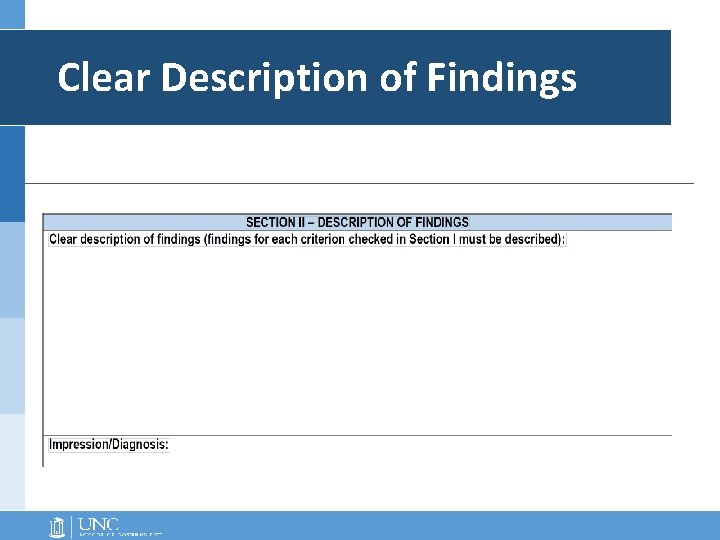
Clear Description of Findings
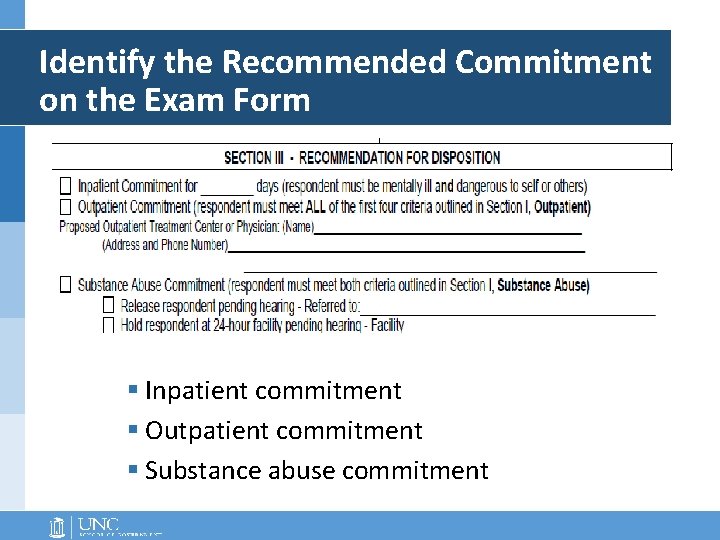
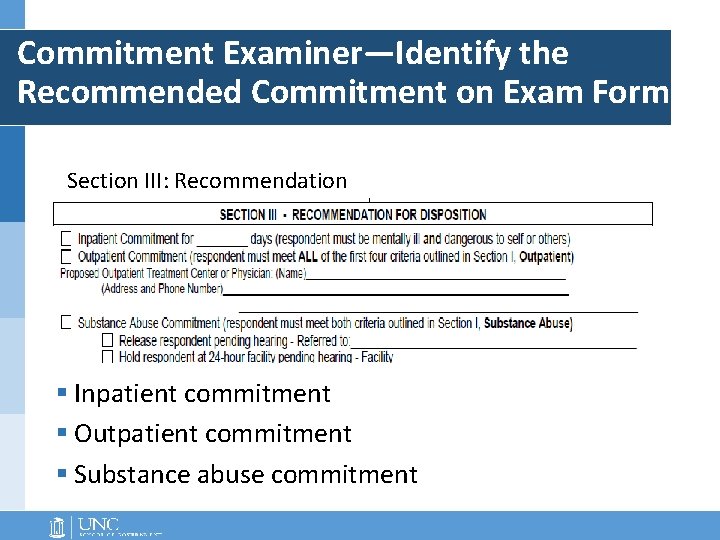
Identify the Recommended Commitment on the Exam Form § Inpatient commitment § Outpatient commitment § Substance abuse commitment
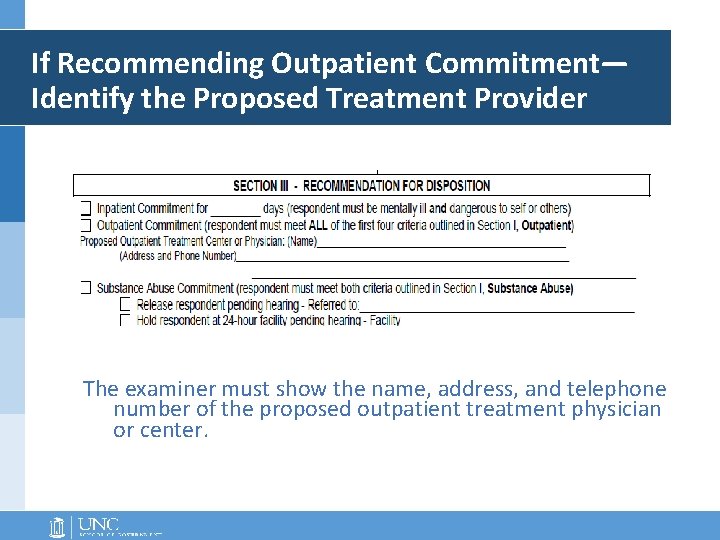
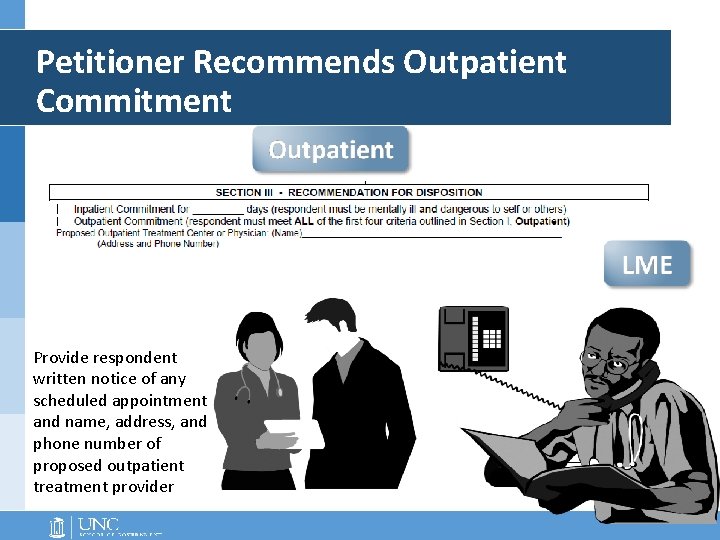
If Recommending Outpatient Commitment— Identify the Proposed Treatment Provider The examiner must show the name, address, and telephone number of the proposed outpatient treatment physician or center.
Outpatient Commitment Recommended— Commitment Examiner Role The examiner must § Give the respondent a written notice listing the name, address, and telephone number of the proposed outpatient treatment provider, and § Contact the LME/MCO—that: Ø serves the county where respondent resides, or Ø coordinated services for the respondent To inform the LME/MCO that the respondent is being recommended for outpatient commitment
Hospital ED Role—Reporting to Clerk 1. The findings and the facts on which they are based must be in writing and sent to the clerk of superior court by the most reliable and expeditious means. 2. If it cannot be anticipated that the clerk will receive a copy within 48 hours of the time it was signed, the examiner must also communicate the findings to the clerk by phone
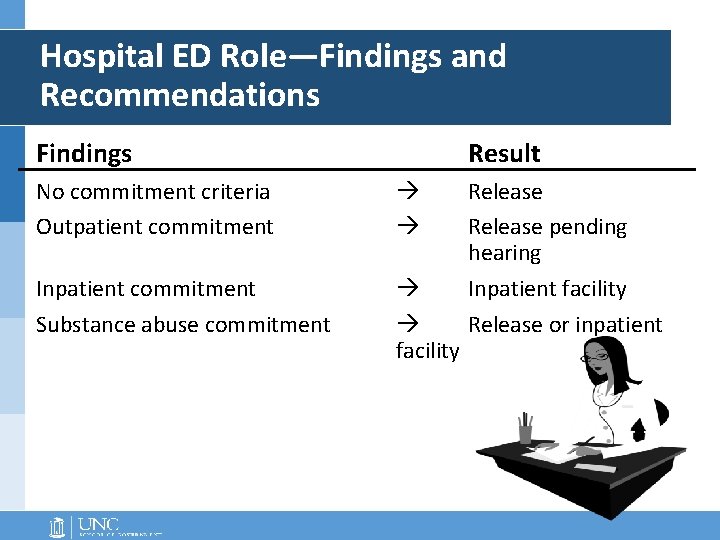
Hospital ED Role—Findings and Recommendations Findings Result No commitment criteria Outpatient commitment Inpatient commitment Substance abuse commitment facility Release pending hearing Inpatient facility Release or inpatient
Inpatient Commitment Recommended § If the examiner recommends inpatient commitment the law enforcement officer or other designated person shall take the respondent to a 24 -hr facility § If a 24 -hour facility is not ØImmediately available or ØMedically appropriate The respondent may be temporarily detained under appropriate supervision
Substance Abuse Commitment Recommended If the commitment examiner recommends substance abuse commitment, and § the examiner recommends release, the respondent must be released. § the examiner recommends holding the respondent pending hearing, the law enforcement officer or other designated person shall take the respondent to a 24 -hr facility designated by DHHS.
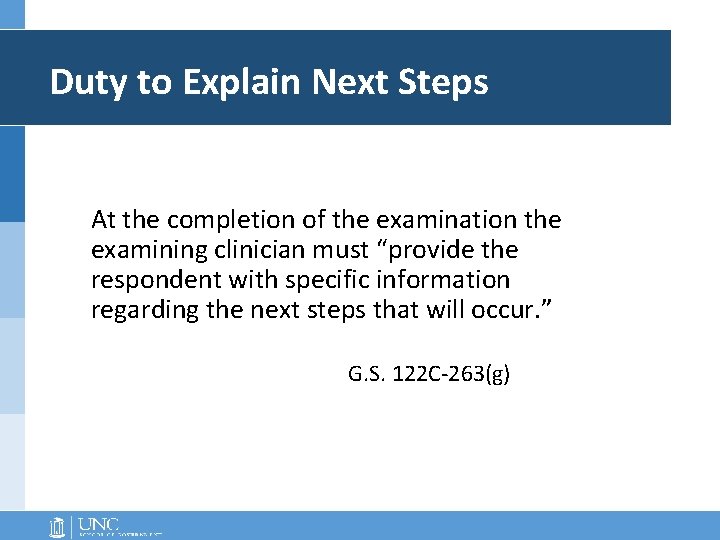
Duty to Explain Next Steps At the completion of the examination the examining clinician must “provide the respondent with specific information regarding the next steps that will occur. ” G. S. 122 C-263(g)
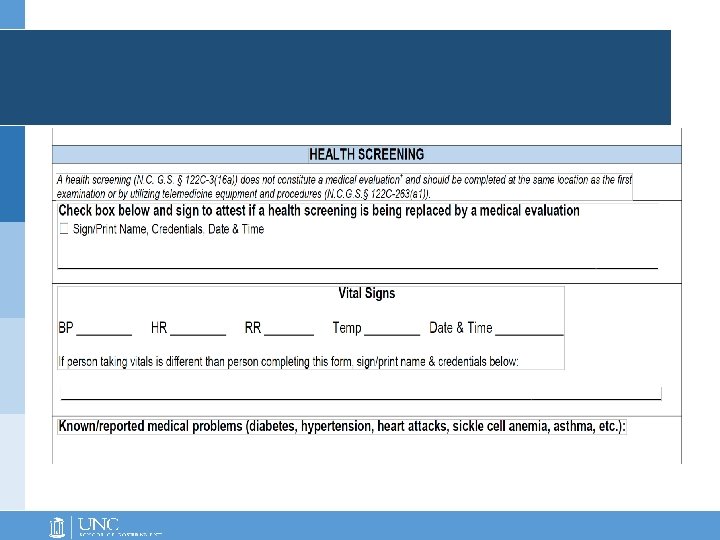
New Health Screening Requirement § Who—May be conducted by the commitment examiner or other individual determined by the facility to be qualified to perform the health screening. § What—A screening suitable for the symptoms presented to determine whether or not an emergency medical condition exists such that the absence of immediate medical attention can reasonably be expected to result in § placing individual’s health in serous jeopardy, § serious impairment to bodily functions, or § serious dysfunction of any bodily organ or part. § Screening tool is incorporated into first exam form
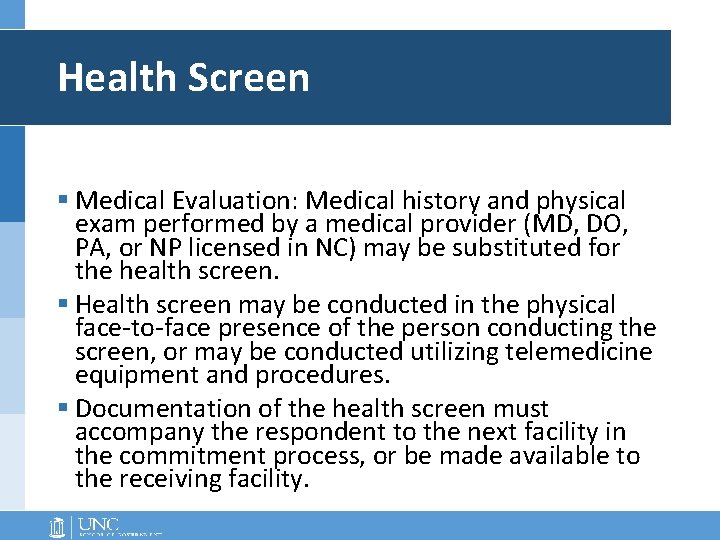
Health Screen § Medical Evaluation: Medical history and physical exam performed by a medical provider (MD, DO, PA, or NP licensed in NC) may be substituted for the health screen. § Health screen may be conducted in the physical face-to-face presence of the person conducting the screen, or may be conducted utilizing telemedicine equipment and procedures. § Documentation of the health screen must accompany the respondent to the next facility in the commitment process, or be made available to the receiving facility.
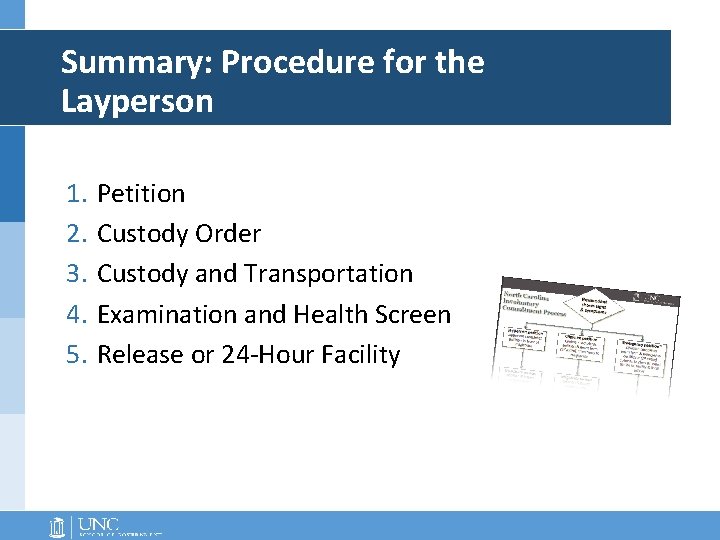
Summary: Procedure for the Layperson 1. 2. 3. 4. 5. Petition Custody Order Custody and Transportation Examination and Health Screen Release or 24 -Hour Facility
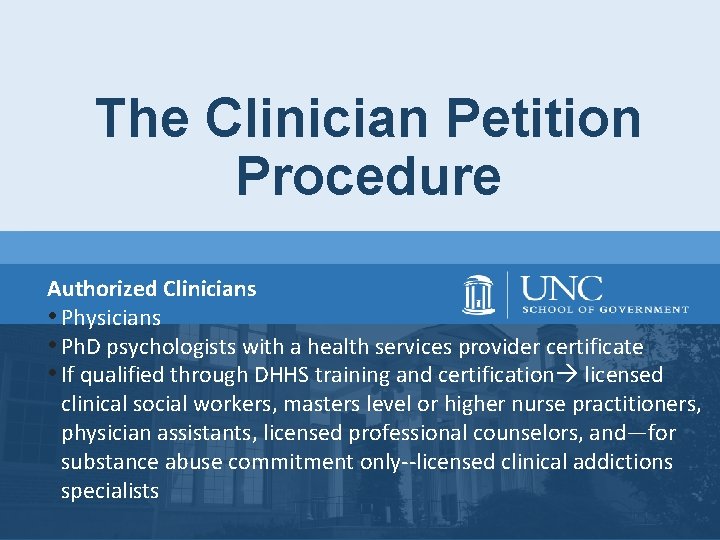
The Clinician Petition Procedure Authorized Clinicians • Physicians • Ph. D psychologists with a health services provider certificate • If qualified through DHHS training and certification licensed clinical social workers, masters level or higher nurse practitioners, physician assistants, licensed professional counselors, and—for substance abuse commitment only--licensed clinical addictions specialists
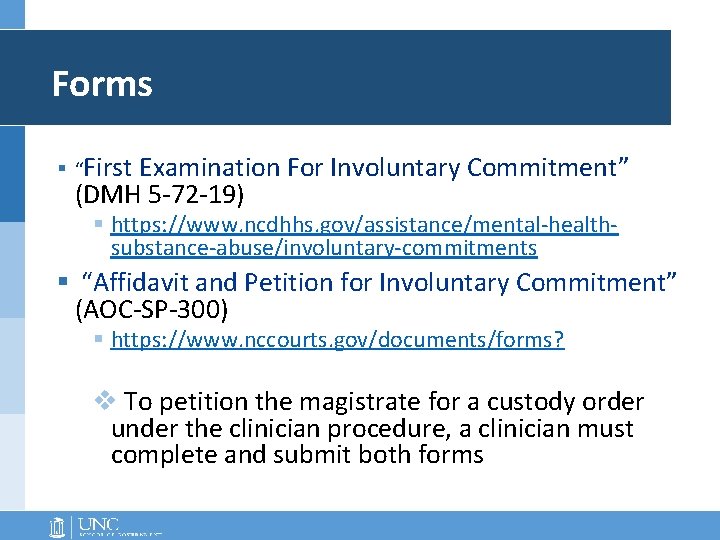
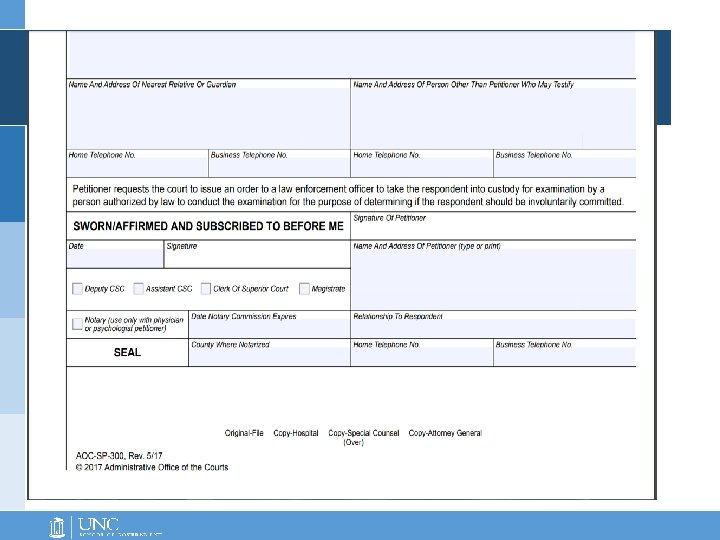
Forms § “First Examination For Involuntary Commitment” (DMH 5 -72 -19) § https: //www. ncdhhs. gov/assistance/mental-healthsubstance-abuse/involuntary-commitments § “Affidavit and Petition for Involuntary Commitment” (AOC-SP-300) § https: //www. nccourts. gov/documents/forms? v To petition the magistrate for a custody order under the clinician procedure, a clinician must complete and submit both forms
AOC-SP-300
Petitioner May Avoid Personal Appearance Before Magistrate If the petitioning commitment examiner: ØExamines the respondent (physical face to face presence or via telemedicine equipment and procedures), and ØSigns the “Affidavit and Petition” before an official authorized to administer oaths (notary), § Then petitioner may file the examination and affidavit forms by delivering copies through facsimile transmission § Must mail originals within 5 days to the clerk of superior court
Commitment Examiner—Identify the Recommended Commitment on Exam Form Section III: Recommendation § Inpatient commitment § Outpatient commitment § Substance abuse commitment
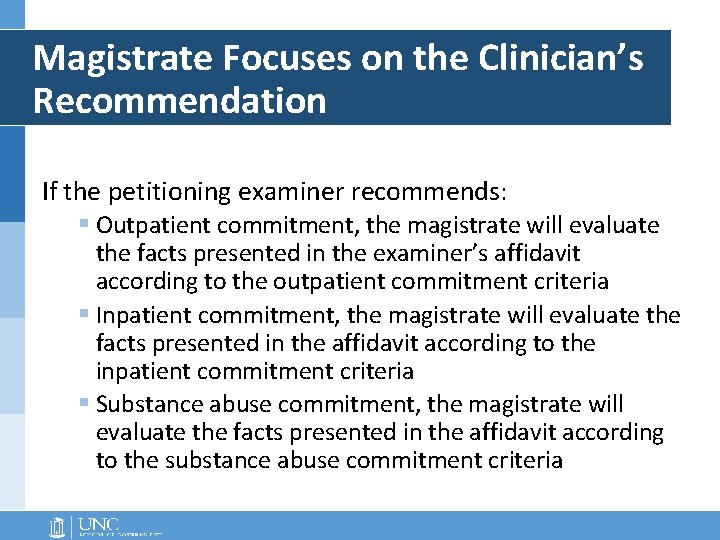
Magistrate Focuses on the Clinician’s Recommendation If the petitioning examiner recommends: § Outpatient commitment, the magistrate will evaluate the facts presented in the examiner’s affidavit according to the outpatient commitment criteria § Inpatient commitment, the magistrate will evaluate the facts presented in the affidavit according to the inpatient commitment criteria § Substance abuse commitment, the magistrate will evaluate the facts presented in the affidavit according to the substance abuse commitment criteria
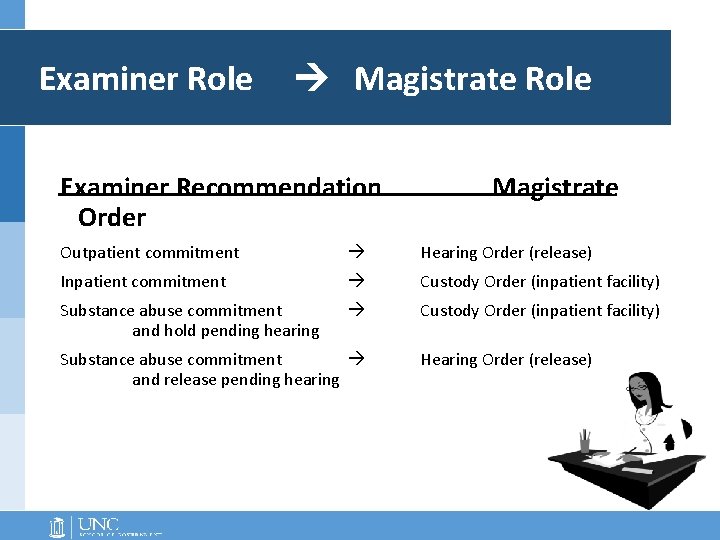
Examiner Role Magistrate Role Examiner Recommendation Order Magistrate Outpatient commitment Hearing Order (release) Inpatient commitment Custody Order (inpatient facility) Substance abuse commitment and hold pending hearing Custody Order (inpatient facility) Substance abuse commitment and release pending hearing Hearing Order (release)
Duty to Explain Next Steps At the completion of the examination the examining clinician must “provide the respondent with specific information regarding the next steps that will occur. ” G. S. 122 C-263(g)
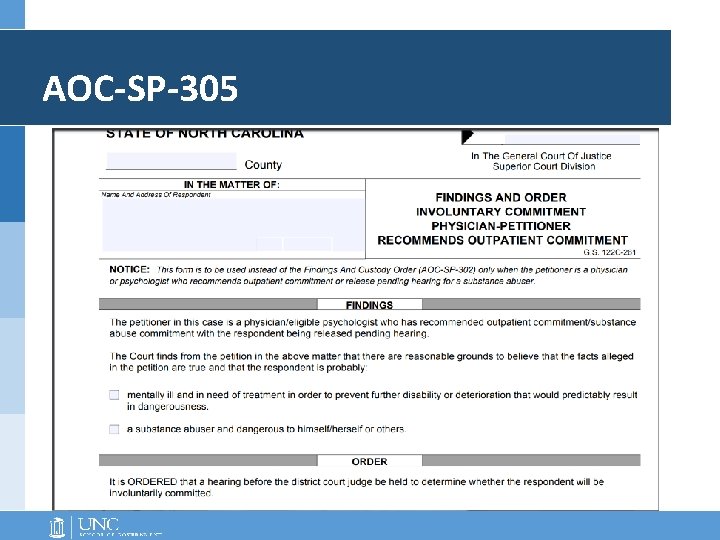
AOC-SP-305
Petitioner Recommends Outpatient Commitment Provide respondent written notice of any scheduled appointment and name, address, and phone number of proposed outpatient treatment provider
Petitioner Recommends Inpatient Commitment or SA Commit and Hold The magistrate shall issue an order to § a law enforcement officer or § any other person authorized under G. S. 122 C‑ 251 To take the respondent into custody and transport to a 24 -hour facility for custody, examination, and treatment pending hearing
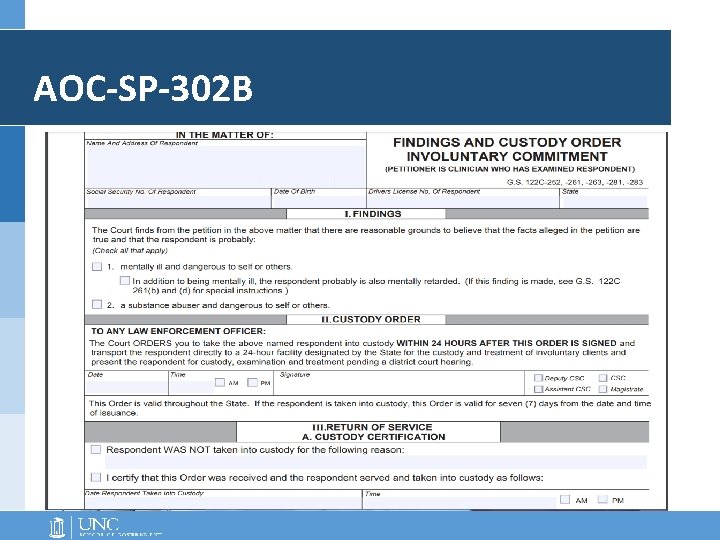
AOC-SP-302 B
Clinician Petition Procedure After 1 st exam and recommendation of inpatient commitment: If a 24 -hour facility is not § Immediately available or § Medically appropriate The respondent may be temporarily detained under appropriate supervision at the site of first examination. 102
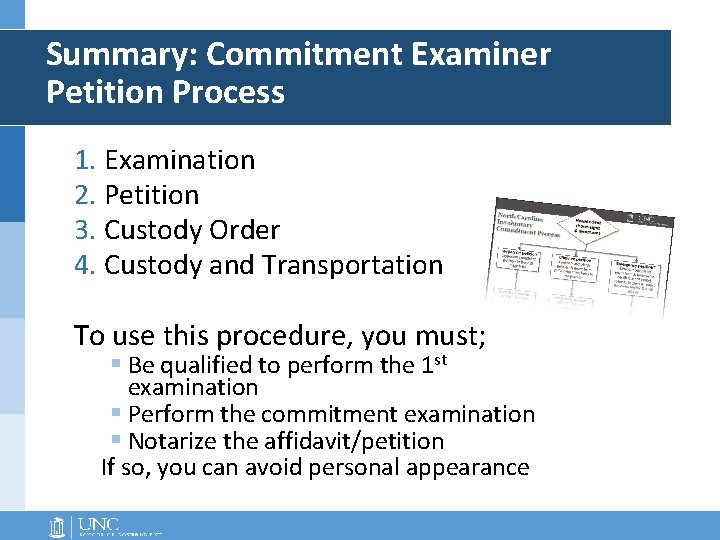
Summary: Commitment Examiner Petition Process 1. Examination 2. Petition 3. Custody Order 4. Custody and Transportation To use this procedure, you must; § Be qualified to perform the 1 st examination § Perform the commitment examination § Notarize the affidavit/petition If so, you can avoid personal appearance
Waiting at First Examination Site and “Appropriate Supervision”
Layperson Petition Procedure § Upon presentation for first exam: § If a commitment examiner is not immediately available, the respondent may be “detained under appropriate supervision” § Following first exam: § If the examiner recommends inpatient commitment and a 24 -hour facility is not immediately available or medically appropriate, the respondent may be “temporarily detained under appropriate supervision” G. S. 122 C-261, 122 C-281 105
Clinician Petition Procedure After 1 st exam and recommendation of inpatient commitment: If a 24 -hour facility is not § Immediately available or § Medically appropriate The respondent may be temporarily detained under appropriate supervision at the site of first examination. 106
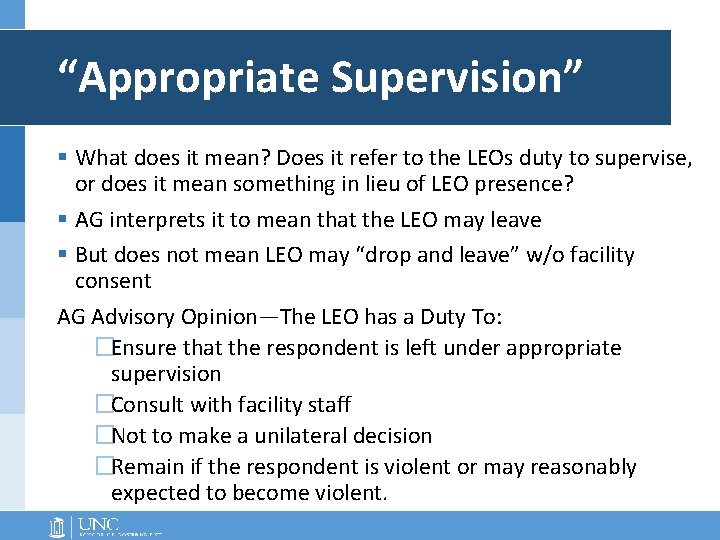
“Appropriate Supervision” § What does it mean? Does it refer to the LEOs duty to supervise, or does it mean something in lieu of LEO presence? § AG interprets it to mean that the LEO may leave § But does not mean LEO may “drop and leave” w/o facility consent AG Advisory Opinion—The LEO has a Duty To: �Ensure that the respondent is left under appropriate supervision �Consult with facility staff �Not to make a unilateral decision �Remain if the respondent is violent or may reasonably expected to become violent.
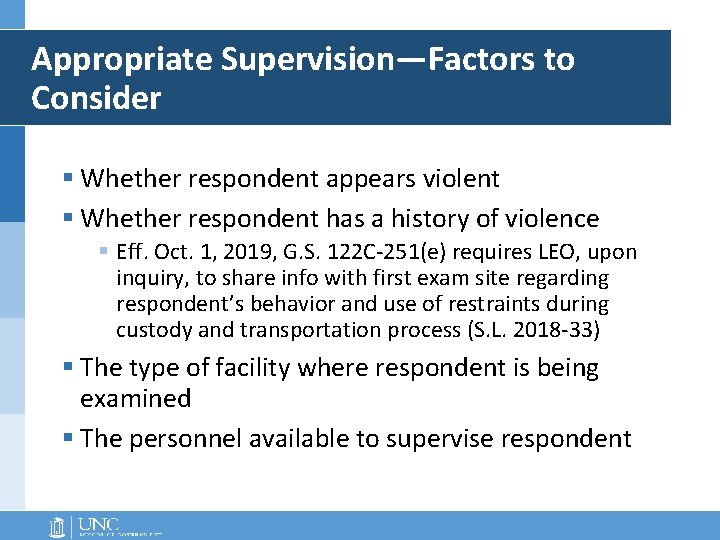
Appropriate Supervision—Factors to Consider § Whether respondent appears violent § Whether respondent has a history of violence § Eff. Oct. 1, 2019, G. S. 122 C-251(e) requires LEO, upon inquiry, to share info with first exam site regarding respondent’s behavior and use of restraints during custody and transportation process (S. L. 2018 -33) § The type of facility where respondent is being examined § The personnel available to supervise respondent
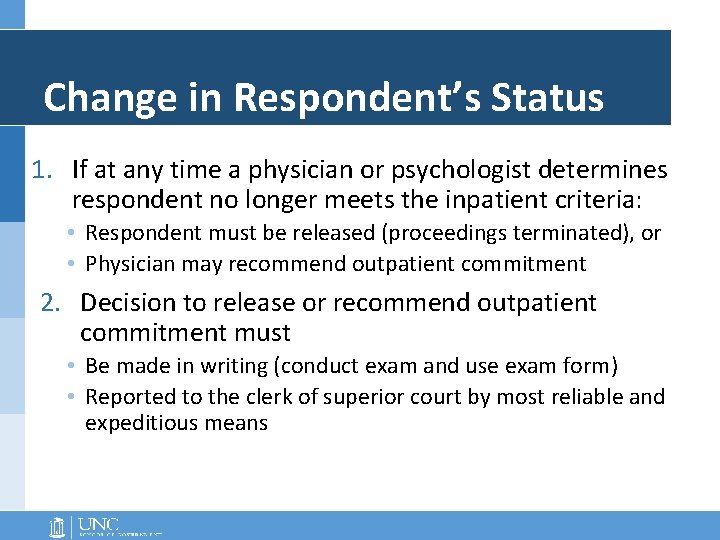
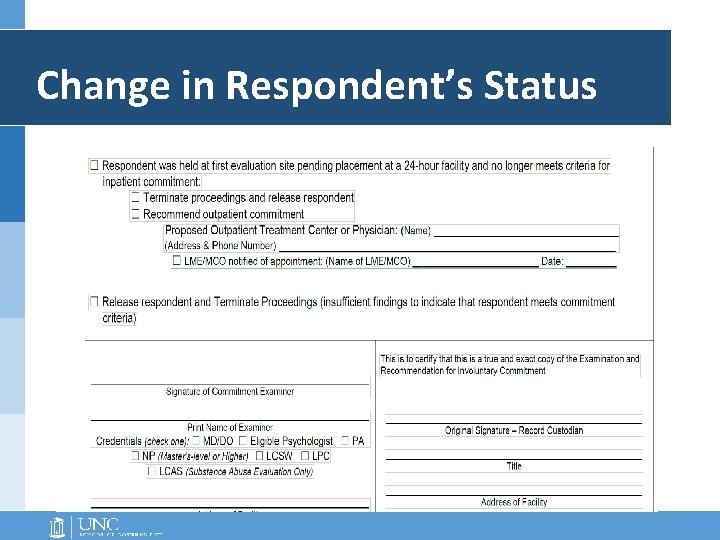
Change in Respondent’s Status 1. If at any time a physician or psychologist determines respondent no longer meets the inpatient criteria: • Respondent must be released (proceedings terminated), or • Physician may recommend outpatient commitment 2. Decision to release or recommend outpatient commitment must • Be made in writing (conduct exam and use exam form) • Reported to the clerk of superior court by most reliable and expeditious means
Change in Respondent’s Status
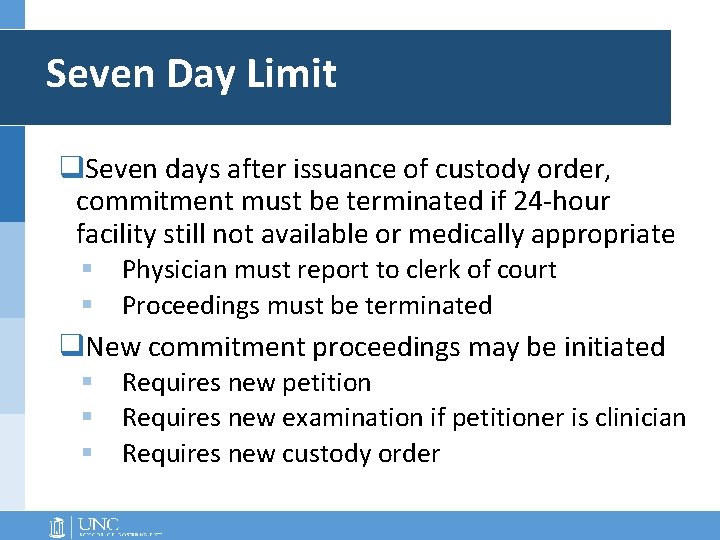
Seven Day Limit q. Seven days after issuance of custody order, commitment must be terminated if 24 -hour facility still not available or medically appropriate § Physician must report to clerk of court § Proceedings must be terminated q. New commitment proceedings may be initiated § Requires new petition § Requires new examination if petitioner is clinician § Requires new custody order
Questions? § Mark Botts § 919. 962. 8204 § botts@sog. unc. edu