
Voluntary Health Agencies Dr Abhay Nirgude Professor Ho
Voluntary Health Agencies Dr Abhay Nirgude Professor & Ho. D
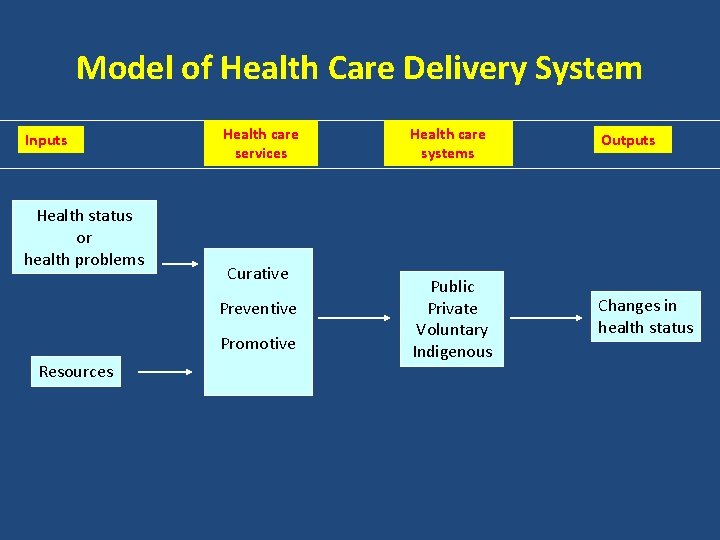
Model of Health Care Delivery System Inputs Health status or health problems Health care services Curative Preventive Promotive Resources Health care systems Outputs Public Private Voluntary Indigenous Changes in health status
Specific Learning Objectives • At the end of the lecture student should able to: • 1. Enumerate various voluntary health agencies. • 2. Discuss the role of voluntary health agencies in health care.
Voluntary health agencies • • • Defined as an organization that is Administered by autonomous board Which holds meetings, collects funds for its support chiefly from private sources And expends money, Whether with or without paid workers
• In conducting a programme directed primarily to furthering the public health by providing the health services or health education • Or by advancing the research or legislation for health • Or by combination of these activities
Functions 1. Supplementing the work of government agencies 2. Pioneering: - Ex Research (Family Planning Program of India) 3. Education
4. Demonstration: - bore hole latrines by Rockefeller foundation. 5. Guarding the work of government agencies 6. Advancing health legislation
Voluntary health agencies in India • • • Indian red cross society. Hind Kusht Nivaran Sangh. Indian Council for Child Welfare. Tuberculosis Association of India. Bharat Sevak Samaj. Central Social Welfare Board.
Voluntary health agencies in India • • • The Kasturba Memorial Fund. Family Planning Association of India. All India Women’s Conference. The All India Blind Relief Society. Professional Bodies. International Agencies.
Functions of Indian red cross society. 1. 2. 3. 4. 5. 6. Relief work Milk and medical supplies Armed forces rehabilitation Maternal and child welfare Family planning Blood bank and first-aid
Hind Kusht Nivaran Sangh. • Previously British Empire Leprosy Relief Association (BELRA) • Renamed as LEPRA in 1950. • Financial assistance to leprosy homes, clinics, health education, training of medical workers, research, all India leprosy conferences.
Indian Council for Child Welfare. • 1952 • Affiliated with International Union for Child Welfare. • Built a network of State & district councils. • Work to secure opportunities & Facilities for children. • Enable overall health and development of children with dignity.
Tuberculosis Association of India. • • 1939 Fund raising through TB seal campaign. Training and health promotion. Institutions: New Delhi Tuberculosis center Lady Linlithgow Sanitorium at Kasauli King Edward VII Sanitorium at Dharampur Tuberculosis Hospital in Mehrauli.
Bharat Sevak Samaj. • 1952 • Help people achieve health by their own actions and efforts. • Work towards improvement of sanitation in villages.
Central Social Welfare Board • Set up by GOI 1953 under general administrative control of the Ministry of Education. • Functions: 1. Surveying the needs and requirements of voluntary health agencies in the country. 2. Promoting and setting up of social welfare organizations on a voluntary basis.
Central Social Welfare Board • Functions: 3. Rendering financial aid
The Kasturba Memorial Fund • 1944 • Improvement in the life of women, especially in villages through “ Gramsevikas”.
Family Planning Association of India • 1949 • Pioneering work in propagating family planning in India. • Family planning clinics, grants in Aid from GOI • Training of doctors and HCP
All India Women’s Conference • 1926 • Branches all over India. • MCH Clinic, medical centers, adult education centers, milk centers and family planning clinics.
The All India Blind Relief Society. • 1946. • Coordinate different institutions working for the blind. • Organizes eye relief camps
Professional Bodies
International Agencies • Rockefeller Foundation • Ford Foundation • CARE ( Cooperative for Assistance & Relief Everywhere) • International Red Cross
ROCKFELLER FOUNDATION- Mr. John. D. Rockfeller – Mainly public health and medical education – Subsequently life sciences, social sciences, humanities, agriculture and family planning – Hookworm disease in Madras – All India Institute of Hygiene and Public Health in Calcutta – Training abroad of candidates from India through fellowships and research grants
• Sponsoring visits from U. S. A • Providing grants to selected institutions • Development of medical college libraries. Population studies • National institute of virology in Pune • Ballabhgarh block of AIIMS
FORD FOUNDATION • • Rural health services and family planning Orientation training centers in public health Research cum action projects - RCA latrine Pilot projects in rural health services – Gandhi gram Establishment of NIHAE in New Delhi Calcutta water supply and drainage scheme Family planning programme
CARE – Cooperative for Assistance and Relief Everywhere • Worlds largest, independent, non profit, non sectarian, international relief and development organisation • CARE provide emergency aid and long term development assistance • Food for children 6 -11 years • Food support in ICDS • Integrated nutrition and health project • Better health and nutrition project
CARE – contd. • Anemia control project • Improving women’s health project • Improved health care for adolecent girls project • Child survival project • Improving women’s reproductive health and family spacing project • Konkan integrated development project
INTERNATIONAL RED CROSS • Henry Dunant, Swiss Businessmen • Traveling north Italy 1859 • Battle of Solferino Indian red cross Junior red cross • Village up liftment • First aid • Anti epidemic work • international friendliness • Understanding and cooperation

Summary
- Slides: 29