
8 qualities shared by strong families 1 Commitment
8 qualities shared by strong families 1. Commitment 2. Appreciation 3. God communication patterns 4. Desire to spend time together 5. A strong value system 6. Ability to deal with crises and stress in a positive manner 7. Resilience 8. Self efficacy 1
6 decision making steps 1. Define what you need or want 2. Look carefully at your resources 3. Gather information on all your choices 4. Identify, evaluate, and compare your choices 5. Make your decision, develop a plan and get started 6. As time passes, evaluate your decision and readjust if necessary 2
Intensity matrix page 46 what do you think? 1. Is intimacy a goal for you? 2. Is it difficult for you to be intimate? 3. In what action realm (intellectual, physical, emotional) do you share intimacy most easily? 4. Which realm is most difficult? 3
The American Myth of Love and Marriage We Americans marry for love and who in the midst of falling in love is always reasonable? • Because Americans tend to believe the romantic myth, numerous marriages have little other than love going for them and the union dissolves because the couple has no basis on which to build a lasting relationship. 4
The American Myth of Love and Marriage Much of the confusion of about the myth of love as a basis for marriage has to do with how love is defined. Does it mean the same to you as it does to me? What is the difference between, loving, crushing, passion… all of it? 5
Defining love The ancient Greeks divided love into a number elements Ludus (game playing love) Storge (friendship love) Mania (possessive dependent love) Eros (physical sexual side of love) Guess which types tend to produce negative consequences? 6
Defining Love For the Greeks, the three most important types of love leading to more successful intimate relationships are: Eros (carnal or physical love) • Agape (spiritual love) • Philos (brotherly or friendly love). • 7
Defining love Philos, the love found in deep and enduring friendships is most important to society’s humanity We need this connection with other people to create a successful society Alienation Crime Isolation Dehumanization 8
Love is what you make it We each define love for ourselves In lasting relationships, the partners must come to a mutual understanding of what each means by love 9
Love is what you make it Intimate self disclosure- opening your self up can lead to getting hurt Intimacy dilemma- love is always an adventure because danger is involved 10
Love is what you make it Indifference is the opposite of love When hurt occurs the lover may react with hurt or hostility However someone who just doesn’t care wasn’t in love 11
Love is what you make it The indifferent person exercises more control over the relationship. Principle of least interest The most loving person in the relationship is more vulnerable and, therefore, often goes to great lengths to placate and please his/her mate 12
Love is what you make it The concept of love has been feminized in America Men vs. women Lets talk about us vs. I provide for you Women use sex to get love Men use love to get sex 13
Gender differences in love Men are less willing to marry without being in love than are women Once a woman commits herself, she tends to become more expressive than he is 14
Gender differences in love Women tend to take more time to love and commit themselves to a relationship than do men Women generally seek emotional relationships, whereas men tend to initially seek physical relationships 15
Theories of love Brotherly love- friendship Maternal love- unselfish interest in your partner, placing your self second Mature love- all of that plus a sexual response 16
Mature love 4 basic elements 1. Care 2. Responsibility 3. Respect 4. Knowledge 17
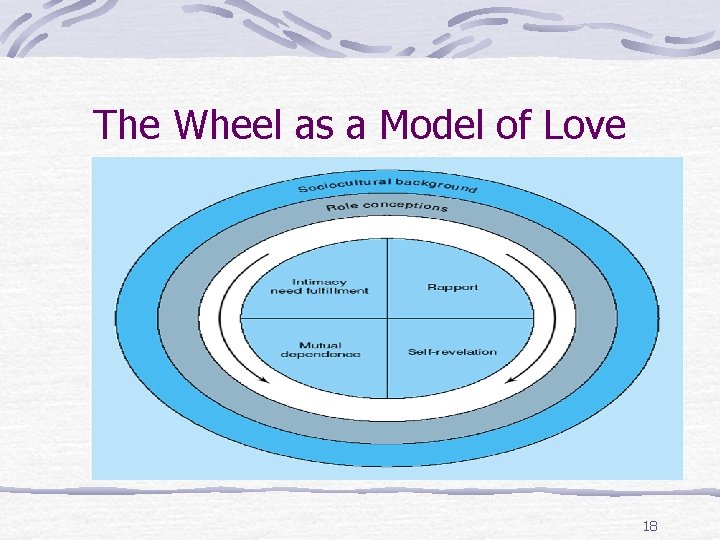
The Wheel as a Model of Love 18
The Wheel as a Model of Love Stage 1 The Rapport Stage Partners are struck by the feelings that they have known each other before. They are comfortable with each other, and both want to deepen the relationship. 19
The Wheel as a Model of Love Stage 2 The Self-revelation Stage The partners share more intimate feelings. This deepens the relationship because such sharing is only done with special people. 20
The Wheel as a Model of Love Stage 2 The Self-revelation Stage Self-disclosure is associated with increased commitment, mutual trust, and feelings of love. Women are more likely than men to reveal their thoughts and feelings 21
The Wheel as a Model of Love Stage 3 Mutual Dependence As sharing becomes more intimate, a feeling of mutual dependence develops. 22
The Wheel as a Model of Love Stage 3 Mutual Dependence Falling in love provides a sense of very rapid expansion of the boundaries of self. There comes a feeling of loss when the partner is absent. 23
The Wheel as a Model of Love Stage 4 Intimacy The partners experience more intimacy and need fulfillment as they deepen their relationship. Emotional support Sympathy 24
Elements of Love intimacy, passion and commitment • Nonlove: Absence of all three elements. • Liking: Intimacy without passion or commitment. 25
Elements of Love intimacy, passion and commitment • Infatuation: Passion without intimacy or commitment. • Romantic love: Intimacy and passion without commitment. 26
Romantic Love The confusion between romance and love causes great trouble in forming long-lasting intimate relationships We often fall in love with our own romantic ideas about someone rather than the real person 27
Romantic Love Are you a romantic or a realist? Let’s take the survey on page 70 -71 28
Romantic Love Because romantic love is such an emotional arousal it is difficult to maintain When a person confuses true love with romantic love you will constantly be disappointed 29
Love versus like It is probably more important to like someone than it is to love them if you are going to live together for an extended amount of time It is easier to like and love someone you who makes you feel good 30
Love versus like What research tells us Page 74 -75 31
Love Falling in love is grand Staying in love is hard work 32
Companionship love With time, the emotional excitement of passionate love tends to fade into a lower key emotional state of friendliness and a deep attachment The fact that love changes over time makes it no less important 33
Companionship love If enduring love is to evolve from a passionate love, the relationship has to be nurtured 34
Love in strong families Many families take each other fro granted until something happens to upset their routine. 35
Love in strong families Respect and appreciation- you cannot appreciate if you do not respect Vicious circle- a pattern of behavior in which negative behavior provokes a negative reaction, which in turn, prompts more negative behavior 36
Unrealistic expectations Many of the difficulties we experience in our interpersonal relationships stem from conflicting attitudes and unrealistic expectations rather than from specific behavior 37
Socialization The process of passing society’s values on to new members that begins at birth. Talk about the girl in the cellar 38
Developmental Stages • Self-Love Stage: Infancy and Early Childhood • Attachment to significant others • In order to love we must be loved 39
Developmental Stages • Parental Identification Stage: Early and Middle Childhood This is where children learn the masculine or feminine role that goes with their biological sex Sex vs. gender 40
Developmental Stages Group Stage: Late Childhood and Preadolescence Elementary school each groups sticks to themselves Cooties? 41
Developmental Stages • Heterosexual Adult Stage • Heightened awareness of the opposite sex and some knowledge of what love means and how to display it • Love map- guides you to fall in love with one person and not the other 42
Jealousy The state of being resentfully suspicious of a loved one’s behavior toward a suspected rival. 43
Envy Represents a discontent with oneself and/or desire for the possessions or attributes of another Elicits more shame, longing, guilt, denial, and a sense of inferiority 44
Quick Quiz 45
1. Love that includes intimacy and commitment without passion is a) Familial Love b) Companionate Love c) Empty Love d) Liking 46
Answer: b • Companionate love is a strong bond that includes intimacy and commitment without passion. 47
2. The process of passing society’s values on to new members is a) Coding b) Modeling c) Brainwashing d) Socialization 48
Answer: d • Socialization is the process of passing society’s values on to new members. 49
3. The Greek term for brotherly love is a) Agape b) Philos c) Eros d) Storge 50
Answer: b • Philos is the Greek term for brotherly love. 51
- Slides: 51