Introduction to Particle Physics II Sinad Farrington 19
- Slides: 43
Introduction to Particle Physics II Sinéad Farrington 19 th February 2015
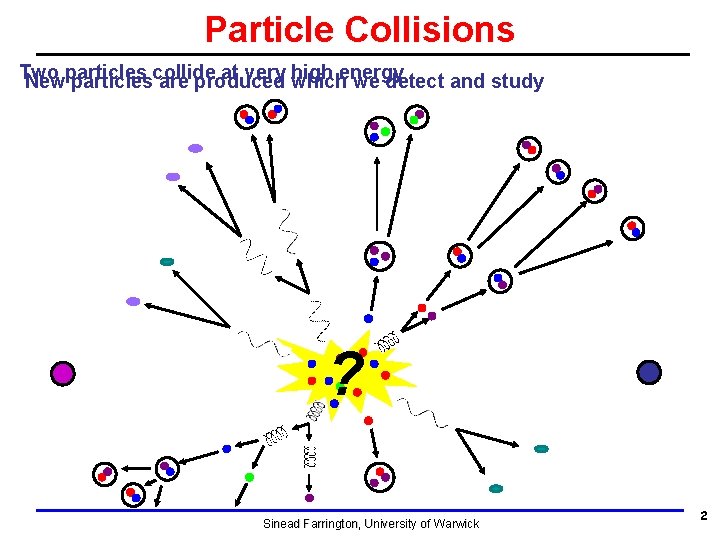
Particle Collisions Two at very which high energy Newparticlescollide are produced we detect and study ? Sinead Farrington, University of Warwick 2
Goals of the LHC • Understanding the generation of mass • Searching for new phenomena to rule in or out new theories • Searching for whatever is out there • Remember E=mc 2 – the more energy we put into the collisions, the more massive the particles we can create Sinead Farrington, University of Warwick 3
First, we need some data to analyse! Sinead Farrington, University of Warwick 4
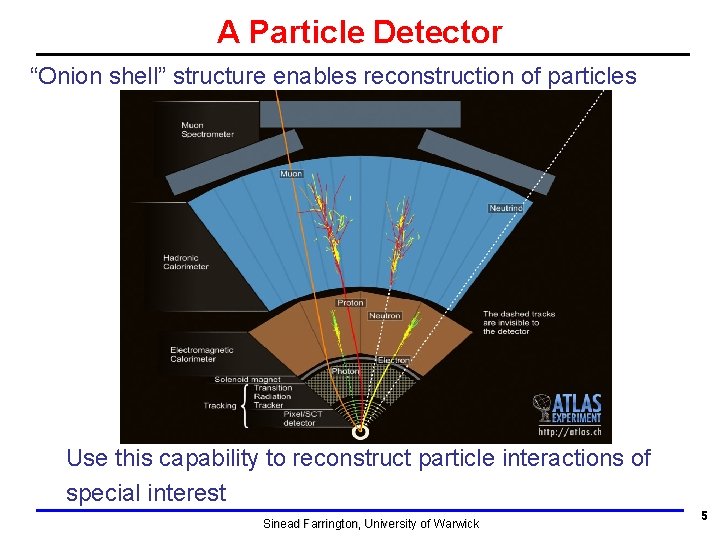
A Particle Detector “Onion shell” structure enables reconstruction of particles Use this capability to reconstruct particle interactions of special interest Sinead Farrington, University of Warwick 5
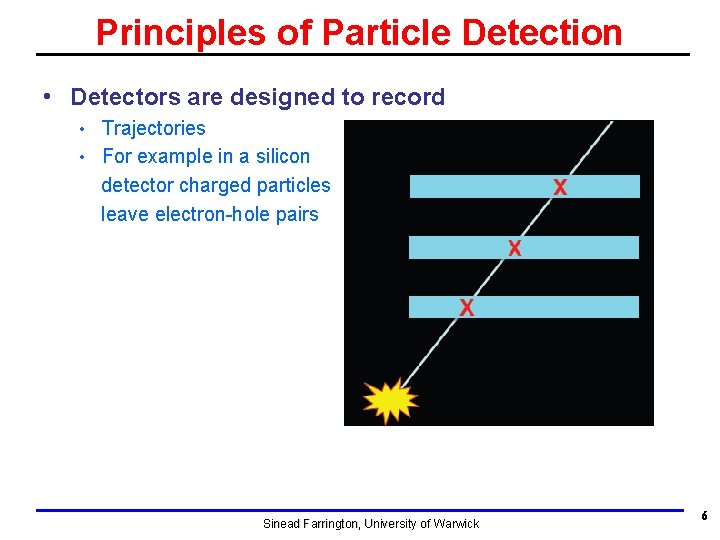
Principles of Particle Detection • Detectors are designed to record Trajectories • For example in a silicon detector charged particles leave electron-hole pairs • Sinead Farrington, University of Warwick 6
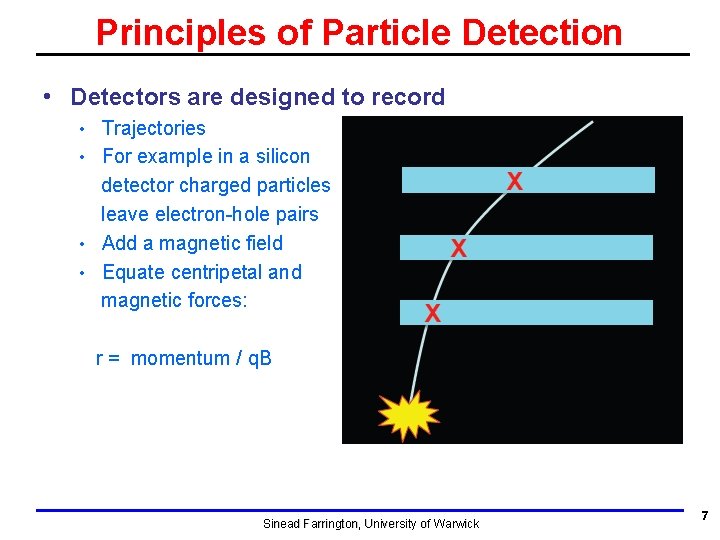
Principles of Particle Detection • Detectors are designed to record Trajectories • For example in a silicon detector charged particles leave electron-hole pairs • Add a magnetic field • Equate centripetal and magnetic forces: • r = momentum / q. B Sinead Farrington, University of Warwick 7
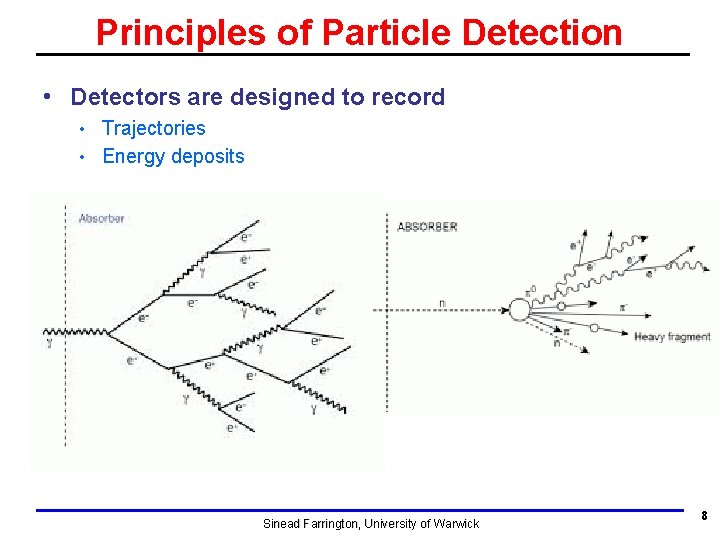
Principles of Particle Detection • Detectors are designed to record Trajectories • Energy deposits • Sinead Farrington, University of Warwick 8
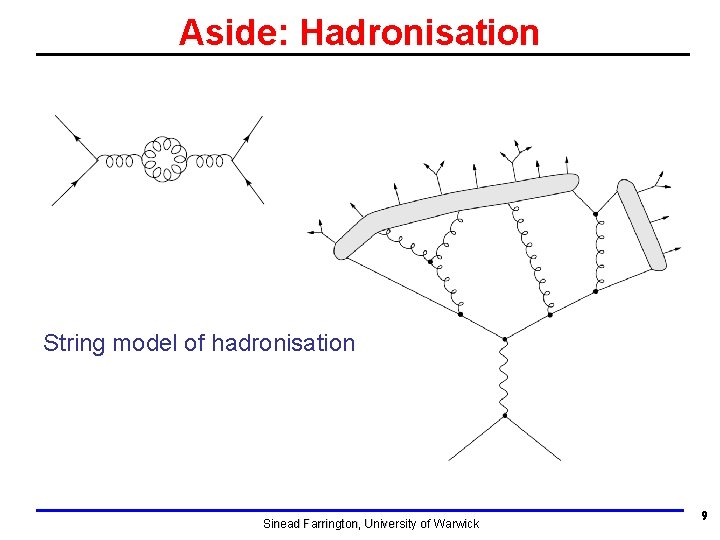
Aside: Hadronisation String model of hadronisation Sinead Farrington, University of Warwick 9
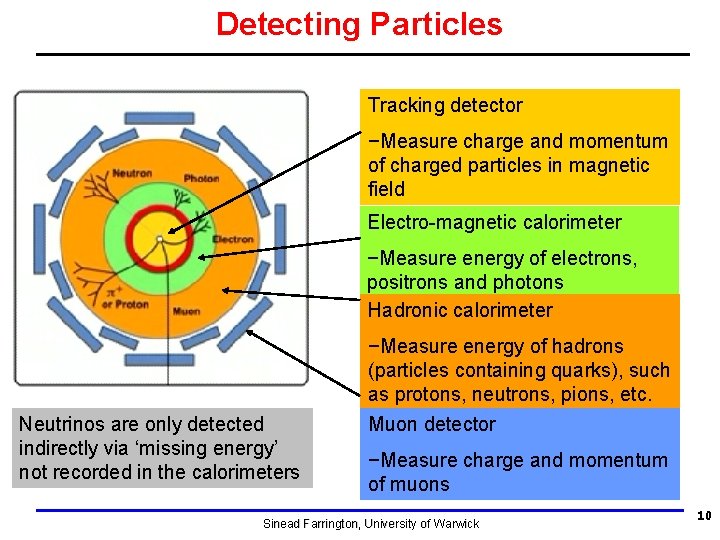
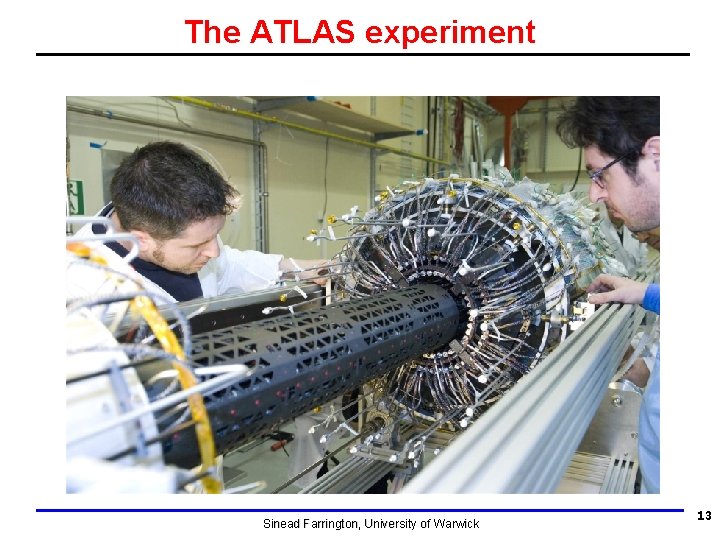
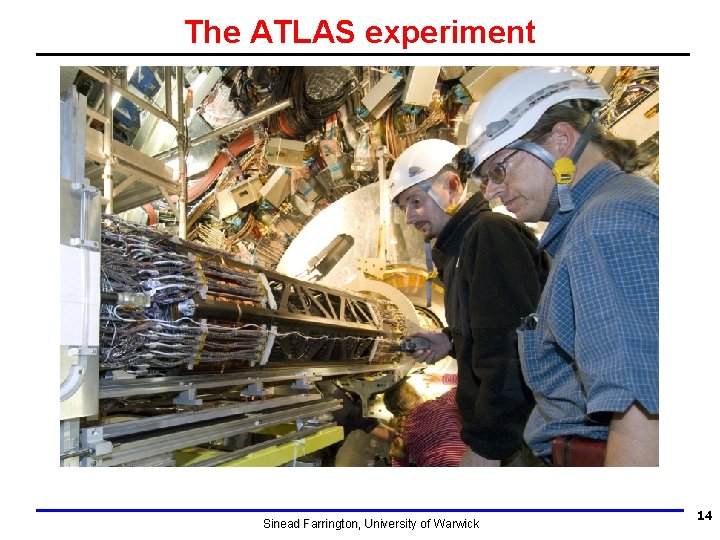
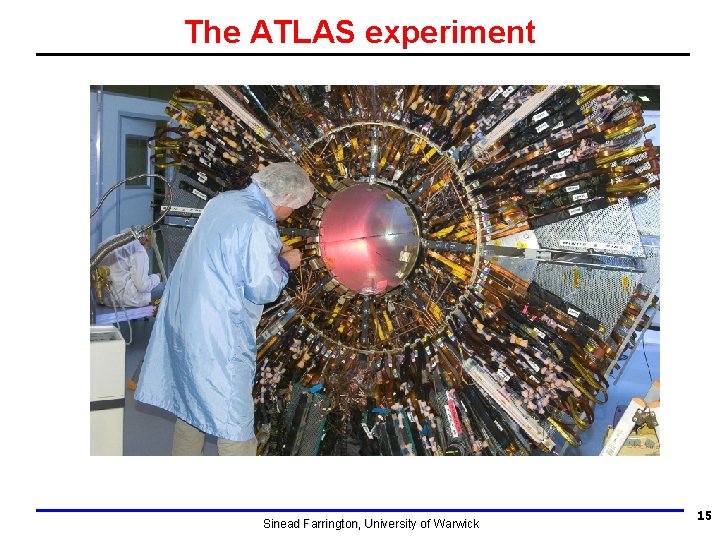
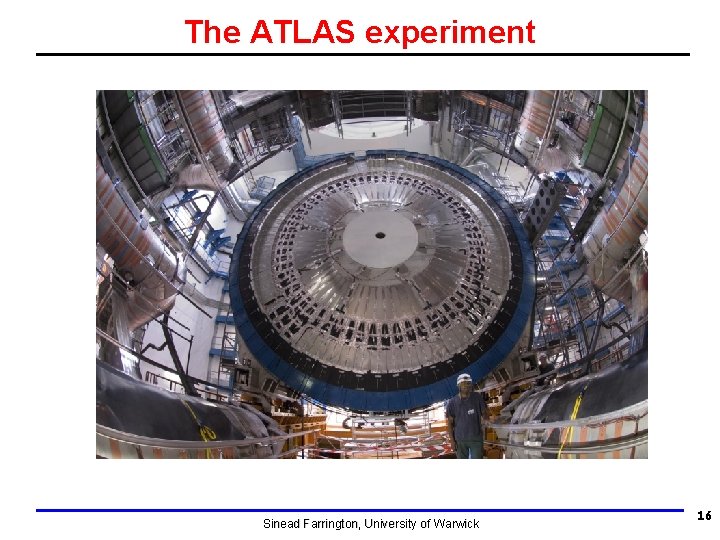
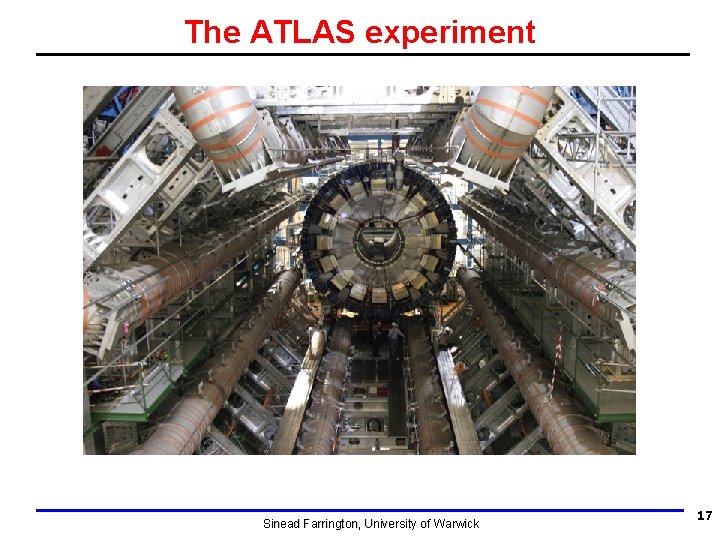
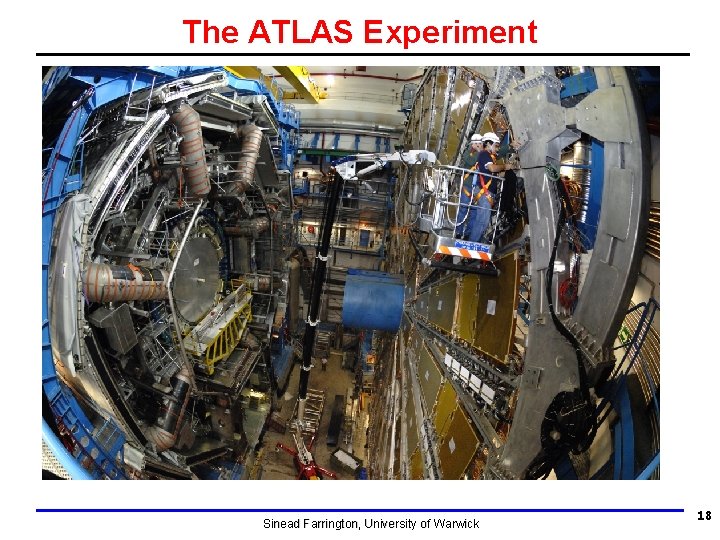
Detecting Particles Tracking detector −Measure charge and momentum of charged particles in magnetic field Electro-magnetic calorimeter −Measure energy of electrons, positrons and photons Hadronic calorimeter Neutrinos are only detected indirectly via ‘missing energy’ not recorded in the calorimeters −Measure energy of hadrons (particles containing quarks), such as protons, neutrons, pions, etc. Muon detector −Measure charge and momentum of muons Sinead Farrington, University of Warwick 10
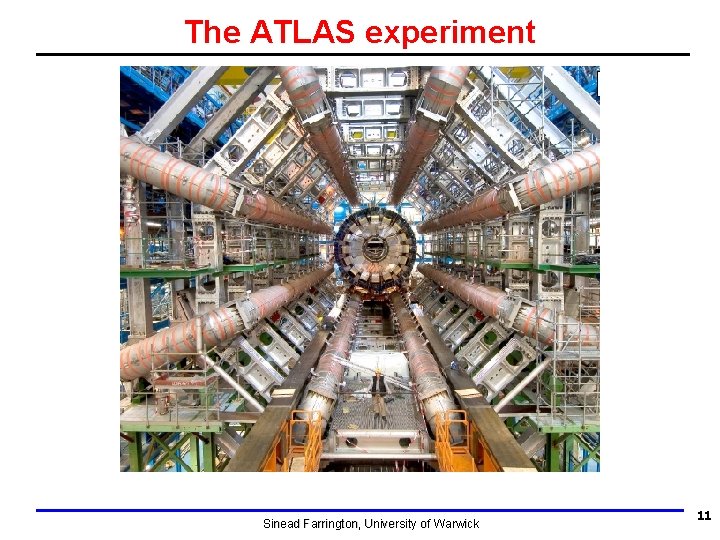
The ATLAS experiment Sinead Farrington, University of Warwick 11
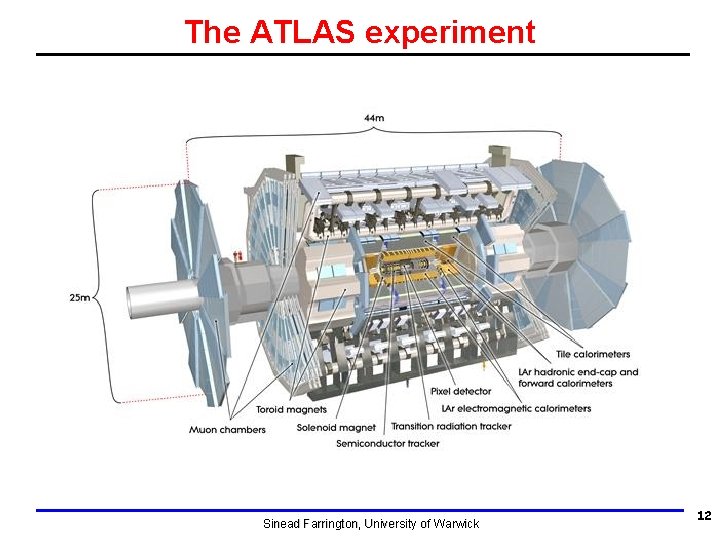
The ATLAS experiment Sinead Farrington, University of Warwick 12
The ATLAS experiment Sinead Farrington, University of Warwick 13
The ATLAS experiment Sinead Farrington, University of Warwick 14
The ATLAS experiment Sinead Farrington, University of Warwick 15
The ATLAS experiment Sinead Farrington, University of Warwick 16
The ATLAS experiment Sinead Farrington, University of Warwick 17
The ATLAS Experiment Sinead Farrington, University of Warwick 18
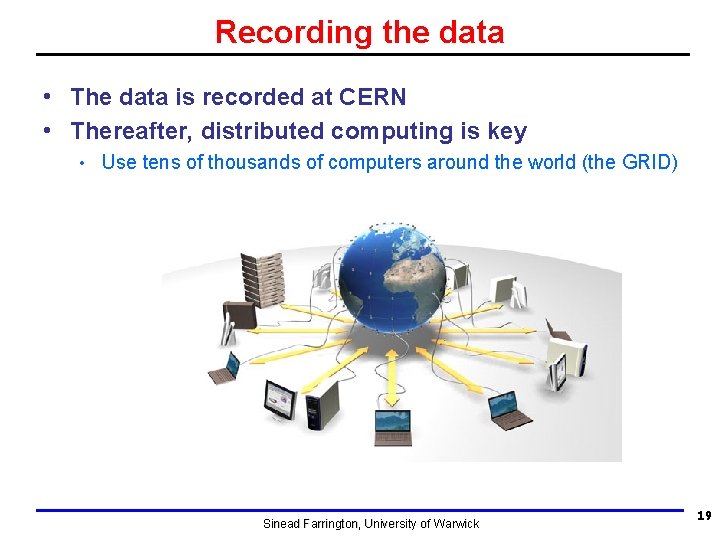
Recording the data • The data is recorded at CERN • Thereafter, distributed computing is key • Use tens of thousands of computers around the world (the GRID) Sinead Farrington, University of Warwick 19
The Higgs Search Sinead Farrington, University of Warwick 20
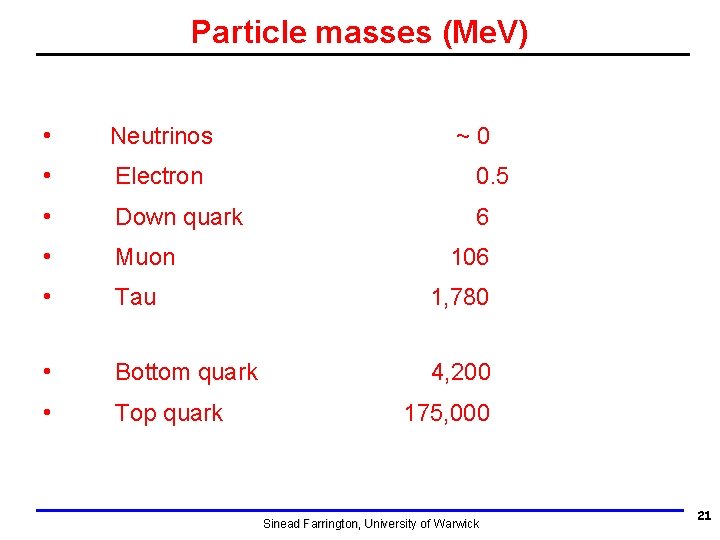
Particle masses (Me. V) • Neutrinos • Electron 0. 5 • Down quark 6 • Muon • Tau 1, 780 • Bottom quark 4, 200 • Top quark ~0 106 175, 000 Sinead Farrington, University of Warwick 21
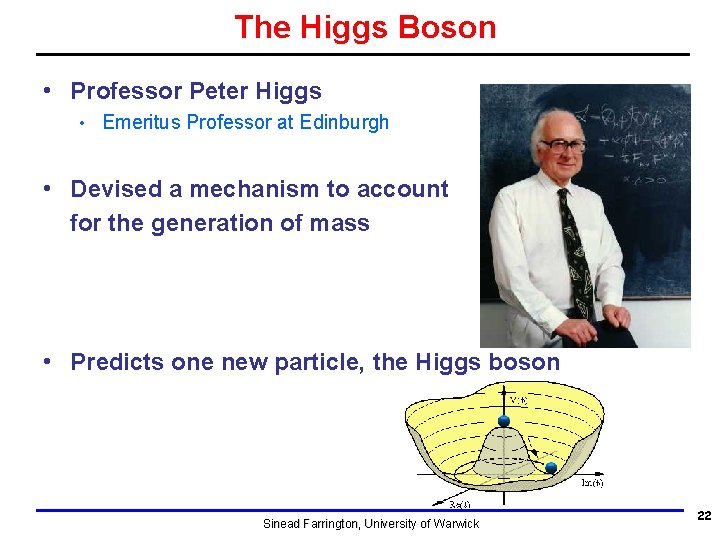
The Higgs Boson • Professor Peter Higgs • Emeritus Professor at Edinburgh • Devised a mechanism to account for the generation of mass • Predicts one new particle, the Higgs boson Sinead Farrington, University of Warwick 22
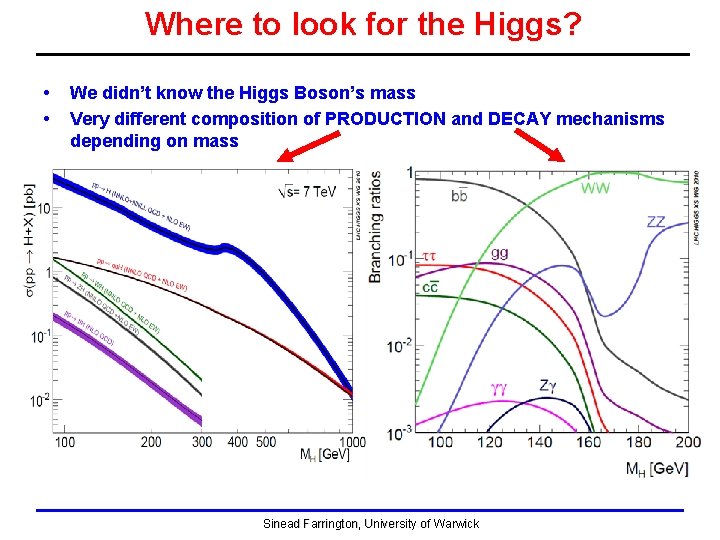
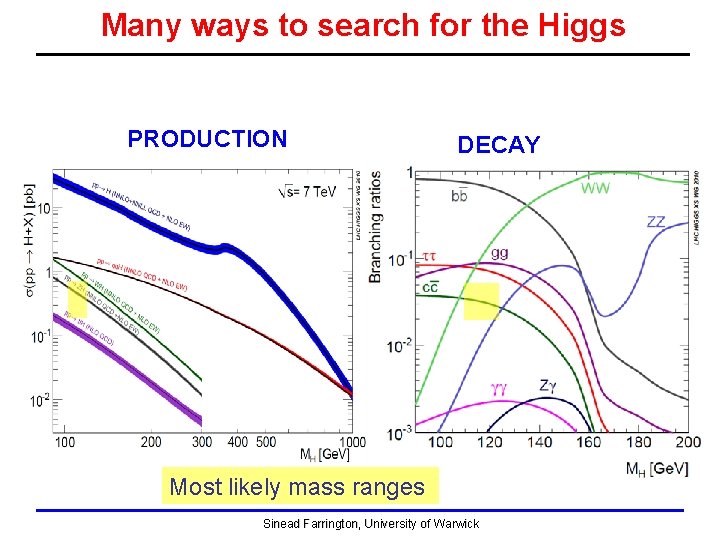
Where to look for the Higgs? • • We didn’t know the Higgs Boson’s mass Very different composition of PRODUCTION and DECAY mechanisms depending on mass Sinead Farrington, University of Warwick
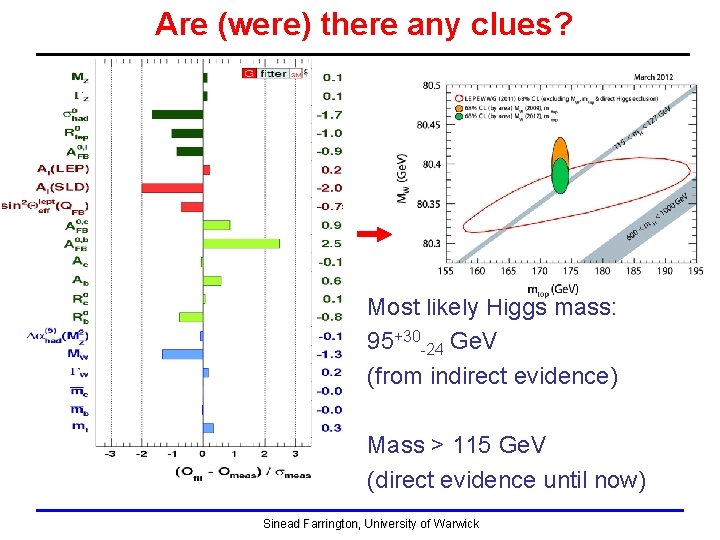
Are (were) there any clues? • Yes! Most likely Higgs mass: 95+30 -24 Ge. V (from indirect evidence) Mass > 115 Ge. V (direct evidence until now) Sinead Farrington, University of Warwick
Many ways to search for the Higgs PRODUCTION DECAY Most likely mass ranges Sinead Farrington, University of Warwick
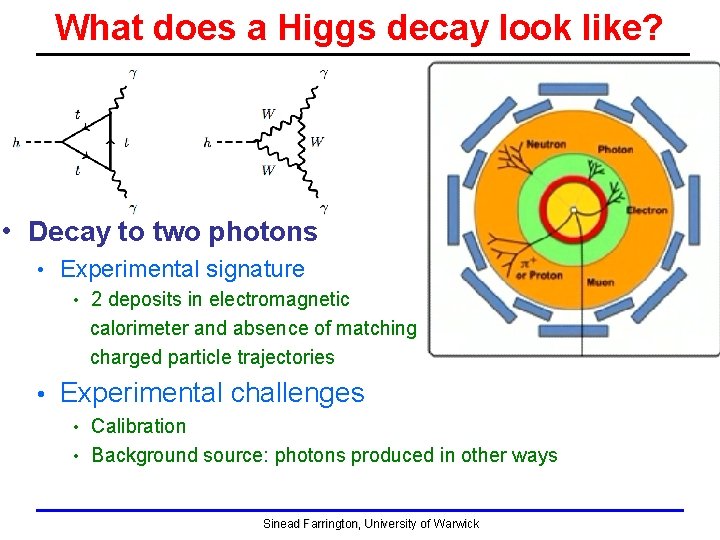
What does a Higgs decay look like? • Decay to two photons • Experimental signature • • 2 deposits in electromagnetic calorimeter and absence of matching charged particle trajectories Experimental challenges Calibration • Background source: photons produced in other ways • Sinead Farrington, University of Warwick
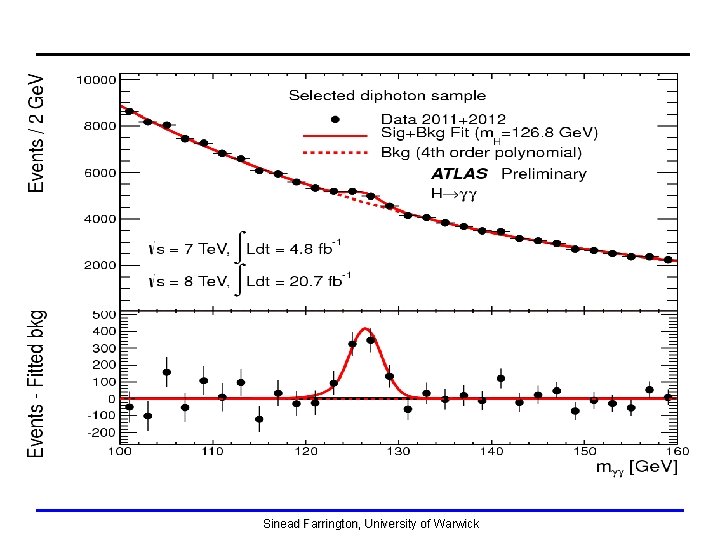
Sinead Farrington, University of Warwick
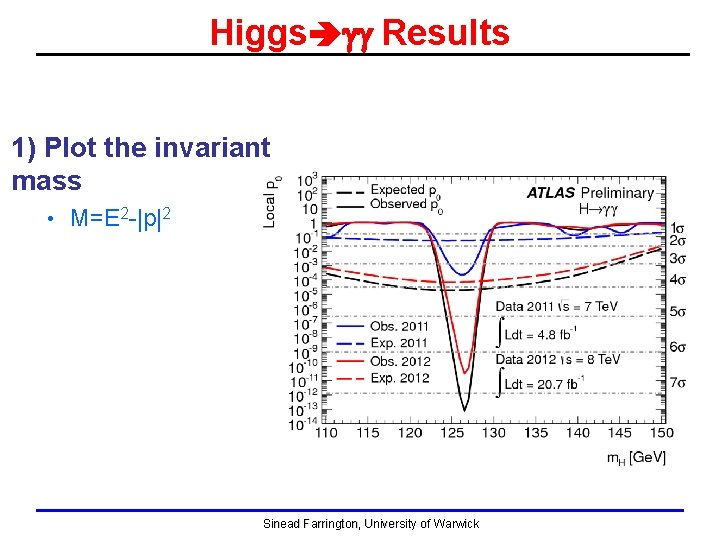
Higgs gg Results 1) Plot the invariant mass • M=E 2 -|p|2 Sinead Farrington, University of Warwick
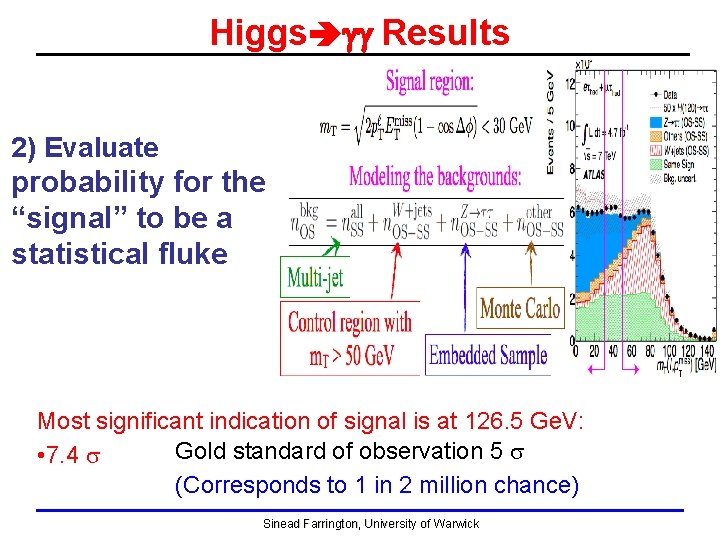
Higgs gg Results 2) Evaluate probability for the “signal” to be a statistical fluke Most significant indication of signal is at 126. 5 Ge. V: Gold standard of observation 5 s • 7. 4 s (Corresponds to 1 in 2 million chance) Sinead Farrington, University of Warwick
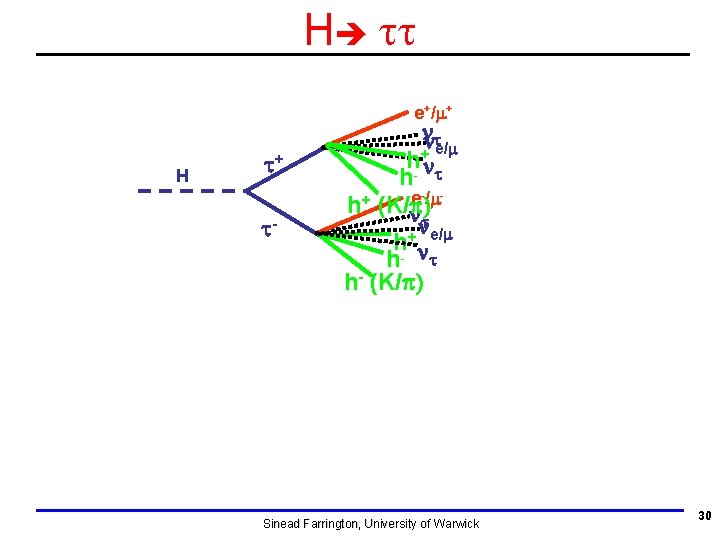
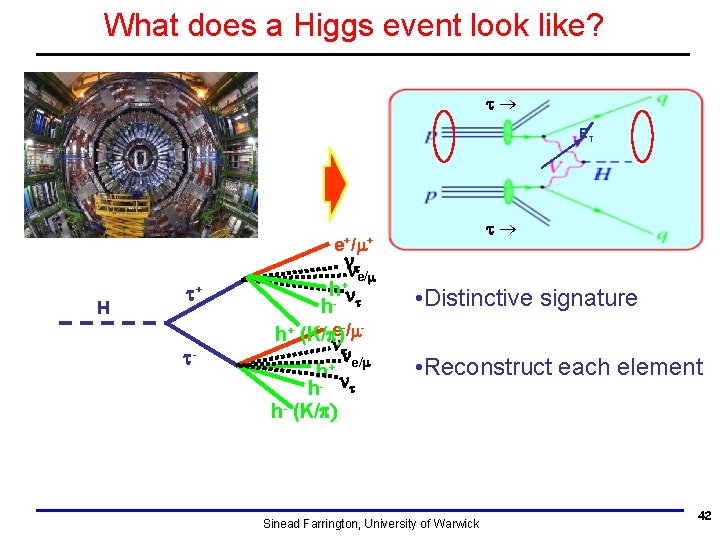
H tt e+/m+ H nnt e/m h- +n h t t+ t- h+ -/me (K/p) nnt h- +ne/m h t h- (K/p) Sinead Farrington, University of Warwick 30
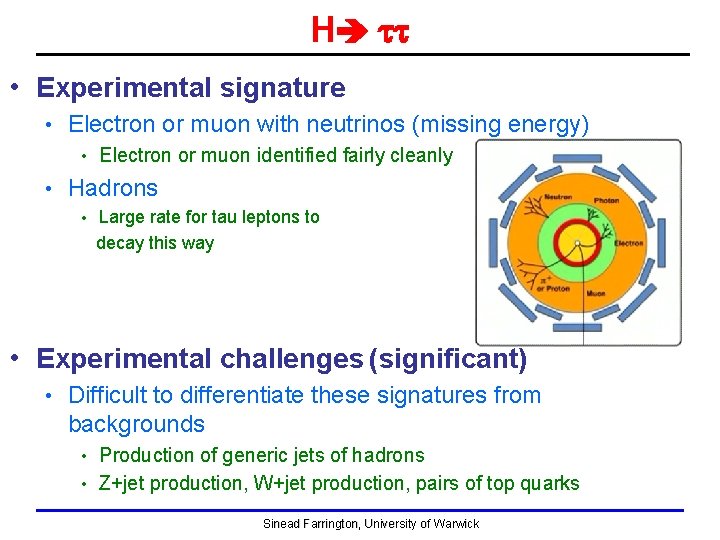
H tt • Experimental signature • Electron or muon with neutrinos (missing energy) • • Electron or muon identified fairly cleanly Hadrons • Large rate for tau leptons to decay this way • Experimental challenges (significant) • Difficult to differentiate these signatures from backgrounds Production of generic jets of hadrons • Z+jet production, W+jet production, pairs of top quarks • Sinead Farrington, University of Warwick
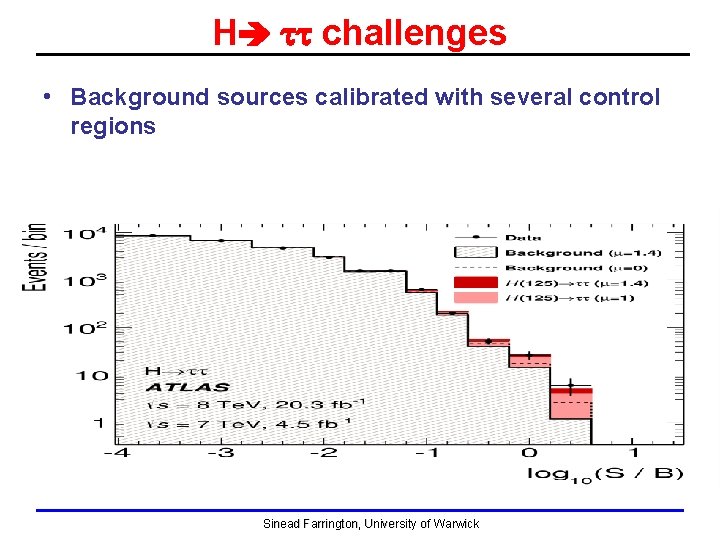
H tt challenges • Background sources calibrated with several control regions Sinead Farrington, University of Warwick
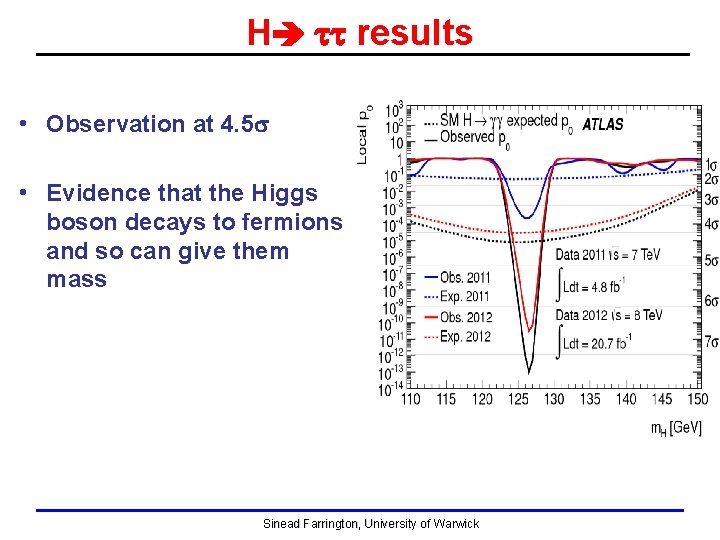
H tt results • Observation at 4. 5 s • Evidence that the Higgs boson decays to fermions and so can give them mass Sinead Farrington, University of Warwick
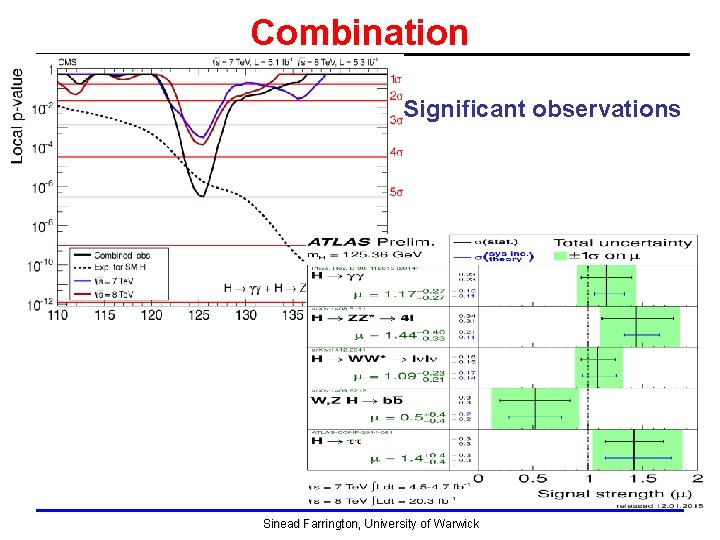
Combination Significant observations Sinead Farrington, University of Warwick
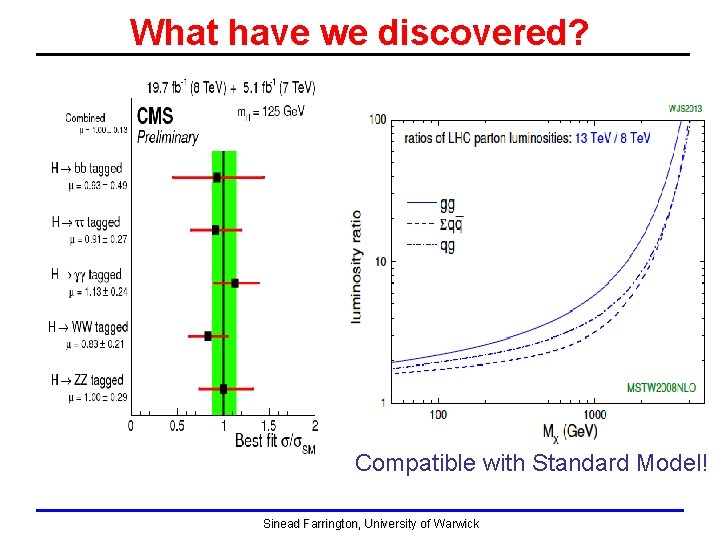
What have we discovered? Compatible with Standard Model! Sinead Farrington, University of Warwick
Future of Higgs Physics • Key properties of this new boson will take some time to ascertain This was always anticipated • In fact we are fortuitous in nature’s choice for the Higgs mass – all decay modes are accessible at this point • • Key to characterising this particle are Production and decay rates (to greater precision) • Intrinsic quantum numbers • • Switch from search mode to precision physics Sinead Farrington, University of Warwick
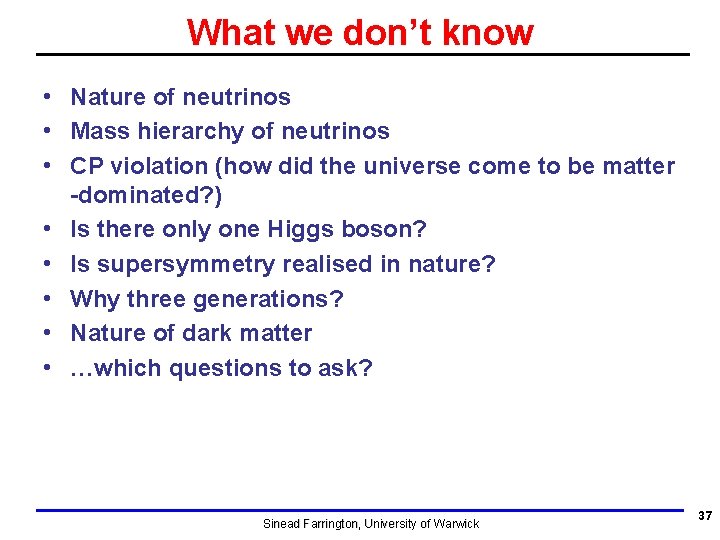
What we don’t know • Nature of neutrinos • Mass hierarchy of neutrinos • CP violation (how did the universe come to be matter • • • -dominated? ) Is there only one Higgs boson? Is supersymmetry realised in nature? Why three generations? Nature of dark matter …which questions to ask? Sinead Farrington, University of Warwick 37
Outreach in the UK • Many opportunities in the UK Particle Physics UK had a stand at the Royal Society Summer Exhibition in London for the past two years • This year a similar stand will be at the Big Bang Science Fair at the NEC in Birmingham 11 -14 March • BA Science Festival has attendance from particle physicists • All UK universities involved in particle physics run outreach events (usually called “masterclasses”) and most will be happy to send someone to give a talk at your school if you ask them • Sinead Farrington, University of Warwick 38
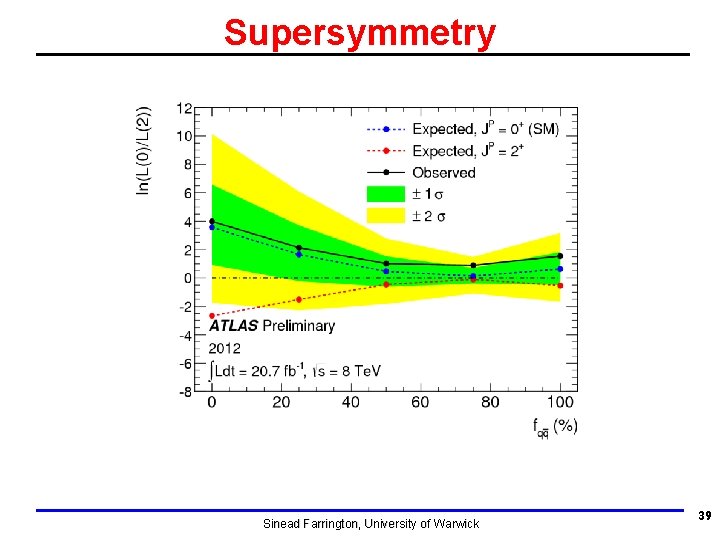
Supersymmetry Sinead Farrington, University of Warwick 39
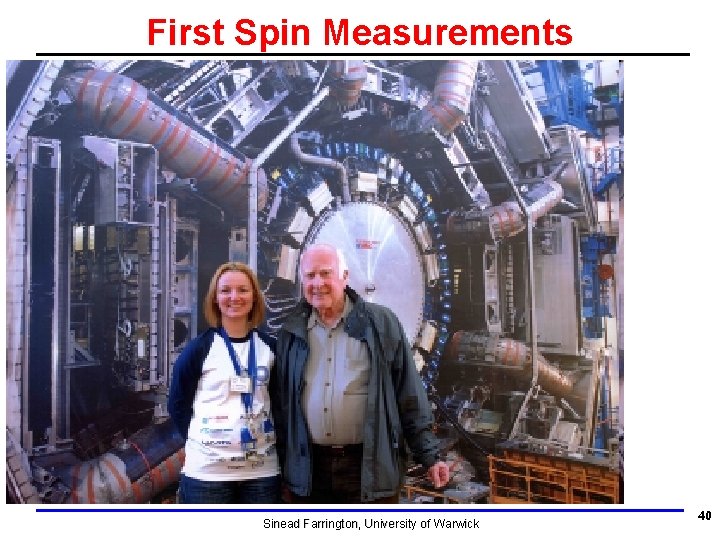
First Spin Measurements Sinead Farrington, University of Warwick 40
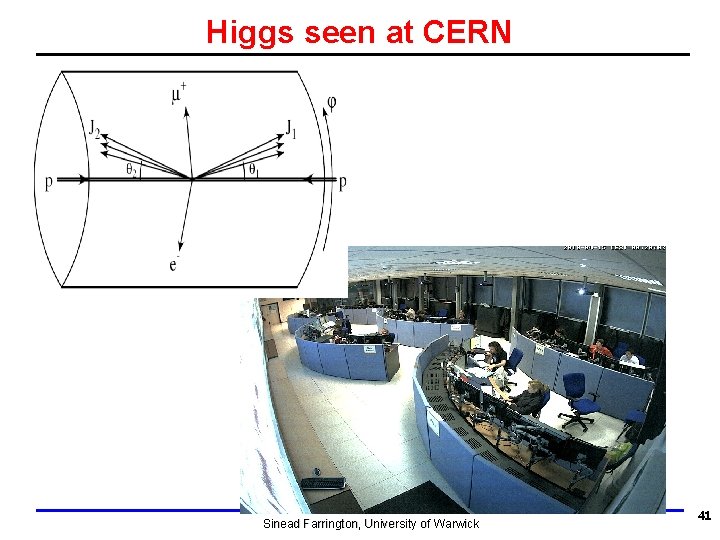
Higgs seen at CERN Sinead Farrington, University of Warwick 41
What does a Higgs event look like? t ET t e+/m+ H t+ t- nnt e/m h+n h- t e-/mh+ (K/p) nt ne/m + h n h- t • Distinctive signature • Reconstruct each element h- (K/p) Sinead Farrington, University of Warwick 42
The CMS Experiment Sinead Farrington, University of Warwick 43