
Higgs to tt at ATLAS Sinad Farrington 8
- Slides: 51
Higgs to tt at ATLAS Sinéad Farrington 8 th December 2014
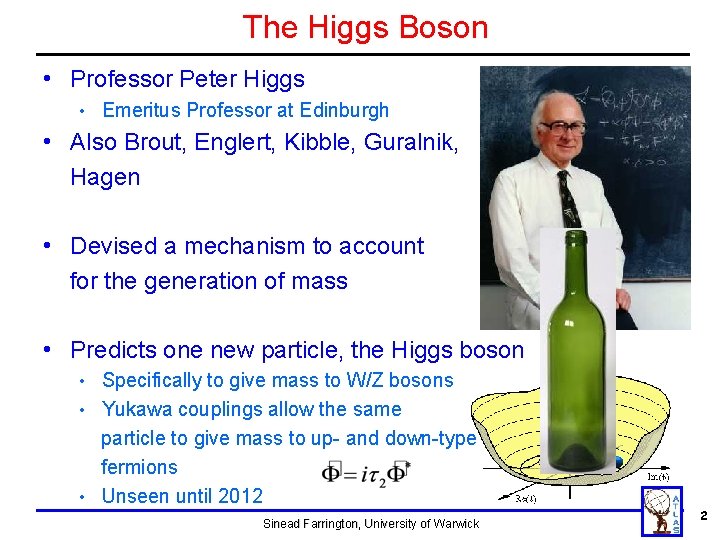
The Higgs Boson • Professor Peter Higgs • Emeritus Professor at Edinburgh • Also Brout, Englert, Kibble, Guralnik, Hagen • Devised a mechanism to account for the generation of mass • Predicts one new particle, the Higgs boson Specifically to give mass to W/Z bosons • Yukawa couplings allow the same particle to give mass to up- and down-type fermions • Unseen until 2012 • Sinead Farrington, University of Warwick 2
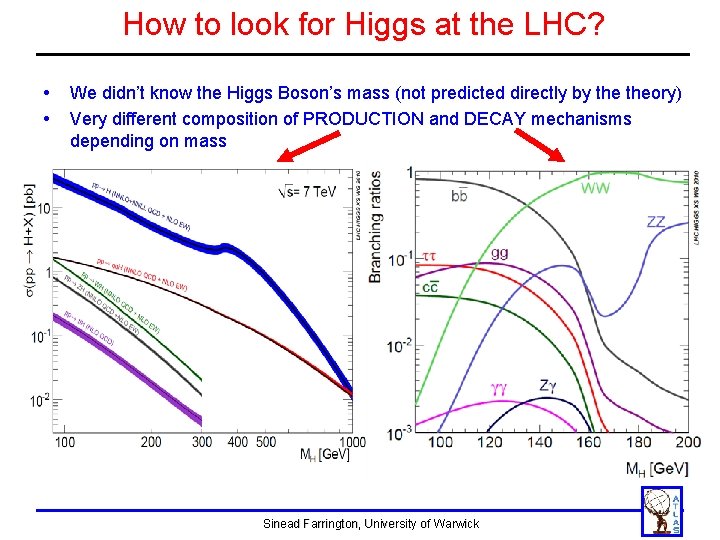
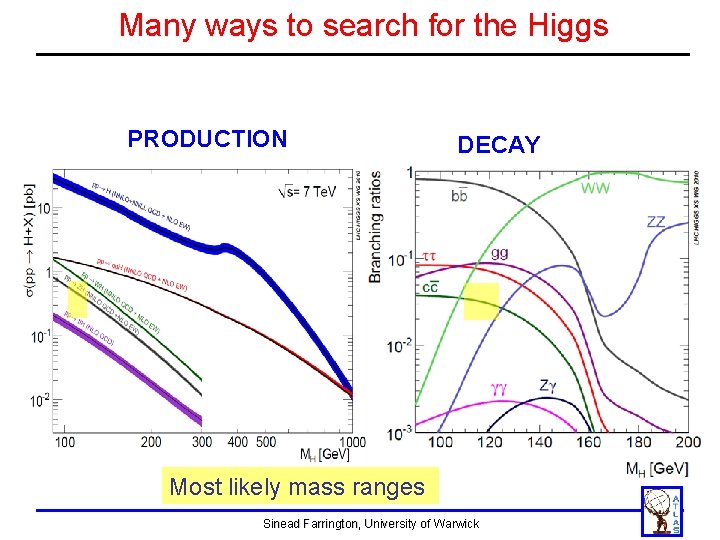
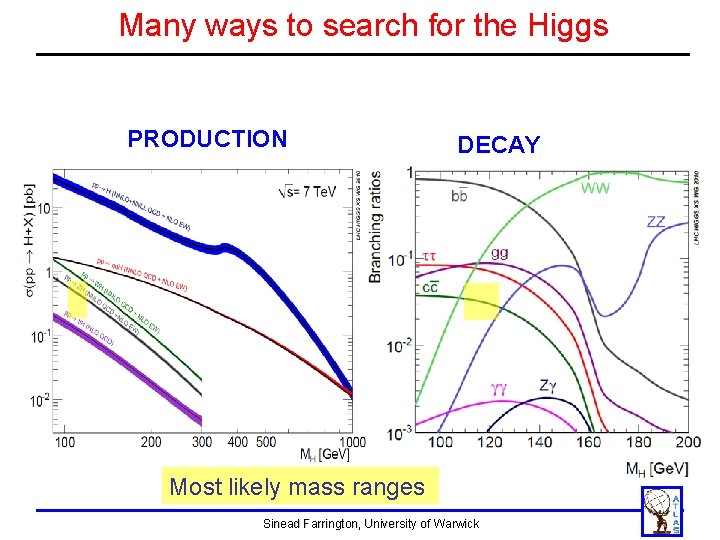
How to look for Higgs at the LHC? • • We didn’t know the Higgs Boson’s mass (not predicted directly by theory) Very different composition of PRODUCTION and DECAY mechanisms depending on mass Sinead Farrington, University of Warwick
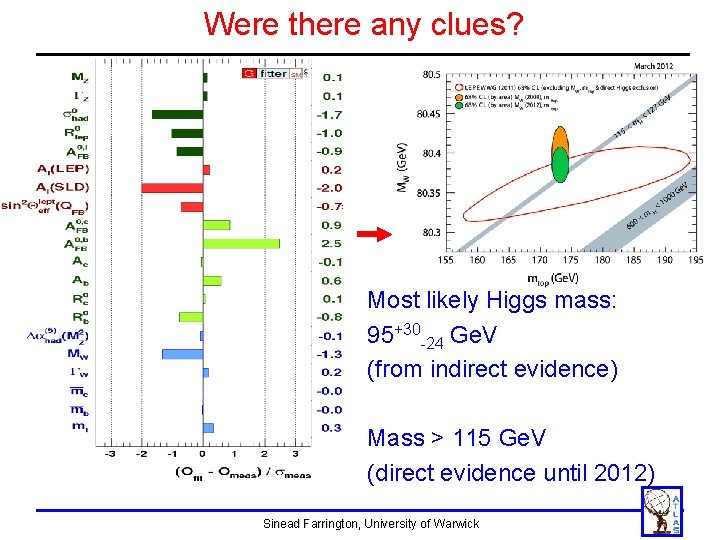
Were there any clues? • Yes! Most likely Higgs mass: 95+30 -24 Ge. V (from indirect evidence) Mass > 115 Ge. V (direct evidence until 2012) Sinead Farrington, University of Warwick
Many ways to search for the Higgs PRODUCTION DECAY Most likely mass ranges Sinead Farrington, University of Warwick
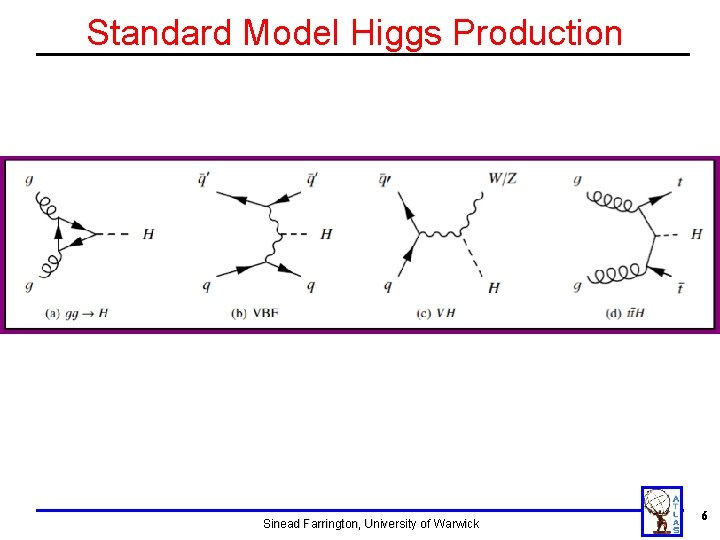
Standard Model Higgs Production Sinead Farrington, University of Warwick 6
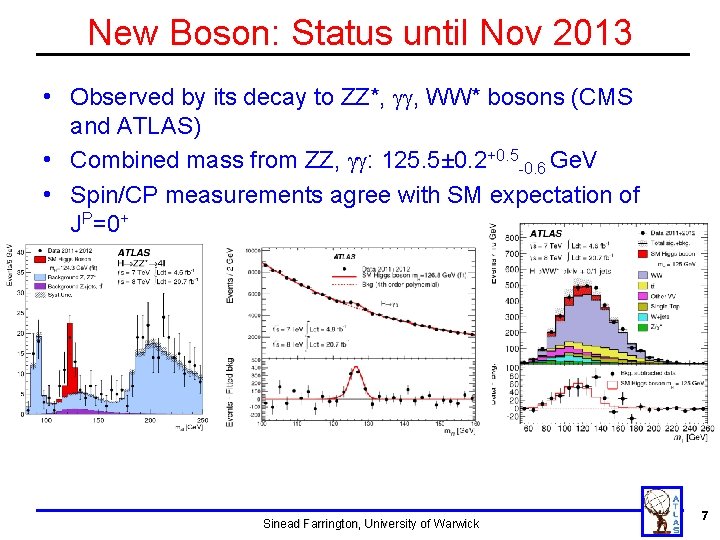
New Boson: Status until Nov 2013 • Observed by its decay to ZZ*, gg, WW* bosons (CMS and ATLAS) • Combined mass from ZZ, gg: 125. 5± 0. 2+0. 5 -0. 6 Ge. V • Spin/CP measurements agree with SM expectation of JP=0+ Sinead Farrington, University of Warwick 7
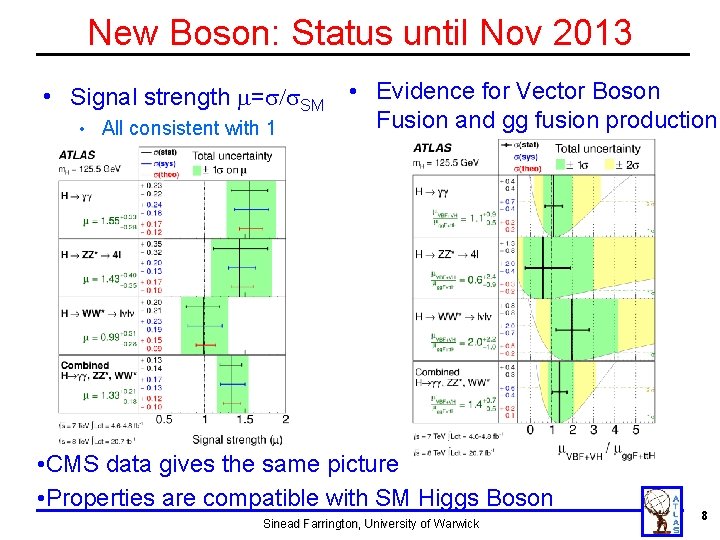
New Boson: Status until Nov 2013 • Signal strength m=s/s. SM • Evidence for Vector Boson • All consistent with 1 Fusion and gg fusion production • CMS data gives the same picture • Properties are compatible with SM Higgs Boson Sinead Farrington, University of Warwick 8
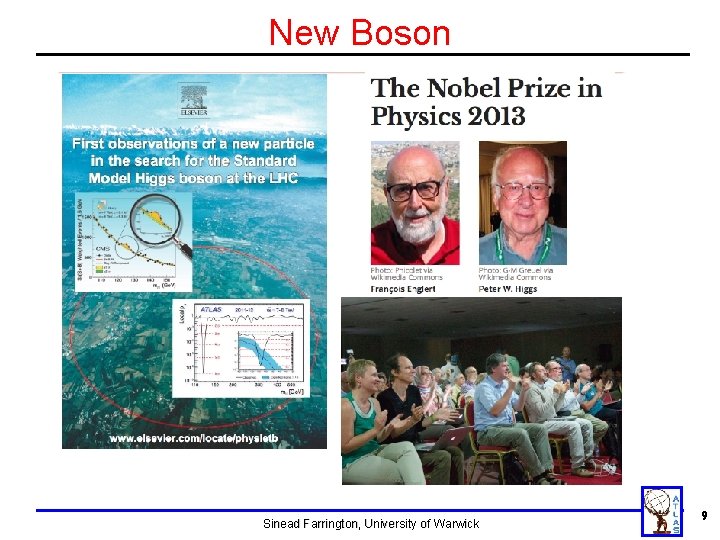
New Boson Sinead Farrington, University of Warwick 9
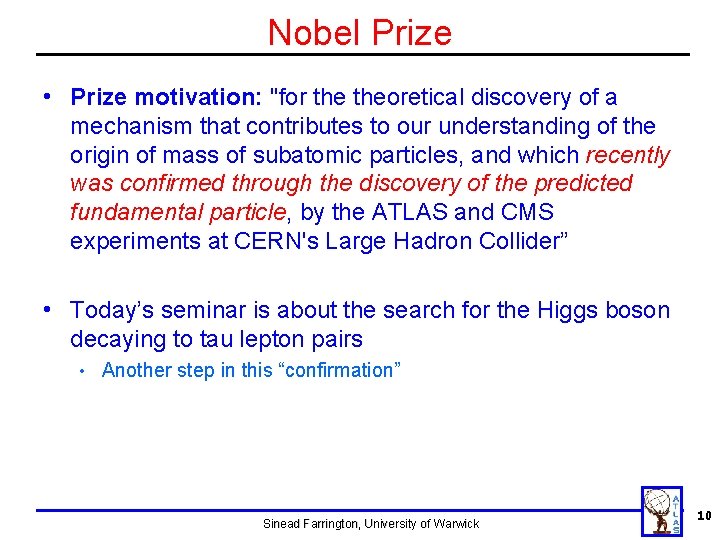
Nobel Prize • Prize motivation: "for theoretical discovery of a mechanism that contributes to our understanding of the origin of mass of subatomic particles, and which recently was confirmed through the discovery of the predicted fundamental particle, by the ATLAS and CMS experiments at CERN's Large Hadron Collider” • Today’s seminar is about the search for the Higgs boson decaying to tau lepton pairs • Another step in this “confirmation” Sinead Farrington, University of Warwick 10
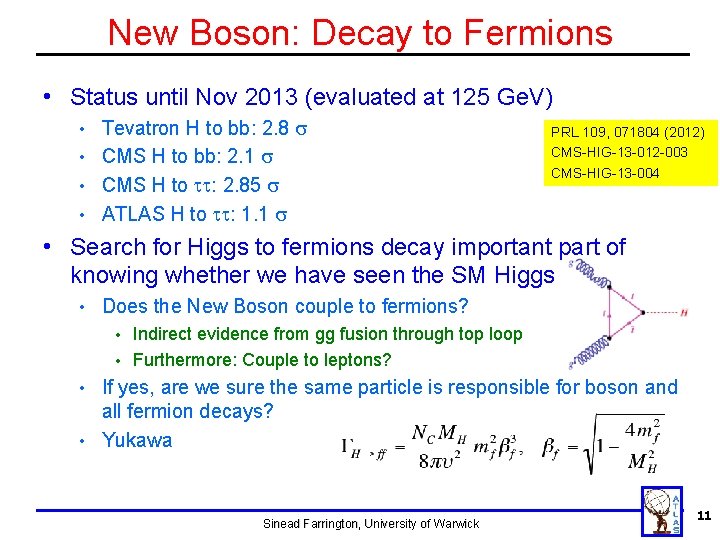
New Boson: Decay to Fermions • Status until Nov 2013 (evaluated at 125 Ge. V) Tevatron H to bb: 2. 8 s • CMS H to bb: 2. 1 s • CMS H to tt: 2. 85 s • ATLAS H to tt: 1. 1 s • PRL 109, 071804 (2012) CMS-HIG-13 -012 -003 CMS-HIG-13 -004 • Search for Higgs to fermions decay important part of knowing whether we have seen the SM Higgs • Does the New Boson couple to fermions? Indirect evidence from gg fusion through top loop • Furthermore: Couple to leptons? • If yes, are we sure the same particle is responsible for boson and all fermion decays? • Yukawa • Sinead Farrington, University of Warwick 11
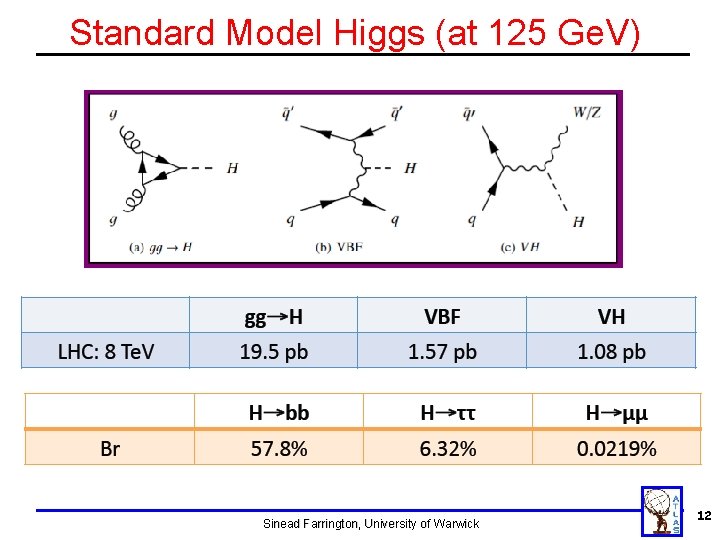
Standard Model Higgs (at 125 Ge. V) Sinead Farrington, University of Warwick 12
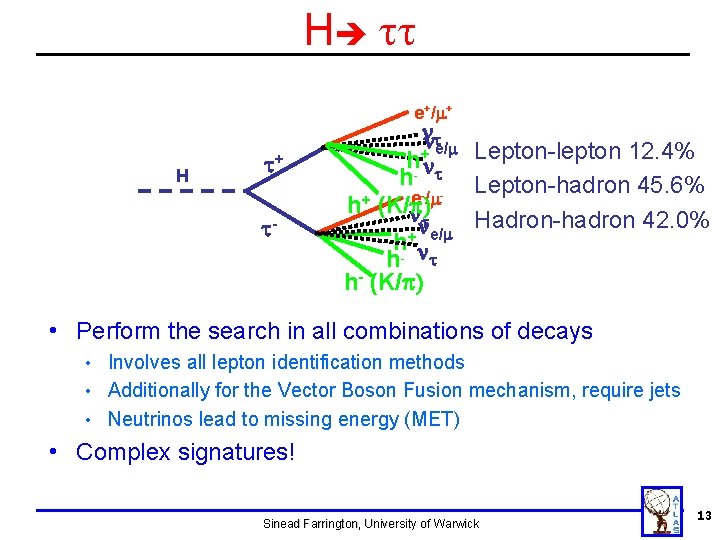
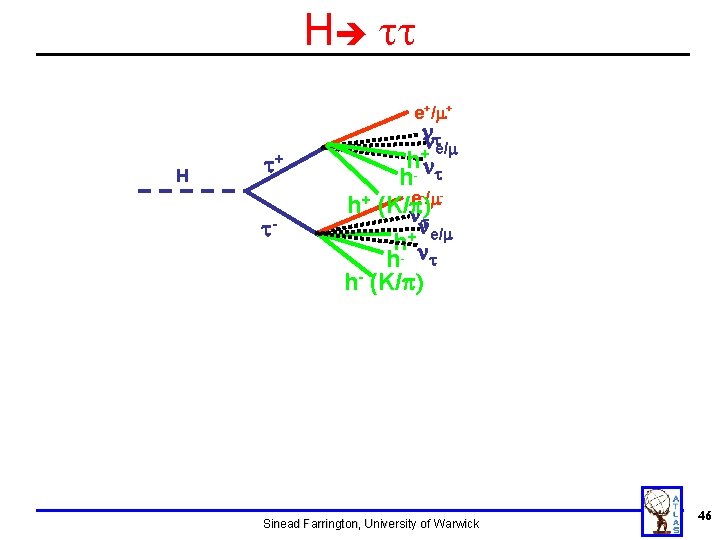
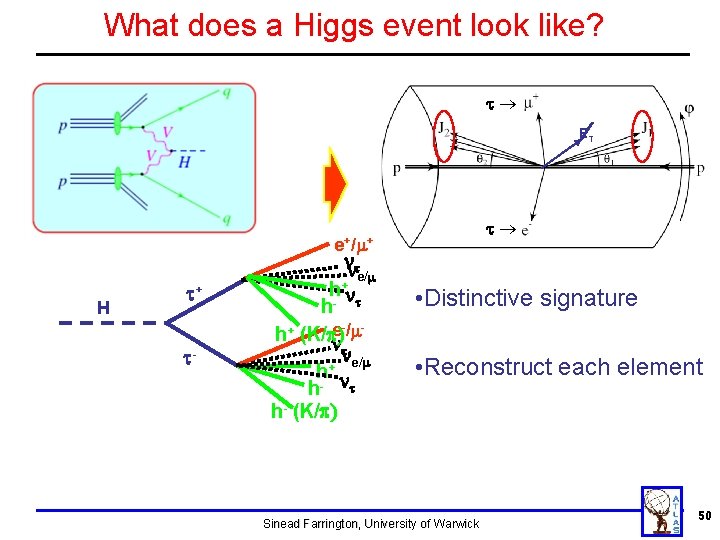
H tt e+/m+ H t+ t- nnt e/m Lepton-lepton 12. 4% h- +n h t Lepton-hadron 45. 6% -/me + h (K/p) nnt Hadron-hadron 42. 0% e/m + h- n h t h- (K/p) • Perform the search in all combinations of decays Involves all lepton identification methods • Additionally for the Vector Boson Fusion mechanism, require jets • Neutrinos lead to missing energy (MET) • • Complex signatures! Sinead Farrington, University of Warwick 13
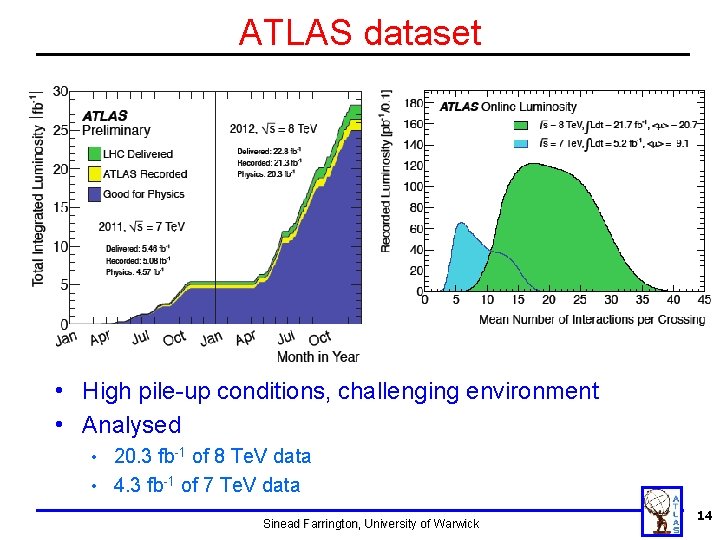
ATLAS dataset • High pile-up conditions, challenging environment • Analysed 20. 3 fb-1 of 8 Te. V data • 4. 3 fb-1 of 7 Te. V data • Sinead Farrington, University of Warwick 14
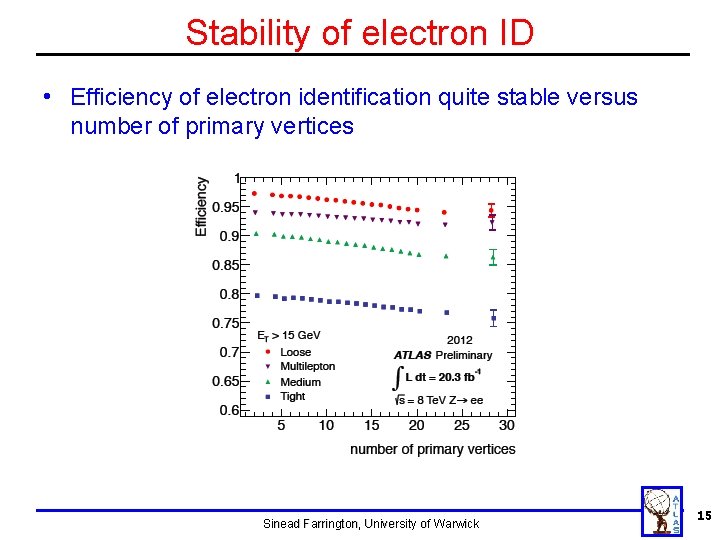
Stability of electron ID • Efficiency of electron identification quite stable versus number of primary vertices Sinead Farrington, University of Warwick 15
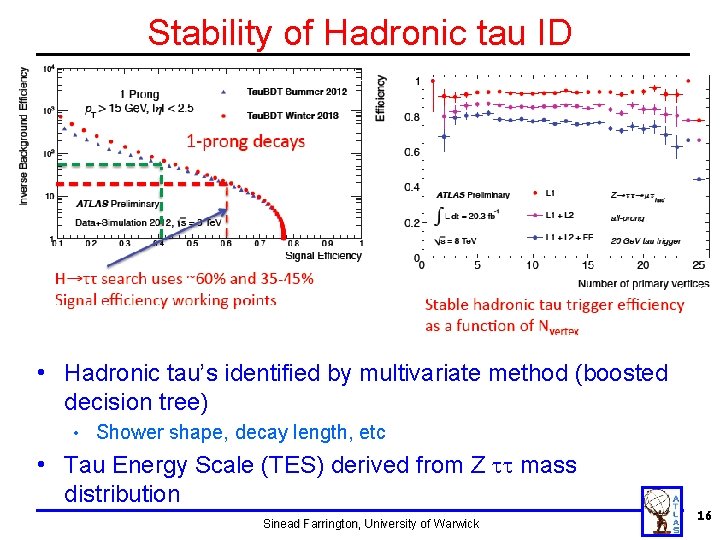
Stability of Hadronic tau ID • Hadronic tau’s identified by multivariate method (boosted decision tree) • Shower shape, decay length, etc • Tau Energy Scale (TES) derived from Z tt mass distribution Sinead Farrington, University of Warwick 16
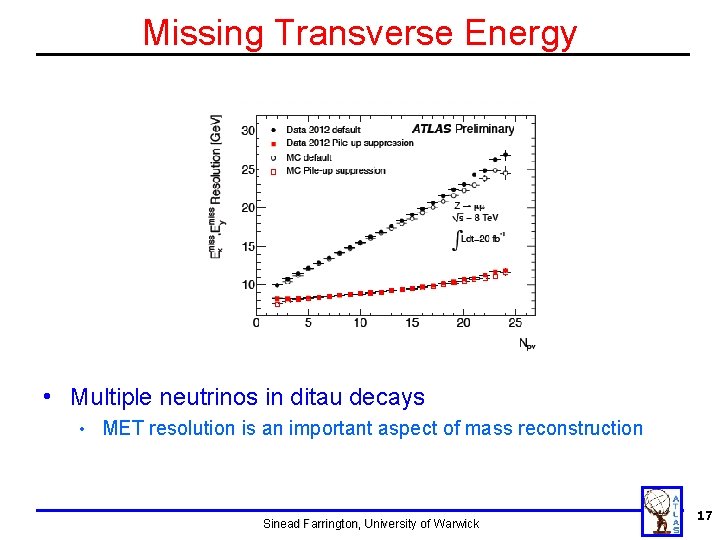
Missing Transverse Energy • Multiple neutrinos in ditau decays • MET resolution is an important aspect of mass reconstruction Sinead Farrington, University of Warwick 17
ATLAS H to tt Analysis • Does the same boson observed to decay to WW*, ZZ*, gg, couple to t leptons? • Try to answer this with a multivariate analysis (BDT) • Data blinded • BDT trained to distinguish SM Higgs signal samples from backgrounds Sinead Farrington, University of Warwick 18
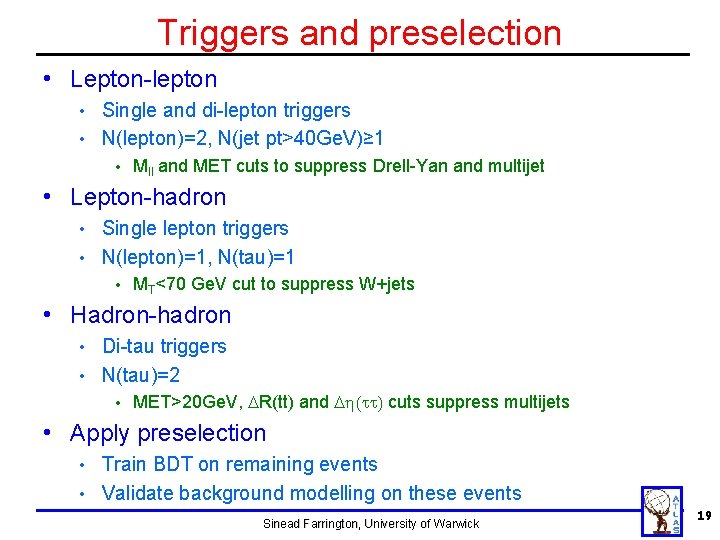
Triggers and preselection • Lepton-lepton Single and di-lepton triggers • N(lepton)=2, N(jet pt>40 Ge. V)≥ 1 • • Mll and MET cuts to suppress Drell-Yan and multijet • Lepton-hadron Single lepton triggers • N(lepton)=1, N(tau)=1 • • MT<70 Ge. V cut to suppress W+jets • Hadron-hadron Di-tau triggers • N(tau)=2 • • MET>20 Ge. V, DR(tt) and Dh(tt) cuts suppress multijets • Apply preselection Train BDT on remaining events • Validate background modelling on these events • Sinead Farrington, University of Warwick 19
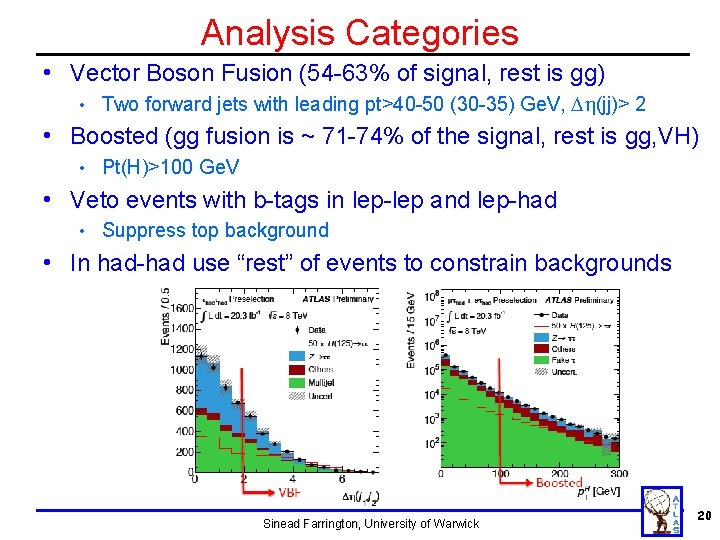
Analysis Categories • Vector Boson Fusion (54 -63% of signal, rest is gg) • Two forward jets with leading pt>40 -50 (30 -35) Ge. V, Dh(jj)> 2 • Boosted (gg fusion is ~ 71 -74% of the signal, rest is gg, VH) • Pt(H)>100 Ge. V • Veto events with b-tags in lep-lep and lep-had • Suppress top background • In had-had use “rest” of events to constrain backgrounds Sinead Farrington, University of Warwick 20
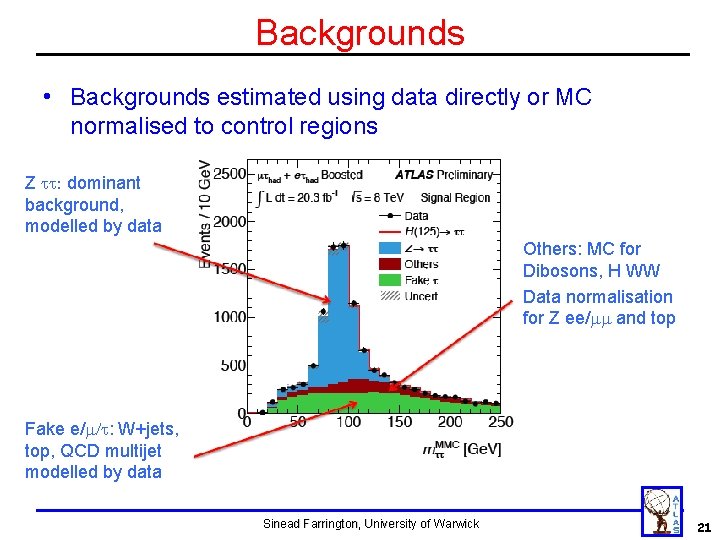
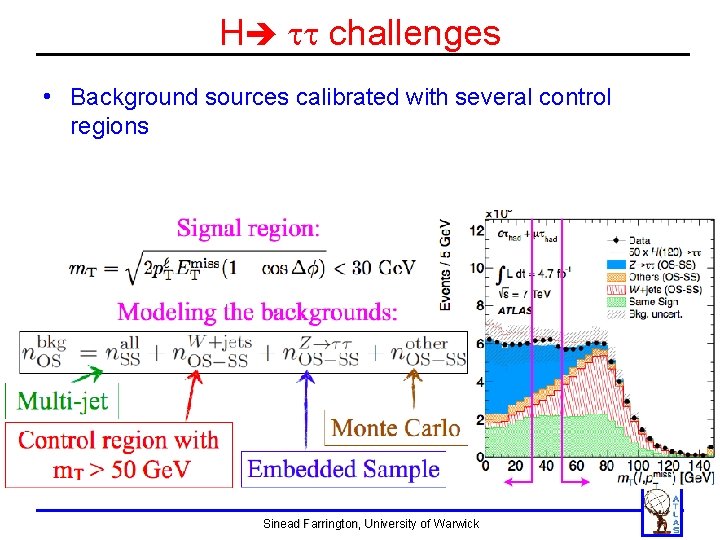
Backgrounds • Backgrounds estimated using data directly or MC normalised to control regions Z tt: dominant background, modelled by data Others: MC for Dibosons, H WW Data normalisation for Z ee/mm and top Fake e/m/t: W+jets, top, QCD multijet modelled by data Sinead Farrington, University of Warwick 21
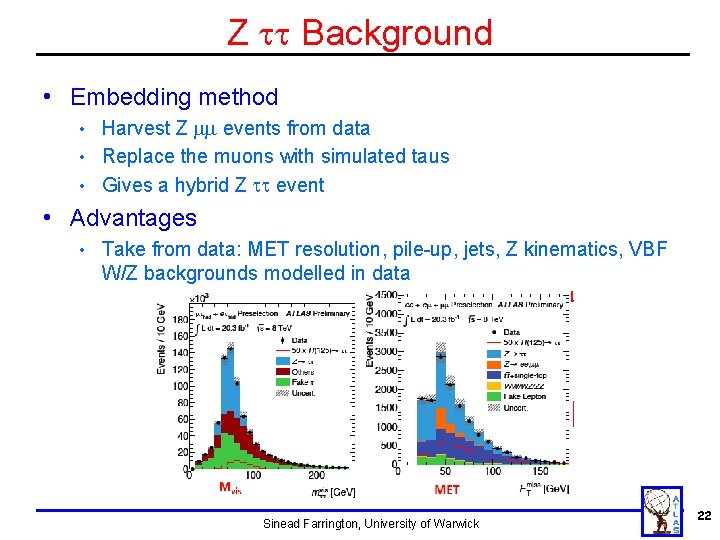
Z tt Background • Embedding method Harvest Z mm events from data • Replace the muons with simulated taus • Gives a hybrid Z tt event • • Advantages • Take from data: MET resolution, pile-up, jets, Z kinematics, VBF W/Z backgrounds modelled in data Sinead Farrington, University of Warwick 22
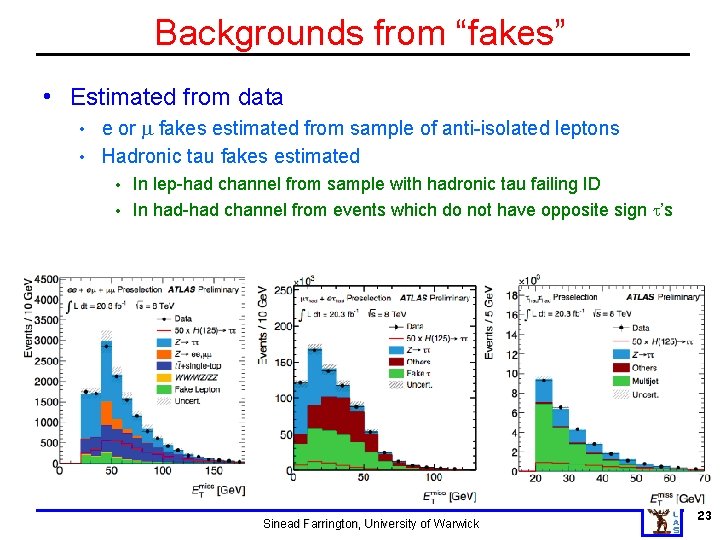
Backgrounds from “fakes” • Estimated from data e or m fakes estimated from sample of anti-isolated leptons • Hadronic tau fakes estimated • In lep-had channel from sample with hadronic tau failing ID • In had-had channel from events which do not have opposite sign t’s • Sinead Farrington, University of Warwick 23
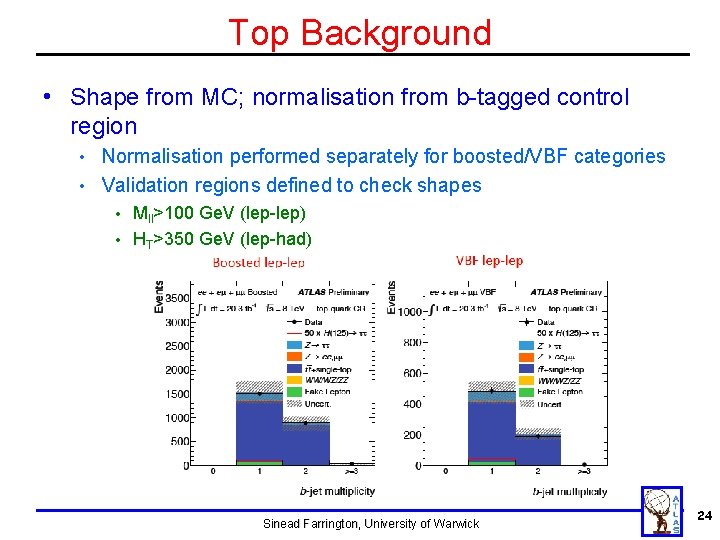
Top Background • Shape from MC; normalisation from b-tagged control region Normalisation performed separately for boosted/VBF categories • Validation regions defined to check shapes • Mll>100 Ge. V (lep-lep) • HT>350 Ge. V (lep-had) • Sinead Farrington, University of Warwick 24
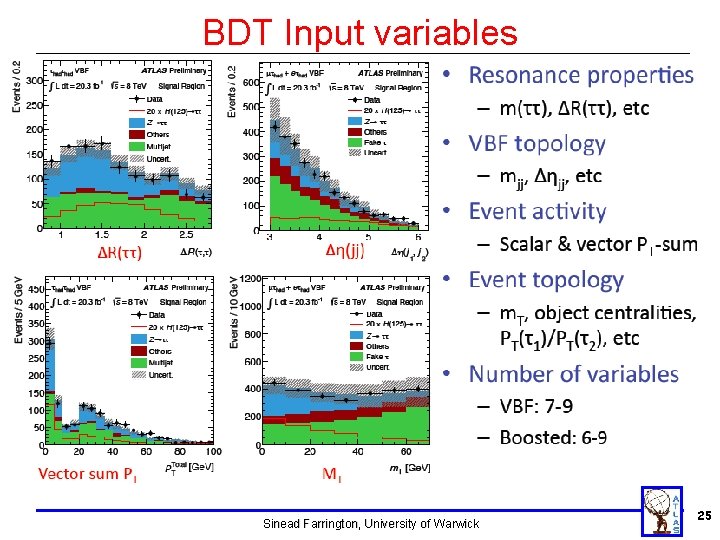
BDT Input variables Sinead Farrington, University of Warwick 25
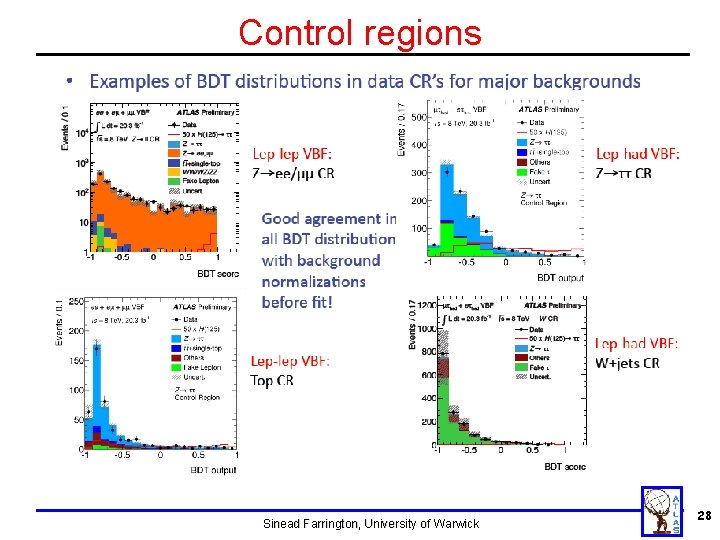
Pre-fit steps • Check modelling of all input variables • And the modelling of the correlations among them • Control regions are fitted simultaneously with signal regions to constrain • • • Z ee/mm + jets in lep-lep, lep-had Top in lep-lep, lep-had W+jets in lep-had Fakes in lep-lep QCD(multijet) in had-had • Fit performed in 60 -100 and 140+ Ge. V sidebands • Provides check of background model, especially Z tt Sinead Farrington, University of Warwick 26
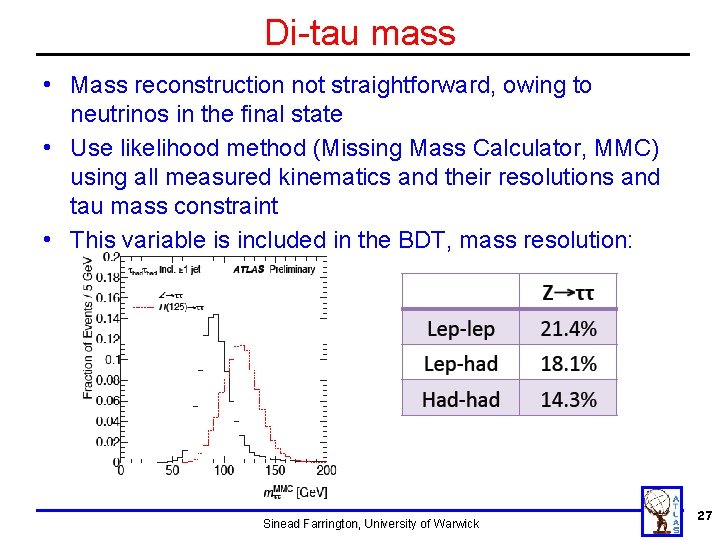
Di-tau mass • Mass reconstruction not straightforward, owing to neutrinos in the final state • Use likelihood method (Missing Mass Calculator, MMC) using all measured kinematics and their resolutions and tau mass constraint • This variable is included in the BDT, mass resolution: Sinead Farrington, University of Warwick 27
Control regions Sinead Farrington, University of Warwick 28
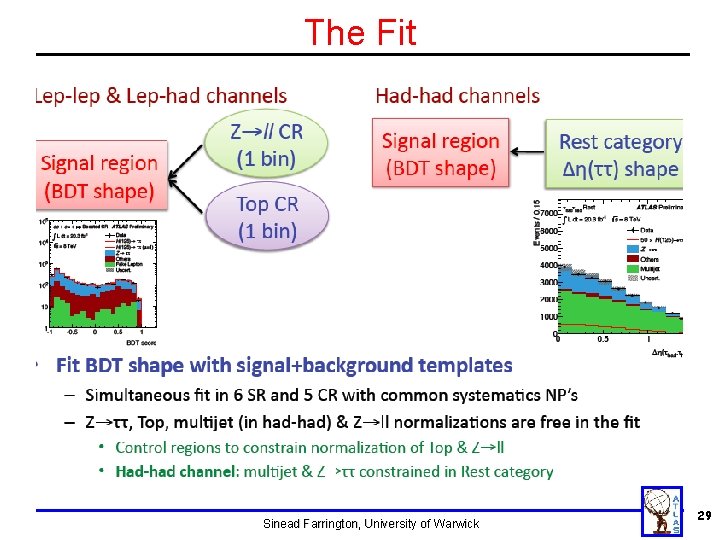
The Fit Sinead Farrington, University of Warwick 29
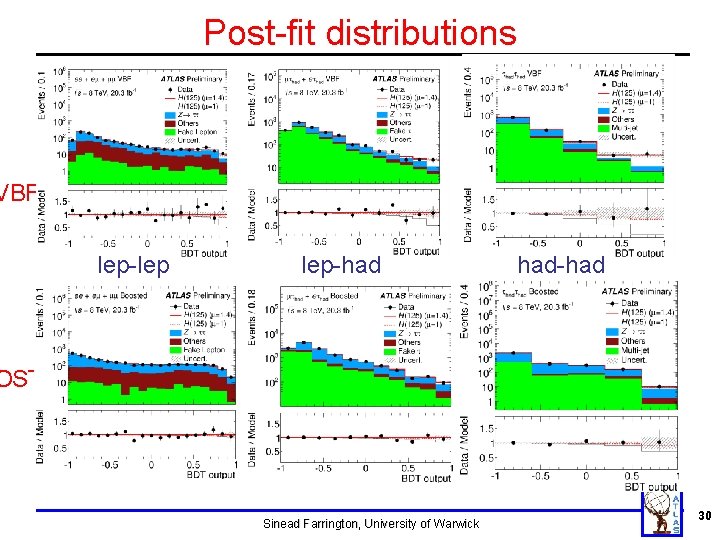
Post-fit distributions VBF lep-lep lep-had had-had OSTED Sinead Farrington, University of Warwick 30
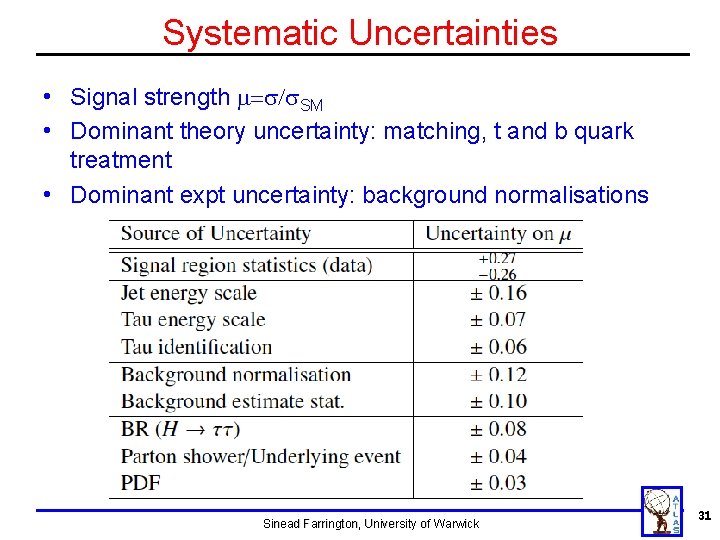
Systematic Uncertainties • Signal strength m=s/s. SM • Dominant theory uncertainty: matching, t and b quark treatment • Dominant expt uncertainty: background normalisations Sinead Farrington, University of Warwick 31
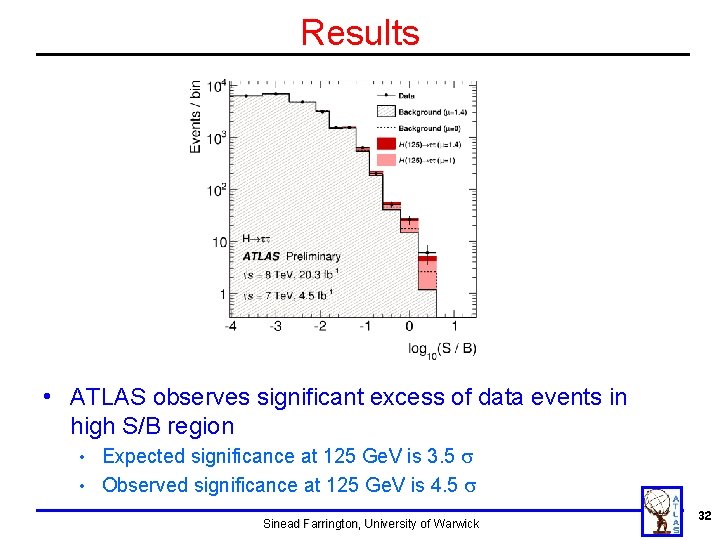
Results • ATLAS observes significant excess of data events in high S/B region Expected significance at 125 Ge. V is 3. 5 s • Observed significance at 125 Ge. V is 4. 5 s • Sinead Farrington, University of Warwick 32
Results • ATLAS observes significant excess of data events in high S/B region Expected significance at 125 Ge. V is 3. 5 s • Observed significance at 125 Ge. V is 4. 5 s • Sinead Farrington, University of Warwick 33
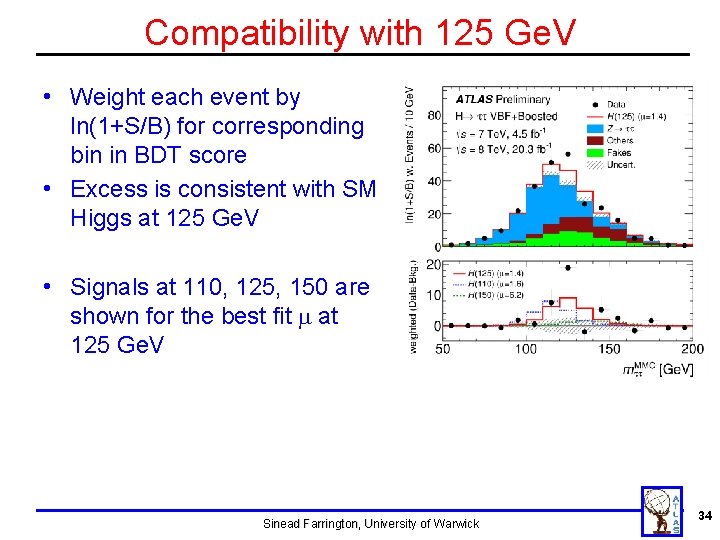
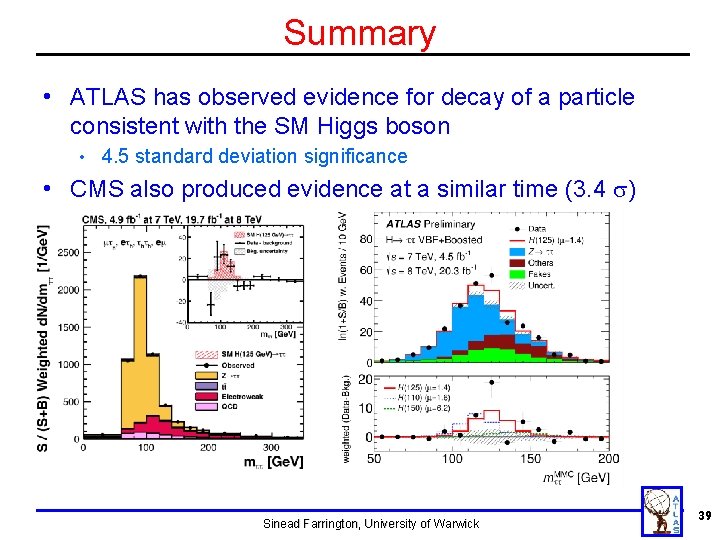
Compatibility with 125 Ge. V • Weight each event by ln(1+S/B) for corresponding bin in BDT score • Excess is consistent with SM Higgs at 125 Ge. V • Signals at 110, 125, 150 are shown for the best fit m at 125 Ge. V Sinead Farrington, University of Warwick 34
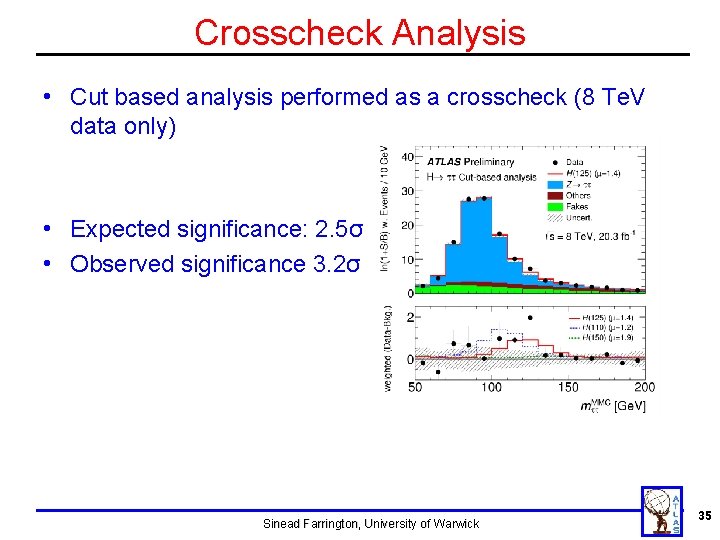
Crosscheck Analysis • Cut based analysis performed as a crosscheck (8 Te. V data only) • Expected significance: 2. 5σ • Observed significance 3. 2σ Sinead Farrington, University of Warwick 35
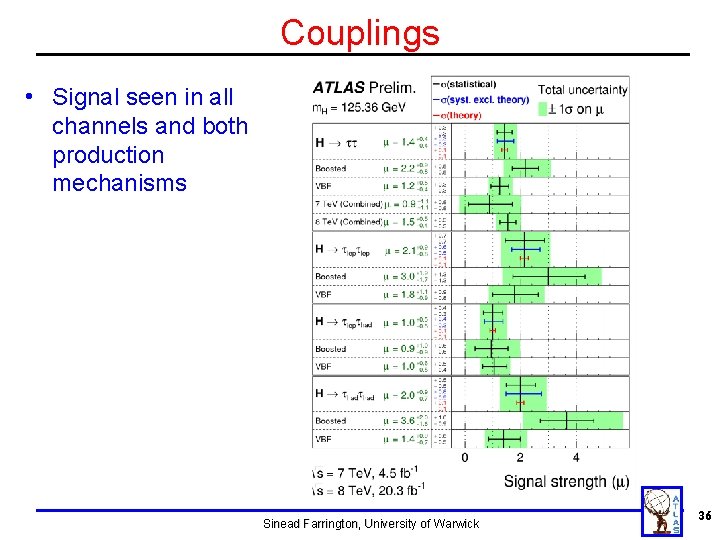
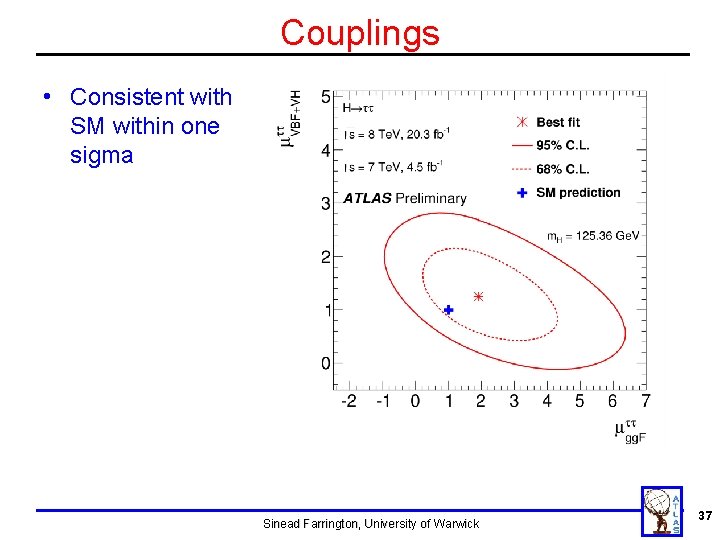
Couplings • Signal seen in all channels and both production mechanisms Sinead Farrington, University of Warwick 36
Couplings • Consistent with SM within one sigma Sinead Farrington, University of Warwick 37
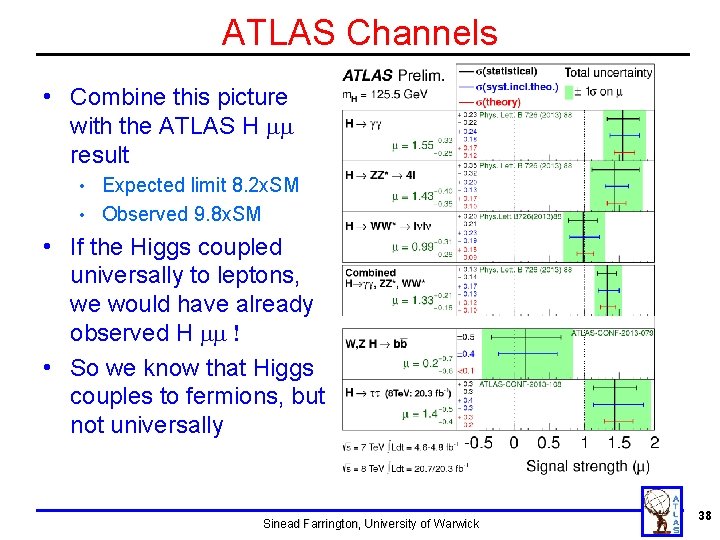
ATLAS Channels • Combine this picture with the ATLAS H mm result Expected limit 8. 2 x. SM • Observed 9. 8 x. SM • • If the Higgs coupled universally to leptons, we would have already observed H mm ! • So we know that Higgs couples to fermions, but not universally Sinead Farrington, University of Warwick 38
Summary • ATLAS has observed evidence for decay of a particle consistent with the SM Higgs boson • 4. 5 standard deviation significance • CMS also produced evidence at a similar time (3. 4 s) Sinead Farrington, University of Warwick 39
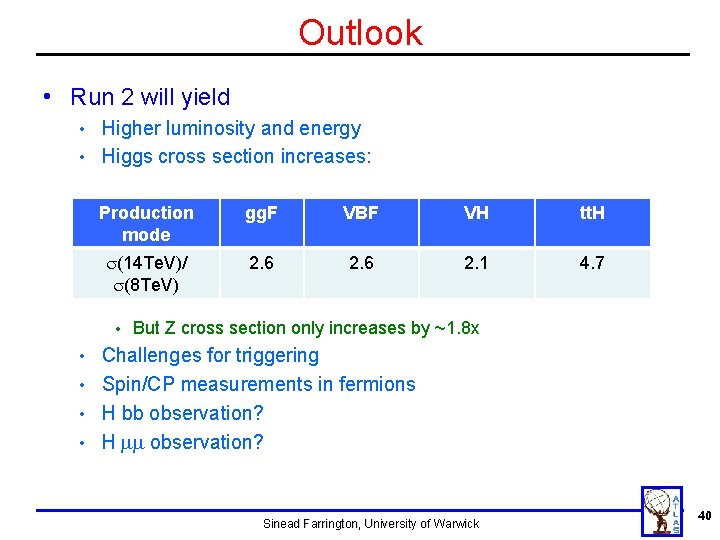
Outlook • Run 2 will yield Higher luminosity and energy • Higgs cross section increases: • Production mode gg. F VBF VH tt. H s(14 Te. V)/ s(8 Te. V) 2. 6 2. 1 4. 7 • But Z cross section only increases by ~1. 8 x Challenges for triggering • Spin/CP measurements in fermions • H bb observation? • H mm observation? • Sinead Farrington, University of Warwick 40
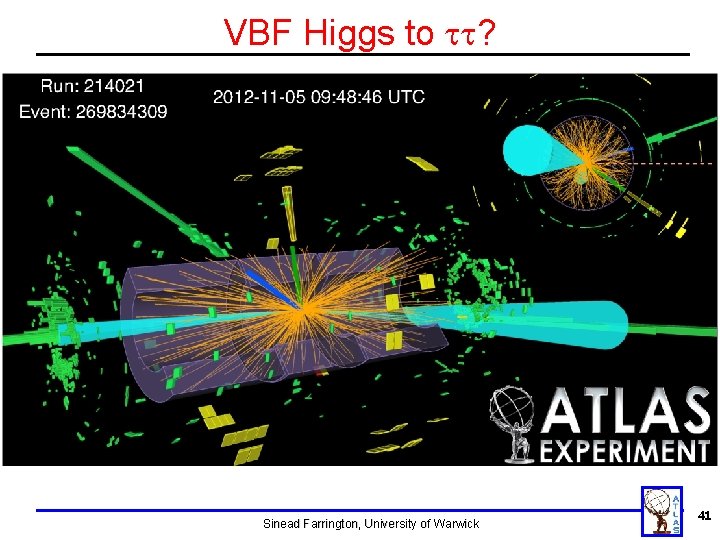
VBF Higgs to tt? Sinead Farrington, University of Warwick 41
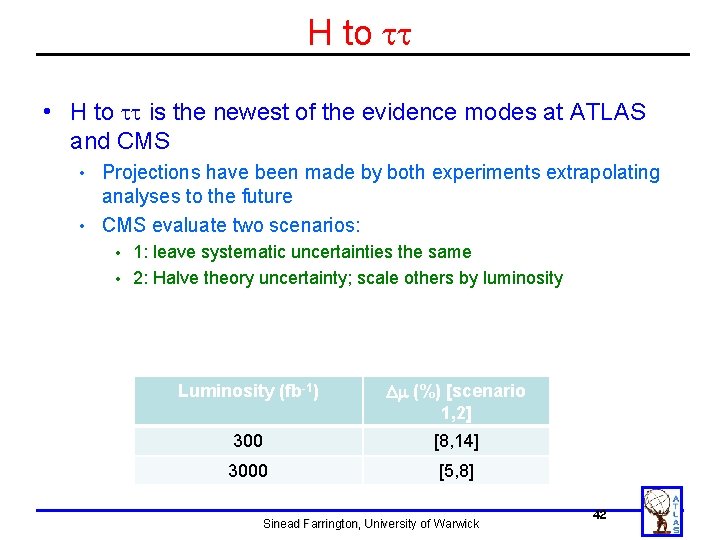
H to tt • H to tt is the newest of the evidence modes at ATLAS and CMS Projections have been made by both experiments extrapolating analyses to the future • CMS evaluate two scenarios: • 1: leave systematic uncertainties the same • 2: Halve theory uncertainty; scale others by luminosity • Luminosity (fb-1) Dm (%) [scenario 1, 2] 300 [8, 14] 3000 [5, 8] Sinead Farrington, University of Warwick 42
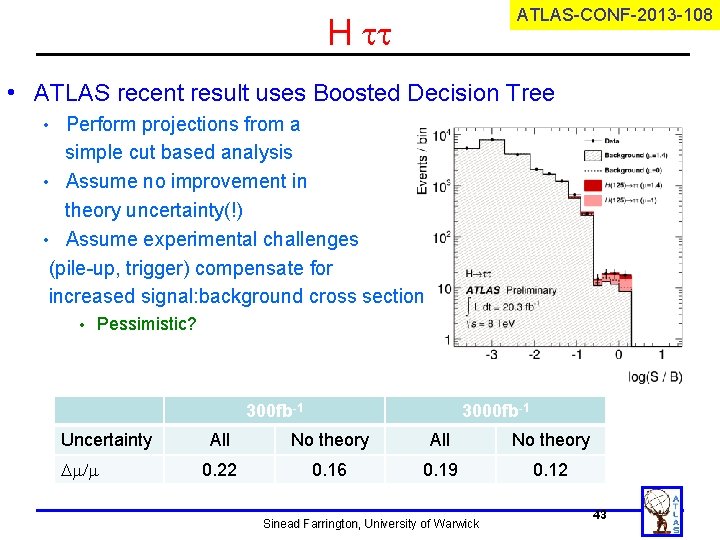
ATLAS-CONF-2013 -108 H tt • ATLAS recent result uses Boosted Decision Tree Perform projections from a simple cut based analysis • Assume no improvement in theory uncertainty(!) • Assume experimental challenges (pile-up, trigger) compensate for increased signal: background cross section • • Pessimistic? 300 fb-1 Uncertainty Dm/m 3000 fb-1 All No theory 0. 22 0. 16 0. 19 0. 12 Sinead Farrington, University of Warwick 43
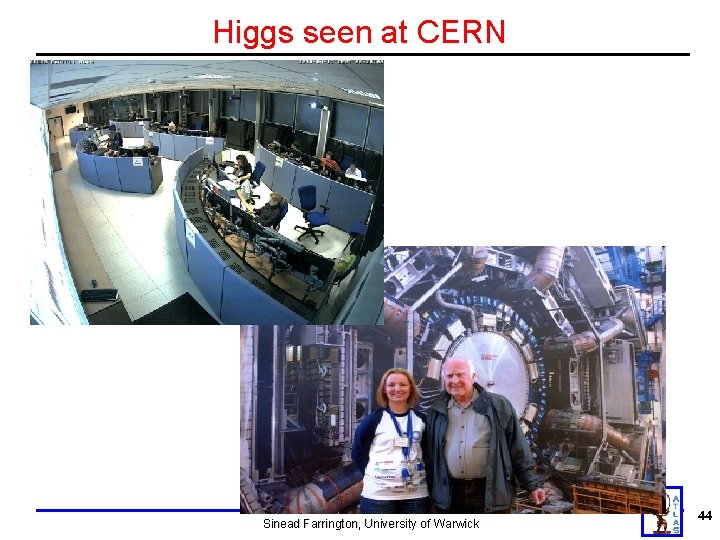
Higgs seen at CERN Sinead Farrington, University of Warwick 44
Many ways to search for the Higgs PRODUCTION DECAY Most likely mass ranges Sinead Farrington, University of Warwick
H tt e+/m+ H nnt e/m h- +n h t t+ t- h+ -/me (K/p) nnt h- +ne/m h t h- (K/p) Sinead Farrington, University of Warwick 46
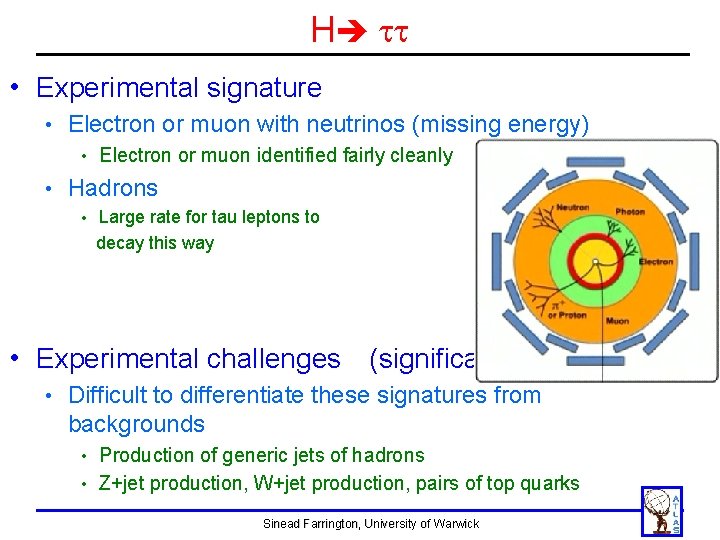
H tt • Experimental signature • Electron or muon with neutrinos (missing energy) • • Electron or muon identified fairly cleanly Hadrons • Large rate for tau leptons to decay this way • Experimental challenges (significant) • Difficult to differentiate these signatures from backgrounds Production of generic jets of hadrons • Z+jet production, W+jet production, pairs of top quarks • Sinead Farrington, University of Warwick
H tt challenges • Background sources calibrated with several control regions Sinead Farrington, University of Warwick
Future • Key properties of this new boson will take some time to ascertain This was always anticipated • In fact we are fortuitous in nature’s choice for the Higgs mass – all decay modes are accessible at this point • • Key to characterising this particle are Production and decay rates • Spin: first measurements made public last week! • Mass (to greater precision) • • Switch from search mode to precision physics Sinead Farrington, University of Warwick
What does a Higgs event look like? t ET t e+/m+ H t+ t- nnt e/m h+n h- t e-/mh+ (K/p) nt ne/m + h n h- t • Distinctive signature • Reconstruct each element h- (K/p) Sinead Farrington, University of Warwick 50
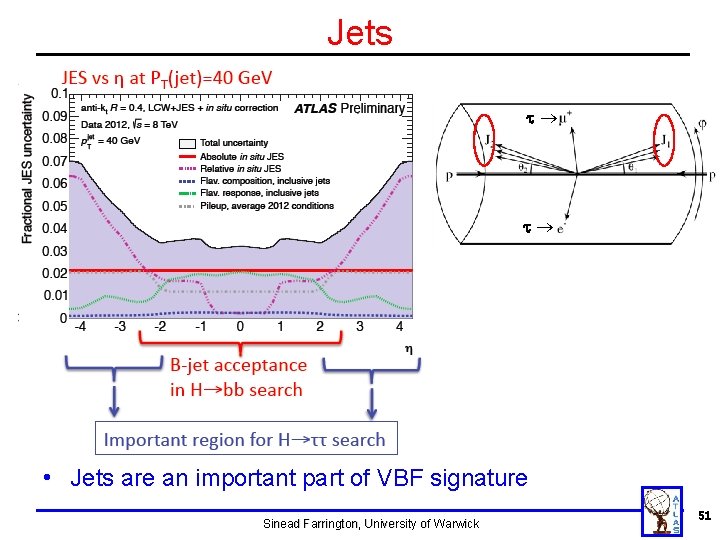
Jets t t • Jets are an important part of VBF signature Sinead Farrington, University of Warwick 51