Intro to the Solar System I How did

- Slides: 28
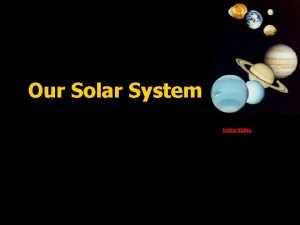
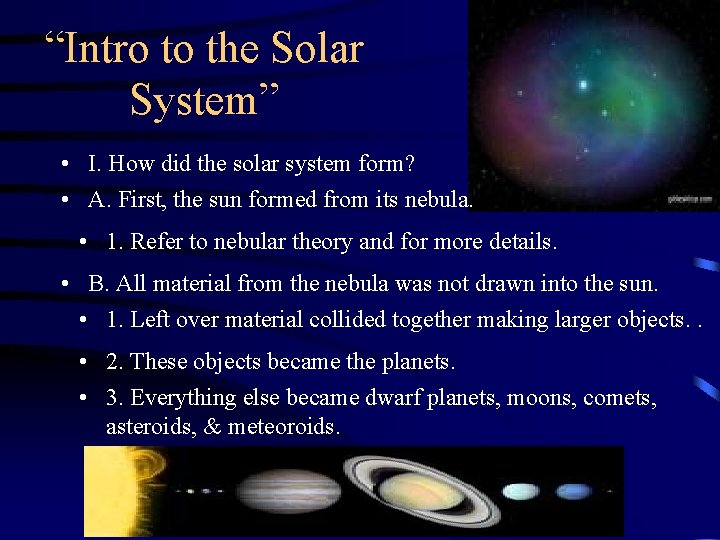
“Intro to the Solar System” • I. How did the solar system form? • A. First, the sun formed from its nebula. • 1. Refer to nebular theory and for more details. • B. All material from the nebula was not drawn into the sun. • 1. Left over material collided together making larger objects. . • 2. These objects became the planets. • 3. Everything else became dwarf planets, moons, comets, asteroids, & meteoroids.
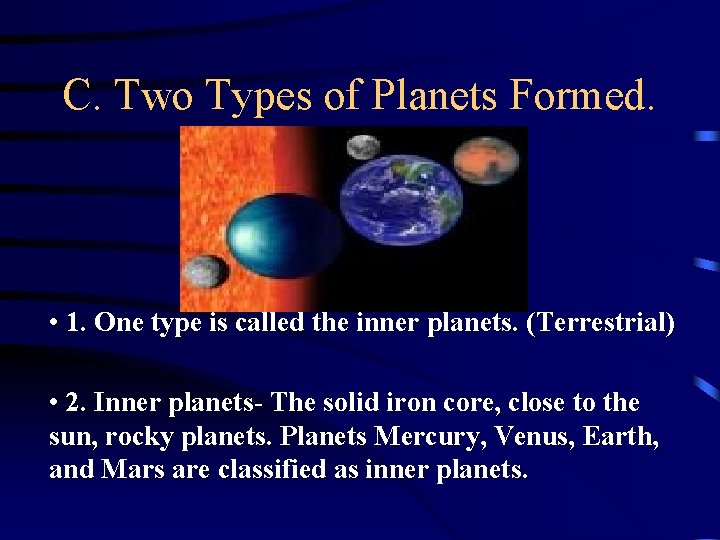
C. Two Types of Planets Formed. • 1. One type is called the inner planets. (Terrestrial) • 2. Inner planets- The solid iron core, close to the sun, rocky planets. Planets Mercury, Venus, Earth, and Mars are classified as inner planets.
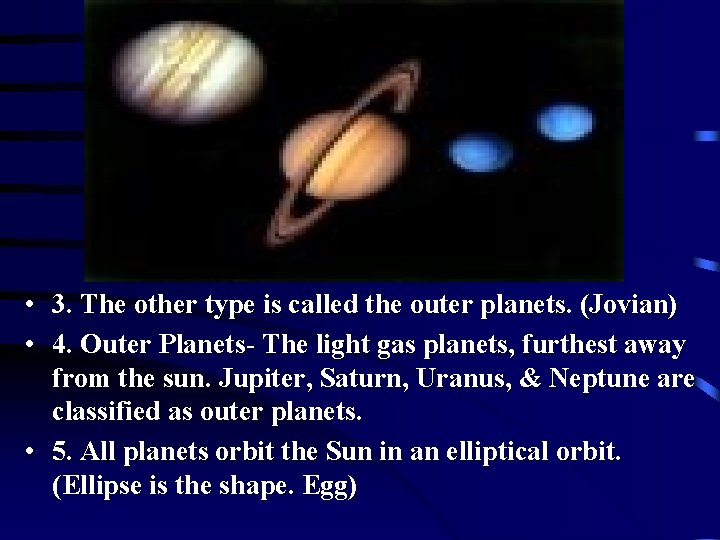
• 3. The other type is called the outer planets. (Jovian) • 4. Outer Planets- The light gas planets, furthest away from the sun. Jupiter, Saturn, Uranus, & Neptune are classified as outer planets. • 5. All planets orbit the Sun in an elliptical orbit. (Ellipse is the shape. Egg)
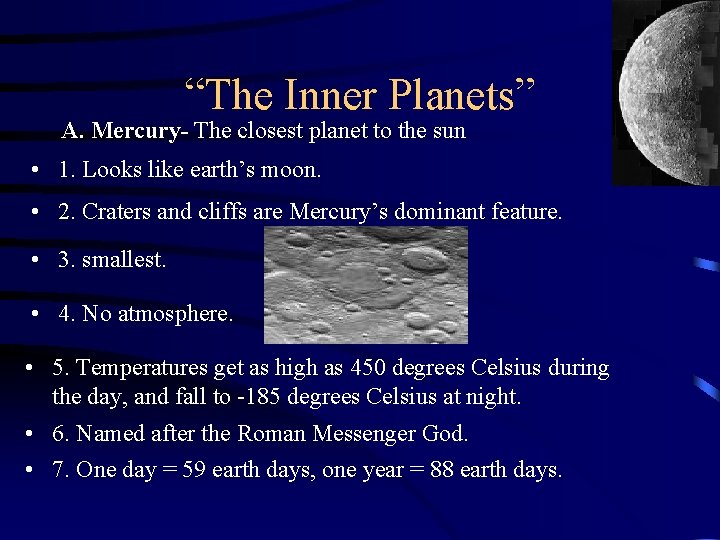
“The Inner Planets” A. Mercury- The closest planet to the sun • 1. Looks like earth’s moon. • 2. Craters and cliffs are Mercury’s dominant feature. • 3. smallest. • 4. No atmosphere. • 5. Temperatures get as high as 450 degrees Celsius during the day, and fall to -185 degrees Celsius at night. • 6. Named after the Roman Messenger God. • 7. One day = 59 earth days, one year = 88 earth days.
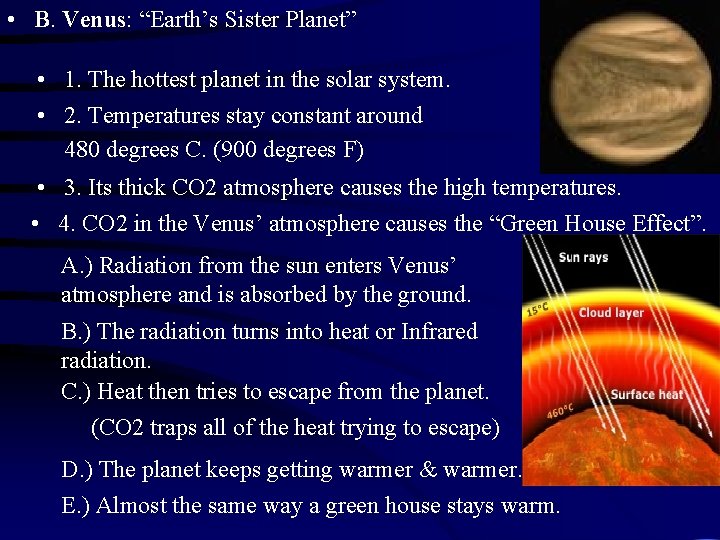
• B. Venus: Venus “Earth’s Sister Planet” • 1. The hottest planet in the solar system. • 2. Temperatures stay constant around 480 degrees C. (900 degrees F) • 3. Its thick CO 2 atmosphere causes the high temperatures. • 4. CO 2 in the Venus’ atmosphere causes the “Green House Effect”. A. ) Radiation from the sun enters Venus’ atmosphere and is absorbed by the ground. B. ) The radiation turns into heat or Infrared radiation. C. ) Heat then tries to escape from the planet. (CO 2 traps all of the heat trying to escape) D. ) The planet keeps getting warmer & warmer. E. ) Almost the same way a green house stays warm.
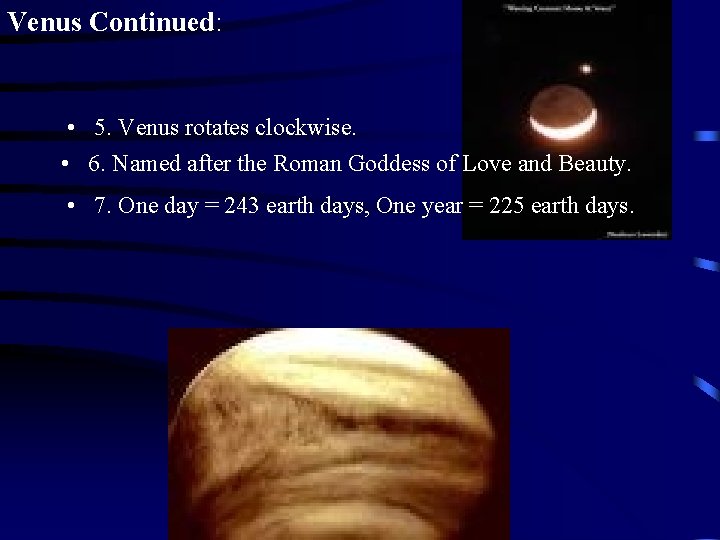
Venus Continued: • 5. Venus rotates clockwise. • 6. Named after the Roman Goddess of Love and Beauty. • 7. One day = 243 earth days, One year = 225 earth days.
C. Earth: “Our Planet” • 1. The only planet that can support human life. • 2. Only planet that has all states of H 2 O on it. A. ) Solid = Ice B. ) Liquid = Water C. ) Gas = Water Vapor • 3. Has one moon. • 4. The only planet with live plate tectonics. • 5. Larger than three planets and smaller than four planets. • 6. One Day = 24 hours, One Year = 365. 25 days.
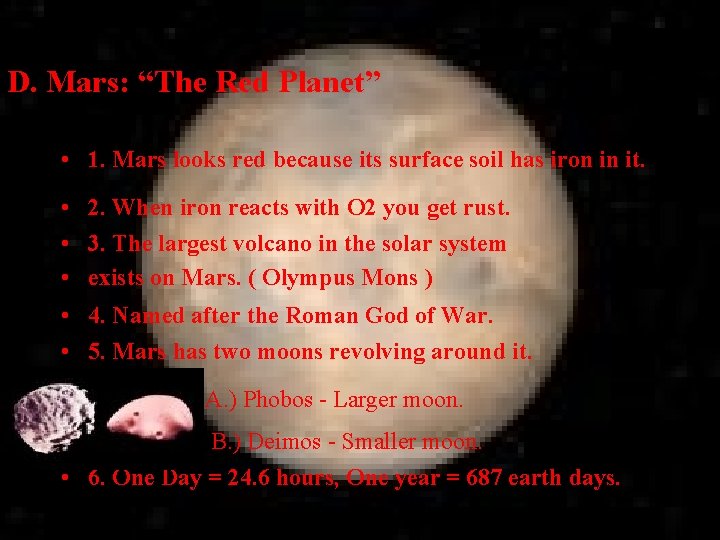
D. Mars: “The Red Planet” • 1. Mars looks red because its surface soil has iron in it. • 2. When iron reacts with O 2 you get rust. • 3. The largest volcano in the solar system • exists on Mars. ( Olympus Mons ) • 4. Named after the Roman God of War. • 5. Mars has two moons revolving around it. A. ) Phobos - Larger moon. B. ) Deimos - Smaller moon. • 6. One Day = 24. 6 hours, One year = 687 earth days.
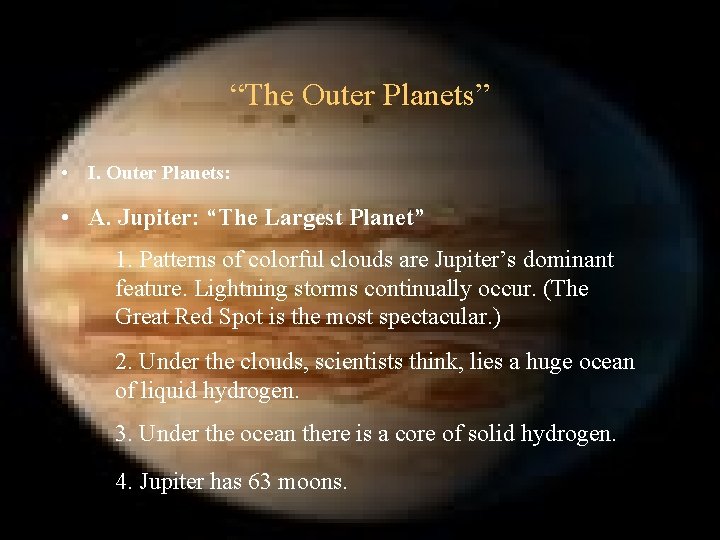
“The Outer Planets” • I. Outer Planets: • A. Jupiter: “The Largest Planet” 1. Patterns of colorful clouds are Jupiter’s dominant feature. Lightning storms continually occur. (The Great Red Spot is the most spectacular. ) 2. Under the clouds, scientists think, lies a huge ocean of liquid hydrogen. 3. Under the ocean there is a core of solid hydrogen. 4. Jupiter has 63 moons.
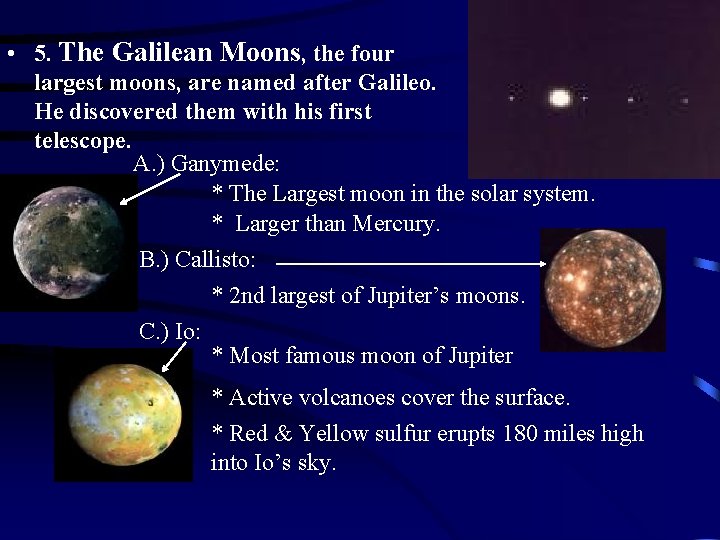
• 5. The Galilean Moons, the four largest moons, are named after Galileo. He discovered them with his first telescope. A. ) Ganymede: * The Largest moon in the solar system. * Larger than Mercury. B. ) Callisto: * 2 nd largest of Jupiter’s moons. C. ) Io: * Most famous moon of Jupiter * Active volcanoes cover the surface. * Red & Yellow sulfur erupts 180 miles high into Io’s sky.
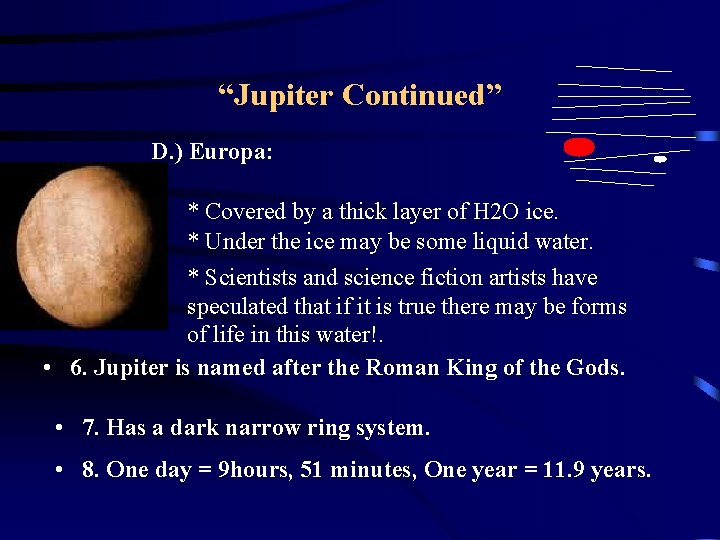
“Jupiter Continued” D. ) Europa: * Covered by a thick layer of H 2 O ice. * Under the ice may be some liquid water. * Scientists and science fiction artists have speculated that if it is true there may be forms of life in this water!. • 6. Jupiter is named after the Roman King of the Gods. • 7. Has a dark narrow ring system. • 8. One day = 9 hours, 51 minutes, One year = 11. 9 years.
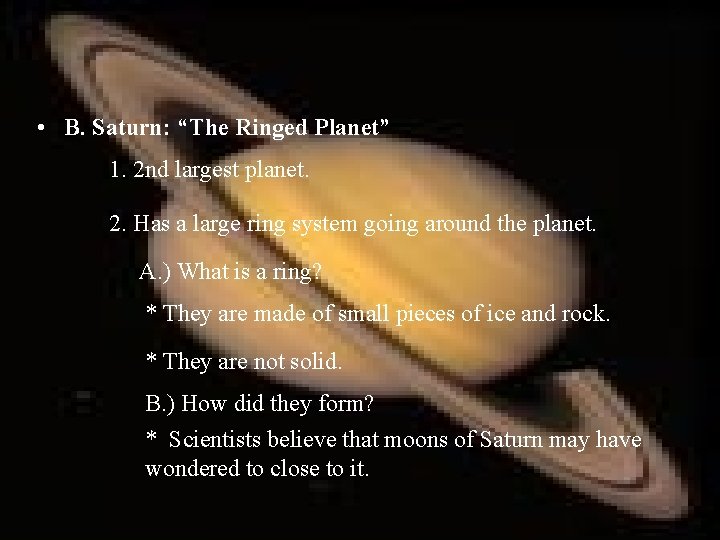
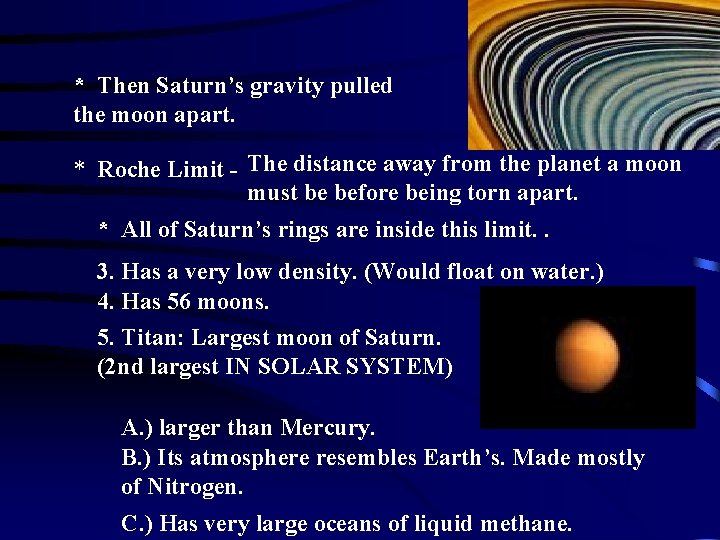
• B. Saturn: “The Ringed Planet” 1. 2 nd largest planet. 2. Has a large ring system going around the planet. A. ) What is a ring? * They are made of small pieces of ice and rock. * They are not solid. B. ) How did they form? * Scientists believe that moons of Saturn may have wondered to close to it.
* Then Saturn’s gravity pulled the moon apart. * Roche Limit - The distance away from the planet a moon must be before being torn apart. * All of Saturn’s rings are inside this limit. . 3. Has a very low density. (Would float on water. ) 4. Has 56 moons. 5. Titan: Largest moon of Saturn. (2 nd largest IN SOLAR SYSTEM) A. ) larger than Mercury. B. ) Its atmosphere resembles Earth’s. Made mostly of Nitrogen. C. ) Has very large oceans of liquid methane.
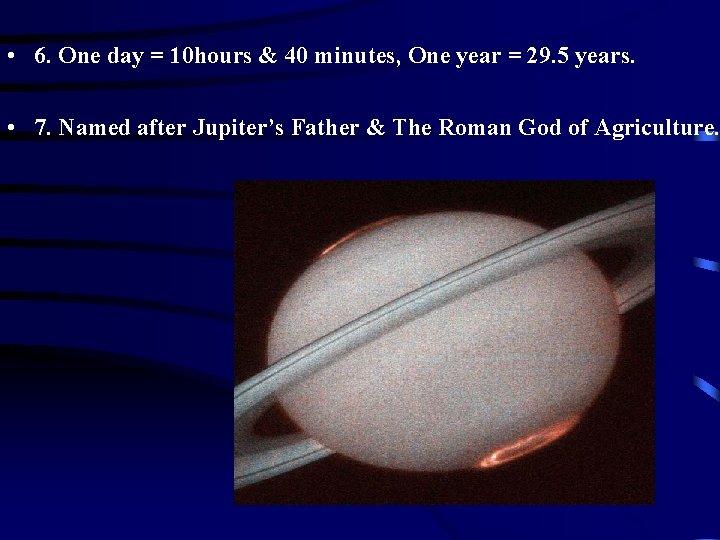
• 6. One day = 10 hours & 40 minutes, One year = 29. 5 years. • 7. Named after Jupiter’s Father & The Roman God of Agriculture.
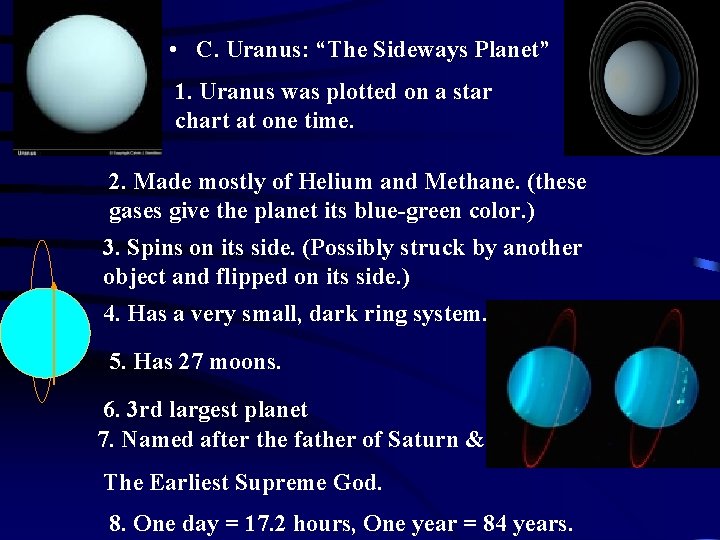
• C. Uranus: “The Sideways Planet” 1. Uranus was plotted on a star chart at one time. 2. Made mostly of Helium and Methane. (these gases give the planet its blue-green color. ) 3. Spins on its side. (Possibly struck by another object and flipped on its side. ) 4. Has a very small, dark ring system. 5. Has 27 moons. 6. 3 rd largest planet 7. Named after the father of Saturn & The Earliest Supreme God. 8. One day = 17. 2 hours, One year = 84 years.
• D. Neptune: “The Blue Planet” 1. Last of the gas giant planets. 2. Made mostly of Hydrogen, Helium, Methane. (This gas gives the planet its blue color. ) 3. Has a very small, dark ring system. 4. Has 13 moons. 5. Triton is its largest moon. * Triton has the coldest surface temperature in the solar system. (-435 degrees F or -260 degrees C. ) * Has active geysers spewing out liquid methane and H 2 O Ice. 6. Named after the Roman God of the Sea. 7. 4 th largest planet. 8. One day = 16. 1 hours, One year = 164 years.
II. Planets, Dwarf Planets, & Small Solar System Bodies: A. “Planet”- is a celestial body that: (a) is in orbit around the sun. (b) has sufficient mass for its self-gravity to shape it into a nearly round shape. (c) has cleared the neighborhood around its orbit of all objects. (d) There are 8 of these objects recognized. B. “dwarf planet”- is a celestial body that: (a) has all the characteristics above except the one below. (b) Has not cleared the neighborhood around it’s orbit of all objects
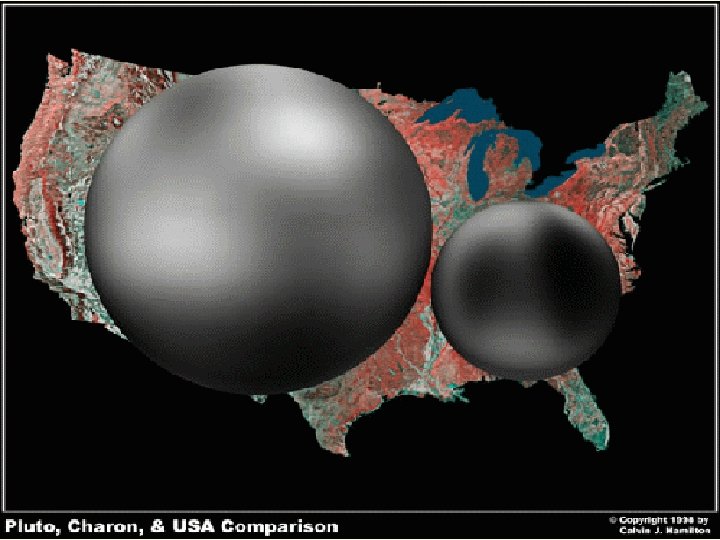
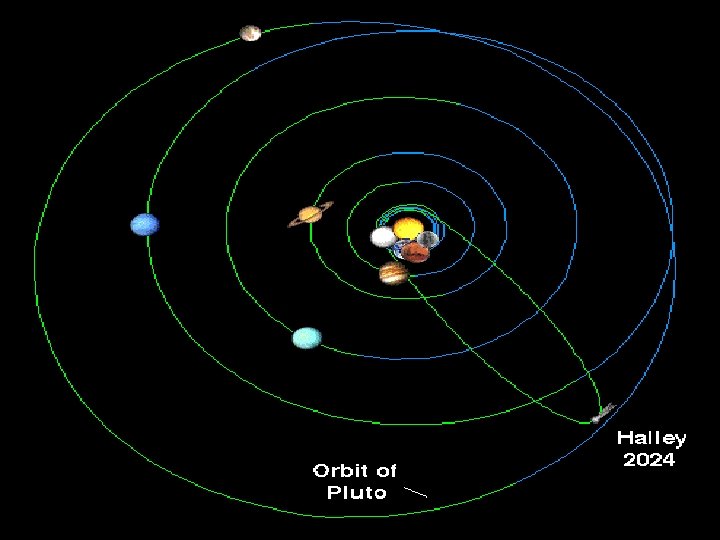
(d) There are 3 of these objects recognized. * Pluto (God of the Underworld), Eris (Goddess of Chaos & Discord), & Ceres (Goddess of Plants). * All Kuiper Belt objects will eventually join this status. * Kuiper Belt- a band of icy debris that is in orbit around the sun, outside of Neptunes orbit. C. “Small Solar System Bodies”- All other objects except satellites orbiting the sun.
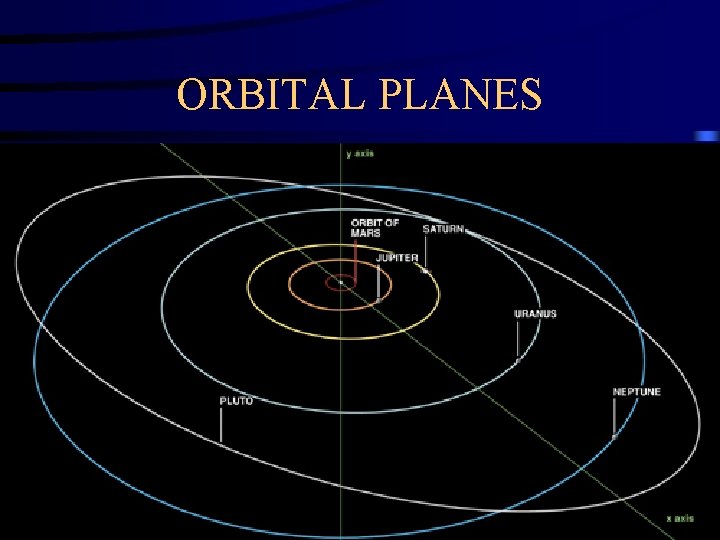
ORBITAL PLANES
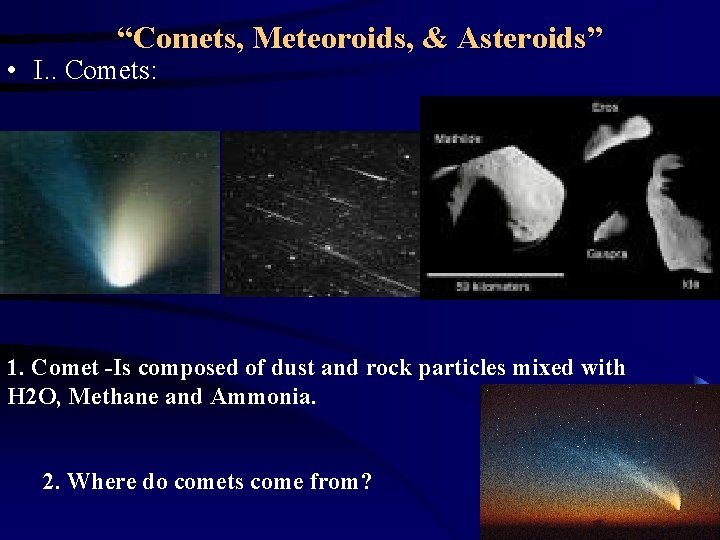
“Comets, Meteoroids, & Asteroids” • I. . Comets: 1. Comet -Is composed of dust and rock particles mixed with H 2 O, Methane and Ammonia. 2. Where do comets come from?
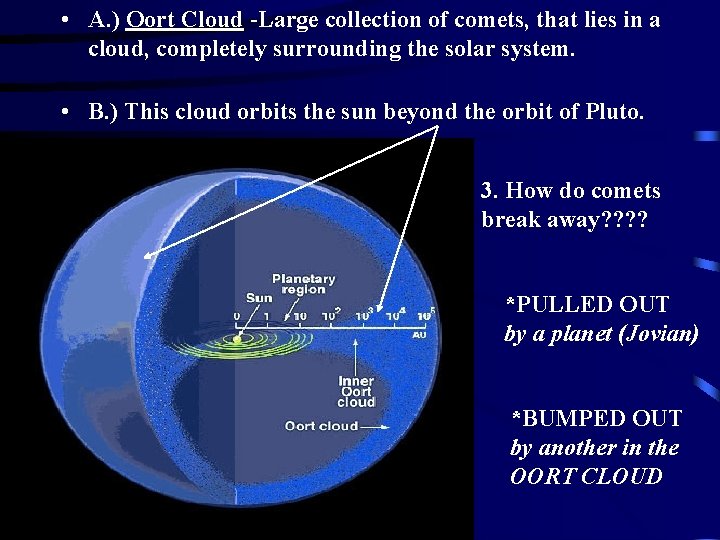
• A. ) Oort Cloud -Large collection of comets, that lies in a cloud, completely surrounding the solar system. • B. ) This cloud orbits the sun beyond the orbit of Pluto. 3. How do comets break away? ? *PULLED OUT by a planet (Jovian) *BUMPED OUT by another in the OORT CLOUD
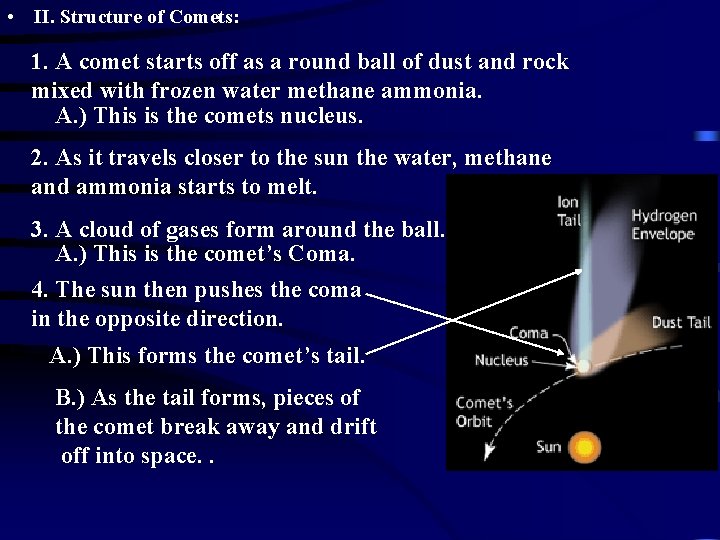
• II. Structure of Comets: 1. A comet starts off as a round ball of dust and rock mixed with frozen water methane ammonia. A. ) This is the comets nucleus. 2. As it travels closer to the sun the water, methane and ammonia starts to melt. 3. A cloud of gases form around the ball. A. ) This is the comet’s Coma. 4. The sun then pushes the coma in the opposite direction. A. ) This forms the comet’s tail. B. ) As the tail forms, pieces of the comet break away and drift off into space. .
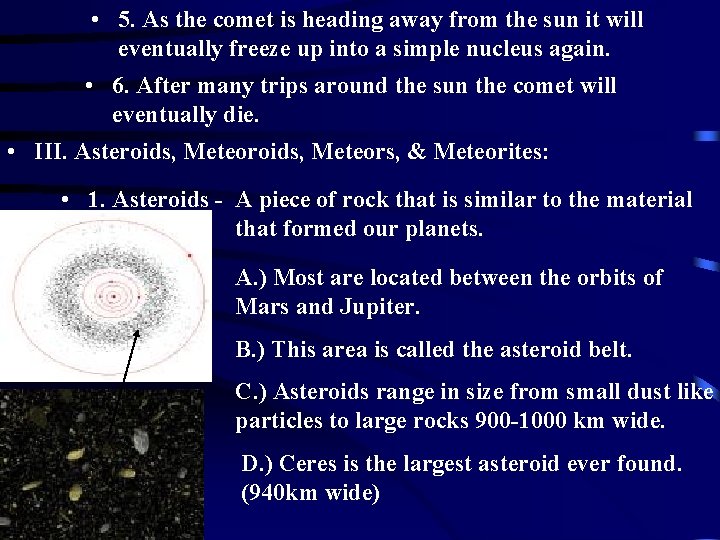
• 5. As the comet is heading away from the sun it will eventually freeze up into a simple nucleus again. • 6. After many trips around the sun the comet will eventually die. • III. Asteroids, Meteors, & Meteorites: • 1. Asteroids - A piece of rock that is similar to the material that formed our planets. A. ) Most are located between the orbits of Mars and Jupiter. B. ) This area is called the asteroid belt. C. ) Asteroids range in size from small dust like particles to large rocks 900 -1000 km wide. D. ) Ceres is the largest asteroid ever found. (940 km wide)
• 2. Meteoroids-Small pieces of rock that travel through space. A. ) Most are found to be pieces of a comet that broke away during its orbit around the sun, or the result of an asteroid collision.
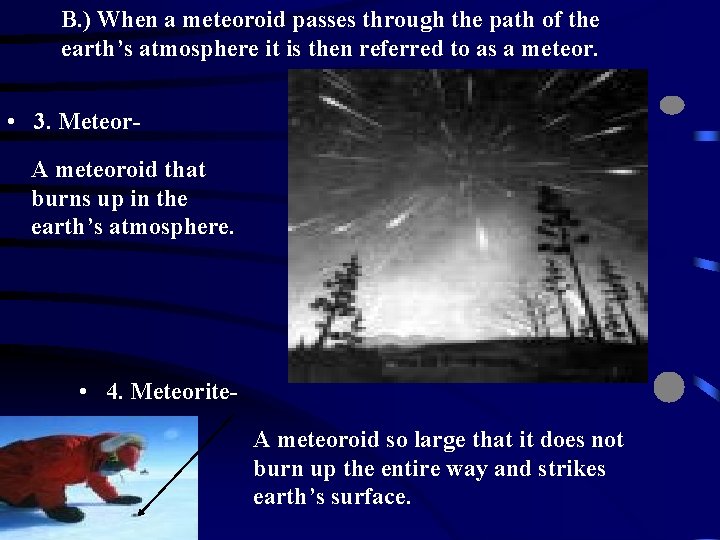
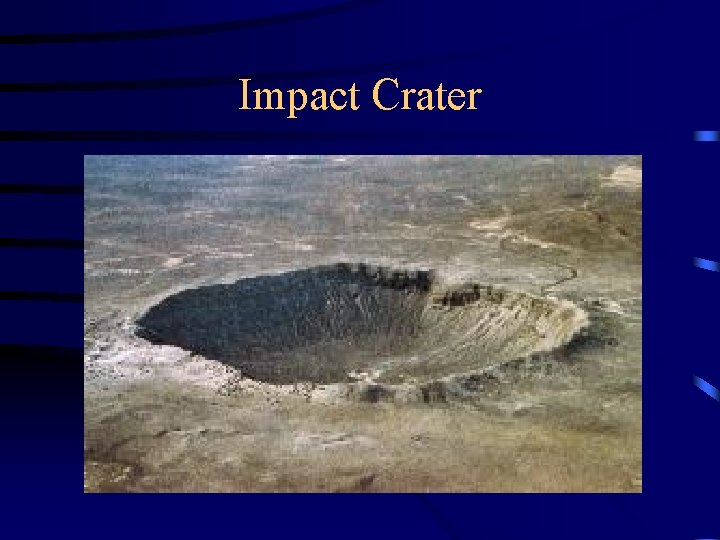
B. ) When a meteoroid passes through the path of the earth’s atmosphere it is then referred to as a meteor. • 3. Meteor. A meteoroid that burns up in the earth’s atmosphere. • 4. Meteorite. A meteoroid so large that it does not burn up the entire way and strikes earth’s surface.
Impact Crater