International Justice War and Transitional Justice SSE Riga

- Slides: 39
International Justice, War and Transitional Justice SSE Riga Debate Society 1
War & Transitional Justice A Pajuste Style Presentation. 2
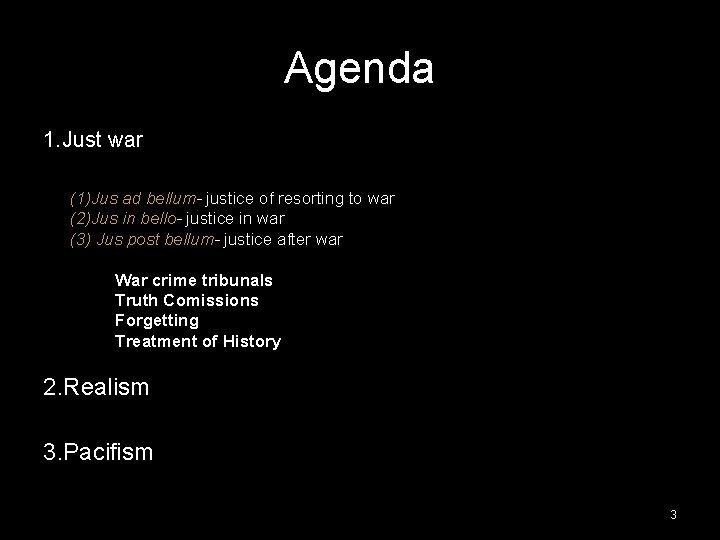
Agenda 1. Just war (1)Jus ad bellum- justice of resorting to war (2)Jus in bello- justice in war (3) Jus post bellum- justice after war War crime tribunals Truth Comissions Forgetting Treatment of History 2. Realism 3. Pacifism 3
Definitive theories I. Just war- war is sometimes justifiable II. Realism- moral justification is not necessary III. Pacifism- war is never justified 4
3 cornerstones of just war theory (1)Jus ad bellum- justice of resorting to war (2)Jus in bello- justice in war (3) Jus post bellum- justice after war 5
Jus ad bellum 1. Just cause: (1) self defense, (2) protection of others, (3) punishment for uncorrected wrongdoings Justification: states exist to protect basic human rights. If they fail at that, there’s no reason for them to exist (Locke). Three criteria for the legitimacy of the state: • the state is recognized as legitimate by its own people and by the international community. • there is an un-coerced general peace and order within that society • and the state is not shunned as a pariah by the rest of the world. 6
Jus ad bellum 1. Just cause: (1) self defense, (2) protection of others, (3) punishment for uncorrected wrongdoings Is preemtive agression allowable? absurd to punish someone for an offense they have yet to commit (Vitoria) International law, for its part, sweepingly forbids preemptive strikes unless they are clearly authorized in advance by the UN Security Council. 7
Jus ad bellum 2. Right intention 3. Proper authority & public declaration 4. Last resort 5. Probability of success 6. Proportionality 8
Example: THW invade Syria Just cause: yes, attrocities committed against people Right intention: questionable Proper authority & public declaration: no, UN Last resort: no, Russian chemical weapons deal, etc. Probability of success: yes, but chemical weapons (may not be min. harm) Proportionality: yes 9
Jus in bello 1. Obedience to international weapons prohibition 2. Discrimination & Non combatant immunity 3. Proportionality 4. Benevolent quarantine for prisoners of war 5. No Means Mala in Sec 6. No Repirsals 10
Jus in bello + Internal considerations 1. Conscription 2. Elections 3. Censorship 4. Civil liberties 11
Examples of motions • THBT human shields can be a legitimate target in war • THBT state media organizations are a legitimate target in war • THS conscription • THBT ‘I was just following orders’ is a legitimate excuse for committing war crimes 12
Jus post bellum 1. Proportionality & Publicity 2. Rights Vindication 3. Discrimination 4. Punishment 5. Compensation 6. Rehabilitation 13
Jus post bellum War Crime Tribunals: ICC Has jurisdiction over serious crimes (genocide, crimes against humanity, aggression) The UN Security Council is authorized not only to refer cases to the court but also to ask its prosecutor to suspend proceedings. Uganda, Congo and CAR have referred their cases to ICC themselves. Sudan was referred by the UN (resulting in the indictment of Omar al-Bashir) Significant representation of victims 14
Jus post bellum War Crime Tribunals: ICC CRITIQUE Victor’s justice Retroactivity- Nullum Crimen, Nulla Poena Sine Lege vs Natural Law Tradition Selectivity- senior level officials often not punished, however ICC employs “Command Responsibility” (CR) 15
Jus post bellum Truth Comissions GOALS unearthing, clarifying and formally acknowledging past abuses, responding to the needs of victims, helping create a culture of accountability, outlining institutional responsibility and possible reforms, advancing the prospects of reconciliation and reducing conflict over the past. GENERAL IDEA: REHABILITATION 16
Jus post bellum Truth Comissions Three criteria: moral in principle, inclusive, and moral in practice. Recognizes victims as moral agents with stories worth telling. Affirms their dignity and agency of those who have been brutalized. A transition from mass atrocity into civil society, if it is to be stable and lasting, requires that the value of the individual lives of an entire class—the class of victims—be affirmed. 17
Jus post bellum Truth Comissions Three criteria: moral in principle, inclusive, and moral in practice. The amnesty-for-truth mechanism created an incentive for perpetrators to come forward. Forgiveness is said to be the only disposition that allows us to break free of the endless cycle of blow and counter blow characteristic of ethnic conflict 18
Jus post bellum Forgetting Undermines the possibility of a common history by excluding an entire class of memories. It obliterates the desire of formerly hostile parties to live together, or the possibility of social solidarity, by creating resentment among an entire group of people. EXAMPLE: Mozambique, where in the aftermath of a long, bloody civil war, the combatants actively elected not to address past atrocities 19
Examples of post-conflict treatment of history Le devoir de mémoire -France has criminalized holocaust denial (as of 2006, 1 year prison sentence) German history books -german’s had US imported history books, teching them guilt 20
Examples of post-conflict treatment of history Rwanda Is there a question? WHAT DO YOU THINK? -how many Hutu’s participated in the killing of Tutsi’s -Why? 21
Examples of post-conflict treatment of history Rwanda Is there a question? -Genocide is awful, but so was Kagame and the RPF -7 and 8 per cent of the adult Hutu population effectively took part in the killings -DR Congo 22
Examples of post-conflict treatment of history Rwanda Is there a question? BUT Rwanda prohibits revisionism, denial and trivialization of the genocide. Effectively there’s one version of the truth. Hutu’s were horrible and Tutsi’s were good. 23
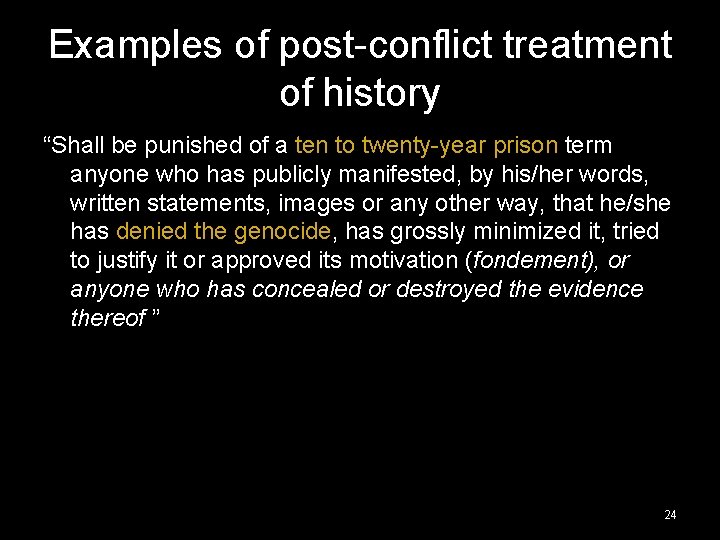
Examples of post-conflict treatment of history “Shall be punished of a ten to twenty-year prison term anyone who has publicly manifested, by his/her words, written statements, images or any other way, that he/she has denied the genocide, has grossly minimized it, tried to justify it or approved its motivation (fondement), or anyone who has concealed or destroyed the evidence thereof ” 24
Examples of post-conflict treatment of history Accordingly, in today’s Rwanda there are no Hutu or Tutsi or Twa, only Banyarwanda. -Any reexamination of the genocide is virtually impossible 25
26
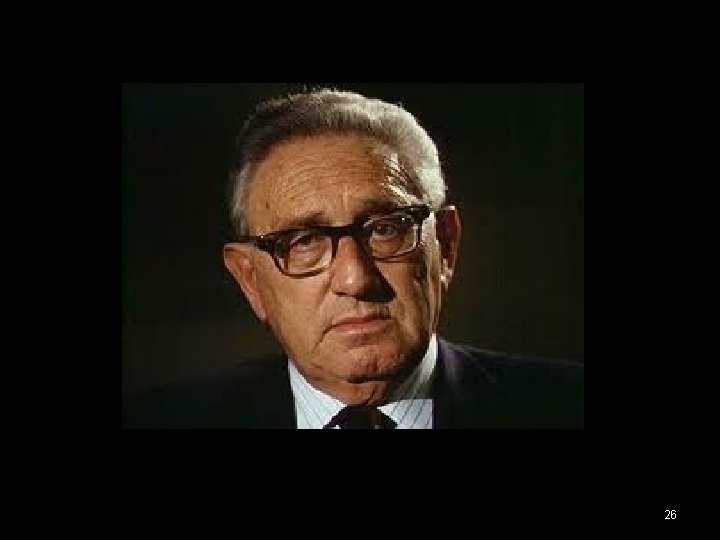
Realism Descriptive realism States are not and/or cannot be moral WHY? International arena is a state of nature among states. A state’s sole goal is continuation of that state. 27
Realism Perscriptive realism States ought not be moral If a state is too moral, it will be exploited by other states more ruthless. 28
29
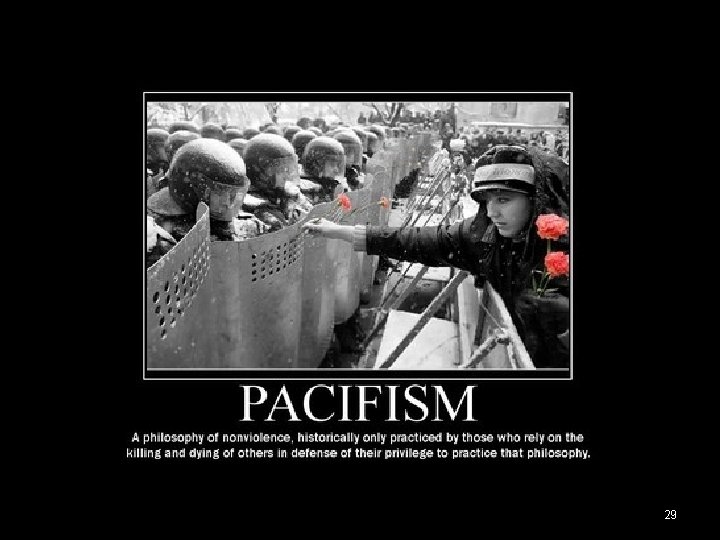
Pacifism Maintain ‘moral purity’ (even in self-defense) Non-violent world is not attainable and ought entails can. Failing to resist agression rewards and maintains it. Pacifist is a ‘free-rider’ 30
International Justice 31
Agenda 1. Why international justice? 2. Mathaethical Particularism 3. Cultural Perfectionism 4. Cosmopolitan Liberalism 5. Rawlsian Cosmopolitanism 6. Rawls’s Law of Peoples 32
Why international justice? Problem with conventional political philosophy- confined to individuals within a state Citizenship seems as morally arbitrary as race or gender, yet it determines to a large extent our opportunities, wealth, etc. (Birth Lottery) 33
Mathaethical Particularism Mac. Intyre’s three levels of argumentation: • Moral rules are learned as specific to a certain community and we never really observe universalizable maxims in action. • The goods that are relevant in morality are defined by communities. • Morality is hard, close to impossible to do as a lone individual, therefore a moral community sharing the same views is necessary. IN DEBATES: can be used to jusify (1) why our moral obligations are limited to our society, (2) why our western ideals don’t apply elsewhere 34
Cultural Perfectionism Doesn’t imply culture as a morality determining factor But implies it’s importance is so high to people and on its own (intrinsic value) that it deserves maintaining IN DEBATES: THW require members of secluded religious communities to give their youth a rumspringa 35
Cosmopolitan Liberalism make a comparison between nationality and race-it cannot serve as ground for justice Singer’s example: I. You pass a pond a child is drowning, you can save him without causing harm to yourself, except your 500$ shoes will be ruined. Should you help? II. If the answer is yes, then if you could sacrifice some money (say 500$) to help a child and save him/her from dying, then you should do it. 36
Cosmopolitan Liberalism make a comparison between nationality and race-it cannot serve as ground for justice Singer’s example: I. You pass a pond a child is drowning, you can save him without causing harm to yourself, except your 500$ shoes will be ruined. Should you help? II. If the answer is yes, then if you could sacrifice some money (say 500$) to help a child and save him/her from dying, then you should do it. IN DEBATE: THB in ‘good samartian’ law 37
Rawlsian Cosmopolitanism We should attempt to optimize the position of those worst off in globally ( a la difference principle, Rawls). On state level we use coercive power against individuals and therefore it is understandable that states have extra responsibilities towards their citizens. 38
Rawls’s Law of Peoples Principles of equality and liberty are controversial globally and therefore cannot truly be used in a global context The difference principle cannot really be applied to individuals (in the global context), but must be applied to ‘peoples’ Make states achieve basic human rights and operate in accordance with public perception of justice. 39