Integrated University Information Systems Thomas Kudrass Leipzig University


- Slides: 43
Integrated University Information Systems Thomas Kudrass Leipzig University of Applied Sciences (Germany) ICEIS 2006 Paphos, Cyprus May 2006
© Thomas Kudrass, Leipzig University of Applied Sciences, ICEIS 2006 Outline 1. 2. 3. 4. 5. 6. 2 2 Motivation: Why Integration? Sample Business Process Requirements Analysis Sample Environment (HTWK Leipzig) Design of a Target Architecture Current and future work 2
© Thomas Kudrass, Leipzig University of Applied Sciences, ICEIS 2006 Why Integration? l l Today´s information systems characterized by Interoperability Examples – Health Care IS l – Integration of ERP and office software l – 3 3 Example: SAP + MS Office Integration of DMS and CMS l l Electronic Medical File Enterprise Content Management (ECM) Why not in universities? 3
© Thomas Kudrass, Leipzig University of Applied Sciences, ICEIS 2006 Motivation am 20. 09. 2005: l „Akademische Servicewüste“ Datenchaos zwingt Unis in die Knie! l Academic service desert. Data chaos pushes down universities! 4 4 4
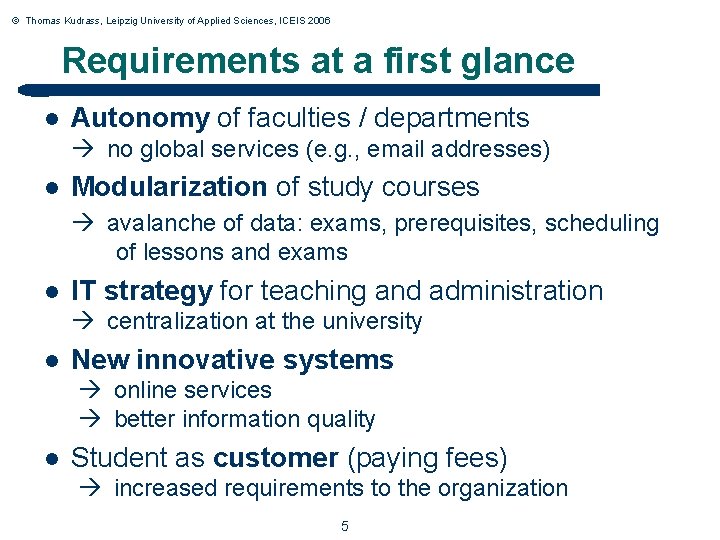
© Thomas Kudrass, Leipzig University of Applied Sciences, ICEIS 2006 Requirements at a first glance l Autonomy of faculties / departments à no global services (e. g. , email addresses) l Modularization of study courses à avalanche of data: exams, prerequisites, scheduling of lessons and exams l IT strategy for teaching and administration à centralization at the university l New innovative systems à online services à better information quality l Student as customer (paying fees) à increased requirements to the organization 5 5 5
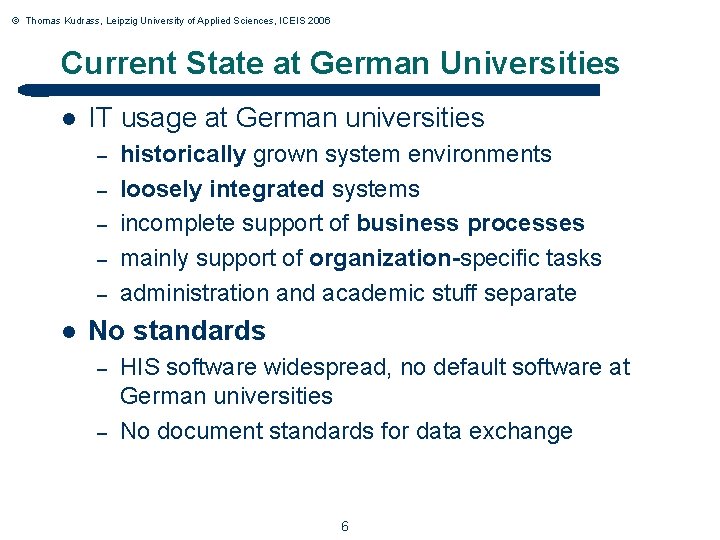
© Thomas Kudrass, Leipzig University of Applied Sciences, ICEIS 2006 Current State at German Universities l IT usage at German universities – – – l No standards – – 6 6 historically grown system environments loosely integrated systems incomplete support of business processes mainly support of organization-specific tasks administration and academic stuff separate HIS software widespread, no default software at German universities No document standards for data exchange 6
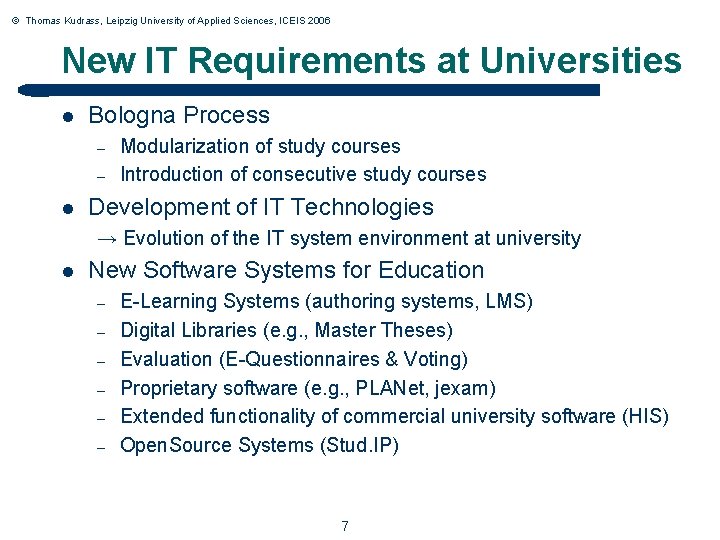
© Thomas Kudrass, Leipzig University of Applied Sciences, ICEIS 2006 New IT Requirements at Universities l Bologna Process – – l Modularization of study courses Introduction of consecutive study courses Development of IT Technologies → Evolution of the IT system environment at university l New Software Systems for Education – – – 7 7 E-Learning Systems (authoring systems, LMS) Digital Libraries (e. g. , Master Theses) Evaluation (E-Questionnaires & Voting) Proprietary software (e. g. , PLANet, jexam) Extended functionality of commercial university software (HIS) Open. Source Systems (Stud. IP) 7
© Thomas Kudrass, Leipzig University of Applied Sciences, ICEIS 2006 Integrated Information Management Overall IT Concept for University Administration (Source: Department of Science, Bavaria, 20001) l Characteristics: – – – l l 8 Unique data input at the primary data source Cross-media processing of the data End-to-end support of business processes Either evolution of existing systems or introduction of an integrated system Evolutionary approach bases on integration of systems at a data level 8 8
© Thomas Kudrass, Leipzig University of Applied Sciences, ICEIS 2006 Outline 1. 2. 3. 4. 5. 6. 9 9 Motivation: Why Integration? Sample Business Process Requirements Analysis Sample Environment (HTWK Leipzig) Design of a Target Architecture Current and future work 9
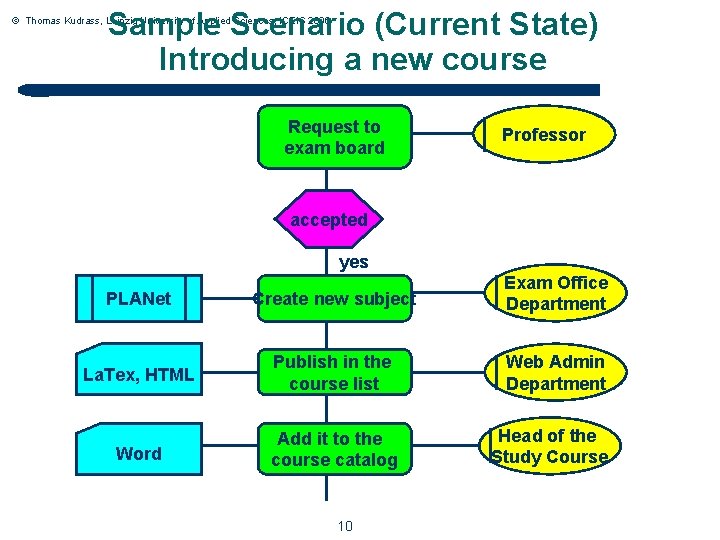
Sample Scenario (Current State) Introducing a new course © Thomas Kudrass, Leipzig University of Applied Sciences, ICEIS 2006 Request to exam board Professor accepted yes PLANet Create new subject Exam Office Department La. Tex, HTML Publish in the course list Web Admin Department Word Add it to the course catalog 10 10 10 Head of the Study Course
© Thomas Kudrass, Leipzig University of Applied Sciences, ICEIS 2006 Sample Scenario (Current State) - 2 - HIS-POS Create new course LIPS Create new course Participant List Enrollment Exam Office Department Admin E-Learning Exam Office Department # of participants >n yes S-PLUS Scheduling & Planning University Administration Participant List Capture participants Professor 11 11 11
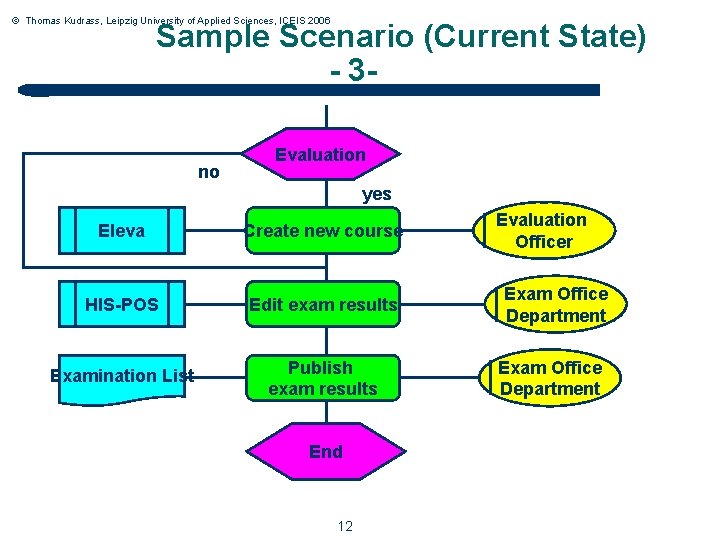
© Thomas Kudrass, Leipzig University of Applied Sciences, ICEIS 2006 Sample Scenario (Current State) - 3 no Evaluation yes Eleva Create new course HIS-POS Edit exam results Examination List Publish exam results End 12 12 12 Evaluation Officer Exam Office Department
© Thomas Kudrass, Leipzig University of Applied Sciences, ICEIS 2006 Outline 1. 2. 3. 4. 5. 6. 13 13 Motivation: Why Integration? Sample Business Process Requirements Analysis Sample Environment (HTWK Leipzig) Design of a Target Architecture Current and future work 13
© Thomas Kudrass, Leipzig University of Applied Sciences, ICEIS 2006 Perspectives of Integration l E-Learning Platform with portal characteristics – l l l 14 14 Ubiquituous access to relevant information and services Centralized identity management New service and infrastructure offerings for students Coupling with systems of the university administration Combining information from different sources Publication and distribution of course materials and documents (theses) 14
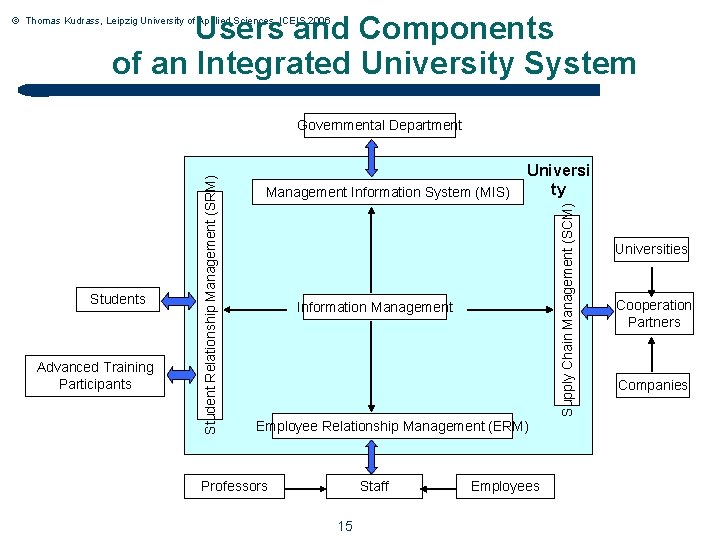
Users and Components of an Integrated University System © Thomas Kudrass, Leipzig University of Applied Sciences, ICEIS 2006 Advanced Training Participants Management Information System (MIS) Information Management Employee Relationship Management (ERM) Professors 15 15 Universi ty Supply Chain Management (SCM) Students Student Relationship Management (SRM) Governmental Department Staff 15 Employees Universities Cooperation Partners Companies
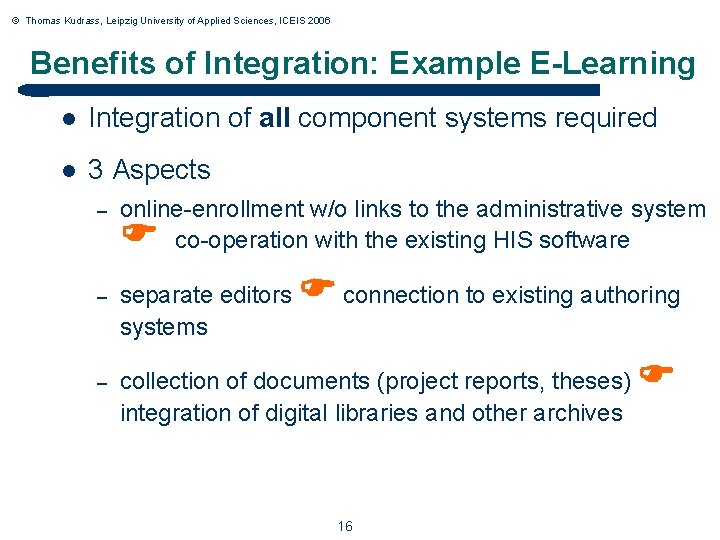
© Thomas Kudrass, Leipzig University of Applied Sciences, ICEIS 2006 Benefits of Integration: Example E-Learning l Integration of all component systems required l 3 Aspects 16 16 – online-enrollment w/o links to the administrative system co-operation with the existing HIS software – separate editors systems – collection of documents (project reports, theses) integration of digital libraries and other archives connection to existing authoring 16
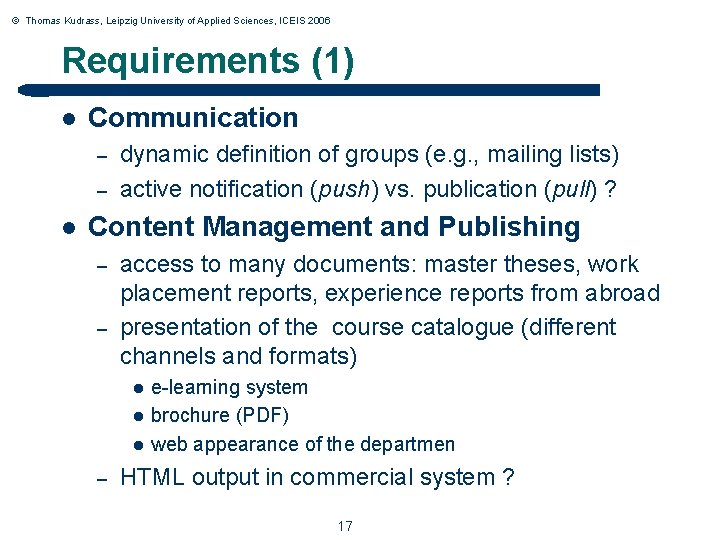
© Thomas Kudrass, Leipzig University of Applied Sciences, ICEIS 2006 Requirements (1) l Communication – – l dynamic definition of groups (e. g. , mailing lists) active notification (push) vs. publication (pull) ? Content Management and Publishing – – access to many documents: master theses, work placement reports, experience reports from abroad presentation of the course catalogue (different channels and formats) l l l – 17 17 e-learning system brochure (PDF) web appearance of the departmen HTML output in commercial system ? 17
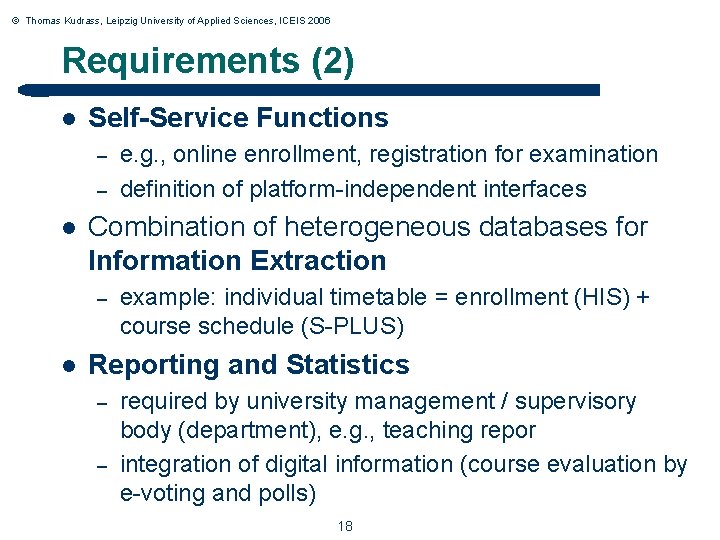
© Thomas Kudrass, Leipzig University of Applied Sciences, ICEIS 2006 Requirements (2) l Self-Service Functions – – l Combination of heterogeneous databases for Information Extraction – l example: individual timetable = enrollment (HIS) + course schedule (S-PLUS) Reporting and Statistics – – 18 18 e. g. , online enrollment, registration for examination definition of platform-independent interfaces required by university management / supervisory body (department), e. g. , teaching repor integration of digital information (course evaluation by e-voting and polls) 18
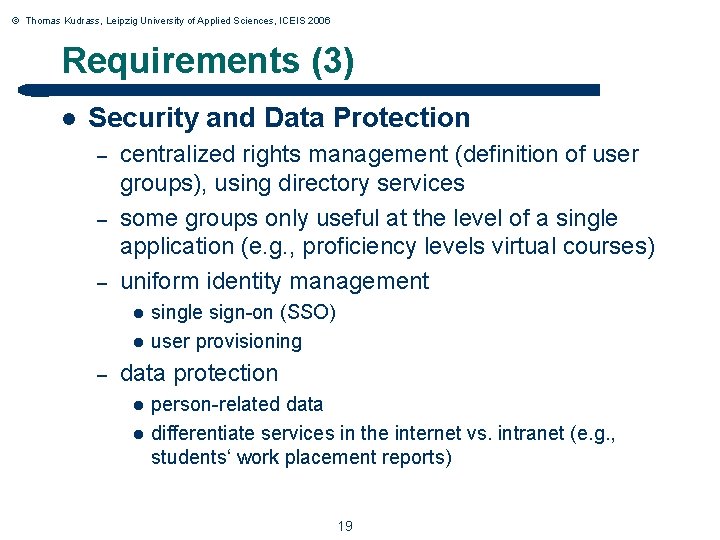
© Thomas Kudrass, Leipzig University of Applied Sciences, ICEIS 2006 Requirements (3) l Security and Data Protection – – – centralized rights management (definition of user groups), using directory services some groups only useful at the level of a single application (e. g. , proficiency levels virtual courses) uniform identity management l l – data protection l l 19 19 single sign-on (SSO) user provisioning person-related data differentiate services in the internet vs. intranet (e. g. , students‘ work placement reports) 19
© Thomas Kudrass, Leipzig University of Applied Sciences, ICEIS 2006 Requirements (4) l Management of Industrial Partner Relationships – – l 20 20 DB for internships in the region DB sponsors and cooperation partners / contacts Alumni Relationships 20
© Thomas Kudrass, Leipzig University of Applied Sciences, ICEIS 2006 Outline 1. 2. 3. 4. 5. 6. 21 21 Motivation: Why Integration? Sample Business Process Requirements Analysis Sample Environment (HTWK Leipzig) Design of a Target Architecture Current and future work 21
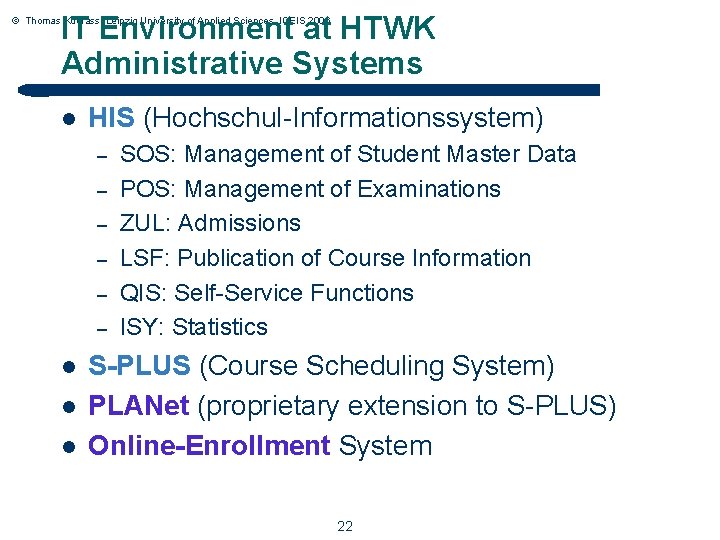
IT Environment at HTWK Administrative Systems © Thomas Kudrass, Leipzig University of Applied Sciences, ICEIS 2006 l HIS (Hochschul-Informationssystem) – – – l l l 22 22 SOS: Management of Student Master Data POS: Management of Examinations ZUL: Admissions LSF: Publication of Course Information QIS: Self-Service Functions ISY: Statistics S-PLUS (Course Scheduling System) PLANet (proprietary extension to S-PLUS) Online-Enrollment System 22
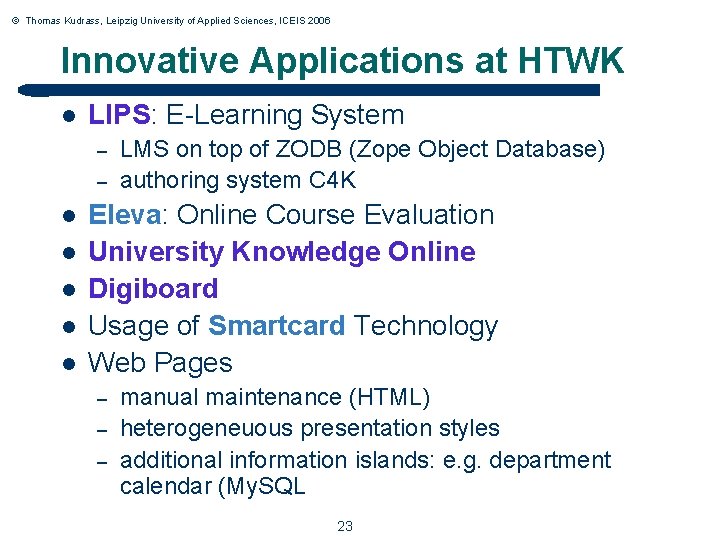
© Thomas Kudrass, Leipzig University of Applied Sciences, ICEIS 2006 Innovative Applications at HTWK l LIPS: E-Learning System – – l l l Eleva: Online Course Evaluation University Knowledge Online Digiboard Usage of Smartcard Technology Web Pages – – – 23 23 LMS on top of ZODB (Zope Object Database) authoring system C 4 K manual maintenance (HTML) heterogeneuous presentation styles additional information islands: e. g. department calendar (My. SQL 23
© Thomas Kudrass, Leipzig University of Applied Sciences, ICEIS 2006 Outline 1. 2. 3. 4. 5. 6. 24 24 Motivation: Why Integration? Sample Business Process Requirements Analysis Sample Environment (HTWK Leipzig) Design of a Target Architecture Current and future work 24
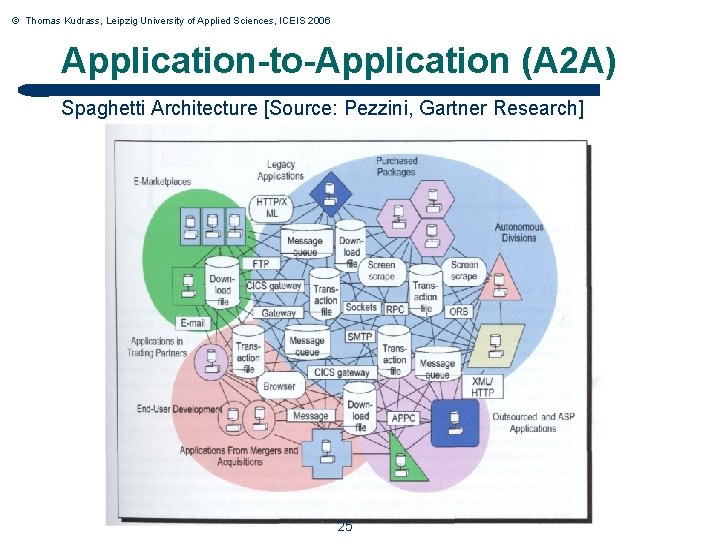
© Thomas Kudrass, Leipzig University of Applied Sciences, ICEIS 2006 Application-to-Application (A 2 A) Spaghetti Architecture [Source: Pezzini, Gartner Research] 25 25 25
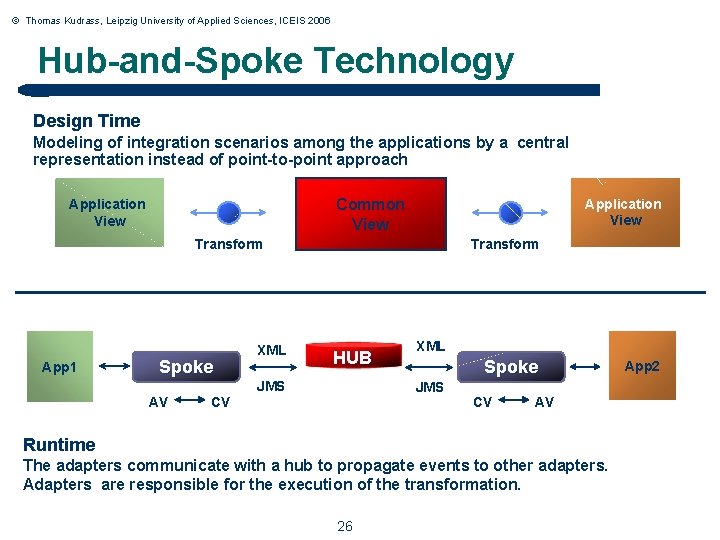
© Thomas Kudrass, Leipzig University of Applied Sciences, ICEIS 2006 Hub-and-Spoke Technology Design Time Modeling of integration scenarios among the applications by a central representation instead of point-to-point approach Common View Application View Transform App 1 Spoke XML Transform HUB JMS AV XML Spoke JMS CV CV AV Runtime The adapters communicate with a hub to propagate events to other adapters. Adapters are responsible for the execution of the transformation. 26 26 App 2
© Thomas Kudrass, Leipzig University of Applied Sciences, ICEIS 2006 Idea: Generic Data Service Project-Independent Logical Access Layer l Extensible Set of Physical Data Source Types l Decoupling of Business Logic and Data Layer l Access to the Generic Data Service – instead of the Data Source l 28 28 28
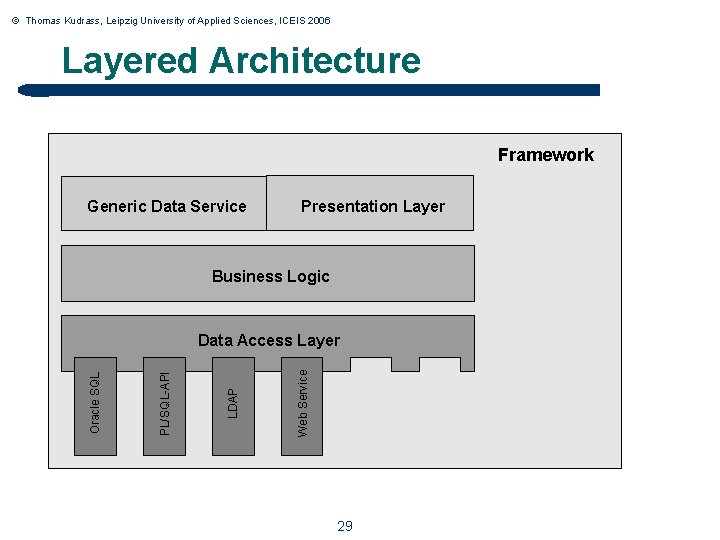
© Thomas Kudrass, Leipzig University of Applied Sciences, ICEIS 2006 Layered Architecture Framework Generic Data Service Presentation Layer Business Logic 29 29 Web Service LDAP PL/SQL-API Oracle SQL Data Access Layer 29
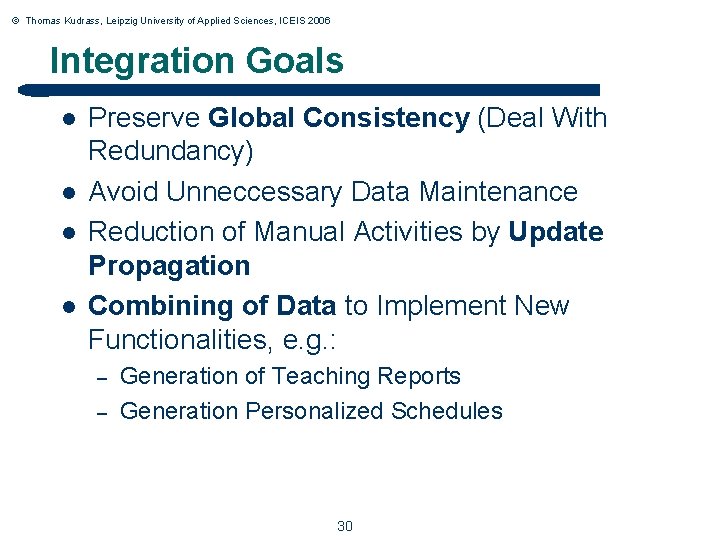
© Thomas Kudrass, Leipzig University of Applied Sciences, ICEIS 2006 Integration Goals l l Preserve Global Consistency (Deal With Redundancy) Avoid Unneccessary Data Maintenance Reduction of Manual Activities by Update Propagation Combining of Data to Implement New Functionalities, e. g. : – – 30 30 Generation of Teaching Reports Generation Personalized Schedules 30
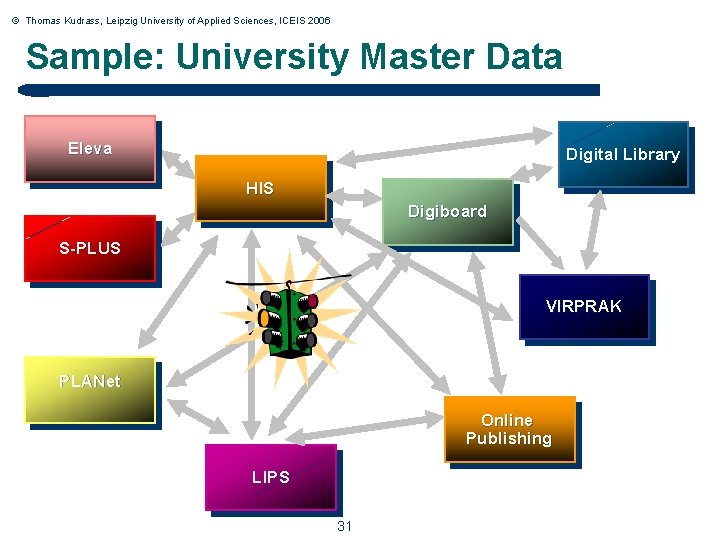
© Thomas Kudrass, Leipzig University of Applied Sciences, ICEIS 2006 Sample: University Master Data Eleva Digital Library HIS Digiboard S-PLUS VIRPRAK PLANet Online Publishing LIPS 31 31 31
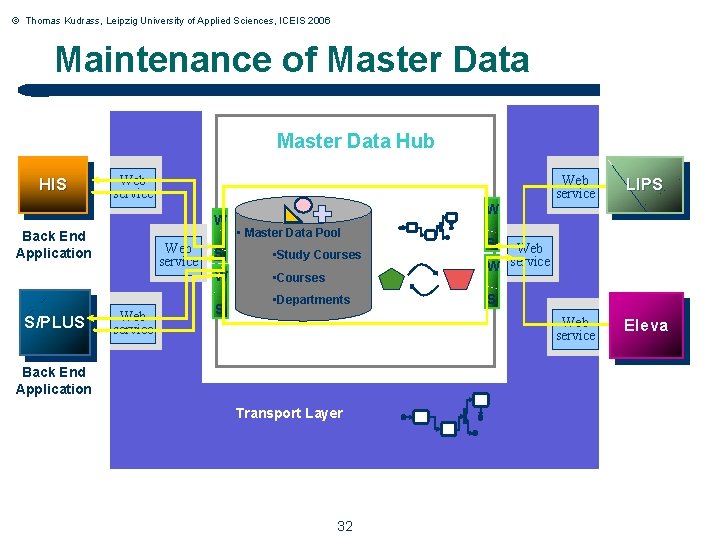
© Thomas Kudrass, Leipzig University of Applied Sciences, ICEIS 2006 Maintenance of Master Data Hub HIS Web service W Back End Application S/PLUS Web service • Master Data Pool • Study Courses W • Courses • Departments Back End Application Transport Layer 32 LIPS Web service Eleva W S S Web service 32 S Web service W S
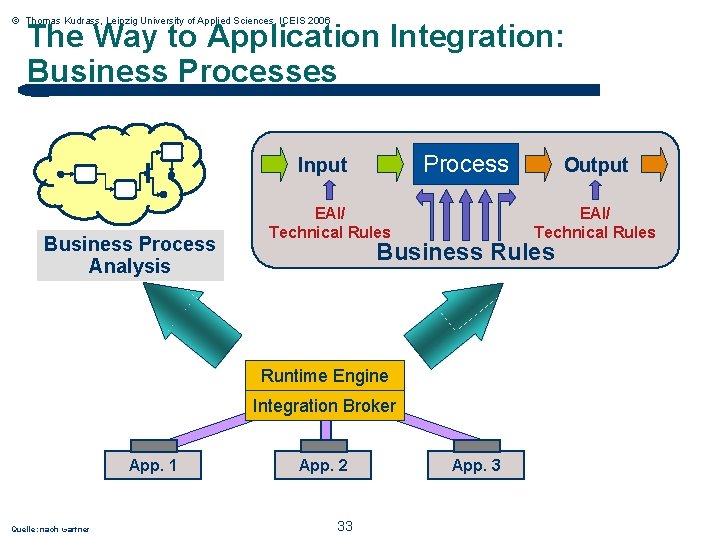
© Thomas Kudrass, Leipzig University of Applied Sciences, ICEIS 2006 The Way to Application Integration: Business Processes Process Input Business Process Analysis EAI/ Technical Rules Business Rules Runtime Engine Integration Broker App. 1 33 33 Quelle: nach Gartner Output App. 2 33 App. 3
© Thomas Kudrass, Leipzig University of Applied Sciences, ICEIS 2006 Analysis of Business Processes l Identification of Primary Data Sources (Master) – l Data Extraction for New Applications – – – l l E-Learning System Metadata for Digital Library Web Content Management System Loose Coupling of Systems Modelling using ARIS Toolset (IDS Scheer) – 34 34 Informations systems in central administration and the departments Integrate different views: Organization, Data, Functions, Processes 34
© Thomas Kudrass, Leipzig University of Applied Sciences, ICEIS 2006 Outline 1. 2. 3. 4. 5. 6. 35 35 Motivation: Why Integration? Sample Business Process Requirements Analysis Sample Environment (HTWK Leipzig) Design of a Target Architecture Current and future work 35
© Thomas Kudrass, Leipzig University of Applied Sciences, ICEIS 2006 Summary l l Incremental Integration Approach Development of Generic Data Services = Building Blocks for Web Presentations – – l l l 36 36 guarantees consistent data usage prerequisite for better reporting Services as Process Steps in Workflows Task: Definition of Standards for Data Exchange (cf. similar effort in E-Government) Important: Overall IT Strategy for University 36
© Thomas Kudrass, Leipzig University of Applied Sciences, ICEIS 2006 Current & Future Work l „Virtuelles Praktikantenamt“ (Administration of Obligatory Work Placements) – Linking to HIS system l l l Evaluation of Integration Software – – l Oracle. AS Inter. Connect (part of the future Oracle Fusion middleware) Cache Ensemble (Integration Suite) Modelling and Implementation of Reconciliation Processes for Master Data using Middleware – 37 37 admission information student master data HIS <-> LIPS HIS <-> PLANet 37
© Thomas Kudrass, Leipzig University of Applied Sciences, ICEIS 2006 Last Slide Questions ? Comments ? Further Ideas ? 38 38 38
© Thomas Kudrass, Leipzig University of Applied Sciences, ICEIS 2006 Additional Slides 39 39 39
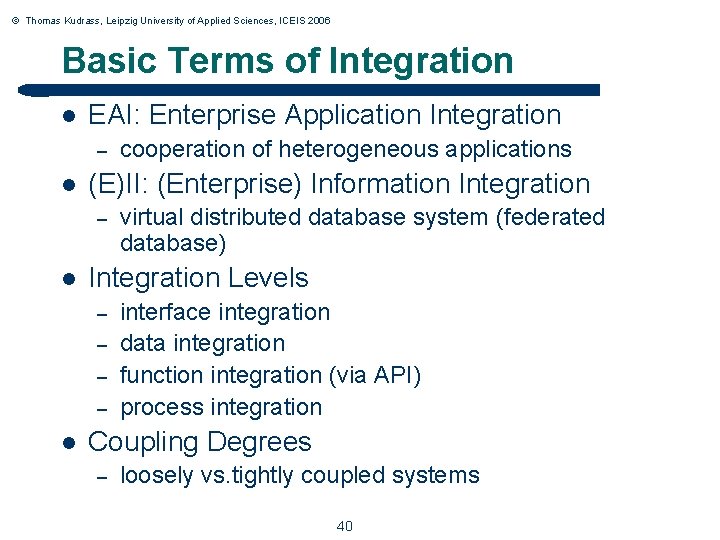
© Thomas Kudrass, Leipzig University of Applied Sciences, ICEIS 2006 Basic Terms of Integration l EAI: Enterprise Application Integration – l (E)II: (Enterprise) Information Integration – l – – – interface integration data integration function integration (via API) process integration Coupling Degrees – 40 40 virtual distributed database system (federated database) Integration Levels – l cooperation of heterogeneous applications loosely vs. tightly coupled systems 40
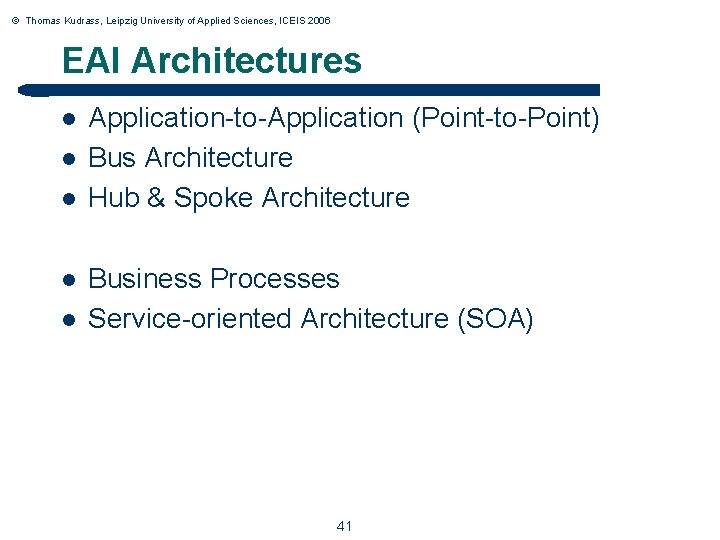
© Thomas Kudrass, Leipzig University of Applied Sciences, ICEIS 2006 EAI Architectures l l l 41 41 Application-to-Application (Point-to-Point) Bus Architecture Hub & Spoke Architecture Business Processes Service-oriented Architecture (SOA) 41
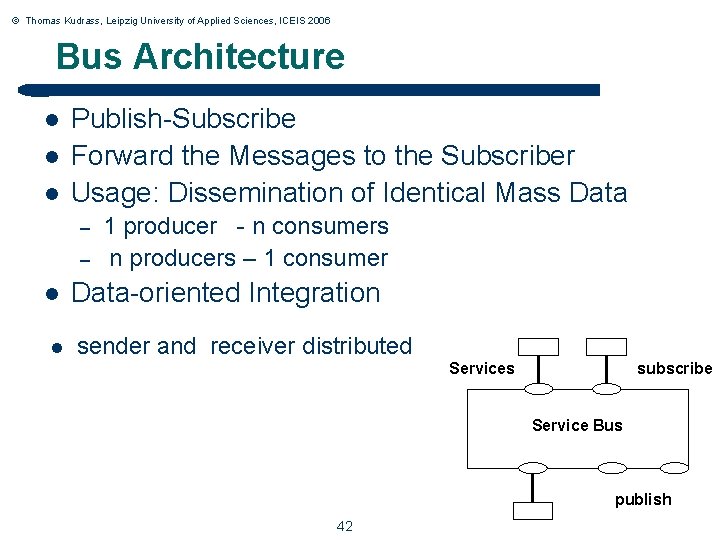
© Thomas Kudrass, Leipzig University of Applied Sciences, ICEIS 2006 Bus Architecture l l l Publish-Subscribe Forward the Messages to the Subscriber Usage: Dissemination of Identical Mass Data – – l l 1 producer - n consumers n producers – 1 consumer Data-oriented Integration sender and receiver distributed Services subscribe Service Bus 42 42 publish 42
© Thomas Kudrass, Leipzig University of Applied Sciences, ICEIS 2006 Hub & Spoke Architektur l l l Hub: Controls and monitors the data exchange Business Rules in Workflow Separation of – – l Advantages: – – l supports process-oriented approach simpler implementation than bus architecture suited for complex data dissemination integration of legacy systems beyond organization borders Disadvantages – 43 43 System-specific connectors (to connect local systems at technical level) Workflows (map the business logic) central hub can become the „bottleneck“ 43
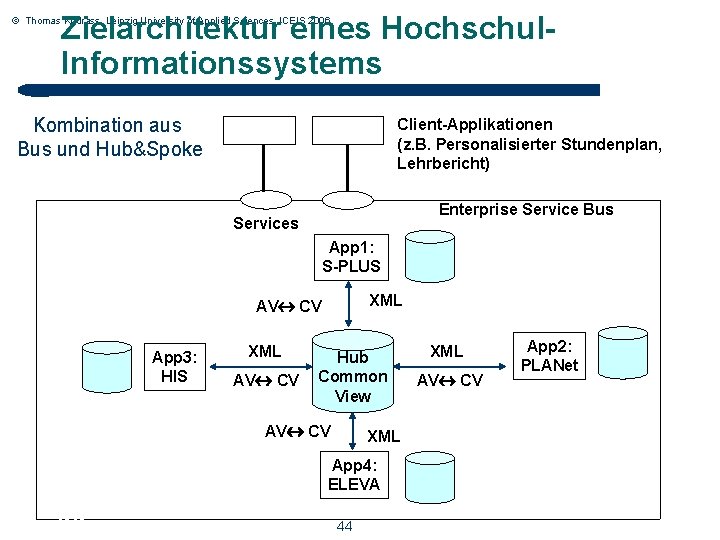
Zielarchitektur eines Hochschul. Informationssystems © Thomas Kudrass, Leipzig University of Applied Sciences, ICEIS 2006 Kombination aus Bus und Hub&Spoke Client-Applikationen (z. B. Personalisierter Stundenplan, Lehrbericht) Enterprise Service Bus Services App 1: S-PLUS XML AV CV App 3: HIS XML AV CV Hub Common View AV CV XML App 4: ELEVA 44 44 44 XML AV CV App 2: PLANet