
Training Course on Integrated Management System for Regulatory

- Slides: 16
Training Course on Integrated Management System for Regulatory Body Module 2 (Safety Standards) (2. 3) Comparison between IAEA Requirements and ISO Standard Requirements IAEA International Atomic Energy Agency
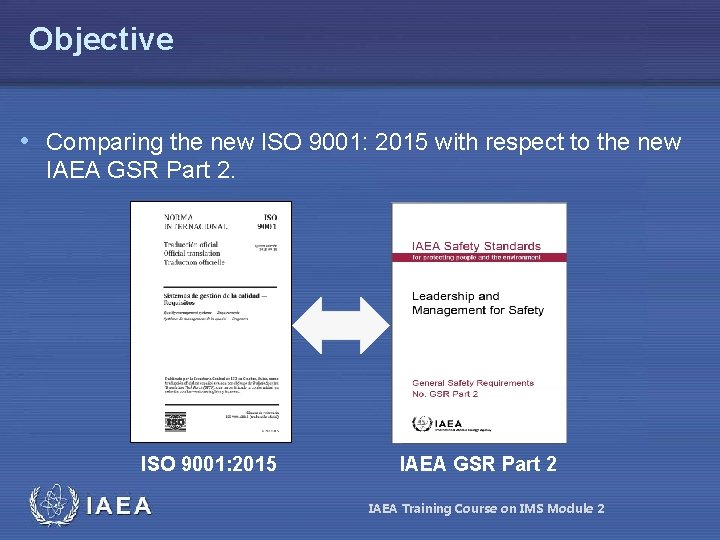
Objective • Comparing the new ISO 9001: 2015 with respect to the new IAEA GSR Part 2. ISO 9001: 2015 IAEA GSR Part 2 IAEA Training Course on IMS Module 2
Content • The design specifications of ISO 9001: 2015 • The different models of Management Systems • Comparison of GSR Part 2 with respect to ISO 9001: 2015. IAEA Training Course on IMS Module 2
Introduction ISO 9001: 2015 evolved from its predecessor of the year 2000. It was published on September 15, 2015. It preserves the most important characteristics of its predecessors. Introduces new concepts that align it broadly with GSR Part 2. Why is it necessary to know a management system norm not foreseen as a safety standard? • ISO 9001 is the norm of greater acceptance in the world for the implementation of management systems (1 106 356 organizations certified until 2016, of which 59 540 in Latin America). • Frequently used in organizations holding internships, in regulatory bodies and by other interested parties (eg suppliers). It is expected that most will move towards the new norm. • Used as a platform to implement other management systems. • It has a new high-level structure that will set the standard of integration in the future with other management models, at least ISO. IAEA Training Course on IMS Module 2
Design specifications (1) • Maintains a set of basic requirements for the ISO 9001: 2015 next 10 years. • It guarantees its applicability to any type of organization, regardless of its size or product to be supplied. • Maintains the current focus on effective process management to achieve the desired results. • It takes into account changes in the practices applied in quality management systems and in technology since the last revision of the ISO 9001 standard. IAEA Training Course on IMS Module 2
Design specifications (2) • It reflects changes in the complexity, demand dynamics of the environment in which organizations perform. ISO 9001: 2015 • It guarantees the alignment between the different management systems. • It facilitates an effective evaluation of the conformity of first, second and third parties. • It uses a simplified language and a style of writing that allows the correct interpretation of the requirements specified in the standard. IAEA Training Course on IMS Module 2
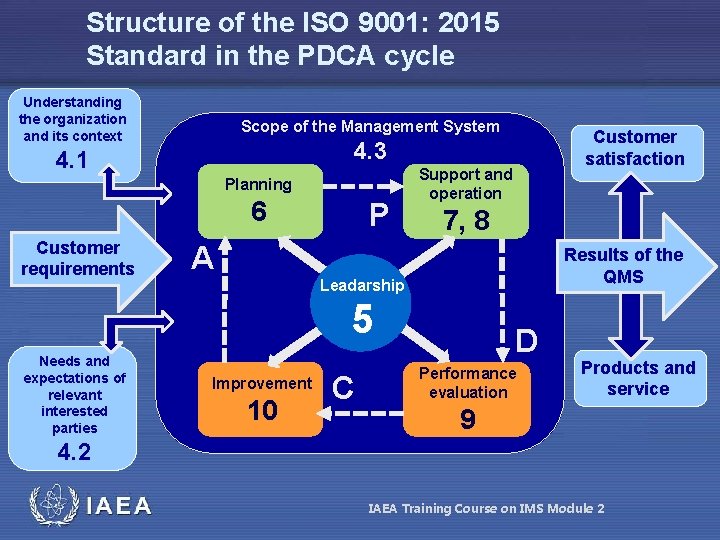
Structure of the ISO 9001: 2015 Standard in the PDCA cycle Understanding the organization and its context Scope of the Management System 4. 3 4. 1 Planning 6 Customer requirements P Support and operation 7, 8 A Results of the QMS Leadarship 5 Needs and expectations of relevant interested parties Customer satisfaction Improvement 10 C D Performance evaluation Products and service 9 4. 2 IAEA Training Course on IMS Module 2
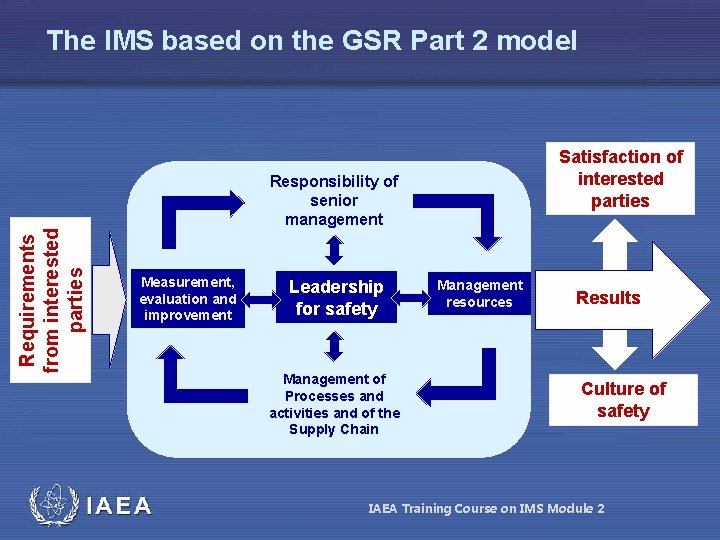
Requirements from interested parties The IMS based on the GSR Part 2 model IAEA Satisfaction of interested parties Responsibility of senior management Measurement, evaluation and improvement Leadership for safety Management of Processes and activities and of the Supply Chain Management resources Results Culture of safety IAEA Training Course on IMS Module 2
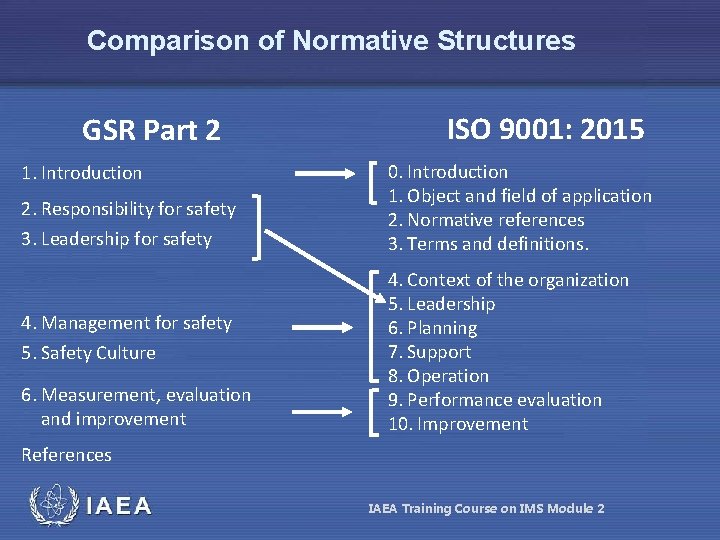
Comparison of Normative Structures GSR Part 2 1. Introduction 2. Responsibility for safety 3. Leadership for safety 4. Management for safety 5. Safety Culture 6. Measurement, evaluation and improvement ISO 9001: 2015 0. Introduction 1. Object and field of application 2. Normative references 3. Terms and definitions. 4. Context of the organization 5. Leadership 6. Planning 7. Support 8. Operation 9. Performance evaluation 10. Improvement References IAEA Training Course on IMS Module 2
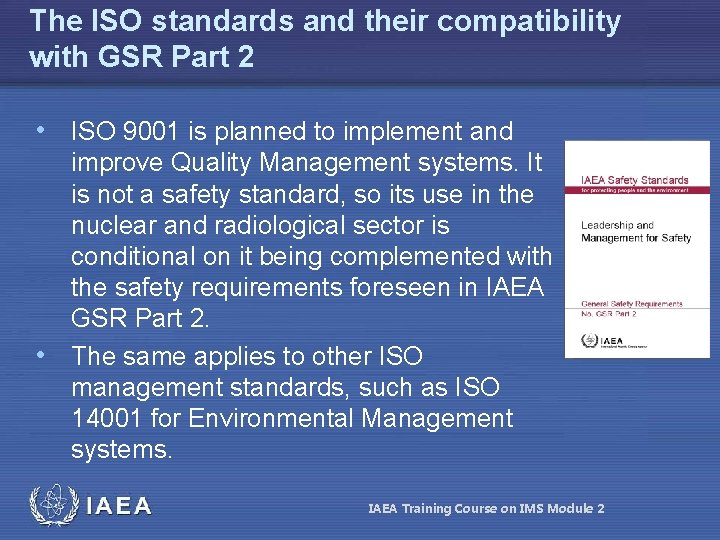
The ISO standards and their compatibility with GSR Part 2 • ISO 9001 is planned to implement and improve Quality Management systems. It is not a safety standard, so its use in the nuclear and radiological sector is conditional on it being complemented with the safety requirements foreseen in IAEA GSR Part 2. • The same applies to other ISO management standards, such as ISO 14001 for Environmental Management systems. IAEA Training Course on IMS Module 2
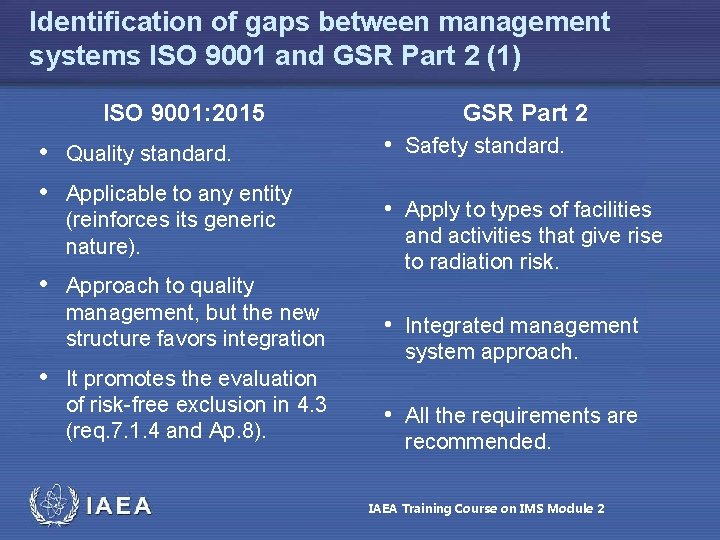
Identification of gaps between management systems ISO 9001 and GSR Part 2 (1) ISO 9001: 2015 • Quality standard. • Applicable to any entity (reinforces its generic nature). • Approach to quality management, but the new structure favors integration • It promotes the evaluation of risk-free exclusion in 4. 3 (req. 7. 1. 4 and Ap. 8). IAEA GSR Part 2 • Safety standard. • Apply to types of facilities and activities that give rise to radiation risk. • Integrated management system approach. • All the requirements are recommended. IAEA Training Course on IMS Module 2
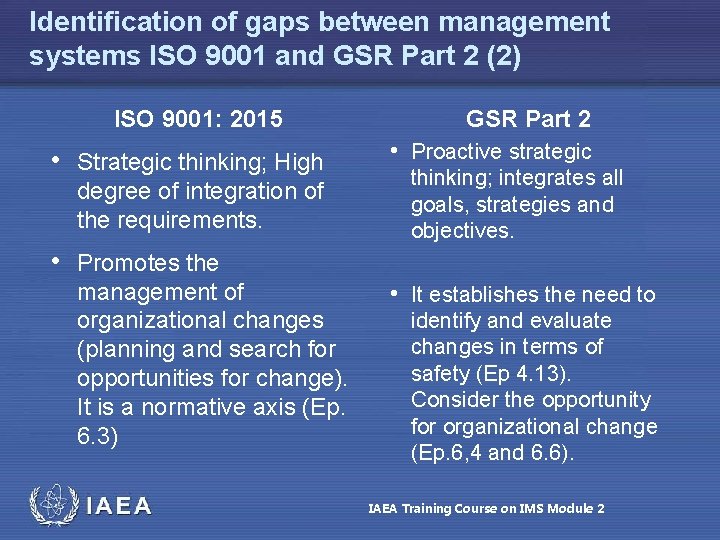
Identification of gaps between management systems ISO 9001 and GSR Part 2 (2) ISO 9001: 2015 • Strategic thinking; High degree of integration of the requirements. GSR Part 2 • Proactive strategic thinking; integrates all goals, strategies and objectives. • Promotes the management of organizational changes (planning and search for opportunities for change). It is a normative axis (Ep. 6. 3) IAEA • It establishes the need to identify and evaluate changes in terms of safety (Ep 4. 13). Consider the opportunity for organizational change (Ep. 6, 4 and 6. 6). IAEA Training Course on IMS Module 2
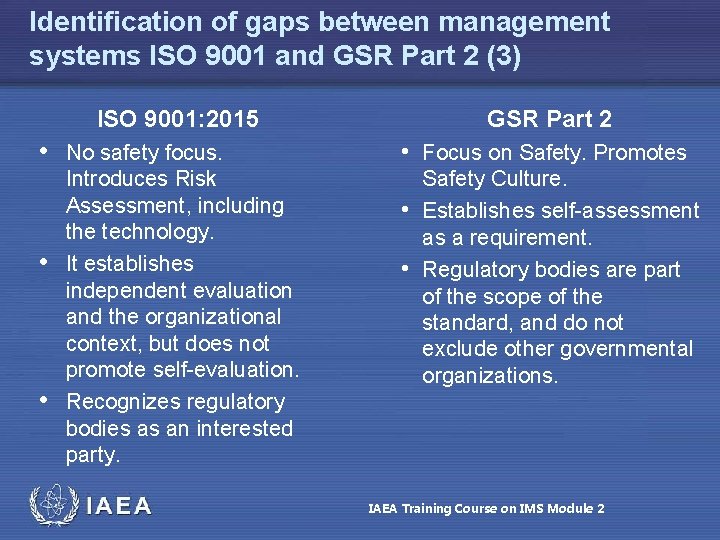
Identification of gaps between management systems ISO 9001 and GSR Part 2 (3) ISO 9001: 2015 • No safety focus. • • Introduces Risk Assessment, including the technology. It establishes independent evaluation and the organizational context, but does not promote self-evaluation. Recognizes regulatory bodies as an interested party. IAEA GSR Part 2 • Focus on Safety. Promotes Safety Culture. • Establishes self-assessment as a requirement. • Regulatory bodies are part of the scope of the standard, and do not exclude other governmental organizations. IAEA Training Course on IMS Module 2
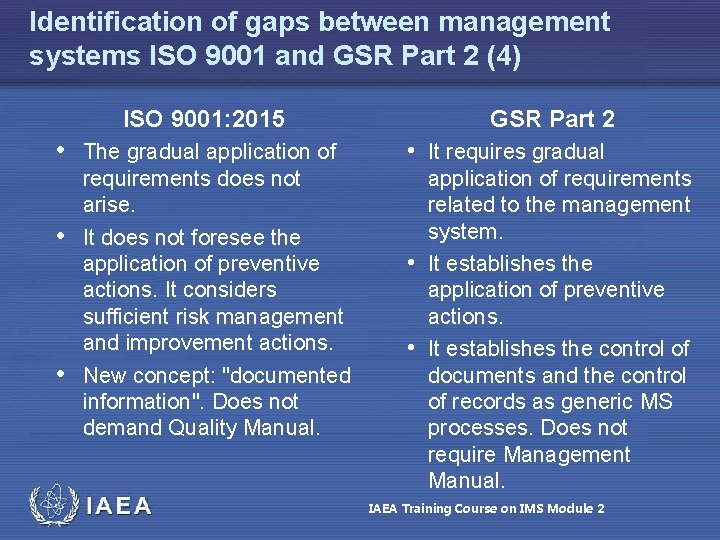
Identification of gaps between management systems ISO 9001 and GSR Part 2 (4) ISO 9001: 2015 • The gradual application of • • requirements does not arise. It does not foresee the application of preventive actions. It considers sufficient risk management and improvement actions. New concept: "documented information". Does not demand Quality Manual. IAEA GSR Part 2 • It requires gradual application of requirements related to the management system. • It establishes the application of preventive actions. • It establishes the control of documents and the control of records as generic MS processes. Does not require Management Manual. IAEA Training Course on IMS Module 2
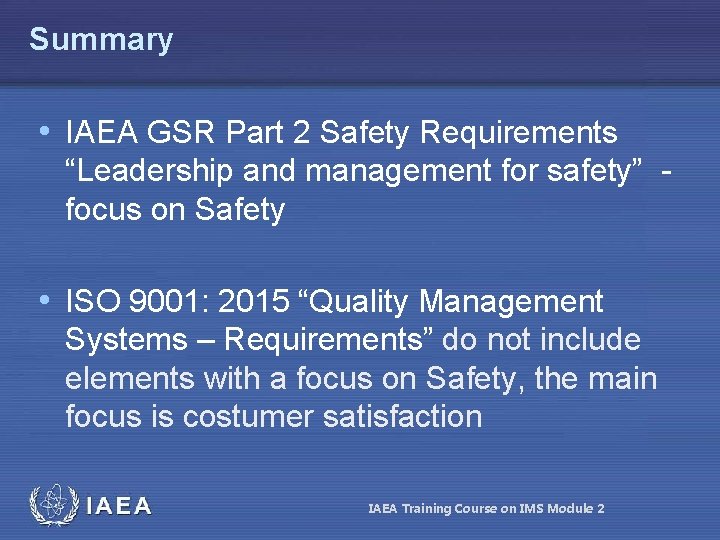
Summary • IAEA GSR Part 2 Safety Requirements “Leadership and management for safety” focus on Safety • ISO 9001: 2015 “Quality Management Systems – Requirements” do not include elements with a focus on Safety, the main focus is costumer satisfaction IAEA Training Course on IMS Module 2
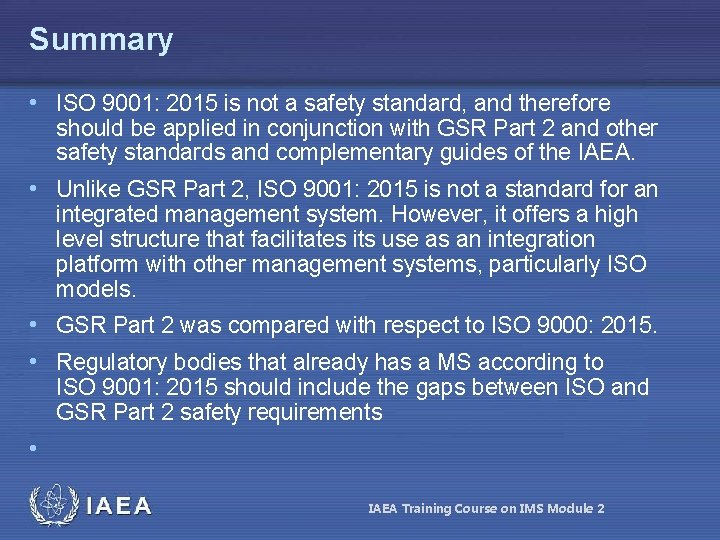
Summary • ISO 9001: 2015 is not a safety standard, and therefore should be applied in conjunction with GSR Part 2 and other safety standards and complementary guides of the IAEA. • Unlike GSR Part 2, ISO 9001: 2015 is not a standard for an integrated management system. However, it offers a high level structure that facilitates its use as an integration platform with other management systems, particularly ISO models. • GSR Part 2 was compared with respect to ISO 9000: 2015. • Regulatory bodies that already has a MS according to ISO 9001: 2015 should include the gaps between ISO and GSR Part 2 safety requirements • IAEA Training Course on IMS Module 2