
Classes and Object 1 Thomas Schwarz SJ Marquette
Classes and Object 1 Thomas Schwarz, SJ Marquette University
Classes and Objects • Imperative programming manipulates the state of memory • • Breaks up tasks through procedures and functions Object Oriented Programming • • Creates objects that interact with each other Objects are defined with a user-defined data type
Classes and Objects • Each object maintains its own state • Objects manipulate themselves and other objects through methods
Classes and Objects • Running Example: • • Complex Numbers Complex numbers live in the complex plane • • • Two canonicals way of representing them: Via coordinates (the real and the imaginary part) Via length and angle to x-axis
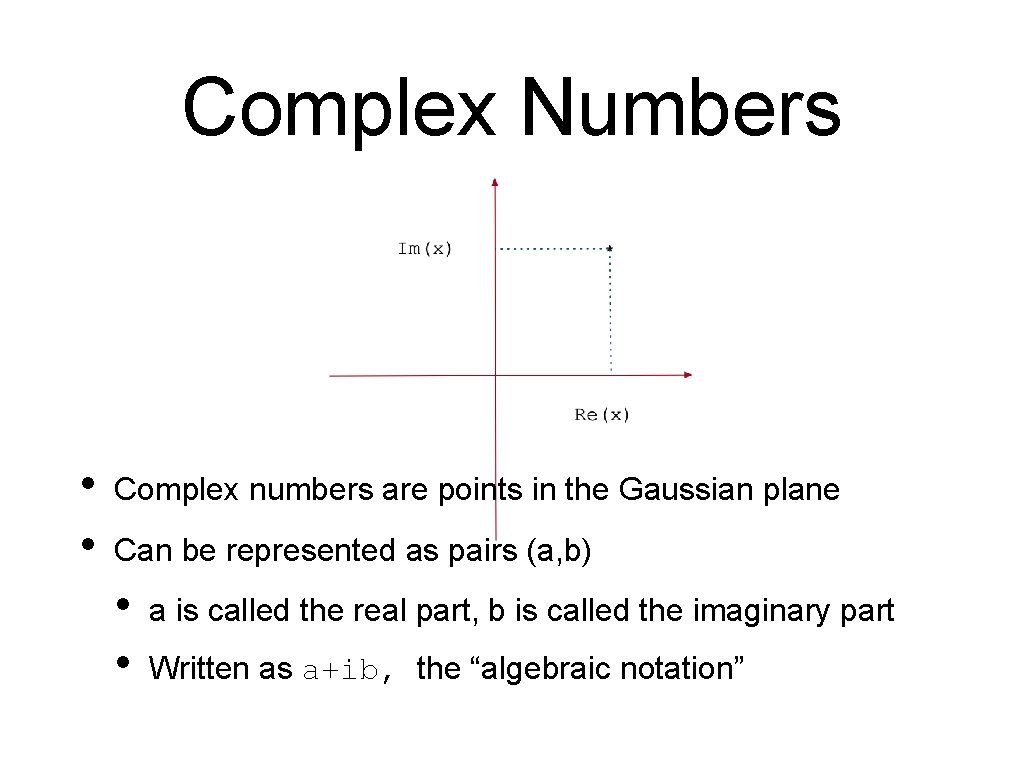
Complex Numbers • • Complex numbers are points in the Gaussian plane Can be represented as pairs (a, b) • • a is called the real part, b is called the imaginary part Written as a+ib, the “algebraic notation”

Complex Numbers r is the length α is the phase in radians • Polar form • • Given by angle Written as with x-axis and a length
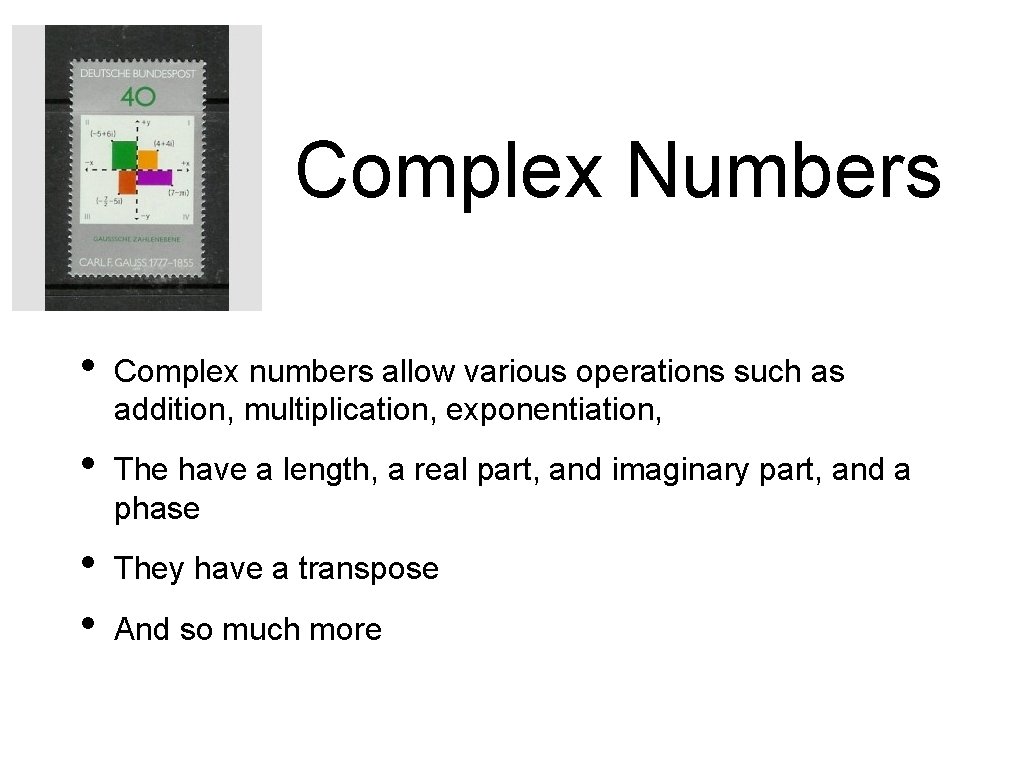
Complex Numbers • Complex numbers allow various operations such as addition, multiplication, exponentiation, • The have a length, a real part, and imaginary part, and a phase • • They have a transpose And so much more
OOP in Python • We define the type of an object as a class • Objects have fields and methods • • • Fields are like variables Methods are like functions A complex number has two fields: the real and the imaginary part A method would be the calculation of the length Another standard method would be a string describing the number
OOP in Python • There are two types of fields and methods: • Those that belong to the class: • • Class variables (aka Class fields), Class methods And those that belong to an object • Object variables, Object methods
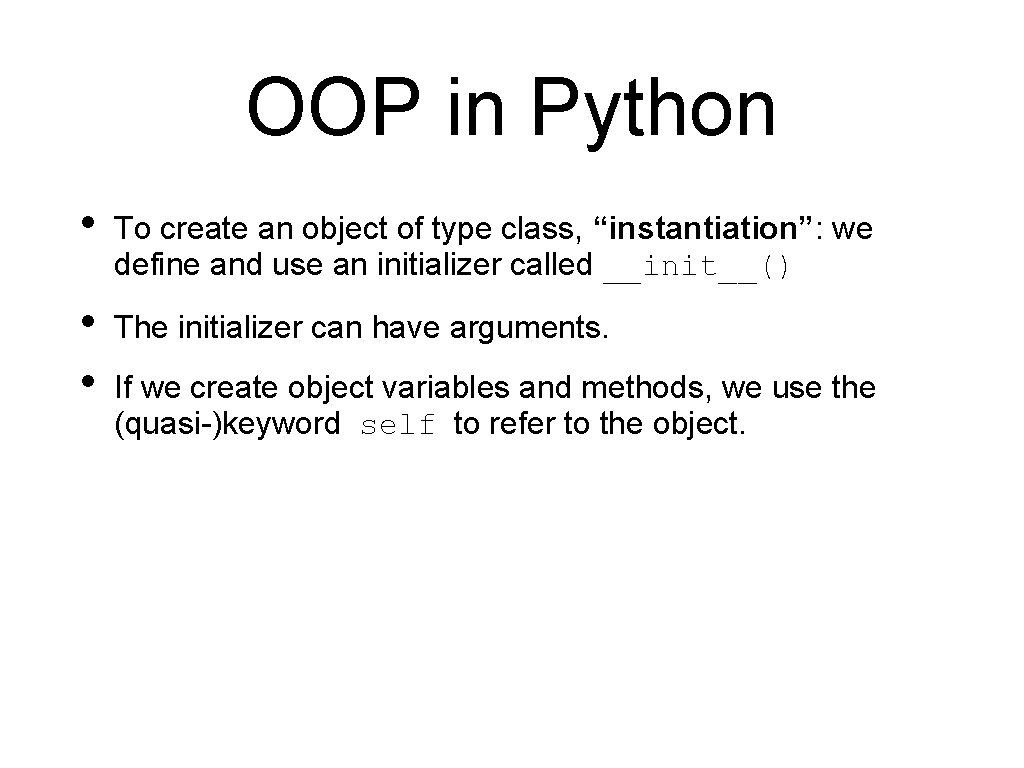
OOP in Python • To create an object of type class, “instantiation”: we define and use an initializer called __init__() • • The initializer can have arguments. If we create object variables and methods, we use the (quasi-)keyword self to refer to the object.
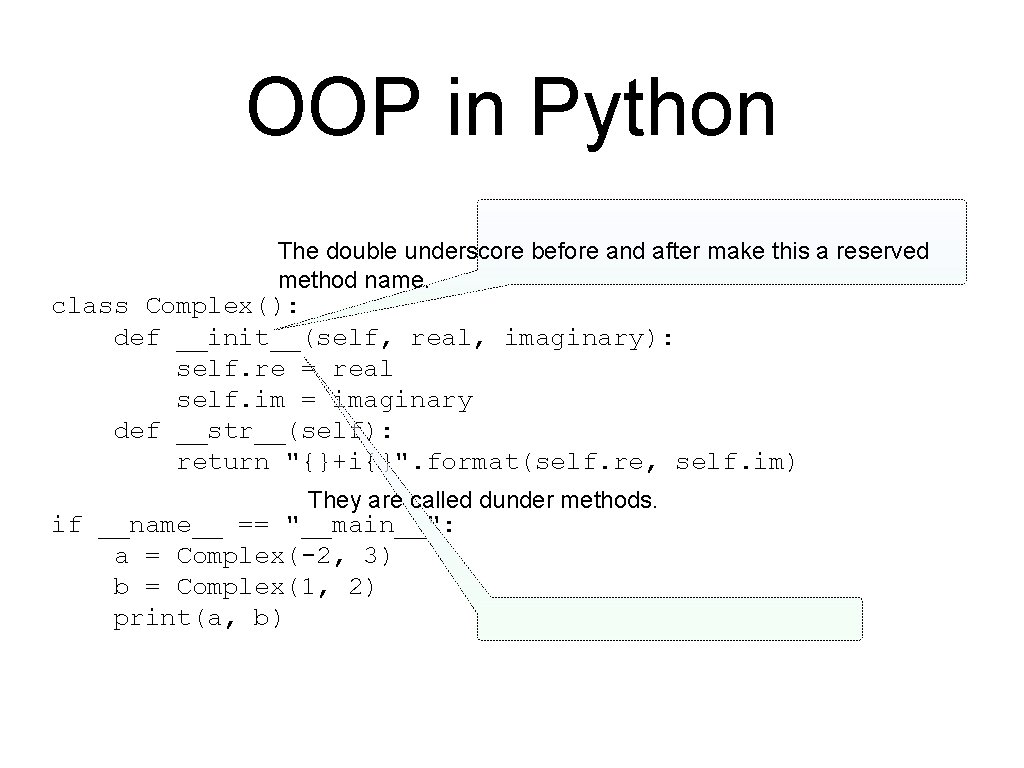
OOP in Python The double underscore before and after make this a reserved method name. class Complex(): def __init__(self, real, imaginary): self. re = real self. im = imaginary def __str__(self): return "{}+i{}". format(self. re, self. im) They are called dunder methods. if __name__ == "__main__": a = Complex(-2, 3) b = Complex(1, 2) print(a, b)
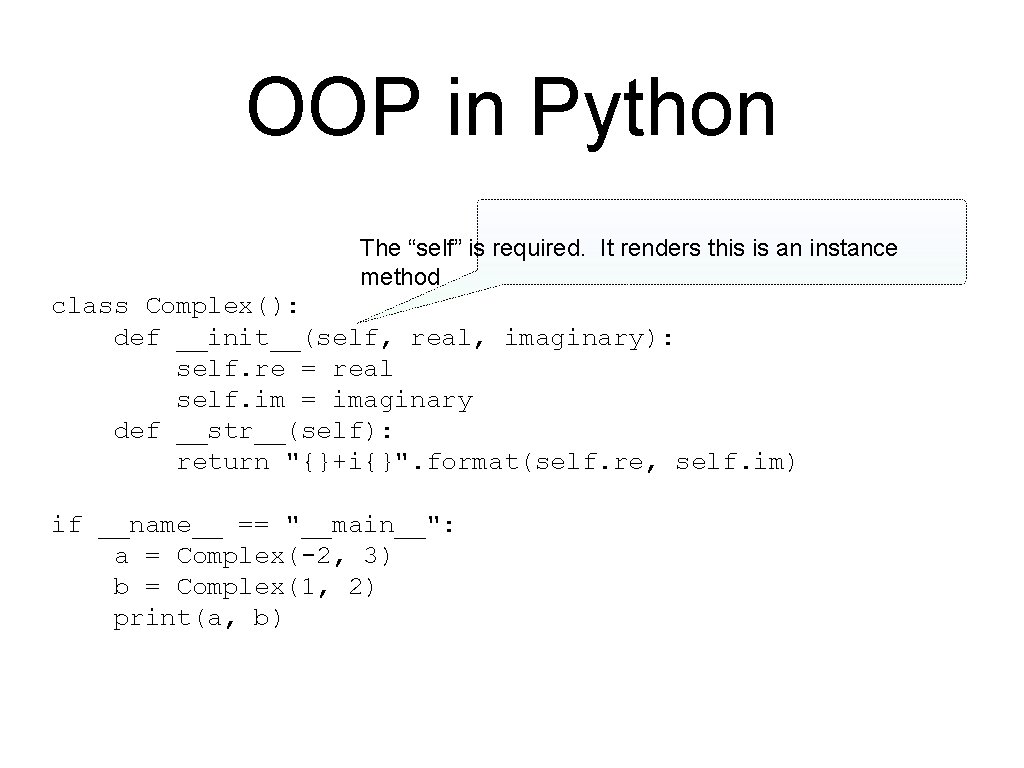
OOP in Python The “self” is required. It renders this is an instance method class Complex(): def __init__(self, real, imaginary): self. re = real self. im = imaginary def __str__(self): return "{}+i{}". format(self. re, self. im) if __name__ == "__main__": a = Complex(-2, 3) b = Complex(1, 2) print(a, b)
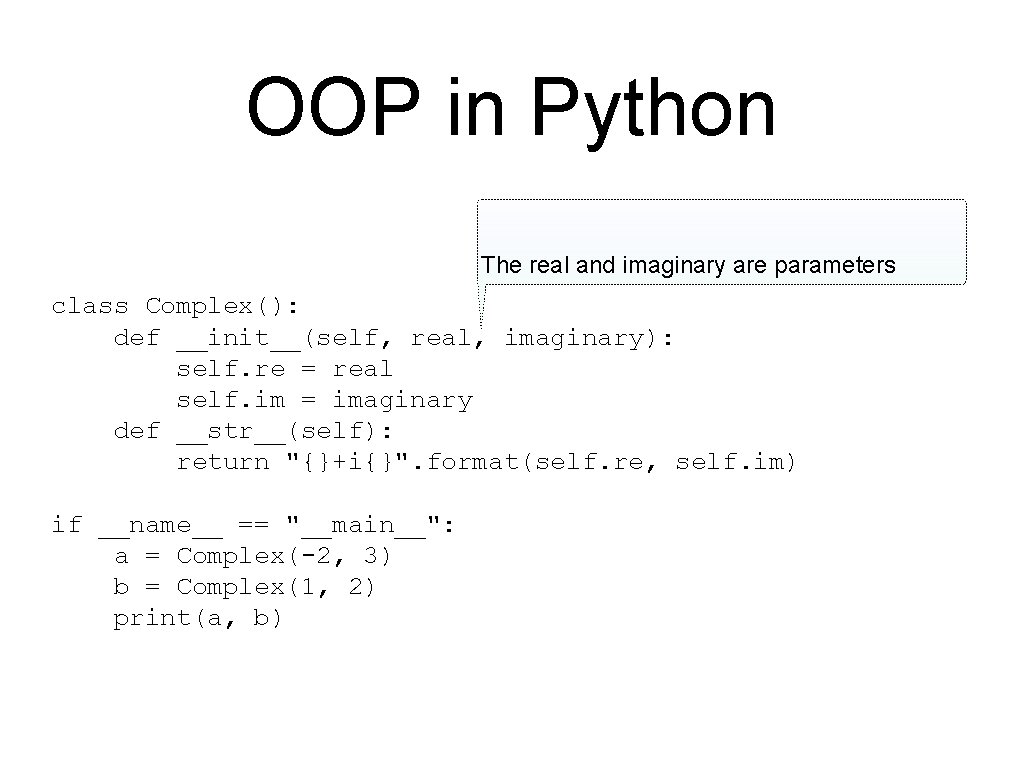
OOP in Python The real and imaginary are parameters class Complex(): def __init__(self, real, imaginary): self. re = real self. im = imaginary def __str__(self): return "{}+i{}". format(self. re, self. im) if __name__ == "__main__": a = Complex(-2, 3) b = Complex(1, 2) print(a, b)
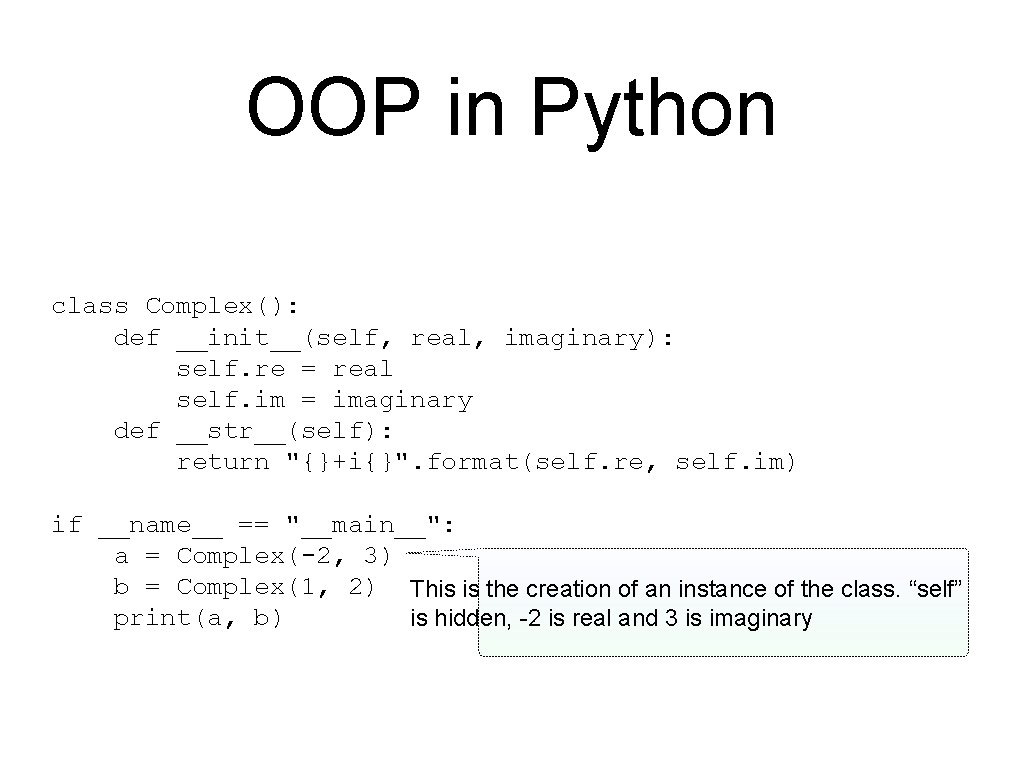
OOP in Python class Complex(): def __init__(self, real, imaginary): self. re = real self. im = imaginary def __str__(self): return "{}+i{}". format(self. re, self. im) if __name__ == "__main__": a = Complex(-2, 3) b = Complex(1, 2) This is the creation of an instance of the class. “self” print(a, b) is hidden, -2 is real and 3 is imaginary
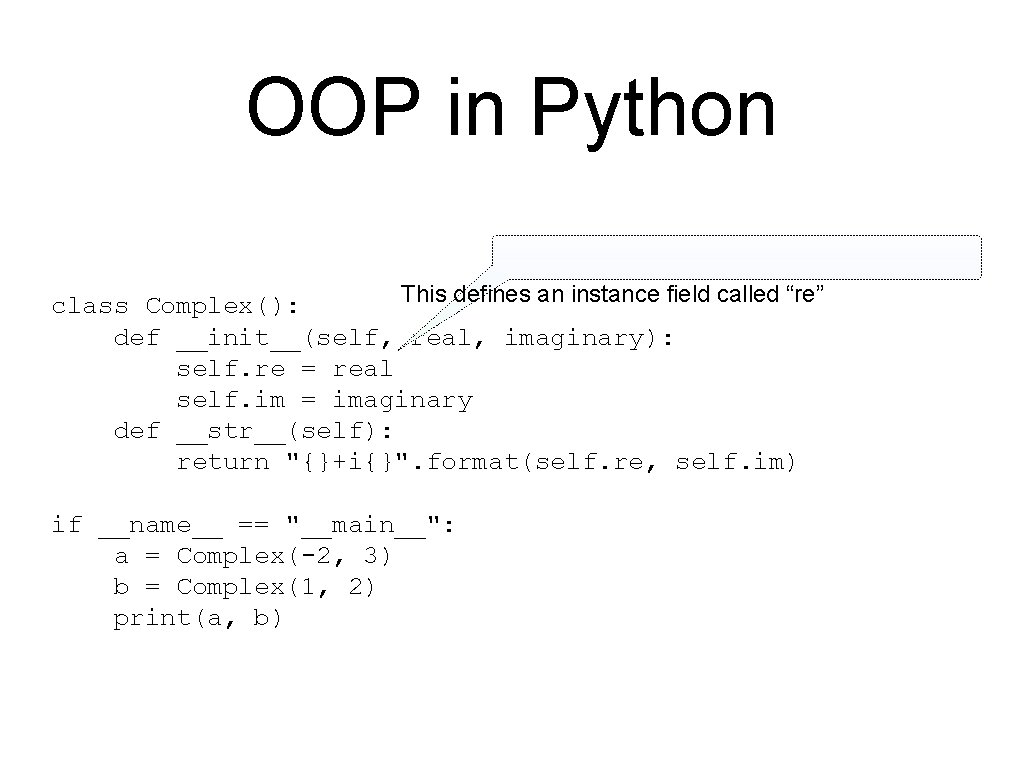
OOP in Python This defines an instance field called “re” class Complex(): def __init__(self, real, imaginary): self. re = real self. im = imaginary def __str__(self): return "{}+i{}". format(self. re, self. im) if __name__ == "__main__": a = Complex(-2, 3) b = Complex(1, 2) print(a, b)
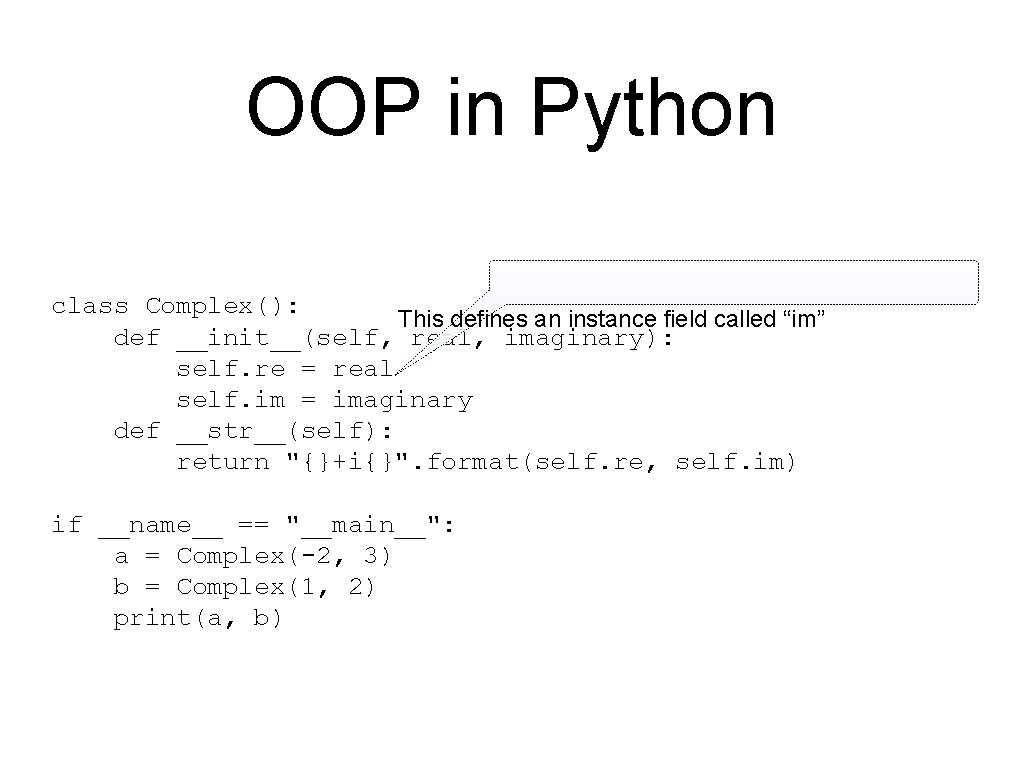
OOP in Python class Complex(): This defines an instance field called “im” def __init__(self, real, imaginary): self. re = real self. im = imaginary def __str__(self): return "{}+i{}". format(self. re, self. im) if __name__ == "__main__": a = Complex(-2, 3) b = Complex(1, 2) print(a, b)
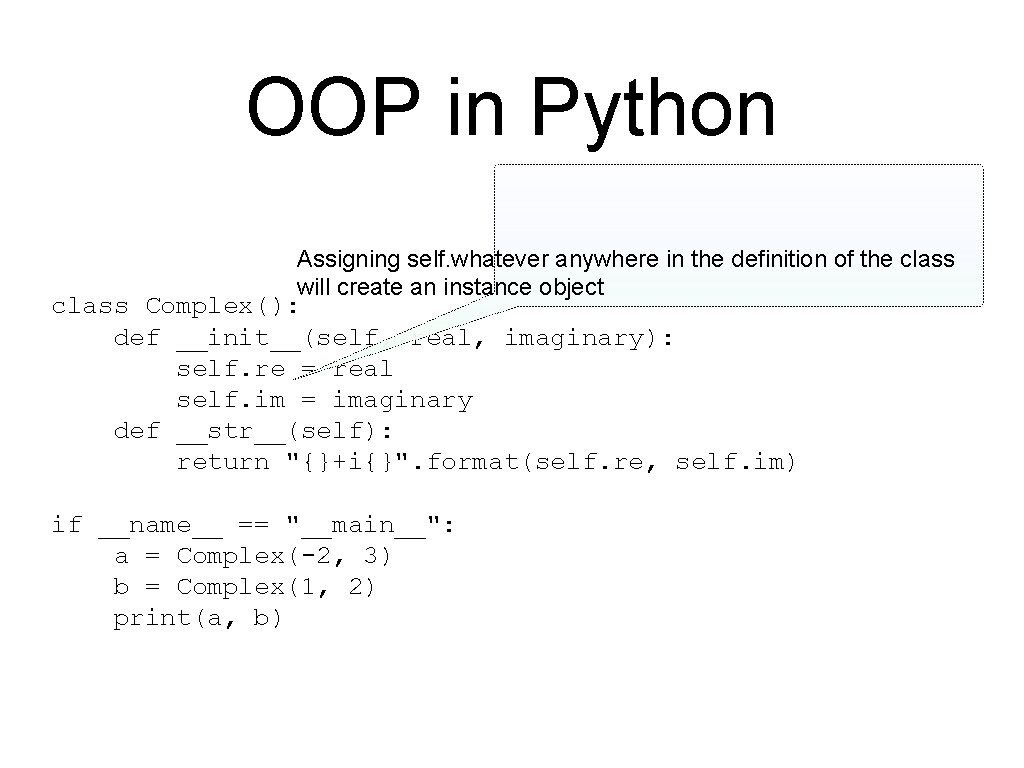
OOP in Python Assigning self. whatever anywhere in the definition of the class will create an instance object class Complex(): def __init__(self, real, imaginary): self. re = real self. im = imaginary def __str__(self): return "{}+i{}". format(self. re, self. im) if __name__ == "__main__": a = Complex(-2, 3) b = Complex(1, 2) print(a, b)
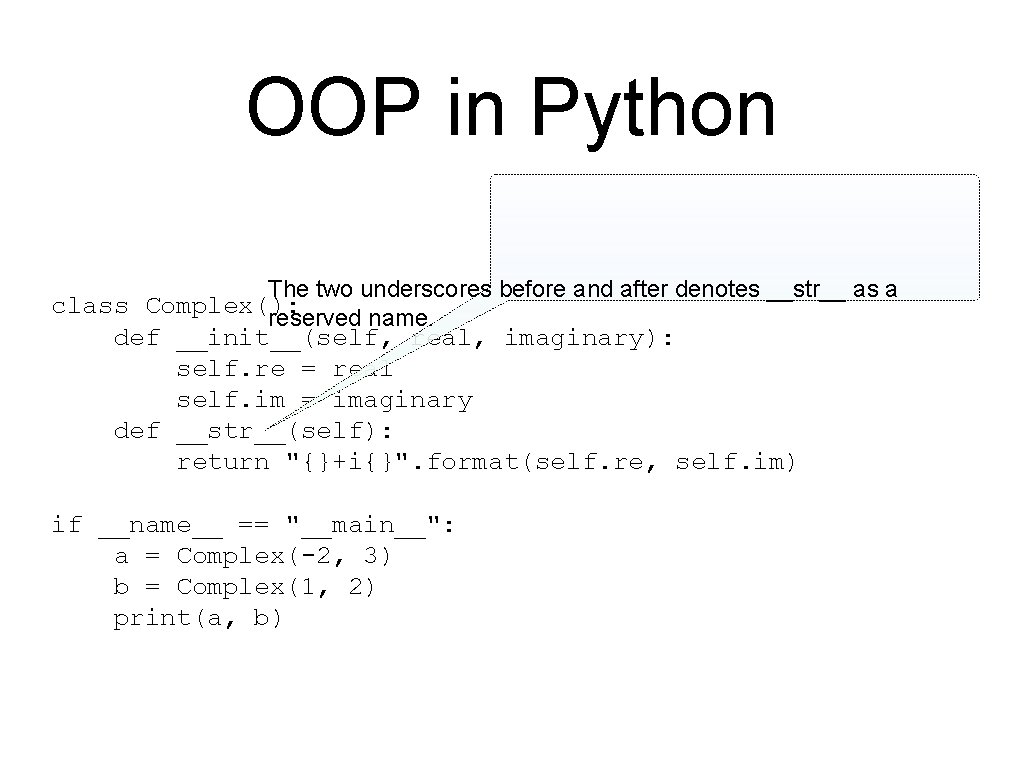
OOP in Python The two underscores before and after denotes __str__ as a class Complex(): reserved name. def __init__(self, real, imaginary): self. re = real self. im = imaginary def __str__(self): return "{}+i{}". format(self. re, self. im) if __name__ == "__main__": a = Complex(-2, 3) b = Complex(1, 2) print(a, b)
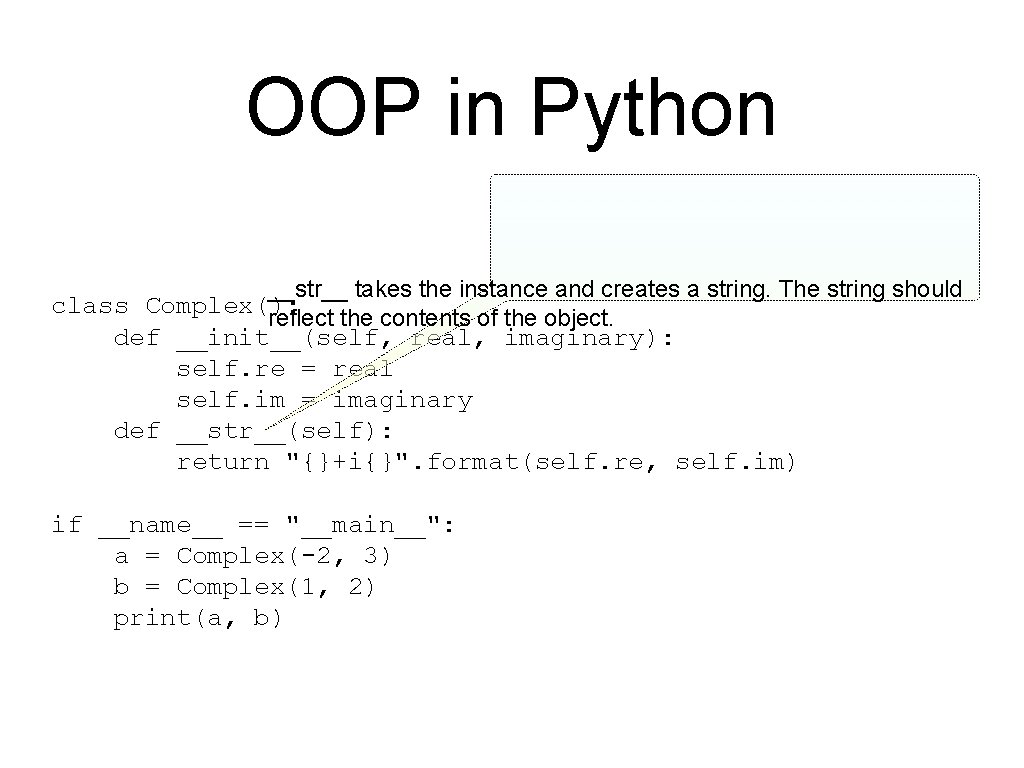
OOP in Python __str__ takes the instance and creates a string. The string should class Complex(): reflect the contents of the object. def __init__(self, real, imaginary): self. re = real self. im = imaginary def __str__(self): return "{}+i{}". format(self. re, self. im) if __name__ == "__main__": a = Complex(-2, 3) b = Complex(1, 2) print(a, b)
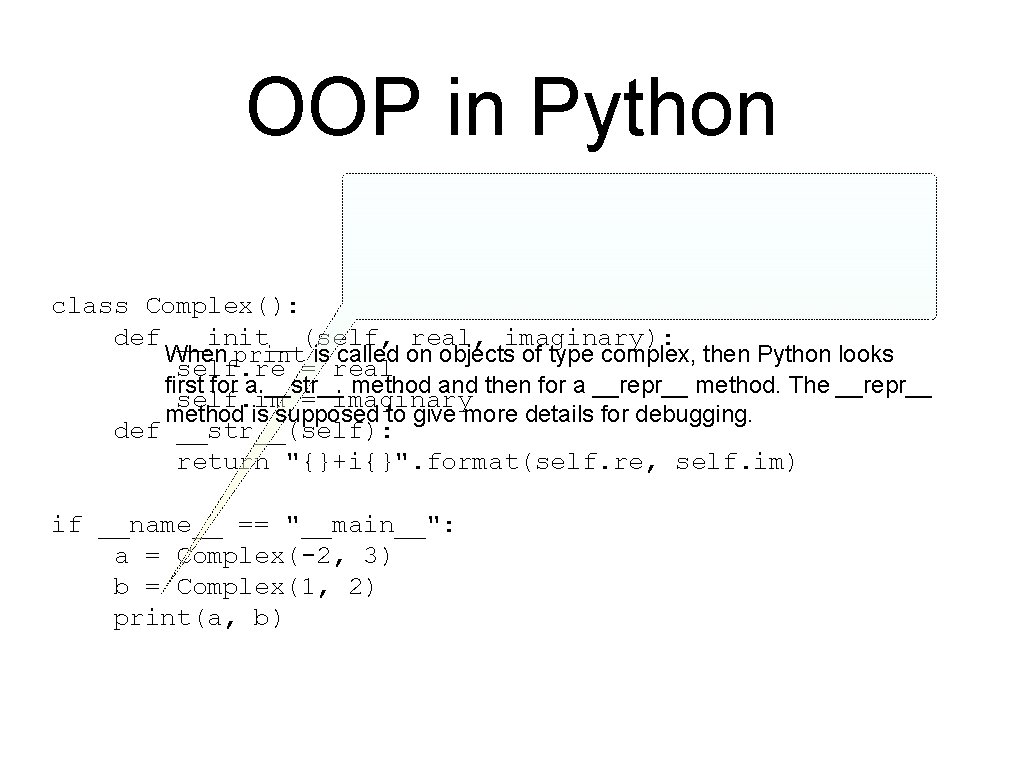
OOP in Python class Complex(): def __init__(self, real, imaginary): When print is called on objects of type complex, then Python looks self. re = real first for a __str__ method and then for a __repr__ method. The __repr__ self. im = imaginary method is supposed to give more details for debugging. def __str__(self): return "{}+i{}". format(self. re, self. im) if __name__ == "__main__": a = Complex(-2, 3) b = Complex(1, 2) print(a, b)
OOP in Python • Adding Methods • Every complex number has a length: • To create a method calculating the length: • We need one argument: the object (the complex number) itself • This argument is called self
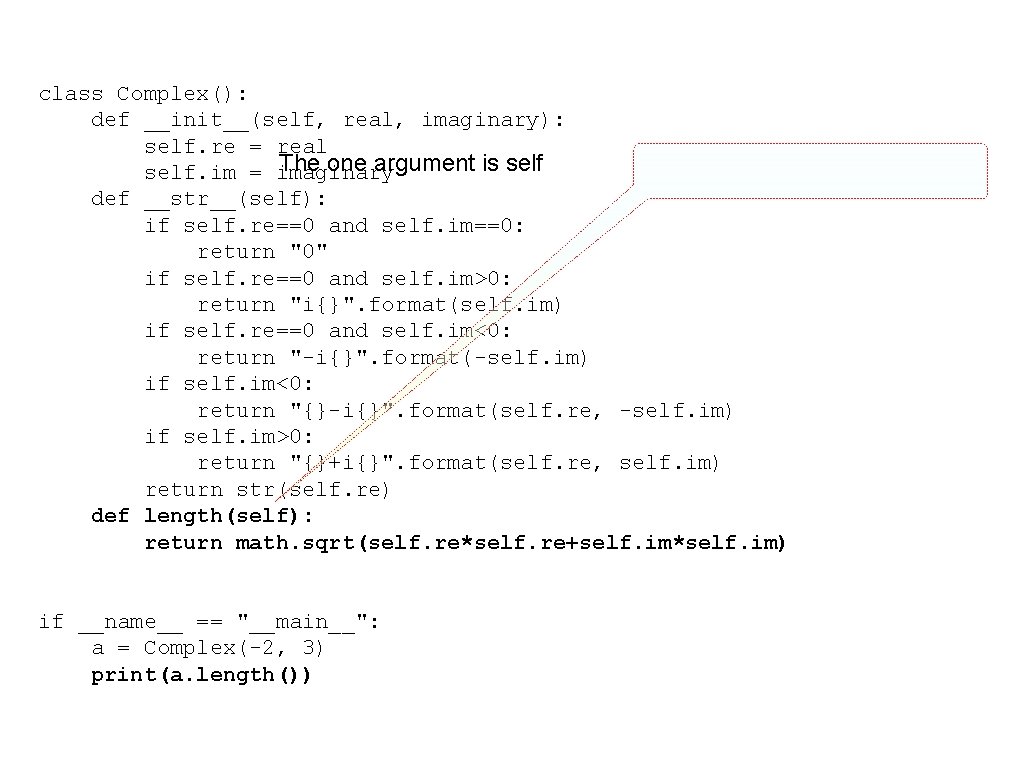
class Complex(): def __init__(self, real, imaginary): self. re = real The one argument is self. im = imaginary def __str__(self): if self. re==0 and self. im==0: return "0" if self. re==0 and self. im>0: return "i{}". format(self. im) if self. re==0 and self. im<0: return "-i{}". format(-self. im) if self. im<0: return "{}-i{}". format(self. re, -self. im) if self. im>0: return "{}+i{}". format(self. re, self. im) return str(self. re) def length(self): return math. sqrt(self. re*self. re+self. im*self. im) if __name__ == "__main__": a = Complex(-2, 3) print(a. length())
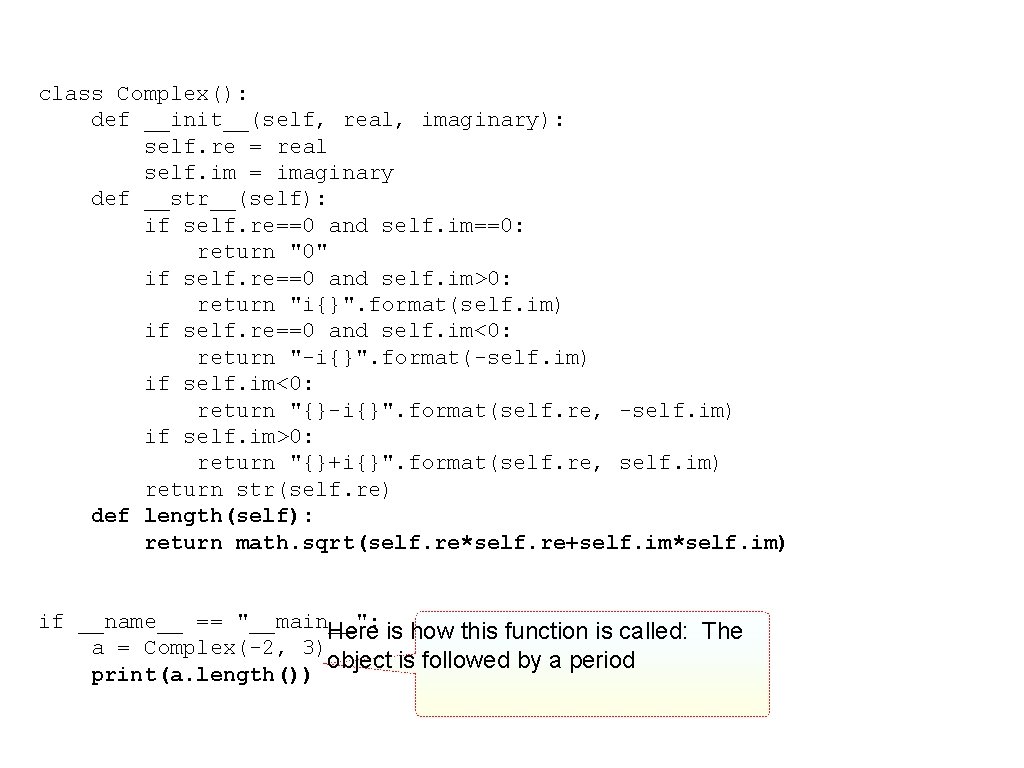
class Complex(): def __init__(self, real, imaginary): self. re = real self. im = imaginary def __str__(self): if self. re==0 and self. im==0: return "0" if self. re==0 and self. im>0: return "i{}". format(self. im) if self. re==0 and self. im<0: return "-i{}". format(-self. im) if self. im<0: return "{}-i{}". format(self. re, -self. im) if self. im>0: return "{}+i{}". format(self. re, self. im) return str(self. re) def length(self): return math. sqrt(self. re*self. re+self. im*self. im) if __name__ == "__main__": Here is how this function is called: The a = Complex(-2, 3) object is followed by a period print(a. length())
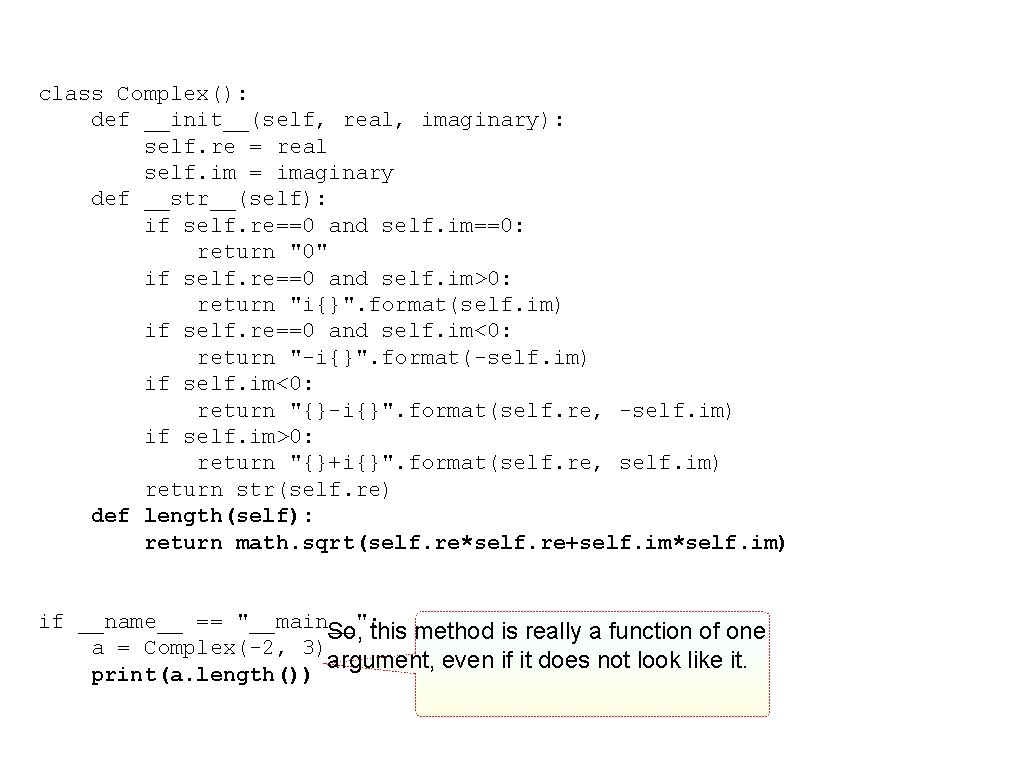
class Complex(): def __init__(self, real, imaginary): self. re = real self. im = imaginary def __str__(self): if self. re==0 and self. im==0: return "0" if self. re==0 and self. im>0: return "i{}". format(self. im) if self. re==0 and self. im<0: return "-i{}". format(-self. im) if self. im<0: return "{}-i{}". format(self. re, -self. im) if self. im>0: return "{}+i{}". format(self. re, self. im) return str(self. re) def length(self): return math. sqrt(self. re*self. re+self. im*self. im) if __name__ == "__main__": So, this method is really a function of one a = Complex(-2, 3) argument, even if it does not look like it. print(a. length())
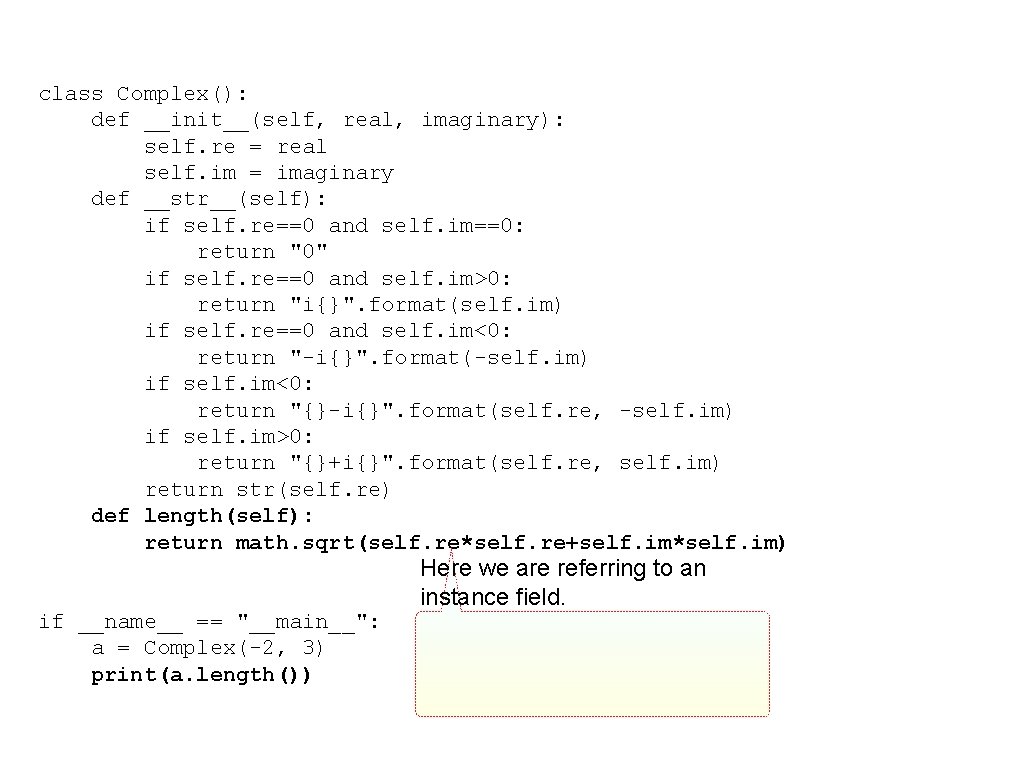
class Complex(): def __init__(self, real, imaginary): self. re = real self. im = imaginary def __str__(self): if self. re==0 and self. im==0: return "0" if self. re==0 and self. im>0: return "i{}". format(self. im) if self. re==0 and self. im<0: return "-i{}". format(-self. im) if self. im<0: return "{}-i{}". format(self. re, -self. im) if self. im>0: return "{}+i{}". format(self. re, self. im) return str(self. re) def length(self): return math. sqrt(self. re*self. re+self. im*self. im) if __name__ == "__main__": a = Complex(-2, 3) print(a. length()) Here we are referring to an instance field.
Self Test: Stop the presentation and fire up IDLE • The phase of a complex number is defined by • Raise a Value. Error in the last case, the arctan in the math library is called atan.
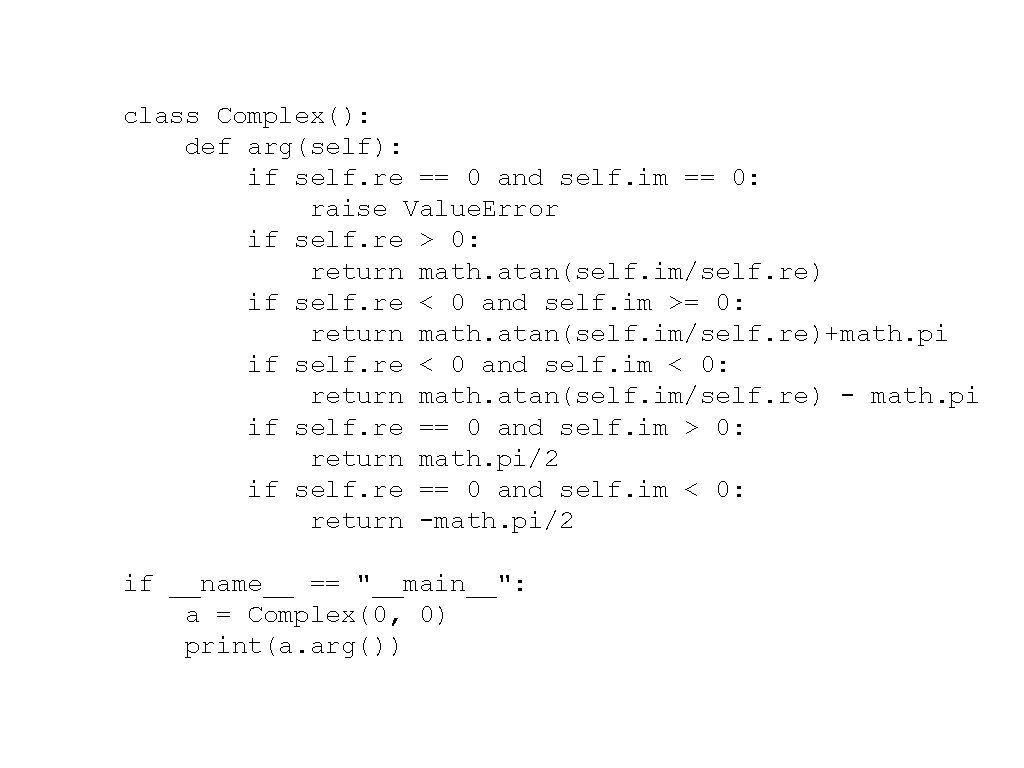
class Complex(): def arg(self): if self. re == 0 and self. im == 0: raise Value. Error if self. re > 0: return math. atan(self. im/self. re) if self. re < 0 and self. im >= 0: return math. atan(self. im/self. re)+math. pi if self. re < 0 and self. im < 0: return math. atan(self. im/self. re) - math. pi if self. re == 0 and self. im > 0: return math. pi/2 if self. re == 0 and self. im < 0: return -math. pi/2 if __name__ == "__main__": a = Complex(0, 0) print(a. arg())
OOP in Python • Methods can of course return other objects • The conjugate of a complex number is obtained by reflecting around the y-axis
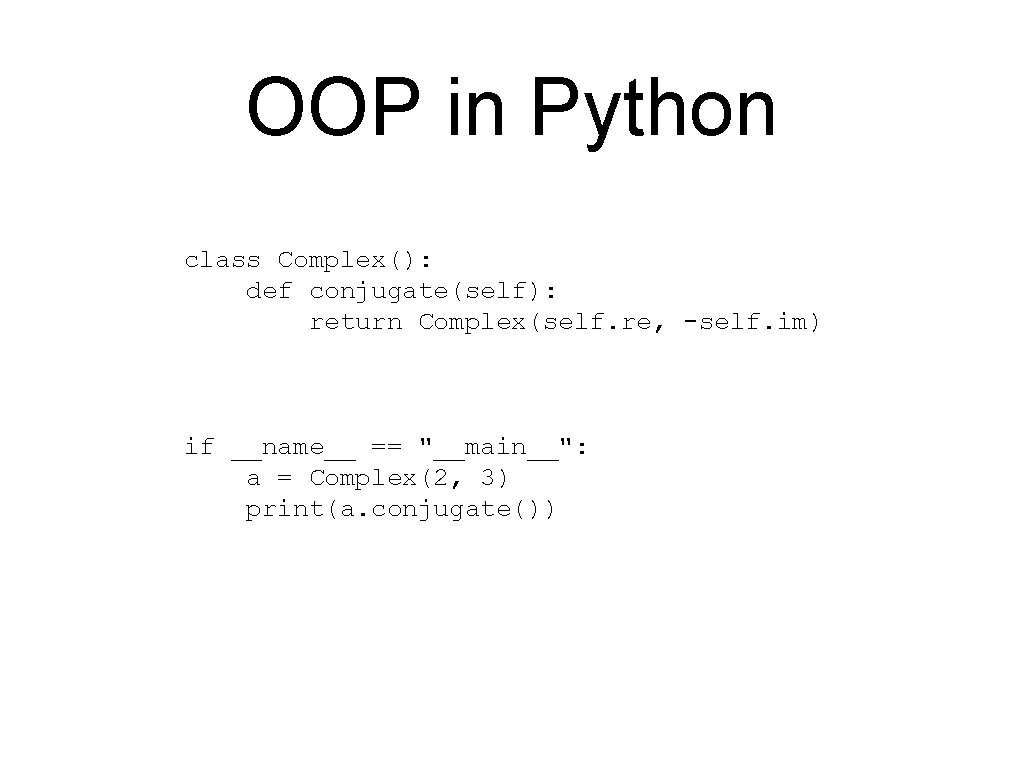
OOP in Python class Complex(): def conjugate(self): return Complex(self. re, -self. im) if __name__ == "__main__": a = Complex(2, 3) print(a. conjugate())
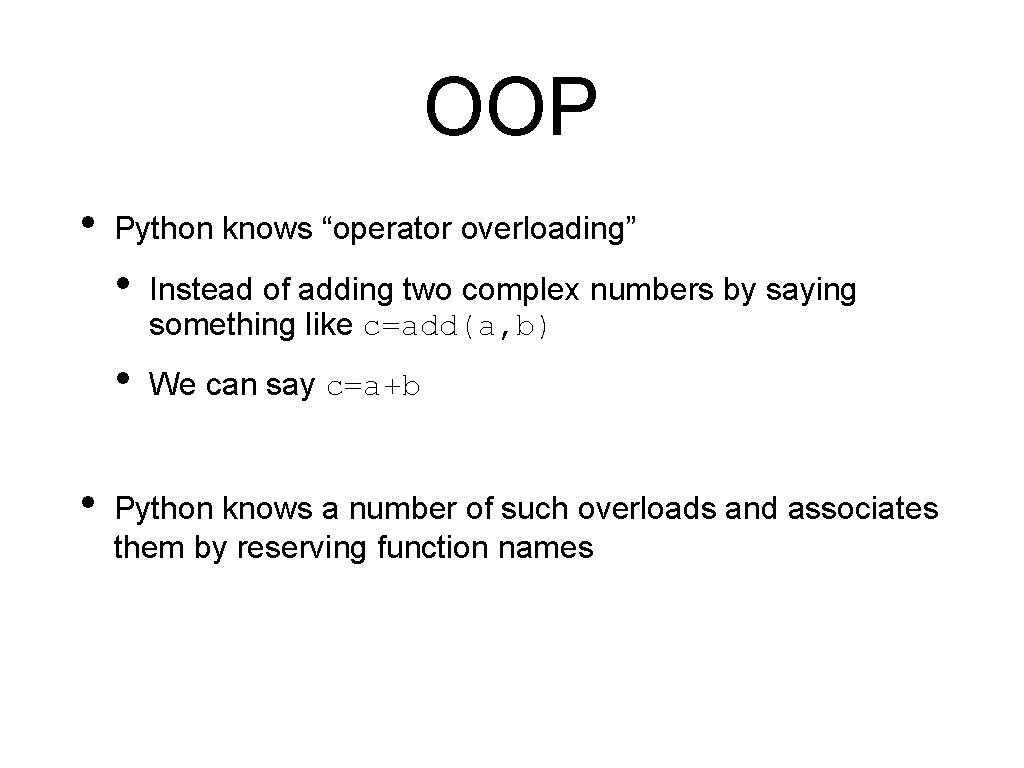
OOP • • Python knows “operator overloading” • Instead of adding two complex numbers by saying something like c=add(a, b) • We can say c=a+b Python knows a number of such overloads and associates them by reserving function names
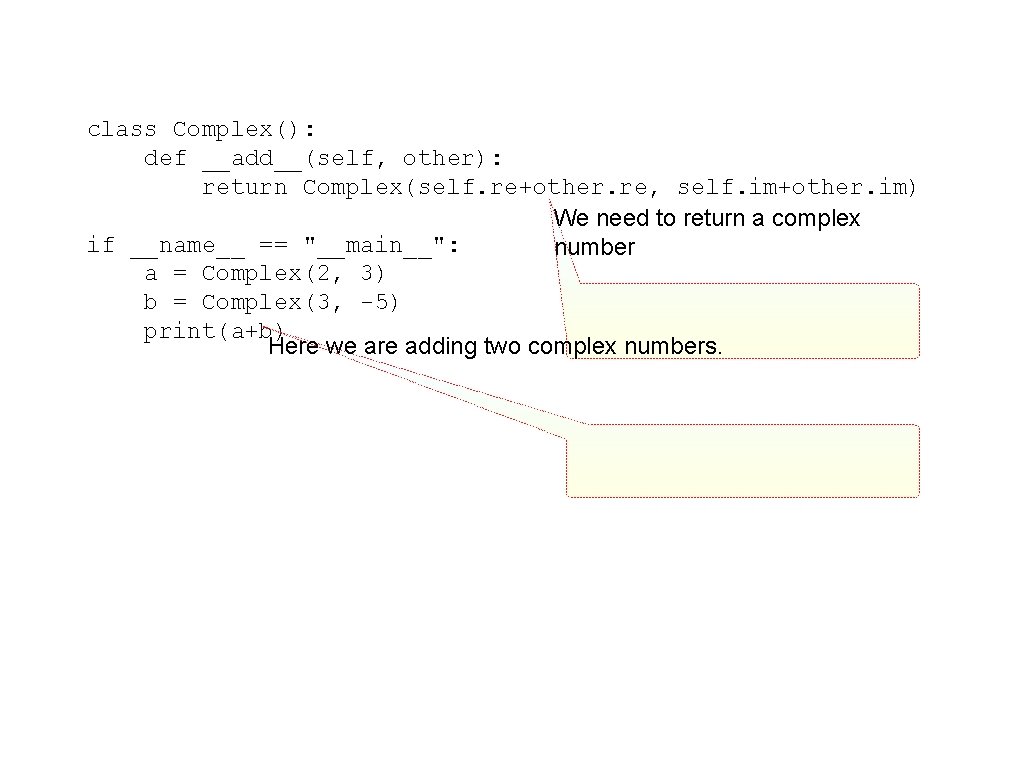
class Complex(): def __add__(self, other): return Complex(self. re+other. re, self. im+other. im) We need to return a complex if __name__ == "__main__": number a = Complex(2, 3) b = Complex(3, -5) print(a+b) Here we are adding two complex numbers.
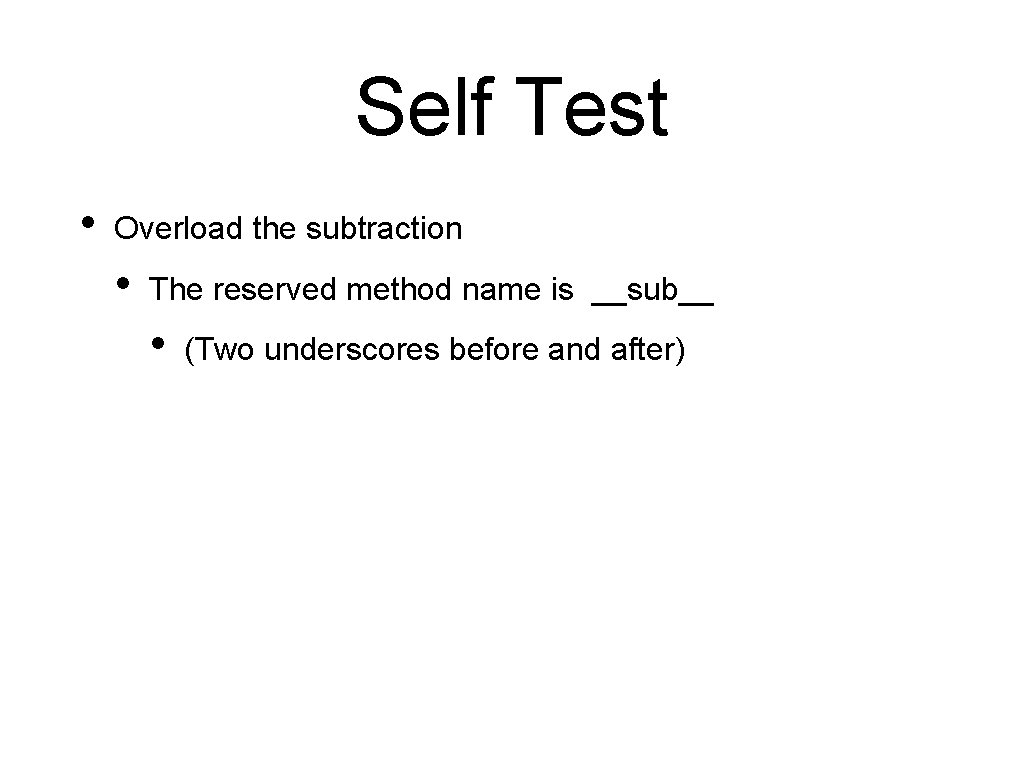
Self Test • Overload the subtraction • The reserved method name is __sub__ • (Two underscores before and after)
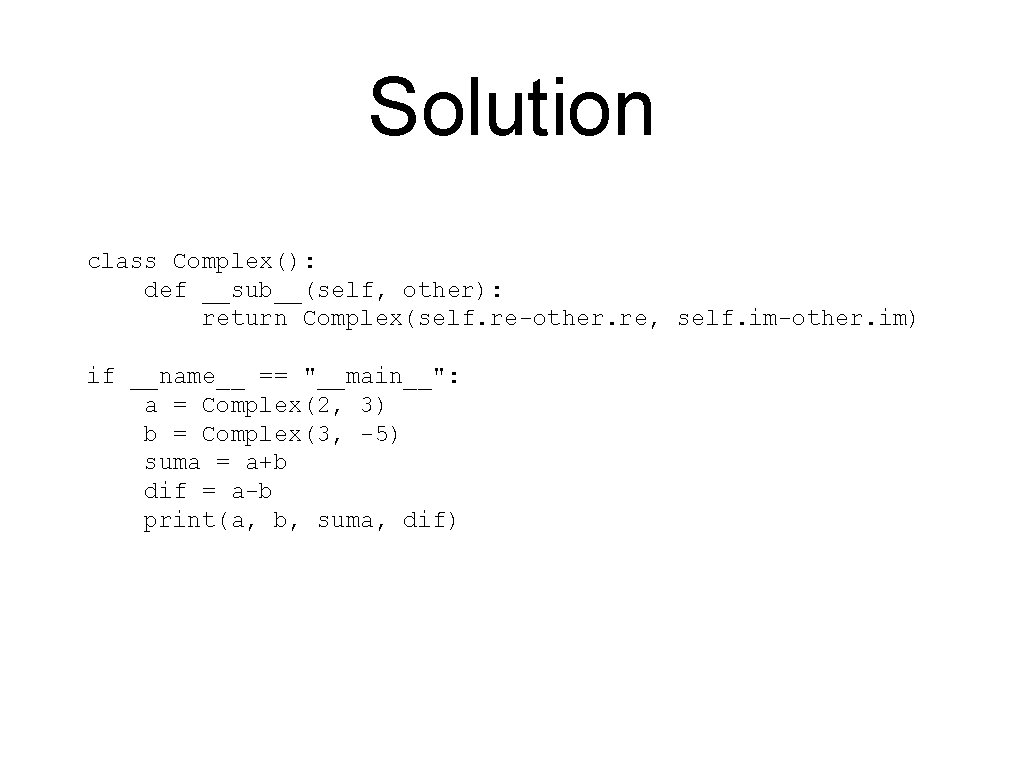
Solution class Complex(): def __sub__(self, other): return Complex(self. re-other. re, self. im-other. im) if __name__ == "__main__": a = Complex(2, 3) b = Complex(3, -5) suma = a+b dif = a-b print(a, b, suma, dif)
OOP in Python • We can define comparisons via overloading • For equality, the reserved method name is __eq__
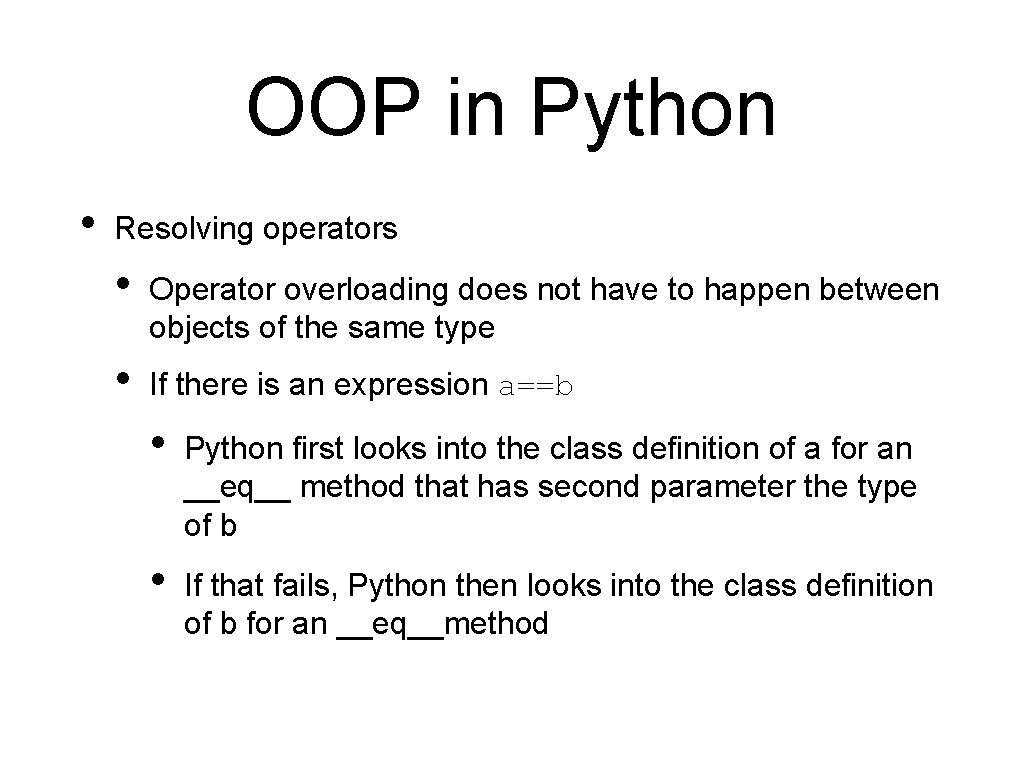
OOP in Python • Resolving operators • Operator overloading does not have to happen between objects of the same type • If there is an expression a==b • Python first looks into the class definition of a for an __eq__ method that has second parameter the type of b • If that fails, Python then looks into the class definition of b for an __eq__method
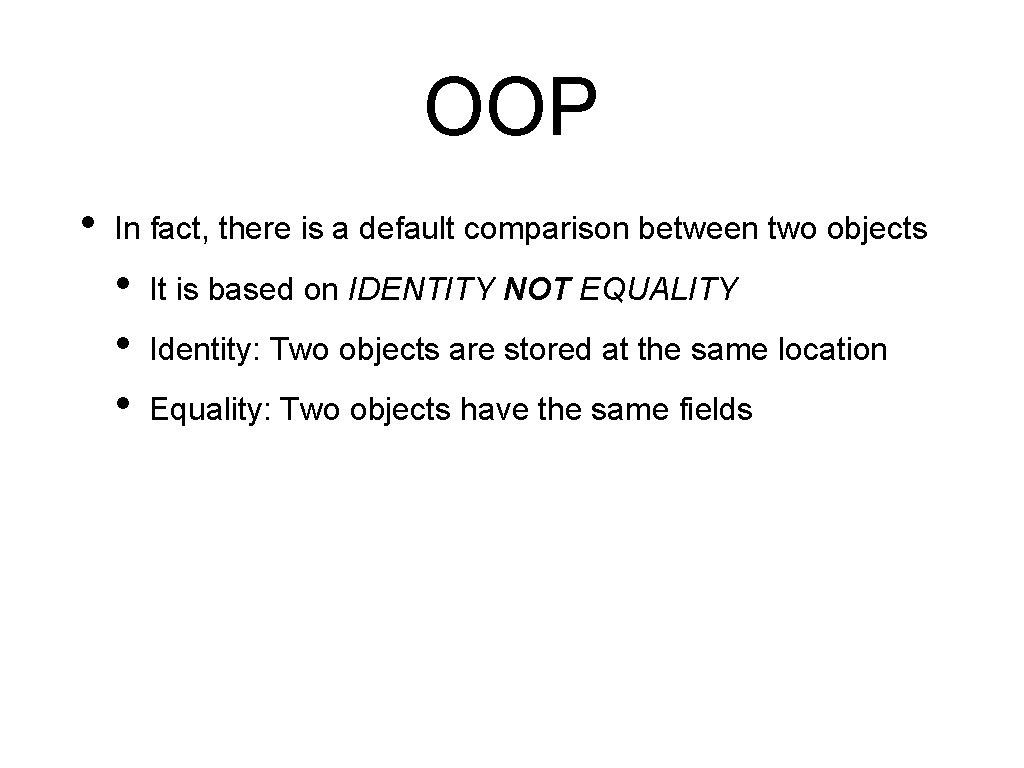
OOP • In fact, there is a default comparison between two objects • • • It is based on IDENTITY NOT EQUALITY Identity: Two objects are stored at the same location Equality: Two objects have the same fields
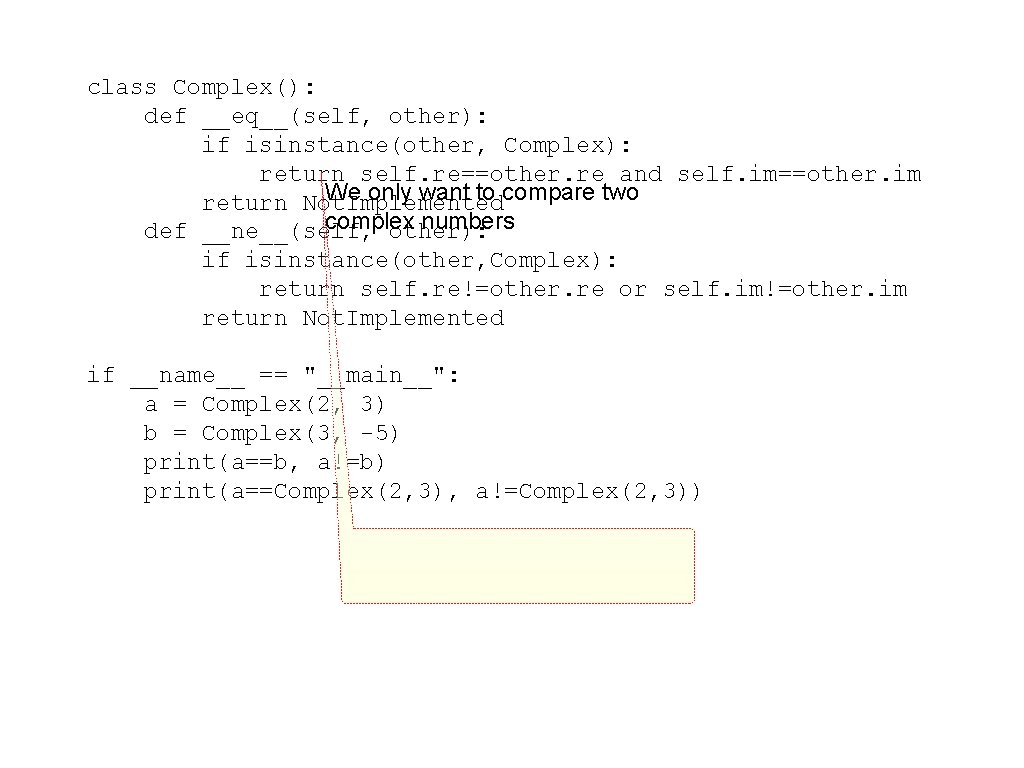
class Complex(): def __eq__(self, other): if isinstance(other, Complex): return self. re==other. re and self. im==other. im We only want to compare two return Not. Implemented complex numbers def __ne__(self, other): if isinstance(other, Complex): return self. re!=other. re or self. im!=other. im return Not. Implemented if __name__ == "__main__": a = Complex(2, 3) b = Complex(3, -5) print(a==b, a!=b) print(a==Complex(2, 3), a!=Complex(2, 3))
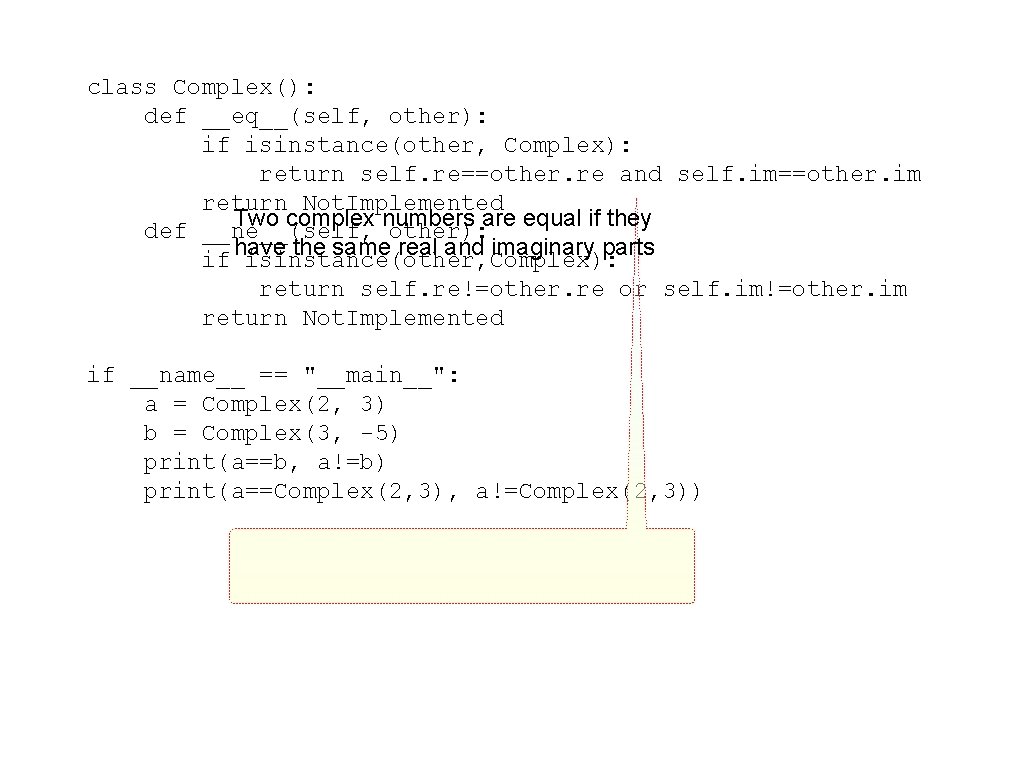
class Complex(): def __eq__(self, other): if isinstance(other, Complex): return self. re==other. re and self. im==other. im return Not. Implemented Two complex numbers are equal if they def __ne__(self, other): have the same real and imaginary parts if isinstance(other, Complex): return self. re!=other. re or self. im!=other. im return Not. Implemented if __name__ == "__main__": a = Complex(2, 3) b = Complex(3, -5) print(a==b, a!=b) print(a==Complex(2, 3), a!=Complex(2, 3))
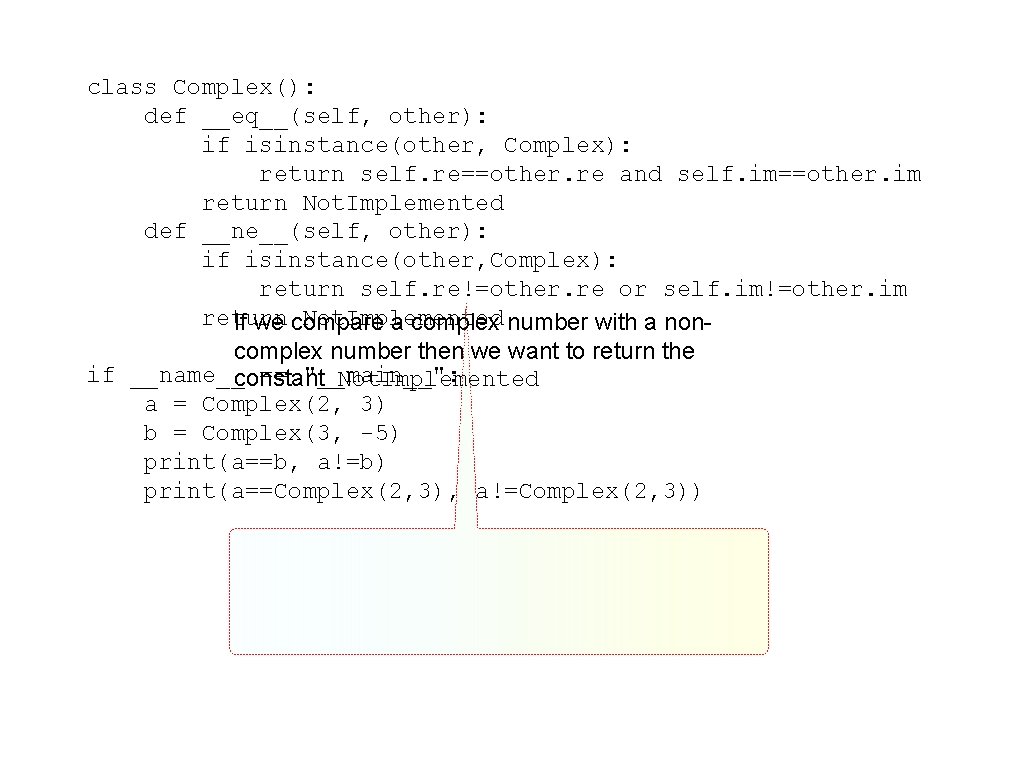
class Complex(): def __eq__(self, other): if isinstance(other, Complex): return self. re==other. re and self. im==other. im return Not. Implemented def __ne__(self, other): if isinstance(other, Complex): return self. re!=other. re or self. im!=other. im return Not. Implemented If we compare a complex number with a noncomplex number then we want to return the if __name__constant == "__main__": Not. Implemented a = Complex(2, 3) b = Complex(3, -5) print(a==b, a!=b) print(a==Complex(2, 3), a!=Complex(2, 3))
Classes and Objects • Classes usually define objects, but they can also used in isolation • Assume that you want to use a number of global variables • • This is dangerous, since you might be reusing the same name Solution: Use a class that contains all these variables
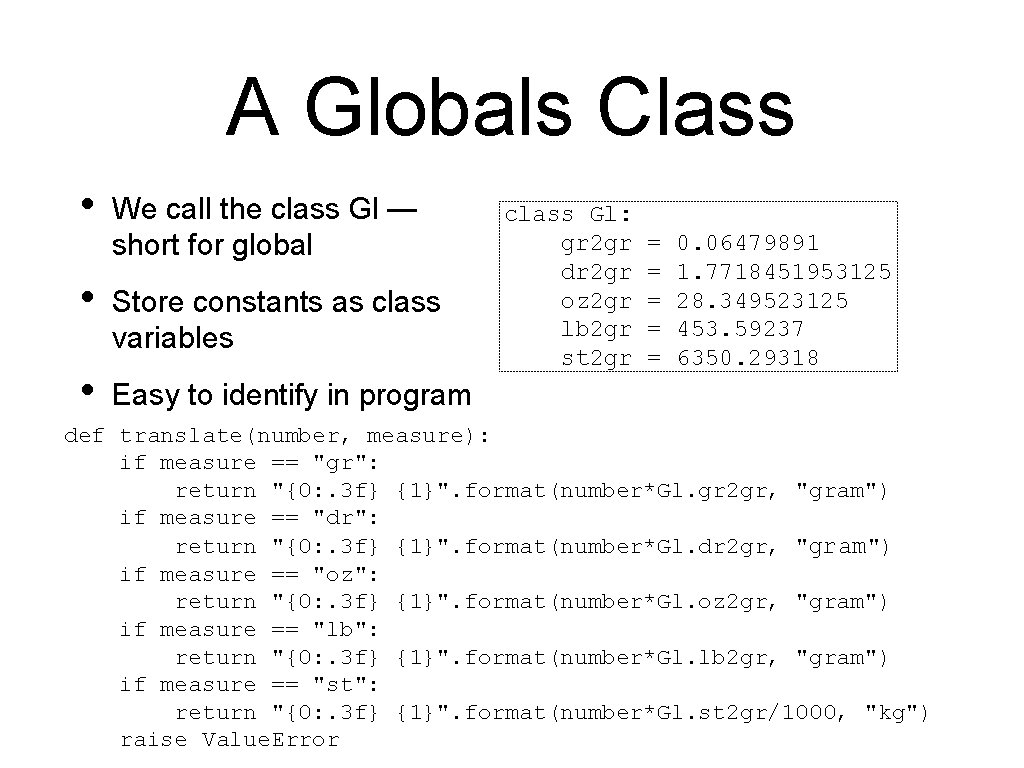
A Globals Class • We call the class Gl — short for global • Store constants as class variables • Easy to identify in program class Gl: gr 2 gr dr 2 gr oz 2 gr lb 2 gr st 2 gr = = = 0. 06479891 1. 7718451953125 28. 349523125 453. 59237 6350. 29318 def translate(number, measure): if measure == "gr": return "{0: . 3 f} {1}". format(number*Gl. gr 2 gr, "gram") if measure == "dr": return "{0: . 3 f} {1}". format(number*Gl. dr 2 gr, "gram") if measure == "oz": return "{0: . 3 f} {1}". format(number*Gl. oz 2 gr, "gram") if measure == "lb": return "{0: . 3 f} {1}". format(number*Gl. lb 2 gr, "gram") if measure == "st": return "{0: . 3 f} {1}". format(number*Gl. st 2 gr/1000, "kg") raise Value. Error
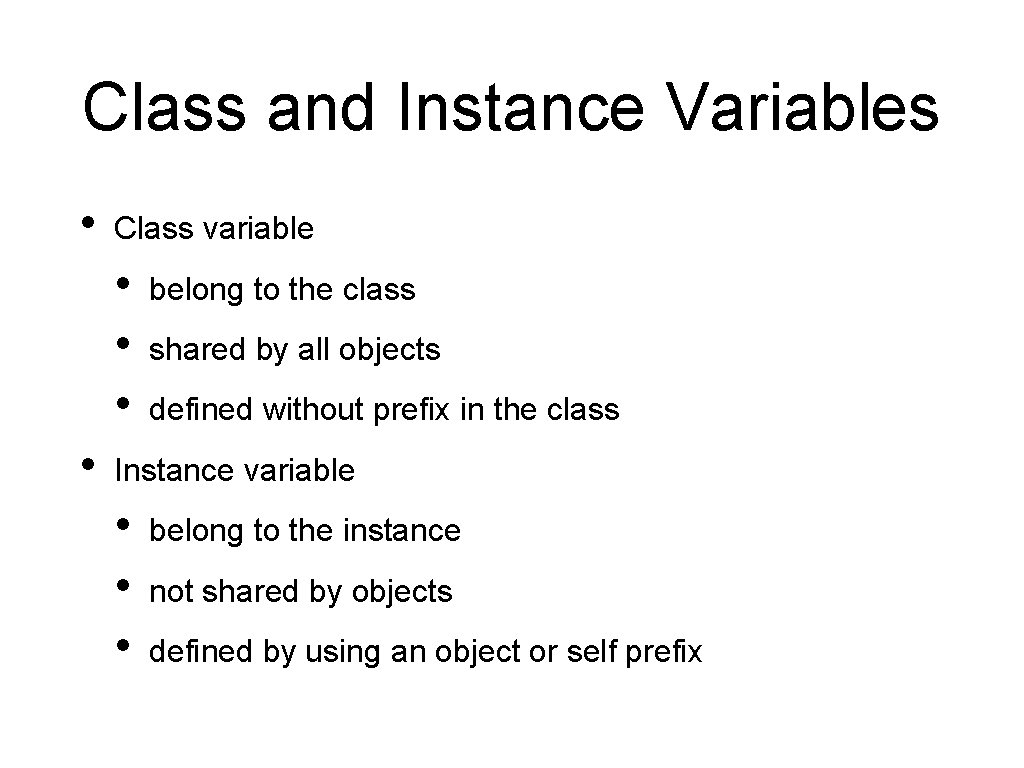
Class and Instance Variables • Class variable • • belong to the class shared by all objects defined without prefix in the class Instance variable • • • belong to the instance not shared by objects defined by using an object or self prefix
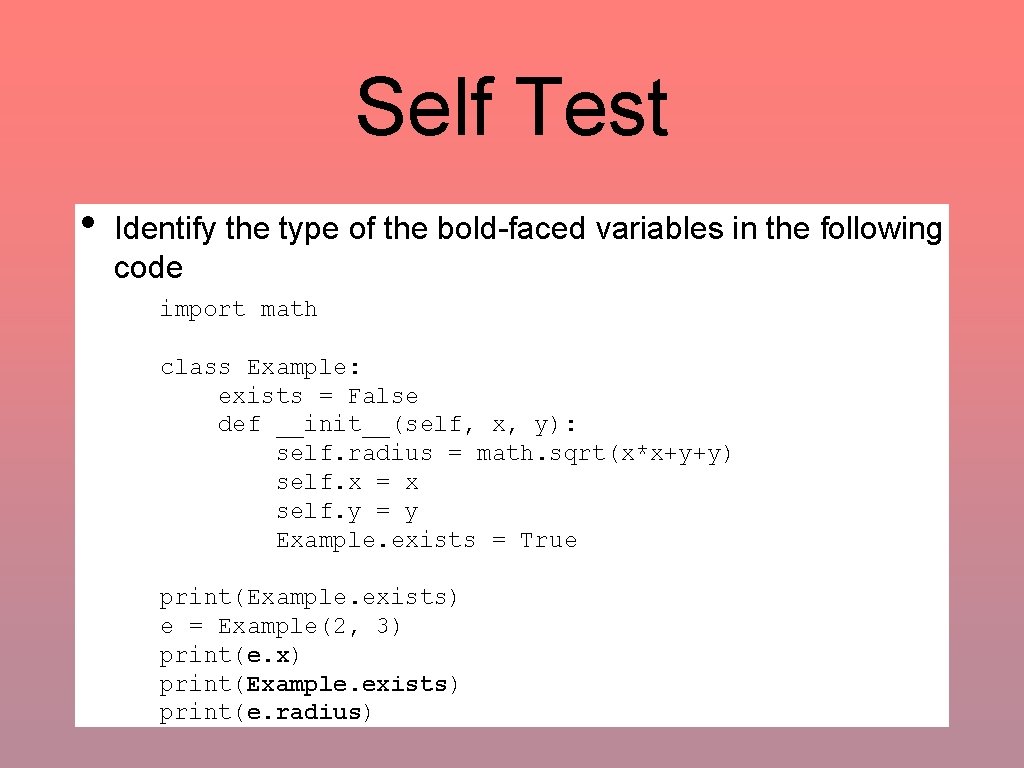
Self Test • Identify the type of the bold-faced variables in the following code import math class Example: exists = False def __init__(self, x, y): self. radius = math. sqrt(x*x+y+y) self. x = x self. y = y Example. exists = True print(Example. exists) e = Example(2, 3) print(e. x) print(Example. exists) print(e. radius)
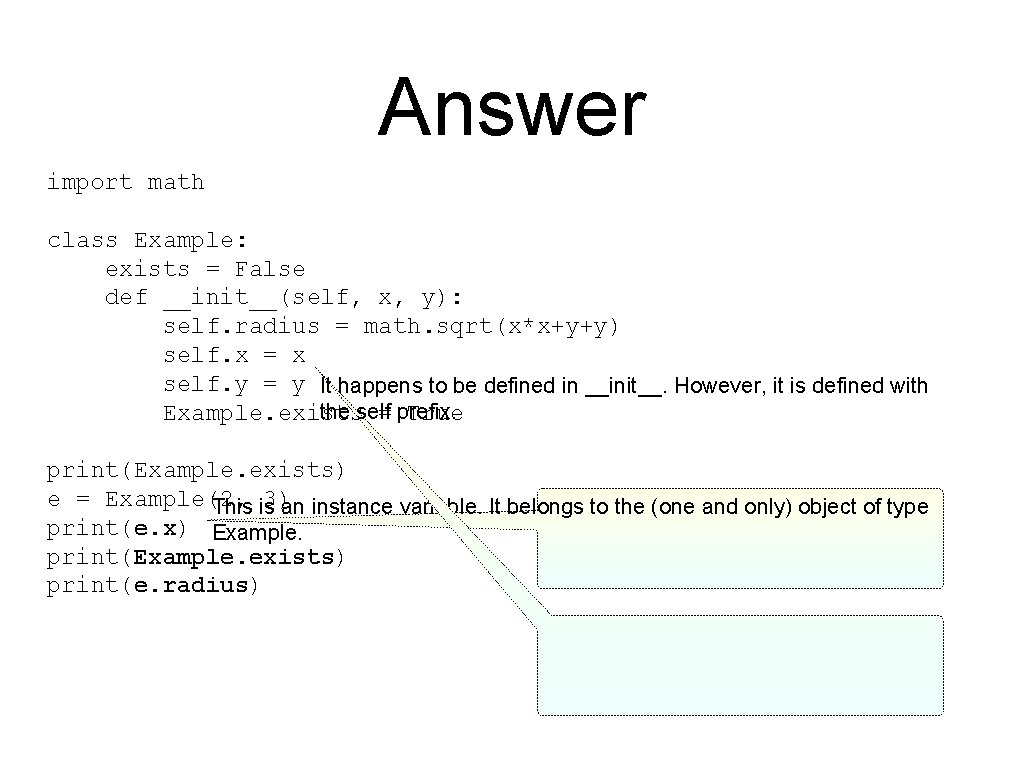
Answer import math class Example: exists = False def __init__(self, x, y): self. radius = math. sqrt(x*x+y+y) self. x = x self. y = y It happens to be defined in __init__. However, it is defined with the self Example. exists = prefix. True print(Example. exists) e = Example(2, 3)an instance variable. It belongs to the (one and only) object of type This is print(e. x) Example. print(Example. exists) print(e. radius)
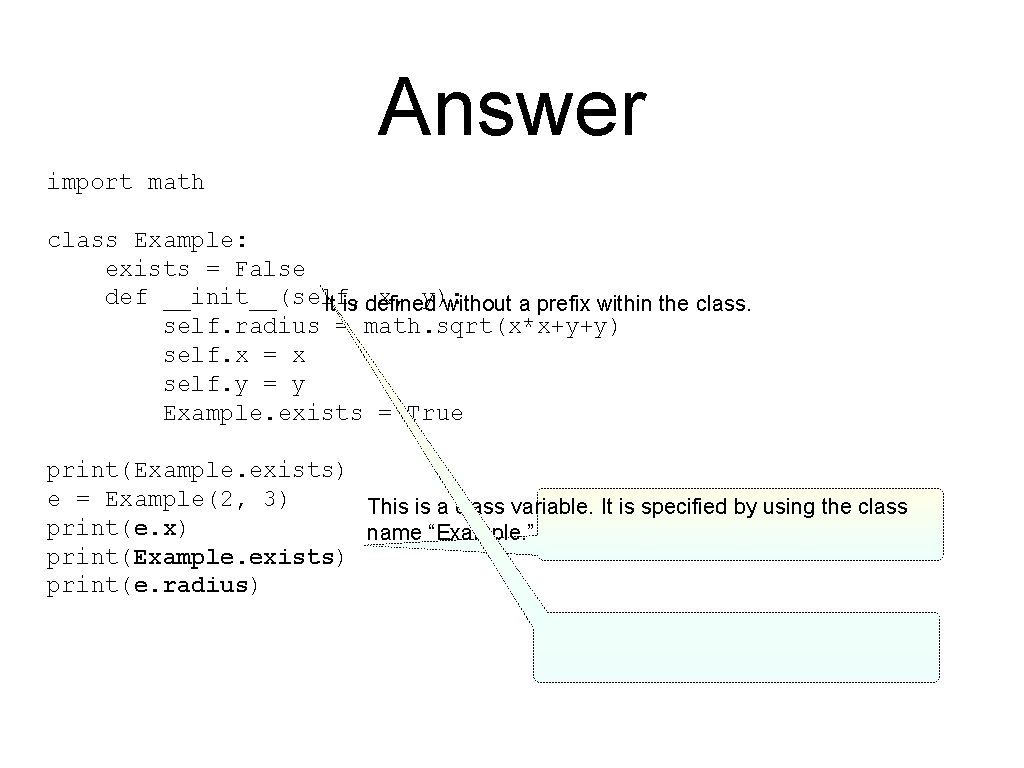
Answer import math class Example: exists = False def __init__(self, x, y): It is defined without a prefix within the class. self. radius = math. sqrt(x*x+y+y) self. x = x self. y = y Example. exists = True print(Example. exists) e = Example(2, 3) This is a class variable. It is specified by using the class print(e. x) name “Example. ” print(Example. exists) print(e. radius)
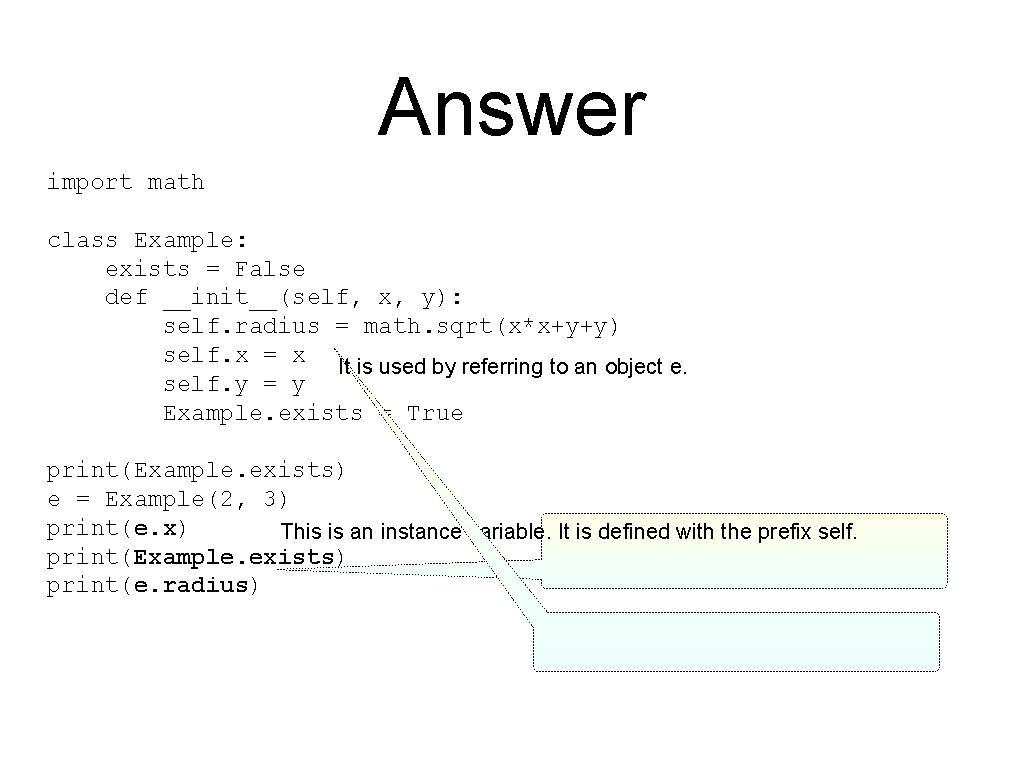
Answer import math class Example: exists = False def __init__(self, x, y): self. radius = math. sqrt(x*x+y+y) self. x = x It is used by referring to an object e. self. y = y Example. exists = True print(Example. exists) e = Example(2, 3) print(e. x) This is an instance variable. It is defined with the prefix self. print(Example. exists) print(e. radius)
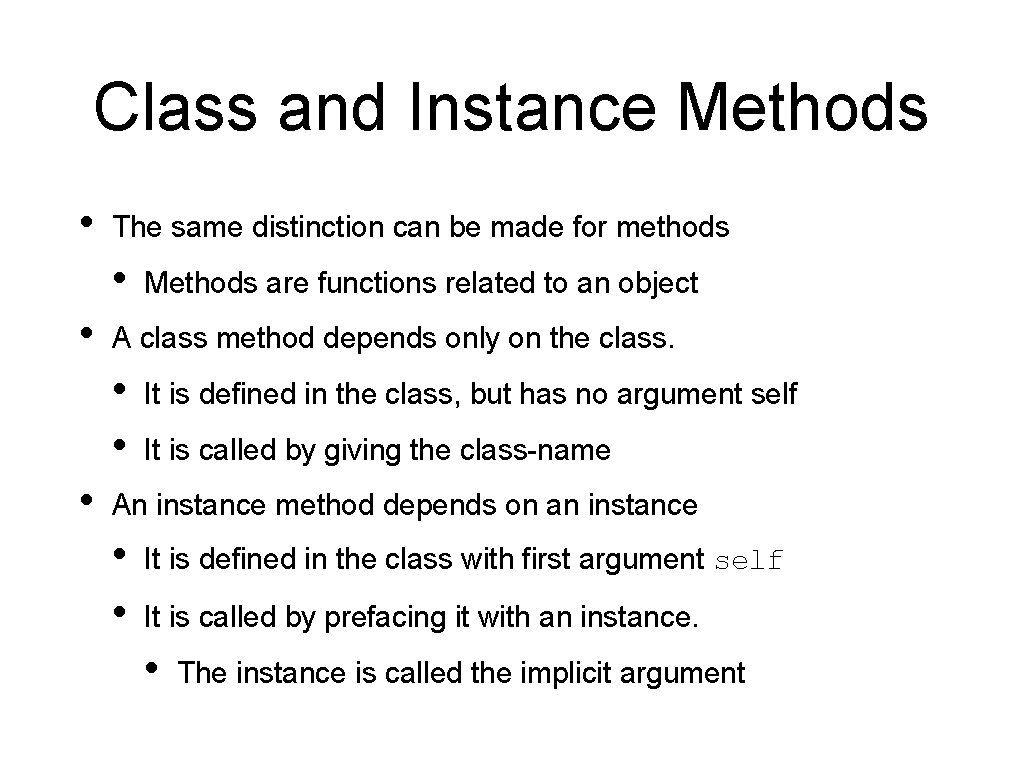
Class and Instance Methods • The same distinction can be made for methods • • A class method depends only on the class. • • • Methods are functions related to an object It is defined in the class, but has no argument self It is called by giving the class-name An instance method depends on an instance • • It is defined in the class with first argument self It is called by prefacing it with an instance. • The instance is called the implicit argument
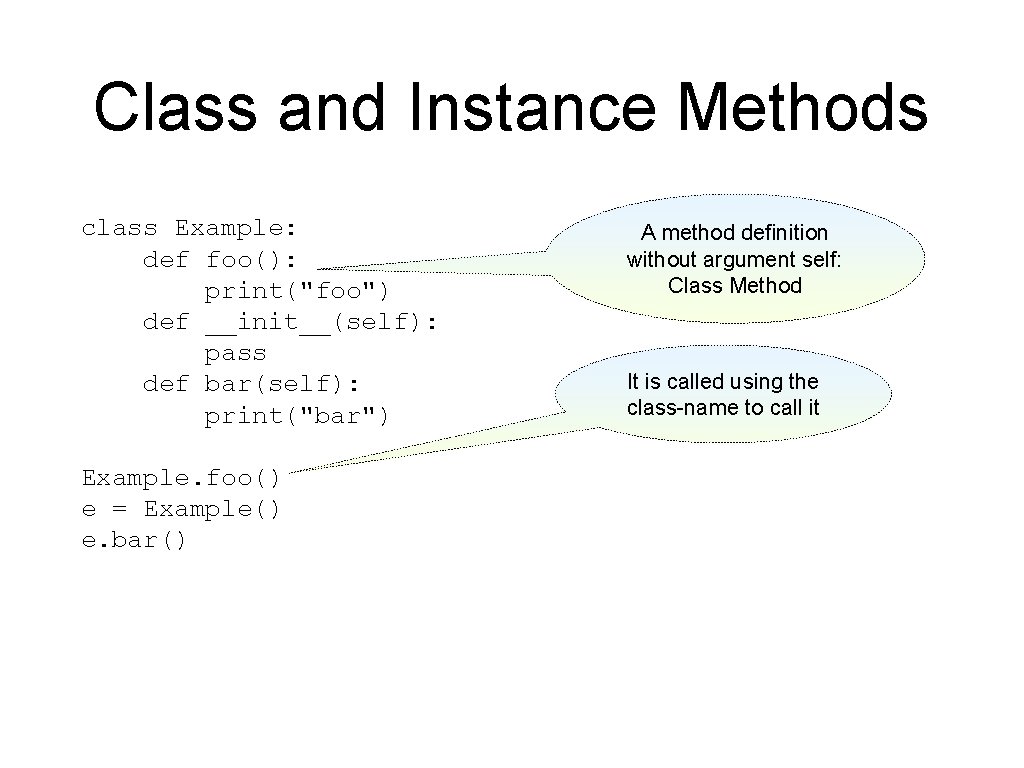
Class and Instance Methods class Example: def foo(): print("foo") def __init__(self): pass def bar(self): print("bar") Example. foo() e = Example() e. bar() A method definition without argument self: Class Method It is called using the class-name to call it
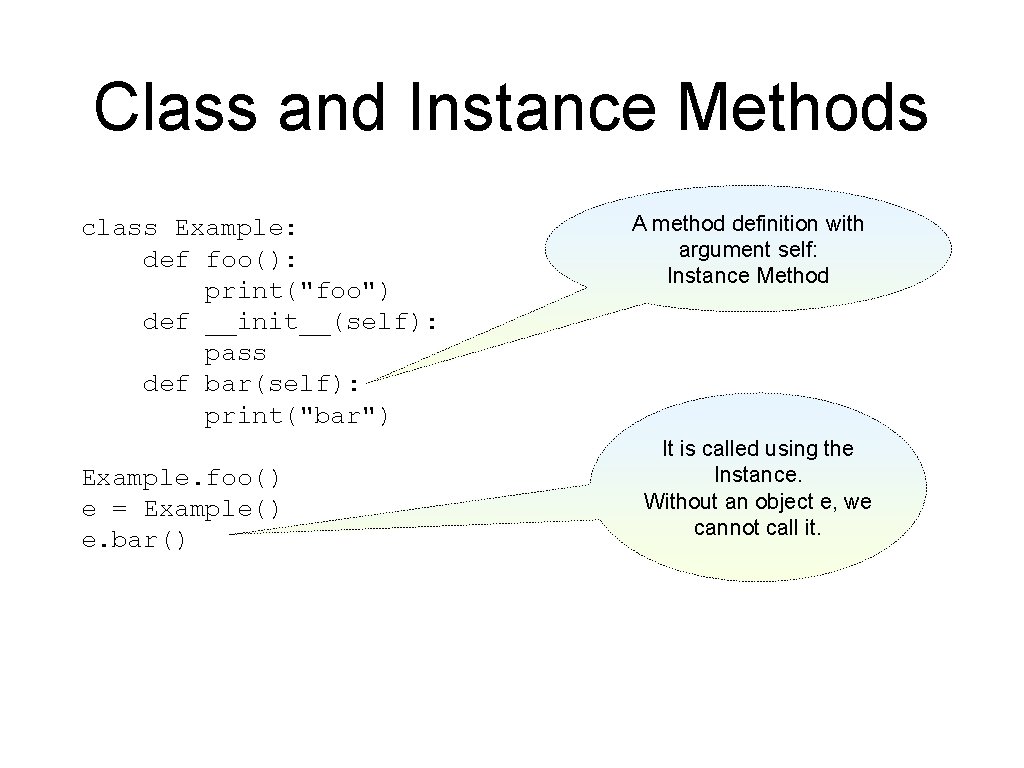
Class and Instance Methods class Example: def foo(): print("foo") def __init__(self): pass def bar(self): print("bar") Example. foo() e = Example() e. bar() A method definition with argument self: Instance Method It is called using the Instance. Without an object e, we cannot call it.
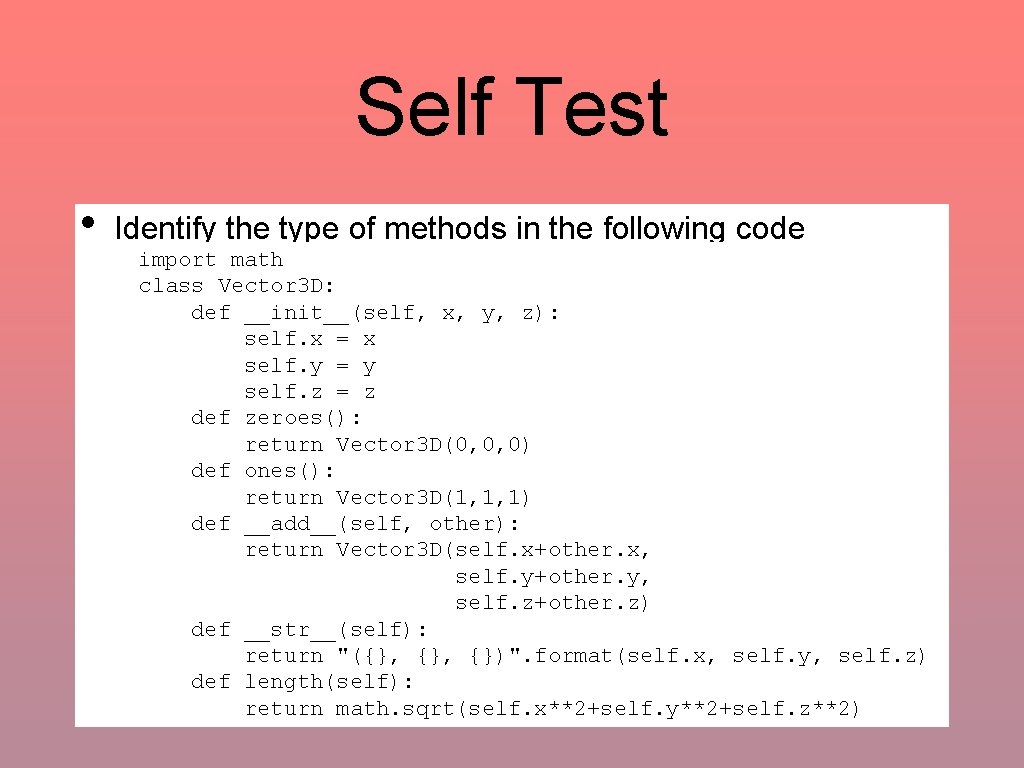
Self Test • Identify the type of methods in the following code import math class Vector 3 D: def __init__(self, x, y, z): self. x = x self. y = y self. z = z def zeroes(): return Vector 3 D(0, 0, 0) def ones(): return Vector 3 D(1, 1, 1) def __add__(self, other): return Vector 3 D(self. x+other. x, self. y+other. y, self. z+other. z) def __str__(self): return "({}, {})". format(self. x, self. y, self. z) def length(self): return math. sqrt(self. x**2+self. y**2+self. z**2)
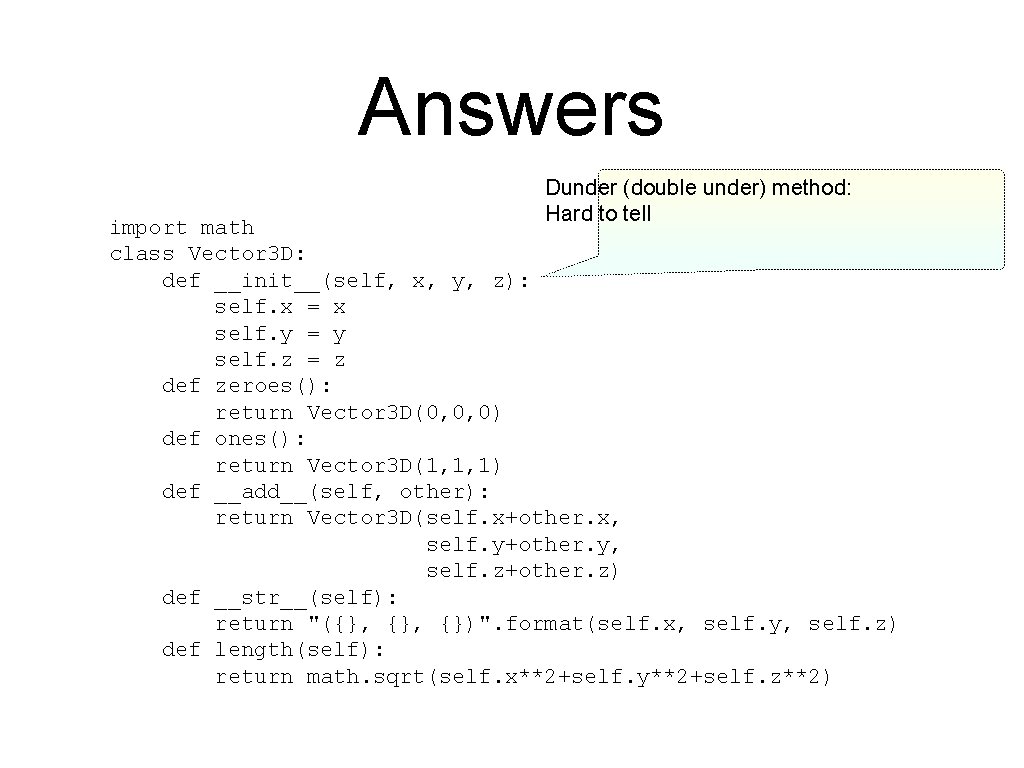
Answers Dunder (double under) method: Hard to tell import math class Vector 3 D: def __init__(self, x, y, z): self. x = x self. y = y self. z = z def zeroes(): return Vector 3 D(0, 0, 0) def ones(): return Vector 3 D(1, 1, 1) def __add__(self, other): return Vector 3 D(self. x+other. x, self. y+other. y, self. z+other. z) def __str__(self): return "({}, {})". format(self. x, self. y, self. z) def length(self): return math. sqrt(self. x**2+self. y**2+self. z**2)
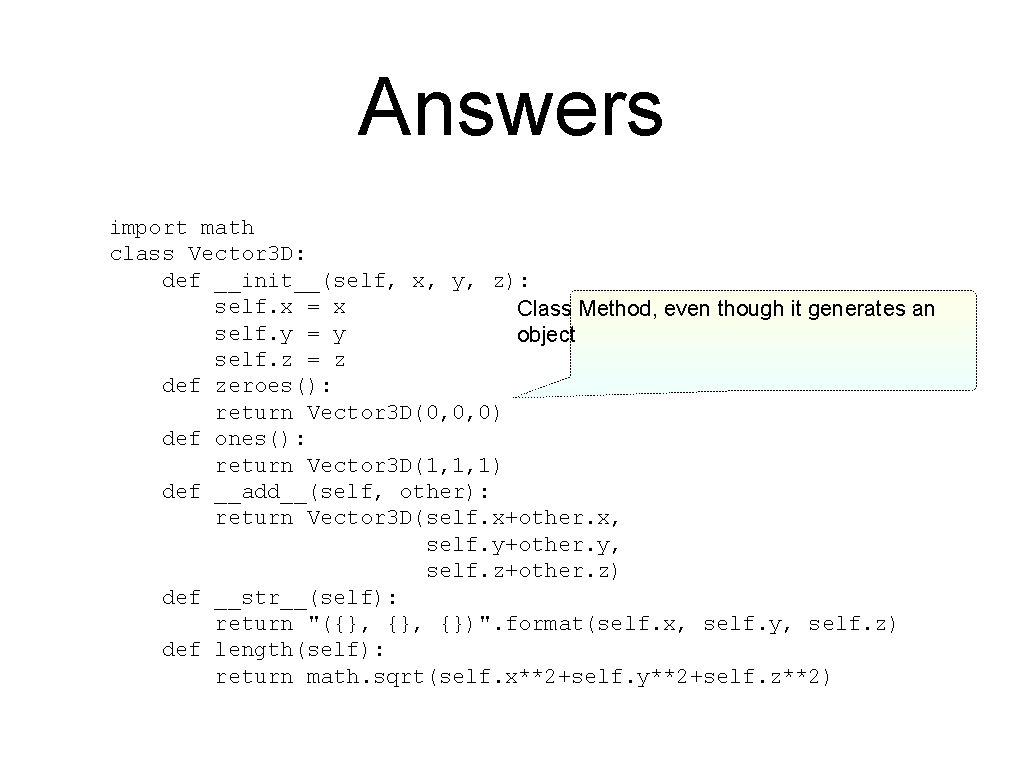
Answers import math class Vector 3 D: def __init__(self, x, y, z): self. x = x Class Method, even though it generates an self. y = y object self. z = z def zeroes(): return Vector 3 D(0, 0, 0) def ones(): return Vector 3 D(1, 1, 1) def __add__(self, other): return Vector 3 D(self. x+other. x, self. y+other. y, self. z+other. z) def __str__(self): return "({}, {})". format(self. x, self. y, self. z) def length(self): return math. sqrt(self. x**2+self. y**2+self. z**2)
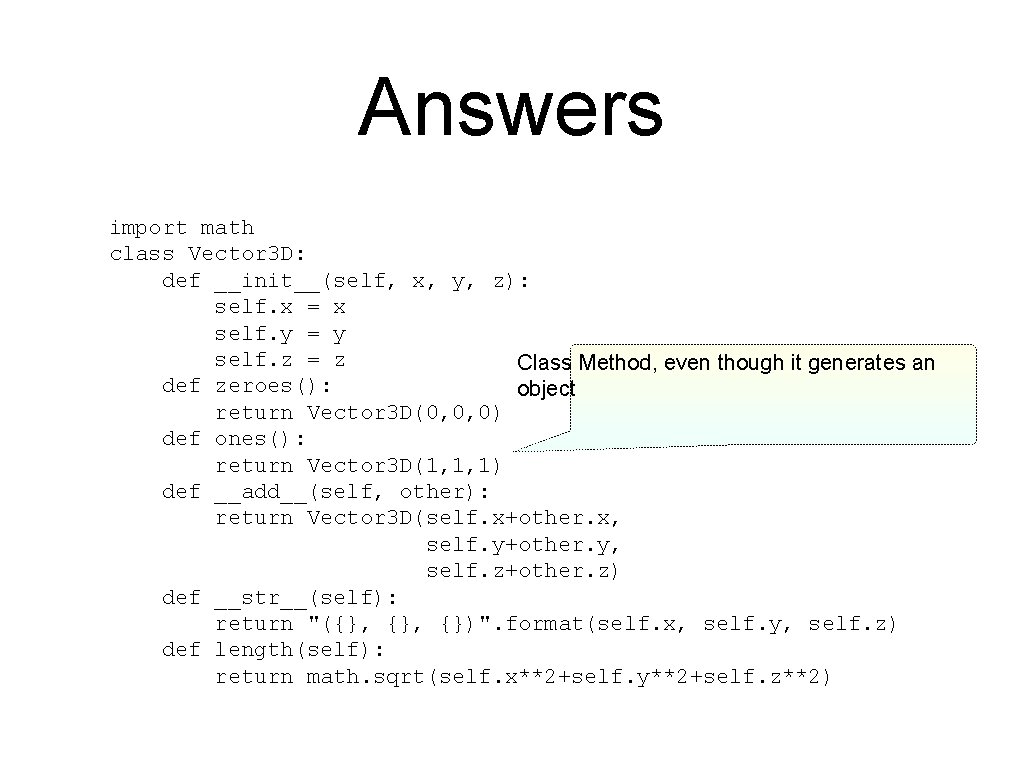
Answers import math class Vector 3 D: def __init__(self, x, y, z): self. x = x self. y = y self. z = z Class Method, even though it generates an def zeroes(): object return Vector 3 D(0, 0, 0) def ones(): return Vector 3 D(1, 1, 1) def __add__(self, other): return Vector 3 D(self. x+other. x, self. y+other. y, self. z+other. z) def __str__(self): return "({}, {})". format(self. x, self. y, self. z) def length(self): return math. sqrt(self. x**2+self. y**2+self. z**2)
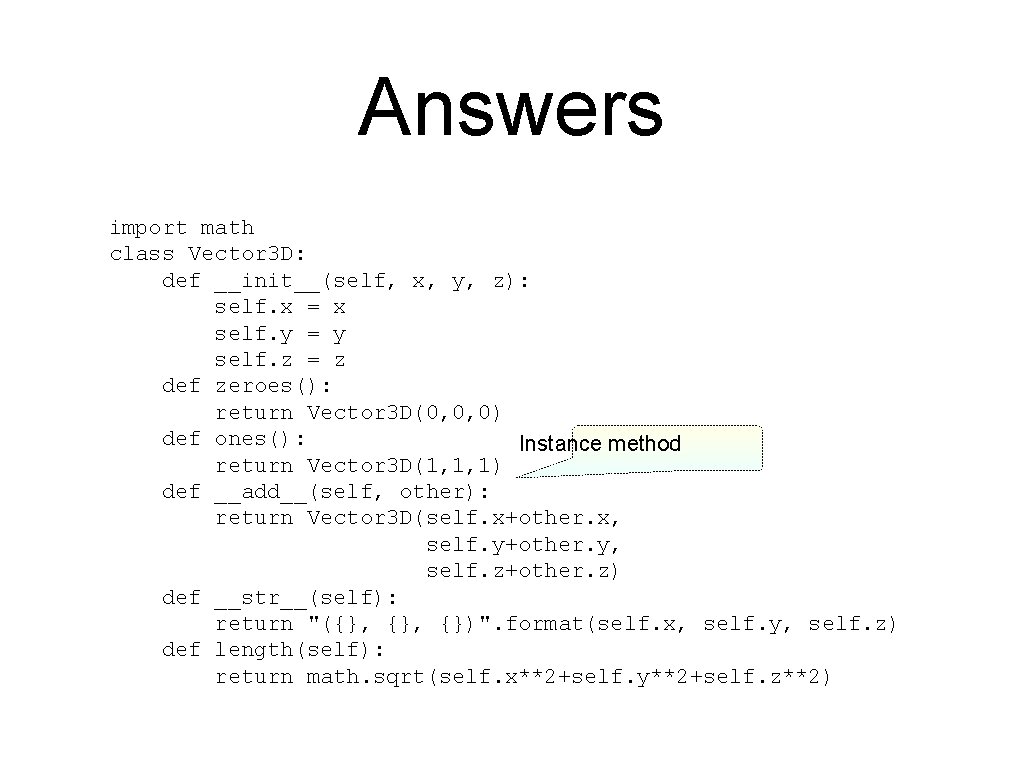
Answers import math class Vector 3 D: def __init__(self, x, y, z): self. x = x self. y = y self. z = z def zeroes(): return Vector 3 D(0, 0, 0) def ones(): Instance method return Vector 3 D(1, 1, 1) def __add__(self, other): return Vector 3 D(self. x+other. x, self. y+other. y, self. z+other. z) def __str__(self): return "({}, {})". format(self. x, self. y, self. z) def length(self): return math. sqrt(self. x**2+self. y**2+self. z**2)
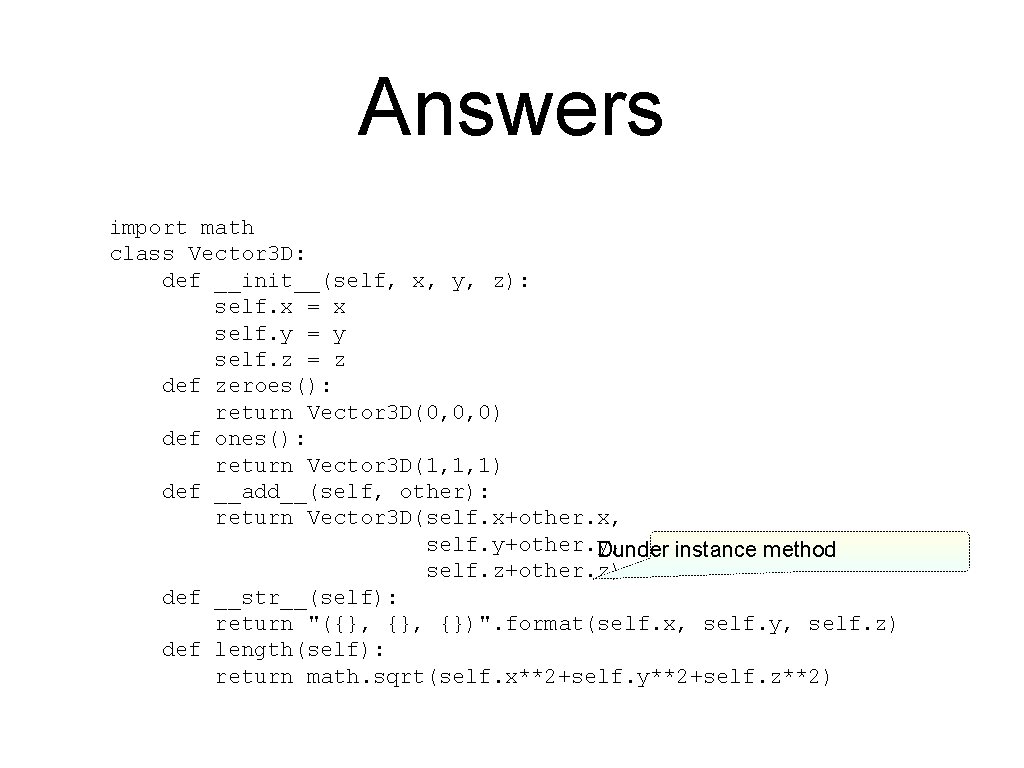
Answers import math class Vector 3 D: def __init__(self, x, y, z): self. x = x self. y = y self. z = z def zeroes(): return Vector 3 D(0, 0, 0) def ones(): return Vector 3 D(1, 1, 1) def __add__(self, other): return Vector 3 D(self. x+other. x, self. y+other. y, Dunder instance method self. z+other. z) def __str__(self): return "({}, {})". format(self. x, self. y, self. z) def length(self): return math. sqrt(self. x**2+self. y**2+self. z**2)
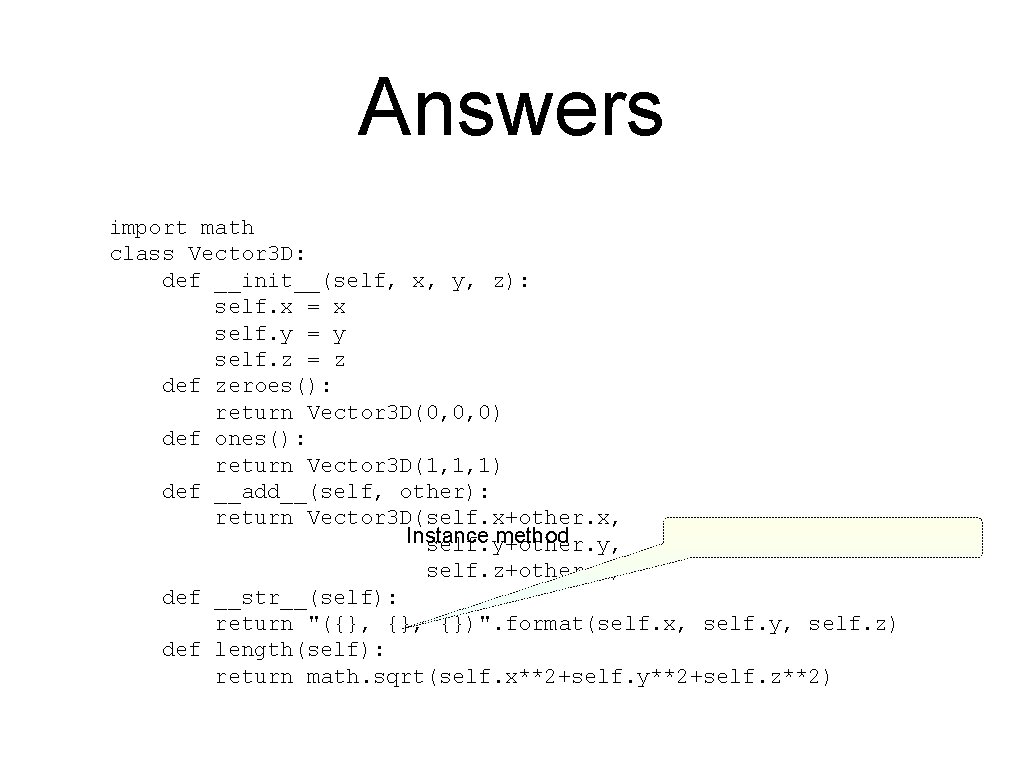
Answers import math class Vector 3 D: def __init__(self, x, y, z): self. x = x self. y = y self. z = z def zeroes(): return Vector 3 D(0, 0, 0) def ones(): return Vector 3 D(1, 1, 1) def __add__(self, other): return Vector 3 D(self. x+other. x, Instance method self. y+other. y, self. z+other. z) def __str__(self): return "({}, {})". format(self. x, self. y, self. z) def length(self): return math. sqrt(self. x**2+self. y**2+self. z**2)
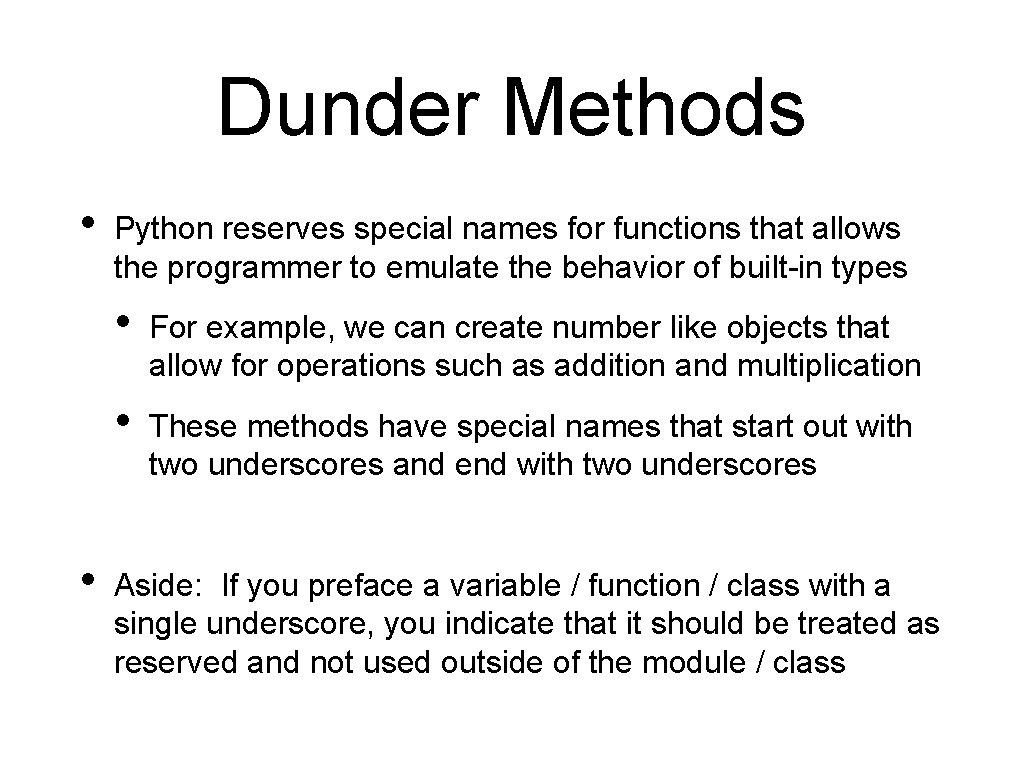
Dunder Methods • • Python reserves special names for functions that allows the programmer to emulate the behavior of built-in types • For example, we can create number like objects that allow for operations such as addition and multiplication • These methods have special names that start out with two underscores and end with two underscores Aside: If you preface a variable / function / class with a single underscore, you indicate that it should be treated as reserved and not used outside of the module / class
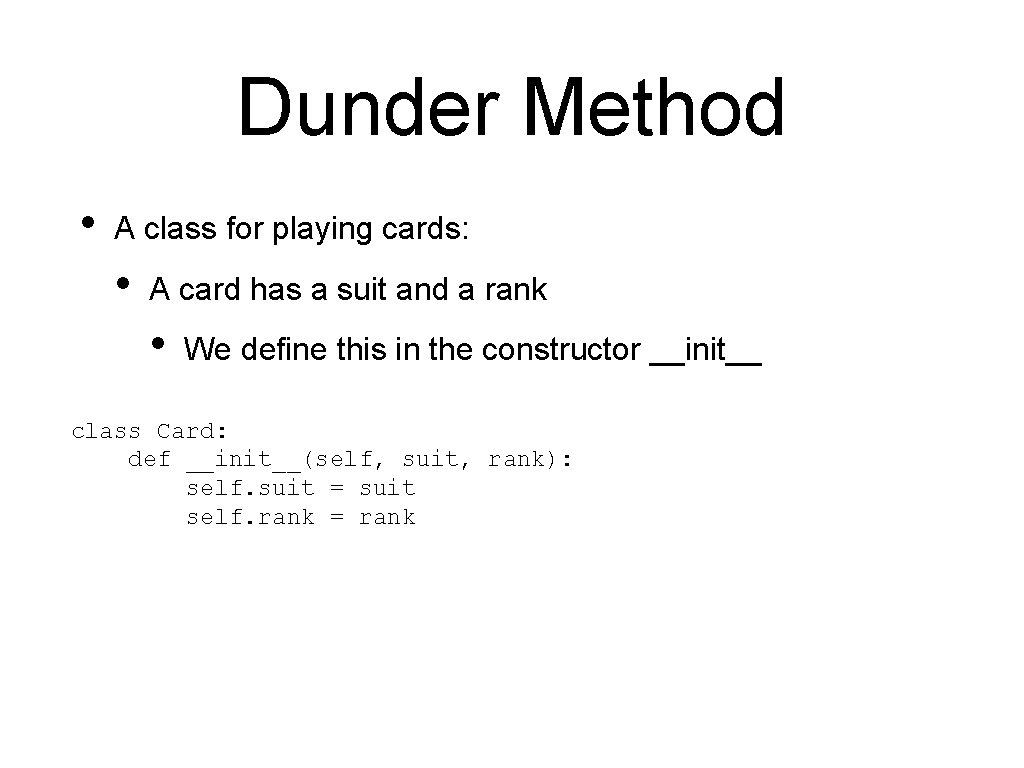
Dunder Method • A class for playing cards: • A card has a suit and a rank • We define this in the constructor __init__ class Card: def __init__(self, suit, rank): self. suit = suit self. rank = rank
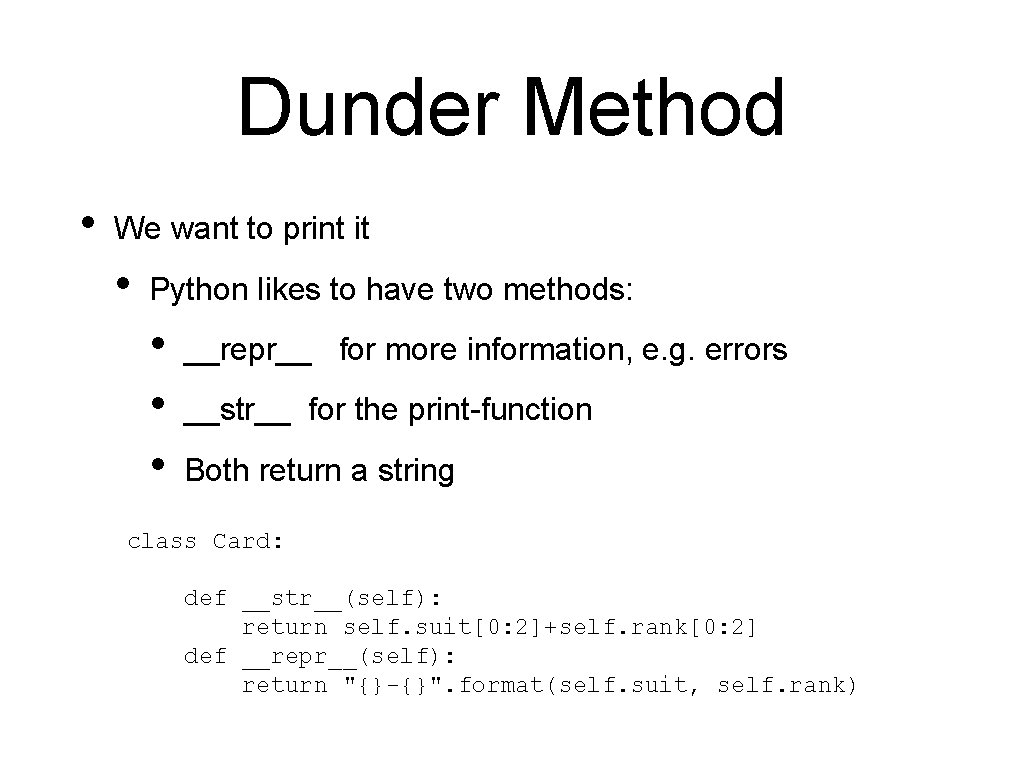
Dunder Method • We want to print it • Python likes to have two methods: • • • __repr__ for more information, e. g. errors __str__ for the print-function Both return a string class Card: def __str__(self): return self. suit[0: 2]+self. rank[0: 2] def __repr__(self): return "{}-{}". format(self. suit, self. rank)
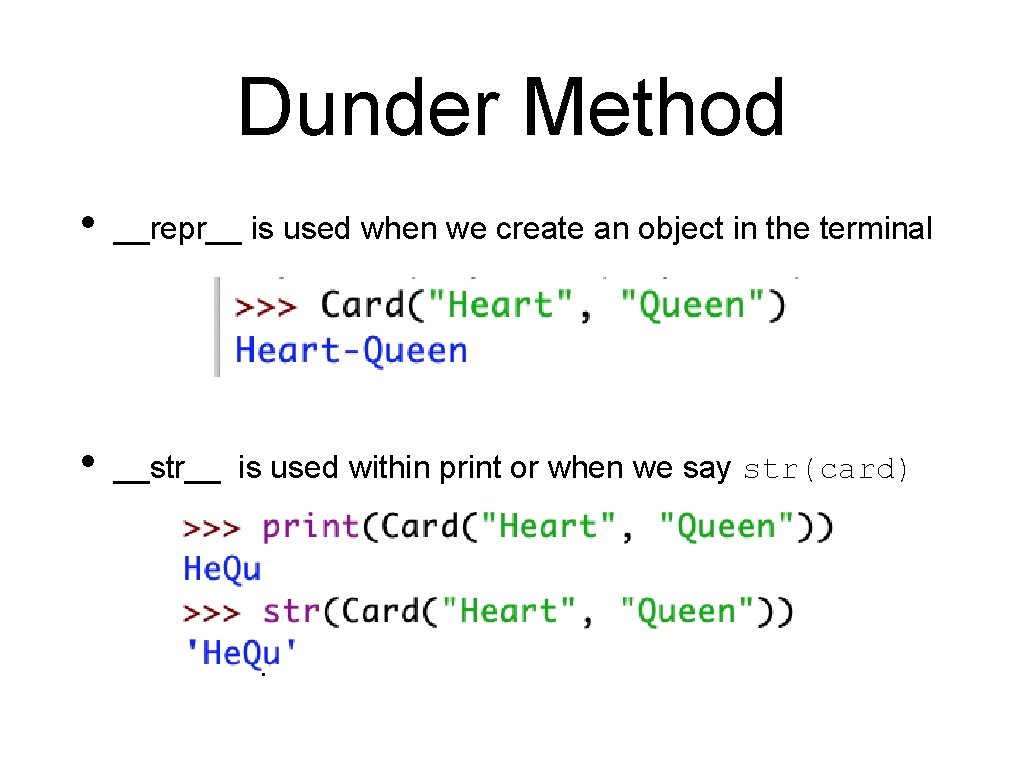
Dunder Method • __repr__ is used when we create an object in the terminal • __str__ is used within print or when we say str(card)
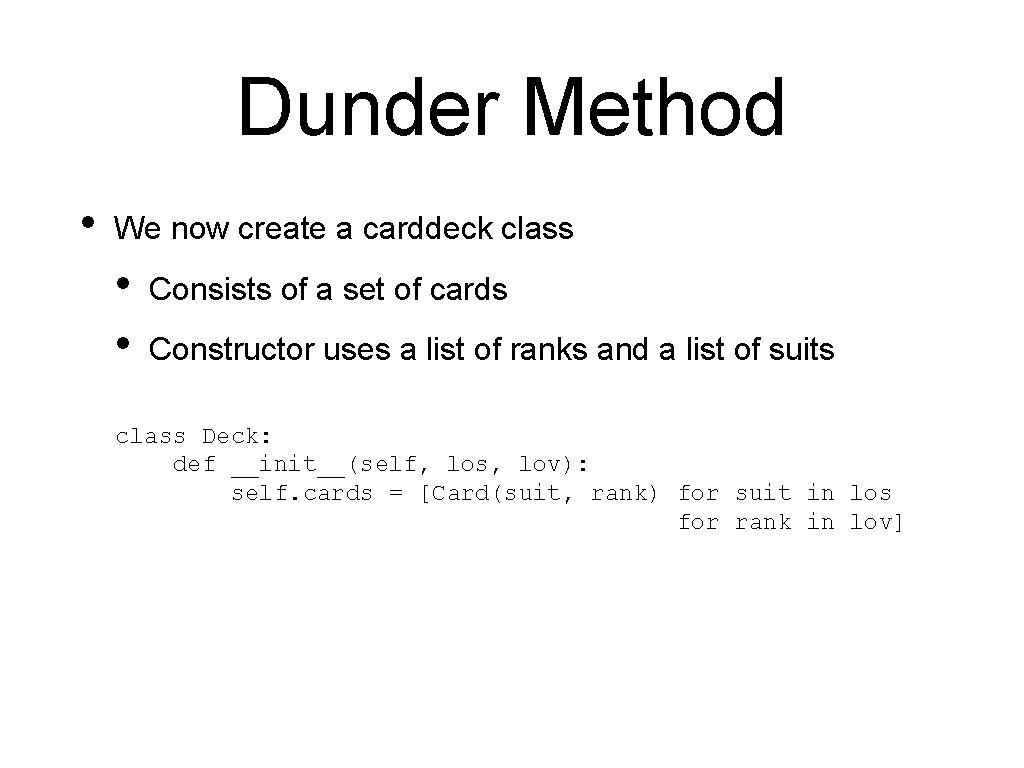
Dunder Method • We now create a carddeck class • • Consists of a set of cards Constructor uses a list of ranks and a list of suits class Deck: def __init__(self, los, lov): self. cards = [Card(suit, rank) for suit in los for rank in lov]
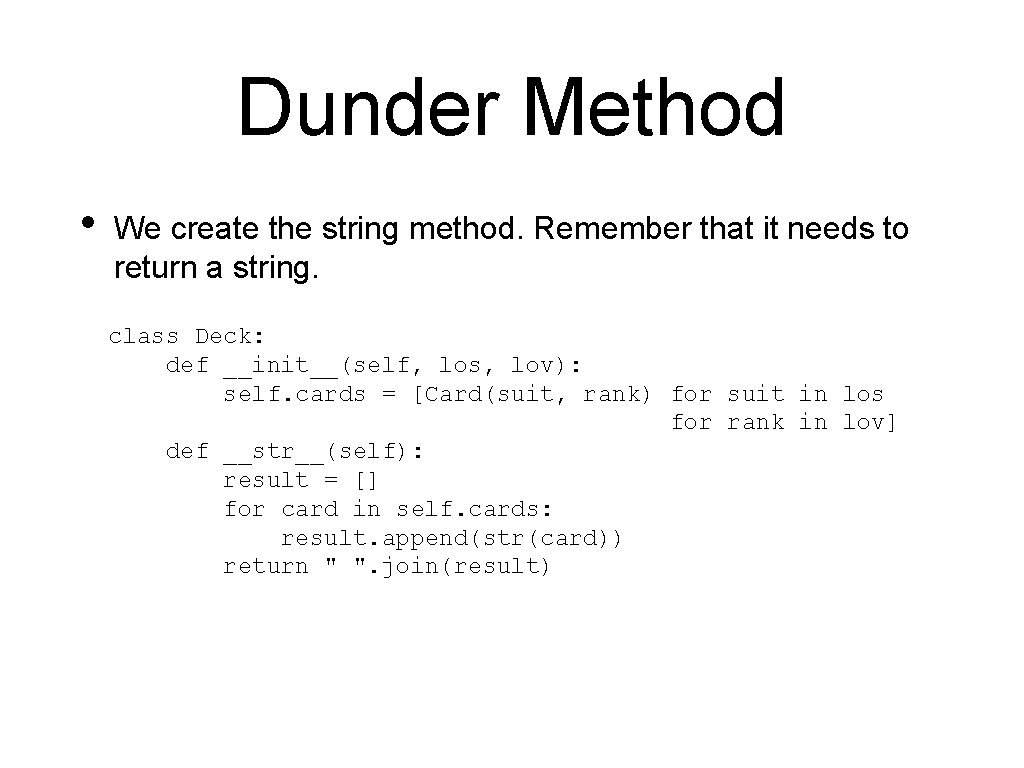
Dunder Method • We create the string method. Remember that it needs to return a string. class Deck: def __init__(self, los, lov): self. cards = [Card(suit, rank) for suit in los for rank in lov] def __str__(self): result = [] for card in self. cards: result. append(str(card)) return " ". join(result)
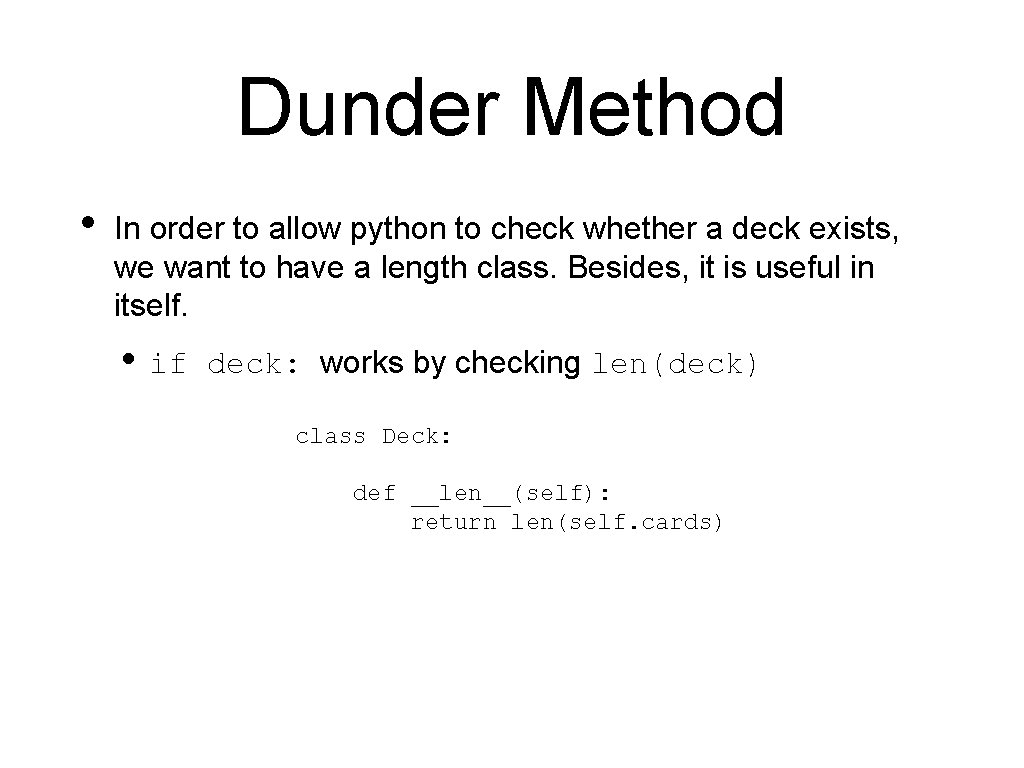
Dunder Method • In order to allow python to check whether a deck exists, we want to have a length class. Besides, it is useful in itself. • if deck: works by checking len(deck) class Deck: def __len__(self): return len(self. cards)
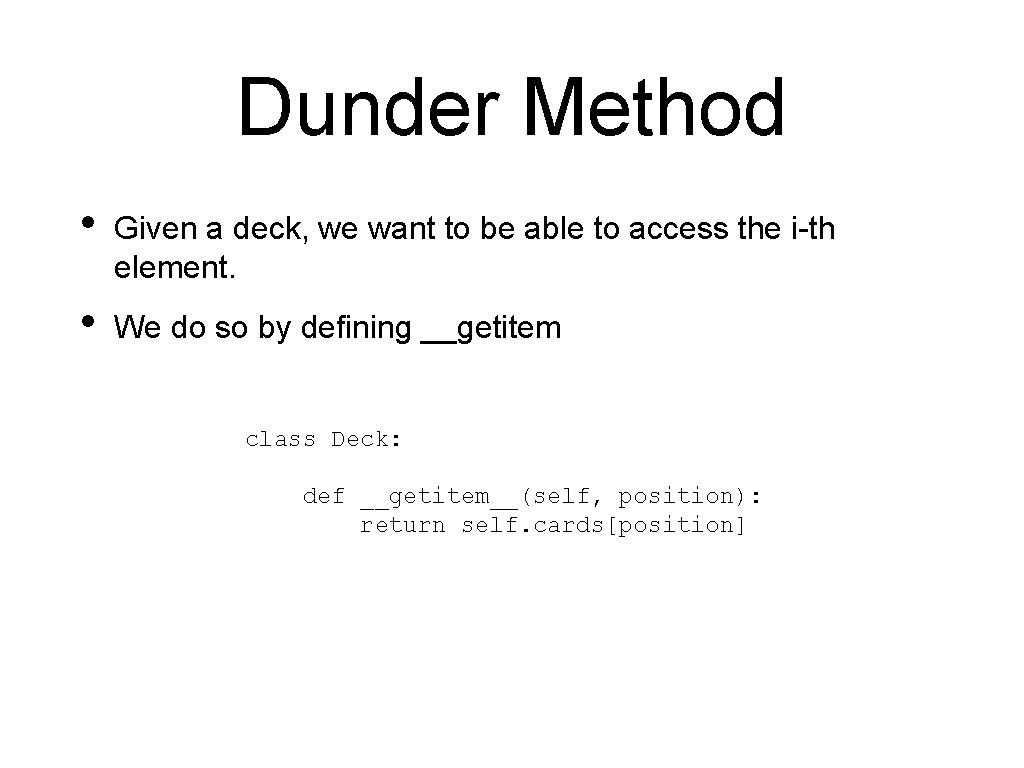
Dunder Method • Given a deck, we want to be able to access the i-th element. • We do so by defining __getitem class Deck: def __getitem__(self, position): return self. cards[position]
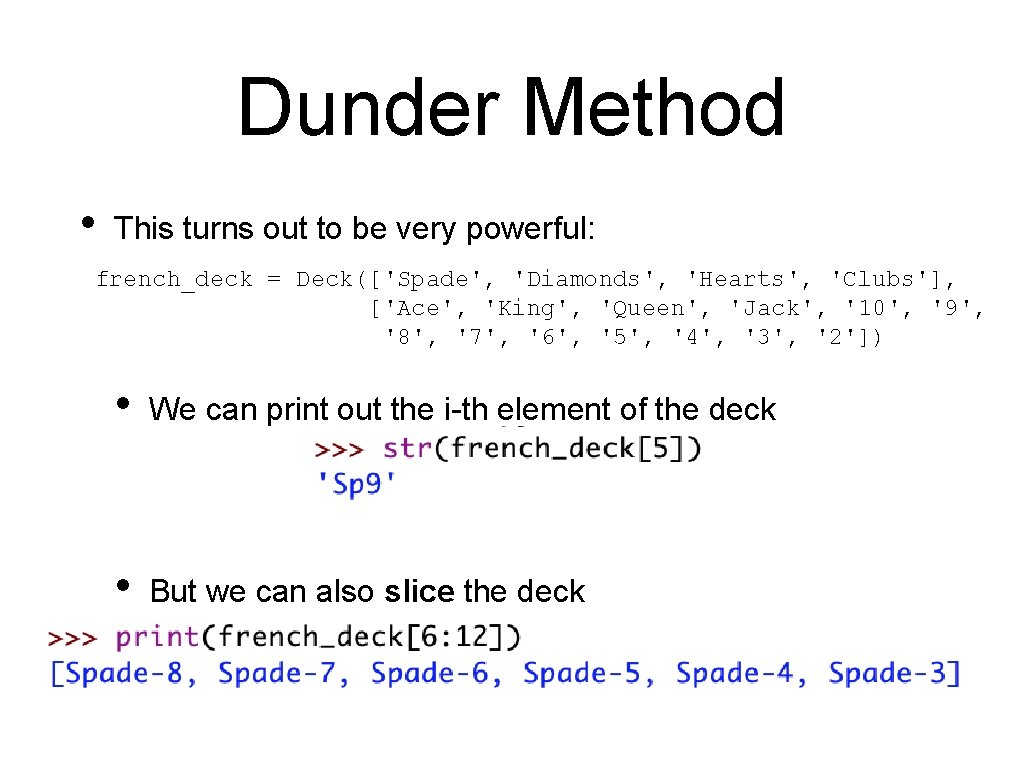
Dunder Method • This turns out to be very powerful: french_deck = Deck(['Spade', 'Diamonds', 'Hearts', 'Clubs'], ['Ace', 'King', 'Queen', 'Jack', '10', '9', '8', '7', '6', '5', '4', '3', '2']) • We can print out the i-th element of the deck • But we can also slice the deck
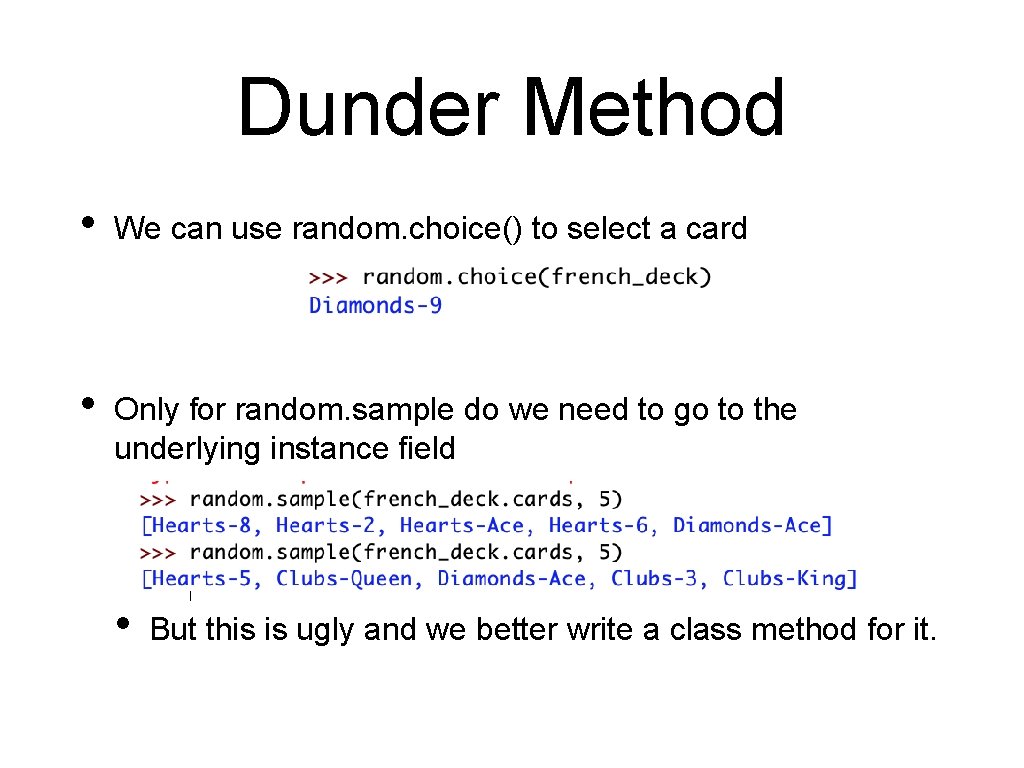
Dunder Method • We can use random. choice() to select a card • Only for random. sample do we need to go to the underlying instance field • But this is ugly and we better write a class method for it.
- Slides: 66