Information Theory and Coding System Information Theory Main
- Slides: 48
Information Theory and Coding System
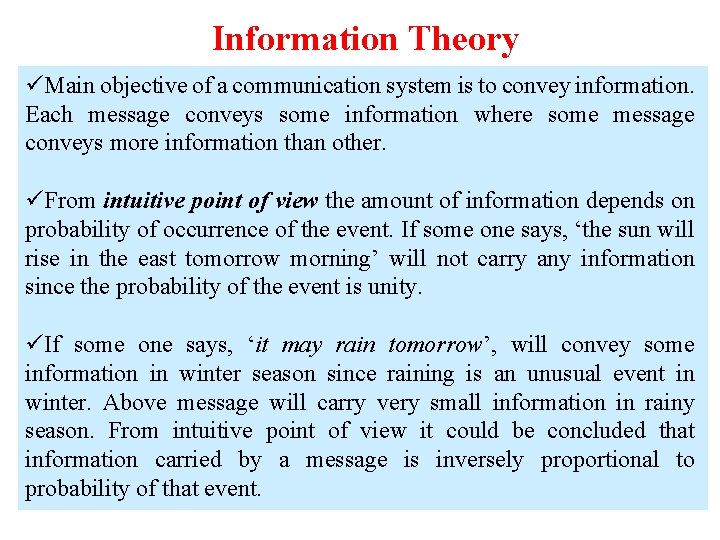
Information Theory üMain objective of a communication system is to convey information. Each message conveys some information where some message conveys more information than other. üFrom intuitive point of view the amount of information depends on probability of occurrence of the event. If some one says, ‘the sun will rise in the east tomorrow morning’ will not carry any information since the probability of the event is unity. üIf some one says, ‘it may rain tomorrow’, will convey some information in winter season since raining is an unusual event in winter. Above message will carry very small information in rainy season. From intuitive point of view it could be concluded that information carried by a message is inversely proportional to probability of that event.
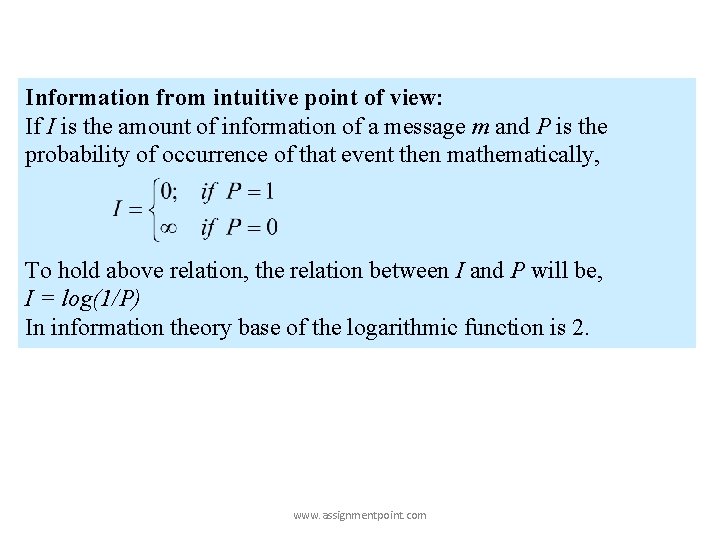
Information from intuitive point of view: If I is the amount of information of a message m and P is the probability of occurrence of that event then mathematically, To hold above relation, the relation between I and P will be, I = log(1/P) In information theory base of the logarithmic function is 2. www. assignmentpoint. com
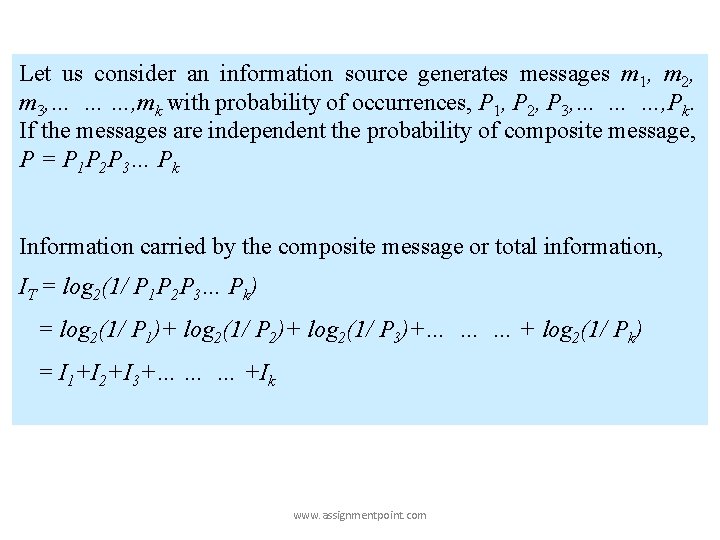
Let us consider an information source generates messages m 1, m 2, m 3, … … …, mk with probability of occurrences, P 1, P 2, P 3, … … …, Pk. If the messages are independent the probability of composite message, P = P 1 P 2 P 3… Pk Information carried by the composite message or total information, IT = log 2(1/ P 1 P 2 P 3… Pk) = log 2(1/ P 1)+ log 2(1/ P 2)+ log 2(1/ P 3)+… … … + log 2(1/ Pk) = I 1+I 2+I 3+… … … +Ik www. assignmentpoint. com
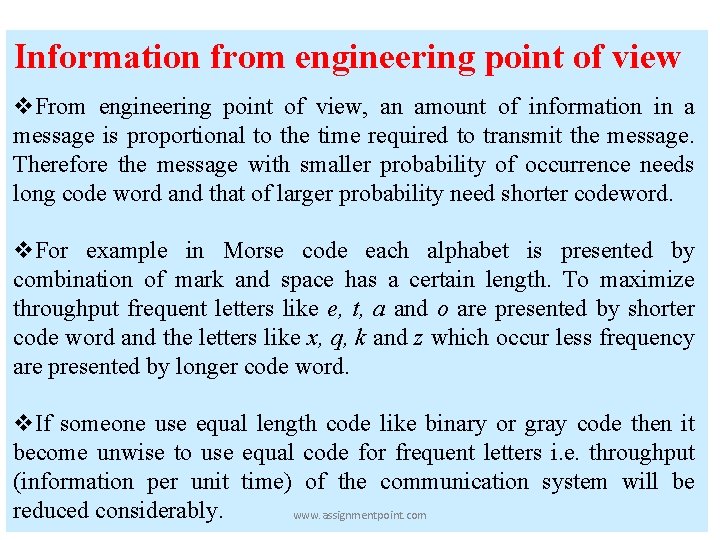
Information from engineering point of view v. From engineering point of view, an amount of information in a message is proportional to the time required to transmit the message. Therefore the message with smaller probability of occurrence needs long code word and that of larger probability need shorter codeword. v. For example in Morse code each alphabet is presented by combination of mark and space has a certain length. To maximize throughput frequent letters like e, t, a and o are presented by shorter code word and the letters like x, q, k and z which occur less frequency are presented by longer code word. v. If someone use equal length code like binary or gray code then it become unwise to use equal code for frequent letters i. e. throughput (information per unit time) of the communication system will be reduced considerably. www. assignmentpoint. com
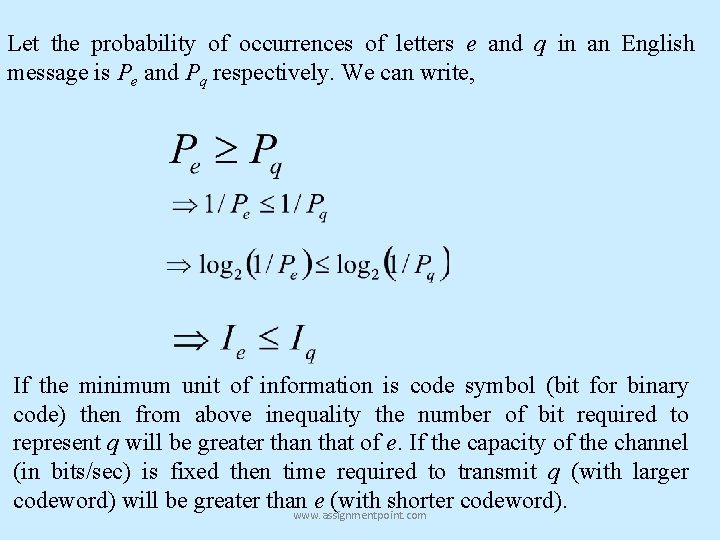
Let the probability of occurrences of letters e and q in an English message is Pe and Pq respectively. We can write, If the minimum unit of information is code symbol (bit for binary code) then from above inequality the number of bit required to represent q will be greater than that of e. If the capacity of the channel (in bits/sec) is fixed then time required to transmit q (with larger codeword) will be greater than e (with shorter codeword). www. assignmentpoint. com
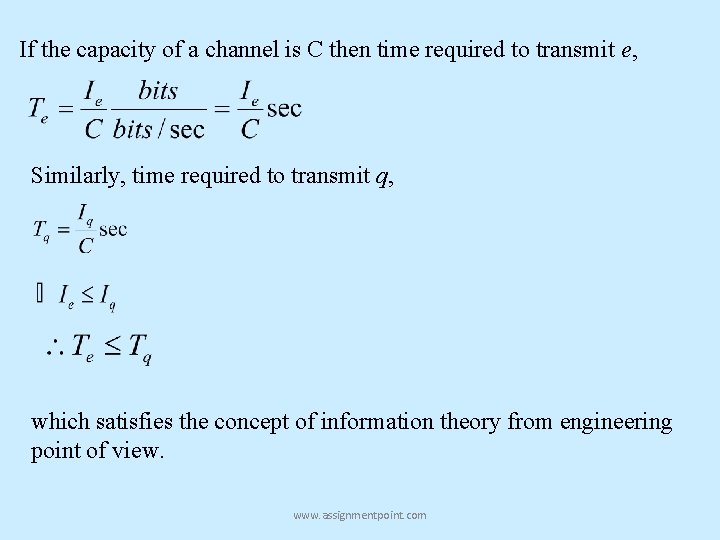
If the capacity of a channel is C then time required to transmit e, Similarly, time required to transmit q, which satisfies the concept of information theory from engineering point of view. www. assignmentpoint. com
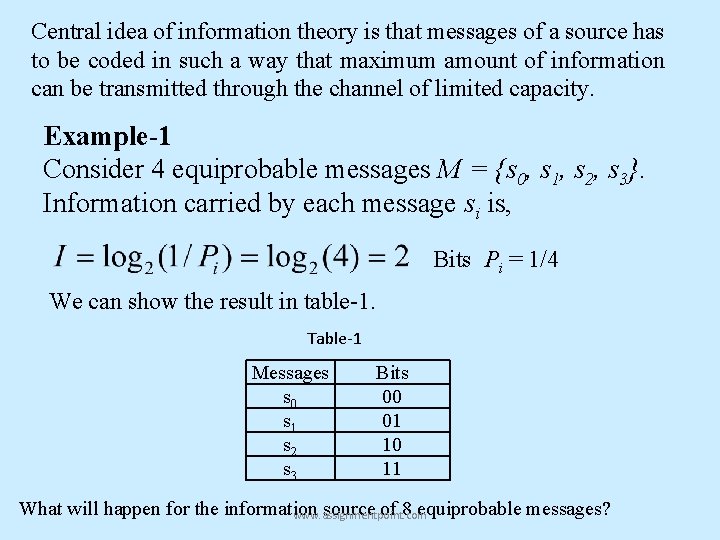
Central idea of information theory is that messages of a source has to be coded in such a way that maximum amount of information can be transmitted through the channel of limited capacity. Example-1 Consider 4 equiprobable messages M = {s 0, s 1, s 2, s 3}. Information carried by each message si is, Bits Pi = 1/4 We can show the result in table-1. Table-1 Messages s 0 s 1 s 2 s 3 Bits 00 01 10 11 What will happen for the information source of 8 equiprobable messages? www. assignmentpoint. com
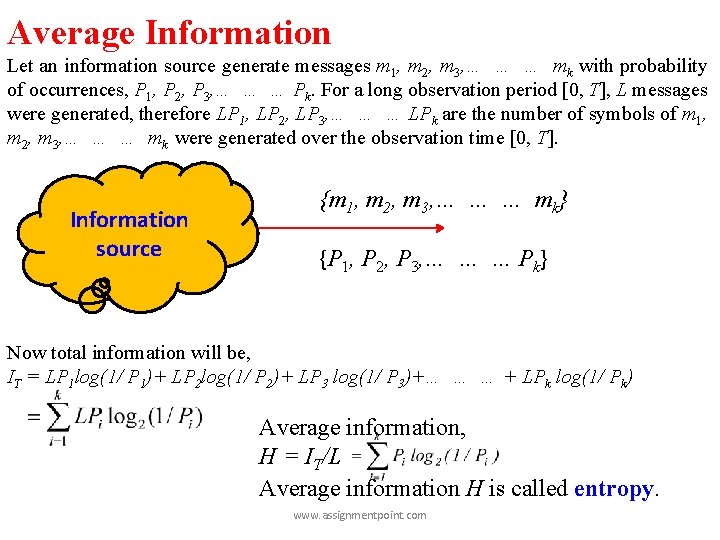
Average Information Let an information source generate messages m 1, m 2, m 3, … … … mk with probability of occurrences, P 1, P 2, P 3, … … … Pk. For a long observation period [0, T], L messages were generated, therefore LP 1, LP 2, LP 3, … … … LPk are the number of symbols of m 1, m 2, m 3, … … … mk were generated over the observation time [0, T]. Information source {m 1, m 2, m 3, … … … mk} {P 1, P 2, P 3, … … … Pk} Now total information will be, IT = LP 1 log(1/ P 1)+ LP 2 log(1/ P 2)+ LP 3 log(1/ P 3)+… … … + LPk log(1/ Pk) Average information, H = IT/L Average information H is called entropy. www. assignmentpoint. com
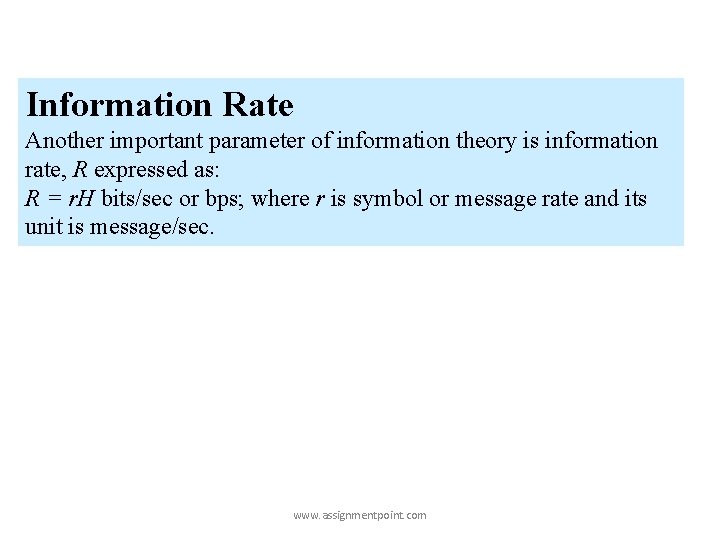
Information Rate Another important parameter of information theory is information rate, R expressed as: R = r. H bits/sec or bps; where r is symbol or message rate and its unit is message/sec. www. assignmentpoint. com
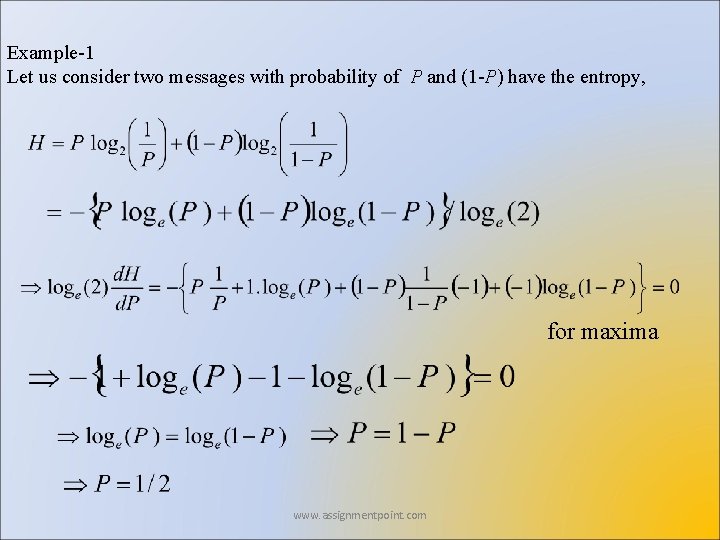
Example-1 Let us consider two messages with probability of P and (1 -P) have the entropy, for maxima www. assignmentpoint. com
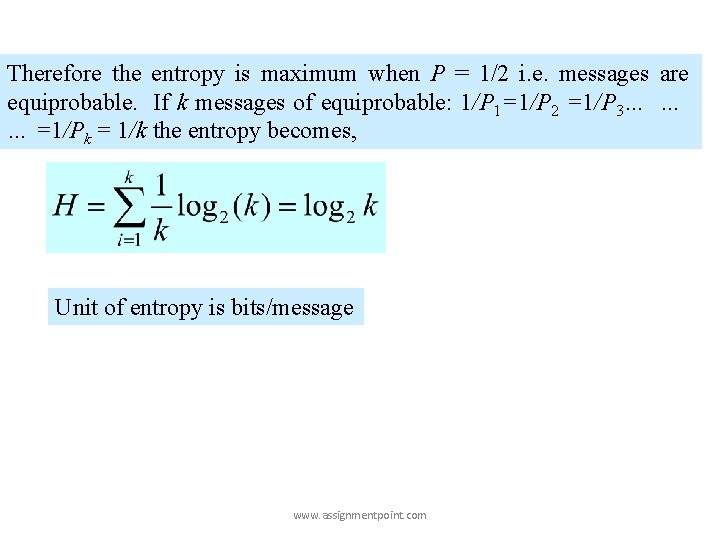
Therefore the entropy is maximum when P = 1/2 i. e. messages are equiprobable. If k messages of equiprobable: 1/P 1=1/P 2 =1/P 3… … … =1/Pk = 1/k the entropy becomes, Unit of entropy is bits/message www. assignmentpoint. com
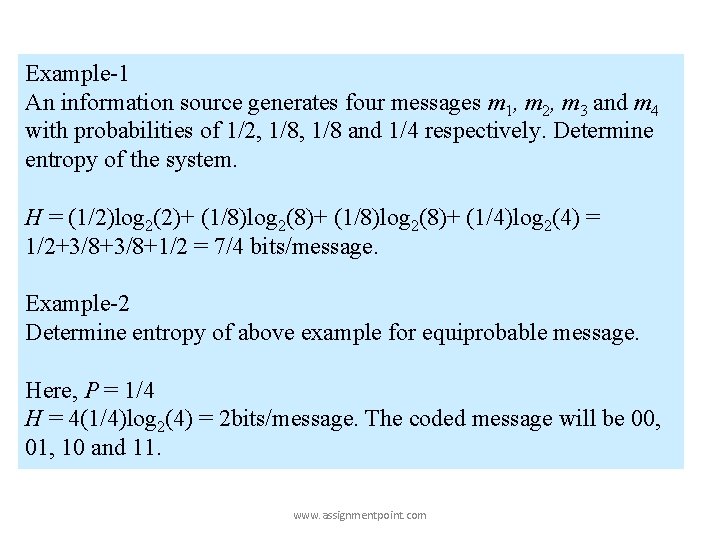
Example-1 An information source generates four messages m 1, m 2, m 3 and m 4 with probabilities of 1/2, 1/8 and 1/4 respectively. Determine entropy of the system. H = (1/2)log 2(2)+ (1/8)log 2(8)+ (1/4)log 2(4) = 1/2+3/8+1/2 = 7/4 bits/message. Example-2 Determine entropy of above example for equiprobable message. Here, P = 1/4 H = 4(1/4)log 2(4) = 2 bits/message. The coded message will be 00, 01, 10 and 11. www. assignmentpoint. com
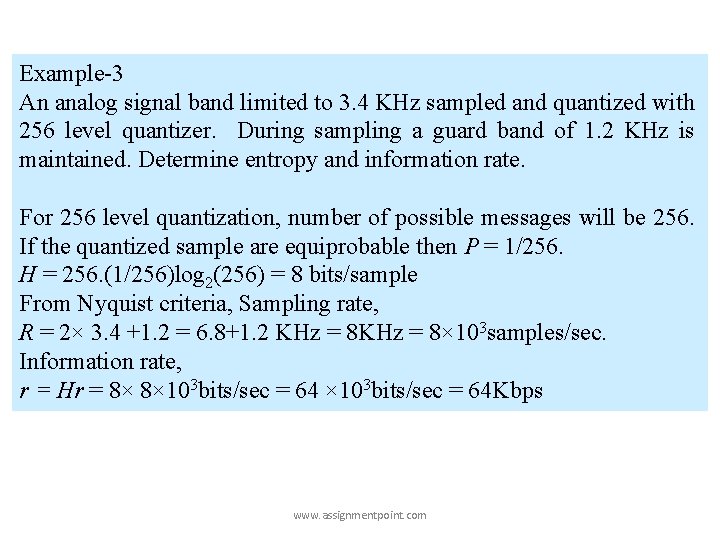
Example-3 An analog signal band limited to 3. 4 KHz sampled and quantized with 256 level quantizer. During sampling a guard band of 1. 2 KHz is maintained. Determine entropy and information rate. For 256 level quantization, number of possible messages will be 256. If the quantized sample are equiprobable then P = 1/256. H = 256. (1/256)log 2(256) = 8 bits/sample From Nyquist criteria, Sampling rate, R = 2× 3. 4 +1. 2 = 6. 8+1. 2 KHz = 8× 10³ samples/sec. Information rate, r = Hr = 8× 8× 103 bits/sec = 64 Kbps www. assignmentpoint. com
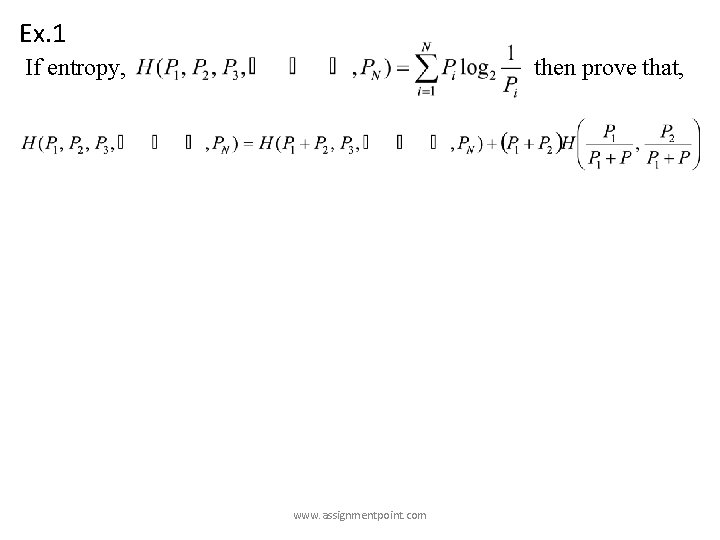
Ex. 1 If entropy, then prove that, www. assignmentpoint. com
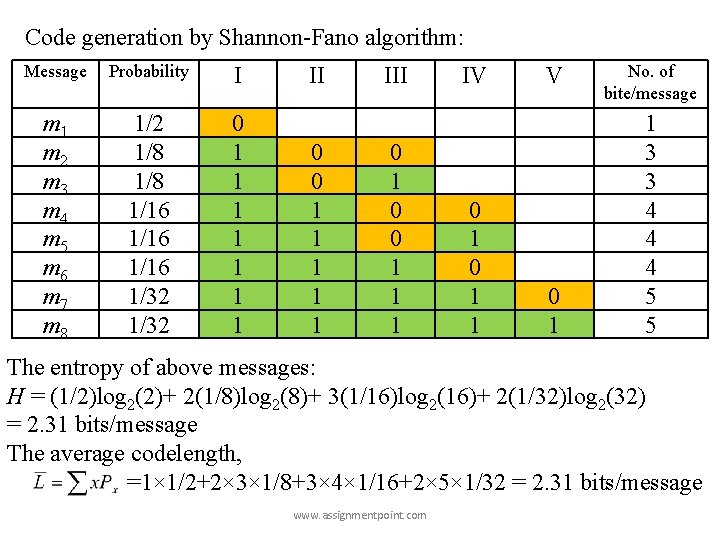
Code generation by Shannon-Fano algorithm: Message Probability I m 1 m 2 m 3 m 4 m 5 m 6 m 7 m 8 1/2 1/8 1/16 1/32 0 1 1 1 1 II 0 0 1 1 1 III 0 1 0 0 1 1 1 IV 0 1 1 V 0 1 No. of bite/message 1 3 3 4 4 4 5 5 The entropy of above messages: H = (1/2)log 2(2)+ 2(1/8)log 2(8)+ 3(1/16)log 2(16)+ 2(1/32)log 2(32) = 2. 31 bits/message The average codelength, =1× 1/2+2× 3× 1/8+3× 4× 1/16+2× 5× 1/32 = 2. 31 bits/message www. assignmentpoint. com
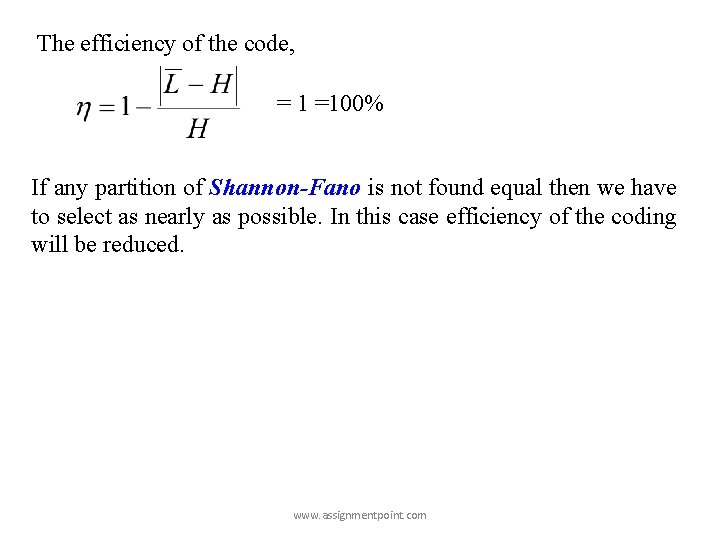
The efficiency of the code, = 1 =100% If any partition of Shannon-Fano is not found equal then we have to select as nearly as possible. In this case efficiency of the coding will be reduced. www. assignmentpoint. com
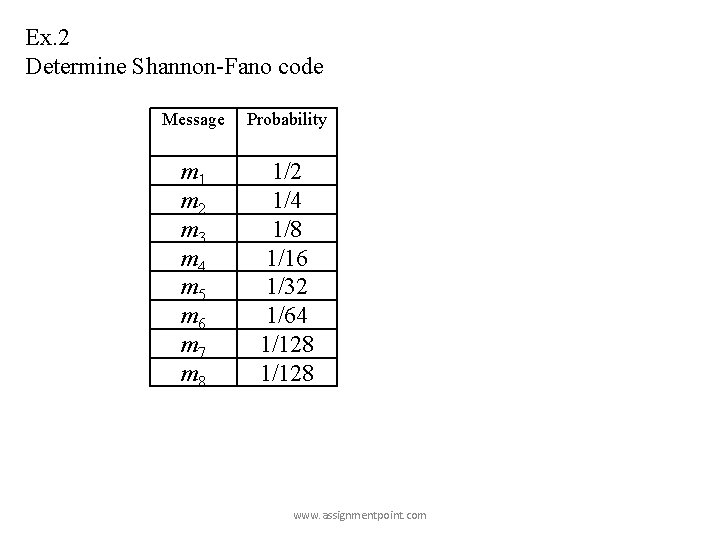
Ex. 2 Determine Shannon-Fano code Message Probability m 1 m 2 m 3 m 4 m 5 m 6 m 7 m 8 1/2 1/4 1/8 1/16 1/32 1/64 1/128 www. assignmentpoint. com
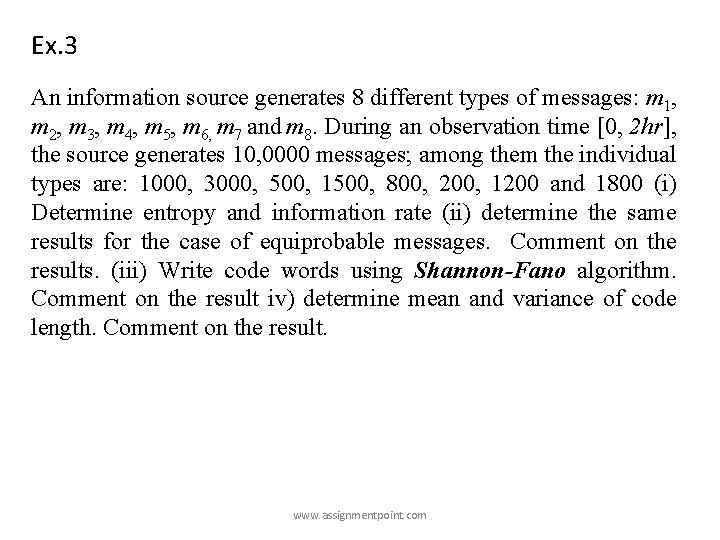
Ex. 3 An information source generates 8 different types of messages: m 1, m 2, m 3, m 4, m 5, m 6, m 7 and m 8. During an observation time [0, 2 hr], the source generates 10, 0000 messages; among them the individual types are: 1000, 3000, 500, 1500, 800, 200, 1200 and 1800 (i) Determine entropy and information rate (ii) determine the same results for the case of equiprobable messages. Comment on the results. (iii) Write code words using Shannon-Fano algorithm. Comment on the result iv) determine mean and variance of code length. Comment on the result. www. assignmentpoint. com
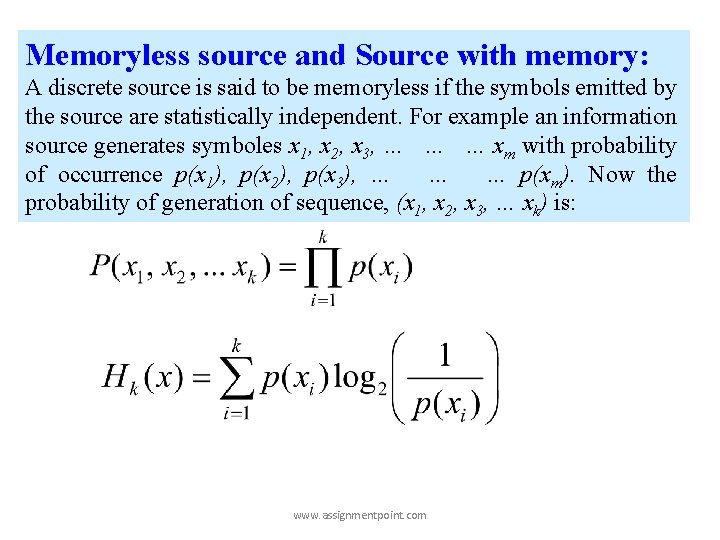
Memoryless source and Source with memory: A discrete source is said to be memoryless if the symbols emitted by the source are statistically independent. For example an information source generates symboles x 1, x 2, x 3, … … … xm with probability of occurrence p(x 1), p(x 2), p(x 3), … … … p(xm). Now the probability of generation of sequence, (x 1, x 2, x 3, … xk) is: www. assignmentpoint. com
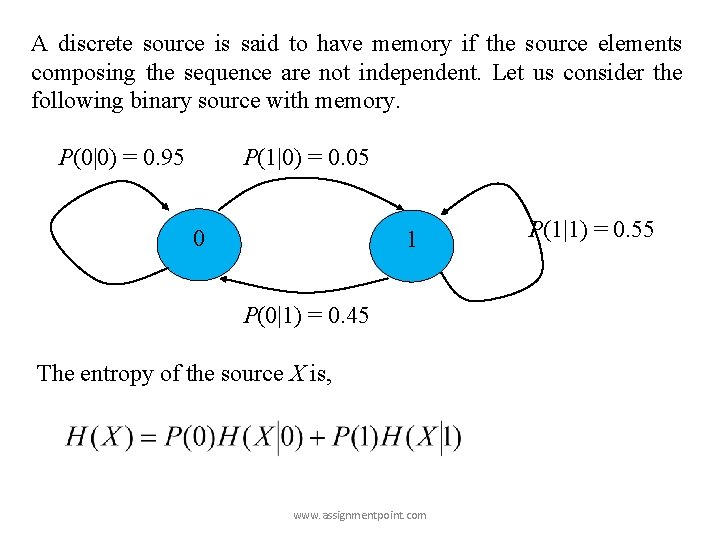
A discrete source is said to have memory if the source elements composing the sequence are not independent. Let us consider the following binary source with memory. P(0|0) = 0. 95 P(1|0) = 0. 05 0 1 P(0|1) = 0. 45 The entropy of the source X is, www. assignmentpoint. com P(1|1) = 0. 55
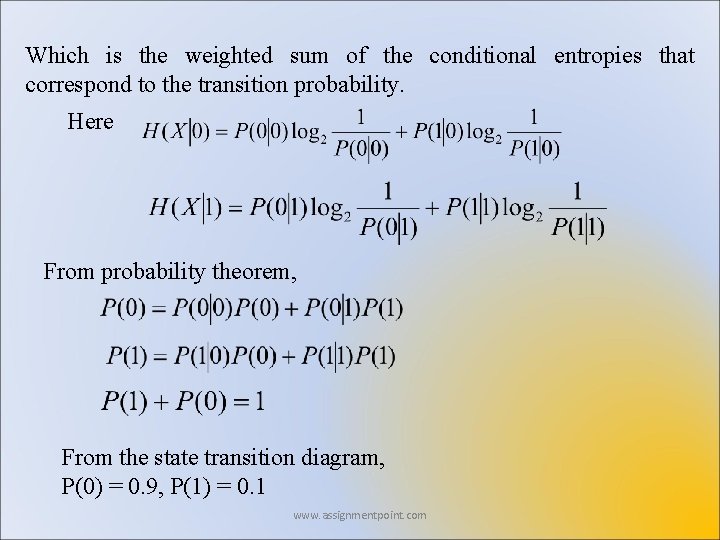
Which is the weighted sum of the conditional entropies that correspond to the transition probability. Here From probability theorem, From the state transition diagram, P(0) = 0. 9, P(1) = 0. 1 www. assignmentpoint. com
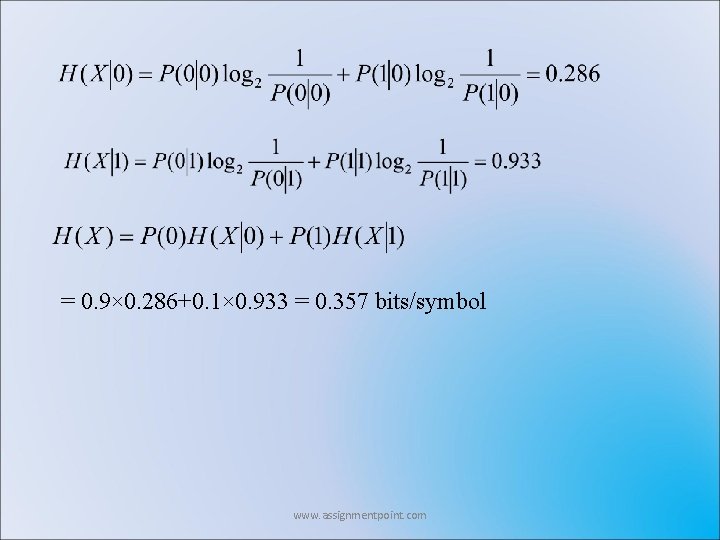
= 0. 9× 0. 286+0. 1× 0. 933 = 0. 357 bits/symbol www. assignmentpoint. com
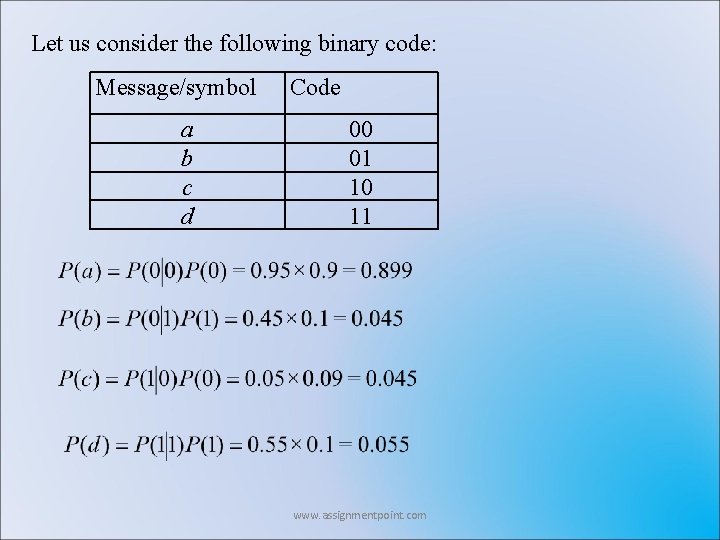
Let us consider the following binary code: Message/symbol a b c d Code 00 01 10 11 www. assignmentpoint. com
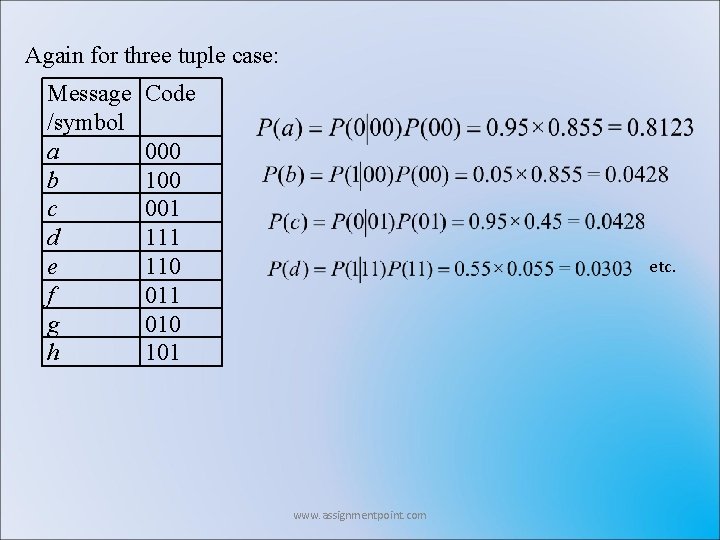
Again for three tuple case: Message /symbol a b c d e f g h Code 000 100 001 110 011 010 101 etc. www. assignmentpoint. com
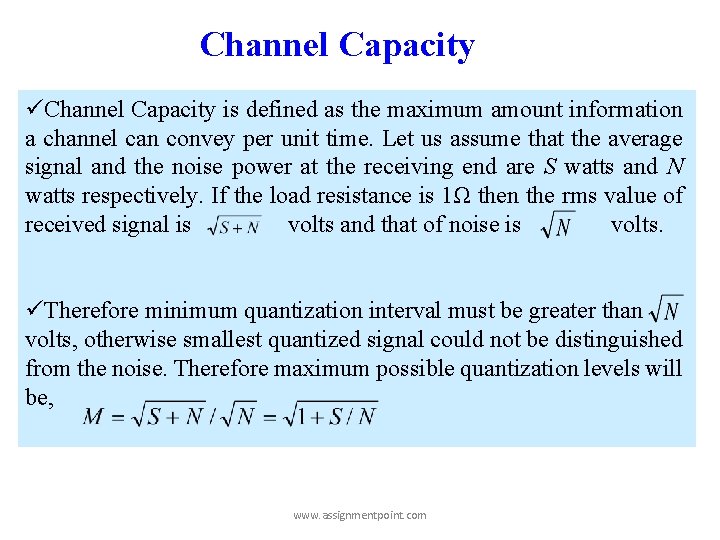
Channel Capacity üChannel Capacity is defined as the maximum amount information a channel can convey per unit time. Let us assume that the average signal and the noise power at the receiving end are S watts and N watts respectively. If the load resistance is 1Ω then the rms value of received signal is volts and that of noise is volts. üTherefore minimum quantization interval must be greater than volts, otherwise smallest quantized signal could not be distinguished from the noise. Therefore maximum possible quantization levels will be, www. assignmentpoint. com
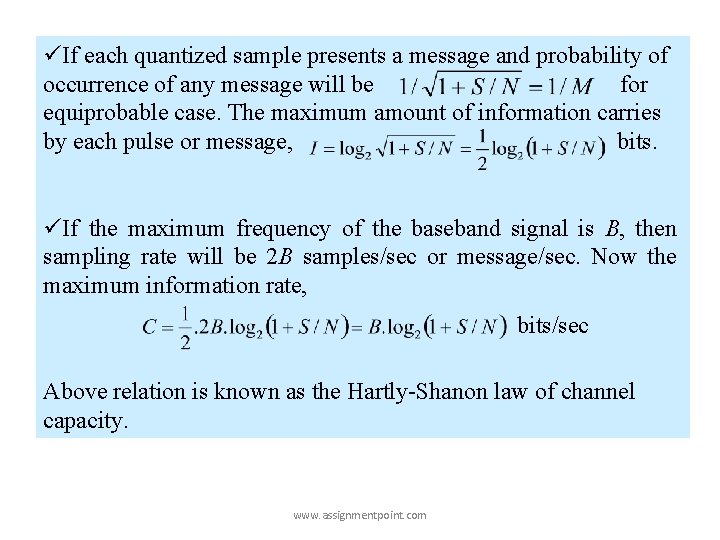
üIf each quantized sample presents a message and probability of occurrence of any message will be for equiprobable case. The maximum amount of information carries by each pulse or message, bits. üIf the maximum frequency of the baseband signal is B, then sampling rate will be 2 B samples/sec or message/sec. Now the maximum information rate, bits/sec Above relation is known as the Hartly-Shanon law of channel capacity. www. assignmentpoint. com
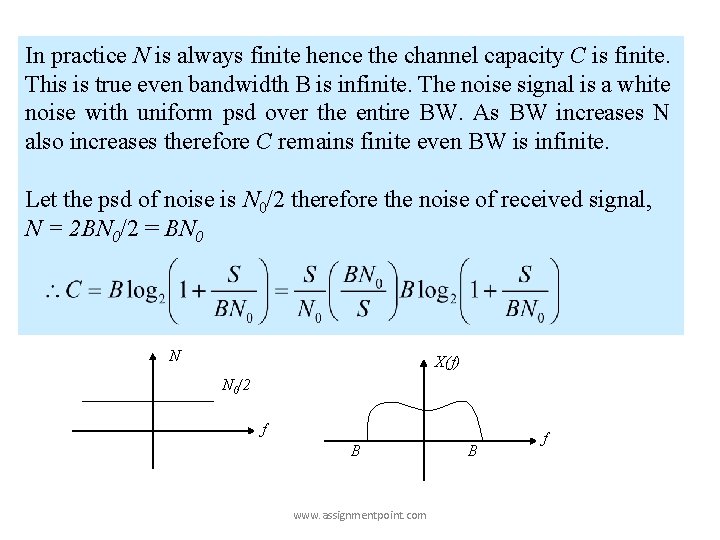
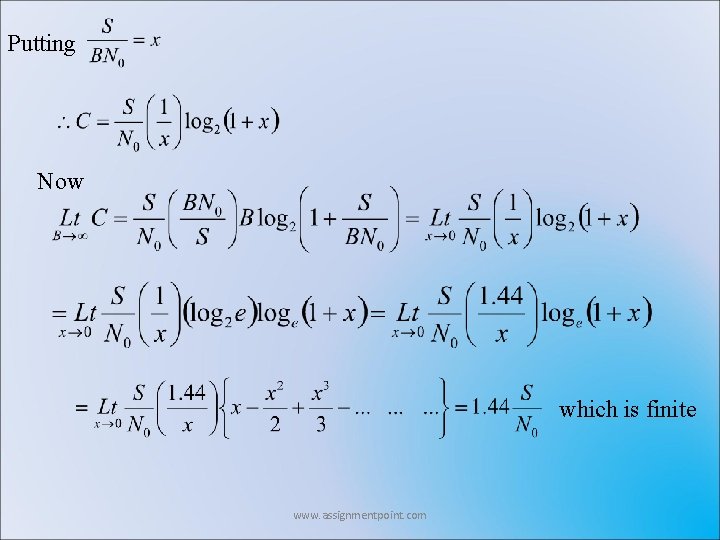
In practice N is always finite hence the channel capacity C is finite. This is true even bandwidth B is infinite. The noise signal is a white noise with uniform psd over the entire BW. As BW increases N also increases therefore C remains finite even BW is infinite. Let the psd of noise is N 0/2 therefore the noise of received signal, N = 2 BN 0/2 = BN 0 N X(f) N 0/2 f B www. assignmentpoint. com B f
Putting Now which is finite www. assignmentpoint. com
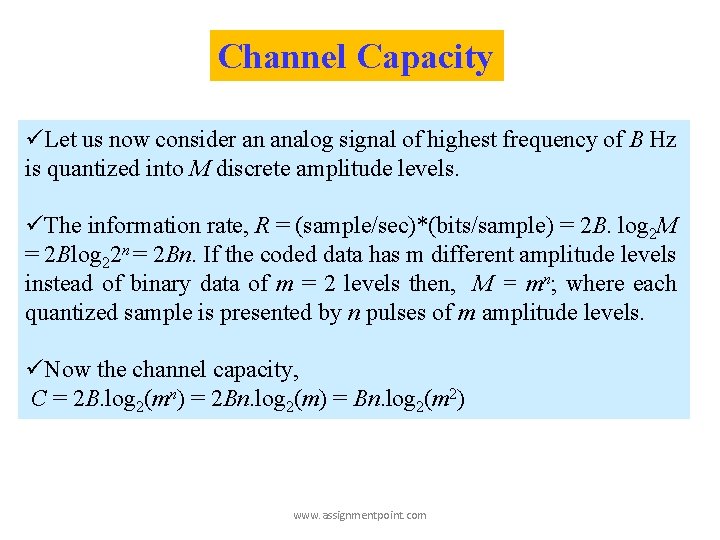
Channel Capacity üLet us now consider an analog signal of highest frequency of B Hz is quantized into M discrete amplitude levels. üThe information rate, R = (sample/sec)*(bits/sample) = 2 B. log 2 M = 2 Blog 22 n = 2 Bn. If the coded data has m different amplitude levels instead of binary data of m = 2 levels then, M = mn; where each quantized sample is presented by n pulses of m amplitude levels. üNow the channel capacity, C = 2 B. log 2(mn) = 2 Bn. log 2(m) = Bn. log 2(m 2) www. assignmentpoint. com
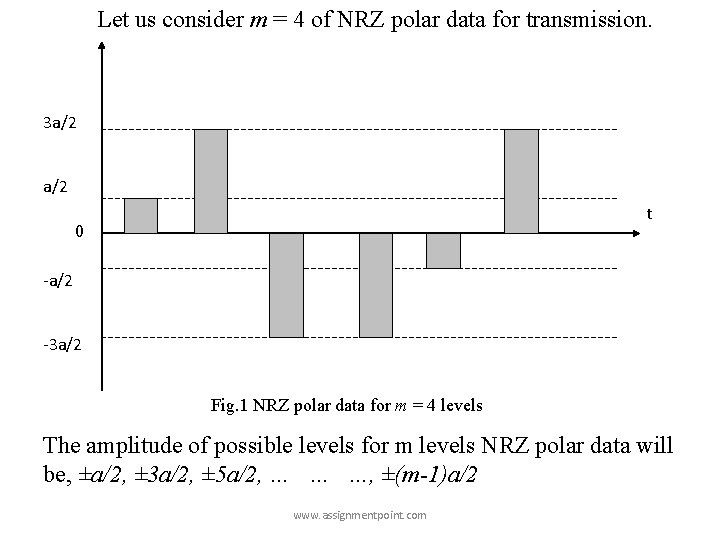
Let us consider m = 4 of NRZ polar data for transmission. 3 a/2 t 0 -a/2 -3 a/2 Fig. 1 NRZ polar data for m = 4 levels The amplitude of possible levels for m levels NRZ polar data will be, ±a/2, ± 3 a/2, ± 5 a/2, … … …, ±(m-1)a/2 www. assignmentpoint. com
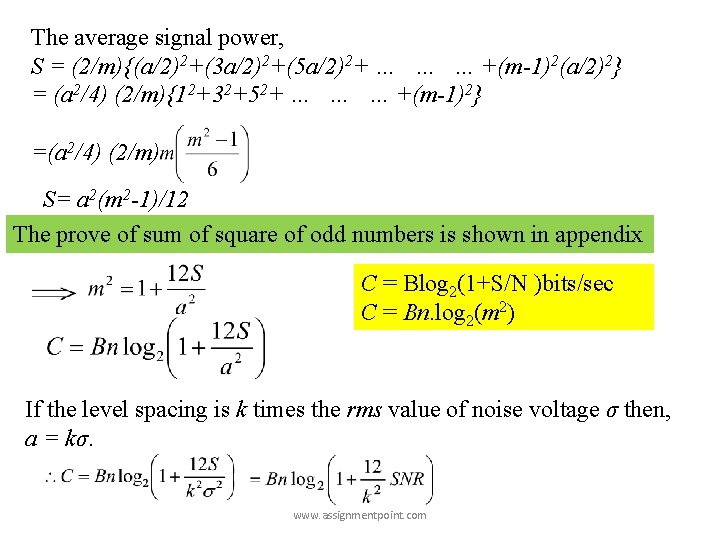
The average signal power, S = (2/m){(a/2)2+(3 a/2)2+(5 a/2)2+ … … … +(m-1)2(a/2)2} = (a 2/4) (2/m){12+32+52+ … … … +(m-1)2} =(a 2/4) (2/m) S= a 2(m 2 -1)/12 The prove of sum of square of odd numbers is shown in appendix C = Blog 2(1+S/N )bits/sec C = Bn. log 2(m 2) If the level spacing is k times the rms value of noise voltage σ then, a = kσ. www. assignmentpoint. com
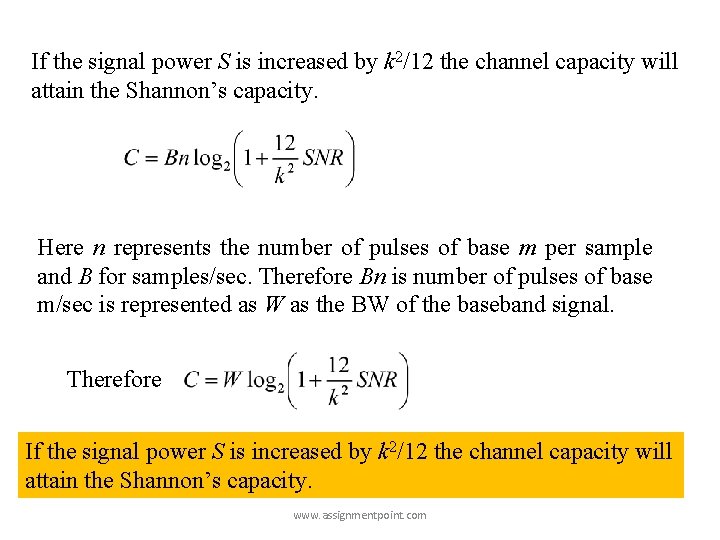
If the signal power S is increased by k 2/12 the channel capacity will attain the Shannon’s capacity. Here n represents the number of pulses of base m per sample and B for samples/sec. Therefore Bn is number of pulses of base m/sec is represented as W as the BW of the baseband signal. Therefore If the signal power S is increased by k 2/12 the channel capacity will attain the Shannon’s capacity. www. assignmentpoint. com
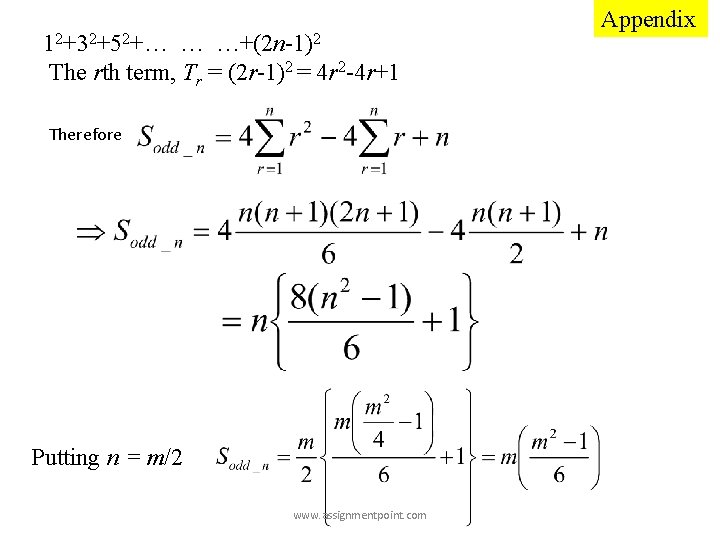
12+32+52+… … …+(2 n-1)2 The rth term, Tr = (2 r-1)2 = 4 r 2 -4 r+1 Therefore Putting n = m/2 www. assignmentpoint. com Appendix
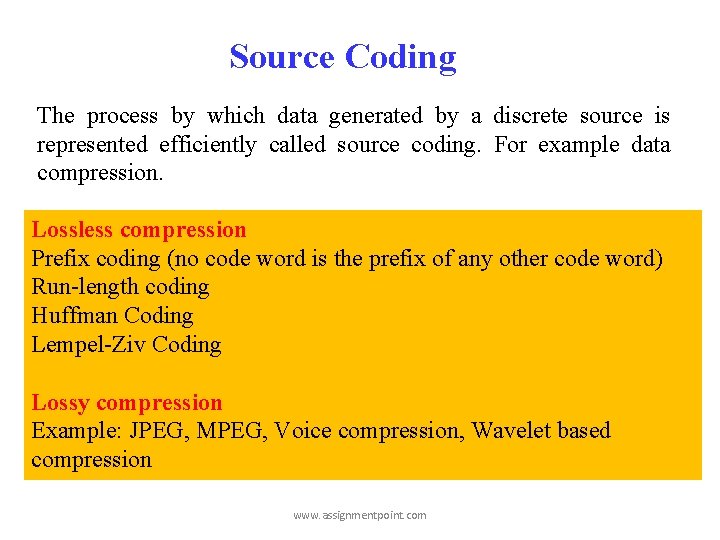
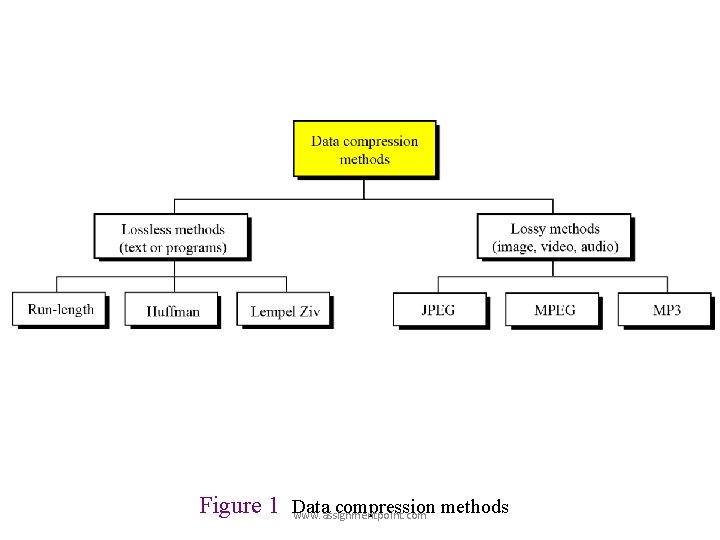
Source Coding The process by which data generated by a discrete source is represented efficiently called source coding. For example data compression. Lossless compression Prefix coding (no code word is the prefix of any other code word) Run-length coding Huffman Coding Lempel-Ziv Coding Lossy compression Example: JPEG, MPEG, Voice compression, Wavelet based compression www. assignmentpoint. com
Figure 1 Data compression methods www. assignmentpoint. com
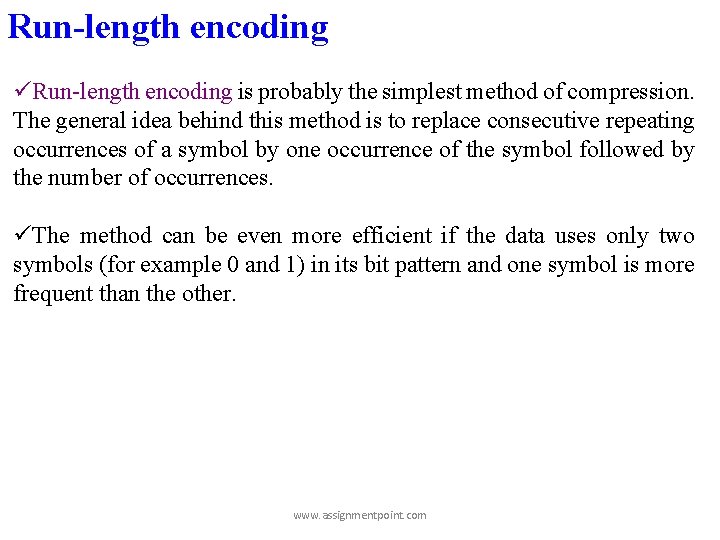
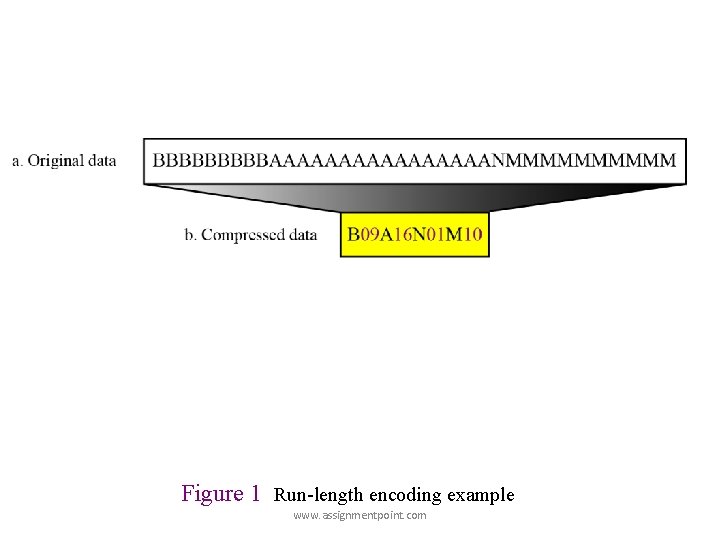
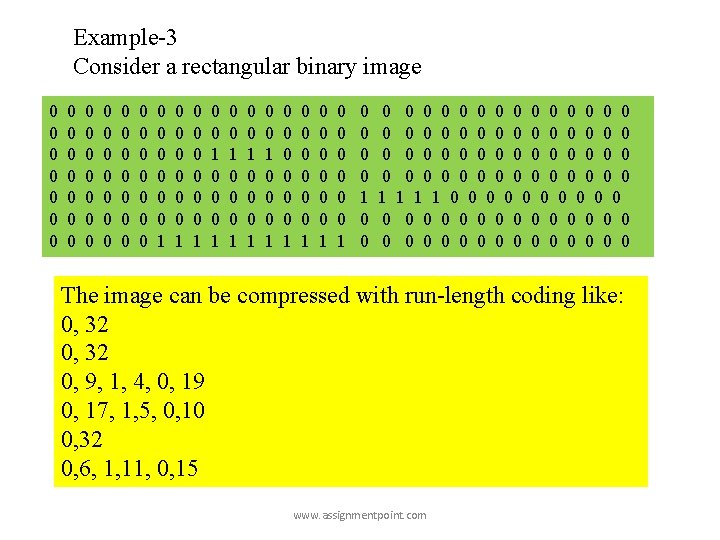
Run-length encoding üRun-length encoding is probably the simplest method of compression. The general idea behind this method is to replace consecutive repeating occurrences of a symbol by one occurrence of the symbol followed by the number of occurrences. üThe method can be even more efficient if the data uses only two symbols (for example 0 and 1) in its bit pattern and one symbol is more frequent than the other. www. assignmentpoint. com
Figure 1 Run-length encoding example www. assignmentpoint. com
Example-3 Consider a rectangular binary image 0 0 0 0 0 0 0 0 0 0 0 0 1 0 0 0 1 0 0 1 0 0 0 1 0 0 0 0 0 0 1 0 0 0 0 0 0 0 0 0 0 0 0 0 0 0 0 1 1 0 0 0 0 0 0 0 0 0 0 The image can be compressed with run-length coding like: 0, 32 0, 9, 1, 4, 0, 19 0, 17, 1, 5, 0, 10 0, 32 0, 6, 1, 11, 0, 15 www. assignmentpoint. com
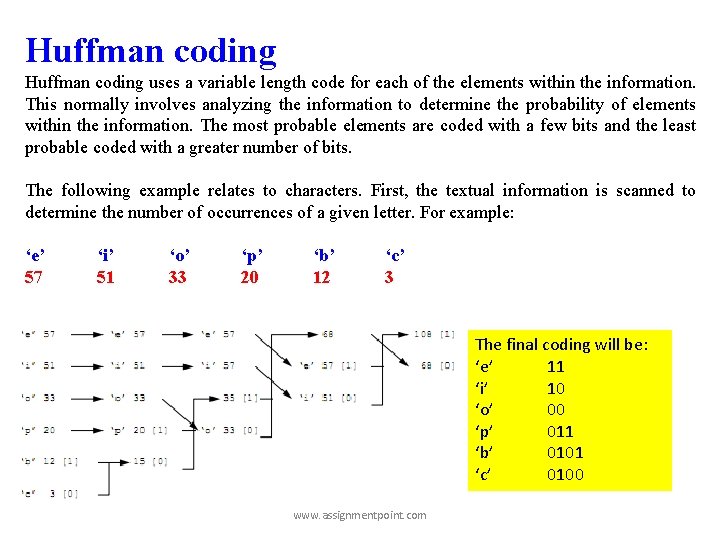
Huffman coding uses a variable length code for each of the elements within the information. This normally involves analyzing the information to determine the probability of elements within the information. The most probable elements are coded with a few bits and the least probable coded with a greater number of bits. The following example relates to characters. First, the textual information is scanned to determine the number of occurrences of a given letter. For example: ‘e’ 57 ‘i’ 51 ‘o’ 33 ‘p’ 20 ‘b’ 12 ‘c’ 3 The final coding will be: ‘e’ 11 ‘i’ 10 ‘o’ 00 ‘p’ 011 ‘b’ 0101 ‘c’ 0100 www. assignmentpoint. com
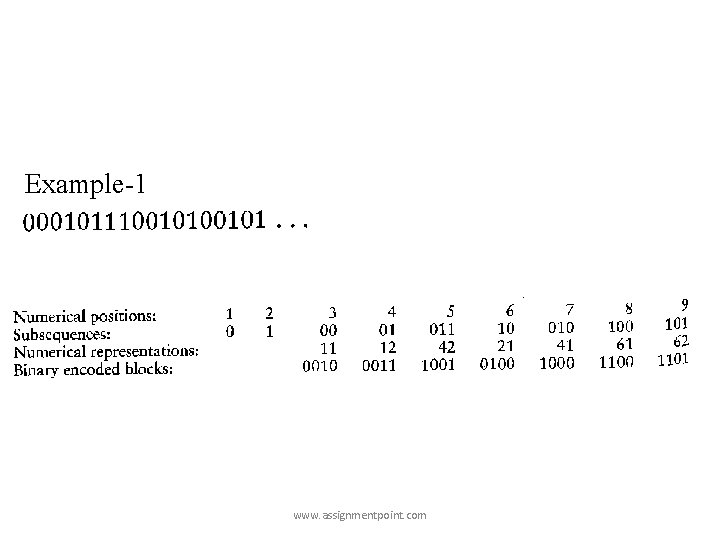
Lempel Ziv encoding üLempel–Ziv–Welch (LZW) is a universal lossless data compression algorithm created by Abraham Lempel, Jacob Ziv, and Terry Welch. It was published by Welch in 1984 as an improved implementation of the LZ 78 algorithm published by Lempel and Ziv in 1978. üThe algorithm is simple to implement, and widely used Unix file compression, and is used in the GIF image format. www. assignmentpoint. com
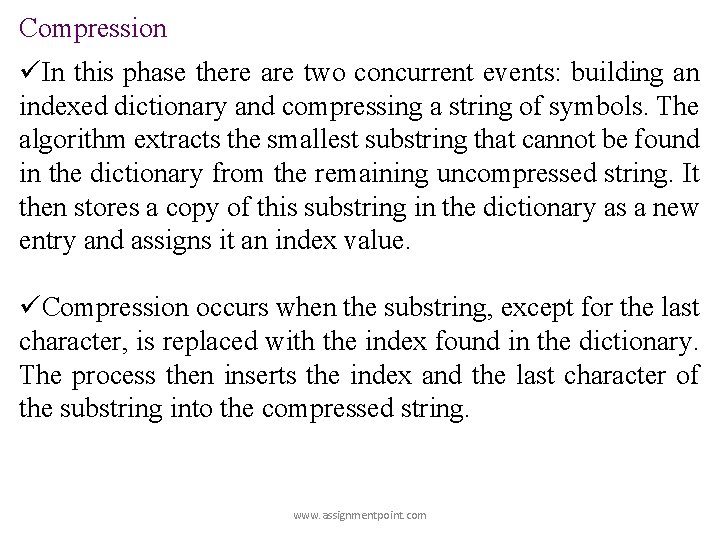
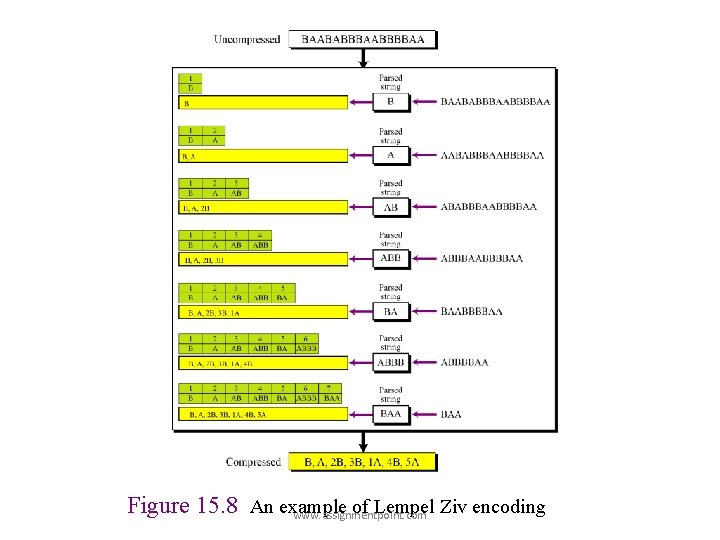
Compression üIn this phase there are two concurrent events: building an indexed dictionary and compressing a string of symbols. The algorithm extracts the smallest substring that cannot be found in the dictionary from the remaining uncompressed string. It then stores a copy of this substring in the dictionary as a new entry and assigns it an index value. üCompression occurs when the substring, except for the last character, is replaced with the index found in the dictionary. The process then inserts the index and the last character of the substring into the compressed string. www. assignmentpoint. com
Figure 15. 8 An example of Lempel Ziv encoding www. assignmentpoint. com
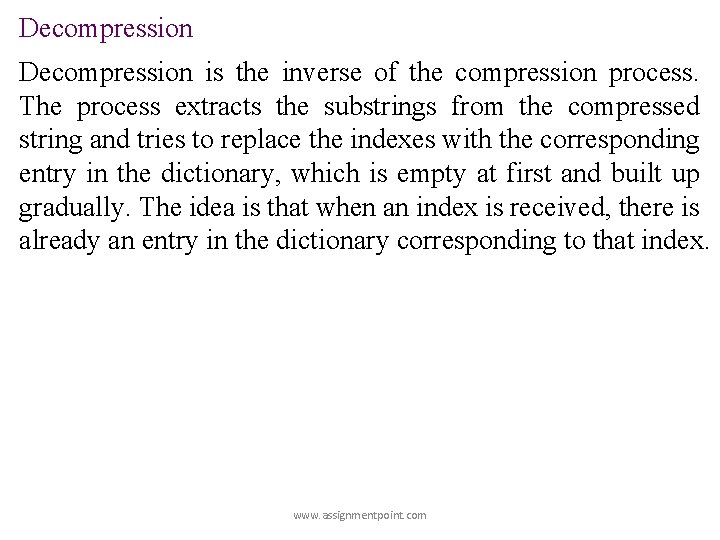
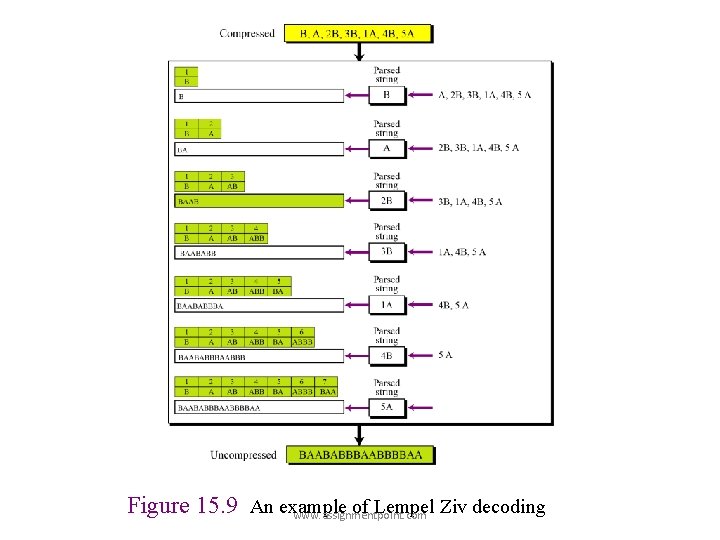
Decompression is the inverse of the compression process. The process extracts the substrings from the compressed string and tries to replace the indexes with the corresponding entry in the dictionary, which is empty at first and built up gradually. The idea is that when an index is received, there is already an entry in the dictionary corresponding to that index. www. assignmentpoint. com
Figure 15. 9 An example of Lempel Ziv decoding www. assignmentpoint. com
Example-1 www. assignmentpoint. com
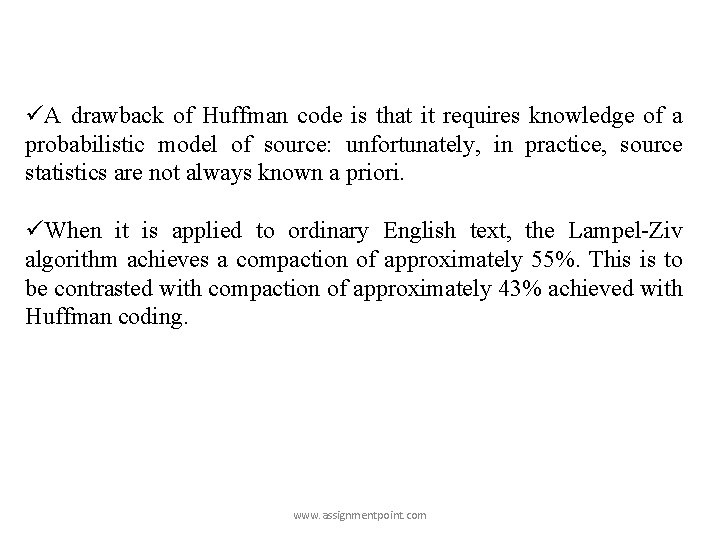
üA drawback of Huffman code is that it requires knowledge of a probabilistic model of source: unfortunately, in practice, source statistics are not always known a priori. üWhen it is applied to ordinary English text, the Lampel-Ziv algorithm achieves a compaction of approximately 55%. This is to be contrasted with compaction of approximately 43% achieved with Huffman coding. www. assignmentpoint. com
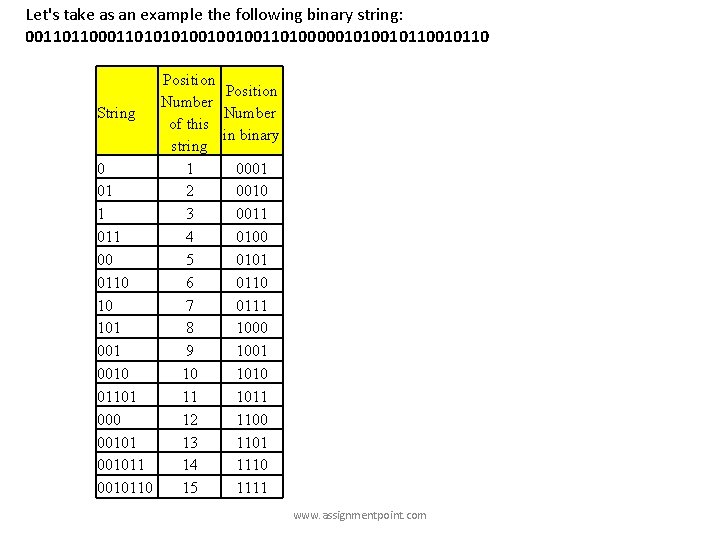
Let's take as an example the following binary string: 001101100011010010010011010000010110010110 Position Number String of this in binary string 0 1 0001 01 2 0010 1 3 0011 4 0100 00 5 0101 0110 6 0110 10 7 0111 101 8 1000 001 9 1001 0010 10 1010 01101 11 1011 000 12 1100 00101 13 1101 001011 14 1110 0010110 15 1111 www. assignmentpoint. com