Heavy Ion Physics Lecture 1 Thomas K Hemmick

- Slides: 49
Heavy Ion Physics Lecture 1 Thomas K Hemmick Stony Brook University
COURAGE INTENTION 2
For the Students! l l l This talk is not targeted at the experts. Students should EXPECT to understand. Whenever the speaker fails to meet this expectation: INTERRUPT! 3 Thomas K Hemmick
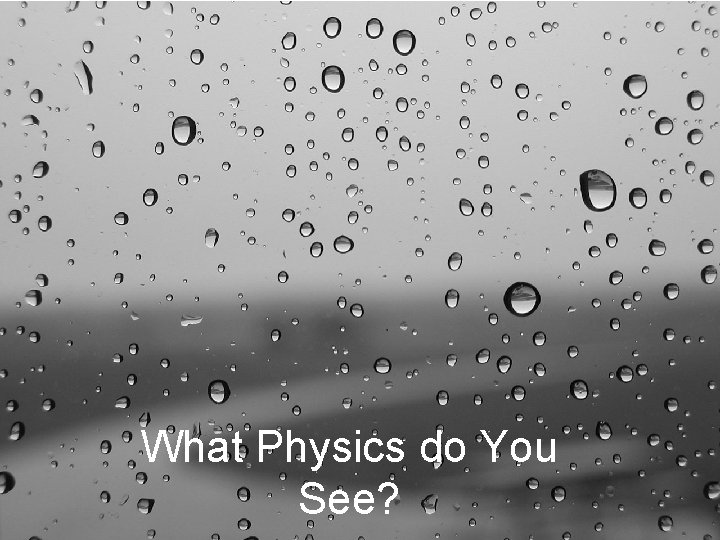
What Physics do You See? Thomas K Hemmick 4
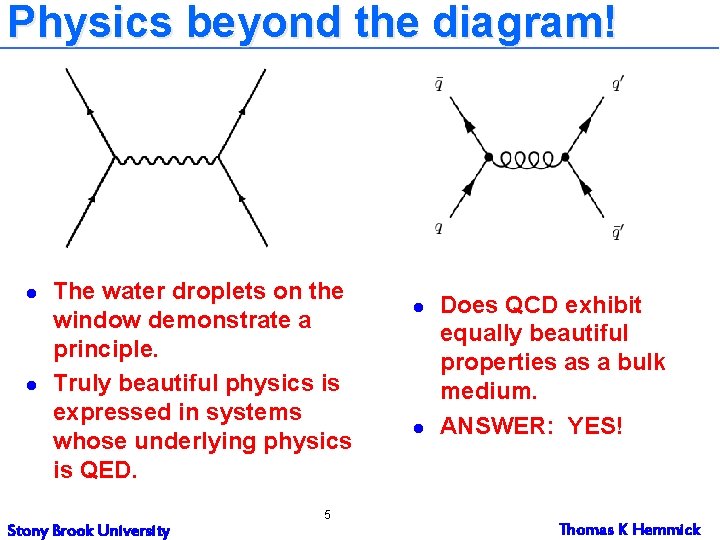
Physics beyond the diagram! l l The water droplets on the window demonstrate a principle. Truly beautiful physics is expressed in systems whose underlying physics is QED. Stony Brook University 5 l l Does QCD exhibit equally beautiful properties as a bulk medium. ANSWER: YES! Thomas K Hemmick
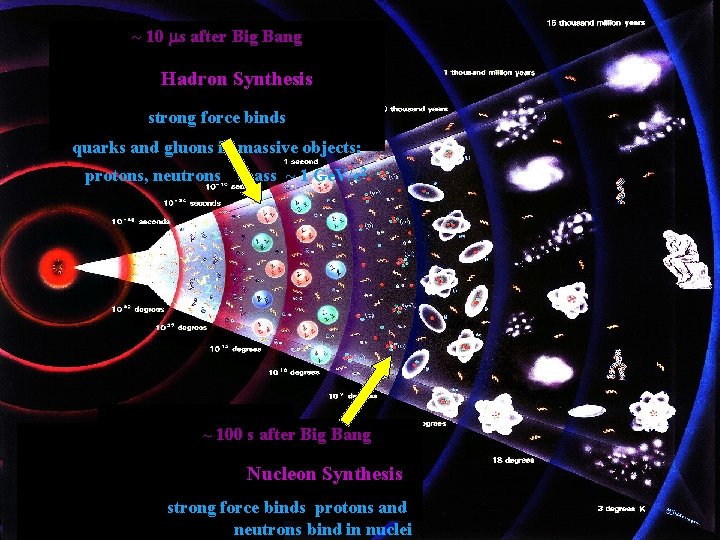
~ 10 ms after Big Bang Hadron Synthesis strong force binds quarks and gluons in massive objects: protons, neutrons mass ~ 1 Ge. V/c 2 ~ 100 s after Big Bang Nucleon Synthesis Axel Drees strong force binds protons and neutrons bind in nuclei
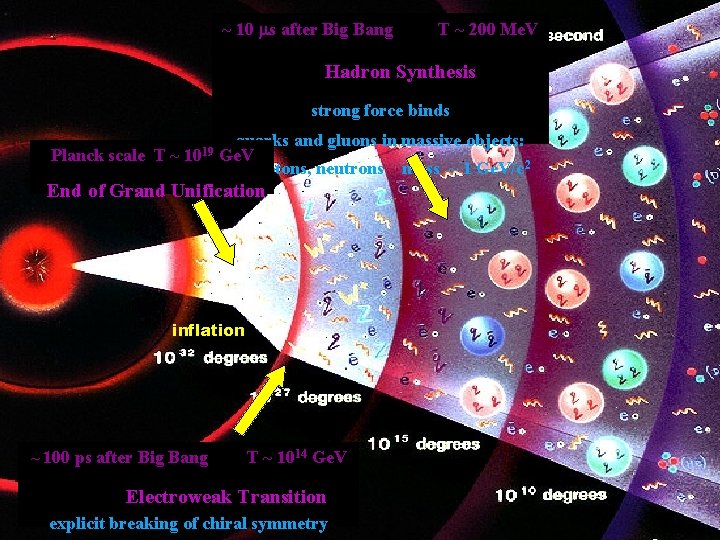
~ 10 ms after Big Bang T ~ 200 Me. V Hadron Synthesis strong force binds Planck scale T ~ 1019 quarks and gluons in massive objects: Ge. V protons, neutrons mass ~ 1 Ge. V/c 2 End of Grand Unification inflation ~ 100 ps after Big Bang T ~ 1014 Ge. V Electroweak Transition explicit Axel Drees breaking of chiral symmetry
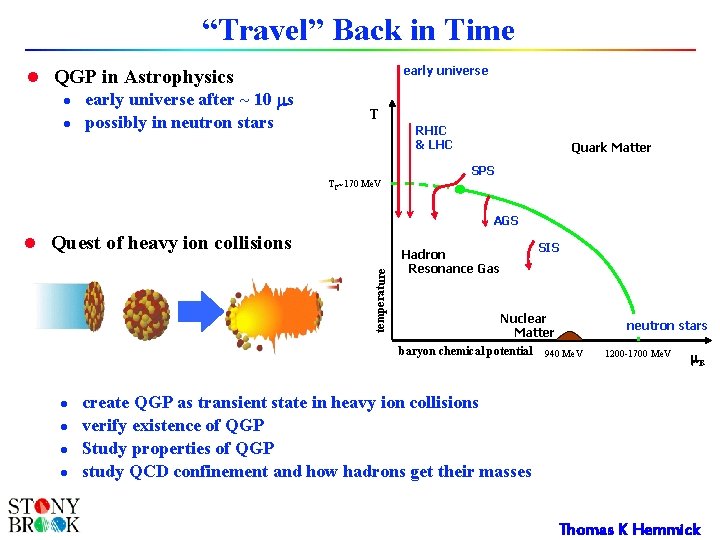
“Travel” Back in Time l QGP in Astrophysics l early universe after ~ 10 ms l possibly in neutron stars early universe T RHIC & LHC Quark Matter SPS TC~170 Me. V AGS temperature l Quest of heavy ion collisions l l Hadron Resonance Gas SIS Nuclear Matter baryon chemical potential 940 Me. V neutron stars 1200 -1700 Me. V m. B create QGP as transient state in heavy ion collisions verify existence of QGP Study properties of QGP study QCD confinement and how hadrons get their masses Thomas K Hemmick
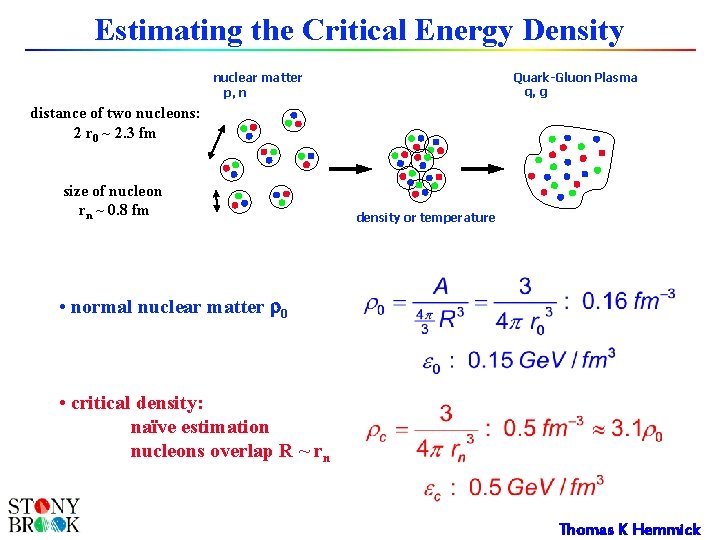
Estimating the Critical Energy Density Quark-Gluon Plasma q, g nuclear matter p, n distance of two nucleons: 2 r 0 ~ 2. 3 fm size of nucleon rn ~ 0. 8 fm density or temperature • normal nuclear matter r 0 • critical density: naïve estimation nucleons overlap R ~ rn Thomas K Hemmick
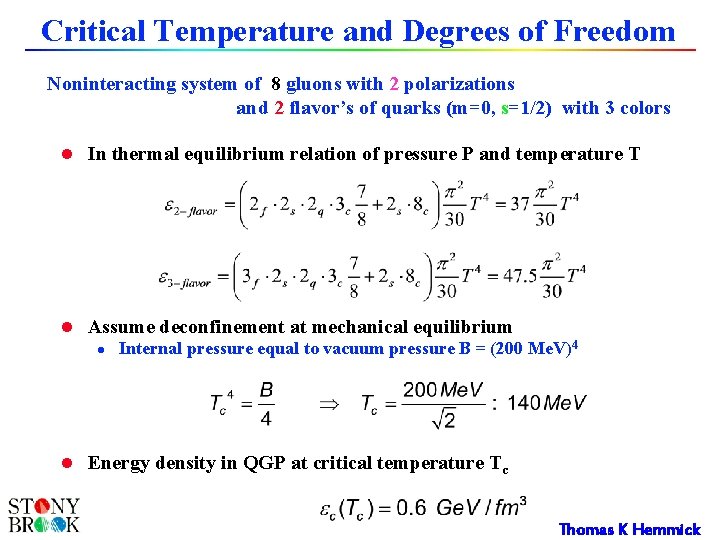
Critical Temperature and Degrees of Freedom Noninteracting system of 8 gluons with 2 polarizations and 2 flavor’s of quarks (m=0, s=1/2) with 3 colors l In thermal equilibrium relation of pressure P and temperature T l Assume deconfinement at mechanical equilibrium l Internal pressure equal to vacuum pressure B = (200 Me. V)4 l Energy density in QGP at critical temperature Tc Thomas K Hemmick
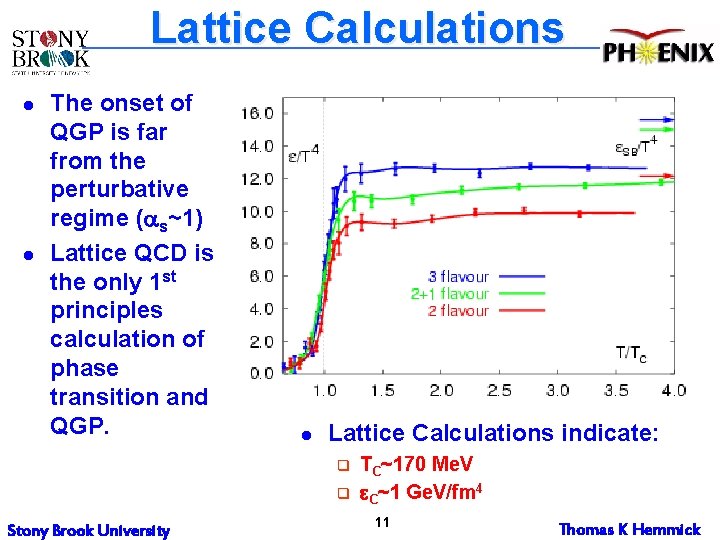
Lattice Calculations l l The onset of QGP is far from the perturbative regime (as~1) Lattice QCD is the only 1 st principles calculation of phase transition and QGP. l Lattice Calculations indicate: q q Stony Brook University TC~170 Me. V e. C~1 Ge. V/fm 4 11 Thomas K Hemmick
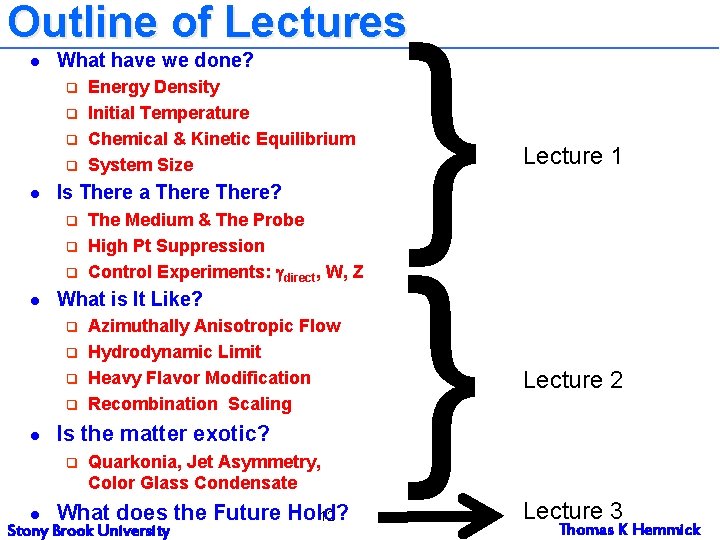
Outline of Lectures l What have we done? q q l Is There a There? q q q l q q q Azimuthally Anisotropic Flow Hydrodynamic Limit Heavy Flavor Modification Recombination Scaling Is the matter exotic? q l The Medium & The Probe High Pt Suppression Control Experiments: direct, W, Z What is It Like? q l Energy Density Initial Temperature Chemical & Kinetic Equilibrium System Size Quarkonia, Jet Asymmetry, Color Glass Condensate What does the Future Hold? 12 Stony Brook University } } Lecture 1 Lecture 2 Lecture 3 Thomas K Hemmick
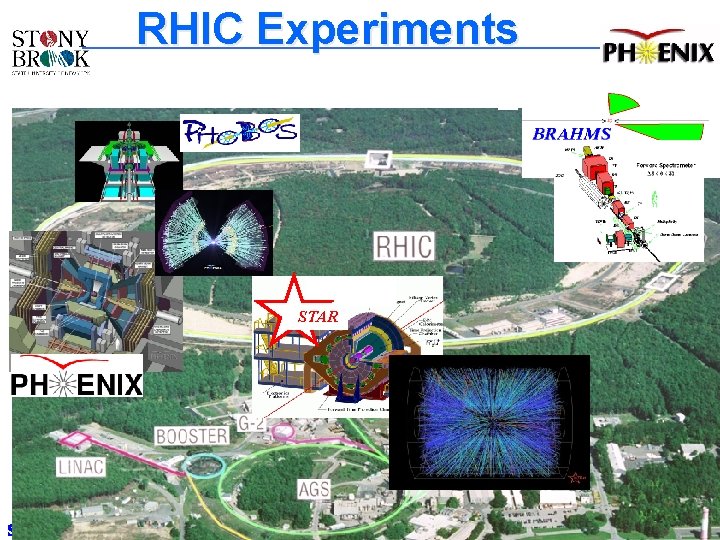
RHIC Experiments STAR Stony Brook University 13 Thomas K Hemmick
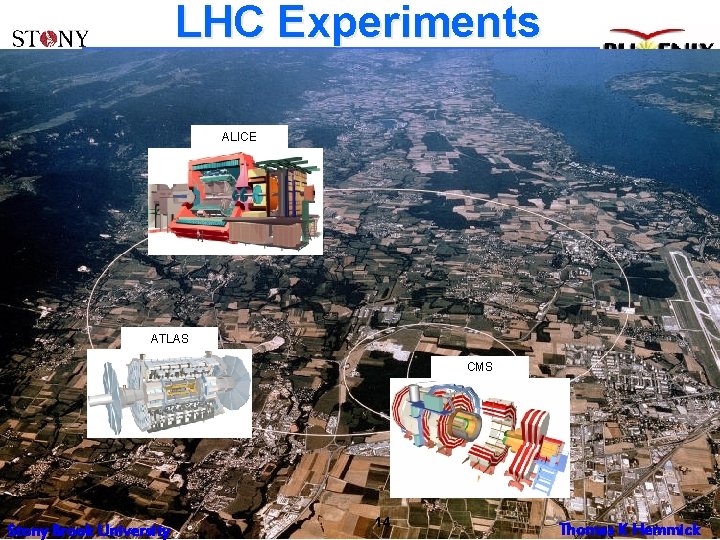
LHC Experiments ALICE ATLAS CMS Stony Brook University 14 Thomas K Hemmick
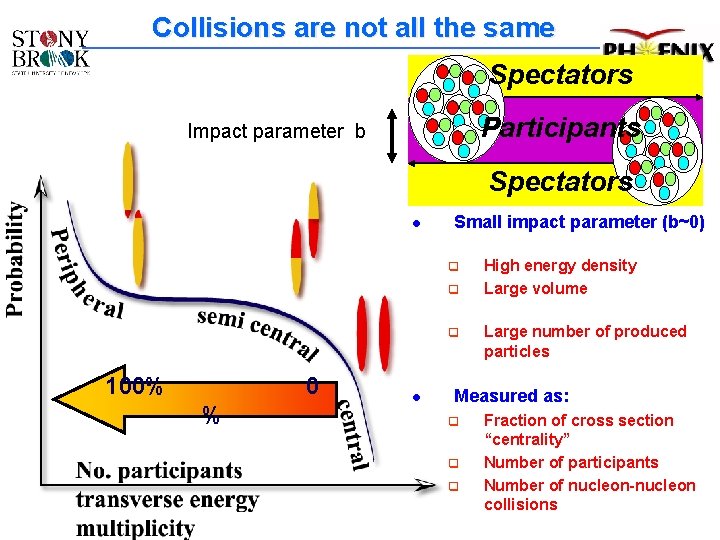
Collisions are not all the same Spectators Participants Impact parameter b Spectators l Small impact parameter (b~0) q q q 100% 0 % l Large number of produced particles Measured as: q q q Axel Drees High energy density Large volume Fraction of cross section “centrality” Number of participants Number of nucleon-nucleon collisions
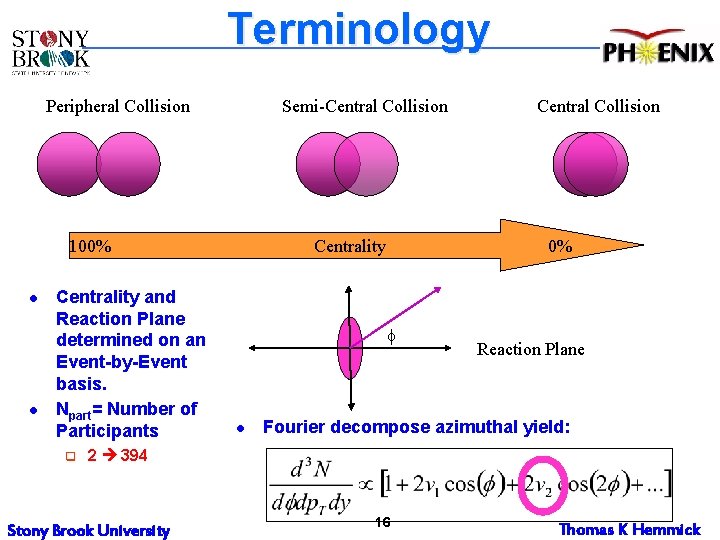
Terminology Peripheral Collision Semi-Central Collision 100% l l Centrality and Reaction Plane determined on an Event-by-Event basis. Npart= Number of Participants q Centrality 0% f l Central Collision Reaction Plane Fourier decompose azimuthal yield: 2 394 Stony Brook University 16 Thomas K Hemmick
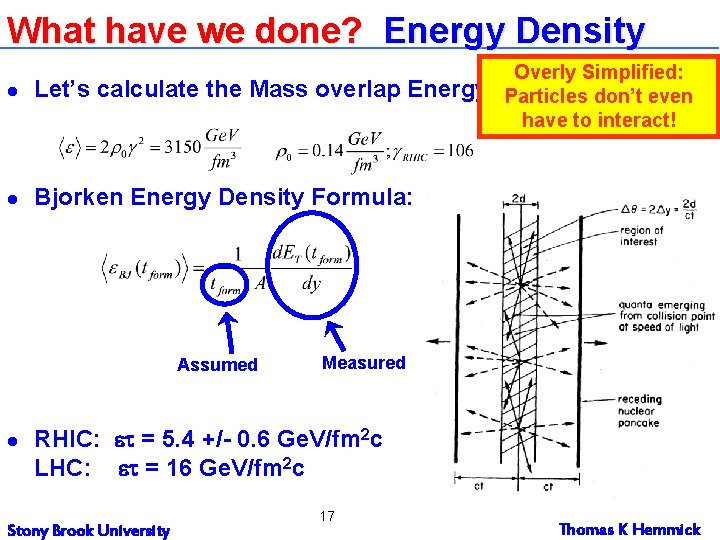
What have we done? Energy Density l Let’s calculate the Mass overlap Energy: l Bjorken Energy Density Formula: Assumed l Overly Simplified: Particles don’t even have to interact! Measured RHIC: et = 5. 4 +/- 0. 6 Ge. V/fm 2 c LHC: et = 16 Ge. V/fm 2 c Stony Brook University 17 Thomas K Hemmick
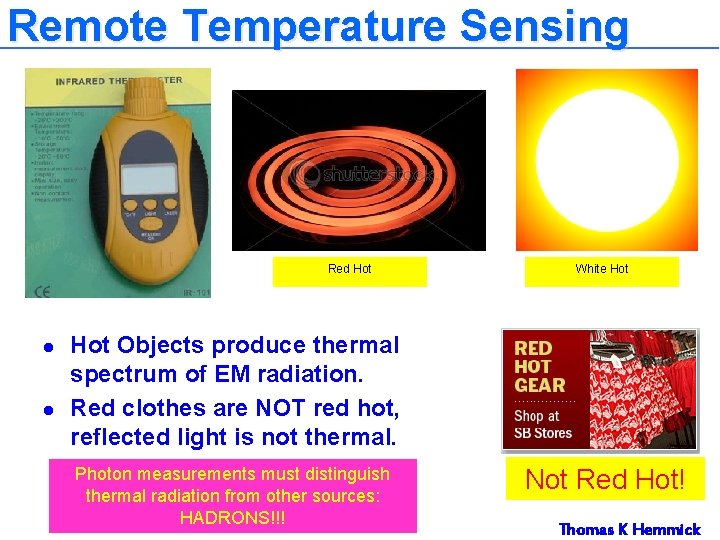
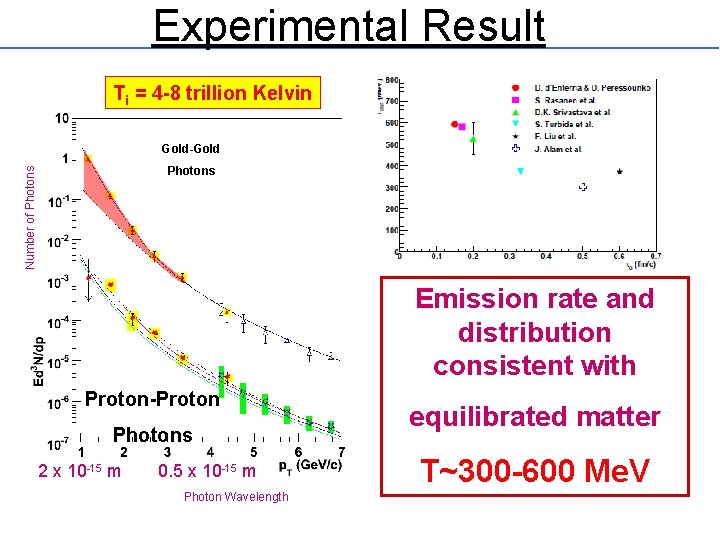
Remote Temperature Sensing Red Hot l l White Hot Objects produce thermal spectrum of EM radiation. Red clothes are NOT red hot, reflected light is not thermal. Photon measurements must distinguish thermal radiation from other sources: 18 HADRONS!!! Not Red Hot! Thomas K Hemmick
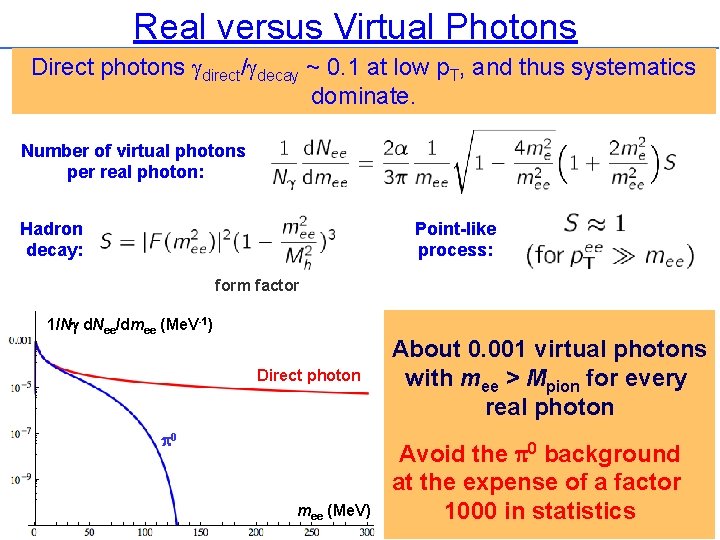
Real versus Virtual Photons Direct photons gdirect/gdecay ~ 0. 1 at low p. T, and thus systematics dominate. Number of virtual photons per real photon: Hadron decay: Point-like process: form factor 1/N d. Nee/dmee (Me. V-1) Direct photon 0 mee 19(Me. V) About 0. 001 virtual photons with mee > Mpion for every real photon Avoid the 0 background at the expense of a factor 1000 in statistics
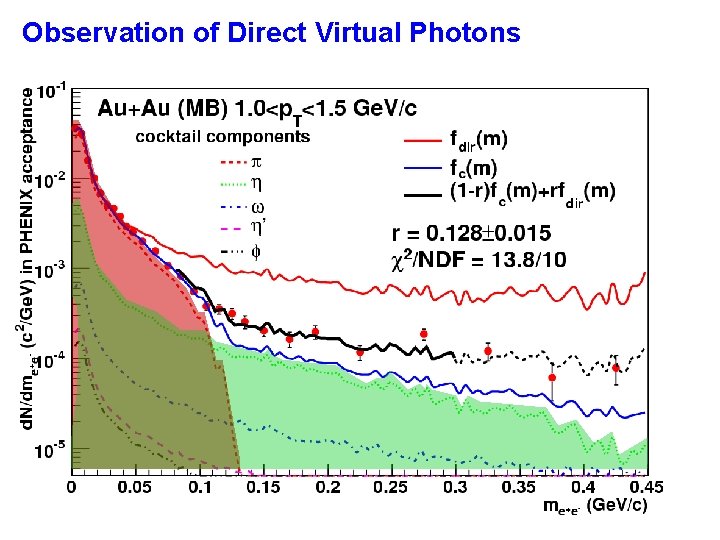
Observation of Direct Virtual Photons 20
Experimental Result Ti = 4 -8 trillion Kelvin Gold-Gold Number of Photons Emission rate and distribution consistent with Proton-Proton Photons 2 x 10 -15 m 0. 5 x 10 -15 m Photon Wavelength equilibrated matter T~300 -600 Me. V
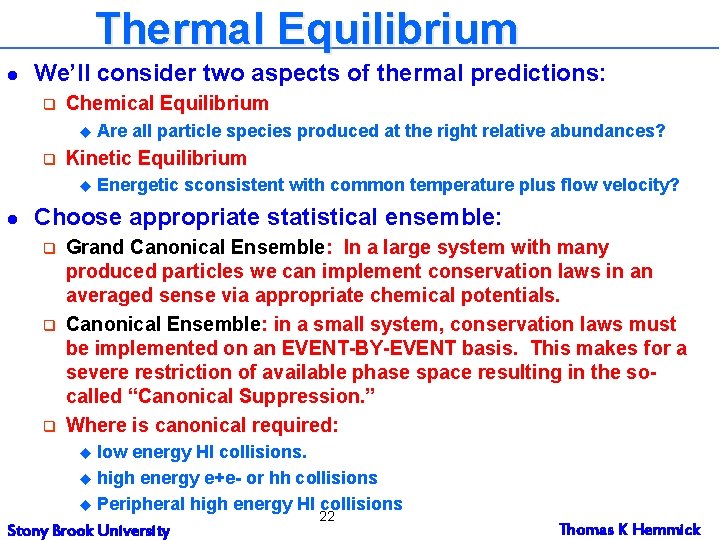
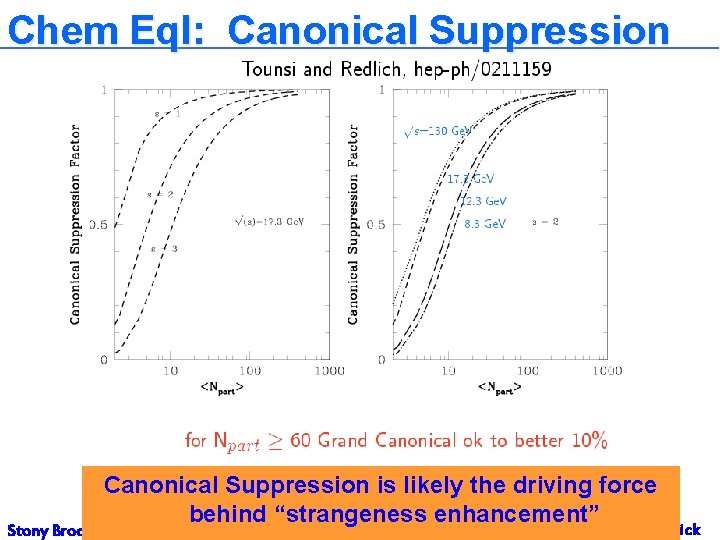
Thermal Equilibrium l We’ll consider two aspects of thermal predictions: q Chemical Equilibrium u Are q all particle species produced at the right relative abundances? Kinetic Equilibrium u Energetic l sconsistent with common temperature plus flow velocity? Choose appropriate statistical ensemble: q q q Grand Canonical Ensemble: In a large system with many produced particles we can implement conservation laws in an averaged sense via appropriate chemical potentials. Canonical Ensemble: in a small system, conservation laws must be implemented on an EVENT-BY-EVENT basis. This makes for a severe restriction of available phase space resulting in the socalled “Canonical Suppression. ” Where is canonical required: u low energy HI collisions. u high energy e+e- or hh collisions u Peripheral high energy HI collisions 22 Stony Brook University Thomas K Hemmick
Chem Eql: Canonical Suppression is likely the driving force 23 behind “strangeness enhancement” Stony Brook University Thomas K Hemmick
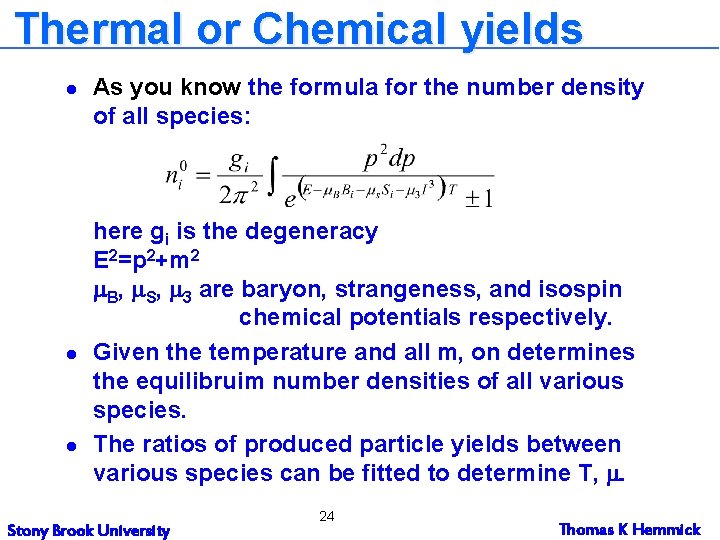
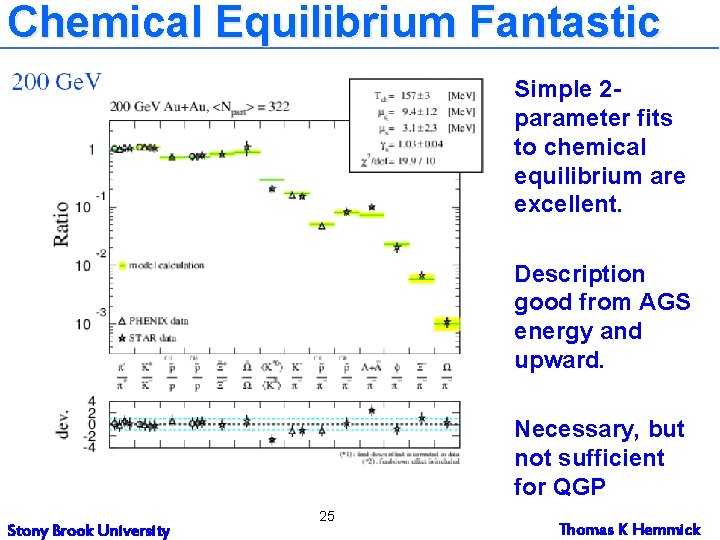
Thermal or Chemical yields l l l As you know the formula for the number density of all species: here gi is the degeneracy E 2=p 2+m 2 m. B, m. S, m 3 are baryon, strangeness, and isospin chemical potentials respectively. Given the temperature and all m, on determines the equilibruim number densities of all various species. The ratios of produced particle yields between various species can be fitted to determine T, m. Stony Brook University 24 Thomas K Hemmick
Chemical Equilibrium Fantastic l l l Stony Brook University 25 Simple 2 parameter fits to chemical equilibrium are excellent. Description good from AGS energy and upward. Necessary, but not sufficient for QGP Thomas K Hemmick
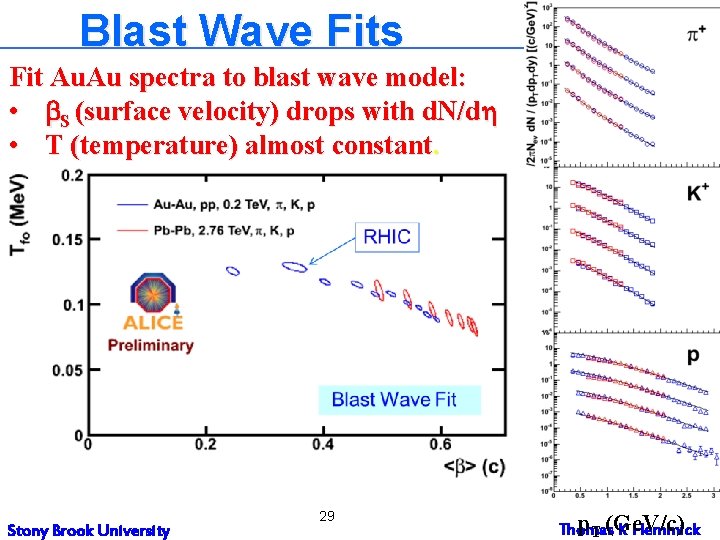
Kinetic Equil: Radial Flow l As you know for any interacting system of particles expanding into vacuum, radial flow is a natural consequence. q l This motion complicates the interpretation of the momentum of particles as compared to their temperature and should be subtracted. q l During the cascade process, one naturally develops an ordering of particles with the highest common underlying velocity at the outer edge. Although 1 st principles calculations of fluid dynamics are the higher goal, simple parameterizations are nonetheless instructive. Hadrons are released in the final stage and therefore measure “FREEZE-OUT” Temp. Stony Brook University 26 Thomas K Hemmick
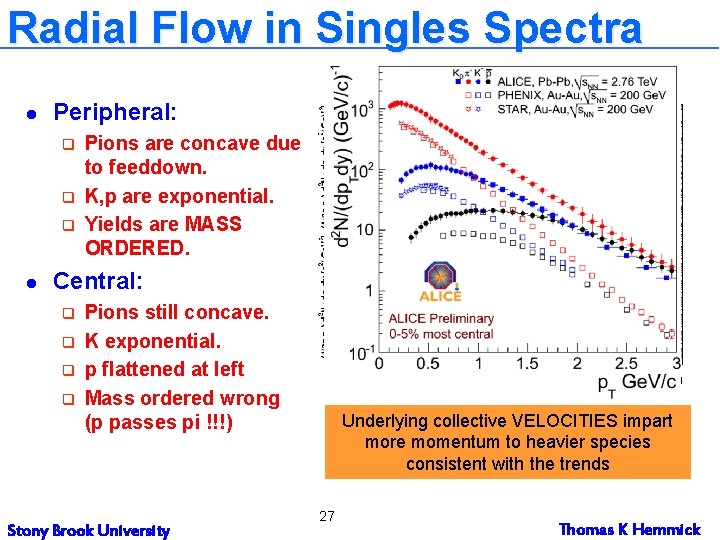
Radial Flow in Singles Spectra l Peripheral: q q q l Central Pions are concave due to feeddown. K, p are exponential. Yields are MASS ORDERED. Peripheral Central: q q Pions still concave. K exponential. p flattened at left Mass ordered wrong (p passes pi !!!) Stony Brook University Underlying collective VELOCITIES impart more momentum to heavier species consistent with the trends 27 Thomas K Hemmick
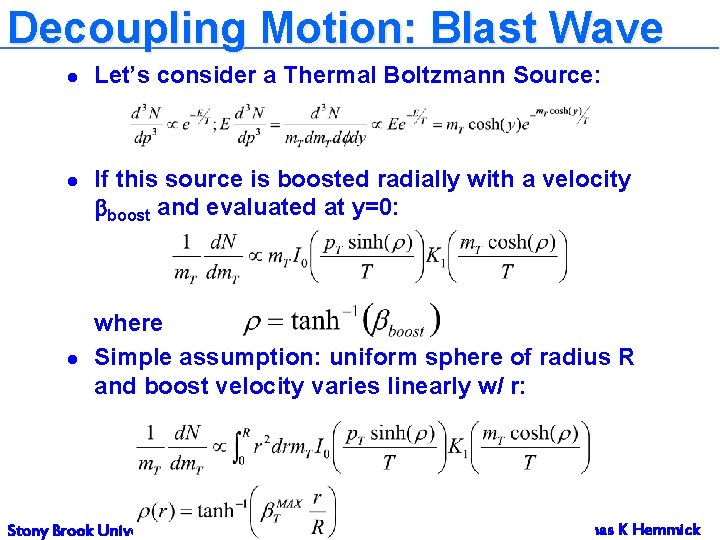
Decoupling Motion: Blast Wave l l l Let’s consider a Thermal Boltzmann Source: If this source is boosted radially with a velocity boost and evaluated at y=0: where Simple assumption: uniform sphere of radius R and boost velocity varies linearly w/ r: Stony Brook University 28 Thomas K Hemmick
Blast Wave Fits Fit Au. Au spectra to blast wave model: • S (surface velocity) drops with d. N/d • T (temperature) almost constant. Stony Brook University 29 p. T (Ge. V/c) Thomas K Hemmick
Intensity Interferometry l All physics students are taught the principles of amplitude interferometry: q l Less well known is the principle of intensity interferometry: q q l The probability wave of a single particle interferes with itself when, for example, passing through two slits. Two particles whose origin or propagation are correlated in any way can be measured as a pair and exhibit wave properties in their relative measures (e. g. momentum difference). Correlation sources range from actual physical interactions (coulomb, strong; attractive or repulsive) to quantum statistics of identical bosons or fermions. Measurement of two-particle correlations allows access space-time characteristics of the source. Stony Brook University 30 Thomas K Hemmick
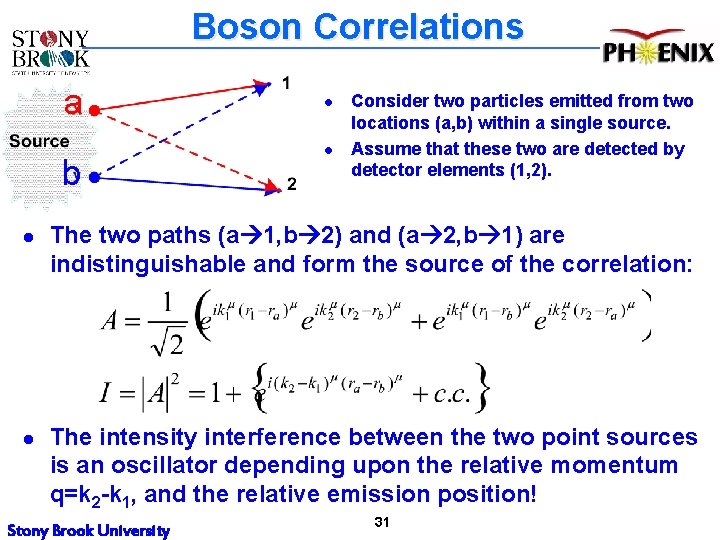
Boson Correlations a b l l Consider two particles emitted from two locations (a, b) within a single source. Assume that these two are detected by detector elements (1, 2). The two paths (a 1, b 2) and (a 2, b 1) are indistinguishable and form the source of the correlation: The intensity interference between the two point sources is an oscillator depending upon the relative momentum q=k 2 -k 1, and the relative emission position! Stony Brook University 31
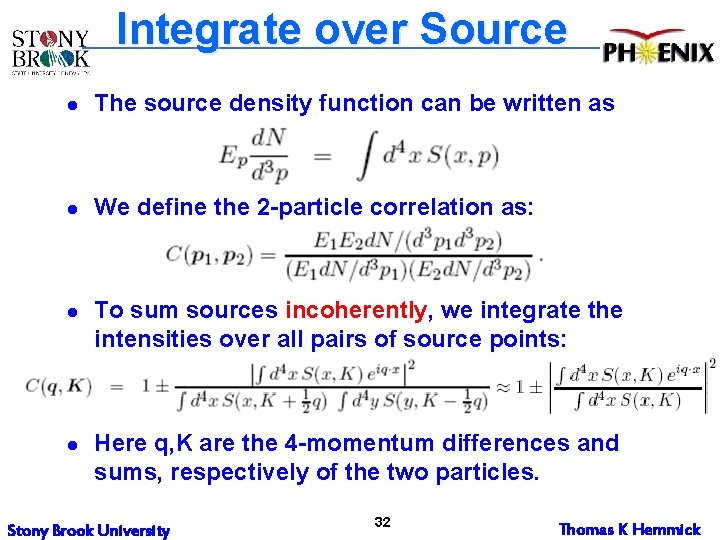
Integrate over Source l The source density function can be written as l We define the 2 -particle correlation as: l l To sum sources incoherently, we integrate the intensities over all pairs of source points: Here q, K are the 4 -momentum differences and sums, respectively of the two particles. Stony Brook University 32 Thomas K Hemmick
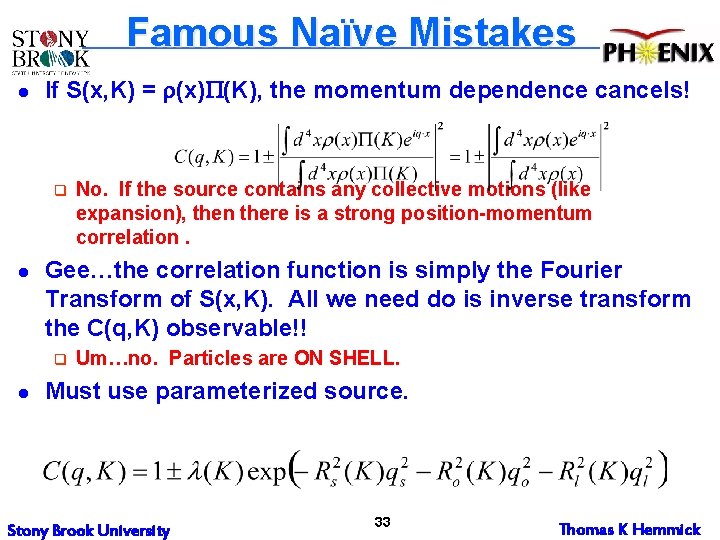
Famous Naïve Mistakes l If S(x, K) = r(x)P(K), the momentum dependence cancels! q l Gee…the correlation function is simply the Fourier Transform of S(x, K). All we need do is inverse transform the C(q, K) observable!! q l No. If the source contains any collective motions (like expansion), then there is a strong position-momentum correlation. Um…no. Particles are ON SHELL. Must use parameterized source. Stony Brook University 33 Thomas K Hemmick
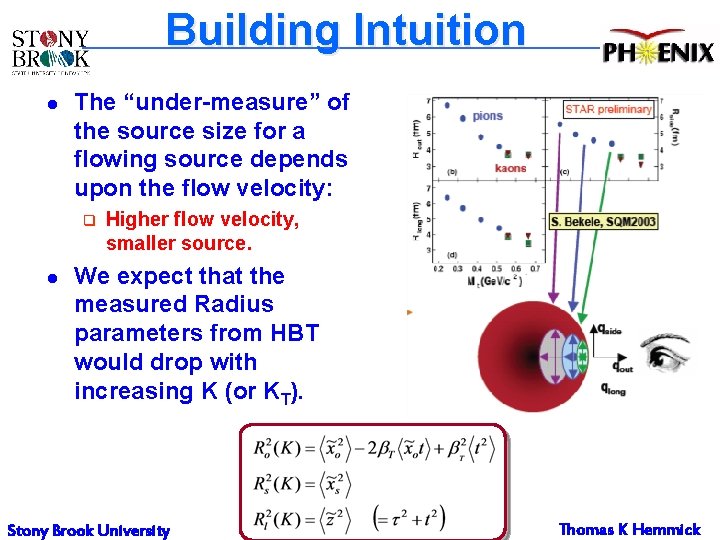
Building Intuition l The “under-measure” of the source size for a flowing source depends upon the flow velocity: q l Higher flow velocity, smaller source. We expect that the measured Radius parameters from HBT would drop with increasing K (or KT). Stony Brook University 34 Thomas K Hemmick
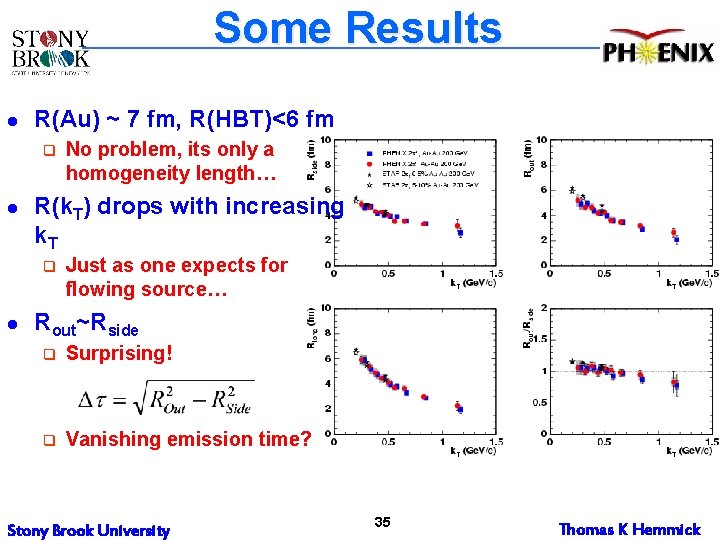
Some Results l R(Au) ~ 7 fm, R(HBT)<6 fm q l R(k. T) drops with increasing k. T q l No problem, its only a homogeneity length… Just as one expects for flowing source… Rout~Rside q Surprising! q Vanishing emission time? Stony Brook University 35 Thomas K Hemmick
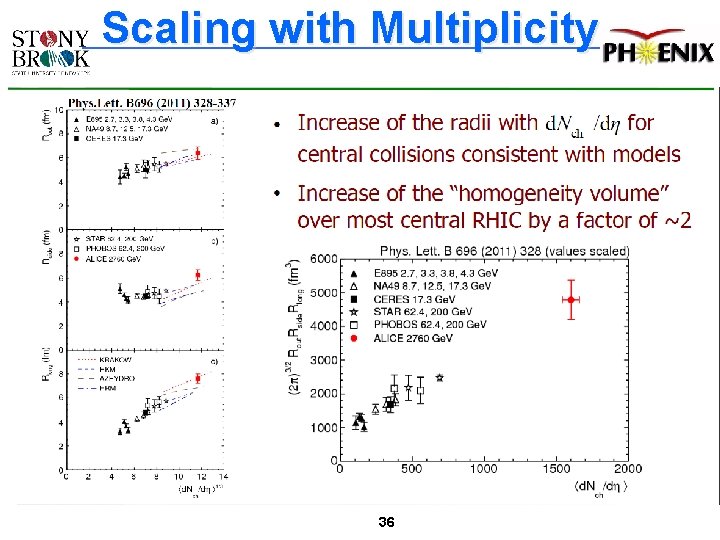
Scaling with Multiplicity 36
Is There a There? l l l We accelerate nuclei to high energies with the hope and intent of utilizing the beam energy to drive a phase transition to QGP. The collision must not only utilize the energy effectively, but generate the signatures of the new phase for us. I will make an artificial distinction as follows: q q l Medium: The bulk of the particles; dominantly soft production and possibly exhibiting some phase. Probe: Particles whose production is calculable, measurable, and thermally incompatible with (distinct from) the medium. The medium & probe paradigm will establish whethere is a there. Stony Brook University 37 Thomas K Hemmick
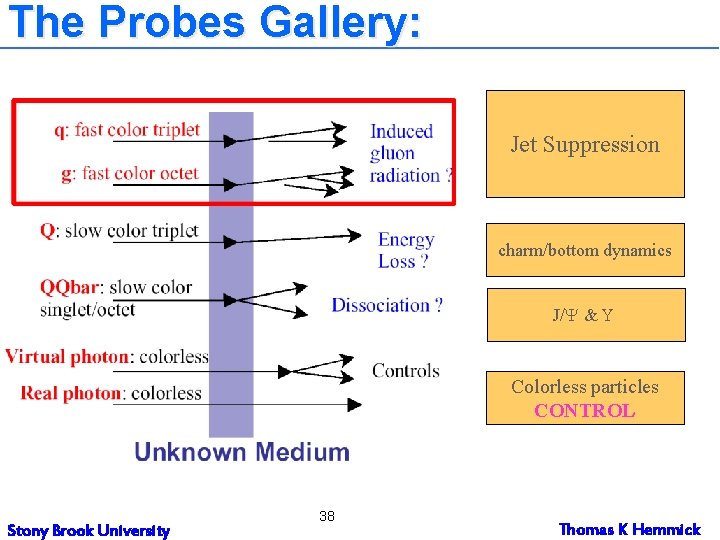
The Probes Gallery: Jet Suppression charm/bottom dynamics J/Y & U Colorless particles CONTROL Stony Brook University 38 Thomas K Hemmick
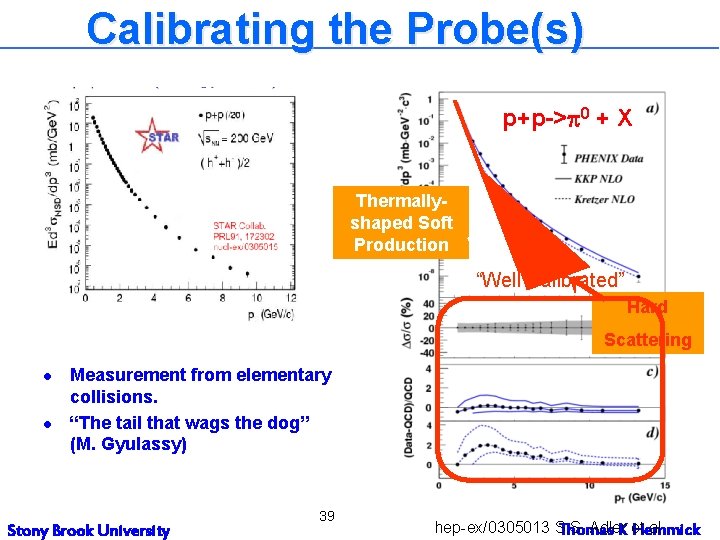
Calibrating the Probe(s) p+p-> 0 + X Thermallyshaped Soft Production “Well Calibrated” Hard Scattering l l Measurement from elementary collisions. “The tail that wags the dog” (M. Gyulassy) Stony Brook University 39 hep-ex/0305013 S. S. Adler al. Thomas K et Hemmick
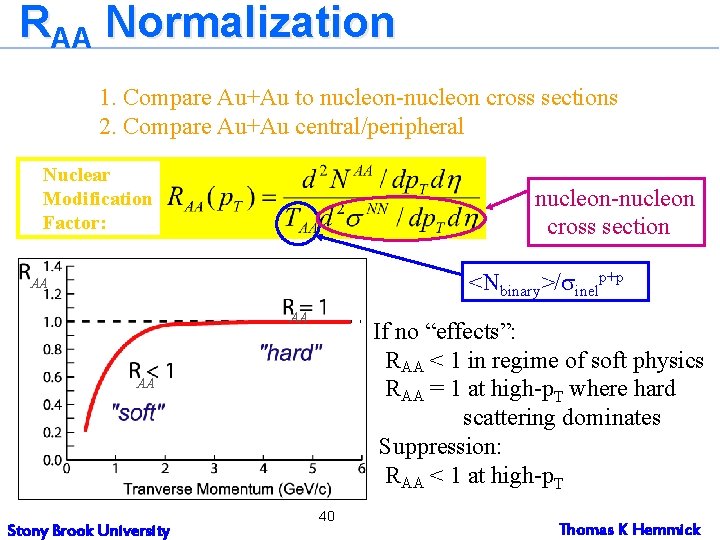
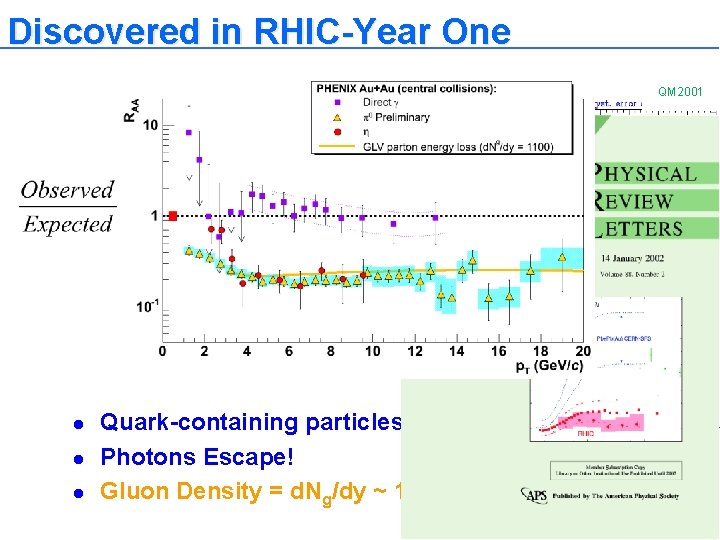
RAA Normalization 1. Compare Au+Au to nucleon-nucleon cross sections 2. Compare Au+Au central/peripheral Nuclear Modification Factor: nucleon-nucleon cross section <Nbinary>/sinelp+p AA AA If no “effects”: RAA < 1 in regime of soft physics RAA = 1 at high-p. T where hard scattering dominates Suppression: RAA < 1 at high-p. T AA Stony Brook University 40 Thomas K Hemmick
Discovered in RHIC-Year One QM 2001 l l l QM 2001 Quark-containing particles suppressed. Photons Escape! Gluon Density = d. Ng/dy ~ 1100 41
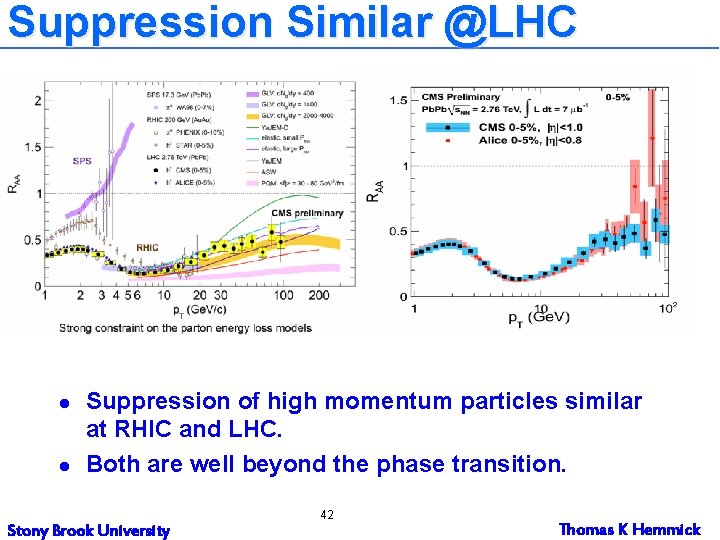
Suppression Similar @LHC l l Suppression of high momentum particles similar at RHIC and LHC. Both are well beyond the phase transition. Stony Brook University 42 Thomas K Hemmick
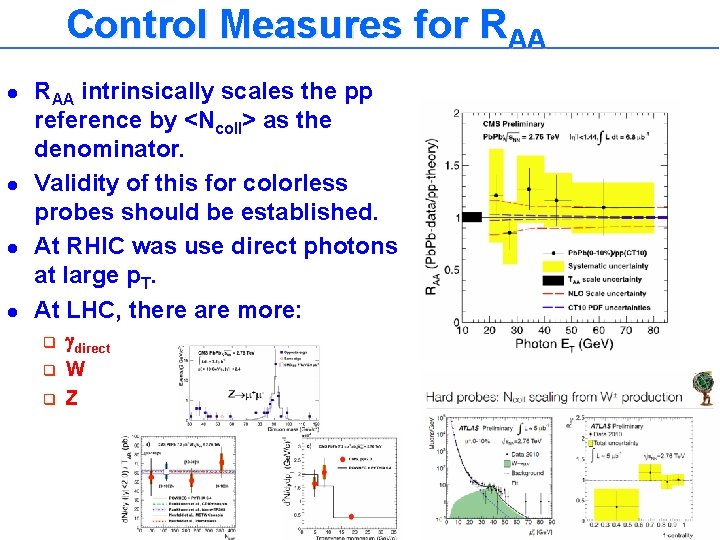
Control Measures for RAA l l RAA intrinsically scales the pp reference by <Ncoll> as the denominator. Validity of this for colorless probes should be established. At RHIC was use direct photons at large p. T. At LHC, there are more: q q q direct W Z
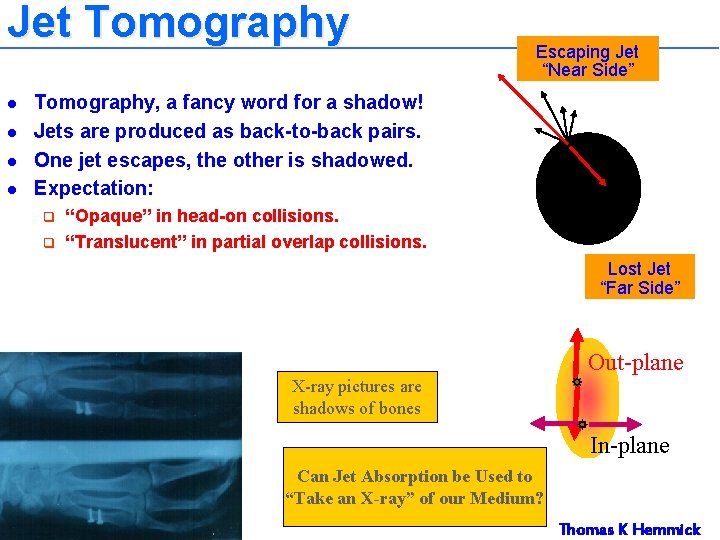
Jet Tomography l l Escaping Jet “Near Side” Tomography, a fancy word for a shadow! Jets are produced as back-to-back pairs. One jet escapes, the other is shadowed. Expectation: q q “Opaque” in head-on collisions. “Translucent” in partial overlap collisions. Lost Jet “Far Side” Out-plane X-ray pictures are shadows of bones In-plane Can Jet Absorption be Used to “Take an X-ray” of our Medium? Stony Brook University 44 Thomas K Hemmick
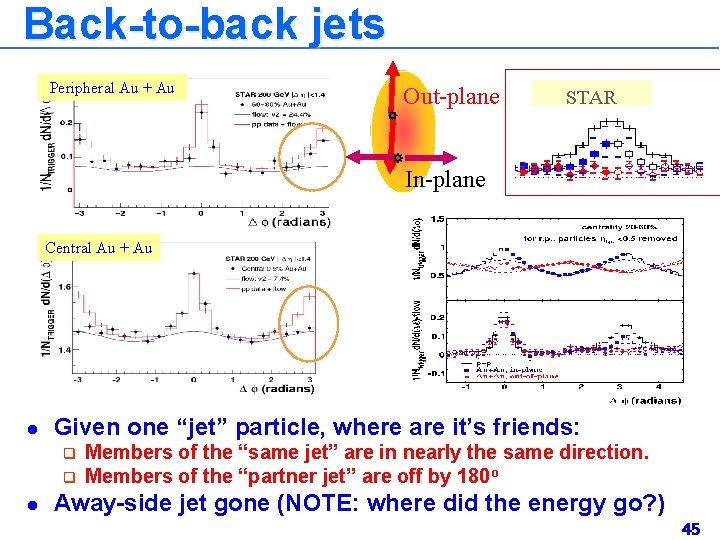
Back-to-back jets Peripheral Au + Au Out-plane STAR In-plane Central Au + Au l Given one “jet” particle, where are it’s friends: q q l Members of the “same jet” are in nearly the same direction. Members of the “partner jet” are off by 180 o Away-side jet gone (NOTE: where did the energy go? ) 45
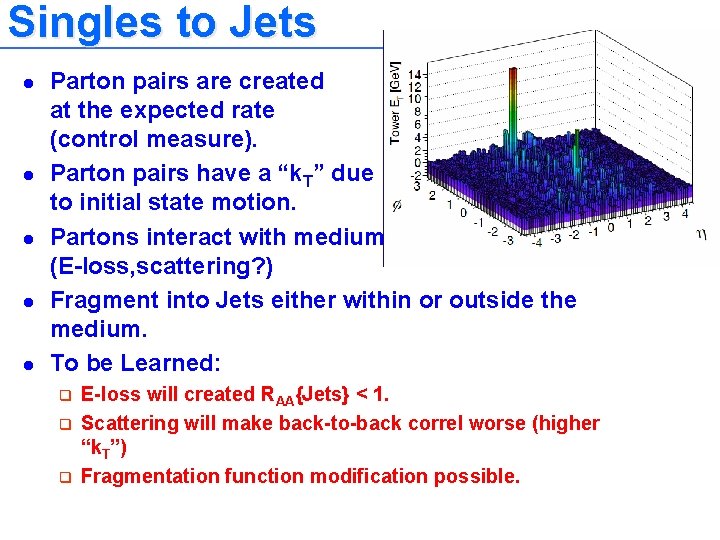
Singles to Jets l l l Parton pairs are created at the expected rate (control measure). Parton pairs have a “k. T” due to initial state motion. Partons interact with medium (E-loss, scattering? ) Fragment into Jets either within or outside the medium. To be Learned: q q q E-loss will created RAA{Jets} < 1. Scattering will make back-to-back correl worse (higher “k. T”) Fragmentation function modification possible.
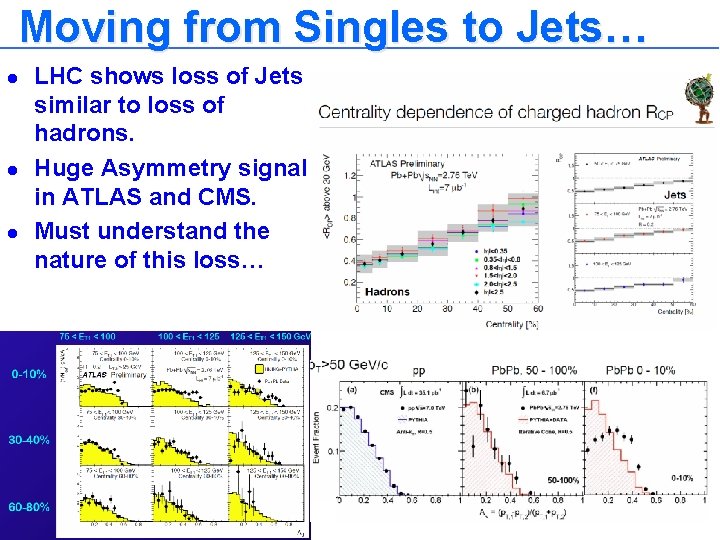
Moving from Singles to Jets… l l l LHC shows loss of Jets similar to loss of hadrons. Huge Asymmetry signal in ATLAS and CMS. Must understand the nature of this loss…
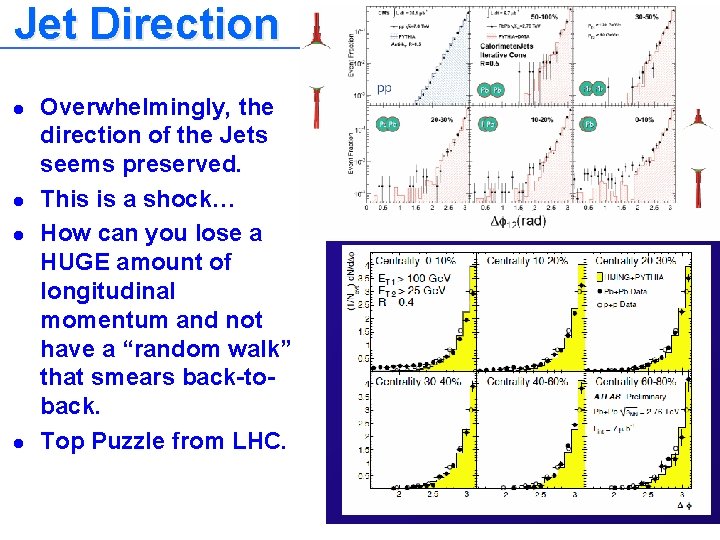
Jet Direction l l Overwhelmingly, the direction of the Jets seems preserved. This is a shock… How can you lose a HUGE amount of longitudinal momentum and not have a “random walk” that smears back-toback. Top Puzzle from LHC.
Summary Lecture 1 l l Heavy Ion collisions provide access to thermal and hydrodynamic state of QCD. RHIC and LHC both provide sufficient energy to create the form of matter in the “plateau” region. The matter is opaque to the propagation of color charge while transparent to colorless objects. Coming in Lecture #2: q q The medium behaves as a “perfect fluid”. Fluid is capable of altering motion of heavy quarks (c/b). Descriptions from string theory (Ad. S/CFT duality) are appropriate. Indications of yet another new phase of matter (Color Glass Condensate) are beginning to emerge. Stony Brook University 49 Thomas K Hemmick