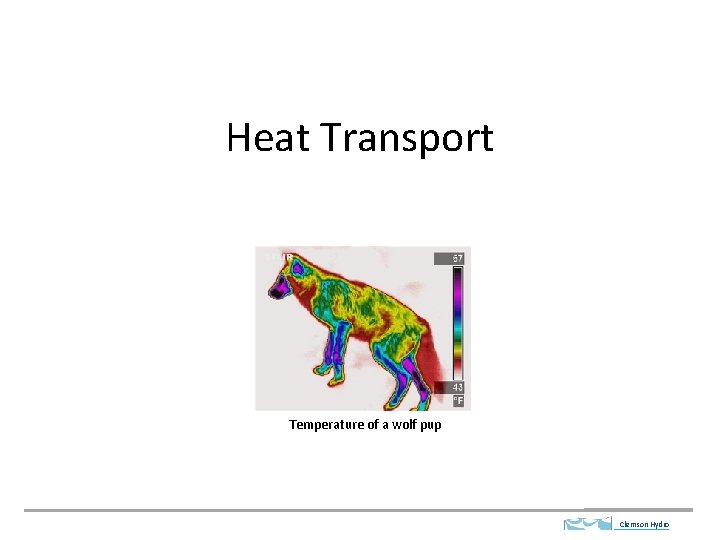
Heat Transport Temperature of a wolf pup Clemson



- Slides: 51
Heat Transport Temperature of a wolf pup Clemson Hydro
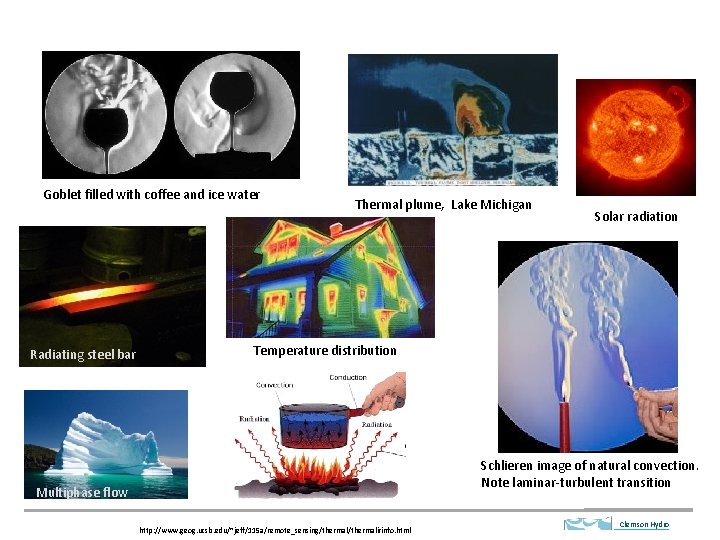
Goblet filled with coffee and ice water Radiating steel bar Thermal plume, Lake Michigan Solar radiation Temperature distribution Schlieren image of natural convection. Note laminar-turbulent transition Multiphase flow http: //www. geog. ucsb. edu/~jeff/115 a/remote_sensing/thermalirinfo. html Clemson Hydro
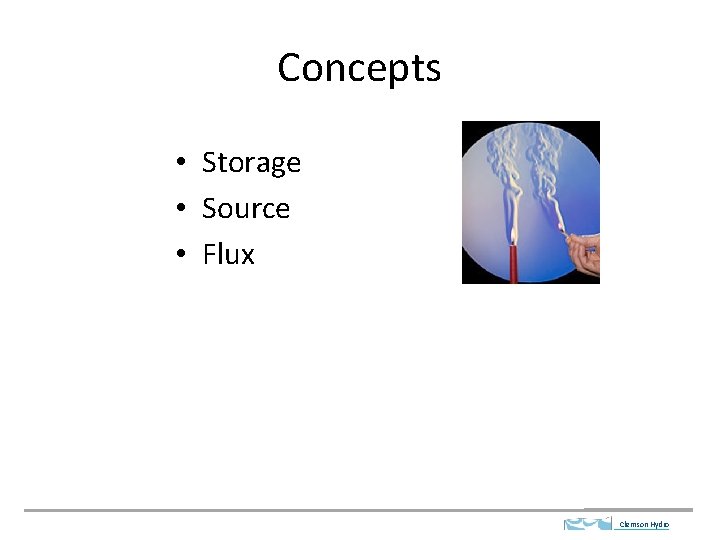
Concepts • Storage • Source • Flux Clemson Hydro
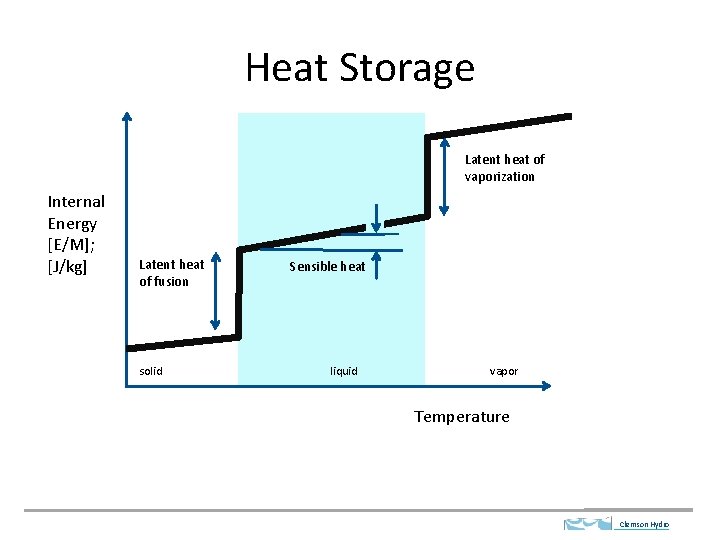
Heat Storage Latent heat of vaporization Internal Energy [E/M]; [J/kg] Latent heat of fusion solid Sensible heat liquid vapor Temperature Clemson Hydro
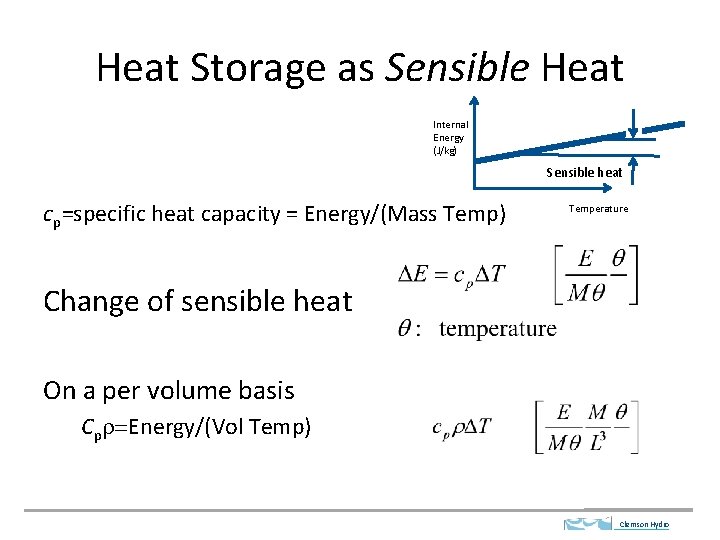
Heat Storage as Sensible Heat Internal Energy (J/kg) Sensible heat cp=specific heat capacity = Energy/(Mass Temp) Temperature Change of sensible heat On a per volume basis Cpr=Energy/(Vol Temp) Clemson Hydro
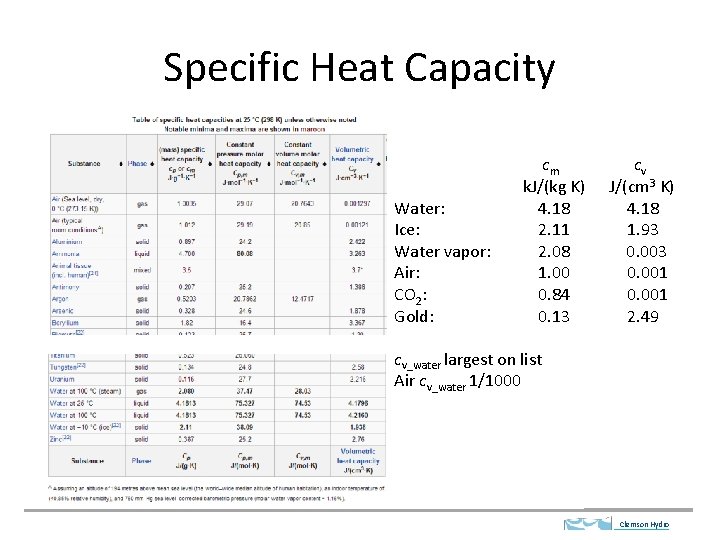
Specific Heat Capacity Water: Ice: Water vapor: Air: CO 2: Gold: cm k. J/(kg K) 4. 18 2. 11 2. 08 1. 00 0. 84 0. 13 cv J/(cm 3 K) 4. 18 1. 93 0. 001 2. 49 cv_water largest on list Air cv_water 1/1000 Clemson Hydro
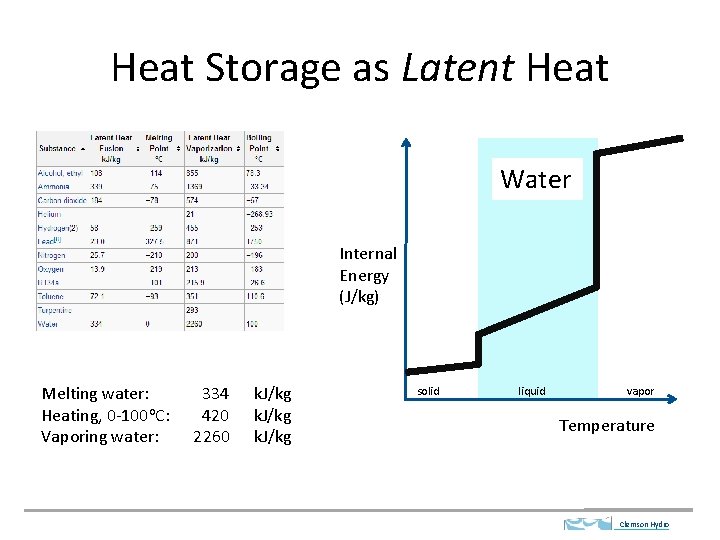
Heat Storage as Latent Heat Water Internal Energy (J/kg) Melting water: Heating, 0 -100 o. C: Vaporing water: 334 420 2260 k. J/kg solid liquid vapor Temperature Clemson Hydro
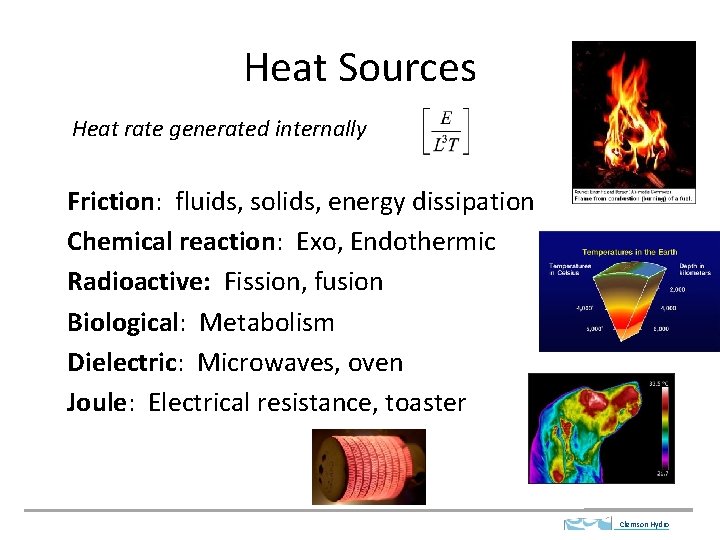
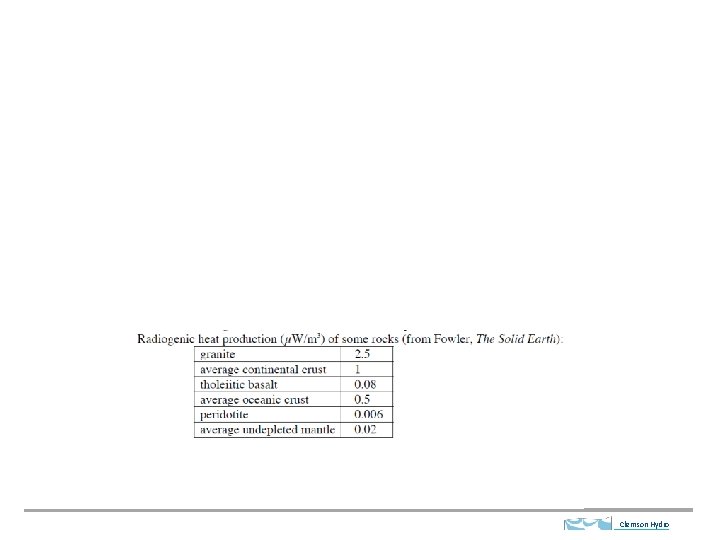
Heat Sources Heat rate generated internally Friction: fluids, solids, energy dissipation Chemical reaction: Exo, Endothermic Radioactive: Fission, fusion Biological: Metabolism Dielectric: Microwaves, oven Joule: Electrical resistance, toaster Clemson Hydro
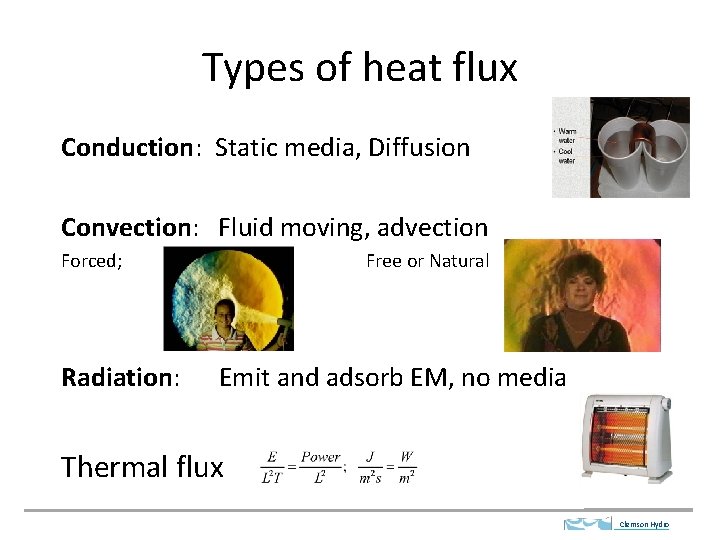
Types of heat flux Conduction: Static media, Diffusion Convection: Fluid moving, advection Forced; Radiation: Free or Natural Emit and adsorb EM, no media Thermal flux Clemson Hydro
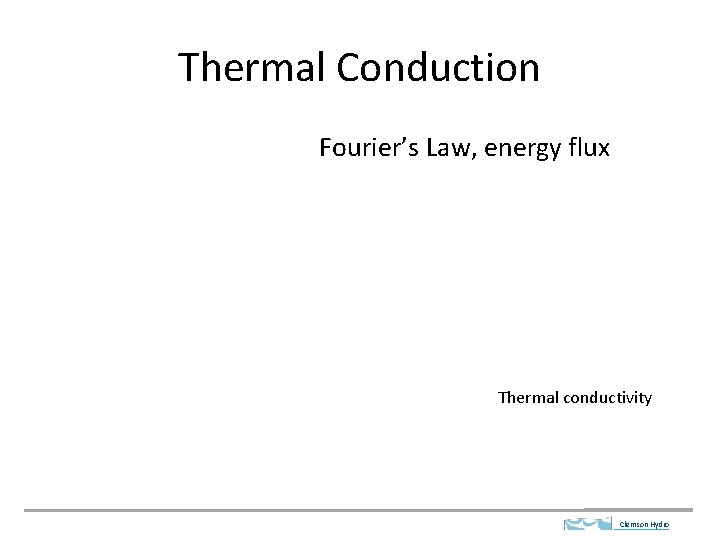
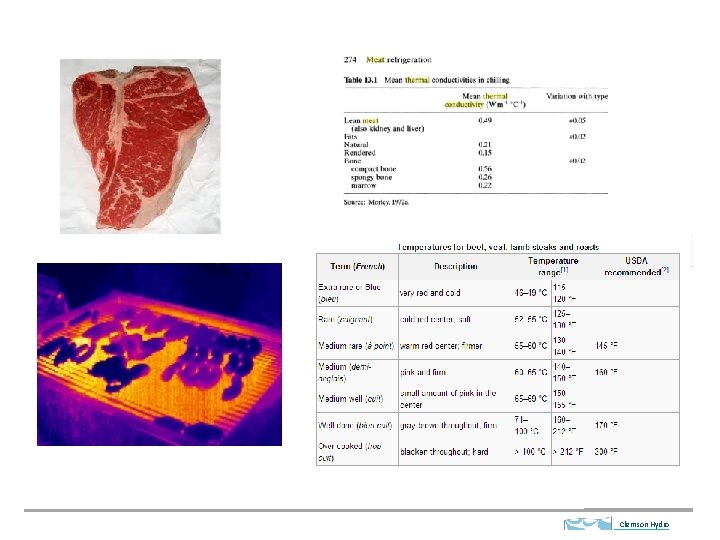
Thermal Conduction Fourier’s Law, energy flux Thermal conductivity Clemson Hydro
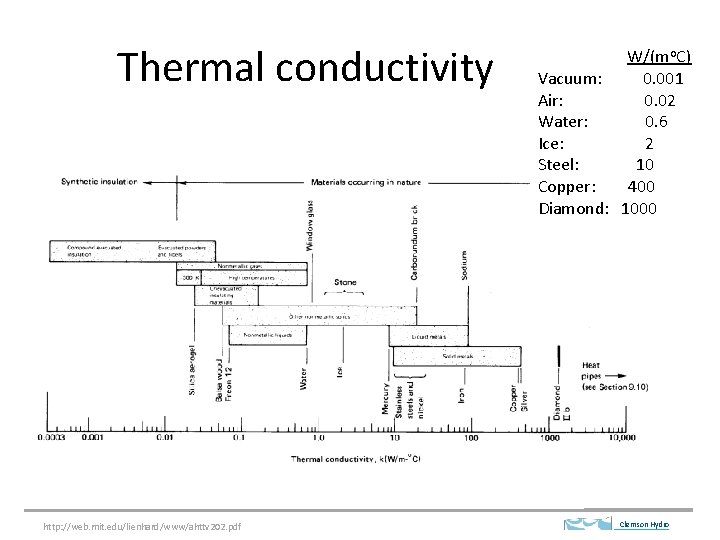
Thermal conductivity http: //web. mit. edu/lienhard/www/ahttv 202. pdf W/(mo. C) Vacuum: 0. 001 Air: 0. 02 Water: 0. 6 Ice: 2 Steel: 10 Copper: 400 Diamond: 1000 Clemson Hydro
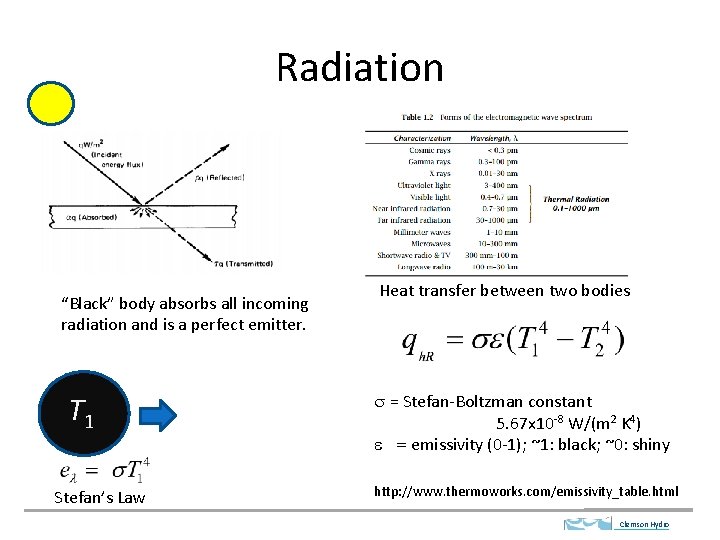
Radiation “Black” body absorbs all incoming radiation and is a perfect emitter. T 1 Stefan’s Law Heat transfer between two bodies s = Stefan-Boltzman constant 5. 67 x 10 -8 W/(m 2 K 4) e = emissivity (0 -1); ~1: black; ~0: shiny http: //www. thermoworks. com/emissivity_table. html Clemson Hydro
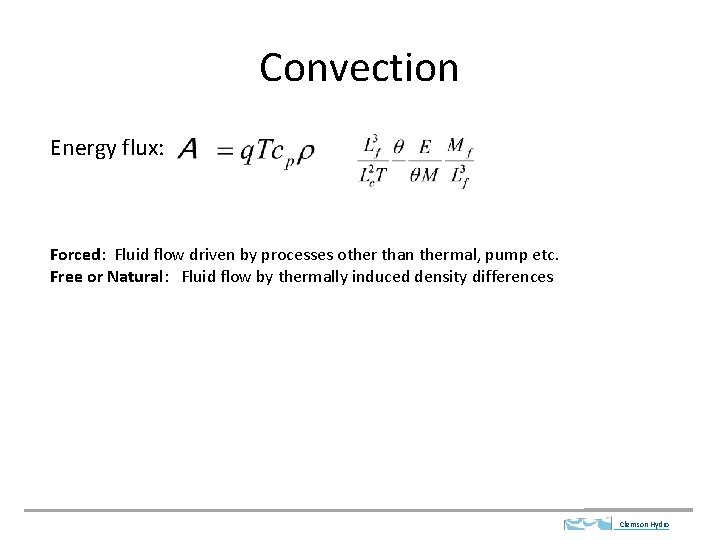
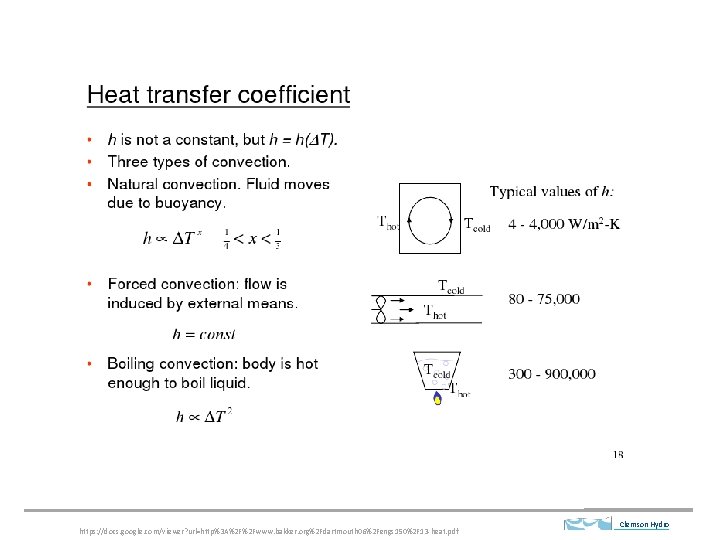
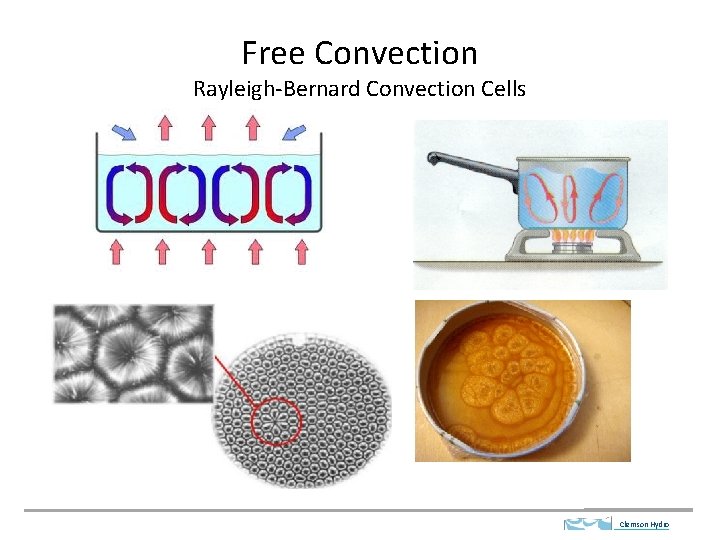
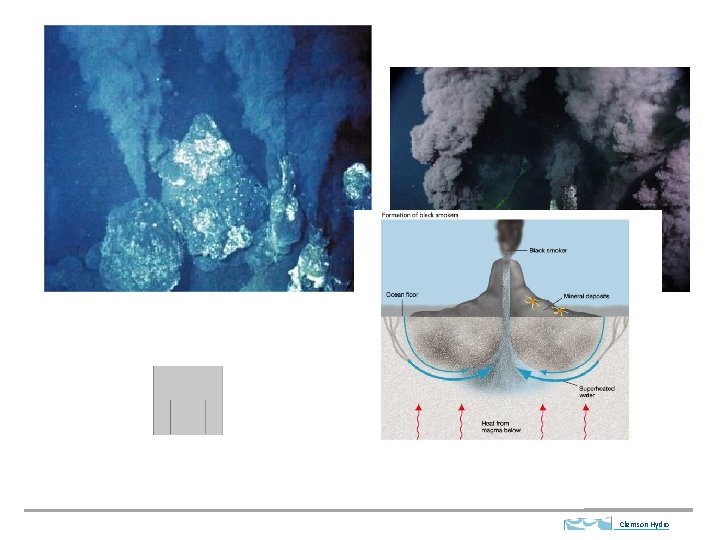
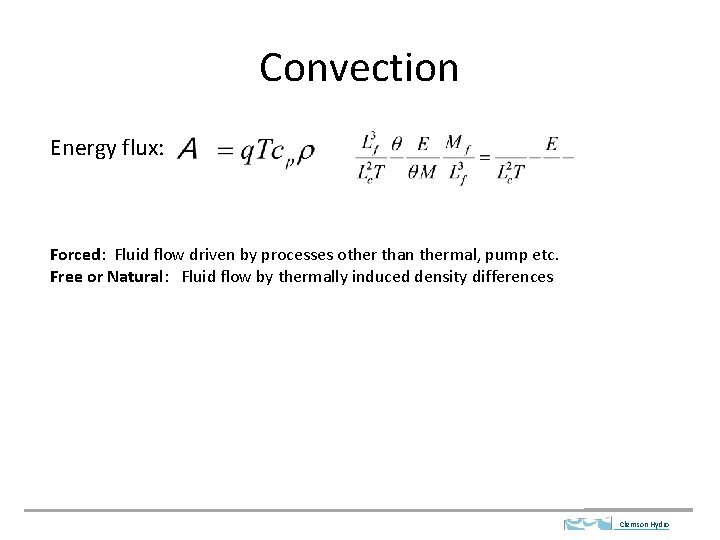
Convection Energy flux: Forced: Fluid flow driven by processes other than thermal, pump etc. Free or Natural: Fluid flow by thermally induced density differences Clemson Hydro
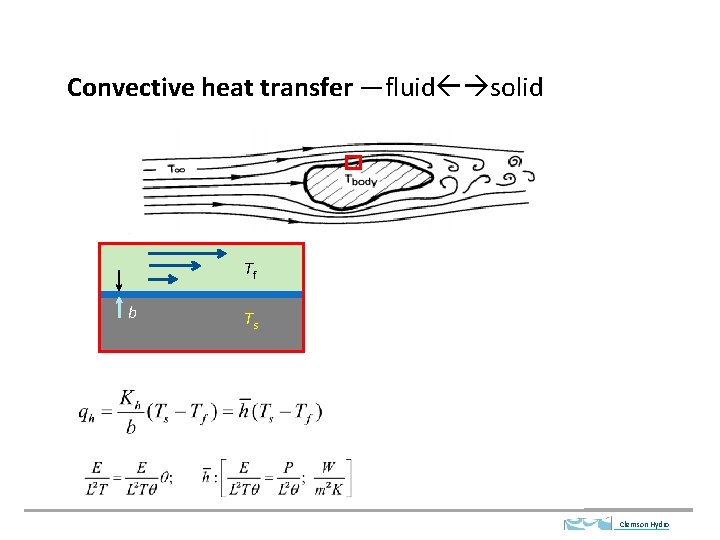
Convective heat transfer —fluid solid Tf b Ts Clemson Hydro
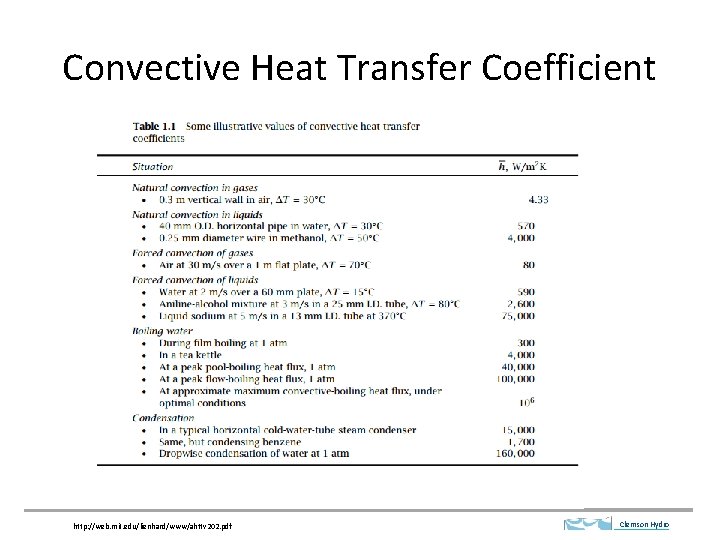
Convective Heat Transfer Coefficient http: //web. mit. edu/lienhard/www/ahttv 202. pdf Clemson Hydro
https: //docs. google. com/viewer? url=http%3 A%2 F%2 Fwww. bakker. org%2 Fdartmouth 06%2 Fengs 150%2 F 13 -heat. pdf Clemson Hydro
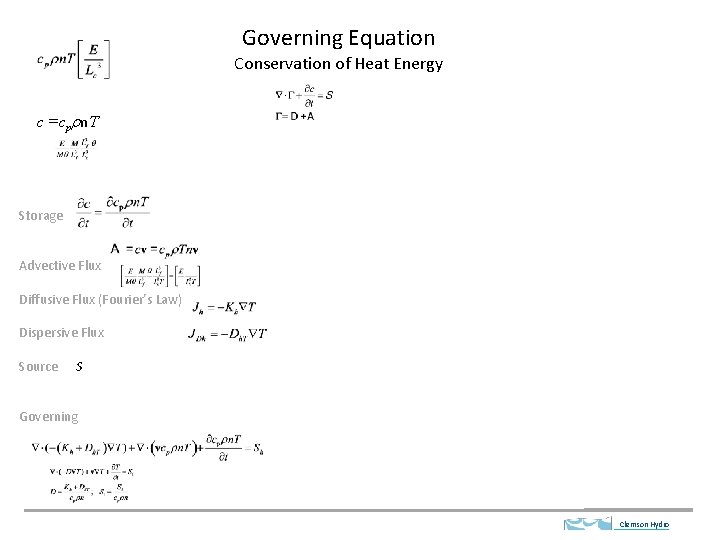
Governing Equation Conservation of Heat Energy c =cprn. T Storage Advective Flux Diffusive Flux (Fourier’s Law) Dispersive Flux Source S Governing Clemson Hydro
Simulation of Heat Transport Clemson Hydro
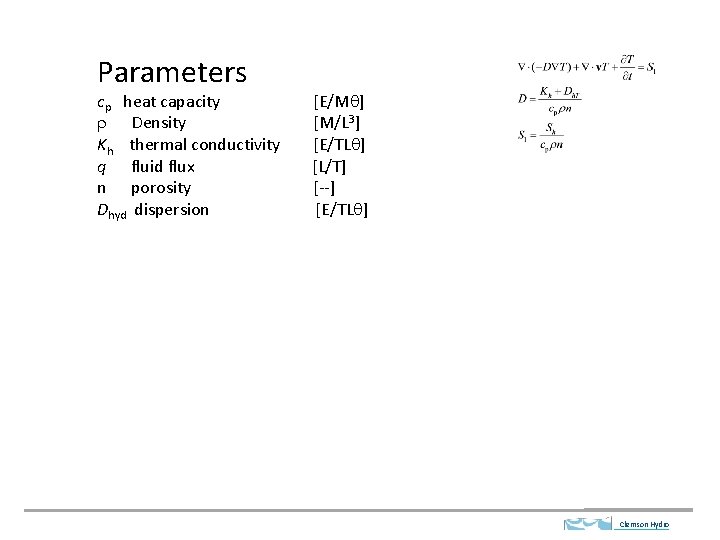
Parameters cp heat capacity r Density Kh thermal conductivity q fluid flux n porosity Dhyd dispersion [E/Mq] [M/L 3] [E/TLq] [L/T] [--] [E/TLq] Clemson Hydro
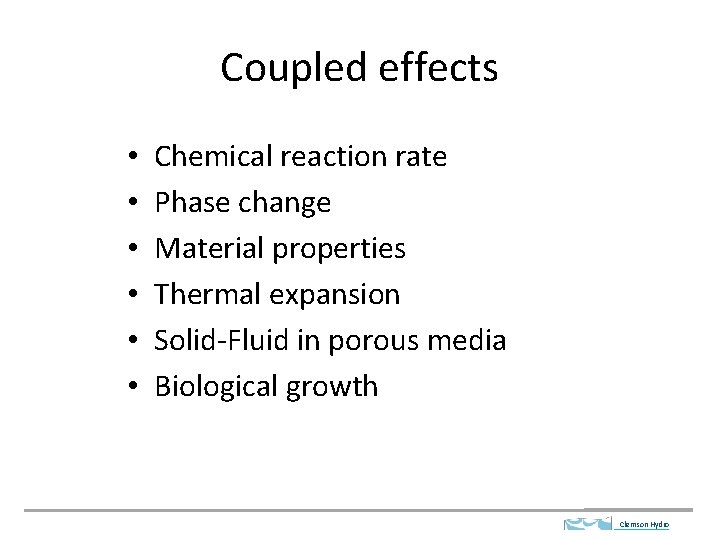
Coupled effects • • • Chemical reaction rate Phase change Material properties Thermal expansion Solid-Fluid in porous media Biological growth Clemson Hydro
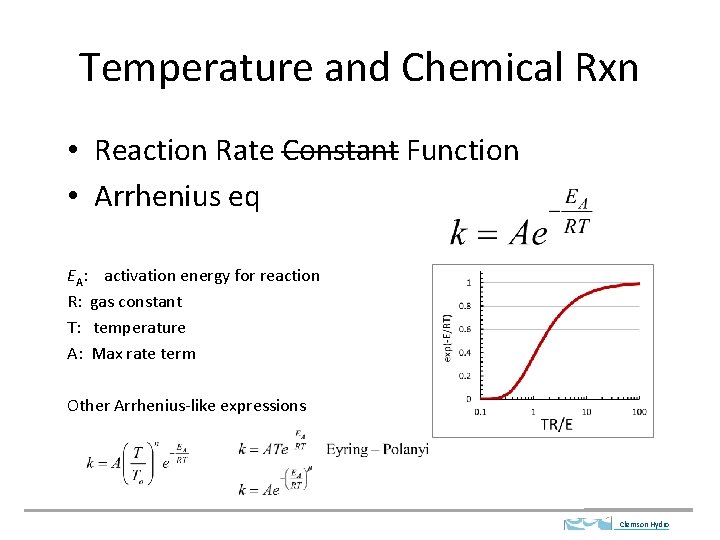
Temperature and Chemical Rxn • Reaction Rate Constant Function • Arrhenius eq EA: activation energy for reaction R: gas constant T: temperature A: Max rate term Other Arrhenius-like expressions Clemson Hydro
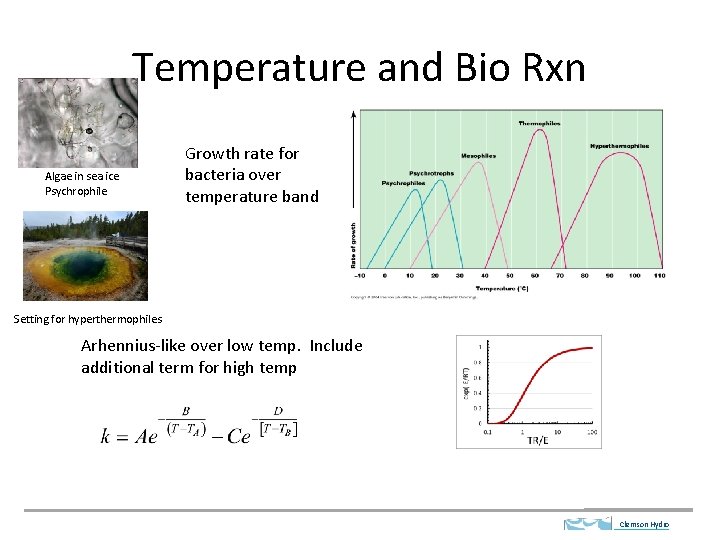
Temperature and Bio Rxn Algae in sea ice Psychrophile Growth rate for bacteria over temperature band Setting for hyperthermophiles Arhennius-like over low temp. Include additional term for high temp Clemson Hydro
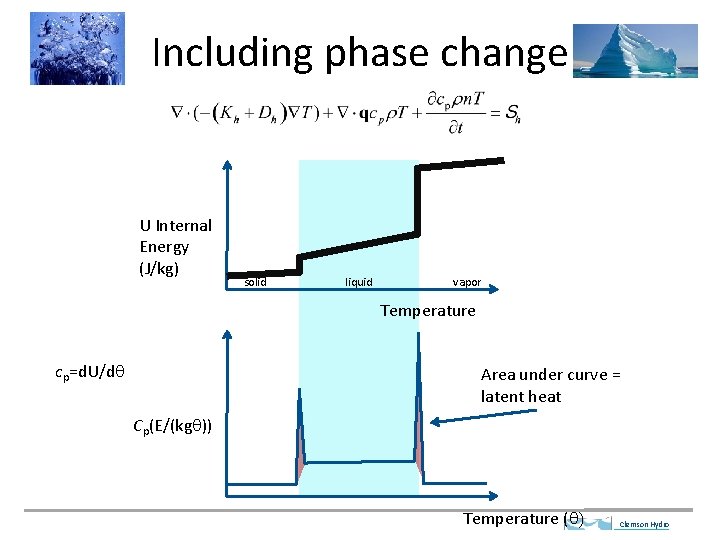
Including phase change U Internal Energy (J/kg) solid liquid vapor Temperature cp=d. U/dq Area under curve = latent heat Cp(E/(kgq)) Temperature (q) Clemson Hydro
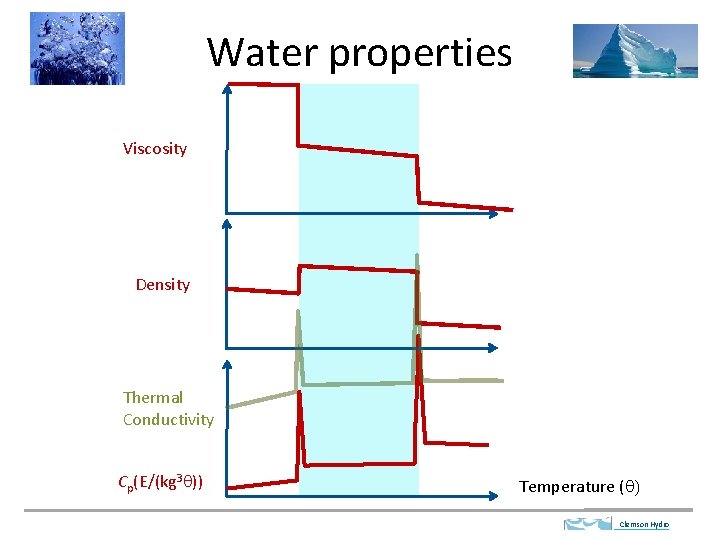
Water properties Viscosity Density Thermal Conductivity Cp(E/(kg 3 q)) Temperature (q) Clemson Hydro
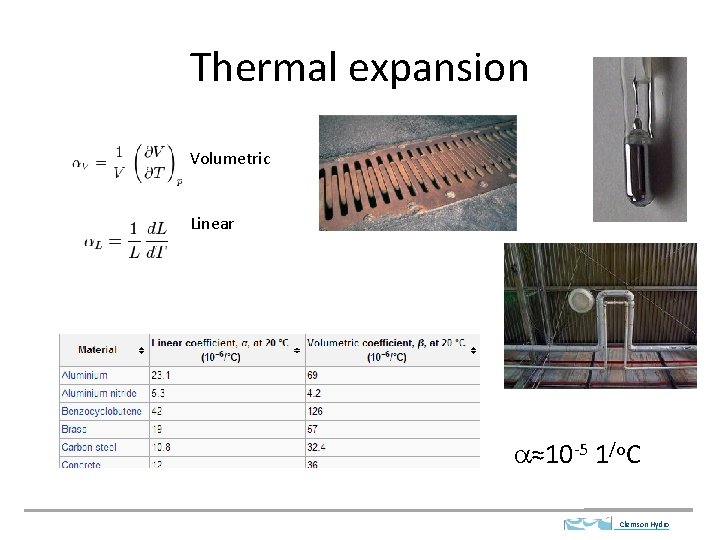
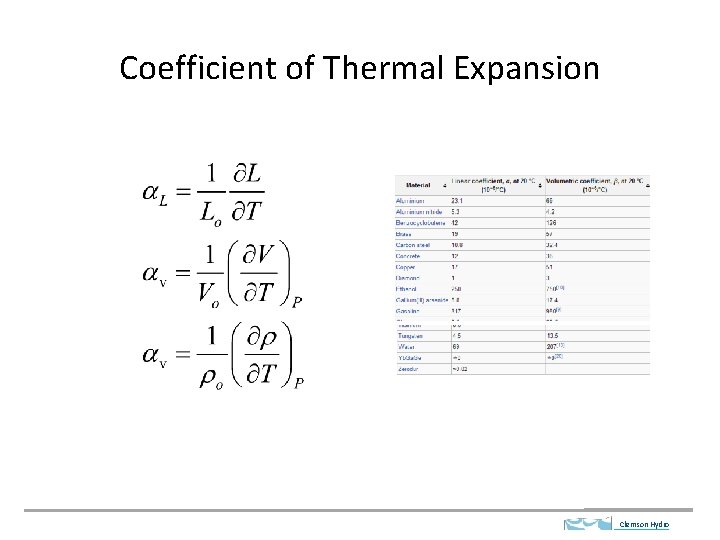
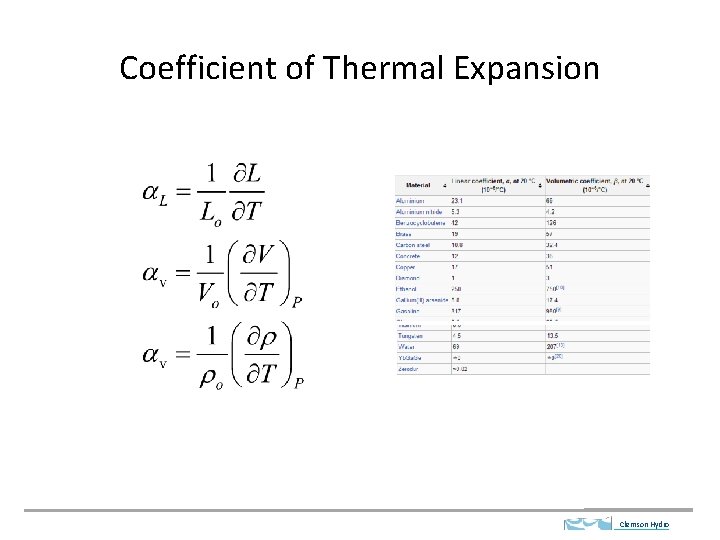
Thermal expansion Volumetric Linear a≈10 -5 1/o. C Clemson Hydro
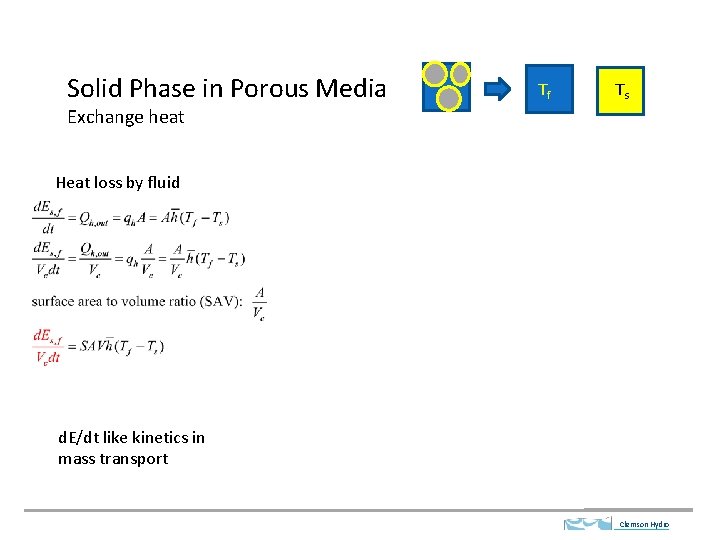
Solid Phase in Porous Media Tf Ts Exchange heat Heat loss by fluid d. E/dt like kinetics in mass transport Clemson Hydro
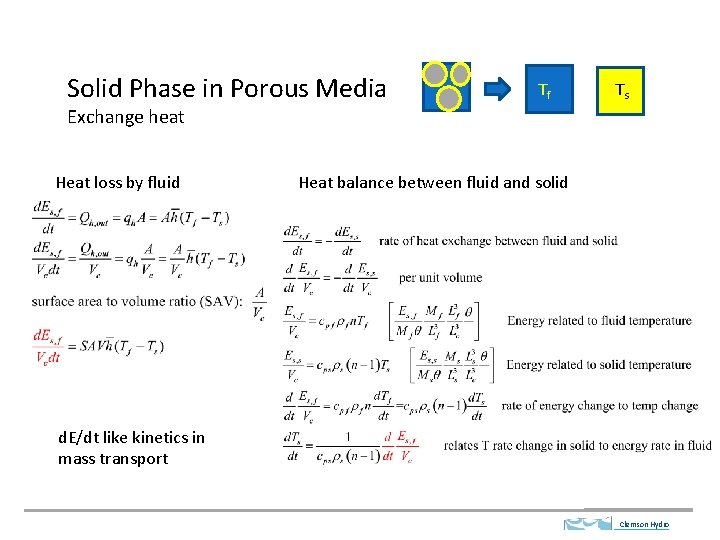
Solid Phase in Porous Media Tf Ts Exchange heat Heat loss by fluid Heat balance between fluid and solid d. E/dt like kinetics in mass transport Clemson Hydro
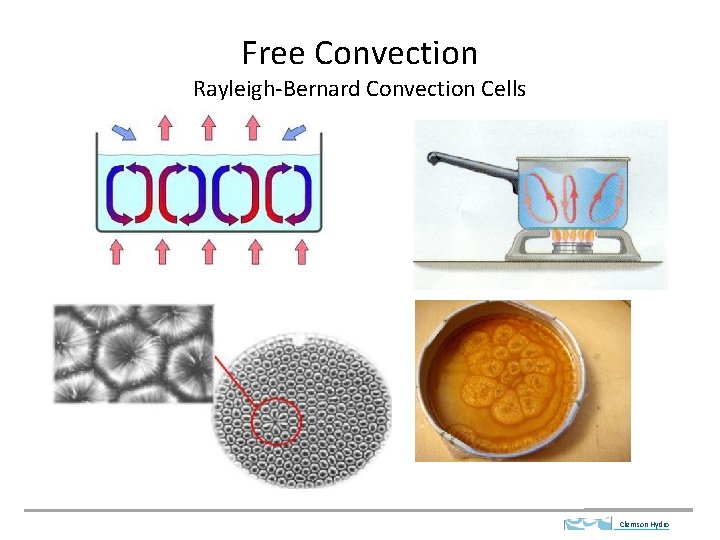
Free Convection Rayleigh-Bernard Convection Cells Clemson Hydro
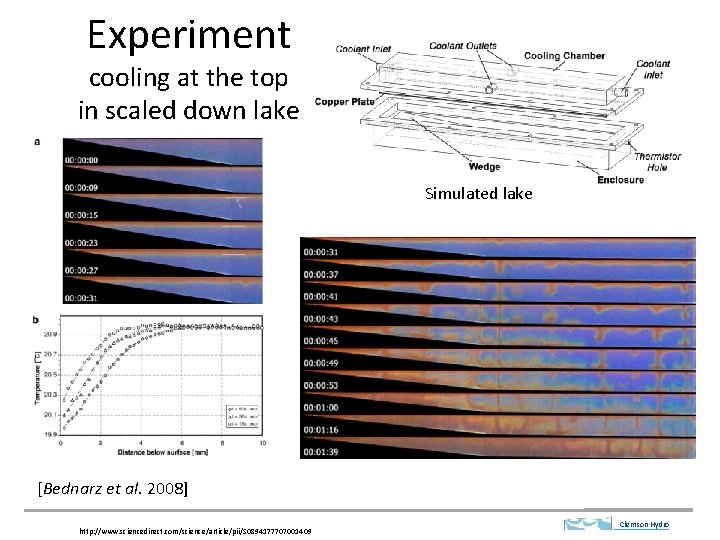
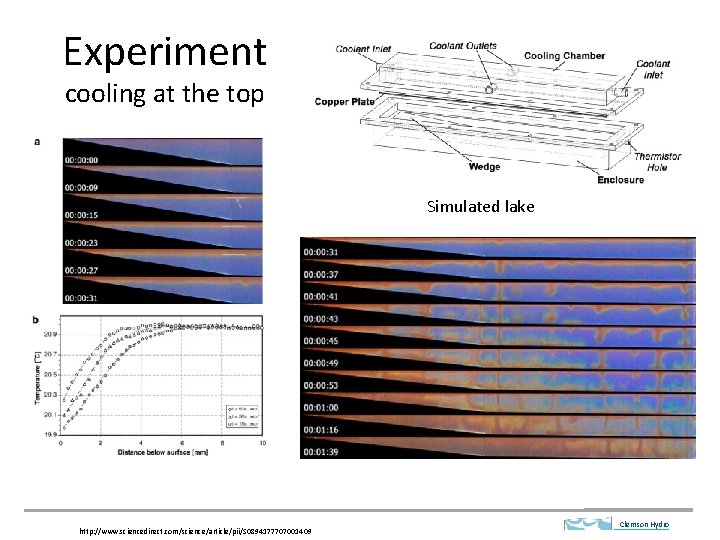
Experiment cooling at the top in scaled down lake Simulated lake [Bednarz et al. 2008] http: //www. sciencedirect. com/science/article/pii/S 0894177707001409 Clemson Hydro
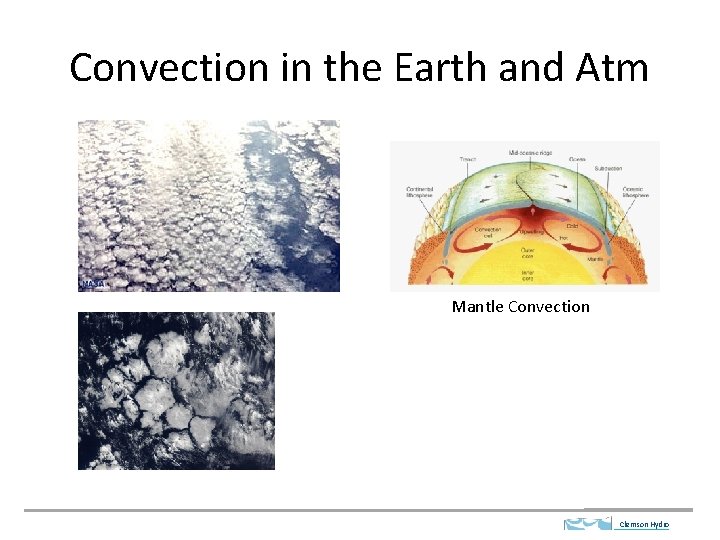
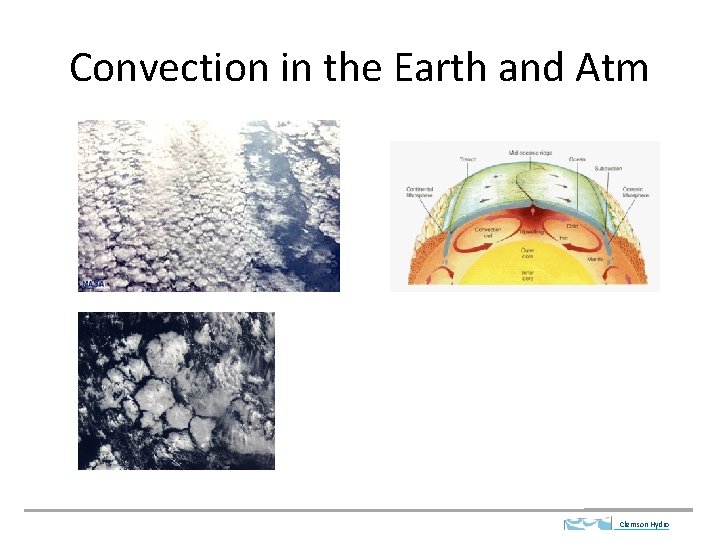
Convection in the Earth and Atm Mantle Convection Clemson Hydro
Clemson Hydro
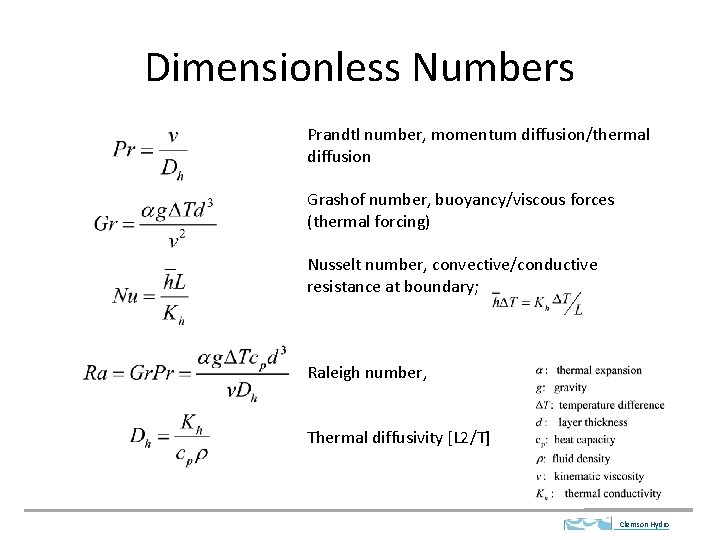
Dimensionless Numbers Prandtl number, momentum diffusion/thermal diffusion Grashof number, buoyancy/viscous forces (thermal forcing) Nusselt number, convective/conductive resistance at boundary; Raleigh number, Thermal diffusivity [L 2/T] Clemson Hydro
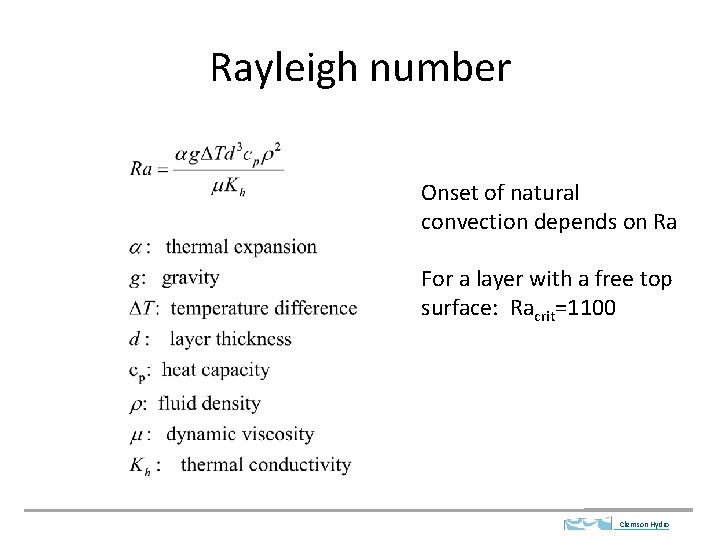
Rayleigh number Onset of natural convection depends on Ra For a layer with a free top surface: Racrit=1100 Clemson Hydro
Coefficient of Thermal Expansion Clemson Hydro
Clemson Hydro
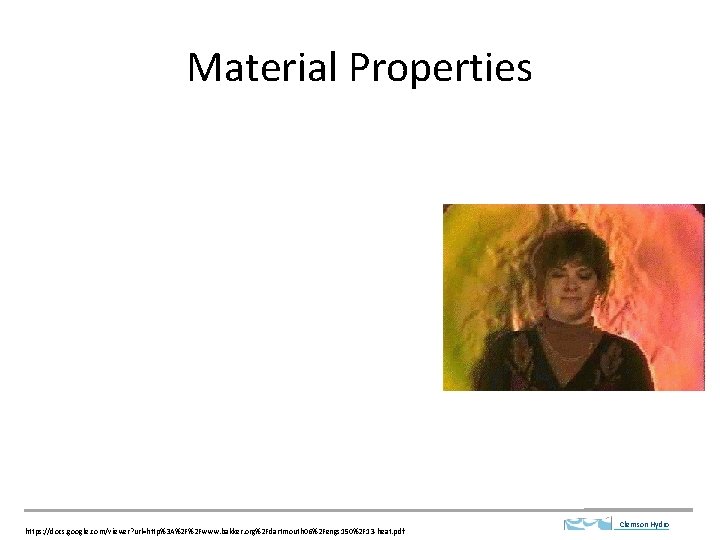
Material Properties https: //docs. google. com/viewer? url=http%3 A%2 F%2 Fwww. bakker. org%2 Fdartmouth 06%2 Fengs 150%2 F 13 -heat. pdf Clemson Hydro
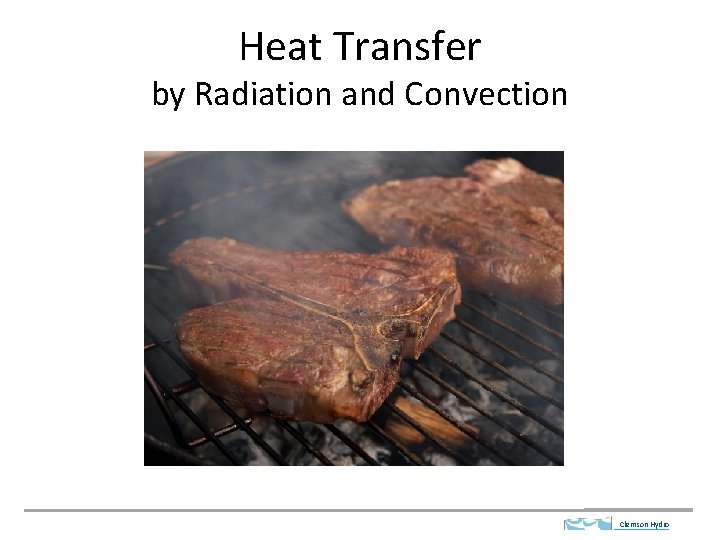
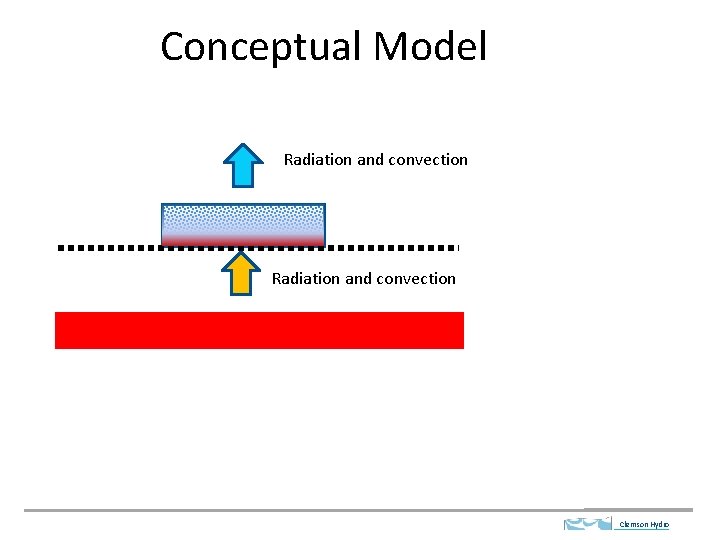
Heat Transfer by Radiation and Convection Clemson Hydro
Clemson Hydro
Conceptual Model Radiation and convection Clemson Hydro
Clemson Hydro
Clemson Hydro
Clemson Hydro
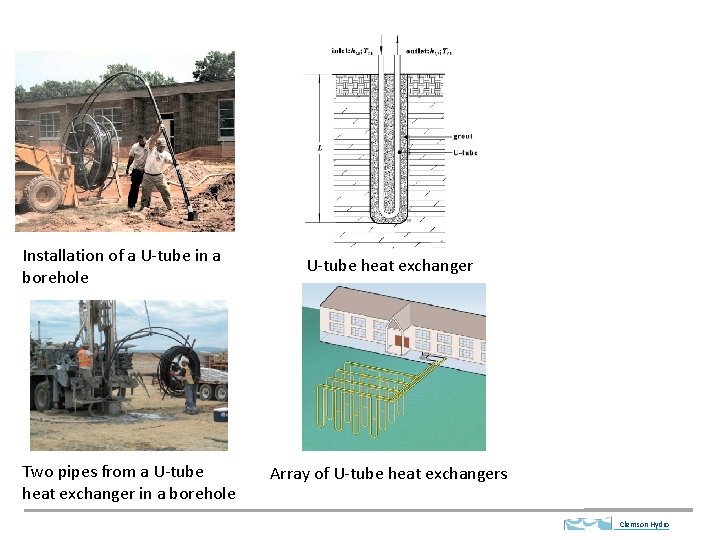
Installation of a U-tube in a borehole Two pipes from a U-tube heat exchanger in a borehole U-tube heat exchanger Array of U-tube heat exchangers Clemson Hydro
Clemson Hydro
Free Convection Rayleigh-Bernard Convection Cells Clemson Hydro
Convection in the Earth and Atm Clemson Hydro
Experiment cooling at the top Simulated lake http: //www. sciencedirect. com/science/article/pii/S 0894177707001409 Clemson Hydro
Rayleigh number Onset of natural convection depends on Ra For a layer with a free top surface: Racrit=1100 Clemson Hydro
Coefficient of Thermal Expansion Clemson Hydro
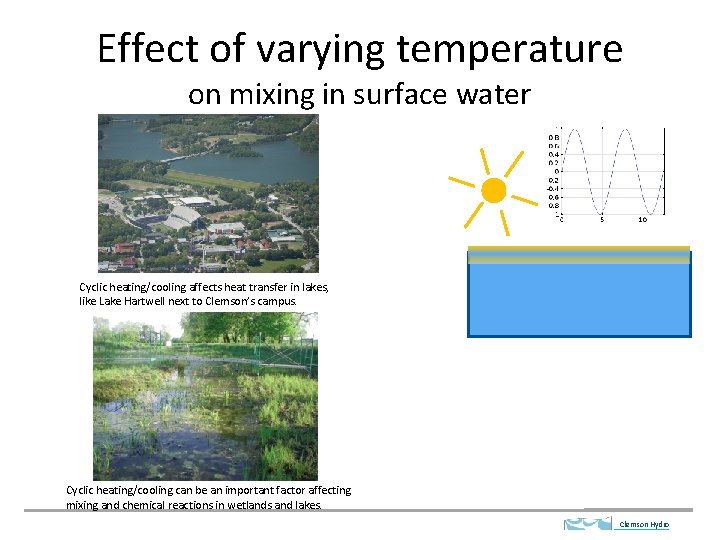
Effect of varying temperature on mixing in surface water Cyclic heating/cooling affects heat transfer in lakes, like Lake Hartwell next to Clemson’s campus. Cyclic heating/cooling can be an important factor affecting mixing and chemical reactions in wetlands and lakes. Clemson Hydro
Convection Energy flux: Forced: Fluid flow driven by processes other than thermal, pump etc. Free or Natural: Fluid flow by thermally induced density differences Clemson Hydro