
Grammar of Image Zhaoyin Jia 03 30 2009
- Slides: 62
Grammar of Image Zhaoyin Jia, 03 -30 -2009
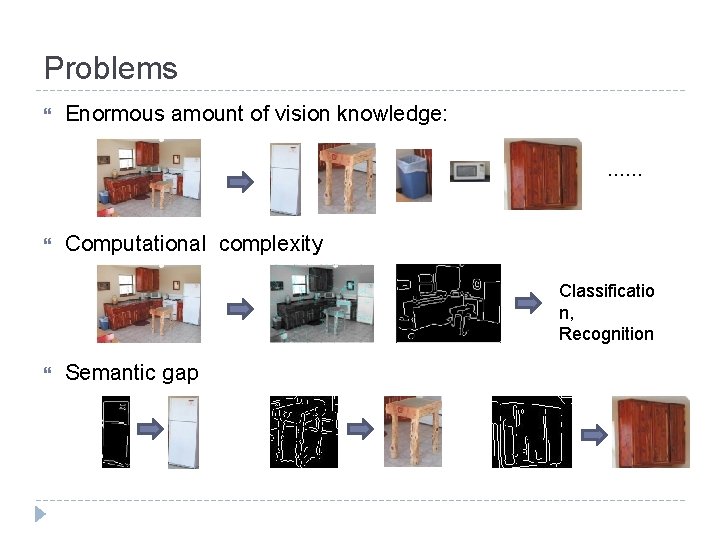
Problems Enormous amount of vision knowledge: …… Computational complexity Classificatio n, Recognition Semantic gap
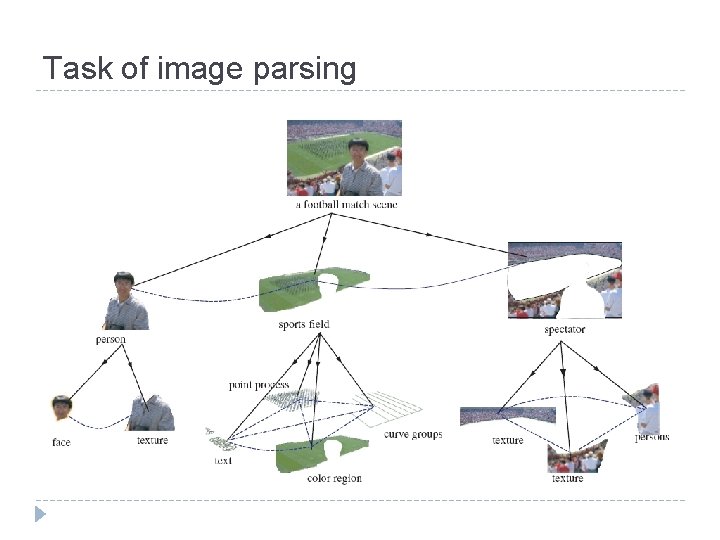
Task of image parsing
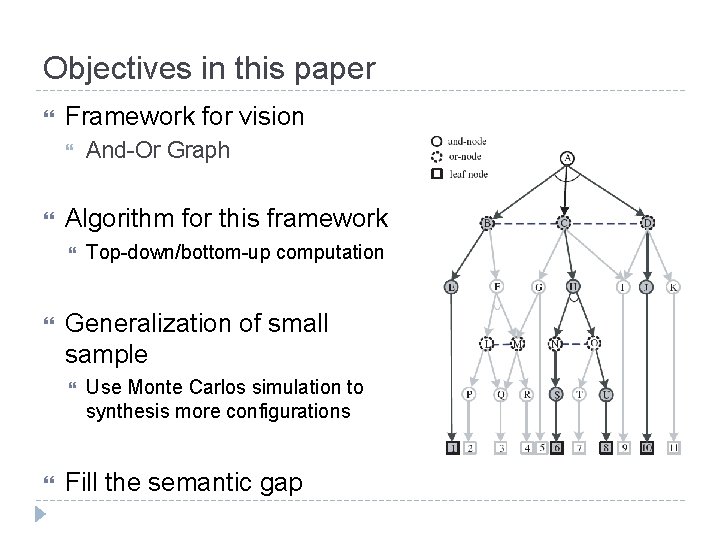
Objectives in this paper Framework for vision Algorithm for this framework Top-down/bottom-up computation Generalization of small sample And-Or Graph Use Monte Carlos simulation to synthesis more configurations Fill the semantic gap
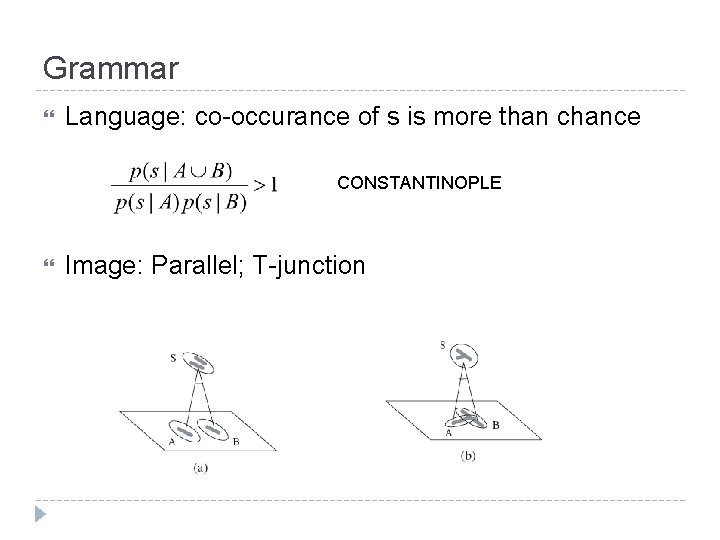
Grammar Language: co-occurance of s is more than chance CONSTANTINOPLE Image: Parallel; T-junction
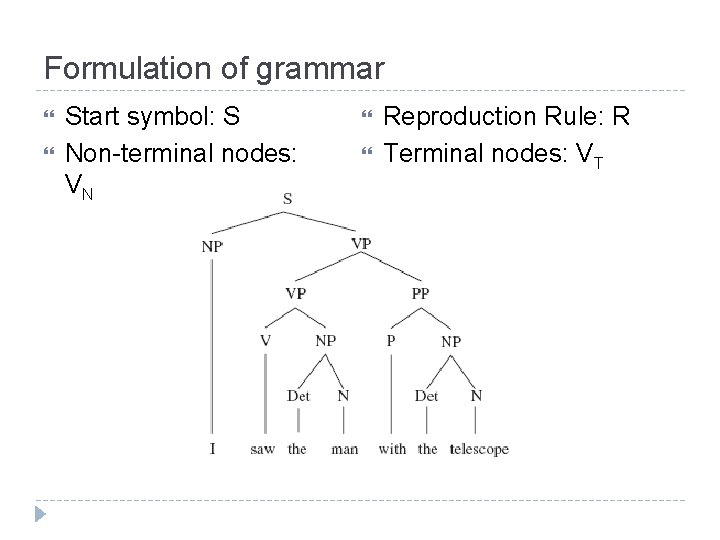
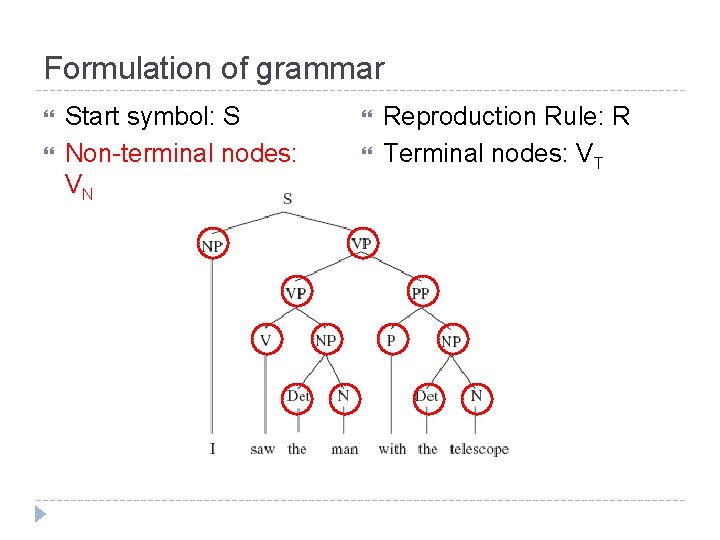
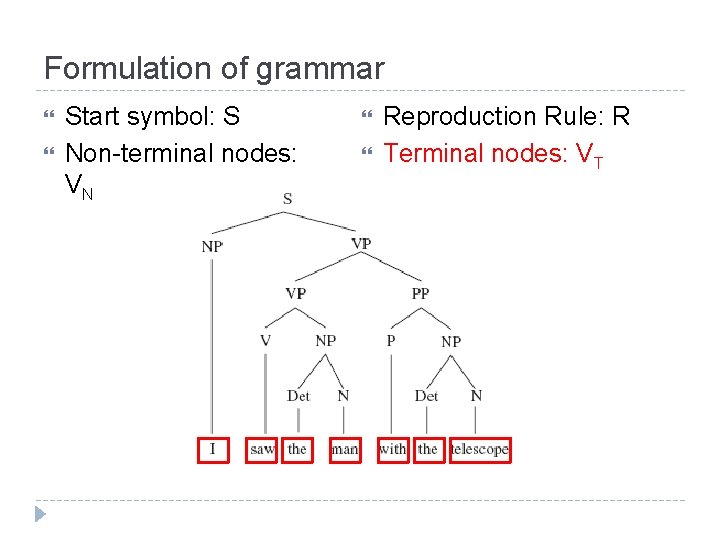
Formulation of grammar Start symbol: S Non-terminal nodes: VN Reproduction Rule: R Terminal nodes: VT
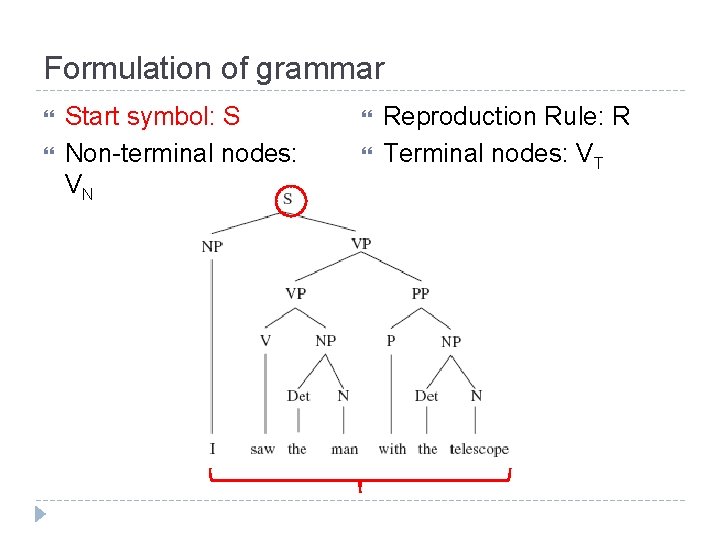
Formulation of grammar Start symbol: S Non-terminal nodes: VN Reproduction Rule: R Terminal nodes: VT
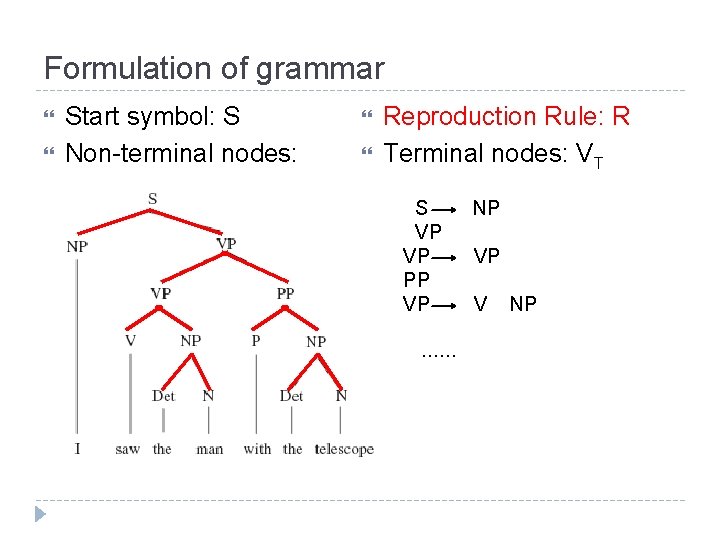
Formulation of grammar Start symbol: S Non-terminal nodes: VN Reproduction Rule: R Terminal nodes: VT S VP VP PP VP …… NP VP V NP
Formulation of grammar Start symbol: S Non-terminal nodes: VN Reproduction Rule: R Terminal nodes: VT
Formulation of grammar Start symbol: S Non-terminal nodes: VN Reproduction Rule: R Terminal nodes: VT
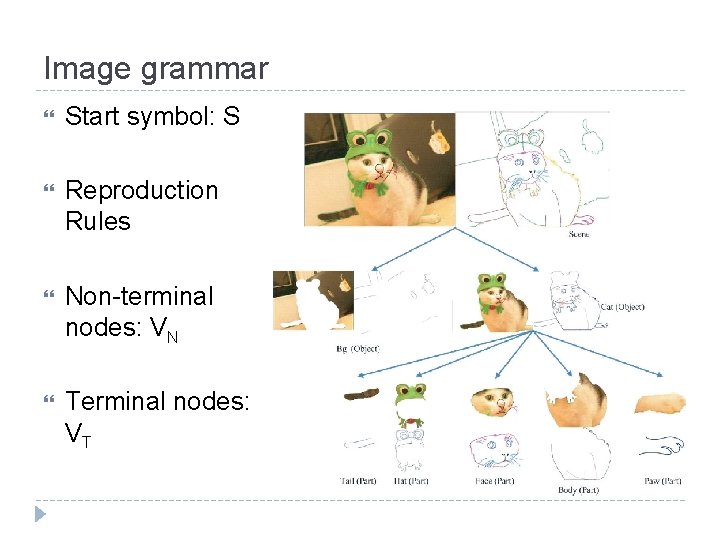
Image grammar Start symbol: S Reproduction Rules Non-terminal nodes: VN Terminal nodes: VT
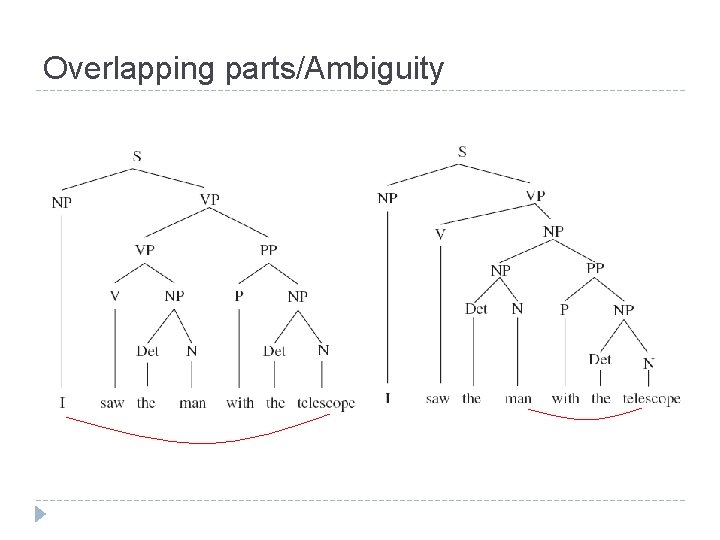
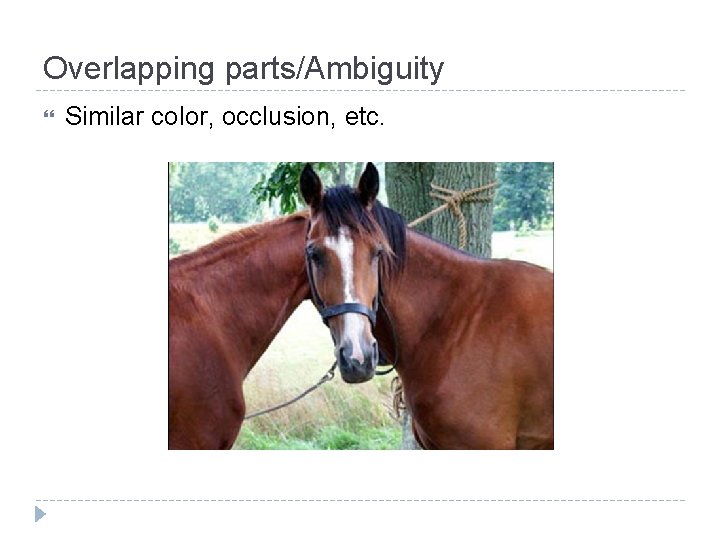
Overlapping parts/Ambiguity
Overlapping parts/Ambiguity Similar color, occlusion, etc.
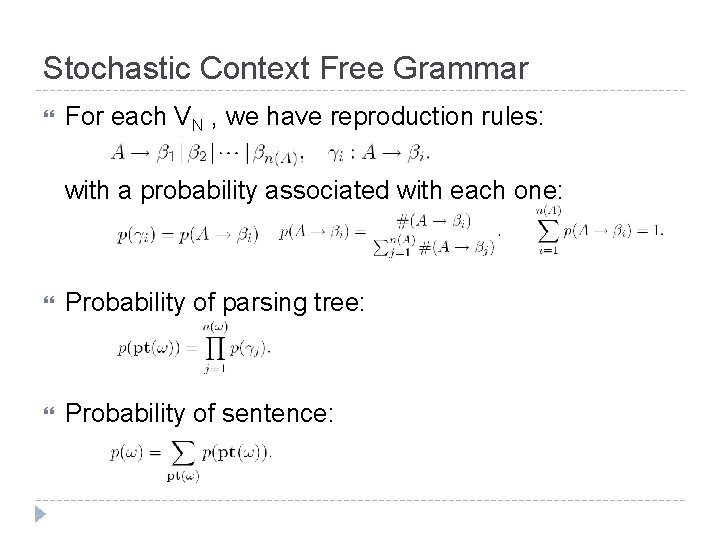
Stochastic Context Free Grammar For each VN , we have reproduction rules: with a probability associated with each one: Probability of parsing tree: Probability of sentence:
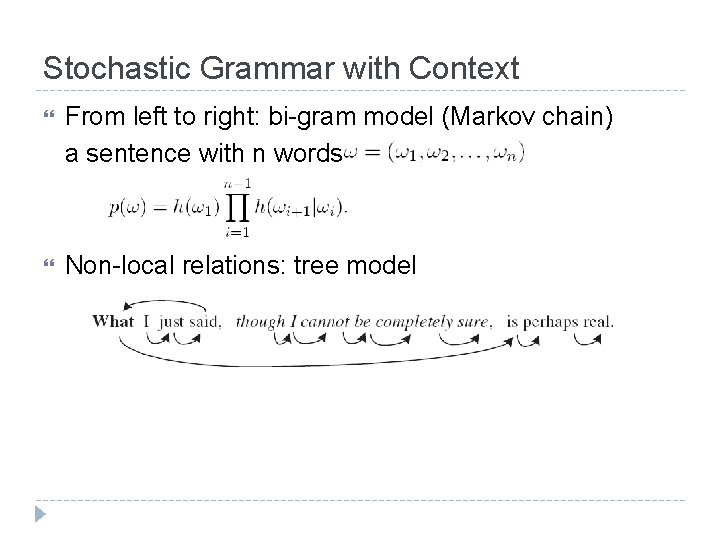
Stochastic Grammar with Context From left to right: bi-gram model (Markov chain) a sentence with n words: Non-local relations: tree model
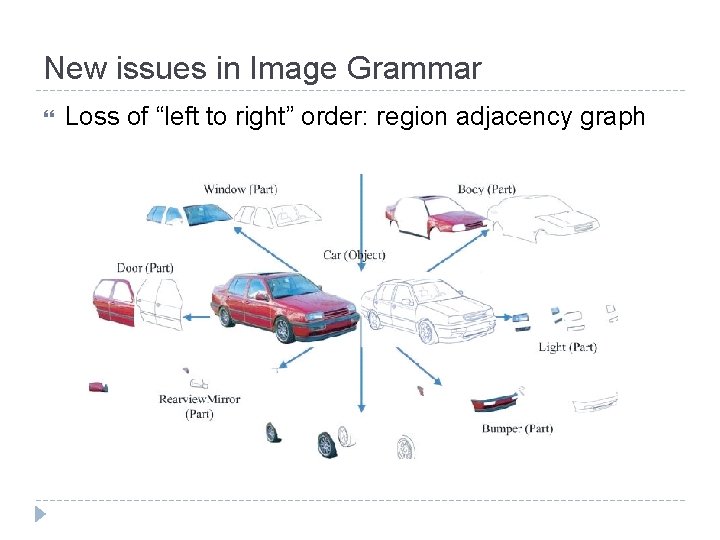
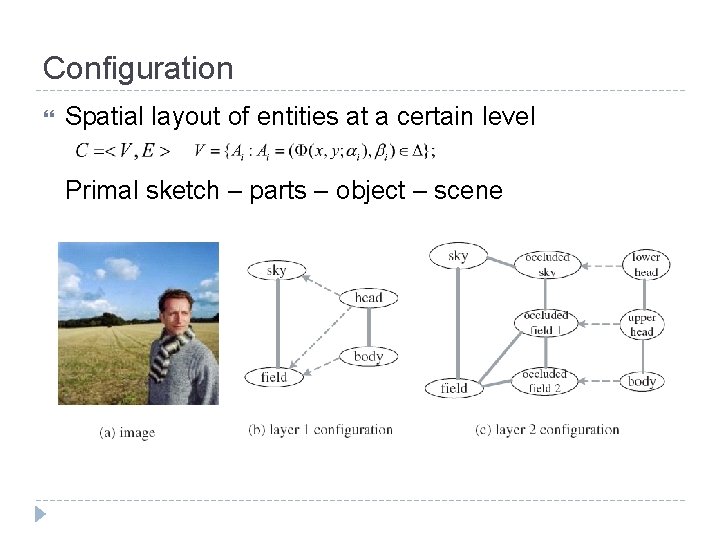
New issues in Image Grammar Loss of “left to right” order: region adjacency graph
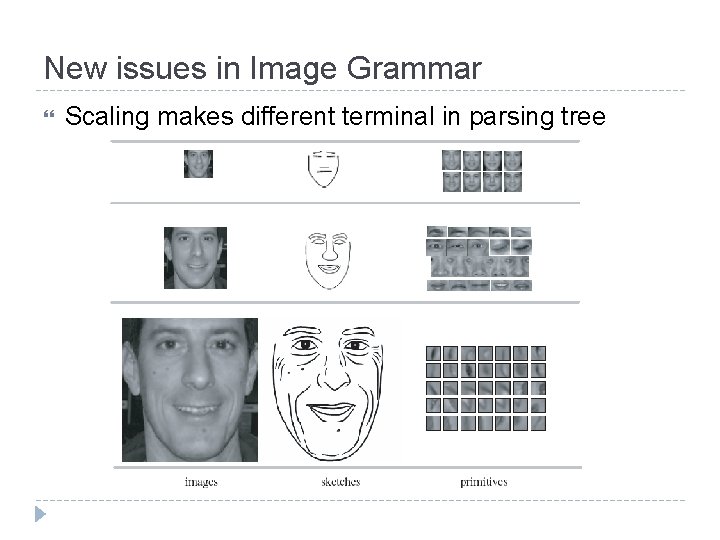
New issues in Image Grammar Scaling makes different terminal in parsing tree
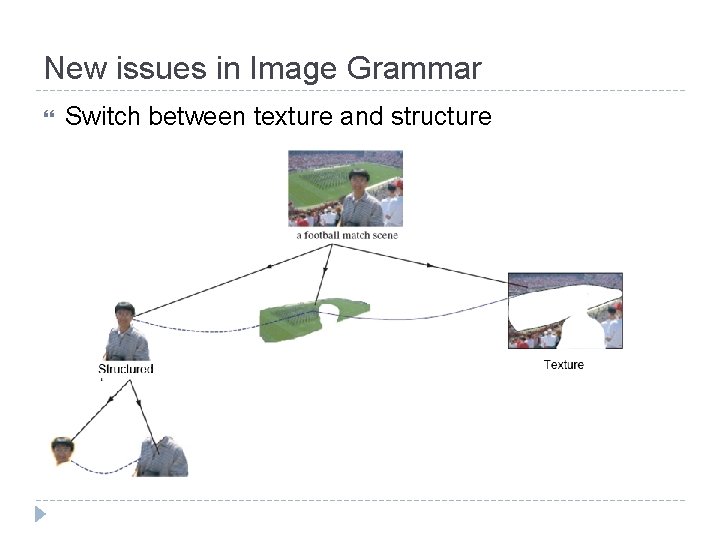
New issues in Image Grammar Switch between texture and structure
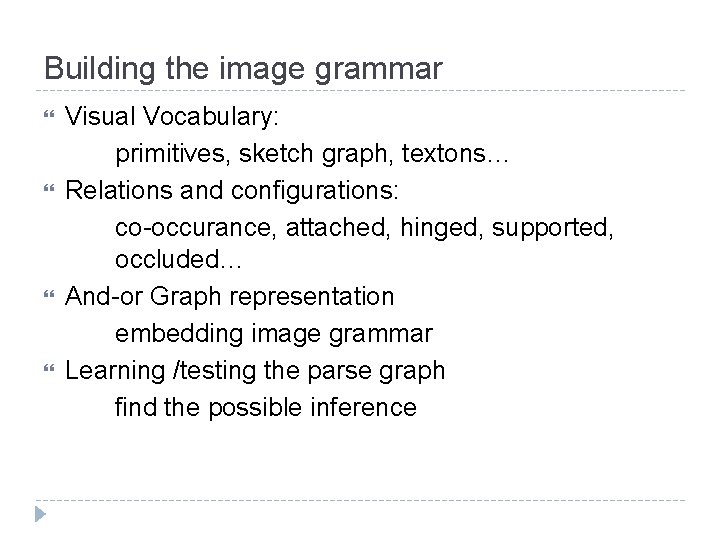
Building the image grammar Visual Vocabulary: primitives, sketch graph, textons… Relations and configurations: co-occurance, attached, hinged, supported, occluded… And-or Graph representation embedding image grammar Learning /testing the parse graph find the possible inference
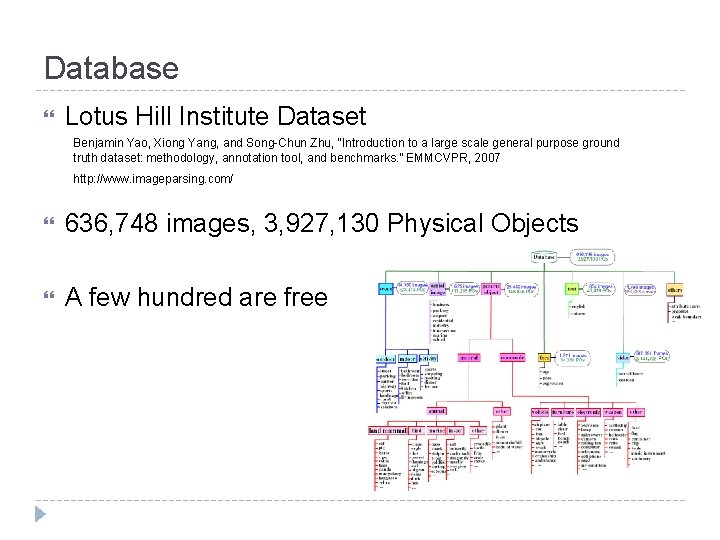
Database Lotus Hill Institute Dataset Benjamin Yao, Xiong Yang, and Song-Chun Zhu, “Introduction to a large scale general purpose ground truth dataset: methodology, annotation tool, and benchmarks. ” EMMCVPR, 2007 http: //www. imageparsing. com/ 636, 748 images, 3, 927, 130 Physical Objects A few hundred are free
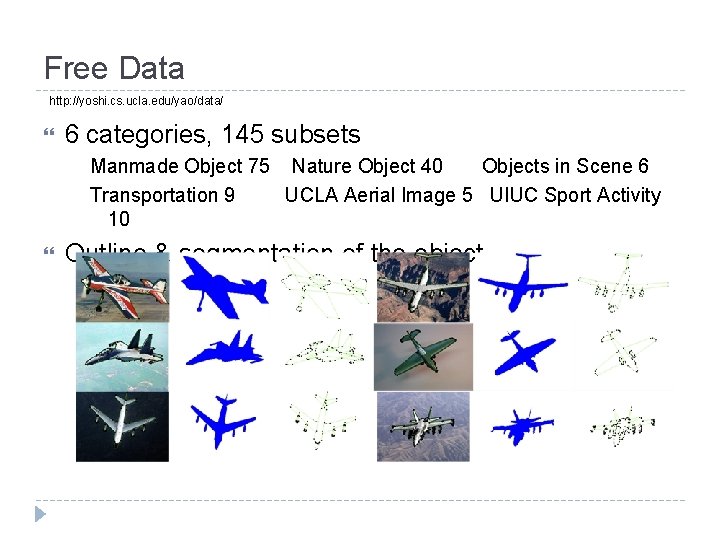
Free Data http: //yoshi. cs. ucla. edu/yao/data/ 6 categories, 145 subsets Manmade Object 75 Nature Object 40 Objects in Scene 6 Transportation 9 UCLA Aerial Image 5 UIUC Sport Activity 10 Outline & segmentation of the object
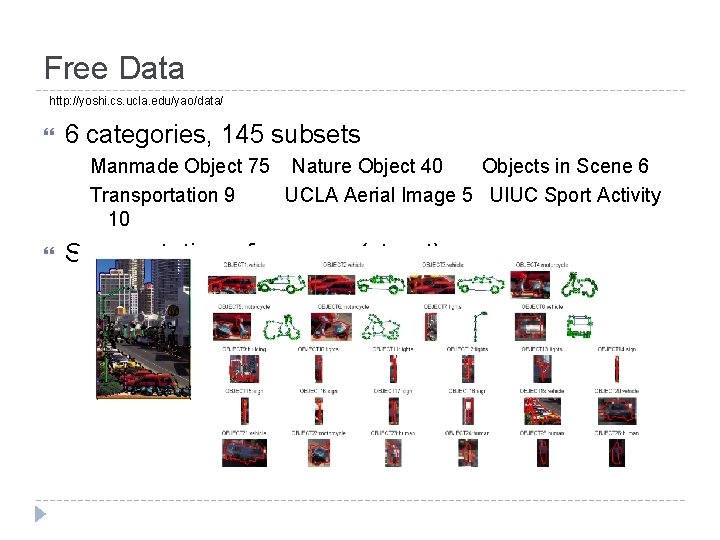
Free Data http: //yoshi. cs. ucla. edu/yao/data/ 6 categories, 145 subsets Manmade Object 75 Nature Object 40 Objects in Scene 6 Transportation 9 UCLA Aerial Image 5 UIUC Sport Activity 10 Segmentation of a scene (street)
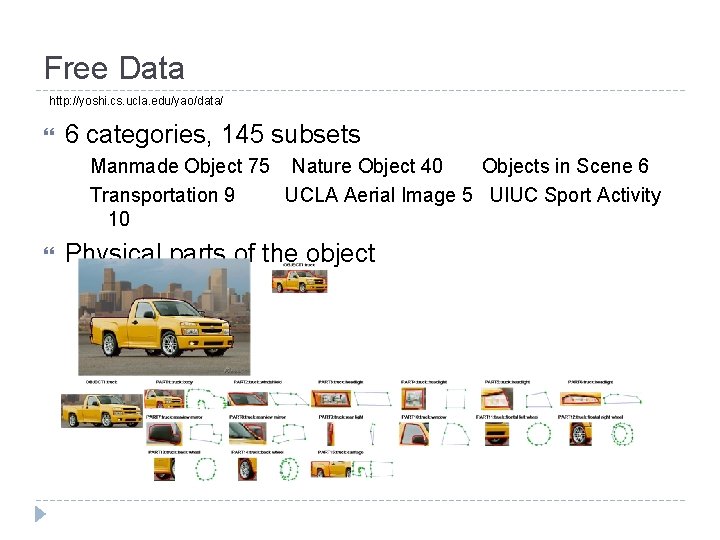
Free Data http: //yoshi. cs. ucla. edu/yao/data/ 6 categories, 145 subsets Manmade Object 75 Nature Object 40 Objects in Scene 6 Transportation 9 UCLA Aerial Image 5 UIUC Sport Activity 10 Physical parts of the object
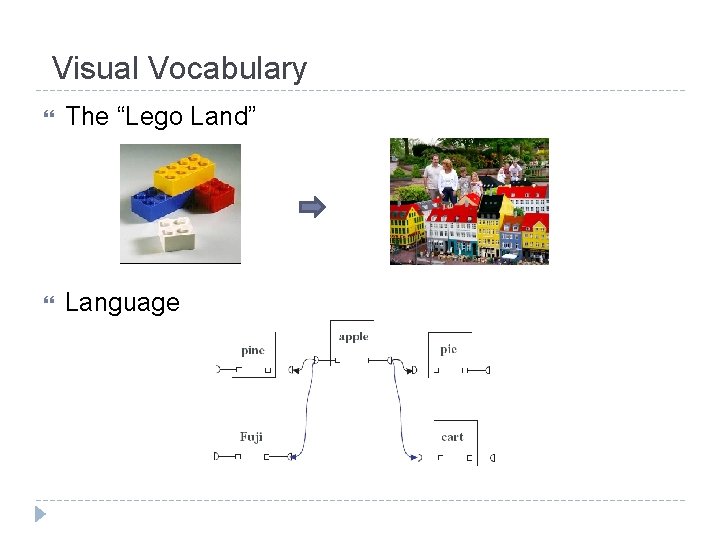
Visual Vocabulary The “Lego Land” Language
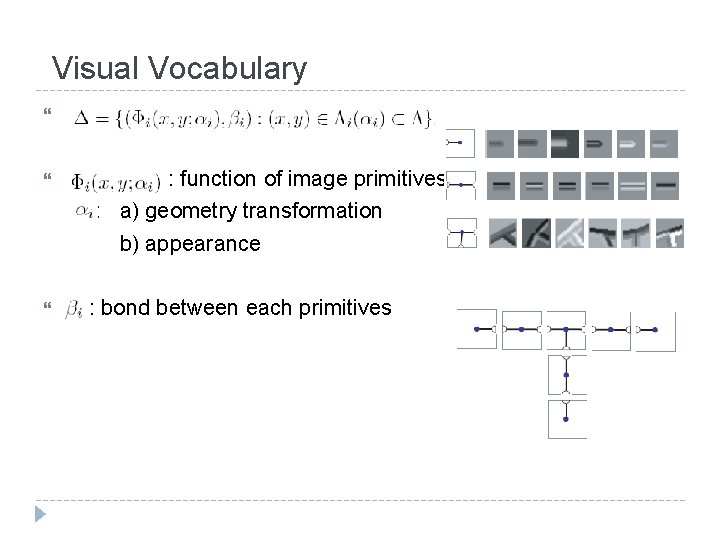
Visual Vocabulary : function of image primitives : a) geometry transformation b) appearance : bond between each primitives
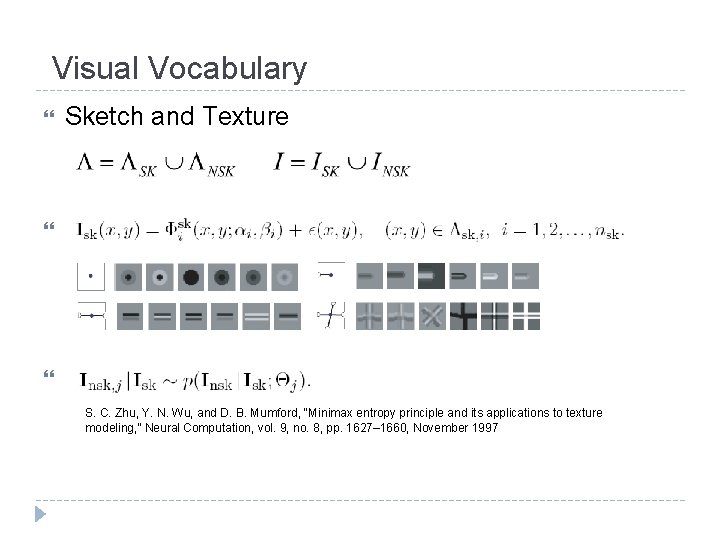
Visual Vocabulary Sketch and Texture S. C. Zhu, Y. N. Wu, and D. B. Mumford, “Minimax entropy principle and its applications to texture modeling, ” Neural Computation, vol. 9, no. 8, pp. 1627– 1660, November 1997
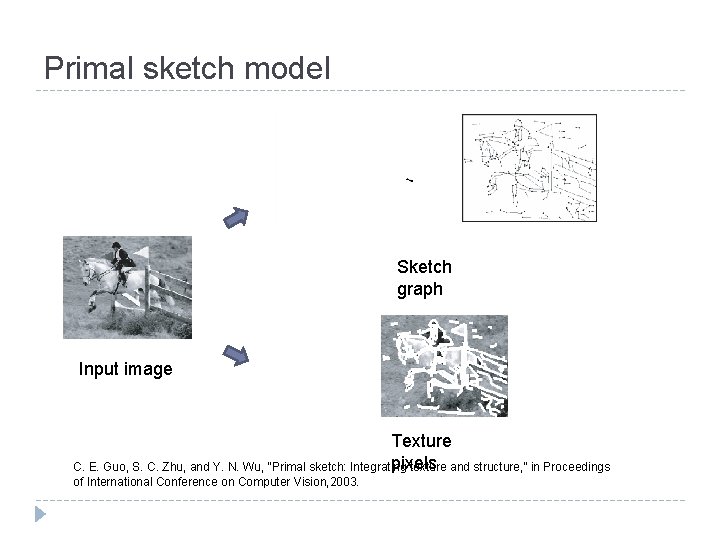
Primal sketch model Sketch graph Input image Texture pixels C. E. Guo, S. C. Zhu, and Y. N. Wu, “Primal sketch: Integrating texture and structure, ” in Proceedings of International Conference on Computer Vision, 2003.
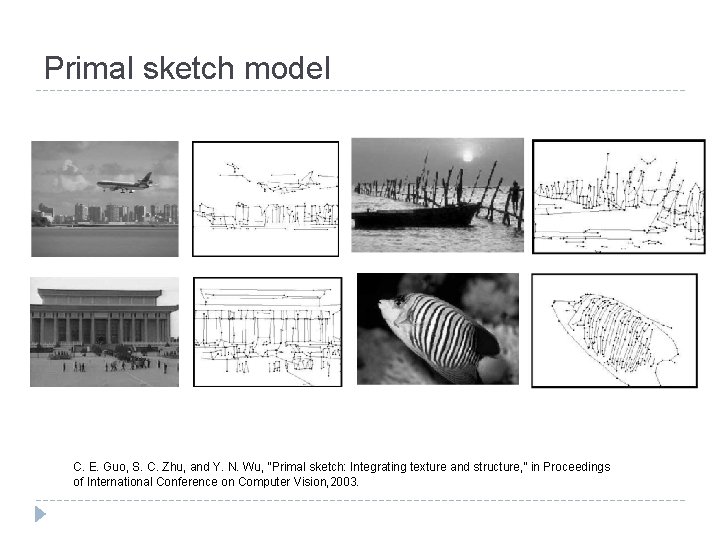
Primal sketch model C. E. Guo, S. C. Zhu, and Y. N. Wu, “Primal sketch: Integrating texture and structure, ” in Proceedings of International Conference on Computer Vision, 2003.
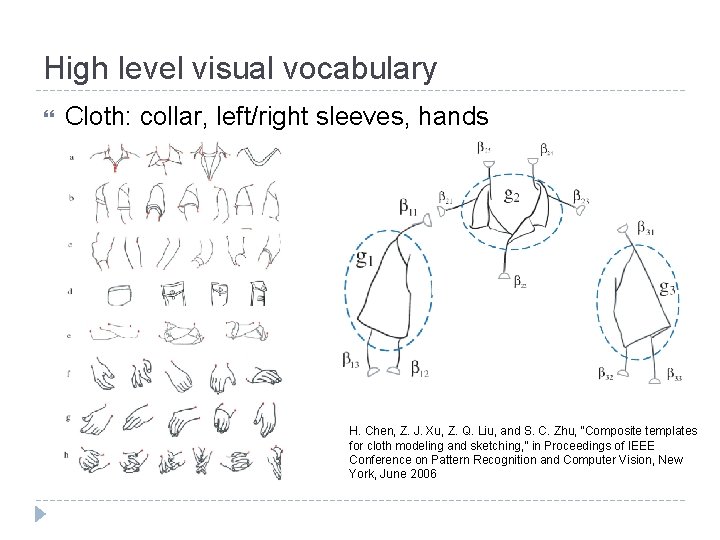
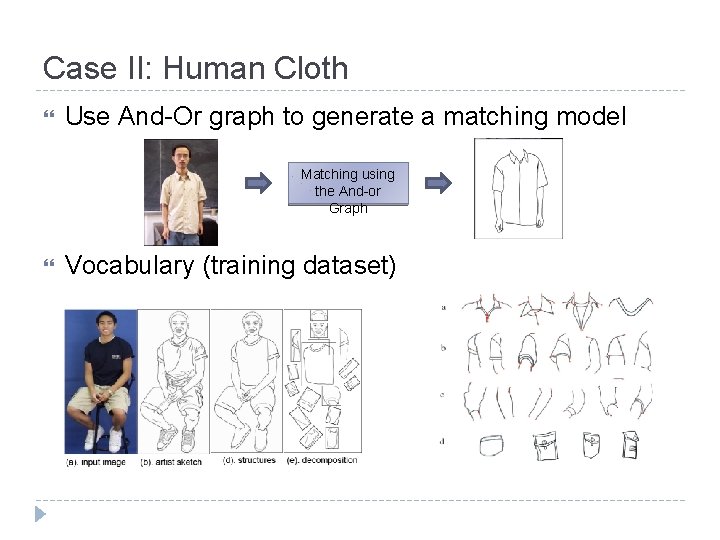
High level visual vocabulary Cloth: collar, left/right sleeves, hands H. Chen, Z. J. Xu, Z. Q. Liu, and S. C. Zhu, “Composite templates for cloth modeling and sketching, ” in Proceedings of IEEE Conference on Pattern Recognition and Computer Vision, New York, June 2006
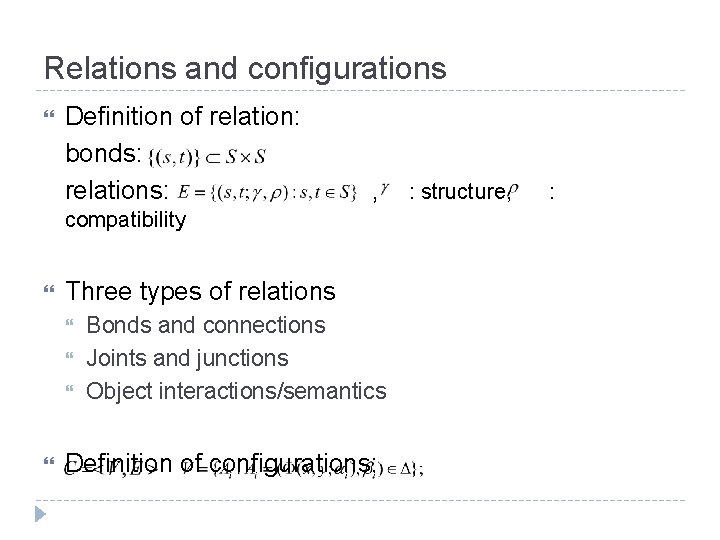
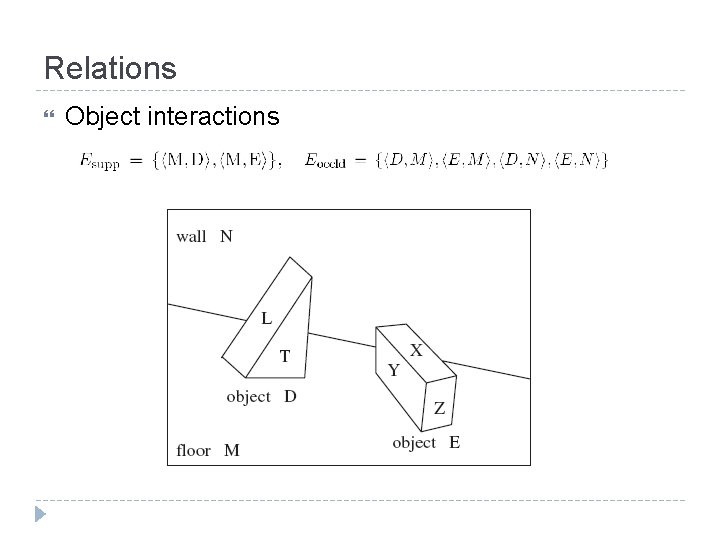
Relations and configurations Definition of relation: bonds: relations: , compatibility Three types of relations Bonds and connections Joints and junctions Object interactions/semantics Definition of configurations: : structure, :
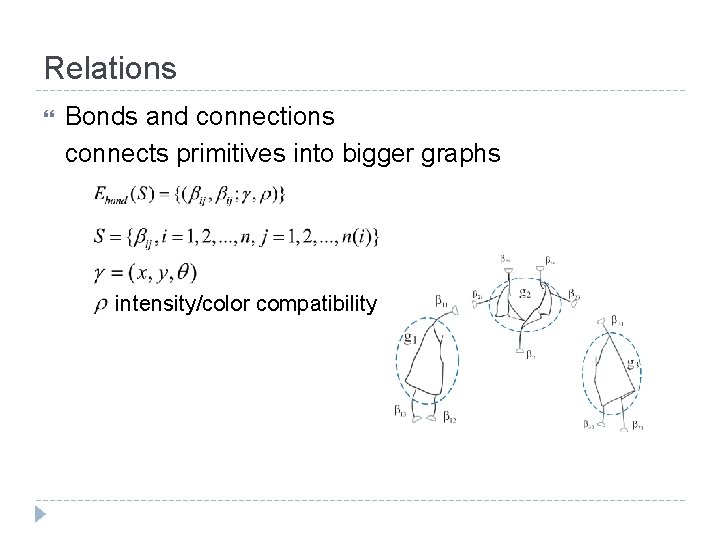
Relations Bonds and connections connects primitives into bigger graphs intensity/color compatibility
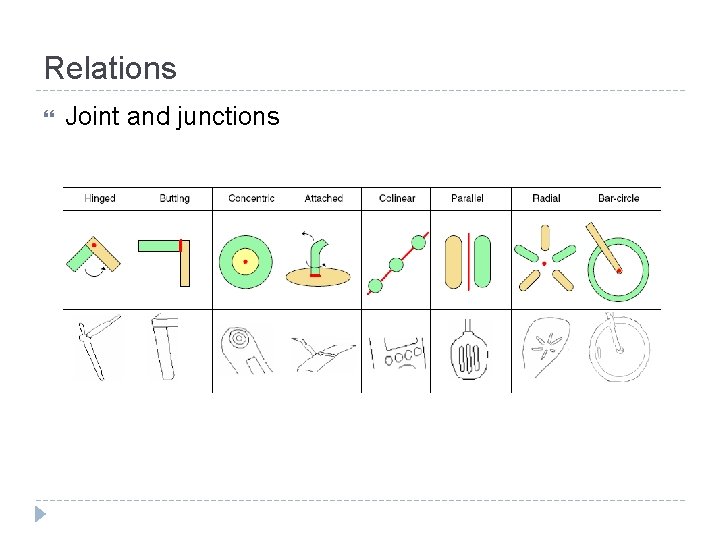
Relations Joint and junctions
Relations Object interactions
Configuration Spatial layout of entities at a certain level Primal sketch – parts – object – scene
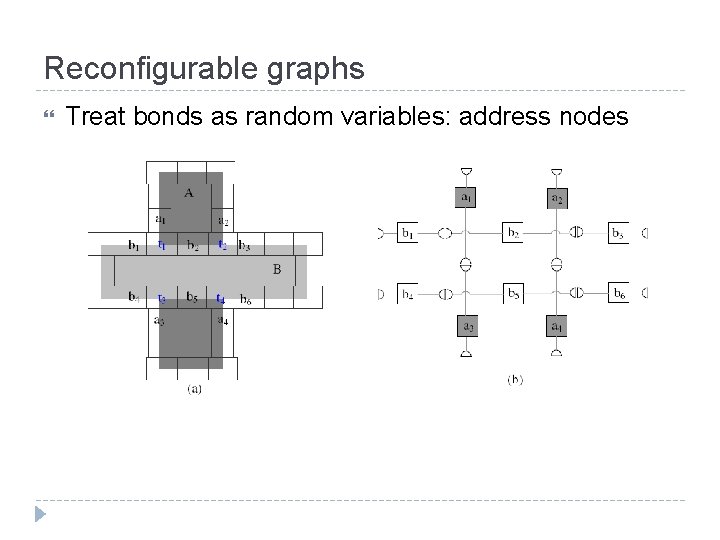
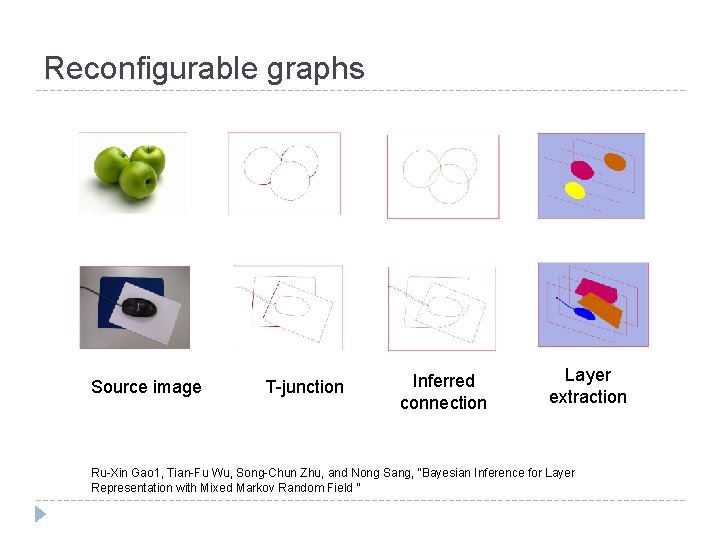
Reconfigurable graphs Treat bonds as random variables: address nodes
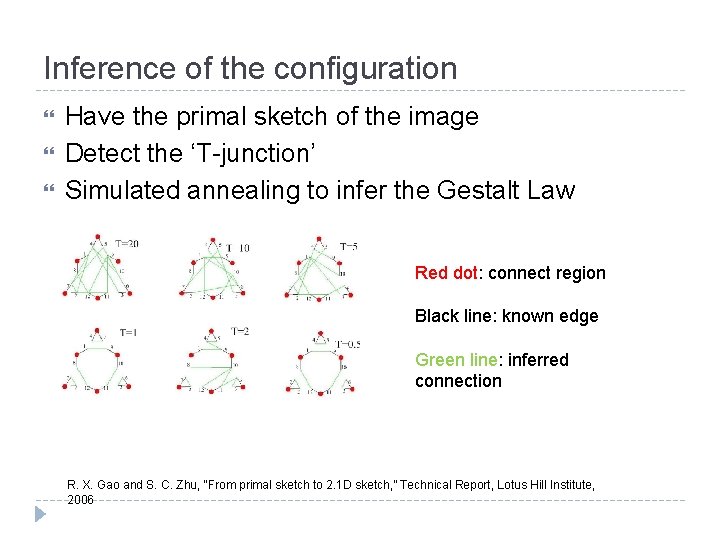
Inference of the configuration Have the primal sketch of the image Detect the ‘T-junction’ Simulated annealing to infer the Gestalt Law Red dot: connect region Black line: known edge Green line: inferred connection R. X. Gao and S. C. Zhu, “From primal sketch to 2. 1 D sketch, ” Technical Report, Lotus Hill Institute, 2006
Reconfigurable graphs Source image T-junction Inferred connection Layer extraction Ru-Xin Gao 1, Tian-Fu Wu, Song-Chun Zhu, and Nong Sang, “Bayesian Inference for Layer Representation with Mixed Markov Random Field ”
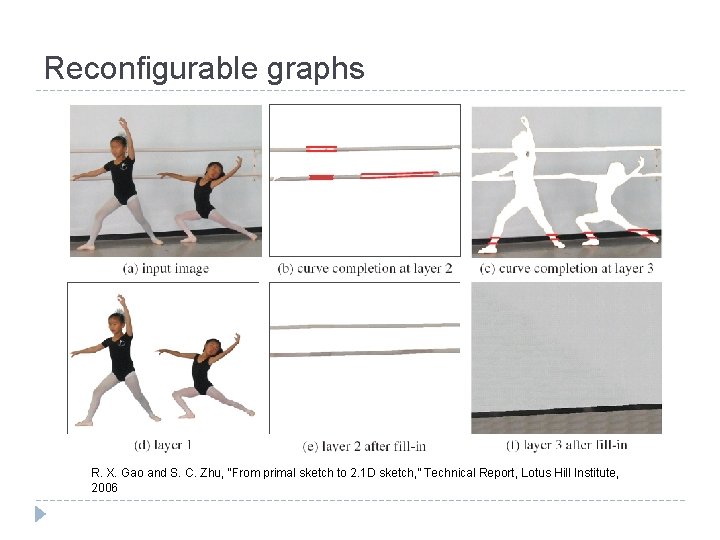
Reconfigurable graphs R. X. Gao and S. C. Zhu, “From primal sketch to 2. 1 D sketch, ” Technical Report, Lotus Hill Institute, 2006
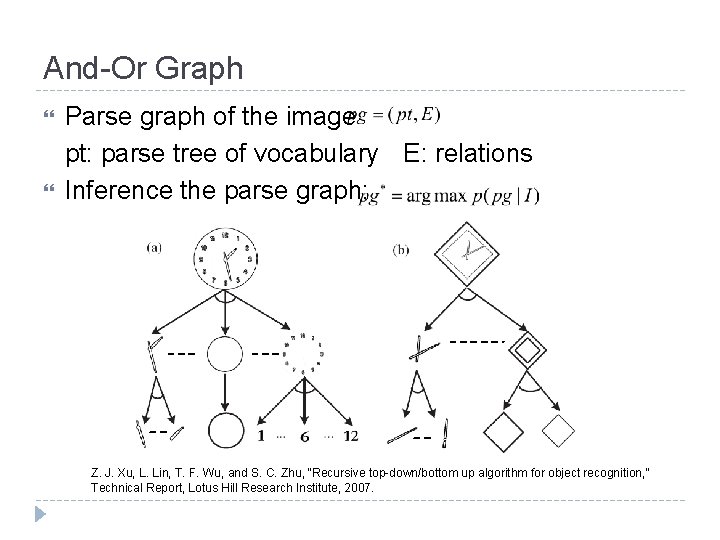
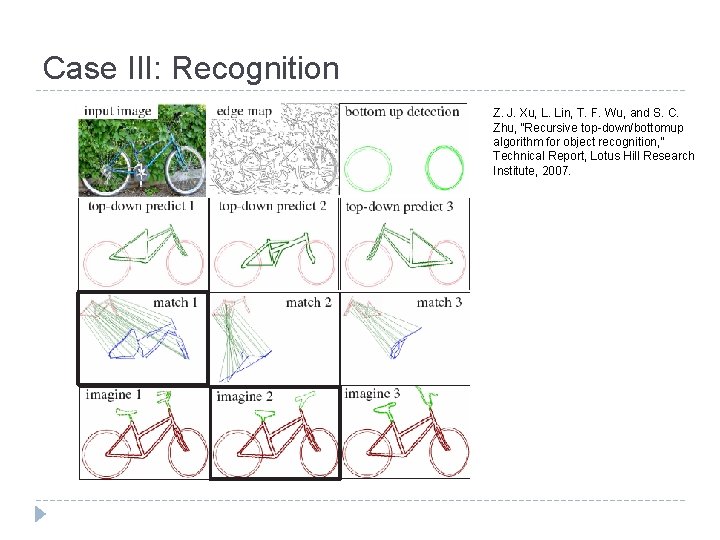
And-Or Graph Parse graph of the image pt: parse tree of vocabulary E: relations Inference the parse graph: Z. J. Xu, L. Lin, T. F. Wu, and S. C. Zhu, “Recursive top-down/bottom up algorithm for object recognition, ” Technical Report, Lotus Hill Research Institute, 2007.
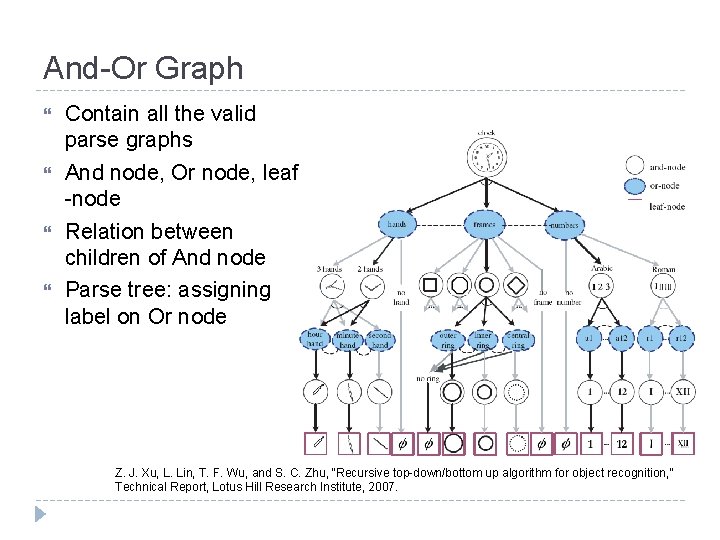
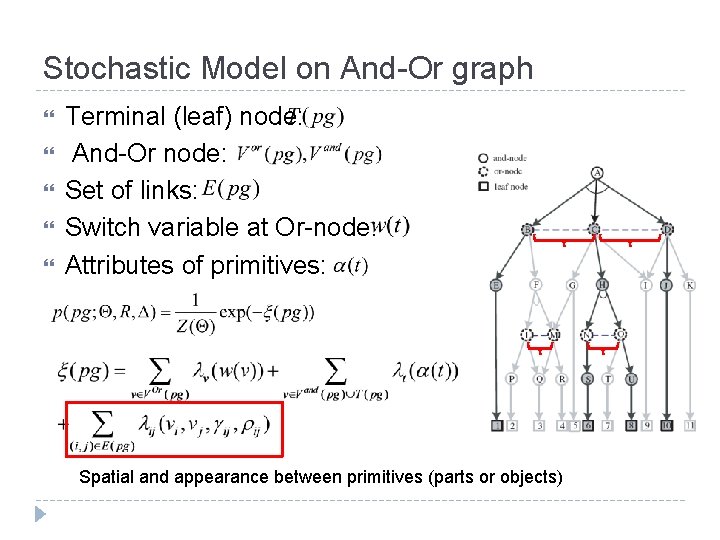
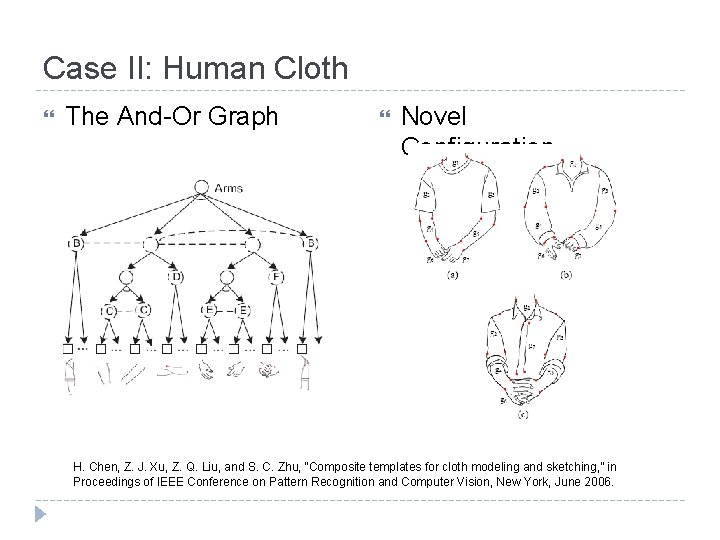
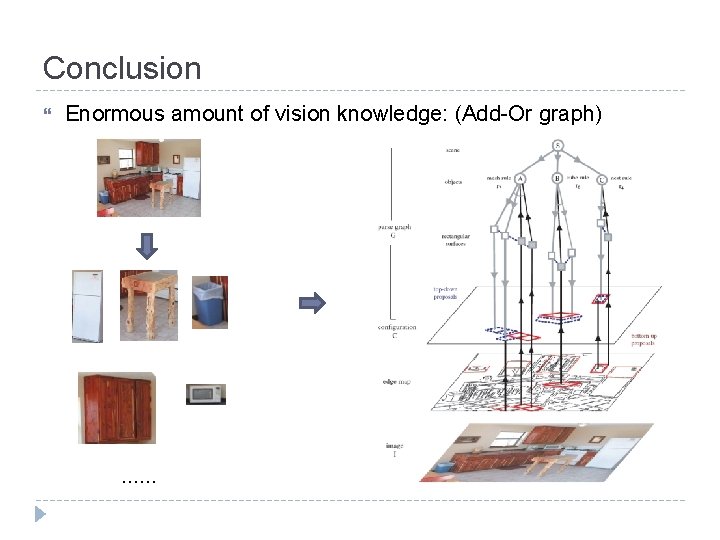
And-Or Graph Contain all the valid parse graphs And node, Or node, leaf -node Relation between children of And node Parse tree: assigning label on Or node Z. J. Xu, L. Lin, T. F. Wu, and S. C. Zhu, “Recursive top-down/bottom up algorithm for object recognition, ” Technical Report, Lotus Hill Research Institute, 2007.
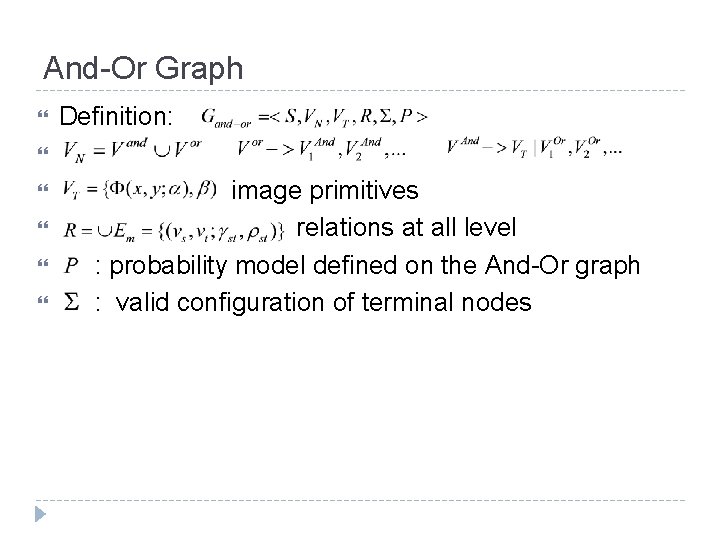
And-Or Graph Definition: image primitives relations at all level : probability model defined on the And-Or graph : valid configuration of terminal nodes
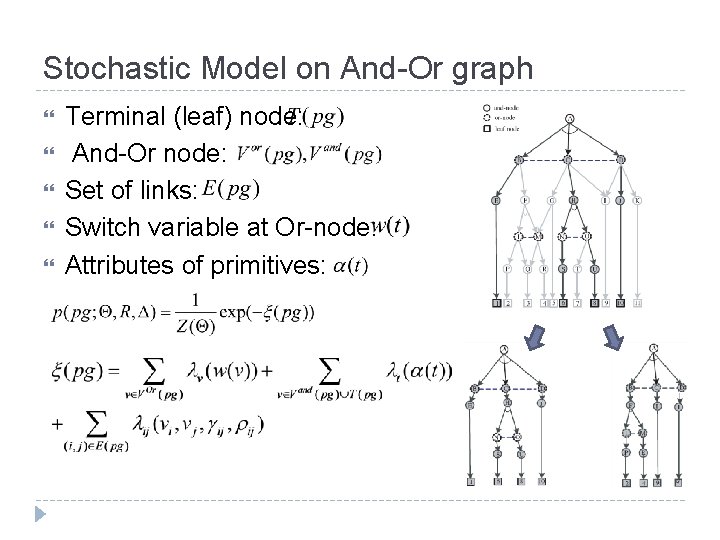
Stochastic Model on And-Or graph Terminal (leaf) node: And-Or node: Set of links: Switch variable at Or-node: Attributes of primitives:
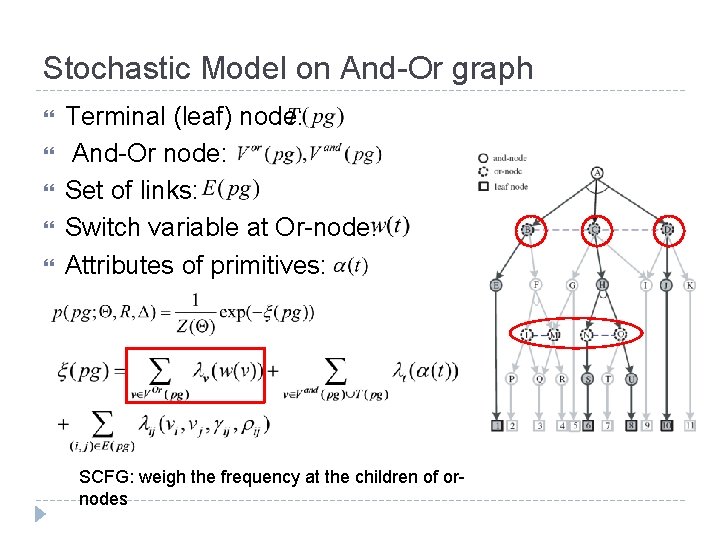
Stochastic Model on And-Or graph Terminal (leaf) node: And-Or node: Set of links: Switch variable at Or-node: Attributes of primitives: SCFG: weigh the frequency at the children of ornodes
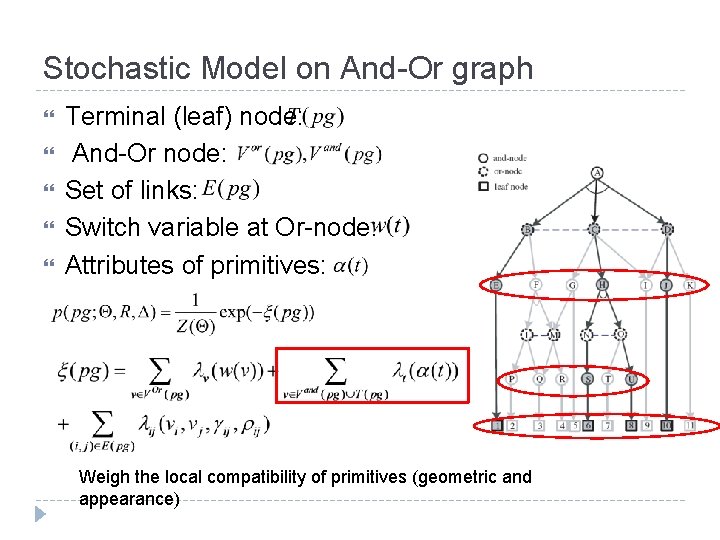
Stochastic Model on And-Or graph Terminal (leaf) node: And-Or node: Set of links: Switch variable at Or-node: Attributes of primitives: Weigh the local compatibility of primitives (geometric and appearance)
Stochastic Model on And-Or graph Terminal (leaf) node: And-Or node: Set of links: Switch variable at Or-node: Attributes of primitives: Spatial and appearance between primitives (parts or objects)
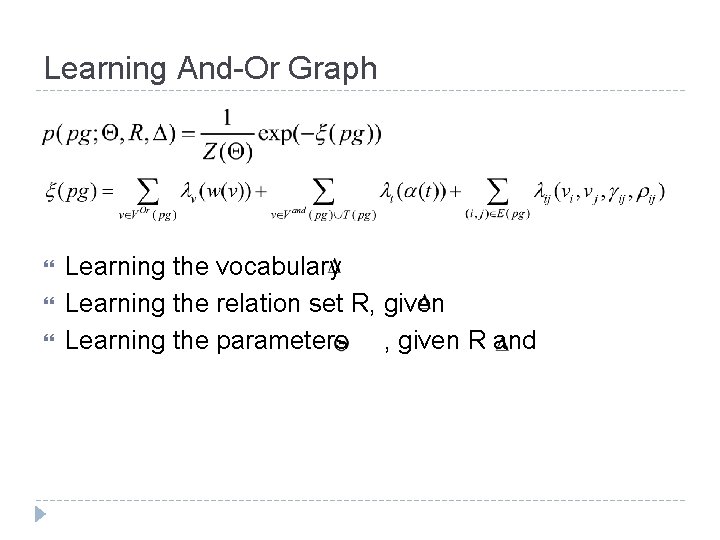
Learning And-Or Graph Learning the vocabulary Learning the relation set R, given Learning the parameters , given R and
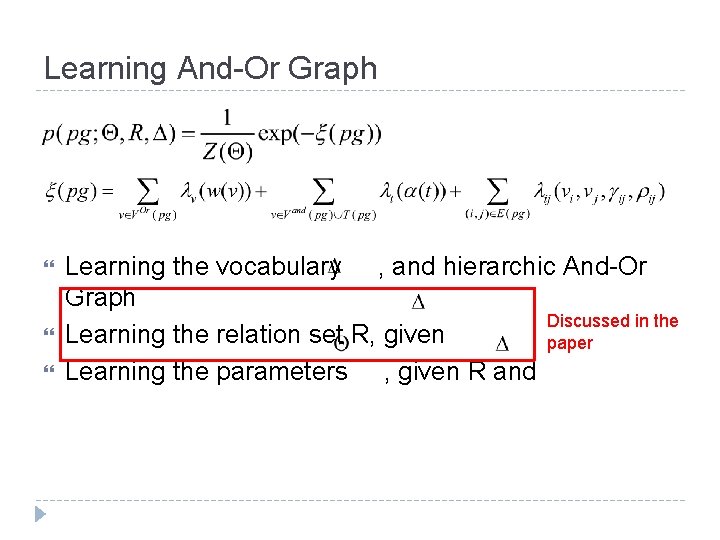
Learning And-Or Graph Learning the vocabulary , and hierarchic And-Or Graph Discussed in the Learning the relation set R, given paper Learning the parameters , given R and
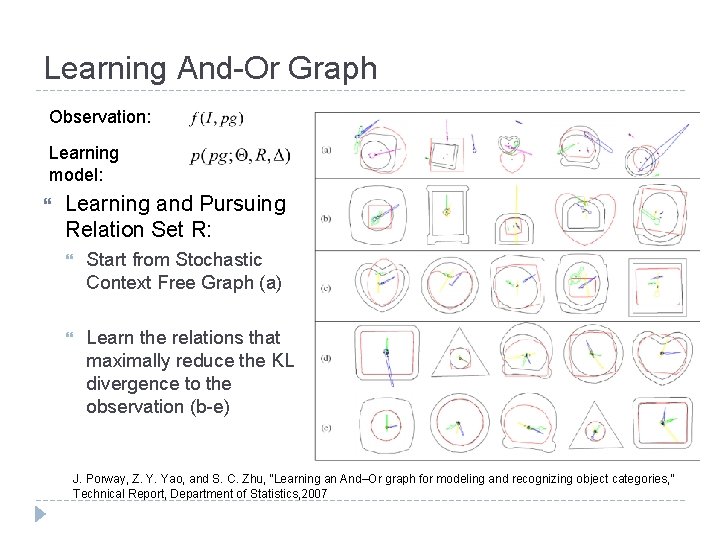
Learning And-Or Graph Observation: Learning model: Learning and Pursuing Relation Set R: Start from Stochastic Context Free Graph (a) Learn the relations that maximally reduce the KL divergence to the observation (b-e) J. Porway, Z. Y. Yao, and S. C. Zhu, “Learning an And–Or graph for modeling and recognizing object categories, ” Technical Report, Department of Statistics, 2007
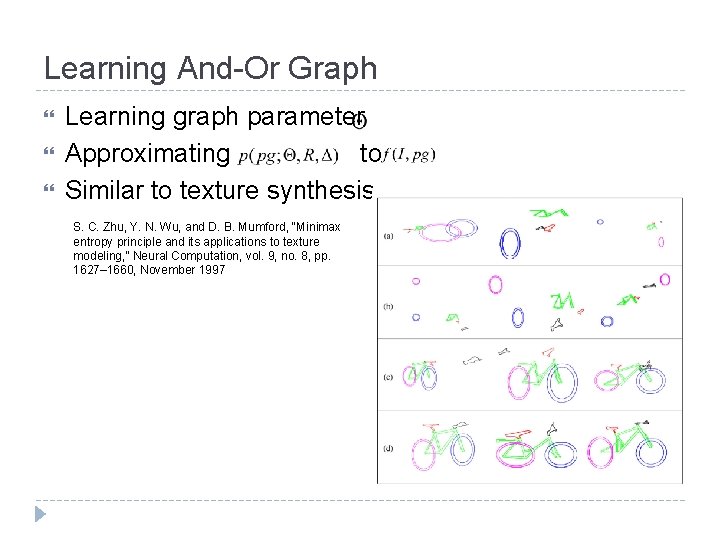
Learning And-Or Graph Learning graph parameter Approximating to Similar to texture synthesis S. C. Zhu, Y. N. Wu, and D. B. Mumford, “Minimax entropy principle and its applications to texture modeling, ” Neural Computation, vol. 9, no. 8, pp. 1627– 1660, November 1997
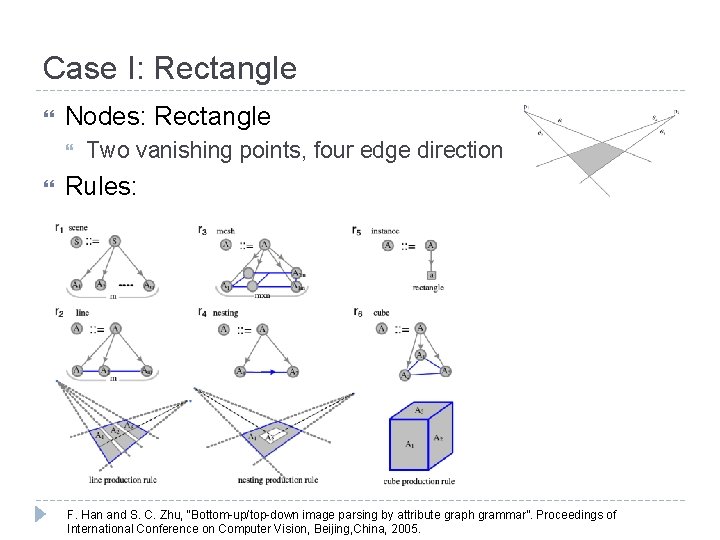
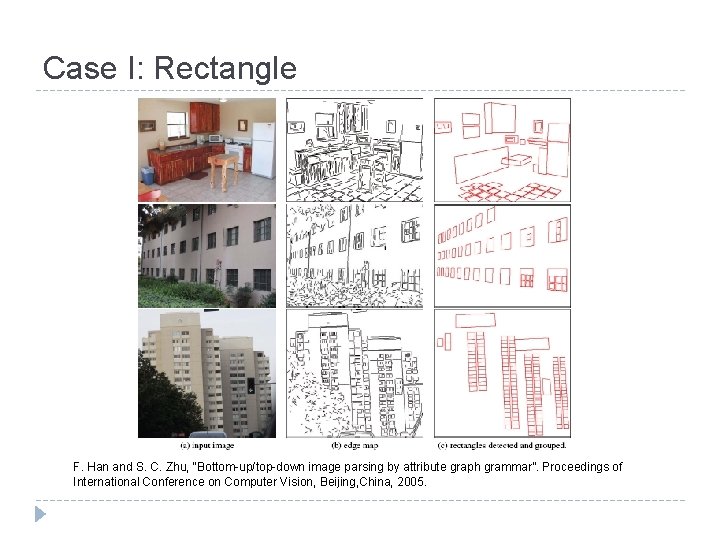
Case I: Rectangle Nodes: Rectangle Two vanishing points, four edge direction Rules: F. Han and S. C. Zhu, “Bottom-up/top-down image parsing by attribute graph grammar”. Proceedings of International Conference on Computer Vision, Beijing, China, 2005.
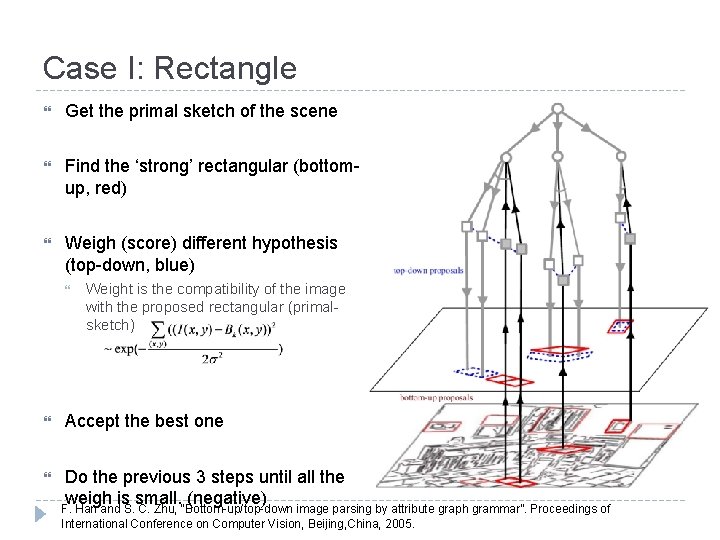
Case I: Rectangle Get the primal sketch of the scene Find the ‘strong’ rectangular (bottomup, red) Weigh (score) different hypothesis (top-down, blue) Weight is the compatibility of the image with the proposed rectangular (primalsketch) Accept the best one Do the previous 3 steps until all the weigh is small. (negative) F. Han and S. C. Zhu, “Bottom-up/top-down image parsing by attribute graph grammar”. Proceedings of International Conference on Computer Vision, Beijing, China, 2005.
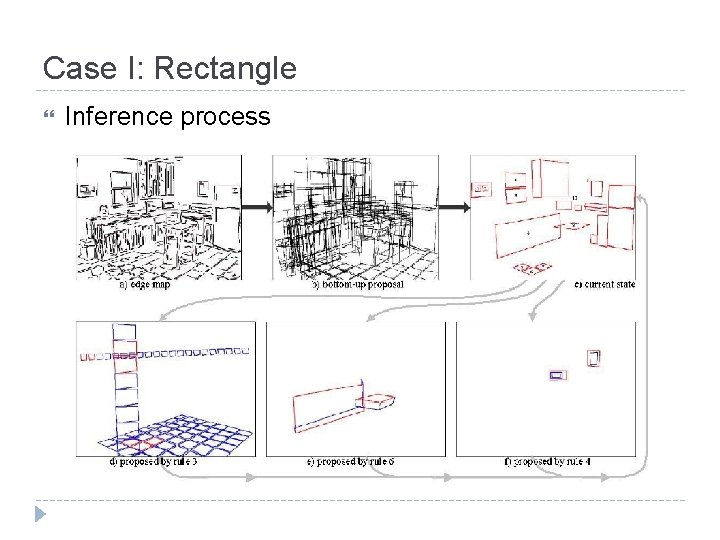
Case I: Rectangle Inference process
Case I: Rectangle F. Han and S. C. Zhu, “Bottom-up/top-down image parsing by attribute graph grammar”. Proceedings of International Conference on Computer Vision, Beijing, China, 2005.
Case II: Human Cloth Use And-Or graph to generate a matching model Matching using the And-or Graph Vocabulary (training dataset)
Case II: Human Cloth The And-Or Graph Novel Configuration H. Chen, Z. J. Xu, Z. Q. Liu, and S. C. Zhu, “Composite templates for cloth modeling and sketching, ” in Proceedings of IEEE Conference on Pattern Recognition and Computer Vision, New York, June 2006.
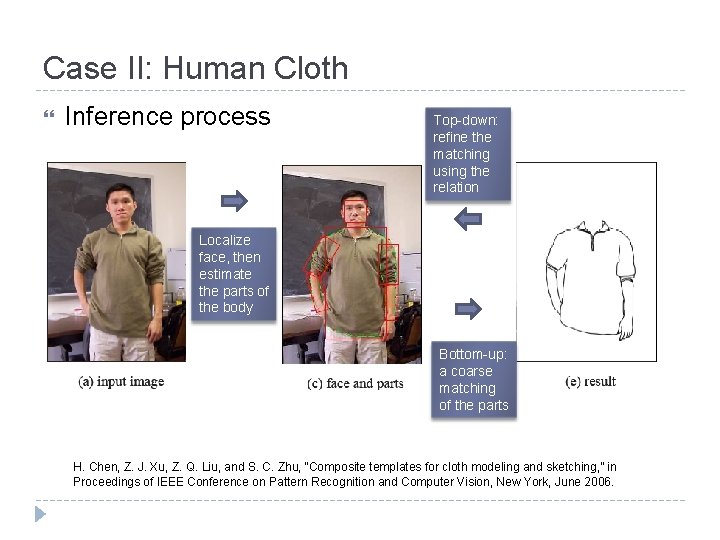
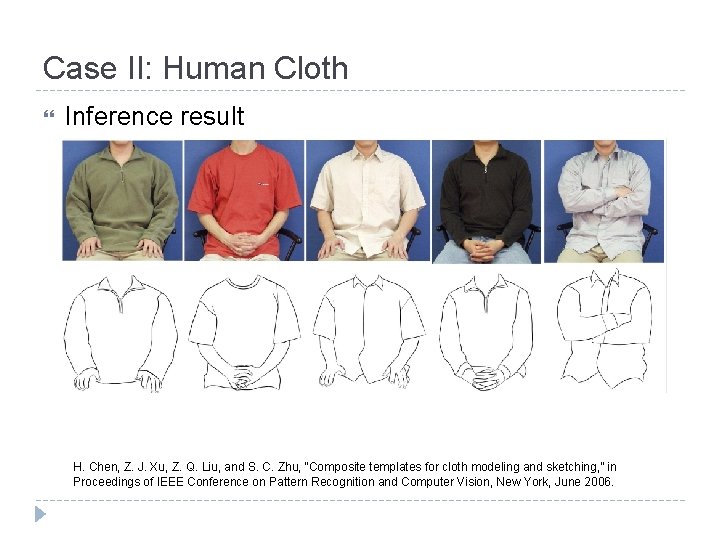
Case II: Human Cloth Inference process Top-down: refine the matching using the relation Localize face, then estimate the parts of the body Bottom-up: a coarse matching of the parts H. Chen, Z. J. Xu, Z. Q. Liu, and S. C. Zhu, “Composite templates for cloth modeling and sketching, ” in Proceedings of IEEE Conference on Pattern Recognition and Computer Vision, New York, June 2006.
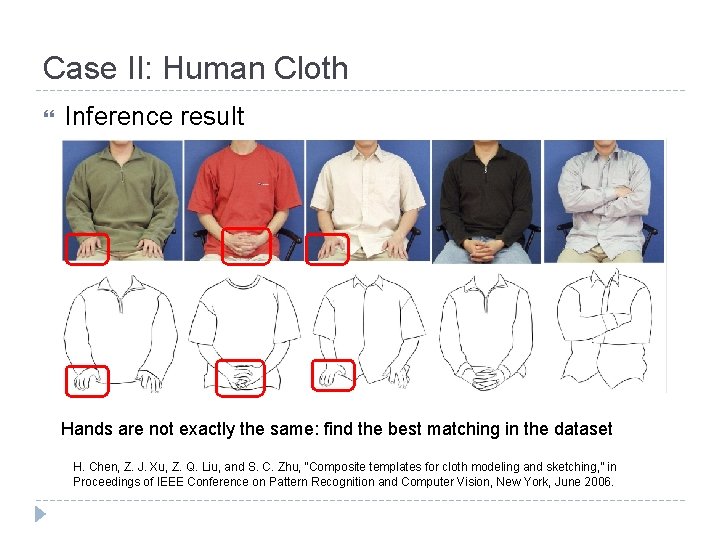
Case II: Human Cloth Inference result H. Chen, Z. J. Xu, Z. Q. Liu, and S. C. Zhu, “Composite templates for cloth modeling and sketching, ” in Proceedings of IEEE Conference on Pattern Recognition and Computer Vision, New York, June 2006.
Case II: Human Cloth Inference result Hands are not exactly the same: find the best matching in the dataset H. Chen, Z. J. Xu, Z. Q. Liu, and S. C. Zhu, “Composite templates for cloth modeling and sketching, ” in Proceedings of IEEE Conference on Pattern Recognition and Computer Vision, New York, June 2006.
Case III: Recognition Z. J. Xu, L. Lin, T. F. Wu, and S. C. Zhu, “Recursive top-down/bottomup algorithm for object recognition, ” Technical Report, Lotus Hill Research Institute, 2007.
Conclusion Enormous amount of vision knowledge: (Add-Or graph) ……
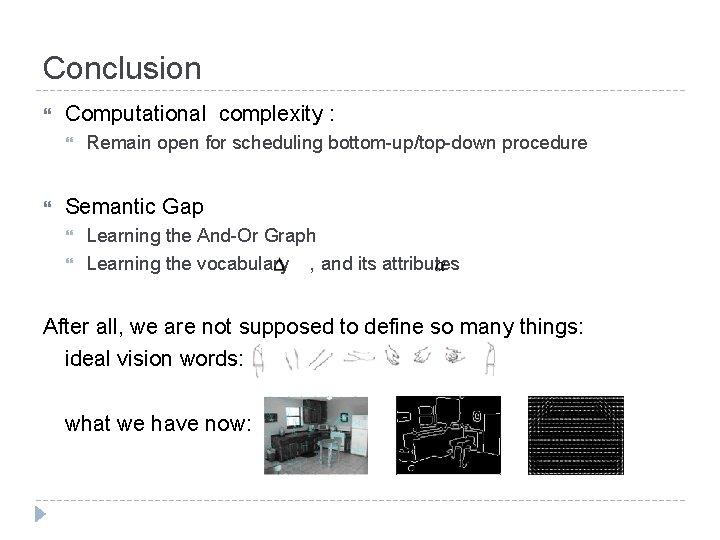
Conclusion Computational complexity : Remain open for scheduling bottom-up/top-down procedure Semantic Gap Learning the And-Or Graph Learning the vocabulary , and its attributes After all, we are not supposed to define so many things: ideal vision words: what we have now:
Thank you Zhaoyin Jia