Financial Fitness for Nonprofits 501 Commons An Introduction

- Slides: 64
Financial Fitness for Nonprofits 501 Commons An Introduction to Financial Accounting for Nonprofit Organizations 501 Commons, © 2008 1
Presentation Map Part 1 Basic Accounting Concepts for Nonprofits Part 2 The Differences between For-profit Enterprises and Nonprofits Part 3 Nonprofit Accounting Systems Part 4 Terminology 2
Main Menu Part 1 p. Basic Accounting Concepts pfor Nonprofits 3
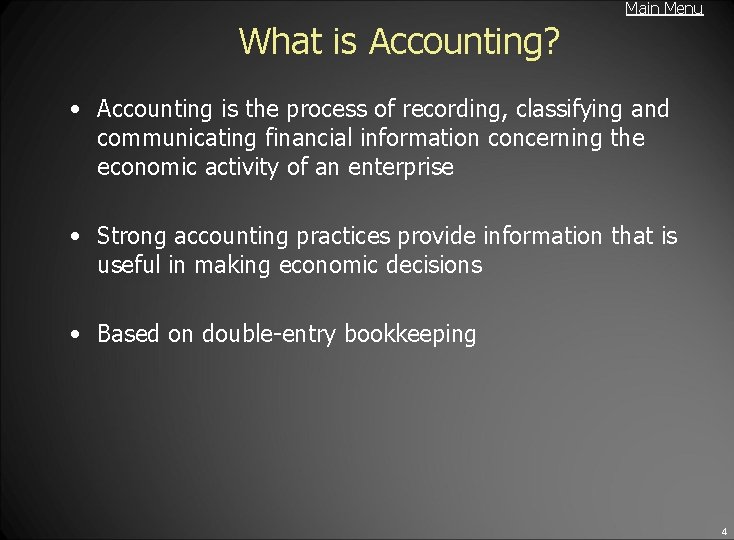
Main Menu What is Accounting? • Accounting is the process of recording, classifying and communicating financial information concerning the economic activity of an enterprise • Strong accounting practices provide information that is useful in making economic decisions • Based on double-entry bookkeeping 4
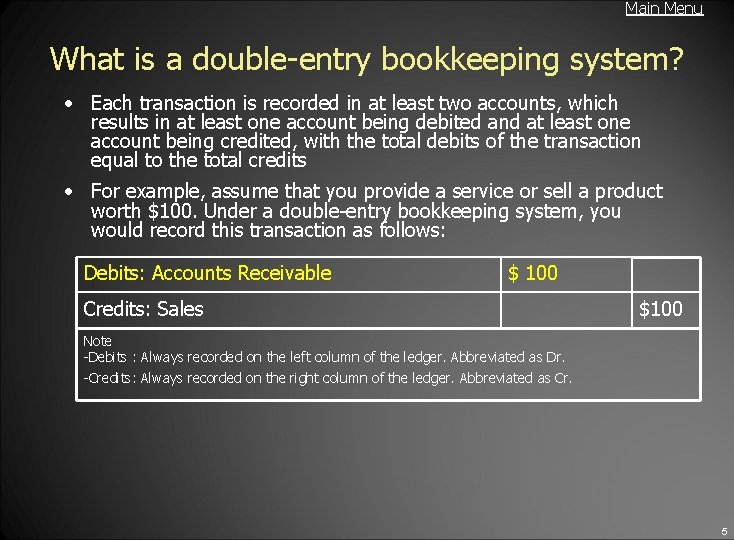
Main Menu What is a double-entry bookkeeping system? • Each transaction is recorded in at least two accounts, which results in at least one account being debited and at least one account being credited, with the total debits of the transaction equal to the total credits • For example, assume that you provide a service or sell a product worth $100. Under a double-entry bookkeeping system, you would record this transaction as follows: Debits: Accounts Receivable $ 100 Credits: Sales $100 Note -Debits : Always recorded on the left column of the ledger. Abbreviated as Dr. -Credits: Always recorded on the right column of the ledger. Abbreviated as Cr. 5
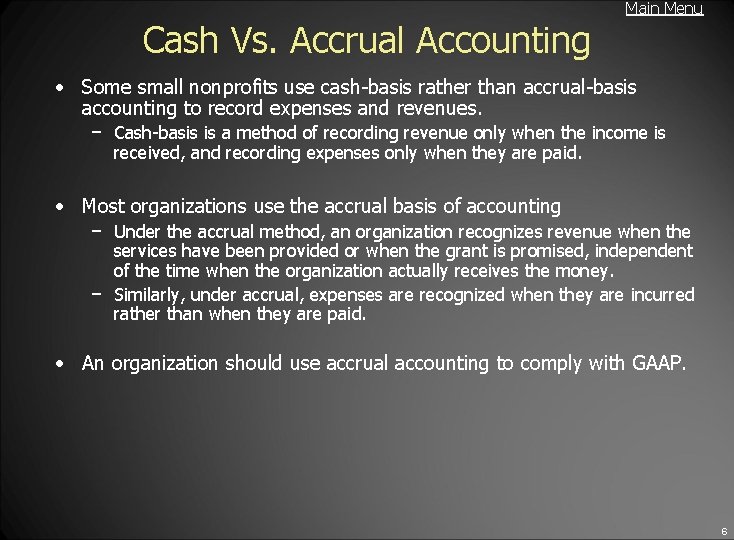
Main Menu Cash Vs. Accrual Accounting • Some small nonprofits use cash-basis rather than accrual-basis accounting to record expenses and revenues. − Cash-basis is a method of recording revenue only when the income is received, and recording expenses only when they are paid. • Most organizations use the accrual basis of accounting − Under the accrual method, an organization recognizes revenue when the services have been provided or when the grant is promised, independent of the time when the organization actually receives the money. − Similarly, under accrual, expenses are recognized when they are incurred rather than when they are paid. • An organization should use accrual accounting to comply with GAAP. 6
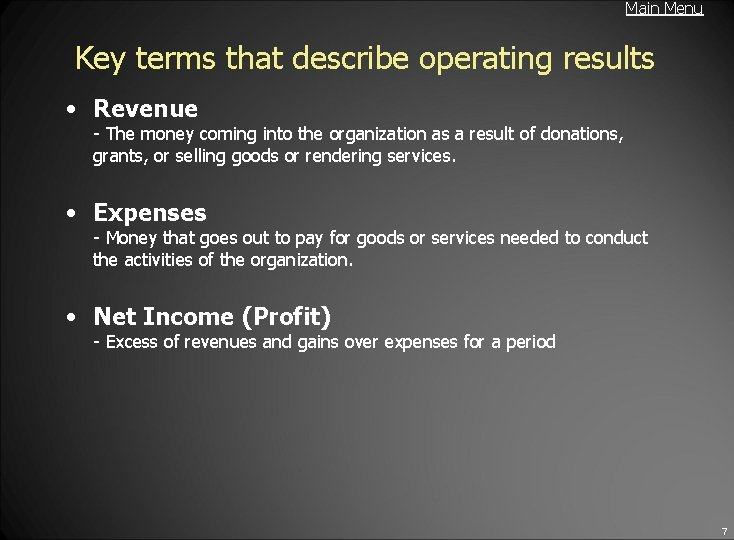
Main Menu Key terms that describe operating results • Revenue - The money coming into the organization as a result of donations, grants, or selling goods or rendering services. • Expenses - Money that goes out to pay for goods or services needed to conduct the activities of the organization. • Net Income (Profit) - Excess of revenues and gains over expenses for a period 7
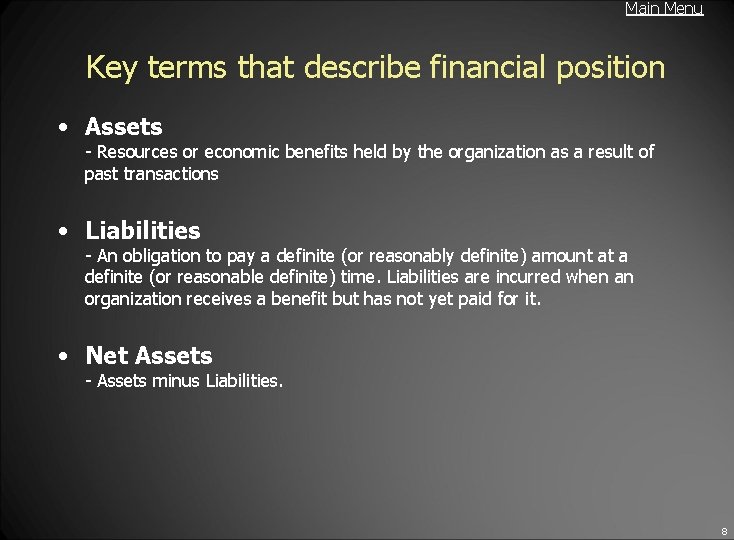
Main Menu Key terms that describe financial position • Assets - Resources or economic benefits held by the organization as a result of past transactions • Liabilities - An obligation to pay a definite (or reasonably definite) amount at a definite (or reasonable definite) time. Liabilities are incurred when an organization receives a benefit but has not yet paid for it. • Net Assets - Assets minus Liabilities. 8
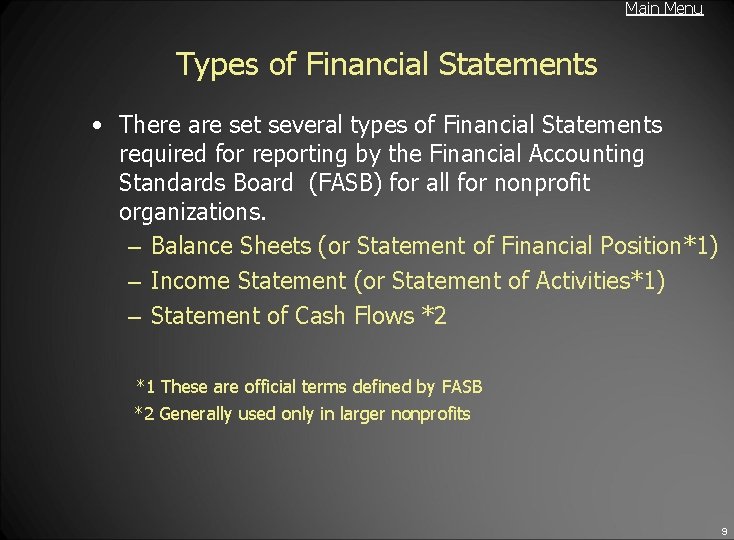
Main Menu Types of Financial Statements • There are set several types of Financial Statements required for reporting by the Financial Accounting Standards Board (FASB) for all for nonprofit organizations. – Balance Sheets (or Statement of Financial Position*1) – Income Statement (or Statement of Activities*1) – Statement of Cash Flows *2 *1 These are official terms defined by FASB *2 Generally used only in larger nonprofits 9
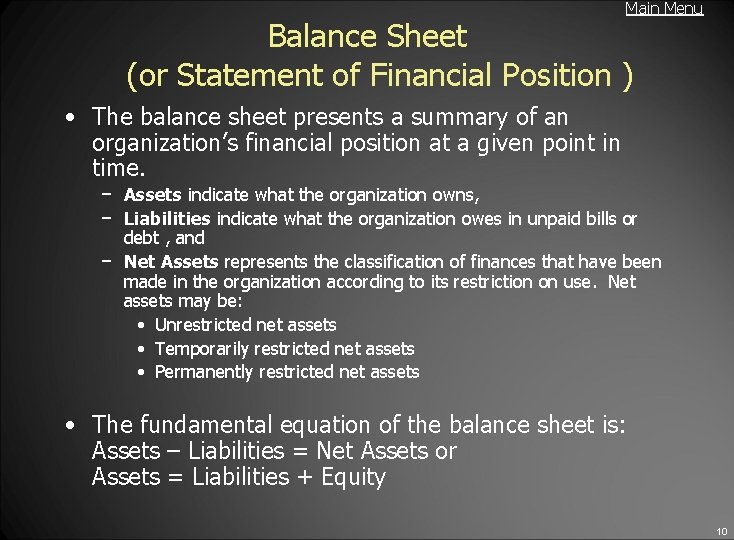
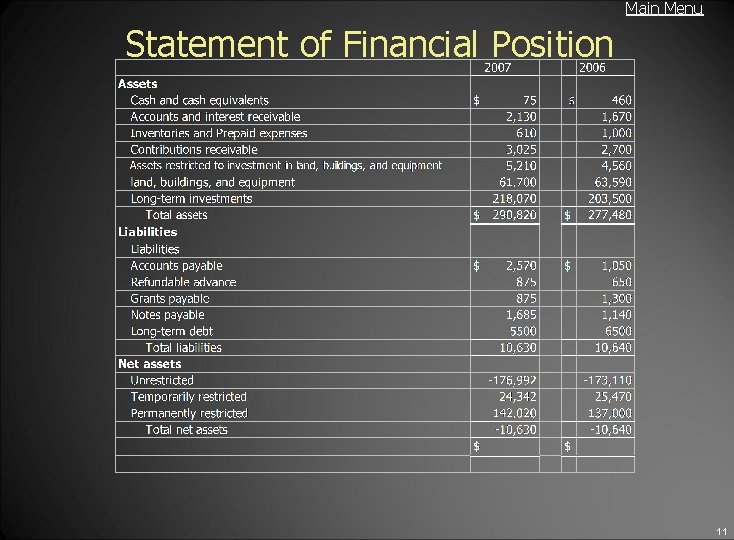
Main Menu Balance Sheet (or Statement of Financial Position ) • The balance sheet presents a summary of an organization’s financial position at a given point in time. − Assets indicate what the organization owns, − Liabilities indicate what the organization owes in unpaid bills or debt , and − Net Assets represents the classification of finances that have been made in the organization according to its restriction on use. Net assets may be: • Unrestricted net assets • Temporarily restricted net assets • Permanently restricted net assets • The fundamental equation of the balance sheet is: Assets – Liabilities = Net Assets or Assets = Liabilities + Equity 10
Main Menu Statement of Financial Position 11
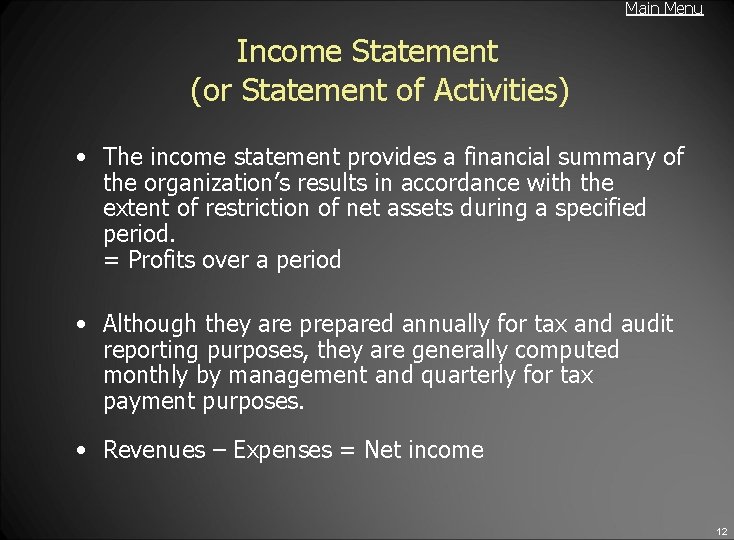
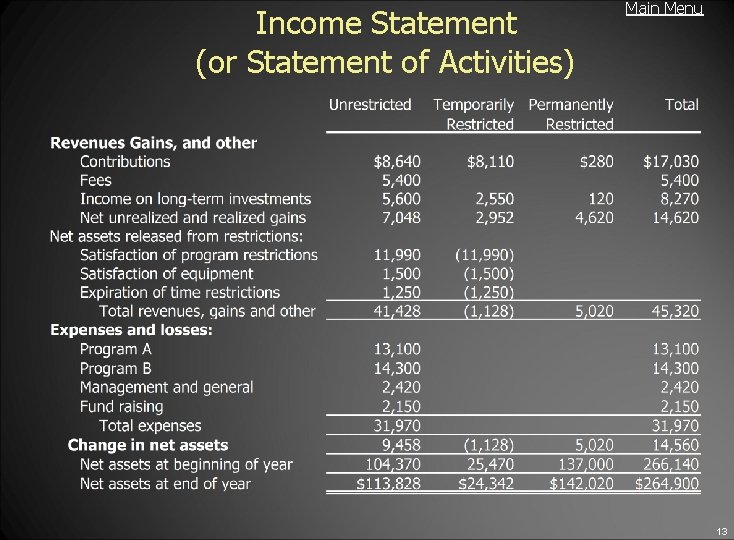
Main Menu Income Statement (or Statement of Activities) • The income statement provides a financial summary of the organization’s results in accordance with the extent of restriction of net assets during a specified period. = Profits over a period • Although they are prepared annually for tax and audit reporting purposes, they are generally computed monthly by management and quarterly for tax payment purposes. • Revenues – Expenses = Net income 12
Income Statement (or Statement of Activities) Main Menu 13
Main Menu Statement of Cash Flows • The statement of cash flows provides a summary of the cash flows over a period of time, typically the year that just ended. 14
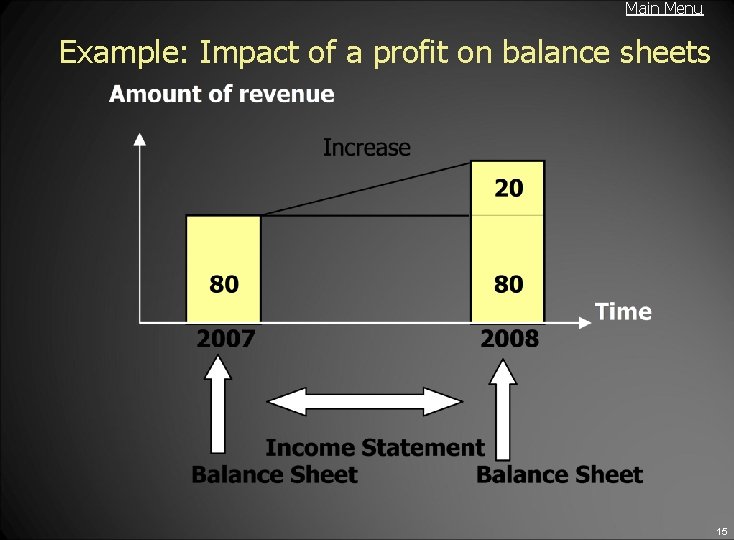
Main Menu Example: Impact of a profit on balance sheets 15
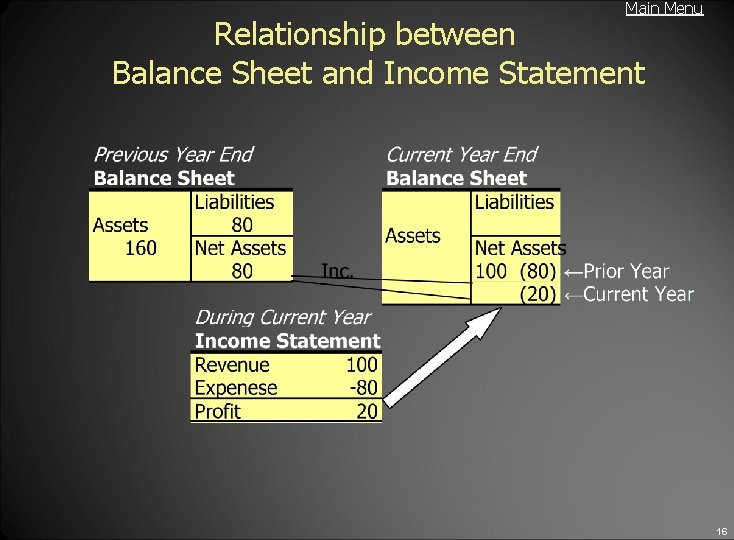
Main Menu Relationship between Balance Sheet and Income Statement 16
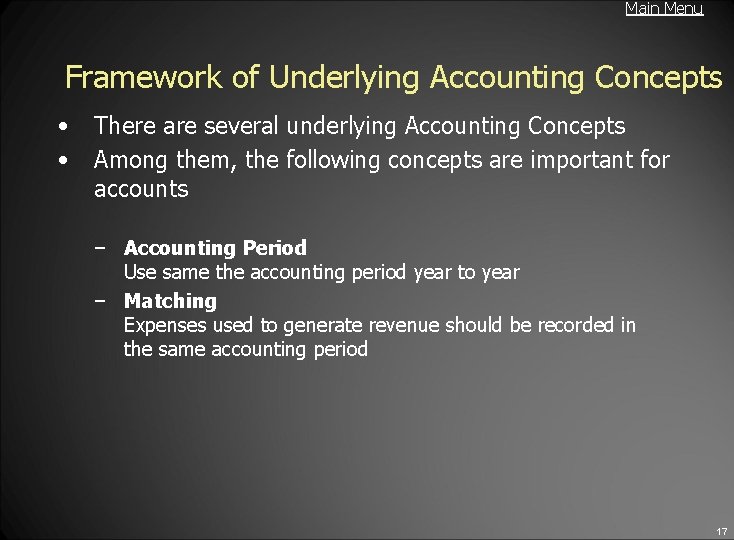
Main Menu Framework of Underlying Accounting Concepts • • There are several underlying Accounting Concepts Among them, the following concepts are important for accounts − Accounting Period Use same the accounting period year to year − Matching Expenses used to generate revenue should be recorded in the same accounting period 17
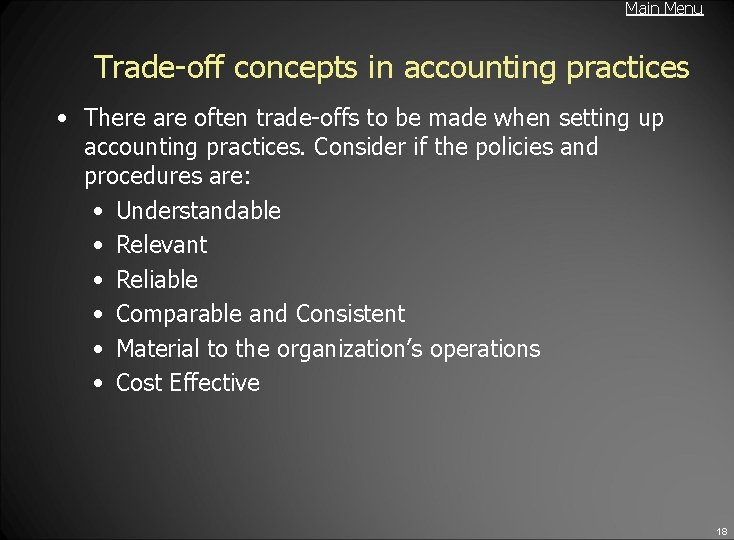
Main Menu Trade-off concepts in accounting practices • There are often trade-offs to be made when setting up accounting practices. Consider if the policies and procedures are: • Understandable • Relevant • Reliable • Comparable and Consistent • Material to the organization’s operations • Cost Effective 18
Main Menu Part 2 p. The Differences between Business Enterprises and Nonprofits Executive Directors, staff, board members and volunteers who are helping to develop accounting systems or volunteering to do financial management for nonprofits may be knowledgeable about business accounting but may not be aware of the important differences between for profit and nonprofit accounting. This section is designed to provide information about these differences. 19
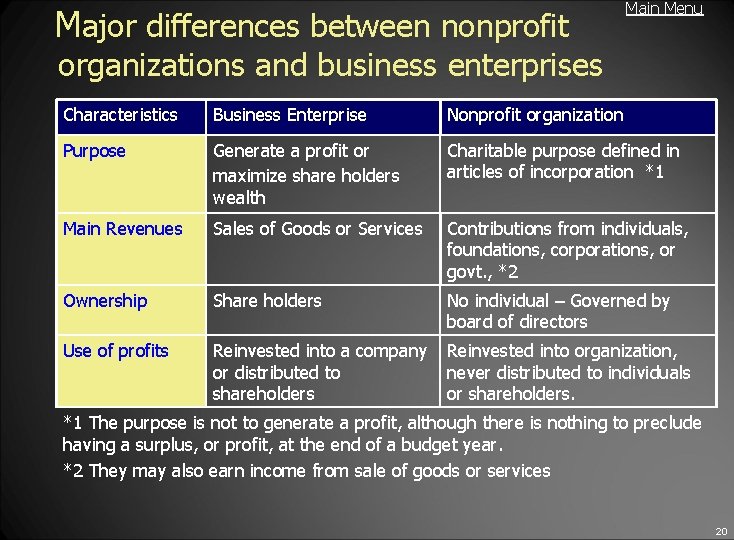
Major differences between nonprofit Main Menu organizations and business enterprises Characteristics Business Enterprise Nonprofit organization Purpose Generate a profit or maximize share holders wealth Charitable purpose defined in articles of incorporation *1 Main Revenues Sales of Goods or Services Contributions from individuals, foundations, corporations, or govt. , *2 Ownership Share holders No individual – Governed by board of directors Use of profits Reinvested into a company or distributed to shareholders Reinvested into organization, never distributed to individuals or shareholders. *1 The purpose is not to generate a profit, although there is nothing to preclude having a surplus, or profit, at the end of a budget year. *2 They may also earn income from sale of goods or services 20
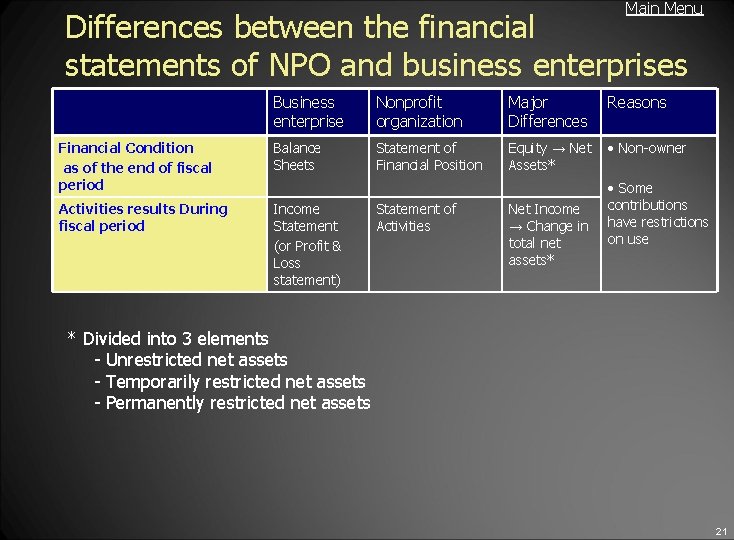
Main Menu Differences between the financial statements of NPO and business enterprises Business enterprise Nonprofit organization Major Differences Reasons Financial Condition as of the end of fiscal period Balance Sheets Statement of Financial Position Equity → Net Assets* • Non-owner Activities results During fiscal period Income Statement (or Profit & Loss statement) Statement of Activities Net Income → Change in total net assets* • Some contributions have restrictions on use * Divided into 3 elements - Unrestricted net assets - Temporarily restricted net assets - Permanently restricted net assets 21
Main Menu Part 3 p. Nonprofit Accounting Systems 22
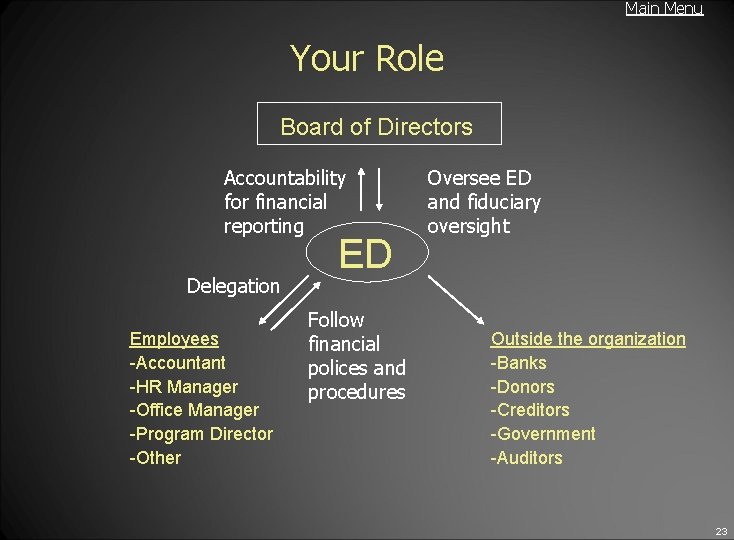
Main Menu Your Role Board of Directors Accountability for financial reporting Delegation Employees -Accountant -HR Manager -Office Manager -Program Director -Other ED Follow financial polices and procedures Oversee ED and fiduciary oversight Outside the organization -Banks -Donors -Creditors -Government -Auditors 23
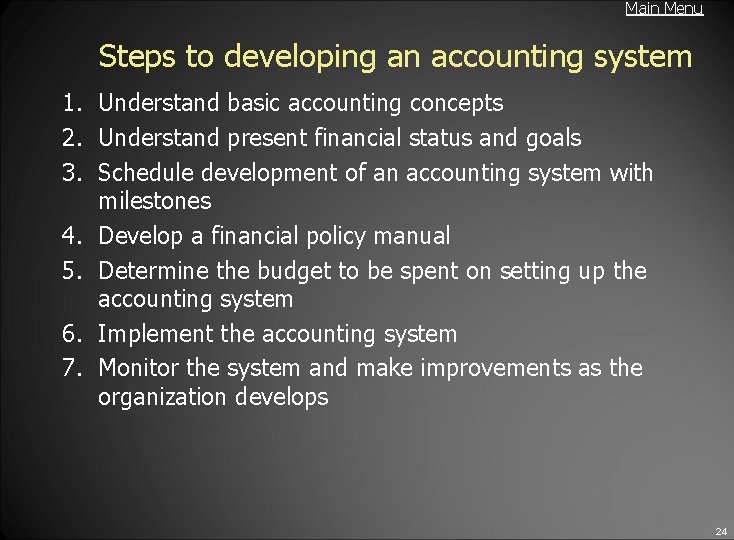
Main Menu Steps to developing an accounting system 1. Understand basic accounting concepts 2. Understand present financial status and goals 3. Schedule development of an accounting system with milestones 4. Develop a financial policy manual 5. Determine the budget to be spent on setting up the accounting system 6. Implement the accounting system 7. Monitor the system and make improvements as the organization develops 24
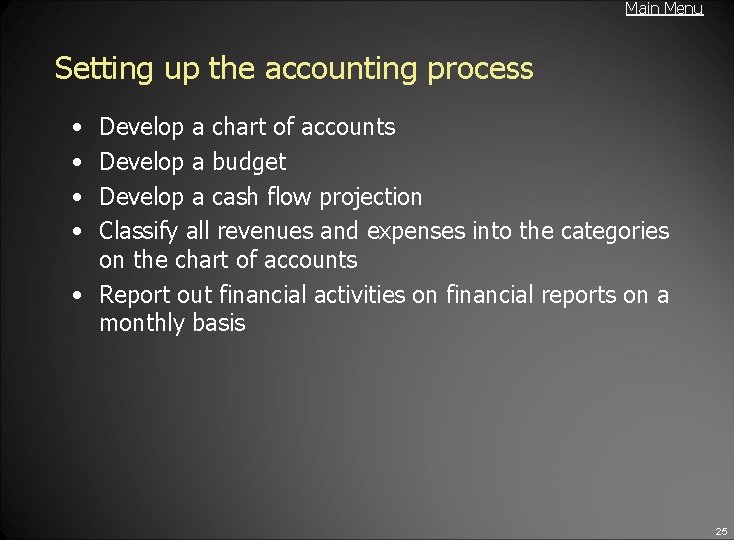
Main Menu Setting up the accounting process • • Develop a chart of accounts Develop a budget Develop a cash flow projection Classify all revenues and expenses into the categories on the chart of accounts • Report out financial activities on financial reports on a monthly basis 25
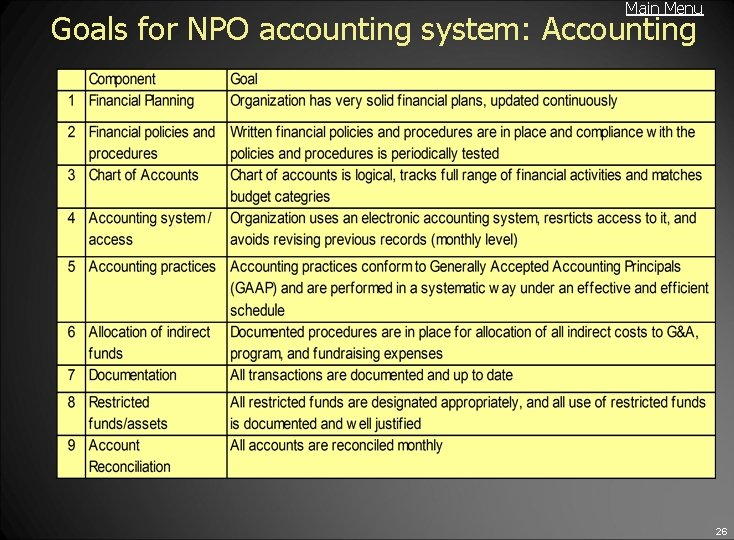
Main Menu Goals for NPO accounting system: Accounting 26
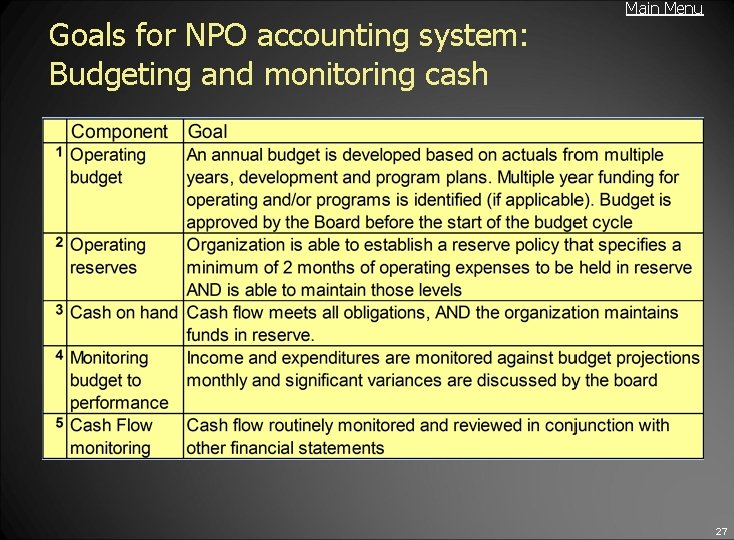
Goals for NPO accounting system: Budgeting and monitoring cash Main Menu 27
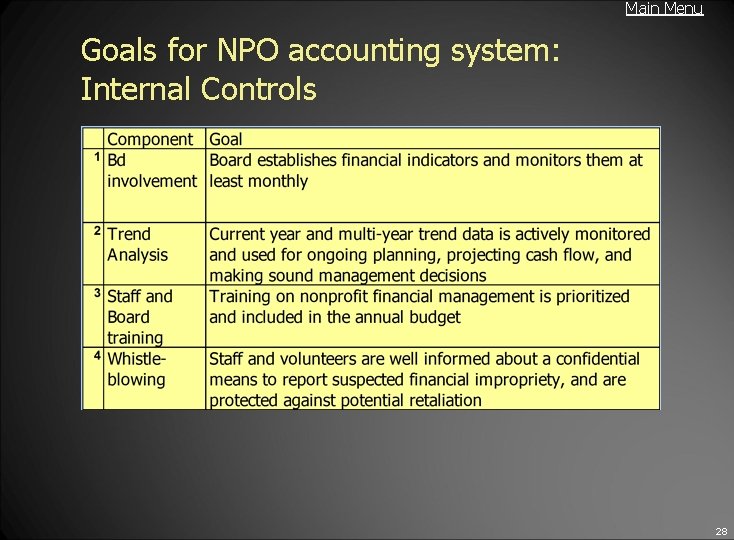
Main Menu Goals for NPO accounting system: Internal Controls 28
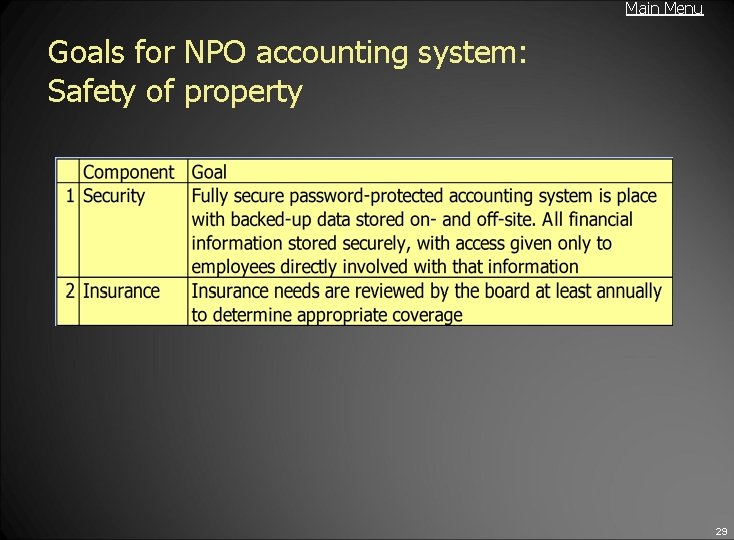
Main Menu Goals for NPO accounting system: Safety of property 29
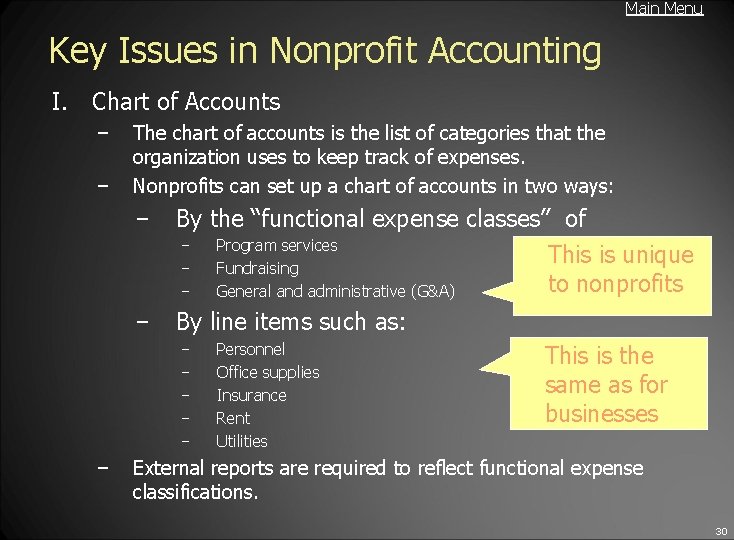
Main Menu Key Issues in Nonprofit Accounting I. Chart of Accounts − − The chart of accounts is the list of categories that the organization uses to keep track of expenses. Nonprofits can set up a chart of accounts in two ways: − By the “functional expense classes” of − − This is unique to nonprofits By line items such as: − − − Program services Fundraising General and administrative (G&A) Personnel Office supplies Insurance Rent Utilities This is the same as for businesses External reports are required to reflect functional expense classifications. 30
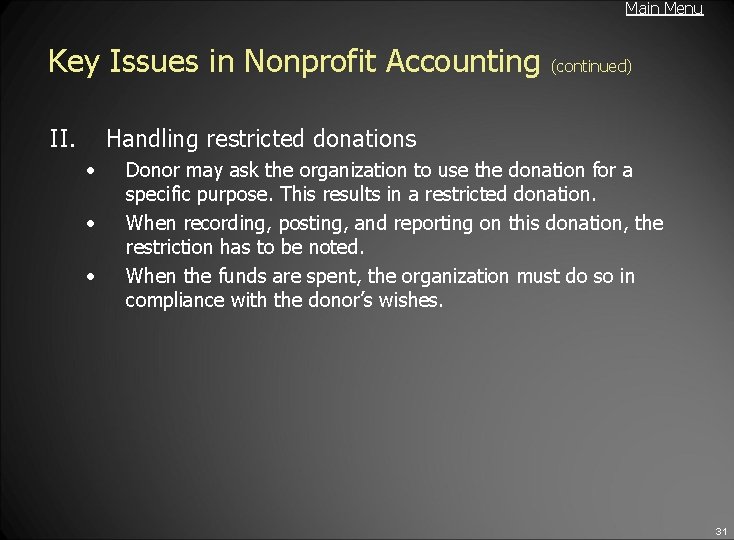
Main Menu Key Issues in Nonprofit Accounting II. (continued) Handling restricted donations • • • Donor may ask the organization to use the donation for a specific purpose. This results in a restricted donation. When recording, posting, and reporting on this donation, the restriction has to be noted. When the funds are spent, the organization must do so in compliance with the donor’s wishes. 31
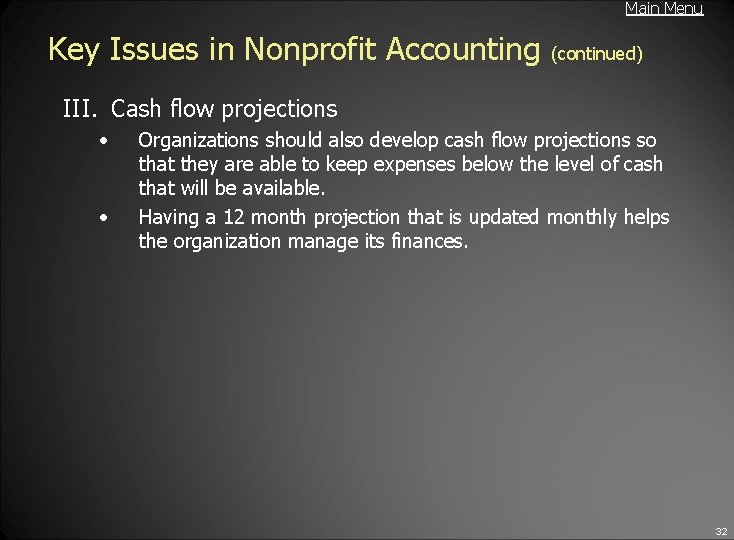
Main Menu Key Issues in Nonprofit Accounting (continued) III. Cash flow projections • • Organizations should also develop cash flow projections so that they are able to keep expenses below the level of cash that will be available. Having a 12 month projection that is updated monthly helps the organization manage its finances. 32
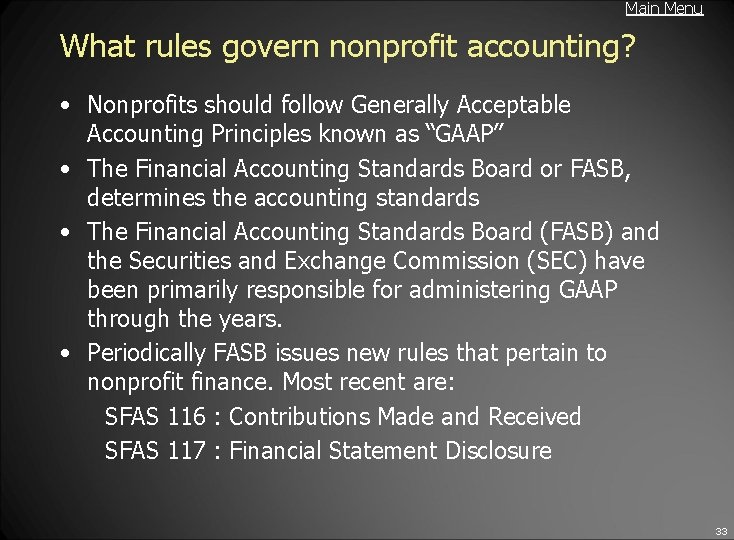
Main Menu What rules govern nonprofit accounting? • Nonprofits should follow Generally Acceptable Accounting Principles known as “GAAP” • The Financial Accounting Standards Board or FASB, determines the accounting standards • The Financial Accounting Standards Board (FASB) and the Securities and Exchange Commission (SEC) have been primarily responsible for administering GAAP through the years. • Periodically FASB issues new rules that pertain to nonprofit finance. Most recent are: SFAS 116 : Contributions Made and Received SFAS 117 : Financial Statement Disclosure 33
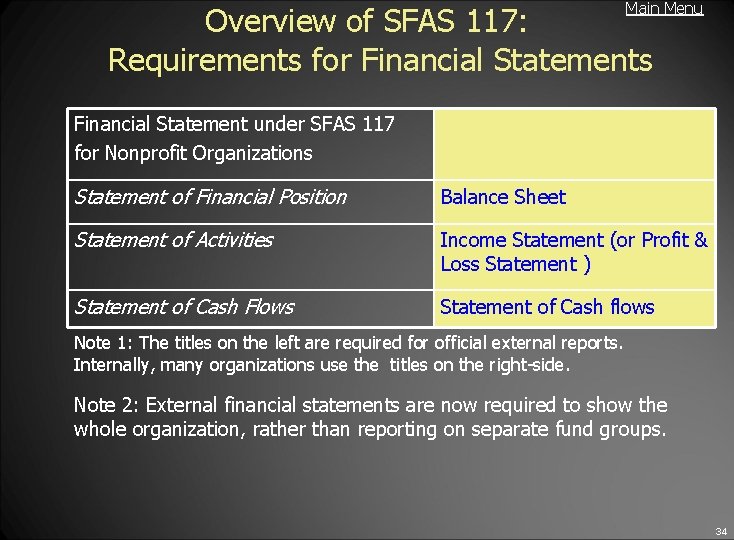
Main Menu Overview of SFAS 117: Requirements for Financial Statements Financial Statement under SFAS 117 for Nonprofit Organizations Statement of Financial Position Balance Sheet Statement of Activities Income Statement (or Profit & Loss Statement ) Statement of Cash Flows Statement of Cash flows Note 1: The titles on the left are required for official external reports. Internally, many organizations use the titles on the right-side. Note 2: External financial statements are now required to show the whole organization, rather than reporting on separate fund groups. 34
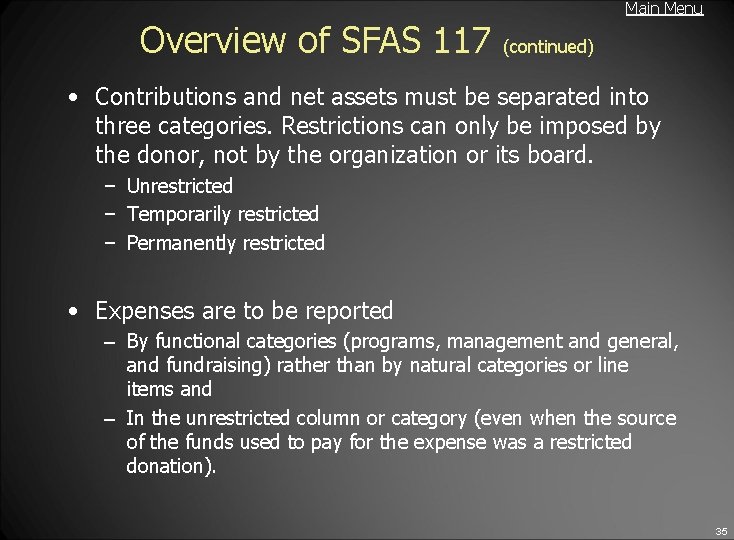
Main Menu Overview of SFAS 117 (continued) • Contributions and net assets must be separated into three categories. Restrictions can only be imposed by the donor, not by the organization or its board. − Unrestricted − Temporarily restricted − Permanently restricted • Expenses are to be reported – By functional categories (programs, management and general, and fundraising) rather than by natural categories or line items and – In the unrestricted column or category (even when the source of the funds used to pay for the expense was a restricted donation). 35
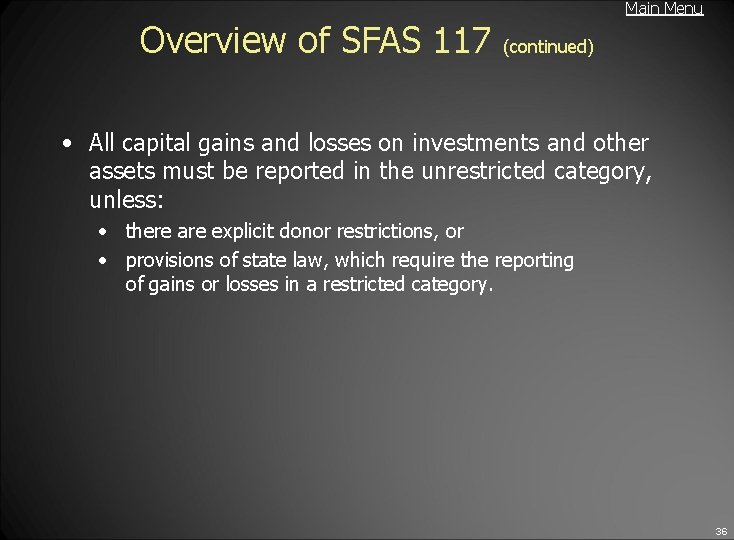
Main Menu Overview of SFAS 117 (continued) • All capital gains and losses on investments and other assets must be reported in the unrestricted category, unless: • there are explicit donor restrictions, or • provisions of state law, which require the reporting of gains or losses in a restricted category. 36
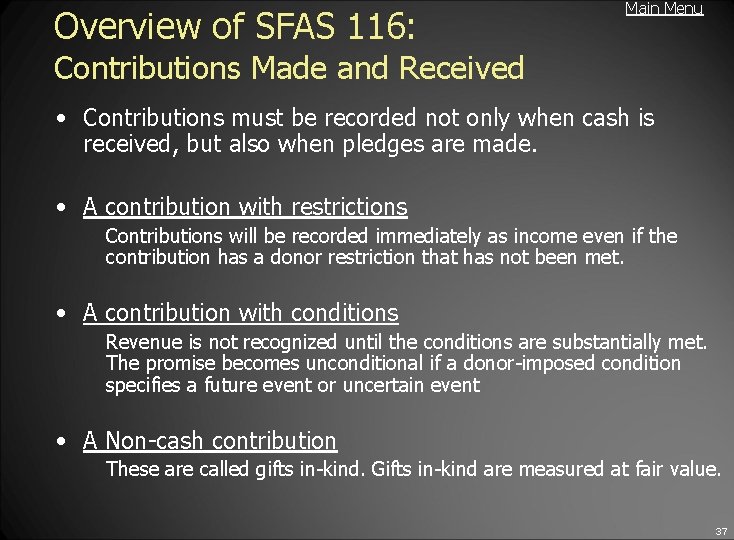
Overview of SFAS 116: Main Menu Contributions Made and Received • Contributions must be recorded not only when cash is received, but also when pledges are made. • A contribution with restrictions Contributions will be recorded immediately as income even if the contribution has a donor restriction that has not been met. • A contribution with conditions Revenue is not recognized until the conditions are substantially met. The promise becomes unconditional if a donor-imposed condition specifies a future event or uncertain event • A Non-cash contribution These are called gifts in-kind. Gifts in-kind are measured at fair value. 37
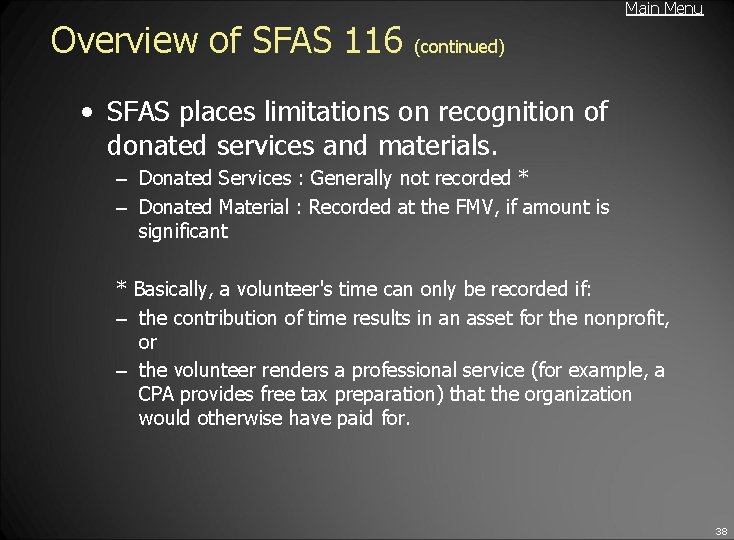
Main Menu Overview of SFAS 116 (continued) • SFAS places limitations on recognition of donated services and materials. – Donated Services : Generally not recorded * – Donated Material : Recorded at the FMV, if amount is significant * Basically, a volunteer's time can only be recorded if: – the contribution of time results in an asset for the nonprofit, or – the volunteer renders a professional service (for example, a CPA provides free tax preparation) that the organization would otherwise have paid for. 38
Main Menu Part 4 p. Terminology for Nonprofit Accounting 39
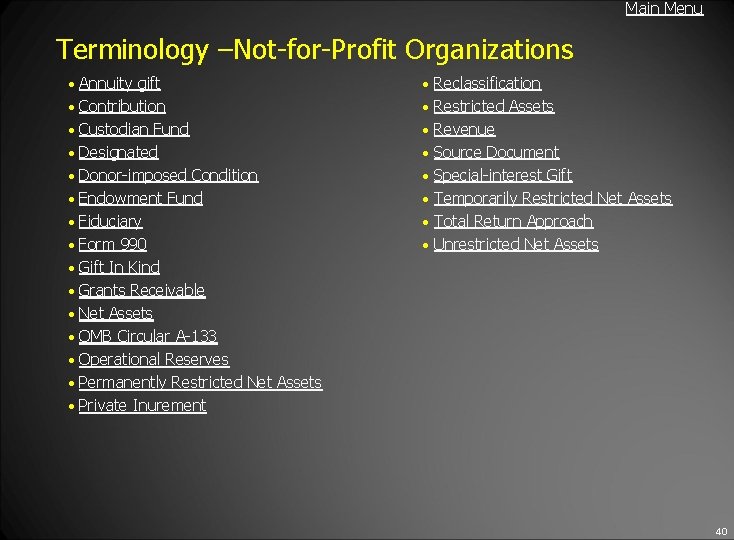
Main Menu Terminology –Not-for-Profit Organizations • Annuity gift • Reclassification • Contribution • Restricted Assets • Custodian Fund • Revenue • Designated • Source Document • Donor-imposed Condition • Special-interest Gift • Endowment Fund • Temporarily Restricted Net Assets • Fiduciary • Total Return Approach • Form 990 • Unrestricted Net Assets • Gift In Kind • Grants Receivable • Net Assets • OMB Circular A-133 • Operational Reserves • Permanently Restricted Net Assets • Private Inurement 40
Main Menu Terminology Annuity Gift A contribution given on the condition that the recipient organization make periodic stipulated payments to the donor or other designated individual. After termination of the payments, the organization keeps the remaining principal of the gift. 41
Main Menu Terminology Contribution An unconditional transfer of cash or other assets to a qualified tax -exempt organization (or a settlement or cancellation of its liabilities) in a voluntary nonreciprocal transfer by another person or entity. Contributions include gifts of money, property, the use of property, services of volunteers, unconditional promises to make gifts in the future and bequests. 42
Main Menu Terminology Custodian Funds received and held by an organization as a fiscal agent for others. 43
Main Menu Terminology Designated Refers to unrestricted resources that the board has voted to set aside for a period of time, or for a specific use. While the board may use the term Endowment fund, because the restriction was set internally, the funds can be made available by the board for any use at any time. Hence, board-designated funds are correctly classed with unrestricted net assets. 44
Main Menu Terminology Donor-imposed Condition A donor stipulation that specifies a future and uncertain event whose failure to occur releases the promisor from the obligation to transfer assets (or provides for a return of the assets). The condition may also be in the form of a restriction on the use of the donated assets which may be a temporary restriction or a permanent one. 45
Main Menu Terminology Endowment Fund An established fund of cash, securities, or other assets to provide income for a not-for-profit organization. The use of the assets of the fund may be permanently restricted, temporarily restricted, or unrestricted. Quasi-Endowment Fund Unrestricted endowment. 46
Main Menu Terminology Fiduciary A person entrusted with management of, and responsibility for, assets belonging to others. Generally, under state laws, governing boards and non-profit organizations are considered to be acting as fiduciaries. 47
Main Menu Terminology Form 990 The Internal Revenue Service (IRS) form used to report annually to the IRS (and to many states) on the financial and other activities of a tax-exempt organization. 48
Main Menu Terminology Fund Balance The excess of assets over liabilities of a particular fund of an organization. Another name for Net Assets 49
Main Menu Terminology GAAP/GAAS GAAP – Generally Accepted Accounting Principles. The rules for recording and reporting transactions in financial statements. GAAS – Generally Accepted Auditing Standards. The procedures undertaken by an independent certified public accountant (CPA) in order to issue an opinion on the fairness of the presentation of the financial statements. 50
Main Menu Terminology Gift In Kind A contribution other than cash or marketable securities. Includes property, supplies, equipment, use of property (free rent) and qualified donated services of volunteers. 51
Main Menu Terminology Grants Receivable Outstanding money owed as promised by a donor or grantor. 52
Main Menu Terminology Net Assets minus Liabilities. The remainder at the close of a fiscal period looks at the financial position of the organization if all assets had been converted to cash and all liabilities had been paid. Revenues minus expenses during a given fiscal period must equal the change in Net Assets for that period. Net Assets are composed of three categories: • Unrestricted Net Assets, • Temporarily Restricted Net Assets, and • Permanently Restricted Net Assets. 53
Main Menu Terminology OMB Circular A-133 Publication of the U. S. Office of Management and Budget, which requires that organizations that spend $300, 000 or more of federal grants and contracts in a year have a special audit of those federal funds. 54
Main Menu Terminology Operational Reserves Often used to refer to the amount of resources currently available to an organization to use in any way it chooses. In accounting terms, this is often defined as including the unrestricted net asset balance less equity in property and equipment, plus the expendable temporarily restricted net asset balance, plus the deferred revenue that will become available within one year. 55
Main Menu Terminology Permanently Restricted Net Assets Donations or grants for which the donor or grantor has placed a permanent restriction. These funds cannot be used for another purpose. However, the earnings from the investment of permanently restricted net assets may be used in any way the organization wishes, including operations. 56
Main Menu Terminology Private Inurement Improper receipt of a financial benefit by a person who is an “insider” to a nonprofit organization. Private inurement is illegal under Section 501(c) of the Internal Revenue Code, and can lead to financial penalties against both the receiver of the benefit and the persons in the organization who authorized the benefit, along with possible loss of tax-exempt status. 57
Main Menu Terminology Reclassification The movement of resources between classes of net assets. The most frequent reclassification is movement from temporarily restricted net assets to unrestricted net assets upon the fulfillment or expiration of a donor-imposed temporary restriction. 58
Main Menu Terminology Restricted Assets Contributions (donations or grants) for which the donor has placed restrictions regarding their use (restrictions may be temporary or permanent) 59
Main Menu Terminology Special-interest Gift General term used to describe various types of gifts under which the benefit of the resources involved is split between the donor and a charity. Includes gift annuities, remainder trusts, lead trusts, and pooled income funds. 60
Main Menu Terminology Temporarily Restricted Net Assets Donations or grants for which the donor or grantor has placed a temporary restriction. • The donor may restrict the use of the funds to a specific use or objective, such as a particular program or activity, or may specify a particular time period for the use of the funds. • When the restriction has been satisfied, the funds are used to pay for that use or activity, or the funds are converted to unrestricted net assets. 61
Main Menu Terminology Total Return Approach A method of managing endowment assets in which a portion of capital gains is made available for current use under a formula approved by an organization’s governing board. 62
Main Menu Terminology Unrestricted Net Assets Donations or grants given without any restrictions regarding their use by the organization. 63
Main Menu Terminology Unrelated Business Income (UBI) Income from a trade or business, conducted by a tax-exempt organization, that is not substantially related to the purposes for which the organization is exempt. 64