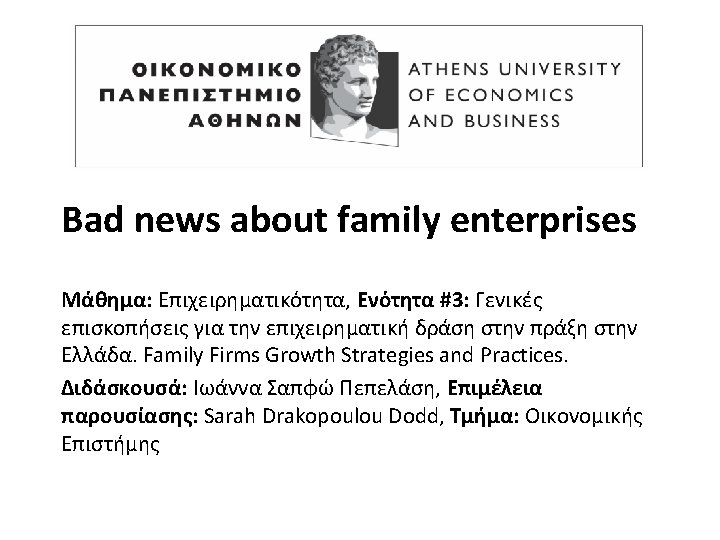
Family Firms Growth Strategies and Practices Strengths and


- Slides: 83
Σκοποί ενότητας • Family Firms: Growth Strategies and Practices. • Strengths and Weaknesses of the Family Firm. • Mapping the Stakeholders in Family Firms. • Balancing Family & Firm: Systems & Subsystems. • Familiness and continuous strategic renewal in the family firms. • The Role of Networking in the Growth Processes of Family Firms: An International Study. 4
Περιεχόμενα ενότητας • Good news about family enterprises. • Bad news about family enterprises. • Family and Firm: Systems, Subsystems and Overlaps. • Which aspects of “familiness“ influence continuous strategic renewal in family firms? 5
What is a Family Business? • A family business is a synthesis of: – Ownership control (15%+) by two or more members of a family or a partnership of families. – Strategic influence by family members on the management of the firm. – Concern for family relationships. – The dream (possibility) of continuity across generations. 7
Let’s start with the good news about family enterprises (1 of 2) • Family firms make a vital contribution to the world economy. – Growing Contribution to GNP of Family Firms. • Family firms are among the world’s largest. • The world’s oldest businesses are family firms. • Many of the world’s best known brands are family firms. 8
Let’s start with the good news about family enterprises (2 of 2) • Family firms perform better than non-family firms. • Family firms have lots of strategic advantages. • And family firms have a special place in Greece. 9
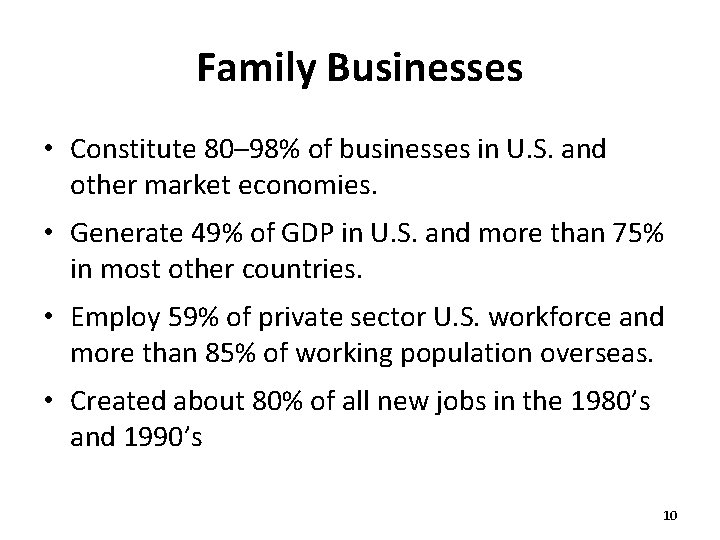
Family Businesses • Constitute 80– 98% of businesses in U. S. and other market economies. • Generate 49% of GDP in U. S. and more than 75% in most other countries. • Employ 59% of private sector U. S. workforce and more than 85% of working population overseas. • Created about 80% of all new jobs in the 1980’s and 1990’s 10
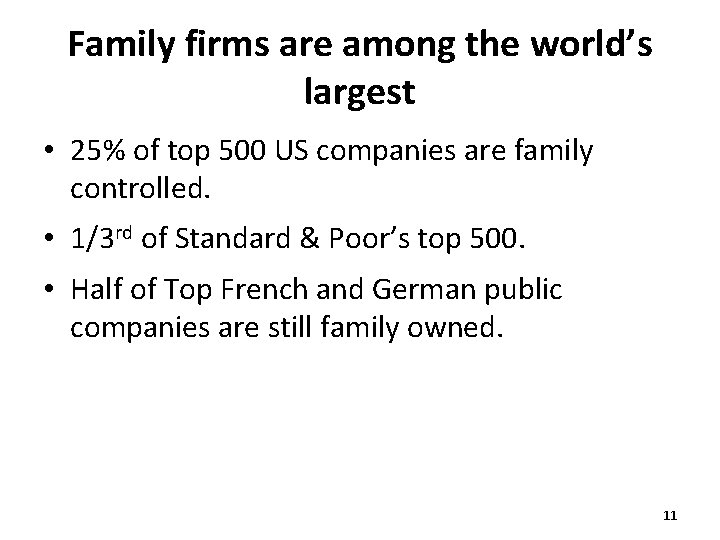
Family firms are among the world’s largest • 25% of top 500 US companies are family controlled. • 1/3 rd of Standard & Poor’s top 500. • Half of Top French and German public companies are still family owned. 11
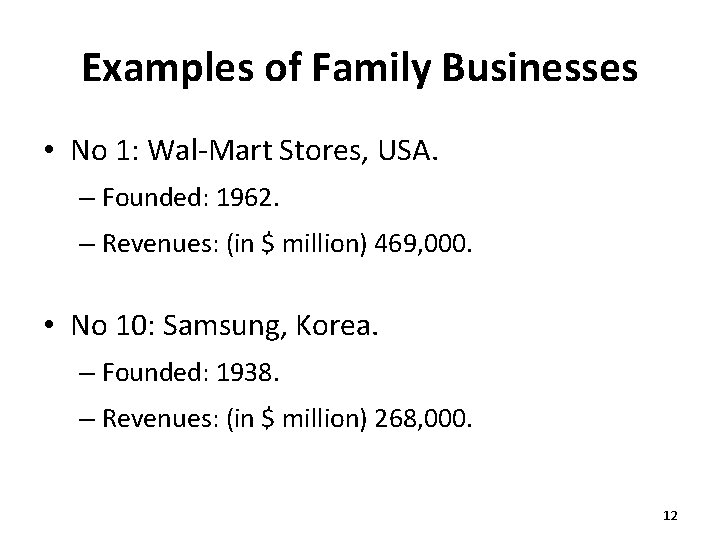
Examples of Family Businesses • No 1: Wal-Mart Stores, USA. – Founded: 1962. – Revenues: (in $ million) 469, 000. • No 10: Samsung, Korea. – Founded: 1938. – Revenues: (in $ million) 268, 000. 12
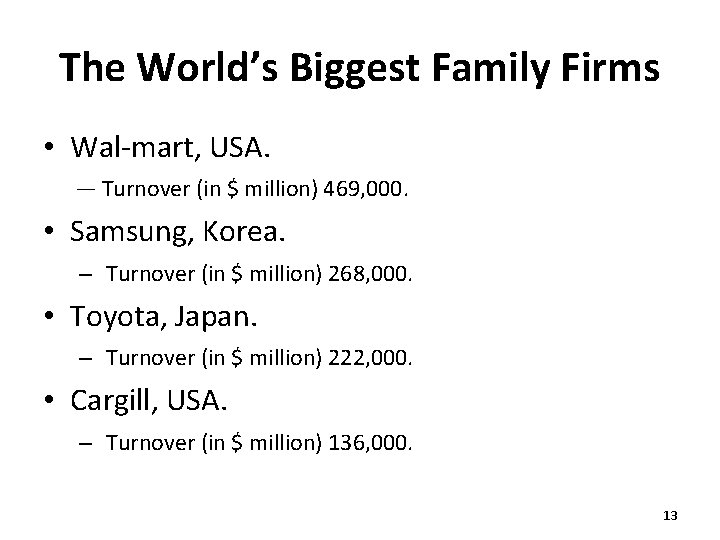
The World’s Biggest Family Firms • Wal-mart, USA. — Turnover (in $ million) 469, 000. • Samsung, Korea. – Turnover (in $ million) 268, 000. • Toyota, Japan. – Turnover (in $ million) 222, 000. • Cargill, USA. – Turnover (in $ million) 136, 000. 13
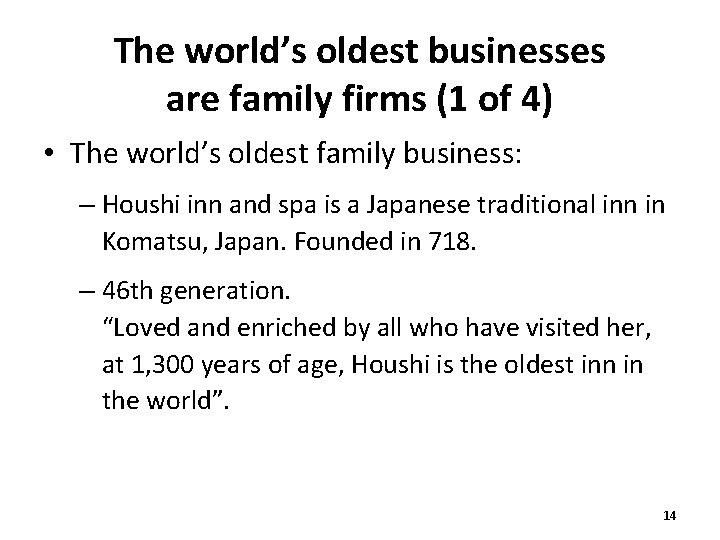
The world’s oldest businesses are family firms (1 of 4) • The world’s oldest family business: – Houshi inn and spa is a Japanese traditional inn in Komatsu, Japan. Founded in 718. – 46 th generation. “Loved and enriched by all who have visited her, at 1, 300 years of age, Houshi is the oldest inn in the world”. 14
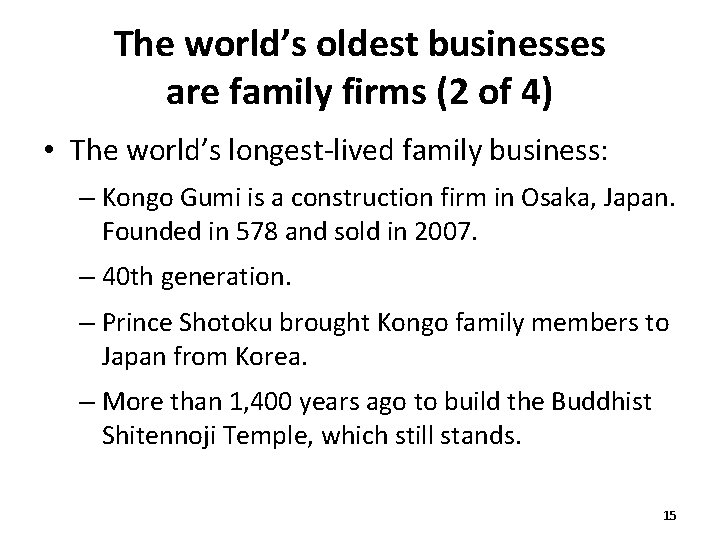
The world’s oldest businesses are family firms (2 of 4) • The world’s longest-lived family business: – Kongo Gumi is a construction firm in Osaka, Japan. Founded in 578 and sold in 2007. – 40 th generation. – Prince Shotoku brought Kongo family members to Japan from Korea. – More than 1, 400 years ago to build the Buddhist Shitennoji Temple, which still stands. 15
The world’s oldest businesses are family firms (3 of 4) • Islay’s Ice Cream – from a dairy founded in 1598. – It is based where the family has lived for more than 900 years! 16
The world’s oldest businesses are family firms (3 of 3) • Château de Goulaine, Vineyard, museum, butterfly collection in Haute Goulaine, France. Founded in 1000. – It is Europe’s oldest business - more than 1000 years old. • Fonderia Pontificia Marinelli, Bell foundry in Agnone, Italy. Founded in 1000. • Barone Ricasoli, Wine and olive oil in Siena, Italy. Founded in 1141. • Barovier & Toso , Glass making in Murano Venezia, Italy. Founded in 1295 – 20 th generation. 17
The world’s oldest businesses are family firms (4 of 4) • Zildjian is America’s oldest company. – The company`s cymbals have been made since 1623. – An alchemist in Constantinople developed a special melting method for making cymbals. – Which is still a closely guarded trade secret today. – His family were given the name Zildjian, which means son of the cymbal maker. 18
Many of the world’s best known brands are family firms • Heineken, • Michelin, • Ikea, • L'Oréal, • Estée Lauder, • United Colors of Benetton, • Marriot. 19
And family firms have a special place in Greece • Between 50% and 65% of very large firms are in family control. • And fully 100% of middle sized firms. – 3 E / Frigoglass – Titan – Alphabank – MOH / Bardinoyiannis Group – Fourlis – Boutaris 20
Family firms have lots of strategic advantages (1 of 2) • Heightened commitment, • longer term perspectives, • patient capital; • sustained values and vision; • continuity, • specialized knowledge; 21
Family firms have lots of strategic advantages (2 of 2) • easier organizational renewal, due to lack of external owners or directors; • cultural preferences for entrepreneurship and innovation; • “the personalism and particularism associated with the family firm form enhance rapid and flexible opportunistic investments based on intuitive heuristics” (Carney, 2005). 22
Special organizational competencies of the family firm • Overlapping responsibilities of owners and managers, along with small company size, enable rapid speed to market. • Concentrated ownership structure leads to higher returns on investment. • Desire to protect the family name and reputation often translates into high product quality and higher Return On Investment (“ROI”) • Patient capital, lower admin costs, skills, knowledge transfer, agility in rapidly changing markets. 23
Weaknesses • Surviving Transition • Family and Business Boundary Problems • Succession Imperatives 25
Surviving Transition • In their first 5 years of operation, approximately 85% of entrepreneurial and family-owned companies disappear. • Among those that survive, – only 30% are successfully transferred to the second generation of the founding-family owners. – only 12% survive under current ownership to the third generation. • Separating family and business roles can be very tough too. 26
Family and Business Boundary Problems • Nepotism, • confusion, • expectations and exploitations, • forming one’s own identity, • the path of self- validation versus zone of comfort, • supervising family members. 27
The Challenge • To maximize the good news and minimize the bad news about family enterprises, by working out how to build on their special features. 28
Adding family to the mix (1 of 2) • 1. Family CEO owner. • 2. Heir who works elsewhere, spouse, minor. • 3. Non-family manager, rewarded with stock; business partner of family founder. • 4. New generation, without shares. Working spouse. 30
Adding family to the mix (2 of 2) • 5. Silent equity partner. • 6. All the rest of the family, who don’t own the firm, or work in it. • 7. Non-family employees and managers. • People can make great contributions to the family business from any of these positions. 31
Family Business Overlap • Family: Harmony, Unity, Self-esteem. • Ownership: Stewardship, Values, Return On Investment (“ROI”). • Management: Production, Profit. • What happens if one of these domains dominates? 32
Family-First Businesses (1 of 2) • If family dominates, we have a “family first” firm. • Employment in the business is a birthright. • Members of the same generation are paid equally. • Perks that transfer from the business to family members are often extensive. 33
Family-First Businesses (2 of 2) • Financial systems may be obtuse by design, and secrecy is often paramount. • Commitment to continuity depends on the agendas of individual family members. 34
Ownership-First Businesses • If ownership dominates, we have an “ownership first” firm. • Investment time horizons and perceived risk are the most significant issues • Have shorter time frames within which financial results are evaluated. 35
Management-First Businesses (1 of 2) • If management dominates, we have a “management first” firm. • Employment is on the basis of qualifications— family is discouraged from working in the business. 36
Management-First Businesses (2 of 2) • Performance of employed family members is reviewed in the same manner as the performance of nonfamily managers. • Compensation is based on responsibility and performance. • Conversation between family members is usually all business. 37
The key to Optimizing Family Firm Performance • Balancing and Separating the Domains is the key to Optimizing Family Firm Performance. – Process, – Systems, – Professionalization. 38
Process, Systems, Professionalization (1 of 3) • How can we distance three domains? – Spelling out rules and roles clearly. – Communicating them well. – Planning professionally: • strategic plan • succession plan 39
Process, Systems, Professionalization (2 of 3) – Preparing and using (for family and non-family staff): • clear job descriptions, • HR policy and procedures, • career development guidelines, • organizational chart, • code of conduct, • performance evaluation measures. 40
Process, Systems, Professionalization (3 of 3) – Respect the need for privacy. – Family members encouraged to work outside business to get experience, and some space. – Developing formal governance systems for family and business. – Writing a family business protocol. 41
Let’s look at some of our studies in Greece • Family Firms: Growth Strategies and Practices. – Strengths and Weaknesses of the Family Firm. – Mapping the Stakeholders in Family Firms. – Balancing Family & Firm: Systems & Subsystems. – Familiness and continuous strategic renewal in the family firms. – The Role of Networking in the Growth Processes of Family Firms: An International Study. 42
Overview (1 of 2) • Does strategic renewal impact upon the performance of family firms? • Which aspects of “familiness” act as facilitators or inhibitors of strategic renewal. 44
Overview (2 of 2) • A survey instrument captured data on relevant family-related characteristics, organizational renewal, and firm performance. • Usable responses were collected from CEOs of 140 family firms in Greece. • Regression analysis was used to test hypotheses. 45
What moves a business from now into the future? (1 of 3) • Corporate Entrepreneurship shows us that “entrepreneurial firms are risk-taking, innovative and proactive” – (Barringer and Bluedorn, 1999, Dess and Lumpkin, 2005. ) • Dynamic Capabilities scholars argue for constant renewal of the resource base. – (Bowman and Ambrosini, 2003, Eisenhardt and Martin, 2000; Teece, Pisano and Shuen, 1997. ) 46
What moves a business from now into the future? (2 of 3) • Strategic marketers stress a firm’s capacity to adjust to change and/or exploit opportunities resulting from environmental changes. – (Dreyer and Gronhaug, 2000. ) • “Flexible Strategists” emphasize developing enabling strategies for organizing towards Iterative Self-renewal. – (Volberda and Lewin , 2003. ) 47
What moves a business from now into the future? (3 of 3) • Organizational Renewal. • Continuous and radical re-creation of organizational structures, processes, and products”. • Morphing. – (Rindova and Kotha 2001. ) 48
Organizational Renewal Imperative • Does this Organizational Renewal Imperative also apply to family firms, given the benefits of strategic benefits of their stability? 49
Benefits of Family Firms Stability: • heightened commitment, • longer term perspectives, • patient capital, • sustained values and vision, • continuity, • specialized knowledge. 50
Does Organizational Renewal Improve Performance for Family Firms? • Hypothesis 1: – Family firms with higher levels of organizational renewal will also report higher levels of financial performance. 51
Family firms and Organizational Renewal • Do family firms have special features which fuel or block the Organizational Renewal? • What does the literature suggest so far? • Is this worth further exploration? 52
Special features that fuel the Organizational Renewal rocket (1 of 2) • Some family firms have a cultural preference for entrepreneurship (Zahra et al. , 2004). • “family firms appear to place substantial importance on innovation practices and strategy” (Craig and Moores 2006, p 7). • The personalism and particularism associated with the family firm form enhance rapid and flexible opportunistic investments. (Carney, 2005) 53
Special features that fuel the Organizational Renewal rocket (2 of 2) • “Concentration of control … may facilitate organizational renewal, by removing any potential outside interference”. (Miller and Le Breton-Miller, 2006) • “…and permit them to be “more aggressive in entering new markets””. (Chrisman et al 2009; 745) 54
Special features that block the Organizational Renewal rocket? (1 of 4) • Continuity and command priorities make family firms a more stable “organizational form” than non-family firms. (Chrisman et al 2009; 754). 55
Special features that block the Organizational Renewal rocket? (2 of 4) • Conservative, established routines promoting “strategic simplicity” and sclerosis are associated with the longer CEO tenure of family firms. (Shepherd and Zahra, 2003; Zahra, 2005; Zahra, Hayton and Salvato, 2004). 56
Special features that block the Organizational Renewal rocket? (3 of 4) • Family-specific altruism constrains kin behavior in the making of commercial decisions (Lubatkin, Schulze, Ling and Dino, 2005; Schulze, Lubatkin and Dino, 2002). 57
Special features that block the Organizational Renewal rocket? (4 of 4) • The “stagnation perspective”, Miller et al (2008: 57 -59). – Large family firms owners become ossified, change-resistant, remote, and exploitative. – Small family firm owners lack the vision, resources, and culture to grow. 58
Literature Review (1 of 2) • Literature implies that family firms experience both very specific inhibitors and idiosyncratic facilitators of organizational renewal. And that both stability and change are probably strategically important for family firms. 59
Literature Review (2 of 2) • Research suggests a wide range of structural and cultural aspects of familiness which probably facilitate or inhibit continuous strategic renewal in family firms. • We selected some which seemed likely to be especially important, and were feasible to explore in the planned survey. 60
Are Founder CEOs more likely to enact Organizational Renewal? (1 of 4) • Successors may be more prone to political rentseeking, than to entrepreneurship (Morck and Young 2003, 2004). • Successors often consider it their duty to show respect to foregoing generations by continuing to enact their decisions (Bertrand Schoar, 2006). • They may thus fall into cross-generational path dependency (Arregle et al 2007). 61
Are Founder CEOs more likely to enact Organizational Renewal? (2 of 4) • A firm founder has already enacted a dramatic adaptive organizational event: the creation of a new venture (Gedajlovic, Lubatkin and Schulze, 2004). • The fit of first gen firms to the environment is better and CEOs have more actual and symbolic power (Gedajlovic, Lubatkin and Schulze, 2004). 62
Are Founder CEOs more likely to enact Organizational Renewal? (3 of 4) • There is less squabbling over resources than in later generations (Miller and Le Breton-Miller, 2006). • Founder CEOs prioritize rapid growth and innovation over longevity objectives - lower social risk than later generations. (Miller et al, 2008; 54). 63
Are Founder CEOs more likely to enact Organizational Renewal? (4 of 4) • Hypothesis 2: – Founder family firm CEOs will display higher levels of organizational renewal. 64
How many psychologists does it take to change a light bulb? • Only one …. • But the lightbulb has to really, really want to change. 65
Do you have to really want to grow to enact Organizational Renewal? (1 of 2) • Conscious management intentionality enables proactivity (Bloodgood and Morrow, 2003; Flier et al. , 2003; Whittington, 1988). • “growth is a function of growth aspiration” (Covin and Slevin, 1997; Wiklund and Shepherd, 2003). 66
Do you have to really want to grow to enact Organizational Renewal? (2 of 2) • Hypothesis 3: – Strong family CEO growth aspiration will lead to higher levels of organizational renewal. 67
Does wanting the kids in the business make you too conservative to enact Organizational Renewal? (1 of 3) • An intention to transfer business ownership to subsequent generations is likely to enhance stewardship issues, including caution in strategy, and financial conservatism (Miller and Le Breton-Miller, 2006). • The altruism associated with parenthood may cause family CEOs to act in risk-averse and conservative ways to protect their children’s future livelihoods (Schulze, Lubatkin, Dino and Buchholtz, 2001). 68
Does wanting the kids in the business make you too conservative to enact Organizational Renewal? (2 of 3) • But, CEO self-control, and the fairness inspired by organizational justice, can mitigate the potentially negative impact of parental altruism on family firm performance (Lubatkin et al, 2007). 69
Does wanting the kids in the business make you too conservative to enact Organizational Renewal? (3 of 3) • Hypothesis 4: – A desire to employ younger generation family members will lead to lower levels of organizational renewal. 70
Does planning and managing for Successor Development and Transfer, make it more likely to enact Organizational Renewal? (1 of 2) • A strong family vision of the firm’s future is a specific kind of growth and survival aspiration, and may be expected to enhance morphing activities. • The undertaking of planning activities aimed at readying the firm for cross-generation transfer offer tremendous potential for organizational renewal and re-invention. 71
Does planning and managing for Successor Development and Transfer, make it more likely to enact Organizational Renewal? (2 of 2) • Hypothesis 5: – Higher levels of succession planning lead to higher levels of organizational renewal. 72
Does employing lots of family in the business make you too conservative to enact Organizational Renewal? (1 of 3) • The more family employees dominate a firm numerically, the more their familial norms, mind-sets, behaviors, and values will also dominate the firm, and the more resistant these will be to change. 73
Does employing lots of family in the business make you too conservative to enact Organizational Renewal? (2 of 3) • Increases in conflict, resource depletion and succession or leadership challenges divert family attention away from continuous strategic renewal, and towards intra-family allocation of status and resources (Miller and Le-Bretton Miller, 2006, p. 83). • The greater the number of family members whose salary income is contingent upon the firm, the lower the likelihood that this will be routinely jeopardized by organizational re-invention. 74
Does employing lots of family in the business make you too conservative to enact Organizational Renewal? • Hypothesis 6: – The higher the percentage of family employees within the firm, the lower the level of organizational renewal. 75
Methodology (1 of 2) • Our study was conducted in Greece: • between 50% and 65% of very large firms in family control (La Porta, Lopez-de-Silanes and Shleifer, 1999; Morck and Yeung, 2004) and fully 100% of middle sized firms. • We surveyed the CEOs of small and medium family firms (excluding micro-firms of less than 10 employees). • Our sample was drawn from the ICAP (the Gallup International Association member in Greece) company directory. 76
Methodology (2 of 2) • After identifying and pre-notifying the appropriate person at each firm, 520 surveys were faxed to the CEOs. Two weeks later, a second copy of the survey was sent to non-respondents. • All respondents self-categorized as family firm CEOs. • 141 usable surveys corresponding to a 27. 1 percent response rate. • The appropriate measures were developed or adopted from previous research. 77
What we found out (1 of 2) • The financial performance of our family firms was only explained by organizational renewal (H 1). • Organizational renewal fully mediates the relationship between our antecedents and financial performance. • CEO: Founder CEOs (H 2) and those with higher growth aspirations (H 3) enjoy higher levels of organizational renewal. 78
What we found out (2 of 2) • Succession: Succession planning does enhance morphing (H 5), but the intention to transfer ownership to following generations does not have a significant effect (H 4). • Higher levels of family employment within the firm are negatively correlated with organizational renewal (H 6). • Market competitiveness, our control variable, does not have an effect on organizational renewal. This indicates that organizational renewal is not a reaction to the environment, but more of a function of the CEO and their intention. 79
So what? • A dynamic capability for profound organizational renewal is a key strategic weapon for family firms, alongside the stability of stewardship • The key role of the family firm CEO emerged from the data. • Professional Succession Planning appears to liberate family firms from the stagnation of too familial and conservative a culture. • Generic family succession intention is not enough! 80
Strong future focus • CEO growth aspiration comes together with structured succession planning and practice to generate a futurefocused culture. • These CEOs are creating a business which will thrive in the future, and not curating an organizational heirloom shaped and constrained by the past. • Their strong future focus liberates them from possible cross -generational path dependency, • Allowing the special resources of their family's business to act instead as a springboard for on-going organizational renewal. 81
Conclusion • Family CEOs producing financial growth through organizational renewal are creating a business which will thrive in the future, and not curating an organizational heirloom shaped and constrained by the past. 82