Producing World Class Goods and Services CHAPTER 9


- Slides: 48
* * * Producing World Class Goods and Services * * CHAPTER ** 9 * Nickels Mc. Hugh Mc. Graw-Hill/Irwin Understanding Business, 8 e 1 -1 9 -1 © 2008 The Mc. Graw-Hill Companies, Inc. , All Rights Reserved.
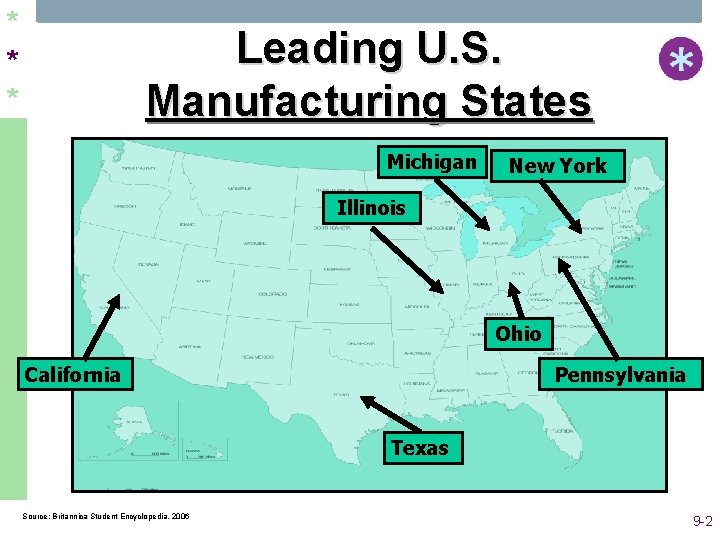
* * * Leading U. S. Manufacturing States Michigan New York Illinois Ohio California Pennsylvania Texas Source: Britannica Student Encyclopedia, 2006 9 -2
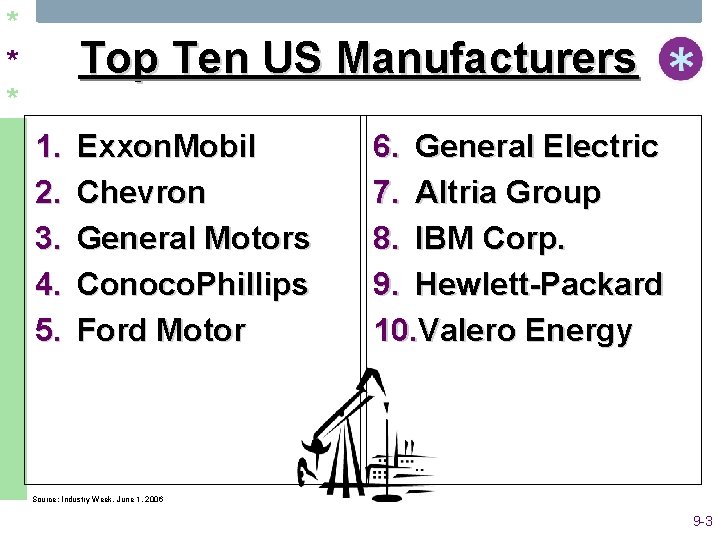
* * * Top Ten US Manufacturers 1. 2. 3. 4. 5. Exxon. Mobil Chevron General Motors Conoco. Phillips Ford Motor 6. General Electric 7. Altria Group 8. IBM Corp. 9. Hewlett Packard 10. Valero Energy Source: Industry Week, June 1, 2006 9 -3
* * * U. S. MANUFACTURING IN PERSPECTIVE MANUFACTURING AFFECTS THE U. S. ECONOMY GM pays its workers about $8. 7 billion a year and supports 900, 000 jobs. Rising gas prices in 2005 threatened American carmakers and encouraged consumers to buy high gas mileage Japanese cars. 9 -4
* * * . Today, American companies have 60% of the U. S. auto market, compared to 95% in the 1950 s. Companies such as BMW, Mercedes, Nissan, and Hyundai have found the U. S. to be a good place to build cars. However, the domestic auto industry is still healthy. 9 -5
* * * How Manufacturers Have Become More Effective • • Focus on customers Maintain close relationships Continuous improvement Focus on quality Save costs Rely on the Internet New production techniques 9 -6
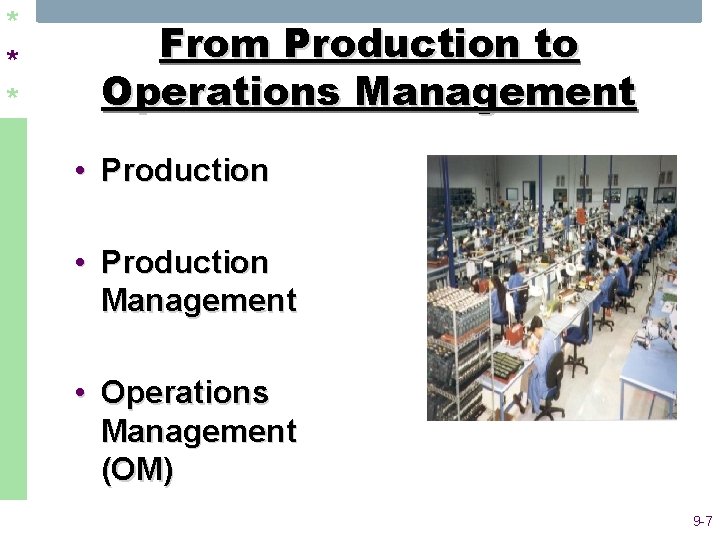
* * * From Production to Operations Management • Production Management • Operations Management (OM) 9 -7
* * * PRODUCTION is the creation of finished goods and services using the factors of production: land, labor, capital, entrepreneurship, and knowledge. Production has usually been associated with MANUFACTURING, but this is changing. The SERVICE SECTOR has grown dramatically. The U. S. now has a SERVICE ECONOMY, one dominated by the service sector. 9 -8
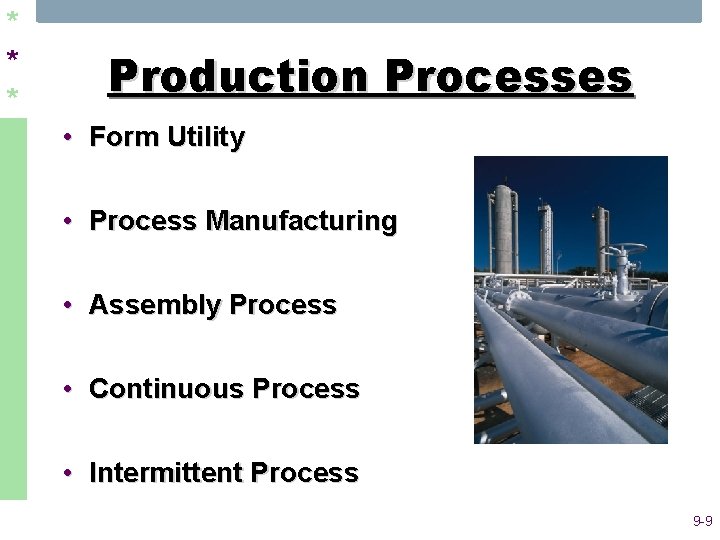
* * * Production Processes • Form Utility • Process Manufacturing • Assembly Process • Continuous Process • Intermittent Process 9 -9
* * I. U. S. MANUFACTURING IN PERSPECTIVE * A. What Manufacturers Have Done to Become More Competitive Learning goal 1 Describe the evolution of production in the United States. 9 -10
* * * Production Processes II. FROM PRODUCTION TO OPERATIONS MANAGEMENT A. Learning goal 2 Define operations management. Operations Management in the Service Sector 9 -11
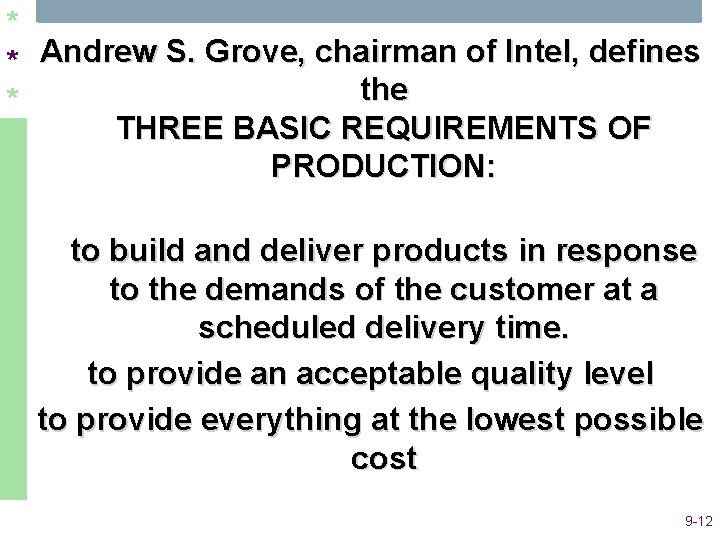
* * Andrew S. Grove, chairman of Intel, defines the * THREE BASIC REQUIREMENTS OF PRODUCTION: to build and deliver products in response to the demands of the customer at a scheduled delivery time. to provide an acceptable quality level to provide everything at the lowest possible cost 9 -12
* * * III. PRODUCTION PROCESSES Learning goal 3 Distinguish between the various production processes and describe several of the production techniques that have improved the productivity of U. S. companies, including computer aided design and manufacturing, flexible manufacturing, lean manufacturing, and mass customization. 9 -13
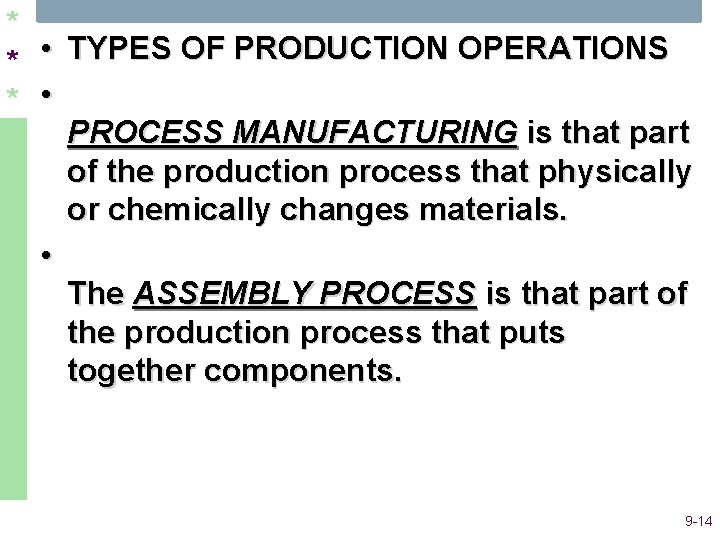
* • TYPES OF PRODUCTION OPERATIONS * * • PROCESS MANUFACTURING is that part of the production process that physically or chemically changes materials. • The ASSEMBLY PROCESS is that part of the production process that puts together components. 9 -14
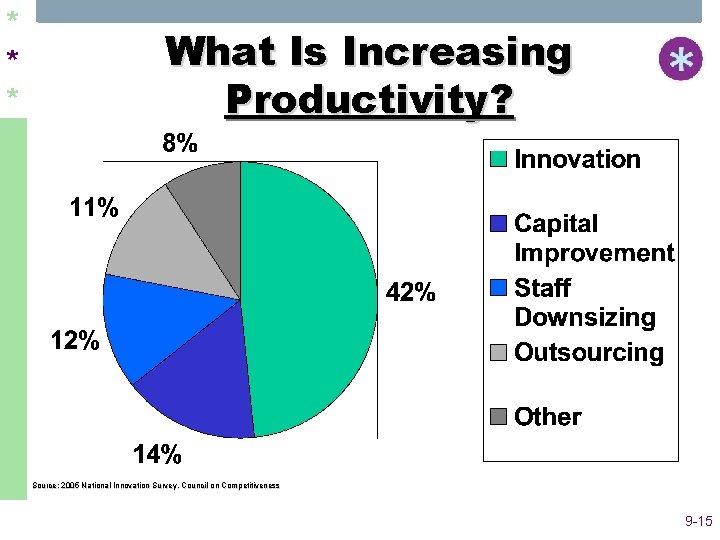
* * * What Is Increasing Productivity? Source: 2005 National Innovation Survey, Council on Competitiveness 9 -15
* * * III. PRODUCTION PROCESSES Learning goal 3 A. The Need to Improve Production Techniques and Cut Costs B. Computer Aided Design and Manufacturing C. Computer Aided Design and Manufacturing D. Flexible Manufacturing E. Lean Manufacturing F. Mass Customization 9 -16
* * * Production Techniques • Flexible Manufacturing • Lean Manufacturing • Mass Customization 9 -17
* * * Operations Management Planning • Facility Location • Facility Layout • Materials Requirement Planning • Purchasing • J I T Inventory Control • Quality Control 9 -18
* * * IV. OPERATIONS MANAGEMENT PLANNING Learning goal 4 Describe the operations management planning issues involved in both the manufacturing and service sectors, including facility location, facility layout, materials requirement planning, purchasing, just in time inventory control, and quality control. A. Facility Location B. Facility Layout C. Materials Requirement Planning D. Purchasing E. Just in Time Inventory Control F. Quality Control 9 -19
* * * • 2. PRODUCTION MANAGEMENT is the term used to describe all the activities managers do to help their firms create goods 9 -20
* * * • b. OPERATIONS MANAGEMENT is a specialized area in management that converts or transforms resources (including human resources) into goods and services. 9 -21
* * * V. CONTROL PROCEDURES: PERT AND GANTT CHARTS Learning goal 5 Explain the use of PERT and Gantt charts to control manufacturing processes. 9 -22
* * * Control Procedures • Program Evaluation & Review Techniques (PERT) • Gantt Chart 9 -23
* * * Gantt Chart • Named for its developer, Henry Gantt • A bar graph that clearly shows what projects are being worked on and how much has been completed at any given time 9 -24
* * * PERT Steps 1. Analyzing and sequencing tasks that need to be done 2. Estimating the time needed to complete each task 3. Drawing a PERT network illustrating the information from steps 1 and 2 4. Identifying the critical path 9 -25
* * * Production Efficiency • Krispy Kreme Doughnuts – 5, 208 a minute • Twinkies – 972 a minute • Life. Savers 5 Flavor Roll – 100 rolls a minute • Jell O Gelatin Boxes – 764 a minute • Chips Ahoy! – 4, 000 a minute Source: World Features Syndicate 9 -26
* * * COMPUTER AIDED DESIGN (CAD) is the use of computers in the design of products. COMPUTER AIDED MANUFACTURING (CAM) is the use of computers in the manufacturing of products. CAD/CAM, the use of both computer aided design and computer aided manufacturing, made it pos sible to custom design products for small markets. 9 -27
* * * CAD has doubled productivity in many firms. In the past, computer aided design machines couldn’t talk to computer aided manufacturing machines. COMPUTER INTEGRATED MANUFAC TURING (CIM) is uniting of computer aided design with computer aided manufacturing 9 -28
* * * FACILITY LOCATION is the process of selecting a geographic location for a company’s operations. One strategy is to find a site that makes it EASY FOR CONSUMERS TO USE THE COMPANY’S service, such as putting flower shops and banks in supermarkets. The ultimate convenience is shopping through the INTERNET. 9 -29
* * * FACILITY LOCATION The most successful service sector businesses are conveniently located. FACILITY LOCATION FOR MANUFACTURERS Manufacturers often choose sites that are CLOSE TO INEXPENSIVE LABOR or to the RIGHT KIND OF LABOR. 9 -30
* * * FACILITY LOCATION Manufacturers often choose sites that are CLOSE TO INEXPENSIVE LABOR or to the RIGHT KIND OF LABOR. LOW COST LABOR remains the key reason manufacturers move their plants, even though labor cost is becoming a smaller portion of total production costs. Firms should maintain the SAME QUALITY STANDARDS AND FAIR LABOR PRACTICES wherever they produce. 9 -31
* * * • LEAN MANUFACTURING is the production of goods using less of everything compared to mass production: less human effort, less manufacturing space, less investment in tools, less engineering time to develop a new product in half the time. 9 -32
* * * Three Requirements For Production 1. Build and deliver products in response to the demands of the customer at a scheduled delivery time 2. Provide an acceptable quality level 3. Provide everything at the lowest possible cost 9 -33
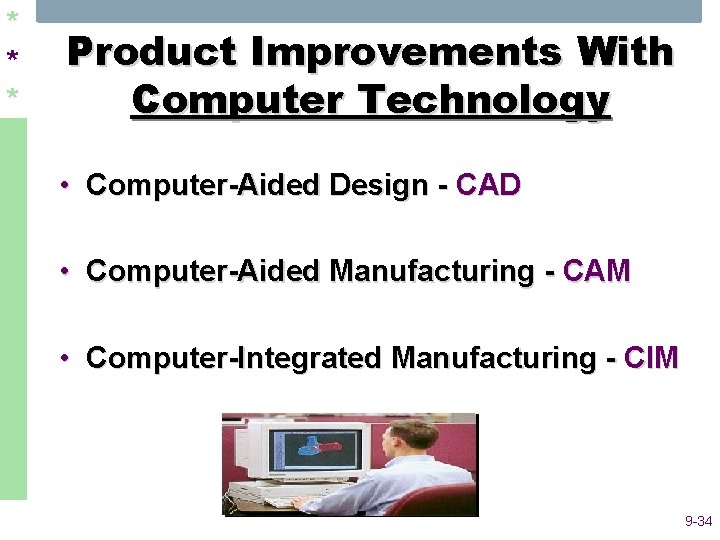
* * * Product Improvements With Computer Technology • Computer Aided Design CAD • Computer Aided Manufacturing CAM • Computer Integrated Manufacturing CIM 9 -34
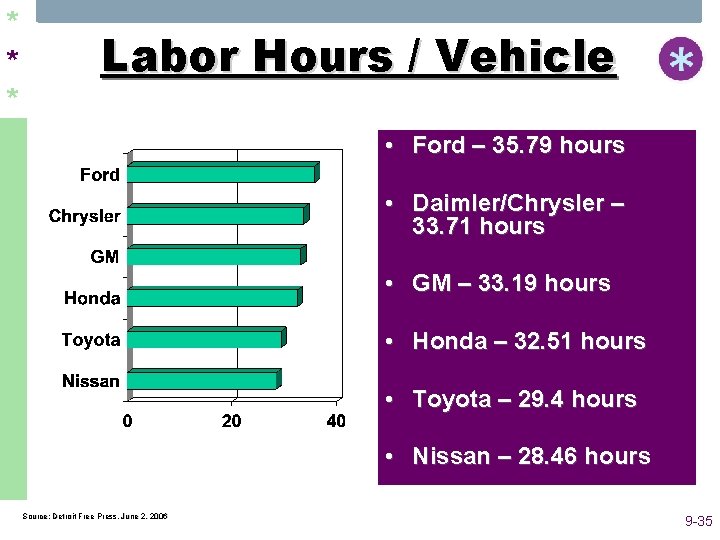
* * * Labor Hours / Vehicle • Ford – 35. 79 hours • Daimler/Chrysler – 33. 71 hours • GM – 33. 19 hours • Honda – 32. 51 hours • Toyota – 29. 4 hours • Nissan – 28. 46 hours Source: Detroit Free Press, June 2, 2006 9 -35
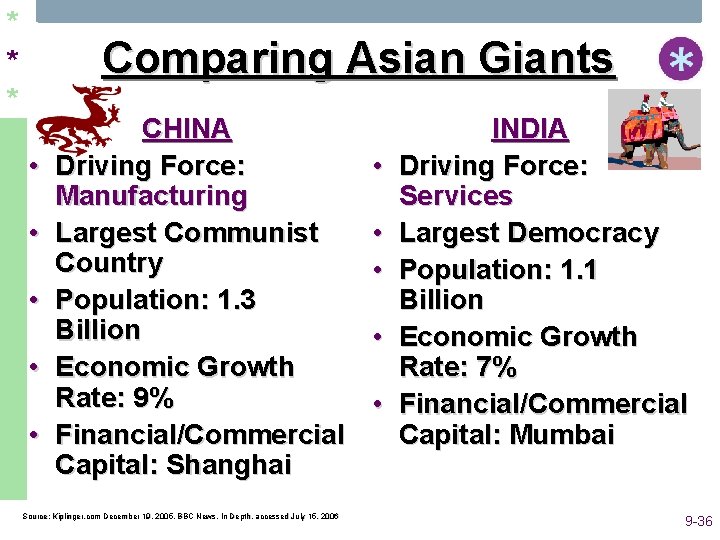
* * * Comparing Asian Giants • • • CHINA Driving Force: Manufacturing Largest Communist Country Population: 1. 3 Billion Economic Growth Rate: 9% Financial/Commercial Capital: Shanghai Source: Kiplinger. com December 19, 2005, BBC News, In Depth, accessed July 15, 2006 • • • INDIA Driving Force: Services Largest Democracy Population: 1. 1 Billion Economic Growth Rate: 7% Financial/Commercial Capital: Mumbai 9 -36
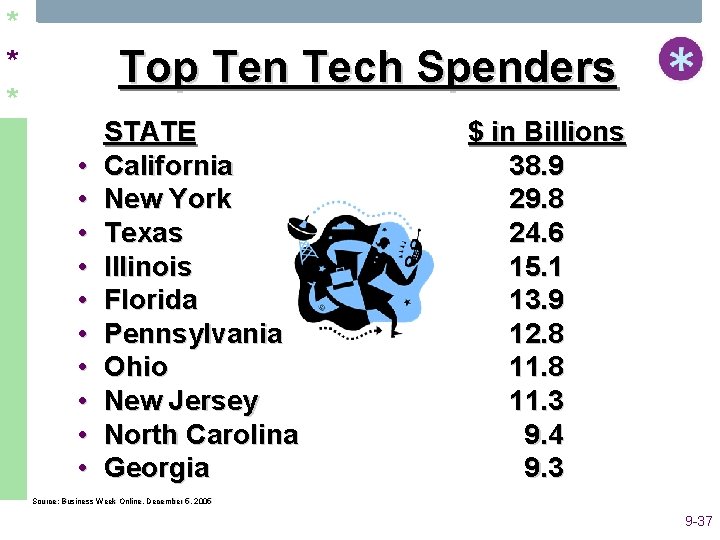
* * * Top Ten Tech Spenders • • • STATE California New York Texas Illinois Florida Pennsylvania Ohio New Jersey North Carolina Georgia $ in Billions 38. 9 29. 8 24. 6 15. 1 13. 9 12. 8 11. 3 9. 4 9. 3 Source: Business Week Online, December 5, 2005 9 -37
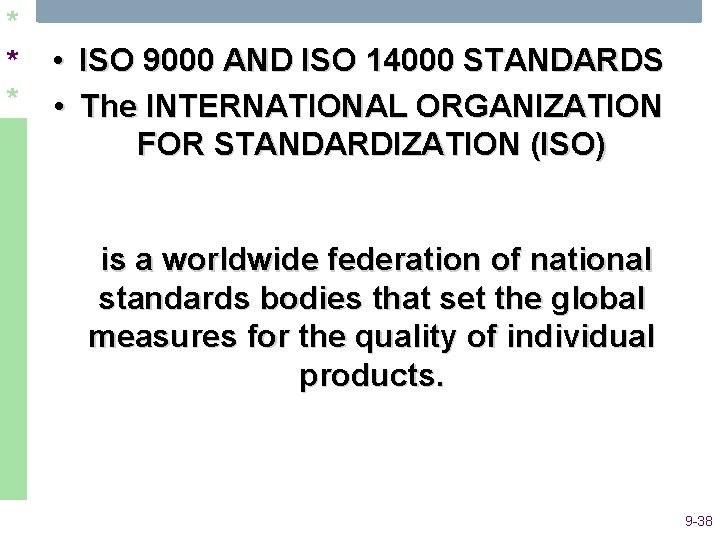
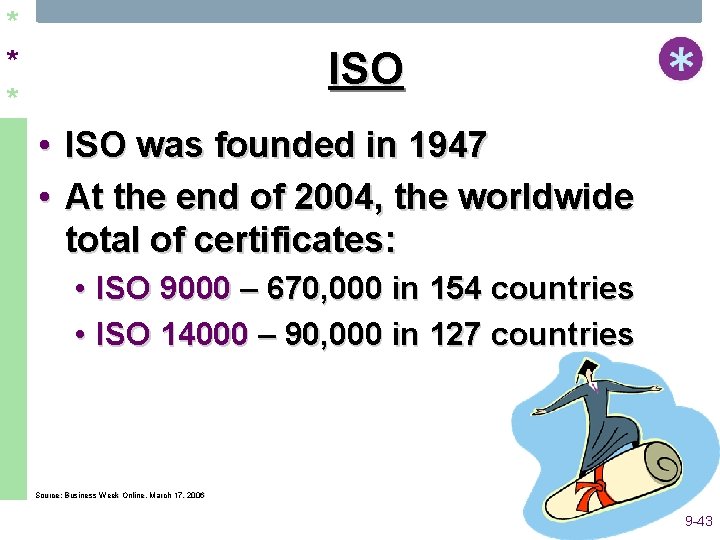
* * * • ISO 9000 AND ISO 14000 STANDARDS • The INTERNATIONAL ORGANIZATION FOR STANDARDIZATION (ISO) is a worldwide federation of national standards bodies that set the global measures for the quality of individual products. 9 -38
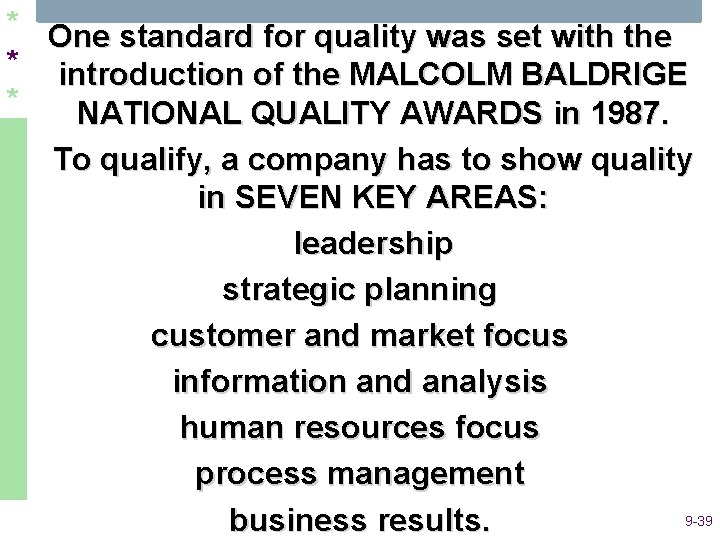
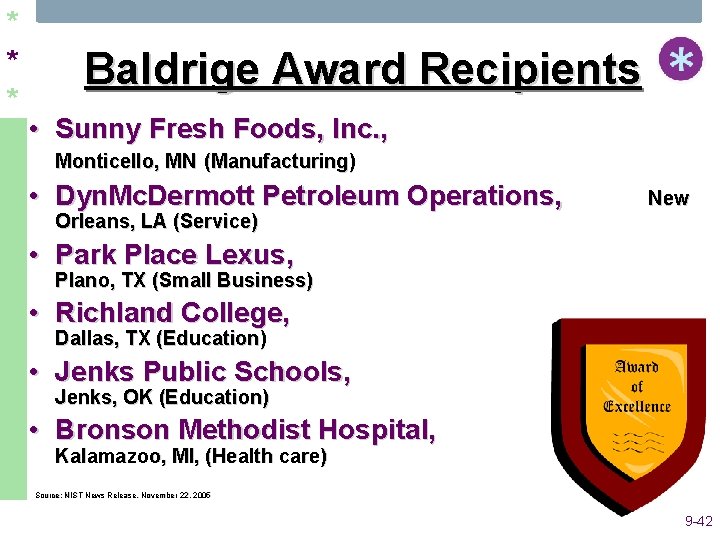
* One standard for quality was set with the * introduction of the MALCOLM BALDRIGE * NATIONAL QUALITY AWARDS in 1987. To qualify, a company has to show quality in SEVEN KEY AREAS: leadership strategic planning customer and market focus information and analysis human resources focus process management 9 -39 business results.
* * * VI. PREPARING FOR THE FUTURE 9 -40
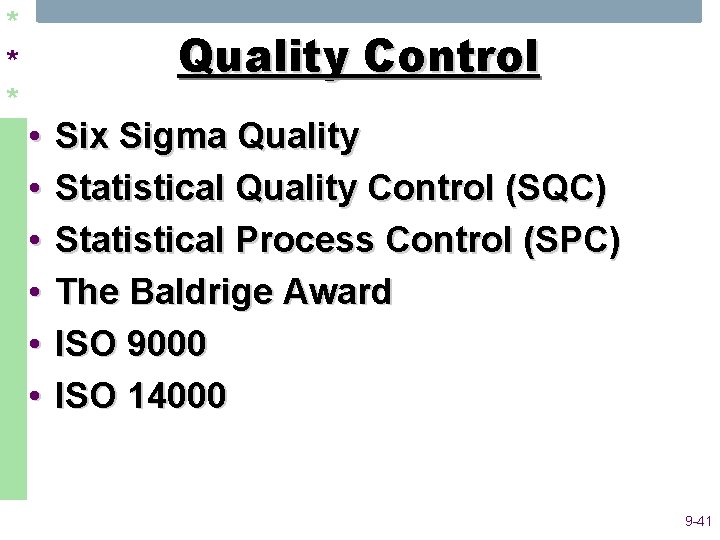
* * * Quality Control • • • Six Sigma Quality Statistical Quality Control (SQC) Statistical Process Control (SPC) The Baldrige Award ISO 9000 ISO 14000 9 -41
* * * Baldrige Award Recipients • Sunny Fresh Foods, Inc. , Monticello, MN (Manufacturing) • Dyn. Mc. Dermott Petroleum Operations, New Orleans, LA (Service) • Park Place Lexus, Plano, TX (Small Business) • Richland College, Dallas, TX (Education) • Jenks Public Schools, Jenks, OK (Education) • Bronson Methodist Hospital, Kalamazoo, MI, (Health care) Source: NIST News Release, November 22, 2005 9 -42
* * * ISO • ISO was founded in 1947 • At the end of 2004, the worldwide total of certificates: • ISO 9000 – 670, 000 in 154 countries • ISO 14000 – 90, 000 in 127 countries Source: Business Week Online, March 17, 2006 9 -43
* * * Learning from Failure • • • Formalize forums for analyzing failure Move the goalposts Share personal stories Bring in outsiders Prove yourself wrong, not right Celebrate smart failures Source: Business Week Online, July 10, 2006 9 -44
* * * Companies now use MODERN QUALITY CONTROL STANDARDS such as six sigma. SIX SIGMA QUALITY is a quality measure that allows only 3. 4 defects per million events. STATISTICAL QUALITY CONTROL (SQC) is the process some managers use to continually monitor all phases of the production process to assure that quality is being built into the product from the beginning. 9 -46
* * * STATISTICAL PROCESS CONTROL (SPC) is the process of taking statistical samples of product components at each stage of the production process and plotting those results on a graph. Checking products against standards all along the production process eliminates the need for quality control inspection at the end. This approach to quality control is often called the DEMING CYCLE (after the late W. Edwards Deming): Plan, Do, Check, Act (PDCA). 9 -47