
International marketing Kai Hu Teaching staff Foreign Language
- Slides: 37
International marketing Kai Hu: Teaching staff @ Foreign Language School Specialization: International Tourism & Hospitality Management Hu. Bei Polytechnic University Ci. Hu Campus, Hubei, China website: http: //www. hbpu. edu. cn/ Mail to 519441816@qq. com
Course outline International marketing basics 1 Introduction to International Marketing 2 Three basic theories of International trade The international marketing environment Targeting marketing information markets International marketing mix Managing the international marketing E-commerce and online marketing
Course requirement Attendance and participation 20% In-class Quiz 20% Group assignment and presentation 60%
Introduction What is marketing? “Marketing is a social and managerial process by which individuals and groups obtain what they need and want through creating, offering, and exchanging products of value with others. ” (Kotler) Process, exchange, value
Needs, wants and demands Needs: needs is a state of deprivation of some basic satisfaction such as: food, clothes, digitals Wants: an individual may need to watch TV, but wants to consume a particular brand of Television. Demands: it is defined in a narrative way not in a broad way in the textbooks. it could be defined as the ability and willingness to buy any number of products based on customer’s purchasing power.
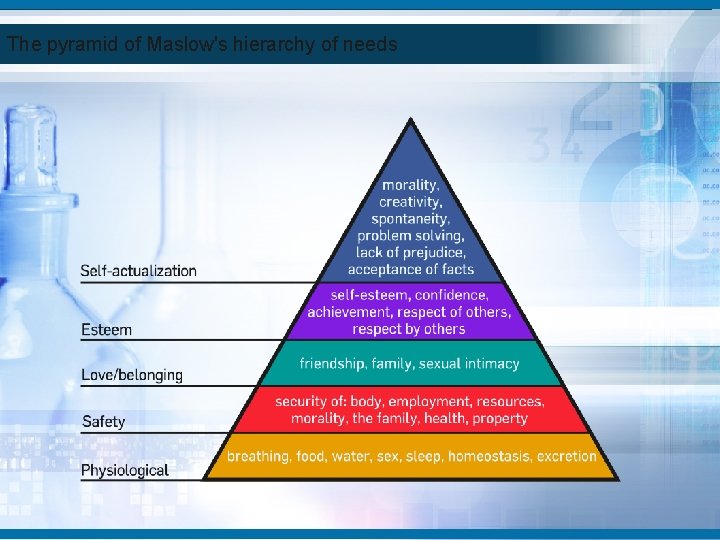
The pyramid of Maslow's hierarchy of needs
According to Maslow's hierarchy of needs, he divides human's needs into five levels: basic needs, safety needs, social needs, esteem needs and selffulfillment needs. He usually uses a triangle or pyramid shape to describe his theory. Question: do the marketers create human needs?
Basic needs are relatively few, but people's wants are unlimited, they are shaped by social influences, their past history and consumption experiences. Different people, then, may have very different wants to satisfy the same need. Everyone needs to keep warm on cold winter nights, for instance. But some people want electric blankets, while others prefer old-fashion down comforters. Just because of this, it give room or scope to the marketer.
Consumer value two factors contribute to consumer value, they are desired value and perceived value Desired value refers to what customers desire in a product or service Perceived value is the benefit that a customer believes he or she received from a product after it was purchased Consumer value: the deference between the values the consumer gains from owning and using a product and the costs of obtaining the product.
consumer satisfaction Consumer purchasing decision is based on their perception of the value that products and services deliver. Consumer satisfaction: To what extent that product’s perceived performance could match a buyer’s expectation. (quality)
exchange, transaction and relationships Exchange: the act of obtaining a desired object from someone by offering something in return. Exchange is the core of marketing.
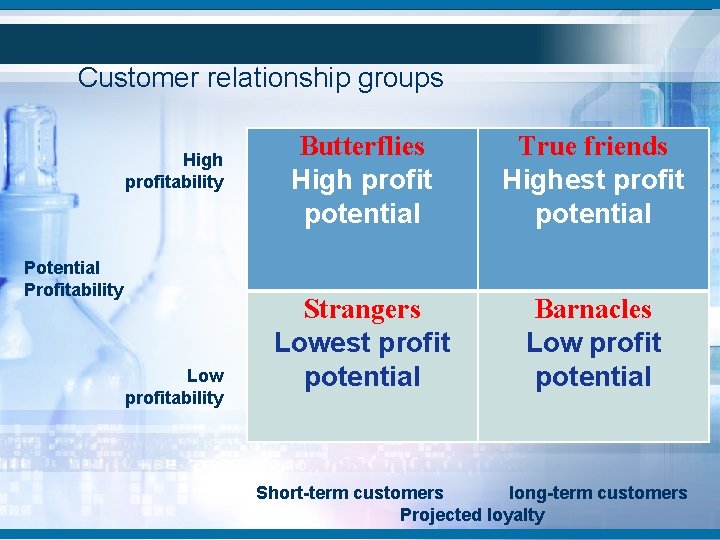
Customer relationship groups High profitability Potential Profitability Low profitability Butterflies High profit potential True friends Highest profit potential Strangers Lowest profit potential Barnacles Low profit potential Short-term customers long-term customers Projected loyalty
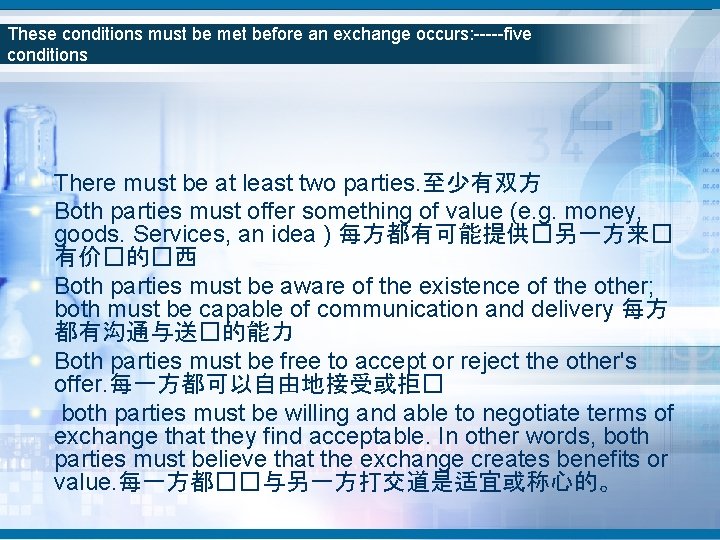
These conditions must be met before an exchange occurs: -----five conditions There must be at least two parties. 至少有双方 Both parties must offer something of value (e. g. money, goods. Services, an idea ) 每方都有可能提供�另一方来� 有价�的�西 Both parties must be aware of the existence of the other; both must be capable of communication and delivery 每方 都有沟通与送�的能力 Both parties must be free to accept or reject the other's offer. 每一方都可以自由地接受或拒� both parties must be willing and able to negotiate terms of exchange that they find acceptable. In other words, both parties must believe that the exchange creates benefits or value. 每一方都��与另一方打交道是适宜或称心的。
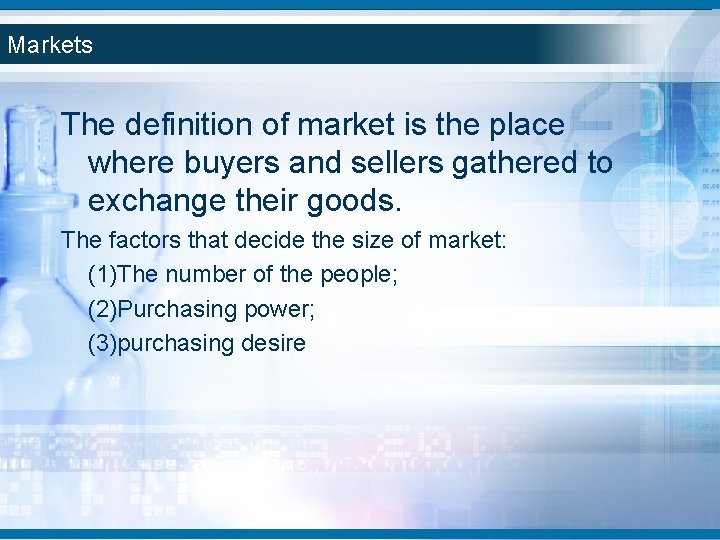
Markets The definition of market is the place where buyers and sellers gathered to exchange their goods. The factors that decide the size of market: (1)The number of the people; (2)Purchasing power; (3)purchasing desire
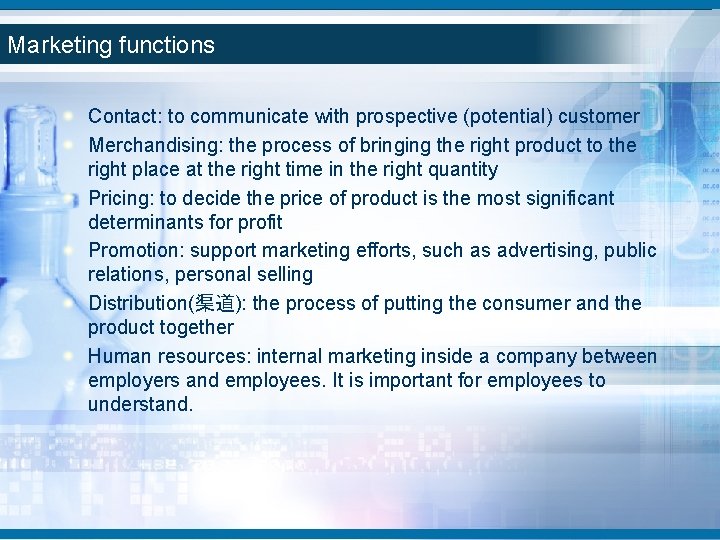
Marketing functions Contact: to communicate with prospective (potential) customer Merchandising: the process of bringing the right product to the right place at the right time in the right quantity Pricing: to decide the price of product is the most significant determinants for profit Promotion: support marketing efforts, such as advertising, public relations, personal selling Distribution(渠道): the process of putting the consumer and the product together Human resources: internal marketing inside a company between employers and employees. It is important for employees to understand.
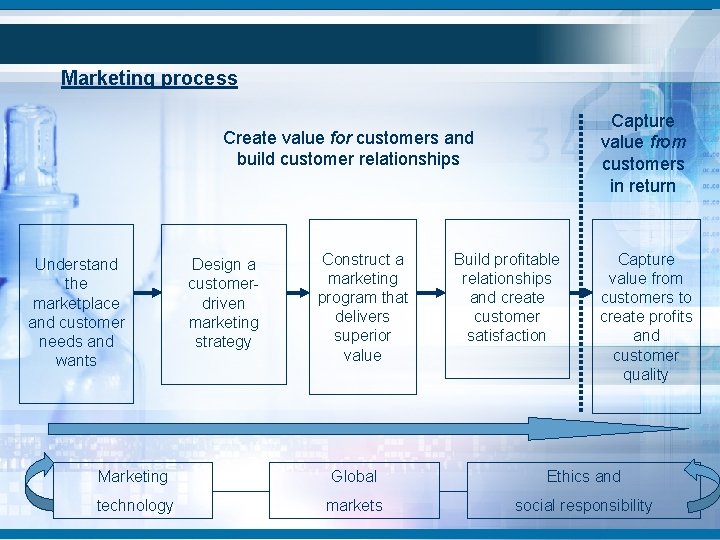
Marketing process Capture value from customers in return Create value for customers and build customer relationships Understand the marketplace and customer needs and wants Design a customerdriven marketing strategy Construct a marketing program that delivers superior value Build profitable relationships and create customer satisfaction Capture value from customers to create profits and customer quality Marketing Global Ethics and technology markets social responsibility
Introduction What is international marketing? - “International marketing is the process of planning and conducting transactions across national borders to create exchanges that satisfy the objectives of individuals and organizations” (Czinkota and Ronkainen) - “International marketing focuses its resources on global market opportunities and threats” (Keegan and Green) - “International marketing is the motor of the internationalization process of the firm” (Usunier) - It is a tool used to obtain improvement of the firm’s position in the global market - Strategy and action, global and local
Different levels of international marketing Domestic marketing : entirely focus on home country market, without targeting overseas market. Export marketing: the initial stage of addressing market opportunities outside the domestic market International marketing: more involved in overseas market. entering certain countries by evaluating a company’s resources and the nature of opportunity and threat.
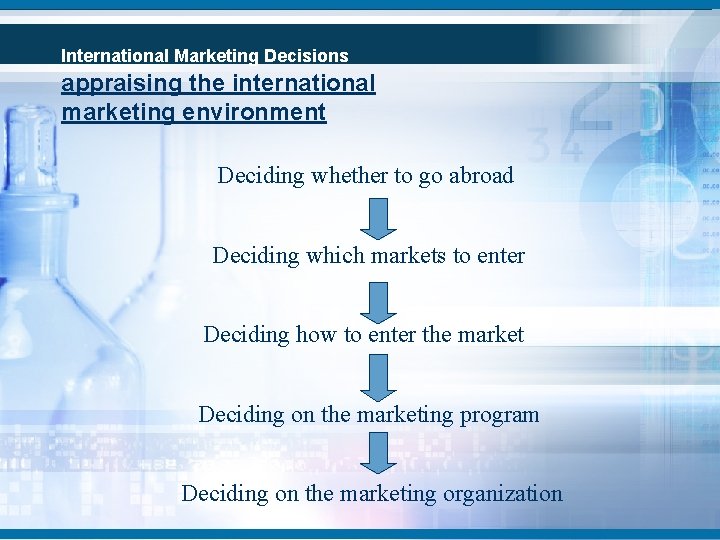
International Marketing Decisions appraising the international marketing environment Deciding whether to go abroad Deciding which markets to enter Deciding how to enter the market Deciding on the marketing program Deciding on the marketing organization
Introduction What are the similarities and differences between international marketing and domestic marketing? Similarities: basic concepts, practices and tools are almost identical, key success factors are the same… Differences: more strategic, more variables, more complex, cultural differences, legal constraints, information sources, managing distances, entry mode choice…
International marketing of Chinese companies Read yourself
marketing management orientations(市����念 ) Marketing management wants to design strategies that will build profitable relationships with target consumers. But what philosophy should guide these marketing strategies?
There are five alternative concepts under which organizations design and carry out their marketing strategies: the production product selling marketing societal marketing concepts.
Production concept This concept is the oldest orientations that guides sellers. ①The content The idea that consumers will favor products that are available and highly affordable. Therefore, management should focus on improving production and distribution efficiency.
②situations adopted: -----two First: Demand for a product exceeds the supply Second: the cost is too high and improved productivity is needed to bring it down. ③disadvantage leading to marketing myopia (短视).
Product concept ①The content The idea that consumers will favor products that offer the most quality, performance, and features and that the organization should therefore devote its energy to making continuous product improvement. ②situations adopted: Demand for a product exceeds the supply. But the extent changed. ③disadvantage: also lead to marketing myopia (短视).
Selling concept ①The content The idea that consumers will not buy enough of the firm's products unless it undertakes a large-scale selling and promotion effort. ②situations adopted: ——�方市�向�方市��渡�段 ★the concept is typically practiced with unsought goods---those that buyers do not normally think of buying, such as insurance or blood donations. These industries must be good at tracking down prospects and selling them on product benefits.
Selling concept (con. ) ★most firms practice the selling concept when they face overcapacity. Their aim is to sell what they make rather than make the market wants. Demand for a product exceeds the supply. But the extent changed further, especially in a small part. ③disadvantage: Such a marketing strategy carries high risks.
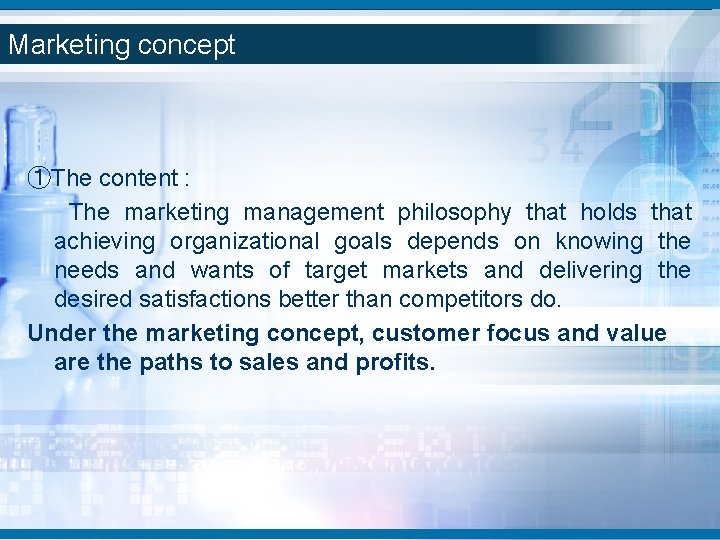
Marketing concept ①The content : The marketing management philosophy that holds that achieving organizational goals depends on knowing the needs and wants of target markets and delivering the desired satisfactions better than competitors do. Under the marketing concept, customer focus and value are the paths to sales and profits.
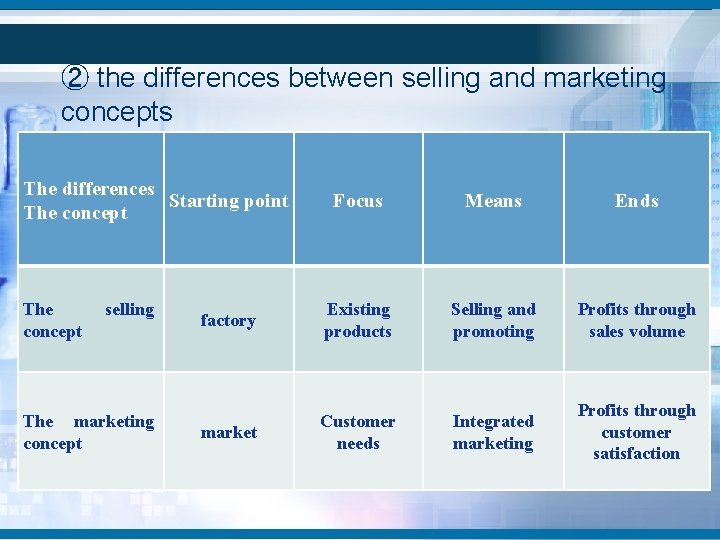
② the differences between selling and marketing concepts The differences Starting point The concept selling The marketing concept Focus Means Ends factory Existing products Selling and promoting Profits through sales volume market Customer needs Integrated marketing Profits through customer satisfaction
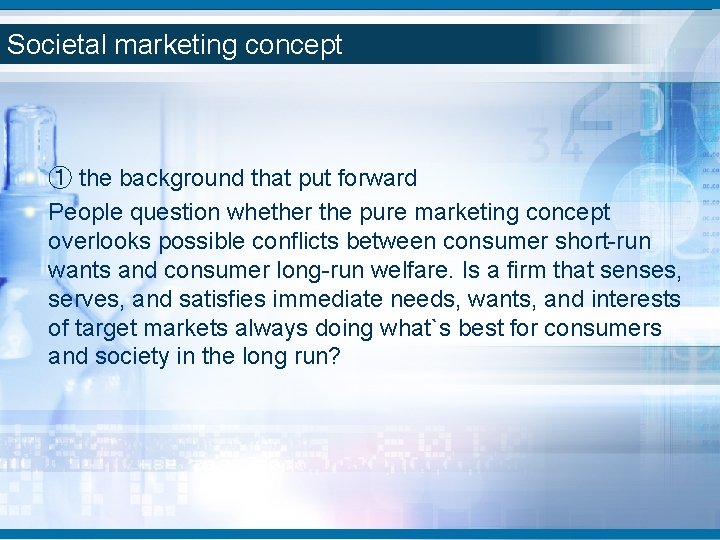
Societal marketing concept ① the background that put forward People question whether the pure marketing concept overlooks possible conflicts between consumer short-run wants and consumer long-run welfare. Is a firm that senses, serves, and satisfies immediate needs, wants, and interests of target markets always doing what`s best for consumers and society in the long run?
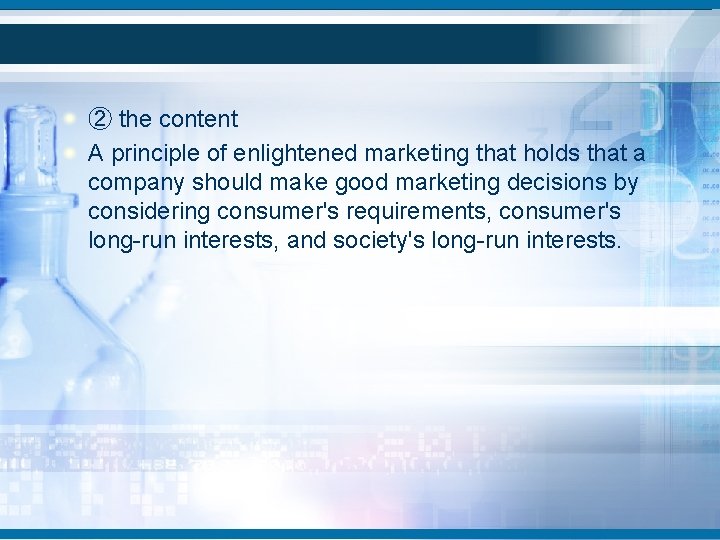
② the content A principle of enlightened marketing that holds that a company should make good marketing decisions by considering consumer's requirements, consumer's long-run interests, and society's long-run interests.