Epilepsy is more common than you think 1





- Slides: 83
Epilepsy is more common than you think! 1
Thank You For Your Support The Epilepsy Foundation wishes to acknowledge the support of the Centers for Disease Control and Prevention (CDC) during the development of this project. 400, 000 Thanks to CDC 2
Claudia’s Story “Once my seizure is over and I’ve regained consciousness, I can see the fear on the faces of the people around. ” Claudia Ochoa is one of the 400, 000 Hispanics with epilepsy in the United States, and one of the 3 million people with epilepsy throughout the country. It has not been easy for Claudia to live with epilepsy, but her desire to lead a normal life has motivated her. Her drive and discipline allowed her to attend the Engineering School at the Autonomous University of Tamaulipas, in Tampico (Mexico), where she earned a degree as an Industrial and Systems Engineer in 1998. 3
Claudia’s Story Seventeen years ago, Claudia was a young girl like any other girl, but at the onset of puberty, her life “literally changed. ” Not only because of all the changes that normally occur during this period in life, but also because it was when Claudia suffered her first epileptic seizure. Claudia has always had her family’s unconditional support. However, she realizes that some people treat her differently after witnessing one of her seizures or, simply, upon learning that she has epilepsy. “I understand that people often look at me in a different way because they do not know what is really happening with me, because they think that what I have is contagious, or simply because my seizures scare them. ” 4
Claudia’s Story Claudia has lived in the United States for 5 years now, is studying English and works at a printer shop. Her main wish is to become fully bilingual and further studies. After suffering an epileptic seizure in June, 2004, Claudia went to the local Epilepsy Foundation office for help. There, Claudia found more than help; she also found understanding and the opportunity to work with them “for her cause. ” Currently, Claudia is a spokeswoman for the Foundation by helping to educate her local Hispanic community on epilepsy. 5
Overview: 6
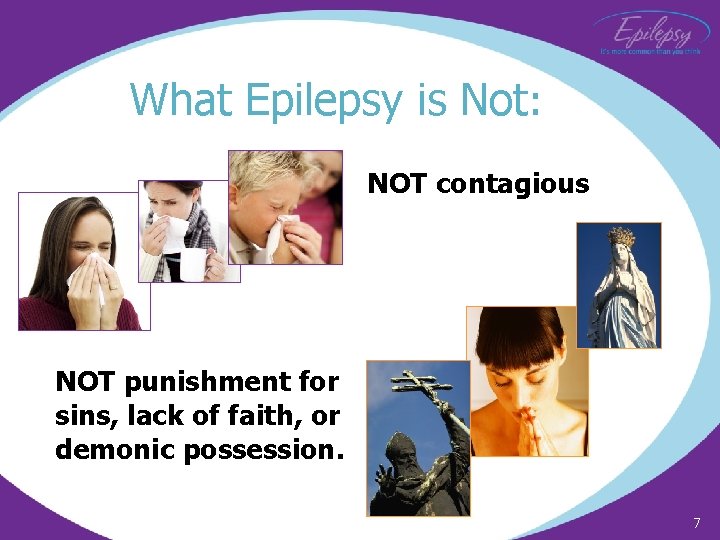
What Epilepsy is Not: NOT contagious NOT punishment for sins, lack of faith, or demonic possession. 7
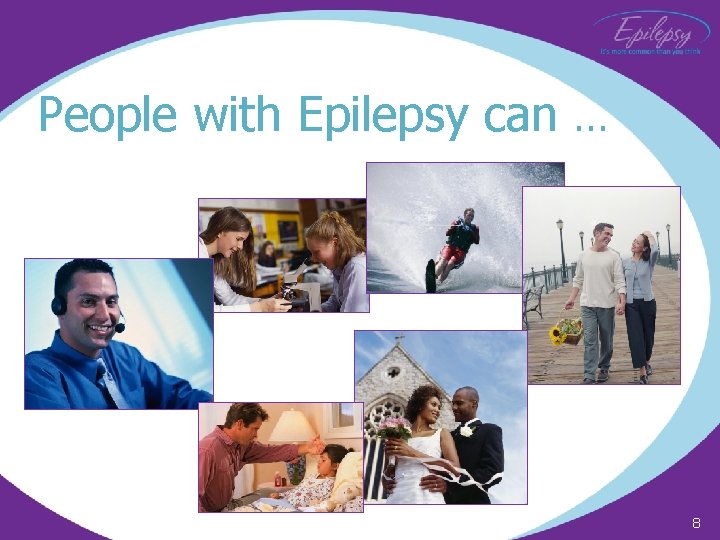
People with Epilepsy can … 8
Introduction n Many people have misconceptions and fears about the convulsive episodes called seizures and epilepsy. It is important to understand the truth about epilepsy, to ensure that people with this condition receive the proper treatment and the respect they need and deserve. Epilepsy can be a serious condition if it is not treated properly. 9
Introduction n Through treatment and understanding, people with epilepsy are capable of living their lives without major problems. For other people, epilepsy may affect almost any aspect of their lives, interfering with their ability to hold a job and carry out their daily activities. If you or someone you know has epilepsy, please take advantage of this session to learn more about epilepsy and be able to share this information with others. 10
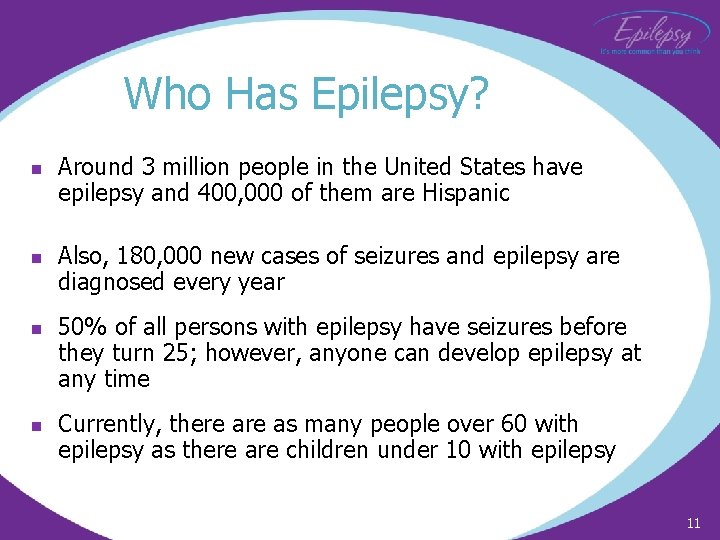
Who Has Epilepsy? n n Around 3 million people in the United States have epilepsy and 400, 000 of them are Hispanic Also, 180, 000 new cases of seizures and epilepsy are diagnosed every year 50% of all persons with epilepsy have seizures before they turn 25; however, anyone can develop epilepsy at any time Currently, there as many people over 60 with epilepsy as there are children under 10 with epilepsy 11
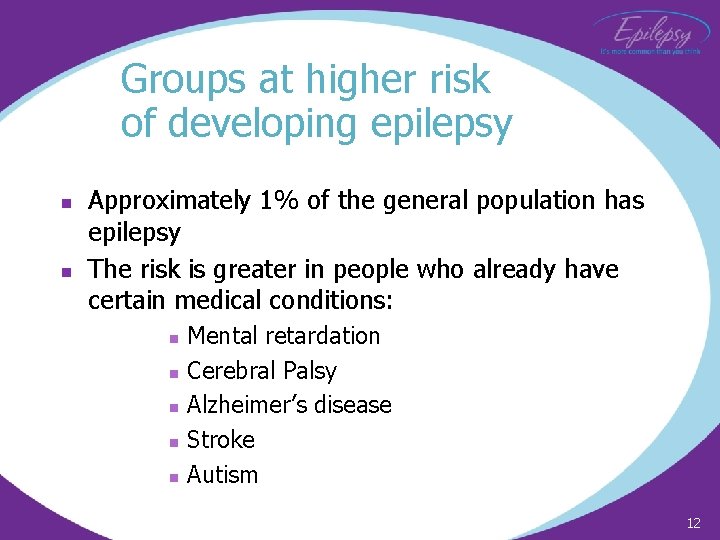
Groups at higher risk of developing epilepsy n n Approximately 1% of the general population has epilepsy The risk is greater in people who already have certain medical conditions: n n n Mental retardation Cerebral Palsy Alzheimer’s disease Stroke Autism 12
The difference between epilepsy and seizures n n Epilepsy is a medical condition characterized by recurrent seizures (which means that they occur more than once). Epilepsy is also known as “seizure disorder. ” A Seizure is a brief, temporary disturbance in the brain’s electrical activity. A seizure is a symptom of epilepsy 13
The Human Brain: 14
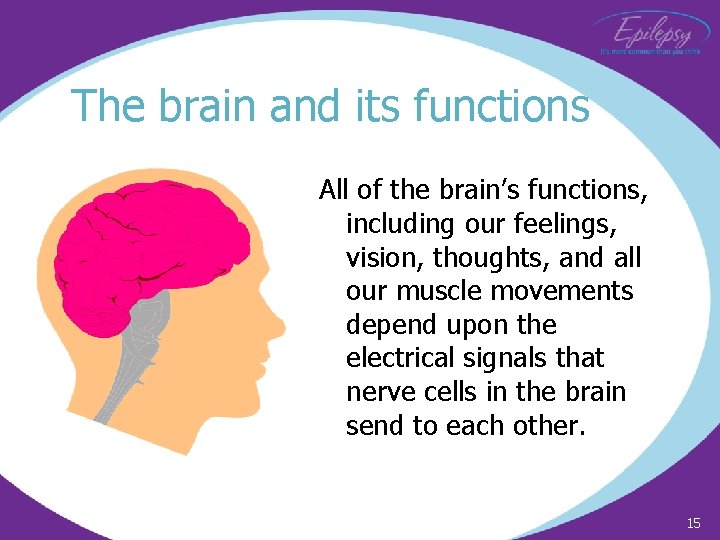
The brain and its functions All of the brain’s functions, including our feelings, vision, thoughts, and all our muscle movements depend upon the electrical signals that nerve cells in the brain send to each other. 15
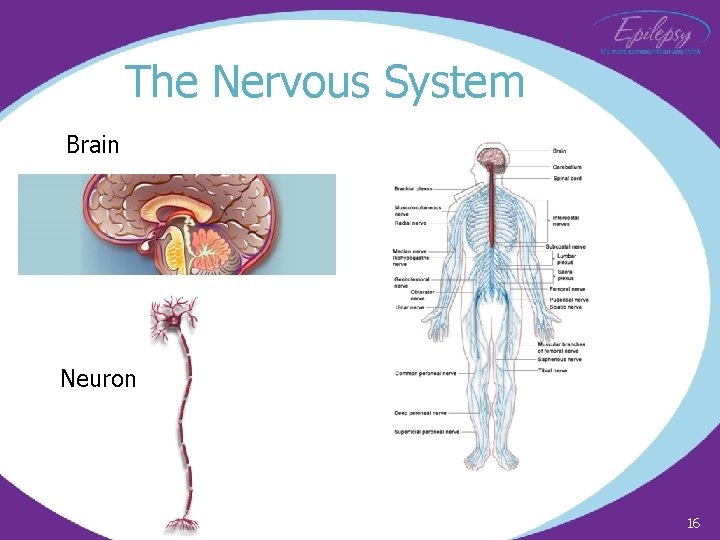
The Nervous System Brain Neuron 16
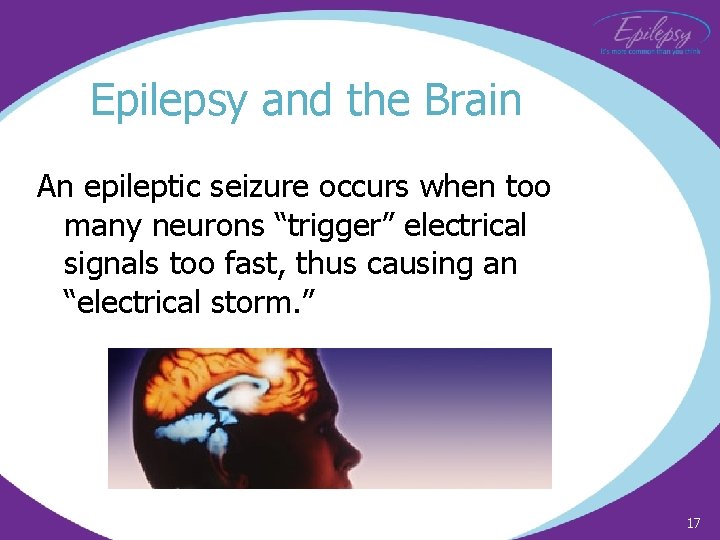
Epilepsy and the Brain An epileptic seizure occurs when too many neurons “trigger” electrical signals too fast, thus causing an “electrical storm. ” 17
What Causes Epilepsy? n n • • • In approximately 70% of all cases, the cause of the epilepsy is unknown. In the remaining 30%, the most common causes are: Head trauma Infection of the brain tissue Brain tumor and stroke • • • Heredity Lead poisoning Prenatal brain development problems 18
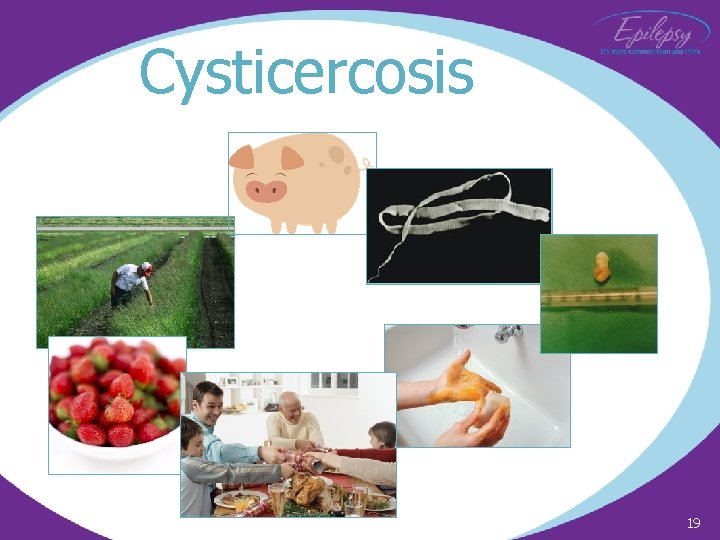
Cysticercosis 19
Cysticercosis and Epilepsy n n n Cysticercosis is a common cause of epilepsy among first-generation Mexican-Americans. It can also occur in members of the second and third generations who live in contact with people who have recently arrived in this country. 10% of all persons admitted to the neurology department in Los Angeles County, California, are admitted due to Cysticercosis. 20
Prevalence of Cysticercosis Worldwide • Mexico • Central America • South America • Africa • Asia 21
Classification of epilepsy, symptoms and first aid: 22
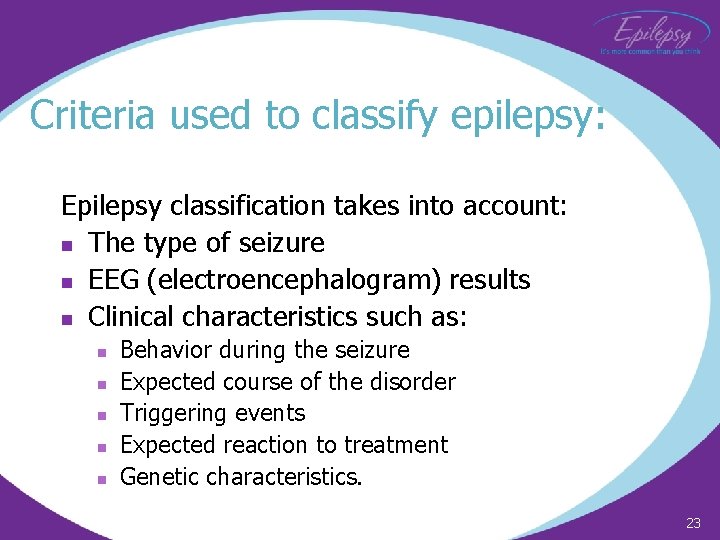
Criteria used to classify epilepsy: Epilepsy classification takes into account: n The type of seizure n EEG (electroencephalogram) results n Clinical characteristics such as: n n n Behavior during the seizure Expected course of the disorder Triggering events Expected reaction to treatment Genetic characteristics. 23
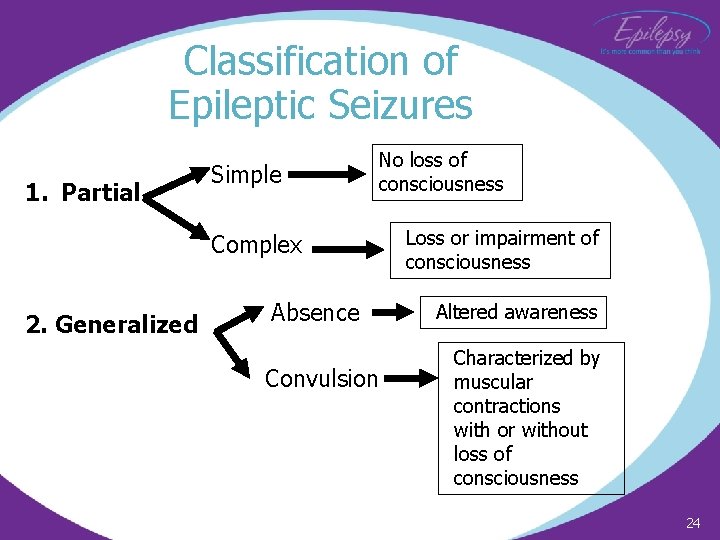
Classification of Epileptic Seizures 1. Partial Simple No loss of consciousness Complex 2. Generalized Absence Convulsion Loss or impairment of consciousness Altered awareness Characterized by muscular contractions with or without loss of consciousness 24
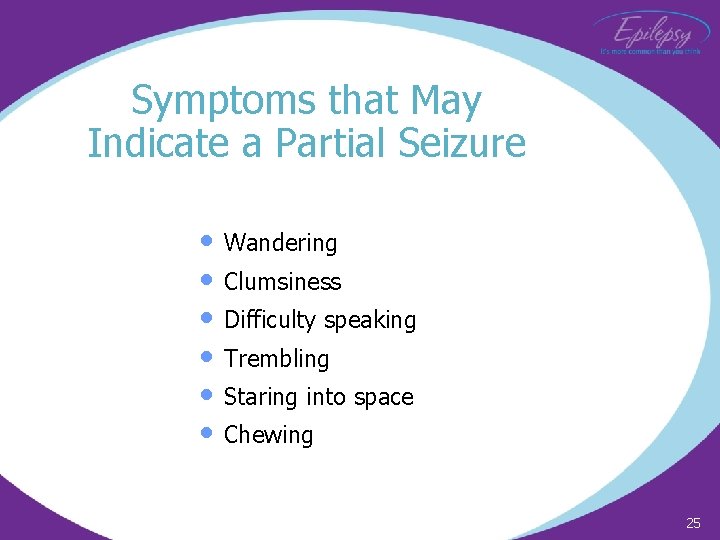
Symptoms that May Indicate a Partial Seizure • • • Wandering Clumsiness Difficulty speaking Trembling Staring into space Chewing 25
Symptoms that May Indicate a Generalized Seizure n n n Sudden moan or cry Falling to the ground Rigidity Shallow breathing Muscle spasms Loss of consciousness 26
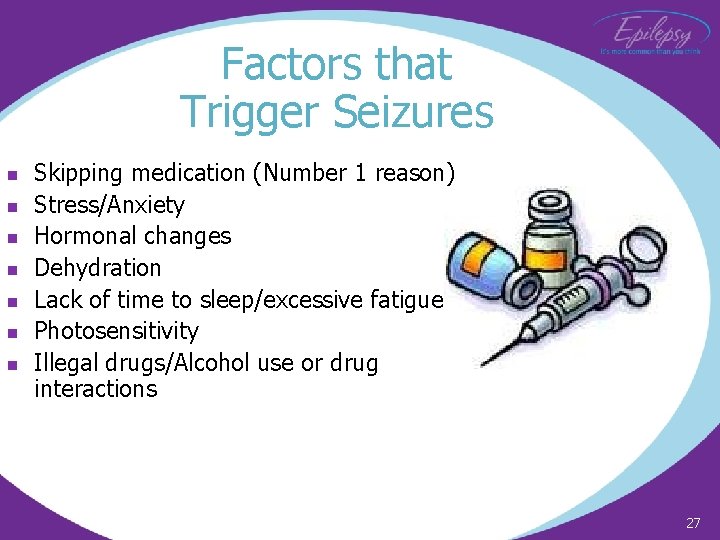
Factors that Trigger Seizures n n n n Skipping medication (Number 1 reason) Stress/Anxiety Hormonal changes Dehydration Lack of time to sleep/excessive fatigue Photosensitivity Illegal drugs/Alcohol use or drug interactions 27
First Aid for a Partial Seizure n n n Do not hold the person down or restrain him or her Explain what is happening to other people Protect the person from danger Speak calmly Stay with the person until the seizure is over Offer to help 28
First Aid for a Generalized Seizure • Cushion the person’s head • • • Loosen any tight clothing around the person’s neck Turn the person onto his or her side Do not put anything in the person’s mouth Look for an identification Do not hold the person down on his/her stomach Once the seizure is over, calmly offer your help 29
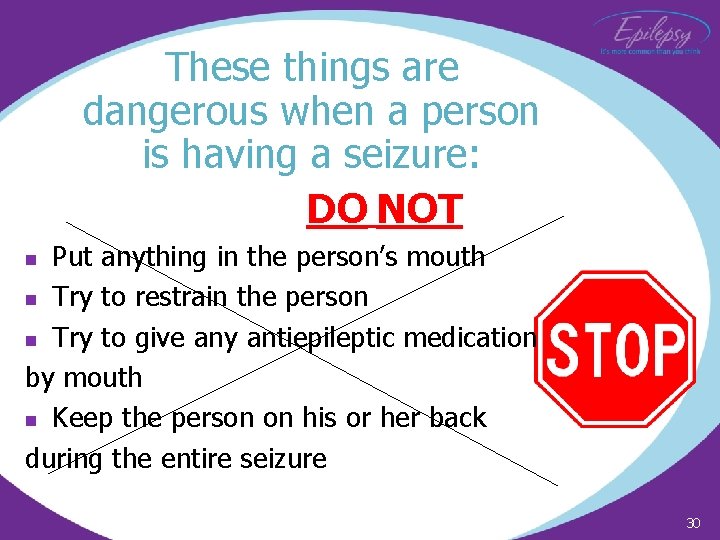
These things are dangerous when a person is having a seizure: DO NOT Put anything in the person’s mouth n Try to restrain the person n Try to give any antiepileptic medication by mouth n Keep the person on his or her back during the entire seizure n 30
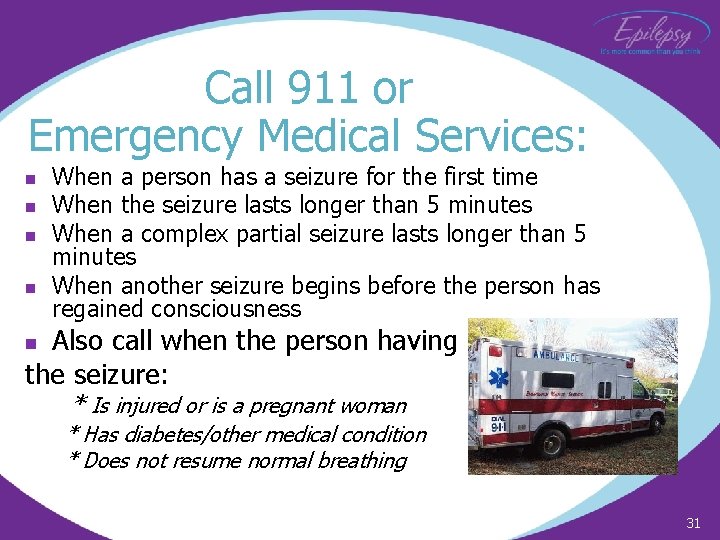
Call 911 or Emergency Medical Services: n n When a person has a seizure for the first time When the seizure lasts longer than 5 minutes When a complex partial seizure lasts longer than 5 minutes When another seizure begins before the person has regained consciousness Also call when the person having the seizure: n * Is injured or is a pregnant woman * Has diabetes/other medical condition * Does not resume normal breathing 31
Diagnosis and treatment of epilepsy: 32
What should you tell your doctor about your seizures? n n n Symptoms Seizure patterns Activity before the seizure (what you were doing right before the seizure) Consider keeping a record of your seizures 33
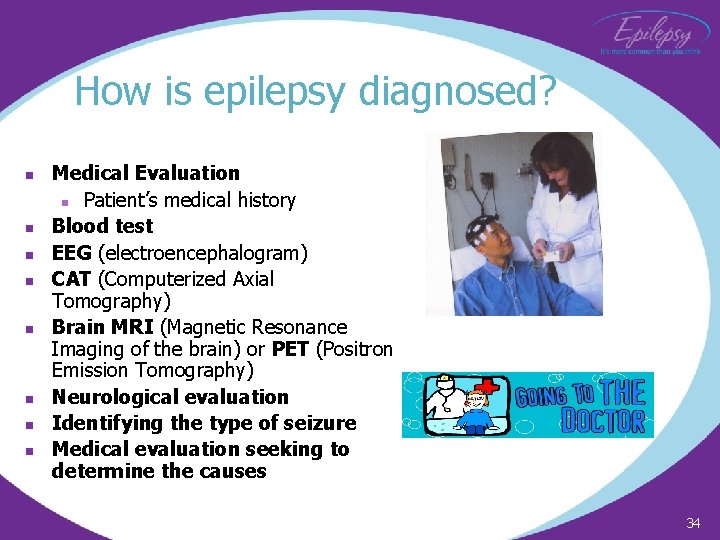
How is epilepsy diagnosed? n n n n Medical Evaluation n Patient’s medical history Blood test EEG (electroencephalogram) CAT (Computerized Axial Tomography) Brain MRI (Magnetic Resonance Imaging of the brain) or PET (Positron Emission Tomography) Neurological evaluation Identifying the type of seizure Medical evaluation seeking to determine the causes 34
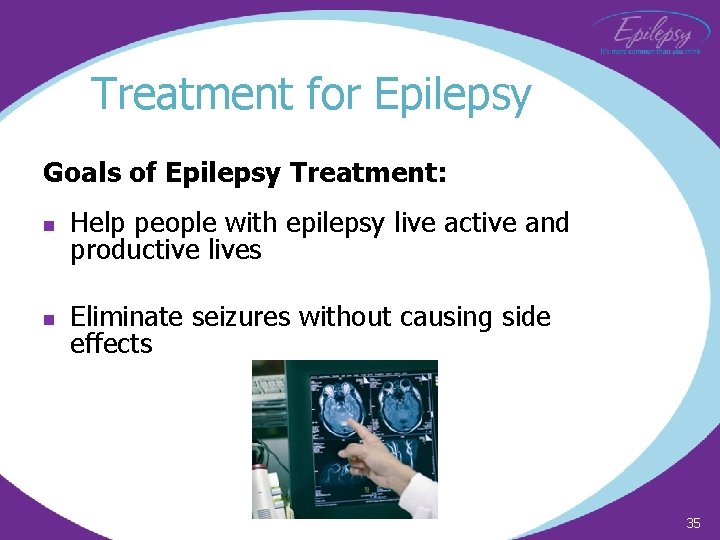
Treatment for Epilepsy Goals of Epilepsy Treatment: n Help people with epilepsy live active and productive lives n Eliminate seizures without causing side effects 35
What factors influence the decision to treat? The treatment may be appropriate n n n Abnormal EEG Previous seizure Partial seizure Driver Other neurological disorders Elderly patient The treatment may NOT be appropriate n n A single seizure No previous history Neurologically normal Side effects 36
Types of treatments for epilepsy: Medication n Surgery n Non-pharmacologic treatment n n Ketogenic Diet Vagus Nerve Stimulation Lifestyle modifications 37
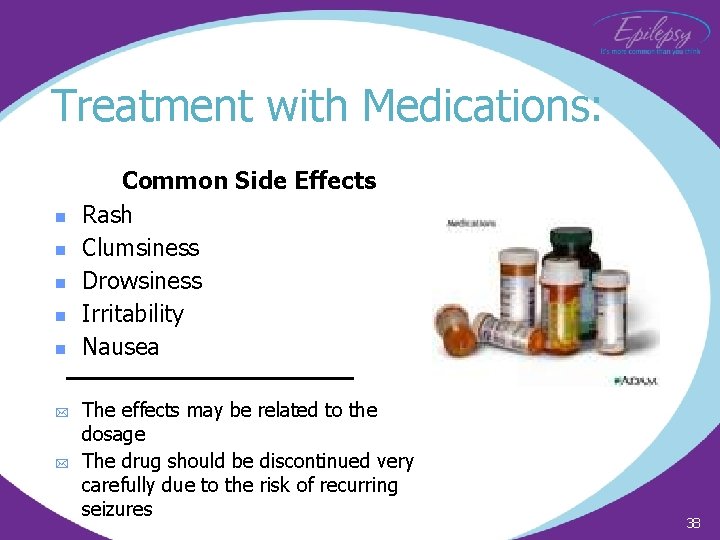
Treatment with Medications: n n n * * Common Side Effects Rash Clumsiness Drowsiness Irritability Nausea The effects may be related to the dosage The drug should be discontinued very carefully due to the risk of recurring seizures 38
Treatment with Medications: Warning signs of serious side effects n n n n Prolonged fever Rash Nausea/vomiting Severe sore throat Mouth ulcers Easy bruising Pinpoint bleeding n n n Weakness Fatigue Swollen glands Lack of appetite Abdominal pain 39
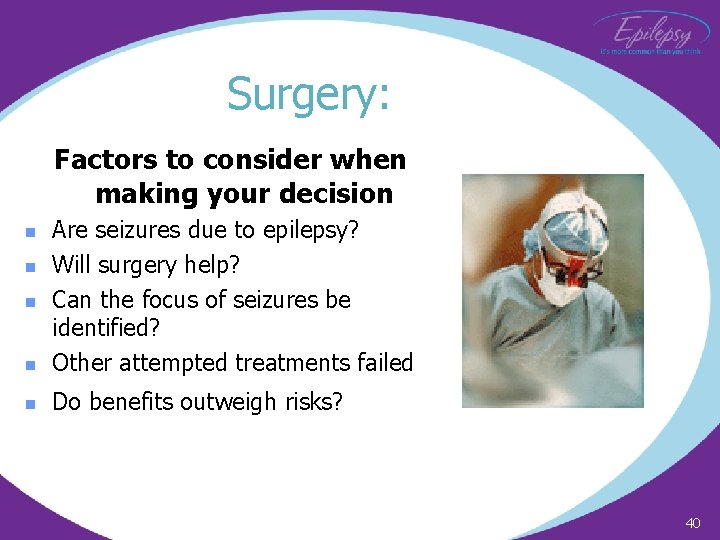
Surgery: Factors to consider when making your decision n Are seizures due to epilepsy? Will surgery help? Can the focus of seizures be identified? Other attempted treatments failed n Do benefits outweigh risks? n n n 40
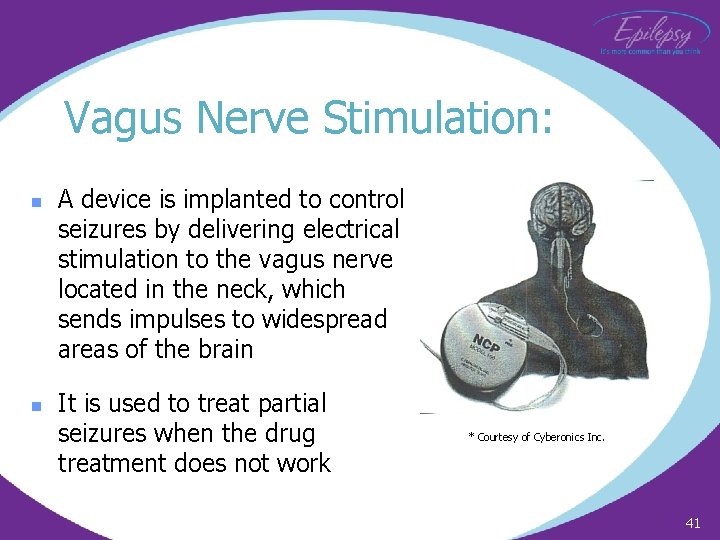
Vagus Nerve Stimulation: n n A device is implanted to control seizures by delivering electrical stimulation to the vagus nerve located in the neck, which sends impulses to widespread areas of the brain It is used to treat partial seizures when the drug treatment does not work * Courtesy of Cyberonics Inc. 41
Ketogenic Diet: n n n Based on the finding that starvation, which burns fat to produce energy, has an antiepileptic effect Mainly used to treat severe childhood epilepsy, has also proved effective in some adults and adolescents High-fat, low-carbohydrate and -protein intake Normally started in the hospital Needs strong family commitment 42
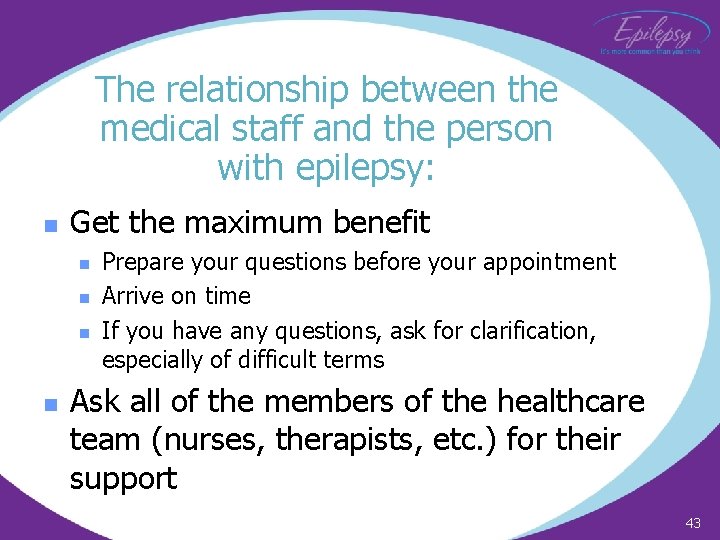
The relationship between the medical staff and the person with epilepsy: n Get the maximum benefit n n Prepare your questions before your appointment Arrive on time If you have any questions, ask for clarification, especially of difficult terms Ask all of the members of the healthcare team (nurses, therapists, etc. ) for their support 43
How is epilepsy perceived? Joseph I. Sirven, MD Director, EEG/Epilepsy Lab Mayo Clinic – Scottsdale n Cultural beliefs and attitudes of the Latin community regarding Epilepsy. Investigation provided by Hispanic Research, Inc. February, 2004 44
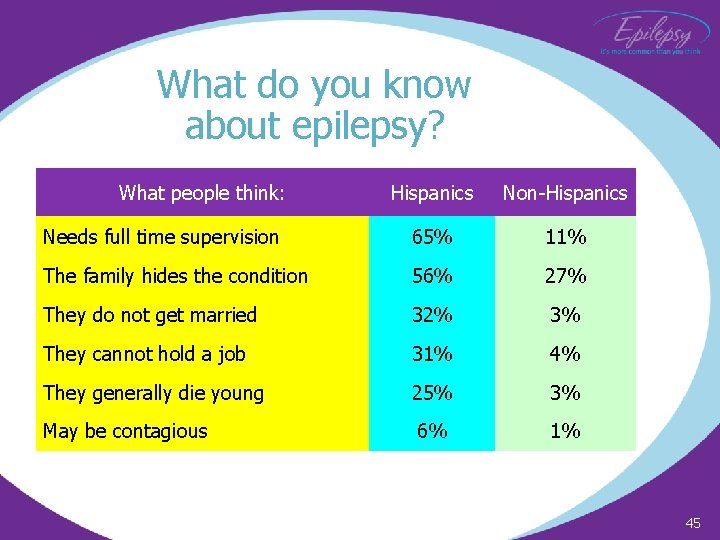
What do you know about epilepsy? What people think: Hispanics Non-Hispanics Needs full time supervision 65% 11% The family hides the condition 56% 27% They do not get married 32% 3% They cannot hold a job 31% 4% They generally die young 25% 3% May be contagious 6% 1% 45
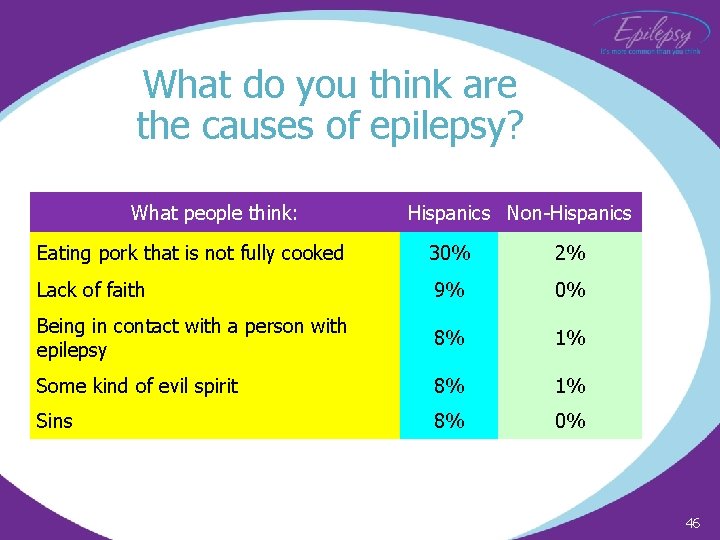
What do you think are the causes of epilepsy? What people think: Hispanics Non-Hispanics Eating pork that is not fully cooked 30% 2% Lack of faith 9% 0% Being in contact with a person with epilepsy 8% 1% Some kind of evil spirit 8% 1% Sins 8% 0% 46
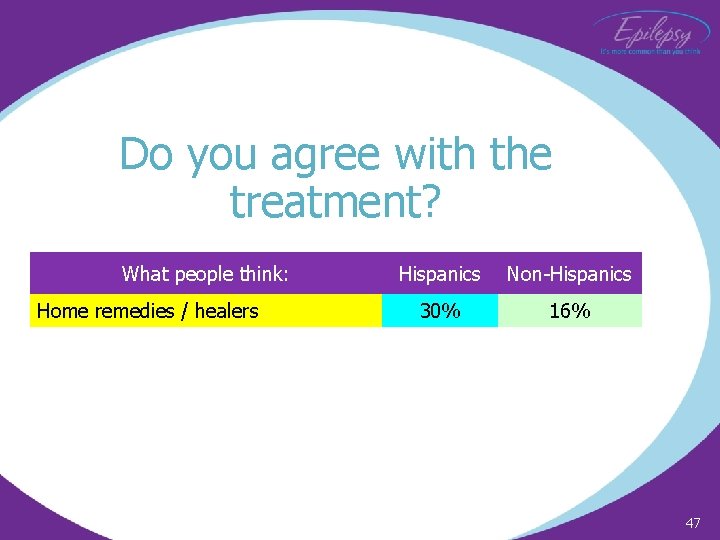
Do you agree with the treatment? What people think: Home remedies / healers Hispanics Non-Hispanics 30% 16% 47
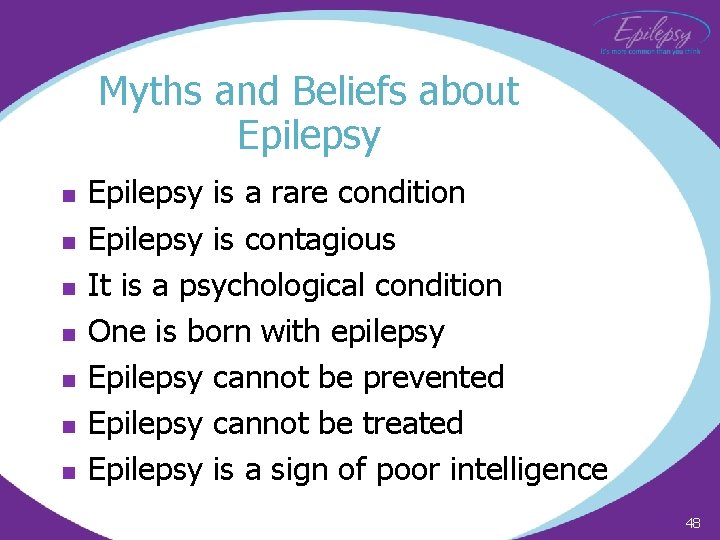
Myths and Beliefs about Epilepsy n n n n Epilepsy is a rare condition Epilepsy is contagious It is a psychological condition One is born with epilepsy Epilepsy cannot be prevented Epilepsy cannot be treated Epilepsy is a sign of poor intelligence 48
The Impact of Epilepsy: 49
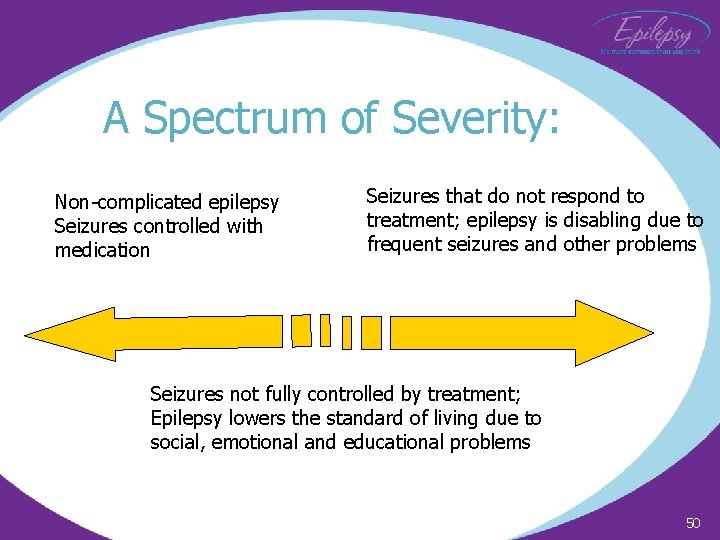
A Spectrum of Severity: Non-complicated epilepsy Seizures controlled with medication Seizures that do not respond to treatment; epilepsy is disabling due to frequent seizures and other problems Seizures not fully controlled by treatment; Epilepsy lowers the standard of living due to social, emotional and educational problems 50
Social Aspects of Epilepsy: n n n n Fear and other emotions Interpersonal relationships Financial costs Schools Employment Driving Recreational activities 51
Emotions: Fear n It is normal to feel fear. Most people with epilepsy fear: v Risk of injury or death v Not knowing when or where a seizure will occur v Impact on the family and finances v Reactions from others 52
Ways to overcome fear: Learn more about epilepsy n Know how to improve safety at home in case of a seizure n Proper first aid for seizures n Join a support group n Talk with a counselor n 53
Emotions: Depression n Signs to watch for: n n n n Excessive sleep or being tired all the time Isolate oneself from others Losing interest in personal appearance Neglecting personal hygiene Excessive crying Being angry all the time Unable to make decisions Feeling worthless 54
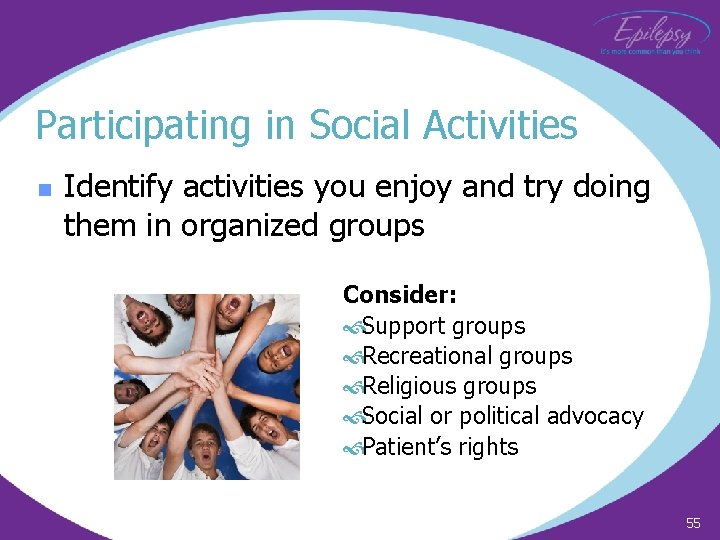
Participating in Social Activities n Identify activities you enjoy and try doing them in organized groups Consider: Support groups Recreational groups Religious groups Social or political advocacy Patient’s rights 55
Financial Impact n n n Medical insurance Employment Supplemental income benefits Potential resources for financial aid • United Way • Social services at clinic or hospital • City or County Health Department • Social Security • Subsidized housing 56
Whom should you tell? n n Department of Motor Vehicles Sports team coach School nurse Friends and potential lovers “For many years, I tried to hide [the epilepsy] from everyone, thinking that I would be judged… they would erase me from their list of friends. Gradually I learned that people aren’t like that… it has opened a number of doors to me that I had previously closed by myself. ” --Brainstorms: Epilepsy in our own words 57
Safety Tips: Bathroom n Install doors that open outward n Install padded carpets on the floor n Make sure drain works properly in bath/shower n Consider using a shower seat n Lower water temperature to avoid scalding Kitchen n Use plastic dishes and cups with lids n Use microwave instead of stove 58
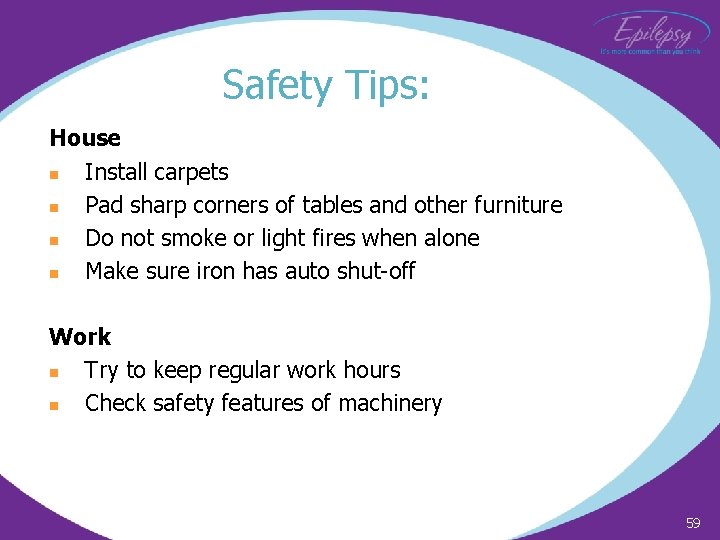
Safety Tips: House n Install carpets n Pad sharp corners of tables and other furniture n Do not smoke or light fires when alone n Make sure iron has auto shut-off Work n Try to keep regular work hours n Check safety features of machinery 59
Utilizing Resources: n n Take responsibility for your life, including taking care of your health Be aware of available resources Cooperate with doctor and healthcare team Find support group networks n Epilepsy Foundation n Other resources 60
The relationship between the medical staff and the person with epilepsy: n n n Be prepared with questions to clarify questions and concerns Tell your doctor about any changes you observe or reactions to medications Ask your doctor to explain anything you don’t understand Ask for a professional translator/interpreter when you don’t understand the language Talk with the nurse and other members of the healthcare team 61
Epilepsy and Children: 62
Education n Most children with epilepsy have IQ’s within the normal range However, the risk of having learning problems is three times greater than the average Students with epilepsy are eligible for special education and related services Encourage children with epilepsy to develop their abilities and reach their potential 63
Develop a relationship with the school: n n Meet all of your child’s teachers Inform teachers and staff about: n n n Your child’s seizure disorder The possible effects of medication What to do in case a seizure occurs at school Encourage your local Epilepsy Foundation affiliate office to provide education to students, teachers and other staff Let your child know that you will notify the school about his/her condition. It will give him/her peace of mind. 64
Information you should provide regarding your child’s epilepsy: n n n General information about epilepsy Describe the type of seizures your child has, whether the seizures are controlled, how often your child has them What seizures look like, how long they last, and what the proper first aid procedures are 65
Education: Resources for parents n n n Parents advocacy groups Epilepsy Foundation Special education services Individuals with Disabilities Education Act (IDEA) Rehabilitation Act 66
Education: Resources for parents n IEP’s: Individualized Education Plans n n n Developed by parents and school staff May include specific services, physical or speech therapy, psychological evaluation and treatment, social work services and counseling Related services that may include education for the school staff and classmates 67
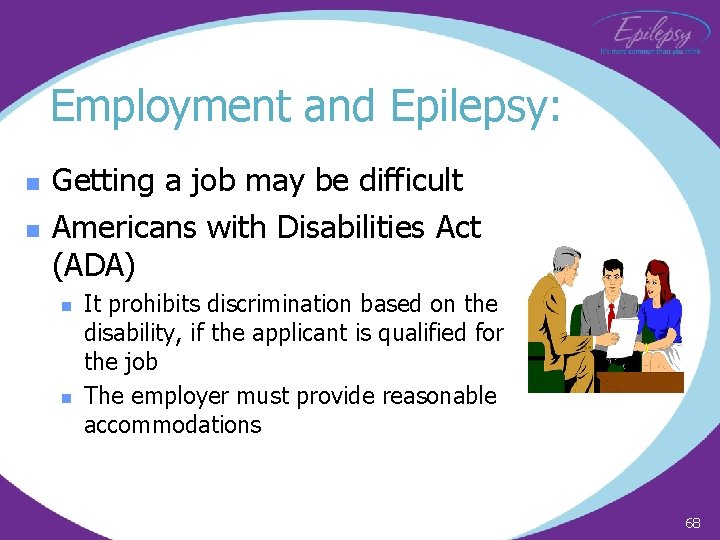
Employment and Epilepsy: n n Getting a job may be difficult Americans with Disabilities Act (ADA) n n It prohibits discrimination based on the disability, if the applicant is qualified for the job The employer must provide reasonable accommodations 68
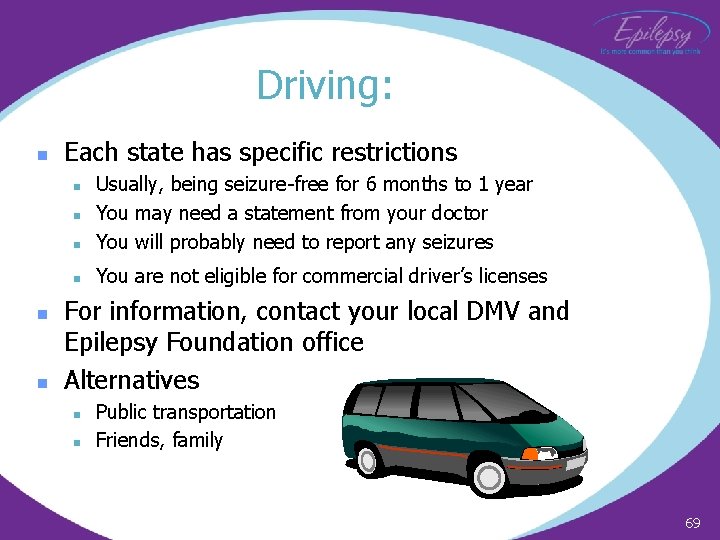
Driving: n Each state has specific restrictions n Usually, being seizure-free for 6 months to 1 year You may need a statement from your doctor You will probably need to report any seizures n You are not eligible for commercial driver’s licenses n n For information, contact your local DMV and Epilepsy Foundation office Alternatives n n Public transportation Friends, family 69
Epilepsy and Women: 70
Epilepsy and women: n Hormonal effects n n n Polycystic ovary syndrome Sexuality and contraception n Hormonal changes during puberty, menopause and the menstrual cycle may affect seizure frequency Sexual dysfunction Birth control pills may be less effective Pregnancy and maternity n n Need to continue with medication Slight increased risk for birth defects 71
Reproductive Health Aspects Contraception and Conception n Pregnancy n Breastfeeding n Possible effects on newborn n 72
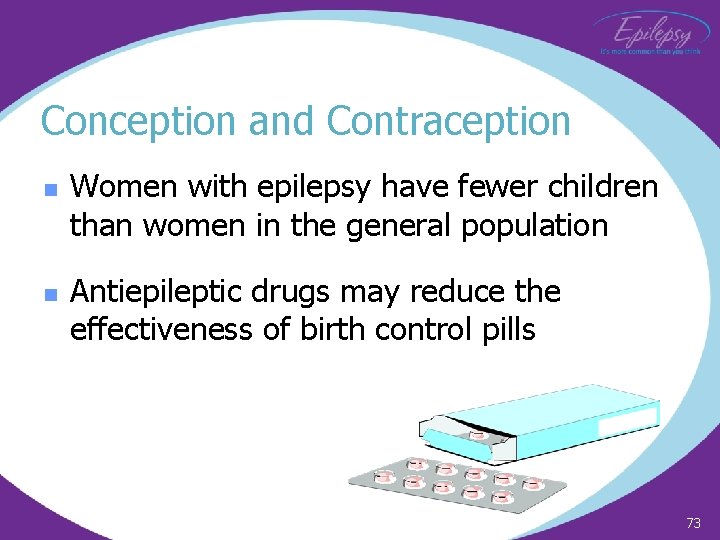
Conception and Contraception n n Women with epilepsy have fewer children than women in the general population Antiepileptic drugs may reduce the effectiveness of birth control pills 73
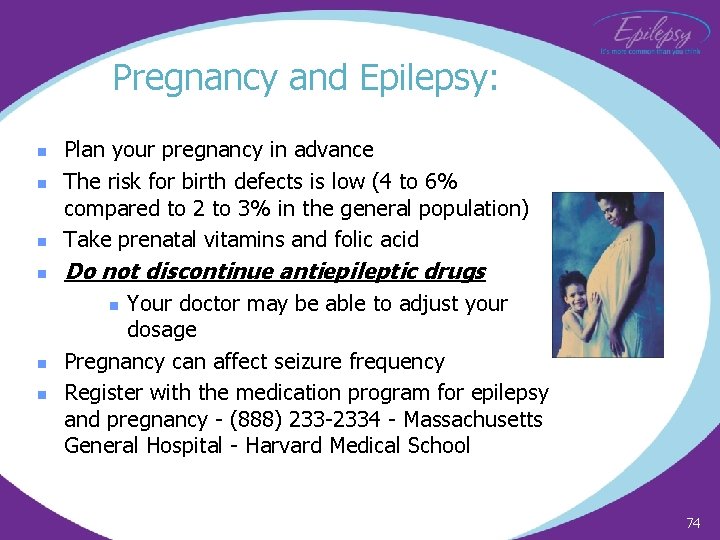
Pregnancy and Epilepsy: n Plan your pregnancy in advance The risk for birth defects is low (4 to 6% compared to 2 to 3% in the general population) Take prenatal vitamins and folic acid n Do not discontinue antiepileptic drugs n n Your doctor may be able to adjust your dosage Pregnancy can affect seizure frequency Register with the medication program for epilepsy and pregnancy - (888) 233 -2334 - Massachusetts General Hospital - Harvard Medical School n n n 74
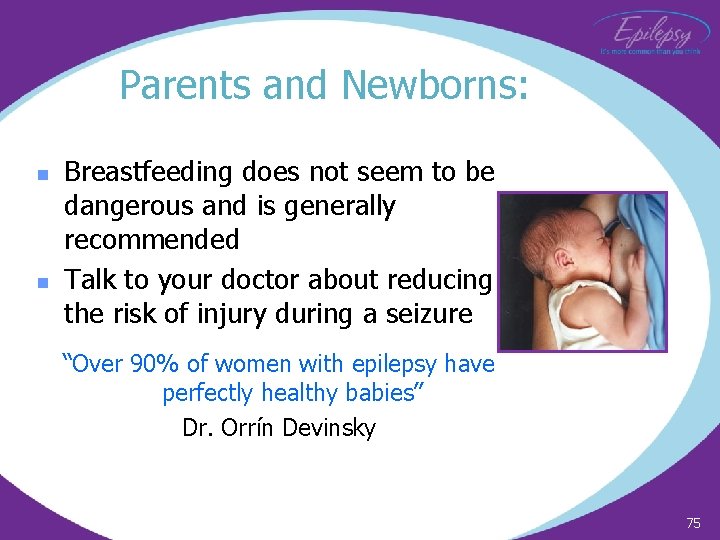
Parents and Newborns: n n Breastfeeding does not seem to be dangerous and is generally recommended Talk to your doctor about reducing the risk of injury during a seizure “Over 90% of women with epilepsy have perfectly healthy babies” Dr. Orrín Devinsky 75
Epilepsy and the Elderly: 76
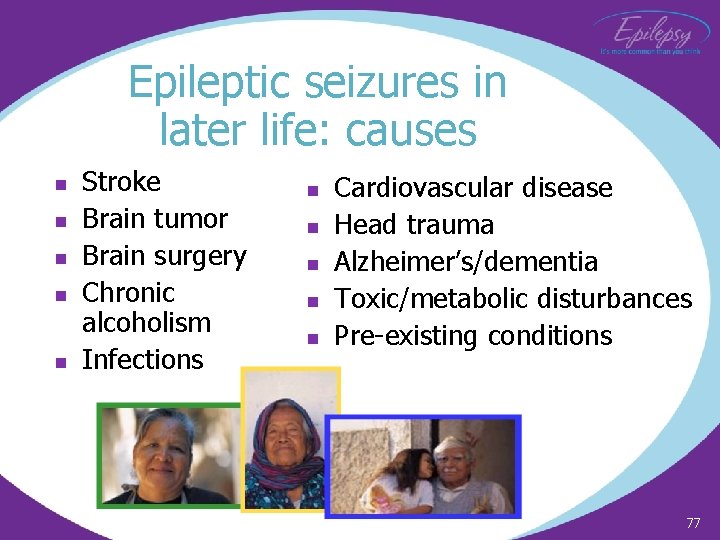
Epileptic seizures in later life: causes n n n Stroke Brain tumor Brain surgery Chronic alcoholism Infections n n n Cardiovascular disease Head trauma Alzheimer’s/dementia Toxic/metabolic disturbances Pre-existing conditions 77
Complex partial seizures Primary challenges n n n Symptoms misinterpreted as effects of aging Symptoms may be linked to other disorders Lack of awareness during the seizure 78
Is it a seizure or not? Signs that indicate epilepsy: n Episodic (sporadic), rather than constant, behavior n Sudden change in the state of awareness n Episode is followed by a period of confusion 79
Social Aspects: n n n n Lack of self-confidence Embarrassment at effects of seizures Increased dependency Loss of driving privileges Decreased mobility Depression/stigma Loss of independence 80
And, finally, be aware of… 81
National and Local Resources n Epilepsy foundation n Local affiliates n Toll free 1 -866 -748 -8008 Medic. Alert Foundation Social Security Administration n www. fundacionparalaepilepsia. org n n State Offices n Professional rehabilitation Protection and advocacy n Services for the elderly 82
For more information: Call 1 -866 -748 -8008 or visit www. fundacionparalaepilepsia. org 83