DIMENSIONALITY REDUCTION K RAMACHANDRA MURTHY WHY DIMENSIONALITY REDUCTION


- Slides: 59
DIMENSIONALITY REDUCTION K. RAMACHANDRA MURTHY
WHY DIMENSIONALITY REDUCTION? It is so easy and convenient to collect data Data is not collected only for data mining Data accumulates in an unprecedented speed Data pre-processing is an important part for effective machine learning and data mining Dimensionality reduction is an effective approach to downsizing data
WHY DIMENSIONALITY REDUCTION? Most machine learning and data mining techniques may not be effective for highdimensional data Curse of Dimensionality The intrinsic dimension may be small.
WHY DIMENSIONALITY REDUCTION? Visualization: projection of high-dimensional data onto 2 D or 3 D. Data compression: efficient storage and retrieval. Noise removal: positive effect on query
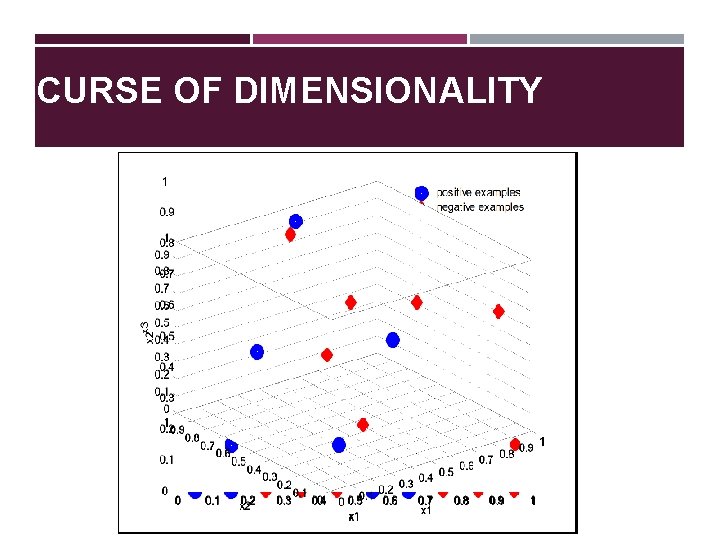
CURSE OF DIMENSIONALITY
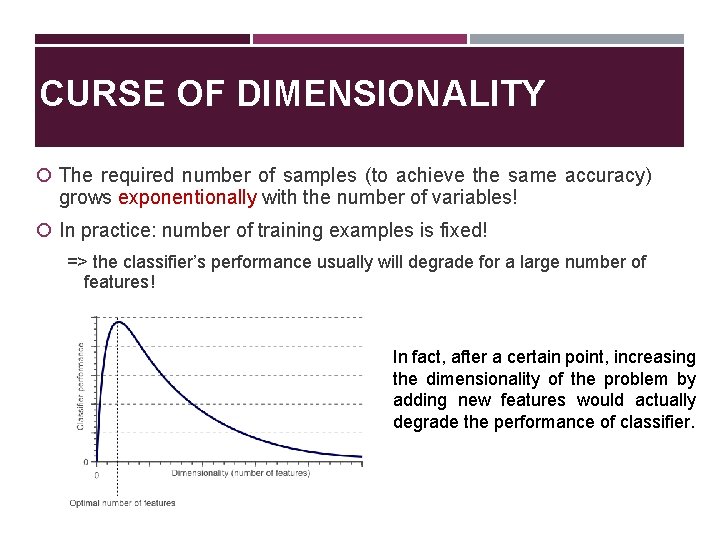
CURSE OF DIMENSIONALITY The required number of samples (to achieve the same accuracy) grows exponentionally with the number of variables! In practice: number of training examples is fixed! => the classifier’s performance usually will degrade for a large number of features! In fact, after a certain point, increasing the dimensionality of the problem by adding new features would actually degrade the performance of classifier.
CURSE OF DIMENSIONALITY - Many explored domains have hundreds to tens of thousands of variables/features with many irrelevant and redundant ones! - In domains with many features the underlying probability distribution can be very complex and very hard to estimate (e. g. dependencies between variables) ! - Irrelevant and redundant features can “confuse” learners! - Limited training data! - Limited computational resources!
EXAMPLE FOR ML-PROBLEM Text-Categorization - Documents are represented by a vector containing word frequency counts of dimension equal to the size of the vocabulary - Vocabulary ~ 15, 000 words (i. e. each document is represented by a 15, 000 -dimensional vector) - Typical tasks: - Automatic sorting of documents into web-directories - Detection of spam-email
MOTIVATION Especially when dealing with a large number of variables there is a need for dimensionality reduction! Dimensionality reduction can significantly improve a learning algorithm’s performance!
MAJOR TECHNIQUES OF DIMENSIONALITY REDUCTION Feature Selection Feature Extraction (Reduction)
FEATURE EXTRACTION VS SELECTION Feature extraction All original features are used and they are transferred The transformed features are linear/nonlinear combinations of the original features Feature selection Only a subset of the original features are selected
FEATURE SELECTION
FEATURE SELECTION Feature selection: Problem of selecting some subset from a set of input features upon which it should focus attention, while ignoring the rest Humans/animals do that constantly!
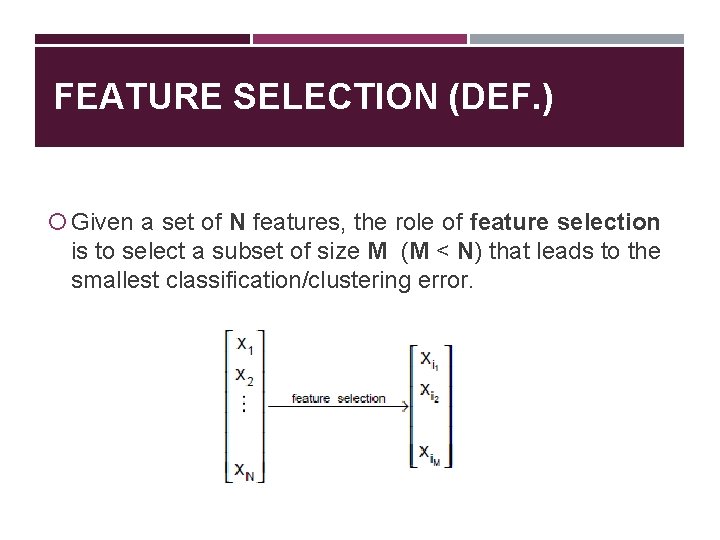
FEATURE SELECTION (DEF. ) Given a set of N features, the role of feature selection is to select a subset of size M (M < N) that leads to the smallest classification/clustering error.
WHY IS FEATURE SELECTION? WHY NOT FEATURE EXTRACTION? v You may want to extract meaningful rules from your classifier When you transform or project, the measurement units (length, weight, etc. ) of your features are lost v Features may not be numeric A typical situation in the machine learning domain
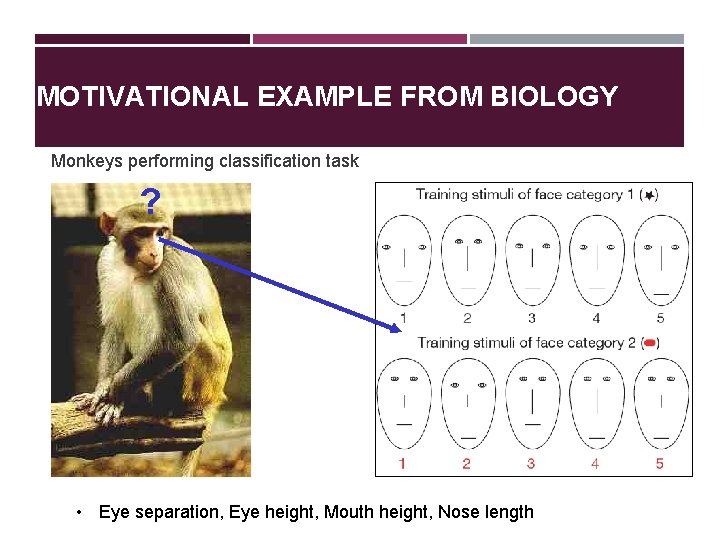
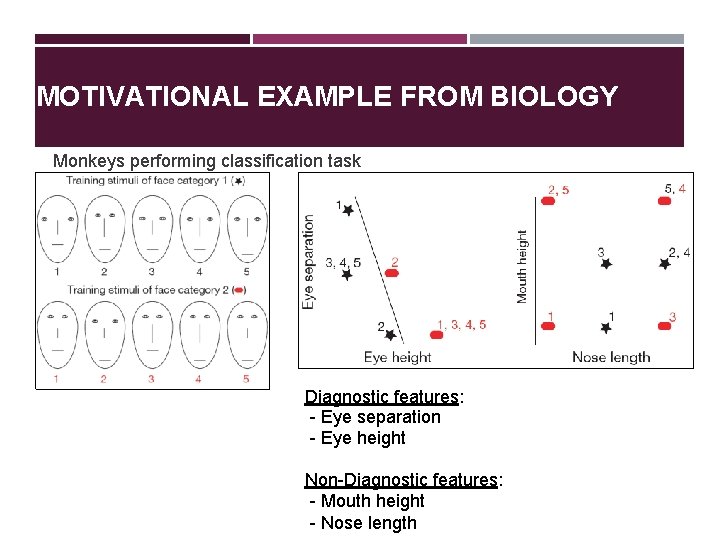
MOTIVATIONAL EXAMPLE FROM BIOLOGY Monkeys performing classification task ? • Eye separation, Eye height, Mouth height, Nose length
MOTIVATIONAL EXAMPLE FROM BIOLOGY Monkeys performing classification task Diagnostic features: - Eye separation - Eye height Non-Diagnostic features: - Mouth height - Nose length
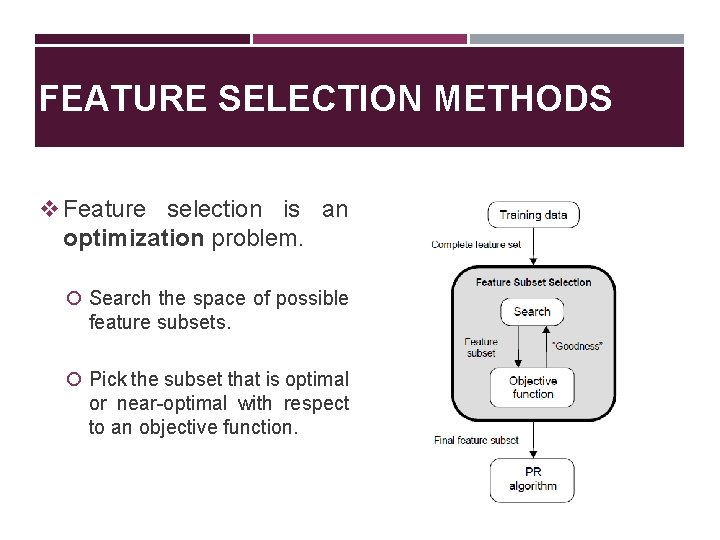
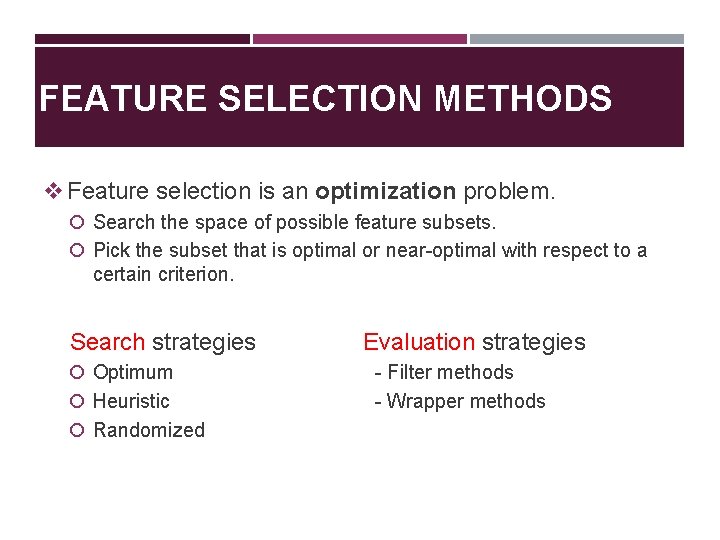
FEATURE SELECTION METHODS v Feature selection is an optimization problem. Search the space of possible feature subsets. Pick the subset that is optimal or near-optimal with respect to an objective function.
FEATURE SELECTION METHODS v Feature selection is an optimization problem. Search the space of possible feature subsets. Pick the subset that is optimal or near-optimal with respect to a certain criterion. Search strategies Evaluation strategies Optimum - Filter methods Heuristic - Wrapper methods Randomized
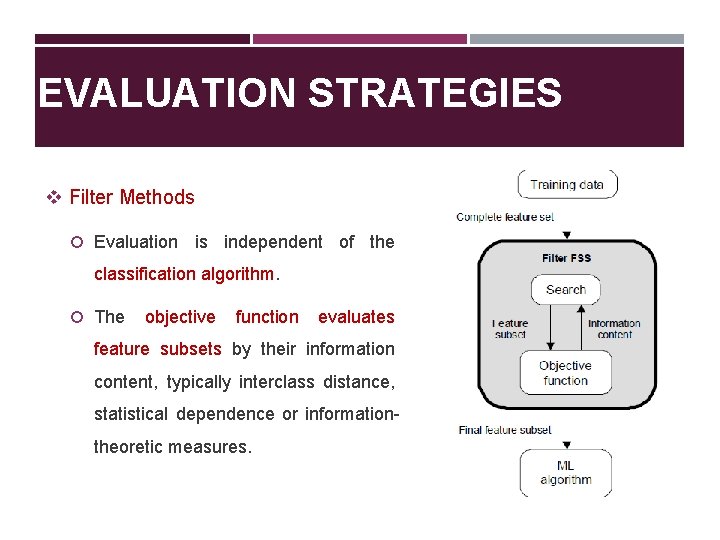
EVALUATION STRATEGIES v Filter Methods Evaluation is independent of the classification algorithm. The objective function evaluates feature subsets by their information content, typically interclass distance, statistical dependence or informationtheoretic measures.
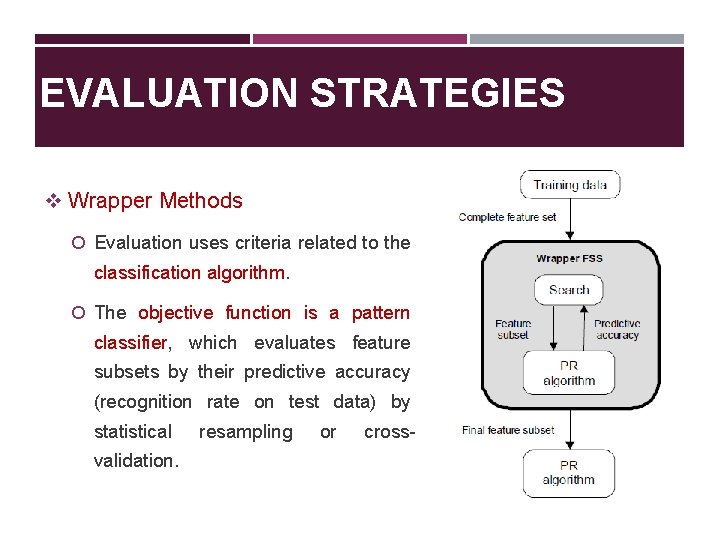
EVALUATION STRATEGIES v Wrapper Methods Evaluation uses criteria related to the classification algorithm. The objective function is a pattern classifier, which evaluates feature subsets by their predictive accuracy (recognition rate on test data) by statistical validation. resampling or cross-
FILTER VS WRAPPER APPROACHES Wrapper Approach v Advantages Accuracy: wrappers generally have better recognition rates than filters since they tuned to the specific interactions between the classifier and the features. Ability to generalize: wrappers have a mechanism to avoid over fitting, since they typically use cross-validation measures of predictive accuracy. v Disadvantages Slow execution
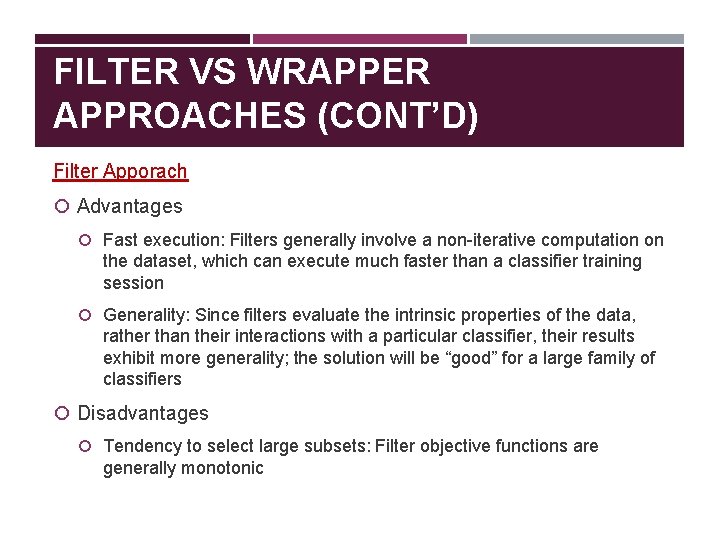
FILTER VS WRAPPER APPROACHES (CONT’D) Filter Apporach Advantages Fast execution: Filters generally involve a non-iterative computation on the dataset, which can execute much faster than a classifier training session Generality: Since filters evaluate the intrinsic properties of the data, rather than their interactions with a particular classifier, their results exhibit more generality; the solution will be “good” for a large family of classifiers Disadvantages Tendency to select large subsets: Filter objective functions are generally monotonic
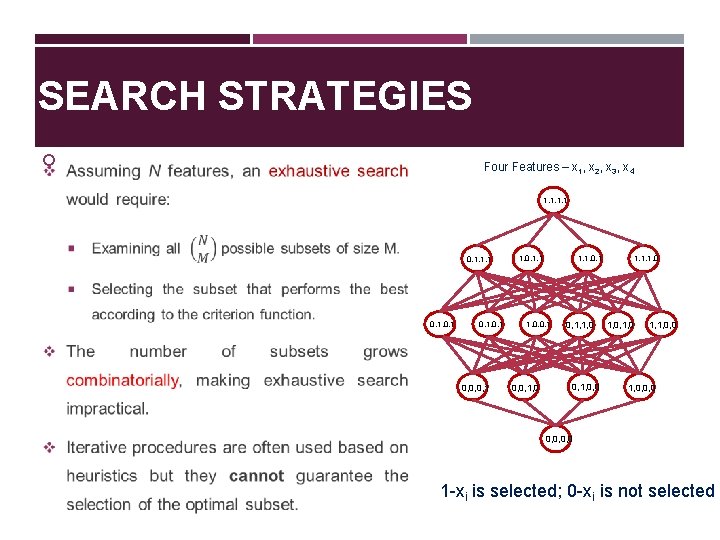
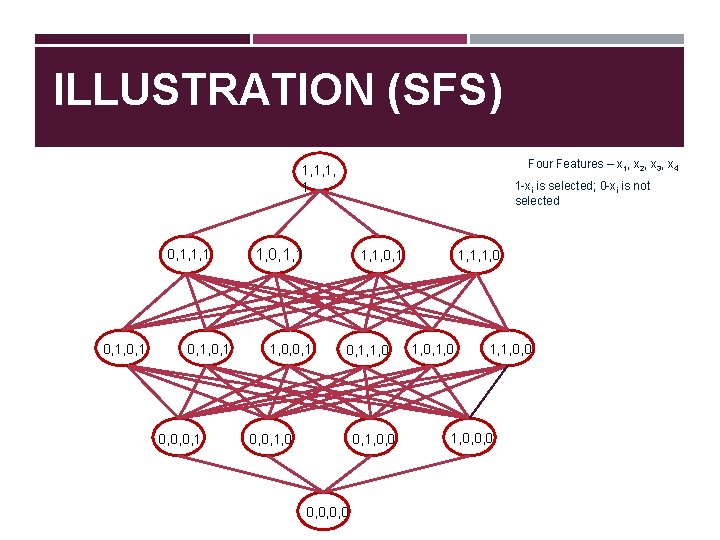
SEARCH STRATEGIES Four Features – x 1, x 2, x 3, x 4 1, 1, 1, 1 0, 1, 0, 1 0, 0, 0, 1 1, 0, 1, 1, 0, 1 1, 0, 0, 1, 0 0, 1, 0, 0 1, 1, 1, 0, 1, 0 1, 1, 0, 0, 0, 0 1 -xi is selected; 0 -xi is not selected
NAÏVE SEARCH v Sort the given N features in order of their probability of correct recognition. v Select the top M features from this sorted list. v Disadvantage Feature correlation is not considered. Best pair of features may not even contain the best individual feature.
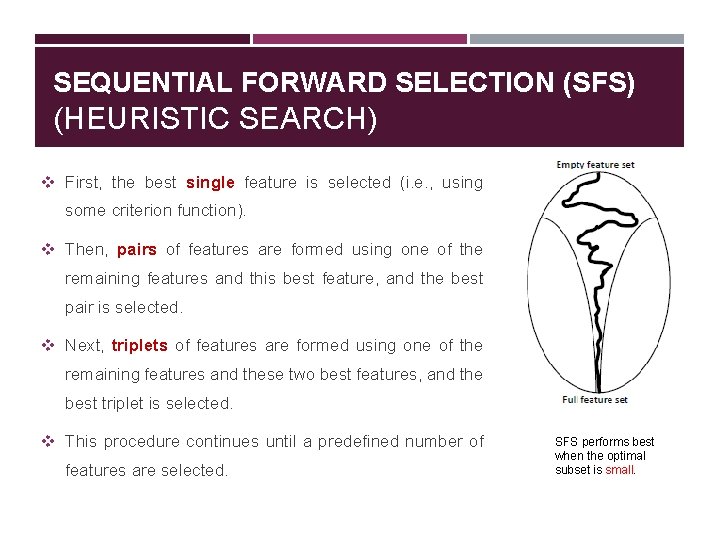
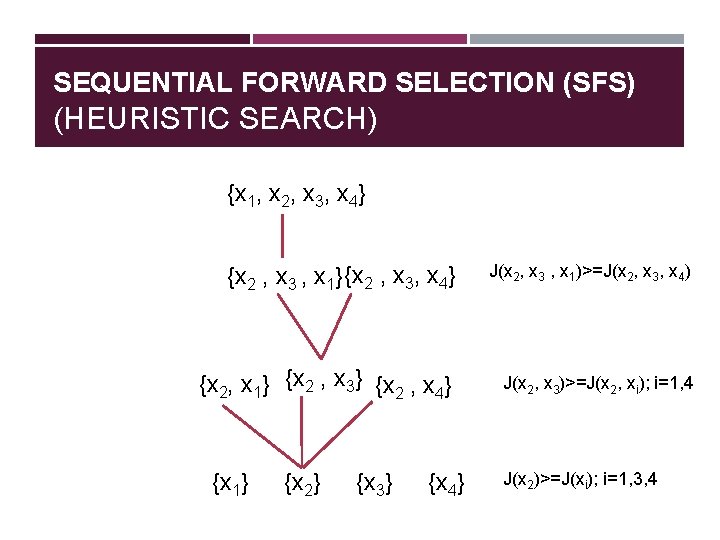
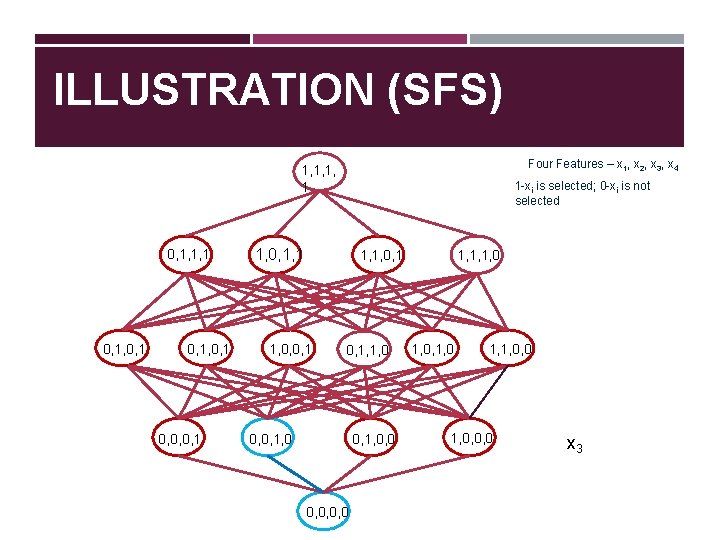
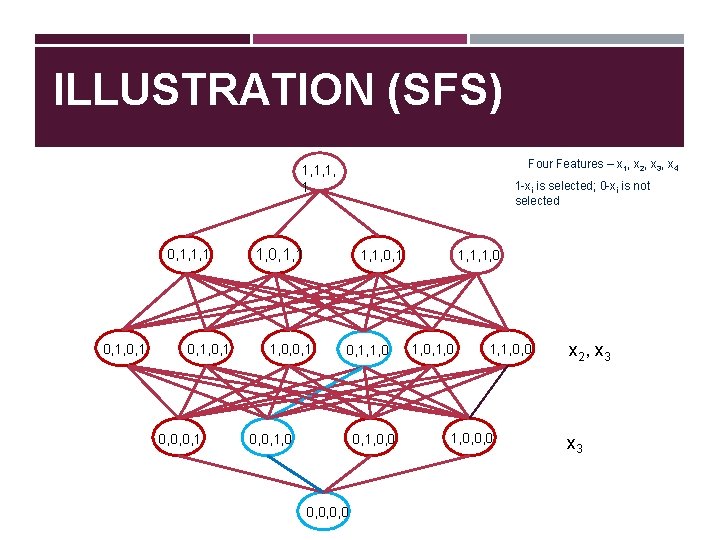
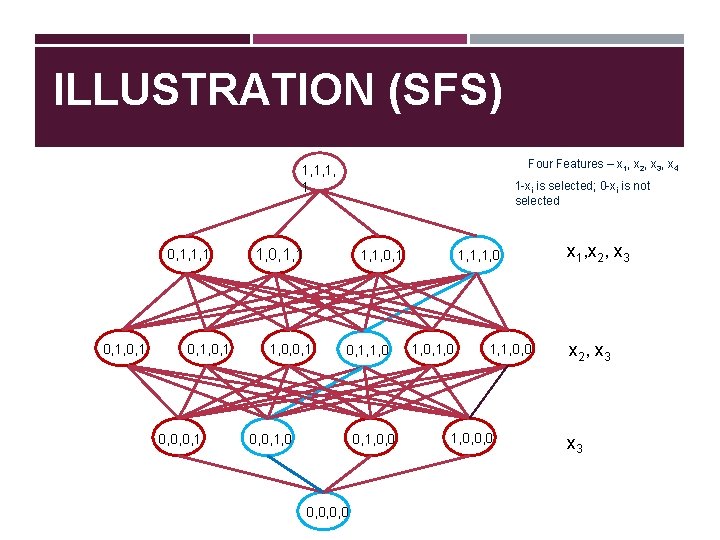
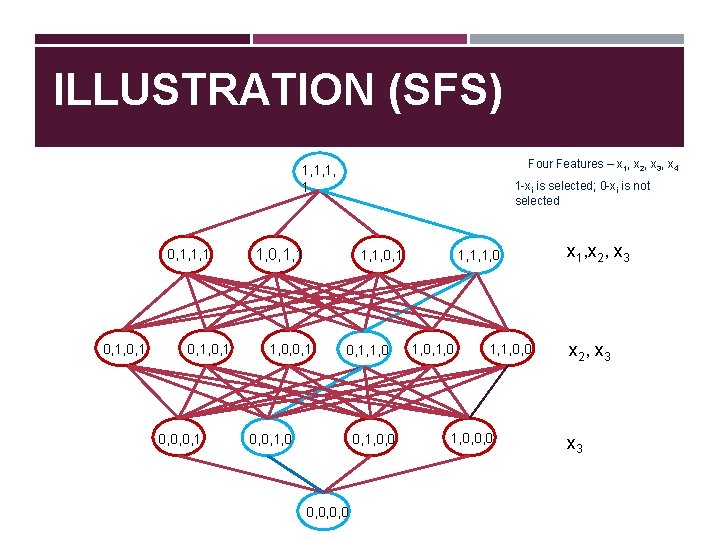
SEQUENTIAL FORWARD SELECTION (SFS) (HEURISTIC SEARCH) v First, the best single feature is selected (i. e. , using some criterion function). v Then, pairs of features are formed using one of the remaining features and this best feature, and the best pair is selected. v Next, triplets of features are formed using one of the remaining features and these two best features, and the best triplet is selected. v This procedure continues until a predefined number of features are selected. SFS performs best when the optimal subset is small.
SEQUENTIAL FORWARD SELECTION (SFS) (HEURISTIC SEARCH) {x 1, x 2, x 3, x 4} {x 2 , x 3 , x 1} {x 2 , x 3, x 4} J(x 2, x 3 , x 1)>=J(x 2, x 3, x 4) {x 2, x 1} {x 2 , x 3} {x 2 , x 4} J(x 2, x 3)>=J(x 2, xi); i=1, 4 {x 1} {x 2} {x 3} {x 4} J(x 2)>=J(xi); i=1, 3, 4
ILLUSTRATION (SFS) Four Features – x 1, x 2, x 3, x 4 1, 1, 1, 1 0, 1, 0, 1 0, 0, 0, 1 1 -xi is selected; 0 -xi is not selected 1, 0, 1, 1, 0, 1 1, 0, 0, 1, 1, 0 0, 1, 0, 0, 1, 0 0, 0, 0, 0 1, 1, 1, 0, 1, 0 1, 1, 0, 0, 0
ILLUSTRATION (SFS) Four Features – x 1, x 2, x 3, x 4 1, 1, 1, 1 0, 1, 0, 1 0, 0, 0, 1 1 -xi is selected; 0 -xi is not selected 1, 0, 1, 1, 0, 1 1, 0, 0, 1, 1, 0 0, 1, 0, 0, 1, 0 0, 0, 0, 0 1, 1, 1, 0, 1, 0 1, 1, 0, 0, 0 x 3
ILLUSTRATION (SFS) Four Features – x 1, x 2, x 3, x 4 1, 1, 1, 1 0, 1, 0, 1 0, 0, 0, 1 1 -xi is selected; 0 -xi is not selected 1, 0, 1, 1, 0, 1 1, 0, 0, 1, 1, 0 0, 1, 0, 0, 1, 0 0, 0, 0, 0 1, 1, 1, 0, 1, 0 1, 1, 0, 0, 0 x 2, x 3
ILLUSTRATION (SFS) Four Features – x 1, x 2, x 3, x 4 1, 1, 1, 1 0, 1, 0, 1 0, 0, 0, 1 1 -xi is selected; 0 -xi is not selected 1, 0, 1, 1, 0, 1 1, 0, 0, 1, 1, 0 0, 1, 0, 0, 1, 0 0, 0, 0, 0 1, 1, 1, 0, 1, 0 1, 1, 0, 0, 0 x 1, x 2, x 3 x 3
ILLUSTRATION (SFS) Four Features – x 1, x 2, x 3, x 4 1, 1, 1, 1 0, 1, 0, 1 0, 0, 0, 1 1 -xi is selected; 0 -xi is not selected 1, 0, 1, 1, 0, 1 1, 0, 0, 1, 1, 0 0, 1, 0, 0, 1, 0 0, 0, 0, 0 1, 1, 1, 0, 1, 0 1, 1, 0, 0, 0 x 1, x 2, x 3 x 3
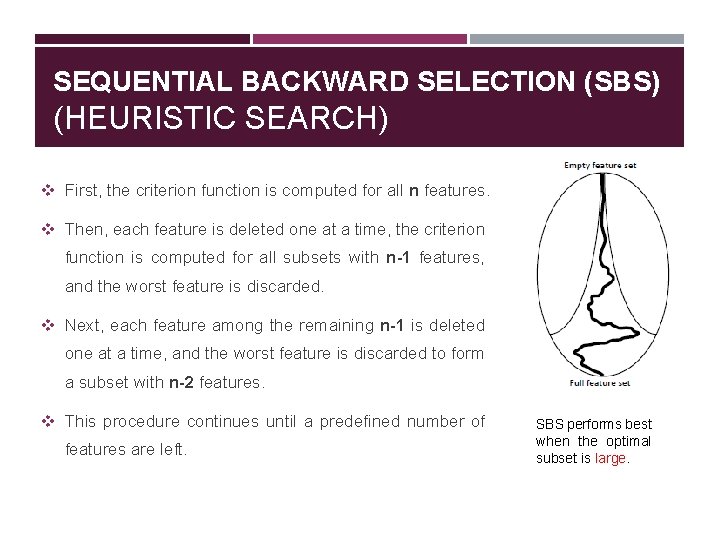
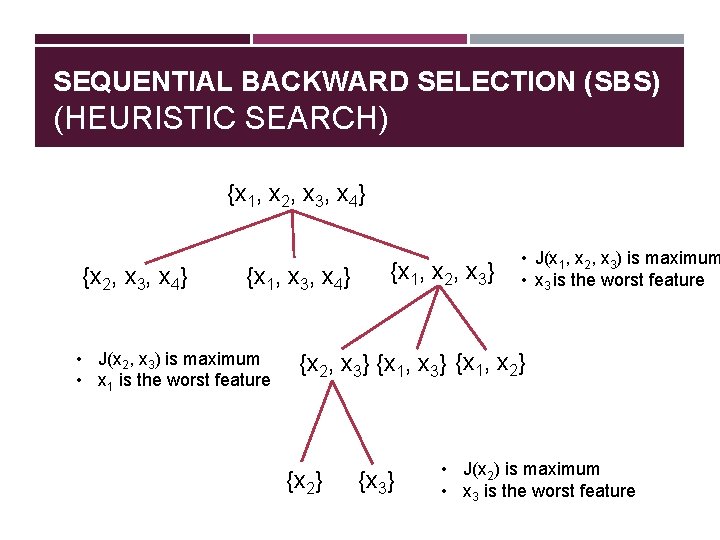
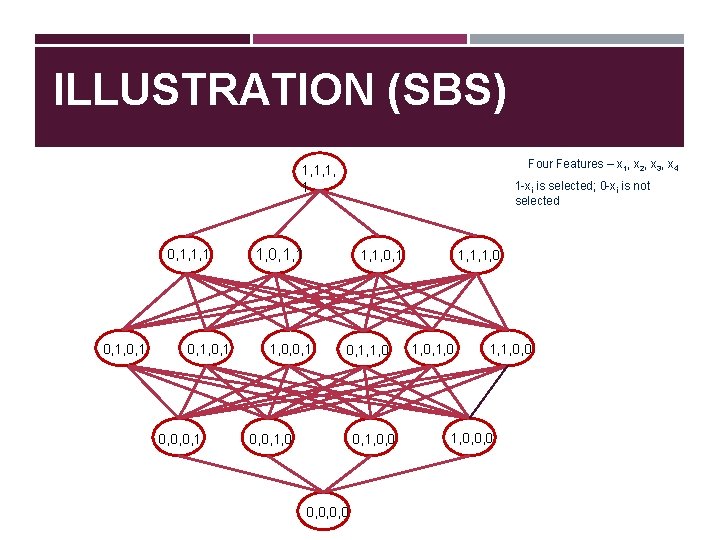
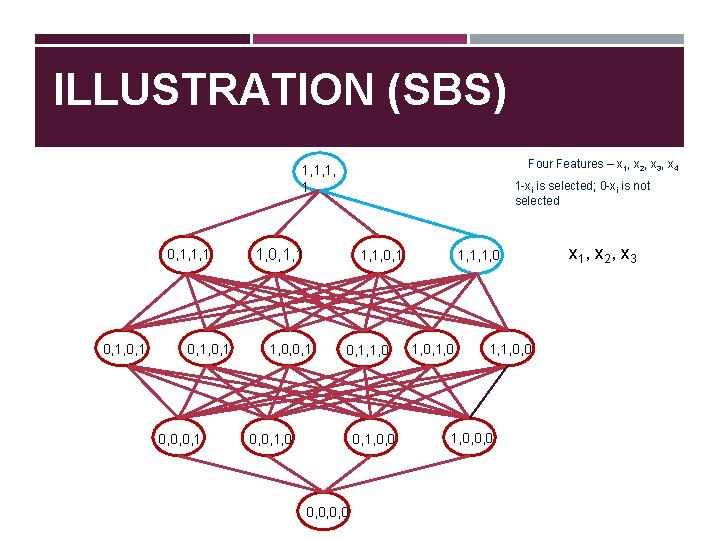
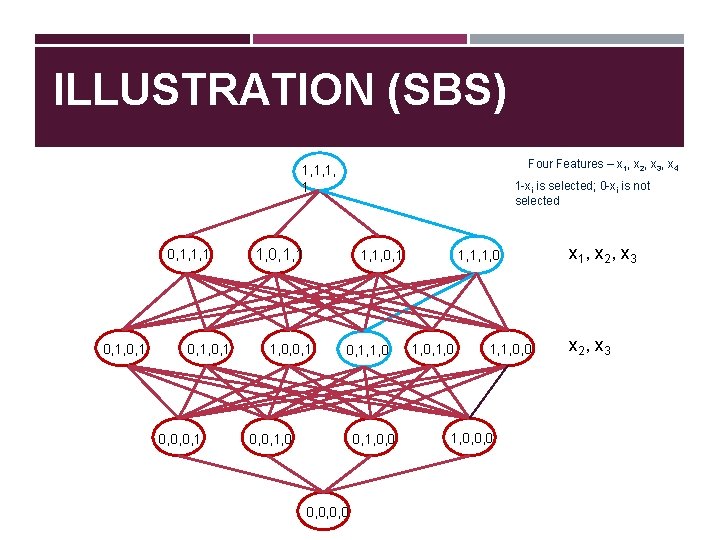
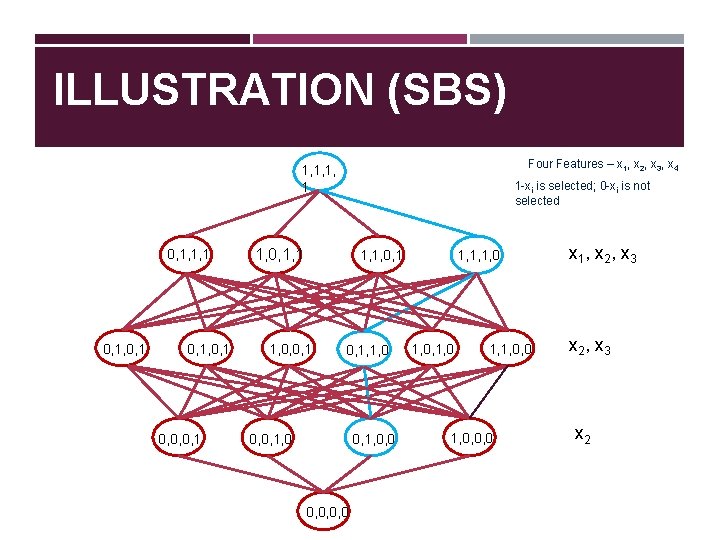
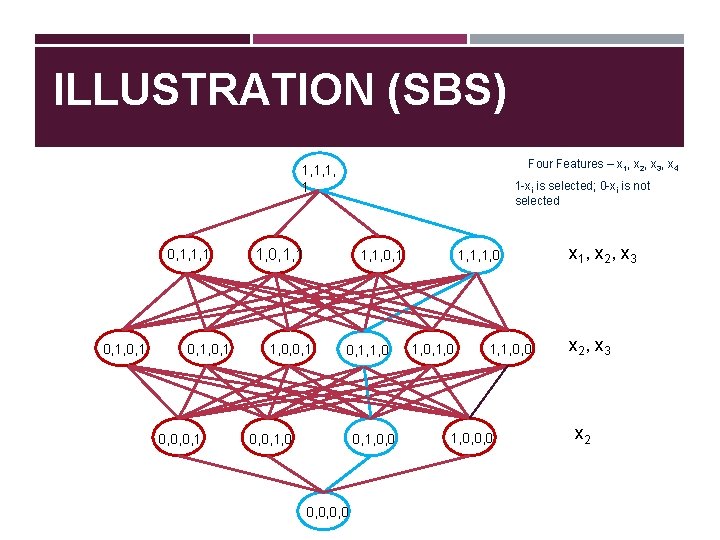
SEQUENTIAL BACKWARD SELECTION (SBS) (HEURISTIC SEARCH) v First, the criterion function is computed for all n features. v Then, each feature is deleted one at a time, the criterion function is computed for all subsets with n-1 features, and the worst feature is discarded. v Next, each feature among the remaining n-1 is deleted one at a time, and the worst feature is discarded to form a subset with n-2 features. v This procedure continues until a predefined number of features are left. SBS performs best when the optimal subset is large.
SEQUENTIAL BACKWARD SELECTION (SBS) (HEURISTIC SEARCH) {x 1, x 2, x 3, x 4} {x 1, x 3, x 4} • J(x 2, x 3) is maximum • x 1 is the worst feature {x 1, x 2, x 3} • J(x 1, x 2, x 3) is maximum • x 3 is the worst feature {x 2, x 3} {x 1, x 2} {x 3} • J(x 2) is maximum • x 3 is the worst feature
ILLUSTRATION (SBS) Four Features – x 1, x 2, x 3, x 4 1, 1, 1, 1 0, 1, 0, 1 0, 0, 0, 1 1 -xi is selected; 0 -xi is not selected 1, 0, 1, 1, 0, 1 1, 0, 0, 1, 1, 0 0, 1, 0, 0, 1, 0 0, 0, 0, 0 1, 1, 1, 0, 1, 0 1, 1, 0, 0, 0
ILLUSTRATION (SBS) Four Features – x 1, x 2, x 3, x 4 1, 1, 1, 1 0, 1, 0, 1 0, 0, 0, 1 1 -xi is selected; 0 -xi is not selected 1, 0, 1, 1, 0, 1 1, 0, 0, 1, 1, 0 0, 1, 0, 0, 1, 0 0, 0, 0, 0 1, 1, 1, 0, 1, 0 1, 1, 0, 0, 0 x 1, x 2, x 3
ILLUSTRATION (SBS) Four Features – x 1, x 2, x 3, x 4 1, 1, 1, 1 0, 1, 0, 1 0, 0, 0, 1 1 -xi is selected; 0 -xi is not selected 1, 0, 1, 1, 0, 1 1, 0, 0, 1, 1, 0 0, 1, 0, 0, 1, 0 0, 0, 0, 0 1, 1, 1, 0, 1, 0 1, 1, 0, 0, 0 x 1, x 2, x 3
ILLUSTRATION (SBS) Four Features – x 1, x 2, x 3, x 4 1, 1, 1, 1 0, 1, 0, 1 0, 0, 0, 1 1 -xi is selected; 0 -xi is not selected 1, 0, 1, 1, 0, 1 1, 0, 0, 1, 1, 0 0, 1, 0, 0, 1, 0 0, 0, 0, 0 1, 1, 1, 0, 1, 0 1, 1, 0, 0, 0 x 1, x 2, x 3 x 2
ILLUSTRATION (SBS) Four Features – x 1, x 2, x 3, x 4 1, 1, 1, 1 0, 1, 0, 1 0, 0, 0, 1 1 -xi is selected; 0 -xi is not selected 1, 0, 1, 1, 0, 1 1, 0, 0, 1, 1, 0 0, 1, 0, 0, 1, 0 0, 0, 0, 0 1, 1, 1, 0, 1, 0 1, 1, 0, 0, 0 x 1, x 2, x 3 x 2
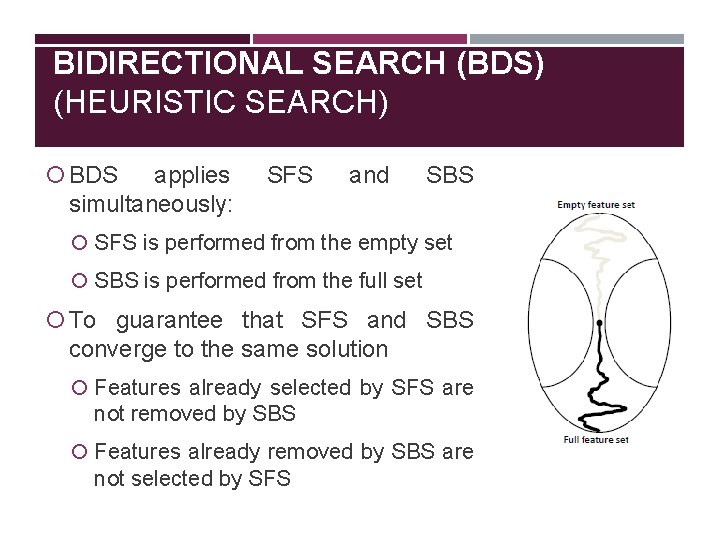
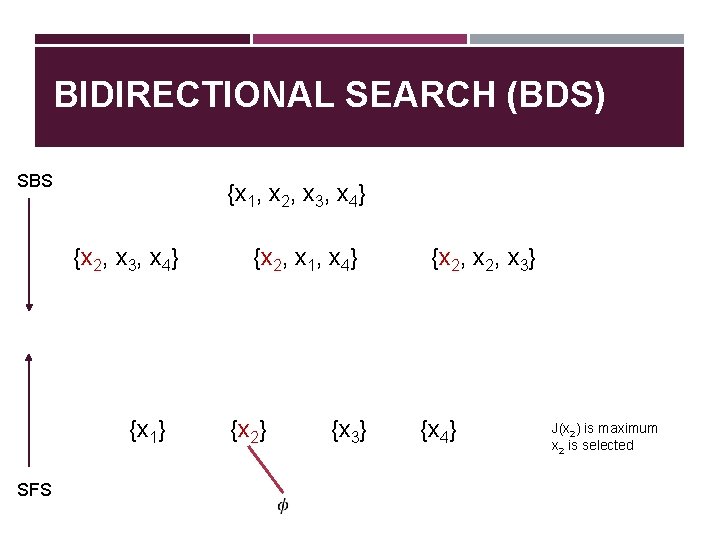
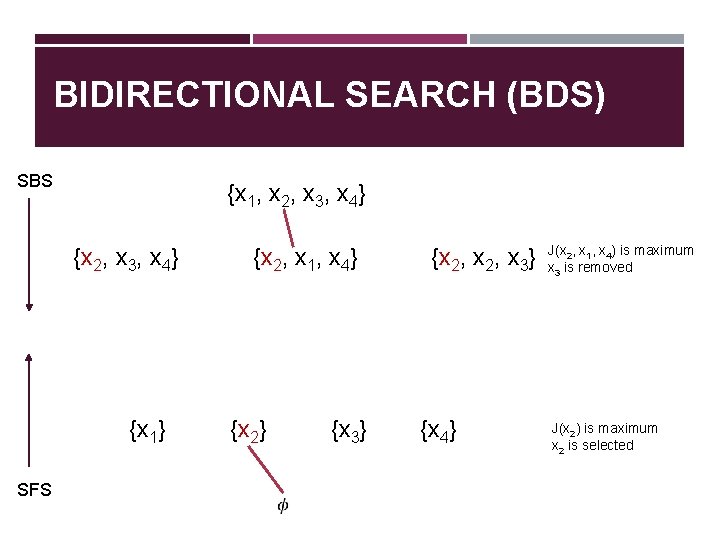
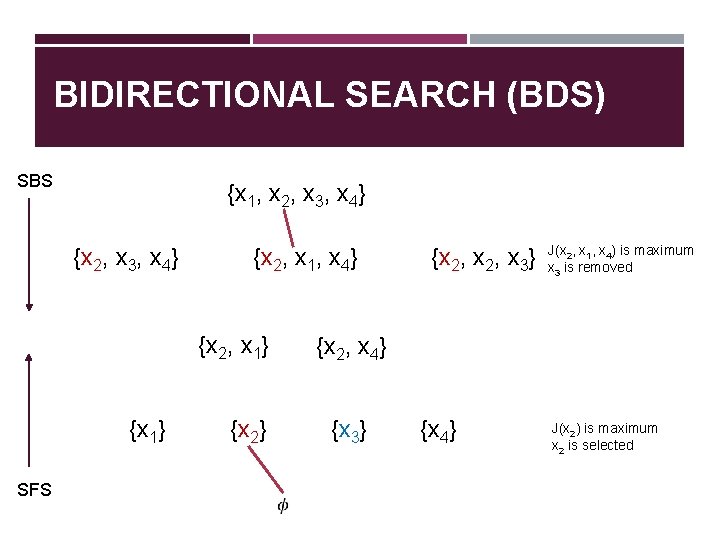
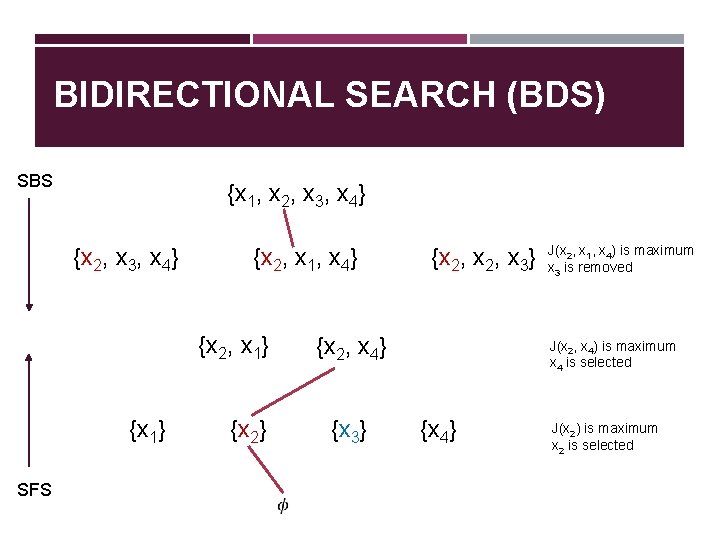
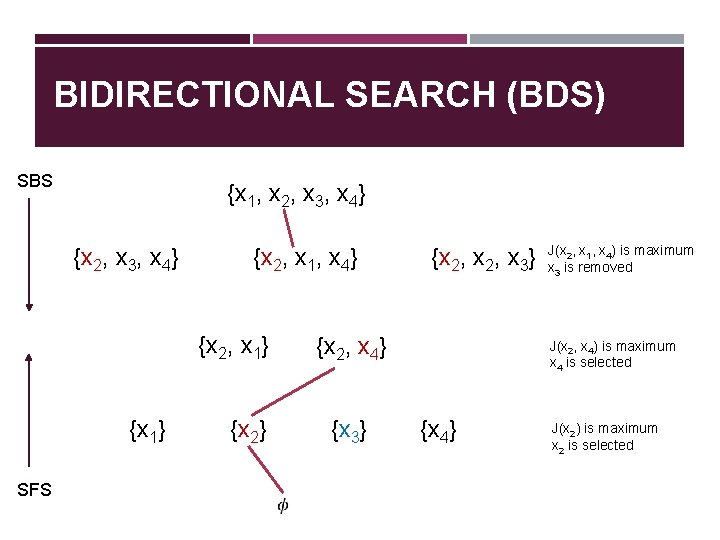
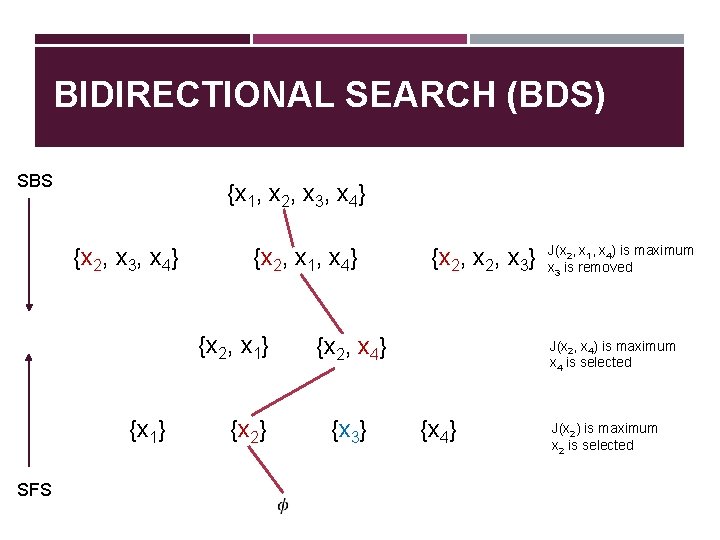
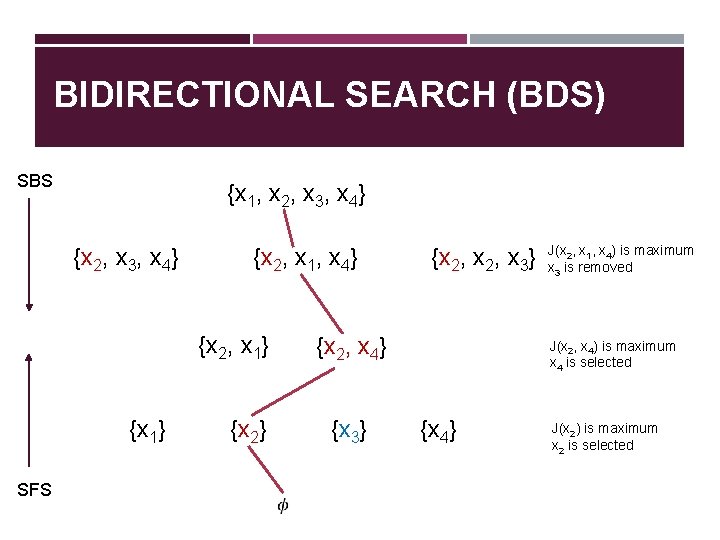
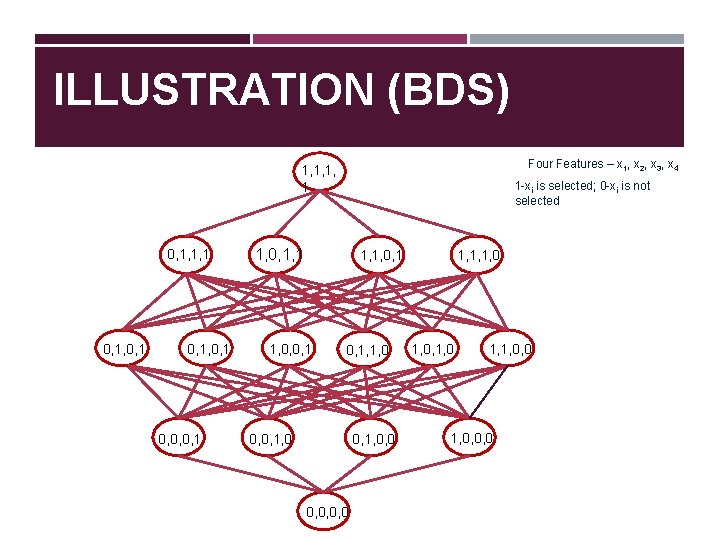
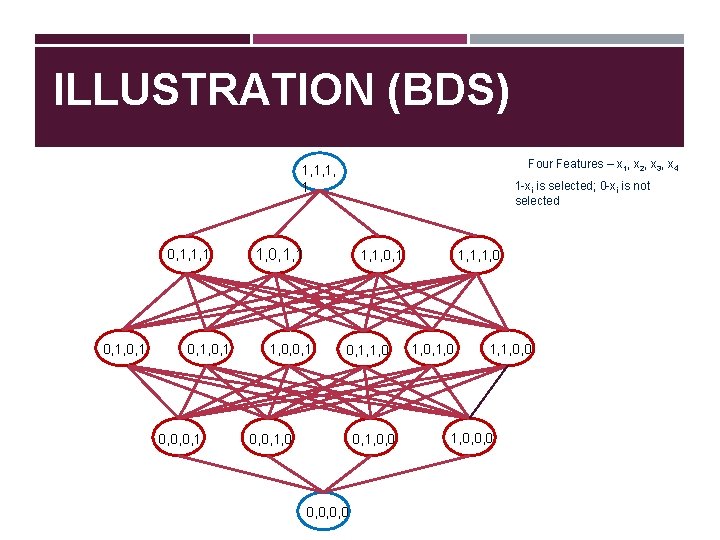
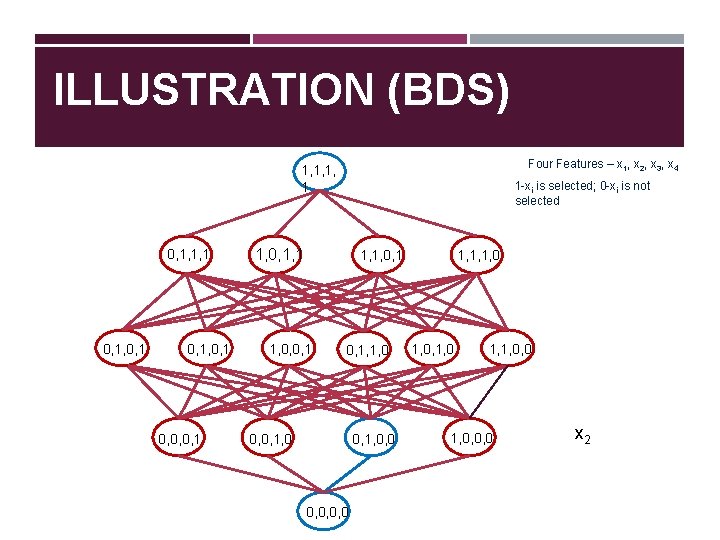
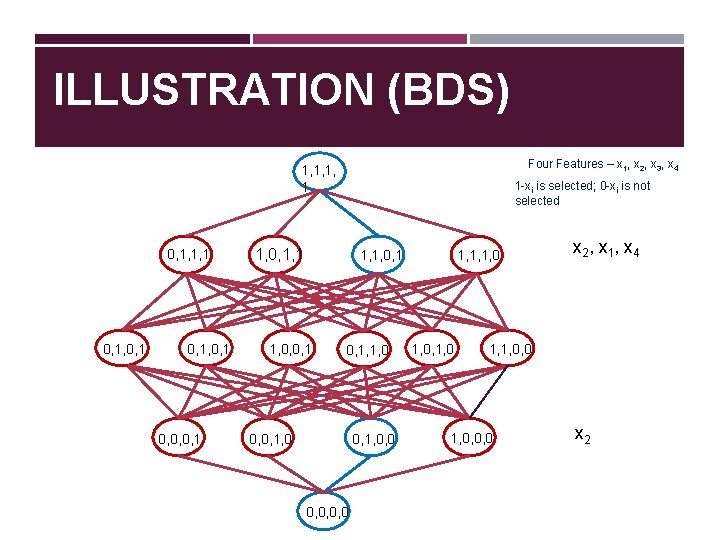
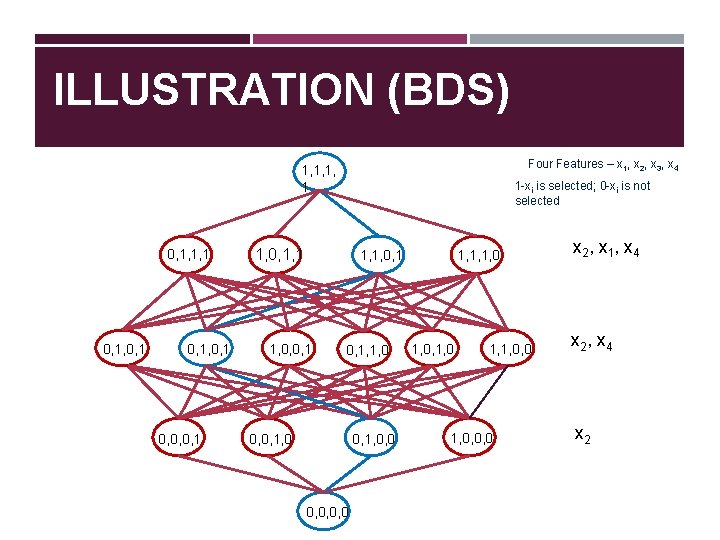
BIDIRECTIONAL SEARCH (BDS) (HEURISTIC SEARCH) BDS applies simultaneously: SFS and SBS SFS is performed from the empty set SBS is performed from the full set To guarantee that SFS and SBS converge to the same solution Features already selected by SFS are not removed by SBS Features already removed by SBS are not selected by SFS
BIDIRECTIONAL SEARCH (BDS) SBS SFS {x 1, x 2, x 3, x 4}
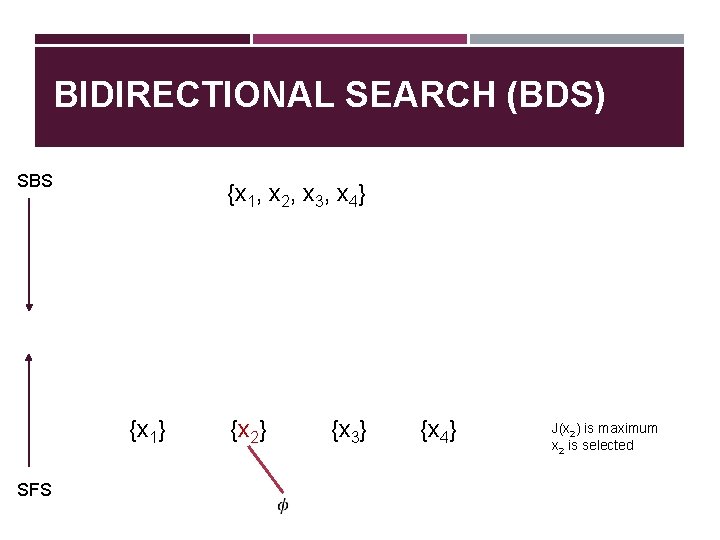
BIDIRECTIONAL SEARCH (BDS) SBS {x 1, x 2, x 3, x 4} {x 1} SFS {x 2} {x 3} {x 4} J(x 2) is maximum x 2 is selected
BIDIRECTIONAL SEARCH (BDS) SBS {x 1, x 2, x 3, x 4} {x 1} SFS {x 2, x 1, x 4} {x 2} {x 3} {x 2, x 3} {x 4} J(x 2) is maximum x 2 is selected
BIDIRECTIONAL SEARCH (BDS) SBS {x 1, x 2, x 3, x 4} {x 1} SFS {x 2, x 1, x 4} {x 2} {x 3} {x 2, x 3} {x 4} J(x 2, x 1, x 4) is maximum x 3 is removed J(x 2) is maximum x 2 is selected
BIDIRECTIONAL SEARCH (BDS) SBS {x 1, x 2, x 3, x 4} {x 2, x 1, x 4} {x 2, x 1} {x 1} SFS {x 2, x 3} J(x 2, x 1, x 4) is maximum x 3 is removed {x 2, x 4} {x 2} {x 3} {x 4} J(x 2) is maximum x 2 is selected
BIDIRECTIONAL SEARCH (BDS) SBS {x 1, x 2, x 3, x 4} {x 2, x 1, x 4} {x 2, x 1} {x 1} SFS {x 2, x 3} {x 2, x 4} {x 2} {x 3} J(x 2, x 1, x 4) is maximum x 3 is removed J(x 2, x 4) is maximum x 4 is selected {x 4} J(x 2) is maximum x 2 is selected
BIDIRECTIONAL SEARCH (BDS) SBS {x 1, x 2, x 3, x 4} {x 2, x 1, x 4} {x 2, x 1} {x 1} SFS {x 2, x 3} {x 2, x 4} {x 2} {x 3} J(x 2, x 1, x 4) is maximum x 3 is removed J(x 2, x 4) is maximum x 4 is selected {x 4} J(x 2) is maximum x 2 is selected
BIDIRECTIONAL SEARCH (BDS) SBS {x 1, x 2, x 3, x 4} {x 2, x 1, x 4} {x 2, x 1} {x 1} SFS {x 2, x 3} {x 2, x 4} {x 2} {x 3} J(x 2, x 1, x 4) is maximum x 3 is removed J(x 2, x 4) is maximum x 4 is selected {x 4} J(x 2) is maximum x 2 is selected
BIDIRECTIONAL SEARCH (BDS) SBS {x 1, x 2, x 3, x 4} {x 2, x 1, x 4} {x 2, x 1} {x 1} SFS {x 2, x 3} {x 2, x 4} {x 2} {x 3} J(x 2, x 1, x 4) is maximum x 3 is removed J(x 2, x 4) is maximum x 4 is selected {x 4} J(x 2) is maximum x 2 is selected
ILLUSTRATION (BDS) Four Features – x 1, x 2, x 3, x 4 1, 1, 1, 1 0, 1, 0, 1 0, 0, 0, 1 1 -xi is selected; 0 -xi is not selected 1, 0, 1, 1, 0, 1 1, 0, 0, 1, 1, 0 0, 1, 0, 0, 1, 0 0, 0, 0, 0 1, 1, 1, 0, 1, 0 1, 1, 0, 0, 0
ILLUSTRATION (BDS) Four Features – x 1, x 2, x 3, x 4 1, 1, 1, 1 0, 1, 0, 1 0, 0, 0, 1 1 -xi is selected; 0 -xi is not selected 1, 0, 1, 1, 0, 1 1, 0, 0, 1, 1, 0 0, 1, 0, 0, 1, 0 0, 0, 0, 0 1, 1, 1, 0, 1, 0 1, 1, 0, 0, 0
ILLUSTRATION (BDS) Four Features – x 1, x 2, x 3, x 4 1, 1, 1, 1 0, 1, 0, 1 0, 0, 0, 1 1 -xi is selected; 0 -xi is not selected 1, 0, 1, 1, 0, 1 1, 0, 0, 1, 1, 0 0, 1, 0, 0, 1, 0 0, 0, 0, 0 1, 1, 1, 0, 1, 0 1, 1, 0, 0, 0 x 2
ILLUSTRATION (BDS) Four Features – x 1, x 2, x 3, x 4 1, 1, 1, 1 0, 1, 0, 1 0, 0, 0, 1 1 -xi is selected; 0 -xi is not selected 1, 0, 1, 1, 0, 1 1, 0, 0, 1, 1, 0 0, 1, 0, 0, 1, 0 0, 0, 0, 0 1, 1, 1, 0, 1, 0 x 2, x 1, x 4 1, 1, 0, 0, 0 x 2
ILLUSTRATION (BDS) Four Features – x 1, x 2, x 3, x 4 1, 1, 1, 1 0, 1, 0, 1 0, 0, 0, 1 1 -xi is selected; 0 -xi is not selected 1, 0, 1, 1, 0, 1 1, 0, 0, 1, 1, 0 0, 1, 0, 0, 1, 0 0, 0, 0, 0 1, 1, 1, 0, 1, 0 1, 1, 0, 0, 0 x 2, x 1, x 4 x 2
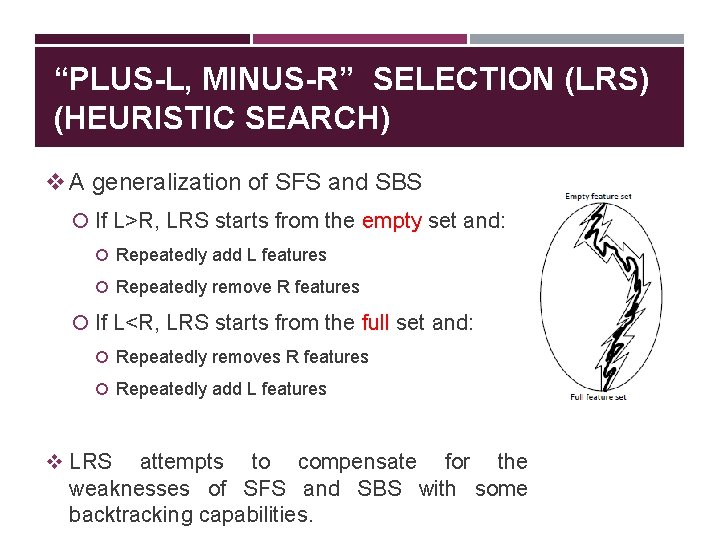
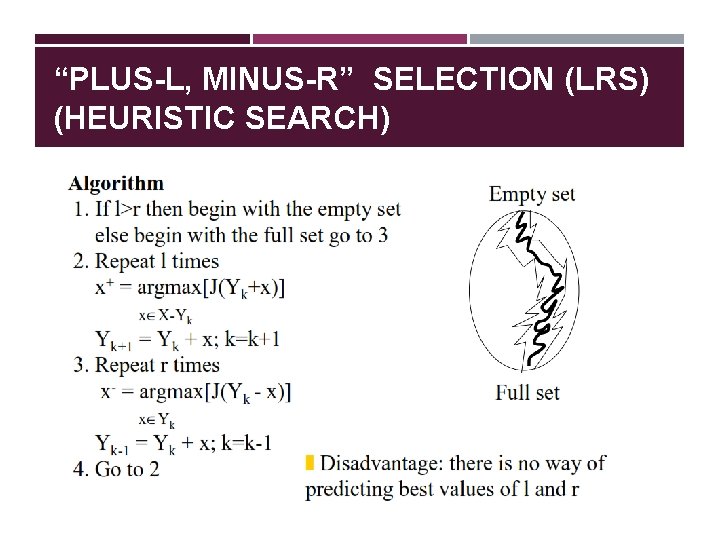
“PLUS-L, MINUS-R” SELECTION (LRS) (HEURISTIC SEARCH) v A generalization of SFS and SBS If L>R, LRS starts from the empty set and: Repeatedly add L features Repeatedly remove R features If L<R, LRS starts from the full set and: Repeatedly removes R features Repeatedly add L features v LRS attempts to compensate for the weaknesses of SFS and SBS with some backtracking capabilities.
“PLUS-L, MINUS-R” SELECTION (LRS) (HEURISTIC SEARCH)
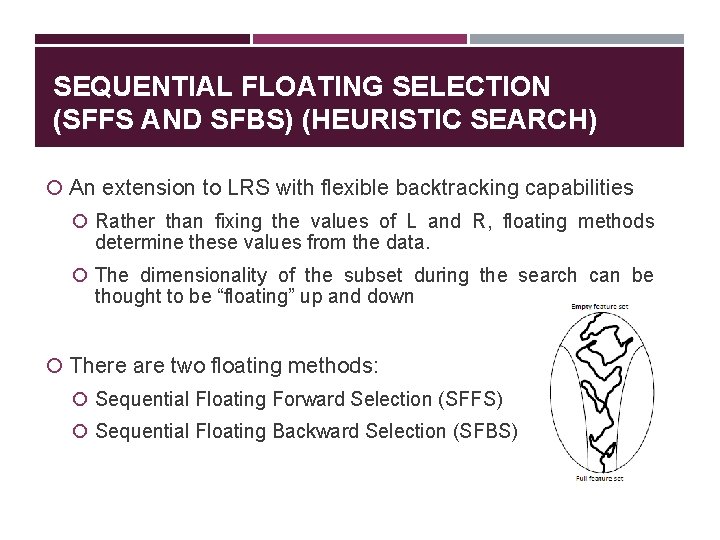
SEQUENTIAL FLOATING SELECTION (SFFS AND SFBS) (HEURISTIC SEARCH) An extension to LRS with flexible backtracking capabilities Rather than fixing the values of L and R, floating methods determine these values from the data. The dimensionality of the subset during the search can be thought to be “floating” up and down There are two floating methods: Sequential Floating Forward Selection (SFFS) Sequential Floating Backward Selection (SFBS)
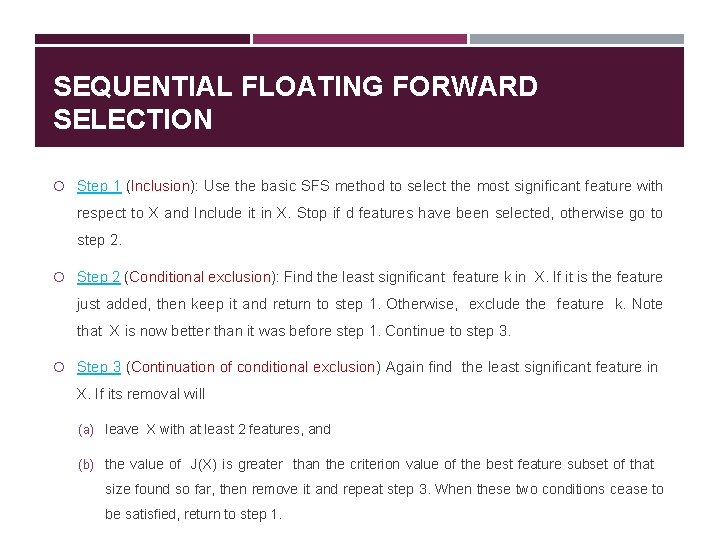
SEQUENTIAL FLOATING FORWARD SELECTION Step 1 (Inclusion): Use the basic SFS method to select the most significant feature with respect to X and Include it in X. Stop if d features have been selected, otherwise go to step 2. Step 2 (Conditional exclusion): Find the least significant feature k in X. If it is the feature just added, then keep it and return to step 1. Otherwise, exclude the feature k. Note that X is now better than it was before step 1. Continue to step 3. Step 3 (Continuation of conditional exclusion) Again find the least significant feature in X. If its removal will (a) leave X with at least 2 features, and (b) the value of J(X) is greater than the criterion value of the best feature subset of that size found so far, then remove it and repeat step 3. When these two conditions cease to be satisfied, return to step 1.
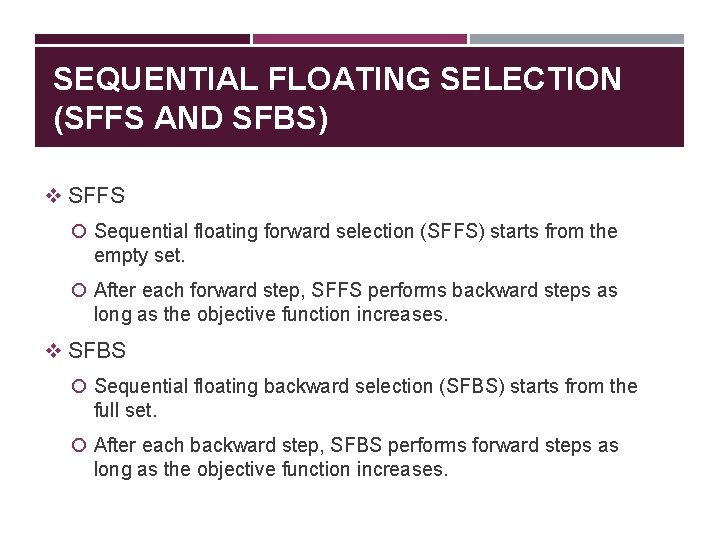
SEQUENTIAL FLOATING SELECTION (SFFS AND SFBS) v SFFS Sequential floating forward selection (SFFS) starts from the empty set. After each forward step, SFFS performs backward steps as long as the objective function increases. v SFBS Sequential floating backward selection (SFBS) starts from the full set. After each backward step, SFBS performs forward steps as long as the objective function increases.