
The Mechanosensitivity of Type I Collagen to MMP
















- Slides: 27
The Mechanosensitivity of Type I Collagen to MMP Cleavage Robert Camp Mechanical Engineering Extracellular Matrix Engineering Research Laboratory (EMERL) Advisor: Jeff Ruberti
Agenda �Who are you? �What is Collagen? �Why is the mechanosensitivity of collagen important? (alternately, Why did IGERT give you money? ) �How are you going to test this? �Where is all this cool work being done? �Current Status �Conclusions and Question/Answer
Who are you? �Robert Camp �Ph. D Student, Mechanical Engineering �Education �Rochester Institute of Technology � BS Mechanical/Aerospace Engineering �University of New Hampshire � MS Mechanical Engineering �Work Experience �High Energy Physics �Infrared Optomechanics
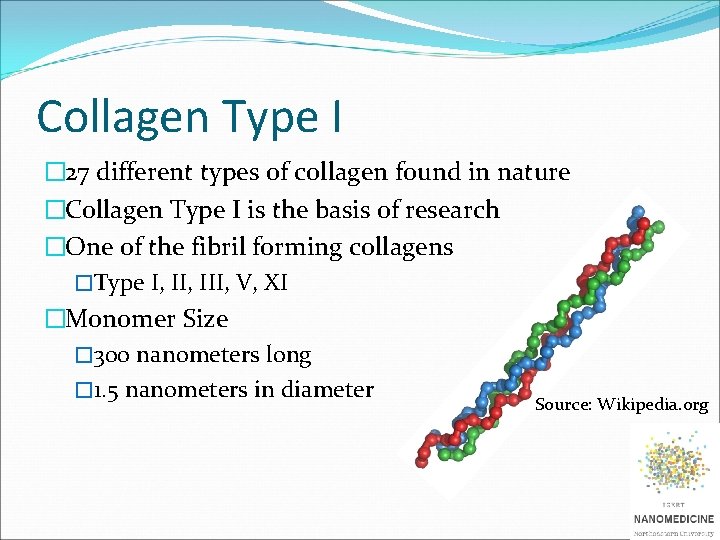
What is Collagen? Source: Wikipedia. org �Principal load bearing and most abundant protein in vertebrate animals �Defined as (GLY-X-Y)n � 3 left-handed helical alpha chains form one right-handed helix collagen monomer
Collagen Type I � 27 different types of collagen found in nature �Collagen Type I is the basis of research �One of the fibril forming collagens �Type I, III, V, XI �Monomer Size � 300 nanometers long � 1. 5 nanometers in diameter Source: Wikipedia. org
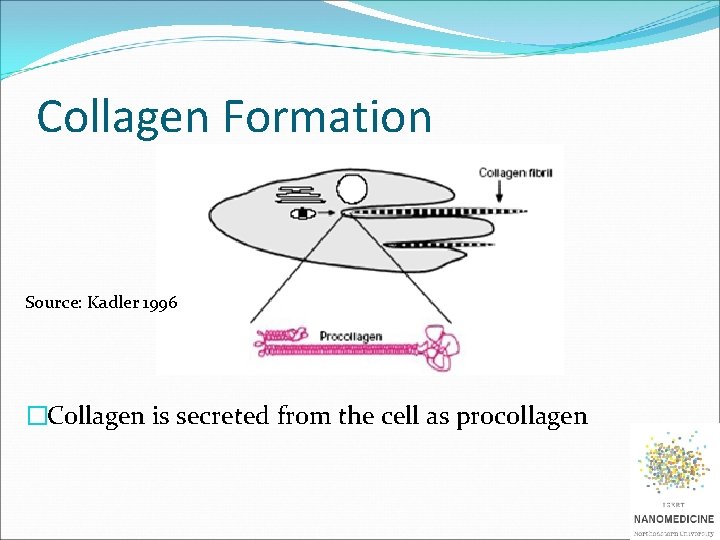
Collagen Formation Source: Kadler 1996 �Collagen is secreted from the cell as procollagen
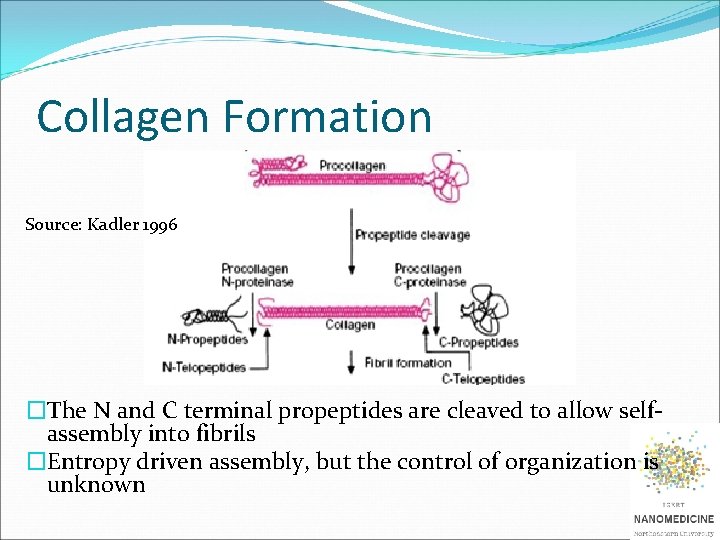
Collagen Formation Source: Kadler 1996 �The N and C terminal propeptides are cleaved to allow selfassembly into fibrils �Entropy driven assembly, but the control of organization is unknown
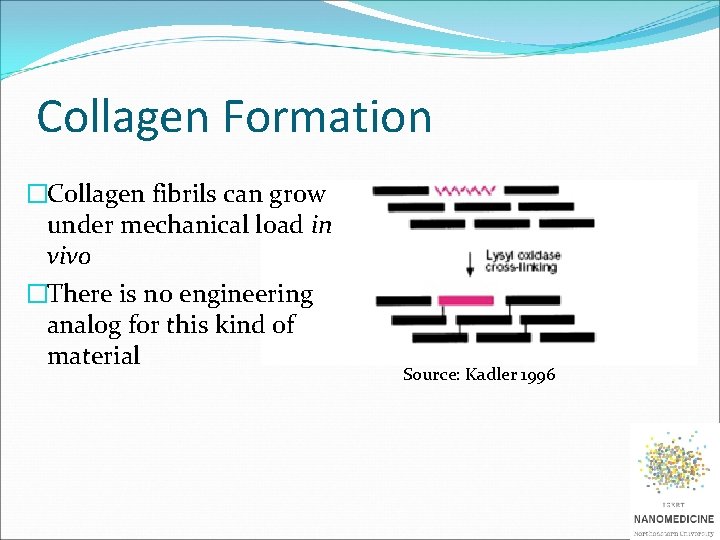
Collagen Formation �Collagen fibrils can grow under mechanical load in vivo �There is no engineering analog for this kind of material Source: Kadler 1996
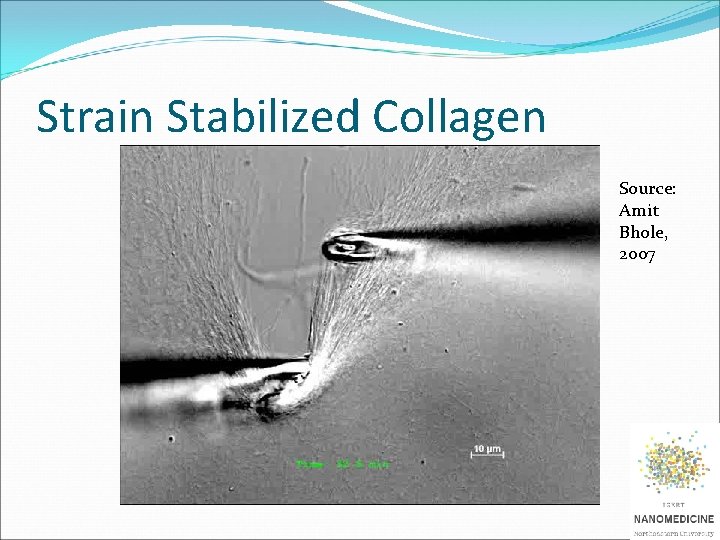
Member of the Mechanome �Mechanome- The constellation of all molecules that are load responsive in nature �Known: Strain-stabilized against thermal denaturation �Suspected: Stabilized against enzymatic cleavage by applied loads. �This is the hypothesis that I am currently attempting to disprove
Strain Stabilized Collagen Source: Amit Bhole, 2007
Why is this important? �Osteoarthritis �$60 Billion effect on the economy Collagen no longer in tension Escaping Fluid Sacs Cleaved Collagen Degrading Collagen in tension Normal
Why is this important? �Basic scientific understanding of collagenous matrix development, remodeling, and repair �Known: Our connective tissue self-optimizes to carry applied loads �Is it the Fibroblast that is smart, or is it the Collagen? OR Fibroblast Collagen
Why is this important? �Enhanced applied science �This mechanism could be exploited by tissue engineers to “sculpt” collagen scaffoldings with collagen monomers, cleavage enzymes, and a applied load �The scaffolding would be load optimized � New class of self-optimizing, healable materials �Exploiting the concept of the load-stabilization of a selfassembling molecule
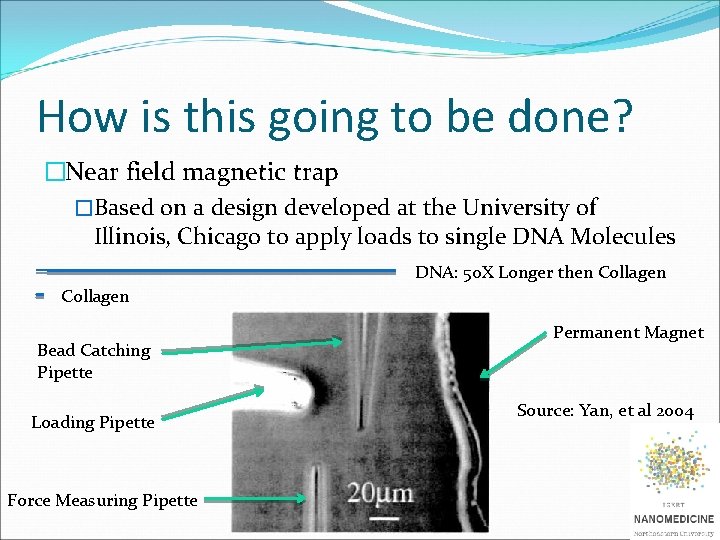
The goal �To use a magnetic trap to apply a force to a collagen monomer to see how it effects the enzymatic cleavage rate
How is this going to be done? �Near field magnetic trap �Based on a design developed at the University of Illinois, Chicago to apply loads to single DNA Molecules DNA: 50 X Longer then Collagen Bead Catching Pipette Loading Pipette Force Measuring Pipette Permanent Magnet Source: Yan, et al 2004
The magnetic trap �Unlike tradition magnetic traps, this one stretches the sample perpendicular to the image plane, instead of parallel with it Internal Magnet Near Field Magnetic Trap Not to Scale Traditional Magnetic Trap
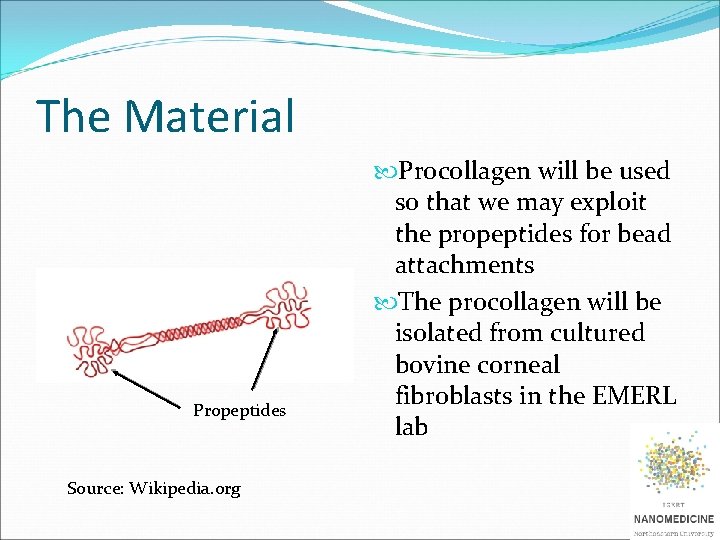
The Material Propeptides Source: Wikipedia. org Procollagen will be used so that we may exploit the propeptides for bead attachments The procollagen will be isolated from cultured bovine corneal fibroblasts in the EMERL lab
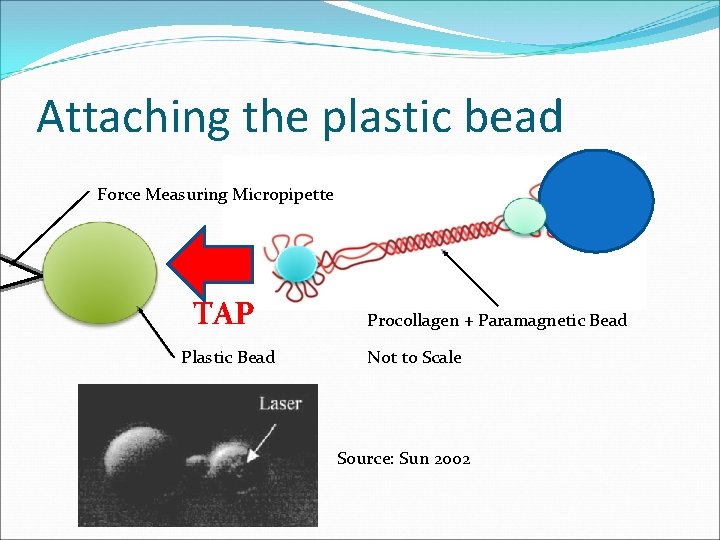
The beads � 2 Beads must be covalently attached to the procollagen �Between 1 and 3 micrometers in diameter �One plastic, one paramagnetic �Procollagen propeptide-antibody-functionalized bead Procollagen Antibody Different Antibody Not Even Close to Scale Paramagnetic Bead
Attaching the plastic bead Force Measuring Micropipette TAP Plastic Bead Procollagen + Paramagnetic Bead Not to Scale Source: Sun 2002
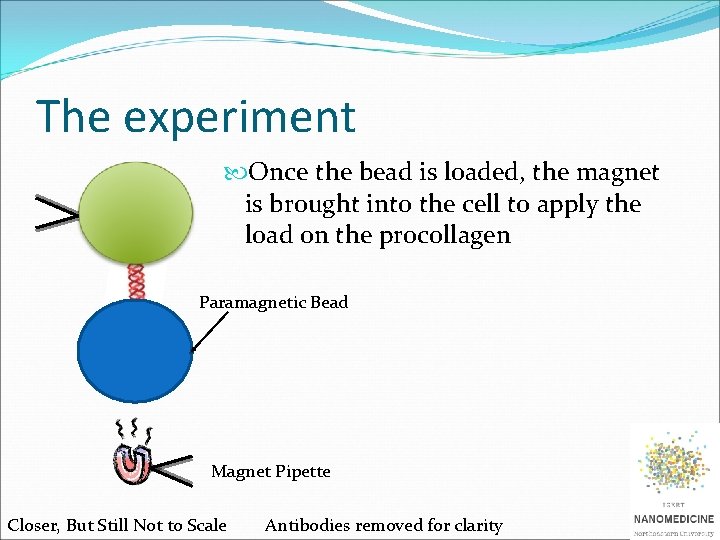
The experiment Once the bead is loaded, the magnet is brought into the cell to apply the load on the procollagen Paramagnetic Bead Magnet Pipette Closer, But Still Not to Scale Antibodies removed for clarity
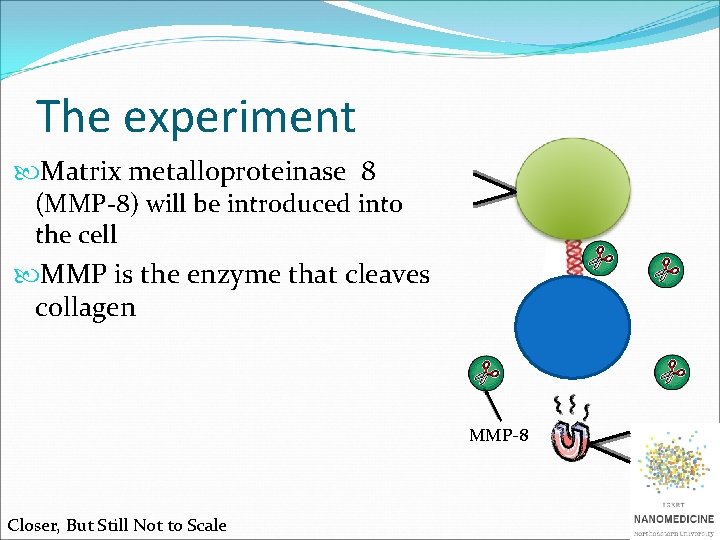
The experiment Matrix metalloproteinase 8 (MMP-8) will be introduced into the cell MMP is the enzyme that cleaves collagen MMP-8 Closer, But Still Not to Scale
The experiment Time to cleavage will be recorded Four successful runs are required for each load Applied loads 1 p. N for control 10, 20, 50, 100, 150, 200, 250, 300 p. N Closer, But Still Not to Scale
The final results �If this experiment demonstrates the cleavage rate is affected by the mechanical load applied to the collagen, our hypothesis on collagen mechanosensitivity properties will be strongly supported. �Even if the null hypothesis is shown, this experiment will still supply important data on MMP binding kinetics, MMP binding forces, and MMP cleavage rates on a single collagen molecule.
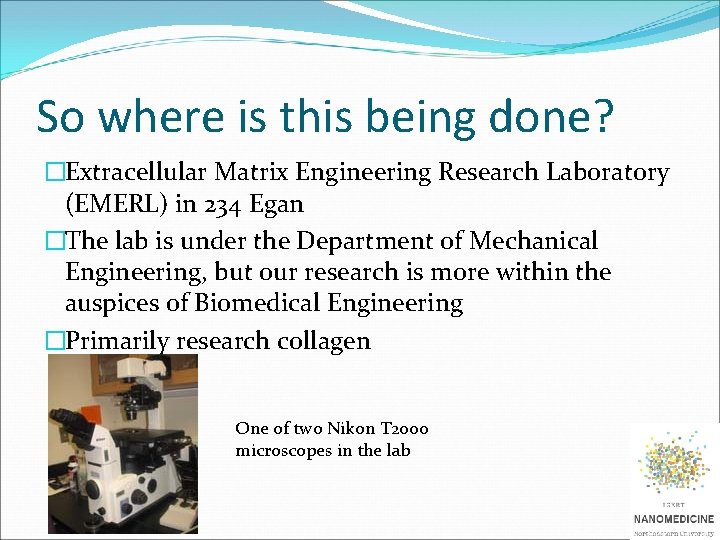
So where is this being done? �Extracellular Matrix Engineering Research Laboratory (EMERL) in 234 Egan �The lab is under the Department of Mechanical Engineering, but our research is more within the auspices of Biomedical Engineering �Primarily research collagen One of two Nikon T 2000 microscopes in the lab
Current Status �Working with Dr. Shashi Murthy, Chemical Engineering Department, Northeastern University to determine the best method to attach the procollagen to the beads �Working on a method to calibrate the force measuring pipettes using microfluid flow
Collagen in Artist Julian Voss-Andreae’s 11 foot tall sculpture of Collagen
Any Questions? “The most exciting phrase to hear in science, the one that heralds new discoveries, isn’t ‘eureka!’, but rather ‘hmmmm, that’s funny’. ” Isaac Asimov