
Topic 19 Topic 19 OxidationReduction Basic Concepts Electron
Topic 19
Topic 19 Oxidation-Reduction: Basic Concepts Electron Transfer and Redox Reactions • One of the defining characteristics of singlereplacement and combustion reactions is that they always involve the transfer of electrons from one atom to another. Click box to view movie clip.
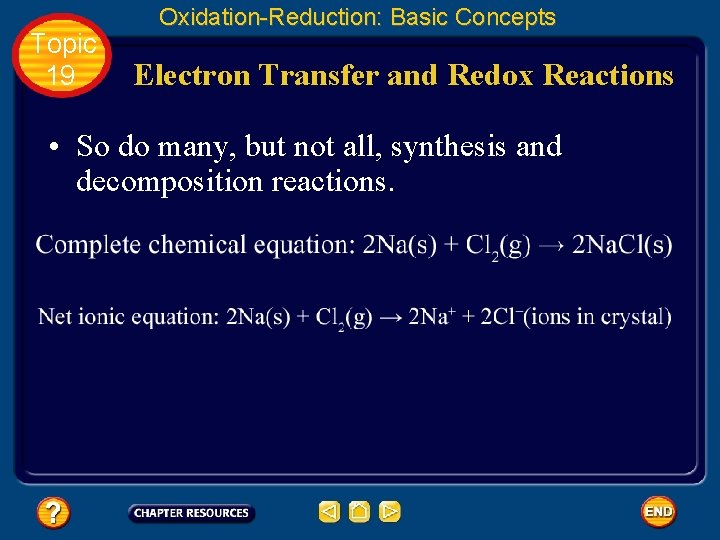
Topic 19 Oxidation-Reduction: Basic Concepts Electron Transfer and Redox Reactions • So do many, but not all, synthesis and decomposition reactions.
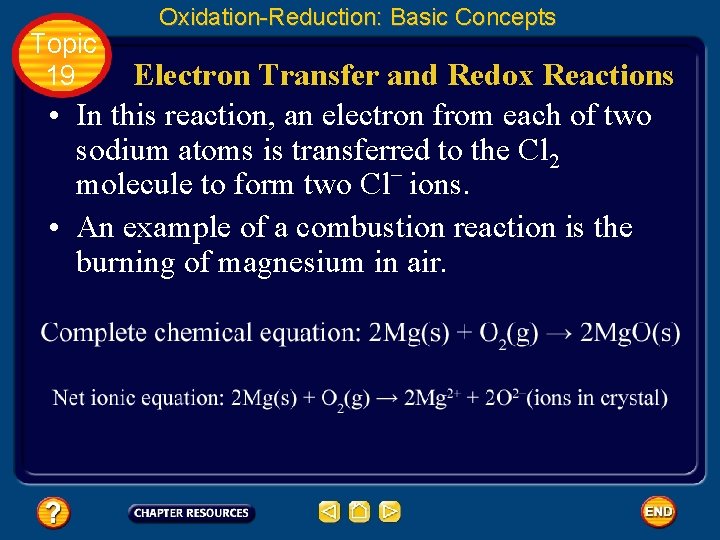
Topic 19 Oxidation-Reduction: Basic Concepts Electron Transfer and Redox Reactions • In this reaction, an electron from each of two sodium atoms is transferred to the Cl 2 molecule to form two Cl– ions. • An example of a combustion reaction is the burning of magnesium in air.
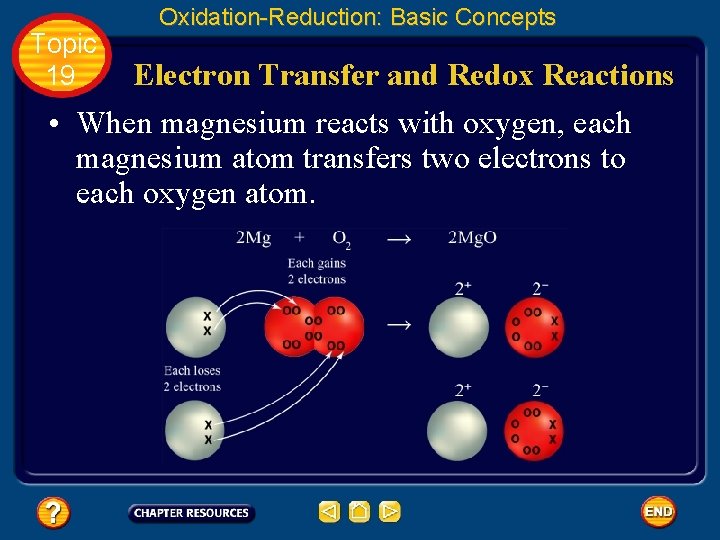
Topic 19 Oxidation-Reduction: Basic Concepts Electron Transfer and Redox Reactions • When magnesium reacts with oxygen, each magnesium atom transfers two electrons to each oxygen atom.
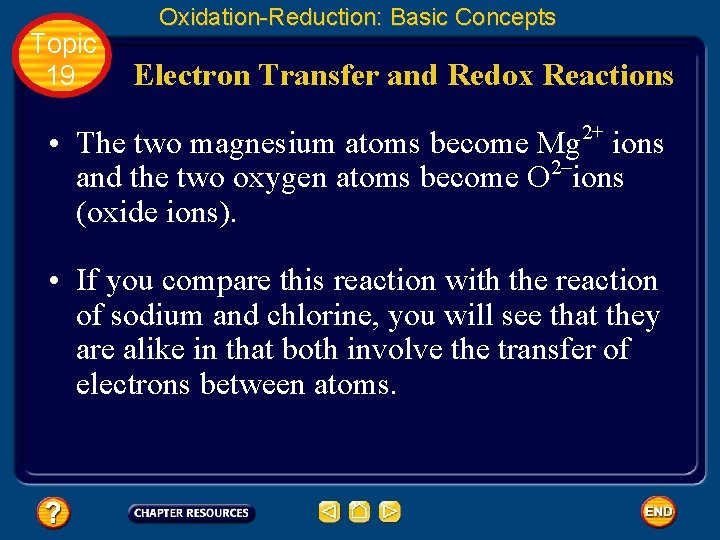
Topic 19 Oxidation-Reduction: Basic Concepts Electron Transfer and Redox Reactions 2+ • The two magnesium atoms become Mg ions and the two oxygen atoms become O 2–ions (oxide ions). • If you compare this reaction with the reaction of sodium and chlorine, you will see that they are alike in that both involve the transfer of electrons between atoms.
Topic 19 Oxidation-Reduction: Basic Concepts Electron Transfer and Redox Reactions • A reaction in which electrons are transferred from one atom to another is called an oxidation–reduction reaction. • For simplicity, chemists often refer to oxidation– reduction reactions as redox reactions. Click box to view movie clip.
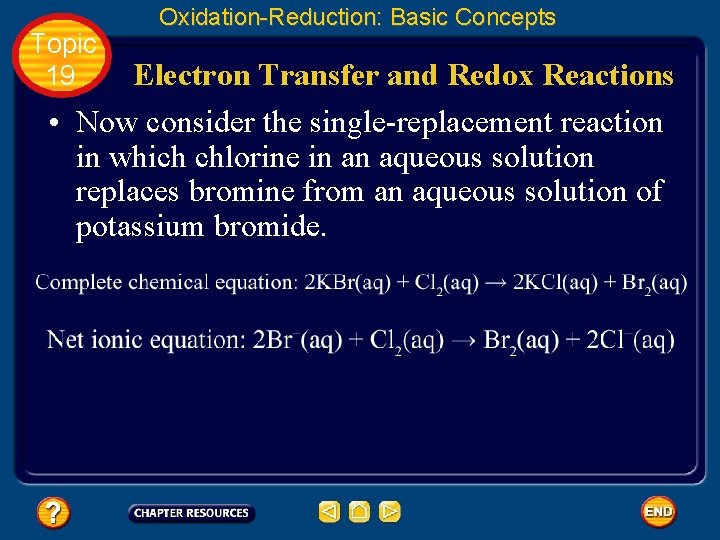
Topic 19 Oxidation-Reduction: Basic Concepts Electron Transfer and Redox Reactions • Now consider the single-replacement reaction in which chlorine in an aqueous solution replaces bromine from an aqueous solution of potassium bromide.
Topic 19 Oxidation-Reduction: Basic Concepts Electron Transfer and Redox Reactions • Note that chlorine “steals” electrons from bromide ions to become chloride ions. • When the bromide ions lose their extra electrons, the two bromine atoms form a covalent bond with each other to produce Br 2 molecules.
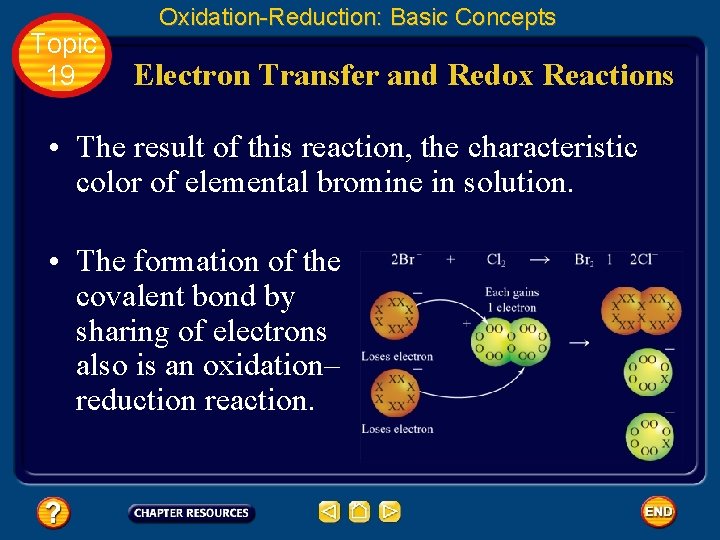
Topic 19 Oxidation-Reduction: Basic Concepts Electron Transfer and Redox Reactions • The result of this reaction, the characteristic color of elemental bromine in solution. • The formation of the covalent bond by sharing of electrons also is an oxidation– reduction reaction.
Topic 19 Oxidation-Reduction: Basic Concepts How do oxidation and reduction differ? • Originally, the word oxidation referred only to reactions in which a substance combined with oxygen, such as the burning of magnesium in air or the burning of natural gas (methane, CH 4) in air. • Today, oxidation is defined as the loss of electrons from atoms of a substance. • Look again at the net ionic equation for the reaction of sodium and chlorine. Sodium is oxidized because it loses an electron.
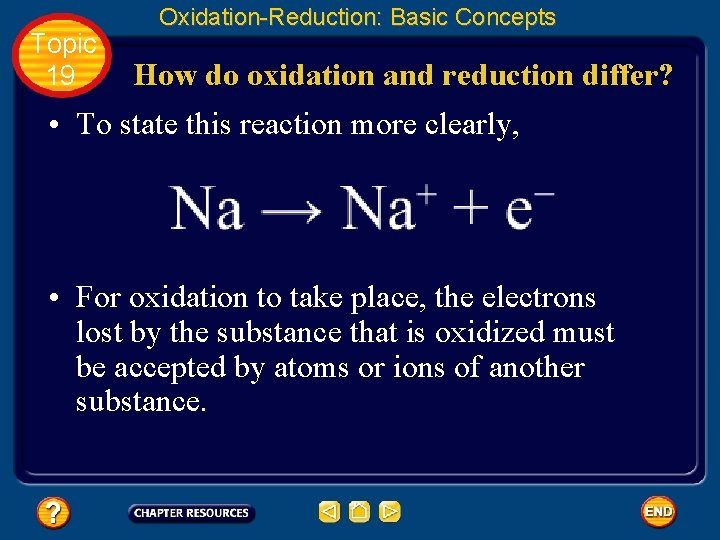
Topic 19 Oxidation-Reduction: Basic Concepts How do oxidation and reduction differ? • To state this reaction more clearly, • For oxidation to take place, the electrons lost by the substance that is oxidized must be accepted by atoms or ions of another substance.
Topic 19 Oxidation-Reduction: Basic Concepts How do oxidation and reduction differ? • In other words, there must be an accompanying process that involves the gain of electrons. • Reduction is defined as the gain of electrons by atoms of a substance.
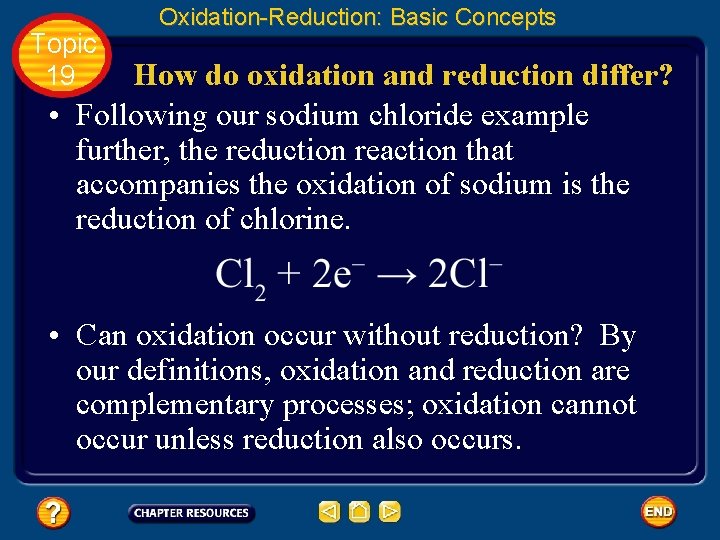
Topic 19 Oxidation-Reduction: Basic Concepts How do oxidation and reduction differ? • Following our sodium chloride example further, the reduction reaction that accompanies the oxidation of sodium is the reduction of chlorine. • Can oxidation occur without reduction? By our definitions, oxidation and reduction are complementary processes; oxidation cannot occur unless reduction also occurs.
Topic 19 Oxidation-Reduction: Basic Concepts How do oxidation and reduction differ? • It is important to recognize and distinguish between oxidation and reduction. • The following memory aid may help. • LEO the lion says GER or, for short, LEO GER • This phrase will help you remember that Loss of Electrons is Oxidation, and Gain of Electrons is Reduction.
Topic 19 Oxidation-Reduction: Basic Concepts Changes in oxidation number • The oxidation number of an atom in an ionic compound is the number of electrons lost or gained by the atom when it forms ions. • Oxidation numbers are tools that scientists use in written chemical equations to help them keep track of the movement of electrons in a redox reaction.
Topic 19 • • Oxidation-Reduction: Basic Concepts Changes in oxidation number Like some of the other tools you have learned about in chemistry, oxidation numbers have a specific notation. Oxidation numbers are written with the positive or negative sign before the number (+3, +2), whereas ionic charge is written with the sign after the number (3+, 2+). Oxidation number: +3 Ionic charge: 3+
Topic 19 Oxidation-Reduction: Basic Concepts Oxidizing and Reducing Agents • The substance that oxidizes another substance by accepting its electrons is called an oxidizing agent. • This term is another way of saying “the substance that is reduced. ”
Topic 19 Oxidation-Reduction: Basic Concepts Oxidizing and Reducing Agents • The substance that reduces another substance by losing electrons is called a reducing agent. • A reducing agent supplies electrons to the substance getting reduced (gaining electrons), and is itself oxidized because it loses electrons.
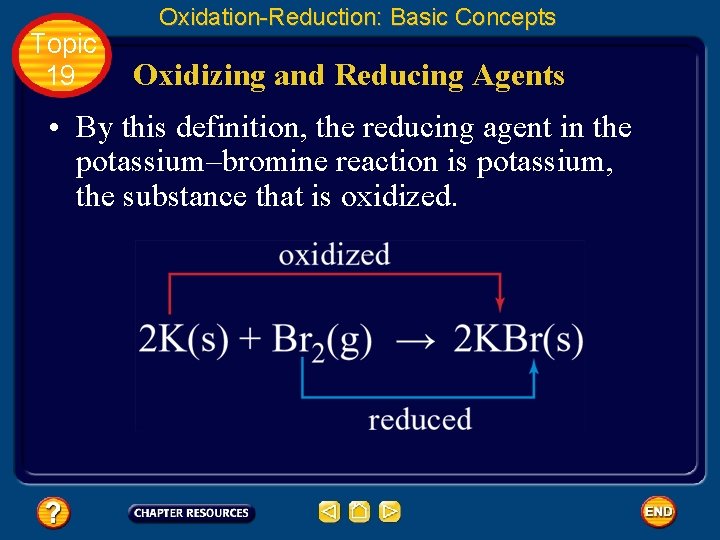
Topic 19 Oxidation-Reduction: Basic Concepts Oxidizing and Reducing Agents • By this definition, the reducing agent in the potassium–bromine reaction is potassium, the substance that is oxidized.
Topic 19 Oxidation-Reduction: Basic Concepts Oxidizing and Reducing Agents • A common application of redox chemistry is to remove tarnish from metal objects, such as a silver cup. Click box to view movie clip.
Topic 19 Oxidation-Reduction: Basic Concepts Oxidizing and Reducing Agents • Other oxidizing and reducing agents play significant roles in your daily life. • For example, when you add chlorine bleach to your laundry to whiten clothes, you are using an aqueous solution of sodium hypochlorite (Na. Cl. O), an oxidizing agent.
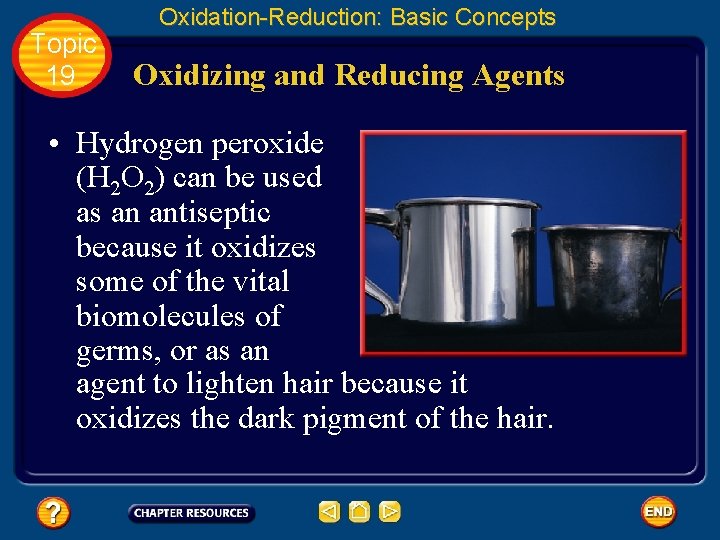
Topic 19 Oxidation-Reduction: Basic Concepts Oxidizing and Reducing Agents • Hydrogen peroxide (H 2 O 2) can be used as an antiseptic because it oxidizes some of the vital biomolecules of germs, or as an agent to lighten hair because it oxidizes the dark pigment of the hair.
Topic 19 Oxidation-Reduction: Basic Concepts Redox and Electronegativity • The chemistry of oxidation–reduction reactions is not limited to atoms of an element changing to ions or the reverse. Click box to view movie clip.
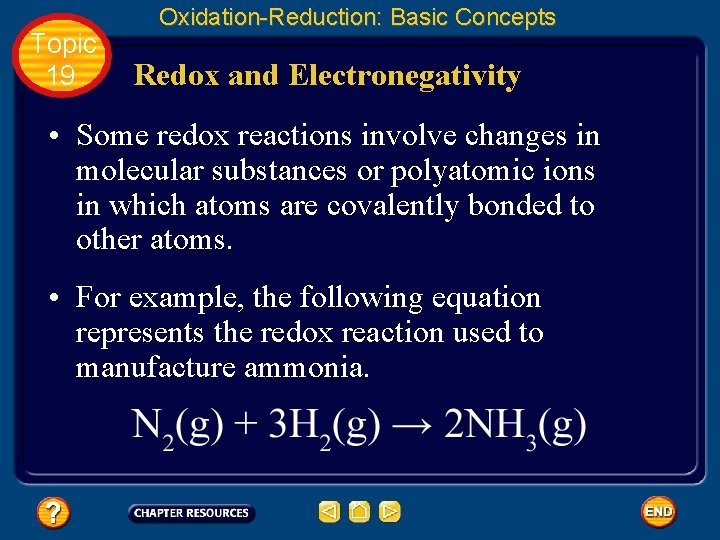
Topic 19 Oxidation-Reduction: Basic Concepts Redox and Electronegativity • Some redox reactions involve changes in molecular substances or polyatomic ions in which atoms are covalently bonded to other atoms. • For example, the following equation represents the redox reaction used to manufacture ammonia.
Topic 19 Oxidation-Reduction: Basic Concepts Redox and Electronegativity • This process involves neither ions nor any obvious transfer of electrons. The reactants and products are all molecular compounds. • Still, it is a redox reaction in which nitrogen is the oxidizing agent and hydrogen is the reducing agent.
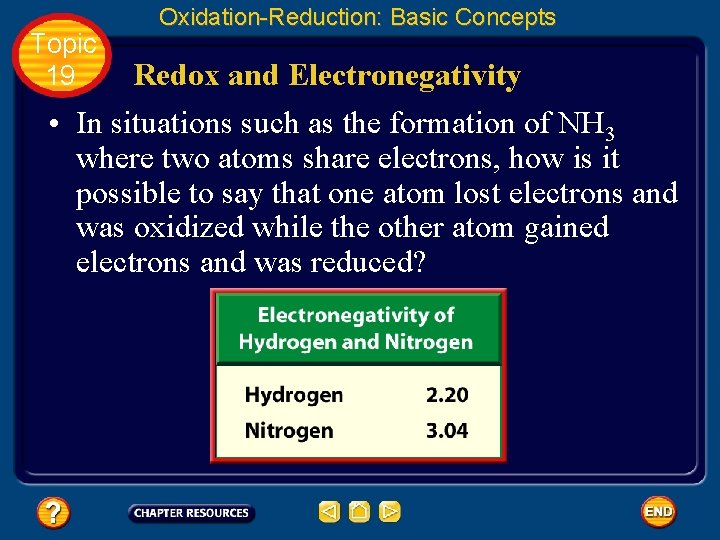
Topic 19 Oxidation-Reduction: Basic Concepts Redox and Electronegativity • In situations such as the formation of NH 3 where two atoms share electrons, how is it possible to say that one atom lost electrons and was oxidized while the other atom gained electrons and was reduced?
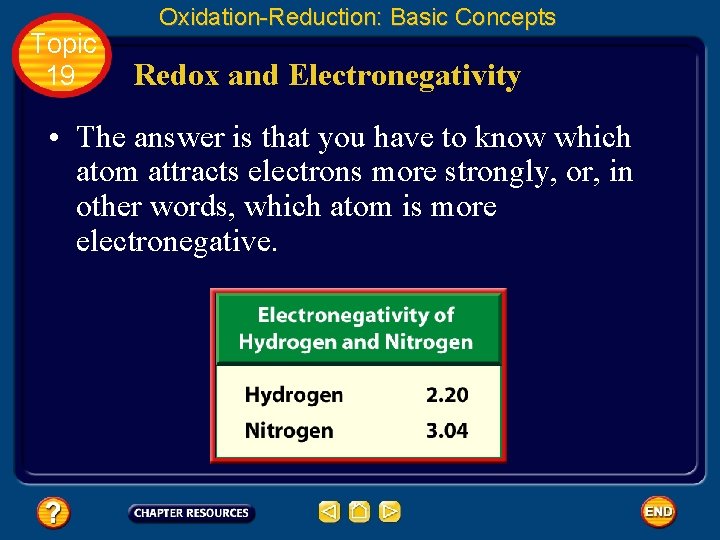
Topic 19 Oxidation-Reduction: Basic Concepts Redox and Electronegativity • The answer is that you have to know which atom attracts electrons more strongly, or, in other words, which atom is more electronegative.
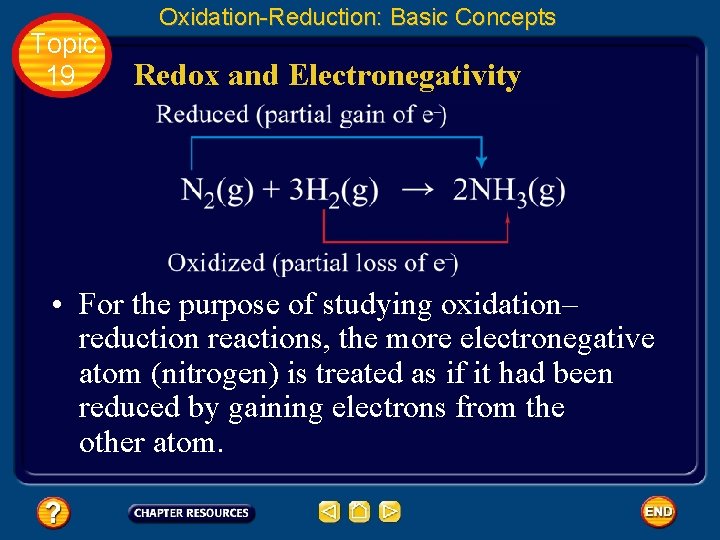
Topic 19 Oxidation-Reduction: Basic Concepts Redox and Electronegativity • For the purpose of studying oxidation– reduction reactions, the more electronegative atom (nitrogen) is treated as if it had been reduced by gaining electrons from the other atom.
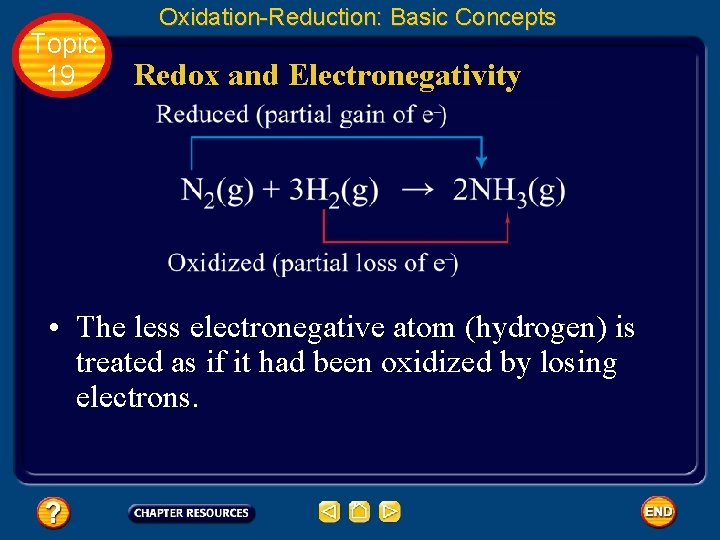
Topic 19 Oxidation-Reduction: Basic Concepts Redox and Electronegativity • The less electronegative atom (hydrogen) is treated as if it had been oxidized by losing electrons.
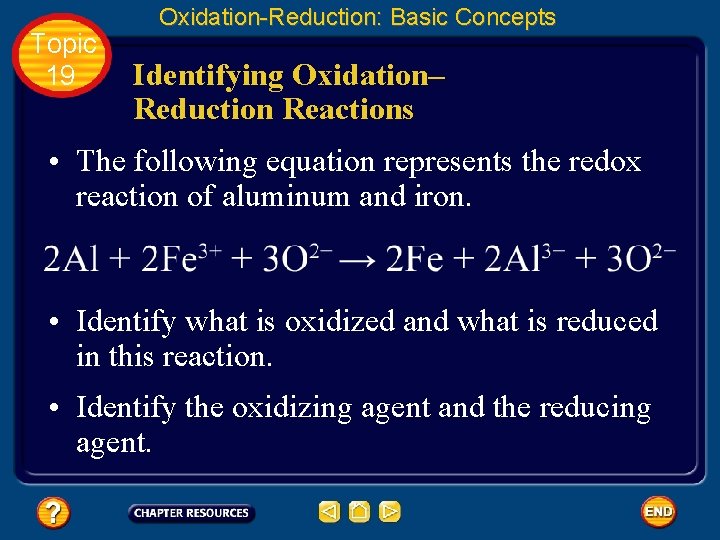
Topic 19 Oxidation-Reduction: Basic Concepts Identifying Oxidation– Reduction Reactions • The following equation represents the redox reaction of aluminum and iron. • Identify what is oxidized and what is reduced in this reaction. • Identify the oxidizing agent and the reducing agent.
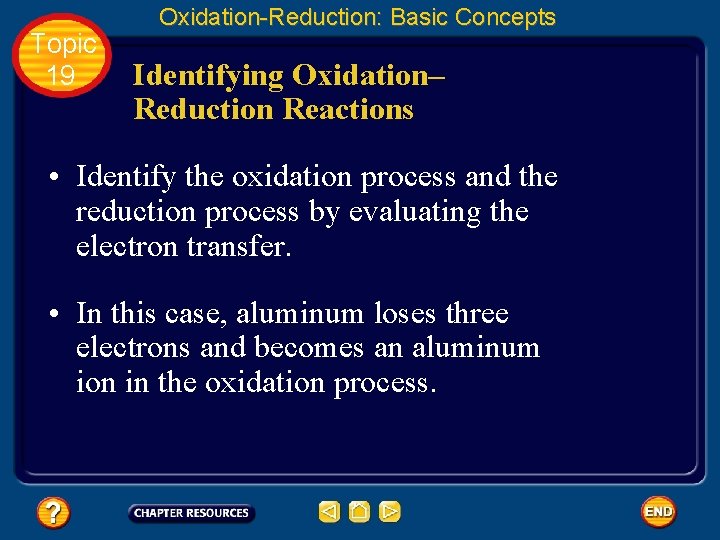
Topic 19 Oxidation-Reduction: Basic Concepts Identifying Oxidation– Reduction Reactions • Identify the oxidation process and the reduction process by evaluating the electron transfer. • In this case, aluminum loses three electrons and becomes an aluminum ion in the oxidation process.
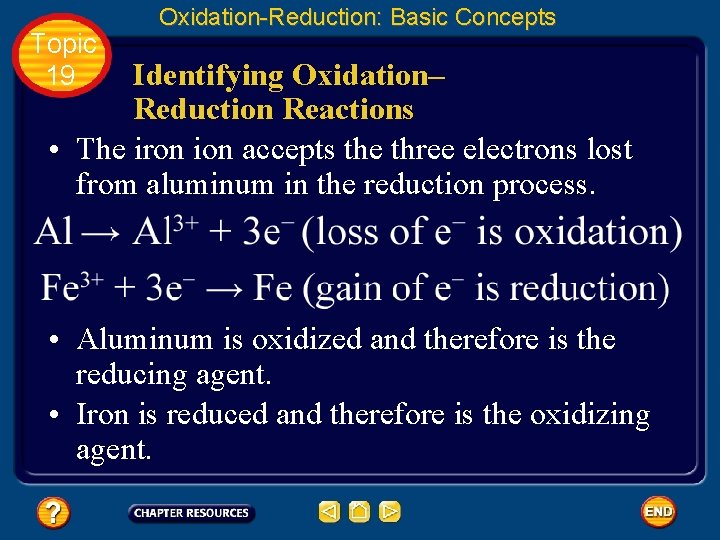
Topic 19 Oxidation-Reduction: Basic Concepts Identifying Oxidation– Reduction Reactions • The iron ion accepts the three electrons lost from aluminum in the reduction process. • Aluminum is oxidized and therefore is the reducing agent. • Iron is reduced and therefore is the oxidizing agent.
Topic 19 Basic Assessment Questions Question 1 For each of the following reactions, identify what is oxidized and what is reduced. Also identify the oxidizing agent and the reducing agent.
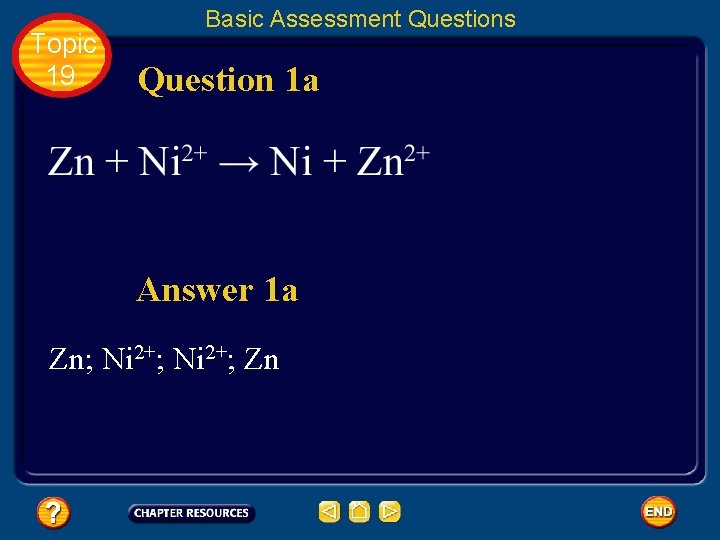
Topic 19 Basic Assessment Questions Question 1 a Answer 1 a Zn; Ni 2+; Zn
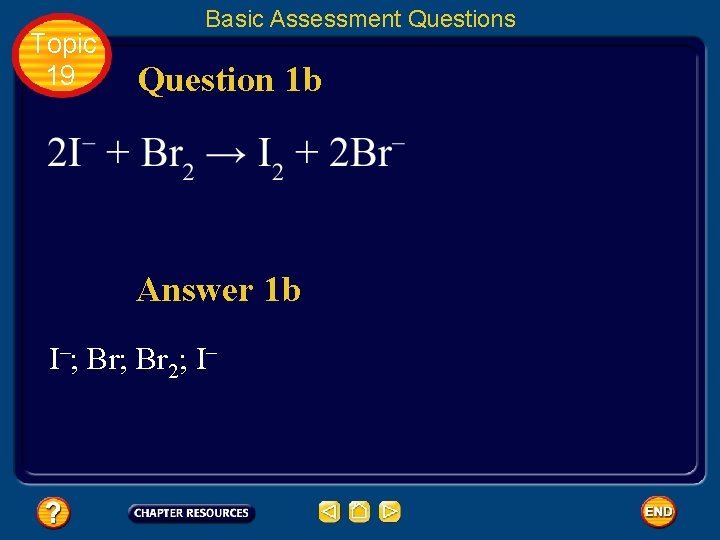
Topic 19 Basic Assessment Questions Question 1 b Answer 1 b I–; Br 2; I–
End of Topic Summary File
- Slides: 37